
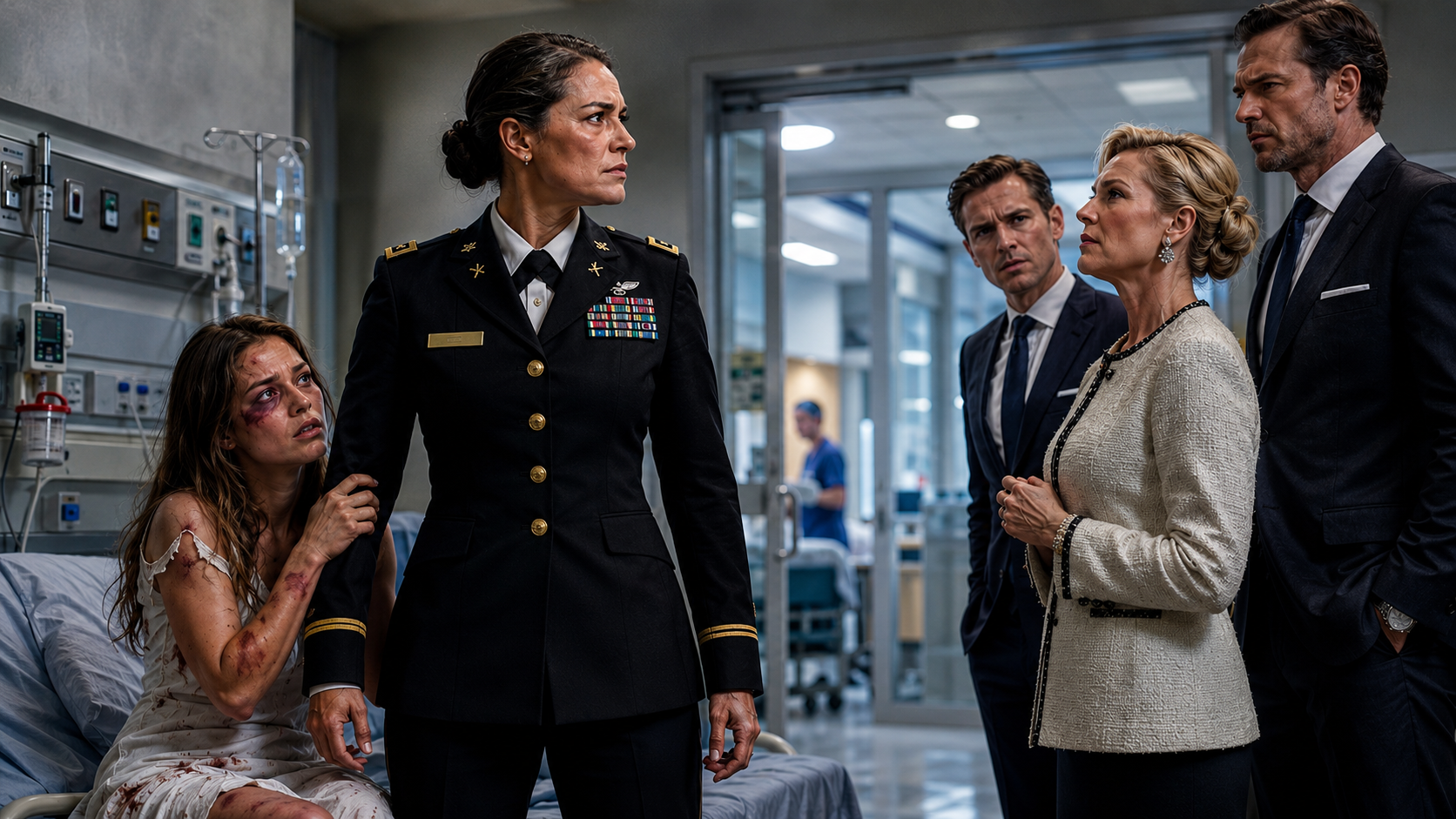
They Chose the Wrong Mother to Threaten
PART 1: THE CALL
The first thing my daughter said when I answered the phone was, “Mom, come get me.”
The second thing she said was so quiet I almost didn’t hear it.
“They hurt me.”
I was still wearing my uniform when I left Fort Liberty that evening.
My black dress jacket was perfectly pressed. The ribbons and medals on my chest caught the fading sunlight as I drove north through rush-hour traffic toward Charlotte, North Carolina.
I don’t remember changing lanes.
I don’t remember the radio.
I don’t remember breathing.
I remember Emily’s voice.
That was all.
“Mom, please.”
There are sounds a mother recognizes no matter how old her child becomes.
A hungry cry.
A frightened cry.
The strangled little silence that means a child is trying not to cry at all.
Emily was thirty-one years old.
Married.
Educated.
Smart.
Independent—or at least she had been before she married Ethan Prescott.
But when she called me that evening, she sounded six.
I had heard that voice once before.
She had been six years old and trapped beneath a fallen tree branch after a summer storm.
I had lifted the branch off her with my bare hands.
At the time, I had thought there was nothing in the world heavier than that branch.
I was wrong.
Mercy General Hospital rose ahead of me in glass and concrete.
I parked crooked.
I never parked crooked.
I walked through the emergency room doors like a storm.
A nurse stepped in front of me.
“Ma’am, you can’t go back there—”
“My daughter,” I said. “Where is Emily Hart?”
My voice wasn’t loud.
It didn’t need to be.
The nurse’s eyes dropped briefly to the gold nameplate over my pocket.
COLONEL VICTORIA HART.
Then she looked at my face.
Something there made her stop arguing.
“Observation room twelve,” she said. “End of the hall, left side.”
I was already moving.
The hospital smelled of antiseptic and stale coffee. Somewhere a monitor beeped steadily. A child cried behind a curtain. Rubber soles squeaked across polished floor.
Then I reached room twelve.
And the world narrowed.
Emily was curled beneath a thin hospital blanket.
One eye was swollen almost shut.
Her lower lip was split.
Dark bruises circled one wrist.
Finger-shaped marks covered both upper arms.
Her white dress—an expensive dress I remembered her wearing at a Prescott Foundation dinner only weeks earlier—was torn near one shoulder and stained along the side.
Her hair hung tangled around her face.
For one terrible second, I simply stood there.
My beautiful daughter.
The same little girl who used to call me every evening when I was deployed just to tell me what color the sunset was.
The same child who once mailed me a drawing of our house with three stick figures standing outside it beneath the words:
COME HOME SAFE, MOM.
The same girl who grew into a woman who insisted she didn’t need protecting.
Now she could barely lift her head.
“Mom.”
I crossed the room in three strides.
Emily reached for me.
I wrapped both arms around her.
Her entire body started shaking.
Not crying.
Shaking.
There is a difference.
Crying is release.
Shaking is what happens when terror has settled so deeply into the body that the body no longer knows the danger is over.
“I’m here,” I whispered.
Her fingers clutched my jacket.
“I’m here.”
For several seconds, I forgot everything else.
The uniform.
The hospital.
My rank.
The years I had spent commanding people under pressure.
I was only her mother.
Then I heard laughter from the doorway.
“She’s always been dramatic.”
My arms tightened around Emily.
I turned slowly.
Ethan Prescott stood in the doorway.
My son-in-law.
Tall. Handsome. Expensively dressed.
The kind of face magazines liked beside headlines about young executives and charitable foundations.
Beside him stood his mother, Margaret Prescott, and Ethan’s older brother, Brandon.
Designer suits.
Luxury watches.
Perfect grooming.
Polished smiles.
Money had wrapped itself around that family for so many generations it seemed to have entered their bloodstream.
Margaret wore diamond earrings and a cream-colored coat that probably cost more than some soldiers made in a month.
She smiled at me as if we had met at a luncheon.
“Colonel Hart.”
Emily stiffened in my arms.
I felt it.
That tiny reaction told me more than a speech could have.
I stood, positioning myself between my daughter and the doorway.
“What happened?”
Ethan sighed.
“Emily had an emotional episode.”
My eyes moved to him.
“An emotional episode.”
“She was upset.”
Margaret stepped in smoothly.
“She fell.”
Nobody touched her.”
Emily’s hand shot out and caught my sleeve.
“No.”
Her voice cracked.
“Mom, no.”
I looked down.
“They locked me in the guest house,” she whispered. “They took my phone. Ethan said if I left him they’d destroy me.”
Ethan rolled his eyes.
“She’s exaggerating.”
“Did you take her phone?”
His jaw tightened.
“She was behaving irrationally.”
“That wasn’t my question.”
Margaret’s smile cooled.
“Victoria.”
We were not friends.
She had never called me Victoria before.
“Our family has spent years dealing with Emily’s sensitivity.”
I stared at her.
“Her sensitivity?”
“She becomes emotional. She interprets things.”
Brandon gave a quiet laugh.
“Some women marry into families they aren’t prepared to handle.”
Emily flinched.
I saw it.
I saw Brandon see me see it.
His smile faded.
I looked at Ethan.
“Did you strike my daughter?”
“No.”
“Did Brandon?”
“No.”
“Did Margaret?”
“No.”
Margaret lifted her chin.
“No one struck anyone.”
I nodded once.
“Then explain the bruises.”
“She fell,” Ethan repeated.
“Onto what?”
Silence.
“The floor.”
“The floor has fingers?”
Brandon shifted.
Margaret’s eyes sharpened.
Ethan looked toward his mother.
That tiny glance mattered.
I filed it away.
For twenty-eight years, people had paid me to notice what happened in the second before someone answered a difficult question.
I noticed everything.
Margaret stepped closer.
“Let’s not make this unpleasant.”
I almost smiled.
My daughter was lying in a hospital bed with her face swollen, and Margaret Prescott wanted to discuss unpleasantness.
“Our family,” she continued, “has friends in the courts, the media, and state government.”
Emily’s grip on my sleeve tightened.
Margaret leaned closer.
“Your military rank doesn’t impress us.”
Brandon smirked.
“Take your daughter home and be grateful we’re not suing her for defamation.”
I looked at each of them.
One by one.
Silently.
Calmly.
Far too calmly.
They mistook my silence for fear.
That was their first mistake.
My second lieutenant once told me I was most frightening when I stopped raising my voice.
He had been joking.
Mostly.
I turned toward the nurse standing outside the room.
“I want my daughter’s injuries fully documented.”
Margaret blinked.
I continued.
“Photographs, physician notes, everything medically appropriate.”
Ethan stepped forward.
“Come on, this is ridiculous.”
I ignored him.
“And I want hospital security.”
Brandon’s smile disappeared.
“For what?”
“So these three leave my daughter’s room.”
Margaret stared at me.
“You have no idea who you’re dealing with.”
I faced her.
“No. You have no idea what I’m dealing with.”
I pointed toward the bed.
“My daughter is injured. She says her husband and his family confined her, took her phone, threatened her, and assaulted her.”
Margaret’s expression hardened.
“You should be very careful with words like that.”
“I am always careful with words.”
The nurse was already moving toward the desk.
Ethan’s face changed.
Just slightly.
For the first time, I saw something beneath the irritation.
Fear.
Not fear of me.
Fear of losing control.
He looked past me.
“Emily. Tell her to stop.”
My daughter shrank farther into the pillow.
I turned.
“Emily.”
She looked at me through one swollen eye.
“You decide,” I said.
Everyone in the room went still.
“If you want them here, they stay. If you want them gone, they leave. If you want to speak to police, we call the police. If you don’t, no one will force you tonight. But you decide.”
Her mouth trembled.
Ethan took another step.
“Baby—”
“No.”
Emily’s voice was barely above a whisper.
Then she swallowed.
“No. Get out.”
Ethan froze.
Margaret’s face turned pale.
“Emily.”
“Get out.”
It was stronger this time.
Brandon shook his head.
“You’re making a huge mistake.”
Emily began trembling again.
I stepped forward.
“So are you.”
Security arrived less than a minute later.
Two officers.
Margaret looked at them as if she had never imagined someone in a uniform might ask her to move.
“This is a family matter.”
One security officer glanced at Emily.
“Not in this room it isn’t.”
Ethan stared at me as they were escorted down the hall.
He stopped at the doorway.
“You’re going to regret turning this into something bigger than it is.”
I held his gaze.
“You already made it bigger than it should ever have been.”
The door closed.
The room fell silent.
Emily started crying.
Not delicately.
Not gracefully.
She covered her face with both hands and sobbed.
I sat beside her and held her until the worst of it passed.
Then a physician came in.
Then a nurse.
Then another staff member.
Questions began.
Where did the injuries come from?
When did this happen?
Who was present?
Had she lost consciousness?
Did she feel safe returning home?
Emily kept looking at me before she answered.
Every time, I said the same thing.
“Tell them what happened.”
Not what I wanted to hear.
Not what would make a case.
Not what would hurt the Prescotts.
The truth.
Only the truth.
Eventually, she whispered, “I told Ethan I was leaving him.”
The room seemed to become colder.
I looked at her.
She stared at the blanket.
“I packed a bag yesterday morning.”
“And?”
“He wouldn’t let me leave.”
Her voice broke.
“He called Margaret.”
I didn’t speak.
“Then Brandon came.”
She drew a shaking breath.
“They took my phone.”
My jaw tightened.
“They said we were going to have a family conversation.”
“What happened in that conversation?”
Emily closed her eyes.
For a long time, she said nothing.
Then she whispered:
“They showed me what kind of family I married into.”
And for the first time that night, I understood that the bruises on my daughter were only the part I could see.
PART 2: THE GUEST HOUSE
Emily didn’t tell me everything at once.
People imagine truth arriving like a confession in a movie.
One uninterrupted speech.
Beginning, middle, end.
Real fear doesn’t work that way.
It comes in fragments.
A sentence while a nurse cleans blood from your lip.
A memory while someone touches your wrist.
A detail at two in the morning that makes you sit upright because suddenly the room feels too small.
We stayed at Mercy General until after midnight.
I took off my jacket before sitting beside Emily for the medical examination.
Not because I was ashamed of the uniform.
Because this was not the Army’s fight.
It was my daughter’s.
And mine.
I folded the jacket carefully over the back of a chair.
Colonel Hart could wait.
Emily needed Mom.
When the doctor stepped out, I asked the question I had been afraid to ask.
“How long?”
Emily stared at me.
“How long has Ethan been hurting you?”
“He hasn’t.”
The answer came too fast.
I waited.
She looked away.
“Not like this.”
There it was.
Not like this.
Four words that opened a door I suddenly wished did not exist.
“What does that mean?”
She rubbed her fingers against the edge of the blanket.
“He would grab my arm sometimes.”
I looked at the bruises.
“He’d block the door during arguments. Take my keys. Tell me I was too upset to drive.”
My stomach turned.
“I thought he was controlling,” she continued. “I didn’t think…”
Her voice vanished.
“You didn’t think it would become this.”
She nodded.
I remembered things then.
Little things.
The way Ethan answered questions for her at dinner.
The way Emily stopped visiting without checking his schedule.
The way she once laughed when I asked why she had changed her phone number and said, “Ethan thinks too many people have access to me.”
The Christmas she had arrived two hours late wearing long sleeves despite the house being warm.
I had noticed.
I had asked.
She had smiled.
I had accepted the smile.
That knowledge sat inside me like broken glass.
“Why didn’t you tell me?”
Emily looked at me sharply.
Then shame filled her face.
“I knew you’d ask that.”
“I’m not blaming you.”
“I know.”
But she didn’t sound like she believed me.
I changed the question.
“What made you decide to leave?”
Her eyes filled again.
“He told me I was going to stop working.”
Emily worked in nonprofit development.
She loved her job.
She loved being useful in ways that had nothing to do with the Prescott name.
“He said it looked bad for his wife to work for someone else. Margaret agreed. They wanted me to join the family foundation.”
“And you said no.”
“At first.”
She gave a bitter little laugh.
“Then he started telling me my job was putting stress on the marriage. Every argument became about how I embarrassed him.”
She looked toward the closed door.
“Yesterday morning, he told me he’d already spoken to my director.”
I went still.
“What?”
“He said I wouldn’t need to go back.”
“Did he have authority to do that?”
“No.”
“Then what did he mean?”
“I don’t know. I didn’t wait to find out.”
She had packed.
One suitcase.
Her passport.
Her laptop.
A photograph of the two of us taken at my promotion ceremony.
She had made it as far as the front stairs.
Ethan had been waiting.
“He asked where I was going.”
“What did you say?”
“That I was done.”
For the first time, something close to anger entered her voice.
“I told him I was tired of asking permission to see my own friends. Tired of apologizing when he screamed at me. Tired of pretending his mother didn’t run our marriage.”
“What did he do?”
“He grabbed the suitcase.”
Her eyes went unfocused.
“He threw it across the foyer.”
I pictured the Prescott house.
Marble floors.
A staircase wide enough for a hotel.
Fresh flowers replaced every morning.
Everything gleaming.
Everything controlled.
“He told me to go upstairs and calm down.”
Emily’s voice dropped.
“I told him no.”
A tear slid down her cheek.
“He slapped me.”
My hands curled.
I forced them open.
“What happened next?”
“He looked shocked.”
That surprised me.
“Shocked?”
“Like he hadn’t meant to do it.”
She swallowed.
“Then I said I was calling the police.”
“And that’s when he took your phone.”
She nodded.
“Margaret came about twenty minutes later. Brandon came with her.”
According to Emily, nobody screamed at first.
That was what frightened her most.
Margaret sat in the formal living room and spoke as though negotiating a business agreement.
Marriage required maturity.
A Prescott wife had obligations.
Private disagreements did not leave the family home.
If Emily walked out accusing Ethan of abuse, the Prescotts would respond.
“They said people would believe them,” Emily whispered.
“Why?”
“Because they had known Ethan his whole life.”
A humorless smile touched her split lip.
“And because they had known me for three years.”
I understood.
They had already been building their version of her.
Too emotional.
Too sensitive.
Unstable.
Ungrateful.
Not quite suited to the family.
Margaret had used those words at the hospital because they had been practiced long before that night.
“What happened after the living room?”
“I tried to leave.”
Brandon blocked the front door.
When Emily tried another exit, Ethan caught her.
She fought him.
Brandon grabbed her arms.
Finger-shaped bruises.
“He said I was making everything worse.”
Emily stared down.
“Ethan kept telling me to stop fighting.”
I couldn’t speak.
“Margaret told them to put me somewhere private until I calmed down.”
The guest house stood beyond the Prescotts’ pool.
I had seen it before.
Two bedrooms.
A small kitchen.
French doors overlooking the garden.
Beautiful enough for an architectural magazine.
Emily had spent most of a day inside it wondering whether anyone would ever hear her.
“They locked the door?”
“From outside.”
“Were you injured before they put you there?”
She nodded.
“Some.”
Some.
I hated that word immediately.
“What happened inside?”
Her breathing changed.
I leaned forward.
“You don’t have to tell me all of it at once.”
“I tried the windows.”
I waited.
“Ethan came back.”
My pulse hammered.
“He said he wanted to talk.”
She wiped her cheek.
“I told him I was leaving no matter what he did.”
Ethan had tried pleading first.
Then apologizing.
Then blaming.
He was under pressure.
His family expected too much.
Emily embarrassed him in front of his mother.
Why couldn’t she just be reasonable?
When she still refused, he became angry again.
“He hit me.”
Emily’s voice had gone flat.
“More than once?”
She nodded.
“Brandon came in when I started screaming.”
I looked at her arms.
“He held me.”
Another nod.
“And Margaret?”
Emily’s face changed.
Not fear this time.
Something deeper.
Betrayal.
“She told me I had caused it.”
I felt cold.
“She said Ethan loved me and I was pushing him.”
Emily touched her split lip.
“Then I called her a monster.”
I already knew the rest before she said it.
“She slapped me.”
I closed my eyes for one second.
Only one.
When I opened them, I was steady again.
“How did you get out?”
“They thought I’d stopped fighting.”
Late that afternoon, they had allowed her back into the main house to wash her face.
Margaret wanted her presentable.
Ethan had an evening event he was expected to attend, and the family had decided Emily would stay home and “rest.”
A housekeeper had entered the laundry room.
Emily asked for a phone.
The woman hesitated.
Emily begged.
The housekeeper finally handed over her own cell.
Emily called me first.
Then the hospital.
She didn’t wait for the Prescotts to discover what she’d done.
She went out through a service entrance and walked to the road.
A passing driver stopped when he saw her.
That was how my daughter had escaped a mansion worth millions.
On foot.
In a torn white dress.
I had spent my career studying crises.
Supply failures.
Personnel problems.
Pressure points.
The chain of events that turns a manageable situation into disaster.
This one was painfully simple.
Ethan believed love meant possession.
Margaret believed the family name mattered more than the truth.
Brandon believed loyalty to his brother excused whatever he did.
And Emily had finally said no.
That single word broke their entire system.
They had answered by trying to break her.
A hospital administrator returned.
“Ms. Hart?”
Emily looked up.
“There are police officers here if you’d like to speak with them.”
Fear crossed her face again.
I reached for her hand.
She whispered, “What if Margaret was telling the truth?”
“About what?”
“The judges. The politicians. The press.”
I didn’t lie to her.
“Maybe she does know powerful people.”
Emily searched my face.
“Then what do we do?”
“We make them deal with facts.”
“What if that isn’t enough?”
I looked at the bruises on my daughter’s arms.
“Then we keep telling the truth until it is.”
She was silent.
Then she nodded.
“Okay.”
The officers came in.
Emily gave her statement.
Slowly.
Painfully.
She never looked away when she named Ethan.
Or Brandon.
Or Margaret.
Near the end, one officer asked, “Do you have somewhere safe to stay tonight?”
“Yes,” I said.
Emily squeezed my hand.
“My mother’s.”
I drove her home at two in the morning.
Not to my quarters near Fort Liberty.
To the small house I had bought years earlier outside Southern Pines because I wanted someplace that belonged to me and not to the Army.
Emily slept in her old bedroom.
I sat in the kitchen until dawn.
At 5:17 a.m., my phone buzzed.
A message from an unknown number.
I opened it.
It contained one sentence.
You still have time to keep this private.
No signature.
It didn’t need one.
I stared at the message.
Then another appeared.
Think carefully about your daughter’s future before you destroy it.
I read both messages twice.
Then I took a screenshot and set the phone facedown.
The Prescotts still believed they were negotiating from strength.
They had money.
Influence.
Reputation.
Connections.
I had something much simpler.
My daughter had finally stopped being afraid to tell the truth.
And by sunrise, I had decided I would do everything in my power to make sure she never had to be silent again.
PART 3: THE PRESCOTT VERSION OF THE TRUTH
By nine the next morning, the Prescotts had already started rewriting history.
I learned that while standing at my kitchen counter making coffee.
Emily was asleep upstairs.
I had slept perhaps forty minutes.
My phone rang.
It was a friend who worked in public affairs at Fort Liberty.
“Victoria,” she said carefully, “have you seen the news?”
“No.”
“Look before you come in.”
The words told me enough.
I opened my laptop.
The first headline made my jaw tighten.
PROMINENT PRESCOTT FAMILY RESPONDS TO “PRIVATE DOMESTIC DISPUTE.”
I clicked.
The statement was polished.
Compassionate.
Almost beautiful.
The Prescott family was “deeply concerned” about Emily’s well-being.
They asked the public to respect the privacy of “a young woman experiencing significant emotional distress.”
They denied any violence.
They said Ethan loved his wife and hoped she would “receive the support she needed.”
Then came the sentence meant for me.
The family is also troubled by attempts to use professional status and public position to exert pressure during a painful private matter.
No name.
No rank.
They didn’t need one.
I read the statement again.
I could almost hear Margaret’s voice.
Your military rank doesn’t impress us.
They weren’t just defending Ethan.
They were laying groundwork.
Emily was unstable.
I was abusing my position.
They were the concerned family trying to protect everyone.
A familiar anger rose inside me.
Hot.
Immediate.
Useful only if controlled.
I closed the laptop.
That was something years in command had taught me.
Anger is energy.
Nothing more.
Give it direction and it can move mountains.
Let it choose the direction and it will drive you off a cliff.
Emily appeared in the doorway in borrowed sweatpants.
Her face looked worse in daylight.
“What’s wrong?”
I should have lied.
I didn’t.
“The Prescotts released a statement.”
Her shoulders sagged.
“What does it say?”
I told her.
Not every word.
Enough.
She closed her eyes.
“I knew they would.”
“You knew?”
“They always do this.”
“What do you mean?”
“Not this exactly.”
She sat at the kitchen table.
“Anytime someone leaves the company or criticizes the foundation, Margaret says the same things. Concern. Disappointment. Misunderstanding.”
She looked at me.
“She never attacks first. She makes the other person look unstable.”
That was useful.
Not as proof of anything.
As understanding.
Margaret didn’t rage.
She framed.
She had tried to frame the hospital room.
Now she was framing the public story.
“Mom, what if this ruins your career?”
“It won’t.”
“You don’t know that.”
“No, but I know what I did. I went to a hospital because my daughter called me. I asked for security. I supported your decision to speak to police.”
“You were in uniform.”
“I had just left duty.”
Emily’s eyes filled.
“They’re doing this because of me.”
I sat across from her.
“No.”
She looked away.
“Emily.”
“No.”
“Look at me.”
She did.
“This is happening because they hurt you and expected you to accept it.”
Her mouth trembled.
“You calling me did not create their behavior. You telling the truth did not create their behavior. The only people responsible for what they did are the people who did it.”
She stared at me for several seconds.
Then she nodded.
Slowly.
“I don’t know how to do this.”
“You already did the hardest part.”
“What?”
“You left.”
That afternoon, I formally notified my command that I was dealing with a serious family matter and requested leave.
I also made one decision that Margaret Prescott had not anticipated.
I refused to give her the fight she wanted.
I did not go on television.
I did not issue statements in uniform.
I did not threaten anyone.
I did not call every influential person I had met during my career.
I did not use rank as a weapon.
I stepped back from official duties and became exactly what I had been when Emily called.
Her mother.
That seemed to frustrate the Prescotts more than anything.
By the next day, the story had spread.
Photos of Ethan and Emily appeared online.
Wedding pictures.
Charity events.
Smiling photographs beneath chandeliers.
Commentators asked how a “perfect marriage” had collapsed.
Anonymous people claimed Emily had always been difficult.
Others claimed the Prescott family was protecting an abuser.
Everyone had an opinion.
Almost nobody knew what happened inside the guest house.
Emily stopped looking at her phone.
Then, on the third morning, she asked for it.
“Are you sure?”
“No.”
She took it anyway.
The fear on her face disappeared little by little.
Then she frowned.
“What?”
“My friends.”
“What about them?”
“They’re texting me.”
I waited.
Her voice cracked.
“They believe me.”
That nearly broke her more than the insults.
One friend wrote that she had noticed Ethan monitoring Emily’s calls.
Another apologized for not pushing harder when Emily stopped showing up to dinners.
A former coworker said simply:
You don’t owe anyone silence.
Emily pressed a fist against her mouth and cried.
Healing does not always begin with strength.
Sometimes it begins when someone believes you.
The Prescotts kept applying pressure.
The messages became more formal.
We should meet.
We should resolve this privately.
Emily should consider the long-term consequences.
A divorce did not need to become destructive.
There were reputations on both sides.
Then Ethan called.
Emily stared at the screen.
“You don’t have to answer.”
“I want to.”
“Then answer.”
She put the phone on speaker.
I stayed silent.
“Emily?”
His voice was soft.
Almost tender.
The voice of a husband checking on his wife.
“I’m here.”
“Thank God.”
He exhaled.
“I’ve been worried sick.”
I watched my daughter’s face.
Her expression didn’t change.
“You hit me.”
Silence.
“Emily—”
“You hit me.”
“You were out of control.”
I felt every muscle in my body tighten.
Emily looked at me.
I didn’t react.
This was hers.
“I was leaving,” she said.
“You were hysterical.”
“I packed a suitcase.”
“You were trying to destroy our marriage.”
“I told you I wanted a divorce.”
His voice sharpened.
“Because your mother puts ideas in your head.”
That almost made me laugh.
Until three nights ago, Emily had hidden nearly everything from me.
“You took my phone,” she said.
“For your own good.”
“You locked me in the guest house.”
A pause.
“We needed you to calm down.”
“We?”
Another pause.
Then Ethan’s breathing changed.
“Why are you doing this?”
Emily’s hand trembled.
But her voice didn’t.
“I’m asking what happened.”
“I shouldn’t have hit you.”
There it was.
No shouting.
No dramatic confession.
Just six quiet words.
Emily’s face went white.
I reached toward my own phone, then stopped.
This was not a movie.
We had not arranged the call as a trap.
What mattered most in that moment wasn’t how useful the sentence might become.
What mattered was that Emily heard him say it.
He had spent days telling her she had imagined things.
Margaret had told a hospital she had fallen.
A public statement had described emotional distress.
Now Ethan himself had said:
I shouldn’t have hit you.
Emily’s eyes filled.
“No,” she whispered. “You shouldn’t have.”
“I was angry.”
“Brandon held me.”
“He was trying to stop you from hurting yourself.”
“And your mother slapped me.”
“You insulted her.”
Emily stared at the phone.
Something changed in her face.
It was subtle.
But I recognized it.
Fear had finally collided with clarity.
Ethan wasn’t denying the important parts anymore.
He was just explaining why she deserved them.
“I have to go,” she said.
“Emily, don’t.”
She ended the call.
For a few seconds, neither of us moved.
Then she whispered, “He really believes it.”
“Yes.”
“He thinks there was a reason.”
“Yes.”
She wiped her face.
“There is no reason.”
“No.”
Her eyes met mine.
And there she was.
My daughter.
Not the frightened woman in the hospital bed.
Not completely.
But enough.
“There is no reason,” she repeated.
That afternoon, the Prescotts announced a charity gala would proceed as scheduled that weekend.
Margaret would be speaking.
So would Ethan.
The family was determined, one commentator said, to “show unity.”
I didn’t care.
Until a reporter called me.
“How did you get this number?”
“Colonel Hart, I’m calling for comment on Mrs. Prescott’s statement.”
“What statement?”
A pause.
“You haven’t heard?”
“No.”
The reporter read it.
Margaret planned to address “recent attacks against her family” at the gala.
Then came the part that made my blood go cold.
She had invited me to attend.
Publicly.
“Mrs. Prescott says she hopes you will come,” the reporter continued, “so both families can demonstrate that personal conflict should not be used to damage institutions or reputations.”
I understood immediately.
It was not an invitation.
It was a stage.
Margaret wanted me either absent and cowardly or present and humiliated.
Emily stood across the room listening.
When I ended the call, she said, “Don’t go.”
I looked at her.
“She’s baiting you.”
“Yes.”
“Then don’t give her what she wants.”
I thought about it.
Then I asked, “What do you want?”
Emily hesitated.
“I want them to stop making me sound crazy.”
I nodded.
“What else?”
“I want them to stop saying nobody touched me.”
Something in me settled.
Not anger.
Decision.
“Then maybe I should go.”
“Mom.”
“Not to fight with her.”
Emily stared at me.
“Then why?”
I looked toward the dark window.
“Because people like Margaret spend their lives believing silence belongs to whoever can afford the best microphone.”
I turned back to my daughter.
“Sometimes the only way to take that power away is to stand in the room and refuse to be ashamed.”
PART 4: THE WRONG MOTHER
I did not wear my uniform to the Prescott gala.
That disappointed Margaret.
I could tell.
The event was held in a downtown Charlotte hotel ballroom filled with donors, executives, local celebrities, politicians, and reporters.
The Prescotts had built their reputation on charity.
Scholarships.
Hospital wings.
Youth programs.
Photographs of Margaret cutting ribbons.
Photographs of Ethan handing oversized checks to smiling children.
Money can do real good.
That is one reason powerful families become difficult to confront.
People don’t want to believe that someone who funds a shelter can create fear inside their own home.
I wore a plain black dress.
No medals.
No nameplate.
Nothing anyone could accuse me of using for intimidation.
Emily stayed home.
That had been her choice.
I had asked three times whether she was certain.
She was.
“I don’t need to watch them,” she said. “I just need to know somebody won’t let them erase me.”
So I went.
Alone.
Margaret saw me almost immediately.
Her smile spread.
“Victoria.”
“Margaret.”
Her gaze moved across my dress.
“No uniform?”
“No.”
“I thought perhaps you’d prefer the symbolism.”
“There isn’t any symbolism.”
“Of course.”
Ethan stood nearby.
His face tightened when he saw me.
Brandon didn’t smile at all.
Interesting.
At the hospital, he had been the loudest.
Now, surrounded by cameras, he kept his mouth shut.
Margaret touched my arm.
I looked down at her hand.
She removed it.
“I appreciate your coming.”
“You invited me.”
“I hoped we could show some maturity.”
“My daughter is home with bruises.”
Her smile remained perfectly still.
“And yet you came to a charity gala.”
“You asked me to.”
For half a second, her eyes hardened.
Then she laughed lightly.
“You military people are very literal.”
“No. We just tend to remember what was said.”
That landed.
She walked away.
The ballroom filled.
Crystal glasses.
Soft music.
Conversations beneath giant chandeliers.
I stood near the back.
People looked at me.
Some knew who I was.
Some pretended not to.
Several whispered.
I let them.
I had been stared at in much worse places.
After dinner, Margaret took the stage.
She began with the foundation.
Children.
Education.
Community.
Responsibility.
She was good.
Better than good.
She knew exactly when to pause.
Exactly when to lower her voice.
Exactly how long to let applause breathe.
Then her tone changed.
“Families,” she said, “are also communities.”
The room quieted.
“And like all communities, they sometimes experience pain.”
I felt the trap closing.
Margaret looked toward me.
Cameras followed her gaze.
“Our family has recently faced a private crisis that has been transformed into a public spectacle.”
Murmurs.
“We have remained silent because we believe compassion should come before retaliation.”
I almost admired the sentence.
Almost.
“We love Emily deeply. Ethan loves his wife. We are concerned about her.”
Ethan lowered his head at exactly the right moment.
“And we are saddened,” Margaret continued, “that certain individuals have chosen confrontation over healing.”
Certain individuals.
Another glance toward me.
More cameras.
“My hope tonight is that we can demonstrate something our country desperately needs.”
Her voice warmed.
“Restraint.”
I knew then what she expected.
Anger.
A scene.
The decorated Army colonel exploding in front of donors.
Proof that Emily came from instability.
Like mother, like daughter.
Margaret lifted one hand.
“Victoria, would you join me?”
A ripple moved through the ballroom.
There it was.
The humiliation.
Public.
Elegant.
Calculated.
She expected me to refuse.
Or rage.
I stood.
Then I walked to the stage.
Every camera in the room turned toward me.
Margaret’s smile widened.
“Thank you.”
She offered me a microphone.
I took it.
“What I hope,” she said, facing the room, “is that we can agree personal misunderstandings should not destroy families.”
I looked at her.
“Is that what happened?”
The smile tightened.
“This isn’t the place to debate details.”
“You invited me onto the stage.”
A few people shifted in their chairs.
Margaret’s eyes flashed.
“I invited you because I believe both families deserve dignity.”
“So does Emily.”
“Of course.”
“Then say her injuries are real.”
Silence.
Ethan looked up.
Margaret kept smiling.
“Victoria, this is exactly the kind of escalation—”
“I’m not escalating.”
My voice remained calm.
“I’m asking you to acknowledge what everyone in this room already knows from the hospital report.”
“You are discussing private medical information.”
“No details.”
I turned toward the audience.
“My daughter was injured.”
Then back to Margaret.
“You said she fell.”
Margaret’s face changed.
Only slightly.
“She did.”
“Your son told her on the phone that he should not have hit her.”
Ethan stood abruptly.
“That’s not what I said.”
I looked at him.
“It is.”
“You twisted a private conversation.”
“I didn’t say anything during that conversation.”
His face flushed.
Margaret stepped closer.
“This is beneath you.”
There it was.
The insult she had been saving.
She lowered her voice, but the microphones caught it.
“For someone in your position, I expected more dignity.”
I studied her.
Then I understood something.
Margaret wasn’t trying to convince me.
She was trying to make me defend myself.
My rank.
My reputation.
My parenting.
My place in that room.
That was how she fought.
She made you argue for the right to stand upright.
I stopped playing.
“This isn’t about my position.”
The room went silent.
I removed the microphone slightly from my mouth, then raised it again.
“I did not come here as Colonel Hart.”
I looked at the cameras.
“I came here as Emily’s mother.”
A flash went off.
“My daughter told her husband she wanted to leave. She says her phone was taken. She says she was prevented from leaving. She says Ethan struck her, Brandon restrained her, and Margaret struck her.”
Brandon stood.
“That’s a lie.”
I turned toward him.
“At the hospital, you said nobody touched her.”
“I didn’t say—”
“You said women sometimes marry into families they aren’t prepared to handle.”
His mouth closed.
Several reporters began writing.
I continued.
“The Prescotts are entitled to deny every allegation. They are entitled to lawyers. They are entitled to defend themselves through every lawful process available to them.”
Margaret seemed surprised.
That wasn’t the speech she expected.
“But what they are not entitled to do,” I said, “is make my daughter ashamed for surviving them.”
The room changed.
You can feel it when a crowd stops watching a spectacle and starts listening.
I felt it then.
Margaret felt it too.
Her smile was gone.
I looked directly at her.
“You told me your family had friends in the courts, the media, and state government.”
A murmur moved through the ballroom.
Margaret went pale.
“I said no such thing.”
“Yes, you did.”
“You have no proof.”
“Maybe not.”
That surprised her.
I wasn’t going to pretend.
I wasn’t going to bluff.
“But I remember it.”
I stepped closer.
“And so does my daughter.”
Margaret stared at me.
I lowered my voice.
“The difference between you and me is that I don’t need anyone to be afraid of my name.”
For the first time since I met her, Margaret Prescott had nothing to say.
I handed the microphone back.
Then Ethan moved.
“Wait.”
I turned.
His eyes were red.
Angry.
Humiliated.
“You’ve spent your whole life ordering people around.”
I said nothing.
“You think because you’ve got medals people have to believe you?”
“No.”
“You’ve hated me since Emily married me.”
“No.”
“You think she’s perfect?”
“No.”
That stopped him.
I looked at him.
“Emily isn’t perfect.”
He stared.
“Neither am I.”
The room was absolutely silent.
“But none of that gives you permission to hit her.”
His face twisted.
“She was leaving me.”
And there it was.
Not a confession to everything.
Something more revealing.
An explanation that exposed exactly how he thought.
I heard several people inhale.
Ethan realized it too late.
Margaret turned sharply.
“Ethan.”
But he was looking only at me.
“She was walking out after everything I gave her.”
I felt an old, familiar sadness settle over me.
Not sympathy.
Sadness.
Because suddenly Ethan seemed smaller than he had at the hospital.
Not powerful.
Not complicated.
Just a man who believed giving someone beautiful things entitled him to own their choices.
“She didn’t belong to you,” I said.
His jaw clenched.
“She was my wife.”
“Yes.”
I stepped down from the stage.
“Not your property.”
The first reporter shouted a question before I reached the floor.
Then another.
Then ten more.
I answered none of them.
I had not come to launch a media campaign.
I had come because Margaret wanted to humiliate me.
Instead, she had given Ethan a microphone.
That was her mistake.
Outside the ballroom, my phone rang.
Emily.
I answered immediately.
“Are you okay?”
“I’m fine.”
Silence.
Then:
“I watched it.”
My heart sank.
“I thought you weren’t going to.”
“I changed my mind.”
“Emily—”
“Mom.”
She was crying.
But there was something different in it.
Something lighter.
“He said it.”
“Yes.”
“He said I was leaving.”
“Yes.”
“He made it sound like that explained everything.”
“I know.”
A long breath.
Then my daughter said something I had been waiting days to hear.
“I want to finish this.”
I leaned against the hallway wall.
“What does that mean?”
“It means I don’t want them to scare me back into silence.”
Her voice steadied.
“I want to cooperate with the investigation. All of it.”
I closed my eyes.
“Are you sure?”
“Yes.”
Then she added:
“And I want a divorce.”
I smiled for the first time in days.
Not because my daughter’s marriage was ending.
Because my daughter had said the words without whispering.
PART 5: THE DOOR OPENS
Power did not disappear overnight.
That would have been a prettier story.
It would also have been a lie.
The Prescotts still had lawyers.
Friends.
Money.
They still knew how to shape headlines.
They still issued statements.
Margaret called the gala exchange “an emotionally charged ambush.”
Ethan claimed his words had been taken out of context.
Brandon stopped speaking publicly altogether.
But something had changed.
They could no longer maintain the clean version of the story.
Nobody touched her.
She fell.
She was unstable.
It had been a private misunderstanding.
Their own words had begun colliding with one another.
Most importantly, Emily no longer carried their version inside her.
That mattered more than any headline.
The investigation continued.
Emily answered questions.
Again.
And again.
She hated it.
There were days she came home exhausted and furious because someone had asked why she didn’t leave earlier.
There were nights she woke convinced she heard Ethan outside.
There were mornings when she said she wished she had never called me because disappearing would have been easier than being discussed by strangers.
I never told her to be strong.
She was tired of being strong.
Instead I made coffee.
I sat beside her.
I drove when she didn’t want to.
I waited outside rooms when she asked me to wait.
I left when she asked for privacy.
Those things were harder for me than they sound.
I had built a career around solving problems.
Emily was not a problem to solve.
She was a person rebuilding a sense of choice.
So I practiced something I had never been particularly good at.
Following her lead.
Weeks passed.
Then months.
The criminal process moved with painful slowness.
But it moved.
Ethan, Brandon, and Margaret were no longer treated as a family protecting its privacy.
They were people answering serious allegations.
The medical documentation mattered.
Emily’s early statement mattered.
Their conflicting explanations mattered.
Ethan’s own words mattered.
No single moment destroyed the Prescott wall.
That wasn’t how it happened.
The wall cracked piece by piece.
One contradiction.
One documented injury.
One statement.
One question they could not answer cleanly.
Then another.
Margaret had spent her life believing reputation was armor.
She learned something my soldiers had always known.
Armor fails at the seams.
Eventually, charges were filed related to what had happened to Emily.
I will not pretend that moment felt victorious.
I was sitting at the kitchen table when Emily received the call.
She listened quietly.
Said thank you.
Hung up.
Then sat there.
I waited for her to smile.
She didn’t.
“You okay?”
“No.”
I moved closer.
“Do you want to talk?”
“I don’t know.”
So we sat in silence.
After a while she said, “I thought I’d feel better.”
“You might later.”
“What if I don’t?”
“Then you don’t.”
She looked at me.
“That’s it?”
“That’s it.”
A tiny smile appeared.
“You’re getting better at this.”
“At what?”
“Not commanding me.”
I laughed.
“Don’t spread that around.”
She smiled wider.
It was the first smile that looked like the old Emily.
Not exactly.
I had learned not to expect the old Emily back.
That was another mistake people make after something terrible happens.
They wait for the person to become who they were before.
But there is no before after certain things.
There is only after.
The question is what you build there.
Emily filed for divorce.
She returned to work months later, not because she needed to prove anything, but because one morning she said, “I miss being good at something Ethan doesn’t own.”
She rented an apartment.
Small.
Bright.
Nothing like the Prescott mansion.
The first day I helped her move in, she stood in the living room surrounded by cardboard boxes.
She looked around.
Then she laughed.
“What?”
“I don’t have a dining table.”
“We’ll buy one.”
“I don’t have curtains.”
“We’ll buy those too.”
“I barely have plates.”
I raised an eyebrow.
“You have four.”
“I have three. One broke.”
“Luxury.”
She laughed again.
Then she walked to the front door.
She opened it.
Closed it.
Opened it again.
I watched quietly.
She turned the lock.
Unlocked it.
Then locked it again.
My throat tightened.
“You okay?”
She nodded.
“I just like knowing I can open it whenever I want.”
That sentence nearly put me on my knees.
Instead I crossed the room and hugged her.
Later, the public attention faded.
It always does.
Another scandal.
Another headline.
Another family.
Another story.
The Prescotts lost some friends and kept others.
Money did not vanish.
Influence did not evaporate.
Justice did not arrive with orchestral music.
But the thing they had valued most—the unquestioned belief that their name could define reality—was gone.
People asked questions now.
Ethan could no longer say Emily simply disappeared because she was unstable.
Margaret could no longer discuss family dignity without someone remembering the hospital.
Brandon could no longer laugh about women who weren’t prepared to handle the Prescotts without hearing his own arrogance reflected back at him.
And Emily was free.
Not magically healed.
Free.
There is a difference.
One evening, almost a year after the night she called me from Mercy General, I was leaving Fort Liberty.
The sun was dropping low beyond the trees.
Orange.
Pink.
A streak of deep violet across the horizon.
My phone rang.
Emily.
I answered through the car speakers.
“Hey.”
“Mom.”
“What happened?”
She laughed.
“Nothing happened.”
I realized I had responded too quickly.
Old reflexes.
“Okay.”
“I just wanted to tell you something.”
“What?”
“The sunset is ridiculous tonight.”
I stopped breathing for a second.
Outside my windshield, the sky burned gold.
I saw another sunset.
Years earlier.
A phone call from a little girl while I was overseas.
Mom, you should see the sky.
I smiled.
“I can see it.”
“Good.”
We were both quiet.
Then Emily said, “Do you remember when I used to call you about sunsets?”
“Every single one.”
“I thought you probably forgot.”
“I didn’t.”
Another silence.
Then she said, “I never thanked you.”
“For what?”
“For coming.”
My hands tightened around the steering wheel.
“You called.”
“I know.”
Her voice softened.
“But you came.”
I pulled into a quiet parking area and stopped the car.
“Emily.”
“Yeah?”
“You never have to thank me for that.”
“I know.”
A beat.
“But I wanted to.”
I looked toward the horizon.
For months, people had told me I was powerful.
Some admiringly.
Some accusingly.
Colonel.
Commander.
Decorated officer.
Margaret Prescott had thought my power came from what I wore on my chest.
Ethan thought it came from my ability to frighten him.
Reporters thought it came from the attention attached to my name.
They were all wrong.
The night Emily called me, I had no army behind me.
No special authority.
No magic word that could make wealthy people tell the truth.
I had a car.
A frightened daughter.
And a choice.
Show up.
Listen.
Believe her.
Refuse to let powerful people define what happened simply because they had louder voices.
That was all.
Sometimes all is enough.
“Mom?”
“I’m here.”
Emily laughed softly.
“You got quiet.”
“Just looking at the sky.”
“Pretty, isn’t it?”
“Beautiful.”
The sun disappeared slowly below the trees.
For a few seconds, the clouds held its light.
Then the color began to fade.
I thought about the night I walked into that hospital.
Margaret’s diamonds.
Brandon’s smirk.
Ethan’s contempt.
Your military rank doesn’t impress us.
They had misunderstood my silence.
They had looked at my uniform and assumed the uniform was the dangerous thing.
They thought power meant connections.
Money.
Courts.
Media.
A famous last name.
They thought they could humiliate me until I backed down.
Threaten Emily until she doubted herself.
Repeat their version until everyone else accepted it.
But they had chosen the wrong woman to intimidate.
Not because I was a colonel.
Because I was a mother who knew the difference between fear and surrender.
And more importantly, I had raised a daughter who finally learned it too.
Before ending the call, Emily said, “Love you, Mom.”
“Love you too.”
I put the car in drive.
Then she added, “And Mom?”
“Yes?”
“If I ever start dating another guy who tells me I’m too emotional, you have permission to remind me of Ethan.”
I laughed.
“Permission to remind you?”
“Only remind me.”
“I’ll try.”
“Mom.”
“Fine.”
She laughed again.
That sound stayed with me all the way home.
For nearly a year, I had remembered her voice from the hospital.
Small.
Broken.
Mom, come get me.
Now, finally, I had another voice to remember.
Her laughter.
Her certainty.
Her freedom.
And I understood something I wished I had known from the beginning.
I had rushed to Charlotte believing my job was to rescue my daughter.
But the final step had never belonged to me.
I could open a door.
I could stand beside her.
I could refuse to let anyone close it again.
Emily was the one who had to walk through.
And she did.
Để lại một bình luận