
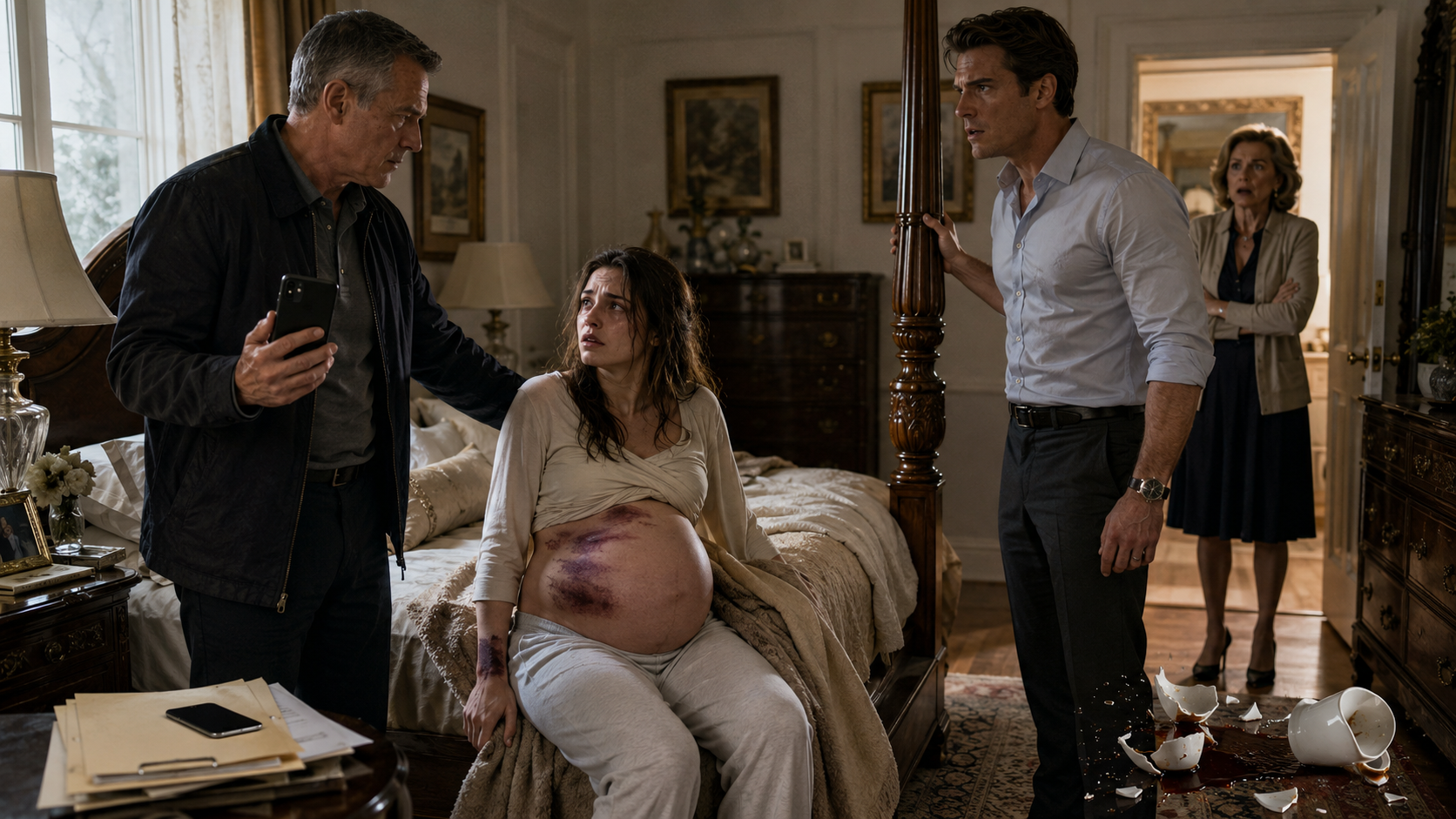
My husband spent months teaching everyone to doubt me. He forgot my father had spent a lifetime learning how liars behave.
PART 1: THE TRUTH BENEATH THE BLANKET
The first thing my father noticed wasn’t my face.
It was the bruises.
He had been standing beside my bed for less than thirty seconds when his eyes dropped to the edge of the heavy gray blanket pulled almost to my shoulders.
I knew the exact moment he saw my wrist.
His expression didn’t change.
That was what frightened Julian.
My father didn’t gasp. He didn’t shout. He didn’t demand an explanation.
He simply reached down and folded the blanket away from me.
“No,” Julian said.
Too fast.
Too sharp.
The room froze.
My father stopped for half a second, then continued.
The blanket slid down.
My swollen wrist appeared first.
Then the yellowing bruise on my forearm.
Then the darker marks around my ribs where Julian’s fingers had dug into me four nights earlier.
And finally, just above the curve of my seven-month pregnant stomach, the shadowy purple stain I had been hiding beneath oversized pajamas.
Behind my father, a coffee mug slipped from Julian’s hand.
Porcelain shattered across the hardwood.
Coffee spread over the cream-colored rug in a dark, ugly bloom.
No one moved.
My father looked at the marks.
Then at me.
“Who did this to you, Vivienne?”
His voice was so quiet that I almost started crying.
Not because I was afraid of him.
Because I wasn’t.
For the first time in months, someone was looking at me as though I were a person whose answer mattered.
Julian recovered first.
He always did.
That was one of the things that had made him so dangerous.
He could go from fury to charm in the time it took another person to blink.
“She slipped in the bathroom,” he said, already stepping closer. “I’ve told her she shouldn’t get up without calling me. The pregnancy has made her dizzy.”
My father didn’t look at him.
Julian tried again.
“My wife keeps losing her balance.”
From the doorway, Beatrice folded her arms.
She was still dressed as though she might leave for lunch at a country club at any moment: cream slacks, pearl earrings, pale lipstick, not a hair out of place.
She looked at my bruises with annoyance rather than horror.
“Vivienne has become extremely emotional,” she said. “We’ve been doing everything we can to protect her from herself.”
Protect me.
That word.
I had heard it so many times that it had started to feel obscene.
We took your phone to protect you.
We canceled that lunch because you need rest.
We told your doctor because someone has to be honest about how unstable you’ve become.
We locked the downstairs door because you shouldn’t be wandering outside alone.
We didn’t invite your friends in because they upset you.
We did this because we love you.
We did this because you’re pregnant.
We did this because you aren’t thinking clearly.
Every bruise had been given a softer name.
Every prison bar had been disguised as concern.
My father finally turned his head.
He looked at Beatrice once.
Not angrily.
Assessing.
I knew that look.
I had seen it when I was a child and he came home from deployment and noticed something broken in the kitchen that I hadn’t admitted breaking.
He had never needed to accuse.
He watched.
He listened.
Then he waited for the lie to collapse under its own weight.
Beatrice’s mouth tightened.
My father turned back to me and crouched beside the bed.
“Look at me.”
I did.
His hair had gone almost completely silver over the past few years. There were deeper lines around his eyes now, and for one painful second I saw not Colonel Arthur Sterling, not the calm officer everyone else knew, but my dad.
The man who had stood beside me at my mother’s funeral.
The man who had called every Sunday even when I kept saying I was fine.
The man I had lied to over and over because Julian had always been close enough to hear.
Dad reached for my hand carefully.
He did not touch the swollen wrist.
“Did you fall?”
Behind him, Julian gripped the bedpost.
The wood gave a small creak beneath his fingers.
I looked at my husband.
His face was pale, but his eyes were issuing the warning I knew by heart.
Think carefully.
He didn’t have to say it.
I could hear him anyway.
Remember what happens when you embarrass me.
Remember no one believes you.
Remember you’re pregnant.
Remember you’re weak.
For six months, Julian and Beatrice had built their version of me piece by piece.
At first, it was almost invisible.
Julian told friends I was tired.
Then anxious.
Then “struggling emotionally.”
When I canceled dinner because he had bruised my shoulder badly enough that I couldn’t wear the dress I’d planned, he told everyone I’d had a panic attack.
When my friend Claire appeared unexpectedly one afternoon, Beatrice intercepted her on the porch and said I was sleeping under doctor’s orders.
I had been upstairs.
Awake.
Standing behind the bedroom curtain.
Watching Claire walk back to her car.
My phone stopped working properly a week later.
Calls disappeared from my history.
Messages arrived hours late.
Sometimes not at all.
Julian said pregnancy brain was making me forget things.
Then he began sitting in on my medical appointments.
The first time I objected, he smiled at the nurse.
“She’s been having some anxiety.”
The nurse gave me a sympathetic look.
It was such a small moment.
But afterward, Julian repeated it for days.
Did you see how she looked at you?
She knows.
They all know.
By midsummer, I had learned to wear long sleeves despite the heat.
I learned to stand at certain angles during video calls.
I learned to cry into a pillow.
I learned which floorboards creaked.
I learned that if Julian’s mouth went completely flat before he spoke, I needed to move away from the nearest wall.
I learned that Beatrice could hurt me while sounding perfectly reasonable.
She rarely struck me.
She preferred fingers around my arm.
A hand twisted behind my back.
A grip on the base of my neck while she murmured, “Stop making my son miserable.”
Julian had once laughed afterward.
“See? Even my mother knows how difficult you are.”
And slowly, horribly, some part of me had begun to wonder whether they were right.
Maybe I was unstable.
Maybe I exaggerated.
Maybe it wasn’t abuse if he apologized afterward.
Maybe it wasn’t imprisonment if the door could technically be opened.
Maybe it wasn’t coercion if I eventually said yes because saying no hurt more.
Then, two weeks ago, I had found the trust documents.
I had been searching Julian’s desk for my passport because he refused to tell me where he’d put it.
Under a stack of insurance papers was a file with my mother’s name on it.
STERLING FAMILY RESIDENTIAL TRUST.
I had sat on the floor for nearly twenty minutes reading the same page over and over.
The house belonged to the trust my mother had created before her death.
I was the beneficiary.
Julian was not.
His name wasn’t on the deed.
It wasn’t on the trust.
It wasn’t anywhere.
He had spent three years calling it his house.
He had changed the locks.
Chosen which friends were allowed inside.
Told me where I could sleep.
Told me what I could wear.
Told me I would leave with nothing if I ever tried to divorce him.
And all along, he was threatening to throw me out of a home that had never belonged to him.
That discovery did something to me.
It didn’t make me brave all at once.
It made me suspicious of every other thing he had told me.
So I started recording.
Not dramatic recordings.
Not traps.
Just truth.
I left my old tablet charging behind a row of books in the bedroom.
I activated the voice recorder before difficult conversations.
I photographed bruises when I could.
I saved screenshots.
I wrote dates in a notebook and hid it beneath the loose lining of an old maternity bag Beatrice considered too cheap to use.
Three nights ago, I recorded Julian saying, very clearly, “Nobody is going to believe a hysterical pregnant woman over an Army officer.”
Yesterday, Beatrice had told me, “Your father is old. Don’t drag him into this.”
They had no idea he was already coming.
I hadn’t known either.
Dad had simply stopped believing my excuses.
He had called me the previous Sunday.
I smiled into the camera.
Julian stood three feet away.
“Everything’s good,” I said.
Dad had watched me for a long time.
Then he asked, “Why is the painting from your hallway hanging in the bedroom?”
It was such a strange question that Julian frowned.
I told Dad we’d redecorated.
He nodded.
We ended the call.
What Julian didn’t understand was that the painting hadn’t moved.
I had.
They had been keeping me almost entirely in the upstairs bedroom for twelve days.
Dad had recognized the background.
He had realized I was no longer taking video calls in different rooms.
He had also noticed I never turned my head fully to the left.
The bruise beneath my hairline hurt when I did.
The next morning, without telling Julian, my father got on a plane.
Now he was kneeling beside me.
Waiting.
“Did you fall?” he repeated.
My throat closed.
Julian shifted behind him.
Beatrice said, “Arthur, please don’t encourage—”
“No.”
The word escaped me so quietly I barely heard it myself.
My father did.
His hand tightened around mine.
Not enough to hurt.
Just enough to remind me I wasn’t alone.
“No,” I whispered again.
The room seemed to change shape.
Beatrice stopped breathing.
Julian’s grip loosened from the bedpost.
Dad’s face remained perfectly still.
I looked at him.
“I didn’t fall.”
Beatrice laughed.
A thin, brittle sound.
“She’s confused. The medication has been affecting her judgment.”
“What medication?” Dad asked.
Beatrice blinked.
Julian stepped in quickly. “Her doctor prescribed something for anxiety.”
“No, he didn’t,” I said.
The words came faster now.
Stronger.
“My obstetrician suggested counseling. Julian told you it was medication.”
My husband stared at me.
I felt the old fear rise immediately.
Hot.
Automatic.
My body remembered consequences before my mind did.
But then Dad stood.
He moved between Julian and the bed.
“Julian.”
My husband lifted his chin.
“Step away from my daughter.”
“This is my home, Colonel.”
The title came out almost mockingly.
Julian knew my father had served. He knew he’d been a colonel.
What Julian had never bothered to learn was that my father wasn’t retired.
He had simply moved after my mother’s death and stopped talking about work around people he didn’t trust.
Dad’s current posting didn’t come up during holiday dinners.
Julian had assumed a gray-haired widower living quietly several states away was harmless.
“You don’t have the authority to come in here and order me around,” Julian continued.
Dad didn’t move.
Before he could respond, I pushed myself upright.
The movement hurt my ribs.
I didn’t care.
“No.”
Julian looked at me.
I forced myself not to look away.
“The house isn’t yours.”
Silence.
“What?”
“It’s mine.”
His expression changed.
Not dramatically.
That would have been easier.
His face just emptied.
I kept going.
“My mother placed it in a protected family trust. I found the paperwork.”
Beatrice’s arms dropped from their folded position.
“That is family property,” she said.
“Yes,” I replied.
“My family.”
Julian took one step toward me.
My father moved faster.
Not violently.
Just enough to block his path.
Julian stopped.
I could see him calculating.
For months, he had controlled every variable.
The phone.
The visitors.
The doctor.
The story.
The doors.
My fear.
Now, one by one, those pieces were slipping out of his hands.
“You were going through my desk?” he asked me.
It would have sounded absurd to anyone else.
To me, it sounded dangerous.
Dad heard it too.
His gaze sharpened.
“Your desk?” I said.
“In my house?”
“Vivienne—”
“And I recorded you.”
That was the first moment Julian truly lost control of his face.
“What did you say?”
“Everything I could.”
Beatrice stepped forward.
“You had no right—”
“I had every right.”
My voice broke, but I kept speaking.
“I recorded the threats. I photographed the bruises. I wrote down the dates.”
Julian stared at me as though I had become a stranger.
Maybe I had.
Or maybe he was finally seeing the person he had worked so hard to erase.
My father reached into his jacket.
He removed a black phone.
Not his personal phone.
Julian recognized that immediately.
His eyes locked onto it.
“Who are you calling?”
Dad looked straight at him.
“Local law enforcement first.”
He unlocked the screen.
“Then the Army Family Advocacy Program.”
Julian’s breathing changed.
“And after that,” Dad continued, “your commanding officer.”
The color drained from Julian’s face.
Beatrice looked from him to my father.
I felt my heart hammer beneath my ribs.
Julian wasn’t simply my husband.
He was Captain Julian Mercer.
A company-grade officer with glowing evaluations, a carefully built reputation, and the kind of polished public image he valued more than almost anything.
Devoted officer.
Dedicated husband.
Future father.
Honorable man.
He had spent years making sure people saw exactly what he wanted them to see.
He had spent months making sure no one saw me at all.
Dad raised the phone to his ear.
Julian finally understood.
This wasn’t going to remain inside the house.
And for the first time since the abuse began, neither was I.
PART 2: THE STORY THEY BUILT AROUND ME
The police arrived before Julian had enough time to rebuild his mask.
That mattered.
Later, I would understand how much.
If he had been given twenty minutes alone with me, he might have convinced me to retract everything.
Not because his story was believable.
Because fear is.
Fear doesn’t need logic.
Fear only needs memory.
Two officers came through the front door.
A man and a woman.
The female officer introduced herself as Officer Ramirez.
She took one look at the room, then at me, and asked whether I could speak to her privately.
Julian objected immediately.
“My wife is medically fragile.”
Ramirez didn’t even turn toward him.
“Sir, I’ll speak with your wife privately.”
“She needs me with her.”
“No.”
One word.
No apology.
No negotiation.
I almost cried again.
I had forgotten other people could tell him no.
Beatrice tried a different approach.
“We’re all concerned because she’s been having episodes.”
Officer Ramirez looked at her.
“What kind of episodes?”
Beatrice hesitated.
That hesitation felt enormous.
For months, their accusations had been vague enough to spread easily.
Emotional.
Unstable.
Paranoid.
Difficult.
Words without measurements.
Words that sounded serious but meant anything they needed them to mean.
Now someone was asking for specifics.
“Anxiety,” Beatrice said.
“Has she been diagnosed with an anxiety disorder?”
“Her doctor is concerned.”
“Which doctor?”
Beatrice looked at Julian.
Ramirez noticed.
So did Dad.
So did I.
Julian stepped forward.
“Officer, I can provide medical information.”
“Are you her doctor?”
His jaw tightened.
“No.”
“Then I’ll speak to your wife.”
The other officer guided Julian downstairs.
Beatrice followed after protesting that she needed to clean the broken coffee before it stained.
Nobody let her.
Dad remained near the door until Officer Ramirez asked me whether I wanted him present.
I nodded.
Only then did he sit.
The moment Julian disappeared down the stairs, my body began shaking.
Not lightly.
Violently.
My teeth clicked together.
My hands trembled so hard I couldn’t hold the glass of water Ramirez offered me.
She didn’t tell me to calm down.
She waited.
That kindness nearly undid me.
“I’m sorry,” I whispered.
“For what?”
I looked at the water sloshing against the sides of the glass.
“I don’t know.”
She crouched slightly so we were closer to eye level.
“Then don’t apologize.”
I stared at her.
That sentence stayed with me.
For months, I had apologized for everything.
For making Julian angry.
For making Beatrice worry.
For dropping a plate.
For asking questions.
For crying.
For being tired.
For wanting to visit my father.
For not wanting Beatrice in the delivery room.
For getting pregnant and then somehow not being pregnant correctly.
I had even apologized after Julian shoved me against the bathroom vanity because I had tried to retrieve my phone from his pocket.
I’m sorry.
I’m sorry.
I’m sorry.
The words had become reflexes.
Ramirez opened a notebook.
“Can you tell me what happened to your wrist?”
My throat tightened.
Dad said nothing.
I appreciated that.
He didn’t answer for me.
I looked down at the swelling.
“Julian grabbed it.”
“When?”
“Tuesday night.”
“What happened before that?”
“I asked for my passport.”
“Why?”
“I wanted to leave.”
Ramirez’s pen stopped.
“Leave the house?”
“Leave him.”
Dad inhaled quietly.
I hadn’t told him that.
I hadn’t told anyone.
Ramirez continued.
“What did your husband do?”
“He said I wasn’t going anywhere.”
My voice shook.
“I tried to get past him. He caught my wrist and twisted it.”
“Did you fall?”
“No.”
“Did he push you?”
I nodded.
“Into the dresser.”
Her eyes moved to my ribs.
“And the bruising there?”
“That was later.”
I hated how strange my own voice sounded.
Flat.
Almost embarrassed.
“He wanted my tablet. He knew I’d been using it.”
“For what?”
I looked at Dad.
Then back at her.
“Recording him.”
For the first time, something shifted in her expression.
Not surprise exactly.
Attention.
“Do you still have those recordings?”
“Yes.”
“Where?”
The question triggered panic so fast I nearly stopped breathing.
Because the tablet was still hidden.
In the house.
And Julian knew now that evidence existed.
Dad saw my face.
“Is it somewhere he can reach?”
I nodded.
“Behind the books on the second shelf. In the bedroom.”
Officer Ramirez stood immediately.
She radioed the other officer.
My pulse hammered while we waited.
Every second felt like Julian’s footsteps in the hallway.
Then the second officer returned carrying the tablet.
He gave it to Ramirez.
My entire body sagged with relief.
“It’s password protected,” I said.
“Only I know it.”
Julian had always accused me of being incapable of keeping anything from him.
For once, he’d been wrong.
Ramirez asked whether there was somewhere else I could go that evening.
I looked around my bedroom.
My mother’s old brass lamp sat on the dresser.
The blue chair she’d bought at an antique market was in the corner.
A photograph of us from college graduation stood beside the window.
For years, this had been the safest room in the world.
Then Julian had turned it into the place where I spent most of my captivity.
“I don’t want to go anywhere,” I said.
Dad looked at me.
Officer Ramirez’s expression remained neutral.
I swallowed.
“This is my home.”
Saying it aloud did something inside me.
“This house belongs to my family trust. My husband doesn’t own it.”
Ramirez nodded slowly.
“Property issues may need to be handled separately, but right now our priority is keeping everyone safe.”
“I know.”
I placed one hand protectively over my stomach.
The baby shifted beneath my palm.
A small rolling movement.
I closed my eyes.
For months, every decision had been filtered through terror.
What if I made him angry?
What if stress hurt the baby?
What if people believed him?
What if I left and had nowhere to go?
Now another question formed.
What if I stayed silent and my child grew up learning that love looked like this?
My eyes opened.
“I want him away from me.”
Dad’s face changed then.
Barely.
Just a tightening around his eyes.
But I knew him.
That was the moment his worry became something harder.
Not rage.
Resolve.
Officer Ramirez asked more questions.
Dates.
Incidents.
Whether Julian had ever threatened the baby.
“No,” I said.
Then I stopped.
Had he?
Not directly.
He never said, I’ll hurt the baby.
He was smarter than that.
Instead, he said things like, “A court isn’t going to give custody to someone unstable.”
Or, “If you keep behaving like this, people are going to question whether you can be a mother.”
Or, “You need me, Vivienne. Without me, they’ll think you’re dangerous.”
I told Ramirez.
She wrote every word.
When she asked about Beatrice, shame flooded me.
“She helped him.”
“How?”
“She kept people away. She took my phone sometimes. She held me when he wanted to search my things.”
Dad’s eyes closed for a second.
I remembered one afternoon particularly clearly.
I had been trying to leave through the kitchen after Julian told me he had canceled another appointment with my friend Claire.
Beatrice stood in the doorway.
“You’re not thinking rationally.”
“Move.”
“You need rest.”
“Move.”
When I tried to get around her, she seized both my arms.
Julian came from behind me.
He took my keys.
Beatrice had whispered in my ear while I struggled.
“Stop behaving like an animal.”
I told Officer Ramirez that too.
By the time I finished, evening light had turned the bedroom windows gold.
Everything looked softer.
Nothing felt soft.
A paramedic examined me.
Then I was taken to the hospital for evaluation because of the pregnancy and bruising.
Dad rode with me.
As they wheeled me through the front door, I saw Julian near the bottom of the stairs speaking rapidly to the second officer.
His composure had returned.
Of course it had.
His shoulders were straight.
His voice controlled.
His expression concerned.
He looked like an officer describing an unfortunate misunderstanding.
Then he saw me.
For one second, the mask disappeared.
His eyes burned.
You did this.
That was what his stare said.
You ruined everything.
I had spent months terrified of that look.
This time, I stared back.
“No,” I said softly.
Dad heard me.
“What?”
I kept looking at Julian.
“He did.”
The hospital was worse than I expected.
Not because anyone was cruel.
Because kindness made the truth harder to avoid.
A nurse asked me whether I felt safe at home.
I laughed.
Then I started crying.
An obstetrician checked the baby.
Strong heartbeat.
No sign of immediate distress.
The relief was so powerful I covered my face and sobbed until my ribs hurt.
Dad stood beside the bed holding my hand.
“It’s okay,” he said.
I shook my head.
“I should have left sooner.”
He didn’t tell me what I wanted to hear.
He didn’t say none of it mattered.
Instead, he said, “You started planning when you were able to start planning.”
I stared at him.
“You knew something was wrong.”
“I knew something didn’t fit.”
“Why didn’t you come earlier?”
The question sounded cruel the moment it left me.
Dad flinched anyway.
I hated myself for it.
But he answered.
“Because you kept telling me you were okay.”
“I was lying.”
“I know that now.”
He sat down.
“For a while, I thought you were pulling away because you were building your own family. Then the calls got shorter. You stopped mentioning Claire. You stopped driving anywhere. Every time I asked whether I could visit, there was a reason I shouldn’t.”
“Julian made those reasons.”
“I suspected.”
I looked at him sharply.
“Then why—”
“Because suspicion isn’t the same thing as knowing, Vivienne. And every time I pushed, you defended him.”
That hurt because it was true.
I had defended Julian repeatedly.
He’s under pressure.
His training schedule is exhausting.
His mother is only helping because I’m tired.
We’re fine.
I just need rest.
Pregnancy is harder than I expected.
Dad looked down at our joined hands.
“Last Sunday’s call was different.”
“The painting.”
“The painting. And your eyes.”
“My eyes?”
“You kept looking slightly to your right before answering.”
I remembered Julian standing there.
Dad continued.
“You’ve done it before.”
“When?”
“When you were seventeen and backed my car into the mailbox.”
Despite everything, a startled laugh escaped me.
He almost smiled.
“Your mother knew too.”
At the mention of her, the laugh disappeared.
“I found her trust.”
“I know.”
I blinked.
“You know?”
“I was one of the original trustees.”
I stared at him.
“Why didn’t you tell me?”
“You were given copies after your mother died.”
“I never saw them.”
Dad’s face went still.
That answer opened another dark space between us.
Julian had handled most of our financial files after we married.
He called it efficiency.
I thought of the documents hidden under his insurance papers.
“Do you think he knew?”
Dad took his time before answering.
“I don’t know.”
Neither of us said what I was thinking.
If Julian had known the house wasn’t his, why had he spent years telling me it was?
And if he hadn’t known, why were my trust documents in his desk?
The question followed me into the night.
Then my phone rang.
Not the phone Julian had controlled.
Dad had bought a temporary one from the hospital gift shop kiosk downstairs and added the few numbers I could remember.
Claire was the first person I called.
She answered on the second ring.
“Vivienne?”
I couldn’t speak.
Her voice changed immediately.
“Oh my God. Viv?”
“I’m here.”
“Where have you been?”
My chest hurt.
“Claire—”
“Julian told me you didn’t want me contacting you anymore.”
I closed my eyes.
Of course he had.
“When?”
“Three months ago.”
I gripped the phone.
“What exactly did he say?”
There was a pause.
“He said my visits were worsening your anxiety. He said you asked him to tell me.”
I looked toward Dad.
He was watching me.
“Claire, I never asked him that.”
Silence.
Then a whisper.
“I knew something was wrong.”
Tears filled my eyes.
“Why didn’t you come back?”
“I did.”
My breath stopped.
“What?”
“I came twice. His mother answered once. Julian answered the other time.”
I remembered watching Claire leave from behind the curtain.
That had been the first time.
I hadn’t known there was a second.
“What happened?”
“Julian said you were asleep. Then he told me you were having paranoid episodes and that your doctor recommended reducing stimulation.”
The same story.
Always the same story.
Claire began crying.
“I’m sorry. I thought respecting what I believed you wanted was helping.”
“It wasn’t your fault.”
The words felt strange coming from me after months of blaming myself for everything.
She inhaled shakily.
“Where are you now?”
“Hospital.”
Her silence turned terrified.
“The baby is okay,” I said quickly. “I’m okay.”
It was the first time I had said those words and meant something close to them.
She asked whether she could come.
I said yes.
Then I hung up and stared at the ceiling.
The lies were spreading backward through my memories now.
Every canceled lunch.
Every missed call.
Every concerned look from someone who had heard I was “struggling.”
Julian hadn’t just isolated me physically.
He had built a second version of me and sent her into the world.
Unstable Vivienne.
Unreasonable Vivienne.
Ungrateful Vivienne.
The woman everyone needed to protect themselves from.
By midnight, I understood something I should have understood much sooner.
Leaving the house would not be enough.
I had to destroy the lie too.
And I already had the recordings to do it.
PART 3: THE VOICE ON THE RECORDING
The next morning, my father asked me a question I wasn’t prepared for.
“What do you want to do?”
I was sitting upright in the hospital bed, eating toast I couldn’t taste.
“What do you mean?”
“I mean exactly that.”
His uniform wasn’t visible.
His rank wasn’t visible.
The phone calls he’d made the previous night weren’t visible.
He was just my father, sitting near the window.
“I can help you,” he said. “Law enforcement can investigate. The command can take appropriate action. Your lawyer can address the house and marriage. But you decide whether you cooperate. You decide what happens with your recordings. You decide what you say.”
I stared at him.
That shouldn’t have felt revolutionary.
It did.
For months, everyone had decided things for me.
Julian decided when I slept.
Beatrice decided who visited.
They decided what my doctor needed to hear.
They decided what I was feeling.
They even decided what my own memories meant.
Now Dad was giving the decision back.
“I want them to hear everything.”
He nodded once.
“Then we’ll make sure they do.”
The recordings were transferred from the tablet while I watched.
I insisted on being involved.
There were more than I remembered.
Some were almost mundane.
Julian complaining about dinner.
Beatrice criticizing my clothes.
Julian telling me I embarrassed him by disagreeing with him in front of another officer’s wife.
But certain recordings made my skin go cold.
In one, my own voice was trembling.
“Give me my phone.”
Julian answered, “When you stop behaving irrationally.”
“It’s my phone.”
“And you’re my wife.”
“That doesn’t mean you can take my things.”
Then Beatrice’s voice entered.
“Don’t raise your voice. Think about the baby.”
“I am thinking about the baby.”
“No, you’re thinking about yourself.”
The recording ended with a scraping noise.
My chair.
I remembered it now.
I had tried to stand.
Julian put his hand on my shoulder and forced me back down.
Another recording was worse.
“You cannot keep telling people I’m mentally ill.”
“I’m telling people you’re having difficulties.”
“I am not.”
“See? This is exactly what I’m talking about.”
“Julian—”
“You think everyone’s against you.”
“Because you keep lying about me.”
A long silence.
Then his voice, lower.
“Nobody is going to believe a hysterical pregnant woman over an Army officer.”
I remembered pressing the stop button after he left.
I remembered sitting in darkness for an hour afterward.
Hearing it now, in a hospital room with my father beside me, was different.
The words sounded smaller.
Crueler.
More deliberate.
Not the angry statement of a man losing control.
The confident statement of a man who believed he had already won.
Dad said nothing until the recording ended.
Then he stood and walked toward the window.
His shoulders were rigid.
“Dad?”
He looked outside.
“I spent your whole childhood teaching you to call me if you were in trouble.”
My chest tightened.
“I know.”
“And you thought you couldn’t.”
“I didn’t want to make things worse.”
His head bowed slightly.
“You couldn’t make this worse.”
“You don’t understand.”
He turned.
I flinched.
Not because he had moved violently.
Because someone moving suddenly still did that to me.
Dad saw it.
His entire face changed.
I hated that more than anything.
“Vivienne,” he said softly.
I swallowed.
“If Julian knew I called you, he’d become perfect for three days. Flowers. Breakfast. Apologies. Then he’d explain why what happened was partly my fault.”
Dad remained silent.
“And after that, it would get worse.”
I stared at the blanket.
“I thought I needed one perfect piece of evidence. Something nobody could explain away.”
“You were trying to survive inside a situation designed to keep you doubting yourself.”
I nodded.
“It sounds stupid now.”
“No.”
His answer was immediate.
“It sounds like coercion.”
I looked at him.
That word mattered.
Because coercion wasn’t hysteria.
It wasn’t oversensitivity.
It wasn’t pregnancy hormones.
It was something one person did to another.
Later that afternoon, a representative from the Army Family Advocacy Program spoke with me.
Then someone from Julian’s chain of command contacted the hospital through formal channels.
I expected a dramatic scene.
There wasn’t one.
No shouting commander arrived to strip Julian of his rank in our living room.
No cinematic arrest happened because my father made one phone call.
Reality was slower.
Paperwork.
Statements.
Medical documentation.
Questions asked twice in slightly different ways.
Dates verified.
Files preserved.
The recordings mattered.
So did the photographs.
So did the pattern.
For the first time, the boring details were on my side.
Julian’s biggest weapon had always been vagueness.
She’s unstable.
She’s emotional.
She’s paranoid.
But a date wasn’t vague.
A bruise wasn’t vague.
A recording wasn’t vague.
Neither was the message Claire still had from him.
She brought it to the hospital when she visited.
I stared at the screen.
Vivienne has asked for some distance. Please don’t encourage her current fears. Her medical team and I are handling things.
Her medical team and I.
I read it twice.
Then again.
“He sent this after I came to see you,” Claire said.
“You were upstairs.”
“I know.”
She stared at me.
“What?”
“I saw you leave.”
Her mouth opened.
“I was standing behind the curtain.”
Claire covered her face.
“Oh God.”
“Don’t.”
“I should have—”
“Don’t.”
She lowered her hands.
I took the phone from her.
“You believed my husband was speaking for me.”
“I shouldn’t have.”
“He made sure it sounded reasonable.”
I knew that better than anyone.
Dad asked Claire to forward the message to me and preserve the original.
I watched him closely.
He wasn’t taking over.
He was showing me what to save.
The difference mattered.
That evening, I received a call from my obstetrician.
Not the one who had seen me at the hospital.
My regular doctor.
Dr. Keller sounded shaken.
“I heard there was an incident.”
I almost laughed at the word.
“Yes.”
“Vivienne, I need to apologize.”
I sat straighter.
“For what?”
“For not insisting on seeing you alone.”
The room seemed to narrow.
“You believed him.”
She didn’t deny it.
“Your husband repeatedly expressed concern about anxiety, mood instability, and paranoia.”
“I told you I was fine.”
“You did.”
“But you believed him.”
A long pause.
“I believed there might be more going on than you were willing to discuss.”
Anger rose through me.
Clean anger.
Not fear.
“Did I ever tell you I was paranoid?”
“No.”
“Did I ever say I was hallucinating?”
“No.”
“Did I ever say I was afraid I’d hurt myself?”
“No.”
“Did I ever tell you I needed Julian to make decisions for me?”
“No.”
My voice sharpened.
“Then why did his version matter more than mine?”
Dr. Keller was silent.
I could hear her breathing.
Finally she said, “It shouldn’t have.”
That answer didn’t undo anything.
But it mattered.
For months, I had wondered whether there was something in my medical record proving Julian was right.
There wasn’t.
There was only concern built from his repeated claims and my own increasing fear.
“Can you document that?” I asked.
“What?”
“That I never reported those symptoms. That the concerns came from him.”
Another pause.
“Yes.”
“And I want future appointments without Julian or Beatrice present.”
“Of course.”
“Not because I’m emotional.”
“No.”
“Because I choose it.”
“Yes.”
My hand stopped trembling.
After the call, Dad looked at me.
“You did well.”
I almost rolled my eyes.
“I’m thirty-one.”
“You’re still allowed to do well.”
A laugh escaped me.
It felt unfamiliar.
Then my temporary phone buzzed.
Unknown number.
I stared at it.
Dad did too.
“Don’t answer if you don’t want to.”
I nearly ignored it.
Then a voicemail appeared.
I listened on speaker.
Beatrice’s voice filled the room.
“Vivienne, I hope you’re satisfied.”
My stomach tightened.
“We are all extremely worried about you. Julian is devastated. Your father has turned a private marital issue into something that could destroy his career. Whatever arguments you and Julian have had, surely you understand that your child’s future depends on your husband’s livelihood.”
I closed my eyes.
There it was.
Not an apology.
Not concern about my injuries.
His career.
She continued.
“You need to correct this before people make decisions that cannot be reversed. Julian loves you. I love you. Families handle problems privately.”
The message ended.
Dad looked at me.
I expected him to speak.
He didn’t.
Instead, he handed me the phone.
“What do you want to do?”
Again.
My choice.
I stared at Beatrice’s number.
Then I saved the voicemail.
“Add it to the file.”
Dad nodded.
For the first time, I understood what resisting them actually looked like.
It wasn’t screaming louder.
It was refusing to erase what they had done.
I returned home two days later.
Julian wasn’t there.
Under temporary restrictions and the developing investigation, he had been ordered to stay away from me while legal measures were addressed.
Beatrice had also left.
The house was quiet.
Too quiet.
I stood inside the front door and couldn’t move.
Claire carried my hospital bag behind me.
Dad stood to my left.
Nobody rushed me.
The broken mug had been cleaned up.
The coffee stain remained.
A dark shape on the pale rug.
I stared at it for a long time.
Then I walked upstairs.
Every step felt strange.
I reached the bedroom.
The bed had been made.
The blanket folded neatly at the foot.
That blanket.
I touched it.
My hand started shaking.
I pulled it off the bed and dropped it on the floor.
Then I opened every curtain.
Sunlight flooded the room.
I opened the windows too.
Hot August air rushed inside.
For months, Beatrice had complained that outside air aggravated my allergies.
I laughed as wind lifted the curtains.
Claire watched me.
“What?”
“I forgot how loud the street is.”
A truck passed.
A dog barked.
Someone’s lawn mower buzzed in the distance.
Ordinary sounds.
Beautiful sounds.
Then Dad appeared in the doorway holding a file.
“The trust attorney called.”
My smile disappeared.
“What did he say?”
“Julian contacted his office this morning.”
My stomach dropped.
“Why?”
Dad handed me the file.
“He wanted information about whether the trust could be challenged.”
The air seemed to leave the room.
Of course.
Even now.
Even after the hospital.
Even after the recordings.
He was thinking about control.
“What happens?”
“That’s your attorney’s question.”
I took the file.
At the top was my mother’s name.
For years, seeing her name made me ache.
Now it gave me strength.
Dad looked at me.
“There’s something else.”
I raised my eyes.
“The attorney said Julian requested copies of the trust documents almost a year ago.”
I went very still.
A year.
Long before I found the papers in his desk.
Long before he told me the house was his.
Long before he threatened to make me homeless if I left.
The truth settled slowly.
Julian had known.
He had known exactly whose house it was.
And he had lied anyway.
I looked around the room.
At the walls.
The furniture.
My mother’s photograph.
A terrible clarity moved through me.
He had never believed the house belonged to him.
He had only needed me to believe it did.
And suddenly, I knew exactly what I wanted to do next.
I wanted him to hear me say the truth to his face.
PART 4: WHAT HE COULDN’T CONTROL
My lawyer hated the idea of me speaking to Julian.
My father hated it more.
Neither forbade me.
That mattered.
The meeting was arranged in a controlled setting with legal counsel involved and no possibility of Julian cornering me alone.
I wanted closure.
More importantly, there were practical matters involving the house and his belongings that had to be handled.
For three nights, I rehearsed what I wanted to say.
Then I threw the pages away.
Julian had spent months making me prepare for him.
Prepare the right answer.
The right expression.
The right tone.
I was done rehearsing.
He entered the conference room wearing civilian clothes.
That unsettled me more than his uniform ever had.
In uniform, Julian looked like the person the world believed him to be.
Without it, he looked like the man who had stood in our bedroom with his fingers around my wrist.
He saw Dad first.
Then me.
His gaze went to my stomach.
For one dangerous second, tenderness appeared on his face.
“Viv.”
I hated that my body responded.
My chest tightened.
I remembered the early years.
Our first apartment.
Late-night takeout.
Julian putting his coat around my shoulders when it rained.
The way he cried at my mother’s funeral and held me when I couldn’t stand.
Abuse hadn’t erased those memories.
That was part of what made everything so painful.
The man I feared had not always looked like a monster.
Sometimes he still didn’t.
“How are you?” he asked.
My lawyer shifted beside me.
I answered.
“Better.”
Julian’s eyes flickered.
“I’m glad.”
He sat.
His attorney began discussing property retrieval, communication restrictions, and ongoing proceedings.
I barely heard him.
Julian kept watching me.
Eventually, his attorney asked for a short recess.
Julian leaned forward.
“This has gone too far.”
There he was.
I looked at him.
“Has it?”
“You know I never wanted to hurt you.”
My ribs almost seemed to ache at the words.
“You did hurt me.”
“I lost my temper.”
“Repeatedly.”
“You were under enormous stress.”
I laughed once.
He stopped.
“What?”
“You can’t stop doing it.”
“Doing what?”
“Making my reaction the problem.”
His jaw tightened.
“I’m trying to take responsibility.”
“No. You’re trying to control the wording.”
Dad remained silent across the room.
Julian glanced at him.
“This should never have involved your father.”
“I involved him.”
“You didn’t know he was coming.”
“No. But I told him the truth when he arrived.”
Julian’s voice dropped.
“After he pressured you.”
My blood went cold.
It was almost impressive.
Even now.
Even here.
He was trying to turn rescue into manipulation.
I reached into the folder in front of me.
My lawyer had printed the trust correspondence.
I slid one page across the table.
“You knew.”
Julian looked down.
His expression changed.
“You knew the house belonged to the trust.”
He didn’t answer.
“You asked the attorney for documents last year.”
“That doesn’t mean—”
“You told me the house was yours.”
“I handled the household finances.”
“You told me you could throw me out with nothing.”
“We were arguing.”
“You knew it wasn’t true.”
He leaned back.
“Vivienne—”
“You needed me to believe I had nowhere to go.”
Silence.
That was the first accusation he couldn’t easily twist.
Because it had a date.
A document.
His own request.
His own signature.
I continued.
“You lied to Claire.”
His face hardened.
“You were distressed.”
“You told her I asked her not to visit.”
“You needed space.”
“I never asked for space.”
“You complained every time she came over.”
“I complained because your mother interrogated me after she left.”
Julian looked toward his attorney.
The attorney said quietly, “Julian.”
A warning.
But my husband had spent too long being obeyed.
“You don’t understand what it was like living with you,” he said.
There it was.
The sentence I had expected.
I felt it strike.
For months, those words would have shattered me.
Now I waited.
He continued.
“You questioned everything. You became suspicious. You turned every disagreement into evidence that I was controlling you.”
“Because you were controlling me.”
“You secretly recorded me.”
“After you started hurting me.”
His face flushed.
“I never hit you.”
My voice became quiet.
“Is that your defense?”
He stared at me.
“You shoved me.”
Silence.
“You twisted my wrist.”
Silence.
“You pinned me against walls.”
His nostrils flared.
“You blocked doors.”
No answer.
“You took my phone.”
He looked away.
“You convinced people I was mentally unstable.”
“I was worried about you.”
“You kept me in one room for almost two weeks.”
“For bed rest.”
“My doctor never ordered bed rest.”
That stopped him.
I had requested a copy of my medical records.
There it was.
No bed-rest order.
No psychiatric diagnosis.
No prescription for the medication Beatrice had claimed was affecting my judgment.
Just notes.
Spouse reports increased anxiety.
Spouse expresses concern regarding emotional volatility.
Patient denies significant mood changes.
The truth had been visible even there.
Buried beneath his voice.
I leaned forward.
“Do you know what finally made me understand?”
Julian said nothing.
“It wasn’t the bruises.”
His expression flickered.
“I kept explaining the bruises to myself. I told myself you were stressed. I told myself you hadn’t meant to grab that hard. I told myself your mother was only trying to protect you.”
Dad’s face tightened at that.
“But then I found the trust documents.”
Julian’s eyes lowered.
“You had lied about something objective. Something written down. Something I could hold in my hands.”
My voice shook.
“And once I knew you lied about that, I started checking everything else.”
He looked at me again.
For the first time, I saw something close to regret.
Not for what he’d done.
For being discovered.
“You destroyed my career,” he said.
The room went silent.
I stared at him.
Then something inside me finally broke.
Not in the way he expected.
I started laughing.
Quietly at first.
Then harder.
Tears came with it.
Julian looked offended.
“You think this is funny?”
“No.”
I wiped my eyes.
“I think I finally understand you.”
His expression went still.
“Your career.”
I shook my head.
“Your reputation. Your evaluations. What people think when you walk into a room.”
“Viv—”
“You haven’t asked once what the doctors said about our baby.”
That hit him.
His mouth opened.
Nothing came out.
I hadn’t planned that sentence.
Maybe that was why it landed so cleanly.
He looked at my stomach.
“The baby is fine,” I said. “In case you’re wondering.”
“I was going to ask.”
“When?”
He said nothing.
“You’ve asked about the house. Your career. My recordings. My father. The investigation.”
My hand settled over my stomach.
“You haven’t asked about her.”
His eyes lifted sharply.
“Her?”
I hadn’t told him.
I hadn’t told anyone except Dad and Claire after the hospital ultrasound confirmed what my obstetrician had suspected.
A daughter.
Julian stared.
“We’re having a girl?”
The word we hurt.
But it didn’t own me anymore.
“I am carrying a girl,” I said.
His face changed.
For the first time that day, the performance vanished.
He looked stunned.
Then wounded.
Then angry.
All in seconds.
“You had no right to keep that from me.”
My father shifted.
I raised one hand slightly.
Not to silence Dad.
To tell him I had this.
“I had no obligation to give you another piece of me while you were hurting me.”
Julian stared.
“I am her father.”
“And that will be addressed legally.”
“You can’t erase me.”
“I know.”
That was important.
I wasn’t pretending the future would be simple.
I wasn’t pretending one confrontation could fix custody issues, divorce, military proceedings, trauma, or the fact that a child connected us.
“I can’t erase you,” I said.
“But you don’t get to erase me either.”
His face hardened.
I stood.
My lawyer stood with me.
Dad remained seated until I reached the door.
Then Julian spoke.
“Vivienne.”
I stopped.
Every instinct told me not to turn around.
I did anyway.
He looked smaller from across the room than he ever had in our house.
“What do you want from me?”
For months, I had imagined the answer.
An apology.
A confession.
Fear.
Regret.
I had wanted him to understand exactly how much he had hurt me.
Now, looking at him, I realized something.
His understanding was not required for my freedom.
“Nothing,” I said.
And I walked out.
The consequences didn’t arrive all at once.
They came in layers.
The military process moved according to its own rules.
The civilian investigation moved according to another.
Attorneys handled the divorce and property issues.
My medical care changed.
So did my daily life.
Some days I woke up feeling powerful.
Other days the sound of a car door outside made me lock myself in the bathroom.
Recovery was humiliating that way.
I wanted freedom to feel like one dramatic breath of fresh air.
Instead, freedom sometimes felt like standing in a grocery store unable to choose cereal because no one had asked me what I wanted for so long.
The first time it happened, I cried between the granola and oatmeal.
Claire found me.
“What’s wrong?”
“There are too many.”
She stared at the shelves.
“Too many what?”
“Choices.”
She understood.
She took the shopping basket from me.
“Okay.”
I wiped my face.
“Okay?”
“Buy both.”
I laughed.
Then cried harder.
So we bought both.
I began therapy.
That had an irony Julian would have enjoyed.
After spending months convincing everyone I needed mental health treatment, he had managed to make sure I eventually did.
But the difference was that this time, therapy was not proof that I was unstable.
It was care after injury.
There was no shame in it.
At my next prenatal appointment, Dr. Keller asked Julian to be removed from my listed contact information.
I corrected her.
“I want him removed.”
She nodded.
“You want him removed.”
Words mattered.
I started noticing how often people accidentally took choices from vulnerable people while trying to help them.
My father never did.
He asked before touching my shoulder.
Asked whether I wanted him at appointments.
Asked whether I wanted him to stay in the house or at a hotel.
The first week, I asked him to stay.
The second, I told him to get a hotel for two nights because I wanted to sleep in the house alone.
I expected him to argue.
He packed a bag.
“You’ll call if you need me?”
“Yes.”
“Promise?”
I smiled faintly.
“I promise.”
That night, I walked through every room.
I opened doors.
Closed them.
Opened them again.
No one stopped me.
I stood on the front porch at midnight wearing pajamas.
The neighborhood was quiet.
Warm air moved against my face.
I could have walked down the street.
I could have driven somewhere.
I could have gone inside.
I could have stayed outside.
It sounds ridiculous until choice has been taken from you.
Then every open door becomes sacred.
I rested both hands over my stomach.
My daughter kicked.
“I know,” I whispered.
For the first time, I wasn’t promising her everything would be perfect.
I was promising something better.
“We’re going to choose.”
PART 5: THE DAY THE LIE FINALLY DIED
Three months later, my daughter was born just after dawn.
I named her Eleanor.
My mother’s middle name.
The labor lasted fourteen hours.
At one point I became convinced I couldn’t do it.
The nurse squeezed my hand.
My father stood on the other side of the room because I had threatened to kill him if he came closer.
Claire laughed so hard she nearly dropped my water cup.
Then Eleanor arrived furious, red-faced, and screaming.
The sound destroyed me.
I cried before I even saw her.
When they laid her against my chest, I stared down at a tiny face that seemed impossibly serious for someone less than a minute old.
“Hi,” I whispered.
Her fingers curled against my skin.
“Hi.”
Dad came closer only when I called him.
He looked at his granddaughter.
The Colonel disappeared.
The investigator disappeared.
The man who could sit through hours of testimony without moving wiped his face with both hands.
“Don’t start,” I warned.
“I’m not doing anything.”
“You’re crying.”
“I’m tired.”
Claire made an offended noise from the corner.
I laughed.
For a few minutes, there was no investigation.
No divorce.
No trust.
No Julian.
Just Eleanor breathing against me.
It was the first moment in nearly a year when fear was not the loudest thing in my body.
By then, Julian’s carefully constructed image had fractured.
Not because my father had destroyed him.
Not because the Army automatically believed me because my father was a colonel.
That distinction became important to me.
Dad opened the door.
I walked through it.
I provided the recordings.
I gave statements.
I released medical documentation.
I preserved messages.
I corrected the lies.
Claire provided what Julian had sent her.
Dr. Keller documented what had actually been reported during my visits and, just as importantly, what had not.
The trust attorney provided records showing Julian knew the house wasn’t his long before he threatened to throw me out of it.
No single item told the entire story.
Together, they formed the pattern he had assumed nobody would ever see.
The military inquiry did not end in the instant punishment I had once imagined.
Investigations rarely move at the speed of anger.
But his command could no longer treat his private behavior as irrelevant to the image of judgment and integrity he presented professionally.
The spotless reputation cracked.
Formal reviews followed.
Restrictions remained in place.
The allegations became documented matters he could not charm away over dinner.
His future, once something he spoke about as though promotion were a natural law, became uncertain.
He blamed me for that.
I knew because Beatrice told me.
She continued leaving messages until my attorney handled communication through formal channels.
Her final voicemail arrived a week before Eleanor’s birth.
I almost deleted it unheard.
Instead, I listened once.
“You have taken everything from him.”
Her voice sounded older.
Not softer.
“You have his home. You have his daughter. You have damaged his profession. I hope one day you understand what you’ve done to this family.”
I saved the message.
Then I sat at my kitchen table and thought about it.
His home.
His daughter.
His profession.
This family.
Even now, she couldn’t see me anywhere in the sentence.
That was the answer.
I didn’t respond.
I didn’t need to.
The house remained mine.
Not because I had won it from Julian.
Because it had never been his to take.
That difference mattered almost as much as the deed itself.
After Eleanor was born, I changed the bedroom.
Not everything.
I kept my mother’s lamp.
The blue chair.
The graduation photograph.
But I replaced the bed.
I took down the curtains.
I moved the bookshelves.
The gray blanket went into a donation bag, then came back out because I couldn’t stand the idea of someone else sleeping under it.
Eventually I threw it away.
Dad found me outside beside the trash bin holding one edge of it.
“You okay?”
I looked at the blanket.
“I don’t know.”
He stood beside me.
I laughed quietly.
“You pulled this down and ruined everything.”
His eyebrows rose.
“That’s one interpretation.”
“Their everything.”
He understood.
For months, Julian and Beatrice had built a world that depended on concealment.
Keep the sleeves long.
Keep the camera high.
Keep the friends away.
Keep the doctor listening to him.
Keep my father several states away.
Keep me under the blanket.
The moment Dad pulled it back, their story had nowhere left to hide.
I released the fabric.
The blanket dropped into the bin.
“I’m glad you came,” I said.
Dad looked at me.
“I wish I’d come sooner.”
“So do I.”
He winced slightly.
I smiled.
“But you came.”
He nodded.
“And I told you.”
“You did.”
We stood quietly for a while.
Then Eleanor cried inside.
I automatically turned toward the door.
Dad smiled.
“That’s your commanding officer.”
I laughed.
“Don’t ever say that again.”
“No promises.”
I went inside.
My divorce from Julian took time.
So did establishing safe arrangements concerning Eleanor.
I learned quickly that escaping someone doesn’t remove every connection to them.
There were lawyers.
Documents.
Negotiations.
Rules.
Days when I felt as though my life had become a stack of folders.
But this time, there were witnesses to the truth.
There were boundaries Julian did not get to define alone.
There were people whose job was not to protect his image.
Most importantly, there was me.
That sounds obvious.
It wasn’t.
For almost a year, I had disappeared from my own life.
Other people described me.
Other people spoke for me.
Other people explained what I thought.
Now, when someone asked what happened, I answered.
Not dramatically.
Not apologetically.
I answered.
Once, during a formal meeting months after Eleanor was born, Julian sat across from me again.
He looked tired.
Not broken.
Not transformed.
Just tired.
He spoke through his attorney for most of the meeting.
Near the end, he looked directly at me.
“I loved you.”
The room became very still.
For a second, the old Vivienne surfaced.
The one who wanted to believe love could excuse almost anything.
I thought about our wedding.
About his hand on my back during the first dance.
About the day we saw Eleanor’s first ultrasound and he cried.
About the first time he grabbed my arm hard enough to frighten me.
About the apology afterward.
About the next bruise.
And the next.
About Beatrice standing in doorways.
About Claire being turned away.
About my father’s face when the blanket came down.
“I believe you believed that,” I said.
Julian’s eyes changed.
It wasn’t the answer he expected.
“But love doesn’t require someone to disappear so you can feel powerful.”
He stared at me.
I stood.
There was no dramatic final insult.
No confession.
No begging.
I didn’t need those things anymore.
Outside the building, Dad was waiting.
He had Eleanor strapped to his chest in a carrier.
The sight was ridiculous.
A decorated Army colonel walking carefully around the courtyard with a sleeping infant tucked against him while holding a diaper bag covered in tiny yellow ducks.
I stopped on the steps.
For a moment, I just watched them.
Dad noticed me.
“How’d it go?”
“It’s done for today.”
He nodded.
“Good enough.”
I walked toward him.
Eleanor stirred when she heard my voice.
Her eyes opened.
She had my mother’s eyes.
At least, that was what Dad insisted.
I touched her tiny hand.
She grabbed my finger.
And suddenly I remembered the bedroom exactly as it had been that morning months ago.
The heavy blanket.
The broken coffee mug.
Beatrice’s crossed arms.
Julian’s hand gripping the bedpost.
My father’s quiet question.
Did you fall?
At the time, saying no had felt like stepping off a cliff.
I had thought the truth might destroy what remained of my life.
Instead, the lie had been the thing destroying me.
The truth hurt.
The truth embarrassed people.
The truth triggered investigations, arguments, legal bills, lost relationships, and consequences.
The truth did not arrive gently.
But it gave me something the lie never could.
A way out.
I lifted Eleanor from Dad’s carrier and held her against my chest.
He adjusted the diaper bag on his shoulder.
“Home?”
I looked at my daughter.
Then toward the parking lot.
“Home.”
That word belonged to me again.
People later liked to tell the story as though my father had saved me.
I understood why.
It was dramatic.
A military colonel walked into his pregnant daughter’s bedroom, pulled down a blanket, saw bruises, and immediately recognized what everyone else had been trained not to see.
That version wasn’t wrong.
It just wasn’t complete.
My father saw the bruises.
But I said no.
I found the trust.
I made the recordings.
I kept the photographs.
I told the officer what happened.
I asked my doctor to correct the record.
I chose to cooperate.
I faced Julian.
I stopped apologizing for surviving him.
Dad never corrected people when they called him my rescuer.
I did.
“He helped me,” I would say.
Then, if they were listening closely, I added the part I needed Eleanor to grow up knowing.
“But I saved myself too.”
Because someday my daughter might face a person who tells her that love requires silence.
Someone might call control protection.
Someone might use concern as a cage.
Someone might tell her nobody will believe her.
And if that day ever comes, I want one truth planted so deeply inside her that no one can dig it out.
You do not need permission to know when you are being hurt.
You do not need unanimous agreement to tell the truth.
And the person who makes you afraid to speak is not entitled to your silence.
Julian had believed his greatest advantage was that I was pregnant, isolated, frightened, and already surrounded by people who had heard his version first.
He believed the louder story would become the true one.
He believed my father’s distance made him irrelevant.
He believed his uniform made him untouchable.
He believed a locked door was enough.
He believed a frightened woman would stay frightened forever.
He was wrong about all of it.
But the mistake that cost him everything was much simpler.
He thought the blanket would stay in place.
It didn’t.
And once it came down, so did every lie they had built around me.
Để lại một bình luận