
PART 1: THE PLATE ON THE FLOOR
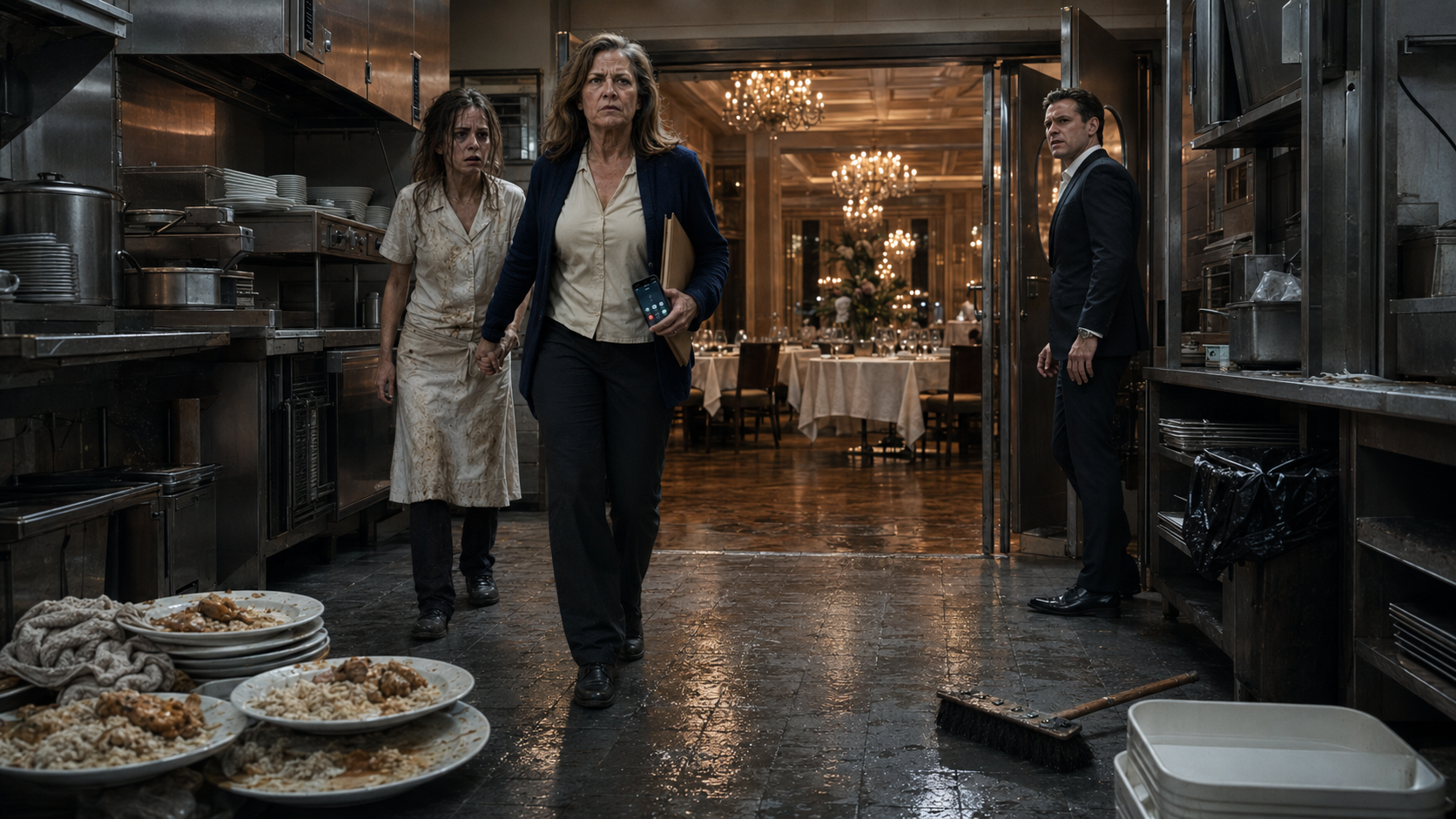
“That useless woman deserves to eat leftovers. If she can’t do her job properly, then she can learn what it feels like to go hungry.”
My son-in-law said it while looking me straight in the eyes.
He didn’t whisper.
He didn’t look ashamed.
He stood beneath the polished pendant lights of his expensive restaurant kitchen with one hand in the pocket of his tailored black trousers, as calm as if he were explaining the evening specials.
Two yards away, my daughter was kneeling on the tile floor.
There was rice stuck to her fingers.
A piece of half-eaten chicken sat on a dirty plate beside her.
And she was crying so silently that, if I hadn’t been looking directly at her, I might not have noticed.
For several seconds, I couldn’t move.
My name is Margaret Miller.
I’m fifty-eight years old, and I spent thirty years teaching elementary school in Baltimore.
I had broken up playground fights.
I had sat with frightened children while their parents screamed at each other in hallways.
I had reported neglect.
I had learned to recognize the child who flinched before anyone raised a hand and the child who apologized when someone else hurt them.
I thought I understood fear.
I never imagined it would take me months to recognize it in my own daughter.
“Chloe,” I whispered.
Her head snapped up.
The terror in her face was worse than the tears.
“Mom.”
She scrambled to her feet so quickly she knocked the plate sideways.
“Mom, you shouldn’t be here.”
That sentence broke something inside me.
Not help me.
Not thank God.
Not even what are you doing here?
You shouldn’t be here.
As if I were the one in danger of breaking a rule.
Behind her, Damian Prescott smiled.
That smile had fooled me once.
It wouldn’t fool me again.
Chloe was thirty-two when she met Damian.
Before him, my daughter had a life that belonged entirely to her.
She was a graphic designer with a small studio in Atlanta’s Richmond neighborhood. Nothing glamorous. One main room, two desks, a wall covered with color samples, an old coffee machine that sounded like it was dying every morning, and a window that leaked whenever the rain came from the east.
She loved it.
She designed restaurant menus, small-business logos, wedding invitations, websites, packaging—whatever paid the bills.
She had built the business herself.
There were months when she worried about money, but there were also mornings when she called me just to say, “Mom, somebody paid me four thousand dollars for something that started as a sketch on a napkin.”
Her father would have been proud of her.
David died when Chloe was eleven.
A heart attack.
One ordinary Tuesday morning, he kissed us goodbye before work, and by that afternoon our entire world had changed.
After that, Chloe and I became unusually close.
Maybe too close sometimes.
We spoke almost every day.
Sunday dinner was sacred.
If she was dating someone serious, I knew about him.
If she hated a client, I knew about him too.
Then Damian appeared.
He was thirty-eight, handsome in a deliberate way, as if he had been assembled by someone who understood exactly what people trusted.
Perfect haircut.
Expensive watch.
Soft voice.
Excellent manners.
He owned a restaurant called The Hearth, a sophisticated place with dark wood walls, brass fixtures, white tablecloths, and reservations that booked out weeks in advance on weekends.
The first time Chloe brought him to dinner, he arrived carrying flowers for me.
Not supermarket flowers.
A large arrangement of white roses and eucalyptus.
“You didn’t have to do that,” I told him.
“I wanted to,” he said.
Then he smiled at Chloe.
“Your daughter told me you’re the reason she believes she can do anything.”
I remember liking him for saying that.
That memory still embarrassed me.
Later, while Chloe was helping me clear the plates, Damian stood in my living room studying the framed photographs on the wall.
When I returned, he was looking at one of Chloe at her college graduation.
“You must be very proud,” he said.
“I am.”
“She’s incredibly talented.”
He turned to me.
“I want her to help me turn The Hearth into one of the best restaurants in the city.”
At the time, it sounded like admiration.
Months later, I would understand that Damian rarely complimented anything he didn’t intend to own.
The changes began slowly.
That was what made them easy to excuse.
Chloe missed a Sunday dinner because Damian had a staffing emergency.
Then another because he needed help redesigning the wine menu.
Then she canceled a weekend trip with two college friends.
“Restaurant crisis,” she said.
She laughed when she said it.
I did too.
A month later, she told me she was temporarily closing her studio.
“Just for a while.”
“Why?”
“The Hearth needs a complete branding overhaul, and Damian says hiring an outside agency would cost a fortune.”
“But that’s your job.”
“I know.”
“So he’s hiring you?”
A pause.
“We’re building something together, Mom.”
That answer bothered me.
I didn’t know why yet.
Whenever I called after that, Damian seemed to be nearby.
Once Chloe answered and whispered, “Hey, Mom.”
Before I could reply, I heard his voice.
“Who is that?”
“My mother.”
“What does she want?”
The words were casual.
The silence afterward wasn’t.
“I was just checking on you,” I said.
“I’m good.”
“You sound tired.”
“I’m fine.”
Then Damian’s voice came closer.
“Tell Margaret I said hello.”
Chloe did.
I told myself newly serious couples became absorbed in each other.
I told myself restaurant ownership was stressful.
I told myself my daughter was an adult and I had to respect her choices.
Then one afternoon, I saw a bruise on her upper arm.
Four dark marks.
Finger-shaped.
“What happened?”
She pulled down her sleeve.
“Car door.”
“You hit the inside of your upper arm against a car door?”
“Yes.”
She wouldn’t look at me.
Every instinct I had developed over three decades in classrooms told me not to believe her.
But she was my daughter, not one of my students.
That distinction became my excuse for cowardice.
A few months later, Chloe married Damian.
The wedding was beautiful.
Of course it was.
Damian believed appearances mattered.
There were candles everywhere. White flowers. Champagne. A string quartet.
Five minutes before I was supposed to walk Chloe toward the ceremony, I found her alone in the bridal room staring at herself in the mirror.
She looked beautiful.
She also looked terrified.
I closed the door behind me.
“Chloe.”
She turned.
“Yeah?”
I took both her hands.
“Are you sure?”
Her smile disappeared.
For one second—only one—I saw my little girl again.
The eleven-year-old who had gripped my fingers at her father’s funeral because the world had suddenly become too large.
Then she looked away.
“Yes, Mom.”
She had taken too long.
I knew it.
She knew I knew it.
But before I could say anything else, someone knocked.
“Two minutes!”
Chloe squeezed my hands.
“I’m sure.”
So I walked her down the aisle.
After the wedding, I almost lost her completely.
Calls became texts.
Texts became one-word replies.
Sunday dinners disappeared.
She stopped seeing friends.
Then my friend Susan called me.
Her first words were, “Margaret, don’t panic.”
Naturally, I panicked.
“What happened?”
“I saw Chloe.”
“Where?”
“At The Hearth.”
Susan hesitated.
“She doesn’t look well.”
I gripped the phone harder.
“What do you mean?”
“She’s very thin. Margaret, I mean very thin. Her hair looks like it’s falling out. And when Damian came near her…”
“What?”
“She changed.”
That was all Susan had to say.
I drove to the restaurant the next afternoon.
Damian met me near the hostess stand.
“Margaret.”
His smile appeared instantly.
“What a surprise.”
“I came to see Chloe.”
“She’s busy.”
“I can wait.”
“We’re preparing for service.”
“Then I’ll say hello and leave.”
His smile tightened.
“Staff only in the kitchen.”
“She’s my daughter.”
“And she’s working.”
That word hit me strangely.
Working.
I looked past him.
“Is she being paid?”
For the first time, Damian’s expression changed.
Only slightly.
But I saw it.
“Chloe and I are married. We don’t keep score like that.”
“Then let me see her.”
He opened his mouth.
I raised my voice.
“Chloe?”
A few people in the dining room turned.
Damian’s jaw tightened.
Then the kitchen door opened.
My daughter walked out.
I stopped breathing.
She had always been slim.
Now her uniform hung from her shoulders.
There were deep shadows beneath her eyes. Her skin looked pale and dry. Her hands trembled when she pushed a strand of hair behind her ear.
And there was a reddish mark around her wrist.
I walked toward her.
“Sweetheart.”
“I’m okay.”
I hadn’t asked.
That frightened me more than anything.
I touched her face.
“Are you eating properly?”
“Yes.”
“Are you sleeping?”
“Yes.”
“Are you happy?”
Chloe looked at Damian.
He walked over and placed his hand on her shoulder.
My daughter’s entire body stiffened.
Not dramatically.
Barely enough for anyone else to notice.
I noticed.
“Tell your mother you’re fine,” he said.
Chloe swallowed.
“I’m fine, Mom.”
A tear rolled down her cheek.
Damian saw it.
So did I.
I should have taken her then.
Instead, fear made me cautious.
I worried that pushing too hard might make her defend him.
I worried he might isolate her completely.
I worried about doing the wrong thing.
So I kissed her forehead and said, “Call me.”
Then I left.
But I didn’t go home.
I parked across the street.
And waited.
One hour.
Then two.
The dinner crowd arrived.
People in nice clothes went inside laughing.
Couples stepped out of cars holding hands.
Through the windows, I could see candles glowing on tables.
By ten thirty, customers began leaving.
By eleven fifteen, the dining room was empty.
Shortly before midnight, most of the staff came out through a side entrance.
The restaurant went dark.
Except for the kitchen.
I sat gripping the steering wheel.
Then I saw the service door.
It hadn’t closed completely.
Maybe somebody had carried trash outside and forgotten it.
Maybe God was finally tired of watching me make excuses.
I crossed the street.
The moment I stepped inside, I smelled bleach, grease, garlic and burnt oil.
I heard scrubbing.
I followed the sound.
Chloe was on her knees beside the stove.
No other employees were there.
A bucket sat beside her.
Her hands were red from chemicals.
On the floor near her was a dirty dinner plate.
Rice.
Chicken.
Half a roasted carrot.
Food customers had left behind.
Chloe picked up the chicken with her fingers.
She took one bite.
And started crying.
“Chloe!”
She spun around.
The food fell from her hand.
“Mom?”
I rushed toward her.
“Oh my God.”
She backed away.
“Mom, go.”
“What?”
“You have to go.”
“Why are you eating that?”
“Please.”
“Chloe, why are you eating someone else’s leftovers?”
Footsteps sounded behind us.
Damian came through the office door.
“What are you doing here?”
There was no charm in his voice now.
No flowers.
No soft smile.
Only irritation.
I stood between him and my daughter.
“I’m taking her home.”
He laughed once.
“You walked into my restaurant after hours.”
“And found my daughter eating garbage.”
“She’s my wife.”
“That doesn’t answer me.”
“She wasted food during service. She made mistakes. There are consequences.”
I stared at him.
“Consequences?”
“She needs discipline.”
“She needs dinner.”
“She needs to stop behaving like a spoiled child.”
Behind me, Chloe whispered, “Mom.”
I turned.
She was shaking.
Damian looked at her.
“You see what you caused?”
She immediately lowered her head.
That was when I understood.
Not everything.
Not yet.
But enough.
I faced him again.
“She was somebody before she met you.”
He smirked.
“She was a mediocre designer with a studio that barely paid rent. I gave her a real business. I gave her purpose.”
“She never needed you to give her a purpose.”
His smile became colder.
“That useless woman deserves what’s happening to her. If she can’t do her job properly, then she can learn what it feels like to go hungry.”
For thirty years, I had told children that hitting people when you were angry solved nothing.
That night, I discovered how much discipline teaching had given me.
I wanted to slap him.
Instead, I turned to Chloe.
“We’re leaving.”
Her eyes widened.
“Mom, I can’t.”
“Yes, you can.”
“You don’t understand.”
“Then explain it to me in the car.”
“I can’t just leave.”
I held out my hand.
“You have a home.”
Her mouth trembled.
“You have me.”
Damian folded his arms.
“She’ll come back.”
I looked at him.
He smiled.
“They always do.”
Something in Chloe’s face changed when he said that.
Maybe humiliation.
Maybe anger.
Maybe the smallest piece of herself remembering that she still existed.
She put her hand in mine.
I picked up her purse.
We walked out.
Damian didn’t follow us.
He didn’t have to.
He believed fear would bring her back.
In the car, Chloe sat curled against the passenger door, trembling so violently her teeth clicked.
I locked the doors.
Then I searched my phone for a name I hadn’t called in almost three years.
Robert Vance.
Attorney.
Old friend.
And one of the few people I trusted not to mistake kindness for weakness.
I pressed call.
He answered on the fourth ring.
“Margaret?”
“Robert.”
My voice broke.
“I need help.”
That night, I realized getting Chloe out of The Hearth had only been the first step.
Because twenty minutes later, while we were driving toward my house, my daughter suddenly whispered:
“Mom, there’s something I signed.”
I looked at her.
“What did you sign?”
Her face went white.
“I don’t know exactly.”
And for the first time since we left the restaurant, I saw something in her eyes besides fear.
I saw panic.
PART 2: THE CONTRACT
Robert arrived at my house at 1:17 in the morning.
I remember the exact time because I was standing in the kitchen staring at the clock while Chloe sat wrapped in a blanket at my table.
She had showered.
The restaurant uniform was in a plastic bag by the washing machine because Robert had told me on the phone not to throw anything away.
“Don’t clean it,” he’d said.
“It may matter.”
That sentence had made everything feel suddenly more serious.
When Robert entered, he looked older than I remembered.
More gray in his hair.
Same calm eyes.
He took one look at Chloe and stopped asking casual questions.
“Do you need medical attention?”
“No,” she whispered.
“Are you sure?”
She nodded.
Robert sat across from her.
“I’m not going to make you tell me everything tonight. But I need to know whether you’re in immediate danger.”
Chloe looked toward the dark window.
“I don’t know.”
My stomach tightened.
“What does that mean?”
She pulled the blanket higher.
“Damian doesn’t like losing control.”
Robert leaned forward.
“Has he threatened you?”
Silence.
“Chloe?”
She looked at me.
Then she began to cry.
Not like she had in the restaurant.
This was different.
These were the tears of someone who had been holding a door shut for too long.
“He said if I left, I’d owe him everything.”
Robert didn’t react.
“Everything meaning what?”
“The restaurant. Lost revenue. Training. Branding costs. Legal fees.”
“That doesn’t make sense.”
“I signed something.”
“When?”
“About eight months ago.”
The timeline struck me immediately.
Eight months.
That was approximately when she had closed her studio.
Robert asked, “Do you have a copy?”
“I think so.”
“Where?”
“My laptop.”
“At the restaurant?”
She shook her head.
“In my bag.”
I looked at the purse I had grabbed from the kitchen.
For the first time that night, I was grateful Damian had been arrogant enough not to stop us.
Chloe opened the bag.
Inside were a laptop, charger, notebook, cosmetics, two pens, a bottle of aspirin and a granola bar crushed flat inside its wrapper.
I stared at the granola bar.
“You had food.”
Chloe’s hand froze.
“I wasn’t allowed to eat it.”
The room went silent.
“What do you mean, allowed?”
Her eyes dropped.
“Damian checks.”
“Checks what?”
“My bag.”
My hands went cold.
Robert spoke before I could.
“Let’s deal with one thing at a time.”
Chloe opened the laptop.
It took her three attempts to type the password because her fingers were shaking.
Then she searched her email.
“There.”
The subject line read:
THE HEARTH FAMILY BUSINESS AGREEMENT — FINAL
She opened the attachment.
Twenty-three pages.
Robert moved his chair closer.
For several minutes, he said nothing.
I watched his face.
That frightened me.
Robert was a man who could read a legal document while someone screamed beside him and still look bored.
Halfway down page six, his eyebrows lifted.
Page nine made him sit back.
“What?” I asked.
He kept reading.
“Robert.”
“One minute.”
Chloe looked sick.
Finally, he closed the document.
“Did you have your own attorney review this before you signed?”
“No.”
“Did Damian tell you to get one?”
“No.”
“What did he tell you this was?”
“A formality. He said investors wanted paperwork proving I was committed to the business.”
Robert looked at me.
Then back at her.
“This isn’t a formality.”
Chloe wrapped both hands around her cup.
“What is it?”
“It appears to classify nearly everything you do for The Hearth as a contribution to the marital business rather than compensated employment.”
Her face fell.
“So he doesn’t have to pay me?”
Robert’s expression hardened.
“That’s not what I said.”
He opened the document again.
“Calling something a contribution doesn’t automatically make wage laws disappear. Especially when the same agreement describes mandatory duties, required hours, performance standards and managerial authority over you.”
I moved behind Chloe and put my hands on her shoulders.
She didn’t tense when I touched her.
That nearly made me cry.
Robert continued.
“This section says you’re responsible for brand design, menu production, scheduling support, vendor communications, social media, private events and front-of-house administrative work.”
“I also clean.”
“That isn’t listed.”
“Neither is prep.”
“How many hours a week?”
She laughed.
It was a terrible sound.
“I don’t know.”
“Estimate.”
“Seventy?”
I thought I had misheard.
“Seventy hours?”
“Sometimes more.”
“For eight months?”
She nodded.
Robert became very still.
“Were you paid?”
“No.”
“Any salary?”
“No.”
“Regular transfers?”
“No.”
“Tips?”
“Damian said owners don’t take tips.”
“Are you legally an owner?”
“I thought I was.”
Robert flipped through the contract.
“You’re not.”
Chloe stared at him.
“What?”
“The agreement repeatedly calls this a family enterprise, but I don’t see any ownership interest granted to you.”
She grabbed the laptop.
“There was supposed to be equity.”
“I see language about possible future participation based on continued service and Damian’s approval.”
Her face drained.
“He told me I owned part of the restaurant.”
“Not according to this.”
I watched something collapse inside my daughter.
For months, perhaps, she had survived by telling herself she was sacrificing for a future that belonged partly to her.
Now even that was gone.
Robert scrolled farther.
Then he stopped.
“And here’s the other problem.”
“What?”
“If you stop providing services before five years, this says the company may seek reimbursement for expenses associated with your training, replacement, lost contracts and brand redevelopment.”
“That’s what he meant when he said I’d owe him.”
“Yes.”
“How much?”
“The agreement doesn’t specify.”
“Damian said more than a hundred thousand dollars.”
Robert looked almost offended.
“That doesn’t mean he can collect it.”
“But he said—”
“I know what he said.”
His voice became gentler.
“Chloe, listen to me. A frightening sentence in a contract is not the same thing as a judge ordering you to pay it.”
She stared at him.
“You mean I can leave?”
I had never understood until that moment how thoroughly Damian had trapped her.
My daughter had not believed she was unhappy but free.
She had believed freedom itself was something she could no longer afford.
Robert asked another question.
“Do you still have your work emails?”
“Most of them.”
“Texts from Damian?”
Her eyes flicked toward me.
“Yes.”
“Schedules?”
“Yes.”
“Anything showing your hours?”
“I made the schedules.”
Robert’s expression changed.
“On this laptop?”
“Copies are in my email.”
“Show me.”
For the next two hours, the shape of my daughter’s life appeared on a computer screen.
Monday, 8:12 a.m.
Where are you? Produce order needs correcting.
Tuesday, 11:46 p.m.
Do not leave until kitchen is finished.
Thursday, 6:03 a.m.
Private event menus need redesign before 10.
Saturday, 1:14 a.m.
If you had done service correctly you would have eaten with everyone else. Consider the hunger motivation.
I read that message twice.
Then a third time.
My vision blurred.
“Margaret,” Robert said quietly.
“I’m fine.”
I wasn’t.
There were hundreds of messages.
Instructions.
Criticism.
Threats disguised as jokes.
Apologies demanded for things I could barely understand.
One message said:
No personal calls during work. That includes your mother.
Another:
You embarrassed me in front of staff. Dinner privileges are gone tonight.
Another:
If you walk out, remember the contract. I will collect every dollar you cost me.
Then we found the spreadsheets.
Chloe had created weekly staff schedules.
Her own name appeared on them.
Opening shifts.
Closing shifts.
Administrative blocks.
Seven days some weeks.
No wage beside her name.
No payment records.
Nothing.
Eight months.
Robert took off his glasses.
“This is not one bad night.”
“No,” Chloe said.
Her voice was barely audible.
“It wasn’t.”
I sat beside her.
“Why didn’t you tell me?”
She began twisting her wedding ring.
“At first, I thought I could fix it.”
“Fix what?”
“Me.”
I couldn’t speak.
She looked at the table.
“He said I was disorganized. Too emotional. That I didn’t understand the pressure he was under. Whenever something went wrong, he could explain exactly how I had caused it.”
Tears filled her eyes.
“And sometimes he was right about little things. I forgot an order once. I printed an old menu file. I scheduled two people wrong.”
“Everybody makes mistakes.”
“He said successful people don’t.”
I took her hand.
“What happened to your arm?”
She knew which bruise I meant.
For a long moment, she didn’t answer.
“Damian grabbed me.”
The words were simple.
That made them worse.
“Because?”
“I tried to leave during an argument.”
I closed my eyes.
Robert said, “Do you have photographs?”
“No.”
“I do.”
Chloe looked at me.
I reached for my phone.
I had taken one without telling her.
The afternoon I noticed the bruise, Chloe had fallen asleep on my sofa for twenty minutes.
Her sleeve had moved up.
Something inside me had told me to photograph it.
At the time, I had felt guilty.
Now Robert stared at the image.
“Keep the original.”
My daughter looked at me with an expression I couldn’t read.
“I’m sorry,” I said.
“No.”
She wiped her face.
“Don’t be.”
At 4:23 a.m., Robert closed the laptop.
“We need to preserve everything.”
He looked at Chloe.
“Do not delete texts. Do not answer Damian by phone if you can avoid it. If he sends messages, save them.”
As if summoned by his name, Chloe’s phone vibrated.
We all looked at it.
Damian.
She froze.
The message appeared on the screen.
You have thirty minutes to come home before I stop being patient.
Another arrived.
Your mother is making this worse.
Then:
You signed a contract.
Robert held out his hand.
“May I?”
Chloe gave him the phone.
A fourth message appeared.
You will be back at the restaurant tomorrow. Do not make me embarrass you by involving lawyers.
Robert looked at me.
I almost laughed.
“Too late,” I said.
For the first time that night, Chloe smiled.
Only slightly.
But it was there.
Then another notification appeared.
An email.
From Damian.
Subject:
NOTICE OF BREACH
Robert opened it.
Damian had attached the same contract.
And in the body of the email he had written one sentence that made Robert sit back and stare at the screen.
Your refusal to report for your scheduled duties will cause substantial financial damage to The Hearth, and you will be held personally responsible.
“What?” I asked.
Robert looked at Chloe.
Then at me.
“He just gave us something very useful.”
Damian believed the contract would drag my daughter back to him.
He had no idea it might be the thing that finally set her free.
PART 3: EIGHT MONTHS
Chloe slept until nearly noon.
I did not.
I sat at my kitchen table with coffee growing cold beside me and listened to every sound the house made.
At eight, Robert called.
He had already sent instructions for preserving Chloe’s records and was preparing a formal notice directing Damian and The Hearth not to destroy relevant documents, messages, schedules or surveillance footage.
“Surveillance footage?” I asked.
“You said there were cameras in the restaurant.”
“There are.”
“Kitchen?”
“I think so.”
My stomach tightened.
“What if last night was recorded?”
“That’s exactly why we tell them not to erase anything.”
By ten, Robert had also advised Chloe to document her working hours as accurately as she could remember.
That became my job.
When she woke, I made eggs and toast.
She stared at the plate.
Then at me.
“You can eat it,” I said before thinking.
Her eyes filled instantly.
I wanted to take the words back.
Instead, I sat across from her.
“Sweetheart.”
“I’m sorry.”
“You don’t apologize for being hungry in this house.”
She covered her mouth and cried.
I let her.
Afterward, she ate every bite.
Then we opened the laptop.
I had spent thirty years teaching children that large problems became manageable when you broke them into small ones.
So that was what we did.
Week one.
Week two.
Week three.
We reconstructed eight months.
Chloe had kept more records than she realized.
Calendar entries.
Emails.
Restaurant schedules.
Design files timestamped at two in the morning.
Vendor messages at six.
Changes to menus sent minutes before midnight.
Every piece showed the same pattern.
Damian had not merely accepted help from his wife.
He had treated her like an employee when he wanted obedience and like a wife when she asked to be paid.
When he needed something, her work was mandatory.
When money came up, suddenly they were partners building a marriage.
I found one email from Chloe written five months earlier.
Damian, I need something transferred to my account. My studio savings are almost gone and I have personal bills coming up.
His reply came fourteen minutes later.
We have discussed this. Stop separating “your” money from “our” future. You are being selfish.
Another message two weeks later:
Can I have Sunday afternoon off? Mom keeps asking to see me.
Damian:
You can see Margaret when your responsibilities are under control.
I stared at that one for a long time.
“That was my birthday,” I said.
Chloe nodded.
I remembered.
She had sent flowers.
Damian’s name had been on the card too.
I had thanked him.
The memory made me sick.
Around three in the afternoon, Chloe’s phone began ringing again.
Damian.
Then again.
Then again.
We didn’t answer.
Eventually, he switched to texts.
We can fix this if you stop listening to your mother.
Five minutes later:
She has always interfered in your life.
Then:
Think carefully about who actually supported your career.
Chloe stared at the screen.
“He used to say that all the time.”
“What?”
“That you didn’t want me to grow up.”
I felt something sharp in my chest.
“Did you believe him?”
She looked ashamed.
“Sometimes.”
That answer hurt.
But the hurt belonged to me.
Not to her.
So I swallowed it.
“I probably held on too tightly after your father died.”
She looked up.
“I was afraid of losing you too.”
“Mom—”
“But loving you and controlling you are not the same thing.”
I pointed at the phone.
“And if I ever made you feel like they were, I’m sorry.”
For several seconds, neither of us spoke.
Then Chloe reached across the table and took my hand.
The phone buzzed again.
This time the message was different.
If you don’t return tonight, I will consider the marriage over.
Chloe stared at it.
I waited.
A few months earlier, I might have said, Good.
I might have told her what to do.
That day, I understood something.
Damian had made every choice for her.
If I wanted my daughter back, I could not rescue her by becoming another person who decided her life.
“What do you want?” I asked.
She looked at me.
“What?”
“Not what Robert wants. Not what Damian wants. Not what I want.”
I squeezed her hand.
“What do you want?”
The question seemed to frighten her.
She stood and walked toward the window.
For nearly a minute, she said nothing.
Then she touched the ring on her finger.
“I want to sleep without worrying that I’ll be punished tomorrow.”
Her voice shook.
“I want to eat when I’m hungry.”
She pulled the ring off.
“I want my work to belong to me again.”
She placed it on the windowsill.
“And I never want to go back.”
I nodded.
“Then we start there.”
That afternoon, Robert came back.
He brought a legal pad, a folder and the expression of a man who had stopped thinking of the situation as an ugly marriage and started thinking of it as a case.
“I found something else in the agreement,” he said.
Chloe stiffened.
“Bad?”
“For Damian? Potentially.”
He put the contract on the table.
“The agreement identifies you as the person responsible for The Hearth’s branding, digital assets, promotional materials and administrative systems. Correct?”
“Yes.”
“It also requires you to comply with operational schedules.”
“Yes.”
“And Damian’s email last night explicitly ordered you to report for scheduled duties.”
Chloe nodded.
Robert tapped the page.
“He may have intended this document to prove you were obligated to him.”
“What does it prove instead?” I asked.
“That depends on what a court or agency ultimately decides. But it is very difficult to argue someone was merely casually helping her husband when you have twenty-three pages defining her mandatory work.”
He opened another folder.
“And Chloe’s records show approximately eight months without wages.”
She stared at him.
“Can we prove the hours?”
“Not every minute. We don’t need to pretend we can.”
He pointed at the schedules.
“But we have quite a lot.”
Then he turned to me.
“Do you remember what Damian said last night?”
“Every word.”
“Exactly?”
I repeated it.
“That useless woman deserves what’s happening to her. If she can’t do her job properly, then she can learn what it feels like to go hungry.”
Robert’s expression tightened.
“Would you testify to that?”
“Yes.”
Chloe closed her eyes.
“I’m sorry.”
I turned toward her.
“For what?”
“That you heard it.”
“Chloe.”
“I didn’t want you to know.”
That was the sentence that finally made me angry with her.
Not because I blamed her.
Because I understood how deeply Damian had taught her to protect him.
“You listen to me.”
She looked up.
“What he did does not become your shame because somebody saw it.”
Her mouth trembled.
“You understand?”
She nodded.
Robert let the silence settle.
Then he said, “There may be video.”
Chloe’s face changed.
“The kitchen cameras.”
“Yes.”
“He watches them.”
“From his office?”
“And his phone.”
My stomach turned.
“Could they show what happened?”
“Probably.”
Robert wrote something down.
“Then the preservation notice matters.”
Chloe suddenly leaned forward.
“Wait.”
“What?”
“The cameras keep thirty days.”
Robert stopped writing.
“You’re sure?”
“Damian complained about the storage cost.”
“Good.”
“How is that good?”
“Because last night should still exist.”
Damian received the legal notice at 4:38 that afternoon.
We knew because seven minutes later he called Chloe seventeen times.
Then came the messages.
You brought a lawyer into our marriage?
Are you insane?
You think those schedules mean anything?
Then the message that made Robert smile without humor:
You volunteered because you are my wife. I never forced you to work.
Chloe stared at it.
Then another arrived.
And whatever happened with meals was discipline for wasting restaurant resources. Don’t twist it.
Robert quietly took a screenshot.
“He keeps doing that,” I said.
“Doing what?”
“Answering questions nobody asked.”
Robert nodded.
“People sometimes become very helpful when they’re frightened.”
By evening, Damian stopped texting.
The silence was almost worse.
Chloe checked the windows twice.
Then three times.
At 9:10, headlights swept across the front of my house.
A black car stopped at the curb.
Chloe went completely still.
“That’s him.”
I stood.
Robert had already gone home.
“Stay here.”
“Mom, don’t.”
“I’m not opening the door.”
Damian stepped out of the car.
He wore the same long dark coat he had worn to my husband’s memorial dinner years earlier.
For one absurd second, all I could think about was how handsome I had once believed he looked.
He walked to the porch.
Knocked once.
Then again.
“Margaret.”
I stood behind the locked door.
“Go away.”
“I need to speak to my wife.”
“She doesn’t want to speak to you.”
“That is not your decision.”
I looked at Chloe.
She was standing ten feet behind me.
I forced myself to say, “He’s right about one thing.”
Her face went pale.
“This is your decision.”
Damian knocked harder.
“Chloe!”
She closed her eyes.
Then she walked toward the door.
I wanted to stop her.
I didn’t.
She stayed behind the lock.
“What?”
Damian’s entire voice changed.
Soft.
Wounded.
The man with roses had returned.
“Baby, come home.”
Chloe started crying.
“I can’t.”
“Yes, you can.”
“No.”
“We had a bad night.”
“You made me eat leftovers from customers’ plates.”
Silence.
Then:
“You are exaggerating.”
I watched Chloe’s expression change.
“I’m not.”
“You were emotional.”
“I was hungry.”
“I told you—”
“I was hungry, Damian.”
His voice hardened.
“You’re humiliating both of us.”
“No.”
She wiped her face.
“I’m telling the truth.”
Another silence.
Then he said the one thing he still believed would control her.
“You signed the agreement.”
Chloe looked at me.
Then she looked through the narrow glass panel beside the door.
“So did you.”
Damian didn’t answer.
Chloe’s voice steadied.
“And now my lawyer has it.”
She stepped back.
For the first time since I had known him, Damian Prescott was the one standing outside a locked door.
And my daughter was the one who decided whether it opened.
It didn’t.
PART 4: WHAT THE CAMERAS SAW
Three days later, Robert called.
“I have the footage.”
I was at the grocery store.
I stopped beside a display of canned tomatoes.
“What footage?”
“The restaurant surveillance from the night you took Chloe out.”
My fingers tightened around the cart.
“Did they actually preserve it?”
“Damian’s attorney did.”
That surprised me.
Robert heard it in my silence.
“Destroying evidence after receiving a preservation notice would create a different category of problems. His lawyer appears smarter than he is.”
“What does the video show?”
A pause.
“Enough.”
I left my cart exactly where it was and drove home.
Chloe was sitting on my sofa with her laptop open, rebuilding her design portfolio.
That had been Robert’s suggestion too.
Not legally.
Emotionally.
“Start putting your own work back in front of yourself,” he had told her.
When I walked in, she knew something had happened.
“What?”
“Robert has the video.”
Her hands froze over the keyboard.
An hour later, we were in his office.
He did not play it immediately.
“I want you to understand that you do not have to watch this.”
Chloe looked at me.
“I do.”
“Why?”
“Because he keeps telling me I remember things wrong.”
Robert nodded.
Then he pressed play.
There was no sound.
The image came from a camera mounted high in the kitchen corner.
The timestamp read 11:43 p.m.
Chloe appeared.
Even from above, I could see how tired she was.
She scrubbed.
Moved equipment.
Carried trash.
Scrubbed again.
At 12:06, Damian entered.
He pointed toward something off camera.
Chloe shook her head.
He stepped closer.
She backed away.
Then he grabbed her wrist.
My hand went over my mouth.
He released her after several seconds.
She resumed cleaning.
At 12:18, he placed a dirty plate on the lower counter near her.
Then he walked away.
Chloe stood staring at it.
For almost two full minutes, she didn’t touch the food.
Then she picked up a piece of chicken.
She ate.
Her shoulders began shaking.
At 12:23, I entered the frame.
Robert stopped the video.
Nobody spoke.
Chloe stared at the frozen image of herself.
“I look so small.”
I reached for her hand.
She didn’t take it.
Not because she was angry.
Because she was staring at the screen.
“I kept thinking maybe I made it worse in my head.”
“You didn’t,” Robert said.
She swallowed.
“He always said I was dramatic.”
Robert closed the laptop.
“The footage doesn’t show drama.”
He looked at her.
“It shows conduct.”
That video changed something in Chloe.
Until then, every memory still passed through Damian’s voice before she trusted it.
Maybe I misunderstood.
Maybe I caused it.
Maybe I deserved it.
The camera had no opinion.
It simply showed what happened.
Robert also had a second discovery.
The restaurant had produced business records in response to his initial demand.
Among them was an internal operations file.
Chloe’s name appeared repeatedly.
Creative and Operations Manager: Chloe Prescott
There were scheduled responsibilities.
Performance notes.
Project deadlines.
Even a document Damian had prepared months earlier for a business insurance review describing Chloe as a “full-time operational resource.”
Full-time.
Unpaid.
Robert placed that page beside the so-called family business agreement.
“He can call you a volunteer now,” he said, “but his own records used a different description when it benefited the restaurant.”
Chloe leaned back.
“So what happens?”
“We give him a chance to resolve this.”
“And if he doesn’t?”
“We proceed.”
Damian’s attorney requested a meeting.
It happened six days later.
I wasn’t supposed to attend at first.
Chloe asked me to.
So I did.
Damian sat across the conference table in a navy suit.
He looked rested.
Polished.
Expensive.
For one sickening moment, I understood exactly why people would believe him.
Then I remembered the plate on the floor.
His attorney, a narrow-faced woman named Evelyn Hart, did most of the speaking.
“Mr. Prescott would like to resolve this private family disagreement without unnecessary escalation.”
Robert replied, “Eight months of uncompensated labor documented by mandatory schedules is not merely a family disagreement.”
Evelyn barely blinked.
“There is substantial disagreement regarding the nature of Mrs. Prescott’s contributions.”
Damian finally looked at Chloe.
“You told me you wanted to build The Hearth with me.”
She flinched.
I felt my body prepare to intervene.
Then I stopped myself.
This was hers.
Chloe took a breath.
“I did.”
Damian leaned back slightly, as if he had won.
Then Chloe continued.
“I wanted to build something with my husband.”
Her voice shook, but she didn’t stop.
“I did not agree to be frightened of eating.”
Damian’s face hardened.
“That is ridiculous.”
“I didn’t agree to work seventy hours a week for nothing.”
“We shared finances.”
“No, you controlled them.”
“That’s a lie.”
“You checked my bank account.”
“Because you were irresponsible.”
“You checked my phone.”
“We’re married.”
“You checked my bag for food.”
His attorney turned toward him.
Just slightly.
Damian noticed.
“That is not what happened.”
Robert opened his laptop.
“We have video from the kitchen.”
Damian stopped moving.
It lasted less than a second.
But I saw it.
So did Chloe.
Robert continued.
“We also have Mr. Prescott’s messages referring to withheld meals as discipline.”
Evelyn looked at Damian again.
This time not subtly.
“What messages?”
Damian’s jaw tightened.
Robert slid printed screenshots across the table.
Evelyn read them.
Her lips pressed together.
Damian spoke sharply.
“Those were taken out of context.”
Robert placed the next document down.
“Here is the contract.”
Another.
“Mrs. Prescott’s schedules.”
Another.
“The company document identifying her as a full-time operational resource.”
Another.
“Eight months of work records.”
Damian looked at Chloe.
The charm vanished.
“You did this?”
She stared at him.
And there it was.
The old reflex.
I saw the fear return to her eyes.
For half a second, I thought she might apologize.
Then she looked at me.
I didn’t speak.
I simply nodded.
Not say this.
Not do that.
Just: I’m here.
Chloe turned back to him.
“No.”
Her voice was quiet.
“You did.”
Damian’s face flushed.
“You think your mother saved you?”
I started to speak.
Chloe beat me to it.
“She opened the door.”
She took a breath.
“I walked through it.”
No one said anything.
Damian stared at her.
Something in his expression frightened me more than anger.
It was disbelief.
He genuinely could not understand how the woman he had reduced to asking permission to eat could now sit across from him and refuse to bend.
Then he made his mistake.
“You won’t last a month without me.”
Chloe looked at him.
“I lasted thirty-two years before you.”
Robert lowered his eyes, almost hiding a smile.
Damian’s attorney asked for a private recess.
They left the room.
The instant the door closed, Chloe began shaking.
I moved my chair closer.
“You did it.”
“Not yet.”
Her eyes were wet.
“But I said it.”
“Yes.”
“I thought I was going to throw up.”
“That doesn’t mean you weren’t brave.”
She laughed through tears.
Twenty minutes later, Evelyn returned without Damian.
That told us everything.
Her tone had changed.
“My client is prepared to discuss resolution.”
The offer was substantial.
Payment for Chloe’s unpaid work.
Additional compensation.
A release from every claimed obligation under Damian’s contract.
Recognition that the creative work Chloe had produced before joining The Hearth remained hers.
Attorney fees.
And confidentiality.
Robert looked at Chloe.
“It’s your decision.”
She stared at the papers.
“What happens to the video?”
Evelyn’s expression tightened.
“It remains confidential as part of settlement.”
“And the messages?”
“The same.”
Chloe was silent.
Damian wanted to buy back the darkness.
He wanted the evidence locked away.
I understood then that his restaurant mattered to him.
His money mattered.
But his image mattered most.
Chloe pushed the offer back.
“No.”
Evelyn blinked.
“Mrs. Prescott, I recommend you consider—”
“I did.”
Robert looked at her.
“What do you want changed?”
Chloe clasped her hands to stop them shaking.
“I want everything I’m legally owed. I want the contract gone. I want my work back.”
She paused.
“And I’m not signing anything that says I have to pretend this never happened.”
Evelyn stared at her.
“You understand litigation may become public.”
“Yes.”
“Your marriage may become public.”
Chloe’s face went still.
“My marriage already happened to me.”
That was the moment I knew Damian had lost.
Not the lawsuit.
Not the money.
Her.
He had lost the version of Chloe who believed his embarrassment mattered more than her pain.
The following morning, Robert filed the first claims.
And that was when the polished world Damian Prescott had built so carefully began to crack.
PART 5: THE WOMAN WHO WALKED OUT
Justice did not arrive like it does in movies.
There was no single courtroom speech.
No judge slammed a gavel and announced that Damian was a monster.
No crowd applauded.
Real consequences came more slowly.
Paper by paper.
Statement by statement.
Record by record.
The contract Damian had used to frighten Chloe became one of the strongest pieces of evidence showing how extensively her duties had been defined.
The schedules established a pattern of work.
Her emails established hours.
His messages established control.
The internal restaurant documents contradicted his claim that she had merely been a wife occasionally helping her husband.
And the kitchen footage showed what words could not soften.
Damian grabbed her.
Damian left the plate.
Chloe ate from it.
There was no clever explanation that made those images beautiful.
Once formal proceedings began, Damian stopped contacting Chloe directly.
His lawyer made sure of that.
The silence affected her in ways I hadn’t expected.
For the first week, every time her phone buzzed she jumped.
By the second, she slept through the night twice.
By the third, I found her standing in front of my refrigerator at midnight eating strawberries from the container.
She saw me.
For a second, fear flashed across her face.
Then she remembered where she was.
“Couldn’t sleep,” she said.
I took another container out.
“Want whipped cream?”
She laughed.
A real laugh.
I had almost forgotten what it sounded like.
Healing was not a straight line.
Some mornings she was furious.
Other mornings she missed him.
That was the part I struggled to understand.
“How can I miss someone who did that to me?” she asked one afternoon.
We were sitting on my porch.
“Because he wasn’t cruel every minute.”
She looked at me.
I had thought about that a great deal.
“If he had been, you would have left sooner.”
Tears filled her eyes.
“He could be wonderful.”
“I know.”
“He remembered everything I liked.”
“I know.”
“He made me feel like I was the most talented person in the room.”
I looked toward the street.
“Until he needed you to believe you were nothing without him.”
Chloe wiped her cheek.
“Yes.”
That was the cruelty of it.
Damian had not fallen in love with a weak woman.
He had chosen a capable one.
Then he spent months convincing her that her capabilities came from him.
By the time he was finished, even hunger felt like something she had earned.
Robert warned us not to expect immediate resolution.
But Damian had a problem.
The longer he fought, the more records became part of the dispute.
The more records appeared, the harder his story became to maintain.
A little over two months after I found Chloe in that kitchen, his attorney requested another settlement conference.
This time, Damian did not attend.
The new offer removed the broad confidentiality terms.
It paid Chloe for the documented unpaid labor and additional damages negotiated through the claims.
The contract was formally released.
Damian abandoned every demand that Chloe compensate The Hearth for leaving.
Her preexisting design portfolio and studio work were recognized as hers.
Most importantly to Chloe, nothing prevented her from telling the truth about her own life.
She signed.
Not because Damian deserved privacy.
Not because she was afraid.
Because she was tired of allowing him to occupy every hour of her future.
The divorce took longer.
He fought over ridiculous things.
Furniture.
A coffee machine.
Two pieces of art Chloe didn’t even want.
Control, Robert told us, often became petty when it could no longer be large.
Chloe stopped reacting.
Eventually, the marriage ended on paper too.
The Hearth survived for a while.
But the lawsuit and the records surrounding it became impossible to separate from Damian’s reputation.
People who had once described him as demanding began using different words.
The restaurant lost key staff.
Business declined.
Within a year, Damian no longer ran it.
I learned that from Susan.
She called me one Sunday morning.
“Have you heard?”
“Heard what?”
“About The Hearth.”
I was standing in my kitchen making coffee.
Across the room, Chloe was arguing with my printer.
“No.”
“Damian’s out.”
I looked at my daughter.
She had regained weight.
Her hair had grown thicker.
She was wearing an old sweatshirt covered in paint marks because she had spent the previous day preparing her new studio.
Not Damian’s restaurant.
Not our house.
Hers.
Again.
“What happened?” I asked.
“Does it matter?”
Susan was quiet.
Then she laughed.
“No. I suppose it doesn’t.”
After we hung up, Chloe looked at me.
“What?”
“Nothing.”
“Mom.”
I smiled.
“Damian no longer runs The Hearth.”
She stopped.
For a few seconds, I searched her face for triumph.
There wasn’t any.
Only sadness.
Then relief.
“Okay,” she said.
“That’s all?”
She thought about it.
Then nodded.
“That’s all.”
And somehow that was more satisfying than revenge.
Damian had spent months making himself the center of her world.
Her fear revolved around him.
Her hunger revolved around him.
Her schedule, money, sleep, clothes, phone calls, friendships and sense of worth all revolved around him.
Now his downfall barely interrupted her morning.
She went back to fighting with the printer.
“Why is this thing saying there’s no paper when there is clearly paper?”
I laughed so hard I had to put down my coffee.
“What?”
“You.”
“What about me?”
“Nothing.”
I crossed the kitchen and hugged her.
At first she protested because she was holding a stack of sample prints.
Then she hugged me back.
“I love you,” I said.
“I love you too.”
A month later, her studio opened.
It was smaller than the old one.
Cheaper too.
The floor creaked.
The front window needed replacing.
The air conditioner sounded like a truck starting.
Chloe adored it.
On opening day, I brought flowers.
White roses and eucalyptus.
I almost chose something else when I realized what they reminded me of.
Then I changed my mind.
Damian did not get to own flowers.
I placed them on her desk.
Chloe stared at them.
Then she looked at me.
“You remembered.”
“I remember everything.”
She smiled.
On the wall behind her desk, she had framed one piece from her old portfolio.
A restaurant menu she had designed years before Damian.
Underneath it, she had placed a handwritten note.
I stepped closer.
It read:
I was somebody before him.
My throat tightened.
Chloe came beside me.
“For the days I forget,” she said.
“You won’t.”
“I might.”
I looked at her.
“Then you’ll remember again.”
That afternoon, customers came through the door.
A bakery owner who needed packaging.
A woman opening a yoga studio.
An old client who hugged Chloe so tightly they both cried.
Life did not return exactly as it had been before.
I don’t believe life works that way.
You don’t walk through something terrible and come out untouched.
But scars are not the same thing as chains.
Sometimes I still think about that night at The Hearth.
The glowing kitchen.
The smell of grease and bleach.
My daughter on the floor.
The dirty plate.
Damian smiling as he told me she deserved it.
For a long time, I tortured myself with one question.
How did I not see it sooner?
I was her mother.
I knew the signs.
The isolation.
The excuses.
The bruise.
The weight loss.
The way she looked at him before answering a question.
I had spent my life noticing frightened children.
Yet with my own daughter, I kept searching for reasonable explanations because the unreasonable truth was too painful to accept.
I cannot change that.
What I can remember is what happened when I finally stopped explaining it away.
I did not scream.
I did not hit him.
I did not stand in his restaurant and beg him to become a decent man.
I took my daughter’s hand.
We walked out.
Then we called someone who knew what to do with contracts, records and evidence.
Damian had thought Chloe’s fear was permanent.
He had thought the agreement trapped her.
He had thought eight months without pay proved she belonged to him.
He had thought humiliation would keep her obedient.
He was wrong.
The contract became evidence.
The unpaid work became a claim.
His messages became a record of his own cruelty.
The cameras preserved the truth he later tried to deny.
But none of those things was what finally destroyed his control.
The most important moment had happened before the lawyers.
Before the filings.
Before anybody saw the footage.
It happened in that kitchen when I held out my hand.
Chloe looked at Damian.
Then at me.
And despite everything he had taught her to fear, she chose to take it.
Months later, on the first Sunday after her studio opened, she came to my house for dinner.
She arrived twenty minutes late carrying dessert.
“Sorry,” she said as she stepped inside. “Client emergency.”
I stared at her.
She froze.
Then we both started laughing.
We ate roast chicken, potatoes and green beans at my old dining table.
Chloe had seconds.
Then thirds.
When we finished, she helped me carry the dishes into the kitchen.
I turned on the faucet.
She reached for a plate.
I took it away from her.
“Sit.”
“Mom, I can wash dishes.”
“I know.”
“Then why—”
“Because I made pie.”
Her eyes widened.
“What kind?”
“Apple.”
She sat immediately.
I cut two enormous slices.
Chloe took one bite and closed her eyes.
“Oh my God.”
“Good?”
“Ridiculous.”
I watched her eat.
No trembling hands.
No checking the doorway.
No asking permission.
No dirty plate on the floor.
Just my daughter at my kitchen table, eating because she was hungry.
And for the first time in almost a year, there was nothing in her face that looked like fear.
That was when I understood something I wish I had understood much earlier.
Damian had believed power meant deciding when another person could eat, sleep, work, speak or leave.
He had mistaken obedience for love.
Fear for loyalty.
Possession for marriage.
But real love had never required Chloe to become smaller.
It had only required someone to remind her there was still a door.
And then trust her enough to let her walk through it herself.
Để lại một bình luận