
PART 1: THE KNIFE AT MY THROAT
“Stay still, sweetheart, or this gets a lot worse for you.”
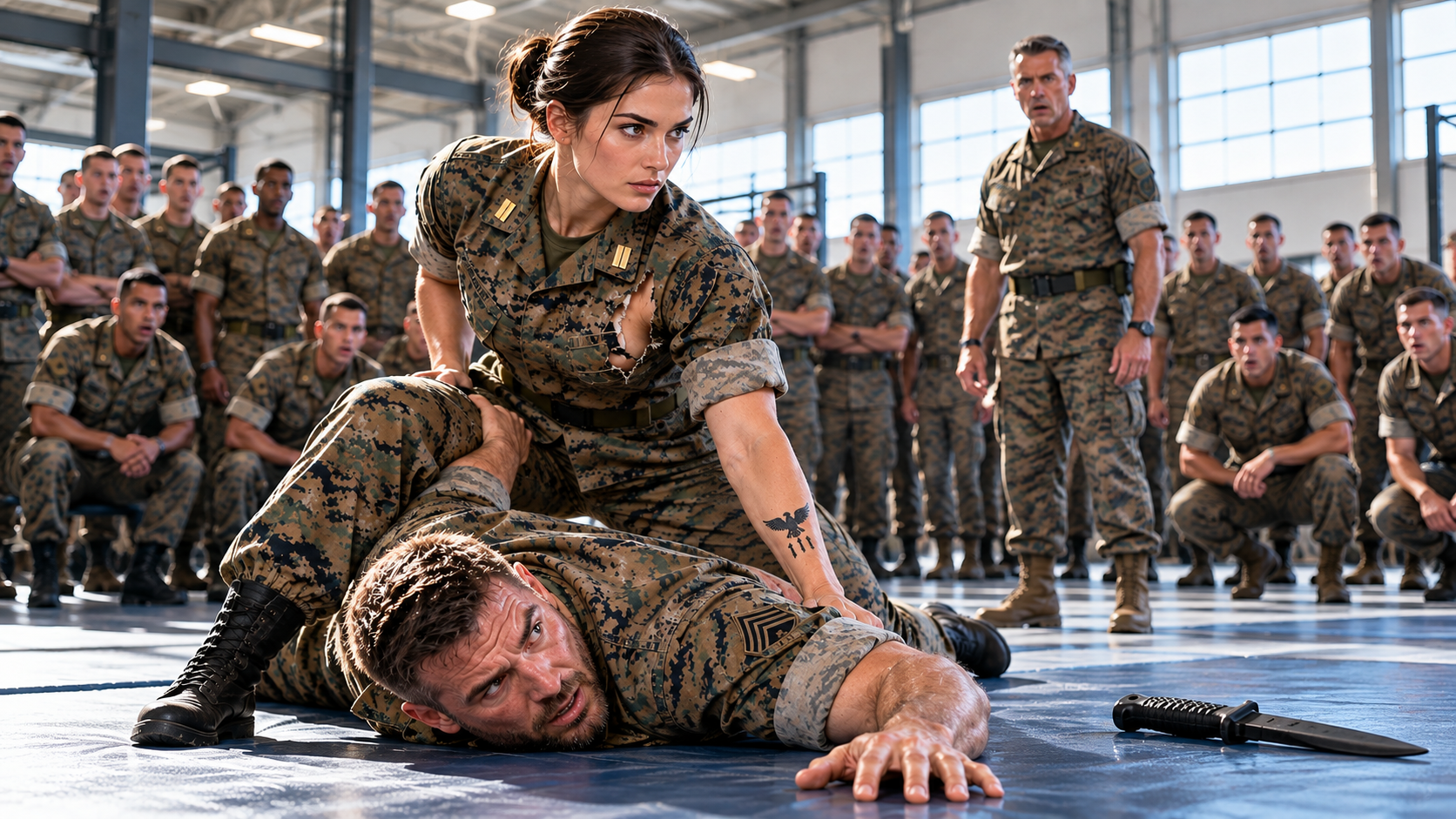
The rubber-edged training knife pressed into the soft space beneath my jaw.
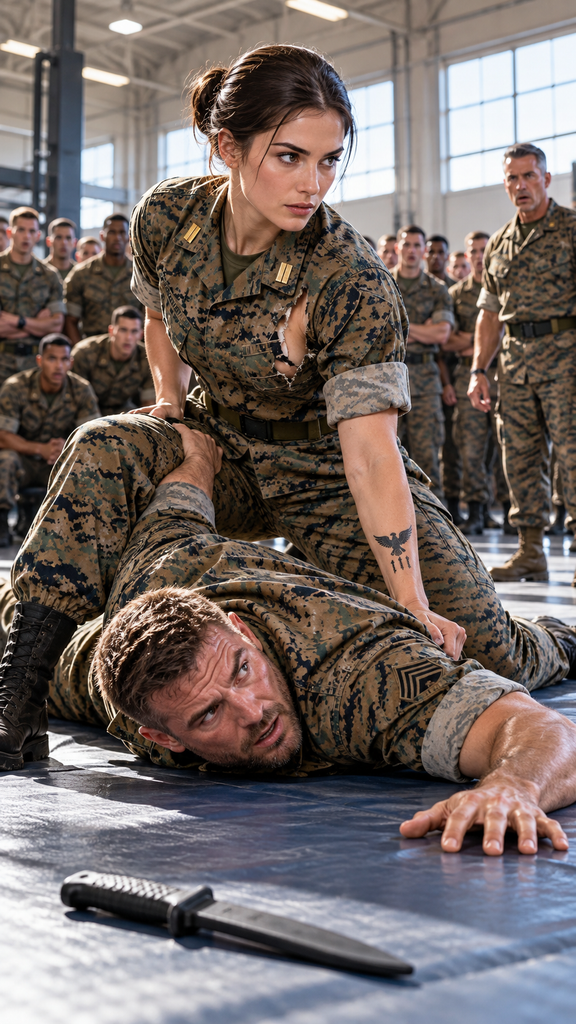
Gunnery Sergeant Kyle Vance had one knee across my ribs and most of his weight driving my right shoulder into the mat. His forearm locked my left arm against the floor. Thirty Marines stood around us in a broken semicircle, breathing hard from the morning drills, watching without saying a word.
Some looked uncomfortable.
A few looked entertained.
Most were waiting to see what I would do.
I heard somebody near the back laugh under his breath.
Then another voice said, “Don’t cry, Lieutenant.”
A pause.
“Cry baby.”
Vance smiled.
Not much.
Just enough.
I stared at the ceiling.
Exposed ductwork.
Fluorescent lights.
One flickering tube three rows down.
I could smell rubber matting, old sweat, disinfectant, and the faint metallic bite of blood where I had split the inside of my lip a minute earlier.
Vance increased the pressure on my ribs.
“Problem, Lieutenant?”
I took a slow breath through my nose.
“No, Gunnery Sergeant.”
“Good.”
The knife moved.
At first I thought he was repositioning it.
Then I heard fabric tear.
The blunted training blade slipped beneath the edge of my utility blouse near the collar and dragged sideways.
Rip.
A line opened across the front of my uniform.
There was a strange quality to the silence after that.
The Marines around us knew stress training.
They understood controlled aggression.
They understood instructors pushing students until fear stripped away whatever confidence they had carried onto the floor.
But this was different.
Everyone knew it.
No one said it.
Vance looked down at the torn fabric.
“Combat doesn’t care about your uniform.”
I said nothing.
He hooked the blade beneath the material again.
Another tear.
This time farther down.
The seam near my shoulder split.
My sleeve shifted.
And the small black eagle tattoo on the inside of my left wrist became visible.
Its wings were spread.
Its talons extended.
Four tiny marks sat beneath it.
Nobody in that room knew what they meant.
I did.
Four names.
Four voices.
Four reasons I had learned, a long time ago, that panic wasted oxygen.
I looked at the tattoo.
Then at Vance.
He interpreted my silence as fear.
That was his mistake.
His second mistake had been pinning my wrist too high.
His third was allowing his weight to drift forward every time he tried to intimidate me.
And his fourth—
The important one—
was believing I had been trying to escape.
I hadn’t.
For the last nineteen seconds, I had been measuring him.
My pulse was steady.
The knife was plastic and rubber composite, but the pressure against my throat was real.
His right knee carried approximately two-thirds of his weight.
His left foot was planted too close to my hip.
His elbow flared every time he leaned down to speak.
His grip was strong.
His balance wasn’t.
I knew exactly what I could do.
The question was whether I should do it.
That question was why I had tolerated the previous four days.
My name is First Lieutenant Mara Tannin.
At twenty-six years old, I had learned that people rarely saw what was in front of them.
They saw paperwork.
Rank.
Age.
Gender.
Ribbon racks.
Job codes.
They saw whatever allowed them to make a decision quickly.
My official record told a simple story.
Logistics officer.
MOS 0402.
No combat deployment decorations.
No impressive row of ribbons.
Temporary reassignment to Marine Corps Base Quantico under a headquarters-directed pilot program.
Incoming instructor.
Female.
Young.
Unproven.
An administrative problem nobody at the Martial Arts Center of Excellence had requested.
That was the story Gunnery Sergeant Vance had read.
It was not false.
It simply wasn’t complete.
There were fourteen months missing from the version he had been permitted to see.
Fourteen months inside a Marine Forces Special Operations Command pilot program that existed mostly in restricted reports, compartmented funding lines, and orders written broadly enough that anyone glancing at them would assume I had been somewhere moving equipment from one warehouse to another.
Six men had washed out during the selection cycle.
I hadn’t.
No one in that warehouse knew that.
And until Vance put the knife to my throat, I had intended to keep it that way.
Four days earlier, I had reported to Quantico at 0545.
The Martial Arts Center of Excellence looked exactly the way serious training facilities usually did: unimpressive from the outside, brutally functional within.
High ceilings.
Industrial lights.
Exposed ventilation.
Rows of heavy bags.
Grappling dummies.
Weapon racks.
Mat space large enough to swallow platoons.
Thirty infantry Marines were cycling through ground-fighting drills when I entered.
Gunnery Sergeant Vance stood at the front.
He was thirty-five and built like someone had designed a human being specifically to carry ammunition uphill.
Thick shoulders.
Heavy forearms.
Close-cut hair starting to gray near the temples.
Eight deployments over nearly two decades.
Two Purple Hearts.
Fallujah.
Sangin.
A Silver Star almost nobody had ever heard him discuss.
Third-degree black belt instructor.
The kind of Marine younger men copied without realizing they were doing it.
He looked at me once.
His face remained professional.
His eyes did not.
You don’t belong here.
Lieutenant Colonel Marcus Breerlin, director of the program, came out of his office carrying black coffee.
“Tannin?”
“Yes, sir.”
He shook my hand.
His grip was brief.
Not disrespectful.
Not welcoming either.
“You’re early.”
“My orders said zero six.”
“They did.”
His eyes moved toward my ribbon rack.
There wasn’t much to look at.
Then back to my face.
“We received the directive from headquarters.”
Directive.
Not request.
I understood the distinction.
“So I was told, sir.”
“Advanced close-protection techniques. Urban confined-space applications. Modified control methods.”
“Yes, sir.”
Breerlin took a drink.
“Nobody here asked for another curriculum.”
“I understand.”
“And you’re supposed to teach it.”
“Yes, sir.”
Vance had walked close enough to hear that answer.
He looked from Breerlin to me.
“Lieutenant.”
“Gunnery Sergeant.”
He glanced at my hands.
People who fight for a living often look at hands.
Mine didn’t tell him what he wanted to know.
No swollen knuckles.
No dramatic scars.
No thick grappler’s fingers.
Just two thin white lines near the base of my right thumb and another across my palm.
“You done MCMAP instructor training before?”
“Not through this schoolhouse.”
His jaw shifted.
“So no.”
“Not through this schoolhouse,” I repeated.
The Marines nearest us went quiet.
Vance smiled.
It wasn’t friendly.
“Understood.”
I knew immediately what the next few days would be.
Not harassment.
Not yet.
Testing.
Institutions had immune systems.
Introduce something unfamiliar, and the first reaction was resistance.
I had expected that.
What I hadn’t expected was how personal Vance intended to make it.
On my second morning, he paired me with Staff Sergeant Cole Mercer, six foot two and nearly two hundred thirty pounds.
“Standard ground escape,” Vance said.
Mercer looked uncomfortable.
“Gunny—”
“You heard me.”
I stepped onto the mat.
Mercer lowered his voice.
“Ma’am, I can keep it controlled.”
“I know.”
Vance heard us.
“No favors.”
Mercer’s expression tightened.
I nodded once.
“Do what he said.”
He came at me hard.
Not maliciously.
Professionally.
He outweighed me by seventy pounds.
He was also experienced enough not to underestimate me completely.
That made the exchange useful.
For ninety seconds, I used only techniques from the standard curriculum.
Nothing more.
I escaped twice.
Lost position once.
Recovered.
Vance watched everything.
When it ended, he folded his arms.
“That supposed to impress us?”
“No.”
“What’s it supposed to do?”
“Answer the drill requirement.”
A couple Marines looked down to hide smiles.
Vance noticed.
His eyes hardened.
The next day he escalated.
Two-on-one control.
Wall pressure.
Weapon-retention scenarios.
Blind-entry reaction exercises.
He kept changing the conditions after the drill had started.
I didn’t complain.
I didn’t need to.
I documented everything.
Time.
Scenario.
Safety violation.
Curriculum deviation.
I had learned during those missing fourteen months that memory became political when people were afraid of consequences.
Documentation did not.
By the fourth morning, the tension inside the building had become physical.
You could feel it.
Breerlin stood near his office longer than usual.
Vance talked less.
The Marines watched me more closely.
At 0730, Vance announced a stress evaluation.
I knew immediately it wasn’t on the scheduled training plan.
“Lieutenant Tannin,” he said. “Center mat.”
I stepped forward.
“What scenario?”
“Uncontrolled detention.”
“How many aggressors?”
“However many it takes.”
There was a small shift around the room.
Breerlin looked up from his clipboard.
“Gunny.”
Vance turned.
“Sir?”
Breerlin hesitated.
That hesitation mattered.
“Keep it within training standards.”
“Of course, sir.”
Then Vance looked at me.
“Unless the lieutenant wants special accommodations.”
“No.”
“Good.”
He handed one Marine a training knife.
Then changed his mind and took it himself.
That was when I realized this was no longer about curriculum.
It was about authority.
Four minutes later, I was on my back with his knee crushing my ribs.
Then the knife touched my throat.
Then my uniform tore.
And my eagle appeared.
I could hear one of the younger Marines breathing too fast nearby.
Vance lowered his face toward mine.
“You still think you’re qualified to teach my Marines?”
That sentence settled something inside me.
Not anger.
Anger would have been easier.
What I felt was disappointment.
Because I finally understood him.
Vance wasn’t trying to injure me.
He was trying to expose me.
In his mind, he was protecting the schoolhouse.
Protecting his Marines from some headquarters experiment forced onto them by people who had never been where he had been.
That motive didn’t excuse what he was doing.
But it explained it.
And once I understood the reason, the decision became simple.
I looked directly into his eyes.
“I was waiting for you to ask.”
His smile disappeared.
I moved.
One moment Vance was above me.
The next, his knife hand was no longer at my throat.
I shifted beneath his center of gravity, redirected the trapped arm, turned through the pressure instead of fighting against it, and let his own forward weight finish what I had started.
He hit the mat hard enough to force the air from his lungs.
Before anyone around us understood the reversal, I was behind him.
His wrist was controlled.
His shoulder was locked.
The training knife lay six feet away.
My knee rested between his shoulder blades.
Not crushing.
Not injuring.
Just enough.
The entire movement lasted less than two seconds.
Thirty Marines froze.
Someone whispered, “Jesus.”
Vance tried to move.
I tightened the position by perhaps half an inch.
He stopped.
I leaned closer.
My voice was quiet.
“You were right about one thing, Gunnery Sergeant.”
His cheek was against the mat.
“What’s that?”
“Combat doesn’t care about my uniform.”
Then Lieutenant Colonel Breerlin said the four words that changed everything.
“Tannin. Release him. Now.”
I let go immediately.
And when I stood, I saw Breerlin staring not at Vance—
but at the eagle on my wrist.
His face had gone pale.
Because unlike everyone else in the room, he seemed to recognize it.
And suddenly I knew my secret was about to stop being mine.
PART 2: THE FOUR NAMES
Nobody moved for three full seconds.
That doesn’t sound like much.
In a room full of Marines trained to react immediately, three seconds feels enormous.
Vance rolled onto one knee.
His expression was almost impossible to read.
Shock came first.
Then anger.
Then humiliation.
But beneath all of it was something more disciplined.
Analysis.
He was replaying what had happened.
Trying to identify the moment he had lost control.
Trying to understand how a logistics lieutenant he had spent four days treating like an unwanted civilian consultant had reversed a dominant position so quickly he hadn’t even had time to brace.
I stepped backward.
My blouse hung open at the torn seam.
The eagle on my wrist remained exposed.
Breerlin stared at it.
“Lieutenant,” he said, “my office.”
Vance stood.
“Sir, I—”
“My office. Both of you.”
Nobody spoke while we crossed the floor.
I could feel thirty pairs of eyes following us.
Breerlin closed his office door.
He set his coffee down.
Then he looked at my torn uniform.
His jaw tightened.
“Gunny, did you cut her blouse as part of an approved training method?”
Vance stood rigid.
“No, sir.”
“Was physical contact with the throat approved?”
“Controlled training-weapon pressure, sir.”
“That is not what I asked.”
“No, sir.”
Breerlin turned to me.
“Are you injured?”
“Bruised ribs. Split lip. Nothing requiring evacuation.”
“That’s not your determination to make.”
“No, sir.”
His frustration sharpened.
Then his eyes dropped again to my wrist.
“Where did you get that?”
I pulled my sleeve down.
“It’s personal.”
“Tannin.”
“With respect, sir, it’s personal.”
Breerlin stared at me.
Vance looked between us.
“What does the tattoo have to do with anything?”
Breerlin didn’t answer him.
Instead he walked to his desk, opened a drawer, and took out my orders.
Not the summary packet.
The sealed supplemental envelope I had handed him when I arrived.
It was still unopened.
I had noticed that on day one.
The instructions printed across the front were simple.
COMMAND REVIEW AUTHORIZED IF OPERATIONAL QUALIFICATIONS ARE CHALLENGED.
He had never opened it because he hadn’t believed my qualifications required investigation.
He had believed the headquarters directive was politics.
Vance believed the same thing.
Now Breerlin slid a finger beneath the seal.
I said, “Sir.”
He stopped.
“If you open that, dissemination restrictions apply.”
“I’m aware.”
“Gunnery Sergeant Vance isn’t cleared for everything in it.”
Vance’s eyes narrowed.
Breerlin looked at him.
“Wait outside.”
“Sir—”
“Outside.”
Vance opened the door and left.
For the first time since I had arrived, he didn’t look angry.
He looked uncertain.
Breerlin opened the envelope.
I watched him read.
The first page changed nothing in his face.
The second did.
By the third, he sat down.
I looked toward the blinds.
Thirty Marines were pretending not to watch the office.
Breerlin read for several minutes.
Finally he put the packet on his desk.
“Fourteen months?”
“Yes, sir.”
“You went through the full selection evaluation?”
“Yes.”
“And the confined-space package?”
“Yes.”
“Close protection?”
“Yes.”
“Resistance training?”
“Yes, sir.”
He leaned back.
“How many completed the program?”
“I’m not authorized to discuss personnel numbers beyond the document.”
He glanced down.
“It says attrition was sixty percent.”
“Yes, sir.”
“And your logistics assignment?”
“Was real.”
“But not complete.”
“No.”
Breerlin rubbed his forehead.
“Why the hell didn’t headquarters tell me?”
“They did.”
His eyes lifted.
I nodded toward the envelope.
His expression hardened, but not at me.
That was the moment I knew he understood his own mistake.
The information had been in his possession for four days.
He had simply decided he didn’t need to know it.
“Why hide your experience?” he asked.
“I didn’t.”
“You didn’t volunteer it.”
“My orders didn’t authorize me to walk onto a training floor and announce restricted qualifications to people who didn’t need them.”
“You could have told Vance you had advanced experience.”
“I did.”
“When?”
“First day. He asked if I had been through this schoolhouse. I said no. He didn’t ask whether I had been through anything else.”
Breerlin closed his eyes briefly.
That answer did not improve his mood.
He stood and looked through the blinds.
Vance waited outside.
The rest of the Marines had resumed moving equipment, but nobody’s attention was on the equipment.
“What happened out there?” Breerlin asked.
“He exceeded the scenario.”
“Why didn’t you stop him earlier?”
“Because I wanted to know whether he was testing the curriculum or testing me.”
“And?”
“Me.”
Breerlin looked at the torn blouse again.
“You could have injured him.”
“Yes.”
“But you didn’t.”
“No.”
“How much were you holding back?”
I didn’t answer.
He looked at me.
“That much?”
“Enough.”
A long silence.
Then he pointed toward the eagle beneath my sleeve.
“I saw a version of that mark once.”
My chest tightened.
“Where?”
“Kandahar. 2018. A team passed through our facility. One of them had it on his gear.”
I said nothing.
“What do the four marks mean?”
My fingers closed automatically around my wrist.
Four names returned to me.
Not as gravestones.
As voices.
One laughing because I had burned coffee so badly he claimed it violated the Geneva Conventions.
One correcting my footwork for the hundredth time.
One telling me the fastest way to lose control of a fight was to make it personal.
One sitting beside me after a brutal evaluation and saying, You don’t need to be stronger than everyone. You need to still be thinking after everyone else stops.
“They’re mine,” I said.
Breerlin watched me for a moment.
Then nodded.
He did not ask again.
That earned more respect from me than anything he had done since I arrived.
There was a knock.
Breerlin opened the door.
Vance stepped inside.
He had regained his composure.
“Sir.”
Breerlin looked at him.
“How long have we served together?”
“Three years here, sir. Twelve total including prior assignments.”
“Have I ever questioned your commitment to training Marines properly?”
“No, sir.”
“I’m going to question your judgment today.”
Vance’s face did not change.
“Yes, sir.”
“You took a professional disagreement and turned it into a personal test.”
Vance looked at me.
“She wasn’t demonstrating what she claimed she could teach.”
“I wasn’t permitted to,” I said.
His head snapped toward me.
“What?”
“The techniques headquarters sent me here to integrate require instructor authorization before open demonstration.”
“Convenient.”
Breerlin slapped the supplemental packet onto the desk.
Vance stopped speaking.
Breerlin leaned forward.
“I’ve reviewed her authorization.”
Something passed through Vance’s expression.
“Sir?”
“She is qualified.”
“How qualified?”
“That is not information you need.”
Vance’s eyes moved back to me.
I saw the exact second his assumptions began breaking apart.
But men like Vance did not abandon beliefs easily.
That was partly why they survived.
It was also why they could become dangerous when they were wrong.
He looked at my torn uniform.
Then at my face.
“I still had control until she used something outside the stated drill.”
“No,” I said.
Breerlin gave me a warning look.
But Vance turned fully toward me.
“No?”
“You had pressure. Not control.”
His jaw tightened.
“Difference?”
“Control means the other person has no useful options.”
“I had a knife on your throat.”
“You had a training knife.”
“In the scenario, assume it’s real.”
“Then in the scenario, you would have been less aggressive with it.”
His eyes narrowed.
“Why?”
“Because a real blade punishes sloppy pressure.”
The room went very quiet.
I continued.
“You were trying to frighten me, not cut me. That made your intent predictable.”
Vance took one step closer.
“Run it again.”
Breerlin said, “No.”
Neither of us looked away from the other.
Vance repeated, “Run it again. Same position.”
“You already have your result.”
“I want to understand it.”
That changed something.
The anger remained.
The embarrassment remained.
But beneath them was the quality I had respected in him before any of this started.
A professional wanted to know why he had failed.
I looked at Breerlin.
“Sir?”
He exhaled.
“No blades. No spectators. Controlled demonstration only.”
Vance nodded.
We returned to the mat.
The Marines stopped pretending not to watch.
Breerlin pointed at them.
“Resume training.”
Nobody resumed training.
He sighed.
“Fine. Watch. Maybe somebody learns something.”
Vance and I reset.
Same position.
His knee over my ribs.
My shoulder trapped.
His hand controlling my wrist.
No knife.
“Ready?” he asked.
“Yes.”
He adjusted.
I felt the difference immediately.
He was correcting his previous mistakes.
Good.
“Go.”
I moved.
He anticipated the turn.
Blocked it.
Shifted his base.
For the first time that morning, I smiled.
He noticed.
“What?”
“Better.”
Then I changed direction.
Three seconds later, I was standing and he was on his back.
This time the room made noise.
Not laughter.
Not cheering.
Just the collective reaction of thirty men realizing something they had believed was impossible had happened twice.
Vance sat up.
He looked at me.
“How?”
I extended a hand.
He stared at it before taking it.
“You were defending the move you thought I used before.”
“And?”
“So I used the defense you gave me.”
He got to his feet slowly.
One Marine near the wall said, “Gunny, respectfully, what the hell?”
Several men laughed.
Vance actually almost smiled.
Almost.
Then he looked at me.
“Again.”
We ran it again.
And again.
On the fifth attempt, he stopped the reversal.
On the sixth, I countered his correction.
On the seventh, neither of us finished cleanly.
Something shifted in the room.
Not acceptance.
Not yet.
But curiosity replaced contempt.
That was enough.
Then Breerlin’s phone rang.
He answered.
“Breerlin.”
His expression changed.
“Yes, sir.”
He looked at me.
Then at Vance.
“No, sir. There was an incident.”
Pause.
“Yes, sir.”
Another pause.
His eyes closed.
“Understood.”
He hung up.
“Who was that?” Vance asked.
Breerlin looked at me.
“Headquarters.”
My stomach tightened.
“What do they know?”
“Apparently enough.”
He picked up my torn collar between two fingers and let it fall.
“They want statements from everyone present.”
Vance went still.
Breerlin’s voice became flat.
“And they want to know why an instructor under direct headquarters orders was restrained beyond approved limits while her uniform was being cut open in front of thirty Marines.”
Nobody laughed after that.
Because the training-floor dispute had just become an official investigation.
And this time, Gunnery Sergeant Vance was the one with nowhere to move.
PART 3: WHAT THEY THOUGHT THEY KNEW
By noon, the building felt like a different place.
Conversations stopped when I walked past.
Marines who had barely looked at me four days earlier suddenly found reasons to make eye contact.
Some appeared embarrassed.
Some curious.
A few looked angry on Vance’s behalf.
I understood that too.
Vance had taught many of them.
Deployed with some.
Mentored others.
Whatever he had done to me that morning did not erase the years during which he had been a good Marine.
People are easier to hate when they are entirely bad.
Vance wasn’t.
That made what happened more complicated.
I changed into a spare blouse.
The torn one went into an evidence bag because the investigating officer requested it.
That bothered me more than I expected.
I had worn damaged uniforms before.
Mud.
Fuel.
Blood.
Once, smoke so thick the fabric smelled burned after three wash cycles.
But watching somebody seal that blouse in transparent plastic made the morning real in a way bruised ribs hadn’t.
I sat alone in a medical examination room while a corpsman checked me.
“Pain when breathing?”
“Only deep inhalation.”
“Any dizziness?”
“No.”
“Nausea?”
“No.”
He pressed near my side.
Pain flashed sharp enough to make my vision brighten.
I inhaled.
He stopped.
“That hurt.”
“I’ve had worse.”
“That wasn’t the question.”
I almost smiled.
“No fractures,” he said after examining me. “Likely bruising. I’m documenting everything.”
“Good.”
He glanced toward my wrist.
The eagle was visible because I had rolled the sleeves.
He didn’t ask.
I appreciated that.
My official statement took forty-seven minutes.
I wrote facts.
Not interpretations.
Vance initiated unscheduled stress evaluation.
Parameters changed during execution.
I verbally confirmed participation.
Restraint exceeded normal pressure.
Training blade applied near throat.
Uniform deliberately cut.
Verbal comments included sweetheart and cry baby from unidentified personnel.
I executed controlled reversal.
No retaliatory strikes.
No injuries observed to Gunnery Sergeant Vance.
I read the statement twice before signing.
People expected anger to make me exaggerate.
I refused to give them that excuse.
At 1600, Breerlin called me back into his office.
Vance was already there.
So was Sergeant Major Daniel Keene, the senior enlisted advisor for the training command.
Keene looked about fifty, though he was probably younger.
He had the calm face of a man who had spent decades listening to young Marines explain why something obviously stupid had seemed like a good idea ten minutes before they did it.
He gestured toward a chair.
“Lieutenant.”
I sat.
Vance remained standing.
Keene studied the statements.
“Thirty-one witnesses,” he said.
Nobody answered.
“Thirty-one statements. Know what’s remarkable?”
He looked at Vance.
“Twenty-eight of them describe almost exactly the same event.”
Vance said, “I understand.”
“Three tried to soften it.”
Vance’s jaw tightened.
“I didn’t ask anyone to do that.”
“I know. Which is why they’re not in more trouble.”
Keene placed the papers down.
“Gunny, tell me why.”
Vance breathed in slowly.
“I believed Lieutenant Tannin’s assignment was politically driven.”
“Based on what?”
“Her record.”
“Her visible record.”
“Yes, Sergeant Major.”
“And you thought?”
“That we were being told to accept instruction from someone who hadn’t earned the authority to teach it.”
I watched him.
There was no excuse in his voice.
Just explanation.
Keene asked, “So you tested her.”
“Yes.”
“For four days.”
“Yes.”
“And when she didn’t fail?”
Vance was silent.
Keene leaned forward.
“You made the test harder.”
“Yes.”
“And when she still didn’t fail?”
Vance looked at the floor once.
“I crossed a line.”
There it was.
Not an apology.
Not yet.
But the first honest sentence he had spoken about the morning.
Keene looked at me.
“Lieutenant, anything?”
“Yes, Sergeant Major.”
Vance raised his eyes.
“I think Gunnery Sergeant Vance should remain part of the integration program.”
That surprised everyone.
Including Vance.
Breerlin stared at me.
Keene said, “Explain.”
“He understands the current curriculum better than anyone I’ve seen here. Marines trust him. If the new material works against somebody with his experience, people will take it seriously.”
Vance’s face hardened.
“You think I need charity?”
“No.”
“Sounds like it.”
“I think removing you would be easier than making you learn from what happened.”
That landed.
Keene’s mouth twitched.
Breerlin looked down, possibly to hide a reaction.
I continued.
“What happened this morning was wrong. I’m not asking anyone to ignore it. But the original problem wasn’t that Gunny Vance doesn’t care about standards. It’s that he cares so much he decided he was the only person qualified to define them.”
Vance stared at me.
I met his eyes.
“You wanted proof. Now you have it.”
He said quietly, “And the knife?”
“That wasn’t about proof anymore.”
His face tightened.
“No.”
“No.”
Keene let the silence sit between us.
Then he collected the statements.
“Administrative findings will proceed independently. Training recommendation noted.”
He stood.
“Lieutenant, you’re dismissed.”
I rose.
“Tannin.”
I stopped at the door.
Vance spoke without looking directly at me.
“The cry baby comment wasn’t mine.”
“I know.”
His eyes lifted.
“How?”
“You were close enough that I knew where your voice was.”
He nodded once.
“That doesn’t make the rest better.”
“No.”
Another nod.
I left.
At 0530 the next morning, I entered the training facility expecting half the room to treat me like a witness in an investigation.
Instead, twenty-nine Marines were already present.
One was missing.
The youngest corporal in the group, a twenty-two-year-old named Jason Pike, stood when I walked in.
“Ma’am.”
“Corporal.”
His cheeks reddened.
“I made the cry baby comment.”
The room went still.
I set my bag down.
“Why are you telling me?”
“Because Gunny’s taking heat and I don’t want it attributed to him.”
I studied him.
He looked miserable.
“Why did you say it?”
He swallowed.
“Everybody was laughing before. Not right then, but… the whole week. About headquarters sending us a female lieutenant who was supposed to show Gunny how to fight.”
A few Marines shifted.
Pike continued.
“I thought it was funny.”
“Did you still think it was funny when he cut my uniform?”
“No, ma’am.”
“Did you tell him to stop?”
“No.”
“Why not?”
He looked down.
“Because he’s Gunny Vance.”
There was the real lesson.
Not combat.
Authority.
I looked around the room.
“How many of you knew the drill had crossed the line before I reversed him?”
Nearly every hand went up.
“How many said something?”
No hands.
I nodded.
“Good.”
They looked confused.
Pike frowned.
“Good, ma’am?”
“Now we know what today’s class is about.”
At 0600, Breerlin entered.
Vance came in behind him.
No one had told me he was coming.
He wore his uniform perfectly.
His expression was unreadable.
Breerlin addressed the formation.
“Gunnery Sergeant Vance has been temporarily relieved as lead instructor pending final administrative review.”
Nobody moved.
“He remains authorized to participate in training.”
That sentence caused several heads to turn.
Vance walked to the back of the formation.
Not the front.
I understood what that cost him.
Breerlin looked at me.
“Lieutenant Tannin, you have the floor.”
I stepped onto the mat.
Thirty Marines looked back.
I could have started with technique.
Instead I held up a training knife.
“Yesterday, most of you knew something was wrong before anyone said anything.”
Nobody breathed loudly.
I continued.
“The most dangerous person in a room is not always the person holding a weapon.”
Vance watched me from the rear.
“Sometimes it’s the person everybody else has decided they aren’t allowed to question.”
Pike lowered his eyes.
I shook my head.
“Corporal. Look at me.”
He did.
“You admitted what you said. That matters. But courage after the fact is not the same as courage during the moment.”
“Yes, ma’am.”
“Remember that.”
“Yes, ma’am.”
I put the knife down.
“Now we train.”
For the next three hours, I showed them pieces of the curriculum I had been sent to integrate.
Not classified methods.
Not magic.
That was the first myth I wanted destroyed.
Advanced fighting was rarely about secret moves.
It was about decisions made under pressure.
Position.
Timing.
Awareness.
Knowing when strength mattered and when strength only made you predictable.
I demonstrated how narrow spaces changed movement.
How protecting another person changed priorities.
How a hallway, doorway, vehicle, or concrete wall eliminated assumptions created by open mat training.
Vance said almost nothing.
But he missed nothing.
When I explained a principle, he tested it mentally.
When I demonstrated a position, he looked for the failure point.
Eventually he raised his hand.
The room noticed.
“Yes, Gunnery Sergeant?”
“That transition fails if the second aggressor closes from the opposite side.”
“Sometimes.”
His eyebrow rose.
I gestured.
“Show me.”
He stepped onto the mat.
Not aggressively this time.
Professionally.
We ran the scenario.
He found the weakness.
I adjusted.
He countered.
The Marines leaned forward.
This was what should have happened on day one.
Not obedience.
Not humiliation.
Challenge.
Question.
Proof.
Adaptation.
At the end, Vance stood breathing hard.
“That version works.”
“Better?”
“Better.”
I nodded.
“Then that’s the version we teach.”
Something passed through the group.
They had expected me to defeat him again.
Instead, I let him improve the technique.
Because this had never been about winning.
Vance seemed to understand that before anyone else.
After training, he approached me alone.
“I owe you an apology.”
I looked at him.
“Yes.”
He almost smiled at the lack of mercy.
“I was wrong about why you were here.”
“Yes.”
“I thought your orders were written by somebody trying to make a statement.”
“They were.”
That surprised him.
I continued.
“The statement was that we had identified gaps in training.”
He exhaled through his nose.
“Fair.”
He looked at my wrist.
“What does the eagle mean?”
The question tightened something behind my ribs that had nothing to do with bruising.
I should have said personal.
I should have ended it there.
Instead, maybe because he had finally asked rather than assumed, I rolled my sleeve back.
Four small marks beneath the eagle.
“Four people taught me things I didn’t understand until later.”
“Dead?”
I met his eyes.
He knew from my silence.
“I’m sorry.”
“So am I.”
“What happened?”
“I can’t tell you most of it.”
“I figured.”
“One of them used to say you should never confuse surviving a bad decision with making a good one.”
Vance looked toward the mat where he had pinned me.
“That aimed at me?”
“Today?”
I lowered the sleeve.
“Yes.”
He nodded.
“I probably earned it.”
Before I could answer, Lieutenant Colonel Breerlin came out of his office carrying a folder.
“Tannin. Vance.”
We turned.
His face told me immediately that the administrative review had reached a decision.
“Inside.”
Vance and I followed.
Breerlin closed the door.
Then he handed Vance a single sheet of paper.
Vance read it.
His expression changed.
Breerlin said, “Headquarters has made its determination.”
And for the first time since the knife touched my throat, I realized the consequences were going to reach far beyond one morning on a mat.
PART 4: THE PRICE OF ASSUMPTIONS
Vance read the page twice.
Then he set it on Breerlin’s desk.
Temporary relief from lead-instructor duties.
Formal reprimand for exceeding approved training parameters.
Mandatory remedial instructor certification.
Retention subject to command review.
No reduction in rank.
No discharge.
No career-ending punishment.
Consequences, not destruction.
I felt relieved.
I didn’t show it.
Vance stood at attention.
“Understood, sir.”
Breerlin looked at him.
“There’s more.”
Vance waited.
“The reviewing authority specifically considered Lieutenant Tannin’s statement recommending your continued participation.”
Vance glanced at me.
I said nothing.
Breerlin continued.
“Your record matters. So does what happened. One does not erase the other.”
“Yes, sir.”
“You’ll spend the remainder of the integration period assigned under Lieutenant Tannin’s instructional authority.”
That one hurt.
I could see it.
Not because I was a woman.
Not entirely.
Because three days earlier he had believed I had no right to teach in his schoolhouse.
Now, officially, he would answer to me on the mat.
“Yes, sir.”
Breerlin turned toward me.
“And headquarters extended your temporary assignment.”
“For how long?”
“Ninety days.”
I stared at him.
“My original orders were twenty-one.”
“They were.”
“Why the extension?”
“Yesterday’s training reports.”
I frowned.
“What about them?”
“The Marines’ performance improved.”
“After one day?”
“Enough for somebody in Washington to become enthusiastic.”
I closed my eyes for half a second.
Vance made a low sound that might have been a laugh.
Breerlin looked at him.
“Something amusing?”
“No, sir.”
“Good.”
He dismissed us.
In the hallway, Vance walked beside me.
“Ninety days.”
“Apparently.”
“You happy about that?”
“No.”
That time he did laugh.
It surprised me.
For the first time, I heard what his Marines heard when he wasn’t angry.
“You’re starting to fit in,” he said.
“Don’t ruin my reputation.”
The next six weeks changed the schoolhouse more than either of us expected.
Not because I transformed everyone into some secret breed of operator.
That wasn’t possible.
It wasn’t even the goal.
The change was smaller.
Which made it more useful.
We stopped treating technique as doctrine handed down from a mountain.
We tested it.
Vance became the harshest critic of every method I introduced.
And eventually, the most effective partner I had.
He would stand in front of a class and say, “Lieutenant, that assumes the Marine has space.”
I would reply, “Then remove the space.”
We would push the scenario against a wall.
Or between training barriers.
Or inside a mock vehicle.
If it failed, we changed it.
If it survived, we kept it.
The Marines began challenging both of us.
Good.
That was what competent instructors were supposed to create.
Not obedience.
Thinking.
Corporal Pike changed too.
He stopped being the loudest man in the room.
Started becoming one of the most observant.
During one scenario, a staff sergeant ignored a safety call because adrenaline had taken over.
Pike immediately stepped in.
“Stop!”
Everything froze.
The staff sergeant glared at him.
Pike’s face went pale.
But he didn’t back down.
“That was a safety call.”
I watched from across the mat.
Vance looked at me.
Neither of us said anything.
We didn’t need to.
Later, Pike approached me.
“Ma’am?”
“Yes?”
“That what you meant?”
“About what?”
“Courage during the moment.”
I nodded.
“Yes.”
He smiled slightly.
“Feels terrible.”
“It usually does.”
By the eighth week, the investigation had become old news.
My torn uniform remained stored somewhere in an administrative evidence locker.
Nobody called me cry baby anymore.
Nobody called me sweetheart.
But the more comfortable people became with me, the more questions came.
Where had I learned this?
Who had trained me?
Why had my service record looked so ordinary?
Why did I have advanced qualifications but almost no decorations?
I answered what I could.
Which wasn’t much.
That irritated people.
Eventually Vance told them to stop asking.
“If the lieutenant could tell you,” he said, “she would have already bored you to death with it.”
I threw a marker at him.
He caught it.
The class laughed.
It was easy enough to forget how we had started.
Until the day Sergeant Major Keene brought in a group of visiting instructors.
One of them was older.
Gray hair at the temples.
Civilian clothes.
No visible rank.
He entered while I was teaching.
I stopped mid-sentence.
My body recognized him before my conscious mind did.
Not because I knew him well.
Because I had seen him once during those fourteen months.
A hallway.
A closed briefing.
Four instructors standing at attention.
The eagle insignia stamped on the corner of a folder.
My left wrist suddenly felt hot beneath my sleeve.
The visitor looked at me.
Then down at my wrist.
“Tannin.”
“Sir.”
Vance noticed.
So did Keene.
The visitor stepped closer.
“How many?”
My throat tightened.
“Four.”
His eyes changed.
He knew what I meant.
He nodded once.
“Still carrying them?”
“Every day.”
That was all.
No explanation.
No dramatic reveal.
No classified confession.
Just two sentences.
But Vance understood enough.
After the visitor left, he found me in the equipment room.
“That man knew the tattoo.”
“Yes.”
“Was he part of the program?”
“I can’t answer that.”
He leaned against the doorway.
“You know what I thought the first morning?”
“I have a fairly detailed idea.”
“I thought you were hiding behind your rank.”
I folded a training vest and set it on the shelf.
“I know.”
“But you were hiding something else.”
“I wasn’t hiding.”
He corrected himself.
“Protecting.”
That word stopped me.
I looked at him.
“Yes.”
He nodded.
“I get that.”
Of course he did.
A man with eight deployments and a Silver Star he never discussed understood better than most people that silence and dishonesty were not the same thing.
He walked toward the door.
“Gunny.”
He stopped.
“You asked once what the four marks mean.”
He waited.
I touched my wrist.
“They’re not a unit symbol.”
“I figured.”
“They’re names.”
He said nothing.
“They were better than me at different things. Stronger. Faster. More experienced. One of them couldn’t shoot a decent pistol group on his first day to save his life, although he would have denied that until death.”
Vance smiled faintly.
I continued.
“The eagle is mine. The marks are theirs.”
“You earned the right to carry them.”
That sentence hit harder than I expected.
I looked away.
“Yes.”
He stood silently for a moment.
Then said, “For what it’s worth, Lieutenant, I’m glad I didn’t actually break your wrist that morning.”
“You weren’t close.”
He stared at me.
I let three seconds pass.
Then smiled.
He shook his head.
“There she is.”
The final week of the ninety-day assignment arrived in November.
Headquarters scheduled a formal evaluation.
Senior instructors.
Command staff.
Observers.
The same kind of people everyone blamed whenever orders arrived that nobody at ground level understood.
Breerlin wanted perfection.
Vance wanted the curriculum attacked hard enough that no one could accuse us of staging a demonstration.
I wanted the Marines to prove the material had become theirs.
The evaluation began at 0600.
Everything went well until the final scenario.
Two Marines.
Confined room.
Protective objective.
Multiple aggressors.
Noise.
Low visibility.
The kind of drill where good technique disappeared unless people understood why it worked.
Halfway through, one participant froze.
Not physically.
Mentally.
I saw it immediately.
Too much information.
Too many bodies.
He reverted to brute force.
An aggressor trapped him against a barrier.
The evaluator raised a hand to end the drill.
Vance said, “Wait.”
The Marine’s eyes moved.
He saw Pike.
Pike shouted one word.
“Think!”
The Marine stopped fighting strength against strength.
Changed position.
Created space.
Moved the protected person.
Recovered.
The scenario continued.
Thirty seconds later, it ended successfully.
Nobody cheered.
This wasn’t entertainment.
But Vance looked at me across the room.
Think.
That had been the real lesson all along.
Not how to beat someone bigger.
Not how to escape a knife.
Not how to prove a woman belonged in the room.
How to keep thinking after fear, pain, ego, hierarchy, and expectation told you to stop.
The senior evaluator closed his folder.
“Lieutenant Tannin.”
“Sir.”
“This curriculum was originally described as an advanced technical integration.”
“Yes, sir.”
“I don’t think that description is accurate.”
Breerlin’s face tightened.
I waited.
The evaluator continued.
“This is decision-making training with physical consequences.”
I nodded.
“Yes, sir.”
He looked toward Vance.
“Gunnery Sergeant, assessment?”
Vance stepped forward.
Ninety days earlier, I would have expected him to look at me before answering.
He didn’t.
He didn’t need permission.
“The material fills a gap.”
“Recommendation?”
“Adopt it.”
One of the observers asked, “Without modification?”
Vance shook his head.
“No, sir. We already modified it.”
He gestured toward me.
“Lieutenant Tannin brought the framework. The Marines broke it until it worked.”
A few smiles appeared.
The evaluator wrote something down.
“Good.”
The review concluded an hour later.
I thought that would be the end.
It wasn’t.
That afternoon, Breerlin called me into his office.
A new set of orders sat on his desk.
I stared at them.
“No.”
He leaned back.
“You haven’t read them.”
“I know that envelope.”
Vance, standing near the window, smiled.
Breerlin slid the papers toward me.
I read.
Headquarters wanted the program retained permanently.
Not with me permanently.
Thank God.
But the schoolhouse would establish a dedicated integration block.
And they wanted a senior enlisted lead.
I looked at Vance.
He stopped smiling.
Breerlin nodded.
“Pending final approval, Gunnery Sergeant Vance will take it.”
Vance stared at him.
“Sir?”
“You heard me.”
“But the reprimand—”
“Still exists.”
Breerlin’s tone sharpened.
“A mistake can be documented without becoming your entire identity, Gunny.”
Nobody spoke.
Then Breerlin looked at me.
“You recommended him.”
“I did.”
Vance turned toward me.
I shrugged.
“You wanted proof.”
He shook his head slowly.
“You really don’t let anything go, do you?”
“Almost nothing.”
My wrist tightened beneath my sleeve.
Almost.
There were four things I would never let go.
That evening, after everybody left, I found Vance alone on the training floor.
The lights over half the warehouse were off.
He stood exactly where he had pinned me ninety days before.
There was no mat there now.
It had been replaced during routine maintenance.
Funny how places changed even when memories didn’t.
He looked down at the floor.
“You ever wish you’d hit me?”
I considered it.
“Yes.”
He laughed once.
“Appreciate the honesty.”
“But I’m glad I didn’t.”
“Why?”
“Because then you would have remembered the punch instead of the lesson.”
He looked at me.
“What lesson?”
I walked past him toward the exit.
“Don’t confuse pressure with control.”
He watched me go.
Then he called after me.
“Tannin.”
I turned.
His expression had become serious.
“Next time somebody puts a knife to your throat?”
“Yes?”
“Try not to wait nineteen seconds.”
I froze.
“How did you know it was nineteen?”
He smiled.
“I reviewed the video.”
I stared at him.
“There was video?”
“Training camera.”
My stomach dropped.
His smile widened.
“How many times did you watch it?”
“Enough.”
“Delete it.”
“Official record.”
“Vance.”
“Yes, ma’am?”
“If that video ever appears in a retirement ceremony, I will deny everything.”
He laughed.
For the first time, so did I.
But my orders ended the following morning.
And before I left Quantico, there was one final thing I needed to do.
PART 5: THE EAGLE ON MY WRIST
I arrived at the training floor at 0545 on my last morning.
The exact time I had arrived on the first.
Predawn light pressed faintly against the high windows.
The building smelled the same.
Rubber.
Canvas.
Disinfectant.
Old sweat.
Determination.
Thirty Marines stood in formation.
Vance was at the front.
I stopped near the edge of the mat.
He looked at his watch.
“You’re early, Lieutenant.”
“You said that ninety days ago.”
“No. Colonel Breerlin said it.”
“You remember everything?”
“Only useful things.”
Pike muttered from the formation, “And humiliating training videos.”
A few Marines laughed.
Vance turned his head slowly.
“Corporal.”
“Gunny.”
“You volunteering for demonstration duty?”
“No, Gunny.”
“Then rediscover silence.”
“Yes, Gunny.”
Breerlin entered a few minutes later.
No ceremony.
I had asked for none.
No speeches.
No plaques.
No embarrassing presentation involving the torn blouse.
Vance claimed to be disappointed.
I suspected he had planned something terrible.
Breerlin faced the formation.
“Lieutenant Tannin’s temporary assignment ends today.”
Several Marines groaned theatrically.
I pointed at them.
“That reaction would have been useful ninety days ago.”
More laughter.
Breerlin continued.
“The integration curriculum has been approved for permanent use. Gunnery Sergeant Vance will assume responsibility for the block after completing final instructor recertification.”
Vance said, “Aye, sir.”
Breerlin looked at me.
“Lieutenant. Anything?”
I had planned a sentence.
Something clean.
Professional.
Thank them.
Tell them they had done good work.
Leave.
Instead, I looked around the room and remembered thirty silent faces while a training knife rested against my throat.
Then I remembered those same Marines stopping drills for safety violations.
Questioning techniques.
Challenging instructors.
Protecting each other.
Thinking.
So I told them the truth.
“When I arrived here, most of you thought you knew why I had been sent.”
A few men looked uncomfortable.
“You looked at my age. My job history. My ribbons. Some of you looked at the fact that I was a woman.”
Nobody denied it.
“That wasn’t unreasonable.”
Vance’s eyebrow rose.
I continued.
“Human beings make fast judgments because sometimes we have to. The problem starts when we become more loyal to the judgment than to the evidence.”
The room became still.
“I made judgments too.”
That surprised them.
“I thought Gunny Vance was arrogant.”
Vance folded his arms.
“You were right.”
Laughter broke the tension.
I smiled.
“I also thought his resistance meant he didn’t want the program to succeed.”
I looked at him.
“I was wrong.”
His expression shifted.
“He wanted it to be worth the risk of teaching Marines something new. His mistake was deciding the answer before he tested the evidence fairly.”
I looked at Pike.
“Some of you followed his judgment because questioning authority felt harder than following it.”
Pike nodded.
“Some of you learned differently.”
I touched my left wrist.
“And so did I.”
I rolled my sleeve back.
The eagle appeared.
For ninety days, people had seen pieces of it.
Few had heard the explanation.
I looked at the four marks beneath its wings.
“My first week here, some of you assumed this was a unit tattoo.”
Nobody spoke.
“It isn’t.”
I traced one mark with my thumb.
“There are four people represented here.”
My throat tightened.
I had spoken about them to Vance.
Never to a room.
“They taught me different lessons.”
I could almost hear them.
One telling me to stop muscling through a transition.
One laughing when I fell.
One telling me I was too stubborn to know when I was tired.
One reminding me that no technique survived first contact with fear unless the person using it had learned how to think.
“They’re gone now.”
The words came out quieter than I intended.
The Marines remained completely silent.
“I don’t carry them because they made me fearless.”
I looked around the warehouse.
“I carry them because they taught me fear isn’t the thing that makes you fail.”
I lowered my arm.
“Stopping is.”
Breerlin looked toward the floor.
Vance stood perfectly still.
I continued.
“You can be afraid and keep thinking.”
“You can be angry and keep thinking.”
“You can be humiliated and keep thinking.”
“You can be wrong and keep thinking.”
I looked directly at Vance.
“And sometimes the hardest thing you can do is realize you were wrong before your pride gets somebody hurt.”
He nodded once.
That was enough.
I pulled my sleeve down.
“That’s all I’ve got.”
Pike raised his hand.
I sighed.
“This is not a classroom, Corporal.”
“Question anyway, ma’am.”
“What?”
He grinned.
“So who actually won between you and Gunny?”
The room erupted.
Vance shouted, “Pike!”
I laughed despite myself.
“Official answer?”
“Yes, ma’am.”
“Training won.”
The groaning was immediate.
“That’s officer nonsense!”
“Cop-out!”
“Ask about the video!”
Vance barked, “Enough!”
They quieted.
Mostly.
I picked up my bag.
Breerlin shook my hand.
This time, unlike the first morning, he didn’t glance at my ribbons.
“Good work, Lieutenant.”
“Thank you, sir.”
“Headquarters will probably send you back someday.”
“That sounds like a threat.”
“It is.”
Then I reached Vance.
For a moment neither of us spoke.
Ninety days earlier he had looked at me and decided I did not belong.
Now he extended his hand.
I took it.
His grip was firm.
Professional.
Equal.
“I owe you more than an apology,” he said quietly.
“No.”
His brow furrowed.
“You sure?”
“You gave me one. Then you changed your behavior.”
I released his hand.
“That’s worth more.”
He nodded.
Then his eyes dropped toward the hidden eagle on my wrist.
“Take care of them.”
I knew what he meant.
“I will.”
I walked toward the exit.
Behind me, Vance shouted, “Formation!”
Boots shifted.
Bodies straightened.
His command voice filled the warehouse.
“Today we’re running confined-space control. Pair up.”
Someone groaned.
Vance continued.
“And if any of you think size guarantees control—”
He stopped.
I paused at the doorway.
I didn’t turn around.
I could hear the smile in his voice.
“—Lieutenant Tannin left us some educational material on that subject.”
Laughter followed me into the hallway.
Outside, dawn had finally reached Quantico.
The air was cold enough to sting my face.
I walked toward my car carrying one duffel bag, my orders, and a wrist full of ghosts.
For years, I had believed the hardest thing about carrying those four names was remembering how they died.
I had been wrong.
The hardest part was remembering how they lived.
How they argued.
How they failed.
How they admitted mistakes.
How they trusted one another enough to challenge bad decisions before those decisions became disasters.
That was what I had almost forgotten.
And strangely, Gunnery Sergeant Kyle Vance—the man who had pinned me down, cut my uniform, and put a training knife against my throat—had helped me remember it.
Not because what he did was acceptable.
It wasn’t.
Consequences mattered.
Standards mattered.
But so did what came after consequences.
He could have spent ninety days defending himself.
Instead, eventually, he learned.
So did Pike.
So did Breerlin.
So did I.
I reached my car and dropped my bag into the passenger seat.
My wrist caught the morning light.
The eagle’s wings disappeared beneath my sleeve when I lowered my arm.
Most people who saw that tattoo would never know what it meant.
That was fine.
People did not need to know every battle you had survived before deciding whether to respect you.
And you should never have to display your scars, your grief, your qualifications, or your worst memories just to prove you deserved dignity.
That lesson had cost me fourteen months, four names, a torn uniform, bruised ribs, and nineteen seconds beneath a knife.
But I finally understood it.
Three months earlier, thirty Marines had watched in silence while someone tried to prove I didn’t belong.
On my last morning, those same Marines stood on the mat using the system I had been sent there to teach.
They challenged it.
Improved it.
Made it theirs.
That was the victory.
Not putting Vance face-down.
Not shocking the room.
Not the investigation.
Not even the apology.
The victory was that the next time somebody in that building saw a person being underestimated, cornered, or dismissed because of an assumption, there were thirty Marines who understood exactly how expensive silence could become.
I started the engine.
For one second, I looked back at the training facility.
Then I heard a voice in my memory.
Calm.
Amused.
Familiar.
You don’t need to be stronger than everyone.
You need to still be thinking after everyone else stops.
I smiled.
“Still thinking,” I whispered.
Then I drove away.
Leave a Reply