
PART 1: THE STORY THEY TOLD ABOUT ME
I came home planning to sit quietly in the last row of my father’s veterans’ ceremony, clap when they called his name, and leave before anyone remembered to ask what had become of me.
Instead, by six o’clock that evening, half the town seemed convinced I had failed in the Navy.
And by six fifteen, a man in full dress whites was marching straight toward me.
But the humiliation had started hours earlier.
I hadn’t been back to Bellweather, Georgia, in almost nine months.
Bellweather wasn’t the kind of place you returned to anonymously.
Population: just under six thousand.
One grocery store.
Two traffic lights.
Three churches large enough to have opinions about everybody.
And enough memory to keep every awkward haircut, failed engagement, family argument, teenage arrest, bad business deal, and unfinished college degree alive for generations.
Small towns remember everything.
Or at least they think they do.
I knew I was in trouble the moment I walked through the front door of my father’s house and heard a woman whisper from the hallway.
“She already left the Navy.”
I stopped with one hand still on the strap of my overnight bag.
The voice belonged to Gladys’s friend Barbara Keene, who had been arranging flowers on a folding table near the dining room.
Another woman murmured something I couldn’t hear.
Then my stepmother laughed.
“She never gets anything right.”
That part I heard perfectly.
I stood there for three seconds.
Maybe four.
Long enough to feel the old reaction rise inside me—the hot pressure behind my ribs, the instinct to walk into the room and correct every sentence.
Then I kept moving.
I had learned years ago that Gladys loved nothing more than being corrected in front of an audience.
It gave her something to fight.
And Gladys never fought to discover the truth.
She fought to win possession of the room.
“Andrea?”
My father appeared at the far end of the hallway.
He looked older than he had on our last video call.
Not dramatically older.
Nothing frightening.
Just smaller somehow.
His hair had gone almost completely silver, and the shoulders that had once seemed enormous inside his Navy dress blues now curved forward slightly beneath a gray sweater.
He smiled.
For a moment, the house disappeared.
I saw the man who had taught me how to tie a bowline when I was eight.
The man who had taken me fishing before sunrise.
The man whose old Navy photographs had lived in a shoebox beneath his bed until I asked to see them so many times that he finally put them in an album.
“You made it,” he said softly.
“I told you I would.”
He came toward me and hugged me.
It lasted maybe two seconds longer than I expected.
Long enough to hurt.
“Flight okay?”
“Fine.”
“Traffic from Atlanta?”
“Terrible.”
He smiled again. “Some things don’t change.”
“No.”
Some things did.
Before either of us could say more, Gladys stepped out of the dining room.
My father had married her when I was twenty-seven.
I was forty-six now.
Nineteen years, and I still felt the temperature in a room change whenever she looked at me.
She wore cream slacks, a navy silk blouse, and the expression of someone inspecting a delivery she hadn’t ordered.
Her eyes traveled from my boots to my dark trousers, then to the plain black coat I was still wearing.
“That’s what you’re wearing?”
I glanced down.
“I just got here.”
“Tonight matters.”
“I know.”
“Donors will be there. City officials. The pastor. The newspaper. Your father’s old shipmates.”
“I know.”
“Everything needs to be perfect.”
My father shifted beside me.
“Gladys—”
She raised one hand.
“I’m just explaining.”
Then she looked at me again.
Her smile became smaller.
Sharper.
“I heard you left the Navy.”
There it was.
Not concern.
Not a question.
An announcement disguised as one.
I met her eyes.
“Did you?”
Her smile twitched.
“Well, people talk.”
“People usually do.”
“So it’s true?”
I could have ended it there.
Three words.
No, it isn’t.
That was all it would have taken.
Instead I looked past her into the dining room, where Barbara Keene had suddenly become very interested in a vase of magnolia branches.
“What exactly did you hear?”
Gladys folded her arms.
“That you’re working some desk job in Virginia now.”
“I am working in Virginia.”
“And you never wear a uniform anymore.”
“You haven’t seen me in months.”
“Your father says you barely tell him anything.”
That landed closer to bone.
I looked at Dad.
He looked down.
Gladys noticed.
Of course she did.
She always noticed weaknesses.
“At least people respected you when you were still serving,” she said.
The room became very quiet.
My father finally spoke.
“That’s enough.”
Gladys looked at him as if he had spilled something.
“I’m trying to prevent embarrassment tonight.”
“Whose?”
She ignored me.
Then she picked up a dish towel from the counter and held it out.
“We still have glasses to dry.”
I stared at the towel.
Then at her.
Behind her, Barbara’s eyes flicked toward us.
Gladys smiled.
That was the point.
There was always an audience.
I took the towel.
Not because she had won.
Because I had been awake since four that morning, I had spent most of the week in meetings that mattered considerably more than Gladys’s opinion of me, and I had not driven from the Atlanta airport to Bellweather to begin a domestic war beside a tray of water glasses.
Gladys walked away satisfied.
My father remained beside me.
“You don’t have to do that,” he said.
I dried a glass.
“I know.”
“Andrea—”
His phone rang.
He looked at the screen.
Whatever he saw changed his posture.
He answered immediately.
“Robert Walker.”
A pause.
Then his shoulders straightened in a movement I recognized before I even understood it.
Thirty-two years had passed since my father retired from active duty, but there were habits the Navy never completely took back.
“Yes, sir.”
Another pause.
“We’ll be ready at six.”
He listened.
“Yes, sir. Absolutely.”
When he hung up, I looked at him.
“Everything okay?”
“Fine.”
“Who was it?”
“Someone from the ceremony committee.”
Gladys appeared again.
“Is he coming?”
Dad nodded.
“Apparently.”
“Good.” She smoothed the front of her blouse. “That will make the evening.”
I went back to drying glasses.
Nobody explained.
Twenty minutes later, I escaped.
I told Dad I needed air.
Gladys told me not to be late.
Then, just as I opened the door, she added, “And Andrea?”
I turned.
“Don’t wear anything military tonight.”
I stared at her.
She lowered her voice.
“You’ll confuse people.”
There are insults so ridiculous they stop hurting for a second simply because your mind needs time to understand them.
I almost laughed.
Instead I said, “Wouldn’t want that.”
I stepped outside.
The November air had sharpened as the sun dropped.
My father’s neighborhood looked almost exactly as it had when I was growing up. Oaks. Brick ranch houses. Mailboxes planted beside neat driveways. The McCall family still had a wooden swing hanging from the tree across the street.
I walked toward my rental car.
Halfway there, my fingers brushed the inside pocket of my coat.
The edge of a card pressed against my knuckles.
I pulled it out.
Plain white.
Department of the Navy seal in one corner.
My name beneath it.
Rear Admiral Andrea M. Walker.
The card wasn’t anything dramatic.
Not a medal.
Not classified orders.
Just a formal identification card issued for an upcoming command conference—a piece of cardstock I had shoved into my pocket after leaving a briefing two days earlier.
I stared at my name.
Rear Admiral.
It still looked strange sometimes.
The promotion had become official three months earlier.
There had been photographs.
Orders.
Handshakes.
A small ceremony in Virginia.
My father had been invited.
He hadn’t come.
A health issue, he had said.
Nothing serious.
Gladys had later explained that flying up for “another Navy thing” was too much at their age.
I had said I understood.
That was something I said often in my family.
I understand.
I understand you’re busy.
I understand Gladys doesn’t like traveling.
I understand you forgot.
I understand you didn’t know.
I understand.
Eventually, understanding can become another word for disappearing.
I slipped the card back into my pocket.
I had not come to Bellweather as Rear Admiral Andrea Walker.
I had come as Robert Walker’s daughter.
That mattered to me.
Maybe more than it should have.
My father was being honored that night for decades of work with local veterans after his retirement. He had helped men navigate benefit claims, driven widows to appointments, organized memorial services, sat beside hospital beds, and remembered the names of sailors who had served with him forty years ago.
Whatever failures existed between us, he had earned his night.
I wasn’t going to take it from him.
So I left my uniform in its garment bag inside the trunk of my rental car.
And I told myself I could survive one evening in the last row.
I had survived worse.
What I didn’t realize was that Gladys had spent the entire afternoon making sure the last row was exactly where everyone thought I belonged.
PART 2: THE LAST ROW
By the time I reached Veterans Hall, the parking lot was nearly full.
The building had once been the town armory.
Red brick.
Tall windows.
Polished wooden floors that smelled faintly of wax no matter how many decades passed.
Someone had hung enormous American flags along the walls. Tables covered in white cloth held photographs of Bellweather veterans from World War II through Afghanistan.
Near the stage sat my father’s old Navy portrait.
Twenty-six years old.
Dark hair.
White hat.
A face I barely recognized as belonging to the man who now moved carefully down stairs.
I stood in front of the photograph longer than I meant to.
“That your daddy?”
I turned.
An elderly man wearing a Marine Corps cap stood beside me.
“Yes.”
He nodded at the photograph.
“Good man.”
“He is.”
The man smiled.
Then his gaze shifted to me.
“You Andrea?”
I felt it immediately.
That tiny change.
Recognition followed by curiosity.
“Yes, sir.”
“Thought so. You look like your mother.”
“Thank you.”
He hesitated.
Then came the question everyone suddenly seemed desperate to ask.
“You out of the service now?”
There are times when silence protects you.
There are other times when it becomes a test.
I looked at him.
“Who told you that?”
His cheeks reddened.
“Oh. Well. You know.”
Yes.
I knew.
“Enjoy the ceremony,” I said.
I moved away.
The whispers followed.
“That’s Robert’s daughter.”
“I heard she washed out.”
“No, I heard she resigned.”
“After all those years?”
“Something happened.”
Something always had to have happened.
Success rarely interested people as much as collapse.
Especially when the collapse belonged to someone they thought had climbed too high.
I reached the rear row.
An empty metal chair waited near the wall.
Perfect.
From there I could see the stage, my father’s reserved table, Gladys moving through the room like a campaign manager, and the double doors at the entrance.
I took off my coat and folded it over my lap.
Underneath I wore a simple dark blue dress.
No ribbons.
No insignia.
No stars.
Nothing that required anyone to reconsider the story they had already chosen.
A woman two seats away smiled at me.
“Andrea Walker?”
“Yes.”
“I’m June Bell. I knew your father from the veterans committee.”
“Nice to meet you.”
She was probably in her seventies, with silver curls and kind eyes.
“So what do you do now?”
“I work in Virginia.”
Gladys had repeated that sentence so many times it had apparently become my entire biography.
June smiled.
“Still with the Navy?”
Before I could answer, Gladys appeared beside us carrying a tray of iced tea and water.
“There you are.”
I looked up.
Her voice dropped.
“If you’re not sitting with family, you might as well make yourself useful.”
I glanced toward the front.
Four chairs stood at the family table.
My father.
Gladys.
Gladys’s adult son, Kevin.
His wife.
No chair had been left for me.
I should have expected it.
I still felt the hit.
“You didn’t put me with Dad?”
Gladys’s expression remained bright because June Bell was watching.
“You said you didn’t want attention.”
“I said I didn’t need to be onstage.”
“Same difference.”
“No, it isn’t.”
Her smile froze.
Then she pushed the tray toward me.
“Could you help?”
I looked toward my father.
He was speaking with two men near the stage.
His back was turned.
That was how things happened in our family.
Gladys acted.
Dad looked away.
And afterward everyone claimed nothing had happened at all.
I took the tray.
June’s face tightened.
I walked the aisles offering drinks to people who had spent the previous hour discussing my alleged professional collapse.
A man from my father’s church accepted lemonade.
“Sorry things didn’t work out for you.”
I held the tray still.
“What things?”
He blinked.
“The Navy.”
“Who said they didn’t?”
His ears went red.
“Well, I just heard—”
“I’m sure you did.”
I moved on.
My heart was beating harder now.
Not from shame.
Anger.
The quiet kind.
The dangerous kind.
At sea, you learned that the most serious problems often announced themselves softly.
A change in vibration.
A smell of overheated wiring.
Water where water shouldn’t be.
The absence of a sound you had stopped consciously noticing.
Anger was like that for me.
I rarely shouted.
I got quieter.
Gladys knew this.
She had always interpreted it as defeat.
Near the front of the room, I reached my father.
He saw the tray in my hands.
His eyebrows pulled together.
“What are you doing?”
“Helping.”
He looked toward Gladys.
I didn’t have to say more.
“Andrea…”
“Tonight’s your night, Dad.”
“That doesn’t mean—”
“It’s fine.”
He gave me a long look.
“No,” he said quietly. “I don’t think it is.”
For one brief second, hope moved through me.
Then the emcee tapped the microphone.
Everyone began finding their seats.
Gladys hurried over.
“Robert, come on. They’re starting.”
Dad looked at me again.
I waited.
Say it.
Tell her I belong at your table.
Just once.
He opened his mouth.
Gladys touched his arm.
“Everybody’s waiting.”
And my father went with her.
I returned to the back row.
That hurt more than anything Gladys had said all day.
Because cruelty from Gladys was familiar.
Silence from my father still had the ability to surprise me.
The lights dimmed.
The emcee, a local attorney named Harold Pierce, welcomed everyone.
There was a prayer.
The Pledge of Allegiance.
A high school choir sang the national anthem.
Then came speeches.
People spoke about sacrifice.
Service.
Loyalty.
Standing beside those who had stood for you.
I sat in the last row listening to those words and wondering how families could praise virtues in public that they struggled to practice in private.
My father was introduced twenty minutes later.
Everyone stood.
I did too.
He walked toward the podium to thunderous applause.
And despite everything, pride filled me.
My father had served twenty-two years in the Navy.
After retirement, he had spent almost three decades helping other veterans without salary or recognition.
I clapped until my palms hurt.
He began speaking.
He thanked the committee.
The town.
Gladys.
His old shipmates.
I expected my name to be absent.
Then he looked toward the rear of the hall.
“My daughter Andrea came a long way to be here tonight.”
A few heads turned.
My throat tightened.
Dad smiled faintly.
“She grew up listening to more Navy stories than any child should have to survive.”
The room laughed.
“And for some reason, instead of learning from my complaints, she joined too.”
Another laugh.
Gladys’s smile looked strained.
My father’s eyes found mine.
“I’m glad you came, sweetheart.”
The applause was polite.
I nodded.
For a moment, the day softened.
Then Dad returned to his seat.
Gladys leaned toward the woman beside her.
I couldn’t hear the words.
I didn’t need to.
Five minutes later, Harold returned to the microphone.
“And before we continue, ladies and gentlemen, we’ve just been informed that a very special guest has arrived.”
Gladys sat straighter.
So did my father.
The rear doors opened.
A man in Navy full dress whites entered.
Gold stripes flashed at his cuffs.
Captain.
Silver hair.
Broad shoulders.
Ribbons arranged with mathematical precision across his chest.
I recognized him instantly.
Captain Samuel Brennan.
Commander of a major Navy installation in Virginia.
More importantly, an officer I had sat beside in meetings three days earlier.
The audience stood.
A ripple moved through the room.
People glanced toward the stage.
Harold smiled.
“Captain Brennan, we’re honored—”
But Brennan wasn’t looking at Harold.
He took two steps inside.
Stopped.
His gaze moved across the room.
Front table.
Stage.
Center aisle.
Then farther back.
Toward me.
I felt the blood leave my face.
No.
Not because I feared him.
Because I knew exactly what was about to happen.
Gladys did not.
She looked delighted.
My father looked confused.
Captain Brennan started down the center aisle.
Every head followed him.
People assumed he was heading toward the podium.
He passed it.
The whispering began.
He passed my father.
Dad turned in his chair.
Brennan kept walking.
Straight toward the rear.
Straight toward me.
I slowly set the untouched glass of water in my hand onto the floor.
June Bell looked from him to me.
“Andrea?”
I stood.
Captain Brennan stopped three feet away.
The entire hall had gone silent.
I could hear the faint hum of the overhead lights.
Gladys was staring.
My father had half risen from his chair.
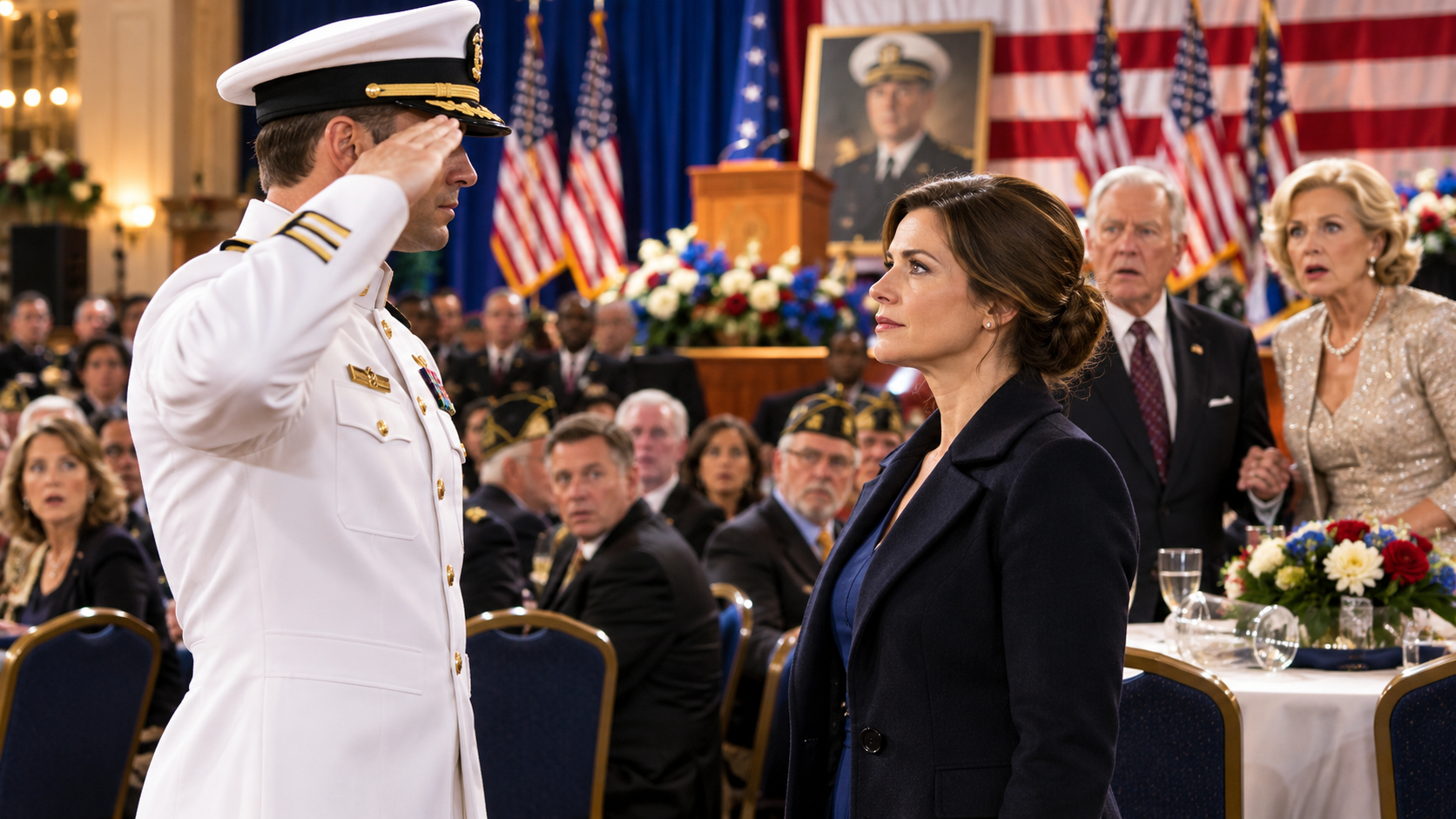
Brennan came to attention.
Then, in front of everyone who had spent the evening whispering that I had failed—
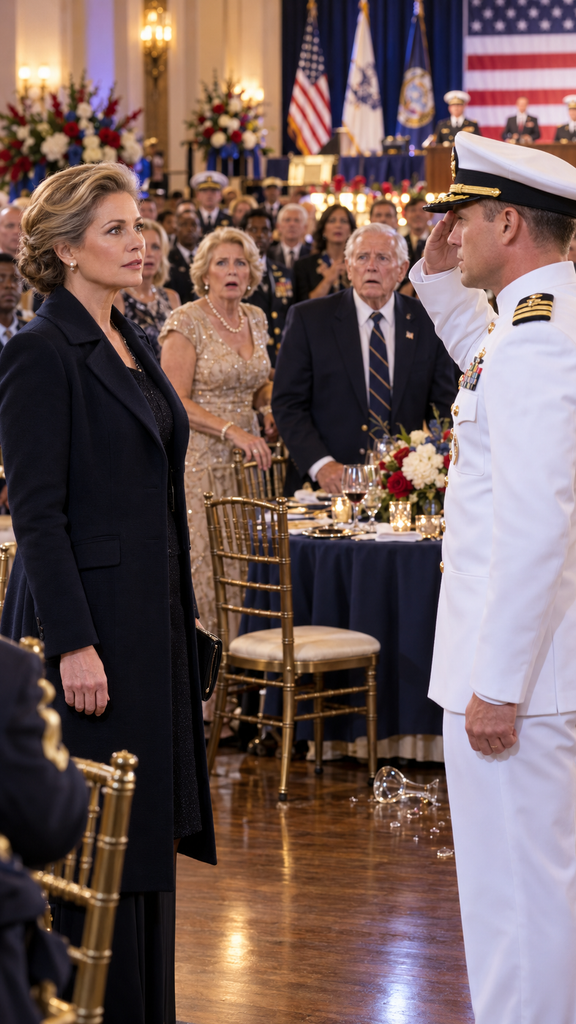
he raised his hand in a perfect military salute.
“Good evening, Admiral Walker.”
Nobody moved.
Nobody breathed.
And then Captain Brennan smiled.
“I didn’t know you were the Andrea Walker from Bellweather, ma’am.”
Behind him, somewhere near the front of the hall, a glass hit the floor.
PART 3: “ADMIRAL WALKER”
For several seconds, I heard absolutely nothing.
Not because the room was silent.
Because my own heartbeat was too loud.
Captain Brennan held the salute.
Training took over.
I returned it.
“Captain.”
His hand dropped.
Mine followed.
Only then did sound creep back into the hall.
A chair squeaked.
Someone whispered, “Admiral?”
Another voice answered, “He said admiral.”
I looked toward the front table.
My father was standing now.
His face had gone pale.
Gladys was completely still.
The woman beside her leaned close and said something.
Gladys didn’t respond.
Captain Brennan seemed to realize he had walked into something considerably more complicated than a veterans’ banquet.
His eyes moved once around the room.
Then back to me.
“Ma’am, apologies. I was told Rear Admiral Walker might be in Georgia this weekend, but I didn’t expect to find you here.”
“That was the idea.”
One corner of his mouth lifted.
“So I gathered.”
A few people laughed nervously.
Nobody knew whether they were allowed to.
Harold Pierce remained at the microphone.
“Captain Brennan?”
Brennan turned.
“Yes?”
Harold pointed toward me with the uncertain expression of a man who had just discovered the woman carrying drink trays outranked his guest of honor.
“I believe we may have missed an introduction.”
Captain Brennan glanced at me.
I gave him a look.
Don’t.
He understood immediately.
Unfortunately, Harold did not.
He stepped away from the podium.
“I’m sorry, Andrea—Admiral Walker—would you mind?”
“Yes,” I said.
A few people blinked.
I smiled.
“I would.”
That earned a real laugh.
Even Brennan chuckled.
The pressure in the room released slightly.
I looked toward the stage.
“This is my father’s night.”
Dad was still staring at me.
Not angry.
Not exactly.
Stunned.
Harold recovered enough to say, “Of course. Absolutely.”
Captain Brennan nodded.
“Then I’ll obey the admiral.”
More laughter.
He started to turn toward the front.
Then stopped.
“Oh. Ma’am.”
“Yes?”
“Congratulations again.”
I knew what he meant.
Apparently no one else did.
Harold grabbed the opportunity.
“Congratulations for what?”
I closed my eyes for half a second.
Brennan looked apologetic.
There was no graceful retreat now.
“My promotion,” I said.
The room became quiet again.
Gladys stood.
The movement was abrupt enough that her chair scraped loudly across the floor.
“Promotion?”
Every face turned toward her.
She seemed to realize too late that she had spoken aloud.
I looked at her.
“Yes.”
Her lips parted.
“To admiral?”
“Rear admiral.”
“But you left.”
A strange feeling passed through me.
Not triumph.
I had imagined moments like this during angry drives home and sleepless nights.
In those imaginary versions, exposing Gladys felt wonderful.
She was humiliated.
I was vindicated.
Everyone who had believed her suddenly understood how wrong they had been.
But real humiliation rarely looks satisfying up close.
Gladys looked frightened.
My father looked devastated.
And I was tired.
“No,” I said. “I didn’t.”
Gladys glanced around the room.
“But you said you were working in Virginia.”
“I am.”
“You said you weren’t on a ship anymore.”
“I’m not.”
“You never said—”
“No.”
My voice stayed calm.
“I never said I left the Navy.”
Her face reddened.
“Well, that’s what everyone understood.”
I looked around the room.
Men and women who had whispered about me avoided my eyes.
“Everyone?”
Gladys swallowed.
Captain Brennan stood motionless beside me.
Professional discretion was fighting visibly with human curiosity.
My father stepped away from his table.
“Andrea.”
I looked at him.
“You’re an admiral?”
The question hurt.
Far more than it should have.
I nodded.
“Since June.”
His expression changed.
“June?”
“Yes.”
The invitation flashed through my memory.
Heavy cardstock.
Official seal.
My note.
Dad, I would really like you there.
His reply had come two days later.
Proud of you. Gladys says travel may be difficult. We’ll celebrate another time.
We never did.
“You said it was a promotion ceremony,” he whispered.
“It was.”
“I thought…”
He stopped.
“What?”
He looked toward Gladys.
That was answer enough.
Gladys shook her head quickly.
“You were already a captain. I assumed it was another position.”
“You never asked.”
She lifted her chin.
“Well, Andrea, you don’t exactly communicate.”
I almost smiled.
There it was.
Gladys’s favorite escape route.
If she misunderstood you, you had failed to explain.
If she insulted you, you were too sensitive.
If she excluded you, you had chosen distance.
If she lied, she had merely been given incomplete information.
June Bell rose beside me.
“Gladys.”
Her voice was quiet.
“You told me this afternoon that Andrea washed out.”
Gladys’s eyes snapped toward her.
“I said I heard—”
“No,” June replied. “You told me.”
Barbara Keene spoke from near the wall.
“You told us she couldn’t handle the Navy anymore.”
Gladys looked around.
People who had been willing to repeat her story were suddenly eager to identify its source.
Human nature is remarkable that way.
“Now hold on,” she said. “Everyone was talking.”
“Because you were talking,” I said.
Her eyes returned to mine.
The room went still.
For the first time that day, I did not protect her from the consequences of her own words.
“I stopped downtown for coffee this afternoon,” I said. “Two men I didn’t know were discussing how I quit.”
Gladys crossed her arms.
“That has nothing to do with me.”
“At Dad’s house, Barbara said I left the Navy before I even entered the room.”
Barbara stared at the floor.
“You told me people respected me when I was still serving.”
Gladys’s jaw tightened.
“I misunderstood.”
“You told me not to wear anything military because I would confuse people.”
Someone inhaled sharply.
My father closed his eyes.
Gladys looked at him.
“Robert, are you going to let her attack me in front of everyone?”
There it was.
The familiar turn.
She wasn’t responsible for what she had done.
I was responsible for describing it.
Dad looked from her to me.
For nineteen years, I had watched him navigate this exact moment.
And for nineteen years, he had almost always chosen the same route.
Peace.
Not truth.
Peace.
Don’t upset Gladys.
Andrea understands.
Andrea is strong.
Andrea will get over it.
Andrea doesn’t visit much anyway.
I saw the decision happen behind his eyes.
Then something changed.
Maybe it was the hall.
Maybe the uniformed veterans watching him.
Maybe the speech he had given ten minutes earlier about loyalty.
Or maybe he finally saw what his silence looked like from the outside.
He faced Gladys.
“No.”
One word.
Gladys blinked.
“What?”
“No, I’m not going to do that.”
Her face changed.
Dad’s voice trembled slightly, but he continued.
“You told me Andrea had left active service.”
“You said she was working at a desk in Virginia!”
“Most admirals have desks somewhere, Gladys.”
A few people coughed to hide laughter.
I looked down.
Even I nearly smiled.
Gladys flushed deeper.
“I thought—”
“So did I,” Dad said.
He looked at me.
“And I should have asked.”
The simple admission struck harder than any grand apology could have.
I swallowed.
Dad took another step toward me.
“I should have asked you.”
I nodded once.
Captain Brennan shifted beside me.
“Sir,” he said gently, addressing my father, “if I may?”
Dad looked at him.
Brennan smiled.
“Your daughter has spent the last three years doing work most people in this room will never hear about and shouldn’t. Before that she held operational commands that would make any Navy family proud.”
My face warmed.
“Captain.”
“I’m stopping, ma’am.”
The room laughed again.
Then his expression became serious.
“But I will say one thing.”
He looked toward my father.
“People don’t accidentally become flag officers.”
That silence was different.
Not cruel.
Not curious.
Respectful.
I wished it didn’t matter.
Part of me resented that it did.
Why should stars on a shoulder make my words more believable?
Why should Captain Brennan’s salute matter more than my own quiet refusal to defend myself?
But I had spent enough years inside institutions to know symbols matter because people decide they matter.
And for one night, the symbol had finally become louder than Gladys.
Harold cleared his throat from the stage.
“Well.”
Nobody looked at him.
He tried again.
“I believe we can all agree Bellweather has two Navy families to be proud of tonight.”
I shook my head.
“Same family.”
Dad looked at me.
Something broke open in his expression.
Harold nodded.
“Same family.”
I picked up my coat.
Gladys stared.
“Where are you going?”
“Outside.”
“In the middle of your father’s ceremony?”
“Yes.”
She looked offended.
Dad looked worried.
Captain Brennan stepped aside.
I walked toward the door.
Just before I reached it, my father called my name.
I stopped.
“Andrea.”
I turned.
He was standing beneath a banner that read:
WE HONOR THOSE WHO SERVED.
“I didn’t know,” he said.
For years, that sentence would have been enough for him.
This time, it wasn’t.
I looked at him.
“You could have.”
Then I walked outside.
PART 4: WHAT SILENCE COSTS
The cold hit my face hard enough to feel clean.
I stood beneath the awning outside Veterans Hall and breathed.
Cars filled the parking lot.
Beyond them, downtown Bellweather glowed beneath strings of lights hung across Main Street.
Somewhere two blocks away, a train horn sounded.
I closed my eyes.
The door opened behind me.
I expected Dad.
Instead, Captain Brennan stepped outside.
He carried his white combination cover beneath one arm.
“Permission to speak freely, ma’am?”
I gave him a look.
“You already publicly announced my rank to my entire hometown.”
“Technically, I greeted a superior officer.”
“You did it loudly.”
“I have projection.”
Despite myself, I laughed.
He smiled.
“Sorry.”
“It’s not your fault.”
He leaned against the brick wall beside me.
“For what it’s worth, I genuinely didn’t know you were from here.”
“I know.”
“I also didn’t know the family situation.”
“I know that too.”
A pause.
Then he said, “They really thought you left?”
“Apparently.”
“How?”
That was the question, wasn’t it?
How could your own family know so little about your life that strangers understood more?
I stared across the parking lot.
“My father knew I was still working for the Navy. Civilian clothes most days. More Pentagon meetings. Virginia. Travel.”
“He knew you made flag?”
“I sent an invitation.”
Brennan winced.
“He didn’t attend.”
“No.”
“Did he know what the ceremony was?”
“I thought so.”
He nodded slowly.
“That’s rough.”
Coming from another officer, the understatement almost made me laugh again.
The door opened.
This time it was Dad.
Brennan straightened.
“I’ll give you two a minute.”
“You don’t have to leave,” I said.
“Yes, ma’am, I absolutely do.”
He put his cover on and walked toward the parking lot.
Dad stood beneath the awning.
For several seconds neither of us spoke.
Then he held something out.
My purse.
“You forgot this.”
“Thanks.”
He didn’t release it immediately.
“Andrea.”
I waited.
He looked older than he had that afternoon.
“I owe you an apology.”
I took the purse.
“Okay.”
He flinched.
Maybe he had expected me to save him from the discomfort.
I had done that most of my life.
It occurred to me that perhaps stopping was not cruelty.
Perhaps it was honesty.
“I really didn’t know about the rank,” he said.
“I believe you.”
“Gladys said you’d moved into administrative work.”
“I did.”
“She made it sound like you were finishing out your time in some civilian position.”
“Rear admirals do administrative work too.”
“I know that now.”
I looked at him.
“You knew it before.”
He nodded.
Fair.
“I should’ve called.”
“Yes.”
“I should’ve come to Virginia.”
“Yes.”
He looked down.
“When your invitation arrived, Gladys told me you probably invited us because you felt obligated.”
I closed my eyes briefly.
“Dad.”
“I know.”
“No. I don’t think you do.”
He looked up.
“I wanted you there.”
His face crumpled slightly.
I continued before I lost the nerve.
“I wanted you there because you were the reason I joined.”
“Andrea—”
“I used to look at your pictures when I was a kid. Remember?”
He nodded.
“You taught me Navy ranks before I knew multiplication. You taught me how to polish shoes. You taught me never to quit because something was hard.”
My voice started to shake.
I hated that.
I had briefed rooms full of admirals without trembling.
But fathers were different.
“I spent half my childhood trying to become someone you would recognize.”
“You never had to.”
“I know that now.”
His eyes filled.
“I was proud of you.”
“Quietly.”
He looked away.
“Yes.”
“That’s the problem.”
The words came easier after that.
“All these years Gladys has made comments. She has minimized everything I do. She tells people I’m difficult. Cold. Too career-focused. She leaves me out of family photographs, forgets to tell me about holidays, changes plans after I book flights, then says I never come home.”
Dad’s face tightened.
“I didn’t know about all of that.”
“You knew enough.”
He said nothing.
“I stopped fighting because every time I did, you asked me to keep the peace.”
“I thought—”
“I know what you thought. You thought I was stronger.”
His eyes returned to mine.
“You were.”
“That doesn’t mean it didn’t hurt.”
He swallowed.
That was the sentence that finally reached him.
Not the rank.
Not the salute.
Not the room full of witnesses.
That.
You thought I was stronger.
That doesn’t mean it didn’t hurt.
Dad rubbed a hand over his face.
“I failed you.”
I breathed out.
“I’m not asking you to call yourself a failure.”
“I am.”
“No.”
I stepped closer.
“I’m asking you to understand what happened.”
He nodded.
Inside, applause erupted.
The ceremony was continuing without us.
Dad glanced at the door.
“They’re about to do the veterans memorial.”
“You should go.”
“Come with me.”
“I will.”
He looked surprised.
“This is still your night,” I said.
“Andrea—”
“But I’m not carrying drinks.”
For the first time all evening, my father laughed.
“Deal.”
When we returned, every person in the room looked at us.
I hated it.
Dad seemed to sense that.
He didn’t march me toward the front.
He simply walked beside me toward the family table.
Gladys was standing there.
One empty chair had appeared.
Someone had moved Kevin and his wife closer together.
I stopped.
Gladys looked at the chair.
Then at me.
“You can sit here.”
The words were stiff.
Not an apology.
A concession.
I looked toward my original seat in the back.
Then back at my father.
Dad pulled out the empty chair.
“Please.”
So I sat.
Not because Gladys had finally made room.
Because my father had.
The ceremony continued.
Names of deceased veterans were read.
A bell rang after each one.
My anger faded beneath the weight of those names.
Men and women gone.
Families changed.
Lives larger than whatever ugly rumor had occupied Bellweather for one afternoon.
Then Harold returned to the microphone.
“We have one final presentation tonight.”
My father looked confused.
So did I.
Captain Brennan stood.
He had taken a seat near the stage.
“This one,” Harold said, “was supposed to be presented by our special Navy guest.”
Brennan walked to the podium.
My stomach dropped.
He glanced directly at me.
I narrowed my eyes.
He smiled.
Traitor.
“Chief Petty Officer Robert Walker,” he said, “would you join me?”
Dad looked at me.
“I don’t know what this is.”
“Neither do I.”
He walked onto the stage.
Captain Brennan spoke about my father’s work with veterans.
Hundreds of benefit applications.
Hospital visits.
Funeral honors.
Scholarships for military families.
Years of volunteer service.
Then he held up a framed certificate.
“On behalf of the regional veterans coalition and with recognition from the Department of the Navy, it is my privilege to thank you for continuing to serve long after your uniform was put away.”
Dad’s eyes filled.
The hall stood.
So did I.
I clapped harder than anyone.
That was why I had come.
Not to be recognized.
Not to expose Gladys.
For him.
Dad accepted the certificate.
Then he moved toward the microphone.
Harold started to take it.
Dad shook his head.
“There’s something I need to say.”
My shoulders tightened.
Gladys whispered, “Robert.”
He ignored her.
He looked at the audience.
“Most of you have known me a long time.”
Murmurs of agreement.
“You know I talk too much.”
Laughter.
“You know I tell the same sea stories more than once.”
More laughter.
“And you know I’m proud of the Navy.”
He paused.
“But tonight I learned something uncomfortable.”
I stopped breathing.
Dad looked toward me.
“I spent years helping other veterans make sure their stories were heard.”
The room quieted.
“And somehow I stopped listening carefully enough to my own daughter’s.”
Gladys stared at him.
I felt tears sting my eyes.
Dad continued.
“I’m proud of Rear Admiral Andrea Walker.”
Applause began.
He raised a hand.
“But not because I found out tonight that she’s an admiral.”
The applause stopped.
“I was proud when she was an ensign. I was proud when she went to sea. I was proud every time she left home and did something harder than I wanted my little girl to have to do.”
His voice broke.
“And I should have said it more.”
I looked down.
“I also should have known what was happening in my own house.”
Gladys whispered his name again.
Dad didn’t look at her.
“That part is mine.”
He nodded once.
“No excuses.”
The silence that followed was complete.
Then he looked back at me.
“I’m sorry, Andrea.”
I wiped one tear before it could reach my cheek.
The room stood again.
This time, when they applauded, I wished they wouldn’t.
Some moments don’t belong to crowds.
But I looked at my father and nodded.
And for the first time in years, I believed he understood what the nod meant.
PART 5: WHAT THE TOWN REMEMBERED
The banquet ended nearly an hour later.
People approached me in waves.
Some congratulated me.
Some apologized.
Most did both.
The man from church who had told me he was sorry things “didn’t work out” shook my hand so vigorously I thought he might dislocate my shoulder.
“I should never have repeated gossip.”
“No,” I said. “You probably shouldn’t have.”
He blinked, then laughed nervously.
I smiled enough to let him know I wasn’t going to execute him in the parking lot.
Barbara Keene apologized too.
“I honestly thought Gladys knew.”
“That’s usually how rumors work.”
June Bell hugged me.
“I knew there was more to that story.”
I smiled.
“You asked.”
“That’s not a difficult thing to do.”
No.
It wasn’t.
Captain Brennan left after extracting a promise that I wouldn’t punish him professionally for “the Bellweather Incident.”
“I’m considering extra duty,” I told him.
“Ma’am, I’m a captain.”
“Then you should know better.”
He laughed and saluted again outside.
This time I laughed too.
Gladys disappeared during the cleanup.
I found her eventually in the side hallway beside the coatroom.
She stood alone.
Without an audience, she looked different.
Smaller.
Not harmless.
But stripped of the energy she drew from other people’s attention.
I could have walked past.
Instead I stopped.
She saw me.
“I suppose you’re happy.”
There was no point pretending I didn’t understand.
“About what?”
“Everyone turning on me.”
“They didn’t turn on you.”
She gave a bitter laugh.
“You embarrassed me.”
I stared at her.
“Gladys, I barely spoke.”
“You let that captain humiliate me.”
“He said my rank.”
“You knew what would happen.”
“No. I came here in a civilian dress and sat in the last row.”
Her mouth tightened.
“You could have corrected me this afternoon.”
“Yes.”
That stopped her.
I continued.
“I could have corrected you when you told me I had failed. I could have corrected Barbara. I could have corrected every person who whispered.”
“Then why didn’t you?”
I thought about it.
The answer mattered.
“Because I was tired of auditioning for your respect.”
Her eyes shifted.
“I never asked you to.”
“No. You just kept setting tests.”
“That’s ridiculous.”
“You told people I washed out of a career I’ve spent more than twenty years building.”
“I misunderstood.”
“No.”
My voice stayed soft.
“You assumed the smallest version of my life because that version made you comfortable.”
Her face changed.
For once, she had no immediate answer.
I went on.
“You heard ‘Virginia’ and ‘desk’ and decided I had failed. You didn’t ask Dad. You didn’t ask me. Then you told people.”
“I said I was sorry.”
“You haven’t.”
She opened her mouth.
Then closed it.
I waited.
Outside the hallway, volunteers stacked chairs.
Metal legs scraped across the floor.
Finally, Gladys said, “I’m sorry.”
The words sounded painful.
Maybe they were.
“For what?”
Her eyes flashed.
I didn’t rescue her.
“For telling people you left the Navy.”
“And?”
She exhaled sharply.
“For saying you failed.”
“And?”
“Good Lord, Andrea.”
I remained silent.
Her shoulders dropped.
“For leaving you out of the family table.”
There.
Not everything.
But something true.
“Thank you,” I said.
She looked surprised.
“That’s it?”
“What do you want me to do?”
“I don’t know.”
Neither did I.
Forgiveness is often treated like a switch.
Apology given.
Forgiveness granted.
Everything restored.
Real families are messier.
Sometimes forgiveness is not returning to the old arrangement.
Sometimes it is refusing to carry hatred while also refusing to pretend trust has magically regrown.
“I’m staying at the hotel tonight,” I said.
Her face hardened again.
“Of course you are.”
“I booked it before I arrived.”
That surprised her.
“Why?”
Because I had learned.
Because loving my father did not require putting myself back inside a house where I spent every visit bracing for the next insult.
“Because boundaries aren’t punishment.”
She looked away.
I started toward the door.
“Andrea.”
I turned.
Gladys stood with one hand against the wall.
“You really are an admiral?”
For a second, I thought she was mocking me.
Then I realized she genuinely could not absorb it.
I smiled.
“Yes.”
“How long?”
“Three months.”
“And Robert didn’t know?”
“He was invited to the ceremony.”
Her face changed.
Shame this time.
Real shame.
She remembered.
“You told me it was a promotion.”
“Yes.”
“I thought captains got promoted to different captain jobs.”
Despite everything, I laughed.
Gladys almost smiled.
Almost.
Then I said, “You could have asked.”
Her smile disappeared.
“I know.”
It was the first honest thing she had said to me all day.
I left her there.
Dad was waiting outside.
He held his framed certificate beneath one arm.
“You’re really going to a hotel?”
“Yes.”
He nodded.
“Okay.”
Old Dad would have asked me to reconsider so Gladys wouldn’t be upset.
This Dad simply accepted it.
“Breakfast tomorrow?” he asked.
“Just us?”
He understood.
“Just us.”
“Eight?”
“Seven thirty.”
“You’re retired.”
“I still wake up at five.”
“Seven forty-five.”
He smiled.
“Deal.”
He hugged me beside my rental car.
This time neither of us rushed.
“I am proud of you,” he whispered.
I closed my eyes.
“Then learn about me.”
He pulled back.
“I will.”
“No.”
I touched his arm.
“Don’t promise big things tonight because you feel guilty. Just call.”
He nodded.
“Tuesday?”
“Tuesday works.”
“And if I forget?”
“I’m an admiral. I have resources.”
He laughed.
I got into my car.
Before I shut the door, he leaned down.
“One question.”
“What?”
“What exactly do you do in Virginia?”
I stared at him.
Then we both started laughing.
It took almost a full minute before I could answer.
“That’s going to require breakfast.”
“Seven thirty.”
“Seven forty-five.”
He pointed at me.
“Rank has gone to your head.”
“Good night, Dad.”
“Good night, Admiral.”
“Don’t start.”
I drove to the hotel smiling.
The next morning, we talked for three hours.
Not about Gladys.
Not mostly.
Dad asked about Virginia.
My work.
My promotion.
The commands I had held.
The places I had lived.
He asked what had scared me most during my career.
I told him.
He asked what I was proudest of.
That answer surprised him.
It wasn’t making admiral.
It was a twenty-three-year-old sailor I had once talked out of leaving the Navy after a catastrophic mistake. That sailor was now a chief petty officer with a wife, two children, and a habit of sending me a Christmas card every year.
Dad listened.
Really listened.
When we left the diner, the waitress refused to charge us.
I made Dad leave enough cash to cover the meal anyway.
Outside, three men were standing beside a pickup.
One recognized me.
“Morning, Admiral.”
I turned.
It was one of the men from the coffee shop the day before.
The same man who had said military life had probably been too much for me.
His face was bright red.
“Morning.”
He rubbed the back of his neck.
“About yesterday…”
I waited.
“I repeated something I didn’t know was true.”
“Yes.”
“I’m sorry.”
“Thank you.”
He looked relieved.
Then he grinned.
“Rear admiral, huh?”
“So they tell me.”
Dad laughed.
We walked toward our cars.
Bellweather looked different in daylight.
Not because the town had changed.
Because the story had.
By noon, I knew exactly what people would be saying at the grocery store, the diner, the church parking lot, the hardware counter.
Did you hear about Robert Walker’s daughter?
Gladys told everybody she washed out of the Navy.
Then a captain walked into Veterans Hall and saluted her.
Turns out she’s an admiral.
Small towns remember everything.
Or at least they remember the version dramatic enough to repeat.
For years, that used to bother me.
I wanted people to know the full truth.
The complicated truth.
The quiet truth.
Eventually I learned something the Navy had tried to teach me long before my family did.
You cannot command every room.
You cannot correct every rumor.
You cannot force everyone to understand who you are.
What you can do is know your position.
Hold your course.
Correct when correction matters.
Speak when silence starts costing too much.
And recognize the difference between humility and allowing yourself to be erased.
That afternoon, before driving back toward Atlanta, I stopped at my father’s house.
Gladys opened the door.
For once, she didn’t comment on my clothes.
Dad appeared behind her.
“You heading out?”
“Yeah.”
He hugged me.
Gladys hovered.
Then she said, “Safe trip.”
“Thank you.”
I stepped toward the porch.
“Andrea?”
I looked back.
Gladys folded her hands.
“If anyone asks me about you…”
She seemed to struggle with the sentence.
“What should I say?”
The old answer would have been nothing.
The angry answer would have been tell them you were wrong.
Instead I looked at my father.
Then at her.
“Tell them I’m still serving.”
She nodded.
“I can do that.”
I walked to the car.
My uniform was still hanging in its garment bag across the back seat.
White jacket.
Gold stripes.
One silver star on each shoulder board.
I unzipped the bag halfway.
For a moment, sunlight caught the insignia.
Then I zipped it closed again.
I didn’t need to wear it in Bellweather.
Not anymore.
The people who mattered either knew who I was—
or had finally learned to ask.
And as I pulled away from my father’s house, I thought again about Captain Brennan crossing that crowded hall.
Everyone had expected him to walk toward the stage.
Toward the important people.
Toward the front row.
Instead, he had walked all the way to the back.
Straight toward the woman carrying a tray.
Then he had stopped in front of me and saluted.
Not because I needed rescuing.
Not because a uniform made me valuable.
Not because a title suddenly transformed failure into success.
He saluted because the truth had been true before anyone in that room recognized it.
That was the part Gladys never understood.
My father finally did.
And so did I.
I had spent too many years waiting for my family to put a chair at the front table before believing I belonged there.
I didn’t need their chair.
I had earned my place long before they thought to make room.
Leave a Reply