
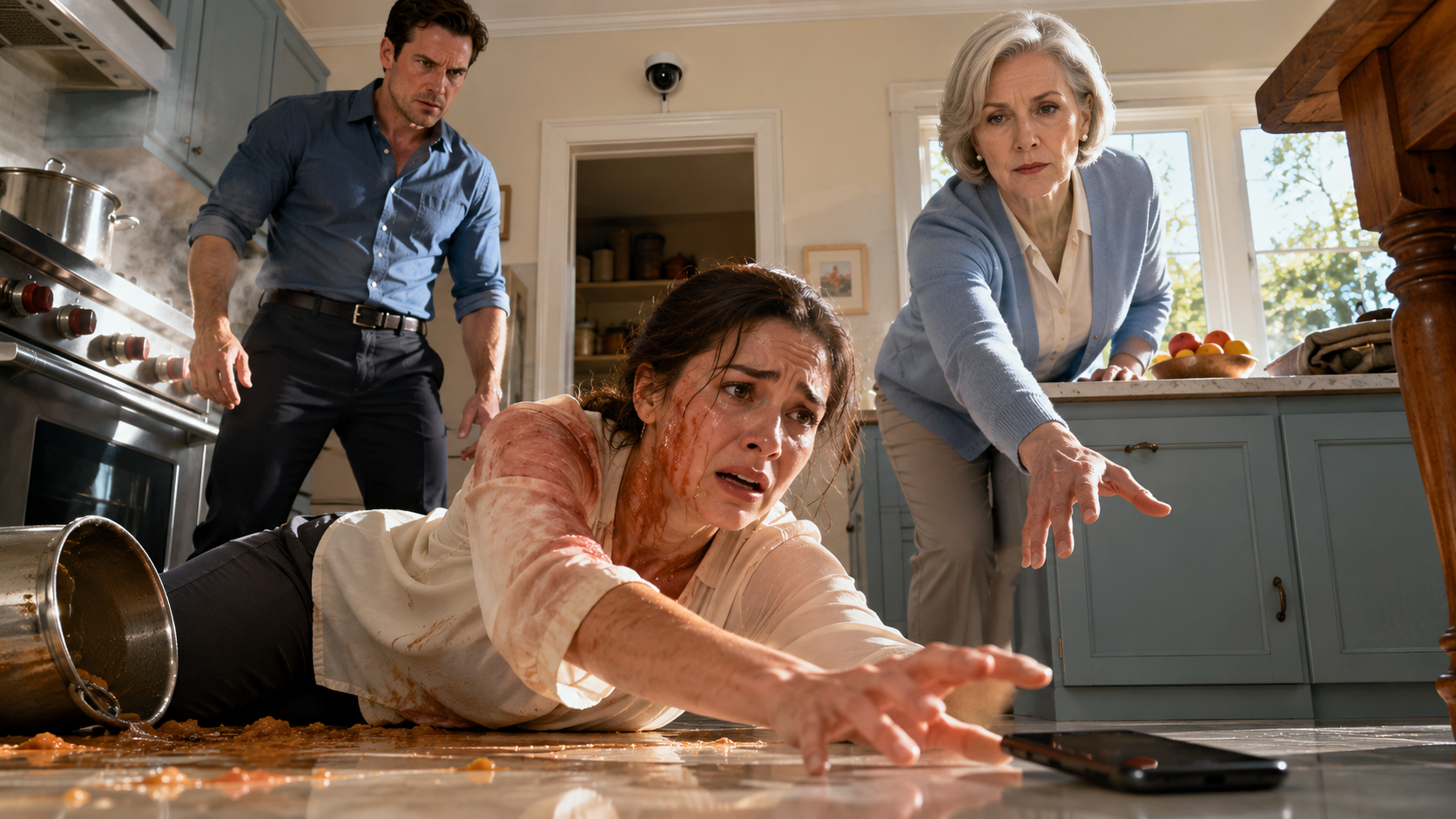
PART 1: THE ACCIDENT THEY PLANNED
The scream that came out of me did not sound human.
One second, I was standing beside the stove in the kitchen my father had built with his own hands, telling my husband for the third time that I would not sell the house.
The next, Julian’s hands slammed into my back.
I crashed against the stove.
The stockpot tipped.
Boiling soup came down over me.
For one impossible second, I didn’t understand what had happened. I only knew that something had exploded across the left side of my face, my neck, my shoulder, and my arm.
Then the pain arrived.
It was not heat.
Heat was too small a word.
It felt as if my skin had been peeled open and fire had been poured directly into me.
I screamed and grabbed at my blouse, but the fabric was soaked through. Pulling it only dragged the burning material against my skin.
I stumbled backward and fell.
“Julian!”
My voice broke on his name.
He stood beside the stove, breathing hard.
He wasn’t reaching for me.
He wasn’t calling for help.
He was staring at me.
His face looked almost blank.
That was what terrified me most.
Across the kitchen, his mother sat at the breakfast table.
Evelyn had watched the entire argument.
She had watched Julian block the doorway when I tried to leave.
She had heard him demand that I sign the papers Sarah had warned me not to sign.
She had heard me say the house belonged to me because my father had left it to me before he died.
She had heard Julian call me selfish.
Now she watched me roll onto my side, sobbing, my burned arm held away from my body.
And she said, very calmly, “Maybe now she’ll stop being selfish.”
I stared at her.
For a moment, the pain almost disappeared beneath the shock.
“Call 911.”
Neither of them moved.
“Please.”
I saw my phone near the fruit bowl.
I tried to crawl toward it.
Evelyn stood first.
She picked up my phone.
Not to call.
To take it away.
“Evelyn,” I gasped.
She carried it to the other side of the counter.
Then she took a dish towel and began wiping the counter.
The soup had splashed everywhere. On the tile. On the cabinets. On the stove. On the floor.
She wiped around me as if I were another mess she intended to clean.
Julian lifted the stockpot upright.
That was when I understood.
Not fully.
Not yet.
But enough.
They were changing the room.
“Don’t,” I whispered.
Julian looked down at me.
His expression sharpened.
“Don’t what?”
“You pushed me.”
His jaw tightened.
“You slipped.”
“No.”
“You slipped, Elena.”
I looked at his mother.
Evelyn folded the towel.
“You were upset,” she said. “You were waving your arms. You lost your balance.”
I could barely breathe.
“No.”
Julian stepped closer.
“You’re in shock.”
“You pushed me.”
His face changed then.
Only slightly.
But I saw it.
Fear.
Not fear for me.
Fear of what I might say.
He crouched beside me and grabbed my uninjured wrist.
“Listen carefully.”
I tried to pull away.
His fingers tightened.
“You slipped.”
“Get away from me.”
“Elena.”
“Call an ambulance.”
He looked toward his mother.
Evelyn glanced at the floor.
“She’s still talking,” she said.
Still talking.
As if they were waiting for me to stop.
My stomach turned.
The shaking started a few minutes later.
Violent, uncontrollable trembling.
I remember my teeth knocking together.
I remember staring at the cabinet near the pantry because it was the only thing I could focus on.
And above that pantry was the small black kitchen camera my father had installed eight months before his death.
Julian knew about it.
That thought came slowly through the pain.
The camera.
Dad.
Then another thought.
The garage.
I stopped looking at the camera.
Julian finally called 911.
“My wife had an accident,” he told the dispatcher.
His voice trembled perfectly.
“She slipped near the stove. There was boiling soup. Please hurry.”
I closed my eyes.
For the first time since he pushed me, I stopped trying to argue.
My father used to tell me that panic wasted the seconds in which truth could still be preserved.
Frank Sterling had not been a suspicious man by nature.
He had been patient. Methodical. Almost annoyingly calm.
But he had noticed Julian long before I was willing to.
Dad had lived in the house for thirty-seven years. He knew every scratch in the floorboards and every hinge that squeaked. After Julian and I married and moved in to help care for him during his final illness, things began breaking.
A cabinet door cracked after an argument.
A lamp shattered.
The hallway thermostat was ripped loose.
Once, a framed photograph of my mother fell from the wall the same night Julian accused me of choosing Dad over him.
Julian always called those things accidents.
Dad never did.
One afternoon, he installed the kitchen camera above the pantry.
“For security,” he said when Julian complained.
I had been embarrassed.
I told Dad Julian wasn’t dangerous.
Dad only looked at me.
“I hope you’re right.”
What Julian did not know was that my father had never trusted a single recording device.
He had connected the camera to a concealed recorder in the detached garage.
“If something happens to the camera,” Dad had told me, “the copy matters more than the original.”
I had forgotten those words.
Until I was lying on the kitchen floor with my skin burning.
The paramedics arrived.
Julian became a husband again.
He cried.
He held my good hand.
He told them I had been distraught because we were discussing finances.
Evelyn said I had been rushing around the stove.
Nobody mentioned the house.
Nobody mentioned the papers.
Nobody mentioned Julian blocking the door.
At St. Matthew’s Hospital, the emergency room became a blur of voices, scissors, medication, bright lights, and pain.
They cut away what was left of my blouse.
I remember one nurse going silent when she saw my shoulder.
I remember someone saying, “Deep partial thickness here.”
Another voice answered, “Possible full thickness along the upper arm.”
I stopped understanding words after that.
Julian stayed near me until a nurse asked him to step outside.
He kissed my forehead.
“My poor wife,” he whispered.
Then his hand closed around my uninjured fingers.
Too hard.
I opened my eyes.
He smiled for the nurse.
“You’re going to be okay.”
His thumb pressed into my knuckles.
The warning was clear.
Later, a sheriff’s deputy came to ask questions.
I heard Julian speak first.
He had already built the story.
I had been emotional.
I had been arguing.
I had turned too quickly.
I had slipped.
Evelyn repeated it almost word for word.
“She’s been under tremendous stress since her father died,” she told the deputy. “She can be unstable when she gets overwhelmed.”
Unstable.
The word traveled through me like a second burn.
For nine days, I said almost nothing.
Julian thought the silence meant I was afraid.
Evelyn thought medication had confused me.
The deputy probably thought I couldn’t remember.
They were all wrong.
I was preserving what I could.
The first night I was lucid enough to think clearly, I asked for the charge nurse.
“My husband cannot have unrestricted access to my medical information.”
She studied my face.
“Do you feel unsafe?”
I looked at the door.
“Yes.”
Everything changed after that.
Not dramatically.
No alarm sounded.
No one rushed in.
But the nurse pulled up a chair.
Her voice became careful.
“What do you need?”
“Photographs.”
“Of your injuries?”
“Yes. Before they change.”
She nodded.
I swallowed.
“And I need to make a private phone call.”
“To the police?”
“Not yet.”
That surprised her.
“To my father’s attorney.”
Sarah Vance answered on the second ring.
“Elena?”
Her voice nearly broke me.
I had known Sarah since I was seventeen. She had handled my father’s estate, his medical directives, and the deed transferring the house solely to me.
She also knew how hard Julian had pushed after Dad died.
I closed my eyes.
“Sarah, listen to me. Do not contact Julian.”
A pause.
“All right.”
“Do not warn him.”
“Elena, what happened?”
“He pushed me into boiling soup.”
Silence.
Then, very softly, “Are you safe right now?”
“I’m in the hospital.”
“I’m coming.”
“No.”
“Elena—”
“First secure the house.”
She understood.
Of course she did.
Dad had trusted her because she never wasted time pretending emotion and strategy were enemies.
“What exactly do you want protected?”
“The property. No sale. No mortgage. No transfer. Nothing Julian can sign, file, borrow against, or claim I agreed to.”
“I’ll handle it.”
“And Sarah?”
“Yes?”
“The garage.”
Another pause.
I lowered my voice.
“Dad’s recorder.”
Her breathing changed.
“You think it caught something?”
“I don’t know.”
That was the truth.
I remembered the camera.
I remembered the backup.
But I had no idea whether the system still worked.
Julian had complained about it for years.
He might have unplugged it.
The recorder might have failed.
The memory could have overwritten itself.
And if he remembered the garage connection—
I couldn’t let myself finish that thought.
Sarah obtained an emergency order preventing any sale, mortgage, or transfer of the house.
Julian received notice two days later.
He came into my hospital room furious.
He closed the door behind him.
“What did you do?”
I looked up from the bed.
My left arm was wrapped from shoulder to wrist.
Dressings covered my neck and part of my jaw.
I had learned not to look at myself in the mirror yet.
“What do you mean?”
“The house.”
His voice was low.
“You had some emergency restriction filed.”
“I’m protecting my property.”
“Our property.”
“My father left it to me.”
“We are married.”
“That doesn’t make everything mine yours.”
His nostrils flared.
“After everything I’ve done for you?”
I almost laughed.
Pain stopped me.
“What exactly have you done for me, Julian?”
He leaned closer.
“You want to start this now?”
“You came here.”
His eyes traveled over my bandages.
There was no guilt in them.
Only irritation.
That answer settled something inside me.
For years, I had tried to interpret his anger as stress.
His cruelty as frustration.
His control as fear of losing me.
Even after he pushed me, some tiny, humiliating part of me had searched for a reason that would make what happened less deliberate.
There wasn’t one.
He wanted the house.
I had said no.
He hurt me.
Then he lied.
It was that simple.
He straightened.
“You should be careful, Elena. You’re on a lot of medication. People might misunderstand the things you say.”
I met his eyes.
“I haven’t said anything.”
His expression changed.
Just for a second.
That was the first time I realized silence could frighten him more than accusation.
Three weeks later, he came to my rehabilitation room carrying divorce papers.
He wore a navy suit.
He had shaved.
He looked like he was attending a business meeting.
I was learning how to lift my left arm again without crying.
He placed the papers on the small table beside my bed.
“What are those?”
“You know what they are.”
I looked at the first page.
Petition for dissolution.
My throat tightened.
I had imagined leaving him a hundred times since the kitchen.
I had not imagined him arriving first.
“I’m filing for divorce,” he said.
I turned the page.
His requests were listed in clean legal language.
Division of marital assets.
Allocation of debts.
Sale of the residence.
Financial support.
I looked up.
“You’re still asking for the house.”
“It needs to be sold.”
“It is not yours.”
“We have debts.”
“You have debts.”
His mouth tightened.
“I supported you.”
“You lived in my father’s house.”
“I renovated it.”
“With whose money?”
His eyes hardened.
Then he looked at my bandaged arms.
And smiled without warmth.
“I didn’t marry a damaged woman.”
The room went very still.
I felt something inside me collapse.
Not love.
That had already died on the kitchen floor.
Something older.
The last instinct to protect the memory of the person I thought he had been.
He continued.
“You’re going to need years of treatment. Maybe more surgery. You can barely take care of yourself, let alone that property. Selling is the reasonable thing.”
I looked down at the papers.
He thought he was humiliating me.
He did not understand that he was giving me clarity.
I signed one page.
He smiled.
Then his smile faded.
“What is that?”
“Receipt.”
“You didn’t sign the settlement.”
“No.”
“Elena.”
“I acknowledged that you served me.”
His jaw flexed.
I slid the papers back toward him.
“You should do whatever you think is best.”
For the first time, uncertainty crossed his face.
He had expected tears.
Begging.
Maybe anger.
I gave him none of it.
His confidence returned slowly.
“You’ll change your mind.”
“Maybe.”
He left.
That evening, Sarah called from a borrowed number.
I sat on the edge of my rehabilitation bed and watched rain crawl down the window.
“Elena,” she said, “we found the recorder.”
My heart stopped.
“Found it?”
“Not exactly.”
I gripped the phone.
“What does that mean?”
“The recorder itself is gone.”
I closed my eyes.
Julian remembered.
“But,” Sarah continued, “your father had configured an off-site backup.”
I opened my eyes.
“What?”
“He never told you?”
“No.”
“He told me he had redundancy. I assumed he meant the garage unit. Apparently he meant more than that.”
My father.
Even dead, he was still thinking three steps ahead.
Sarah took a breath.
“The cloud account logged motion from the garage the night after you were hospitalized. Julian entered with bolt cutters.”
My fingers went cold.
“He took the recorder.”
“Yes.”
I looked at the closed rehabilitation-room door.
“Did he know about the backup?”
“Apparently not.”
“And the kitchen?”
Sarah did not answer immediately.
My heart began pounding.
“Sarah?”
“The camera recorded seventeen minutes.”
I couldn’t speak.
“It shows the argument,” she said. “It shows Julian blocking the doorway. It shows Evelyn moving your phone. It shows the pot.”
My eyes filled.
Not because I was relieved.
Not yet.
Because somewhere, in a file neither Julian nor Evelyn knew still existed, the truth had survived.
“Elena,” Sarah said, her voice tight, “there’s something else.”
“What?”
“The audio begins before the assault.”
I pressed the phone closer to my ear.
“What did he say?”
Sarah was quiet for so long that I could hear the rain against the glass.
Then she told me.
“Julian said, ‘If she won’t sign, Mom, we’ll make it look like an accident.’”
And suddenly I knew exactly what kind of marriage I had survived.
PART 2: I LET HIM THINK I WAS BROKEN
I watched the footage for the first time in a private therapy room.
Detective Marcus Miller sat beside Sarah.
A laptop rested on the table between us.
I had asked to see it.
Sarah had warned me that I didn’t need to.
Detective Miller had warned me twice.
I insisted.
“If they’re going to use it,” I said, “I need to know what it shows.”
He looked at me for a long moment.
“All right.”
The video began with an empty kitchen.
Morning light fell through the windows.
The stockpot sat on the stove.
Then Evelyn entered.
She carried a folder.
I remembered that folder.
The sale documents.
Julian appeared seconds later.
He looked toward the hallway.
Then he said, “She’s never going to agree while she thinks she can keep hiding behind Frank’s will.”
My stomach tightened.
Evelyn sat at the table.
“You’ve been too soft.”
“I’ve asked her.”
“You’ve complained at her. That’s not the same thing.”
Julian opened the folder.
“She thinks because the deed is in her name, she has all the power.”
“She has emotional attachment. That’s different.”
I stared at Evelyn’s face on the screen.
Calm.
Patient.
As if they were discussing a stubborn appliance.
Then Julian spoke the sentence Sarah had quoted.
“If she won’t sign, Mom, we’ll make it look like an accident.”
The first time I heard it, I stopped breathing.
Detective Miller paused the video.
“Do you need a minute?”
“No.”
My voice sounded far away.
“Keep going.”
The recording resumed.
Evelyn answered him.
Not with shock.
Not with confusion.
She said, “Don’t be stupid.”
For one second, a pathetic part of me hoped that was the moment she would stop him.
Then she added, “If you frighten her, she might sign. You don’t need to ruin everything.”
Julian laughed quietly.
“She won’t listen.”
Then I entered.
Watching myself walk into that kitchen was worse than watching the assault.
I looked normal.
That was what hurt.
My hair was tied back.
I carried a mug.
I had no idea I was walking into a room where my husband and his mother had already discussed making something look like an accident.
On the video, I stopped when I saw the folder.
“No.”
Julian said, “You haven’t even read it.”
“I read the last version.”
“This one is different.”
“I’m not selling Dad’s house.”
Evelyn interrupted.
“You mean your house.”
I turned toward her.
“Yes.”
Her mouth tightened.
“Marriage is supposed to be a partnership.”
“So is assaulting someone into signing papers?”
The word assault made my stomach twist because at the time I had meant his intimidation, his blocking doors, his slamming objects.
I hadn’t known what was coming.
Julian moved between me and the hallway.
“You’re being dramatic.”
“I’m leaving.”
“We’re finishing this conversation.”
“No.”
“You always do this.”
“Move.”
“Sign the agreement.”
“No.”
“Then at least authorize Sarah to negotiate.”
“No.”
His voice rose.
“What exactly are you saving this place for? Your father is dead.”
On the recording, I went completely still.
Even months later, those words hurt.
I remembered saying, “Move away from me.”
Julian did not.
I stepped toward the stove because it was the only open path around him.
Evelyn stood.
“Stop acting like a victim.”
Then Julian shoved me.
There was no slip.
No confusion.
No accidental contact.
Both hands went into my back.
Hard.
The stockpot tilted.
The screen blurred for half a second as steam rose.
My scream filled the room.
I looked away.
Detective Miller reached for the pause button.
“Don’t.”
My voice shook.
“Let it play.”
I forced myself to watch.
I saw Evelyn take my phone.
I saw Julian lift the pot.
I saw myself crawling.
I saw Evelyn wiping the counter.
And I saw something I had not remembered.
Julian stood over me and said, “You ruined everything.”
Not “Are you okay?”
Not “I’m sorry.”
You ruined everything.
The video ended after the paramedics arrived.
No one spoke for several seconds.
Detective Miller finally closed the laptop.
“This is not an accident.”
I stared at the black screen.
“No.”
“The garage video also shows attempted destruction or concealment of evidence. We’re documenting everything carefully. I don’t want you contacting either of them about the recordings.”
“I won’t.”
“They may contact you.”
“They already do.”
His expression sharpened.
“How?”
“Messages. Through Julian’s lawyer. Sometimes Evelyn calls and hangs up.”
“Save everything.”
“I have.”
Sarah looked at me.
“You’ve been doing more than recovering.”
I almost smiled.
“Dad taught me paperwork.”
That was true.
My father had believed that people revealed themselves in records.
Dates.
Receipts.
Statements.
What they claimed before they knew which facts would later matter.
So while Julian told anyone who would listen that I had suffered some kind of breakdown, I began building a life around patience.
I did not answer his public accusations.
I did not argue with neighbors.
I did not post photographs of my injuries.
I learned how to dress wounds.
I learned how to sleep without rolling onto my left shoulder.
I learned which stretches made scar tissue feel as though it were tearing and which ones slowly returned movement to my arm.
I learned that pain was loud but temporary.
I also learned something Julian had never understood about me.
Silence was not surrender.
At home—because eventually I returned to my father’s house—I moved through rooms that no longer felt innocent.
The kitchen was hardest.
The first morning I stood in the doorway, I could not cross the threshold.
The stove had been cleaned.
The pot was gone.
The tile shone.
But my body remembered.
My heart raced.
My left hand began shaking.
I smelled soup that wasn’t there.
For several minutes, I simply stood.
Then I turned around.
That felt like defeat.
So I stopped.
I went back.
One step.
Then another.
I made it to the kitchen table.
I sat there for almost an hour.
The next day, I stood beside the counter.
A week later, I boiled water.
When the kettle began to steam, I cried so hard I had to sit on the floor.
But I did not leave.
Recovery was not heroic.
It was ugly and repetitive.
Some days, I felt strong.
Other days, a shirt collar touching my neck could reduce me to tears.
What kept me moving was not revenge.
At least not at first.
It was the house.
Dad had left it to me because it was the only place where my mother still seemed present in small ways.
Her pencil marks remained inside a pantry door where she had measured my height as a child.
Dad’s workbench was still in the garage.
The roses he planted outside my bedroom window came back every spring.
Julian had looked at all of that and seen money.
That realization hurt almost as much as losing him.
Our divorce case moved quickly because Julian wanted it to.
He believed pressure favored him.
He demanded half the value of the house.
He claimed he had contributed to renovations.
He claimed I had abandoned the marriage.
He requested financial support.
Then Sarah sent me a copy of one filing and said, “Read paragraph twenty-three.”
I did.
Julian had written, under oath, that he had been present in the kitchen at the moment of my injury and had immediately responded to what he called “an unfortunate domestic accident.”
I read it twice.
Then a third time.
“What am I missing?”
Sarah tapped the page.
“He’s placing himself there.”
“We already know he was there.”
“Yes. But his defense attorney has been suggesting the video could have been assembled from different dates or manipulated. Julian just swore that he was in that exact kitchen during the incident.”
I looked at her.
“And?”
“And he also references the home surveillance system.”
My pulse changed.
I read further.
He claimed he had “previously expressed concerns” about my father recording private family discussions.
Sarah leaned back.
“He has just admitted he knew the camera existed.”
“But not the backup.”
“No.”
I looked at the page again.
Julian thought he was using the camera against me.
Instead, he was authenticating the room around it.
The criminal investigation continued quietly.
Julian hired an expensive defense lawyer.
Evelyn gave a statement claiming she had been in shock.
Their story began changing around the edges.
First, I had slipped.
Then Julian had reached for me and accidentally made contact.
Then the soup had spilled before he touched me.
Then the camera angle was deceptive.
Every adjustment created another contradiction.
Detective Miller recovered the visible pantry camera from a trash bag behind Evelyn’s rental property.
When he told me, I was sitting in Sarah’s office.
“He threw it away there?”
“We can’t yet prove which of them physically placed the bag,” he said. “But we have the device.”
“Does it work?”
“Partially.”
My stomach dropped.
“Partially?”
“The internal memory is damaged, but not empty. More importantly, the internal clock data and fragment timestamps correspond with the concealed backup.”
Sarah smiled for the first time that afternoon.
“Their manipulation argument just became harder.”
I looked at Detective Miller.
“Will it be enough?”
“I don’t promise outcomes.”
I appreciated him for that.
“But?”
“But evidence doesn’t have to be dramatic to be strong. Sometimes consistency is stronger than spectacle.”
That sounded like something Dad would have said.
Six weeks before the criminal hearing, Evelyn called me.
I almost ignored it.
Then I remembered Detective Miller’s instructions.
We had already arranged for certain future calls to be lawfully recorded through the investigation.
I answered.
“Hello?”
“Elena.”
Her voice was softer than usual.
Almost maternal.
That frightened me more than anger.
“What do you want?”
“I want this ugliness to stop.”
I stared at the scar running down my forearm.
“So do I.”
“Then stop it.”
“How?”
“Drop the accusation.”
I closed my eyes.
“You mean tell the police I lied?”
“I mean tell them you were confused.”
“I wasn’t.”
“You were in pain.”
“I remember everything.”
“No, you remember what you want to remember.”
I heard Detective Miller’s earlier advice in my mind.
Don’t lead her.
Let her talk.
So I asked, “What do you think I remember?”
A pause.
“You remember an argument.”
“Yes.”
“You remember Julian being angry.”
“Yes.”
“You remember the pot.”
“Yes.”
Her voice sharpened.
“You forced him to lose his temper.”
My hand clenched around the phone.
I said nothing.
She continued.
“You kept humiliating him. That house became more important than your marriage.”
“Forgive me for what, Evelyn?”
She exhaled in irritation.
“For forcing him to lose his temper. For pushing everything until something happened.”
Something happened.
As if weather had entered the kitchen.
As if hands had not touched my back.
“Would Julian forgive me?” I asked.
“He might.”
I looked toward the small device Detective Miller had arranged for the call.
“For being burned?”
“For what you did to this family.”
My scarred skin pulled tight as I flexed my fingers.
“What do you want me to do?”
“Sign the house over.”
My heartbeat slowed.
“Why?”
“Because then there’s nothing left to fight about.”
“And the video?”
Silence.
Very short.
But there.
“What video?” she asked.
I almost smiled.
“You called me to talk about the accusation. I assumed you meant the camera.”
“That camera misunderstood what happened.”
A camera misunderstood.
I closed my eyes.
“What does that mean?”
“Angles can make things look different.”
“So Julian didn’t push me?”
“He was angry.”
“That isn’t what I asked.”
“He put his hands out.”
“Why?”
“To stop you.”
“From what?”
She hesitated.
“From storming off again.”
The lie was becoming more complicated.
I let her build it.
“And after I fell?”
“We panicked.”
“You took my phone.”
“You didn’t need it.”
“I was begging you to call 911.”
“We did call.”
“After you wiped the counter.”
Her breath stopped.
For the first time, she understood she had said too much.
“Elena.”
“Yes?”
“You are making a terrible mistake.”
“No.”
My voice was calm.
“You did.”
She hung up.
I stared at the phone for a long time.
Then Detective Miller stepped from the adjoining room.
His expression was grim.
“She just gave us quite a bit.”
I looked at him.
“Enough?”
He did not answer directly.
But Sarah did.
“Enough to make their next lie very difficult.”
And for the first time since the kitchen, I began to believe the truth might not merely survive.
It might corner them.
PART 3: THE WOMAN JULIAN THOUGHT HE HAD ERASED
Julian underestimated scars because he thought they only showed damage.
He never understood that scars also showed survival.
By the fifth month, I could raise my left arm above my shoulder again.
Not easily.
Not without tightness.
But I could do it.
The doctors stopped wrapping most of my arm.
The compression garments remained.
The skin along my neck and shoulder was uneven and sensitive.
Some days I hated mirrors.
Other days I stood in front of one deliberately.
I would look at the woman staring back and force myself not to search for who I had been before.
That woman had loved Julian.
This one knew him.
There was value in that.
The divorce became uglier as the criminal case moved closer to court.
Julian’s lawyer sent letters demanding access to the property.
He wanted inspections.
Appraisals.
Financial records.
Sarah answered everything properly and gave nothing away.
The house remained protected.
Julian became more aggressive.
One morning, I received a message from him.
You are dragging this out because you want sympathy.
I saved it.
Another arrived.
You think those burns make you untouchable. They don’t.
I saved that one too.
Then:
Dad’s house is not a shrine. Grow up.
That message made me cry.
Not because it hurt.
Because it reminded me of the last conversation I had with my father about Julian.
Dad had been sitting in the sunroom under a blanket, thinner than I wanted to admit.
“You don’t have to defend him to me,” he said.
“I’m not defending him.”
“You are.”
I looked away.
Dad’s hands were weak then, but his eyes were clear.
“He gets angry,” I said. “He’s under pressure.”
“Pressure reveals structure.”
I frowned.
“What does that mean?”
“It means a bridge doesn’t collapse because wind exists. It collapses because something in it couldn’t bear the load.”
“You always turn everything into engineering.”
He smiled.
“Occupational disease.”
Then his smile disappeared.
“Elena, I’m not asking whether Julian loves you when life is easy. I’m asking what he becomes when you tell him no.”
At the time, I had resented him.
After the kitchen, I finally understood.
Julian had not become someone else when I refused to sell.
He had become more fully himself.
The day before the preliminary criminal hearing, I drove to the cemetery.
I had not been there since before the assault.
I stood in front of Dad’s grave with my coat pulled high around my neck.
For several minutes, I said nothing.
Then I whispered, “You were right.”
I hated saying it.
Not because Dad had been wrong to warn me.
Because being right had not saved him the pain of watching me dismiss those warnings.
“I’m sorry.”
Wind moved through the grass.
There was no answer.
I sat on the damp bench nearby.
“I kept thinking loving him meant I had to interpret everything in the kindest possible way.”
My throat tightened.
“I thought leaving room for an explanation made me fair.”
I looked down at my hands.
“It just made room for him.”
I stayed until the cold reached my bones.
When I stood, I touched two fingers to the name carved in stone.
“I’m keeping the house.”
The next morning, Julian tried to speak to me in the courthouse hallway.
I saw him before he reached me.
He had changed.
Stress had carved lines around his mouth.
His suit fit too loosely.
But he still moved with the same confidence, as if every room belonged to him until someone proved otherwise.
His lawyer walked a few steps behind.
Evelyn stood near the courtroom doors.
When she saw my face without bandages, her expression flickered.
Not pity.
Assessment.
Julian stopped in front of me.
“You look better.”
I said nothing.
His gaze moved to the compression sleeve beneath my jacket.
“Can we talk?”
Sarah stepped closer.
“My client has nothing to discuss with you privately.”
Julian ignored her.
“Elena.”
I finally looked at him.
For months I had imagined this moment.
I thought I would feel rage.
Instead, I felt tired.
“You served me divorce papers in rehabilitation.”
His face tightened.
“You know things were complicated.”
“You told me you didn’t marry a damaged woman.”
His lawyer murmured, “Julian.”
But he kept staring at me.
“I was angry.”
“That seems to happen whenever I say no.”
His mouth opened.
Then he saw Detective Miller walking toward us.
And behind Detective Miller was an evidence technician carrying a sealed equipment case.
Julian’s face drained.
He knew that case.
Maybe not its contents.
But he understood.
The camera.
For one second, the courthouse hallway disappeared.
I was back on the kitchen floor.
He was standing over me.
I could hear Evelyn saying maybe now I would stop being selfish.
Then I felt Sarah’s hand touch my elbow.
Not pulling me.
Just reminding me where I was.
I looked at Julian again.
He no longer seemed powerful.
He seemed frightened.
The hearing was not the final trial.
I knew that.
Sarah had prepared me not to expect a dramatic ending in one afternoon.
But it was the first time the evidence was laid out in a formal setting where Julian could not interrupt it, explain over it, or rewrite it afterward.
Detective Miller testified about the recovered systems.
The prosecutor introduced the original visible camera.
The backup recording was authenticated through its technical records.
The garage footage showed Julian entering after my hospitalization.
My medical photographs documented injuries consistent with the direction and location of the scalding liquid.
Then the kitchen footage played.
I did not look at Julian.
I watched the judge.
The courtroom heard his voice.
“If she won’t sign, Mom, we’ll make it look like an accident.”
No one moved.
Then Evelyn’s voice.
“Don’t be stupid.”
Then the rest.
Their argument.
My refusal.
Julian blocking me.
The shove.
My scream.
Evelyn taking my phone.
The wiping.
The delay.
For months, those seventeen minutes had lived in my head as fragments.
In court, they became sequence.
Cause.
Effect.
Choice.
Julian’s defense lawyer argued that the conversation before the incident was ambiguous.
That “make it look like an accident” referred to frightening me, not injuring me.
That the shove had been an impulsive movement during an emotional marital dispute.
The prosecutor answered with one question.
“If the physical contact was accidental or impulsive, why did Mr. Hale enter a locked garage with bolt cutters after his wife was hospitalized and remove the recording equipment?”
Julian’s lawyer objected.
Legal arguments followed.
I barely heard them.
I was watching Evelyn.
She sat behind Julian.
Her hands were clasped tightly in her lap.
She had spent months describing me as unstable.
Now she was watching herself move my phone away while I screamed for help.
At the end of the hearing, the case moved forward.
There would be a trial unless a plea agreement intervened.
Outside, reporters waited on the courthouse steps because the case had attracted local attention.
I hated that.
I did not want my burns turned into entertainment.
Sarah asked if I wanted to use another exit.
I almost said yes.
Then Julian came through the doors behind us.
A reporter called his name.
Another called mine.
I froze.
Julian’s lawyer moved quickly to shield him.
For years, Julian had loved controlling the version of our marriage other people saw.
Good husband.
Patient husband.
Grieving husband.
Victim of a difficult wife.
I realized that walking away in silence would not protect me anymore.
So when a reporter asked, “Elena, do you have anything to say about today’s evidence?” I stopped.
Sarah looked at me.
I looked directly at the cameras.
“My husband told people I slipped.”
My voice shook.
I continued anyway.
“His mother said I was unstable. They believed that if they repeated those things enough, what happened in my kitchen would become less real.”
I felt every eye on me.
“I’m not asking anyone to believe me because of my injuries. I’m asking that the evidence be heard.”
Then I walked away.
That evening, Julian called from a number I didn’t recognize.
I almost declined it.
Something made me answer.
“What?”
He was silent.
Then he said, “You enjoyed that.”
My stomach turned.
“Enjoyed what?”
“Humiliating me.”
I stared at the dark windows of my living room.
“You watched me burn.”
“That isn’t what happened.”
“I saw the video.”
“So did I.”
“Then why are you still lying?”
His breathing grew heavier.
“You destroyed my life over a house.”
I closed my eyes.
There it was.
Even now.
The house.
“You pushed me into boiling liquid because I wouldn’t sell.”
“You could have avoided all of this.”
My hand tightened around the phone.
“How?”
“By acting like a wife.”
I almost laughed.
Instead I whispered, “Thank you.”
He went silent.
“For what?”
“For reminding me there is nothing left to grieve.”
I ended the call.
Then I blocked the number.
The trial date was set.
The divorce remained unresolved.
Julian still wanted money.
Evelyn still claimed she had misunderstood what happened.
And I still woke some nights with the sensation of boiling liquid running over my skin.
But the fear had changed.
I was no longer afraid they could erase the truth.
Now I was afraid of what it would cost me to tell it.
There was only one way through that fear.
I had to tell it anyway.
PART 4: EVERYTHING THEY SAID CAME BACK TO THEM
The first question Julian’s attorney asked me at trial was whether I hated my husband.
I sat in the witness chair and looked at him.
“No.”
He raised an eyebrow.
“You don’t hate the man you accuse of deliberately injuring you?”
“I’m afraid of what he is capable of.”
“That wasn’t my question.”
“No. I don’t hate him.”
“Why not?”
The prosecutor objected.
The judge sustained it.
But I had already answered the question for myself.
Hatred would have required too much of me.
Julian had already taken skin, sleep, trust, months of rehabilitation, and every uncomplicated memory of my kitchen.
I would not give him the rest.
His attorney approached the argument from every direction.
Was I angry about the divorce?
Yes.
Was I grieving my father?
Yes.
Had Julian and I argued before?
Yes.
Had I threatened to leave him?
Yes.
Had I refused to sell the house?
Yes.
He paused after that.
“So the house was a source of serious marital conflict.”
“Yes.”
“You valued that property more than your marriage.”
“No.”
“Yet you refused compromise.”
“My father left the house to me.”
“And your husband disagreed with your decision.”
“He was allowed to disagree.”
“But you wouldn’t change your mind.”
“No.”
His attorney turned slightly toward the jury.
“And after this alleged assault, you immediately took legal action to ensure Mr. Hale could not access or transfer the property.”
“Yes.”
“So even from your hospital bed, your focus was the house.”
That line was designed to make me look cold.
Obsessed.
Selfish.
I knew it.
For months, Evelyn had used that exact word.
I looked toward Julian.
He was watching me.
Waiting.
I turned back to the attorney.
“My focus was preventing the person who had just hurt me over the house from gaining control of the house.”
Silence.
The attorney’s expression tightened.
“No further question on that point.”
When the prosecutor questioned me, she did not ask me to describe every second of pain.
I was grateful.
She asked what happened before the shove.
I told the jury about the papers.
The pressure.
The blocked doorway.
The refusal.
Then she asked, “Why didn’t you immediately tell the responding deputy that Mr. Hale had pushed you?”
I swallowed.
“Because my husband was still with me.”
“Were you afraid?”
“Yes.”
“Of what?”
“That if the camera had failed, it would be my word against his and his mother’s.”
The prosecutor glanced toward the jury.
“And what did you do instead?”
“I asked the hospital to document my injuries. I restricted my medical access. I contacted my father’s attorney. And I asked her to secure the house and locate the recording system.”
“Why?”
“Because my father taught me that if somebody is already changing the story, you protect what they cannot change.”
I looked down.
“My husband changed the room before the ambulance arrived. His mother wiped the counter. He lifted the pot. They moved my phone. Then they told the deputy I slipped.”
I raised my eyes again.
“I knew I needed something they couldn’t talk over.”
The kitchen footage provided that.
But it was Evelyn’s phone call that changed the atmosphere in the courtroom.
Her attorney fought to keep it out.
Arguments took place without the jury present.
Eventually, the permitted portion was played.
My voice came first.
“Forgive me for what?”
Then Evelyn.
“For forcing him to lose his temper.”
I saw Julian close his eyes.
The recording continued.
“Sign the house over, and we can all say the video misunderstood what happened.”
The courtroom went completely silent.
Julian’s defense had depended on ambiguity.
A tragic marital accident.
A confusing camera angle.
An emotional argument.
Evelyn’s own words collapsed those explanations.
The video misunderstood what happened.
Not that the video was fake.
Not that the kitchen was wrong.
Not that Julian had never touched me.
Only that somehow the camera itself had interpreted their actions unfairly.
When Evelyn testified, she tried to explain.
She said she had been attempting to calm me.
She said “forcing him to lose his temper” was a figure of speech.
She said she wanted the family conflict resolved.
She said asking me to sign over the house was not an admission of wrongdoing.
The prosecutor asked, “Why did you move Elena’s phone?”
“I was afraid she would drop it.”
“While she was on the floor asking you to call emergency services?”
“I was confused.”
“Why did you wipe the counter?”
“There was hot liquid everywhere.”
“Why did you clean before calling for help?”
“I wasn’t thinking.”
“Why did you tell the responding officer Elena had slipped?”
“I believed she had.”
The prosecutor walked toward the screen.
A still frame appeared.
Julian’s hands were visible against my back.
“Do you still believe she slipped?”
Evelyn stared at the image.
“I believe it was chaotic.”
“That wasn’t my question.”
Evelyn’s mouth tightened.
“No.”
It was the first honest answer I had heard from her.
Julian did not testify.
His lawyer attacked intent instead.
He argued that the shove had happened in anger but was not intended to cause the burns.
That Julian could not have known the exact movement of the stockpot.
That the earlier sentence about making something look like an accident was ugly but not a literal plan to scald me.
The prosecutor did not claim Julian had calculated every splash.
She did not need to.
She returned to the sequence.
Pressure me to sign.
Block my exit.
Discuss an accident.
Shove me beside boiling liquid.
Delay help.
Alter the scene.
Lie.
Destroy the recording equipment.
Then demand the house again while I was still bandaged.
When presented in order, the events did not look random.
They looked like decisions.
The jury deliberated for hours.
I spent that time in a small room with Sarah.
My left arm ached from tension.
“You all right?” she asked.
“No.”
She smiled faintly.
“Good answer.”
I looked at the floor.
“What happens if they don’t believe me?”
Sarah was quiet.
“The truth exists independently of a verdict.”
“That sounds like something lawyers tell people when they might lose.”
“It is.”
I looked at her.
She continued.
“But listen to the rest. A verdict matters. Accountability matters. But what Julian did is not made real by twelve people agreeing with you, and it is not made unreal if they fail to understand it.”
I rubbed the edge of my compression sleeve.
“I want it to matter.”
“I know.”
“I want him to know he couldn’t do this and then walk away.”
“I know.”
A knock came at the door.
We both stood.
The jury had returned.
I do not remember every legal word that followed.
I remember the clerk.
I remember Julian standing.
I remember Evelyn behind him.
I remember holding my breath.
Then came the finding.
Guilty on the principal assault charge.
Guilty on the evidence-related charge the jury had been asked to consider.
I closed my eyes.
Sarah’s hand found mine.
I did not smile.
I did not feel triumphant.
I cried.
Quietly.
The sound surprised me.
It was grief leaving in a form I finally understood.
Julian turned before he was taken from the courtroom.
For one second, our eyes met.
There was anger in his face.
Shock.
Disbelief.
And beneath all of it, accusation.
As if I had done this to him.
As if truth itself were a betrayal.
I did not look away.
The sentencing would come later.
Other proceedings involving Evelyn were still unresolved.
The divorce still had to be finalized.
There were more papers.
More hearings.
More mornings when I woke exhausted before anything had even happened.
Justice did not arrive as one perfect moment.
It came in pieces.
A protected deed.
A nurse’s photograph.
A preserved file.
A recovered camera.
A recorded phone call.
A sworn contradiction.
A verdict.
Each piece restored something small.
But Julian still had one fight left.
The house.
And even after everything, he believed he could take part of it with him.
PART 5: THE HOUSE HE COULD NOT TAKE
Six months after Julian pushed me into the stockpot, I walked into family court wearing a sleeveless blouse beneath my jacket.
It was the first time I had worn one in public since the burns.
The scar along my arm was visible.
So was the uneven skin near my shoulder.
I had almost changed clothes before leaving home.
Then I remembered what Julian had said in rehabilitation.
I didn’t marry a damaged woman.
For months, I had heard that sentence every time I looked in the mirror.
That morning, I decided I was tired of dressing around his voice.
Sarah met me outside the courtroom.
Detective Miller was there too because certified evidence from the criminal case had been requested for the property dispute.
He carried the same secured case containing the recovered kitchen camera and accompanying records.
The sight of it no longer frightened me.
It looked small.
Almost ordinary.
That seemed right.
Truth often did.
Julian appeared through a side entrance with his attorney.
He was awaiting sentencing in the criminal matter under conditions I had been advised not to discuss publicly.
The confidence he once carried had vanished.
He looked at the camera case.
Then at me.
His eyes stopped on my bare arm.
For a second, I saw the same expression he had worn in the rehabilitation room.
Disgust.
But it no longer reached me.
The family-court issue was narrower than the criminal case.
The judge was not there to punish Julian for what he had done to me.
The questions involved property, marital finances, his claimed contributions, and whether the inherited house should be divided or sold.
Julian’s filings had made enormous claims.
He said he had funded renovations.
Records showed otherwise.
My father had paid for major repairs before his death.
I had paid subsequent expenses from accounts tied to inherited funds and my earnings.
Julian had contributed to ordinary household costs at times, but there was no documentation supporting the ownership interest he demanded.
He also claimed selling the property had been a longstanding mutual plan.
That argument fell apart under his own messages and the kitchen recording.
A mutual plan did not require threats.
A mutual plan did not require blocking a doorway.
A mutual plan did not end with one spouse burned on the floor.
Sarah did not dramatize.
She did not need to.
She placed the deed before the court.
My father’s estate documents.
Financial records.
Julian’s sworn filings.
Then the relevant portions of the criminal evidence.
At one point, Julian’s attorney argued that the criminal case should not transform a property dispute into moral punishment.
The judge agreed with the principle.
“So let us not do that,” the judge said. “We will decide ownership based on the governing documents, contribution records, and applicable law.”
My heart pounded.
Sarah squeezed my hand beneath the table.
Then the judge added, “But the court will also not pretend coercion is evidence of a mutual agreement to sell.”
Julian stared straight ahead.
The house remained mine.
No forced sale.
No ownership share based on unsupported renovation claims.
No reward for demands he had tried to enforce through violence.
There were still ordinary financial matters to resolve, but the central thing he had wanted from the beginning was gone.
He could not take my father’s house.
When the judge finished, I expected to feel victorious.
Instead, I thought of Dad in the sunroom.
Pressure reveals structure.
I finally understood the whole meaning.
Pressure had revealed Julian.
But it had revealed me too.
For years, I thought strength meant tolerating discomfort without complaining.
Keeping peace.
Giving people another chance.
Trying to understand.
Those things could be strengths.
But in the wrong hands, they became doors people walked through.
After court, Julian asked to speak to me.
Sarah started to refuse.
I stopped her.
“Here,” I said. “With counsel present.”
Julian glanced at the attorneys.
His face tightened.
“Fine.”
We stood in an empty conference area near the courthouse hallway.
For several seconds he said nothing.
Then he asked, “Was it worth it?”
I almost didn’t understand.
“What?”
“All of this.”
His eyes moved toward Detective Miller and the evidence case farther down the hall.
“The police. The trial. The publicity. Destroying my relationship with my mother. Ruining both our lives.”
I stared at him.
“You still think I did this.”
“You could have handled things privately.”
“You pushed me into boiling soup.”
“I lost my temper.”
“You discussed making it look like an accident before I entered the kitchen.”
His jaw tightened.
“That wasn’t what I meant.”
“You removed the recorder.”
“I panicked.”
“You told the police I slipped.”
“I was scared.”
“You brought me divorce papers while I was still bandaged and asked for the house.”
His face changed.
For a moment, the anger disappeared.
Something else came through.
Not remorse.
Need.
“You were never going to give me anything.”
I understood then.
That was his wound.
Not losing me.
Not hurting me.
Not even prison.
He could not accept that something existed in my life that he could not control simply because he wanted it.
“My father left me that house.”
“And I was your husband.”
“Yes.”
“You were supposed to choose us.”
“I did.”
His expression flickered.
“For years, I chose the marriage every time I explained your behavior away.”
I stepped closer.
“I chose us when you broke things and called it stress. I chose us when you insulted my father because he questioned you. I chose us when you pressured me about the property. I kept choosing a version of our marriage where your anger always had an explanation.”
My voice trembled.
“But the day you put both hands on my back, you made the choice for me.”
He looked at my scars.
Then away.
His voice dropped.
“I never meant for it to be that bad.”
There it was.
The closest thing to admission I would ever receive.
Not I’m sorry.
Not I shouldn’t have touched you.
Not I was wrong.
Only that bad.
As though a smaller burn would have been acceptable.
As though fear without permanent scars would have been forgivable.
I nodded slowly.
“I believe you.”
He looked surprised.
“You do?”
“Yes.”
I held his gaze.
“I don’t think you cared how badly I was hurt. I think you cared whether I signed.”
His face went white.
For once, he had no answer.
I turned away.
“Elena.”
I stopped.
His voice was smaller.
“What am I supposed to do now?”
For years, that question would have controlled me.
I would have tried to comfort him.
Solve something.
Carry part of the consequences so he did not have to carry all of them.
I looked back.
“That’s not mine to figure out anymore.”
Then I walked away.
Outside, afternoon light covered the courthouse steps.
Sarah joined me.
“So,” she said, “what happens to the house now?”
I looked at her.
“What do you mean?”
“You fought to keep it. I’m asking what you’re going to do with it.”
For months, the house had existed only as the center of a conflict.
Something Julian wanted.
Something I defended.
Something Dad had left.
I had never asked what came after defending it.
“I’m going home,” I said.
Sarah smiled.
“That sounds like a start.”
The kitchen waited for me when I returned.
I stood in the doorway.
The camera above the pantry was gone, held as evidence.
A lighter rectangle remained on the wall where it had been mounted.
For months, I had considered renovating the entire room.
New stove.
New counters.
New flooring.
Anything that might separate the place from what happened.
But I kept delaying.
That evening, I understood why.
I did not want Julian’s final mark on the house to be that he had made one room impossible for me to live in.
So I opened the pantry.
Inside the door were my mother’s pencil marks.
Elena — age 7.
Elena — age 10.
Elena — almost taller than Mom.
I ran my fingers over them.
Then I found the lowest mark my father had added years later as a joke.
Elena — age 30. Still stubborn.
I laughed.
The sound surprised me.
Then I cried.
Not violently.
Not the way I had cried in rehabilitation.
Just enough.
Afterward, I filled a kettle with water.
My left hand shook when I placed it on the stove.
I turned the burner on.
The faint blue flame appeared.
My heart began racing.
I stayed.
The water heated.
Steam rose.
My breathing became shallow.
I pressed both hands against the counter.
“I’m here,” I whispered.
It was something a therapist had taught me.
Name the room.
Name the date.
Name what is happening now.
Not then.
Now.
“My kitchen.”
I looked toward the pantry.
“My house.”
The kettle clicked.
I turned off the burner.
Then I poured the water into a mug.
Nothing happened.
No one blocked the doorway.
No one demanded a signature.
No one stood behind me.
I carried the tea to the breakfast table where Evelyn had once sat and watched me scream.
The chair across from me was empty.
I left it that way.
Months later, the criminal case finally ended completely.
Julian was sentenced.
The remaining legal consequences involving the destruction of evidence and Evelyn’s conduct were handled through the courts in ways Sarah explained to me carefully and repeatedly.
I attended what I needed to attend.
I stayed away from what I did not.
I stopped measuring healing by their punishment.
That was harder than I expected.
For a while, I thought justice would mean waking one morning and no longer remembering the kitchen.
It didn’t.
I remembered.
Sometimes I still do.
A pot boiling too loudly can tighten my throat.
The smell of certain soups can make my skin prickle.
There are days when scar tissue aches before rain.
And there are photographs of me before the assault that I still cannot look at for long.
But memory is not the same thing as captivity.
Julian believed that when he pushed me, he had changed the balance of power.
He believed pain would make me easier to control.
Evelyn believed humiliation would make me surrender.
Then, when the burns became permanent, Julian believed he could discard me and take the thing he had hurt me for.
They were wrong every time.
The house remained standing.
So did I.
A year after the assault, Sarah came over for dinner.
I cooked.
Not soup.
I was not interested in symbolism that obvious.
We ate chicken, roasted vegetables, and bread at the old kitchen table.
At one point, Sarah looked toward the pantry wall.
“You ever going to put another camera there?”
I followed her gaze.
The rectangle where Dad’s camera had been was still faintly visible.
“No.”
She raised an eyebrow.
“Really?”
“I put security outside.”
“Probably smarter.”
I smiled.
“But I’m leaving that spot empty.”
“Why?”
I thought about Dad.
About the recorder hidden in the garage.
About seventeen minutes Julian thought he had erased.
About walking into court with my scars uncovered while Detective Miller carried the camera Julian had thrown away.
“The old one already did its job.”
Sarah lifted her glass.
“To Frank.”
I lifted mine.
“To Frank.”
Then, after a moment, I added, “And to backups.”
She laughed.
So did I.
It was a real laugh.
Easy.
Unforced.
The kind I had once believed Julian had taken from me.
Later, after Sarah left, I locked the front door and walked through the quiet house.
The hallway.
The sunroom.
Dad’s old office.
The kitchen.
I switched off the lights one by one.
At the stove, I paused.
For a second, I could still see the morning everything changed.
Julian’s hands.
The falling pot.
Evelyn’s face.
My own body on the floor.
But another memory lived there now too.
Steam rising from a kettle.
My hand steadying against the counter.
My voice saying:
My kitchen.
My house.
I touched the scar along my arm.
Julian had once looked at those scars and called me damaged.
He had been wrong about that too.
Damage was what he had done.
Survival was what I had done afterward.
There was a difference.
I turned off the final light.
The kitchen disappeared into darkness behind me.
And for the first time since my father died, I understood exactly why he had left the house to me.
Not because he expected me to preserve every wall forever.
Not because he wanted me trapped by memory.
He left it to me because he wanted me to have one place in this world that no one could force me out of simply because they were stronger, louder, angrier, or more entitled.
Julian had tried.
His mother had helped him.
They had lied.
They had cleaned the room.
They had taken the recorder.
They had called me unstable.
They had called me selfish.
Julian had looked at my bandaged body and decided I was no longer worth keeping.
Then he demanded the house as if cruelty had earned him a share of it.
But my father had prepared for men who thought destroying evidence was the same thing as destroying truth.
The camera remembered.
The hospital remembered.
The records remembered.
The court remembered.
And eventually, I allowed myself to remember without being afraid of what the memory meant.
I was not the woman Julian shoved toward that stove.
Not anymore.
I was the woman who got back up.
And the house was still mine.
Để lại một bình luận