
PART 1: THE FALL I WASN’T SUPPOSED TO SURVIVE
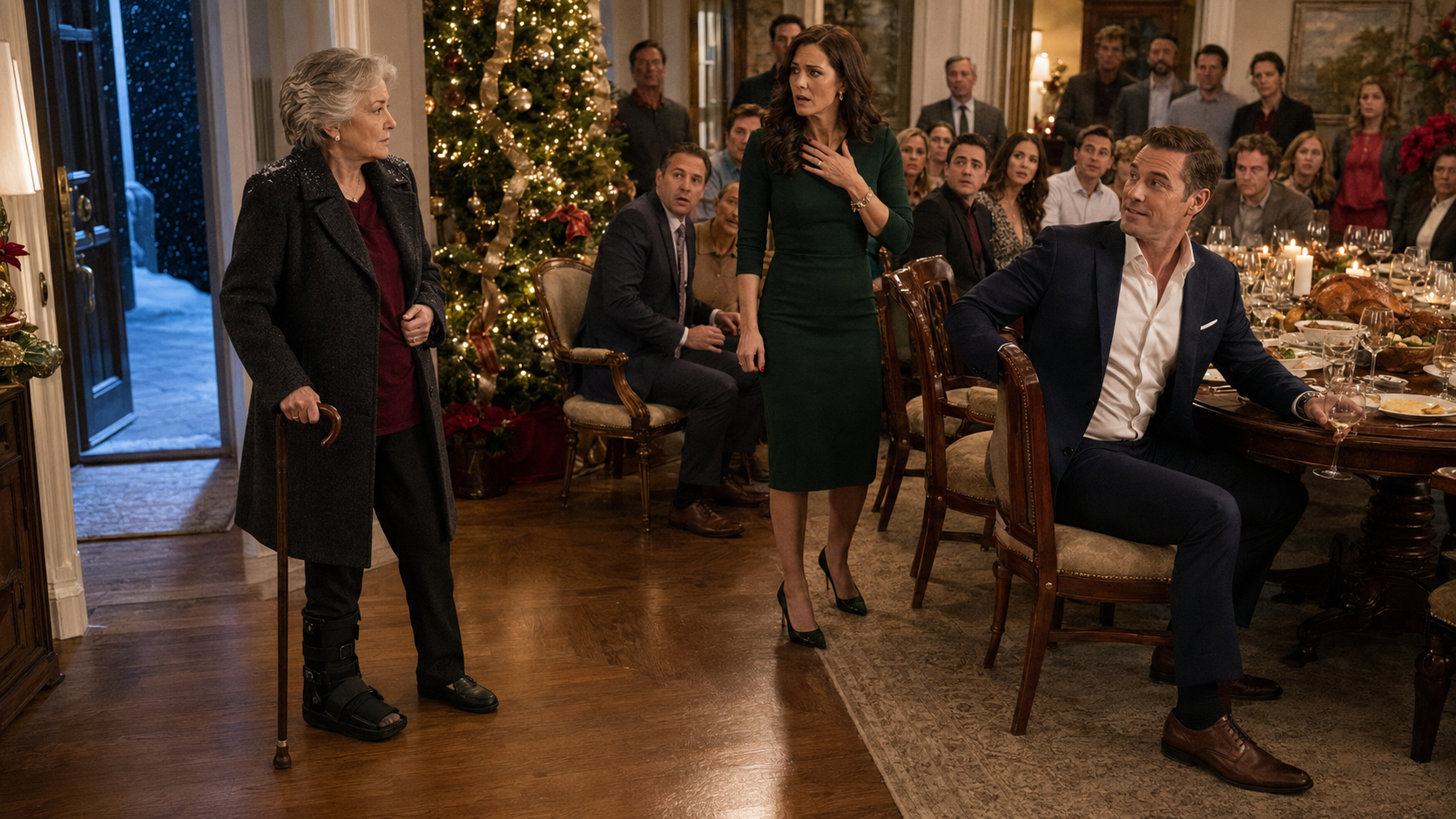
The moment I stepped into my son’s house on Christmas Eve, the celebration died.
Every conversation stopped.
Every fork hovered above its plate.
Even the Christmas music seemed to fade beneath the heavy thud of my medical boot and the sharp tap of my cane against the polished hardwood floor.
They had expected me to stay hidden.
Injured.
Terrified.
Silent.
Instead, I had come home.
Snow clung to the shoulders of my dark wool coat. My left hand trembled around the handle of my cane, although I told myself it was from the cold and not from seeing my son again.
Beneath my coat, clipped securely inside the lining, a tiny digital recorder captured every breath, every gasp, every whispered curse.
The Christmas tree in Daniel’s living room glittered with gold ribbons, glass ornaments, and warm white lights. Candles glowed above crystal wineglasses and expensive plates. The dining table was crowded with food—roasted turkey, glazed carrots, potatoes, pies, wine.
All of it purchased while I had been lying in a hospital bed.
Much of it purchased with money that had once been mine.
The room smelled of cinnamon, pine, butter, and expensive perfume.
But beneath all of that warmth, I smelled fear.
My daughter-in-law, Sophia, reacted first.
Her eyes dropped to the thick black orthopedic boot encasing my injured foot.
For one revealing second, the color vanished from her face.
Then the performance began.
She pressed one manicured hand to her chest.
“Oh my God.”
Her chair scraped backward.
She hurried toward me with the wide-eyed expression of a woman shocked by tragedy.
“What happened?”
Someone near the end of the table murmured my name.
Daniel’s aunt stared at my cane.
One of Sophia’s cousins whispered, “Was she in an accident?”
I ignored them.
Sophia stopped two feet in front of me.
Up close, I could see the tiny muscle jumping beside her right eye.
She had always been good at pretending.
That was one of the things I had admired about her before I understood what I was seeing.
She could enter a room furious and become charming before anyone noticed. She could turn irritation into concern, greed into practicality, cruelty into a wounded expression that made other people apologize to her.
Now she arranged her face into horror.
“Margaret,” she breathed. “Your foot…”
I looked at her.
I did not blink.
“You know exactly what happened.”
Her mouth opened.
Nothing came out.
The room seemed to contract around us.
And for one terrible instant, I was back at the top of my staircase three weeks earlier.
I had been carrying folded towels from the upstairs linen closet.
Nothing dramatic.
Nothing unusual.
Just another ordinary Tuesday morning in the house my husband and I had bought thirty-two years before.
I remember the winter light falling across the hallway carpet.
I remember the faint smell of Sophia’s perfume.
And I remember footsteps behind me.
Fast footsteps.
Not someone approaching to speak.
Someone closing distance.
I had barely begun to turn when two hands struck hard between my shoulder blades.
The force lifted me forward.
My stomach dropped.
The railing disappeared from beneath my fingers.
Then there was nothing but stairs.
My shoulder hit first.
Then my hip.
Then my head.
Then my foot twisted beneath me with a sound I still heard in my dreams.
I screamed.
I struck the landing.
For several seconds, I could not breathe.
Pain consumed everything.
My ankle burned.
My ribs felt crushed.
The ceiling spun above me.
Then a figure appeared at the top of the stairs.
Sophia.
She stood perfectly still.
She did not scream.
She did not run down to help me.
She looked at me.
That was what had stayed with me.
Not just the shove.
Not just the fall.
Her face afterward.
There had been panic in it, yes.
But there had also been calculation.
A pause.
As if she were trying to decide whether I was badly injured enough.
Then I heard her footsteps retreat.
Minutes later, she reappeared, shouting my name as if she had just discovered me.
She called emergency services.
She cried when the paramedics arrived.
She told them she had been in the kitchen when she heard the fall.
And because I was drifting in and out of consciousness, because my head was bleeding, because pain had swallowed my ability to form complete sentences, her version became the first version anyone heard.
An accident.
Margaret had fallen.
Margaret had been dizzy lately.
Margaret was getting older.
Margaret lived alone.
Margaret was stubborn.
Margaret needed help.
By the time I could think clearly enough to say otherwise, the story had already been built around me.
And my own son had helped build it.
Now, three weeks later, Daniel watched me from the Christmas table.
He leaned back in his chair.
Then he laughed.
It was not nervous laughter.
It was not surprise.
It was slow, smug, and satisfied.
The laugh of a man who believed the dangerous part was already over.
“Maybe you finally learned your lesson,” he said.
The words landed harder than my body had landed on the stairs.
For a second, I forgot about the recorder.
I forgot the officer waiting outside.
I forgot everything I had promised myself I would do.
I saw only my son.
My only child.
The little boy who used to climb into my bed during thunderstorms.
The teenager whose school principal had once called him reckless and arrogant, forcing me to sit across from a desk and defend him.
The young man whose first business failed because he spent money faster than he earned it.
I had given him $72,000 to save him from bankruptcy.
When his second business struggled, I guaranteed a loan.
When he married Sophia and complained their apartment was too small, I helped with their down payment.
Every time he stumbled, I called it helping.
Every time I rescued him, I told myself mothers did that.
I had spent years confusing love with protection.
Daniel had spent years learning that consequences were something his mother could be persuaded to remove.
Sophia shot him a sharp look.
“Daniel.”
He ignored her.
I could almost see the confidence moving through him.
He thought the hospital had weakened me.
He thought painkillers had blurred my memory.
He thought fear had done the rest.
Most of all, he thought the legal documents he had filed while I was hospitalized had trapped me more effectively than any broken bone ever could.
My home.
That was what this had really become about.
The house where I had raised him.
The house my late husband, Robert, and I had spent decades paying for.
The house Daniel had started referring to as “the property” less than forty-eight hours after my fall.
I had learned that from a social worker at the hospital.
Her name was Elaine.
She had stepped into my room on the fifth morning carrying a folder.
“Mrs. Whitmore,” she had said gently, “your son is requesting documentation related to your capacity and discharge planning.”
I stared at her.
“My capacity?”
She hesitated.
“He’s expressed concern that you may no longer be able to safely manage your financial or personal affairs.”
At first I thought I had misunderstood.
Then she showed me the paperwork.
Daniel had already spoken with an attorney.
He was seeking emergency authority to manage certain financial matters on my behalf.
His filing described me as forgetful.
Confused.
Emotionally unstable.
Physically unsafe.
It referenced my fall as evidence.
My fall.
The one his wife had caused.
According to Daniel, he wanted only to “protect his vulnerable mother from making dangerous decisions while cognitively impaired.”
There were requests for access to accounts.
Property records.
Insurance information.
Documents concerning the house.
And buried among the paperwork was something that chilled me more than anything else.
Daniel had already contacted a real estate professional.
My house had not even been legally placed under his control.
He was already discussing its value.
I remembered staring at the page until the words blurred.
Estimated sale price.
Condition.
Timeline.
Vacant possession.
Vacant.
I was still alive.
And my son was planning for my home to be empty.
That afternoon, I called him.
“Daniel, what have you done?”
He sighed.
Not shocked.
Not ashamed.
Annoyed.
“Mom, this is exactly why I had to step in.”
“Step in?”
“You’re not thinking clearly.”
“You are trying to take control of my house.”
“I’m trying to make sure you don’t destroy what’s left because you’re emotional.”
I gripped the phone so tightly my fingers hurt.
“I fell down the stairs.”
“And before that, you were already making bad decisions.”
“Which decisions?”
A pause.
“You’re impossible.”
That was the moment I understood he had no real examples.
Only a narrative.
A useful one.
I lowered my voice.
“Did Sophia tell you what happened?”
Another pause.
Too long.
Then he said, “Sophia found you after you fell.”
Found me.
I closed my eyes.
My heart began pounding.
“Were you home?”
“No.”
“You sound very certain.”
“Because I trust my wife.”
More than me.
I almost said it.
Instead I asked, “Do you trust her enough to risk prison?”
The silence that followed told me more than his answer.
When he finally spoke again, his voice had changed.
“Mom, stop.”
Not confused.
Not offended.
Afraid.
Then the call disconnected.
That night I began writing down everything I remembered.
The footsteps.
The shove.
Sophia standing above me.
Her delay before calling for help.
Daniel’s filings.
The real estate inquiry.
The change in his voice.
For the first time since my husband died six years earlier, I felt truly alone.
Then I remembered something Robert used to tell me whenever Daniel got into trouble as a teenager.
Loving someone doesn’t require believing their lies.
I had hated those words then.
Now they felt like a door opening.
I contacted the police.
And I told them I did not believe I had fallen.
I believed someone had pushed me.
By Christmas Eve, the officer investigating my report knew more than Daniel and Sophia realized.
But there was still one thing we needed.
Something neither legal filings nor memory could provide.
We needed them to speak when they believed they had already won.
So I had come to dinner.
Broken foot.
Cane.
Recorder.
And a question I had waited three weeks to ask my son to his face.
Why?
PART 2: WHAT THEY SAID WHILE I COULDN’T WALK
After my fall, the hospital became its own strange world.
Days were measured by medication schedules, blood pressure checks, physical therapy, and the slow humiliations of needing help to do things I had done without thought for most of my life.
I had fractured bones in my foot and ankle.
My shoulder was badly bruised.
Two ribs were cracked.
The cut at the back of my head required stitches.
The doctors told me I was lucky.
I began to hate that word.
Lucky.
People said it because I had not died.
They did not understand how frightening it was to realize someone had tried to make that possibility real.
The first night after I told police about Sophia, I barely slept.
Every noise in the hallway made me tense.
Every pair of footsteps outside my room made me look toward the door.
Sophia had access to me.
Daniel had access to me.
And until that point, both had been treated as caring family members.
That changed after I spoke with Officer Nathan Cole.
Cole was not dramatic.
He did not promise an arrest.
He did not immediately tell me he believed every detail.
He simply sat beside my hospital bed with a notebook and asked me to repeat the story slowly.
“What did you feel immediately before the fall?”
“Hands.”
“Where?”
“Between my shoulder blades.”
“Both hands?”
“I think so.”
“Did you see anyone?”
“Afterward. Sophia.”
“How long after?”
“Seconds.”
“You’re sure?”
“Yes.”
“Did she come down?”
“Not immediately.”
“How long did she wait?”
“I don’t know. Maybe twenty seconds. Maybe longer.”
Twenty seconds sounded insignificant until I heard myself say it.
When a seventy-year-old woman is lying broken at the bottom of a staircase, twenty seconds is an eternity.
Officer Cole wrote everything down.
Then he asked about Daniel.
I showed him the documents.
The requests for financial control.
The property information.
The messages Daniel had sent.
One read:
You need to stop making this adversarial. I’m trying to protect you.
Another:
If you keep fighting, the court will see exactly why you’re no longer capable of making rational decisions.
Another:
Sign the authorization. It will make everything easier.
Cole read them without changing expression.
“Did your son discuss selling your house before the fall?”
“No.”
“Had you told him you intended to sell?”
“No.”
“Had you discussed giving him the property?”
“Never.”
“What happens to the house eventually?”
I hated answering.
“Daniel is my only child.”
“So he expected to inherit?”
“Yes.”
He nodded once.
“Did he know that?”
“Yes.”
The word sat between us.
There was a difference between wanting your inheritance early and trying to kill someone for it.
I was not ready to believe my child had crossed that distance.
Even after everything.
That was the most humiliating part.
I still wanted another explanation.
Sophia might have lost her temper.
Maybe Daniel knew afterward but had not planned it.
Maybe greed had started after the fall rather than before it.
Maybe my son was selfish, opportunistic, cruel—but not monstrous.
I kept searching for a version I could survive emotionally.
Then Daniel and Sophia came to visit me.
It was four days before Christmas.
Daniel entered first carrying a poinsettia wrapped in silver paper.
Sophia followed with a bag from an expensive bakery.
The sight of her nearly stopped my breathing.
My hands went cold beneath the blanket.
She smiled weakly.
“We brought your favorite cookies.”
I looked at the bag.
“They’re not my favorite.”
Her smile flickered.
Daniel placed the plant on the windowsill.
“Mom, can we not start?”
“You’ve been here thirty seconds.”
“And you’re already hostile.”
Sophia touched his arm.
“Daniel, please.”
I watched them perform kindness for each other.
It suddenly occurred to me how often I had mistaken that performance for character.
Daniel sat beside my bed.
“We need to talk.”
“About the house?”
His jaw tightened.
“About your future.”
“My future is apparently very crowded. Everyone seems to be making plans for it.”
“See? This.”
“What?”
“The sarcasm. The paranoia.”
Sophia looked down.
Daniel leaned closer.
“You accused my wife of pushing you.”
“I told the police what happened.”
“You fell.”
“No.”
“You were dizzy.”
“No.”
“The doctor said you hit your head.”
“After I was pushed.”
His face changed.
Only slightly.
But I saw it.
I had spent more than forty years reading that face.
When Daniel was a child, his lower lip tightened before he lied.
As an adult, the habit had migrated to his jaw.
Now the muscle flexed once.
Then again.
“Mom, if you keep saying things like that, you’re only helping my case.”
There it was.
Not hurting us.
Not destroying the family.
Helping my case.
He had stopped speaking as my son.
He was speaking as an opponent.
I looked at Sophia.
“Were you behind me?”
She froze.
Daniel answered for her.
“No.”
“I asked Sophia.”
Sophia swallowed.
“I was in the kitchen.”
“Then how did you get to the top of the stairs before you came down to me?”
Her eyes flashed.
“I wasn’t at the top.”
“Yes, you were.”
“You were confused.”
“You stood there looking at me.”
“That never happened.”
“You waited.”
Her voice rose.
“I said it never happened!”
Daniel stood.
“Enough.”
A nurse appeared at the door.
Everything changed instantly.
Sophia stepped backward.
Daniel lowered his voice.
“We’re upsetting her.”
The nurse looked at me.
“Mrs. Whitmore, would you like your visitors to leave?”
For most of my life, I would have said no.
I would have softened the situation.
I would have worried about embarrassing Daniel.
I would have tried to preserve peace.
Instead I said, “Yes.”
Daniel stared at me.
“Mom.”
“You heard her.”
His eyes hardened.
Sophia reached for his sleeve.
He pulled away.
Before leaving, he bent toward me.
“Think very carefully about what you’re doing.”
The nurse stiffened.
Daniel smiled as if he had said something loving.
Then they left.
My heart pounded for several minutes afterward.
But beneath the fear was something else.
Clarity.
Later that evening, Officer Cole returned.
I told him what had happened.
He was quiet.
Then he asked, “Would you be willing to speak with them again?”
My stomach tightened.
“Why?”
“Because people who think they’re smarter than everyone else often become careless when they believe the outcome is already decided.”
That sentence stayed with me.
He could not ask me to put myself in danger.
He made that clear.
But he explained that if Daniel or Sophia made statements voluntarily, those statements could matter.
I thought about the Christmas dinner.
Daniel had invited relatives before my fall.
Afterward, Sophia had sent a message saying they would “understand completely” if I stayed at the hospital rehabilitation unit through the holidays.
I read that message differently now.
They did not want an injured mother at Christmas.
They wanted an absent witness.
I told Cole about the dinner.
He looked at me for a long moment.
“You want to go?”
“Yes.”
“Why?”
Because it was my family too.
Because I was tired of being discussed as if I were already gone.
Because Daniel had used my silence as evidence that he controlled the story.
Because if I stayed away, he would sit beneath Christmas lights telling relatives how sadly his mother had deteriorated.
But there was another reason.
One I hated admitting.
“I want to hear what my son says when he sees me.”
Cole nodded.
The next morning, he showed me how to use a small digital recorder.
Simple.
Reliable.
One switch.
One light.
He told me not to confront anyone alone.
He would remain nearby.
If I felt unsafe, I was to leave.
I agreed.
Before he left, he said, “Mrs. Whitmore, this is not about making them confess to something dramatic. Don’t force it.”
“I know.”
“Just let them talk.”
I almost laughed.
Daniel had always loved talking when he thought he was right.
The recorder would not need much help.
But there was something Officer Cole did not know yet.
The Christmas dinner would not be the first time Daniel had been recorded.
Because earlier that morning, Sophia had called me.
I nearly ignored it.
Then I answered.
For several seconds neither of us spoke.
Finally she said, “Margaret, you need to stop this.”
“Stop what?”
“The police.”
I turned on the recorder lying beside me.
“Why?”
“You know why.”
“No. Tell me.”
She exhaled sharply.
“I didn’t mean for you to get hurt that badly.”
Every hair on my arms lifted.
I did not speak.
Sophia seemed to realize what she had said.
“I mean—you fell because we were arguing.”
“We weren’t arguing.”
“You were angry.”
“I was folding towels.”
“Margaret…”
“Did you push me?”
Silence.
Then I heard a man’s voice in the background.
Daniel.
“What are you doing?”
Sophia muffled the phone.
I could not understand her answer.
Then Daniel’s voice came closer.
“Hang up.”
I said his name.
“Daniel.”
The line remained open.
There was shuffling.
Sophia whispered, “She won’t stop.”
Then Daniel said words that froze me.
“She should’ve stopped three months ago.”
I gripped the recorder.
“What happened three months ago?”
No answer.
I remembered.
Three months earlier, Daniel had asked me to put his name on the house.
Not give it to him.
Just “simplify things,” he said.
He wanted to be added to the deed.
I refused.
Robert and I had agreed the house would remain mine for as long as I lived.
Daniel had called me selfish.
Two weeks later, he apologized.
I thought the argument was over.
Now I understood it had only changed shape.
Sophia hissed, “Daniel, stop.”
He sounded furious.
“No, I’m tired of this. She acts like we’re trying to steal something that’s coming to us anyway.”
My stomach turned.
“Coming to you when?” I asked.
There was a horrible silence.
Daniel realized the call was still connected.
Then he said quietly, “Mom, you need to let Sophia and me handle things now.”
“Why?”
“Because you’re making everything worse.”
“And if I had died on those stairs?”
Sophia made a small sound.
Daniel did not answer immediately.
When he finally did, his voice was flat.
“Then at least we wouldn’t be having this conversation.”
The call ended.
I stared at the recorder for a long time after that.
He had not said, I wanted you dead.
But he had said enough to change something inside me forever.
Officer Cole listened twice.
Then he asked whether Daniel knew I was recording.
“No.”
“Did you threaten them?”
“No.”
“Did you lead them?”
“I asked what happened.”
He nodded.
“This matters.”
“Is it enough?”
“Enough for what?”
“To prove he planned it.”
He did not lie to me.
“Not by itself.”
I looked toward the window.
Snow was beginning to fall.
Christmas lights from a building across the street blurred through the glass.
Cole continued.
“But it tells us he had a financial grievance before the fall. It shows knowledge. It shows hostility. And Sophia’s statement matters too.”
I turned back.
“What statement?”
His eyes met mine.
“I didn’t mean for you to get hurt that badly.”
For the first time, hearing someone else repeat it, I understood the weight of the sentence.
Not I didn’t hurt you.
Not You’re mistaken.
I didn’t mean for you to get hurt that badly.
An admission wrapped inside an excuse.
Sophia had just told us the fall was not an accident.
The only remaining question was how much Daniel had known before she put her hands on my back.
Christmas Eve would answer that.
PART 3: THE CHRISTMAS DINNER THEY THOUGHT I WOULD MISS
I was discharged from the hospital late on Christmas Eve afternoon.
Against medical advice, according to one particularly unhappy nurse.
Not because I was medically unstable.
Because she thought walking into a family confrontation days after leaving a hospital was “an aggressively bad idea.”
I told her I agreed.
Then I signed the discharge paperwork anyway.
A friend drove me to Daniel’s neighborhood.
Officer Cole followed separately.
The plan was simple.
I would enter.
Cole would remain close.
I would stay near the front room and dining area.
If Daniel or Sophia threatened me physically, I would leave immediately.
If they talked, I would let them.
I looked down at the recorder in my palm before switching it on.
Such a small object.
It did not look capable of destroying a family.
But the truth was, the recorder would not destroy anything.
Whatever happened next had been built long before I pressed that button.
I only planned to make it audible.
The front steps of Daniel’s house had been salted.
I climbed them one painful step at a time.
My cane struck the concrete.
My boot felt heavy.
Through the front windows I could see people laughing.
Daniel’s relatives.
Sophia’s family.
People who had known me for years.
People who had visited my home.
Eaten at my table.
Sent me birthday cards.
Some of them had apparently accepted Daniel’s claim that I was too “confused” to attend Christmas dinner.
I rang the bell.
No one heard it over the music.
So I opened the unlocked door.
And stepped inside.
The celebration died.
Sophia came toward me.
“Oh my God. What happened?”
“You know exactly what happened.”
Then Daniel laughed.
“Maybe you finally learned your lesson.”
At that moment, every remaining doubt inside me went quiet.
There are sentences that end relationships.
Not because the words are magical.
Because they reveal something that had been hidden too long.
Daniel’s aunt, Linda, stared at him.
“What lesson?”
Daniel ignored her.
Sophia whispered, “Daniel, stop.”
He picked up his wineglass.
“Why? Everyone’s been tiptoeing around this for weeks.”
“Around what?” I asked.
His eyes met mine.
“You.”
There were fifteen people in that dining room.
No one moved.
I limped toward the empty chair at the far side of the table.
Someone started to stand to help me.
I raised one hand.
“I can manage.”
Pain shot through my ankle as I lowered myself into the chair.
I placed my cane beside me.
Sophia remained standing.
Daniel took a slow drink.
I looked around the table.
“Apparently there has been some misunderstanding about why I wasn’t going to attend tonight.”
Daniel shook his head.
“Mom.”
“I was in the hospital.”
“We know.”
“Because I fell down a staircase.”
Linda frowned.
“We heard.”
Sophia interrupted.
“It was awful. I found her—”
“You pushed me.”
The room erupted.
Not loudly.
In fragments.
A gasp.
A chair shifting.
Someone whispering, “What?”
Sophia’s mother said her name.
Sophia stared at me.
“That is not true.”
I reached beneath the table and touched the edge of my coat where the recorder sat hidden.
“Then tell them what is true.”
Daniel slammed his glass down.
“This is exactly what I’ve been dealing with.”
Linda looked at him.
“What do you mean?”
“My mother is not well.”
The sentence was prepared.
I knew immediately.
He had said it before.
Repeated it.
Practiced it.
“She suffered a head injury,” he continued. “She’s been paranoid. Accusatory. She’s confused about timelines. She has been making irresponsible financial decisions.”
“Name one,” I said.
He looked at me.
“One irresponsible financial decision.”
“This isn’t the place.”
“You brought it up.”
His face hardened.
Sophia moved toward him.
“Daniel, maybe we should—”
He brushed her hand away.
“No. She wants to do this publicly? Fine.”
That was exactly what I had hoped pride would make him say.
He leaned forward.
“You refused basic estate planning.”
“I have an estate plan.”
“You refused to add me to the house.”
“There we are.”
Linda looked between us.
“What does the house have to do with her fall?”
Daniel’s eyes flicked toward her.
“Nothing.”
I smiled for the first time.
“Then why did you contact a real estate agent while I was unconscious?”
Several people turned toward him.
His cousin Mark lowered his fork.
“You did what?”
Daniel’s confidence cracked.
Only a little.
“I asked about options.”
“For my house.”
“For the family.”
“My husband and I bought that house. There is no ‘family’ ownership.”
“I’m your son.”
“That does not make you the owner.”
“You were going to leave it to me anyway.”
Sophia closed her eyes.
Daniel realized too late that he had said it.
Linda whispered, “Daniel.”
He looked around the table.
“What? Is everyone going to pretend this is shocking? I’m her only child.”
I asked, “And how long were you willing to wait?”
His expression changed.
Sophia’s hand shot out and grabbed his wrist.
“Enough.”
He jerked free.
I could hear my own heartbeat.
“Three months ago,” I continued, “you asked me to put your name on the deed.”
“You should have.”
“I said no.”
“Because you’re stubborn.”
“And three weeks ago I was pushed down a staircase.”
Sophia stepped back.
Daniel scoffed.
“Listen to yourself.”
“I have.”
“Mom, you’re seventy years old. You live alone in a house that’s too big for you. You refuse help. You hoard money you don’t use. You act like every suggestion is an attack.”
“It became an attack when your wife put both hands on my back.”
“I did not!” Sophia cried.
Her voice cracked.
I turned toward her.
She was crying now.
Real tears or staged ones, I could not tell.
“I was trying to stop her!”
Daniel stood so quickly his chair nearly overturned.
Every person at the table froze.
Sophia clapped a hand over her mouth.
I felt the room change.
Not everyone understood what she had admitted.
But Daniel did.
He stared at her with naked fury.
“You were trying to stop me from what?” I asked.
Sophia shook her head.
“I—I mean from leaving.”
“Leaving where?”
“The conversation.”
“What conversation?”
She looked at Daniel.
That was her mistake.
Every person at the table followed her eyes.
Daniel spoke through his teeth.
“Don’t.”
Sophia started crying harder.
“I didn’t mean—”
I leaned forward.
“Sophia, what happened at the top of those stairs?”
“You were angry.”
“About what?”
“Daniel.”
He spoke her name like a command.
She turned on him.
“Stop looking at me like that!”
Silence.
He lowered his voice.
“Sit down.”
“No.”
“Sit down.”
“You said she wouldn’t come here!”
That sentence passed through the room like electricity.
Daniel stared at her.
I whispered, “Why wouldn’t I come?”
Sophia realized.
Her face collapsed.
Daniel recovered faster.
“Because she was in the hospital, obviously.”
I looked at him.
“You sound disappointed.”
He laughed again.
But this time there was no confidence in it.
Only anger.
“You shouldn’t even be here.”
“It’s Christmas.”
“You should be in rehab.”
“Why? So you could explain to everyone that your confused old mother was too unwell to attend?”
“That’s not what I said.”
“It’s what you filed with the court.”
His aunt gasped.
Daniel turned toward her.
“This is private.”
“No,” I said. “You made it public when you told relatives I was unstable.”
“You are unstable.”
“Because I remember being pushed?”
“Because you won’t let this go!”
My hand closed around the edge of the table.
“What exactly am I supposed to let go?”
His voice rose.
“The house! The documents! Sophia! The stairs! All of it!”
No one moved.
He heard himself too late.
Mark slowly stood.
“Daniel…”
“Stay out of it.”
Mark’s expression hardened.
“I think maybe everyone should hear her.”
Daniel turned on me.
His face was no longer the face of the confident son protecting an aging mother.
The mask had finally slipped.
“You have spent your entire life controlling everything,” he said.
My throat tightened.
“That’s what you think?”
“You control money. You control property. You control everyone with guilt.”
“I paid your debts.”
“Exactly.”
“I saved your business.”
“So you could remind me forever.”
“I helped you buy this house.”
“And made sure everyone knew.”
“I never asked for anything back.”
“You expected gratitude.”
The bitterness in his voice stunned me.
Not because resentment was new.
Because I finally understood its size.
Every rescue I had called love, Daniel had experienced as proof that I possessed what he needed.
Money.
Security.
Control.
And instead of wanting independence, he had learned to resent the person who could provide it.
He pointed toward my injured foot.
“You could have made this easy.”
A woman at the table whispered, “Oh my God.”
Sophia began shaking her head.
“Daniel.”
But he was gone now.
Not physically.
Emotionally.
Pride had taken control.
“You shouldn’t have made everything so difficult,” he continued.
“We tried to handle this peacefully.”
I kept my voice steady.
“By pushing me down a staircase?”
His nostrils flared.
“Maybe now you understand that you can’t keep fighting us.”
Sophia went white.
“Stop talking.”
Daniel laughed.
“Why? She can barely walk. What is she going to do?”
I looked at him for several seconds.
Then I answered.
“Listen.”
The front door opened.
Cold air swept down the hallway.
Candle flames trembled.
Snow crunched beneath boots.
Daniel’s smile disappeared.
Officer Nathan Cole stepped inside.
He wore his winter uniform coat.
In one hand, he carried a compact audio playback device.
Daniel shoved his chair backward so violently it scraped across the floor.
“What is this?”
I lifted my chin.
“Come in, Officer.”
Sophia’s knees nearly gave way.
Her mother reached toward her.
Sophia pulled away.
Daniel glanced toward the doorway.
It was only one glance.
Quick.
Instinctive.
But I saw the calculation.
Distance.
Exit.
Witnesses.
Consequences.
Officer Cole walked toward the table.
“Mr. Whitmore. Mrs. Whitmore.”
Daniel raised both hands.
“I don’t know what she told you, but my mother has suffered a head injury.”
Cole looked at me.
I reached inside my coat.
The recorder was warm from being against my body.
I placed it in his hand.
Daniel stared at it.
Then at me.
His face changed completely.
For the first time in my life, I saw my son understand that I had not come to beg him.
I had come prepared.
Cole placed the recorder beside the serving dishes.
“We need to hear this together.”
PART 4: THE VOICE BEHIND THE PUSH
Officer Cole did not immediately press play.
He looked around the table first.
“This recording includes a telephone conversation voluntarily initiated by Mrs. Whitmore several days ago, along with audio from this evening.”
Daniel stared at me.
“You recorded me?”
His outrage almost made me laugh.
“You lied to a court to take control of my property.”
“That doesn’t give you the right—”
Cole cut him off.
“Mr. Whitmore, I suggest you listen.”
Sophia was breathing so fast I could hear it from across the table.
Her mother whispered, “Sophia, what did you do?”
“I didn’t—”
The recorder clicked.
Static crackled softly through the room.
Then my own voice played.
Why?
Sophia’s recorded voice answered.
You know why.
I watched her close her eyes.
The conversation continued.
The police.
My recorded voice:
Why?
Then Sophia.
Clear.
Unmistakable.
I didn’t mean for you to get hurt that badly.
Someone at the table gasped.
Sophia’s mother sat down heavily.
Mark whispered a curse.
Daniel stared at the recorder.
The audio continued.
My voice asked:
Did you push me?
Silence.
Then Daniel in the background.
What are you doing?
Sophia:
She won’t stop.
Daniel:
She should’ve stopped three months ago.
I watched Linda’s face.
She remembered, perhaps, the argument about the deed.
Everyone had heard pieces of it.
No one had understood.
My voice came through again.
What happened three months ago?
Daniel’s recorded voice grew louder.
No, I’m tired of this. She acts like we’re trying to steal something that’s coming to us anyway.
Sophia whispered his name.
Then I asked the question that had haunted me since the call.
And if I had died on those stairs?
This time, no one at the Christmas table breathed.
The pause on the recording seemed endless.
Then Daniel’s voice filled the dining room.
Cold.
Flat.
Cruel.
Then at least we wouldn’t be having this conversation.
Sophia began to sob.
Daniel did not move.
The recording ended.
For several seconds, no one spoke.
The Christmas tree continued blinking.
Red.
Gold.
White.
The turkey steamed beneath the chandelier.
Somewhere in the kitchen, an automatic timer began beeping.
It was grotesquely ordinary.
I had imagined this moment in the hospital.
I had imagined Daniel breaking.
Apologizing.
Explaining.
I had imagined rage.
I had imagined denial.
I had never imagined how small he would look when everyone finally heard him.
His aunt stared at him.
“How could you say that?”
Daniel looked toward her.
“You don’t understand.”
“I heard you.”
“It was taken out of context.”
I almost smiled.
“Then give us the context.”
His mouth tightened.
No answer.
Sophia suddenly spoke.
“He told me she was going to ruin us.”
Every face turned toward her.
Daniel’s expression sharpened.
“Sophia.”
She backed away from him.
“No.”
He lowered his voice.
“Don’t do this.”
“You said the house was supposed to be yours.”
“I said—”
“You said she was punishing you.”
“Sophia, stop.”
She was crying openly now.
Three weeks ago, I had hated her with a simplicity that felt almost clean.
She was the woman who put her hands on me.
The person whose shove had fractured my body.
But listening to her now, I saw something more complicated.
Not innocence.
Never that.
Fear.
Cowardice.
Greed.
And the realization that the man she had protected was preparing to protect himself at her expense.
Officer Cole said, “Mrs. Whitmore, tell me what happened before the fall.”
Daniel stepped forward.
“She doesn’t have to say anything.”
Cole looked at him.
“I wasn’t asking you.”
Sophia wiped her face with both hands.
“Daniel had been trying to get Margaret to sign things.”
“What things?” Cole asked.
“Property documents. Financial authorization.”
“Did you know she refused?”
“Yes.”
“Did Mr. Whitmore ask you to harm his mother?”
Sophia looked at Daniel.
He shook his head once.
Tiny.
Almost invisible.
She saw it.
So did I.
Her face changed.
“No,” she whispered.
Daniel exhaled.
Then Sophia continued.
“He didn’t say, ‘Push her down the stairs.’”
Daniel’s relief vanished.
“Sophia.”
“He never said those exact words.”
Officer Cole remained still.
“What did he say?”
She looked at me.
I will never forget that look.
Not because it asked forgiveness.
It did not.
It looked like a person finally seeing the human being she had reduced to an obstacle.
“He said you had to be made to understand.”
My fingers tightened.
“Understand what?”
“That he wasn’t going to wait forever.”
The room seemed to tilt.
Daniel snapped, “That could mean anything.”
Sophia turned toward him.
“You told me if she became incapable, the court would have to step in.”
“I was talking about legal options.”
“You said the fall would help.”
Silence.
Daniel went completely still.
Officer Cole’s voice was very calm.
“When did he say that?”
Sophia hugged herself.
“After.”
I breathed again.
After.
Important.
Not before.
Daniel had not necessarily ordered the push.
Not according to her.
But he had known immediately.
And he had used it.
Cole asked, “What happened before Mrs. Whitmore fell?”
Sophia looked at me.
“You told me you were changing your estate plan.”
I frowned.
“No, I didn’t.”
“Yes, you did.”
“When?”
“That morning.”
I remembered.
Sophia had been in my kitchen.
We had been discussing Christmas plans.
Daniel had asked, through her, whether I had reconsidered adding him to the deed.
I said no.
Then I said something else.
“If Daniel keeps trying to bully me over that house, I may have to rethink what I leave him.”
I had not meant it as a formal announcement.
I had been angry.
But Sophia had heard a threat to their expectation.
She continued.
“I told Daniel.”
“Before you pushed me?”
“Yes.”
Daniel closed his eyes briefly.
Sophia’s voice shook.
“He was furious. He said you were trying to control us again.”
Daniel interrupted.
“I was not there.”
Cole said, “No one said you were.”
“I never told her to push anyone.”
Sophia shouted, “You told me to make her understand!”
“That does not mean assault her!”
“You knew what happened afterward!”
“I knew you said she fell!”
Sophia stared at him.
“You knew.”
He pointed at her.
“You are not putting this on me.”
I felt something inside me break.
Not my heart.
That had happened weeks earlier.
The illusion.
The last fragile piece of belief that my son, faced with the truth, might show concern for what had happened to me.
Instead, he was fighting over percentages of blame.
Who pushed.
Who knew.
Who said what.
As if my body at the bottom of the staircase had been a failed business transaction.
Sophia’s voice became very quiet.
“You came to the hospital that night.”
Daniel said nothing.
“You asked whether she remembered.”
I looked at him.
He would not meet my eyes.
Sophia continued.
“You asked me exactly what she said before the ambulance came.”
Daniel snapped, “Because you had just told me my mother fell down the stairs!”
“You asked if she could still sign documents.”
A sound of disgust came from someone at the table.
Daniel looked around desperately.
“This is insane.”
Sophia laughed once.
A broken sound.
“No. You know what was insane? Sitting in the hospital parking lot while you searched property values.”
My stomach twisted.
I had known about the real estate inquiry.
I had not known when it happened.
Officer Cole asked, “The night of the fall?”
Sophia nodded.
Daniel shouted, “Because we needed to know what options existed if she couldn’t return home!”
“Six hours after I fell?” I asked.
He turned toward me.
His face was flushed.
“You were seventy years old with a head injury and broken bones!”
“And your first concern was my home.”
“My first concern was the future.”
“Yours.”
“Our family’s.”
“No, Daniel.”
I forced myself to stand.
Pain shot through my foot.
Linda moved toward me.
I raised my hand.
I needed to do this myself.
I balanced on the cane.
Then I looked at my son.
“Your father and I spent thirty-two years paying for that house.”
Daniel’s jaw tightened.
“We missed vacations to pay the mortgage.”
“Mom—”
“We saved. We repaired things ourselves. Your father worked overtime. I took additional shifts. We built a life there.”
“I know.”
“No. You know its value.”
He flinched.
“You stopped seeing it as my home.”
“That’s not true.”
“You saw it as your future.”
He said nothing.
I continued.
“And when I refused to turn my future into your property, you decided I was controlling you.”
“That’s not what happened.”
“You told a court I was incapable.”
“You were injured.”
“You contacted a real estate agent.”
“You couldn’t live there alone.”
“You threatened me in the hospital.”
“I was trying to make you understand reality.”
“And when your wife admitted she had hurt me?”
Silence.
I waited.
“What did you do?”
His eyes dropped.
That answer was worse than any confession.
I nodded slowly.
“You did not call the police.”
No answer.
“You did not tell the doctor.”
Nothing.
“You did not protect me.”
His lips parted.
I stopped him.
“You protected the opportunity.”
Sophia began crying again.
Daniel looked toward Officer Cole.
“She pushed her. Not me.”
I closed my eyes.
There it was.
At last.
Not Sophia says she pushed her.
Not if she pushed her.
“She pushed her.”
The entire table heard it.
Officer Cole heard it.
And the recorder heard it.
Daniel realized what he had said.
Too late.
Cole stepped forward.
“Mr. Whitmore.”
Daniel backed away.
“I want a lawyer.”
“You’re entitled to one.”
“I’m not saying anything else.”
“That would be wise.”
Sophia sank into a chair.
I thought she might faint.
Cole spoke to another officer waiting just outside.
The rest happened slowly and quickly at the same time.
Questions.
Instructions.
Sophia asking whether she was being arrested.
Daniel repeating that he wanted an attorney.
Relatives moving away from them as though physical distance might erase their association.
I stood beside the Christmas table gripping my cane.
My whole body shook.
But I did not feel victorious.
Not yet.
I felt empty.
Officer Cole paused beside me before escorting them out.
“You did well.”
I looked toward Daniel.
He was putting on his coat.
For one final second, his eyes met mine.
I waited for something.
Regret.
Love.
Shame.
Anything that belonged to the boy I remembered.
Instead he said, “You didn’t have to do this.”
The sentence almost destroyed me.
Then I understood.
Even now, Daniel believed consequences were things other people did to him.
I straightened.
“No,” I said. “You did.”
And this time, he had no answer.
PART 5: WHAT MY SON WANTED ME TO BECOME
The legal process did not end on Christmas Eve.
Real life rarely gives us endings that clean.
Sophia eventually admitted she had shoved me during the argument at the top of the stairs.
She insisted she had not intended to kill me.
I believed that part.
Not because I forgave her.
Because the details fit.
She had been angry.
She had heard I might reconsider what Daniel inherited.
She had confronted me.
I had walked away.
She grabbed my arm.
I pulled free.
She followed.
At the top of the staircase, I told her to leave my house.
She shoved me.
Hard.
Whether she meant for me to fall one step or all the way down did not change what she did.
But the investigation also made clear that Daniel’s role was different from what I had first imagined in the darkest hours of the hospital.
He had not stood somewhere giving a direct order.
There was no secret command saying, Kill my mother.
The truth was uglier because it was more believable.
For months, Daniel had told Sophia that I was selfish.
That I was withholding what should eventually belong to them.
That I was using money to control him.
That if I became incapable, he could take over.
That if I could no longer live in the house, it could be sold.
That my resistance was the only thing standing between them and financial security.
He created the pressure.
Sophia acted violently under that pressure.
Then, once he learned what she had done, Daniel did not protect me.
He protected the advantage.
He contacted an attorney.
He built a story about cognitive decline.
He used my head injury as evidence that I was confused.
He sought control.
He investigated selling the house.
And when Sophia panicked, he told her to stay quiet.
The most painful part of all was learning that he had visited my house the morning after the fall.
Not to bring me clothes.
Not to secure it for my return.
He photographed rooms.
The kitchen.
The upstairs bedrooms.
The renovated bathroom.
The backyard.
He sent some of those photographs in connection with the property inquiry.
My hospital bracelet was still around my wrist.
My blood was probably still somewhere on the stair carpet.
My son was already thinking about square footage.
That knowledge changed me.
For weeks after Christmas, I woke before dawn with my heart racing.
Sometimes I dreamed about the fall.
Sometimes I dreamed Daniel was eight years old again.
That was worse.
In those dreams he came running into the kitchen wearing dinosaur pajamas, asking me to make pancakes.
Then I woke and remembered his adult voice saying:
Then at least we wouldn’t be having this conversation.
People asked whether I hated him.
I never knew how to answer.
Hatred would have been simpler.
What I felt was grief without a funeral.
The person was alive.
The relationship was dead.
Or perhaps the relationship I thought we had had never existed in quite the way I believed.
That possibility hurt most.
During recovery, I returned to my own house.
Not a facility.
Not Daniel’s home.
Mine.
The first time I stood at the bottom of the staircase again, I froze.
My physical therapist was beside me.
“You don’t have to do this today,” she said.
I stared upward.
The hallway looked ordinary.
Sunlight.
Family photographs.
The wooden banister Robert had refinished by hand.
Nothing about it looked dangerous.
That frightened me.
Terrible things do not always happen in terrible places.
Sometimes betrayal waits in a familiar hallway.
I tightened my hand around the railing.
“One step,” I said.
My therapist nodded.
“One step.”
I climbed.
Slowly.
Painfully.
When I reached the top, I cried.
Not because of the pain.
Because the last time I had stood there, someone had decided my wishes mattered less than what they wanted from me.
This time, every step had been my decision.
I began changing other things too.
My attorney withdrew every filing Daniel had initiated on my behalf and challenged the claims made about my mental capacity.
The court-appointed assessment Daniel had hoped would prove I was incompetent did the opposite.
I was alert.
Oriented.
Financially capable.
Fully aware of my property.
Fully capable of making my own decisions.
I remember sitting in my attorney’s office when she told me.
“Daniel’s emergency petition is effectively dead.”
I stared at her.
A strange laugh escaped me.
“What?”
She smiled gently.
“You sound surprised.”
“I knew I wasn’t incompetent.”
“I would hope so.”
“It’s just…”
I looked toward the window.
“I spent weeks with people talking around me like I was disappearing.”
She closed the folder.
“You’re not disappearing.”
No.
I wasn’t.
That became the center of everything.
I was not dead.
I was not confused.
I was not a signature waiting to happen.
I was not an inconvenience standing between my son and a house.
I was Margaret Whitmore.
Seventy years old.
Widowed.
Injured.
Heartbroken.
And still here.
I changed my estate plan.
Not in rage.
Not immediately.
I waited until I could make the decision without hearing Daniel’s voice in my head.
Then I sat with my attorney and looked at everything Robert and I had built.
The savings.
The investments.
The house.
I thought about what inheritance was supposed to mean.
For years, I had assumed it meant blood.
My son would receive what remained because he was my son.
But Daniel had spent years treating the future inheritance as if it already belonged to him.
That assumption had poisoned us.
So I changed the terms.
I made provisions for several people and organizations that had mattered to Robert and me.
I created clear instructions regarding my care.
I appointed someone I trusted to make decisions if I ever truly became unable to make them myself.
Someone who had never asked what my house was worth.
When my attorney asked whether I wanted Daniel removed entirely, I stared at the page for a long time.
Finally I said, “Yes.”
My voice did not shake.
It was not revenge.
It was reality.
An inheritance is a gift from the living.
Not a debt owed to the waiting.
Daniel wrote to me once after that.
His attorney sent the letter.
Most of it concerned legal matters.
At the end, Daniel added three handwritten sentences.
I never wanted you dead.
Everything got out of control.
I hope one day you understand that I thought I was protecting my family.
I read those lines several times.
Then I placed the letter in a drawer.
I did understand.
That was the tragedy.
Daniel had defined “his family” in a way that no longer included me except as an asset.
He had convinced himself that wanting my property was the same as planning responsibly.
That resenting my boundaries was the same as being mistreated.
That exploiting my injury was the same as protecting everyone.
Perhaps he truly had not wanted me dead.
But when confronted with the possibility, his response had been:
Then at least we wouldn’t be having this conversation.
Sometimes the ugliest truth is not that someone planned your death.
Sometimes it is that your death would have solved their problem.
Sophia wrote to me too.
Her letter was longer.
She apologized.
She described panic, anger, fear, Daniel’s pressure, their financial stress.
She told me she had replayed the moment on the stairs every night.
She said she wished she had walked away.
I believed that too.
But regret does not reverse gravity.
Regret did not lift me from the landing.
Regret did not unbreak my foot.
Regret did not erase the image of her standing above me.
I did not answer.
Forgiveness, if it ever came, would not require access.
By spring, I could walk without the boot.
The cane lasted longer.
One morning, I carried it into the garage and placed it beside a shelf.
Then I stood there staring at it.
For months, that cane had announced me before I entered a room.
Tap.
Step.
Tap.
Step.
On Christmas Eve, it had been the sound that stopped the celebration.
I ran my fingers over the handle.
Then I left it there.
The house became quiet again.
But it was a different quiet.
Not the frightened silence of the hospital.
Not the silence Daniel had expected from me.
This quiet belonged to me.
I repainted the upstairs hallway.
I replaced the stair runner.
For a long time I thought changing it would feel like letting them erase what happened.
Instead, it felt like refusing to make the staircase a monument to them.
I moved a large photograph of Robert from the living room to the small table near the stairs.
In it, he was laughing at something outside the frame.
The first morning after I placed it there, I stopped in front of him.
“You were right,” I whispered.
The photograph, naturally, said nothing.
I smiled anyway.
Loving someone did not require believing their lies.
It also did not require letting those lies become my future.
The following Christmas, I did not attend a large dinner.
I hosted one.
Small.
Warm.
People I trusted.
No elaborate gold decorations.
No performance.
No conversations that stopped when I entered.
Before dinner, snow began falling outside.
I stood near the window holding a glass of cider while someone lit candles.
For a brief second, the smell of cinnamon brought me back to Daniel’s dining room.
The recorder.
Sophia’s pale face.
The scrape of Daniel’s chair.
Officer Cole pressing play.
My son’s voice filling the room.
I expected the memory to hurt.
It did.
But it no longer owned me.
One of my friends called from the dining room.
“Margaret, are you coming?”
I looked toward the staircase.
Then toward the people waiting for me.
“Yes,” I said.
And I meant more than dinner.
I walked into the room without a cane.
No one gasped.
No one pretended.
No one was waiting for me to weaken so they could take my place.
I sat at the head of my own table.
Someone poured wine.
Someone laughed.
Someone complained that the potatoes were getting cold.
Life, ordinary and precious, continued around me.
For years, I had thought motherhood meant keeping the door open no matter what.
Covering mistakes.
Paying debts.
Making excuses.
Saving Daniel from every consequence because I believed that was what love required.
I know differently now.
Sometimes love is holding a child’s hand on the first day of school.
Sometimes love is lending money when he fails.
Sometimes love is forgiveness.
And sometimes, when that child becomes a man who sees your life as an obstacle between himself and what you own, love means refusing to lie for him anymore.
Daniel once believed a broken foot, a frightened mother, and a few legal documents would make me disappear.
He believed age made me weak.
He believed injury made me helpless.
He believed being my son gave him rights to things that were never his.
And above all, he believed silence was the same as surrender.
He was wrong.
Because the cruelest thing I heard on Christmas Eve was not Sophia admitting she had pushed me.
It was my own son confirming that once I fell, he saw an opportunity.
But the most important thing recorded that night was something else.
It was my own voice.
Steady.
Clear.
Still mine.
The voice of a woman they had tried to describe as confused.
The voice of a mother who finally stopped protecting the person hurting her.
The voice that said the sentence Daniel had spent his whole life avoiding.
No.
No, you do not own my house.
No, you do not get to rewrite what happened.
No, blood does not erase betrayal.
No, my age does not make me incapable.
No, my injuries do not make me powerless.
And no, I will not disappear simply because my existence has become inconvenient to you.
I survived the staircase.
But that was not the hardest thing I survived.
The hardest thing was discovering what my son had become after I reached the bottom.
Getting back up was the part that saved me.
Để lại một bình luận