
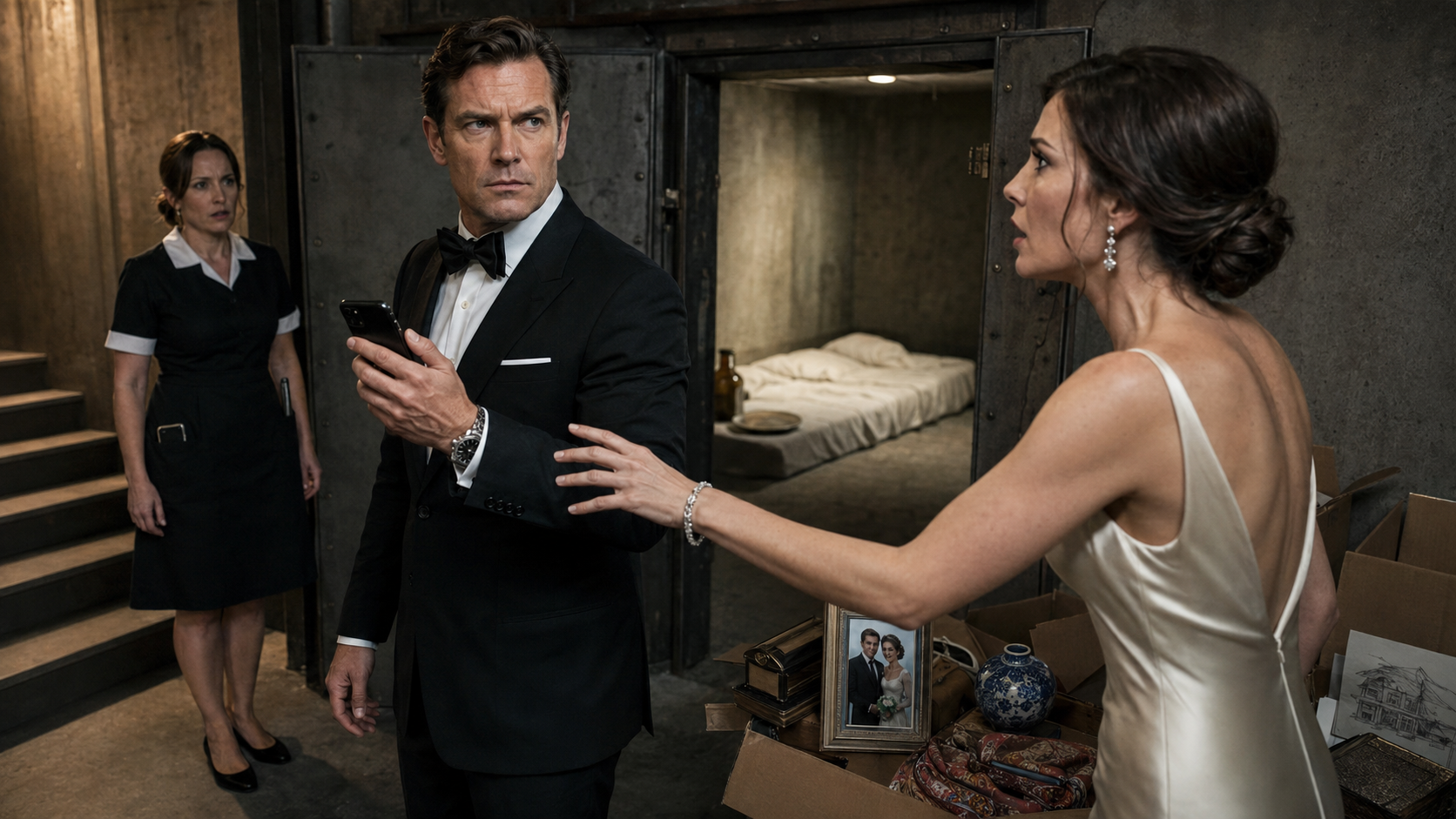
The night I found the billionaire’s missing son, his new wife was smiling beneath a chandelier thirty feet away.
PART 1: THE SOUND NO ONE ELSE HEARD
The first time I heard Ethan Sterling cry from behind a wall, I was carrying eleven champagne glasses and pretending not to exist.
That was what people like the Sterlings paid people like me to do.
Move quietly.
See everything.
Repeat nothing.
The ballroom glittered behind me as I slipped through the staff door with a silver tray balanced against my hip. Crystal chandeliers threw light over polished marble. A string quartet played something soft and expensive near the windows. Women in silk gowns laughed into their champagne while men who owned half the skyline spoke about money as if it were weather.
And at the center of all of it stood William Sterling.
My employer.
A real-estate billionaire whose name hung on buildings across Manhattan.
Beside him was his new wife, Isabella.
She wore ivory satin that night.
Not white exactly.
Something softer. More elegant.
The kind of dress that made people turn when she entered a room.
She had one hand resting lightly on William’s arm, her posture perfect, her smile calm.
Too calm.
I’d worked in the Sterling house for six years. Long enough to remember William before his wife’s death. Long enough to remember when there were family photographs on the piano and toys under the library table and muddy sneakers abandoned near the back stairs.
Long enough to remember Ethan laughing.
He had been nine when Isabella moved into the house and nine when the photographs of his mother began disappearing.
Not all at once.
That would’ve been obvious.
One frame from the entrance table.
Two from the upstairs hall.
The wedding portrait from the library.
Then his mother’s blue porcelain vase vanished from the dining room.
Then her books disappeared from the sitting room.
Each time, Isabella had an explanation.
“We’re refreshing the space.”
“William needs to move forward.”
“Children shouldn’t grow up surrounded by grief.”
No one argued with her.
Especially not William.
He loved Ethan. I never doubted that.
But grief had hollowed him out after his wife died, and Isabella had arrived when he was exhausted from being both father and widower. She was organized where he was distracted. Controlled where he was wounded.
At first, even I had been relieved.
The house felt alive again.
Then Ethan stopped laughing.
Five days before the party, he disappeared.
When I asked where he was, Isabella had smiled.
“Maine.”
She said it as though I’d asked where she’d sent a package.
“He’s spending a little time with family. William and I thought it would be healthy. Ethan and I need some space before we settle properly into our new family dynamic.”
I had hesitated.
Ethan hated Maine in winter.
He’d once told me the old family house there smelled like wet wood and loneliness.
But I hadn’t questioned her.
She was Mrs. Sterling.
I was the woman paid to polish the silver.
So I carried my tray into the staff hallway that night and tried not to think about him.
Then I heard it.
A tiny sound.
I stopped walking.
Behind me, muffled music pulsed through the ballroom doors.
Ahead of me, the service corridor was empty.
I listened.
Nothing.
I took another step.
Then it came again.
A weak, broken sob.
My hands tightened around the tray.
Every glass trembled.
I knew that sound.
“Ethan?”
I barely whispered his name.
No answer.
I set the tray on a narrow table.
My heart was suddenly beating hard enough to make my throat hurt.
I’d heard Ethan cry before.
After his mother died, nightmares sometimes woke him around two or three in the morning. He would sit at the top of the servant staircase with his blanket wrapped around his shoulders because he didn’t want to wake his father.
I had found him there more than once.
He never screamed.
He tried too hard not to.
He cried exactly the way the sound in that hallway sounded.
Quietly.
As though he were ashamed of needing help.
Another sob slipped through the corridor.
This time I knew where it came from.
The wall.
I stared at it.
Exposed brick ran the length of the staff passage, broken only by a massive baroque painting in a thick gold frame.
I had hated that painting since Isabella had ordered it hung there two weeks earlier.
It was too large.
Too dramatic.
And completely wrong for a service corridor no guest ever saw.
A dark landscape covered most of the canvas—twisted trees, storm clouds, a little stone house beneath a moon.
I stepped toward it.
“Ethan?”
Silence.
Then something scraped faintly.
Not inside the hallway.
Behind it.
Cold spread through me.
I gripped the frame.
It barely moved.
I pushed harder.
The painting shifted perhaps half an inch.
My breath caught.
There was no brick behind the frame.
Only darkness.
I pulled instead.
One side of the frame swung toward me.
It wasn’t hanging on the wall.
It was attached to it.
A concealed door.
For several seconds I couldn’t move.
The music from the party continued behind me.
Laughter.
Violins.
Champagne.
And in front of me was a narrow opening filled with blackness.
I took my phone from my pocket and turned on the flashlight.
Stone steps descended sharply.
I could smell damp concrete.
Dust.
Something stale.
I should have called security.
I should have called William.
Maybe I should have called the police before taking another step.
But then I heard it again.
“Please…”
A child’s voice.
Barely there.
I went down.
The stairs ended in an older section of the basement I’d never seen.
The Sterling mansion had been rebuilt and expanded so many times that parts of it didn’t match. Marble upstairs. Brick downstairs. Old service tunnels behind newer walls.
My phone light swept across pipes, wooden shelves and covered furniture.
“Ethan?”
I heard quick movement.
Then:
“Emma?”
My knees almost buckled.
I followed his voice toward the far wall.
At first it looked solid.
Then my light caught a thin vertical line.
A panel.
I pushed.
Locked.
“Ethan.”
I pressed both hands against it.
“Sweetheart, I’m here.”
Something hit the other side.
“Emma?”
His voice cracked.
“It’s me.”
“Don’t leave.”
“I won’t.”
“Please don’t leave me.”
“I won’t.”
I meant it before I knew what I was promising.
I ran my fingers over the panel until I found the lock.
A simple brass latch had been installed on the outside.
The outside.
For one strange second, my mind refused to understand what that meant.
Then it did.
Ethan hadn’t locked himself in.
Someone had locked him in.
I lifted the latch.
The panel opened inward.
My flashlight illuminated a room that was barely a room at all.
Maybe it had once been used for storing wine.
There was no window.
No proper bed.
Just an old mattress pushed against one wall.
A blanket.
A plastic bottle of water.
An empty plate.
And Ethan.
He sat curled against the mattress with his knees pulled to his chest.
He wore gray pajama pants and a navy sweater.
The same sweater I’d seen him wearing six days earlier.
His hair was dirty.
His skin looked pale beneath the harsh light.
And when he saw me, his face crumpled.
I dropped to my knees.
“Oh, God.”
He threw himself at me.
I caught him.
He was shaking so badly I could feel it through both our clothes.
“Emma.”
“I’m here.”
I held the back of his head.
“I’m here, baby.”
“She said nobody would hear me.”
Every muscle in my body went still.
I knew who he meant.
I didn’t want to know.
But I did.
“Who said that?”
Ethan pulled back.
His eyes were huge.
Terrified.
“Isabella.”
The name seemed to change the temperature of the room.
I looked toward the open panel.
Then at the lock.
Then back at Ethan.
“How long have you been down here?”
“I don’t know.”
“Five days?”
His lips trembled.
“I think.”
Five days.
Maine.
Five days while trays of champagne passed through the ballroom and florists filled the house with white roses.
Five days while his father slept two floors above him.
Rage came so quickly it frightened me.
I had to swallow before I could speak.
“Did she hurt you?”
Ethan looked down.
“She grabbed me.”
“Anywhere else?”
He shook his head.
Then nodded.
Then shook his head again.
I understood.
He was too frightened to organize it.
I took off my housekeeping jacket and wrapped it around him.
“We’re leaving.”
His head snapped up.
“No.”
“Ethan—”
“No, she’ll see.”
“That’s all right.”
“You don’t understand.”
His fingers dug into my wrist.
“She told Dad I went away. She said if I told anybody she’d say I was lying again.”
“Again?”
His eyes filled.
“She says I’m confused.”
A memory flashed through me.
Three weeks earlier.
Ethan standing in the kitchen doorway while Isabella told William he’d misplaced one of his mother’s photographs.
Ethan insisting Isabella had taken it.
Isabella smiling patiently.
William rubbing his forehead.
“Buddy, Isabella says she didn’t.”
“I saw her!”
“Ethan.”
“I saw her put it in a box!”
“Enough.”
The boy had looked at me then.
Not angry.
Desperate.
And I had looked away.
That memory hurt more now than it had any right to.
I reached into my pocket and started recording video.
First Ethan.
Then the mattress.
The bottle.
The plate.
The lock on the outside.
I didn’t know what would happen next.
But I knew one thing.
I was done looking away.
“Tell me what happened,” I said softly.
Ethan stared at my phone.
“Right now?”
“Only if you can.”
His voice shook.
“I heard her talking to Dad.”
“About what?”
“Me.”
I waited.
“She wanted me to go to another school.”
That didn’t surprise me. Isabella had mentioned boarding school more than once.
Ethan continued.
“Dad said no.”
Something tightened in my chest.
“What happened after that?”
“She got mad.”
“At you?”
“Later.”
He rubbed his hands together.
“I told her I heard them. I said Dad wasn’t going to send me away.”
His eyes dropped.
“She said I didn’t understand grown-up decisions.”
Then his face changed.
Not fear this time.
Something older.
Something worse.
“Then I asked where Mom’s things were.”
I felt cold.
“What things?”
“Her pictures. Her letters. The music box from my room.”
I’d wondered where that music box went.
His mother had given it to him when he was five.
“He said she didn’t take them.”
“Who?”
“Dad.”
“But she did.”
“How do you know?”
“I found them.”
My heart kicked.
“Where?”
“Boxes. Down here.”
I looked around.
The old shelves.
Covered furniture.
Dark corners.
“She saw me.”
His breath hitched.
“She said I was sneaking. I tried to run upstairs. She grabbed me and put me in here.”
“Ethan…”
“She said I had to calm down.”
He began crying again.
“Then she came back and said I was going to stay until I understood that she was my family now.”
I closed my eyes for one second.
Just one.
Because if I gave myself more than that, I was going to fall apart.
When I opened them, Ethan was watching me.
“What did your dad say?”
“She said he knows.”
That hurt too.
But something about it felt wrong.
“Did you hear him say that?”
“No.”
“Did he come down here?”
“No.”
“Did you hear him?”
“No.”
“Then we don’t know what he knows.”
Ethan looked toward the doorway.
“She’ll come back.”
“Then we need to move.”
I stood.
He grabbed my hand.
I squeezed his fingers.
“Stay behind me.”
We made it only six steps into the basement before I heard a sound overhead.
A hinge.
Then footsteps.
Slow.
Precise.
Coming down the hidden staircase.
Ethan stopped breathing.
I knew those footsteps too.
Isabella Sterling never hurried.
Not even when she was angry.
Especially when she was angry.
Her voice floated down through the dark.
“Emma?”
Ethan’s hand became ice inside mine.
Then Isabella appeared at the bottom of the stairs.
Still wearing ivory satin.
Still wearing diamonds.
Still perfectly composed.
She looked first at me.
Then at Ethan.
And her beautiful face went completely empty.
“Well,” she said.
“You’ve made a terrible mistake.”
PART 2: THE WOMAN IN IVORY
I had watched Isabella Sterling charm senators, investors, designers, actresses and women who seemed professionally incapable of being impressed.
Until that night, I had never understood how she did it.
Then she found me standing beside the child she’d locked behind a wall, and she smiled.
Not because she was happy.
Because smiling was how Isabella controlled rooms.
“Emma,” she said quietly, “step away from Ethan.”
I tightened my grip on his hand.
“No.”
Something flickered in her eyes.
Tiny.
Gone almost instantly.
Behind us, the hidden room stood open.
The latch was visible.
So was the thin mattress.
There was no way for her to pretend it didn’t exist.
So she didn’t try.
“Ethan has been having an extremely difficult time,” she said.
The same tone someone might use to explain a delayed dinner reservation.
“He became agitated several days ago.”
Ethan moved closer to me.
“You’re lying.”
Her eyes shifted to him.
“Sweetheart—”
“Don’t call me that.”
The words burst out of him.
Isabella’s jaw tightened.
She looked back at me.
“This is exactly what I mean.”
I almost laughed.
Not because anything was funny.
Because the alternative was screaming.
“You locked him in a basement.”
“For his safety.”
“Behind a wall.”
“He was hysterical.”
“For five days?”
Her expression changed again.
“You don’t understand the situation.”
“Then explain it.”
“Not here.”
“Here seems appropriate.”
She glanced toward the stairs.
The party continued above us.
That was when I realized something important.
Isabella wasn’t afraid of me.
She was afraid of the ballroom.
The guests.
The witnesses.
William.
I took one step toward the stairs.
She moved in front of them.
“Emma.”
For the first time, the softness left her voice.
“Think very carefully.”
“I am.”
“You are an employee in my husband’s home.”
“Ethan is his son.”
“And I am his wife.”
“That doesn’t answer anything.”
Her eyes narrowed.
“You have always been too attached to the boy.”
My stomach turned.
“Excuse me?”
“He trusts you. You encourage that dependency.”
Ethan squeezed my hand.
I said nothing.
Isabella continued.
“His mother died. His father has struggled to discipline him because of guilt. Ethan learned very quickly that if he cried, somebody would rescue him.”
The boy beside me flinched.
I hated her for noticing.
I hated her more for using it.
“He needed boundaries,” she said.
“You call this a boundary?”
“I call it an emergency measure.”
“There is a lock on the outside.”
“He was attempting to run.”
“From you.”
Her lips pressed together.
“You have no idea what has been happening in this family.”
“You’re right.”
I lifted my phone slightly.
“But I’m learning.”
Her gaze dropped.
She saw it.
“What are you doing?”
“Documenting what I found.”
“Give me the phone.”
“No.”
“Emma.”
“No.”
She stepped toward me.
Ethan recoiled.
That movement changed everything.
I had seen children afraid before.
Afraid of thunderstorms.
Afraid of needles.
Afraid of disappointing adults.
This was different.
Ethan’s entire body reacted to Isabella before she even touched him.
William needed to see that.
Not tomorrow.
Not after Isabella had time to explain.
Now.
I slipped my phone into my uniform pocket.
“We’re going upstairs.”
“No.”
“Move.”
“Do not speak to me like that.”
“Then stop standing between a child and the stairs.”
Her face flushed.
Only slightly.
But I’d finally cracked the marble.
“Do you have any idea what William will do when you storm into that ballroom with his son looking like this?”
I stared at her.
“Yes.”
That answer bothered her.
She leaned closer.
“Think.”
Her voice dropped to a whisper.
“Do you think a man like William Sterling wants his private life turned into entertainment for two hundred people?”
There it was.
Not concern for Ethan.
Concern for the image.
The Sterling name.
The photographs tomorrow morning.
The whispers.
The headlines.
“Maybe you should have thought of that before you locked his son behind a wall.”
Her nostrils flared.
Ethan tugged my sleeve.
“Emma.”
I looked down.
He was staring past Isabella.
At something near the shelves.
Boxes.
Half-hidden beneath a dust sheet.
One had fallen partly open.
I could see the corner of a silver frame.
Ethan’s mother’s photograph.
I understood.
Those were the boxes he’d found.
Isabella saw me looking.
She stepped sideways, blocking them.
Too late.
Another piece clicked into place.
She hadn’t just been redecorating.
She had removed everything that reminded William and Ethan of the woman who came before her.
Maybe she told herself it was necessary.
Maybe she believed a dead woman had too much power in a living house.
But Ethan had caught her.
And instead of admitting it, she’d turned the child into the problem.
“You told William Ethan misplaced those photographs,” I said.
Isabella didn’t answer.
“You told him he was confused.”
“He is grieving.”
“And the music box?”
Silence.
Ethan whispered, “It’s in there.”
Isabella looked at him sharply.
“Enough.”
He flinched.
I stepped between them.
“Don’t.”
“Emma, I am warning you.”
“No. You’re finished warning people.”
For one moment, I thought she might hit me.
Instead she smiled again.
But it wasn’t convincing anymore.
“Do you think William is going to believe a housekeeper over his wife?”
That landed.
Not because I thought she was right.
Because I knew she might be.
Money changed the weight of people’s words.
I’d learned that years ago.
In houses like that, wealthy people called their anger “standards.”
Employees called theirs unemployment.
Isabella knew exactly where I stood in the hierarchy.
She knew I had a uniform on while she wore diamonds.
She knew which one of us belonged in the family photographs.
But she had forgotten something.
Ethan was still holding my hand.
And William might doubt me.
He might doubt a video.
He might even doubt his own eyes for a moment because believing the truth would mean admitting something monstrous had happened beneath his roof.
But he would have to look at his son.
“Maybe he won’t believe me,” I said.
“Then Ethan can tell him himself.”
Her eyes went flat.
“Ethan is a child.”
“So?”
“An emotional child.”
I stared at her.
“That’s your plan?”
She said nothing.
“You erase his mother’s things. He catches you. You tell his father he’s confused. Then you lock him down here, and if he talks, you say he’s emotional.”
“I did not lock him here because of photographs.”
“Then why?”
“Because he was impossible.”
Ethan made a small sound.
Isabella heard herself too late.
I saw it.
A crack.
A flash of panic.
She recovered quickly.
But not quickly enough.
My phone was still recording inside my pocket.
I prayed the microphone could hear her.
“Move,” I said again.
She didn’t.
So I did the one thing she never expected from the help.
I raised my voice.
“Mr. Sterling!”
Her face changed.
“Stop.”
I shouted louder.
“MR. STERLING!”
She lunged forward and grabbed my arm.
Ethan screamed.
I pulled free.
Footsteps sounded above us.
Not William.
Someone else.
One of the staff.
“Hello?” a man’s voice called.
Isabella’s eyes flew toward the staircase.
I recognized Thomas, one of the evening servers.
“Get Mr. Sterling!” I yelled.
“Emma!” Isabella snapped.
Thomas appeared at the top of the stairs.
He stared.
First at Isabella.
Then at me.
Then at Ethan.
His face drained of color.
“Get Mr. Sterling,” I repeated.
Isabella lifted a hand.
“Thomas, don’t.”
Poor Thomas froze.
I couldn’t blame him.
He’d worked there four months.
Probably made less in a year than Isabella had spent on flowers that evening.
She spoke slowly.
“Ethan had an episode. Emma is making matters worse.”
Thomas’s eyes moved to the hidden room.
The mattress.
The outside lock.
He swallowed.
Then he turned.
And ran upstairs.
Isabella cursed.
It was the first ugly word I’d ever heard from her.
The sound shocked Ethan so badly he almost jumped.
Then she followed Thomas.
For half a second, I considered staying hidden downstairs until William came.
Then I remembered who controlled the story if we stayed out of sight.
Isabella.
No.
I knelt in front of Ethan.
“Listen to me.”
His face was wet.
“I want to go to my room.”
“I know.”
“I don’t want everybody looking at me.”
“I know.”
“I look disgusting.”
That nearly broke me.
“You look like someone who survived something.”
His mouth trembled.
“That’s different.”
I brushed dirty hair from his forehead.
“There are a lot of people upstairs.”
“I know.”
“That scares me too.”
He looked surprised.
Adults often forget children need to know fear isn’t something only they feel.
“But right now,” I continued, “those people can protect you because Isabella can’t pretend you aren’t here if everyone sees you.”
He understood.
Slowly.
“Will Dad be there?”
“Yes.”
“What if he believes her?”
The question was so quiet I almost missed it.
I took his face gently between my hands.
“Then we keep telling the truth.”
He stared at me.
“Even if he gets mad?”
“Especially then.”
He nodded.
I stood.
Together, we climbed the hidden stairs.
Behind us, the concealed room remained open.
I deliberately left it that way.
The painting hung crookedly against the brick when we stepped into the service corridor.
Music still played.
Somewhere beyond the double doors, a hundred people were enjoying the most glamorous party in Manhattan.
I took Ethan’s hand.
Then I opened the ballroom door.
The light hit us first.
Then the silence.
It moved across the room in waves.
One conversation stopped.
Then another.
Then another.
Heads turned.
A woman near the bar lowered her glass.
One of the musicians stopped playing.
The violin beside him faltered.
William stood near the center of the ballroom.
Isabella had reached him first.
She was whispering furiously into his ear.
Then he saw Ethan.
I watched a billionaire become nothing but a father.
His face went white.
The champagne glass slipped from his hand.
It shattered across the marble.
“Ethan?”
The boy beside me stopped walking.
“Dad.”
William ran.
Not walked.
Ran.
People moved out of his way.
He reached us and dropped to his knees in a thousand-dollar tuxedo without even noticing the broken glass nearby.
He grabbed Ethan’s shoulders.
“Jesus Christ.”
His voice broke.
“Ethan.”
Then he pulled him against his chest.
For several seconds, neither of them spoke.
William held him.
Ethan stood stiffly at first.
Then his hands grabbed the back of his father’s jacket.
“Dad.”
“I’m here.”
“Dad.”
“I’m here.”
William looked at me over his son’s shoulder.
There was terror in his eyes.
“Where was he?”
Before I could answer, Isabella arrived.
“William, listen to me.”
He stood slowly.
One hand remained on Ethan.
“Where,” he repeated, “was my son?”
No one in the ballroom moved.
I looked directly at Isabella.
“Behind the wall.”
William stared at me.
“What?”
“In the basement.”
Isabella stepped in.
“William—”
I didn’t look away from him.
“There is a hidden staircase behind the painting in the staff corridor. It leads to a basement storage area. Ethan was locked inside a room.”
William’s face seemed to collapse inward.
“Locked?”
“Yes.”
He looked at Isabella.
She reached for him.
“Please. This isn’t what it looks like.”
Ethan buried his face against his father.
And William whispered:
“Then tell me what it is.”
PART 3: WHAT WILLIAM REFUSED TO SEE
No one remembers the music stopping.
People remember the broken champagne glass.
They remember Ethan’s bare feet against the marble.
They remember William Sterling staring at his new wife as though he’d never seen her before.
But I remember the silence.
There are different kinds of silence.
Polite silence.
Angry silence.
Awkward silence.
Then there is the silence that comes when everybody in a room knows a life has just split into before and after.
Isabella looked around the ballroom.
Two hundred witnesses.
Phones were beginning to appear.
William noticed.
“Put them away.”
He didn’t shout.
He didn’t need to.
“Everyone.”
Several hands dropped.
Then he looked at the head of household security.
“Close the doors.”
Isabella stiffened.
“William.”
“Close them.”
The security man obeyed.
William turned to me.
“Show me.”
Ethan grabbed his sleeve.
“No.”
His father looked down.
“I need to see it.”
“No, Dad.”
“You don’t have to go back,” I said.
William looked at me.
“I’ll show you.”
Ethan’s fingers remained twisted in his jacket.
William hesitated.
Then he knelt again.
“I’m not leaving you.”
“You did.”
The words were barely audible.
But William reacted like he’d been hit.
Ethan started crying.
“You left me.”
William closed his eyes.
“I thought you were in Maine.”
“She said you knew.”
He looked at Isabella.
She didn’t speak.
William’s face changed.
Not rage.
Not yet.
Something worse.
Understanding.
“What did she tell you?” he asked Ethan.
“That you wanted me gone.”
William shook his head immediately.
“No.”
“She said you were tired of me being angry.”
“No.”
“She said you wanted a new family.”
“No.”
His voice cracked.
“I never said that.”
Ethan stared at him.
“Promise?”
William pressed both hands against his son’s face.
“I swear to you.”
The boy’s knees seemed to give slightly.
William caught him.
For a moment they simply held each other.
Then Isabella spoke.
“He was out of control.”
William looked up.
She continued too quickly.
“He was breaking things. Screaming. Running through the house. I was trying to stop him from hurting himself.”
“Five days?” I asked.
She shot me a look.
William heard.
“Five days?”
“He wasn’t down there the entire—”
“I was,” Ethan whispered.
Isabella’s face tightened.
“Ethan, you know that isn’t true.”
The boy stopped crying.
His expression became strangely blank.
I’d seen that expression before.
The moment a child begins questioning his own memory because an adult is telling him it never happened.
I stepped forward.
“It is true.”
Isabella snapped, “Stay out of this.”
“No.”
William turned toward me.
“What did you find?”
I took out my phone.
“Everything I could record.”
I showed him.
The basement.
The narrow room.
The mattress.
The water bottle.
The plate.
The lock on the outside.
William watched without speaking.
The muscles in his jaw moved.
Then Ethan’s voice came through the recording.
She said nobody would hear me.
William shut his eyes.
I kept the video playing.
She said he knows.
Did you hear him say that?
No.
Then:
I found Mom’s things.
William opened his eyes.
“What?”
I stopped the video.
“There are boxes in the basement.”
Isabella stepped forward.
“William, for God’s sake, they are household items.”
“His mother’s?”
“We discussed clearing the house.”
“No.”
He said it quietly.
She blinked.
“No?”
“We discussed changing some rooms.”
“Which is what I did.”
“You said Ethan had misplaced the wedding photograph.”
She looked around.
People were watching.
She lowered her voice.
“This is not the place.”
William laughed once.
There was no humor in it.
“No, apparently the place is behind a wall.”
Her face hardened.
“You’re humiliating me.”
Something moved through the guests at that.
Not a sound exactly.
A reaction.
William stared at her.
“My son walked into this room after being locked in a basement for five days, and you’re worried about humiliation?”
“I am worried about what this looks like.”
“What does it look like?”
“You know how people twist things.”
“Then untwist it.”
She opened her mouth.
Nothing came out.
William looked at me.
“Take me down there.”
This time Ethan allowed him to stand.
William whispered something to the security man, who moved closer to the boy.
I didn’t like leaving Ethan.
He caught my hand.
“You’re coming back?”
“Yes.”
“Promise?”
“I promise.”
I followed William into the staff corridor.
Isabella followed us.
Of course she did.
William stopped when he saw the painting.
He looked at it for several seconds.
“I didn’t know this opened.”
“Neither did I.”
“I own this house.”
The words weren’t prideful.
They sounded sick.
I pushed the frame.
The hidden stairway opened.
He stared into the darkness.
Behind us, Isabella exhaled.
“William, please don’t do this while you’re angry.”
He didn’t even turn around.
“I’m not angry yet.”
We went down.
I had never understood how frightening William Sterling could be until then.
He wasn’t loud.
He didn’t threaten.
He simply became very still.
He reached the bottom of the stairs.
I pointed.
“There.”
The hidden panel remained open.
He walked toward it.
Then stopped at the threshold.
I watched him take in the mattress.
The blanket.
The empty bottle.
The outside latch.
His hand closed around the doorframe.
For a long time, no one spoke.
Finally William asked, “Who installed the latch?”
Isabella answered.
“I did.”
He turned.
At least she didn’t lie.
“Why?”
“I told you.”
“Tell me again.”
“Ethan was acting dangerously.”
“So you locked him in a room?”
“Temporarily.”
“Five days isn’t temporary.”
“I brought him food.”
My stomach turned.
William stared at her.
“You brought him food.”
“He wasn’t starving.”
I heard the change in William’s breathing.
Isabella heard it too.
She rushed on.
“I was trying to make him understand consequences.”
“For what?”
“He broke into private storage.”
I looked toward the boxes.
William followed my gaze.
He crossed the room.
Isabella moved.
“William.”
He pulled away the dust sheet.
There were six boxes.
Maybe seven.
He opened the first.
A framed photograph lay on top.
His wedding day.
His late wife laughing as she turned toward the camera.
William didn’t touch it.
His face went gray.
He opened another box.
Books.
A blue vase.
Children’s drawings.
A scarf.
The silver music box.
He picked that up.
His thumb brushed the lid.
“Ethan asked me about this.”
Isabella crossed her arms.
“I was reorganizing.”
“He told me you took it.”
“I told you—”
“And I told him he was wrong.”
William looked at her.
“I made him apologize to you.”
Silence.
“I made my son apologize for telling the truth.”
Isabella’s voice softened.
“William, this obsession with your first wife has been unhealthy for both of you.”
I stared at her.
There it was.
Not grief.
Competition.
With a dead woman.
William’s face became unreadable.
“You boxed up her things without asking me.”
“I was helping you move forward.”
“You lied about it.”
“I knew you’d become sentimental.”
“Ethan saw you.”
“He was snooping.”
“So you told me he was confused.”
“He is confused!”
Her voice finally rose.
It echoed off the concrete.
Isabella seemed shocked by her own volume.
Then the truth began coming out.
Not as a confession.
People like Isabella don’t confess.
They justify.
“He has never accepted me.”
“He’s nine,” William said.
“He treats me like an intruder.”
“You entered his mother’s house less than a year after she died.”
“Our house.”
William stared at her.
She corrected herself.
“This house.”
But it was too late.
“He undermines me constantly,” she continued. “He watches me. He questions every decision. Every time I move a vase, every time I change a room, every time I try to build a life with you, he drags her into it.”
William’s face tightened.
“His mother?”
“Yes.”
“He’s a child grieving his mother.”
“And I’m supposed to live with a ghost forever?”
No one answered.
Isabella’s eyes shone.
For the first time that night, I saw real emotion.
Not remorse.
Resentment.
“He wants me gone.”
William said, “So you locked him up.”
“I needed him to stop.”
“Stop what?”
“Fighting me.”
“He’s nine.”
“Stop saying that!”
Her scream hit the walls.
There it was.
The woman behind the smile.
Ethan had seen her long before the rest of us.
William stepped toward her.
She backed away.
“I wanted him to calm down,” she said. “I wanted him to understand that things were changing.”
“You told him I wanted him gone.”
“I told him boarding school might be better.”
“I said no.”
“You weren’t thinking rationally.”
“He is my son.”
“And I am your wife!”
“Not after tonight.”
The words landed without drama.
That made them heavier.
Isabella stared at him.
“You don’t mean that.”
William looked toward the little room.
“I do.”
Her face changed.
Not sadness.
Panic.
“William.”
He pulled out his phone.
She reached for his wrist.
“What are you doing?”
“Calling the police.”
Her composure shattered.
“No.”
He stepped away.
“William, wait.”
“You locked my son in a basement.”
“I was trying to protect this family.”
“From a nine-year-old?”
She looked at me.
Hatred filled her face.
“This is because of her.”
I almost laughed again.
“Of course.”
“You always encouraged him to resist me.”
“Emma,” William warned softly.
Not because he disagreed.
Because he saw what Isabella was doing.
She wanted another target.
Another argument.
Anything except the truth.
Isabella pointed at me.
“She has hated me from the beginning.”
I stared at her.
“No.”
She blinked.
“I barely thought about you.”
That hurt her more than anger would have.
“I noticed Ethan was unhappy,” I continued. “I noticed his mother’s things disappearing. I noticed he was afraid to contradict you.”
I swallowed.
“And I should have noticed sooner.”
William’s eyes shifted toward me.
So did Isabella’s.
I wasn’t going to pretend I had been perfect.
That mattered too.
“I believed you when you said Maine,” I said. “I heard Ethan tell the truth about those photographs, and I let myself believe it wasn’t my business.”
My voice shook.
“That was my mistake.”
Then I looked at the hidden room.
“But putting him in there was yours.”
Isabella said nothing.
William finished making the call.
When he lowered the phone, Isabella seemed to finally understand.
This wasn’t a marital disagreement.
There would be no private agreement before breakfast.
No quiet transfer to a country house.
No family statement drafted by lawyers before anyone heard the truth.
There were too many witnesses upstairs.
And there was a child who had spent five days behind a wall.
She looked toward the stairs.
William noticed.
“Don’t.”
She stopped.
“I need air.”
“You need to stay here.”
“You can’t imprison me.”
The irony was so ugly that even she heard it.
William’s face twisted.
Then footsteps sounded above us.
Security.
Two men descended.
William pointed toward Isabella.
“Stay with her.”
She stared at him.
“You would have your employees guard your wife?”
William didn’t answer.
He turned to me instead.
“Take me to Ethan.”
We climbed the stairs together.
Halfway up, William stopped.
His hand gripped the railing.
“Emma.”
I turned.
He looked older than he had an hour earlier.
“What if he never forgives me?”
There are moments when people with enormous power ask questions money cannot touch.
I thought of Ethan in the dark.
I thought of all the nights William had been twenty feet away.
“I don’t know.”
He closed his eyes.
I continued.
“But don’t ask him for forgiveness tonight.”
His eyes opened.
“Ask him what he needs.”
William nodded.
Then we went back to his son.
PART 4: THE TRUTH IN THE BALLROOM
By the time we returned, someone had found Ethan shoes.
Someone else had brought him water.
A woman I recognized as William’s sister had wrapped a blanket around his shoulders and was sitting beside him near the fireplace.
The party was over.
No one had formally announced it.
There was simply no celebration left.
Some guests had quietly departed.
Others remained because the doors had been closed and statements would need to be taken.
The flowers still smelled sweet.
Champagne still sparkled in abandoned glasses.
It all looked obscene now.
Ethan saw his father and stood.
William stopped a few feet away.
He didn’t rush him this time.
That mattered.
“Can I come closer?” he asked.
Ethan hesitated.
Then nodded.
William sat beside him.
I stayed nearby.
Not because anyone asked me to.
Because Ethan kept checking to make sure I hadn’t disappeared.
Police arrived minutes later.
The house changed again.
No longer a billionaire’s mansion.
A scene.
Questions.
Names.
Times.
People moving through the staff corridor.
Photographs being taken of the hidden staircase and the room below.
Isabella came upstairs between two security employees.
She was no longer composed.
Her satin dress had dirt along the hem.
A strand of dark hair had come loose near her cheek.
She looked human for the first time.
That should have made me feel pity.
It didn’t.
She saw Ethan.
Then William.
“Can we speak privately?”
William shook his head.
“Please.”
“No.”
“I made a mistake.”
Ethan stared at the floor.
William noticed.
“Don’t.”
Isabella followed his gaze.
Her expression softened.
“Ethan.”
He recoiled.
William stood.
“Do not address him.”
“I need to apologize.”
“No. You want him to make you feel better.”
Her face crumpled.
“That’s not fair.”
William looked almost stunned.
“Fair?”
One of the officers approached.
He asked Isabella to come with him.
She hesitated.
Then she turned toward William.
“I love you.”
He didn’t answer.
That was the last thing she said before they took her from the ballroom.
No grand speech.
No dramatic confession.
Just three words nobody in that room believed anymore.
The front doors closed behind her.
And suddenly it was quiet.
Ethan started shaking.
William knelt.
“Hey.”
He reached out.
Then stopped before touching him.
Ethan noticed.
After a moment, the boy leaned forward on his own.
William wrapped his arms around him.
This time Ethan cried loudly.
Maybe because he finally could.
Maybe because there was no wall between him and anyone who might hear.
I turned away.
Not because I wanted to leave.
Because some moments belonged to them.
Later, I gave my statement.
I told the police exactly what I’d heard.
Exactly where I’d found the painting.
Exactly how the latch looked.
I gave them the video from my phone.
They listened to Isabella’s voice from my pocket recording.
He was impossible.
I wanted him to understand consequences.
He has never accepted me.
Words that had sounded like threats in the basement became evidence under fluorescent light.
But the most important evidence wasn’t mine.
It was Ethan.
Not because a child should ever have to prove his suffering.
But because when he was ready, he told them what happened in his own words.
He told them Isabella had become angry after he found his mother’s belongings boxed away.
He told them she’d grabbed him when he tried to go upstairs.
He told them she pushed him into the little room.
He told them she’d returned with food and water but refused to let him leave.
He told them she said he would stay until he “stopped trying to ruin the family.”
He told them she said his father knew.
When he said that, William left the room.
I found him twenty minutes later in the kitchen.
Of all places.
The enormous catering staff had cleared out.
Trays sat half-washed near the sinks.
William stood alone beside the island where Ethan used to do homework.
His tuxedo jacket was gone.
His tie hung loose.
He held a photograph.
His late wife.
The one from the basement.
I almost left.
He heard me.
“Emma.”
I stopped.
He stared at the picture.
“Do you know what the worst part is?”
I didn’t answer.
“There were signs.”
His voice was flat.
“Yes.”
He looked at me then.
Most people would have lied.
They would have told a billionaire he couldn’t have known.
That Isabella had fooled everybody.
That evil was impossible to recognize until it revealed itself.
But that wasn’t true.
And William didn’t need comfort more than Ethan needed accountability.
“There were signs,” I repeated.
He nodded slowly.
“I saw some.”
I waited.
“Ethan complained about her.”
“Yes.”
“I thought he was jealous.”
“Maybe part of him was.”
William flinched.
“But jealous children still tell the truth.”
He looked back at the photograph.
“I kept telling myself he needed stability.”
“He did.”
“I thought that meant supporting my wife.”
“You thought it meant ending conflict.”
He stared at me.
I chose my words carefully.
“Those aren’t always the same thing.”
For a long moment, he said nothing.
Then he nodded.
“I wanted peace.”
That was the first completely honest thing I’d heard about what had happened.
William hadn’t stopped loving Ethan.
He hadn’t wanted him hurt.
He hadn’t knowingly abandoned him.
But he had wanted peace so badly that whenever Ethan and Isabella disagreed, he chose the explanation requiring the least from him.
Ethan was grieving.
Ethan was adjusting.
Ethan had misplaced something.
Ethan misunderstood.
Isabella was helping.
Isabella knew what she was doing.
Every small surrender had made the next one easier.
Until five days passed and he accepted that his son was hundreds of miles away because the woman he trusted said so.
“Why didn’t you call him?” I asked.
William looked ashamed.
“I texted.”
My heart sank.
“What did the messages say?”
He pulled out his phone.
He showed me.
Hope you’re having fun, buddy.
Call me when you get a chance.
Love you.
No replies.
Then one message from Isabella’s phone to William two days earlier.
Spoke with Ethan. He’s still angry. Give him time. This is good for him.
William looked sick.
“I accepted that.”
“You trusted your wife.”
“I trusted the easier answer.”
That was different.
And he knew it.
I didn’t have anything to say.
So I stood there.
Eventually he asked, “Is he going to be okay?”
“I don’t know.”
He nodded.
Another honest answer.
“But he has you now,” I said.
His eyes filled.
“Does he?”
“That depends on what you do next.”
He looked at me.
“I don’t know what to do.”
“Start by believing him.”
William wiped his face with one hand.
“Even when it’s difficult?”
“Especially then.”
Footsteps sounded behind us.
Ethan stood in the doorway.
He looked small inside the oversized blanket.
William immediately straightened.
“Hey.”
Ethan stared at the photograph in his father’s hand.
“Mom.”
William looked down.
“Yeah.”
“She put that away.”
“I know.”
“Are you going to put it back?”
The question was simple.
The answer wasn’t.
William walked to the kitchen shelf.
There had once been a small framed photograph there.
Isabella had replaced it with a ceramic bowl.
William moved the bowl.
Then set the photograph in its place.
Ethan watched.
“So I can keep Mom’s stuff?”
William’s face broke.
“All of it.”
“Even if it makes you sad?”
William crossed the kitchen.
He stopped before him.
“Being sad because I miss her doesn’t mean I want to forget her.”
Ethan’s chin trembled.
William continued.
“And loving someone new should never have required either of us to pretend she didn’t exist.”
Ethan stared at him.
Then asked the question I knew was coming.
“Why didn’t you believe me?”
William’s eyes closed briefly.
Because there was no good answer.
When he opened them, he didn’t make excuses.
“I should have.”
“Why didn’t you?”
“I thought I understood what was happening.”
“You didn’t.”
“No.”
“I told you.”
“You did.”
“You made me say sorry.”
William swallowed.
“I did.”
“To her.”
“I know.”
Ethan’s voice rose.
“I wasn’t lying!”
“I know.”
“You said I was.”
“I was wrong.”
The kitchen seemed to shrink around them.
Ethan was crying now.
So was William.
“I was wrong,” William said again. “And I am so sorry.”
“She said you didn’t want me anymore.”
William sank to his knees.
“Ethan.”
“She said you wanted her.”
“I wanted both of you.”
“She said I was ruining it.”
“No.”
“She said you picked her.”
William’s face twisted.
“No.”
“You did.”
The words were brutal because they were true in the way children measure truth.
Not by intention.
By what happened.
William didn’t defend himself.
He simply nodded.
“I made choices that made it feel that way.”
Ethan stared at him.
“And I will regret that for the rest of my life.”
His voice cracked.
“But I did not stop wanting you. Not for one second.”
Ethan wiped his nose on the blanket.
William almost smiled.
Almost.
Then Ethan stepped toward him.
Not all the way.
Just one step.
William stayed where he was.
That mattered too.
Healing wasn’t going to happen because a billionaire said the right thing in a kitchen.
It wasn’t going to happen in one night.
But it started there.
Not with forgiveness.
With truth.
Later, shortly before dawn, William’s sister took Ethan upstairs to shower and change.
He refused to sleep in his old bedroom.
Too close to Isabella’s room.
So they prepared one of the guest suites near William’s.
Before Ethan went upstairs, he came to me.
“Emma?”
“Yeah?”
“Are you going home?”
I looked at the clock.
It was nearly four in the morning.
Eventually I would.
But not yet.
“Not until you fall asleep.”
He nodded.
Then he surprised me by hugging me.
“Thank you for hearing me.”
I couldn’t answer for a second.
I bent and held him.
“Thank you for calling.”
He pulled back.
“I didn’t think anybody could.”
“Could what?”
“Hear me.”
I looked toward the distant staff hallway.
Toward the crooked painting.
“I almost didn’t.”
He frowned.
“But you did.”
Yes.
I did.
And for the rest of my life, I would wonder what would’ve happened if the orchestra had been louder.
If I’d taken another corridor.
If I’d dismissed the sound as plumbing.
If I’d remembered my place.
Then I realized something.
That was exactly what Isabella had counted on.
Not that the walls were thick enough.
That everyone around her had been trained not to question what happened behind them.
PART 5: AFTER THE WALL CAME DOWN
Three months later, William had the hidden wall demolished.
Not repaired.
Not sealed.
Demolished.
I watched workers carry chunks of plaster and brick through the service entrance until nothing remained of the narrow room where Ethan had been kept.
William could have hidden it.
People with his money were very good at removing unpleasant things.
Instead he wanted it gone because Ethan asked him to make sure nobody could ever be locked there again.
So he did.
The painting disappeared too.
I never asked where it went.
I didn’t care.
The house changed slowly after that.
Not magically.
Slowly.
That was important.
Ethan didn’t wake up one morning happy.
He had nightmares.
For weeks he refused to close his bedroom door.
If a room locked from the outside, he wouldn’t enter it.
He couldn’t stand hearing footsteps on stairs when he couldn’t see who was coming.
Sometimes he became furious with William for reasons that seemed small until you understood they weren’t small at all.
If William was late coming home, Ethan panicked.
If a text went unanswered, Ethan assumed something bad had happened.
If his father made a decision without explaining it, Ethan heard Isabella’s voice again.
Grown-up decisions.
William learned.
He stopped telling Ethan to calm down.
He stopped saying, “Trust me,” as though trust were something a parent could demand.
Instead he explained.
He showed up.
He listened.
And when he got it wrong, he apologized without adding excuses afterward.
That was harder for him than buying skyscrapers.
I respected him more for doing it.
Isabella never returned to the house.
There were lawyers.
Court dates.
Statements.
A lot of things I wasn’t part of and didn’t want to be.
The only thing that mattered to me was that Ethan never had to see her unless people whose job it was to protect him decided it was safe and necessary.
For a long time, he didn’t want to hear her name.
So we didn’t say it.
The boxes from the basement came upstairs one by one.
Not all at once.
Ethan chose where everything went.
His mother’s books returned to the sitting room.
The blue vase went back to the dining room.
The wedding photograph returned to the entrance hall.
The silver music box went beside Ethan’s bed.
William didn’t turn the house into a shrine.
That wasn’t what Ethan wanted.
He simply stopped pretending love had to be erased before life could continue.
One afternoon, I found father and son sitting together on the floor of the library surrounded by photographs.
Ethan held one up.
“Look at your hair.”
William groaned.
“Put that away.”
“You had so much.”
“I still have hair.”
“Not like that.”
“Emma, help me.”
I kept dusting the bookshelf.
“I don’t get involved in family disputes.”
Ethan stared at me.
Then we both burst out laughing.
William pointed.
“That’s not funny.”
Which made it worse.
That was the first time I heard Ethan laugh in that room after Isabella left.
A real laugh.
Not polite.
Not careful.
I had to turn toward the shelves because my eyes filled.
Some sounds stay with you.
So does the absence of them.
A week later, William called me into his office.
I’d been expecting it.
People had treated me differently since the night of the party.
Some staff looked at me like I’d become important.
I hated that.
I was still Emma.
I still hated ironing formal linen.
I still drank too much coffee.
I still had to remind Thomas not to stack crystal glasses where they could fall.
William stood when I entered.
“Sit.”
“I’m fine.”
“Emma.”
I sat.
He looked uncomfortable.
That was almost entertaining.
Men who negotiated billion-dollar deals apparently found conversations with housekeepers intimidating.
“I owe you something,” he said.
“No.”
“You don’t know what I’m going to say.”
“If it’s money, no.”
His eyebrows lifted.
“It was money.”
“I figured.”
“You saved my son’s life.”
I shook my head.
“I opened a door.”
“You opened a door everyone else walked past.”
That silenced me.
He placed an envelope on the desk.
I didn’t touch it.
“William.”
It was the first time I’d used his first name while employed in his house.
He noticed.
“If you want to thank me,” I said, “don’t turn what happened into a story about me being brave.”
He frowned.
“Why?”
“Because then you get to tell yourself Ethan was saved by some extraordinary act.”
I leaned forward.
“It shouldn’t take an extraordinary act to believe a frightened child.”
His expression changed.
I continued.
“I want you to remember how ordinary that night was.”
The party.
The trays.
The hallway.
The faint sound.
“Remember that all I really did was stop when I heard him.”
William looked at the envelope.
Then moved it aside.
“What do you want?”
I thought about it.
“Make sure every person working in this house knows they can come to you if they’re worried about Ethan.”
“Done.”
“Not through Isabella. Not through a manager. Directly.”
“Done.”
“And don’t punish somebody for being wrong.”
He frowned.
“If they have a concern, they need to be able to say it without being afraid they’ll lose their job.”
He nodded slowly.
“Done.”
“And Ethan should have people outside this house he can talk to.”
“He does now.”
“Good.”
William leaned back.
“Anything else?”
“Yes.”
He waited.
“Stop calling me into your office when I’m supposed to be supervising lunch.”
For one stunned second he stared.
Then he laughed.
I smiled.
The envelope remained on his desk when I left.
Two days later, I found out he’d put the money into an account for Ethan’s future charity work instead.
I didn’t argue with that.
Spring came.
The house opened its windows again.
The first warm afternoon of the year, I was in the staff corridor when I stopped in front of the place where the painting had once hung.
The wall was gone.
In its place was a wide opening leading to a renovated storage room.
Bright lights.
No hidden panels.
No locks.
No darkness.
I heard footsteps behind me.
Ethan.
He stood beside me.
We looked at the opening together.
“Do you still hear it?” he asked.
“Hear what?”
He pointed.
“Me.”
I knew what he meant.
Sometimes memory has sound.
I nodded.
“Sometimes.”
“Me too.”
We stood quietly.
Then he said, “I screamed the first day.”
I looked at him.
“I screamed really loud.”
My throat tightened.
“But nobody came.”
“I’m sorry.”
“The next day I screamed less.”
He stared into the renovated room.
“Then I stopped because she said nobody could hear.”
I didn’t know what to say.
He looked at me.
“But you heard me when I wasn’t even loud.”
“Yes.”
“How?”
I thought about that for a long time.
Maybe because I’d heard him cry after his mother died.
Maybe because I’d known him since he was small.
Maybe because some part of me had already sensed something wrong.
But none of those answers felt complete.
So I told him the truth.
“I was listening.”
He considered that.
Then nodded as though the answer made perfect sense.
We walked back toward the main house.
At the end of the corridor, Ethan stopped.
“Emma?”
“Yeah?”
“Do you think she hated me?”
The question came without warning.
I looked at him.
I could have given him something easy.
I could have said no.
I could have told him Isabella had been sick or confused or unhappy.
Maybe some of those things were true.
But I had learned what happens when adults soften reality until children can no longer trust their own memory.
“I don’t know what she felt,” I said.
“But I know what she did was wrong.”
He waited.
“And none of it happened because there was something wrong with you.”
His eyes dropped.
“Even when I was mean to her?”
“Even then.”
“I told her I wished Dad never married her.”
“That probably hurt.”
“So…”
“So adults are still responsible for what they do when they’re hurt.”
He looked at me again.
“You can be angry at somebody without locking them behind a wall.”
A tiny smile appeared.
“Obviously.”
I raised an eyebrow.
“Obviously.”
He grinned.
Then he ran toward the kitchen because the cook had promised him chocolate cake.
I stayed in the corridor for another moment.
Sunlight poured through the far window.
Dust floated inside it.
Nothing looked frightening anymore.
But I knew better now.
Terrible things do not always happen in frightening places.
Sometimes they happen inside mansions filled with flowers.
Behind paintings worth more than houses.
While an orchestra plays twenty yards away.
Sometimes the dangerous person isn’t the stranger outside the gate.
Sometimes she’s standing beneath a chandelier in an ivory dress, smiling beside the man who trusts her.
And sometimes cruelty survives not because nobody cares, but because everyone assumes someone more important will notice.
That was the part I never forgot.
People later asked how I’d known something was wrong.
I hadn’t.
Not at first.
I had believed the Maine story.
I had accepted Isabella’s explanations.
I had watched Ethan become quieter and told myself families were complicated.
I wasn’t the brilliant detective people wanted me to be afterward.
I was a housekeeper carrying dirty champagne glasses.
The only difference was that when I heard a child crying where no child was supposed to be, I stopped.
I listened again.
Then I moved the painting.
For five days, Isabella Sterling had trusted a hidden wall to keep her secret.
She had trusted money.
Silence.
Status.
A grieving husband’s desire for peace.
A child’s fear that nobody would believe him.
And the invisible line separating the people who owned the house from the people who cleaned it.
She had been right about almost all of those things.
But she had been wrong about one.
A wall only keeps a secret as long as nobody is willing to push it.
And once I did, the whole house finally heard Ethan cry.
Để lại một bình luận