
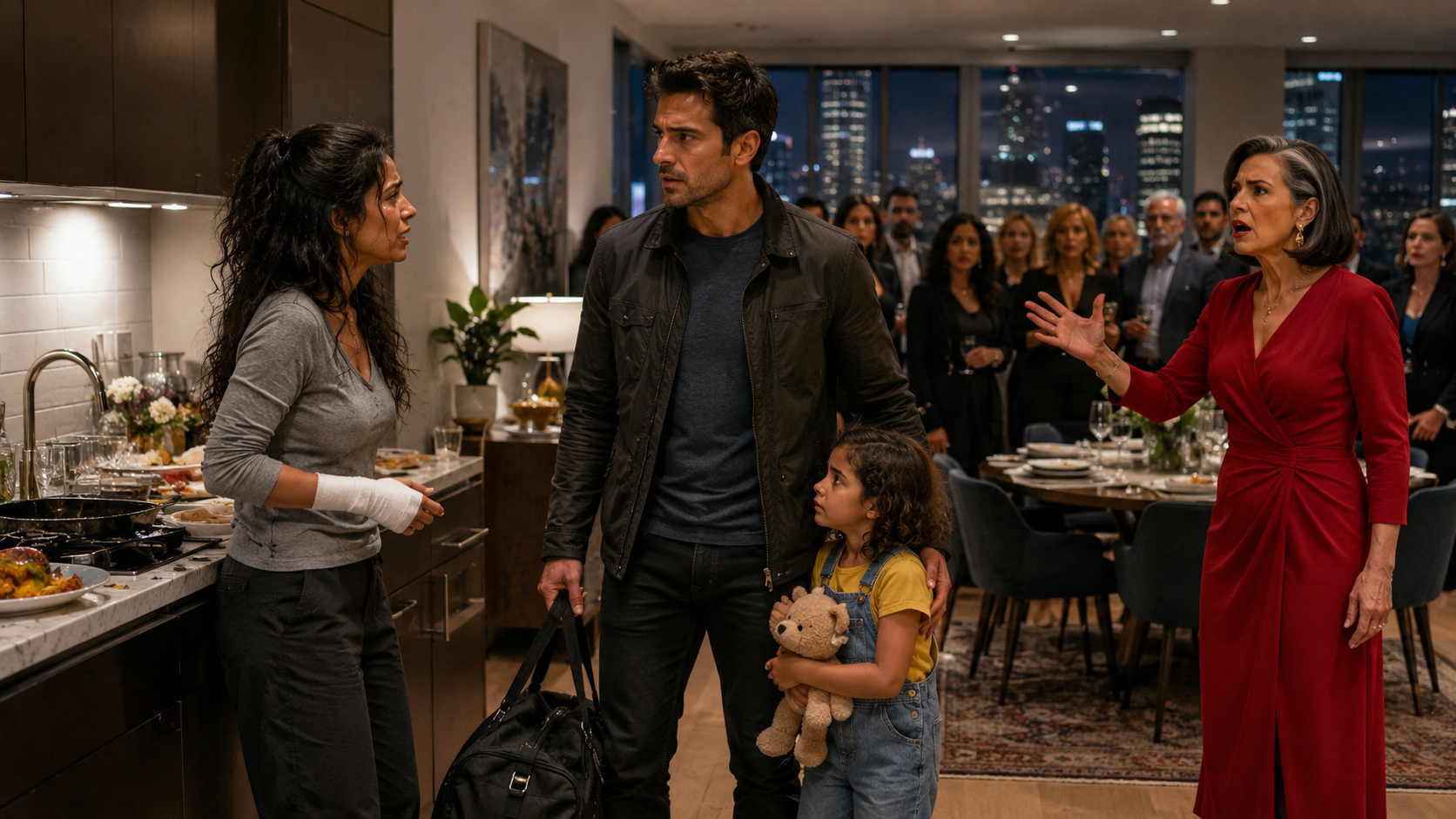
PART 1: THE PARTY I WAS NEVER SUPPOSED TO SEE
“If your daughter doesn’t finish washing those dishes, neither of you is eating dinner tonight.”
My mother said it with the same calm tone someone might use to ask for more coffee.
She had no idea I was standing less than thirty feet away.
Listening.
I had come home to Chicago two days earlier than planned.
The logistics conference I was supposed to attend in Seattle had been canceled because of an emergency issue with the venue. I could have stayed in the hotel. My company had already paid for the room through Friday.
Instead, I changed my flight.
I wanted to surprise my wife, Maya, and our five-year-old daughter, Chloe.
For most of the flight, I pictured Chloe racing toward me the second I opened the door.
She always did that.
“Daddy!”
Then she would launch herself at my knees so hard I nearly lost my balance.
Maya would stand behind her, smiling in that tired, beautiful way she had, pretending to be annoyed that I had forgotten to text before leaving the airport.
I had even bought Chloe a ridiculous stuffed salmon from the Seattle airport because she had recently become obsessed with sea animals.
It was sticking out of my duffel bag when I unlocked my front door.
I remember that detail because afterward I kept thinking about how ordinary everything still seemed at that exact second.
One key turning.
One door opening.
One life ending.
Another beginning.
The first thing that hit me was the smell.
Roasted meat.
Deep-fried appetizers.
Garlic.
Stale grease.
Wine.
And enough perfume to make the hallway smell like the cosmetics section of a department store.
Then I heard laughter.
Not three or four people.
A crowd.
Glasses clinked somewhere inside my condo. Women talked over one another. Music played from the speakers I had installed in the living room.
I stood in the entryway, confused.
There were shoes everywhere.
Heels, designer flats, boots, expensive leather loafers.
At least twenty pairs.
I slowly closed the door behind me.
Our condo had four bedrooms and an open living area overlooking downtown Chicago. Maya and I had bought it three years earlier after I received a promotion to senior project manager at a logistics firm.
I was thirty-four.
I worked too much.
I traveled more than I liked.
But I had always told myself I was doing it for my family.
That sentence would become almost unbearable to remember.
I moved quietly down the hallway.
Then I heard my mother.
“My son bought me this designer dress, you know.”
Laughter followed.
“He says that now that he’s doing so well, his mother deserves to look like royalty too.”
I stopped.
I had not bought my mother a designer dress.
“He spoils you, Evelyn,” another woman said.
“Well, I sacrificed everything for him. It’s only right.”
More laughter.
My jaw tightened.
My mother, Evelyn Vance, had moved in with us a year earlier.
She was sixty-two and had chronic knee pain that made stairs difficult. Her house in Ohio had become too much for her to maintain, and after months of phone calls about loneliness, medical appointments, and how frightened she was of falling with no one around, she finally asked whether she could move in.
I hesitated.
Maya didn’t.
“She’s your mother,” she had told me. “We have the room.”
I kissed her forehead.
“You sure?”
“Of course.”
God.
That memory still hurts.
Because Maya had opened our home to the woman who would eventually make her afraid to live in it.
At first, everything seemed manageable.
Then things changed.
Not dramatically.
That was why I missed it.
Maya began losing weight.
She started wearing long sleeves in July.
She stopped joining Chloe and me on our Saturday walks along the river because she was “tired.”
Chloe stopped running through the hallway.
Whenever my mother entered a room, my daughter would suddenly become very interested in whatever toy was in front of her.
At dinner, Maya would barely speak.
I noticed.
I asked.
But I never asked hard enough.
“Everything okay?”
Maya would open her mouth.
And my mother would answer.
“Your wife is just exhausted again.”
Or:
“She takes everything personally.”
Or:
“Alex, don’t interrogate her. You work all day. She has a comfortable life. Let the woman be moody.”
Sometimes Maya would look at me.
Just look.
I had mistaken that look for fatigue.
Now I know it was a question.
Are you going to believe me if I tell you?
And every time, without knowing it, I had answered.
No.
I walked farther toward the living room.
Nearly twenty women sat around two folding tables covered with food.
Food from my kitchen.
Wine from the cabinet.
Serving trays Maya and I received as wedding gifts.
My mother sat at the head of the larger table wearing a red dress I had never seen.
She looked completely at home.
More at home than my wife had looked in months.
One of the guests lifted her glass.
“This place is gorgeous, Evelyn.”
My mother smiled.
“Living here is like staying at a five-star resort.”
“And where is your daughter-in-law?”
Evelyn’s expression changed.
It was small.
A little curl at the corner of her mouth.
“In the kitchen, right where she belongs.”
Several women laughed politely.
My hands went cold.
“And the little girl is helping too,” Evelyn continued. “You have to teach them discipline while they’re young, or they grow up lazy.”
I turned toward the kitchen.
For one second, I didn’t want to walk in there.
Some instinct was warning me that whatever I saw would divide my life into before and after.
Then I heard running water.
I moved.
Maya stood at our deep kitchen sink.
Her hair was stuck to her forehead with sweat.
A pile of dirty plates rose beside her.
Pots.
Serving platters.
Glasses.
Silverware.
Grease-covered roasting pans.
And beside her stood Chloe.
My five-year-old daughter.
She was on a plastic stepping stool.
Standing on her toes.
Holding a ceramic platter almost as wide as her torso.
Hot water poured over her hands.
Her fingers were red and wrinkled.
Dish soap covered her wrists.
She wasn’t crying.
That was what frightened me most.
Chloe cried when she scraped her knee.
She cried when a cartoon fox lost its mother.
She cried once because she thought the moon was lonely.
But standing over a sink of scalding water, her arms shaking beneath a dish that was too heavy for her, she made no sound.
She had learned not to.
A woman came into the kitchen behind me without noticing I was there.
She placed a dirty glass beside Maya.
“Fetch me another iced tea with extra ice.”
Maya lowered her head.
“Yes.”
“And slice some watermelon while you’re at it.”
“Yes. Right away.”
The woman walked out.
Maya reached for a knife.
That was when I saw the bandage around her thumb.
Then another strip of gauze around her wrist.
Her sleeve shifted.
More white fabric disappeared beneath it.
“Maya.”
She froze.
The knife slipped from her fingers and struck the cutting board.
Chloe turned.
Her face changed when she saw me.
Not relief.
Fear.
She grabbed the platter harder.
“Daddy…”
I stepped forward.
Her lower lip trembled.
“Please hurry up and help us, because if we don’t finish washing all of these, Grandma said you’re going to be mad and Mommy and I won’t get any dinner.”
Something inside me went completely still.
Behind me, the living room had gone silent.
I looked at Maya.
She couldn’t meet my eyes.
“Why would Grandma tell you I’d be mad?”
Chloe looked toward the doorway.
My mother was standing there now.
Her face had lost all its color.
“Alex.”
I held up one hand.
She stopped.
I took the platter from Chloe.
Her arms stayed raised for a second afterward, as if her body didn’t understand yet that she was allowed to put them down.
I lifted her off the stool.
The second her feet hit the floor, she reached for me.
I picked her up.
She buried her face in my neck.
She was shaking.
Not crying.
Shaking.
My mother finally found her voice.
“Alex, this looks much worse than it is.”
I looked at Maya again.
“Show me your hands.”
She didn’t move.
“Maya.”
Slowly, she rolled her sleeves back.
Both hands were bandaged.
Her palms.
Her wrists.
Several fingers.
Some of the gauze was damp.
My stomach dropped.
“What happened?”
Maya whispered, “I burned them.”
My mother spoke immediately.
“She was careless while cooking.”
I turned toward her.
She smiled too quickly.
“It was an accident.”
I had heard that sentence before.
Three days earlier, while I was in Seattle, my mother had called.
“Maya had a little kitchen accident,” she’d told me. “Nothing serious. I told her not to bother you because you were working.”
I had texted Maya.
Mom says you burned yourself. You okay?
She had replied:
I’m okay. Focus on work. Love you.
That was all.
I looked at her now.
At both bandaged hands.
Then at the sink.
Then at our daughter’s bright red fingers.
“Why are you washing dishes?”
Maya swallowed.
My mother sighed dramatically.
“Because we have guests, Alex. Somebody has to clean.”
I stared at her.
“You invited twenty people into my home while Maya has burns on both hands.”
“They’re minor.”
“And Chloe?”
“She wanted to help.”
Chloe’s fingers tightened around my shirt.
“No, I didn’t.”
The words were barely audible.
But I heard them.
Everyone did.
My mother’s face hardened.
“Chloe.”
My daughter flinched in my arms.
That single movement told me more than any explanation could have.
I turned toward the living room.
Twenty women stared at me.
Some looked embarrassed.
Some annoyed.
Two were still holding forks.
I walked into the center of the room with Chloe against my chest.
“My daughter is five.”
Nobody spoke.
“My wife has burns on both hands.”
One woman slowly set down her wine glass.
I looked at every person in the room.
“You have five minutes to leave.”
My mother laughed nervously.
“Oh, Alex, don’t be ridiculous.”
“Four minutes and fifty seconds.”
“Alex!”
I faced her.
“My house.”
Her mouth fell open.
“My wife.”
She glanced toward the kitchen.
“My daughter.”
Then I lowered my voice.
“And whatever has been happening here stops now.”
Nobody argued after that.
Chairs scraped.
Women began collecting purses.
One woman muttered, “We didn’t know.”
Another wouldn’t look at me.
The guest who had ordered Maya to fetch iced tea rushed past without saying anything.
My mother followed me down the hallway.
“You are humiliating me.”
I stopped.
Those words were so absurd I almost laughed.
“You’re humiliated?”
“Those are my friends!”
“My daughter thought I was going to starve her.”
“I never said starve.”
Chloe pressed closer to me.
I felt her heartbeat against my chest.
My mother lowered her voice.
“She’s exaggerating.”
I looked at Chloe.
Then at Maya standing in the kitchen doorway.
Maya was staring toward the top of the cabinets.
Just for a second.
A strange look crossed her face.
Fear.
Decision.
Then she looked away.
I noticed.
I didn’t understand it yet.
But I noticed.
Five minutes later, the front door closed behind the final guest.
The condo became quiet.
No laughter.
No clinking glasses.
No music.
Only Chloe’s breathing.
I locked the door.
My mother stood behind me with her arms crossed.
“You owe me an apology.”
I turned.
“No.”
“Then you need to hear my side.”
“I’m going to hear everyone’s side.”
She looked satisfied, as if she thought that meant she had regained control.
I set Chloe down.
She immediately grabbed my hand.
I crouched in front of her.
“Sweetheart, listen to me.”
Her eyes filled.
“You are never going to lose dinner because dishes aren’t washed.”
She stared at me.
“Never.”
A tear slipped down her cheek.
“And Mommy?”
“Mommy too.”
Another tear.
“Even if Grandma says you told her?”
My blood ran cold.
I looked up.
My mother was suddenly very interested in adjusting the sleeve of her red dress.
“What else did Grandma say I told her?”
Chloe looked terrified.
Maya stepped forward.
“Alex…”
My mother cut her off.
“This is inappropriate. She’s five. She gets confused.”
I stood.
“No. She answers.”
Chloe looked at me.
Then whispered the sentence that made my knees feel weak.
“Grandma said you know everything.”
Silence.
“She said you told her to make Mommy behave when you’re gone.”
I looked at Maya.
Her eyes filled with tears.
And that was the moment I understood something far worse than what I had walked into.
My mother hadn’t only been hurting my family.
She had been using me to do it.
And somehow, for months, she had convinced my wife and daughter that I was part of it.
PART 2: WHAT THEY THOUGHT I KNEW
I sent my mother to her bedroom.
She refused at first.
“This is my home too.”
“No,” I said. “It isn’t.”
Her face tightened.
“You begged me to move here.”
“I offered you a place to stay.”
“You wouldn’t speak to your mother this way if your father were alive.”
There it was.
Guilt.
Her favorite weapon.
My father had died when I was twenty-three.
For years afterward, whenever my mother wanted something, his memory appeared in the conversation.
Your father would be ashamed.
Your father would never let me struggle.
Your father would expect you to take care of me.
Sometimes I wondered whether she remembered him as a husband or simply as an argument she could still win.
That night, for the first time in my life, the weapon didn’t work.
“Go to your room.”
Her eyes narrowed.
“You’re choosing her over your own mother.”
I looked toward Maya.
My wife stood with both hands wrapped in gauze because my mother had apparently decided a woman with burns should cater a luncheon.
“Yes.”
Evelyn stared at me.
I had never answered that quickly before.
Something shifted in her face.
Then she walked away.
I heard her bedroom door slam.
Chloe jumped.
I immediately regretted not taking my mother out of the condo right then.
But Maya was pale.
Chloe’s hands were red.
I needed to understand what had happened before I made another move.
I filled a bowl with cool water and sat Chloe at the kitchen table.
“Hands in here.”
She obeyed instantly.
Too instantly.
“Sweetheart, you don’t have to move that fast.”
She looked confused.
I crouched beside her.
“You’re not in trouble.”
“Okay.”
“You don’t have to say okay either.”
“Okay.”
Then she realized what she had done.
Her mouth twitched.
Mine did too.
For half a second, I saw my daughter again.
Then her smile disappeared.
I called our pediatrician’s after-hours line. A nurse asked questions about the temperature of the water, how long Chloe’s hands had been exposed, whether there were blisters.
Fortunately, the redness appeared superficial, but we were instructed to monitor her carefully and bring her in the following morning.
Then I turned to Maya.
“We’re going to urgent care.”
“I already went.”
“When?”
“Two days ago.”
“What did they say?”
She hesitated.
“Second-degree burns.”
My chest tightened.
“Both hands?”
She nodded.
“How?”
Her eyes moved toward the hallway.
“Not here.”
That answer terrified me.
I took Chloe into our bedroom.
“Can you watch a movie in here for a little while?”
“Is Grandma coming?”
“No.”
“Promise?”
“Promise.”
She climbed onto the bed.
I handed her the stuffed salmon from my duffel.
She stared at it.
“What’s his name?”
Her face softened.
“Mr. Bubbles.”
“Excellent name.”
“He’s not a bubble.”
“I know.”
“He’s a fish.”
“I know.”
“Salmon.”
“Very specific.”
That almost earned another smile.
I kissed her forehead.
When I returned to the kitchen, Maya was attempting to wipe the counter with the side of her wrist.
I gently took the cloth away.
“Stop.”
Her whole body stiffened.
Not because I had yelled.
I hadn’t.
Because I had told her to stop.
Like an order.
I saw the reaction.
And I hated myself for not seeing all the others.
“Maya.”
“I’m sorry.”
“Why are you apologizing?”
“I don’t know.”
That answer almost broke me.
I pulled out a chair.
“Sit.”
She sat slowly.
I sat opposite her.
For several seconds, neither of us spoke.
Finally, I said, “Tell me.”
She stared at her bandaged hands.
“It didn’t start like this.”
“I know.”
“She was difficult sometimes, but I thought I could handle difficult.”
“What did she do?”
“She criticized everything.”
Maya gave a weak laugh.
“The laundry. My cooking. How I dressed Chloe. How much money groceries cost. How late I slept.”
“You wake up before six.”
“She said mothers shouldn’t need alarms.”
I closed my eyes briefly.
“Then what?”
“When you were home, she was different.”
That was the first major piece.
“What do you mean?”
“She’d complain, but lightly. Like jokes. If you were in the room, she would ask before taking things. She’d play with Chloe. She’d tell me to rest.”
“And when I left?”
Maya looked up.
“She changed.”
“How?”
“She started giving me lists.”
“What kind of lists?”
“Cleaning. Cooking. Errands.”
“You’re not her employee.”
“I know.”
“Why did you do them?”
Her expression changed.
Not anger exactly.
Something deeper.
“Because she told me you wanted me to.”
I stared at her.
“What?”
“She said you were frustrated.”
“With you?”
Maya nodded.
“She said you complained to her that the condo was always messy. That I spent too much money. That Chloe was becoming spoiled.”
“I never said any of that.”
“I know that now.”
“No. Maya, I have never—”
“I know.”
I stopped.
“Now?”
She swallowed.
“At first I didn’t believe her.”
“Then why—”
“She knew things.”
My mouth went dry.
“What things?”
“Things you had told her.”
Of course.
I had complained to my mother.
Not about Maya.
About ordinary life.
The dryer breaking.
A grocery bill.
Chloe refusing bedtime.
A delivery arriving late.
Tiny frustrations.
My mother had taken each piece and sharpened it.
Maya continued.
“She’d say, ‘Alex told me he’s embarrassed by how much you spend on groceries.’ Or, ‘Alex says Chloe has no discipline.’”
“I never—”
“I know.”
Her voice broke.
“But you were always traveling. And when you came home, you looked tired.”
I remembered those nights.
Me walking through the door after twelve-hour days.
Maya trying to tell me something.
My mother interrupting.
And me saying the words I would probably regret forever.
Can we not do this tonight?
I put my elbows on the table and covered my face.
“Maya…”
“She would tell me you didn’t want more stress.”
I lowered my hands.
“So you stopped telling me.”
She nodded.
“How long?”
“Months.”
I felt sick.
“What about Chloe?”
Maya’s eyes hardened.
That frightened me more than her tears.
“She started using you against her too.”
I couldn’t speak.
“She’d tell Chloe that Daddy wanted her room perfect. Daddy didn’t like whining. Daddy would be disappointed if she didn’t obey Grandma.”
My stomach twisted.
“And food?”
Maya stared down.
“What about food?”
“She started saying Chloe couldn’t have snacks until chores were finished.”
“Chores?”
“Picking up toys at first.”
“For a five-year-old, fine.”
“I thought so too.”
“Then?”
“Making her bed. Folding towels. Putting away dishes.”
I looked toward the kitchen stool.
“And eventually washing them.”
Maya nodded.
“Why didn’t you stop her?”
The second the words left my mouth, I wanted them back.
Maya’s face closed.
I heard what I had actually asked.
Why didn’t you protect our daughter?
When I had not protected either of them.
“I did.”
Her voice was flat.
“I stopped her every time I could.”
“Maya, I didn’t mean—”
“She started punishing me when I interfered.”
I froze.
“What does that mean?”
“She’d hide my phone.”
“What?”
“She’d take the charger. Change the Wi-Fi password. Cancel groceries I ordered and tell me you said I was spending too much.”
I stood so fast the chair scraped backward.
“She did what?”
Maya flinched.
I immediately lowered my voice.
“Sorry.”
She stared at the table.
“I found ways around it.”
“How?”
“I started keeping cash.”
“For what?”
“Food.”
I couldn’t process that.
Food.
In my condo.
With my salary.
My wife had hidden cash to make sure she and our daughter could eat.
“And the long sleeves?” I asked.
Maya didn’t answer.
I looked at her.
“Maya.”
“She grabbed me.”
My hands curled into fists.
“When?”
“Different times.”
“Where?”
“Arms mostly.”
“Did she hit you?”
“No.”
The answer came quickly.
Too quickly.
“No?”
“She never punched me.”
I understood the distinction.
“What did she do?”
“Grabbed me. Shoved past me. Once she pulled my hair when I tried to take Chloe out of the room.”
I stood and walked to the window because if I stayed seated, I might go down the hallway and do something I would regret.
Chicago glowed beneath us.
Traffic moved normally.
People crossed sidewalks.
The world had not changed.
Mine had.
“When did the burns happen?”
Maya became silent.
I turned.
“Tell me.”
“She had friends coming.”
“The party?”
“She started preparing days ago.”
“Why were you cooking?”
“She told me you had approved it.”
I laughed once.
There was nothing funny in it.
“She said you told her she should entertain more because she was lonely.”
I had told my mother she needed friends in Chicago.
That was all.
Another sentence turned into a weapon.
Maya rubbed her wrists.
“Two nights ago, she wanted me to make soup.”
“For twenty people?”
“And pasta. She kept changing the menu.”
“What happened?”
“The pot was full.”
Her breathing changed.
“I told her it was too heavy.”
I sat again.
“She said I was being dramatic.”
I waited.
“She told me to move it.”
“Maya…”
“I tried.”
Her eyes fixed on something behind me.
Not the kitchen.
The memory.
“The handles were hot. I put towels around them. I lifted it from the stove.”
Her voice became smaller.
“She was angry because I was moving too slowly.”
I could hear my heartbeat.
“What did she do?”
“She grabbed the other handle.”
“And?”
“I told her not to.”
Maya looked at me.
“She pulled.”
I stopped breathing.
“The pot tilted.”
Her eyes filled.
“Boiling water went over both my hands.”
For a moment, everything in the kitchen blurred.
“She caused this.”
“She said she was trying to help.”
“Did she call an ambulance?”
“No.”
“Urgent care?”
“No.”
“She told me to put ice on it.”
My voice rose.
“You don’t put ice on burns like that.”
“I know.”
“Then how did you get treatment?”
“After she went to bed, I took Chloe and drove myself.”
“With your hands like that?”
“I wrapped them in towels.”
I stared at my wife.
I imagined her driving through Chicago at night with burned hands while our child sat in the back seat.
And where was I?
In a Seattle hotel.
Answering work emails.
Ordering room service.
Believing everything was fine.
“Why didn’t you call me?”
Maya looked away.
“She told me if I ruined your conference over an accident, you would finally get tired of me.”
I whispered, “Jesus.”
“She said you already thought I was weak.”
“I don’t.”
“She said you told her.”
“I didn’t.”
“I know.”
“But you believed her.”
Maya looked directly at me.
“I believed your silence.”
That sentence landed harder than anything my mother could have said.
Because she was right.
I hadn’t abused my wife.
I hadn’t threatened her.
I hadn’t starved her.
But I had seen enough to know something was wrong.
And every time the truth tried to reach me, I had chosen peace over questions.
I reached across the table.
Then stopped.
Her hands were injured.
So I placed mine palms-up between us.
“I am sorry.”
Maya’s mouth trembled.
“I should have seen it.”
She began crying.
Quietly.
“I should have listened.”
“I should have told you.”
“You tried.”
She shook her head.
“You tried.”
I remembered every interrupted conversation.
Every strange look.
Every time she had gone silent after my mother walked into the room.
“You tried,” I repeated.
Then I noticed her eyes move upward again.
Toward the cabinets.
The same place she had looked earlier.
“What’s up there?”
Maya went still.
“What?”
“You keep looking over there.”
Her face changed.
For the first time that evening, I saw something other than fear.
Resolve.
“There’s something I need to show you.”
She stood.
Then we heard my mother’s bedroom door open.
Maya’s entire body stiffened.
Footsteps came down the hallway.
Evelyn appeared in the kitchen.
She had changed out of the red dress.
She looked tired now.
Older.
Almost fragile.
For most of my life, that appearance would have been enough.
Not anymore.
“I think we’ve all had time to calm down,” she said.
I stood between her and Maya.
“No.”
She frowned.
“Alex—”
“You’re leaving tomorrow.”
Her face went blank.
“Excuse me?”
“You heard me.”
“This is ridiculous.”
“You burned Maya.”
“It was an accident.”
“She says you pulled the pot.”
My mother’s eyes flicked toward Maya.
There it was.
Not shock.
Not confusion.
A warning.
Maya saw it too.
“She’s lying,” my mother said.
My wife took one step backward.
I stepped forward.
“Look at me.”
My mother did.
“You do not look at my wife like that again.”
“Your wife has been poisoning you against me since the day I moved in.”
“No.”
“She resents me.”
“No.”
“She wants me gone.”
“Yes.”
The answer surprised even her.
I continued.
“And so do I.”
Her eyes filled instantly.
She was good.
Very good.
“After everything I did for you?”
I felt the old guilt rise.
Then I looked at Maya’s bandages.
It disappeared.
“You have until tomorrow morning to pack.”
My mother’s tears stopped.
Just like that.
Her voice turned cold.
“You’re going to regret humiliating me.”
“No.”
I glanced at Maya.
“I already know what I regret.”
Then my mother said something strange.
Something I didn’t understand until ten minutes later.
“You think her version is the truth because she cried first?”
Maya stared at her.
Evelyn pointed at my wife.
“Ask her what she’s been doing behind your back.”
My stomach dropped.
Maya whispered, “Don’t.”
My mother smiled.
“What?”
I looked between them.
“What is she talking about?”
Maya’s face drained.
Evelyn folded her arms.
“Yes, Maya.”
Her smile widened.
“Why don’t you show him?”
I turned toward my wife.
Maya looked at the top of the kitchen cabinets.
Then at me.
Finally, she said:
“I was going to.”
And she reached for a chair.
PART 3: THE CAMERA ABOVE THE CABINETS
I steadied the chair while Maya climbed carefully.
“Let me.”
“No.”
Her voice was quiet but firm.
“I need to do this.”
I understood.
So I stayed beside her.
She reached behind a decorative basket above the cabinets and pulled out something black.
Small.
A camera.
I recognized it immediately.
We had bought it years ago when Chloe was a baby.
A little Wi-Fi camera that had once sat on a shelf in her nursery.
We stopped using it when she turned three.
I thought it was in storage.
My mother laughed from the doorway.
“You’ve been secretly recording me?”
Maya climbed down.
Her face was pale.
“Yes.”
“For how long?”
“Two weeks.”
Evelyn looked at me.
“Do you understand how insane that is?”
I didn’t answer.
Maya carried the camera to the table.
“The recordings save to an account on my phone.”
My mother’s expression changed.
Only slightly.
But I saw it.
“What exactly did you record?” I asked.
Maya looked at me.
“Enough.”
Evelyn stepped forward.
“Alex, before you watch anything, remember that recordings can be taken out of context.”
I turned.
“Go to your room.”
“This concerns me.”
“Go.”
“I’m not a child.”
“No. You’re a sixty-two-year-old woman who made a five-year-old wash dishes while threatening to withhold food.”
“I was teaching discipline.”
“Go.”
She didn’t.
Maya took her phone from a drawer.
I stared at it.
“You said she hid your phone.”
“This is my old one.”
Of course.
Another thing she had been forced to hide.
“I charged it during the day and kept it in the kitchen.”
My mother scoffed.
“So calculating.”
Maya ignored her.
Her fingers shook too badly to type.
“Here.”
She pushed the phone toward me.
“I can’t.”
“You want me to open it?”
She nodded.
I entered the passcode she gave me.
There were dozens of clips.
Motion activated.
Different dates.
Different times.
My stomach tightened.
I tapped the oldest.
The kitchen appeared.
Maya stood at the counter preparing breakfast.
My mother entered.
Even through a tiny speaker, her voice was clear.
“Why is she still asleep?”
Maya answered, “It’s six fifteen.”
“So?”
“She’s five.”
“She needs structure.”
“She needs sleep.”
My mother stepped closer.
“You argue about everything.”
“I’m not arguing.”
“Alex says she’s becoming spoiled.”
Maya’s shoulders fell.
I paused the video.
“He never said that,” Maya whispered.
“I know.”
I started it again.
The recording continued.
My mother opened the refrigerator.
“What is this?”
“Yogurt.”
“I can see that.”
“For Chloe.”
“Too much sugar.”
“It’s plain yogurt.”
“Don’t be smart with me.”
I watched my mother take the container and throw it into the trash.
Maya stared at her.
“That was her breakfast.”
“She can have eggs.”
“She doesn’t like eggs.”
“She’ll eat them when she’s hungry.”
The clip ended.
My hands were shaking.
I opened another.
Chloe was coloring at the table.
My mother walked in.
“Toys away.”
“I’m coloring.”
“Toys away.”
“Mommy said I can finish.”
My mother bent until her face was inches from Chloe’s.
“Your father owns this home.”
Chloe stopped coloring.
“And your father says children obey adults.”
My daughter whispered, “Okay.”
“Good.”
Then my mother pointed at a basket of laundry.
“Fold the towels.”
Chloe looked confused.
“I don’t know how.”
“Then learn.”
The clip ended.
I heard myself say, “Stop.”
No one had spoken.
The word came from me.
I put the phone down.
My mother seized the opportunity.
“You see? Nothing abusive. Rules. Structure.”
I looked at her.
“Get away from me.”
Her eyes widened.
“Alex.”
“Get away from me.”
She stepped back.
I played another.
Maya was sweeping.
My mother sat at the table drinking coffee.
“You missed under the island.”
“I’ll get it.”
“And the guest bathroom smells.”
“I cleaned it.”
“Then clean it again.”
“I have to take Chloe to preschool.”
“I’ll take her.”
“No.”
My mother’s head snapped up.
“What did you say?”
“I said no.”
My chest tightened.
Maya continued.
“She told me yesterday you said I’m confusing her.”
“I said no such thing.”
“I’m her mother.”
Evelyn stood.
“And I am Alex’s mother.”
“That doesn’t make you Chloe’s parent.”
My mother walked toward her.
Even watching through the screen, I felt the temperature in the room change.
“You should be very careful.”
Maya didn’t move.
“About what?”
“About making my son choose.”
The recording ended.
I looked at Maya.
“You told her.”
“I tried.”
“You stood up to her.”
“I tried.”
My mother made an irritated sound.
“Oh, for God’s sake. Are we going to watch every petty disagreement?”
I opened another.
This one was three days old.
I saw Chloe sitting at the table after preschool.
There was a plate in front of her.
Apple slices.
Maya stood near the sink.
My mother entered and picked up the plate.
“No.”
Maya turned.
“She hasn’t eaten since lunch.”
“She didn’t put away her shoes.”
“Give it back.”
“When the shoes are put away.”
“She’s hungry.”
“She won’t die.”
Maya grabbed for the plate.
My mother pulled it away.
“Evelyn.”
“What?”
“Give my daughter her food.”
“Your daughter is lazy.”
“She is five.”
“And already manipulative.”
Chloe began crying.
My mother looked at her.
“Stop.”
The crying became quieter.
“Stop it.”
Chloe covered her mouth.
That was when Maya lost control.
“Do not speak to her like that.”
My mother spun around.
“Excuse me?”
“You heard me.”
“I am helping you.”
“No. You’re frightening her.”
My mother stepped closer.
“You’re becoming very brave.”
“I’m calling Alex.”
Maya moved toward the counter.
The camera caught my mother grabbing her wrist.
Hard.
Maya gasped.
“Let go.”
“You’re not bothering him over this.”
“Let go.”
“Stop acting insane.”
“I said let go.”
Maya pulled back.
My mother shoved her arm away.
Maya struck the edge of the counter.
The clip ended.
I sat motionless.
The condo seemed unnaturally quiet.
My mother finally spoke.
“She was hysterical.”
I looked at her.
“She said she was going to call you while you were working. I was trying to calm her down.”
“You grabbed her.”
“She was emotional.”
“You grabbed her.”
“She twists everything.”
I opened another recording.
My mother stopped talking.
This one was from two nights earlier.
9:17 p.m.
The kitchen lights were bright.
A large stockpot sat on the stove.
Steam rolled upward.
Maya stood beside it.
Even before anything happened, I knew.
This was it.
The pot.
The burns.
The story my mother had already called an accident.
My stomach tightened until it hurt.
On the video, Maya turned off the burner.
“I’m leaving it here to cool.”
My mother entered.
“No. I need the stove.”
“Use the other burner.”
“I need space.”
“It’s too heavy.”
My mother scoffed.
“You carried it there.”
“It wasn’t full.”
“Move it.”
“No.”
My mother stopped.
It was the first time I had heard Maya say that word so firmly.
“No?”
“I’m not lifting boiling water across the kitchen.”
“Don’t be dramatic.”
“I’ll move it when it cools.”
“You always have an excuse.”
Maya took a step away.
My mother moved toward the stove.
“I’ll help you.”
“No.”
She grabbed one handle.
Maya immediately grabbed the other.
“Evelyn, stop.”
“Lift.”
“Stop.”
“Lift it.”
“You’re going to spill—”
My mother jerked her side of the pot.
The video became chaos.
A metallic crash.
Maya screaming.
The pot tipped against the edge of the stove before hitting the floor.
Water spread everywhere.
Maya stumbled backward clutching both hands.
My mother stared.
For three full seconds she did nothing.
Then Chloe appeared at the hallway entrance.
“Mommy!”
“Stay back!” Maya screamed.
My daughter began crying.
My mother finally moved.
Not toward Maya.
Toward Chloe.
“Stop screaming.”
I paused the video.
My vision had gone blurry.
I realized I was crying.
I wiped my face.
Maya stood beside me silently.
“Did she help you?”
“No.”
I looked at my mother.
She had no answer.
“What happened after this?”
Maya whispered, “Keep watching.”
I pressed play.
Maya was leaning over the sink with water running over her hands.
She was sobbing.
My mother picked up a towel.
“You should have listened.”
Maya stared at her.
“What?”
“I told you to lift.”
“You pulled the pot.”
“Because you weren’t cooperating.”
“You burned me.”
“Don’t be ridiculous. You dropped it.”
“I didn’t drop it.”
“Alex will hear that you did.”
Maya froze.
So did I.
My mother continued.
“And if you call him during an important work trip and turn this into some dramatic emergency, maybe he’ll finally understand what I’ve been telling him.”
“What have you been telling him?”
“That you can’t handle this family.”
Maya’s face changed.
“That’s a lie.”
“Is it?”
“Yes.”
“Then why does he believe me every time?”
I stopped the video.
Nobody moved.
My mother whispered, “Alex…”
I held up my hand.
She went silent.
I started the video again.
Maya’s breathing was ragged.
My mother picked up the fallen pot.
“Clean this before Chloe slips.”
Maya stared at her.
“My hands are burned.”
“You made the mess.”
Then my mother walked out.
The recording continued for another minute.
Maya stood alone at the sink.
Crying.
Trying to turn off the faucet with her forearm.
I couldn’t watch anymore.
I put the phone down.
For several seconds, all I could hear was the refrigerator humming.
Then my mother began.
“I can explain—”
“No.”
“You saw one angle.”
“No.”
“She resisted me.”
“No.”
“I lost my grip.”
“You said she dropped it.”
“I was upset.”
“You told me she was careless.”
“She was!”
I stood.
My mother stepped backward.
“You lied to me.”
“Because I knew you would overreact.”
“You lied to me about my wife.”
“I was protecting you.”
“You used my name to threaten my daughter.”
“I was disciplining her.”
“You withheld food.”
“Don’t use dramatic words.”
“You grabbed Maya.”
“She provoked me.”
“You burned her.”
“It was an accident!”
I slammed my palm against the table.
Chloe cried out from the bedroom.
Instantly, I stopped.
My chest heaved.
Maya looked toward the hallway.
I lowered my voice.
“Get out.”
My mother stared at me.
“What?”
“Tonight.”
“You said morning.”
“I changed my mind.”
“Alex, it’s late.”
“I don’t care.”
“I have nowhere to go.”
“You have twenty friends who were just sitting in my living room.”
Her face hardened.
“You would throw your own mother onto the street?”
“I am removing you from the home where my wife and child are afraid of you.”
“That’s not the same thing.”
“You’re right.”
I walked toward the hallway.
“It should have happened sooner.”
She followed.
“You’ll regret this.”
I turned.
“No.”
For the first time, I knew that with absolute certainty.
“I’ll regret that I didn’t do it months ago.”
Then Chloe appeared in the bedroom doorway holding Mr. Bubbles against her chest.
She looked from me to my mother.
“Daddy?”
I crouched.
“Yes?”
“Is Grandma mad?”
My mother opened her mouth.
I pointed at her without looking away from Chloe.
“Do not speak.”
She stopped.
Chloe stared at me.
“Is she going to make Mommy clean?”
“No.”
“Me?”
“No.”
“Is she staying?”
I looked at my daughter.
“No.”
Chloe’s shoulders dropped.
Not from sadness.
Relief.
My mother saw it.
So did I.
And whatever argument she had planned died on her face.
Thirty minutes later, she walked out of my condo with two suitcases.
I locked the door.
Then I changed the code.
PART 4: THE THINGS I HAD REFUSED TO SEE
I thought removing my mother would make the condo feel safe again.
It didn’t.
Not immediately.
The silence itself felt dangerous.
Every sound made Chloe look toward the hallway.
When the elevator dinged outside our front door, Maya went rigid.
That night, Chloe refused to sleep alone.
She climbed between us with Mr. Bubbles under one arm and held onto Maya’s shirt with the other.
Around two in the morning, she woke crying.
“No, Grandma. I’m doing it.”
Maya and I both sat up.
Chloe was still asleep.
“I’m doing it,” she whimpered. “Don’t tell Daddy.”
My heart cracked open.
I gathered her into my arms.
“Chloe.”
She woke with a gasp.
“It’s me.”
Her eyes searched the room.
“Daddy?”
“Yes.”
“Grandma said—”
“Grandma isn’t here.”
She blinked.
“She’s gone?”
“Yes.”
“For tomorrow?”
“No.”
She stared at me.
“For always?”
I looked at Maya.
Maya gave a small nod.
“She won’t live here anymore.”
Chloe began crying.
Not loudly.
The sound came from somewhere deep inside her.
I held her.
Maya put one bandaged arm around us.
For a long time, none of us spoke.
Then Chloe asked the question I had been dreading.
“Did you really tell Grandma I’m bad?”
“No.”
She looked at me.
“I never told her that.”
“She said you did.”
“I know.”
“Did you tell her Mommy is lazy?”
“No.”
“Did you tell her Mommy doesn’t deserve food when she’s mean?”
My throat closed.
“No.”
“Did you tell her Mommy makes you sorry you married her?”
Maya turned away.
I stared at Chloe.
“No.”
My daughter watched my face carefully.
Children learn adults the way adults learn weather.
They notice changes before storms.
“Then Grandma lied?”
“Yes.”
The word came out rough.
“Yes. Grandma lied.”
Chloe was quiet.
Then she turned to Maya.
“Mommy?”
“Yes, baby?”
“You weren’t bad?”
Maya began crying.
“No.”
Chloe leaned into her.
“Me neither?”
“No.”
My wife’s voice broke completely.
“You neither.”
I didn’t sleep again.
The next morning, I took Chloe to her pediatrician.
Maya came too.
The doctor examined Chloe’s hands, asked careful questions, then asked to speak to us without Chloe in the room for a few minutes.
A nurse took her to choose stickers.
The doctor looked at Maya’s bandages.
Then at me.
“Has the person responsible for this been removed from the home?”
“Yes.”
“Does she have access?”
“No. I changed the locks and entry code.”
“Good.”
The word felt enormous.
Good.
One good decision after months of bad ones.
We documented everything.
Maya’s burns.
Chloe’s hands.
The recordings.
The food restriction.
The threats.
The grabbing.
The lies.
I made the report myself.
Maya sat beside me while I did it.
I wanted her to see that I wasn’t going to hide from what had happened.
My mother called seventeen times that morning.
I didn’t answer.
Then came messages.
You have completely misunderstood the situation.
Maya has always hated me.
That video doesn’t show everything.
Your father would be ashamed of you.
I gave you my entire life.
You are abandoning your mother because your wife manipulated you.
Then:
If you continue spreading lies about me, I will tell everyone what kind of son you really are.
I stared at that message.
Something inside me almost laughed.
For years, fear of being a bad son had controlled me.
I had never realized how much power disappeared the moment I became more afraid of being a bad husband and father.
I blocked her.
Then I called my company.
My director answered.
“Alex? Everything okay?”
“No.”
I told him I had a family emergency and needed time.
I expected questions.
Maybe resistance.
Instead he said, “Take the week.”
That simple response made me realize another lie I had told myself.
That work required every sacrifice I made.
Sometimes I had been hiding there too.
Over the next several days, our home began revealing its history.
Not through dramatic evidence.
Through habits.
Maya asked permission before ordering groceries.
“Do you think sixty dollars is too much?”
“No.”
“For everything?”
“Maya, buy food.”
She stared at me.
I softened my voice.
“Please. Buy whatever we need.”
Chloe hid crackers in her bedroom.
I found three packages behind her stuffed animals.
When I asked why, she burst into tears.
“Don’t throw them away.”
I sat on the floor.
“I won’t.”
“Grandma said snacks make me greedy.”
I looked at the crackers.
Then at my daughter.
“Can I tell you something?”
She nodded.
“Food isn’t something you earn by being good.”
She frowned.
“Really?”
“Really.”
“What if my room is messy?”
“You still eat.”
“What if I don’t finish dishes?”
“You still eat.”
“What if I cry?”
“You definitely still eat.”
That earned a tiny smile.
“What if I’m mad?”
“Still eat.”
“What if you’re mad?”
I swallowed.
“Still eat.”
She thought about it.
Then gave me one cracker.
I ate it.
It was the most important meal I had ever shared with anyone.
Maya was harder.
Not because she didn’t believe me.
Because trust doesn’t come back just because the danger leaves.
One evening, I reached over her in the kitchen to take a mug from the cabinet.
She ducked.
A tiny movement.
Instinctive.
I stepped back.
She froze.
“I’m sorry.”
“No.”
She looked down.
“Maya, look at me.”
Slowly, she did.
“You never have to apologize for that.”
“I know you weren’t—”
“I know.”
I hated the expression on her face.
Embarrassment.
As if fear were something she had done wrong.
I kept my distance.
“Do you want me to leave the kitchen?”
“No.”
“Want me to stay?”
She nodded.
So I stayed.
Not touching her.
Not trying to fix anything.
Just there.
A week after my mother left, one of the party guests called.
I almost ignored the number.
Then I recognized the name from the building’s visitor log.
Linda Mercer.
She had been at the table.
I answered.
“Alex?”
“Yes.”
“I’m sorry to bother you.”
“What do you want?”
Silence.
Then she said, “I owe your wife an apology.”
My anger rose immediately.
“Then tell her.”
“I will, if she lets me.”
I waited.
Linda continued.
“Your mother told us Maya liked hosting.”
I laughed bitterly.
“She told us Maya was shy and didn’t enjoy sitting with older women, so she preferred staying in the kitchen.”
I closed my eyes.
“She told us Chloe begged to help.”
I said nothing.
“I ordered iced tea.”
I remembered her.
She was the woman who had dropped the glass beside Maya.
“I’m ashamed.”
“Good.”
She accepted that.
“I should have seen it.”
“Yes.”
Another silence.
Then Linda said, “There’s something else.”
I sat straighter.
“What?”
“Your mother talked about you all the time.”
“That doesn’t surprise me.”
“No, I mean…”
Linda hesitated.
“She said you were strict with Maya.”
My chest tightened.
“What exactly did she say?”
“That Maya was irresponsible with money. That you asked your mother to help manage the household because Maya couldn’t handle it.”
I gripped the phone.
“She told people this?”
“Yes.”
“Anything else?”
“She said you agreed Maya needed structure.”
The pattern became complete.
My mother had built two versions of me.
For Maya and Chloe, I was the unseen authority behind every punishment.
For her friends, I was the successful son who had placed his mother in charge.
And for me, Maya was fragile, emotional, disorganized.
She had isolated each of us inside a different lie.
“I’m sorry,” Linda said.
I looked through the living room.
Maya sat on the couch beside Chloe, helping her fit pieces into a puzzle.
“Apologize to Maya.”
“I will.”
“And if my mother tells you another story about my family?”
“I won’t believe it.”
“That’s not enough.”
“What do you mean?”
“Tell the truth.”
Linda was quiet.
Then she said, “I will.”
After I hung up, Maya looked at me.
“Who was it?”
“Linda.”
Her expression tightened.
“The iced tea woman?”
“Yes.”
“What did she want?”
“To apologize.”
Maya looked back at the puzzle.
“I don’t want to talk to her.”
“You don’t have to.”
She studied me.
It was such a simple answer.
But she seemed surprised by it.
Then my phone rang again.
Unknown number.
I answered.
My mother’s voice came through.
She had found another phone.
“Alex.”
I stood and walked toward the office.
“What do you want?”
“I want my things.”
“You can arrange a time through me. You are not coming here without notice.”
“This is still legally my residence.”
“You left voluntarily.”
“Because you threatened me.”
“I told you to leave after watching you abuse my wife.”
“She is destroying this family.”
“No.”
“You think you’re protecting her.”
“I am.”
“You’re going to wake up one day and realize what she did.”
I almost hung up.
Then she said:
“You have no idea what she says about you when you aren’t there.”
I stopped.
Old Alex would have asked.
What does she say?
Old Alex would have felt doubt.
Instead, I looked through the glass office door at Maya.
She was laughing softly because Chloe had put a puzzle piece upside down on purpose.
“What does that have to do with you burning her?”
Silence.
My mother hadn’t expected that.
“She hates me.”
“What does that have to do with you withholding food from Chloe?”
“I never withheld—”
“What does that have to do with you telling my daughter I wanted her punished?”
“You’re twisting—”
“What does any of it have to do with what you did?”
She went quiet.
For the first time in my life, she had nowhere to move the argument.
I had spent years letting her change the subject from her actions to her feelings.
Now I refused.
Finally she whispered, “I’m your mother.”
“I know.”
“I made you who you are.”
I looked at Maya.
Then at Chloe.
“No.”
My voice was calm.
“You taught me what I never want to become.”
I ended the call.
That night, there was a knock at our door.
Chloe froze.
Maya went pale.
I checked the camera.
My mother stood outside.
Two suitcases beside her.
She was crying.
And she was pounding on the door hard enough to shake the frame.
“Alex!”
Chloe ran to me.
“Daddy.”
“I’ve got you.”
“Alex, open this door!”
I didn’t.
My mother kept pounding.
“Please!”
Maya came into the hallway.
We looked at each other.
For once, neither of us needed words.
I called building security.
When my mother realized I truly wasn’t going to open the door, her crying stopped.
Her face changed.
She looked directly into the doorbell camera.
“You’re going to pay for this.”
Chloe heard her.
I felt my daughter grip my leg.
I crouched beside her.
“No.”
She looked at me.
“Grandma is angry.”
“I know.”
“She said you’re going to pay.”
“She can say whatever she wants.”
“Is it true?”
I looked directly into Chloe’s eyes.
“No.”
Then the security guards arrived.
My mother was escorted away.
And for the first time since I had returned from Seattle, Chloe walked through the living room without looking over her shoulder.
PART 5: THE FIVE MINUTES THAT CHANGED OUR HOME
Healing didn’t arrive all at once.
It came in ordinary pieces.
A bowl of cereal at ten at night because Chloe said she was hungry.
Maya leaving dirty dishes in the sink until morning.
The first time she did that, I woke before her and found them there.
For months, the sight of dirty dishes had apparently meant danger.
Now they meant something else.
Nobody had been forced to clean them.
I made coffee.
I left the dishes.
When Maya came downstairs, she stopped in the kitchen doorway.
Her eyes went to the sink.
Then to me.
“You didn’t wash those?”
“No.”
“Why?”
I shrugged.
“Because I didn’t feel like it.”
She stared at me.
Then laughed.
It started quietly.
Then she covered her mouth with one bandaged hand.
I began laughing too.
Chloe wandered in wearing dinosaur pajamas.
“What’s funny?”
“Dishes,” Maya said.
Chloe looked suspicious.
“Dishes aren’t funny.”
“They are today.”
Chloe considered this.
Then announced, “I’m not washing them.”
My heart tightened.
I smiled.
“Excellent decision.”
“I’m five.”
“You certainly are.”
She climbed onto a chair.
“I want pancakes.”
Maya looked at me.
I looked at her.
“Pancakes.”
She nodded.
“Pancakes.”
We made them together.
Badly.
Maya still couldn’t grip utensils properly, so I flipped them.
The first one landed half outside the pan.
Chloe laughed so hard milk came out of her nose.
For the first time in months, our kitchen sounded like ours.
The recording mattered.
Not because it magically repaired us.
Nothing could do that.
But it ended the argument over reality.
My mother could deny.
She could minimize.
She could call Maya dramatic.
She could tell her friends she had been misunderstood.
But there was a camera above the cabinets.
There was the pot.
There was the boiling water.
There was her voice telling my burned wife to clean the floor.
There was her voice telling Chloe that I wanted her punished.
There was her hand around Maya’s wrist.
There was the truth.
A truth that had existed long before I was willing to see it.
The authorities took the recordings seriously.
So did the doctors.
So did the people who needed to.
I didn’t allow my mother back into our home.
For the immediate future, all communication went through formal channels and only when necessary.
Some relatives called me.
A cousin from Ohio said, “She’s still your mother.”
I answered, “And Maya is still my wife.”
An aunt said, “Families forgive.”
I said, “Forgiveness and access are not the same thing.”
Another relative told me my mother was devastated.
I looked across the room at Chloe sleeping with a bag of crackers tucked beneath her pillow because some part of her still feared food could disappear.
“So are we.”
That ended the conversation.
Maya’s bandages eventually came off.
The skin beneath was pink and sensitive.
For a while, she hated looking at her hands.
One night I found her standing over the kitchen sink staring at them.
I walked in slowly.
“You okay?”
She nodded.
Then shook her head.
“I don’t know.”
I stood beside her.
Not too close.
“I keep thinking about the pot.”
I waited.
“I knew it was dangerous.”
“You said no.”
“I should’ve walked away.”
“Maya.”
“If I had just—”
“No.”
She looked at me.
“No more finishing her sentences for her.”
Her eyes filled.
“She pulled it.”
“Yes.”
“She burned you.”
Maya breathed out.
“Yes.”
“You told her to stop.”
“Yes.”
“You protected Chloe.”
Her face crumpled.
“I tried.”
“You did.”
She cried then.
I didn’t tell her not to.
I didn’t tell her everything would be fine.
I had learned that sometimes promises become another way of ignoring reality.
So I simply stayed.
After a while, she said, “I was angry with you.”
“I know.”
“I still am sometimes.”
“I know.”
“You were here, Alex.”
The words hurt.
“I know.”
“You were in this house. You saw pieces of it.”
“I know.”
“And you believed her.”
I swallowed.
“Yes.”
Maya looked at me.
I could have defended myself.
I could have explained the travel.
The pressure.
My mother’s manipulation.
The way she had spent my entire childhood making guilt feel like love.
All of it was true.
None of it erased what Maya had experienced.
“I’m sorry,” I said.
She wiped her face.
“I don’t know when I’ll stop being angry.”
“You don’t have to decide.”
That surprised her.
I continued.
“I’m not asking you to make me feel better about what I missed.”
She stared at me for a long time.
Then she slowly leaned her shoulder against mine.
Not forgiveness.
Not yet.
But trust doesn’t always return as a grand gesture.
Sometimes it comes back as an inch.
I took the inch.
Months passed.
Chloe started laughing loudly again.
The first few times, she would stop herself.
Look around.
Wait.
Then realize nobody was coming to silence her.
Eventually she stopped checking.
We developed a new rule in our house.
Actually, Chloe developed it.
One night she was building a tower of blocks in the living room.
Maya called, “Dinner!”
Chloe came running.
Then stopped.
“Wait.”
“What?” I asked.
“We need a house rule.”
I raised an eyebrow.
“What kind?”
She climbed into her chair.
“Nobody has to be hungry because somebody is mad.”
Maya went still.
I felt something tighten in my chest.
“That’s a very good rule.”
Chloe nodded seriously.
“And nobody says Daddy said something unless Daddy said it.”
I smiled.
“Also excellent.”
“And Mommy.”
“Absolutely.”
“And me.”
Maya laughed softly.
“Yes. You too.”
Chloe held up three fingers.
“And if somebody says stop, you stop.”
I looked at Maya.
Her eyes were shining.
“That might be the most important one,” she said.
We wrote all three rules on a piece of paper.
Chloe decorated it with stars.
I taped it to the refrigerator.
Months later, it was still there.
One Saturday afternoon, I stood in the same kitchen where everything had finally come apart.
Sunlight poured through the windows.
Maya was cutting strawberries.
Her hands had healed enough that only faint discoloration remained around two fingers and one wrist.
Chloe sat on the counter telling an elaborate story about a mermaid who ran a pizza restaurant.
The sink was full of dishes.
Nobody cared.
Then Chloe pointed toward the top of the cabinets.
“Daddy?”
“Yeah?”
“What’s that?”
I followed her finger.
The camera.
We had never taken it down.
For a second, I couldn’t speak.
Maya followed my gaze.
Our eyes met.
“Do we still need it?” I asked.
Maya looked around the kitchen.
At Chloe.
At me.
At the dishes.
At the refrigerator with our rules taped to it.
Then she shook her head.
“No.”
I got a chair.
This time I climbed.
I reached behind the decorative basket and took down the little black camera.
It felt heavier than it should have.
That object had recorded the worst moments of my family’s life.
It had shown me a version of my mother I had refused to believe existed.
But more painfully, it had shown me a version of myself I needed to change.
A man who thought providing money meant he was providing safety.
A husband who asked whether everything was okay but accepted the easiest answer.
A father who assumed love could never be impersonated by fear.
I set the camera on the table.
Chloe poked it.
“Is it broken?”
“No.”
“Why was it up there?”
Maya and I looked at each other.
Then Maya said, “It helped Daddy learn something important.”
Chloe looked at me.
“What?”
I picked her up.
“That when people you love are scared, you don’t just ask once if they’re okay.”
She wrapped her arms around my neck.
“What do you do?”
“You listen.”
She thought about it.
“Even if they whisper?”
“Especially then.”
Maya looked away, blinking quickly.
I reached for her hand.
This time she let me take it.
The last time my mother had stood in that kitchen, she had believed everything in our home belonged to her.
The food.
The space.
My wife’s labor.
My daughter’s obedience.
Even my voice.
She had spoken for me so often that eventually Maya and Chloe stopped believing I had a voice of my own.
Coming home two days early changed that.
People sometimes ask whether I regret not warning my family that I was coming back from Seattle.
No.
If I had called, the dishes would have been gone.
The guests might have been gone.
Chloe’s hands would have been dry.
My mother would have been waiting in the living room wearing the face I knew.
Maya would have said she was tired.
I would have believed it.
And I might have left again.
Instead, I walked through that door while the truth was still standing in my kitchen.
My wife with bandaged hands.
My daughter crying over a sink.
My mother at the head of a table acting like a queen.
Twenty guests eating food prepared by a woman in pain.
I gave them five minutes to leave.
At the time, I thought I was clearing strangers out of my home.
I understand now that I was doing something much bigger.
I was finally choosing who my home belonged to.
Not the loudest person.
Not the person who could make me feel the most guilty.
Not the person who insisted that being family gave her unlimited access to us.
It belonged to the people who were supposed to feel safe inside it.
Maya.
Chloe.
And me.
The pot of boiling water showed me what my mother had done.
The hidden recording proved how long she had been doing it.
But neither one was the most painful truth.
The most painful truth was that Maya had hidden a camera because she no longer believed her own words would be enough for me.
That was the part I had to live with.
And it was also the part I could change.
So now, when Maya says something is wrong, I listen.
When Chloe says no, I pay attention.
When someone uses love as an excuse to control, threaten, humiliate, or hurt the people in my home, I do not negotiate with the word family.
And every evening, no matter what happened that day, Chloe eats dinner.
Sometimes the dishes sit in the sink afterward.
Sometimes they sit there all night.
Nobody goes hungry.
Nobody is punished.
Nobody is afraid of footsteps coming down the hall.
And when my daughter laughs, she doesn’t lower her voice anymore.
Để lại một bình luận