
PART 1: THE LIE MY WIFE BROUGHT HOME
For forty-eight hours, I believed my wife had been injured in some kind of accident at our son’s wedding.
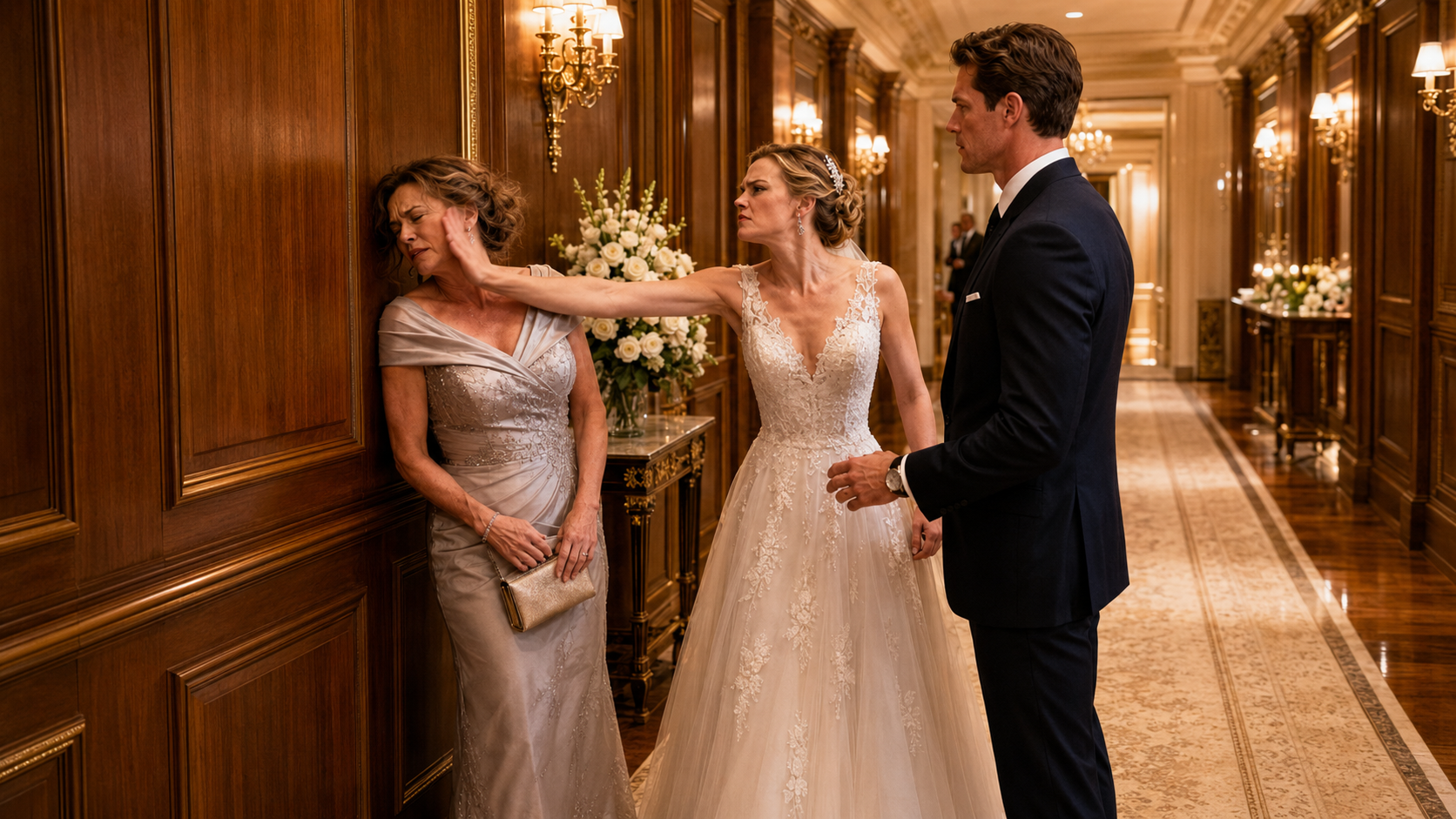
Then I watched my daughter-in-law slap her.
I watched my son grab his own mother by the arm.
And I watched him slam her into an oak-paneled wall hard enough to knock her to the floor.
The security footage had no sound, but it didn’t need any.
I knew my wife’s face.
I knew the shape her mouth made when she was trying not to cry.
I knew the way she curled inward when she was frightened.
Most of all, I knew the way Michael looked down at her.
There was no shock on my son’s face.
No horror.
No instinct to help.
He simply stared at the woman who had raised him, turned around, and walked back toward his wedding reception with his new wife.
I watched the footage twice.
Then a third time.
The estate manager stood behind me in silence.
When the screen froze on the final frame, my wife was still on the floor.
My son was already gone.
I didn’t shout.
I didn’t curse.
I didn’t punch the desk.
I only held out my hand.
“I need a raw copy of that file on a flash drive. Now.”
The manager swallowed.
“Yes, Mr. Whitaker.”
He probably thought my calm meant shock.
Michael would later make the same mistake.
He thought my silence meant I was devastated.
He was half right.
What my son didn’t know was that before the next sunrise, the locks on my home would be changed, his gate code would no longer work, the wedding gift he was counting on would disappear, his executive position would be under review, and the inheritance he had spoken about for years as though it were already his would be sitting on my attorney’s desk.
But before any of that happened, my wife came home with a lie.
And I nearly believed her.
The wedding had been held on a private estate outside the city, the sort of place with stone terraces, old trees wrapped in lights, fountains imported from Italy, and employees who seemed trained to appear from thin air whenever a guest needed champagne.
Cassandra had wanted perfection.
That word had followed us for almost a year.
Perfect flowers.
Perfect lighting.
Perfect table settings.
Perfect photographs.
Perfect guest list.
Perfect dress code.
Ellen had laughed about it in the beginning.
“She only gets one wedding,” she had told me.
I remembered looking across the kitchen island at my wife.
“Hopefully.”
Ellen had smacked my arm with a dish towel.
“Robert.”
“What?”
“Don’t start.”
I hadn’t started.
For twelve months, I had done the opposite.
I had stayed out of it.
Whenever Michael called with another request, I wrote the check or told the accountant to handle it.
Whenever Cassandra changed something that had already been paid for, Ellen told me not to complain.
“They’re excited.”
When the flower budget doubled, they were excited.
When Cassandra decided the original photographer’s work wasn’t “editorial” enough and replaced him, they were excited.
When Michael called to explain that the reception needed additional imported wine because Cassandra’s family had certain expectations, apparently that was excitement too.
I knew what the wedding cost.
I also knew Michael could not have paid for half of it himself.
But I kept my mouth shut because Ellen wanted our son’s wedding to be a happy memory.
That was the kind of woman she was.
She had spent thirty-four years turning our house into a place Michael could always come back to.
When he was eight and lost his first baseball championship, she sat on the kitchen floor with him because he refused to get up.
When he was sixteen and wrecked his first car, she hugged him before I could finish asking whether he’d been drinking.
When he graduated from college, she cried harder than he did.
When he joined my company, she made me promise I wouldn’t treat him more harshly simply because he was my son.
When he brought Cassandra home, Ellen was determined to love her because Michael loved her.
That was Ellen.
She made room.
Even when people did not deserve the space.
The night of the wedding, I left the reception before she did.
A migraine had started behind my left eye sometime after the speeches. Ellen wanted to stay for the final dances, and she insisted I go home.
“You’ve done your duty,” she whispered, adjusting my tie.
“My duty?”
“You didn’t argue with the band. You didn’t complain about the wine. You didn’t threaten Michael when he called me old during his toast.”
“He said you haven’t aged.”
“He said you’ve gotten older gracefully.”
“Exactly. He called me old diplomatically.”
She smiled.
That smile stayed in my mind for the next two days.
Because when Ellen came home shortly after midnight, she wasn’t smiling.
I heard the front door.
Then silence.
Normally, she called my name the second she entered a room.
That night, nothing.
I went downstairs.
She was standing in the foyer with one hand pressed against the small table near the door.
Her dress was torn along the side seam.
One shoe had a broken strap.
Her hair, which had been pinned up when I left, was hanging partly across her face.
And she was trembling.
“Ellen?”
She looked at me.
Something in her expression made every protective instinct I had ignite at once.
I crossed the foyer.
“What happened?”
“Nothing.”
“That doesn’t look like nothing.”
“I fell.”
She tried to move past me.
Her left leg buckled slightly.
I caught her elbow.
She gasped.
I immediately released her.
“I’m sorry.”
Then I saw her arm.
Four darkening marks curved around the flesh above her elbow.
Fingerprints.
I felt heat climb from my chest into my face.
“Ellen.”
She pulled her arm against her body.
“It’s fine.”
“Who did this?”
“No one.”
“Those are fingers.”
“Robert—”
“Who grabbed you?”
“I told you. I fell.”
“You fell and got grip marks on your arm?”
She looked away.
That was when I knew.
Not what had happened.
But that she was protecting someone.
My first thought was that a drunk guest had cornered her.
My second was worse.
I took out my phone.
“I’ll call Michael.”
She moved so quickly she nearly fell again.
Her hand closed around my sleeve.
“Please.”
I stared at her.
“Please what?”
“Don’t call him.”
“Why?”
“Don’t ruin his night.”
The words struck me as strange even then.
“What does Michael’s night have to do with someone hurting you?”
“Nothing. I just—I don’t want a scene.”
“Ellen, you’re bleeding.”
It was only a small scrape near her knee.
That didn’t matter.
Someone had put hands on my wife.
“Robert, please.”
Her voice broke.
That stopped me.
Not because I agreed.
Not because I believed her.
Only because in thirty-seven years of marriage, Ellen had almost never begged me for anything.
I put the phone down.
“Fine.”
Her shoulders loosened.
“But you’re not going upstairs alone.”
“I can walk.”
“I didn’t ask.”
Normally that would have earned me an eye roll.
That night, she let me help her.
I sat her on the edge of our bed and brought ice, antiseptic, pain medication, and an old towel.
The bruise on her arm kept darkening.
I said nothing about it.
Neither did she.
At one point, I knelt in front of her and wrapped ice around her swollen knee.
Her fingers moved through my hair.
“Don’t be angry,” she whispered.
I looked up.
“At you?”
“At anyone.”
That sentence bothered me more than the first lie.
I took her hand.
“What happened?”
Her eyes filled.
Then she smiled.
It was an awful smile.
Thin.
Fragile.
Designed to make me stop asking questions.
“I slipped.”
I stared at her for a long time.
Finally, I nodded.
“All right.”
She kissed my forehead.
“Thank you.”
But I didn’t believe her.
Not for a second.
Ellen fell asleep sometime after three.
I didn’t.
I sat beside her in the dark, listening to her breathing.
Every few minutes, I remembered those marks on her arm.
Someone had grabbed her hard enough to bruise her.
She was protecting whoever had done it.
And somehow, she believed telling me the truth would ruin our son’s wedding night.
There weren’t many explanations for that.
None of them were good.
At six in the morning, I checked my phone.
Michael had sent a photograph to the family group chat.
He and Cassandra were smiling beneath a tunnel of sparklers.
His arm was around her waist.
Her head was on his shoulder.
The caption read:
Perfect ending to a perfect night.
I stared at the photograph.
Then I looked at my sleeping wife.
Her damaged shoe was still lying beside the bedroom door.
And for the first time, I wondered if Michael knew exactly what had happened to his mother.
Two days later, I learned the answer.
My phone rang at 10:17 in the morning.
“Mr. Whitaker?”
“Yes.”
“This is Daniel Mercer from Hawthorne Estate.”
The venue manager.
I remembered him from the wedding. Mid-fifties, careful, professional. The kind of man who didn’t waste words.
“I hope I’m not disturbing you.”
“What is it?”
There was a pause.
“Our technical contractor has been reviewing a problem we experienced with several of the corridor cameras Saturday evening.”
I stood straighter.
“What problem?”
“Part of the system stopped recording properly. We believed some files were corrupted.”
“And?”
“One of those files was recovered this morning.”
I said nothing.
Neither did he for several seconds.
Then he asked, “Mrs. Whitaker is all right?”
My grip tightened around the phone.
“Why are you asking me that?”
Another pause.
“Mr. Whitaker, I strongly advise you to come down here.”
“I’ll bring my wife.”
“No.”
The word came too fast.
Mercer immediately lowered his voice.
“Please, sir. Come alone.”
The house seemed to go silent around me.
“What did you see?”
“I would rather show you.”
“Tell me now.”
“I don’t think I should do that over the phone.”
I looked toward the staircase.
Ellen was upstairs.
She still had a faint limp.
“Does this involve my wife?”
“Yes.”
“Does it involve my son?”
This time the pause was longer.
“Yes.”
That was the moment some part of me already knew.
Not the details.
Not how bad it would be.
But enough.
I picked up my keys.
“I’m on my way.”
And during the entire drive to Hawthorne Estate, one sentence kept repeating inside my head.
Come alone.
By the time I reached the property, I knew I was about to see something my wife had been willing to lie to protect me from.
I simply didn’t know that the person she was protecting was our son.
PART 2: THE CORRIDOR CAMERA
Daniel Mercer was waiting near the entrance when I arrived.
He didn’t offer his hand.
That told me more than anything else could have.
“Mr. Whitaker.”
“Show me.”
He nodded.
No small talk.
No coffee.
No attempts to soften whatever he had called me there to see.
He led me through a service hallway and into a small office behind the administrative wing.
Then he shut the door.
Locked it.
Closed the blinds.
I watched each movement.
“You think someone is going to interrupt us?”
“No.”
“Then why lock the door?”
His jaw tightened.
“Because this concerns your family.”
He sat behind the desk.
I remained standing.
There was a monitor on one side, paused on an empty corridor.
I recognized it.
The bridal wing.
Ellen and I had walked through it earlier that afternoon when Cassandra wanted family photographs.
Oak walls.
Cream runner.
Gold sconces.
A decorative table with white roses at the far end.
“What time?”
“Approximately eleven forty-three.”
I checked my memory.
I had left shortly after ten-thirty.
“Play it.”
Mercer hesitated.
“Mr. Whitaker—”
“Play it.”
He pressed the key.
For several seconds, nothing happened.
Then Ellen appeared from the left side of the screen.
Even without sound, I could tell she was upset.
She was holding her clutch with both hands in front of herself.
She stopped near the wall.
A few seconds later Cassandra entered.
Michael was behind her.
I felt my entire body harden.
Cassandra moved toward Ellen quickly.
Her hands were sharp, animated.
She pointed toward the reception area, then toward Ellen’s dress.
Ellen said something.
Cassandra laughed.
Not happily.
I had seen that expression before.
Contempt didn’t require sound.
“What were they saying?” I asked.
Mercer shifted.
“One of our employees was nearby. She couldn’t hear everything.”
“What did she hear?”
He didn’t answer immediately.
I turned toward him.
“What did she hear?”
He exhaled.
“Mrs. Michael Whitaker was angry about photographs taken earlier. She apparently said Mrs. Whitaker was making the wedding look…”
He stopped.
“Say it.”
“Cheap and tacky.”
Something cold moved through me.
On the screen, Ellen stepped backward.
Cassandra followed.
Michael stood two feet away.
My son.
Thirty-two years old.
Six feet tall.
Perfect suit.
Expensive watch.
Everything about him polished for the most photographed night of his life.
His mother was being berated in front of him.
And he did nothing.
Ellen lifted one hand.
I knew that gesture.
She did it when she was trying to calm someone.
I had watched her do it with Michael a hundred times when he was growing up.
Easy.
It’s all right.
Let’s not fight.
Then Cassandra slapped her.
I stopped breathing.
The blow turned Ellen’s head.
Her body shifted sideways.
My fingers dug into the back of the chair in front of me.
Mercer reached for the keyboard.
“Would you like me to—”
“No.”
My voice sounded unfamiliar.
“Keep playing.”
Ellen touched her cheek.
Michael finally moved.
For one foolish fraction of a second, I thought he was going to defend her.
I actually thought that.
I thought I was about to watch my son step between his wife and his mother.
Instead, Michael grabbed Ellen.
His hand wrapped around her upper arm.
Exactly where the bruises were.
I saw Ellen recoil.
She tried to pull away.
Michael’s other hand came up.
I couldn’t hear him, but his mouth was moving.
He was shouting at her.
At his mother.
Then he shoved her.
Not a small push.
Not an accidental movement.
Not a reflex.
He drove her backward.
Ellen hit the oak wall shoulder-first.
Her head snapped sideways.
Then she fell.
Her damaged shoe twisted beneath her.
The strap broke.
Her clutch slid across the floor.
I heard the faint scrape of Mercer’s chair as he shifted behind me.
On the screen, Cassandra stepped forward.
For a moment, I thought she was going to help Ellen.
Instead, she nudged the broken shoe away with her foot.
Not hard.
Almost casually.
As if my wife were clutter.
Michael looked down.
He stood there for three seconds.
Maybe four.
I counted them later.
Over and over.
Long enough to see his mother wasn’t getting up.
Long enough to make a choice.
Then Cassandra said something.
Michael turned.
They walked away together.
Neither looked back.
The corridor was empty again.
Ellen remained on the floor.
I don’t know how long I stood there after the footage stopped.
I remember the hum of the air conditioner.
I remember the tiny green light beneath the monitor.
I remember Mercer saying my name once.
Maybe twice.
Mostly, I remember looking at my son walking out of frame.
There are moments in a parent’s life when the child in your memory and the adult in front of you separate forever.
Until that second, somewhere inside me, Michael was still four years old with cereal on his shirt.
Still eleven, running into our bedroom because thunder scared him.
Still eighteen, trying not to cry when Ellen hugged him before college.
Still twenty-five, standing in my office, nervous on his first day with the company.
Then I watched him leave his mother on the floor.
And the boy disappeared.
“Mr. Whitaker?”
I raised one hand.
Mercer stopped.
I needed to think.
Anger is useful only if you control it.
Uncontrolled anger turns you into the stupidest person in the room.
So I did what I had spent forty years in business teaching younger men to do.
I separated facts from emotion.
Fact one: Cassandra struck Ellen.
Fact two: Michael physically grabbed Ellen.
Fact three: he shoved her against a wall.
Fact four: she fell and was visibly injured.
Fact five: he left.
Fact six: Ellen lied to protect him.
Fact seven: neither Michael nor Cassandra had contacted us in the forty-eight hours since.
Not to check on her.
Not to apologize.
Not even to ask if she was all right.
I pointed to the computer.
“Is that the original file?”
“The recovered file, yes.”
“Has it been altered?”
“No.”
“Edited?”
“No.”
“Compressed?”
“The playback software creates a viewing format, but the underlying recovered file has been preserved.”
“Who has access?”
“Myself, our technical contractor, and the owner.”
“Anyone else?”
“No.”
“Good.”
Mercer looked almost surprised.
“Good?”
“I don’t want this circulating.”
His expression shifted.
“I understand.”
“I mean it. Not an employee’s phone. Not social media. Not gossip. Nothing.”
“Of course.”
I held out my hand.
“I need a raw copy of that file on a flash drive. Now.”
He nodded immediately.
While he copied it, I kept staring at the frozen image.
Ellen on the floor.
The thing that hurt most wasn’t the shove.
It wasn’t even Cassandra’s slap.
It was Michael’s decision afterward.
He could have lost his temper.
People lose control.
It doesn’t excuse what they do, but human beings can make ugly mistakes in seconds.
What happened next was different.
He had time.
He looked down.
He saw his mother hurt.
And he decided the reception mattered more.
The photographs mattered more.
His bride’s anger mattered more.
His mother’s pain could wait.
Mercer handed me the flash drive.
I took it.
“Was anyone else in the corridor?”
“Not during that section.”
“And your employee who heard part of the argument?”
“She was around the corner near the service station. By the time she looked back, Mrs. Whitaker was leaving.”
“Ellen walked out herself?”
“Yes.”
Of course she did.
She probably picked up her own purse too.
Probably fixed her own hair.
Probably limped through the parking area without asking anyone for help because she didn’t want a scene at Michael’s wedding.
My throat tightened.
Mercer stood.
“Mr. Whitaker, I’m sorry.”
I looked at him.
“For what?”
“That happened here.”
“You didn’t do it.”
“No.”
He glanced at the monitor.
“But I have a mother.”
That nearly broke my composure.
I nodded once.
Then I left.
I didn’t call Michael on the drive home.
I wanted to.
I imagined exactly what I would say.
I imagined driving to his hotel.
I imagined dragging him out of whatever honeymoon suite Ellen and I had helped pay for and making him watch the footage frame by frame.
But rage wanted immediacy.
I wanted something else.
I wanted clarity.
Michael had grown increasingly comfortable over the years.
Too comfortable.
He had begun speaking about things he did not own as though they had already been transferred to him.
The company.
Our vacation property.
My investments.
The wedding gift.
The house he and Cassandra wanted.
His inheritance.
Once, during a family dinner, Cassandra had joked that she and Michael were “just waiting for Robert to admit he’s semi-retired so we can start making real decisions.”
Everyone laughed.
Including me.
At the time.
Now I remembered the way Michael had smiled.
Not embarrassed.
Pleased.
He didn’t think he was dependent on us.
He thought he was waiting for us to get out of the way.
When I arrived home, Ellen was sitting at the kitchen table drinking tea.
She looked at the flash drive in my hand.
Then at my face.
“Where were you?”
“Hawthorne.”
Her cup stopped halfway to her mouth.
I saw it.
That fraction of a second.
Fear.
“You went back to the venue?”
“Yes.”
“Why?”
“They called.”
Her hand tightened around the cup.
“What did they want?”
I looked at my wife.
I could have told her.
I could have put the drive on the table and said, I know.
But she was still protecting Michael.
And before I asked her to stop, I needed to understand how much protecting him had cost us.
“I’ll tell you later.”
“Robert.”
“Later.”
She watched me walk out of the room.
For the first time in our marriage, I deliberately left her with a question unanswered.
I went upstairs to my study.
Closed the door.
Opened the locked cabinet where I kept copies of our estate documents.
Then I started making a list.
Michael’s executive position?
Mine to recommend, subject to the company’s governance process.
His shares?
Unvested.
The vehicle he drove?
Corporate lease.
The vacation house he called “our lake place” when speaking to friends?
Owned by a family trust I controlled.
The down payment he and Cassandra expected us to provide after the wedding?
Never transferred.
The home address he still used on several personal and legal records?
Ours.
The gate access?
Mine.
The keys?
Mine.
The comfortable future he believed had already been promised to him?
That was mine too.
Or rather, it had been.
I sat behind my desk and looked at the photograph across from me.
Michael at six years old between Ellen and me.
All three of us smiling.
For years, I had believed giving my son security would make him confident.
I hadn’t noticed when security became expectation.
I hadn’t noticed when expectation became entitlement.
Maybe that was my failure.
If so, I was about to correct it.
I picked up my phone.
My first call was to my attorney.
The second was to my accountant.
The third was to the trust administrator.
The fourth was to corporate counsel.
Then I called our security company.
“Mr. Whitaker,” the representative said, “what changes would you like made?”
“All exterior access.”
“Is there a security concern?”
I looked down at the flash drive.
“Yes.”
“What access should remain active?”
“Mine and my wife’s.”
“And Mr. Michael Whitaker?”
I didn’t hesitate.
“Remove him.”
That night, for the first time since our son was a teenager, Michael no longer had a key that could bring him home.
PART 3: WHAT MY SON THOUGHT BELONGED TO HIM
The next morning began quietly.
That was what made it almost surreal.
Sunlight came through the kitchen windows.
The coffee machine hissed.
Ellen stood at the counter in her robe, carefully favoring her knee.
Somewhere in another part of the city, my son was probably waking beside his new wife believing his life was exactly the same as it had been the day before.
It wasn’t.
At eight-thirty, my attorney called.
We discussed the estate plan.
I did not disinherit Michael in a fit of anger.
That would have been exactly the kind of impulsive decision I had avoided since leaving Hawthorne.
Instead, I instructed my attorney to begin reviewing every provision involving him.
Anything automatic would be reconsidered.
Anything discretionary would remain discretionary.
Any assumption Michael had made about immediate control after my death was no longer an assumption I intended to reward.
At nine-fifteen, I spoke with the trust administrator.
Michael’s access to the vacation property was suspended.
It wasn’t his home.
He had no ownership interest.
He had simply been permitted to use it.
Permission could end.
At ten, I spoke with corporate counsel.
That conversation lasted longer.
My company employed nearly four hundred people.
I was not going to treat it like a family toy simply because my son had.
Michael’s position had always been legitimate on paper, but I had accelerated his rise.
I had given him opportunities other people would have spent years earning.
He wasn’t incompetent.
That almost made it worse.
He was capable enough to believe he had earned everything alone.
So we reviewed his employment agreement, his unvested equity package, and the vehicle lease attached to his position.
No theatrics.
No illegal retaliation.
No false accusations.
Just boundaries.
His future at the company would no longer be protected by me.
If the board wanted to evaluate his leadership, it would evaluate him by the same standards as anyone else.
If his position depended on my sponsorship, that sponsorship was over.
His unvested shares would remain subject to their terms.
His company vehicle would remain tied to his employment status.
No more hidden safety net.
No more father standing behind the curtain.
At eleven, the locksmith finished.
At eleven-twenty, the gate code changed.
At noon, I cancelled the transfer of the wedding gift.
That was the easiest.
Michael and Cassandra had been planning to use it toward a house.
A beautiful place.
Too large for two people.
Too expensive without help.
Cassandra had sent Ellen photographs for months.
She loved the marble kitchen.
Michael loved the garage.
They had spoken about our gift as though it were a closing document.
It wasn’t.
The money was still ours.
I instructed the accountant not to transfer a dollar.
Ellen found me in my study shortly afterward.
She closed the door behind her.
“You changed the gate code.”
It wasn’t a question.
“Yes.”
“And the locks.”
“Yes.”
Her face paled.
“Why?”
I looked at her bruised arm.
She followed my eyes.
Then she understood.
Not everything.
Enough.
“Robert.”
“I saw it.”
Silence.
She lowered herself into the chair across from me.
For several seconds, she looked at the carpet.
“When?”
“Yesterday.”
“The venue?”
“Yes.”
Her eyes closed.
I had been angry at her for lying.
That anger vanished the moment I saw her sitting there.
She didn’t look deceptive.
She looked ashamed.
And my wife had nothing to be ashamed of.
“Why didn’t you tell me?” I asked.
Her answer came quietly.
“Because he’s our son.”
“That isn’t an answer.”
“It is to me.”
“No. It’s a reason you were willing to protect him. It doesn’t tell me why you thought he deserved protection.”
She looked at me.
“I didn’t know what else to do.”
“You tell me.”
“And then what?”
“I deal with it.”
“Exactly.”
I leaned back.
“So you were protecting him from me.”
“I was protecting everyone.”
“Everyone except yourself.”
Her mouth tightened.
“Please don’t turn this into—”
“Into what, Ellen?”
“A war.”
I stood.
“This is not a war.”
“You changed the locks.”
“Our son put his hands on you.”
“He lost his temper.”
My voice dropped.
“Don’t.”
She flinched.
I immediately regretted the sharpness.
But I refused to let her reduce what happened.
“Don’t do that for him.”
“Robert—”
“Cassandra slapped you.”
Her eyes filled.
“Michael grabbed you hard enough to leave fingerprints.”
“I know.”
“He shoved you into a wall.”
“I know.”
“He watched you fall.”
She looked away.
“And then he left you there.”
That was the one.
Her face broke.
Not dramatically.
Ellen rarely cried loudly.
Her chin trembled.
Her shoulders folded.
And tears began sliding down her face.
I came around the desk.
She whispered, “I know.”
I knelt beside her.
For a long time, neither of us spoke.
Finally, she said, “He looked right at me.”
I closed my eyes.
“I know.”
“I kept thinking he’d come back.”
That sentence hurt worse than the footage.
“I sat there for maybe thirty seconds. Maybe a minute. I don’t know. I thought he would turn around.”
I took her hand.
“He didn’t.”
“No.”
“What happened before Cassandra slapped you?”
Ellen wiped her face.
“She was angry about the photographs.”
“What photographs?”
“The family pictures.”
“What was wrong with them?”
“Me, apparently.”
I felt the familiar heat returning.
Ellen shook her head.
“Don’t.”
“Tell me.”
“She said I’d ruined the look she wanted. She said I didn’t fit the aesthetic of the photographs.”
I stared at her.
Ellen gave a small, miserable laugh.
“I wish I could tell you exactly what that means.”
I could.
Cassandra had spent a year constructing a wedding designed to look effortless despite costing more than some houses.
Every detail had to suggest wealth without admitting anyone cared about wealth.
Ellen had never understood that performance.
She wore what she liked.
She spoke to servers the same way she spoke to executives.
She carried safety pins in her handbag.
She had spent part of the reception helping one of Cassandra’s young cousins fix a torn hem.
Nothing about my wife was curated.
That was why people trusted her.
It was also probably why Cassandra couldn’t control how Ellen appeared.
“She told me I made the wedding look cheap,” Ellen continued.
“And tacky.”
Her eyes lifted sharply.
“You heard that?”
“The manager told me.”
She looked down.
“I told her she was being ridiculous. That photographs were photographs. She said I had embarrassed her all day.”
“How?”
“She didn’t say anything that made sense.”
“And Michael?”
“He told me to stop arguing.”
Of course.
“Then Cassandra slapped you.”
Ellen nodded.
“What did Michael say?”
Her silence answered before she did.
“He told me I was causing a scene.”
I stood slowly.
“You were causing a scene.”
“Robert.”
“His wife hit you, and he thought you were the problem.”
“He was upset.”
“So was she. Apparently that gave both of them permission.”
“I am not defending what he did.”
“You have been defending what he did since you walked through our front door.”
That hurt her.
I saw it immediately.
I softened my voice.
“You lied to me because you thought telling the truth would hurt Michael.”
“I thought you’d destroy his marriage.”
“I didn’t marry Cassandra.”
“You know what I mean.”
“No. I know what you were afraid of. You were afraid I’d make him choose.”
“Yes.”
I sat on the edge of the desk.
“Ellen, he already chose.”
She stared at me.
“At the wedding, he chose.”
Her eyes closed again.
I hated saying it.
But some truths hurt because they are cruel.
Others hurt because they are undeniable.
“He didn’t have to divorce her,” I continued. “He didn’t have to scream. He didn’t have to ruin the reception. He had to do one thing.”
“What?”
“Help his mother off the floor.”
Ellen covered her mouth.
I let the silence sit between us.
Then she looked toward the papers on my desk.
“What have you done?”
I told her.
All of it.
The locks.
The gate.
The gift.
The trust access.
The estate review.
The company.
By the time I finished, her expression had changed from sadness to alarm.
“Robert, that’s his entire life.”
“No.”
“It practically is.”
“Then we made a bigger mistake than I realized.”
She stood.
“He’s our son.”
“And?”
“You can’t erase him because of one terrible night.”
“I haven’t erased him.”
“You’re taking everything away.”
I shook my head.
“No. I’m taking back what still belongs to us.”
She stared at me.
“There’s a difference.”
“Will it feel different to him?”
“Probably not.”
That was the point.
Michael had spent years confusing access with ownership.
Support with entitlement.
Love with obligation.
I walked to the window.
“I am not taking his salary out of his bank account. I’m not taking his personal property. I’m not destroying his reputation. I’m not putting that video online. I’m not calling his clients. I’m not lying about him.”
I turned back.
“I am simply no longer guaranteeing that his life remains comfortable.”
Ellen was quiet.
“The wedding gift?” she asked.
“Cancelled.”
“They’ve already been talking to the realtor.”
“Then they’ll have to adjust.”
“The lake house?”
“Access suspended.”
“The company?”
“I told counsel I will no longer protect his position. He’ll face a formal review.”
“His shares?”
“Unvested.”
“And the inheritance?”
“Under review.”
She looked exhausted.
I went to her.
“If you want me to restore your access arrangements with him to this house, I will discuss it with you. This is your home too.”
She looked at the bruises on her arm.
“No.”
That surprised me.
“What?”
“Not yet.”
I waited.
She took a long breath.
“I don’t want him walking in here like nothing happened.”
For the first time since I saw the footage, some of the pressure in my chest loosened.
I nodded.
“Neither do I.”
Her phone rang.
We both looked at it.
Michael.
Ellen froze.
The phone rang again.
Then stopped.
A few seconds later, mine started.
I looked at the screen.
Michael.
I let it ring.
Ellen looked at me.
“You’re not answering?”
“No.”
“He’ll know something’s wrong.”
“Something is wrong.”
The call ended.
Thirty seconds later, he called again.
Then again.
On the fourth attempt, I answered.
“Hello, Michael.”
“Dad.”
He sounded cheerful for exactly one syllable.
Then his tone changed.
“What happened to the gate code?”
I looked at Ellen.
She closed her eyes.
I answered quietly.
“It changed.”
“Yeah, I figured that out. Why?”
“Security update.”
“Okay. What’s the new code?”
There it was.
No question about his mother.
No apology.
No hesitation.
Just the assumption that whatever had changed would immediately be restored for him.
“There isn’t one for you.”
Silence.
“What?”
“You don’t have access right now.”
“Dad, what are you talking about?”
“You heard me.”
Another silence.
Longer.
Then his voice lowered.
“Is Mom there?”
“Yes.”
“Can I talk to her?”
I looked at Ellen.
She shook her head.
“No.”
“Why not?”
“Because she doesn’t want to talk to you.”
That landed.
“What do you mean she doesn’t want to talk to me?”
I almost laughed.
Instead, I said nothing.
Then Michael’s breathing changed.
He knew.
Maybe he didn’t know how.
But he knew.
“Dad.”
“Yes?”
“What did she tell you?”
I looked at my wife.
Her face went still.
And that question told both of us everything we needed to know.
Not “Is Mom okay?”
Not “What happened?”
Not “Why is she upset?”
What did she tell you?
I answered with the truth.
“Nothing.”
Michael went silent.
Then I added, “That was the problem.”
And I hung up.
PART 4: THE THINGS HE LOST
Michael called fourteen times that day.
Cassandra called six.
Neither left an apology.
Their messages changed as the hours passed.
At first, Michael sounded confused.
Then irritated.
Then concerned.
Then angry.
By late afternoon, panic had entered his voice.
“Dad, I don’t know what’s going on, but my assistant says legal wants to meet with me Monday.”
Another message:
“Dad, call me. This is getting ridiculous.”
Then:
“I just got an email about the vehicle agreement. What the hell are you doing?”
Cassandra’s messages were different.
“Robert, I think there’s been some misunderstanding.”
Then:
“Ellen must have told you a very distorted version of what happened.”
Then:
“We should discuss this as adults before anyone makes emotional decisions.”
That one almost impressed me.
The woman who had slapped my wife wanted to warn me against emotional decisions.
I saved every message.
Not because I needed ammunition.
Because anger can distort memory, and I wanted the record to remain clean in my own mind.
That evening, Ellen and I ate dinner together.
Neither of us had much appetite.
Halfway through, she put down her fork.
“Do you think he’ll come here?”
“Yes.”
“How?”
“He can still drive to the gate.”
She almost smiled.
“I suppose he can.”
“He’ll come.”
“How do you know?”
“Because until yesterday, every problem in Michael’s life could eventually be solved by coming home.”
She looked at me for a long moment.
“That sounds sad when you say it like that.”
“It is sad.”
At seven-thirty, the gate intercom rang.
Michael.
I looked at Ellen.
“Do you want me to send him away?”
She didn’t answer immediately.
The intercom rang again.
Finally, she stood.
“No.”
“No?”
“Let him in.”
I studied her face.
“Are you sure?”
“I don’t want to hide in my own house.”
That was my wife.
Gentle did not mean weak.
Sometimes people confused the two because Ellen didn’t raise her voice.
They never understood that softness could contain steel.
I opened the gate remotely.
Michael’s car appeared at the end of the drive.
Cassandra was in the passenger seat.
Of course she was.
They walked to the front door together.
Michael tried his key before he rang the bell.
I heard the metal scrape uselessly inside the new lock.
Then the bell rang.
I opened the door.
My son’s expression was something I had rarely seen.
Uncertainty.
“Dad.”
“Michael.”
Cassandra stood beside him in a cream coat, arms folded.
“Can we come in?”
I stepped aside.
They entered the foyer.
Michael looked toward the staircase.
“Mom?”
Ellen appeared from the living room.
He saw the bruise on her arm.
His eyes dropped.
For the first time since the wedding, no one spoke.
Cassandra broke the silence.
“We need to clear this up.”
I looked at her.
“No.”
She frowned.
“No?”
“You need to explain it. Clearing it up suggests there’s confusion.”
“Robert, you weren’t there.”
“No.”
I reached into my pocket.
“But the camera was.”
Michael’s face drained of color.
Cassandra stared at me.
“What camera?”
I said nothing.
Michael did.
“The corridor.”
I turned toward him.
His eyes met mine.
So he knew there had been a camera.
Interesting.
Not evidence of a plan.
Just one more indication that his first concern was consequences.
I pointed toward my study.
“In there.”
Cassandra started talking before we reached the room.
“Whatever you think you saw, there was context.”
“Good.”
I opened the door.
“You can provide it afterward.”
I had connected the file to the television mounted on the wall.
I didn’t need to play it again.
I’d seen enough.
But Ellen hadn’t.
She had lived it from inside her own fear.
That was different.
Before I touched the remote, I looked at her.
“You don’t have to watch.”
She hesitated.
Then she sat.
“Yes, I do.”
Michael remained standing.
Cassandra sat beside him.
I pressed play.
No one spoke as Ellen appeared in the corridor.
I watched my son’s face instead of the screen.
His jaw tightened when Cassandra confronted Ellen.
His eyes dropped when the slap came.
When the video showed him grabbing his mother’s arm, he looked away completely.
“Watch,” I said.
“Dad—”
“Watch.”
He forced himself to look.
The shove came.
On screen, Ellen hit the wall.
Beside me, my real wife inhaled sharply.
I reached for her hand.
She squeezed mine.
Then the worst moment arrived.
Michael looked down at his mother.
Turned.
Walked away.
The video ended.
Silence filled the room.
I shut off the television.
“Context.”
Cassandra spoke first.
“Ellen was provoking me.”
Ellen stared at her.
I felt my hand tighten around the remote.
But this was Ellen’s confrontation too.
I stayed quiet.
Cassandra continued.
“I had been under pressure all day. There were problems with the photographs, the schedule was behind, my mother was upset, and Ellen kept dismissing everything I was trying to explain.”
Ellen’s voice was soft.
“You hit me.”
“I shouldn’t have slapped you.”
“That’s not an apology.”
Cassandra blinked.
I almost smiled.
Ellen rarely demanded anything.
When she did, people noticed.
Cassandra straightened.
“I’m sorry I slapped you.”
Ellen waited.
Then she turned toward Michael.
He looked miserable.
“Mom.”
“Why did you grab me?”
“I was trying to stop the argument.”
“No.”
“I was.”
“You left marks.”
“I didn’t mean to.”
“You shoved me.”
His mouth tightened.
“I lost my temper.”
“And then?”
He didn’t answer.
Ellen’s eyes filled, but her voice remained steady.
“And then what did you do, Michael?”
“Mom—”
“Say it.”
He looked at the floor.
“I went back inside.”
“You left me there.”
“I thought you were okay.”
“You watched me hit the wall.”
“I wasn’t thinking.”
“No.”
Her voice cracked for the first time.
“You weren’t.”
Michael sat forward.
“I am sorry.”
Ellen looked at him.
“I kept waiting for you to come back.”
He covered his face for a moment.
“Mom, I messed up.”
“You did more than mess up.”
“I know.”
“Do you?”
“Yes.”
Cassandra shifted beside him.
“This is becoming unnecessarily dramatic.”
Michael turned.
“Cass.”
“No, I’m serious. What happened was wrong, but we’re talking about destroying our lives over a thirty-second argument.”
I finally spoke.
“Your life is being destroyed?”
She looked at me.
“Michael is being threatened at work. Our house plans are suddenly on hold. We’ve been locked out of a family property. You changed your own home security like we’re criminals.”
“You’re not criminals.”
The words came calmly.
Cassandra seemed surprised.
I continued.
“And I haven’t accused either of you of being criminals. I haven’t called the police. I haven’t posted the footage. I haven’t sent it to your friends. I haven’t contacted your wedding guests. I haven’t done anything to publicly humiliate you.”
“Then what exactly are you doing?”
“Ending the subsidy.”
She stared at me.
Michael’s head lifted.
“Dad.”
I looked at my son.
“Your mother and I have spent years making sure you never had to worry about certain things.”
“I never asked for—”
I laughed once.
He stopped.
“You didn’t ask for the company position?”
“I earned my position.”
“You contributed. You worked. But you were also given opportunities other people weren’t.”
His jaw tightened.
“That isn’t fair.”
“No. It wasn’t.”
That silenced him.
I went to my desk and picked up a folder.
“You want fair? Fine.”
I opened it.
“Your executive position will be reviewed under normal company procedures. I will not interfere on your behalf.”
“Dad—”
“Your equity remains governed by the vesting schedule you signed. Nothing more.”
His face changed.
“The shares?”
“Are not yours yet.”
He stared at me.
I turned a page.
“The vehicle is attached to your executive compensation package. Whatever happens there will follow the agreement.”
“This is insane.”
“The vacation property belongs to the trust. You have no ownership interest. Your access was a privilege.”
“Dad.”
“The house gift has been cancelled.”
Cassandra stood.
“You can’t do that.”
I looked at her.
“It’s my money.”
“You promised us.”
“We discussed giving you a gift.”
“You know we’ve been planning around it.”
“That was your mistake.”
Her face flushed.
“We have a deposit at risk.”
“Then you’ll need to speak with your realtor.”
Michael stood too.
“Stop.”
I looked at him.
“Stop what?”
“All of this.”
“No.”
“You’re punishing me.”
“Yes.”
He seemed stunned by the answer.
I didn’t pretend otherwise.
“Actions have consequences, Michael.”
“So you’re taking my entire future because of one mistake?”
“Your future?”
I walked toward him.
“You’re thirty-two years old. You have an education. You have professional experience. You have a salary. You have savings. You have a wife with her own career. You have more advantages than most people receive in a lifetime.”
My voice remained quiet.
“If removing my money destroys your future, then you never built one.”
His face hardened.
“You’ve always said everything you did was for family.”
“It was.”
“Then this is hypocrisy.”
“No. This is the first time I’ve realized you believed family meant access.”
“I don’t.”
“Really?”
I pointed toward the foyer.
“What was the first thing you asked me yesterday?”
He said nothing.
“The gate code.”
His face shifted.
“Not how your mother was.”
“I knew she was okay.”
“How?”
“She walked away.”
I stared at him.
There it was.
The sentence he should never have said.
Ellen stood slowly behind me.
“She walked away.”
Michael turned toward her.
“Mom, that’s not what I meant.”
“You watched me on the floor, and because I eventually walked away, you decided I was okay?”
“No.”
“You didn’t call me.”
He froze.
“You didn’t text me.”
“Mom—”
“You didn’t come home.”
His eyes reddened.
“You went back to the reception.”
“I didn’t know what to do.”
“You could have helped me stand.”
He looked as though she had struck him.
Good.
Not because I enjoyed hurting my son.
Because for the first time since I watched that footage, he seemed to understand that the deepest wound wasn’t physical.
Ellen stepped closer.
“I defended you to your father.”
Michael’s expression collapsed.
“I know.”
“No, you don’t. I came home bruised, and I lied for you.”
He stared at her.
“I told him I fell.”
Cassandra looked uncomfortable.
Ellen continued.
“I was afraid he’d ruin your wedding night. I was afraid he’d hate you. I was afraid he’d make everything worse.”
Her voice trembled.
“And do you know what I was most afraid of?”
Michael shook his head.
“That if I told the truth, I would have to admit to myself what you did.”
The room went completely still.
Michael whispered, “Mom.”
“I can understand anger. I can understand panic. I can even understand making one terrible choice in a terrible moment.”
She touched the fading bruise.
“But you looked at me.”
Tears slipped down her face.
“You looked directly at me and walked away.”
Michael cried then.
Quietly.
He sat back down and covered his mouth.
Cassandra remained standing.
I watched her expression change.
Not to remorse.
To frustration.
She still believed this was something to manage.
A bad scene.
A financial complication.
An obstacle between herself and the future she expected.
“Ellen,” she said, “we have apologized. What else do you want?”
My wife looked at her.
“Nothing.”
Cassandra blinked.
“Nothing?”
“I don’t want anything from you.”
She took my hand.
“And you’re not getting anything from me either.”
That was the moment I knew Ellen understood what I had been trying to do.
This wasn’t revenge for the sake of pain.
It was the end of pretending love required us to finance disrespect.
Michael looked at me.
“What about the inheritance?”
I almost couldn’t believe he asked.
From the expression on his face, he regretted it the second the words left his mouth.
Ellen closed her eyes.
Cassandra looked sharply at him.
I walked back to my desk.
“It’s under review.”
“Meaning?”
“Meaning you should live your life assuming you’re responsible for it.”
His voice was hoarse.
“You’re cutting me out?”
“I didn’t say that.”
“Then what are you saying?”
“That whatever happens after your mother and I die is no longer part of your financial plan.”
“Dad—”
“Build your own life.”
I looked from him to Cassandra.
“Pay for your own house. Drive a car you can afford. Take vacations you pay for. Earn whatever position your company believes you deserve. Save your own money.”
Then I looked only at Michael.
“If someday your mother forgives you, understand that forgiveness is not a financial instrument.”
He stared at me.
For once, my son had nothing to say.
I opened the study door.
The conversation was over.
Michael stopped beside Ellen on his way out.
“Mom.”
She looked at him.
“I’m sorry.”
This time, his apology sounded different.
Maybe because there was nothing left to gain from it.
Maybe because he finally understood.
Ellen nodded.
“I hope you are.”
He looked like he wanted to hug her.
He didn’t try.
That was at least one boundary he finally respected.
Cassandra walked out without speaking to me.
Michael followed her.
I watched through the front window as they crossed the drive.
Halfway to the car, Cassandra turned on him.
Even through the glass, I could see her anger.
Her hands moved sharply.
Michael didn’t answer.
He just kept walking.
A minute later, they drove away.
Ellen stood beside me.
“Do you think we went too far?”
I looked at the empty driveway.
“No.”
She was quiet.
Then she leaned her head against my shoulder.
Neither of us said what we were both thinking.
For the first time in Michael’s adult life, he was leaving our house with only what actually belonged to him.
PART 5: WHAT LOVE DOESN’T BUY
The days after that were quieter than I expected.
I had imagined fury.
Threats.
Family phone calls.
Accusations.
Instead, Michael disappeared into the consequences.
The house purchase did not proceed on the terms he and Cassandra had planned.
Without our contribution, they had to reconsider what they could afford.
That wasn’t tragedy.
It was arithmetic.
His company review proceeded without me protecting him.
Corporate counsel made certain I understood that distinction.
I had built the company over decades.
I would not damage it to hurt my son.
Michael remained responsible for proving that his position was justified.
For the first time since he’d joined the firm, his father’s name would neither push him upward nor catch him if he fell.
His unvested shares remained exactly what they had always been.
Conditional.
The vehicle issue was handled according to his employment terms.
No midnight tow truck.
No humiliation.
No theatrical repossession from a restaurant parking lot.
I wasn’t interested in spectacle.
I wanted separation.
The vacation house remained inaccessible to him.
The gate code remained changed.
The new locks remained in place.
And the wedding gift remained in our account.
The most important change, however, happened inside our house.
Ellen stopped saying she fell.
The first time someone asked about her arm, she simply said, “There was an incident at the wedding.”
No lie.
No elaborate explanation.
No protection purchased with her own dignity.
One evening, about two weeks later, I found her sitting in the living room with one of Michael’s childhood photo albums.
I stood in the doorway.
“You all right?”
She nodded.
Then shook her head.
Then laughed softly.
“I don’t know.”
I sat beside her.
On the open page, Michael was seven.
Front teeth missing.
Holding a homemade birthday cake Ellen had decorated with far too much blue icing.
“I keep trying to find the moment,” she said.
“What moment?”
“When he became someone who could do that.”
I looked at the photograph.
“I don’t think there was one moment.”
“Then what did we miss?”
I knew she had been asking herself that question every day.
So had I.
Maybe we had given too much.
Maybe I had solved too many problems.
Maybe Ellen had forgiven too quickly.
Maybe Michael had gradually come to believe the world would soften every consequence before it reached him.
Or maybe none of that explained what he had done.
Parents can influence children.
We cannot manufacture their character forever.
At some point, they choose.
“I don’t know what we missed,” I said.
Ellen looked at me.
“That isn’t very comforting.”
“No.”
“At least you’re honest.”
“I try.”
She closed the album.
“Do you hate him?”
The question surprised me.
“No.”
“You looked like you hated him when they left.”
“I hated what he did.”
“That’s different?”
“It has to be.”
She studied me.
“I thought you said he had to live with consequences.”
“He does.”
“So do we.”
That was Ellen.
Even when she was hurt, she could see further than I could.
She leaned back against the sofa.
“I love him.”
“I know.”
“I don’t know if I want to see him yet.”
“You don’t have to.”
“I might forgive him eventually.”
“You might.”
She looked at me carefully.
“You won’t.”
I thought about it.
“I didn’t say that.”
“You didn’t have to.”
I smiled faintly.
“Ellen, you can forgive him tomorrow if that’s what you need.”
“And you?”
“I’ll decide what forgiveness means when I get there.”
She reached for my hand.
“What if I want the gate code restored someday?”
“Then we discuss it.”
“The lake house?”
I looked at her.
“That will be a harder discussion.”
She laughed.
It was the first real laugh I’d heard from her since the wedding.
I squeezed her hand.
Then she became serious again.
“I don’t want money to be the only reason he comes back.”
“Neither do I.”
That was the heart of it.
For years, we had been generous because we loved him.
Now we needed to know whether he loved us when generosity was no longer guaranteed.
Three weeks after the wedding, Michael asked to meet Ellen.
Not me.
Her.
He sent a short message.
No excuses.
No mention of the house.
No mention of the company.
No mention of money.
He asked if she would meet him for coffee.
Ellen showed me the message.
“What do you think?”
“I think it’s your decision.”
“You don’t want to come?”
“No.”
That surprised her.
“You really don’t?”
“This isn’t about me.”
She looked down at the phone.
For several seconds, she hesitated.
Then she typed.
“I’ll meet him.”
I drove her there but stayed in the car.
Not because she needed protection.
Because her knee still bothered her on stairs, and because after nearly four decades of marriage, sometimes love is simply being nearby without intruding.
She was inside for almost an hour.
When she returned, her eyes were red.
I waited until she buckled her seat belt.
“How was it?”
“He apologized.”
“Properly?”
She nodded.
“He didn’t blame Cassandra.”
That mattered.
“He didn’t blame the wedding.”
That mattered more.
“He said he was angry at me because Cassandra was angry, and all he could think about was stopping the problem before anyone noticed.”
I stared through the windshield.
“And you became the problem.”
“Yes.”
I hated hearing it.
Ellen continued.
“He said the second he walked away, he knew he’d done something terrible.”
“Then why didn’t he come back?”
“He was ashamed.”
I let out a humorless breath.
“Convenient.”
“I said the same thing.”
I looked at her.
“You did?”
“Yes.”
There was a little steel in her voice.
Good.
“What else?”
“He said he kept telling himself he’d call the next morning. Then he saw the family chat, and because I didn’t say anything, he convinced himself I wanted to forget it.”
“That sounds like Michael.”
“Yes.”
“Did you forgive him?”
She looked out the passenger window.
“Not yet.”
I started the car.
After a moment, she added, “But I believe he’s sorry.”
I nodded.
That was hers to believe.
Not mine to take away.
“And Cassandra?”
Ellen’s expression changed.
“He says they’re having problems.”
I didn’t ask for details.
Their marriage was not mine to manage.
Cassandra had done what she had done.
Michael had done what he had done.
Whatever happened between them afterward belonged to them.
“Did he ask about the money?” I asked.
“No.”
That surprised me.
“Not once?”
“Not once.”
I pulled out of the parking lot.
After several blocks, Ellen said, “Does that change anything for you?”
“Not yet.”
She nodded.
“I didn’t think so.”
The truth was, I was glad he hadn’t asked.
Not because it earned him anything.
Because perhaps, for the first time, he was beginning to understand that the money had never been the real issue.
Months passed.
The bruises disappeared.
The torn dress remained in the back of Ellen’s closet for a while.
One Saturday, I found her holding it.
“You keeping it?”
She looked at the ripped seam.
“No.”
“Want me to throw it out?”
She shook her head.
“I’ll do it.”
She folded it carefully.
Not because it deserved care.
Because Ellen did everything carefully.
Then she placed it in a donation bag.
I watched her.
“You sure?”
“Yes.”
She straightened.
“It was just a dress.”
I knew what she meant.
The dress wasn’t the wound.
The wall wasn’t the wound.
The bruises weren’t even the deepest wound.
The wound had been seeing her son choose comfort over her pain.
Healing would take longer than skin.
But it had started.
My relationship with Michael changed too.
For months, we spoke only when necessary.
At work, I treated him as I would any other executive.
Sometimes that was probably harder for him than anger would have been.
He could no longer walk into my office and assume a private conversation would erase a professional problem.
He had to prepare.
He had to defend his decisions.
He had to accept criticism without leaning on the fact that he was my son.
And something unexpected happened.
He began to improve.
Not immediately.
Not dramatically.
But the excuses became less frequent.
He stopped assuming I would intervene.
When he made mistakes, he corrected them faster.
When he succeeded, the success actually belonged to him.
I never told him I was proud of that.
Not then.
Some lessons need room.
The estate plan remained under review.
The cancelled wedding gift remained cancelled.
The vacation property remained restricted.
I didn’t restore those things simply because Michael started behaving better.
That would have taught exactly the wrong lesson.
Consequences are not vending machines.
You don’t insert three months of good behavior and get your privileges back.
Trust returns slowly.
If it returns at all.
One evening nearly a year after the wedding, Ellen and I were sitting on the back terrace when the gate intercom rang.
I checked the screen.
Michael.
Alone.
Ellen looked at me.
“Were you expecting him?”
“No.”
She watched the image for a moment.
“Let him in.”
I raised an eyebrow.
“You sure?”
“Yes.”
I opened the gate.
Michael parked near the house.
He didn’t try the old key this time.
He rang the bell.
I opened the door.
“Dad.”
“Michael.”
He held something in his hand.
A small paper bag.
“Mom home?”
“In the back.”
He nodded.
“I brought her those lemon cookies she likes.”
I almost smiled.
He had remembered.
Not expensive flowers.
Not jewelry.
Not some grand apology purchased with guilt.
Six-dollar cookies from a bakery Ellen had loved for years.
“You can come in,” I said.
He paused.
Maybe he understood what those words meant now.
Not access.
Permission.
“Thanks.”
He walked through the foyer.
For a second, I remembered the boy who used to throw his backpack on that same floor.
Then I remembered the man on the security footage.
Both were Michael.
That was the difficult truth.
People are not only the best thing they have done.
They are not only the worst thing either.
But the worst thing still counts.
Love doesn’t erase it.
Money doesn’t erase it.
Being family doesn’t erase it.
Michael stepped toward the terrace.
Then stopped.
“Dad?”
“Yes?”
“I know you probably don’t believe me.”
“About what?”
“I am sorry.”
I looked at him.
A year earlier, I would have wanted that sentence.
After the wedding, I thought hearing it would satisfy something inside me.
It didn’t.
But it mattered.
“I know,” I said.
He looked surprised.
“That doesn’t mean everything goes back to the way it was.”
“I know.”
“Good.”
He nodded.
Then he went outside to see his mother.
I stayed near the doorway.
Ellen smiled when she saw the bag.
Michael sat across from her.
They began talking.
Nothing dramatic happened.
No music.
No grand reconciliation.
No instant restoration.
Just a mother and son trying to understand what remained after trust had been broken.
I could live with that.
I never released the security footage publicly.
I didn’t need strangers to hate Michael.
I didn’t need Cassandra humiliated online.
I didn’t need applause.
Justice doesn’t always require an audience.
Sometimes justice is much quieter.
Sometimes it is a changed lock.
A cancelled check.
A privilege withdrawn.
A father finally saying no.
A mother finally refusing to lie.
Michael had mistaken our love for an unconditional financial contract.
Cassandra had mistaken Ellen’s gentleness for weakness.
They had both believed the life around them was permanent because Ellen and I had spent decades making it comfortable.
They were wrong.
Ellen may forgive our son completely one day.
I hope she can, if that gives her peace.
Maybe I will too.
But forgiveness and access are not the same thing.
Forgiveness and trust are not the same thing.
And forgiveness does not mean pretending the wall never happened.
I still have the flash drive.
It sits in a locked drawer in my study.
I rarely think about it now.
But I have never destroyed it.
Not because I plan to use it.
Because there was a time when my wife came home bruised and convinced herself that protecting our son mattered more than telling the truth.
I will never allow that truth to disappear again.
Michael has his own life now.
His own bills.
His own choices.
His own consequences.
He knows the gate no longer opens simply because he arrives.
He knows the company is not his because he shares my last name.
He knows our assets are not promises waiting for us to die.
Most importantly, he knows his mother is not someone he can hurt and then leave on the floor while the rest of his life continues unchanged.
That lesson cost him.
It should have.
As for Ellen, she still keeps too many safety pins in her handbag.
She still forgives people faster than I do.
She still tells me I’m too stubborn.
And sometimes, when Michael visits, I hear her laugh with him from the kitchen.
I’m glad.
I never wanted to take her son away.
I only wanted our son to understand that loving someone does not mean accepting whatever they do to you.
And if there is one thing I learned from watching that terrible footage, it is this:
A person shows you what they value when they believe there will be no consequences.
My son showed me.
Then I showed him there would be.
Để lại một bình luận