
PART 1: THE WOMAN NOBODY COULD BATHE
The first time Eleanor Vance screamed at me, I hadn’t even touched her.
“Don’t you dare touch my back! Get your hands off me, or I swear to God I’ll scream until the police get here!”
Her voice tore through the second-floor hallway of Oakridge Senior Living so sharply that Mr. Peterson stopped halfway through a spoonful of tomato soup in the dining room.
I stood in Eleanor’s bathroom doorway holding a folded towel.
Both my hands were visible.
I hadn’t moved toward her.
But Eleanor had seen the towel.
That was enough.
“Okay,” I said quietly. “I’m putting it down.”
“Get out.”
“I will.”
“Now.”
I placed the towel on the counter and stepped backward.
Her face was pale beneath the angry red patches spreading across her cheeks. She was seventy-six, but there was nothing weak about the way she stared at me. Her shoulders were squared. Her jaw was tight. One hand clutched the front of her floral robe as if I had tried to tear it off.
I backed into the hallway and closed the door.
The head nurse, Dana, was waiting near the medication cart.
She didn’t look surprised.
“I warned you,” she said.
“I didn’t touch her.”
“I know.”
“I didn’t even ask her to undress.”
Dana sighed.
“Eleanor knows what bath day means.”
I looked toward the closed door.
“How long has she been like that?”
“Since she got here.”
“Three years?”
“Almost.”
That seemed impossible.
Eleanor wasn’t confused. She didn’t have advanced dementia. She could tell you the names of every president since Eisenhower, argue with the evening news, and beat half the staff at Scrabble.
She showered herself as much as she could. She washed her face and arms. She let staff help with her hair when her arthritis was bad.
But no one was allowed near her back.
Not nurses.
Not aides.
Not doctors unless absolutely necessary.
Once, according to Dana, a caregiver had tried to insist.
Eleanor had thrown a plastic water pitcher across the room.
Another time, she’d locked herself in the bathroom for nearly two hours.
“Don’t force it,” Dana told me. “We’ve documented everything. Her physician knows. Her family knows. We do what she’ll tolerate.”
“Family?”
“One son. Marcus.”
I heard the way she said his name.
Not cruelly.
Just without much expectation attached to it.
“Does he visit?”
Dana made a face that answered the question before she spoke.
“Sometimes.”
That was my introduction to Eleanor Vance.
I was twenty-four years old, three semesters short of a nursing degree I wasn’t sure I’d ever finish, and desperate enough for work that I had accepted Oakridge’s offer before they’d finished explaining the weekend schedule.
My mother had lost her job six months earlier. Rent didn’t care about anyone’s bad luck. Neither did electricity, groceries, or my student loan company.
I had entered nursing school thinking care was mostly technical.
Check vitals.
Administer medication.
Prevent falls.
Watch for infections.
Document everything.
At Oakridge, I learned that the technical parts were often the easiest.
The hard part was sitting with an eighty-two-year-old woman while she waited beside a window for a daughter who had forgotten she promised to come.
The hard part was learning which residents still wanted their wedding rings put on every morning even though their spouses had been dead twenty years.
The hard part was understanding that some people didn’t become difficult because they were old.
Sometimes they became difficult because difficulty was the last defense they had left.
Eleanor was famous among the staff for her temper.
I discovered, slowly, that most of it was armor.
She hated weak coffee.
She hated daytime television.
She hated anyone calling her “sweetie.”
She loved newspaper crossword puzzles.
She liked her toast nearly burned.
And whenever rain struck her window, she became unusually quiet.
That last thing took me several weeks to notice.
I stopped mentioning showers.
Instead, I brought her coffee.
The first time, she glanced suspiciously at the cup.
“What is this?”
“Coffee.”
“I can see that.”
“Then why’d you ask?”
Her eyes narrowed.
I thought I had pushed too far.
Then the corner of her mouth twitched.
She took a sip.
“This is terrible.”
“You drank half of it.”
“I’m testing the extent of the damage.”
The next morning I brought another.
After that, I started leaving crossword puzzles on her breakfast tray.
One morning I leaned against her dresser while she worked.
“Capital of Norway,” I said. “Four letters.”
She didn’t look up.
“Oslo.”
“Show-off.”
“Basic geography isn’t showing off.”
“Okay. Twelve across. ‘Greek goddess of wisdom.’”
“Athena.”
“You’re ruining this for me.”
That was the first time I heard Eleanor laugh.
It wasn’t a large laugh.
Just one soft sound that escaped before she could stop it.
But after weeks of seeing her glare at almost everyone, I felt absurdly proud of it.
Trust came in inches.
She let me help put lotion on her hands.
Then her calves.
Two weeks later, she allowed me to wash her feet.
“You miss between the toes,” she complained.
“I haven’t started yet.”
“I’m warning you in advance.”
A few days after that, she let me wash her hair.
She kept her robe tightly fastened.
I never touched her shoulders.
Then one afternoon I forgot.
I was helping her put on a cardigan. The sleeve had twisted, and as I straightened the fabric, the tips of my fingers brushed the area just below her right shoulder blade.
Eleanor moved so fast that I barely had time to react.
She spun and seized my wrist.
Her fingers dug into my skin.
For one strange second, we stared at each other.
I had seen Eleanor angry.
This wasn’t anger.
Her pupils were wide.
Her breathing was shallow.
There was pure terror in her face.
Not embarrassment.
Not irritation.
Terror.
“Not my back,” she whispered.
“I’m sorry.”
“Never.”
“I understand.”
Her grip loosened.
She looked down at my wrist and released me as if she had just realized what she was doing.
“I’m sorry,” she muttered.
“You don’t have to apologize.”
“I hurt you.”
“You surprised me.”
She turned away.
For the rest of that afternoon, she barely spoke.
I didn’t ask why.
That night I lay in bed thinking about her expression.
I had seen fear like that once before, on my mother’s face after a man ran a red light and nearly hit our car.
It was the fear of someone whose body had remembered danger before her mind had time to tell it that she was safe.
After that, I became even more careful.
And Eleanor became warmer with me in ways she probably thought I didn’t notice.
She started saving the crossword clues she couldn’t solve until my shift.
She asked if my mother had found work.
She complained when I missed two days with the flu.
When I came back, she said, “You look awful.”
“I missed you too.”
“Don’t be dramatic.”
I laughed.
She didn’t.
The phrase seemed to leave a bad taste in her mouth.
Then she changed the subject.
A month later I met Marcus.
I didn’t know who he was at first.
He walked into Eleanor’s room wearing a dark wool coat and carrying a bakery box with a red ribbon. He was somewhere in his mid-forties, maybe older, with expensive shoes and a phone that seemed permanently attached to one hand.
I was changing Eleanor’s water pitcher.
“Mom,” he said.
Eleanor’s entire expression changed.
Not exactly happiness.
Something more complicated.
Hope trying not to look like hope.
“Marcus.”
He kissed the air near her cheek.
“I brought those cookies you like.”
“They’re not the ones I like.”
“They’re butter cookies.”
“I like shortbread.”
“They’re practically the same.”
“They are not.”
He sighed immediately.
I’d been in the room less than thirty seconds and already felt as if I’d walked into an argument that had started years before I was born.
Marcus glanced at me.
“You the new aide?”
“Hannah.”
He nodded.
“She’s the one who drinks the terrible coffee,” Eleanor said.
“I bring the terrible coffee.”
Marcus didn’t smile.
His phone buzzed.
He checked it.
“I’ve only got about forty minutes, Mom. Traffic was insane.”
Eleanor looked at the window.
“You came all this way. Sit down.”
“I am sitting.”
He wasn’t.
He was standing beside the chair.
Eventually he lowered himself into it, but five minutes later his phone buzzed again.
I excused myself.
Twenty minutes after that, I passed the nurses’ station and heard Eleanor’s voice through the half-open door of her room.
Marcus must have stepped into the hallway because he was speaking on his phone.
Then, as I approached with a medication cup, he went back inside.
I stopped when I heard him say, “The staff told me you made another scene about taking a shower.”
Eleanor’s voice became quiet.
“It wasn’t a scene, Marcus.”
“Well, just cooperate.”
Silence.
“I’m paying a lot of money for them to take care of you.”
“I know.”
“Do you? Because I can’t keep taking time off work every time you decide to throw a tantrum.”
My grip tightened around the paper cup.
There it was again.
That word.
Not dramatic this time.
Tantrum.
Eleanor said, “I never asked you to come because of that.”
“Then stop making everything so difficult.”
“I didn’t ask you to come at all.”
“That’s not what I meant.”
“No. I know what you meant.”
Another silence.
Then Marcus exhaled.
“I don’t have time for this.”
The door opened.
I stepped aside.
He almost walked into me.
For a moment, embarrassment crossed his face. He knew I’d heard.
Then his expression hardened.
“She gets worked up,” he said, as if explaining a faulty machine. “Don’t take it personally.”
I looked past him.
Eleanor was sitting beside her bed.
Her hands were folded in her lap.
“I don’t,” I said.
Marcus nodded, already looking at his phone.
He left.
Eleanor sat without moving.
I brought her medication inside.
She swallowed the pills with water.
Then she stared at the black screen of her phone for nearly ten minutes.
She didn’t cry.
I almost wished she would.
There are some kinds of sadness that become more painful when the person carrying them has learned how not to make a sound.
I wanted to tell her Marcus was wrong.
I wanted to ask what had happened to her.
Instead, I sat in the chair he’d left empty and opened the crossword.
“Six letters,” I said. “‘To endure.’”
Eleanor stared at me.
Then she looked down.
“Persist.”
“Seven.”
“Tolerate.”
“Eight.”
“Then the puzzle is wrong.”
I smiled despite myself.
Eventually, she did too.
We never discussed Marcus’s visit.
We never discussed her back.
Not until a rainy morning in February.
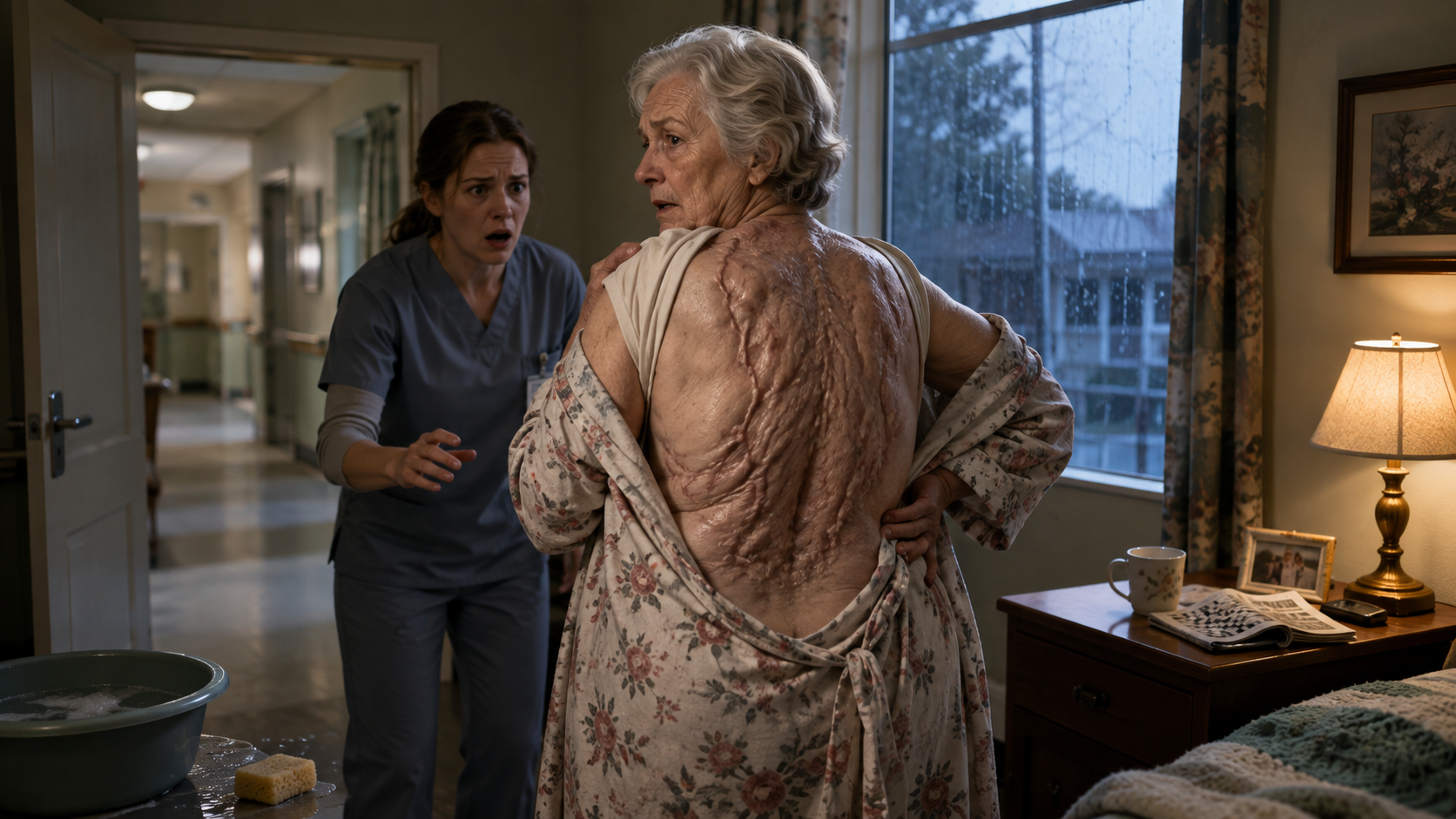
I had just started my shift when Eleanor’s call light came on.
When I entered, she was standing beside her bed in her robe.
She looked exhausted.
“Close the door,” she said.
I did.
“Lock it.”
“Eleanor—”
“Please.”
That word frightened me more than if she’d shouted.
I locked the door.
She looked toward the bathroom.
“Bring a basin of warm water. Soap. A sponge.”
I stared at her.
“Are you sure?”
“No.”
I waited.
Her fingers trembled at the belt of her robe.
Then she lifted her chin.
“But I’m asking you anyway.”
I didn’t move immediately.
“Eleanor, we don’t have to do anything you don’t want to do.”
“I know.”
“We can stop whenever you say.”
“I know.”
“Even if we only wash one inch.”
“I know, Hannah.”
Her voice broke slightly.
“Before I change my mind.”
I went.
When I returned, she was sitting on the edge of the bed.
Rain tapped the window.
The same rain that always made her quiet.
She unfastened the robe herself.
Her hands shook so badly that I almost offered to help.
I didn’t.
She pulled the fabric down from one shoulder.
Then the other.
Underneath she wore a thin cotton undershirt.
For several seconds, she stayed like that.
Breathing.
Preparing.
Finally she reached behind herself, caught the hem of the shirt, and slowly lifted it.
She turned her back to me.
The sponge slipped from my fingers.
It hit the floor with a wet thud.
I couldn’t breathe.
From just beneath her shoulder blades almost to her waist, Eleanor’s skin was covered by one massive sheet of scar tissue.
Thick ridges crossed pale, glossy areas. Some parts were puckered. Others looked stretched and smooth, almost like wax that had melted and hardened again.
My nursing classes came back to me in fragments.
Full-thickness burns.
Skin grafts.
Contracture.
Old trauma.
But none of the clinical words belonged in that room.
All I could think was that somebody had once watched this woman survive something terrible.
And for three years, people had been calling her difficult because she didn’t want strangers touching the place where it happened.
“My God,” I whispered.
Eleanor flinched.
I wished immediately that I’d said nothing.
But it was too late.
“Who did this to you?”
She didn’t answer.
Rain moved in silver lines down the window.
Then Eleanor said something so softly I almost didn’t hear it.
“Marcus’s father.”
And everything I thought I understood about her changed.
PART 2: THE STORY UNDER THE SCARS
For several seconds, I said nothing.
Eleanor’s shirt was still lifted.
Her back was exposed.
And suddenly I understood how wrong the moment could become if I treated her scars like evidence instead of part of her body.
I picked up the sponge.
Then I looked at her face in the mirror.
“Do you still want me to wash your back?”
Her eyes met mine in the glass.
“Yes.”
“Okay.”
I wrung the sponge until almost no water remained.
“Tell me before I touch you.”
“I will.”
I brought my hand close but stopped.
“Now?”
Her eyes closed.
“Now.”
I touched the sponge to the upper edge of the scar.
Eleanor sucked in a breath.
I froze.
“Stop?”
“No.”
“Are you sure?”
“Keep going.”
I moved slowly.
Not because the scar itself would necessarily hurt after forty years, but because something inside Eleanor clearly still did.
Every few seconds I told her where I was going to touch next.
“Left side.”
She nodded.
“Lower.”
Another nod.
“Near your waist.”
Her shoulders loosened by degrees.
Halfway through, she began crying.
No sound.
Just tears sliding down her cheeks.
I saw them in the mirror.
“I’m sorry,” I said.
“Don’t be.”
“We can stop.”
“If I stop now, I may never let anyone do this again.”
So I continued.
When I finished, I dried her skin by pressing the towel gently instead of rubbing.
Then I stepped back.
“It’s done.”
Eleanor lowered her shirt.
Her shoulders shook once.
She pulled the robe closed.
I thought she might tell me to leave.
Instead, she said, “Sit.”
I sat.
She remained on the edge of the bed.
For a long time, neither of us spoke.
Finally she asked, “What did Marcus tell you about his father?”
“Nothing.”
“Did he ever mention him?”
“No.”
A humorless little smile crossed her face.
“That sounds like Marcus.”
She looked toward the rain.
“His father’s name was Robert.”
I waited.
“We were married twenty-two years.”
That surprised me.
“You don’t have to tell me this.”
“I know.”
She rubbed her thumb against the edge of her robe.
“That’s what makes it possible.”
I didn’t understand at first.
Then I did.
No one was forcing her.
No one was demanding an explanation.
For once, she could choose.
Eleanor took a long breath.
“Robert wasn’t always cruel.”
She saw something in my expression and gave me a tired look.
“That’s the part people never understand. They think a cruel man walks into your life wearing a sign.”
I said nothing.
“He was funny when I met him. Patient. He could fix anything. My mother adored him. He danced with me in the kitchen.”
Her voice softened despite herself.
“After Marcus was born, things changed slowly enough that I kept finding reasons for them.”
Robert lost a job.
Robert drank more.
Robert apologized.
Robert promised.
Robert broke a plate.
Robert punched a wall.
Robert grabbed her arm.
Robert cried afterward.
Robert bought flowers.
Robert swore he’d never frighten her again.
Then he did.
Eleanor looked at me.
“Do you know what the most dangerous word can be?”
I shook my head.
“Almost.”
I frowned.
She continued.
“He almost hit me. He almost hurt Marcus. He almost drove us off the road. He almost broke my wrist.”
Her mouth tightened.
“So you tell yourself nothing truly terrible happened. Not yet.”
I thought of the scar beneath her shirt.
“But something did.”
She nodded.
“February eighteenth.”
Her eyes moved to the window.
“Forty years ago tomorrow.”
The rain suddenly made sense.
I didn’t interrupt.
“Marcus was eight.”
She smiled faintly.
“He was skinny. Always running. Always climbing something he shouldn’t.”
I had trouble imagining the man with the expensive coat as an eight-year-old boy.
“Robert had been angry for days. I’d spoken to a lawyer.”
My chest tightened.
“You were leaving him.”
“I was trying.”
She looked down.
“I’d packed one suitcase for Marcus and one for myself. They were in the trunk of my sister’s car.”
“Did Robert know?”
“He found the lawyer’s card.”
The room felt colder.
“He came home before dinner. He’d been drinking.”
Eleanor’s fingers stopped moving.
“I told Marcus to go upstairs.”
She closed her eyes.
“Robert blocked the kitchen door.”
I could almost see it.
The narrow room.
The rising voices.
A frightened child listening from somewhere he had been told not to be.
“We had one of those old kerosene heaters,” she said. “The furnace was unreliable. Robert hated paying repairmen, so he’d drag that heater around the house in winter.”
Her breathing changed.
I leaned forward but didn’t touch her.
“He kept asking where I thought I was going. He called me ungrateful. Crazy. Dramatic.”
That word again.
My stomach twisted.
“I told him I was taking Marcus and leaving.”
She swallowed.
“Robert grabbed my arm.”
Her eyes weren’t in the room anymore.
“I pulled away. He grabbed me again. We struggled.”
The heater tipped.
Eleanor’s voice became almost flat.
“I heard the glass break.”
Kerosene spread across the floor.
Robert stumbled backward.
A curtain caught.
Then the wall.
“Marcus came down the stairs.”
Eleanor’s face crumpled.
“He wasn’t supposed to.”
She pressed a hand to her mouth.
“He heard me scream.”
I waited.
“He ran toward me.”
The fire moved faster than anyone expected.
Eleanor remembered shouting for Marcus to stop.
She remembered Robert swearing.
She remembered heat.
Then she saw the burning curtain collapse.
“Marcus froze.”
Her hands clenched.
“So I ran to him.”
She got between her son and the flames.
She pushed him toward the back door.
Something burning fell across her shoulders.
Maybe the curtain.
Maybe part of the wooden frame.
She didn’t remember.
She remembered only throwing herself over Marcus.
Her back took the fire.
“I could smell my hair,” she whispered.
I felt sick.
“Robert pulled Marcus out.”
“What about you?”
“I crawled.”
Her eyes met mine.
“I don’t remember much after that.”
She spent seven weeks in a burn unit.
Four surgeries.
Skin grafts.
Months learning to move without tearing healing tissue.
For a while, doctors didn’t know whether she’d regain full use of her left arm.
I stared at her.
“Marcus knows you saved him.”
Eleanor’s silence answered me.
“He has to know.”
“No.”
“How could he not?”
“He remembers the fire.”
“But—”
“He doesn’t remember it the way I do.”
Something shifted inside me.
“What was he told?”
Eleanor looked away.
“That I knocked over the heater.”
I stared.
“Robert told the police we’d been arguing because I was hysterical.”
“Why would they believe him?”
“Because I told them the same thing.”
I sat back.
“You what?”
“I said it was an accident.”
“Eleanor.”
“I know.”
“Why?”
For the first time since she’d begun, anger flashed across her face.
“Because I was thirty-six years old, half my body wrapped in bandages, high on morphine, terrified my husband would take my son, and Robert was standing beside my hospital bed telling me that if I said one word about what really happened, Marcus would be dragged into court.”
Her voice rose.
“He said they’d make Marcus testify. He said they’d ask why I hadn’t left sooner. He said child services might take him from both of us.”
She pressed both hands into her knees.
“And I believed him.”
The anger disappeared as quickly as it came.
“What happened after you recovered?”
“I left.”
“With Marcus?”
Her hesitation told me the answer was complicated.
“Eventually.”
Robert fought her.
He had money Eleanor didn’t.
A stable job by then.
A house.
No visible injuries.
And a police report stating the fire had been an accident caused during Eleanor’s “emotional episode.”
For six months, Marcus lived mostly with his father while Eleanor recovered.
Six months was enough.
“Robert told him I had tried to leave before the fire,” Eleanor said. “He told him I didn’t want either of them anymore.”
“But you got Marcus back.”
“Shared custody.”
She gave a small, bitter laugh.
“On paper.”
Marcus grew up traveling between two stories.
His father’s story said Eleanor was unstable, dramatic, difficult.
Eleanor’s silence said nothing.
And children, she told me, often believe the story spoken most confidently.
“Why didn’t you tell him when he got older?”
That was the question I regretted immediately.
Eleanor looked at me.
Not offended.
Just tired.
“You think I haven’t asked myself that?”
I lowered my eyes.
“I’m sorry.”
“When Marcus was sixteen, he worshiped his father. At twenty, he thought I exaggerated everything. At thirty, Robert had cancer.”
She stared at the floor.
“He asked me not to destroy the last months Marcus had with him.”
“Robert asked you?”
“Yes.”
I couldn’t speak.
“And you agreed?”
“I thought Marcus would have time afterward.”
Her eyes shone.
“Then afterward came.”
Robert died.
But by then Marcus had a wife, work, a mortgage, children of his own.
There was never a good time.
Then his marriage ended.
Then Eleanor became ill for a while.
Then there were grandchildren’s graduations.
Birthdays.
Christmases.
Years.
Silence hardened.
“The longer you carry a lie for someone,” Eleanor said, “the heavier it becomes to put down.”
I thought of Marcus telling her not to throw a tantrum.
I thought of her face going blank.
“He sounds like him,” I said before I could stop myself.
Eleanor went very still.
I wished I could take it back.
But she knew exactly what I meant.
“Sometimes,” she whispered.
“Does Marcus know that?”
“No.”
“Has he ever seen your back?”
“Not since the hospital.”
“He was eight.”
“He saw enough.”
She suddenly stood.
The conversation was over.
I rose too.
“Eleanor—”
“Please don’t tell anyone.”
That stopped me.
“Your medical team should know about the scarring.”
“They already know I have old burns. Not the story.”
“Marcus—”
“Especially not Marcus.”
I looked at her.
“He treats you like you’re making this up.”
“I know.”
“He thinks you’re difficult because you won’t let people touch you.”
“I know.”
“And you’re protecting him from the truth?”
Her expression sharpened.
“Don’t confuse silence with protection, Hannah. I stopped knowing what it was years ago.”
That sentence stayed with me.
Before I left, she went to her closet.
At the bottom sat an old blue overnight case.
I’d noticed it before because it didn’t match anything else in her room. Its corners were worn white. A tiny brass lock hung from the zipper.
Eleanor touched it with the toe of her slipper.
“Tomorrow is the anniversary.”
I looked at the case.
“What is that?”
“The past.”
She gave me a tired smile.
“And before you ask, no. I’m not opening it.”
She turned away.
But as I reached the door, she said, “Hannah.”
I looked back.
“If Marcus calls tomorrow…”
She hesitated.
“Tell him I’m tired.”
“Okay.”
“And don’t tell him why.”
That night, I couldn’t stop thinking about the blue case.
Not because I wanted to know what was inside.
Because for the first time I understood that Eleanor had not spent forty years hiding only a scar.
She had been hiding a whole version of her life.
And the person most damaged by the lie had begun speaking to her in the voice of the man who started it.
PART 3: THE BOX SHE KEPT LOCKED
Marcus did call the next morning.
At 9:17.
I know because Eleanor was sitting beside the window watching the rain when her phone began to vibrate on the table.
She looked at the screen.
Didn’t touch it.
It stopped.
Thirty seconds later, it rang again.
“You want me to answer?” I asked.
“No.”
The third time, she sighed.
“Put it on speaker.”
I did.
“Mom?”
Marcus sounded irritated already.
Eleanor said, “Hello.”
“I’ve been calling.”
“I noticed.”
“The facility left me a message yesterday.”
My stomach tightened.
Dana must have called to discuss Eleanor finally accepting assistance.
Marcus continued.
“They said you let someone help bathe you.”
Eleanor glanced at me.
“Yes.”
“Well, that’s good.”
She said nothing.
“Mom?”
“I’m here.”
“See? I told you this didn’t have to be such a big production.”
I closed my eyes.
Eleanor’s face changed.
Not dramatically.
That was almost worse.
Some old door simply shut behind her eyes.
Marcus kept talking.
“If you’d just cooperated from the beginning—”
“Marcus.”
“What?”
“Do you remember the fire?”
Silence.
A long one.
“What fire?”
Eleanor stared at the rain.
“The house.”
His voice changed.
“Oh.”
“You were eight.”
“Of course I remember.”
“What do you remember?”
I held my breath.
Marcus laughed once, uncertainly.
“Where is this coming from?”
“What do you remember?”
Another pause.
“The kitchen.”
“And?”
“Smoke.”
“And?”
“I don’t know, Mom. It was forty years ago.”
Eleanor’s fingers tightened around the arm of her chair.
“Do you remember me?”
Marcus didn’t answer immediately.
Then he said, “I remember you screaming.”
Eleanor looked as if he’d struck her.
“I see.”
“Mom, what is this?”
“Nothing.”
“You brought it up.”
“I shouldn’t have.”
“Is this because of the bath thing?”
“No.”
“Then what?”
She reached toward the phone.
I thought she would end the call.
Instead she asked, “What did your father tell you happened?”
I saw fear cross her face as soon as the question left her mouth.
Marcus’s voice became guarded.
“You know what he told me.”
“I want to hear you say it.”
“He said you knocked over the heater.”
Eleanor stopped breathing for a second.
Marcus continued more slowly.
“You were upset. You two were fighting. You tried to leave. The heater fell.”
“He told you I knocked it over?”
“Mom.”
“Answer me.”
“Yes.”
“And you believe him.”
“This is ridiculous.”
“Do you?”
“Why are we doing this?”
“Marcus.”
His patience snapped.
“Because you admitted it!”
Eleanor recoiled.
I stared at the phone.
“What?” she whispered.
“You admitted it. Dad showed me.”
The room became very quiet.
“Showed you what?”
“The report.”
Eleanor’s face drained of color.
“What report?”
“The police statement. You said you were emotional. You said you hit the heater.”
“No.”
“You signed it.”
“No.”
“I saw your signature.”
Eleanor stood so abruptly the chair scraped backward.
“No.”
“Mom—”
“I said there had been an accident.”
“You said—”
“I never said I knocked it over.”
Marcus exhaled sharply.
“This is exactly what I’m talking about. You take something from forty years ago and turn it into—”
“Into what?”
Her voice was shaking.
Marcus stopped.
Eleanor whispered, “Say it.”
He didn’t.
“Something dramatic?”
Silence.
Then the call disconnected.
I don’t know whether Marcus hung up or the connection dropped.
It didn’t matter.
Eleanor stood in the middle of the room with both hands trembling.
“He changed it,” she said.
“What?”
“Robert.”
She turned toward me.
“I signed one statement at the hospital.”
“Could you have forgotten what was in it?”
“No.”
The certainty in her voice was immediate.
“He read it to me before I signed. It said the heater was knocked over during an argument. I wouldn’t let them write that I did it.”
She moved toward the closet.
“What are you doing?”
“The case.”
Her fingers fumbled with the lock.
“You said you weren’t opening it.”
“I changed my mind.”
She gave a short, bitter laugh.
“Apparently that’s one of my many talents.”
She knew the combination.
The lock clicked.
Inside the blue case were ordinary things.
A stack of old photographs.
A child’s red mitten.
A folded newspaper.
Hospital papers.
Several letters tied with a faded ribbon.
Eleanor stared at them as if they’d been waiting for her.
She pulled out the newspaper first.
The paper had yellowed until it was almost brown.
The headline was small.
MOTHER AND SON INJURED IN SOUTH SIDE HOUSE FIRE
Eleanor handed it to me.
The article said an eight-year-old boy had escaped with minor burns and smoke inhalation. His mother, thirty-six-year-old Eleanor Vance, had suffered severe burns while “apparently shielding the child from falling debris.”
I read that sentence twice.
“Eleanor.”
“I know.”
“Marcus needs to see this.”
She didn’t respond.
I looked farther down.
Robert Vance had been treated for smoke inhalation and released.
The fire marshal believed a portable kerosene heater had been knocked over.
The cause remained under investigation.
No mention of Eleanor causing it.
No mention of hysteria.
No accusation.
I looked at her.
“What else?”
She slowly opened a hospital envelope.
Inside were discharge records, surgical notes, and a photocopy of a statement.
Her hands shook too badly to hold it.
I read.
It wasn’t long.
Eleanor had reported that during an argument with her husband, “the heater was struck and overturned.”
Not by whom.
Then near the bottom was a handwritten note:
Patient declines to elaborate. States primary concern is son’s welfare.
Her signature appeared underneath.
“That’s what I signed,” she said.
I believed her.
But belief wasn’t the same as proof of what Robert had shown Marcus.
“Do you have the report Marcus saw?”
“No.”
“Could it have been a different report?”
“Maybe.”
She sank onto the bed.
“Or Robert typed one himself.”
We couldn’t know.
And I was careful not to pretend we did.
The article proved Eleanor had shielded Marcus.
Her statement proved she had never accepted blame in the way Marcus remembered.
It didn’t prove who knocked over the heater.
For that, there was only Eleanor’s word.
At least, I thought there was.
Then she reached for the letters.
“What are those?”
“Robert wrote them while I was in the hospital.”
My skin prickled.
“You kept his letters?”
“I kept everything.”
“Why?”
She stared at the ribbon.
“Because some part of me knew I might one day need to remember that I wasn’t crazy.”
She untied it.
Most of the letters were apologies.
Not romantic ones.
Ugly apologies.
The kind that somehow made the victim responsible for forgiving the person who hurt her.
Robert wrote that he’d “lost control.”
He wrote that Eleanor had “pushed too hard.”
He wrote that they should forget what happened for Marcus’s sake.
Then we reached the fourth letter.
Eleanor’s hand stopped.
“I forgot this one.”
She handed it to me.
I read slowly.
Robert complained that Eleanor’s sister had been asking questions.
He warned Eleanor against “telling everyone I shoved you.”
Then came the line that made the room seem to tilt.
If you keep saying I hit that heater when I grabbed you, they’ll turn Marcus against me, and after all he saw that night, you know what court will do to him.
I looked up.
Eleanor was staring at me.
There it was.
Not every detail.
Not every second.
But enough.
Robert himself had put it in writing.
He had grabbed her.
The heater had been struck during it.
Marcus had witnessed something.
And Robert had been afraid of what his son might say in court.
I set the letter down carefully.
“Eleanor.”
She covered her face.
For the first time since I’d known her, she sobbed.
Not quietly.
Forty years came out of her all at once.
I sat beside her.
I didn’t tell her everything would be okay.
I didn’t tell her Robert couldn’t hurt her anymore.
Grief does not become harmless just because the person who caused it is dead.
I only stayed.
Eventually she whispered, “I should have told him.”
“You were afraid.”
“I was his mother.”
“Both can be true.”
“I let Marcus believe I caused it.”
“You were trying to survive.”
“For forty years?”
I didn’t have an answer.
After a while, Eleanor wiped her face.
Then she looked at the documents spread across the bed.
“I want copies.”
“Of everything?”
“Everything.”
“What are you going to do?”
She folded the newspaper along its old crease.
“I don’t know yet.”
But she did know one thing.
She wasn’t putting the case back in the closet.
That afternoon, Marcus arrived without calling.
I saw him cross the lobby from the nurses’ station.
His coat was unbuttoned.
His expression was furious.
“Hannah.”
I stood.
“She’s in her room.”
“I want to know what happened yesterday.”
“That’s something you need to ask her.”
“I did.”
“Then listen to the answer.”
His eyes narrowed.
“You’re getting involved in something you don’t understand.”
Maybe he was right.
I didn’t understand forty years of their family.
But I understood what fear looked like.
I understood what scar tissue looked like.
And I understood the difference between attention-seeking and terror.
“Your mother asked me to help wash her back,” I said.
His expression shifted.
It was the first time I’d seen him genuinely caught off guard.
“So?”
“So I saw the burns.”
The color left his face.
For one second, Marcus looked eight years old.
Then it vanished.
“Those are from the fire.”
“I know.”
He looked toward the elevator.
“She told you.”
“Some.”
His jaw tightened.
“Then she told you her version.”
The elevator doors opened.
Marcus stepped inside.
Before they closed, I said, “She kept the newspaper.”
His head snapped up.
“What?”
“And the hospital statement.”
The doors began closing.
I added one last thing.
“And your father’s letters.”
The doors shut between us.
I didn’t know what Marcus would do upstairs.
I didn’t know whether Eleanor would show him anything.
But five minutes later, a call light flashed from her room.
Not hers.
The emergency button.
I ran.
PART 4: WHAT MARCUS REMEMBERED
When I reached Eleanor’s room, the door was open.
Marcus stood by the window.
Eleanor was beside the bed.
The blue case lay open between them.
No one was injured.
I released the breath I’d been holding.
Eleanor looked at me.
“I hit the button by mistake.”
I wasn’t convinced.
Marcus’s face was gray.
In his hand was Robert’s letter.
“You knew she had this?” he asked me.
“She opened the case today.”
“You read it?”
“She asked me to.”
His eyes moved back to the page.
Eleanor said, “Marcus, Hannah can leave.”
“No.”
His voice cracked.
He swallowed.
“No. Stay.”
Eleanor looked at me.
I remained by the door.
Marcus read the letter again.
Then he picked up the newspaper.
His finger stopped beneath the line about Eleanor shielding him.
“I don’t remember this.”
His mother said nothing.
“I don’t remember you covering me.”
“You were eight.”
“I remember Dad pulling me outside.”
“That happened.”
“So he saved me.”
“He got you through the door after I pushed you toward it.”
Marcus stared at her.
“That’s not what he said.”
“I know.”
“No.”
He shook his head.
“No, he said you were screaming. He said you knocked the heater down because you were angry.”
“I was screaming.”
Eleanor’s voice was calm now.
“The kitchen was on fire.”
Marcus flinched.
“He said you tried to grab me.”
“I did.”
“He said you were out of control.”
“I was trying to get you away from the flames.”
“Stop.”
Eleanor stopped.
Marcus pressed both hands against his head.
I watched him struggle with something far more frightening than a piece of paper.
Memory.
Not a clean memory.
Fragments.
Smoke.
Heat.
His mother’s voice.
His father’s hands.
A story repeated so many times that he no longer knew where memory ended and explanation began.
“I remember the stairs,” Marcus said.
Eleanor’s expression changed.
“What?”
“The bottom stair.”
He looked toward her.
“I was on the bottom stair.”
She went completely still.
“You told me to go back up.”
“Yes.”
“I didn’t.”
“No.”
Marcus closed his eyes.
“I remember Dad holding your arm.”
No one moved.
“He was near the heater.”
Eleanor’s lips parted.
Marcus’s breathing became ragged.
“I remember you pulling away.”
He opened his eyes.
“Then something broke.”
“The heater.”
“No. Glass.”
“The reservoir.”
He stared at her.
“I remember the smell.”
Eleanor nodded slowly.
“Kerosene.”
Marcus backed into the chair and sat.
“I remember you turning around.”
His voice was barely audible.
“There was fire behind you.”
Eleanor began to cry.
Marcus didn’t seem to notice.
“You pushed me.”
“Toward the back door.”
“You fell.”
“Yes.”
“There was something on you.”
“I don’t know what.”
“The curtain.”
Eleanor’s face crumpled.
Marcus whispered, “It was burning.”
Forty years vanished from his face.
He wasn’t a middle-aged man anymore.
He was a terrified little boy staring at something he’d spent his entire life trying not to see.
“I ran back.”
Eleanor shook her head.
“Your father grabbed you.”
“I was trying to get to you.”
“I know.”
“Why didn’t I remember?”
She moved one step toward him.
He stood abruptly.
“Why didn’t you tell me?”
The question exploded through the room.
Eleanor stopped.
“Marcus—”
“Why?”
“I tried.”
“When?”
“When you were young.”
“No, you didn’t!”
“Your father was always there.”
“He wasn’t there every second of my life!”
“I know.”
“You let me believe—”
His voice broke.
He turned away.
“You let me believe you did it.”
Eleanor went pale.
“I thought I was protecting you.”
“From what?”
“From him.”
“He’s dead!”
“Not then.”
“He’s been dead twelve years.”
“I know.”
Marcus laughed bitterly.
“That’s your answer for everything.”
Eleanor recoiled.
I nearly intervened.
Then she raised one hand.
Not to silence him.
To stop me.
She wanted this.
Or maybe she knew she had to survive it.
Marcus paced across the room.
“I spent my whole childhood thinking you were unstable.”
“I know.”
“I thought Dad kept us together.”
“I know.”
“I thought you tried to leave because you didn’t want us.”
“I wanted to leave him.”
“You never told me that.”
“I was afraid you’d think I was making excuses.”
“You should have let me decide!”
Eleanor’s chin trembled.
“Yes.”
That single word stopped him.
No defense.
No explanation.
Just yes.
Marcus stared.
Eleanor continued.
“I was wrong.”
His anger faltered.
“I was frightened when you were eight. Then I was ashamed when you were eighteen. When you were twenty-eight, I thought too much time had passed. When you were thirty-eight, your father was dying and I told myself I could wait.”
Her voice shook.
“Then I woke up one day and I was seventy years old.”
Marcus looked down.
“And every year I waited made the truth uglier.”
She pulled her robe tighter around herself.
“I don’t want you to forgive me for that.”
He looked up.
“But I will not let you call me a liar.”
Marcus said nothing.
“I will not let you call what happened a tantrum.”
Silence.
“And I will not spend whatever years I have left being ashamed of what your father did to me.”
Something changed in the room then.
Eleanor was still crying.
Her hands were still trembling.
But I had never seen her look stronger.
Marcus glanced at me.
Then back at her.
“What did he do?”
Eleanor’s face tightened.
“You remember enough.”
“I need to hear you say it.”
She hesitated.
Then she did.
“He grabbed me because I was leaving him. When I pulled away, he shoved me. His leg hit the heater. It fell. The fuel spilled. The curtain caught.”
Marcus closed his eyes.
“He didn’t push you into the fire?”
“No.”
“He didn’t set you on fire?”
“No.”
I was struck by the fact that even now, Eleanor refused to make the story worse than it was.
She didn’t need to.
The truth was enough.
“The fire was an accident,” she said. “The violence wasn’t.”
Marcus opened his eyes.
That sentence broke something in him.
He sat again.
For nearly a minute, nobody spoke.
Then he said, “Dad showed me a report.”
“I know.”
“It had your signature.”
“This is what I signed.”
She handed him the hospital copy.
He read it.
His brow furrowed.
“This isn’t the same.”
“Then I don’t know what he showed you.”
Marcus stared at the signature.
“I swear it looked like yours.”
“It may have been.”
“You think he forged it?”
“I don’t know.”
“Then what—”
“I don’t know, Marcus.”
She sounded exhausted.
“I am done filling in what I don’t know.”
That mattered.
She wasn’t replacing one mythology with another.
She was giving him only what she had.
The letter.
The hospital report.
The newspaper.
Her scar.
His own memory.
Marcus placed the paper down.
Then he looked at his mother’s back.
Not at the scar.
He couldn’t see it beneath her robe.
But his eyes fixed on the place where it was hidden.
“Can I see?”
Eleanor froze.
Every muscle in my body tightened.
Marcus seemed to realize what he’d asked.
“I’m sorry.”
He backed away slightly.
“Forget it.”
Eleanor looked at me.
I didn’t know what to tell her.
This wasn’t my decision.
After a long silence, she said, “Close the door.”
My throat tightened.
I closed it.
Marcus didn’t move.
Eleanor turned her back to him.
Her hands rose toward the collar of her robe.
They stopped.
She couldn’t do it.
Marcus’s eyes filled.
“You don’t have to.”
She lowered her hands.
For a moment, I thought that was the end of it.
Then Eleanor said, “Hannah.”
I stepped toward her.
“Help me.”
“Are you sure?”
“No.”
That was the same answer she’d given me the morning before.
Then, just as before, she added, “Do it anyway.”
I gently lowered the robe from her shoulders.
Marcus made a sound I will never forget.
Not a gasp.
Not exactly.
It sounded like grief becoming physical.
His knees nearly buckled.
He gripped the back of the chair.
Eleanor stood with her back exposed.
All those ridges.
All that skin.
All those years.
Marcus stared.
Then his hand rose.
He stopped before touching her.
“Mom.”
Eleanor turned her head slightly.
“Can I?”
Her eyes closed.
For forty years, people had taken choices from her.
Her husband.
The fire.
Doctors.
Fear.
Shame.
Even well-meaning caregivers who treated bathing as a task to complete.
Now her son stood inches away and asked.
Eleanor whispered, “Yes.”
Marcus touched one small place near her shoulder.
Barely.
His fingers trembled.
Then he began to cry.
“I’m sorry.”
Eleanor covered her mouth.
“I’m so sorry.”
She turned.
Marcus immediately pulled his hand away, perhaps afraid he’d done too much.
But Eleanor caught it.
For a second, mother and son stood facing each other with their hands joined.
“I sounded like him,” Marcus whispered.
She didn’t answer.
“I did.”
His face twisted.
“All those times I told you to stop being dramatic.”
Eleanor looked down.
“All those times I told you to cooperate.”
“Marcus—”
“I sounded like him.”
“Sometimes.”
He shut his eyes.
She squeezed his hand.
“But you are not him.”
He looked at her.
“How can you say that?”
“Because he never once asked permission before he hurt me.”
Marcus broke.
He bent forward and pressed his forehead against her hand.
Eleanor stood there crying with him.
I turned toward the window.
Some moments don’t need witnesses.
A few minutes later, I quietly left the room.
I had almost reached the nurses’ station when I heard Eleanor call my name.
I looked back.
She stood in her doorway with her robe closed.
Marcus was behind her.
Her eyes were red.
But she was smiling.
“Hannah.”
“Yeah?”
“You forgot something.”
“What?”
“My coffee.”
I laughed.
“Still terrible?”
“Almost certainly.”
Marcus wiped his face.
For the first time since I’d met him, he smiled too.
“Make mine terrible while you’re at it.”
PART 5: WHAT WE STOP CARRYING
Nothing became perfect after that.
I think people expect truth to work like a light switch.
Darkness.
Click.
Light.
Families aren’t like that.
Marcus did not suddenly become the devoted son he should have been all those years.
Eleanor did not wake the next morning free from nightmares.
Forty years of silence did not disappear because a letter was opened.
But things changed.
Marcus came back the following weekend.
Without cookies.
That was Eleanor’s first approving observation.
“He finally stopped buying those awful things.”
He brought shortbread instead.
“Better,” she admitted.
They talked for three hours.
I don’t know what they said.
They closed the door.
That became a habit.
Every Sunday afternoon, Marcus drove from Chicago.
Sometimes he stayed an hour.
Sometimes four.
Sometimes they argued loudly enough that I could hear them from the hall.
That, strangely, made me happy.
Not because conflict was good.
Because silence had done enough damage.
One Sunday Marcus emerged looking frustrated.
“She is impossible.”
From inside the room Eleanor shouted, “I heard that.”
“I know.”
He looked at me.
“How do you deal with her?”
“Coffee.”
“Terrible coffee,” Eleanor called.
Marcus sighed.
But he was smiling.
He eventually brought the police report his father had shown him.
He found it in a box of Robert’s belongings.
It wasn’t an official police report.
It was a typed summary Robert had written years later while preparing documents during a custody dispute.
At the bottom was a photocopy of Eleanor’s signature taken from another page.
Marcus had been fifteen when Robert showed it to him.
At fifteen, official-looking paper had been enough.
Marcus stared at the document for a long time.
Then he tore it in half.
Eleanor stopped him.
“No.”
He looked at her.
“Keep it.”
“Why?”
“Because that happened too.”
He frowned.
“The lie happened.”
She touched the original hospital statement.
“So did this.”
Then she touched the newspaper clipping.
“And this.”
Finally her hand moved toward her own shoulder.
“And this.”
Marcus said nothing.
“We don’t get better by pretending the ugly things never existed,” she told him.
I remembered that.
Months passed.
The most surprising change wasn’t Marcus.
It was Eleanor.
At first, she would only allow me to help wash her back.
The process took nearly half an hour because I announced every movement before touching her.
“Upper right.”
“Go.”
“Across the shoulder.”
“Fine.”
“Lower left.”
“Your water’s getting cold.”
“Because someone talks too much.”
Eventually she started making jokes.
Then one morning she let Dana help.
I was stunned.
Dana was even more stunned.
“You sure?” she asked.
Eleanor rolled her eyes.
“Do you all have to ask me that twelve times?”
Dana looked at me.
I hid a smile.
“Once is enough,” Eleanor said.
But after thinking about it, she added, “Once is necessary.”
That became an unofficial rule in Eleanor’s care plan.
Ask.
Tell her before touching.
Wait for consent.
Stop immediately if she says stop.
It was obvious, really.
It should have been obvious from the beginning.
But health care can become so focused on what has to be done that sometimes people forget to ask what happened to the person resisting it.
I went back to nursing school the following fall.
Part-time.
I kept working at Oakridge.
Eleanor claimed this was inconvenient because my class schedule disrupted her coffee service.
I told her she was free to request another aide.
“I have,” she said.
“Repeatedly.”
“And?”
“They keep sending you.”
“Terrible management.”
“Abysmal.”
She smiled.
Marcus helped with some of my tuition.
I refused the first time he offered.
Then he explained why.
“I’m not trying to rescue you.”
We were standing in Oakridge’s lobby.
“I owe this place more than money.”
“You don’t owe me.”
“I know.”
He glanced toward the elevator.
“I owe myself a chance to do something decent without turning it into a debt.”
That sounded like something he’d learned from Eleanor.
So I accepted enough to cover books for one semester.
Nothing more.
Two years after I first met Eleanor, I completed my nursing degree.
She sat in the second row at graduation.
Marcus sat beside her.
When my name was called, Eleanor stood before anyone else.
At seventy-eight, she clapped above her head like I’d won an Olympic medal.
Marcus had to pull her back into the chair.
Later she denied all of it.
“I applauded with dignity.”
“You screamed.”
“I projected.”
“You yelled, ‘That’s my girl.’”
“Prove it.”
Marcus had recorded the entire thing.
She threatened to disown him.
By then, the scars on her back were no longer a secret.
But they weren’t public either.
Eleanor never became someone who wanted to tell her story to strangers.
She didn’t give speeches.
She didn’t join survivor groups.
She didn’t want Robert’s name carved into every conversation she had for the rest of her life.
“I survived him,” she told me once. “I’m not spending what’s left of my life introducing him to everyone.”
That sounded like Eleanor.
The last conversation we ever had about the fire happened on another rainy February morning.
Three years had passed since she first let me see her back.
She was eighty then.
I was helping her change into a clean sweater.
She turned around without thinking.
Her back was exposed.
I realized something before she did.
She hadn’t flinched.
I hadn’t announced my movement.
My hand had brushed lightly against the edge of the scar while adjusting her shirt.
Eleanor noticed my expression.
“What?”
“Nothing.”
“Hannah.”
I smiled.
“I touched your back.”
She became still.
For one terrifying second, I thought I’d ruined everything.
Then she looked over her shoulder.
“So?”
“You didn’t—”
“Scream?”
“No.”
“Throw a pitcher at you?”
“No.”
“Call the police?”
“Not yet.”
We both laughed.
Then her expression softened.
She sat on the bed.
“Do you know why I finally asked you that morning?”
“The first time?”
She nodded.
I’d wondered for years.
“Why?”
“Because you never tried to convince me I was safe.”
I frowned.
She continued.
“Everyone else did.”
She imitated the cheerful voice of well-meaning caregivers.
“‘Eleanor, you’re safe. Eleanor, nobody’s going to hurt you. Eleanor, it’s only a bath.’”
Her smile disappeared.
“You never said that.”
“I didn’t know if you’d believe me.”
“Exactly.”
She looked toward the window.
“You asked permission instead.”
I sat beside her.
Rain slid down the glass.
“I thought if I let you see it,” she said, “you might look at me differently.”
“I did.”
She raised an eyebrow.
I smiled.
“I stopped thinking you were difficult.”
“Don’t go too far. I am difficult.”
“You absolutely are.”
“Good.”
She leaned back.
“For years, I thought the scar was the ugliest thing Robert left me.”
Her voice became quieter.
“It wasn’t.”
“What was?”
“The doubt.”
I didn’t answer.
“Doubt about whether I remembered correctly. Doubt about whether it was bad enough to leave. Doubt about whether Marcus would believe me. Doubt about whether I was the kind of woman Robert said I was.”
She rubbed her hands together.
“The scar was simple compared to that.”
I thought about all the times I had watched her lock the bathroom door.
All the screams.
All the hands she’d slapped away.
“Do you still hate anyone touching it?”
“Sometimes.”
“Then why didn’t you react today?”
She thought about that.
Finally she said, “Because today I knew whose hand it was.”
That might have been the most important thing Eleanor ever taught me.
Trauma isn’t always fear of what is happening.
Sometimes it’s fear that what happened before is happening again.
And healing isn’t forgetting the difference.
It’s finally being able to feel it.
Marcus arrived that afternoon carrying coffee.
Not cookies.
Coffee.
He handed one cup to his mother.
She took a sip.
Her face twisted.
“This is terrible.”
Marcus looked offended.
“It’s from the place you like.”
“They’ve declined.”
“You said the exact same thing last week.”
“Because it was true last week.”
I laughed.
Marcus handed me a cup.
“Don’t encourage her.”
“Too late.”
He sat beside his mother.
They began arguing about whether he should replace her old phone.
I stood by the window and listened.
Two people who had spent decades living inside different versions of the same night were now arguing about battery life.
It was ordinary.
Beautifully ordinary.
Before I left the room, Eleanor called after me.
“Hannah.”
I turned.
She had already opened the crossword Marcus brought.
“Seven letters. ‘Freedom from restraint.’”
I thought about it.
“Liberty?”
“Seven.”
“Release?”
She looked at the grid.
Then at me.
“Release.”
She wrote the word slowly.
R-E-L-E-A-S-E.
Marcus watched her.
Neither of them said anything.
They didn’t have to.
For almost forty years, Eleanor had believed that keeping the truth buried was the price of protecting her son.
Marcus had believed that his mother’s fear was proof of her weakness.
I had believed, when I first met her, that my job was to get her through a bath.
All of us had been wrong.
The secret beneath Eleanor’s scars wasn’t simply that her husband had caused the fire.
It wasn’t even that she had taken the flames across her own back while protecting her eight-year-old son.
The secret was what happened afterward.
A frightened woman had been persuaded to silence herself.
A frightened boy had been given someone else’s version of his memories.
And year after year, without realizing it, he had repeated the language of the man who hurt her.
Until one rainy morning, Eleanor decided she would rather risk losing her son’s love than keep accepting his father’s lie.
The scar didn’t change that day.
It remained thick and uneven.
It still pulled when the weather turned cold.
There were still places Eleanor didn’t like anyone touching.
But the meaning of it changed.
Marcus no longer saw evidence that his mother had lost control.
He saw the place where she had covered him with her body.
Eleanor no longer saw only the night Robert hurt her.
She saw the night she got her son out alive.
And I stopped seeing a patient who refused to cooperate.
I saw a woman who had spent forty years saying the same thing in the only way her body still knew how.
Don’t touch me there.
Listen to me.
Believe me.
Ask first.
For once, someone finally did.
And when the truth came out, it didn’t erase what had happened.
It did something harder.
It gave the story back to the woman who had lived it.
Để lại một bình luận