
PART 1: The Seven Words He Left Me
My grandfather died with my hand wrapped around his and the rest of our family nowhere in sight.
His last breath carried seven words that would soon tear them apart.
“Look behind the family portrait after I’m gone.”
For six months, I had watched Arthur Bennett disappear by inches.
Cancer took his appetite first, then his strength, then the booming voice that had once filled every room he entered. By the end, he could barely sit upright without help. I fed him soup when his hands shook, changed his sheets when the medication made him sick, drove him to appointments, and slept in the faded green chair beside his bed whenever the pain was too severe for him to be alone.
My father visited once.
Eleven minutes.
I knew because I watched the clock.
Dad stood beside Grandfather’s bed in an expensive wool coat, glanced around the room as though illness might be contagious, and spent most of those eleven minutes asking whether Grandfather had “gotten his paperwork in order.”
Grandfather stared at him.
“What paperwork?”
“You know. Estate stuff.”
Dad tried to smile.
“Just so there aren’t problems later.”
I wanted to throw him out.
Grandfather only said, “There are always problems later when people deserve them.”
Dad laughed because he thought it was a joke.
It wasn’t.
My mother never came.
She sent flowers once with the price sticker still stuck to the bottom of the vase.
My younger sister, Chloe, didn’t even pretend.
“He doesn’t recognize anyone anymore,” she told me when I asked her to visit. “Why would I drive an hour just to sit there while he sleeps?”
“He recognizes me.”
“Of course you think that.”
“He asks about you.”
That silenced her for half a second.
Then she said, “Tell him I’m busy.”
Grandfather heard the conversation because the phone was on speaker.
Afterward, I sat beside him, ashamed on Chloe’s behalf.
He looked toward the window.
“You don’t have to apologize for other people’s choices, Jenny.”
He was the only person still allowed to call me Jenny.
Everyone else called me Genevieve.
I squeezed his hand.
“They should be here.”
“Yes.”
The simple way he said it hurt more than anger would have.
He knew.
He knew exactly who came.
He knew who called.
He knew who didn’t.
And despite what Chloe told herself, he remembered everything.
Two weeks before his death, he asked me an unusual question.
“What exactly do you do when you find stolen money?”
I looked up from the paperwork I was sorting beside his bed.
“What?”
“At work.”
I smiled.
“You’ve asked me that before.”
“Tell me again.”
I worked as a forensic accountant for a federal contractor. Most people heard the word accountant and imagined tax returns and spreadsheets. My work was different.
I followed money people didn’t want followed.
Hidden transfers.
Shell companies.
Altered expense reports.
Forged authorizations.
Payments disguised as gifts.
Money moved through three accounts so nobody would ask where it started.
I explained some of that to Grandfather.
He listened with his eyes closed.
“And if someone signs another person’s name?”
“That depends on the document.”
“What if someone uses a power of attorney after it’s revoked?”
I stopped.
“That could be fraud.”
He opened his eyes.
“What if the person says it was a gift?”
“Then you look for evidence that the gift was actually authorized.”
“What kind?”
“Bank records. Emails. signatures. Timing. Witnesses. Medical records if capacity is an issue. Anything showing intent.”
Grandfather nodded.
At the time, I thought he was worried someone might take advantage of him after he became weaker.
“Is something happening?” I asked.
“No.”
“Grandpa.”
His mouth twitched.
“You always did know when people were lying.”
“That wasn’t an answer.”
“No.”
I leaned toward him.
“If you’re worried about Dad handling something, tell me.”
He reached over and patted my hand.
“Not yet.”
I should have pushed harder.
For weeks after his death, that thought haunted me.
But on his final night, I understood why he had kept quiet.
The room was dark except for the lamp beside the bed.
His breathing had become shallow.
I called my parents.
No answer.
I called Chloe.
She declined the call, then texted:
At dinner. Is it urgent?
I typed:
He’s dying.
Three dots appeared.
Then vanished.
She never replied.
At 2:17 in the morning, Grandfather opened his eyes.
“Jenny.”
“I’m here.”
He squeezed my fingers with surprising strength.
“Listen.”
I leaned close.
“After I’m gone, look behind the family portrait in the living room.”
I stared at him.
“What?”
“The portrait.”
“Grandpa, what are you talking about?”
“Don’t tell them.”
My heartbeat changed.
“Tell who?”
But his eyes had already closed.
“Grandpa?”
He breathed once.
Then again.
Then he didn’t.
I sat beside him until morning, still holding his hand.
At the funeral, my family arrived dressed for a magazine advertisement about grief.
My father wore a tailored black suit.
My mother wore pearls.
Chloe wore enormous sunglasses despite the cloudy weather and cried whenever someone hugged her.
She had not visited Grandfather once in six months.
Yet at the cemetery, she clutched my mother’s arm and sobbed loudly enough that several people turned to look.
I stood three feet away thinking about the unanswered text message on my phone.
He’s dying.
No reply.
After the burial, we gathered at Grandfather’s house.
His attorney, Raymond Vance, sat at the dining-room table with a leather folder in front of him.
I knew Raymond only vaguely. He had handled Grandfather’s legal affairs for years and had always struck me as painfully precise.
Dad sat forward before Raymond had even opened the folder.
Mother folded her hands.
Chloe kept checking her phone under the table.
Raymond began reading.
The house went to my father.
Dad didn’t react much, but I saw his shoulders relax.
The investment accounts named in the will went to my mother.
She pressed her lips together, performing appropriate sadness.
Grandfather’s jewelry collection went to Chloe.
Her eyebrows lifted.
Then Raymond reached my name.
“And to my granddaughter Genevieve Bennett, I leave my cedar music box and all contents contained therein.”
Silence.
Chloe blinked.
Then she laughed.
Actually laughed.
“You’re kidding.”
Raymond looked over his glasses.
“I am reading the document.”
Chloe turned toward me with a smile she couldn’t hide.
“You wiped his mouth for six months and got a toy?”
“Chloe,” Mother murmured.
But she was smiling too.
Mother touched my wrist with false tenderness.
“Genevieve, don’t take it personally. Your grandfather knew who was capable of managing substantial assets.”
I looked at her hand until she removed it.
Dad leaned back.
“The music box is upstairs, I think.”
Raymond closed the folder.
“There are still probate procedures to complete. Nothing should be sold, removed, or distributed until—”
Dad waved a hand.
“Obviously.”
Then he looked at me.
“You should get your things out tonight, though.”
“My things?”
“Whatever you’ve left here. Clothes, toiletries. We want to get the house photographed as soon as possible.”
“Grandpa died three days ago.”
“And?”
I stared at him.
Dad shrugged.
“Leaving a house empty costs money. There’s no reason to be sentimental.”
No reason to be sentimental.
I thought about the bed upstairs.
The medicine organizer on the kitchen counter.
The dent in the green chair where I’d slept.
Eleven minutes.
That was how much time my father had found for the dying man whose house he was already preparing to sell.
I stood.
“I’m going home.”
Chloe smiled.
“Don’t forget your music box.”
They mistook my silence for humiliation.
That was their first mistake.
That evening, my parents and Chloe went to dinner.
I knew because Chloe posted a picture online.
Three glasses of wine.
A steakhouse.
Her caption read:
Grandpa would want us to celebrate his life.
I stared at it for five seconds, then grabbed my coat.
The house was dark when I returned.
I used the key Grandfather had given me months earlier.
The living room smelled faintly of his pipe tobacco even though he hadn’t smoked in years.
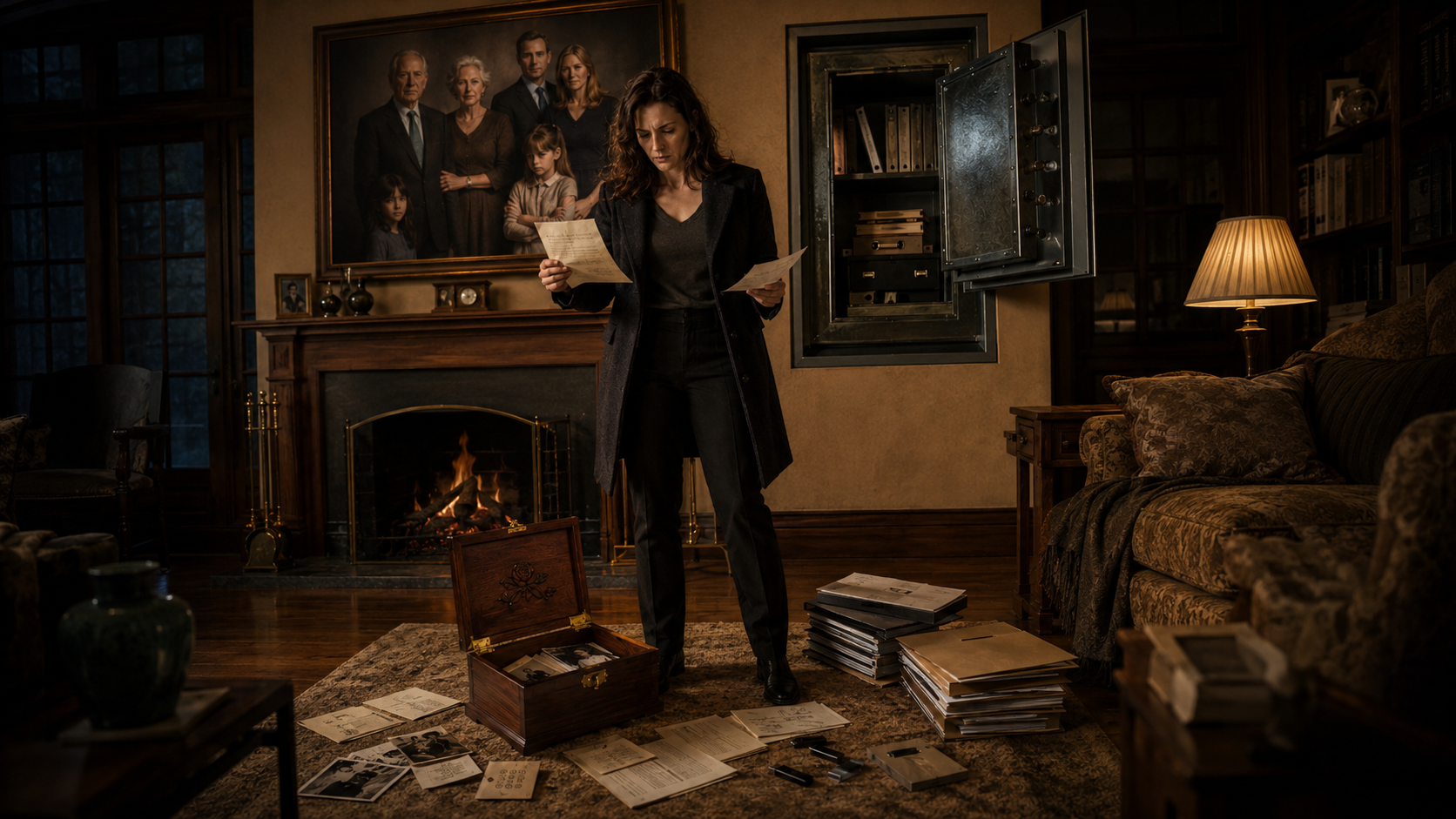
The family portrait hung above the fireplace.
I knew exactly which one he’d meant.
It had been taken when I was twelve.
My grandparents stood in the middle.
Dad and Mother stood beside them.
Chloe, nine years old and already irritated that the photographer wasn’t paying enough attention to her, stood in front.
I was at the edge of the frame.
I lifted the portrait carefully.
Behind it was a steel safe recessed into the wall.
My breath stopped.
Grandfather had never mentioned a safe.
There was a keypad.
For several minutes, I had no idea what to do.
Then I remembered the cedar music box.
I went upstairs.
It sat on the top shelf of Grandfather’s closet.
Dark cedar.
Brass hinges.
A small carved rose on the lid.
It had belonged to my grandmother.
Inside were old photographs, two folded notes, and a card with six handwritten numbers.
I returned downstairs.
The numbers opened the safe.
Inside were property deeds.
Bank statements.
Copies of canceled checks.
A thick file labeled DANIEL—my father’s name.
Another labeled ELAINE—my mother.
A third labeled CHLOE.
There were three flash drives.
And one sealed envelope.
GENEVIEVE
Grandfather’s handwriting shook across the front.
I sat on the living-room floor before opening it.
The first line made every hair on my arms rise.
Genevieve, everything they believe they inherited was stolen.
I kept reading.
Not from you. From me.
My eyes moved faster.
Your father began first. Your mother helped him. Chloe learned from both of them. They believe I became too sick to understand. They are wrong. I have spent the last year documenting what they did.
My hands began to tremble.
The next line was underlined twice.
Do not confront them until you understand the records.
I looked toward the safe.
Bank records.
Deeds.
Canceled checks.
Flash drives.
Exactly the kind of evidence I traced for a living.
Then I reached the final paragraph.
I could have confronted them myself. Instead, I chose to let them believe greed had worked. Greedy people become careless when they think they have already won.
I read that sentence three times.
Then I looked at the three labeled files.
For the first time, I understood why Grandfather had spent his final weeks asking me questions about forged signatures, hidden transfers, and financial crimes.
He hadn’t been asking how to protect himself.
He had been teaching me where to look.
And when I opened my father’s file, the first document inside was a property deed bearing Grandfather’s signature.
There was only one problem.
The date beside that signature was from a day I had personally been sitting beside Grandfather in a hospital room while his right hand was strapped to an IV board.
PART 2: Follow the Money
I didn’t sleep that night.
But I didn’t confront anyone either.
Grandfather had known me well enough to underline that instruction.
Do not confront them until you understand the records.
So I did what I had been trained to do.
I stopped being the grieving granddaughter for a few hours and became an accountant.
First, I photographed everything exactly as I found it.
The safe.
The folders.
The order of the documents.
The flash drives.
The envelope.
I created a written inventory with timestamps.
Then I called Raymond Vance at seven the next morning.
He answered sounding irritated.
“Genevieve?”
“I found something in Grandfather’s house.”
“What?”
“I’d rather not describe it over the phone.”
There was a pause.
“Is it estate property?”
“Possibly evidence.”
That changed his voice.
“Evidence of what?”
“Financial exploitation.”
Silence.
Then Raymond said, “Don’t remove anything else.”
“I haven’t.”
“I’m coming.”
He arrived forty minutes later.
I watched him read Grandfather’s letter.
Raymond’s expression barely changed, but the muscles around his jaw tightened.
“Did you know?”
“No.”
“You prepared his will.”
“Yes.”
“And you didn’t know he believed his children were stealing from him?”
“He never said that.”
I studied him.
Raymond noticed.
“You’re wondering whether I’m involved.”
“I trace financial misconduct for a living.”
“So you’re suspicious by profession.”
“By experience.”
To my surprise, he nodded.
“Good.”
He examined the deed I’d found.
“This isn’t something I prepared.”
“Dad’s name is the grantee.”
“Yes.”
The deed appeared to transfer one of Grandfather’s rental properties to my father for ten dollars and “other valuable consideration.”
According to the date, Grandfather had signed it eight months earlier.
I remembered that week perfectly.
He’d been hospitalized with pneumonia.
I had spent four consecutive days with him.
His dominant hand had an IV line taped across it, and he had been too weak to sign his own discharge paperwork.
Yet this deed carried a clean, confident signature.
Raymond looked at me.
“Do you have proof of the hospitalization?”
“Medical records will.”
“Good.”
I pointed to the safe.
“There are more.”
There were.
A second deed transferred another small property.
A home-equity line had been opened against Grandfather’s primary residence.
Several large withdrawals followed.
The pattern began approximately eighteen months before his death, soon after Grandfather had given Dad a limited power of attorney to handle bills while Grandfather recovered from surgery.
At first, the payments looked legitimate.
Utilities.
Insurance.
Property taxes.
Then they changed.
Thirty-five thousand dollars transferred into an account controlled by Dad.
Forty-two thousand.
Eighty thousand.
Payments to a company called DKB Property Solutions.
I recognized the initials immediately.
Daniel Keith Bennett.
My father.
The company address was a post-office box.
No obvious operations.
No employees.
No reason for my grandfather to be sending it money.
Then I found a copy of a power-of-attorney revocation.
Signed.
Notarized.
Dated eleven months before Grandfather died.
I looked at Raymond.
“If this is valid, Dad’s authority ended here.”
Raymond read it carefully.
“It appears valid.”
“But the transfers continued.”
“Yes.”
“Using the old power of attorney.”
Raymond’s face darkened.
“Yes.”
That was the first piece.
My father’s.
Mother’s file was more complicated.
Elaine Bennett had never held power of attorney.
She hadn’t needed it.
Dad moved money from Grandfather’s accounts into DKB Property Solutions.
Then DKB transferred portions of that money to a joint investment account held by my parents.
The descriptions were almost laughably casual.
FAMILY GIFT
REIMBURSEMENT
LOAN REPAYMENT
I found no loan documents.
No gift letters.
Nothing signed by Grandfather.
But there was something better.
Grandfather had printed monthly bank statements and circled every questionable transaction in red.
Beside one $75,000 transfer, he had written:
I never authorized this. D confronted me when I asked. E said it was “family money.”
E.
Elaine.
My mother.
I stared at the handwriting.
It was strange hearing his voice through notes on bank statements.
Then I opened Chloe’s file.
At first, the amounts were smaller.
Four thousand dollars.
Six thousand.
Nine thousand.
Payments described as:
CARE SUPPORT
PERSONAL ASSISTANCE
MEDICAL TRANSPORT
I felt sick.
Chloe had never visited him.
Not once.
Yet according to the records, Grandfather had paid her nearly ninety thousand dollars over fourteen months for caregiving and transportation.
I knew who had driven him to those appointments.
Me.
There were copies of checks.
Several carried his supposed signature.
One was dated the afternoon I had driven him to oncology.
I remembered Chloe calling me that same day.
She had been at a resort three states away.
I knew because she spent twenty minutes complaining that the hotel’s pool was smaller than the pictures online.
I sat back.
“She billed him for caring for him while she was on vacation.”
Raymond didn’t answer.
He didn’t need to.
The bank records answered for him.
I opened one of the flash drives.
Folders filled the screen.
BANK
DEEDS
POWER OF ATTORNEY
EMAILS
NOTES
Grandfather had been thorough.
Very thorough.
I felt a strange surge of pride beneath the horror.
He had known enough to preserve originals and copies.
He had saved emails Dad apparently didn’t know he’d printed.
One message from Mother to Dad read:
Once the house is yours, we’ll refinance properly and clean up the remaining balances.
Another from Chloe:
Are you sure Grandpa doesn’t check the old account? I don’t want Jenny seeing anything. She notices everything.
My name stopped me.
Jenny.
They had been worried about me.
Not because I was family.
Because I was a risk.
I read further.
Dad answered:
She thinks she’s helping with pills and groceries. Keep it that way.
My hands went cold.
Six months.
I had been bathing Grandfather, feeding him, changing bedding, organizing medications, and driving him to doctors while my own family joked behind my back that I was too busy doing the physical work to notice them stealing.
Raymond closed the laptop.
“Enough for now.”
“No.”
“Genevieve.”
“I need to know how far it goes.”
“You need to preserve the evidence properly.”
That stopped me.
He was right.
I couldn’t treat this like a private family argument.
If these records proved what they appeared to prove, chain of custody mattered.
Original documents mattered.
Bank verification mattered.
Recorded deeds mattered.
And if I mishandled them, Dad would use that against me.
We spent the next two hours documenting the safe.
Raymond arranged for the original financial records to be secured through his office pending review.
I kept Grandfather’s personal letter because it was addressed to me.
Before leaving, Raymond paused beside the cedar music box.
“What exactly did the will leave you?”
“The box and its contents.”
He nodded.
“Then everything physically inside it belongs to you.”
I opened it again.
Beneath the photographs was another folded sheet I had overlooked.
It contained three account numbers and one sentence:
Start with the house. The public record tells the truth.
That afternoon, I searched the county property records.
My father had been right about one thing.
There was a deed involving the house.
He simply didn’t know which one.
Fourteen months before Grandfather died, a transfer-on-death deed had been recorded.
I read the beneficiary name twice.
Then a third time.
Genevieve Bennett.
My heart pounded.
The document meant the house was set to pass outside the will at Grandfather’s death, assuming the deed was valid.
Dad had just spent three days telling everyone he inherited it.
He had ordered me to remove my belongings.
He was already planning to list it.
But Grandfather’s note had been right.
The public record told the truth.
The house had never become Dad’s.
And if the other records were genuine, losing the house was about to become the smallest of his problems.
My phone rang that evening.
Dad.
I let it go to voicemail.
He called again.
Then Chloe.
Then Mother.
Finally, a message appeared in the family group chat.
DAD: Need everyone at Grandpa’s tomorrow at 10. Realtor coming.
I stared at it.
Then typed:
That’s premature.
Dad responded immediately.
The house is mine, Genevieve. Raymond read the will.
I looked at the recorded transfer-on-death deed on my screen.
For a moment, I considered telling him.
Instead, I remembered Grandfather’s warning.
Greedy people become careless when they think they have already won.
So I typed only:
Then I’m sure you have nothing to worry about.
Three dots appeared.
Disappeared.
Appeared again.
Finally Dad wrote:
What is that supposed to mean?
I didn’t answer.
Because by then, I had opened the second flash drive.
And on it was a video file recorded eleven months earlier.
The thumbnail showed Grandfather sitting in the same chair where my father had once asked whether he’d updated his will.
The filename was:
IF THEY DENY EVERYTHING.
PART 3: The Family They Thought I Couldn’t Fight
I didn’t play the video alone.
That decision may have saved everything.
The next morning, I brought the flash drive to Raymond’s office.
He invited another attorney from his firm into the room as a witness while the device was copied and preserved.
Then we played it.
Grandfather appeared on-screen wearing a blue cardigan.
He looked healthier than he had during his final months, but thinner than I remembered from before the illness.
He stared directly at the camera.
“My name is Arthur James Bennett. I am making this recording voluntarily and while I am of sound mind.”
My chest tightened.
He stated the date.
Then he began listing transactions.
Not vaguely.
Specifically.
Dates.
Amounts.
Accounts.
He said he had given my father limited financial authority after surgery and had revoked it after discovering unauthorized transfers.
He said Dad had continued using copies of the revoked power of attorney.
He said Mother knew where portions of the money came from.
Then he spoke about Chloe.
“I never employed my granddaughter Chloe Bennett as my caregiver.”
I looked down.
“She did not transport me to medical appointments. She did not provide home care. Payments marked as such were not authorized by me.”
Raymond paused the video.
“This is significant.”
I barely heard him.
Grandfather’s voice had filled the room again.
For six months, I had wanted one more conversation with him.
Now I had one, but he was talking about betrayal.
Raymond continued the video.
Grandfather described confronting Dad.
According to him, Dad insisted he was merely “managing family assets.”
Grandfather demanded repayment.
Dad refused.
Mother accused Grandfather of humiliating them and said everything would eventually belong to the family anyway.
That explained her phrase in the bank-statement note.
Family money.
Then Grandfather said something I hadn’t expected.
“I chose not to file a public accusation while I was undergoing treatment because I did not trust them to preserve records if they knew I was documenting what happened. I have therefore retained copies of every record available to me.”
Raymond and I exchanged a look.
Grandfather hadn’t been passive.
He’d been building a case.
“I also chose not to change my existing will in a way that would alert them.”
I leaned forward.
There it was.
“The will they know about gives Daniel my residence, Elaine certain investment accounts, and Chloe my personal jewelry. They expect those gifts. Their expectation is useful.”
His expression became almost amused.
“I have made separate lawful arrangements regarding property that does not pass under that will. More importantly, no beneficiary is entitled to keep property obtained through fraud merely because he later receives a testamentary gift.”
Raymond paused the recording again.
“He knew exactly what he was doing.”
“So why not just disinherit them?”
“Because they would have known.”
I remembered the letter.
Greedy people become careless.
Raymond continued.
Grandfather’s final words on the video were for me.
“Genevieve, if you’re watching this, I’m sorry.”
My vision blurred.
“You deserved a family who valued what you gave without calculating what they might receive. I couldn’t give you that. But I could leave you the truth.”
I covered my mouth.
“I don’t expect you to avenge me. I expect you to do what you have always done.”
He smiled faintly.
“Follow the numbers.”
The video ended.
Nobody spoke.
Dad arrived at Grandfather’s house with a realtor at ten.
I was already there.
So was Raymond.
Dad stopped when he saw both of us.
“What is this?”
Mother came in behind him.
Chloe was last.
She looked at Raymond.
“Why is the lawyer here?”
The realtor smiled uncertainly.
“Should I wait outside?”
“Yes,” Raymond and I said together.
Dad’s eyes narrowed.
“No. This is ridiculous. We’re photographing the house.”
Raymond opened his briefcase.
“No listing can proceed.”
Dad laughed.
“Excuse me?”
“There is a recorded transfer-on-death deed affecting the property.”
Silence.
Mother looked at Dad.
Chloe looked at me.
Dad’s face changed.
“What transfer-on-death deed?”
Raymond placed a certified copy on the table.
Dad snatched it up.
I watched his eyes reach the beneficiary name.
He looked at me.
“No.”
I said nothing.
“This is fake.”
“It is recorded with the county,” Raymond replied.
“Then she manipulated him.”
There it was.
Instantly.
Not grief.
Not confusion.
Attack.
Dad pointed at me.
“She lived here for months. She had access to everything.”
Chloe stepped closer.
“Oh my God.”
Mother pressed a hand to her chest.
“Genevieve, what did you do?”
I almost admired the speed.
Seconds earlier they had believed the house belonged to Dad.
Now that it didn’t, I had somehow stolen it.
“I didn’t prepare the deed.”
“You expect us to believe that?” Chloe snapped.
“I didn’t know it existed until yesterday.”
Dad laughed harshly.
“You’re a forensic accountant. You think that makes this look better? You knew exactly how to hide things.”
Raymond interrupted.
“The deed was recorded fourteen months ago.”
Dad turned on him.
“She was already taking care of him.”
“Occasionally,” I said. “His cancer treatment hadn’t even started yet.”
Mother shook her head.
“He trusted you too much.”
I felt something harden inside me.
“Interesting choice of words.”
“What does that mean?”
I looked at Dad.
“Do you still have the power of attorney Grandfather gave you after his surgery?”
The room changed.
Only slightly.
But I saw it.
Dad’s expression froze.
Mother looked toward him.
Chloe stopped talking.
“Why?” Dad asked.
“Just wondering.”
“That’s none of your business.”
“It became my business when Grandpa started asking me about fraud.”
Mother’s face went white.
Dad stepped toward me.
“What did he tell you?”
Grandfather had been right.
Greedy people became careless when they thought they had won.
And frightened when they realized they hadn’t.
I didn’t answer.
Dad’s voice rose.
“What did he tell you, Genevieve?”
Raymond stepped between us.
“That is enough.”
Dad ignored him.
“Did you take documents out of this house?”
“Any estate documents discovered here are secured.”
“Where?”
“My office,” Raymond said.
Dad stared at him.
Then at me.
“What documents?”
I saw Chloe glance at Mother.
That was the moment I knew all three understood exactly what the question meant.
Innocent people ask what happened.
Guilty people ask what you found.
I picked up my bag.
“Raymond will contact you.”
Dad moved in front of the doorway.
“You are not walking out until you explain what you’ve done.”
My pulse jumped.
For half a second, I was twelve again, standing at the edge of the family portrait while Dad decided what everyone else was allowed to say.
Then I remembered Grandfather’s video.
Follow the numbers.
I looked him in the eye.
“Move.”
He didn’t.
Raymond took out his phone.
“Daniel, if you prevent her from leaving, I will call the police.”
Dad stared at him.
Then stepped aside.
As I passed Mother, she whispered, “You have no idea what you’re doing to this family.”
I stopped.
I looked at the woman who hadn’t visited her dying father once.
“No,” I said quietly. “I’m finding out what you did to it.”
Over the next week, the numbers got worse.
Raymond, acting in his estate role, initiated a formal review and notified the relevant financial institutions that unauthorized transactions were being disputed.
The distributions under the will were frozen.
Dad called me nineteen times.
Mother sent long messages about loyalty.
Chloe sent one message:
You better be very sure before you ruin people’s lives.
I replied:
I am.
Then I blocked her.
I built a timeline.
That was my strength.
Not shouting.
Not threats.
A timeline.
Grandfather granted Dad a limited power of attorney.
Dad began handling ordinary bills.
Then came the first unexplained transfer.
Then the first payment to DKB Property Solutions.
Grandfather discovered it.
He revoked Dad’s authority.
After the revocation, Dad continued using the old document.
Mother’s investment account began receiving money.
Chloe’s fake caregiver payments accelerated.
Two rental-property deeds appeared with suspicious signatures.
A home-equity line was opened.
And every time money moved, one of them benefited.
I compared signatures from the disputed documents against verified signatures.
Some differences were obvious.
Others were subtle.
But I wasn’t a handwriting expert, so I didn’t pretend to be one.
Instead, we sought independent verification.
Medical records established where Grandfather had been on signing dates.
Bank logs showed which branch received documents.
Electronic metadata showed when files had been created.
Public records showed when deeds were submitted.
The evidence began doing what good evidence always does.
It stopped requiring emotion.
It simply sat there.
Impossible to explain away.
Then Raymond called me on a Thursday afternoon.
“We found the notary record for one of the deeds.”
“And?”
“There isn’t one.”
I sat up.
“What do you mean?”
“The notary whose stamp appears on the document has no entry for Arthur Bennett on that date.”
My heartbeat quickened.
“Could the log be incomplete?”
“Possible. But there’s more.”
He paused.
“The notary says she was out of state that week.”
I closed my eyes.
One more contradiction.
One more thread.
Then Raymond added, “Daniel has retained counsel.”
“Of course he has.”
“And his attorney is claiming you exerted undue influence over Arthur.”
I laughed once.
There it was.
Their strategy.
If they couldn’t explain the records, they would destroy my credibility.
“They’re saying the deed to me proves it?”
“Yes.”
“Anything else?”
Raymond hesitated.
“They’re suggesting you isolated your grandfather while he was ill.”
I couldn’t speak for several seconds.
I had been the only person who came.
Now they were going to use their own absence as evidence against me.
The cruelty of it was almost elegant.
They hadn’t visited.
They hadn’t helped.
They hadn’t held his hand.
And now they intended to argue that I had been alone with him because I had pushed everyone else away.
My family had stolen his money.
But if they could make me look greedy enough, perhaps nobody would care.
That evening, I returned to the music box.
I needed to hear Grandmother’s old melody.
Instead, when I lifted the velvet lining, I discovered one final folded paper trapped beneath it.
I unfolded it carefully.
It wasn’t another account number.
It was a list of names.
Doctors.
Neighbors.
A home-health nurse.
Raymond Vance.
And beside the list, Grandfather had written:
They saw who came. They also saw who didn’t.
For the first time since Dad accused me of isolating him, I smiled.
He had prepared for that lie too.
PART 4: What They Said When the Money Stopped
My parents began telling their version of the story before the legal process had even caught up with the evidence.
According to them, I had manipulated a sick old man.
I had poisoned Grandfather against his children.
I had used my financial knowledge to “confuse” him about ordinary family transactions.
I had somehow arranged for him to secretly transfer the house to me.
Chloe told relatives I had always resented her.
Mother told an aunt that caring for Grandfather had “changed” me.
Dad’s attorney suggested that months of caregiving had given me access and influence nobody else had.
There was only one problem with their story.
Other people had been watching.
Grandfather’s oncologist remembered me at nearly every appointment.
His home-health nurse documented who was present during visits.
His neighbor, Mr. Fletcher, had seen me carrying groceries in every week.
Raymond’s appointment calendar showed Grandfather had met him privately more than once without me present.
And the county record proved the transfer-on-death deed had been recorded long before Grandfather became dependent on me for daily care.
Their accusation didn’t collapse immediately.
But it began cracking.
Chloe called Aunt Ruth and apparently tried to convince her I had stolen the house.
Ruth called me afterward.
“She asked whether you’d always been jealous of her.”
I almost laughed.
“What did you say?”
“I asked whether jealousy makes someone drive to chemotherapy appointments.”
I smiled.
“Then what?”
“She hung up.”
The smile disappeared quickly.
Because beneath the satisfaction, I was exhausted.
I had buried the man who raised me, then spent weeks proving I had not exploited him simply because I had been the one who loved him enough to stay.
Sometimes justice feels powerful from the outside.
From inside it, justice is paperwork.
It is sleepless nights.
It is rereading ugly emails.
It is watching people you once loved invent a version of you that makes their behavior easier to survive.
One evening, I sat alone in Grandfather’s living room beneath the empty space where the family portrait had hung.
The portrait itself leaned against the wall.
I looked at twelve-year-old me standing at the edge.
Grandfather had once told me that family photographs lied.
“They make everybody stand close together,” he said, “even when they aren’t.”
I hadn’t understood him then.
I did now.
The formal estate meeting happened three weeks later.
Dad arrived with his attorney.
Mother came with him.
Chloe wore a cream-colored coat and looked furious before anyone spoke.
Raymond sat at the head of the conference table.
I sat across from my family.
There were additional legal representatives present because the disputed transactions had moved beyond a simple probate question.
Raymond began calmly.
“Distributions from Arthur Bennett’s estate remain suspended pending resolution of claims involving unauthorized transfers and possible financial exploitation.”
Dad’s attorney objected to the language.
Raymond continued.
He listed the disputed transactions.
Money transferred through DKB Property Solutions.
Funds deposited into my parents’ account.
Payments to Chloe.
The two questionable property deeds.
Use of a revoked power of attorney.
The home-equity borrowing.
Mother interrupted.
“Arthur gave us money all the time.”
Raymond looked at her.
“Do you have documentation establishing these particular transfers were gifts?”
“He was our father.”
“That wasn’t my question.”
Dad leaned forward.
“My father wanted us taken care of.”
“Then why use a revoked power of attorney?”
Dad’s attorney touched his arm.
“Daniel.”
But Dad had never been good at being questioned.
“He revoked it because Genevieve got into his head.”
I looked at him.
“When?”
“What?”
“When did I get into his head?”
He glared.
“After you started spending all your time there.”
“The revocation was signed before I became his primary caregiver.”
Silence.
I slid a copy of the timeline across the table.
Dad didn’t touch it.
His attorney did.
Chloe suddenly said, “What about her house?”
I looked at her.
“What?”
“You all keep acting like she’s some saint. She got the house.”
“The property passed under a recorded beneficiary deed,” Raymond said.
“Which is incredibly convenient.”
Raymond’s expression remained neutral.
“The deed was signed and recorded months before the alleged period of isolation your family’s counsel has described.”
Chloe folded her arms.
“It still doesn’t prove she didn’t pressure him.”
I had waited for that.
I reached into my folder.
“Do you remember June seventeenth?”
She frowned.
“No.”
“You were in Cabo.”
Her expression flickered.
“So?”
“You posted seventy-three photographs.”
“What’s your point?”
“Grandfather’s medical appointment was that same day.”
“I don’t remember his appointments.”
“I do.”
I slid a copy of one canceled check across the table.
It was payable to Chloe.
$7,500.
The memo line read:
Transportation and home care.
“That payment was deposited while you were in Mexico.”
Chloe stared at it.
Mother whispered, “That doesn’t mean anything.”
I placed another one down.
Then another.
“On this date, Chloe was in Miami. On this one, she was at a wedding in Chicago. On this one, her own social-media post says she’d been in New York for five days.”
Chloe’s face turned red.
“Dad handled those payments.”
I looked at Dad.
He looked at her.
There it was.
The first crack inside their alliance.
Dad said, “Don’t drag me into your paperwork.”
Chloe stared at him.
“You told me Grandpa approved them.”
Mother shut her eyes.
Nobody spoke.
I felt no triumph.
Only sadness.
Grandfather had predicted this too.
Greed held people together only until fear became stronger.
Raymond continued.
“We also have a recorded statement from Arthur.”
All three of them froze.
Dad’s attorney looked up.
“What recorded statement?”
Raymond glanced at me.
I nodded.
The video began.
Grandfather appeared on the conference-room screen.
For the first time since his death, my father saw his own father looking directly at him.
Grandfather stated his name.
The date.
His mental clarity.
Then he described revoking Dad’s authority.
Mother’s lips parted.
Chloe went pale.
Dad did not move.
Grandfather described the transfers.
He denied authorizing the caregiver payments.
He denied gifting the disputed funds.
He stated plainly that he believed his son, daughter-in-law, and granddaughter had taken advantage of his weakened health.
Then he said:
“I know they may accuse Genevieve because she is the one who stayed.”
My throat tightened.
On-screen, Grandfather continued.
“She did not isolate me. She was simply the person who kept coming after everyone else stopped.”
Mother began crying.
Not loudly.
For once, there was no audience she could perform for.
Grandfather named his doctors.
His nurse.
His attorney.
His neighbor.
People who could confirm his independence during the relevant period.
Then came the final sentence.
“If my family claims Genevieve turned me against them, ask them one question.”
Dad stared at the screen.
“Where were they?”
The video ended.
The silence afterward was absolute.
Then my father did something I never expected.
He looked at Chloe.
“This is your fault.”
She stared at him.
“My fault?”
“You kept taking money after I told you to stop.”
“You told me those payments were approved!”
“You knew what they were.”
Mother turned toward Dad.
“Don’t you dare put this on her.”
His voice rose.
“I was trying to protect this family!”
I almost laughed.
Protect.
That word again.
Raymond shut the laptop.
“Mr. Bennett.”
Dad ignored him.
He pointed at me.
“You think you’ve won?”
I looked at my father.
“This was never a game.”
“You get the house and we get destroyed. Convenient.”
“I didn’t make those transfers.”
“You think you’re better than us because you sat beside an old man’s bed?”
That finally hurt.
Not because I believed him.
Because I realized how little he understood.
“I sat beside your father’s bed.”
Dad stopped.
“Your father.”
My voice shook now.
“He asked for you.”
For the first time, Dad looked away.
I continued.
“He asked whether you had called. He asked whether Mom was coming. He asked about Chloe.”
Chloe’s eyes filled.
“You had six months to be his family. I never stopped any of you.”
Nobody answered.
Then Dad’s attorney leaned toward him and whispered something.
Dad’s face changed.
“What?”
The attorney repeated it.
I couldn’t hear every word.
But I heard enough.
…potential criminal referral…
Dad went still.
That was when the room finally understood what Grandfather had meant.
This wasn’t an inheritance dispute anymore.
It was evidence.
And evidence did not care who was family.
PART 5: What My Grandfather Actually Left Me
The consequences did not arrive in one dramatic afternoon.
Real consequences rarely do.
They came slowly.
Letters.
Bank investigations.
Interviews.
Civil claims.
Financial records requested from institutions my parents had hoped nobody would examine.
The disputed deeds were challenged.
The unauthorized transfers were traced.
The fake caregiving payments were documented.
Grandfather’s recorded statement was reviewed alongside medical records showing that he had been mentally competent during the period when he gathered the evidence and revoked Dad’s authority.
Independent specialists examined the questionable signatures.
The story my family had built around me became harder and harder to maintain.
Eventually, Dad stopped saying I had manipulated Grandfather.
Not because he apologized.
Because his lawyer apparently convinced him it was hurting him.
Mother stopped sending messages about family loyalty.
Chloe deleted several old social-media posts after realizing some of them had helped establish where she had been when she supposedly provided care.
Too late.
Screenshots existed.
Dates existed.
Bank records existed.
Numbers are stubborn things.
People can reinterpret conversations.
They can deny motives.
They can cry.
They can blame.
They can insist everyone misunderstood.
But $7,500 deposited into an account on June seventeenth remains $7,500 deposited on June seventeenth.
And Cabo remains a long way from Richmond.
The estate eventually recovered a substantial portion of the money that had been improperly transferred.
Some funds were returned voluntarily after attorneys became involved.
Others were recovered through formal claims.
My father’s anticipated inheritance was reduced dramatically because of the amounts attributed to transactions he had directed or benefited from.
My mother’s expected investment inheritance was swallowed by the financial claims surrounding the money that had already flowed into accounts she controlled.
Chloe returned jewelry that did not properly belong to her and repaid money tied to caregiving she had never performed.
The investigators handled the rest.
I did not celebrate when legal consequences followed.
That surprised people.
Aunt Ruth once asked if I felt vindicated.
We were sitting on Grandfather’s porch.
The house was mine by then.
The transfer-on-death deed had survived every challenge.
“I feel tired,” I told her.
She nodded.
“That sounds more honest.”
I looked toward Grandfather’s garden.
“They thought I wanted them destroyed.”
“Did you?”
I thought about it.
“At first, maybe.”
“And now?”
“I wanted them to tell the truth.”
“Did they?”
“No.”
Ruth smiled sadly.
“Sometimes consequences tell it for people.”
That was probably the closest thing I ever received to a confession.
Dad came to the house once after everything was settled.
He hadn’t been there since the estate meeting.
I saw him standing on the porch through the window.
For a moment, I considered pretending I wasn’t home.
Then I opened the door.
He looked older.
Not ruined.
Not broken.
Just older.
“Can I come in?”
I hesitated.
“No.”
His jaw tightened automatically.
Then he seemed to remember that anger no longer gave him authority over me.
He nodded.
“This was supposed to be mine.”
He looked past me into the hallway.
“The house.”
“Yes.”
“That’s what the will said.”
“The deed came later.”
He stared at me.
“Did you know he was going to do it?”
“No.”
“You expect me to believe that?”
“I don’t care whether you do.”
That silenced him.
For most of my life, I had cared desperately what my father believed about me.
That was another thing Grandfather had left me without putting it in a document.
Freedom from that.
Dad looked toward the living-room wall.
I had rehung the family portrait.
Not because I wanted the family in it back.
Because I wanted to remember what had been behind it.
“Why didn’t he just confront me?” Dad asked.
I studied him.
“He did.”
“When?”
“When he asked you to repay him.”
Dad’s expression changed.
So Grandfather’s account had been true.
“He was confused.”
“No.”
“He was sick.”
“Sick isn’t stupid.”
Dad rubbed his face.
“He was going to leave it all to us eventually.”
There it was.
The sentence underneath everything.
Eventually.
As if inheritance could travel backward through time and turn theft into permission.
“You decided his money already belonged to you.”
Dad didn’t answer.
“You decided his property was yours before he died.”
His voice sharpened.
“We were his family.”
“So was I.”
“You got the house.”
“I got the house because he recorded a deed.”
“You also got to play hero.”
I almost closed the door.
Then I stopped.
“No, Dad.”
I looked directly at him.
“I got six months of watching someone I loved die while wondering why his son couldn’t find more than eleven minutes for him.”
His face tightened.
“You remember that?”
“I remember everything.”
He looked down.
For the first time, his voice lost its anger.
“Eleven minutes?”
“Yes.”
He stood there quietly.
Then he asked, “Did he really ask for me?”
That question reached the part of me that still remembered him as my father instead of a name in a financial file.
“Yes.”
“When?”
“More than once.”
Dad’s eyes turned wet.
I didn’t comfort him.
Some pain belongs to the person who created it.
“He wasn’t always easy,” Dad whispered.
“I know.”
“You didn’t know what it was like growing up with him.”
“No.”
“He expected everything.”
“Maybe.”
Dad looked toward the driveway.
“I kept thinking I’d come when he got worse.”
“He did get worse.”
“I know.”
“And you didn’t come.”
His eyes closed.
“No.”
For the first time, he wasn’t arguing.
That didn’t repair anything.
But it was true.
He nodded once and walked away.
Mother never came.
She sent a letter almost a year later.
It contained no full apology.
But she admitted she had known Dad was moving money and had chosen not to ask questions because the money benefited them.
She wrote that she had told herself Grandfather would have given it to them eventually.
I kept the letter because it belonged with the records.
Chloe contacted me once.
Her message said:
I know you think I stole from him. Dad told me those payments were okay.
I answered:
You knew you weren’t caring for him.
She never replied.
That was enough.
People assumed Grandfather had secretly left me a fortune.
He hadn’t.
The house was valuable, but it wasn’t a mansion.
It was an old Virginia home with creaking floors, a stubborn furnace, and a porch that needed repairs every spring.
I kept it.
Not because I had won.
Because it had been the last place where Grandfather and I had still been a family.
I turned his bedroom into a study.
I kept the green chair.
I kept Grandmother’s cedar music box on a shelf.
And I kept the portrait.
Sometimes visitors asked why.
“Bad memories?” Aunt Ruth asked once.
“Some.”
“Then why hang it?”
I looked at twelve-year-old me standing at the edge of the photograph.
“Because the picture isn’t the important part.”
“What is?”
I lifted it from the wall.
The safe was still there.
Empty now.
The evidence had been returned or archived properly after the cases ended.
But I had never removed the safe.
“This.”
Ruth laughed.
“You kept an empty safe?”
“I kept the place where Grandpa told me the truth.”
She grew quiet.
I rehung the portrait.
For years, my family had mistaken appearances for reality.
The photograph showed six people standing close together.
It didn’t show resentment.
Greed.
Absence.
It didn’t show who would stay beside a hospital bed or who would count someone else’s money before they were dead.
It didn’t show my father visiting for eleven minutes.
My mother mailing flowers.
Chloe calling care a waste of time.
It didn’t show me sleeping in that green chair.
Pictures could lie.
Records were harder.
On the second anniversary of Grandfather’s death, I took the cedar music box to the cemetery.
I sat beside his grave and opened it.
The old melody played weakly.
Grandmother had loved that song.
For a while, I said nothing.
Then I laughed.
“You knew exactly what you were doing, didn’t you?”
Wind moved through the trees.
I imagined his crooked smile.
The one he’d worn whenever he let someone believe they were smarter than him.
“You let them laugh at me.”
I could hear him answering.
Only for a little while, Jenny.
My eyes filled.
“They thought you left me nothing.”
The music slowed.
I touched the carved rose on the lid.
They had been wrong.
The house mattered.
The truth mattered.
But neither was the greatest thing he’d left me.
My real inheritance had begun six months before he died.
It was every quiet afternoon beside his bed.
Every story he told me.
Every time he squeezed my hand.
Every appointment I drove him to.
Every night I stayed because he was afraid to wake up alone.
My parents and Chloe had been so busy calculating what they might receive after his death that they missed what was still available while he was alive.
They inherited documents.
Then lost most of what those documents promised because of what they had done.
I inherited time.
No court could take that away.
I closed the music box.
Before leaving, I rested my hand on his headstone.
“I followed the numbers.”
My voice broke.
“And you were right.”
The truth had been there all along.
In bank records.
In canceled checks.
In public deeds.
In Chloe’s vacations.
In a revoked power of attorney.
In a photograph hiding a safe.
But the simplest evidence had never been financial.
My grandfather had spent six months dying.
There had been four people in our family who could have come.
Three chose not to.
I chose to stay.
In the end, that was why he trusted me with the truth.
And when my family laughed because the will left me only a cedar music box, I let them laugh.
Because Grandfather had taught me one final lesson before he died.
The people who think they’ve won are often the easiest ones to expose.
You just have to let them stop hiding first.
Để lại một bình luận