
PART 1: Three Empty Places
When my parents skipped the funeral of my husband and two children because celebrating my sister’s birthday mattered more to them, I thought I had already learned exactly how little I meant to my family.
Six months later, one headline with my name and $18.7 million in it proved I had been wrong.
They could care.
They just needed the right reason.
The morning my life ended, my husband, Ethan Miller, was driving our children north along Interstate 95 outside Richmond, Virginia.
I wasn’t with them.
That fact became the sharpest object in my life.
I was supposed to go.
We had planned to spend the day together. Ethan wanted to take Lily and Noah to see his parents, then stop for dinner on the way home. But I had woken up with a headache and a pile of unfinished work, and when Ethan saw me rubbing my temples over the kitchen counter, he kissed my forehead and told me to stay home.
“I’ve got them,” he said.
Those were the last words my husband ever said to me in person.
I’ve got them.
For six months afterward, I heard that sentence in dreams.
Sometimes he was laughing when he said it.
Sometimes he was standing in our kitchen.
Sometimes I was running after him, screaming that he didn’t have them, that none of us had them anymore.
The truck driver fell asleep.
His tractor-trailer crossed the median.
There wasn’t enough time for Ethan to avoid it.
I learned those facts from a state trooper whose face I cannot remember, although I remember everything else about that morning with horrible precision.
The gray sky.
The fluorescent lights in the hospital.
The smell of burned coffee near the nurses’ station.
The chapel with six wooden pews.
The ash streaked across my hands because someone at the accident scene had let me get too close before realizing who I was.
I remember sitting in that chapel staring at my wedding ring while a chaplain whispered something about not being alone.
I was alone.
I had just lost my husband and both of my children.
Lily was seven.
She had Ethan’s brown eyes and my stubbornness. She loved glitter pens, strawberry yogurt, and correcting adults when they used the wrong dinosaur name.
Noah was four.
He still climbed into our bed during thunderstorms. He believed peanut butter sandwiches tasted better when cut into triangles, and he couldn’t pronounce “spaghetti” without somehow adding three extra syllables.
Ethan was thirty-eight.
He sang badly in the shower, made pancakes every Saturday morning, and left cabinet doors open no matter how many times I complained about it.
By noon, all three were gone.
I called my father from the chapel because there are moments when your body keeps following an old map even after the roads have disappeared.
Something terrible happens.
You call your parents.
That was what people did.
That was what daughters did.
So I called.
Music and laughter spilled through the phone when Dad answered.
Someone shouted in the background.
Glasses clinked.
Then I heard my sister Melissa laughing and telling everyone to come closer because she was about to blow out her birthday candles.
“Claire?” Dad said. “Can you speak up? It’s loud in here.”
My mouth wouldn’t work at first.
“Dad.”
“What?”
“There’s been an accident.”
The noise continued behind him.
“What happened?”
“Ethan is gone.”
There was a pause.
Not long enough.
“What do you mean, gone?”
My throat tightened so hard I thought I might choke.
“Lily and Noah too.”
The silence was different after that.
For perhaps three seconds, I believed the world had finally reached him.
Then my mother’s voice appeared farther from the phone.
“What is she saying?”
Dad answered her, but he must have covered the receiver because I couldn’t hear the words.
My mother came on.
“Claire?”
“Mom.”
“What do you mean they’re gone?”
“They died this morning.”
Even saying it felt impossible.
There should have been some law of language preventing a mother from putting her children’s names beside the word died.
But there wasn’t.
“The truck hit them,” I whispered. “They couldn’t save them.”
My mother made a small sound.
I closed my eyes.
“The funeral is Friday. Please, Mom. I need you there.”
There was movement on the other end. Then my father returned.
“Friday?”
“Yes.”
Another pause.
Then he sighed.
Actually sighed.
“Claire, Friday is your sister’s birthday dinner. That reservation has been booked for weeks.”
I stared at the little wooden cross on the chapel wall.
For a second, I genuinely thought I had misunderstood him.
“Dad, my husband and my children are dead.”
“I understand.”
“No. I don’t think you do.”
“We’re all upset, Claire.”
“Then come.”
“Your mother has already put the deposit down. Melissa’s fiancé’s parents are coming. Everyone has arranged their schedules.”
I couldn’t breathe.
“Ethan is dead,” I said again. “Lily is seven years old. Noah is four. I’m asking you to come bury them.”
His voice hardened slightly, the way it always did when he decided I was being unreasonable.
“And I’m telling you that this weekend has been planned for a long time.”
I heard Melissa in the background.
“Is she still on the phone?”
Something inside me cracked.
“Put Mom back on.”
“Claire—”
“Please.”
My mother came back.
I was crying now.
Not loudly.
I didn’t have the strength.
“Mom, please come.”
She hesitated.
I remember that hesitation more clearly than I remember the crash scene.
Because hesitation meant there was a choice.
And then she made it.
“Your sister only turns thirty once.”
I lowered the phone.
The chaplain was watching me.
I don’t remember ending the call.
Maybe Dad did.
Maybe I did.
I only remember staring at the black screen afterward and thinking that my family had just died twice.
Once on the highway.
Once in that chapel.
Three days later, I stood between three caskets.
There are things nobody should ever have to choose.
The flowers for their child’s funeral.
The photograph beside a coffin.
Which dress their daughter should be buried in.
Whether their son’s favorite stuffed animal should stay with him.
Whether their husband’s wedding ring should remain on his hand.
I made all those decisions.
Ethan’s parents made the ones I couldn’t.
Margaret, my mother-in-law, arrived at my house the day after the crash carrying nothing but her purse because she had forgotten to pack clothes.
She took one look at me and collapsed against my chest.
We stood in the entryway holding each other while Lily’s purple school jacket hung three feet away.
Ethan’s father, Robert, handled phone calls.
He spoke to the funeral home.
He contacted Ethan’s coworkers.
He brought groceries nobody ate.
He answered the door when neighbors came carrying casseroles.
Neither of them asked me to comfort them.
Not once.
That was how I learned the difference between people who shared grief and people who expected you to make your grief convenient.
At the church, Ethan’s side was full.
His coworkers came.
His old college roommate flew in from Chicago.
Lily’s teacher sat with three other teachers in the back row.
Parents from her school came.
Two firefighters who had responded to the crash stood silently near the doors.
Noah’s preschool teacher brought a small blue paper dinosaur he had made the week before.
My side of the church was nearly empty.
My parents weren’t there.
Melissa wasn’t there.
My cousins weren’t there.
None of my mother’s siblings came.
Only Aunt Ruth.
She drove six hours after hearing about the accident from a neighbor.
A neighbor.
Not my parents.
Not Melissa.
Not anyone who shared my blood.
When Ruth entered the church, her hair windblown from the drive and her face already wet with tears, she stopped so abruptly that the woman behind her nearly ran into her.
She looked at the three caskets.
Then she looked at me.
“Oh, Claire.”
That was all she said.
She crossed the church and wrapped both arms around me.
For the first time since the accident, I cried into someone from my own family’s shoulder.
“Where is everybody?” she whispered.
I couldn’t answer.
She figured it out anyway.
Her face changed.
Ruth had always been the quiet one in my mother’s family. She wasn’t dramatic. She didn’t shout. She had spent most of her life smoothing over arguments and sending birthday cards even when nobody remembered hers.
But when she understood why my parents weren’t there, her expression went cold.
“They chose the birthday dinner?”
I nodded.
Ruth closed her eyes.
“Jesus Christ.”
At the cemetery, rain began falling.
I stood between Ethan’s parents while three caskets were lowered into the ground.
Margaret sobbed so violently she couldn’t breathe.
Robert kept one hand firmly around my shoulders.
Ruth held my other hand.
And somewhere two hours away, my parents were sitting in a restaurant while servers carried out a cake for Melissa.
I know that because later, one of my cousins posted photographs.
I shouldn’t have looked.
I did.
Melissa wore a red dress.
My mother was smiling beside her.
Dad had one arm around Melissa’s shoulders.
There were candles on the cake.
Champagne glasses on the table.
Someone had written:
Celebrating our girl. Family is everything.
I stared at that caption until my vision blurred.
Family is everything.
My children had been buried that afternoon.
Three days later, Mom texted me.
For one stupid, hopeful second, I believed she might apologize.
Instead, her message said:
Hope you’re managing. Melissa felt hurt that you didn’t call her on her birthday.
I read it once.
Then twice.
Then a third time.
The grief inside me was so enormous that anger had barely found room to exist.
Until that moment.
I typed several replies.
Deleted all of them.
Finally, I placed my phone facedown on the kitchen table.
Something inside me became quiet.
Not peaceful.
Not healed.
Final.
And that was the beginning of the six months in which my family disappeared from my life.
At first, I thought they might realize what they’d done.
They didn’t.
My father called twice in the first month.
I didn’t answer.
He left one voicemail.
“Your mother says you’re upset. Call us when you’re ready to talk.”
Upset.
That was the word he chose.
Melissa sent me a photograph from her engagement party invitation.
Hope you can make it!
As if I had missed a brunch.
As if my silence was a scheduling conflict.
The family group chat continued without interruption.
Pictures of meals.
Holiday plans.
My cousin’s new car.
Melissa discussing wedding colors.
My mother complaining about grocery prices.
Dad sending bad jokes.
Nobody asked whether I slept.
Nobody asked if I could enter Lily’s bedroom without collapsing.
Nobody asked what it was like to receive three death certificates in the mail.
Nobody asked how many times I woke at two in the morning because I thought I heard Noah calling for water.
Nobody asked why Ethan’s coffee mug remained beside the sink for seven weeks.
Nobody asked why Lily’s jacket still hung by the door.
Nobody asked why Noah’s little sneakers stayed crooked beneath the bench exactly where he’d kicked them off.
People say grief comes in waves.
That sounds almost gentle.
Mine came like machinery.
Relentless.
Heavy.
Indifferent.
It crushed ordinary things first.
Grocery shopping.
Laundry.
Mail.
Then it found memory.
The supermarket aisle where Ethan used to argue with me about cereal.
A glitter sticker beneath the dining table.
A tiny fingerprint on the hallway mirror.
For months, my house was full of ghosts that didn’t know they were supposed to leave.
And maybe I didn’t want them to.
Ethan’s parents came often.
Sometimes Margaret and I talked.
Sometimes we didn’t.
Robert fixed a leaking faucet Ethan had been meaning to repair.
Aunt Ruth called every Sunday evening.
She never told me to move on.
Never said everything happened for a reason.
Never mentioned forgiveness.
She simply asked, “Did you eat today?”
Some days, that question saved me.
Then lawyers began calling.
Insurance companies.
Investigators.
The trucking company.
There were reports and statements and negotiations.
I hated every minute of it.
Putting numbers beside death felt obscene.
How much was Ethan’s life worth?
How much for Lily?
How much for Noah?
There was no answer.
There could never be an answer.
But there was accountability.
The truck driver had been exhausted.
The records showed problems with scheduling and rest.
The company’s insurer eventually agreed to settle the wrongful-death claims rather than drag the case through years of litigation.
The final figure was $18.7 million.
When my attorney told me, I stared at him without speaking.
He must have mistaken my silence for shock.
“Claire, I understand it’s a lot to process.”
I looked toward the window.
“Can it bring them back?”
He lowered his eyes.
“No.”
“Then it’s just money.”
I meant it.
At first.
Then I remembered something Ethan had said once after we passed a terrible wreck with the children in the back seat.
He had slowed the car and glanced into the mirror at Lily and Noah.
“There should be better barriers on roads like this,” he’d said. “People shouldn’t die because somebody drifts across a median.”
I hadn’t remembered that conversation in years.
Now it returned with painful clarity.
And suddenly I knew what part of the money could become.
Not compensation.
Not replacement.
Purpose.
I decided to establish a foundation in Ethan, Lily, and Noah’s names focused on child passenger safety, road-safety education, and support for families dealing with catastrophic traffic loss.
For the first time since the funeral, I made a decision that felt pointed toward something instead of away from pain.
My attorney’s office released a brief statement after the settlement was finalized.
I approved it.
The next morning, the headline appeared.
WIDOW OF I-95 CRASH VICTIMS AWARDED $18.7 MILLION IN SETTLEMENT; ANNOUNCES CHILD SAFETY FOUNDATION
By nine o’clock, my phone started ringing.
By noon, every relative who had ignored me for six months remembered my number.
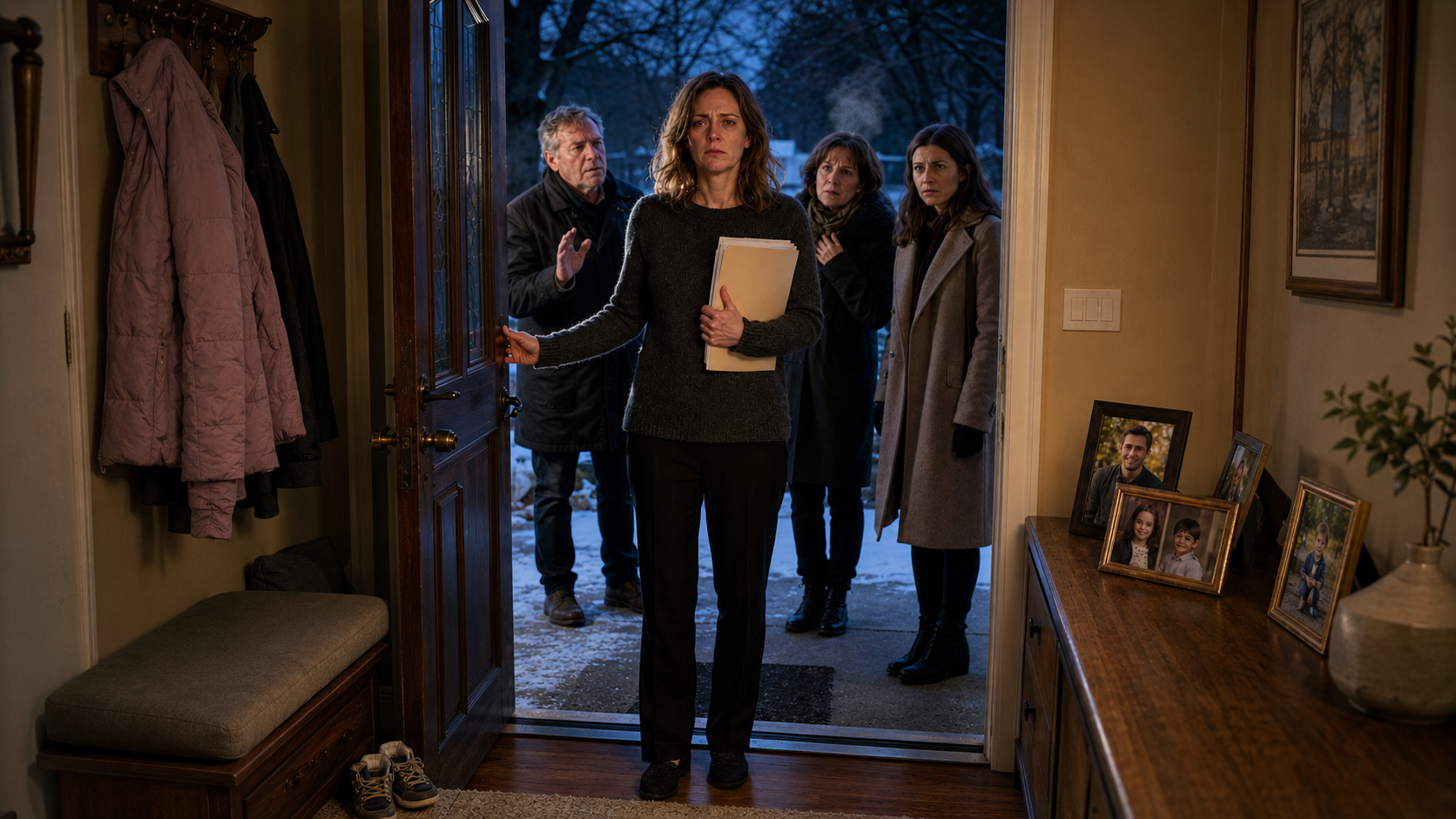
By evening, someone was pounding on my front door.
I walked to the living-room window and moved the curtain aside.
My mother stood on the porch.
My father was beside her.
And behind them, wearing the same expression she’d worn whenever she wanted something from me since we were children, was Melissa.
My father raised his hand and knocked again.
“Claire!” he shouted.
Then my mother saw me through the glass.
And smiled.
PART 2: Suddenly, We Were Family Again
That smile made me angrier than if she’d arrived screaming.
It was soft.
Careful.
Almost maternal.
The kind of smile she should have worn when she entered the church six months earlier.
I didn’t open the door.
Mom leaned toward the window.
“Claire, sweetheart.”
Sweetheart.
I actually laughed.
It came out wrong. Thin and broken.
Dad knocked harder.
“We know you’re in there.”
I stayed where I was.
Melissa wrapped her coat tighter around herself.
“It’s freezing!”
Of course that was her concern.
I finally walked to the door but left the deadbolt locked.
“What do you want?”
Mom blinked.
“We want to see you.”
“You’ve had six months.”
“Claire,” Dad said, “don’t start.”
I stared at him through the glass.
Don’t start.
I wondered if he remembered saying almost the same thing when I was sixteen and angry that Melissa had taken my car without permission.
In my family, pain had always become bad behavior the moment it inconvenienced somebody else.
Mom pressed her palm against the door.
“We saw the news.”
“There it is.”
Her expression tightened.
“What is that supposed to mean?”
“It means you didn’t come when Ethan died. You didn’t come when Lily died. You didn’t come when Noah died. But eighteen-point-seven million dollars makes you drive over in freezing weather.”
Melissa rolled her eyes.
“We didn’t come here because of the money.”
I looked at her.
“Then why today?”
She opened her mouth.
Nothing came out.
Dad stepped closer.
“We heard about the settlement, yes. Obviously. It’s public. But that made us realize things have gone too far.”
“Things?”
“This separation.”
“This isn’t a separation.”
“What would you call it?”
I looked directly at him.
“A consequence.”
His face hardened.
Mom intervened quickly.
“We know you were hurt.”
Were.
Past tense.
“I buried my husband and my children while you ate birthday cake.”
Melissa flinched.
“Can you stop saying it like that?”
My fingers tightened around the edge of the door.
“How would you prefer I say it?”
“It wasn’t just birthday cake.”
I stared at her.
She kept going.
“My engagement was basically being announced that weekend. Jason’s family was there. Mom and Dad couldn’t just disappear.”
For a moment, nobody moved.
Something extraordinary happened inside me then.
I stopped wondering whether they understood.
They did.
They simply believed their reason was sufficient.
“Go home,” I said.
Mom’s eyes widened.
“Claire.”
“Go home.”
“We drove all this way.”
“You drove two hours for money. Aunt Ruth drove six hours for a funeral.”
Dad slapped his palm against the door.
“Enough.”
I stepped back instinctively.
His voice dropped.
“Open this door. We’re your parents.”
“And Ethan was my husband.”
Dad went silent.
“Lily and Noah were your grandchildren,” I continued. “Do you remember that?”
Mom’s eyes filled with tears.
I would have believed them once.
Maybe a part of me still wanted to.
“Don’t do this,” she whispered. “Don’t punish us forever for one mistake.”
One mistake.
Not coming to the funeral.
Not calling afterward.
Not visiting.
Not checking on me.
Sending me an engagement invitation.
Telling me Melissa was hurt because I hadn’t called her on the day my children died.
Six months of silence.
One mistake.
“Please leave.”
Melissa folded her arms.
“Can we at least come inside and talk like adults?”
“No.”
Her face changed.
For the first time, the polite performance slipped.
“So what? You’re just done with all of us?”
“I didn’t leave you.”
“Claire—”
“You left me.”
Nobody answered.
I shut the interior door.
They remained on the porch for another ten minutes.
My father knocked twice more.
My mother called my phone from outside.
Melissa sent a message.
This is cruel. Mom is crying.
I looked at it.
Then I blocked her number.
I blocked Dad.
Then Mom.
It was the first thing I’d done in months that made my hands stop shaking.
I thought that would be the end of it.
I should have known better.
The next morning, I had fourteen missed calls from numbers I didn’t recognize.
Three belonged to cousins.
One belonged to my mother’s brother.
Two were from family friends I hadn’t spoken to in years.
Messages followed.
Your parents are devastated.
Life is short, Claire. Don’t let money destroy your family.
That one almost impressed me.
Money.
Apparently money had destroyed my family.
Not abandoning me at three funerals held on the same day.
Money.
Another message came from Cousin Angela.
I know everyone made mistakes, but your parents love you. Melissa says you’ve changed since the settlement.
I’d received the settlement forty-eight hours earlier.
Apparently wealth worked fast.
I called Aunt Ruth.
She answered on the second ring.
“How bad is it?”
I sat down.
“How did you know?”
“Your mother called me.”
I closed my eyes.
“What did she say?”
“That you’re shutting everyone out.”
“Did she mention showing up the day the settlement hit the news?”
A pause.
“Yes.”
“Did she mention why?”
“Not exactly.”
I laughed without humor.
Ruth sighed.
“Claire, I told her something she didn’t appreciate.”
“What?”
“That if she’d wanted a daughter, she should have behaved like a mother when her daughter needed one.”
My eyes filled instantly.
Ruth’s voice softened.
“You don’t owe me anything either, you understand?”
“What?”
“The money. I don’t want you thinking I’m calling because—”
“Aunt Ruth.”
“I’m serious.”
“I know.”
“I came because Ethan and those babies mattered.”
I covered my mouth.
Those babies.
Nobody from my side of the family had called them that since they died.
Ruth continued.
“If that settlement vanished tomorrow, I’d still call Sunday and ask if you ate.”
That did it.
I cried.
Not the violent grief from the cemetery.
Something quieter.
The kind that comes when kindness touches a bruise.
After a while, Ruth said, “What are you going to do?”
“About them?”
“About all of it.”
I looked across the room.
On the bookshelf sat a framed photograph from the previous summer.
Ethan had Noah on his shoulders.
Lily was squinting into the sun.
I was laughing at something outside the frame.
“I already know what I’m doing with a lot of the settlement.”
“The foundation?”
“Yes.”
“Then do that.”
“What about my parents?”
Ruth was quiet for a moment.
“People reveal themselves in emergencies, Claire. Sometimes they reveal themselves again when money appears.”
I stared at the photograph.
“What if they really regret it?”
“Then regret will still be there without access to your bank account.”
That sentence stayed with me.
The family campaign lasted three weeks.
My mother emailed.
My father wrote from an old work account.
Melissa contacted me through social media after I blocked her phone.
Their messages changed tone depending on the day.
First came concern.
We are worried you’re making major financial decisions while grieving.
Then guilt.
Your father hasn’t slept since you refused to speak to us.
Then nostalgia.
Remember when we all went to the beach when you and Melissa were little? We were happy once.
Then accusation.
Ethan would not want you cutting off your family.
That one made me throw my phone across the couch.
They had forfeited the right to use my husband’s name.
The strangest part was how quickly the settlement became part of conversations they insisted were not about the settlement.
Dad wrote:
You need trustworthy people around you now. There are going to be people trying to take advantage of you. Family protects family.
Melissa sent:
Mom said you’re putting millions into some foundation. I hope you’re getting professional advice because that seems really extreme when there are people in your own family whose lives you could change.
There it was.
Not a request.
Not yet.
But a door cracking open.
I replied for the first time in six months.
Only one sentence.
My children are the people whose lives I wanted to change.
Melissa answered almost immediately.
That’s not what I meant and you know it.
I didn’t respond.
Two days later, Dad appeared at my house alone.
I saw him through the door camera.
I almost ignored him.
Then he held up a thick envelope.
“I just want to talk.”
I opened the door but didn’t invite him inside.
“What is that?”
He glanced at the envelope.
“Nothing formal.”
“Then what is it?”
He shifted his weight.
My father had always been confident with me.
That day, for the first time, he looked uncomfortable.
“Melissa and Jason have been trying to buy a house.”
I just stared.
“They’ve had trouble with the down payment. Housing is expensive, and the wedding—”
I started laughing.
He frowned.
“This isn’t funny.”
“No.”
I wiped tears from my eyes.
“It really isn’t.”
“Claire, listen.”
“You came here to ask me for money for Melissa’s house.”
“I’m asking you to consider helping your sister.”
“My sister didn’t come to my children’s funeral.”
“Because we had already committed to her event.”
“And now you’d like me to commit money to hers.”
Dad’s jaw tightened.
“It wouldn’t even make a noticeable difference to you.”
There are sentences that expose an entire person.
That was one.
Not a noticeable difference.
As though the settlement had fallen from the sky.
As though every dollar wasn’t attached to the absence of someone I loved.
“You think I won the lottery.”
“I never said that.”
“You don’t have to.”
“I understand where the money came from.”
“No, you don’t.”
“Claire—”
“No.”
He exhaled sharply.
“I don’t know why you insist on making everything harder than it needs to be.”
My chest went still.
There he was.
My father.
The real one.
Not the worried parent from the emails.
Not the sad man on my porch.
The man from the chapel who had treated three deaths like a scheduling conflict.
“How much?”
He stopped.
“What?”
“How much were you going to ask me for?”
“That’s not the point.”
“How much?”
He looked away.
“Two hundred thousand would put them in a very strong position.”
Two hundred thousand dollars.
I nodded slowly.
“Did Melissa send you?”
“No.”
“Does Mom know you’re here?”
He didn’t answer.
I understood.
“All three of you discussed this.”
“We discussed the fact that family should help family when they’re able.”
I looked at the envelope.
“What is that?”
“Some estimates. What they need. It’s not a demand.”
I didn’t take it.
Behind me, my house was silent.
Too silent.
For six months, I’d hated that silence.
That day, it felt protective.
“Do you know what Noah wanted for his fifth birthday?”
Dad blinked.
“What?”
“He wanted a green bicycle.”
“Claire…”
“Do you know what Lily was going to be in her school play?”
His face tightened.
“Why are you doing this?”
“Answer me.”
He couldn’t.
I nodded.
“You don’t know.”
“That doesn’t mean we didn’t love them.”
“Do you know what song Ethan and I danced to at our wedding?”
“That’s ridiculous.”
“Do you know where they’re buried?”
His mouth opened.
Then closed.
And that was my answer.
I stepped backward.
Dad’s eyes flashed.
“So this is it?”
“This is what?”
“You’re going to sit on eighteen million dollars and watch your own sister struggle?”
I felt something inside me become perfectly calm.
“It isn’t eighteen million anymore.”
He stared.
“What?”
“I’ve committed a substantial portion to the foundation.”
His face changed so quickly I almost missed it.
Shock.
Then anger.
Then calculation.
“How much?”
I smiled without warmth.
“That’s the first sincere question you’ve asked about my life in six months.”
I closed the door.
He shouted my name once.
Then he left the envelope on the porch.
I never opened it.
PART 3: What They Thought I Owed Them
I began therapy three weeks after the funeral.
At first, I barely spoke.
My therapist, Dr. Evans, didn’t push.
She let me sit in silence.
Some sessions I talked about the crash.
Some sessions I talked about Ethan.
Some sessions I talked about how guilty I felt for laughing at something on television.
That was one of grief’s cruelties nobody warned me about.
The first time I laughed after my children died, I cried for two hours afterward.
It felt like betrayal.
As though happiness were a room I no longer had permission to enter.
Eventually, we talked about my parents.
I told Dr. Evans about the funeral.
The birthday dinner.
The text from my mother.
The settlement.
The porch.
The two hundred thousand dollars.
When I finished, she asked me a question.
“What would reconciliation look like to you?”
“I don’t know.”
“What would you need from them before you considered it?”
I thought about that for a long time.
“An apology.”
“What kind?”
“A real one.”
“What makes an apology real?”
I stared at my hands.
“They would have to understand what they did.”
“And if they don’t?”
That was the question.
Because somewhere beneath the anger, I still had a daughter inside me.
A daughter who wanted her mother to call.
A daughter who wanted her father to say he’d made the worst mistake of his life.
A daughter who wanted to hear that they had sat at Melissa’s birthday dinner unable to eat because they knew they should have been beside me.
I wanted remorse.
Not because remorse would fix anything.
Nothing could.
I wanted proof that I had mattered.
That Ethan had mattered.
That Lily and Noah had mattered.
Maybe that was why their sudden interest hurt so much.
They hadn’t found me because grief had finally reached them.
They had found me because Google had.
The foundation became my lifeline.
I named it The Miller Three Foundation.
At first, some people suggested calling it something less personal.
I refused.
I wanted their names attached to what came next.
Not merely to an accident report.
Not to a settlement headline.
To something alive.
We planned grants for child-passenger safety programs, support for grieving families after fatal roadway accidents, and partnerships with organizations working on highway-safety awareness.
I wasn’t pretending I could save everybody.
I had learned too painfully that nobody could.
But helplessness had nearly swallowed me.
The foundation gave me somewhere to put my hands.
Margaret became involved almost immediately.
“I want to help,” she said.
I hesitated.
“Are you sure?”
She looked at me across my kitchen table.
“Claire, I’m their grandmother.”
Present tense.
I’m.
Not was.
I reached across the table and covered her hand.
Robert volunteered too, mostly behind the scenes.
Aunt Ruth offered to help with paperwork.
“I don’t know anything about foundations,” she admitted.
“Neither do I.”
“Good. We’ll be incompetent together.”
For the first time in months, I laughed without immediately feeling guilty.
That mattered.
Slowly, my world began to contain things besides loss.
Not instead of loss.
Beside it.
There is a difference.
I still cried in Lily’s room.
I still couldn’t move Noah’s sneakers.
I still woke reaching toward Ethan’s side of the bed.
But I also began taking walks again.
I answered emails.
I helped choose a logo for the foundation.
I stood in a conference room and spoke Lily’s and Noah’s names without breaking down.
Then my mother found another way in.
She mailed me a letter.
Not an email.
Not a text.
A handwritten letter.
I recognized her cursive before I opened it.
Claire,
I don’t know how things became this bad.
I stopped reading.
That sentence told me everything.
Not:
I know exactly what I did.
Not:
I failed you.
Not:
I should have been there.
I don’t know how things became this bad.
As though six months of choices had simply happened around her.
I kept reading anyway.
She wrote that families were complicated.
That everyone processed grief differently.
That Melissa had needed them too.
That my father had been under stress.
That they had believed giving me space was respectful.
Then came the sentence I had expected.
Now that your circumstances have changed, I worry that people may surround you for the wrong reasons, and I hope you remember that blood is permanent.
I put the letter down.
Blood is permanent.
So was death.
Apparently permanence mattered only when it supported her argument.
At the bottom, she had written:
We would like you to come to Melissa’s wedding planning dinner next month. No fighting. No money discussions. Just family.
For several minutes, I considered going.
Not because I wanted to.
Because I wanted to test them.
Dr. Evans asked why.
“I need to know if there’s anything real left.”
“What would you look for?”
“I don’t know.”
“You do.”
She was right.
I wanted to see whether they could sit in the same room with me and speak about Ethan, Lily, and Noah without changing the subject.
I wanted to see whether my mother could say their names.
I wanted to know whether Melissa could apologize without explaining herself.
So I went.
The dinner was at my parents’ house.
I had not been there since before the accident.
When Dad opened the door, his whole face changed.
“Claire.”
He hugged me before I could decide whether I wanted him to.
My arms stayed at my sides.
Mom appeared behind him.
“Oh, sweetheart.”
She started crying immediately.
For half a second, I almost surrendered.
That is what makes family wounds so difficult.
The person hurting you still has the face you learned to trust as a child.
Mom smelled like the same perfume she’d worn for twenty years.
The hallway had the same framed photographs.
Melissa and me at the beach.
My high-school graduation.
Melissa’s college graduation.
My wedding.
Then I saw something that stopped me.
On the console table was a new framed photograph.
Melissa’s birthday dinner.
The birthday dinner.
The one they’d attended instead of my family’s funeral.
My parents stood on either side of her.
Everybody was smiling.
Mom saw what I was looking at.
“Oh.”
That was all.
“Oh.”
She picked up the frame and placed it facedown.
Too late.
Melissa entered the room wearing leggings and an oversized sweater.
“Hey.”
“Hi.”
Her fiancé, Jason, stood behind her.
He looked uncomfortable.
I’d met him only a few times before the crash.
“I’m sorry, Claire,” he said quietly.
Every head turned toward him.
My throat tightened.
“For what?”
“For Ethan. And Lily and Noah.”
It was the first time anyone in that house had said all three names.
“Thank you.”
Melissa looked irritated.
“Can we not make tonight depressing?”
I stared at her.
Jason stared at her too.
“What?” she said. “Mom specifically said no fighting.”
“No one was fighting,” he replied.
Dinner was exactly what I feared.
Dad talked about work.
Mom talked about flowers for the wedding.
Melissa talked about venues.
Nobody mentioned the empty chairs at my table.
Finally, halfway through the meal, my mother said, “How is your foundation project going?”
“Good.”
“That’s nice.”
Silence.
Melissa pushed food around her plate.
Then she said, “Did you ever think about what Dad asked?”
There it was.
I looked at my mother.
She suddenly became very interested in her water glass.
“No money discussions,” I said.
Melissa sighed.
“I’m not discussing money. I’m asking whether you thought about something.”
“That involves money.”
“Everything involves money, Claire.”
Jason shifted beside her.
“Mel.”
“No, seriously. We’re all acting like it’s some forbidden topic.”
Dad put his fork down.
“This isn’t the time.”
I almost smiled.
Now it wasn’t the time.
Melissa looked at me.
“Do you have any idea what it’s like trying to buy a house right now?”
For several seconds, I couldn’t speak.
Then I said, “Do you have any idea what it’s like choosing three caskets?”
Jason closed his eyes.
Mom whispered, “Claire.”
“No. She asked me a question.”
Melissa’s cheeks flushed.
“Why do you always do that?”
“Do what?”
“Use what happened to shut down every conversation.”
I felt my heartbeat in my throat.
“What happened?”
“You know what I mean.”
“No. Say it.”
She looked away.
“What happened.”
I pushed my chair back.
Dad stood.
“Everyone calm down.”
“I’m calm.”
Mom started crying.
“Please. This is exactly what I didn’t want.”
I looked at her.
“What did you want?”
“A family dinner.”
“You had one.”
She froze.
“Six months ago,” I said. “You had your family dinner.”
Melissa stood now.
“Are you going to hold that over us forever?”
“You didn’t miss a birthday party.”
“It wasn’t a party!”
“You missed my husband’s funeral. You missed your niece’s funeral. You missed your nephew’s funeral.”
“I was your daughter too!” Melissa shouted at our parents.
The room went silent.
And there it was.
The truth beneath everything.
Melissa’s eyes were wet.
“It was my birthday. My engagement. For once, something was about me.”
I stared at her.
“For once?”
She looked away.
Suddenly I saw our childhood differently.
The competition.
The comparisons.
The way Melissa treated attention like oxygen.
The way my parents rushed to reassure her whenever someone else needed more.
Maybe she had spent years believing love was a limited resource.
Maybe my parents had taught her that.
But understanding wasn’t absolution.
I said quietly, “My children died.”
She wiped her eyes.
“I know.”
“You didn’t even call me.”
“I didn’t know what to say.”
“You could have said their names.”
She said nothing.
“You could have come.”
Her face crumpled slightly.
And for the first time, I saw something behind her defensiveness.
Shame.
Real shame.
It disappeared quickly.
“You don’t know what Mom and Dad were saying,” she whispered.
I looked at them.
Dad’s expression changed.
“What does that mean?”
Melissa glanced at him.
“Nothing.”
“Melissa.”
Mom stood suddenly.
“This has gone far enough.”
But now I understood there was something else—not a secret, not some dramatic hidden conspiracy.
Just more truth.
“What were they saying?”
Melissa stared at the table.
“That you’d have Ethan’s family.”
I stopped breathing.
Mom whispered, “That isn’t what we meant.”
Melissa continued.
“They said Margaret and Robert would be there. That you wouldn’t be alone.”
I looked at my parents.
Dad’s face had gone pale.
“And Melissa needed us,” Mom said quickly.
“So you counted parents.”
“What?”
“You counted them.”
“Claire—”
“You decided I already had two.”
Nobody spoke.
“So you stayed with her.”
My mother began crying harder.
“We thought…”
“What?”
“We thought you would understand.”
I laughed once.
It hurt.
“You thought I would understand why my parents didn’t come to bury my children because my dead husband’s parents were already there?”
Dad stood rigidly beside the table.
“It sounds terrible when you say it like that.”
My chair scraped backward.
“It was terrible when you did it.”
I picked up my coat.
Mom followed me into the hallway.
“Claire, please.”
I stopped beside the console.
The birthday photograph was still facedown.
“Do you know what the worst part is?”
She shook her head.
“I kept thinking maybe you didn’t understand.”
Her face crumpled.
“But you did. You thought about it. You discussed it. You decided Margaret and Robert were enough parents for me.”
“That’s not fair.”
“No.”
I looked at her.
“It wasn’t.”
Then I walked out.
Behind me, Melissa called my name.
This time, I stopped.
She stood in the doorway.
“What?”
Her arms were folded tightly across her chest.
“I am sorry they died.”
It wasn’t enough.
But it was the first sentence she’d said in six months that wasn’t about herself.
I nodded once.
“I’m sorry too.”
Then I left.
PART 4: The Price of an Apology
After the dinner, my father didn’t contact me for two weeks.
My mother sent three messages.
Melissa sent one.
Hers surprised me.
I know saying I’m sorry now doesn’t fix anything. I don’t know how to talk to you without making it worse, so I’m going to stop trying for a while.
I read it several times.
Then I replied:
That is probably best.
It wasn’t forgiveness.
It wasn’t reconciliation.
But it was the first honest exchange we’d had since the crash.
My parents were different.
They escalated.
Dad sent me a long email accusing me of “rewriting history.”
Mom said I was forcing everyone to choose sides.
Then I learned from Aunt Ruth that my parents had begun telling relatives that grief had made me unstable and that the settlement was “changing my personality.”
Ruth sounded furious.
“I told your mother you weren’t behaving differently because of money.”
“What did she say?”
“She said, ‘You don’t see her the way we do.’”
I laughed.
“That’s accurate. She actually sees me.”
Ruth didn’t laugh.
“Claire, there’s something I think you should understand.”
“What?”
“They’re embarrassed.”
That surprised me.
“About what?”
“The article.”
“The article didn’t mention them.”
“Exactly.”
I sat quietly.
Ruth explained that people in my parents’ social circle had seen the settlement coverage. Some remembered the crash. Some asked how my parents were doing. One woman apparently asked my mother how she had survived attending three funerals in one day.
Mom changed the subject.
Someone else knew they hadn’t attended.
Then people started asking questions.
My parents were not confronting grief.
They were confronting reputation.
Suddenly, their absence had witnesses.
That explained the urgency.
The porch visits.
The letters.
The family dinner.
They wanted reconciliation because reconciliation would erase the visible consequence of what they’d done.
If I came back, everyone could pretend the wound had closed.
The realization hurt.
But it also freed me.
I stopped waiting for the perfect apology.
Two months later, the Miller Three Foundation held its first public event.
It wasn’t elaborate.
I didn’t want a gala.
I didn’t want champagne.
I didn’t want wealthy strangers applauding while photographs of my dead children played behind them.
We organized a community child-seat safety event with local volunteers, safety educators, and families.
There were inspection stations.
Information tables.
Activities for children.
The foundation also announced its first emergency-support grants for families dealing with fatal roadway loss.
The night before the event, I couldn’t sleep.
At two in the morning, I walked downstairs and stood near the front door.
Lily’s jacket still hung there.
Noah’s sneakers were still beneath the bench.
I had moved almost everything else by then.
Not thrown away.
Never thrown away.
Packed carefully.
Preserved.
But those two things remained.
I touched the sleeve of Lily’s jacket.
“I’m trying,” I whispered.
My voice disappeared into the dark house.
“I don’t know if I’m doing it right.”
For a moment, I imagined Ethan answering.
He would have said there wasn’t a right way.
Then he would have made some terrible joke.
I smiled.
And this time, I didn’t apologize for it.
The next morning was cold but bright.
Margaret arrived early carrying coffee.
Robert was already outside helping volunteers move tables.
Aunt Ruth wore a foundation sweatshirt one size too large and immediately began bossing people around despite insisting she was “just there to help.”
For the first time since the accident, I felt surrounded without feeling trapped.
These people weren’t standing beside me because of the settlement.
They were standing beside me because they loved the people whose absence had created it.
That difference meant everything.
Half an hour before we opened, Ruth approached me.
Her face was careful.
“Your parents are here.”
My stomach dropped.
“What?”
“And Melissa.”
I looked toward the entrance.
There they were.
Mom.
Dad.
Melissa.
For one second, I was back at my front door.
Then I noticed something.
They weren’t walking toward me.
They had stopped near the edge of the parking lot.
Dad’s hands were in his coat pockets.
Mom looked frightened.
Melissa held a small bouquet of white flowers.
I walked toward them.
Margaret moved as though she intended to come with me.
I touched her arm.
“It’s okay.”
She searched my face.
“You sure?”
“No.”
That made her smile sadly.
“Fair enough.”
I crossed the parking lot alone.
My father spoke first.
“We didn’t know if you’d let us come.”
“You could have asked.”
Mom nodded.
“You’re right.”
It was a small sentence.
But it was the first time I had ever heard her say those words without adding a defense.
Melissa held out the flowers.
“They’re not for you.”
I looked at her.
She swallowed.
“I thought maybe there was somewhere for Lily and Noah. Or Ethan.”
There was.
Inside the community center, we had placed three framed photographs beside the foundation banner.
“Come on.”
I led them inside.
When my mother saw the photographs, she stopped walking.
Ethan was smiling in one.
Lily had two missing front teeth.
Noah had chocolate smeared across his cheek.
Mom covered her mouth.
Dad looked down.
Melissa placed the flowers beneath the photographs.
Nobody spoke for a while.
Then my father said something I never expected.
“I should have been there.”
I looked at him.
His voice shook.
“At the funeral.”
Mom started crying.
Dad kept staring at the photographs.
“I should have been there.”
For months, I had imagined hearing those words.
In my imagination, they healed something.
In reality, they didn’t.
They hurt.
Because they were true.
“You should have.”
He nodded.
“I told myself you had Ethan’s parents. I told myself Melissa needed us. I told myself we’d come see you afterward when things settled down.”
His mouth twisted bitterly.
“That sounds pathetic now.”
“It sounded pathetic then.”
He nodded again.
“I know.”
Mom whispered, “I thought if we admitted what we’d done, you’d never forgive us.”
I looked at her.
“So you pretended you hadn’t done anything.”
She shut her eyes.
“Yes.”
There it was.
Finally.
Not a misunderstanding.
Not bad timing.
Not grief affecting everyone differently.
A choice.
Then another choice.
And another.
Melissa stared at Lily’s photograph.
“I was angry at you.”
I turned toward her.
“Why?”
Her eyes filled.
“Because everybody was talking about the accident.”
I couldn’t hide my disbelief.
“I know how horrible that sounds.”
“It is horrible.”
“I know.”
She looked ashamed.
“It was my birthday, and then this happened, and I felt guilty for being angry that it wasn’t about me anymore. So instead of admitting that, I made you the problem.”
She wiped her cheek.
“When you didn’t call me, I told Mom I was hurt. I knew why you didn’t call. Of course I knew.”
I said nothing.
“I think I wanted someone to tell me I was allowed to still matter.”
Mom flinched.
Melissa shook her head.
“But I should have come.”
“Yes.”
“I should have called.”
“Yes.”
“I should never have let Dad ask you for money.”
My gaze moved to Dad.
He looked away.
Melissa continued.
“I knew about it.”
“I assumed you did.”
“I wanted the house.”
At least she was finally telling the truth.
“I convinced myself it wasn’t really asking much because you had so much.”
Her voice broke.
“Then Jason asked me what I thought that money represented.”
I remembered Jason at the dinner.
The only person in that house who had immediately said their names.
Melissa looked toward the photographs.
“I couldn’t answer him.”
Silence stretched between us.
Finally, Mom said, “We don’t expect anything from you.”
I almost smiled.
“You did.”
“Yes.”
She swallowed.
“We did.”
The event doors opened behind us.
Families began arriving.
Children’s voices filled the building.
For an instant, the sound hit me so hard I could barely breathe.
A little boy ran past carrying a toy truck.
He was about Noah’s age.
I closed my eyes.
Then opened them.
Dad noticed.
His face changed.
Maybe for the first time, he understood that grief wasn’t something I’d been withholding from them.
It was something I lived inside every minute.
“Claire,” he said, “what do you want us to do?”
That question mattered more than the apology.
Not:
What do you want to give us?
Not:
When will you forgive us?
What do you want us to do?
I looked at all three of them.
“Today?”
“Today.”
“Help.”
Dad blinked.
“With the foundation?”
“Yes.”
Mom nodded immediately.
“What should we do?”
I pointed toward a volunteer table.
“Ask Ruth.”
My father’s face showed brief alarm.
Despite everything, I almost laughed.
“She’s angry with me.”
“Yes.”
“Very angry?”
“Go ask her.”
He actually did.
Ruth stared at him for a long moment, then handed him a box and pointed across the room.
Mom began helping register families.
Melissa joined volunteers packing safety-information folders.
I watched them.
I didn’t forgive them that day.
That is important.
People like stories where apologies erase damage.
Mine didn’t.
An apology could not put my parents in those empty church seats.
It couldn’t change what I saw when I stood between three caskets and searched a nearly empty row for my mother.
It couldn’t remove the birthday photograph from my memory.
It couldn’t make Lily eight.
It couldn’t make Noah five.
It couldn’t bring Ethan home.
Some things cannot be repaired.
They can only be acknowledged.
And sometimes acknowledgment is where something new begins.
Not what existed before.
Something smaller.
More cautious.
More honest.
PART 5: What the Money Was Really Worth
The headline followed me for a long time.
Whenever someone searched my name, there it was.
$18.7 million.
People saw the number before they saw the reason.
Some strangers congratulated me.
I hated that word.
Congratulations belonged to promotions.
Weddings.
Babies.
Lottery tickets.
There was nothing to congratulate me for.
I would have returned every dollar for one Tuesday morning.
One.
I would have traded all of it to hear Ethan leave another cabinet open.
To find glitter on the carpet.
To trip over Noah’s shoes.
To hear Lily shout from upstairs that her brother had touched something she told him not to touch.
That was wealth.
I knew that now.
The settlement was not wealth.
It was evidence of absence.
So I made sure it served something larger than me.
The foundation grew carefully.
Not extravagantly.
Carefully.
We funded more safety programs.
We helped families with immediate expenses after fatal crashes.
We supported education efforts around fatigued driving.
Every project carried the same three names.
Ethan.
Lily.
Noah.
My parents did not receive money.
Neither did Melissa.
That boundary never changed.
To their credit, eventually they stopped asking.
My relationship with them remained complicated.
For months, I saw them only at foundation events or occasional lunches.
Mom stopped calling me “sweetheart” every time she wanted to soften a difficult conversation.
Dad learned not to explain his apology.
Melissa postponed our closeness rather than demanding it.
Sometimes she texted:
Thinking about Lily today.
Or:
I saw a dinosaur backpack and thought of Noah.
The first few times, I cried.
Then one day, I answered:
He would have loved it.
That was how we began.
Not with forgiveness.
With truth.
Aunt Ruth once asked if I thought I would ever fully forgive them.
We were sitting on my porch almost a year after the accident.
“I don’t know,” I said.
She nodded.
“Good answer.”
“People keep acting like forgiveness is the finish line.”
“It isn’t.”
“What is?”
Ruth took a sip of tea.
“Maybe there isn’t one.”
I thought about that.
Inside my house, Lily’s jacket no longer hung by the door.
I had finally folded it and placed it in a memory box with her drawings, school photographs, and glitter pens.
Noah’s sneakers were gone from beneath the bench too.
They were in a box upstairs with his dinosaur pajamas and favorite storybook.
For months, I had believed moving them meant leaving my children behind.
Eventually, I understood something.
They weren’t in the shoes.
They weren’t in the jacket.
They weren’t in the coffee mug.
They were in me.
Moving an object couldn’t erase them.
Neither could continuing to live.
The hardest thing grief ever asked of me was not surviving the funeral.
It was surviving ordinary days afterward.
And then surviving them without feeling guilty.
On the first anniversary of the crash, I drove to the cemetery alone.
Margaret and Robert had visited that morning.
My parents asked if they could come.
I said no.
They accepted it.
That mattered.
Some moments were still mine.
I brought three things.
For Ethan, a coffee mug from the little diner where we’d had our first date.
For Lily, a packet of glitter pens.
For Noah, a tiny green bicycle ornament.
The bicycle broke me.
I sat on the grass between their graves and cried until my chest hurt.
“I miss you.”
The wind moved through the trees.
“I miss you so much.”
For a long time, I said nothing else.
Then I told them about the foundation.
I told Ethan about the families we’d helped.
I told Lily about a little girl at one of our safety events who had corrected an instructor about dinosaurs.
I told Noah I had finally stopped cutting my own sandwiches into triangles because every time I did, I cried.
Then I laughed.
“I know. Very dramatic.”
I could almost hear Ethan teasing me.
The ache remained.
It always would.
But the pain was no longer the only thing connecting me to them.
Love was still there.
Memory was still there.
Purpose was there.
I pressed my fingers to Ethan’s name carved into the stone.
“I thought surviving meant I left you.”
My voice shook.
“I know better now.”
I sat there until the sun began lowering.
When I returned home, there was an envelope in my mailbox.
No return address.
Inside were three cards.
One from Mom.
One from Dad.
One from Melissa.
They hadn’t sent them to the cemetery.
They hadn’t shown up.
They had respected my no.
Dad’s card contained only four handwritten lines.
I have no excuse for missing that day.
I failed you when you needed me most.
I am sorry.
I will spend the rest of my life knowing I cannot undo it.
I read it twice.
Then I set it aside.
Mom’s said:
I used to think being your mother guaranteed me a place in your life. I understand now that being family is something I have to live, not something I can demand. I love you. I am sorry I abandoned you.
I covered my mouth.
Then I opened Melissa’s.
Her message was shortest.
I am thinking about Ethan, Lily, and Noah today. I won’t ask you to answer.
That was all.
No excuses.
No request.
No pressure.
For the first time, they had given me something without asking what they could receive in return.
I placed the cards in a drawer.
I didn’t call them that evening.
I wasn’t ready.
Maybe they finally understood that love did not entitle them to my healing on their schedule.
Two weeks later, the foundation hosted another safety event.
A reporter came.
She interviewed me after most of the families had left.
At the end, she glanced at her notes.
“Your story received national attention because of the size of the settlement. What has the money changed for you?”
I looked across the community center.
Margaret was talking to a young mother near the registration table.
Robert was stacking chairs.
Aunt Ruth was arguing with a printer.
Dad was carrying boxes toward a storage room.
Mom was collecting abandoned coffee cups.
Melissa was kneeling beside a little girl, helping her zip a jacket.
Nobody was watching me.
Nobody was asking me for anything.
I turned back to the reporter.
“It showed me something.”
“What?”
“Who came when there was nothing to gain.”
She lowered her pen slightly.
I continued.
“The worst day of my life taught me who considered my pain important enough to interrupt their plans. The settlement taught me who suddenly considered me important when my circumstances changed.”
The reporter was quiet.
“Do you forgive your family?”
I looked toward my parents.
My father caught my eye from across the room.
He didn’t wave.
Didn’t approach.
He simply nodded and returned to carrying boxes.
I thought about the cemetery.
The empty church seats.
The birthday photograph.
The envelope asking for two hundred thousand dollars.
The apology cards.
The months of work afterward.
“I think forgiveness is less important than accountability,” I said. “Some relationships survive because people apologize. Others survive because they change. I’m still finding out which kind mine is.”
She wrote that down.
Then she asked about the foundation.
That was the question I wanted.
I told her about Ethan.
I told her about Lily.
I told her about Noah.
Not how they died.
Who they were.
Ethan made terrible pancakes whenever he experimented with recipes but insisted everyone eat them anyway.
Lily once organized a classroom petition because she believed recess was too short.
Noah called ambulances “amber-lamps” and refused correction.
The reporter laughed.
So did I.
And something extraordinary happened.
Their names existed in a room without death immediately following them.
For so long, people had heard Ethan, Lily, and Noah and thought tragedy.
I wanted the world to hear their names and think life.
That became the real purpose of everything.
Six months earlier, I had stood in a hospital chapel with ash on my hands and begged my parents to come bury my family.
They chose birthday candles.
When the money came, they found my address.
At first, I thought that was the cruelest possible proof of what I meant to them.
Maybe it was.
But money did something else too.
It stripped away every excuse.
When there was nothing I could give them, they stayed away.
When there was something they wanted, they came running.
And when I refused to give it to them, they had a choice.
Leave again.
Or finally learn how to stay.
Melissa’s house wasn’t bought with my settlement.
Her wedding wasn’t paid for by my children’s deaths.
My parents never touched the money.
The foundation did.
Families did.
Children did.
The names of my husband and children did.
And slowly, cautiously, my parents learned that if they wanted a place in my life, it would not be purchased from me with guilt, history, or blood.
They had to earn it through presence.
Through respect.
Through accepting no.
Through remembering birthdays without forgetting death anniversaries.
Through saying Ethan’s name.
Lily’s name.
Noah’s name.
Some wounds remained.
They always would.
I still sometimes woke expecting Ethan beside me.
I still occasionally reached for strawberry yogurt at the grocery store before remembering Lily wasn’t there to eat it.
I still saw green bicycles and had to stop walking.
But grief no longer felt like the highway barrier I had crashed into.
It became something I carried.
Heavy.
Permanent.
But mine.
One evening, after everyone left the foundation office, I found myself alone beside the wall where we’d hung three photographs.
Ethan.
Lily.
Noah.
The building was quiet.
Sunset came through the windows.
I touched Lily’s photograph.
Then Noah’s.
Then Ethan’s.
The settlement papers were locked somewhere in a filing cabinet.
The newspaper headline had long since disappeared from the front page.
Eighteen-point-seven million dollars had sounded enormous when the world first attached the number to my name.
Standing there, it felt very small.
Because I knew exactly what real wealth had looked like.
It had looked like Ethan dancing badly while making pancakes.
It had looked like Lily’s jacket hanging by the door.
It had looked like Noah’s crooked sneakers beneath the bench.
It had sounded like three people laughing in my kitchen.
And if I could have bought that life back, there would never have been enough money in the world.
But I couldn’t.
So I did the only thing left to me.
I carried their names forward.
And when people finally came knocking because they thought tragedy had made me rich, I learned that the most valuable thing I had left wasn’t the settlement.
It was the right to decide who entered my life.
This time, I chose carefully.
Để lại một bình luận