
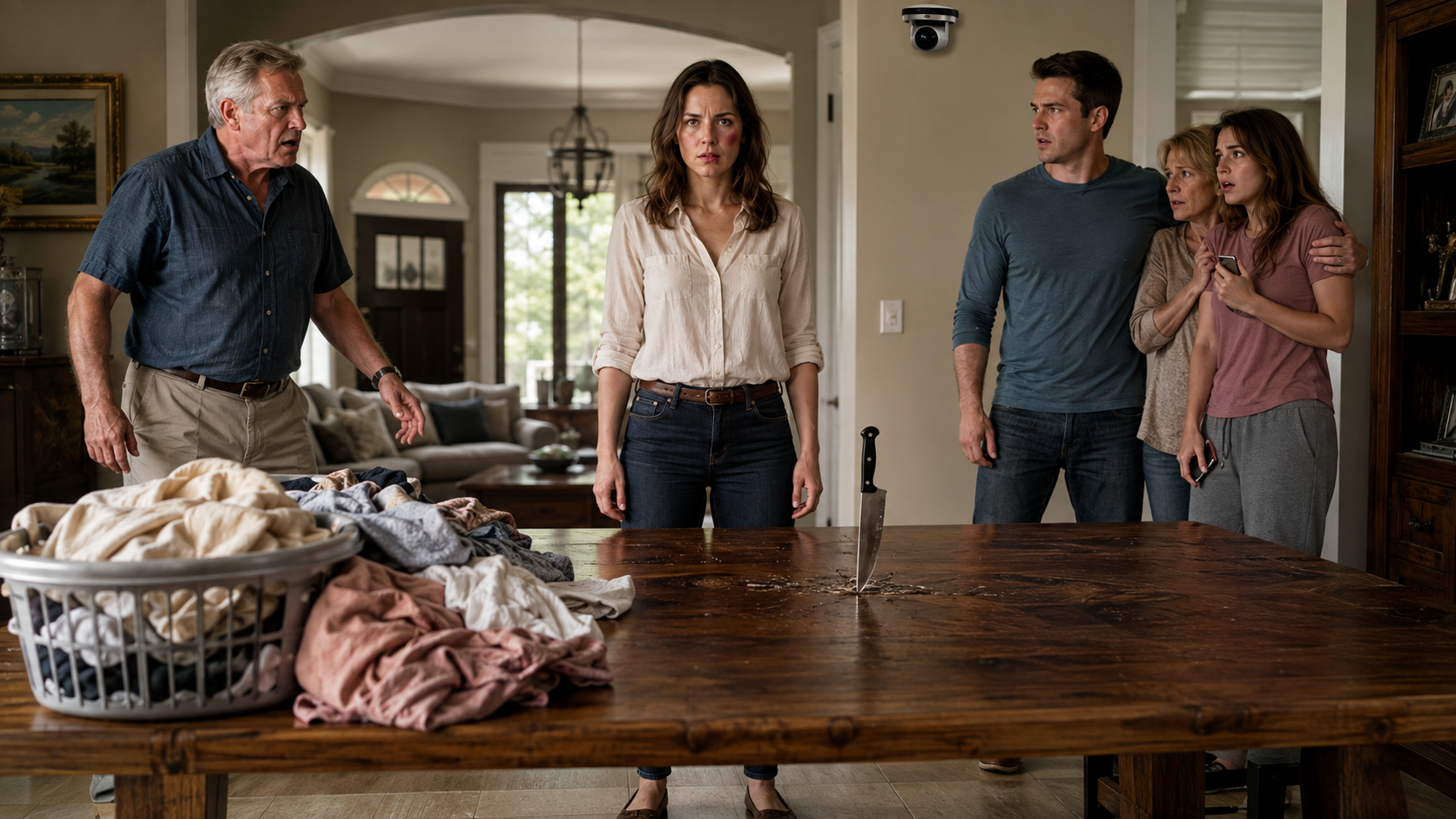
My father-in-law slapped me because I refused to wash his daughter’s underwear. Two days later, I left the marriage. What I found on the security footage afterward exposed a multimillion-dollar lie that had controlled that family for decades.
PART 1: THE SECOND MORNING OF MY MARRIAGE
“In this house, my son’s wife washes even her sister-in-law’s underwear. If you don’t like it, the door is right there.”
That was the welcome I received on the second morning after my wedding.
For a few seconds, I honestly thought Charles was joking.
Then I looked at his face.
He wasn’t.
My name is Nicole. I was thirty-one years old, managed a marketing team for a technology company in Phoenix, paid my own bills, had lived alone for six years, and had somehow convinced myself that moving temporarily into my husband’s family home after our wedding would be practical.
That was Ryan’s idea.
“Three months,” he had promised me. “Four at the absolute most. We save some money, finish looking for a house, then move.”
His parents owned a large Spanish-style home outside Phoenix with more bedrooms than they needed. Ryan’s younger sister, Megan, still lived there too.
I had met them dozens of times before the wedding.
Charles was loud, opinionated, and obsessed with the word respect.
Brenda, my mother-in-law, smiled constantly and apologized for him constantly.
Megan was twenty-three, spoiled in the casual way some youngest children are spoiled, but I had never considered her cruel.
And Ryan…
Ryan was gentle.
Or at least I had believed gentleness and courage were the same thing.
I learned otherwise beside a pile of dirty underwear.
It was barely eight in the morning.
I had walked into the laundry room carrying my coffee when I found three baskets waiting beside the wash basin.
Megan was leaning against the wall in pajama shorts, scrolling through her phone.
“Good,” she said when she noticed me. “You’re awake.”
I glanced at the baskets.
“What’s all this?”
“Our laundry.”
She said it as if the answer should have been obvious.
There were jeans, shirts, socks, sweatpants, towels, and beneath them, bras and underwear belonging to people I had known for less than a year.
I stared.
Megan finally looked up.
“Wash my blouses by hand first,” she said. “And keep my things separate. The machine ruins them.”
I actually laughed.
Not because it was funny.
Because my brain refused to accept that she was serious.
“You want me to wash your clothes?”
She frowned.
“Yeah.”
“Why?”
She blinked.
“Because you’re Ryan’s wife.”
That answer disturbed me more than the request.
I set my coffee down.
“Megan, I came here to build a family, not become the maid. Everyone can wash their own personal clothes. Towels and shared laundry can go into the washing machine.”
Her expression hardened immediately.
“But Mom always did it.”
“Then your mother was doing you a favor.”
“It’s not a favor. It’s how our family works.”
“Not with me.”
That was when Brenda appeared in the doorway.
She had clearly been listening.
She smiled, but there was strain around her mouth.
“Just do it this once, dear.”
I turned toward her.
“Why?”
“Megan is the youngest. She’s used to things being done a certain way.”
Megan crossed her arms.
Brenda lowered her voice.
“A good daughter-in-law avoids unnecessary problems.”
I remember looking at her then and feeling the first real chill.
Not anger.
Recognition.
I had heard women say sentences like that my entire life.
Keep the peace.
Don’t embarrass the family.
You know how men are.
Why make things worse?
It was the language people used when they wanted the person being mistreated to become responsible for everyone else’s comfort.
“A good family also respects boundaries,” I said. “Megan is an adult. She can wash her own underwear.”
Megan gasped as though I had insulted her.
Brenda’s smile disappeared.
And from the kitchen came the scrape of a chair.
Charles entered carrying his coffee.
He was sixty-two, broad-shouldered despite retirement, with gray hair cut close to his head and the posture of a man who expected rooms to adjust themselves around him.
“What’s the problem?”
“No problem,” Brenda said quickly.
Megan pointed at me.
“She refuses to do the laundry.”
I almost laughed again.
“I refuse to hand-wash a twenty-three-year-old woman’s underwear.”
Charles stared at me.
“So you’ve already started talking back?”
Something in his tone made the room feel smaller.
“I’m not talking back. I’m answering.”
“You just got here.”
“Yes.”
“And already you want to change our traditions.”
“I’m not changing your traditions. I’m deciding what I will and won’t do.”
He stepped closer.
Behind him, Brenda went silent.
That silence told me she knew what was coming before I did.
Charles set his coffee cup on a shelf.
“In this house,” he said, “my son’s wife washes even her sister-in-law’s underwear. If you don’t like it, the door is right there.”
I felt my heart start beating faster.
But I was not afraid yet.
I was still foolish enough to believe adults could disagree without violence.
“Then we understand each other,” I said. “I won’t wash them.”
His face changed.
I saw the movement.
I simply didn’t understand it quickly enough.
His hand struck my cheek so hard that my head snapped sideways.
My shoulder crashed against a chair.
The chair scraped across the tile.
For half a second, everything disappeared beneath a white burst of pain.
Then came the ringing in my ear.
The taste of blood.
The strange sensation of my own pulse inside my swollen lip.
Nobody moved.
I put one hand against the chair and straightened.
Charles was breathing hard.
Not shocked.
Not regretful.
Angry.
As though hitting me had been the reasonable part of the conversation.
Brenda stared at the floor.
Megan had stepped backward.
And then I saw Ryan.
He had come out of our bedroom wearing a T-shirt and sweatpants.
My husband.
Two days after standing before our families and promising to love and protect me.
I waited for him to cross the room.
I waited for him to ask if I was okay.
I waited for him to look at his father with even half the anger burning inside me.
Instead he stood there.
Frozen.
“Ryan,” I whispered.
His eyes moved from my bleeding lip to Charles.
“Nicole…”
“Your father just hit me.”
“I saw.”
I waited.
Nothing.
“Are you going to say something?”
His jaw tightened.
Then he gave me the sentence that ended our marriage before either of us understood it was over.
“You shouldn’t have provoked my father.”
I stared at him.
He immediately looked ashamed.
“You know how he gets,” he added quietly.
Something shattered inside me.
Not love.
Love rarely dies in one clean moment.
It was trust.
And trust, once broken, changes the shape of everything around it.
I walked away.
“Nicole,” Ryan said.
I continued into the kitchen.
Behind me, Brenda whispered, “Ryan, go talk to her.”
But I wasn’t interested in talking anymore.
I opened the knife block and pulled out the large chef’s knife.
When I walked back into the dining area, Megan’s face went white.
Charles took half a step backward.
Ryan raised both hands.
“Nicole. Put that down.”
I didn’t point it at anyone.
I didn’t move toward Charles.
I walked to the enormous mesquite dining table Charles loved more than most people.
He told every guest the same story about it—custom-made, hand-finished, nearly impossible to replace.
I lifted the knife.
And drove it straight into the tabletop.
The blade struck wood with a violent crack.
Everyone jumped.
Silence fell.
I left my hand wrapped around the handle.
Then I looked directly at Charles.
“Listen carefully.”
My own voice surprised me.
It was quiet.
“No one will ever lay a hand on me again. The next assault will be reported, recorded, and handled in court. I did not come into this house to be your servant. I did not marry your son to become your punching bag.”
Charles’s face was dark with rage.
“You threatening me?”
“No.”
I pulled the knife free.
“I’m warning you about consequences.”
Ryan stared at the gouge in the table.
For one unbelievable second, his expression held more horror over damaged furniture than over my swollen face.
That was when I knew.
I walked into our bedroom and took out my suitcase.
Ryan followed me.
“We can fix this.”
I folded clothes without looking at him.
“No.”
“My dad shouldn’t have done that.”
“He assaulted me.”
“I know.”
“And you blamed me.”
“I panicked.”
“You had time to choose your words.”
“Nicole, please.”
He stepped in front of the door.
I looked at him.
“Move.”
“What will people say if you leave two days after the wedding?”
That almost hurt worse than the slap.
I lifted my suitcase.
“They’ll say your wife had more courage to leave than you had to defend her.”
His face crumpled.
“Don’t do this.”
“I didn’t.”
I looked toward the living room.
“Your father did.”
Then I looked back at Ryan.
“And you helped.”
He moved aside.
My parents lived forty minutes away.
My mother opened the door before I could knock twice.
The moment she saw my face, she covered her mouth.
“Oh my God. Nicole.”
She started crying before I did.
My father came from the kitchen.
He had spent thirty-four years teaching high-school history and had the calmest temperament of any man I knew.
When he saw the bruise forming on my cheek, that calm disappeared.
“Who?”
“Charles.”
His jaw tightened.
“And Ryan?”
I looked away.
My father understood.
He didn’t ask me why I had argued.
He didn’t ask whether I could have handled things differently.
He didn’t ask what Charles’s version would be.
He took my suitcase from my hand and said, “No tradition on this earth gives someone permission to hit you.”
That was the first moment I cried.
By noon, Brenda had already begun rewriting what happened.
A cousin messaged me.
Then one of Ryan’s aunts.
Then a woman I had met once at the rehearsal dinner.
According to Brenda, I had refused to help the family, exploded over laundry, grabbed a knife, and chased Charles through the house.
The slap had vanished from the story.
So had Ryan’s silence.
I became violent.
Unstable.
Dangerous.
I didn’t post anything.
I didn’t defend myself publicly.
I texted Ryan.
Did your mother tell people I chased your father with a knife?
He answered ten minutes later.
She’s upset. Everyone is upset.
That wasn’t my question.
A pause.
Then:
Yes.
I stared at the screen.
Did she tell them he hit me first?
Another long pause.
No.
I saved the conversation.
Then I wrote:
So you admit she lied about what happened?
His response came almost immediately.
She exaggerated. You never chased anyone. Dad hit you and then you put the knife in the table. I told her she shouldn’t leave that part out. Please come home so we can deal with this privately.
I took screenshots.
And suddenly I remembered the camera.
Three weeks before our wedding, dozens of gifts had begun arriving at Ryan’s parents’ house.
Some were expensive.
My mother had bought us a standing mixer.
My boss had sent crystal glasses.
Several relatives had given envelopes containing cash.
I had paid for a security camera covering the main living room and dining area.
Ryan complained about it.
“My dad hates cameras.”
“It’s temporary,” I had told him. “Just until the wedding gifts are moved.”
A few days later Ryan told me the system wasn’t working.
I had been too busy with wedding preparations to check.
But the service account was in my name.
I opened the company’s app.
My password failed.
I reset it.
The screen loaded.
And there it was.
Living Room Camera.
Online.
My hands started trembling.
I scrolled backward.
8:03 a.m.
Laundry baskets.
Megan.
Brenda.
Charles.
Me.
I pressed play.
I watched myself get slapped.
Even though I remembered every second, watching it from outside my own body felt different.
The sound was worse than I expected.
Then Ryan appeared.
I listened to him say it again.
You shouldn’t have provoked my father.
I watched myself walk away.
Come back with the knife.
Drive it into the table.
I watched the entire family jump.
And then my own voice:
No one will ever lay a hand on me again.
There was no chasing.
No attack.
No ambiguity.
I downloaded the video immediately and backed it up in three places.
Three days later, I invited Ryan, Brenda, Charles, and Megan to meet me in a private room at a café.
My parents wanted to come.
I asked them not to.
I needed to do this myself.
Charles walked in last.
He didn’t apologize.
He didn’t even ask about my face.
He sat down and folded his arms.
“I hope you’ve calmed down.”
I connected my phone to the wall-mounted television.
“What are you doing?” Brenda asked.
“Correcting the story.”
I played the footage.
No one spoke while it ran.
Megan stared at the table.
Brenda’s face drained of color.
Ryan looked physically sick.
Charles watched himself slap me.
Then he watched himself stand silent as his son blamed me.
Then came the knife.
The warning.
My departure.
When the screen went black, the room was so quiet that I could hear the air conditioner.
I looked at Brenda.
“If you ever tell anyone again that I chased your husband with a knife, I’ll send them this.”
She swallowed.
I looked at Charles.
“Tomorrow I’m filing for divorce. I’m also making a formal report about the assault.”
Ryan flinched.
“Nicole—”
“No.”
Charles leaned forward.
“You really want to destroy a marriage over one slap?”
I stared at him.
“No.”
I pointed toward Ryan.
“He destroyed it with one sentence.”
Ryan lowered his head.
Then Charles laughed.
It wasn’t amusement.
It was contempt.
“You think you’re powerful because you have a video?”
“I think evidence is useful when people lie.”
“You have no idea what kind of family you married into.”
Something flickered across Brenda’s face.
Fear.
Not fear of me.
Fear of him.
Charles saw it too.
His eyes snapped toward her.
“Don’t.”
Brenda looked down.
I noticed.
At the time, I didn’t understand it.
I gathered my phone.
“This is finished.”
Charles stood.
“You walk away from this family, you walk away with nothing.”
I almost smiled.
“I came in with my own career, my own savings, and my own name. I’ll be fine.”
His expression hardened.
Behind him, Brenda looked even more frightened.
And I heard Charles mutter something beneath his breath.
“You should’ve made sure that damn camera was off.”
I thought he meant the slap.
I was wrong.
That evening, back at my parents’ house, I opened the security footage again.
This time I didn’t stop when I left the house.
I kept watching.
And twelve minutes after I drove away, Charles said something that changed everything.
“Now she’ll start digging.”
Brenda whispered, “She doesn’t know anything.”
“She knows how to research.”
“So?”
Charles slammed his palm against the damaged mesquite table.
“So if she pulls the house records, she’ll see Evelyn’s name.”
My hand froze over the keyboard.
Brenda looked toward the front windows.
“Keep your voice down.”
“The camera’s dead.”
“No, Charles. You said it was dead.”
“It is.”
Then came the sentence that made the skin rise along my arms.
“If Ryan finds out what the trust is worth, thirty years of keeping this family under control goes straight to hell.”
I stopped the video.
Rewound it.
Played it again.
If Ryan finds out what the trust is worth…
A trust.
Thirty years.
And Evelyn.
I knew that name.
Evelyn Reynolds had been Charles’s mother.
She had been dead for almost fifteen years.
I sat in my parents’ guest room with my bruised cheek reflected faintly in the dark computer screen.
My divorce had already begun.
But apparently my marriage had placed me inside a lie much older than I was.
And for the first time, I understood why Charles had looked terrified when I mentioned evidence.
He wasn’t afraid I could prove he hit me.
He was afraid I might discover what else he had been hiding.
PART 2: THE NAME ON THE DEED
I should have ignored it.
That was what my mother said when I told her about the recording.
“Nicole, you’re leaving,” she reminded me. “Whatever secret they have belongs to them.”
She wasn’t wrong.
My father was quieter.
“What exactly did he say?”
I played the clip.
My parents listened.
My mother closed her eyes.
My father leaned toward the laptop.
“Again.”
I replayed it.
When it finished, he sat back.
“This isn’t about curiosity anymore.”
Mom looked at him.
“What do you mean?”
“Charles thinks information gives him control.”
He pointed at the screen.
“And he’s scared of losing it.”
I barely slept.
The next morning I filed for divorce.
Ryan and I had been married less than a week.
There were no children.
No jointly owned property.
No complicated finances.
What should have been the beginning of a life together had become paperwork before the flowers from our reception had finished dying.
Afterward, I went to my office.
My boss took one look at my face and told me to take the rest of the week off.
I refused.
Work was one of the few places where my life still made sense.
Campaign reports still needed revisions.
Budgets still had numbers.
Clients still wanted clear answers.
Unlike marriage, spreadsheets did not promise one thing and become another overnight.
During lunch, I opened the Maricopa County property records.
I searched Charles Reynolds.
Several properties appeared.
Then I searched the address of the house.
The owner was not Charles Reynolds.
It wasn’t Brenda either.
The property belonged to:
EVELYN REYNOLDS FAMILY PROPERTY TRUST
I stared at the screen.
My pulse quickened.
I searched the trust name.
Another parcel appeared.
Then another.
And another.
A commercial strip near Tempe.
Warehouse land near the interstate.
An undeveloped parcel that had recently been rezoned.
A small office complex.
The records stretched backward through years of transfers, refinancing documents, trustee deeds, and tax assessments.
I started building a spreadsheet.
Research was part of my job.
You learned quickly that one piece of information rarely mattered alone.
Patterns mattered.
Dates mattered.
Names that appeared repeatedly mattered.
By three o’clock, I had a timeline.
In 1996, Evelyn Reynolds transferred the family home and several investment properties into a trust.
In 1998, more property had been added.
In 2001, two commercial parcels were sold and replaced by different investments.
Charles appeared repeatedly.
But not as owner.
As trustee.
That distinction mattered.
I knew enough to know it mattered, but not enough to know how much.
So I sent the records to my divorce attorney, Dana Brooks.
She called me an hour later.
“Before you get excited,” she said, “the trust has almost nothing to do with your divorce.”
“I know.”
“Good.”
“But what does it mean?”
“It means exactly what it says. Charles is acting as trustee for assets owned by the trust.”
“Can he own the trust?”
“Possibly indirectly, depending on the terms. We don’t have the trust instrument.”
“Could Ryan be a beneficiary?”
“Possibly.”
I thought of Charles’s words.
If Ryan finds out what the trust is worth…
“Dana, one more question. What could these properties be worth?”
There was a pause.
“I’m not a commercial appraiser.”
“Roughly.”
Another pause.
“Based only on assessed values? Several million.”
“How many?”
“Nicole.”
“Please.”
“Six to eight million would not surprise me.”
I stared through the glass wall of my office.
“And market value?”
“Potentially more.”
My throat went dry.
Charles had spent years telling everyone the house was his.
His money.
His rules.
His children repeatedly joked that he could “cut them off” whenever he wanted.
I had heard him threaten Ryan with it during wedding planning.
“You embarrass this family and you can forget about anything from me.”
Ryan had gone pale.
At the time, I assumed it was ordinary family wealth being used as leverage.
Now I wondered whether the threat itself was fake.
That evening, Ryan called.
I almost ignored him.
Instead I answered.
“Nicole.”
His voice sounded exhausted.
“What?”
“I’ve been trying to give you space.”
“Good.”
“My dad says you’re filing a police report.”
“I am.”
He was silent.
Then: “He shouldn’t have hit you.”
I closed my eyes.
It was amazing how long it had taken him to say a sentence that should have been immediate.
“No.”
“He’s angry because he thinks you’re trying to ruin him.”
“He hit me. Your mother lied about me. I documented it. Consequences are not the same thing as revenge.”
“I know.”
“Do you?”
Another silence.
Then he said, “I’m sorry.”
I believed he meant it.
That was the painful part.
Ryan wasn’t evil.
He was conditioned.
He had spent his whole life learning that Charles’s anger was weather.
You didn’t confront weather.
You changed your behavior to survive it.
But I had not married the frightened boy Ryan had once been.
I had married the adult man he chose to become.
“I found something else on the recording,” I said.
“What?”
“After I left.”
His breathing changed.
“What?”
“Your father and mother were talking.”
“About what?”
“Evelyn Reynolds.”
Silence.
“My grandmother?”
“And a trust.”
Nothing.
“Ryan?”
“What trust?”
My fingers tightened around the phone.
“You seriously don’t know.”
“Know what?”
“The house is owned by something called the Evelyn Reynolds Family Property Trust.”
“That doesn’t make sense.”
“It’s in the county records.”
“No. Dad owns the house.”
“No, Ryan. Your father is listed as trustee.”
“That’s basically the same thing.”
“It isn’t.”
“How do you know?”
“Because I asked an attorney.”
He went silent again.
Then he laughed once, nervously.
“Okay. So Grandma put the house in a trust. Rich people do that for taxes.”
“There are other properties.”
“How many?”
“At least four major ones that I found.”
His voice became quieter.
“What kind?”
“Commercial.”
Another pause.
“How much?”
“I don’t know.”
That was technically true.
I had an estimate.
I wanted him to ask his own questions.
“Why are you telling me this?”
“Because your father was afraid you’d find out.”
Ryan said nothing.
I continued.
“The camera was still recording after I left. He said if you found out what the trust was worth, thirty years of keeping the family under control would be over.”
For several seconds, I heard only his breathing.
Then he whispered, “Send it to me.”
I did.
He called again twenty minutes later.
This time, his voice sounded different.
Not frightened.
Broken.
“My dad always said the house was his.”
“I know.”
“He said Grandma left everything to him.”
“Maybe she did. We don’t know the trust terms.”
“He told me I’d lose my inheritance if I married someone he didn’t approve of.”
I sat down.
“When?”
“Before I proposed to you.”
I hadn’t known that.
“What did you say?”
“That I didn’t care.”
A bitter laugh escaped me.
“Apparently you cared two mornings after the wedding.”
“That’s not fair.”
I said nothing.
He exhaled.
“No. It is.”
For the first time since I left, Ryan didn’t defend himself.
“My whole life,” he said, “if Megan or I challenged him, he threatened us with money. College. Cars. The house. The inheritance. He said everything existed because of him.”
“And maybe some of it does.”
“But why hide the trust?”
“That’s what you should ask.”
He immediately answered, “I can’t.”
The disappointment hit me so sharply that I almost laughed.
There he was.
The man I married.
The man who wanted truth only if someone else carried it into the room for him.
“You can,” I said.
“You don’t understand him.”
“I understand exactly enough.”
“Nicole—”
“No. You want me to find the documents, confront your father, absorb his anger, and then hand you the answer.”
“That’s not what I said.”
“You didn’t need to.”
I softened my voice.
“Ryan, if you are a beneficiary, you have rights. Talk to an attorney. Ask questions. Do something.”
“What if this tears my family apart?”
I looked at the faint bruise reflected in my office window.
“Your father slapped your wife in front of you, your mother lied about it, and everybody expected me to apologize.”
I paused.
“Your family is already torn apart. You’ve just been trained to call the damage peace.”
He didn’t answer.
I ended the call.
Two days later, someone knocked on my parents’ front door.
It was Megan.
She looked nothing like the girl who had ordered me to wash her underwear.
No makeup.
Hair tied back.
Oversized sweatshirt despite the Arizona heat.
My mother looked at me.
I nodded.
Megan stepped inside.
“I need to talk to you.”
“If you’re here to defend your father—”
“I’m not.”
She stared at the floor.
“I heard the recording.”
“Ryan showed you?”
She nodded.
“What do you want?”
Her eyes filled.
“I want to know whether he can actually cut me off.”
It would have been easy to enjoy that moment.
Three days earlier she had stood beside a basket of her underwear expecting me to wash it.
Now she looked like a frightened child discovering that the rules governing her entire life might be imaginary.
But humiliation had already taught me something.
Power feels ugly when you enjoy using it against someone weaker.
“I don’t know,” I said.
She looked disappointed.
“But the property records are real.”
“He always told us everything was his.”
“Ryan said the same.”
Megan lowered herself onto the edge of the couch.
“You know why I still live there?”
I almost said, Because everyone does everything for you.
Instead I waited.
“Dad told me if I moved out before I got married, I’d never get anything from the family.”
I frowned.
“You’re twenty-three.”
“I know.”
“He controls where you live because of an inheritance?”
“He controls everything with it.”
Her voice cracked.
“College major. Boyfriends. Jobs. He hated the internship I wanted because it was in California. He said if I took it, I was choosing strangers over family.”
I suddenly saw the laundry scene differently.
Not better.
Megan had still treated me terribly.
But Charles’s system had rewarded obedience and passed entitlement downward.
Brenda served Charles.
The newest woman served everyone.
Megan had learned that hierarchy so thoroughly she didn’t even recognize it as cruelty.
“Why did you expect me to wash your clothes?” I asked.
Her face reddened.
“Because Mom said that’s how it would be.”
“And you thought that was acceptable?”
“No.”
“Then why did you do it?”
Tears filled her eyes.
“Because for once, I wouldn’t be the person at the bottom.”
That answer stayed with me.
It didn’t excuse her.
But it explained more than an apology would have.
Megan wiped her face.
“I’m sorry.”
I nodded once.
“I believe you.”
“Can you forgive me?”
“Not yet.”
She looked down.
I sat across from her.
“But you can start by finding out who you are when you’re not benefiting from someone else being smaller than you.”
She cried harder then.
And three days later, for the first time in their adult lives, Ryan and Megan hired an attorney together.
Not because I made them.
Because I refused to do it for them.
That decision was the beginning of the end of Charles Reynolds’s kingdom.
PART 3: THE FORTUNE BEHIND THE RULES
The first thing Ryan and Megan’s attorney requested was a copy of the trust.
Charles refused.
That was when everything accelerated.
Ryan called me after the meeting.
“He says it’s private.”
“If you’re beneficiaries, your attorney will know what you’re entitled to.”
“He says we aren’t beneficiaries.”
“Then why was he afraid you’d discover its value?”
“I asked him that.”
I sat up.
“You confronted him?”
“Yes.”
That surprised me.
“What did he say?”
“That you’re poisoning us against him.”
“Of course.”
“He called you a gold digger.”
I actually laughed.
“We were married for four days.”
“I told him that.”
Another surprise.
Ryan continued.
“He said you found out we had money and now you’re trying to take it.”
“Ryan, my attorney already told me the trust has nothing to do with our divorce.”
“I know.”
“Does your father?”
“He doesn’t care.”
There it was.
Charles wasn’t defending facts.
He was defending control.
Anyone who challenged him became selfish.
Disrespectful.
Ungrateful.
Dangerous.
The label changed.
The purpose didn’t.
Two weeks after the laundry-room incident, Charles contacted me directly.
I had blocked his number, so he emailed my work address.
Nicole,
This has gone far enough. Families have disagreements. Mature adults handle them privately. Your decision to involve attorneys and law enforcement is vindictive and unnecessary.
I am prepared to reimburse you for wedding expenses if you agree to stop spreading private family matters and encourage Ryan to abandon this ridiculous trust inquiry.
I read the email twice.
Then forwarded it to Dana.
She called immediately.
“Do not respond.”
“I wasn’t planning to.”
“Good.”
“Does this count as bribery?”
“Not necessarily. Don’t turn it into something it isn’t.”
That was one reason I liked Dana.
She refused to make my situation more dramatic than reality.
Reality was dramatic enough.
“He’s offering money for silence,” I said.
“Yes.”
“And specifically wants Ryan to stop asking about the trust.”
“Yes.”
“So he’s scared.”
“Obviously.”
I stared at the email.
“Can I tell Ryan?”
“Yes. Just forward the exact message. No commentary.”
I did.
Ryan called ten minutes later.
“He offered you money?”
“Read the email.”
“Are you going to take it?”
The question hurt.
Not because I wanted the money.
Because after everything, some part of Ryan still wondered.
“No.”
“I didn’t mean—”
“Yes, you did.”
“I’m sorry.”
I ended the call.
Three days later, Ryan and Megan’s attorney obtained enough documents to confirm the basic structure.
Ryan asked to meet me.
We chose the same café where I had shown the assault footage.
I almost laughed at the symmetry.
He arrived holding a thick folder.
He looked older.
Not physically.
Something behind his eyes had changed.
I remembered loving those eyes.
That made seeing him harder.
He put the folder on the table.
“You were right.”
“About what?”
“Almost everything.”
He opened the folder.
“My grandmother created the trust in 1996.”
I nodded.
“Grandpa had died two years earlier. She owned several parcels of land that he’d accumulated around Phoenix before development pushed property values up.”
“And she put them in the trust.”
“Yes.”
“For Charles?”
Ryan shook his head.
“For the family.”
He slid a page toward me.
I read carefully.
Charles had been named trustee.
Brenda had certain lifetime protections relating to the family home.
And Ryan and Megan were named remainder beneficiaries.
I looked up.
“He can’t disinherit you.”
“No.”
The word came out like a confession.
Ryan rubbed his face.
“All those years.”
“How much?”
He laughed once.
It was an empty sound.
“We don’t know exactly yet.”
“Estimate.”
“The real estate alone is probably worth between nine and eleven million.”
I stared at him.
“And there are investment accounts.”
“How much?”
“Maybe another two million.”
I leaned back.
For a moment, neither of us spoke.
The Reynolds family had spent decades living beneath Charles’s authority because he convinced everyone the future belonged to him.
The house.
The property.
The inheritance.
The security.
More than ten million dollars of leverage.
Except it was never his to take away.
“He knew,” I said.
“Of course he knew.”
“And Brenda?”
Ryan looked toward the window.
“Yes.”
That answer surprised me less than it should have.
“She knew the whole time?”
“She signed documents as a witness on some of the early transfers.”
I thought of her in the laundry-room doorway.
Just do it this once, dear.
A good daughter-in-law avoids problems.
How many times had Brenda said similar words to herself?
Ryan’s jaw tightened.
“Grandma apparently didn’t trust Dad with the property outright.”
“Why?”
“We’re still figuring that out.”
There was something in his expression.
“What?”
He hesitated.
“Mom says Grandma and Dad fought constantly about money.”
“That doesn’t explain this.”
“No.”
“Ryan.”
He looked at me.
“Grandma thought he was controlling.”
The irony was almost unbearable.
“Apparently when Dad and Mom were newly married, he controlled every dollar. Mom couldn’t even buy groceries without telling him exactly what she spent.”
A chill moved through me.
Ryan continued.
“Grandma found out.”
I remembered Charles’s mother only vaguely from photographs.
A tiny silver-haired woman smiling beside grandchildren.
“She started putting assets out of Dad’s direct control,” Ryan said. “She wanted Mom protected, and later us.”
“So your grandmother saw what he was.”
“Looks that way.”
“And Brenda knew she had protection.”
“Yes.”
“Then why stay?”
Ryan’s eyes became sad.
“Having legal protection and feeling free aren’t the same thing.”
I looked down at the documents.
I understood that.
What I didn’t understand was why Brenda had helped Charles reproduce the same system.
“Your mother let him control you anyway.”
Ryan nodded.
“She says she thought keeping him calm was safer.”
“And what does she say about me?”
He looked away.
That gave me the answer.
“She wants you to drop the police report.”
I laughed.
Ryan flinched.
“Of course she does.”
“She thinks if Dad gets publicly humiliated, he’ll get worse.”
“So I’m responsible for preventing that?”
“No.”
“Then why are you telling me?”
He looked directly at me.
“Because I finally told her no.”
I went still.
Ryan swallowed.
“I told her she had spent thirty years managing Dad’s temper by making everyone else smaller.”
My anger softened by one degree.
Not enough to repair anything.
Enough to see the effort.
“What happened?”
“She slapped me.”
I stared.
“Your mother?”
He almost smiled.
“Apparently slapping is a family communication strategy.”
I didn’t laugh.
Neither did he.
Then his eyes filled.
“I spent my entire childhood watching her surrender before Dad exploded. I thought that was maturity. I thought you avoided conflict by giving the angry person what they wanted.”
He took a breath.
“That’s what I did when he hit you.”
“I know.”
“I looked at you and knew he was wrong.”
His voice broke.
“But I was more afraid of confronting him than I was afraid of losing you.”
The sentence landed between us.
There was finally no excuse inside it.
Only truth.
I nodded.
“Yes.”
He wiped his eyes.
“I am so sorry.”
I looked at the man I had married.
I still loved part of him.
Maybe I always would.
But love without safety had become something I refused to worship.
“I believe you,” I said.
He looked hopeful.
That hurt.
“So you’ll reconsider?”
“No.”
His face collapsed.
“Nicole—”
“You’re doing something important now, Ryan. Keep doing it.”
“We could do it together.”
“No.”
“Why?”
“Because you didn’t become my husband when you stood beside me at the wedding.”
He stared at me.
“You had the chance to become my husband when your father hit me.”
His eyes closed.
“And you chose to become his son instead.”
He cried quietly.
So did I.
We sat across from each other in a café where strangers drank coffee ten feet away while our marriage died for the second time.
Not in anger.
In understanding.
Sometimes that is worse.
Before he left, Ryan handed me a photocopy from the trust file.
“What’s this?”
“Something Grandma wrote.”
It wasn’t a legal clause.
It was a letter.
A private instruction to the successor trustee, dated 1996.
Ryan had highlighted one paragraph.
I read it.
Evelyn wrote that property could become a weapon when one person controlled everyone’s shelter and future. She wanted what she had built with her husband to provide security to the next generation, not obedience.
I read the paragraph twice.
The truth really had been there from the beginning.
Charles had spent thirty years turning the exact thing his mother tried to prevent into his greatest source of power.
And then he slapped me because I refused to wash underwear.
It sounded absurd when reduced to one sentence.
But it wasn’t really about laundry.
It never had been.
The underwear was only the test.
Would I obey?
Would I accept the hierarchy?
Would I make myself smaller so Charles could remain large?
When I refused, he used the language he understood best.
Force.
Unfortunately for him, I had introduced something into that house he had spent decades avoiding.
A record.
PART 4: THE HOUSE WAS NEVER HIS
The confrontation happened six weeks after my wedding.
By then, the bruise on my face was gone.
The marriage was ending cleanly.
The assault report existed.
And Charles’s control over the trust was being formally challenged.
Ryan and Megan’s attorney had discovered something important.
The trust required periodic accounting to adult beneficiaries.
Ryan was thirty-three.
Megan was twenty-three.
Neither had ever received one.
Charles insisted they had never requested it.
Their attorney pointed out that the document did not make disclosure optional.
For the first time in decades, Charles was being forced to explain money he had always spoken about as if it were simply his.
I did not need to attend the family meeting.
I almost didn’t.
Then Brenda called.
It was the first time she had contacted me directly since spreading the knife story.
“Nicole,” she said, “I need you to come.”
“No.”
“Please.”
“Why?”
“Because this began with what happened to you.”
“No, Brenda. This began long before me.”
She went silent.
I immediately knew I had struck something true.
Finally she whispered, “That’s why I need you there.”
I agreed for one reason.
I wanted to hear her say it.
The meeting took place at the Reynolds house.
When I walked inside, the first thing I saw was the mesquite table.
The knife mark was still there.
Charles had tried to have it repaired, but the gouge was too deep to disappear completely.
A thin dark line cut through the polished surface.
I touched it with one finger.
“You proud of that?”
Charles’s voice came from behind me.
I turned.
He looked thinner.
Angrier.
“No.”
“Cost me six thousand dollars.”
“Your wife’s son could’ve lost his marriage before breakfast. But yes, let’s discuss the table.”
His eyes narrowed.
“You always have to have the last word.”
“No. I just stopped letting you have all of them.”
Ryan entered from the hallway.
Megan followed.
Brenda stood near the kitchen, hands clasped tightly together.
Their attorney was present as well, an older woman named Claire Matthews.
Charles looked around.
“This is ridiculous.”
Claire opened a folder.
“No, Mr. Reynolds. This is an accounting meeting requested by beneficiaries of a trust you administer.”
“My family doesn’t need lawyers to talk.”
Megan surprised everyone.
“You spent our whole lives saying the money was yours.”
Charles looked at her.
“It might as well be.”
“No,” Claire said calmly. “Legally, it very much does not.”
Charles’s jaw flexed.
Ryan sat down.
“Dad, why didn’t you tell us?”
“I told you everything you needed to know.”
“That isn’t an answer.”
“I protected this family.”
“From what?”
“From becoming spoiled and useless.”
Megan laughed bitterly.
“You literally raised me not to wash my own clothes.”
Brenda closed her eyes.
Even I almost laughed.
Charles pointed at me.
“This is what she’s done.”
Everyone looked toward me.
I stayed standing.
“What exactly did I do?”
“You came into this family and poisoned everyone.”
“I lived here for two days.”
“You challenged our values.”
“I refused laundry duty.”
“You disrespected me in my own house.”
That was the moment.
The sentence.
The lie beneath everything.
I looked around the room.
Then back at him.
“Is it?”
His expression changed.
I spoke slowly.
“Is it your house, Charles?”
Silence.
His face darkened.
“You know damn well what I mean.”
“No. For weeks I’ve been wondering what you mean.”
I pointed toward the floor.
“This house belongs to the Evelyn Reynolds Family Property Trust.”
His mouth tightened.
“You are the trustee.”
I took one step closer.
“You slapped me because I refused to obey you in a house you spent thirty years pretending was yours.”
“Nobody pretended anything.”
Ryan spoke.
“You told me Grandma left everything to you.”
“She left me in charge.”
“That isn’t the same thing.”
“I built this family!”
“No,” Brenda said.
The room went silent.
Charles turned slowly.
“What?”
Brenda’s hands were shaking.
But she raised her head.
“I said no.”
Charles stared at her.
“You don’t know what you’re talking about.”
“Yes, I do.”
She crossed the room.
For the first time since I had known her, Brenda stopped looking like someone waiting for permission.
“Your mother saved this family from you.”
Charles’s face went crimson.
“Watch yourself.”
“No.”
His expression changed again.
It was almost fascinating.
One syllable.
No.
The same word I had used over the laundry.
The same word that had earned me a slap.
Brenda was trembling violently.
But she continued.
“Evelyn knew what you were becoming.”
“Mom was paranoid.”
“She watched you take my paycheck.”
“I paid the bills.”
“She watched you cancel my bank card because I spent seventy dollars without asking you.”
“That was our money.”
“She watched you threaten to throw me out when Ryan was a baby.”
Ryan went pale.
“What?”
Brenda looked at him.
“I never told you.”
Charles slammed his palm onto the table.
“That has nothing to do with this.”
“It has everything to do with this!”
Brenda’s voice cracked across the room.
Nobody moved.
She pointed at the folder.
“Your grandmother created that trust because she was afraid if Charles owned everything outright, he would use the money to control me forever.”
Megan covered her mouth.
Brenda continued through tears.
“Then you children were born. Evelyn changed the trust so Charles could manage the property, but he couldn’t simply take it away from you because he was angry.”
Ryan stared at his father.
“You knew?”
Charles said nothing.
“You knew you couldn’t disinherit us?”
“It was more complicated than that.”
“Did you know?”
“Yes!”
The word exploded from him.
Ryan physically recoiled.
Charles stood over the table.
“Yes. I knew. And look what happened the minute you found out. You hired lawyers. You turned against your own father. You stopped listening.”
Megan stared at him.
“That’s why you lied?”
“I maintained order.”
“You terrified us.”
“I gave you everything!”
“You threatened to take away something that was never yours to take!”
Charles pointed at her.
“And without me, none of you would know how to manage it.”
Claire closed her folder.
“Mr. Reynolds, this conversation is making my job considerably easier.”
He glared at her.
I watched Brenda.
She was crying silently.
I asked the question that had bothered me since Ryan told me she knew.
“Why did you help him?”
She looked at me.
I kept my voice calm.
“You knew the trust existed. You knew he didn’t own everything. Why did you stand in that laundry room and tell me to obey him?”
Her face crumpled.
Charles laughed without humor.
“Because she understands marriage.”
Brenda turned toward him.
“No.”
Then she looked at me again.
“Because I became a coward.”
Nobody spoke.
Her voice was barely above a whisper.
“At first, I told myself I was surviving him.”
She wiped her face.
“Then I told myself I was protecting the children.”
Another breath.
“Eventually I stopped knowing the difference between protecting people and teaching them how to surrender.”
I thought of Ryan.
You know how he gets.
Brenda continued.
“When Megan told me you refused the laundry, I knew she was wrong.”
Megan looked down.
“I knew Charles would be angry. And instead of standing beside you, I tried to make you cooperate because that was easier than making him behave.”
Her eyes met mine.
“Then he hit you.”
My throat tightened.
“And I still said nothing.”
“Yes.”
“I lied afterward.”
“Yes.”
“Because I was ashamed.”
“That doesn’t undo it.”
“I know.”
There was no defensiveness in her answer.
“I’m sorry.”
I nodded slowly.
“I believe you’re sorry.”
She waited.
“But I’m not going to tell you it’s okay.”
“I understand.”
Charles scoffed.
“This is pathetic.”
Ryan stood.
“No. What’s pathetic is that Grandma knew exactly what you were thirty years ago.”
Charles stared at him.
Ryan’s hands were shaking.
I recognized that fear.
But he kept speaking.
“You made us believe we were dependent on you.”
“You were.”
“No.”
Ryan pointed toward the trust documents.
“We were dependent on a system where you kept the information and threatened everyone who questioned you.”
“I’m your father.”
“And Nicole was my wife.”
The room became very still.
Ryan looked at me.
“She was my wife, and you hit her.”
Charles rolled his eyes.
“Oh, for God’s sake. One slap.”
Ryan’s voice changed.
“That one slap cost me my marriage.”
“You chose her.”
“No.”
Ryan shook his head.
“That’s the worst part.”
He looked at me again.
“I didn’t choose her.”
The sadness on his face made my chest ache.
“That’s why I lost her.”
Charles had no answer.
For once, everyone in the room was looking directly at what he had done.
He could no longer rename it.
Couldn’t call fear respect.
Couldn’t call silence loyalty.
Couldn’t call control protection.
Couldn’t call trust property his.
Claire began explaining the next steps.
A full accounting.
Independent valuation of trust assets.
Review of transactions.
Potential appointment of a co-trustee or replacement trustee if the terms and circumstances justified it.
Charles interrupted repeatedly.
Nobody surrendered.
Not Brenda.
Not Ryan.
Not Megan.
And not me.
Eventually he looked around the room and realized something extraordinary.
He had lost the thing that mattered more to him than money.
Automatic obedience.
He looked at me last.
“This is what you wanted.”
“No.”
I glanced at the knife scar on the table.
“All I wanted was not to wash another grown woman’s underwear.”
Megan made a strange choking noise.
It took me a second to realize she was laughing through tears.
Then Ryan laughed too.
Brenda covered her face.
Even Claire smiled.
Charles did not.
I picked up my purse.
At the doorway, Brenda called my name.
I turned.
She looked smaller than I remembered.
But somehow less weak.
“What would you have done,” she asked, “if Ryan defended you that morning?”
The room went quiet.
I looked at him.
He looked back.
And I told the truth.
“I probably would have stayed.”
Ryan shut his eyes.
I continued.
“Not in this house. But in the marriage.”
His face twisted.
That was the consequence he would have to carry.
Not because I wanted to punish him.
Because some choices cannot be returned after you understand their cost.
I opened the door.
Behind me, Charles said nothing.
For the first time since I had entered his family, he did not have the final word.
PART 5: THE THINGS WE CHOOSE TO KEEP
My divorce from Ryan became final eight months after our wedding.
The actual process was almost painfully simple.
No children.
No shared house.
No fight over money.
I kept what was mine.
He kept what was his.
I refused reimbursement for the wedding.
I refused Charles’s earlier offer.
I wanted nothing that could later be rewritten as payment for my silence.
The assault case moved separately.
I provided the recording.
Ryan confirmed what happened.
So did Megan.
Eventually, even Brenda gave a truthful statement.
Charles’s attorney advised him not to test a clear video against four witnesses.
The legal consequences were less dramatic than television.
There was no screaming courtroom scene.
No handcuffs at sunrise.
There were hearings, paperwork, mandated conditions, fines, and a record that could no longer be converted into a family misunderstanding.
That was enough for me.
The trust battle took longer.
I only heard about it because Ryan occasionally updated me.
At first I asked him not to.
Then I realized part of me wanted to know whether anyone in that family actually changed once I was gone.
The final accounting valued the combined trust assets at just over twelve million dollars.
Twelve million.
Every time I heard that number, I thought about the laundry room.
Charles had controlled an entire family with money that wasn’t his while arguing over who should hand-wash a blouse.
The absurdity made the cruelty clearer, not smaller.
Ryan and Megan had not suddenly become millionaires.
The trust had rules.
Assets.
Income distributions.
Long-term structures.
Obligations.
But the truth changed something more important than their bank accounts.
Charles could no longer threaten them with imaginary financial annihilation every time they disagreed.
Eventually, he was replaced as sole trustee.
An independent professional took over administration.
Brenda remained in the family home under protections Evelyn had established decades earlier.
Charles remained there for a while too.
From what Ryan told me, theirs became a very different marriage.
Whether it survived was not my concern.
Megan moved into an apartment.
She got a job with a design firm in California.
The internship she once rejected had long since disappeared, but she found another opportunity in the same city.
Before leaving Phoenix, she asked to meet me.
We had coffee.
She placed a small gift bag on the table.
“What’s this?”
“Open it.”
Inside were two mesh laundry bags and a bottle of detergent.
I stared at them.
Then at her.
She smiled nervously.
“I do my own now.”
I laughed.
It surprised both of us.
Then she became serious.
“I’ve thought about that morning a thousand times.”
“So have I.”
“I hated you for saying no.”
“I know.”
“Not because I thought you were wrong.”
She looked down.
“Because you did something I didn’t know I was allowed to do.”
That was more apology than I expected.
“You were allowed,” I said.
“I know that now.”
She hesitated.
“Do you hate me?”
“No.”
“Why not?”
“I don’t need to.”
That confused her.
So I explained.
“Forgiving you doesn’t mean pretending it didn’t happen. But carrying hatred would just keep me inside that laundry room.”
She nodded slowly.
Then she smiled.
“I’m still sorry.”
“I know.”
We hugged before leaving.
It wasn’t sisterhood.
It wasn’t a magical reconciliation.
It was something smaller and more honest.
Two women acknowledging what happened and refusing to repeat it.
Brenda wrote me a letter.
I did not answer.
Not because I hated her.
Because sometimes forgiveness needs distance more than conversation.
She wrote that she had spent years believing endurance made her strong.
She now understood that endurance without resistance had slowly transformed into complicity.
One sentence stayed with me:
I taught my children to survive their father when I should have taught them that love does not require fear.
I kept the letter.
Ryan was the last person I saw.
Three weeks after the divorce became final, he asked if I would meet him one final time.
We walked through a park near Tempe Town Lake.
The evening was warm.
Children rode bicycles nearby.
Joggers passed us.
Life continued with the almost insulting normality it always has after personal disasters.
Ryan had started therapy.
I could tell before he mentioned it.
He apologized less compulsively.
He explained less.
There was more stillness in him.
“I used to think being a good son meant preventing Dad from getting angry,” he said.
I looked toward the water.
“And now?”
“Now I think it meant I spent thirty years organizing my life around his emotions.”
“That sounds accurate.”
He smiled faintly.
“I deserved that.”
“No.”
I looked at him.
“That’s another habit you need to break.”
“What?”
“Turning everything into punishment.”
He frowned.
“You don’t need to deserve pain to learn from it.”
He was quiet.
Then he nodded.
We walked farther.
Eventually he asked the question I had known was coming.
“Did you ever think about staying?”
“Yes.”
He looked at me quickly.
“After?”
“No.”
His face fell.
I continued before he could misunderstand.
“I thought about what staying would mean. I thought about whether remorse was enough. Whether love was enough.”
“And?”
“No.”
He took a slow breath.
“Because of what I said.”
“Because of what it revealed.”
He nodded.
I wanted him to understand.
“The slap was your father’s choice. Your mother’s lie was her choice. Megan’s behavior was hers.”
I touched my chest.
“Leaving was mine.”
Then I looked at him.
“And blaming me when I was bleeding was yours.”
His eyes filled.
“I know.”
“The fact that you understand it now matters.”
“Just not enough.”
“Not enough to restore what existed before.”
He stared across the lake.
“I wish I could go back.”
“So do I.”
That surprised him.
I smiled sadly.
“I didn’t want my marriage to fail, Ryan.”
“I know.”
“I loved you.”
His voice broke.
“I still love you.”
Part of me wanted to say it back.
I didn’t.
Not because it wasn’t true.
Because love was no longer a promise I wanted him waiting on.
Instead I said, “Then become the kind of man who never does that to another person.”
He swallowed.
“I’m trying.”
“Good.”
We reached the parking lot.
Before leaving, Ryan took out his phone.
“I almost forgot.”
He showed me a photograph.
The mesquite table.
I recognized the dining room immediately.
The gouge from the knife was still visible.
I raised an eyebrow.
“Your dad never fixed it?”
“He tried.”
Ryan smiled.
“The repair guy said he could sand the whole table down, but it would change the finish.”
“So Charles refused.”
“Of course.”
I laughed.
Ryan put the phone away.
“Dad hates that mark.”
“I can imagine.”
“Mom doesn’t.”
That surprised me.
“She says it reminds her of the day somebody finally said no in that house.”
For several seconds, I couldn’t speak.
Then I shook my head.
“I don’t want to become some family legend.”
“You already are.”
“Wonderful. Nicole and the Sacred Laundry Rebellion.”
Ryan laughed.
For one moment, it sounded like the man I had married.
Then the moment passed.
We hugged goodbye.
There was no kiss.
No promise.
No secret hope spoken aloud.
Just gratitude for what had been real and grief for what had failed.
I watched him walk to his car.
Then I went to mine.
A year after my wedding, I signed the lease on a townhouse by myself.
Nothing extravagant.
Two bedrooms.
A little patio.
A kitchen with terrible cabinet handles I planned to replace.
The first night there, my mother brought takeout.
My father brought a toolbox.
Megan mailed me a housewarming card from California.
Brenda sent nothing, which I appreciated.
Ryan sent a single text.
Proud of you. No response needed.
I didn’t respond.
I stood alone in my laundry room later that night.
My clothes were tumbling in the dryer.
I thought about how small the original conflict had been.
A basket of dirty clothing.
A demand.
One word.
No.
People often imagine life-changing moments arriving with dramatic music.
They don’t.
Sometimes they arrive disguised as something ridiculous.
A blouse.
A coffee cup.
A seat at a dinner table.
A person asking you to tolerate one small humiliation because resisting would make everyone uncomfortable.
That was what Charles misunderstood.
He believed boundaries were challenges to authority.
He believed love meant obedience.
He believed money could make fear permanent.
And for almost thirty years, he was right.
His mother had seen the danger long before I did.
Evelyn had placed millions of dollars beyond his ownership because she understood something the rest of the family forgot:
Security should make people freer.
Not easier to control.
Charles spent decades pretending the fortune belonged to him.
Brenda spent decades surviving the lie.
Ryan spent decades fearing it.
Megan learned how to benefit from it.
And then I walked into the house without knowing any of that and refused to wash underwear.
He slapped me because he thought fear would put me in my place.
Instead, I drove a knife into his precious table and told him nobody would ever lay a hand on me again.
At the time, I thought the crack of that blade entering the wood was the sound of my marriage breaking.
I understand it differently now.
My marriage had broken seconds earlier, when my husband watched me bleed and asked me to accommodate the man who caused it.
The knife was simply the first sound anyone could hear.
And the multimillion-dollar secret?
It mattered.
It exposed Charles.
It freed Ryan and Megan from a threat that had shaped their entire lives.
It forced Brenda to face what her silence had become.
But eventually I realized the money was never the biggest truth hidden inside that house.
The biggest truth was much simpler.
Charles had power only because everybody around him had been trained to surrender first.
The moment people started asking questions, his kingdom began collapsing.
The moment Ryan demanded documents, Charles lost leverage.
The moment Megan moved out, he lost another weapon.
The moment Brenda said no, he lost thirty years of certainty.
And the moment I carried my suitcase through that front door with my cheek swollen and my heart broken, he lost me completely.
I never became rich from the Reynolds fortune.
I never wanted a dollar of it.
I left with exactly what I had brought into that marriage.
My career.
My savings.
My family.
My name.
And one thing I had nearly surrendered without realizing how valuable it was.
My right to decide what happens to me.
Charles once told me that if I didn’t like his rules, the door was right there.
He thought it was a threat.
It turned out to be the best advice he ever gave me.
So I used it.
And I never went back.
Để lại một bình luận