
PART 1: THE WOMAN AT THE OUTDOOR SINK
I came home three days early and found my wife on her knees, washing dishes for my mother.
For a few seconds, my mind refused to understand what my eyes were seeing.
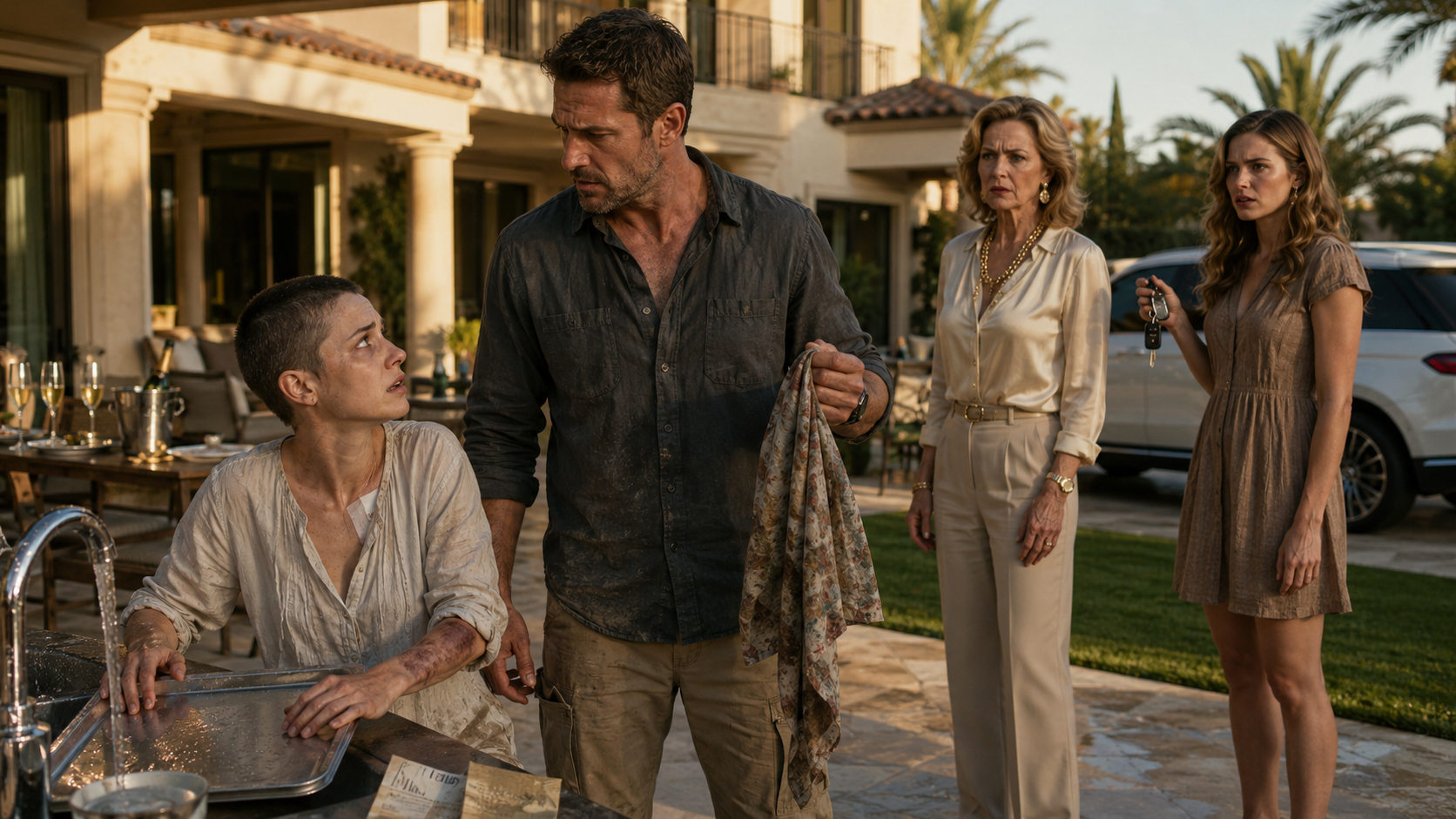
Natalie was crouched beside the outdoor utility sink behind our house, scrubbing silver serving trays beneath a hard stream of water. The late-afternoon Arizona heat pressed down on the patio, bright enough to make the stone tiles shimmer. Her sleeves were rolled to her elbows.
Her arms looked too thin.
Not tired.
Not stressed.
Thin.
A faded blue scarf covered her head, tied behind her neck.
Her hands trembled as she worked.
And from somewhere above us, my mother shouted, “Natalie! I said get those finished before the guests arrive. I don’t want you wandering around when people are here.”
I stood just beyond the corner of the house with my duffel bag still over my shoulder.
My first thought was that I had driven to the wrong home.
That sounds ridiculous.
I knew the address.
I had paid the mortgage on that house for six years.
I had chosen the tile Natalie was kneeling on.
But almost everything else had changed.
There were new stone planters along the driveway. Imported-looking patio furniture sat beneath a motorized awning I had never seen before. A pearl-white luxury SUV gleamed beside the garage.
Through the French doors, I could see a massive new sectional sofa.
Crystal glasses.
Fresh flowers.
The whole place looked like a magazine spread.
For one brief, stupid second when I had pulled into the driveway, I had felt proud.
I had thought, Mom really has been taking care of things.
Then I saw Natalie.
She must have sensed me because she turned.
The plate in her hand slipped against the stainless-steel sink.
Her eyes widened.
“Ethan?”
The way she said my name nearly broke me.
Not joy.
Fear.
She looked like someone who had been caught doing something forbidden.
I dropped my bag.
“Natalie.”
She stood too quickly and had to catch herself against the counter.
I crossed the patio in three strides.
Up close, the changes were worse.
Her cheeks had hollowed. Her skin looked almost translucent. There were dark circles beneath her eyes. The oversized blouse she wore seemed to hang from her shoulders instead of fit them.
“What happened to you?”
“I—”
The balcony doors slid open above us.
My mother stepped outside.
Lorraine had always known how to enter a room as though it belonged to her.
Even when I was a kid, even when she was exhausted after ten-hour shifts at the bank, she had carried herself with the crisp confidence of someone who believed panic was a character flaw.
Now she wore a cream silk blouse, tailored slacks, gold bracelets, and earrings I did not recognize.
Her expression changed when she saw me.
“Ethan?”
I looked from her to Natalie.
“Surprise.”
For half a second, my mother’s face went blank.
Then she smiled.
“My God. You’re early.”
“Three days.”
“We thought you were coming Friday.”
“I finished the site report.”
She came down the patio stairs quickly.
“Well, you should have called.”
That sentence stayed with me.
Not I’m so happy to see you.
Not You must be exhausted.
You should have called.
Behind her, another figure appeared.
My sister Brooke.
She held a set of car keys in one hand.
The keys had a silver emblem matching the new SUV in the driveway.
Brooke gave me a cautious smile.
“Hey, stranger.”
I looked at Natalie again.
She had lowered her eyes.
“What is going on?”
My mother stopped beside me.
“What do you mean?”
I pointed to the sink.
“To start with, why is my wife washing serving trays outside?”
Lorraine sighed.
It was the exact sigh she used when a cashier made a mistake or a waiter forgot her lemon.
“Because she insisted on helping.”
Natalie looked up.
My mother saw it.
Her voice sharpened.
“Isn’t that right?”
Natalie swallowed.
I saw the fear cross her face.
That was when I noticed the bruises.
Three dark marks around her upper arm.
Finger-shaped.
Something inside me went cold.
Brooke walked onto the patio.
“She has been difficult,” she said.
I stared at her.
“Difficult?”
Brooke shrugged.
“You’ve been gone a long time.”
“I’ve been working.”
“No one said you weren’t.”
“Then explain what I’m looking at.”
Natalie stepped toward me.
“Ethan, maybe we should go inside.”
Her scarf shifted slightly.
I saw pale skin beneath it.
No hairline.
I reached toward the fabric.
Natalie flinched.
I stopped immediately.
My hand stayed suspended between us.
“Can I?”
Her eyes filled.
Then she nodded.
I untied the scarf.
The fabric loosened and fell into my hand.
Her hair was gone.
Not thinning.
Not patchy.
Cut nearly to the scalp.
I stared.
My heartbeat became so loud I could hear it.
Natalie had always loved her hair.
It had been long when I met her, dark brown and thick enough that she complained it took forever to dry.
Whenever I left for a project, she used to tease me that she’d cut it short while I was gone.
She never did.
Now there was almost nothing left.
“What happened?”
My mother folded her arms.
“Do not let her manipulate you.”
I turned slowly.
“What did you say?”
“She shaved it for attention.”
Natalie closed her eyes.
Brooke nodded quickly.
“She’s been impossible, Ethan. Seriously. Crying. Making accusations. Acting like we’re abusing her whenever we ask her to do anything.”
I looked down.
Natalie’s hands were red from hot water.
“Ask her?”
Neither of them answered.
Then I noticed the corner of a medical bandage beneath Natalie’s collar.
Everything inside me narrowed to that tiny square of white gauze.
“What is that?”
Natalie touched her chest.
“Ethan—”
“What happened?”
My mother spoke before she could.
“She had a minor procedure. She has exaggerated the entire situation.”
I looked at Natalie.
She was crying silently now.
Not dramatically.
Not loudly.
Tears simply slipped down her cheeks.
I wanted to grab my mother by the shoulders and demand the truth.
I wanted to call Brooke every name I knew.
I wanted to smash the champagne glasses visible through the window.
Instead, something years of field work had taught me took over.
When equipment failed in the desert, you did not start ripping cables out because you were angry.
You stopped.
You assessed.
You found the failure.
Then you shut the entire system down safely.
My mother had managed my finances for years.
Six years earlier, when I began traveling constantly for a solar engineering company, Lorraine had offered to handle the bills.
She had spent almost thirty years in banking.
I trusted her.
Eventually I had signed a limited power of attorney so she could deal with the mortgage, insurance, contractors, taxes, and investment transfers while I spent weeks at a time in places where cell service sometimes vanished entirely.
Every month, I sent money home.
A lot of money.
I lived cheaply in trailers and motels because I believed Natalie and I were building something secure.
By my rough calculation, more than two hundred thousand dollars had passed through the accounts my mother supervised.
Now there was a luxury SUV in my driveway.
Gold on my mother’s wrists.
And my wife was washing trays outside without any hair.
If I exploded now, Lorraine could move money before I understood where it was.
She could destroy records.
She could invent a story.
And looking at Natalie’s fear, I realized she already had.
So I smiled.
It may have been the hardest thing I had ever done.
Brooke’s eyebrows rose.
My mother relaxed slightly.
“I think,” I said, “everyone’s emotional because I showed up unexpectedly.”
Natalie stared at me.
I glanced at her once.
Just once.
Then back at my mother.
“I’ve had a long drive.”
Lorraine’s mouth softened.
“Exactly. Come inside. We’ll talk.”
I nodded.
“Actually, I have some good news.”
Brooke stopped turning the SUV key around her finger.
“What kind of good news?”
I pretended to hesitate.
“I wasn’t planning to say anything until Friday.”
My mother’s interest sharpened instantly.
“Say what?”
“My company’s restructuring.”
Lorraine frowned.
“Are you losing your job?”
“Technically.”
Brooke’s face fell.
I almost laughed.
Then I added, “But they’re buying out several long-term field contracts.”
My mother said nothing.
I let the silence breathe.
“The package they’re discussing for me is around nine hundred thousand dollars.”
Brooke’s lips parted.
My mother took one step toward me.
“Nine hundred thousand?”
“Before taxes.”
The atmosphere changed.
Instantly.
It was almost beautiful in its ugliness.
Brooke’s concern vanished.
My mother’s shoulders relaxed.
Even her voice warmed.
“My goodness, Ethan.”
“There is one complication.”
“What?”
“The company doesn’t want ownership disputes when it releases the funds. Their lawyers want confirmation that assets acquired with my employment income are properly titled.”
Lorraine’s expression tightened.
I continued before she could think too hard.
“They’ll need everything purchased through my accounts transferred into my name before the package is finalized.”
Brooke’s fingers closed around the SUV keys.
My mother glanced at them.
Tiny movement.
But I saw it.
I smiled.
“Shouldn’t be a problem.”
Lorraine recovered quickly.
“Of course not.”
“Great.”
I picked up my duffel bag.
“Then tomorrow we can straighten out the paperwork.”
Natalie was still staring at me.
She understood something was happening.
She just didn’t know what.
My mother reached for my arm.
“Tonight we celebrate.”
Behind us, Natalie quietly picked up the scarf.
I turned toward her.
“She celebrates too.”
Lorraine gave a little laugh.
“Naturally.”
But when our eyes met, there was no warmth in hers.
Only calculation.
That night they opened a bottle of champagne upstairs.
Natalie did not join us.
After ten minutes of pretending to listen to Brooke talk about restaurants, I excused myself.
“I need to shower.”
My mother nodded toward the hallway.
“Guest room is ready.”
I stopped.
“Guest room?”
She smiled too quickly.
“Natalie has been sleeping downstairs. She sleeps better alone lately.”
My stomach twisted.
I walked downstairs.
Natalie was waiting at the bottom of the steps.
She put one finger to her lips.
Then she led me through the laundry room.
Past shelves packed with cases of sparkling water.
Past cardboard boxes containing serving platters and unopened appliances.
To the storage room.
My wife had been sleeping on a cot between Christmas decorations and bulk paper towels.
There was a small fan on the floor.
A lamp.
A plastic cup.
The only window had been painted shut.
I stood in the doorway.
“No.”
Natalie looked down.
“No.”
My voice cracked this time.
She closed the door behind me.
“Please don’t yell.”
“Why are you sleeping here?”
She hugged herself.
“Because your mother said I was disturbing everyone upstairs.”
“Everyone?”
“Brooke moved in three months ago.”
Of course she had.
I pointed at the cot.
“You’ve been sleeping here?”
Natalie nodded.
“For how long?”
“Almost three months.”
My eyes burned.
I stepped closer.
“Nat. Tell me what happened.”
Her hands began shaking.
Then, slowly, she unbuttoned the top of her blouse.
She pulled the fabric aside.
A surgical dressing covered the upper part of her left breast.
I stopped breathing.
Natalie’s voice was barely audible.
“I have breast cancer.”
Upstairs, somebody laughed.
The sound came through the ceiling.
Bright.
Careless.
I looked at the woman I loved.
And for the first time in my life, I understood how a person could become capable of hating their own family.
PART 2: WHAT SHE SOLD TO STAY ALIVE
I sat on the edge of the cot because my knees stopped working.
Natalie remained standing for a few seconds, one hand holding her blouse closed.
Then she sat beside me.
“How long?”
“I found the lump about four months ago.”
Four months.
I had been in New Mexico four months ago.
Sleeping in a construction trailer beside an unfinished solar field while Natalie called me every night and told me everything at home was fine.
“You didn’t tell me.”
“I tried.”
The words hit harder than if she had accused me.
“What do you mean, you tried?”
She looked toward the door.
Even with it locked, she lowered her voice.
“I called you the day after I found it.”
I remembered the call.
Barely.
It had been during a site inspection.
Natalie had sounded distracted.
I had asked if she was okay.
She told me she was tired.
“You said you were fine.”
“Your mother was standing beside me.”
I looked at her.
“She was listening?”
Natalie nodded.
“Afterward she told me there was no reason to scare you before we knew anything.”
That sounded exactly like Lorraine.
Practical.
Reasonable.
Always packaged that way.
“So you went to a doctor?”
“I tried to schedule a mammogram. The clinic said there was a problem with the insurance.”
My stomach sank.
“What problem?”
“Your mother told me the policy had expired.”
“That is impossible.”
“I know that now.”
I stared at her.
“My company deducts the premium automatically.”
“She said you had changed plans. She said the paperwork wasn’t complete.”
I stood.
Natalie grabbed my wrist.
“Ethan.”
I looked toward the ceiling.
“I will kill them.”
“No.”
“They knew?”
“I don’t know what Brooke knew at first.”
“My mother knew.”
“Yes.”
The word was soft.
Certain.
I sat again.
“Tell me everything.”
She inhaled slowly.
“The doctor wanted imaging. Your mother said we should wait until the insurance issue was fixed. I asked her for money.”
“How much?”
“At first, not much. A few hundred for the imaging.”
“And?”
“She said the household accounts were tight.”
I laughed once.
It sounded ugly.
Above our heads sat thousands of dollars’ worth of furniture.
The vehicle outside alone probably cost more than some people’s annual salaries.
“What happened next?”
“The lump got bigger.”
Natalie stared at her hands.
“I started getting scared.”
“Why didn’t you call me from someone else’s phone?”
“I did.”
I turned.
“What?”
“I called from the pharmacy once. You didn’t answer.”
I remembered a missed Arizona number.
I had been forty miles from the nearest town.
“I called back.”
“Your mother answered your phone call at the house.”
My pulse thudded.
“She told you it was a wrong number?”
I remembered.
A woman had answered our home line.
Lorraine.
She said someone had probably misdialed.
I had thought nothing of it.
Natalie continued.
“After that, she took my phone.”
“She took it?”
“She said I was becoming unstable.”
My hands curled into fists.
“She told Brooke I was panicking over nothing and obsessing about being sick. They started treating me like I couldn’t be trusted.”
“Why would Brooke believe that?”
Natalie hesitated.
“Because your mother told her I wanted control of your money.”
I looked at the boxes around us.
Something clicked.
“My money.”
Natalie nodded.
“She said you were sending everything to her because you had lost confidence in me. That I spent too much.”
I almost choked.
“You?”
Natalie smiled sadly.
“I know.”
Natalie had argued with me for two weeks before buying a hundred-and-fifty-dollar coffee maker.
Meanwhile Brooke was driving a pearl-white SUV.
“Then what?”
“I went to a women’s clinic.”
“How?”
“Bus.”
Her eyes dropped.
“I sold a few things first.”
“What things?”
“Jewelry.”
“Which jewelry?”
She did not answer.
Then I noticed her left hand.
Her wedding band was there.
But the small diamond bracelet I had given her on our tenth anniversary was gone.
So were the gold earrings her grandmother had left her.
“What else?”
She touched the side of her head.
I looked at the scarf lying beside us.
The room seemed to tilt.
“No.”
“The clinic needed four hundred dollars for the biopsy deposit.”
“No.”
“I had two hundred and thirty.”
“Natalie.”
She swallowed.
“There was a wig shop near the bus station. They buy untreated hair.”
I shut my eyes.
“I got four hundred dollars.”
My wife had sold her hair so she could find out if she was dying.
And somewhere upstairs my mother was drinking champagne purchased with money I had earned while missing half my marriage.
I put both hands over my face.
For years I had told myself I was sacrificing for Natalie.
That every lonely motel room, every canceled vacation, every missed birthday was building our future.
And while I was out there congratulating myself for being a good provider, she had been trapped inside my own house.
“I am sorry.”
She turned toward me.
“This isn’t—”
“I am sorry.”
I couldn’t stop saying it.
She touched my wrist.
“You didn’t know.”
“I should have.”
“How?”
“I should have called more.”
“You called every day.”
“I should have come home.”
“You were working.”
“For what?”
My voice broke.
I gestured around the storage room.
“For this?”
Natalie leaned against me.
I held her carefully.
She felt so light.
“When did you get the results?”
“Three weeks ago.”
“What stage?”
“They don’t know everything yet. The biopsy confirmed cancer. I need more scans.”
“Why haven’t you gotten them?”
She looked at me.
I already knew.
“Money.”
She nodded.
I stood again.
This time I didn’t say anything.
I simply paced.
My brain began assembling pieces.
The insurance.
The missing phone.
The money.
The bruises.
“Who grabbed your arm?”
Natalie touched the marks.
“Brooke.”
I froze.
“Why?”
“She caught me trying to use her phone.”
“To call me?”
“Yes.”
“What happened?”
“She took it. I tried to get it back.”
“And my mother?”
“She told Brooke to stop. Then she said if I kept behaving like that, she would call a doctor and tell them I was having some kind of breakdown.”
Natalie laughed bitterly.
“She said nobody would believe a sick woman who was clearly hysterical.”
I sat beside her again.
“Listen to me. Are you in immediate medical danger tonight?”
“I don’t think so.”
“Pain?”
“Some.”
“Fever?”
“No.”
“Bleeding?”
“No.”
“Tomorrow I am taking you to a doctor.”
Her face tightened.
“What about your mother?”
“I’m going to give her exactly what she wants.”
Natalie stared at me.
“Why?”
“Because I need her relaxed.”
I explained the power of attorney.
The accounts.
The transfers.
How Lorraine still had legal access she could abuse before I could revoke everything properly.
Natalie listened in silence.
“So the nine hundred thousand?”
“Doesn’t exist.”
For the first time that night, something flickered across her face.
Not happiness.
But recognition.
“You lied.”
“I lied.”
“To your mother.”
“Yes.”
A faint smile touched her mouth.
I had not realized how much I missed seeing that.
“What are you going to do?”
“First, tomorrow morning, I revoke the power of attorney.”
“She’ll notice.”
“Eventually.”
“And the accounts?”
“I’ll freeze what I can and document everything.”
“Ethan, what if she has already spent it?”
“Then we find out how much.”
Natalie’s gaze drifted toward the ceiling.
“You don’t understand how good she is at explaining things.”
“I do.”
“No.” She shook her head. “You understand her as your mother.”
That stopped me.
“She can make cruelty sound responsible. She can make you feel embarrassed for questioning her.”
I remembered being fourteen and apologizing for being upset when she missed my school play because she had been working.
I remembered being twenty-two and signing financial forms I barely read because she said she understood them better.
Natalie continued.
“She told me you were tired of me.”
I felt physically sick.
“What?”
“She said you kept extending your assignments because being home made you unhappy.”
“Natalie—”
“I didn’t believe her at first.”
“At first?”
“She knew details.”
Of course she did.
My mother had access to my travel schedule.
My work correspondence occasionally went to the house.
She knew when I changed projects.
When I volunteered for overtime.
“She said you had asked her to protect your money from me.”
“I never said that.”
“I know.”
“Look at me.”
She did.
“I never said that.”
Her eyes filled again.
“I know now.”
“No. I need you to hear it from me. I did not stay away because I wanted to escape you. I thought I was helping us.”
“I know.”
“I was stupid.”
“You trusted your mother.”
“I trusted the wrong person with the right things.”
Natalie looked down.
Then she whispered, “She trusted you to stay gone.”
That sentence stayed in my chest.
Upstairs, footsteps crossed the kitchen.
Someone opened a cabinet.
Natalie stiffened.
I touched her hand.
“From now on, you don’t do anything they tell you to do unless it helps us get through tomorrow.”
“What if they know I’ve told you?”
“They won’t.”
“How?”
“Because you’re going to go upstairs with me.”
Her fear returned.
“Ethan—”
“And I’m going to act like I believe them.”
She searched my face.
“They’ll say terrible things.”
“I know.”
“They’ll lie.”
“I know.”
“They’ll try to make you doubt me.”
I took both her hands.
“Then we let them.”
“What?”
“We let them think it’s working.”
She stared.
“And while they do that, we collect everything.”
Her breathing slowed.
I saw the moment she understood.
Not revenge.
Not yet.
Something more important.
A way out.
“Tomorrow,” I whispered, “I will pretend I believe every lie they tell me.”
“And then?”
I looked toward the ceiling.
“Then I take back everything—and make sure they can never rewrite what they did to you.”
The floor creaked outside the storage room.
A shadow appeared beneath the door.
Then my mother’s voice came softly from the hallway.
“Ethan?”
Natalie went pale.
My mother tried the handle.
Locked.
A pause.
“What are you two doing in there?”
I looked at Natalie.
Then I smiled.
The performance was about to begin.
PART 3: THE PRICE OF BELIEVING A LIAR
I opened the door wearing the tired expression of a husband who had just received very inconvenient news.
My mother stood outside in her silk blouse.
She glanced past me at Natalie.
“What happened?”
I rubbed my face.
“You were right.”
Natalie’s eyes flashed toward me.
Lorraine tilted her head.
“About what?”
“This is more complicated than I realized.”
My mother stepped closer.
“I tried to tell you.”
“I know.”
Natalie looked down.
It hurt to see her do it.
But we had agreed.
My mother had to believe she still controlled the story.
I walked into the laundry room.
Lorraine followed.
“Natalie says she has cancer.”
My mother released a heavy breath.
“Yes.”
“You knew?”
“She had a biopsy.”
“And you didn’t tell me?”
“I was waiting until we had something concrete.”
“She says the biopsy was positive.”
My mother’s face barely changed.
“She told us that.”
Us.
As though she had been part of a family council.
I leaned against the washing machine.
“Why is she sleeping in there?”
Lorraine lowered her voice.
“She has been volatile.”
Natalie said nothing.
My mother’s confidence grew.
“She hardly eats, then complains she’s weak. She cries constantly. She picks fights with Brooke. She tried to steal Brooke’s phone.”
I looked at Natalie.
She played her role perfectly.
Her face crumpled.
“I wasn’t stealing—”
“Please,” I said quietly.
She stopped.
My mother watched me.
I could practically feel her relief.
“Ethan, I know this is difficult.”
“Was the insurance really canceled?”
That question made her blink.
Only once.
Then she recovered.
“There was a lapse.”
“How?”
“Administrative mistake.”
“Whose?”
“The insurer’s.”
“Do you have the letters?”
“I believe so.”
“Good.”
“Why?”
“The company’s lawyers are going to need a complete financial picture.”
The words company’s lawyers worked like magic.
Her posture shifted.
“Oh.”
“They want records from the last several years. Assets, insurance, major purchases. Normal stuff.”
Brooke appeared at the stairs.
“How detailed?”
I looked at her.
“Pretty detailed.”
Her hand went instinctively toward the SUV keys in her pocket.
I pretended not to notice.
“The good news is, once they confirm everything, the separation package can move quickly.”
Lorraine smiled.
“We’ll organize whatever you need.”
“I knew I could count on you.”
Her face softened with pride.
That almost made it worse.
I had spent my life feeding that pride.
The next morning, I woke before sunrise.
Natalie had slept beside me in our bedroom.
Not the storage room.
I had insisted.
My mother had objected once, saying Natalie needed “quiet,” but I told her I wanted my wife with me.
Lorraine gave in.
At five thirty, I quietly photographed the bruises on Natalie’s arm and the room where she had been sleeping.
The cot.
The painted window.
The medical paperwork hidden in a grocery bag beneath a stack of towels.
The receipt from the wig shop.
Four hundred dollars.
I stared at that receipt for a long time before photographing it.
At seven, I called the bank.
By eight fifteen, I was sitting in a branch office with Natalie beside me.
My mother believed we were meeting a company attorney.
Instead, I revoked her authority.
The bank representative was careful not to react when I explained why.
“We can terminate access associated with the power of attorney immediately,” she said. “You’ll also want to review authorized users and linked transfers.”
“I want copies of everything.”
She printed records.
Years of records.
I watched numbers appear on paper.
Transfers.
Withdrawals.
Credit-card payments.
Vehicle payments.
Furniture retailers.
Jewelry stores.
Restaurants.
Spa charges.
A down payment on the SUV.
My hands went numb.
Natalie touched my knee beneath the desk.
The representative looked at me.
“Mr. Carter, would you like us to freeze discretionary transfers while you review these?”
“Yes.”
“Your mother may receive alerts when certain privileges are removed.”
“How soon?”
“Potentially immediately.”
I checked my phone.
Nothing.
Yet.
We left the bank and drove directly to the hospital.
That was the part that mattered.
Not the money.
Not the trap.
Natalie.
A patient coordinator helped restore clarity to the insurance situation within thirty minutes.
The policy had never expired.
There had been no lapse.
No administrative mistake.
It had been active the entire time.
I sat very still in a plastic chair.
Natalie stared at the floor.
The coordinator said, “Your coverage shows continuous enrollment.”
“You’re certain?”
“Yes.”
I looked at my wife.
She closed her eyes.
For four months she had believed she could not afford care.
Because my mother told her so.
The doctor ordered imaging and additional tests.
I stayed through every appointment.
When Natalie changed into a hospital gown, she started crying.
I thought she was afraid of the scan.
Then she whispered, “I forgot what it feels like when someone believes me.”
I held her face in my hands.
“That is never happening again.”
By noon, my phone was vibrating constantly.
MOM.
MOM.
BROOKE.
MOM.
Finally I answered.
“Hey.”
My mother’s voice was controlled.
“Where are you?”
“At the lawyer.”
“Which lawyer?”
“Company’s.”
A pause.
“I tried to access the household account.”
“Yeah, they said that might happen.”
“What might happen?”
“Temporary restrictions during verification.”
“What did you authorize?”
“Nothing major.”
Natalie looked at me.
I put the call on speaker without saying so.
My mother asked, “Why was my power of attorney revoked?”
There it was.
I stared at the road.
“Because the separation agreement requires everything directly under my control.”
Silence.
Then, “You could have discussed that with me.”
“Sorry. Lawyers.”
The word annoyed her now.
“Ethan, I have managed those accounts for years.”
“I know.”
“I deserve more respect than finding out through a bank notification.”
“I said I’m sorry.”
Another pause.
Then her voice warmed.
“Come home. We’ll go through the asset records together.”
“Perfect.”
I ended the call.
Natalie looked at me.
“She knows something is wrong.”
“She suspects.”
“What now?”
“Now we let greed beat suspicion.”
We went home at three.
My mother had arranged folders across the dining-room table.
Brooke sat nearby.
Neither smiled.
I placed my briefcase down.
Lorraine tapped the documents.
“Mortgage. Utilities. Investments. Home improvements.”
“Great.”
She watched me carefully.
“Your package really is nine hundred thousand?”
I laughed lightly.
“Possibly more if the deferred incentive is approved.”
Brooke sat forward.
“How much more?”
My mother shot her a look.
I pretended to consider.
“Maybe another hundred.”
One million dollars.
The number filled the room.
Brooke’s suspicion disappeared first.
My mother’s took longer.
But not much longer.
“What exactly needs transferring?” Lorraine asked.
I opened my notebook.
“Anything bought primarily using my employment income but registered under someone else’s name.”
Brooke leaned back.
“The SUV?”
I shrugged.
“Probably.”
She looked at my mother.
Lorraine answered quickly.
“That’s fine.”
Brooke stared at her.
“What?”
My mother smiled tightly.
“Temporarily.”
I almost admired the calculation.
They believed they were giving up ownership today to receive a share of a million dollars tomorrow.
I pushed papers across the table.
“The attorney prepared standard transfer declarations.”
That part was true.
Just not the attorney they imagined.
I had spent an hour with a lawyer recommended by the bank.
He explained that assets purchased with funds traceable to my accounts could be documented and, depending on ownership records, recovered or transferred voluntarily.
Voluntary was easier.
So I offered voluntary.
Lorraine signed first.
Household assets.
Certain investment interests.
The vehicle.
Brooke stared at the SUV transfer form.
“You’re really going to put it back afterward?”
I looked her directly in the eyes.
“Why wouldn’t I?”
She signed.
The answer satisfied her because she still believed I was the same brother who trusted them.
Then my mother did something I had not expected.
She handed me another folder.
“These are the investment statements.”
I opened it.
The balance was far lower than it should have been.
I looked up.
Lorraine spoke before I could ask.
“The market has been rough.”
That was almost funny.
Not because it was remotely convincing.
Because it showed how long she had survived by speaking confidently around people who loved her.
I nodded.
“Lawyers can sort it out.”
She smiled.
That evening my mother hosted dinner for two of her friends.
Natalie sat beside me.
Lorraine had apparently decided hiding her would now look suspicious.
One of the women leaned toward Natalie.
“Lorraine told us you’ve been unwell.”
Natalie’s fork stopped.
My mother answered for her.
“Nothing we can’t handle.”
We.
I looked at Natalie.
She slowly lifted her gaze.
“Yes,” she said. “Lorraine has handled almost everything.”
My mother’s smile froze.
I put my hand over Natalie’s.
“Actually, Nat has another oncology appointment tomorrow.”
The entire table went quiet.
Brooke’s fork clicked against her plate.
Lorraine turned toward me.
“Another?”
“Yes.”
“You didn’t mention that.”
“I just did.”
Her eyes hardened.
I smiled.
“You okay, Mom?”
“Of course.”
But the balance had shifted.
She knew it.
I knew it.
Natalie knew it.
And beneath the table, my wife squeezed my hand.
Not because she was frightened.
Because for the first time in months, somebody else was starting to feel trapped.
PART 4: THE RECORD THEY COULDN’T ERASE
My mother knocked on our bedroom door at midnight.
I was awake.
So was Natalie.
“Ethan?”
I opened the door halfway.
Lorraine stood in the hallway wearing a robe.
Her face looked older without makeup.
“We need to talk.”
“Tomorrow.”
“Now.”
I stepped outside and closed the door behind me.
“What is it?”
She crossed her arms.
“You’re treating me like a criminal.”
Interesting choice of word.
“I haven’t accused you of anything.”
“You froze the accounts.”
“Standard procedure.”
“You revoked my power of attorney.”
“Standard procedure.”
“You took Natalie to a doctor without telling me.”
That one almost shattered my composure.
“My wife doesn’t need your permission to see a doctor.”
Lorraine’s mouth tightened.
“I did not say she did.”
“You sounded like it.”
“Ethan, you have been home less than forty-eight hours. I have been dealing with this for months.”
“With what?”
She gestured toward the bedroom.
“With her.”
I felt my jaw tighten.
“She is sick.”
“She is also manipulative.”
“Explain.”
My mother looked relieved.
She thought the opening had arrived.
“She blames me for everything.”
“Such as?”
“The insurance.”
“Was it canceled?”
Lorraine paused.
“I told you there was confusion.”
“That’s not what I asked.”
She stared at me.
I waited.
Finally she said, “I may have misunderstood a notice.”
“A notice.”
“Yes.”
“Do you still have it?”
“No.”
Of course not.
I nodded slowly.
“What about her phone?”
Lorraine’s eyes narrowed.
“What about it?”
“She says you took it.”
“She was making hysterical calls.”
“To who?”
“Anyone who would listen.”
“She says she tried calling me.”
“That is not how I remember it.”
“Did you take her phone?”
“She needed rest.”
“Yes or no?”
My mother’s voice sharpened.
“Do not interrogate me in my own home.”
There it was again.
My own home.
I almost corrected her.
Then decided to save it.
“Fine.”
I turned toward the bedroom.
She grabbed my arm.
“Ethan.”
I looked down at her hand.
She released me.
Her voice softened.
“I am your mother.”
“I know.”
“Everything I have done has been for this family.”
“That is what I always believed.”
The wording landed.
Her face changed slightly.
Before she could respond, I went inside.
Natalie was sitting upright.
“How much did you hear?”
“Enough.”
I climbed into bed beside her.
“She’ll start destroying things.”
“Probably.”
“Did we get enough?”
I looked at my phone.
Earlier that evening, I had copied every financial statement I could find.
I had photographed check registers.
Transfer confirmations.
Purchase invoices.
I had forwarded electronic records to the lawyer.
More importantly, Natalie had written a timeline.
Every attempt to obtain care.
Every request for money.
Every threat.
Every time Lorraine intercepted a call.
Every time Brooke took her phone.
We could not prove every sentence.
But we could prove enough of them that the rest became difficult to dismiss.
“We have enough to stop her from rewriting the financial history,” I said.
“And what about me?”
I turned.
“What do you mean?”
“What if she says I lied?”
“She will.”
Natalie looked away.
“I know.”
“Then we don’t argue with her version.”
“What do we do?”
“We show ours.”
The next morning, I drove Natalie to the hospital again.
The doctor discussed the next stages of treatment.
There were more tests ahead.
More waiting.
Words like surgery, lymph nodes, treatment plan.
I listened.
I took notes.
Natalie asked questions.
That mattered to me.
For months, other people had spoken over her.
Now every decision was hers.
On the drive home, she said, “I’m scared.”
“I know.”
“I don’t want you to keep saying everything will be okay.”
I looked at her.
She stared through the windshield.
“Because you don’t know.”
She was right.
So I didn’t say it.
“I am scared too.”
She turned toward me.
“But whatever happens next, you won’t face it alone.”
She nodded.
“That I believe.”
When we reached home, the SUV was gone.
So was Brooke.
My mother stood in the kitchen.
“Where is she?”
Lorraine did not look up.
“She went out.”
“With a vehicle she signed over yesterday?”
My mother set down her coffee cup.
“Don’t be petty.”
“Where did she go?”
“I don’t know.”
I took out my phone.
“Call her.”
“Ethan—”
“Call her.”
Lorraine stared at me.
Then she laughed.
It was a small, disbelieving sound.
“You really are doing this.”
“Doing what?”
“Turning against us because your wife has filled your head with poison.”
Natalie entered behind me.
My mother pointed at her.
“There. Look at her. She can barely hide how pleased she is.”
Natalie went still.
Lorraine continued.
“She has resented me for years.”
“I have never—”
“You hated that Ethan trusted me with the finances.”
Natalie’s face reddened.
“You told me he didn’t trust me.”
“Because he didn’t!”
The room went silent.
My mother realized what she had said.
I looked at her.
“Excuse me?”
She recovered instantly.
“I meant financially. He trusted my experience.”
“Then why tell Natalie that meant I didn’t trust her?”
“You’re twisting my words.”
“No.”
I took my phone out.
“I am finally listening to them.”
Lorraine stared at the screen.
“What is that?”
“A recording.”
Her face drained.
It was not a secret recording of previous conversations.
I had simply started recording when we came through the front door.
Arizona law allowed one-party consent, and I was part of the conversation.
The lawyer had made sure I understood what I could document.
My mother stepped toward me.
“You recorded me?”
“I documented what you said.”
“You have no right.”
“I have every right to record a conversation I’m part of.”
Natalie looked at me.
I hadn’t told her I was doing it.
I wanted her reactions to stay natural.
Lorraine’s eyes moved between us.
“This is disgusting.”
“No.”
My voice remained calm.
“What is disgusting is telling a sick woman her insurance is gone when it isn’t.”
“I made a mistake.”
“Then refusing her money for a biopsy?”
“We didn’t know it was necessary.”
“She found a lump.”
“People find lumps all the time.”
Natalie flinched.
I stepped between them.
“And while you were being cautious with her medical expenses, you bought jewelry.”
My mother said nothing.
“You paid twelve thousand dollars toward Brooke’s vehicle.”
Silence.
“Fourteen thousand in furniture.”
“Those were household expenses.”
“Spa charges?”
“Personal care.”
“Restaurants?”
“Networking.”
I almost smiled.
“Of course.”
She folded her arms.
“You sent me the money.”
“I asked you to manage it.”
“I did.”
“For who?”
“For this family.”
I pointed toward Natalie.
“She is my family.”
That finally cracked something.
My mother’s face changed.
Not remorse.
Anger.
“You never would have had this life without me.”
There it was.
The debt she had always believed I owed.
“I sacrificed for you,” she said.
“I know.”
“I worked when other mothers stayed home.”
“I know.”
“I put you through school.”
“With loans I paid back.”
“I gave you everything.”
“And because of that, you thought everything I earned belonged to you.”
“That is not what happened.”
“Then explain Brooke’s SUV.”
My mother looked toward the garage.
“She needed transportation.”
“She had a car.”
“It was unreliable.”
“It was four years old.”
“You make good money.”
The simplicity of the answer stunned me.
You make good money.
So they had spent it.
Because they believed abundance erased theft.
I looked at Natalie.
“You asked her for four hundred dollars.”
Her voice shook.
“Yes.”
My mother scoffed.
“You are dramatizing that.”
I turned back.
“She sold her hair.”
For the first time, Lorraine said nothing.
“She sold her hair because you would not give her four hundred dollars for a biopsy.”
“She chose to do that.”
I felt my vision narrow.
“What did you just say?”
“I didn’t cut it off.”
Natalie stepped forward.
Something changed in her face.
For months, fear had kept her quiet.
Now, finally, anger arrived.
“No,” she said. “You just told me that if I wanted to waste money proving I was sick, I could find it myself.”
Lorraine stared at her.
Natalie’s voice grew stronger.
“You told me Ethan would be furious if I touched household funds.”
“I said—”
“You told me he was already angry about my spending.”
“You were spending.”
“On groceries.”
“You ordered things online.”
“Medication.”
“You were unstable.”
“I was terrified.”
“And you made everyone else miserable.”
Natalie’s breathing quickened.
I reached for her, but she shook her head.
She wasn’t breaking.
She was speaking.
“You told me nobody would believe me.”
My mother glanced at the phone recording.
Natalie saw it.
A terrible, almost peaceful smile appeared on her face.
“But he does.”
The front door opened.
Brooke walked in.
She saw us.
Stopped.
Then looked at my mother.
“What happened?”
“Give me the keys,” I said.
Brooke frowned.
“No.”
“You signed the vehicle transfer.”
“You said you’d transfer it back.”
“I asked why I wouldn’t. I never promised I would.”
“You tricked me.”
“Yes.”
Her mouth fell open.
I almost regretted the satisfaction I felt.
Almost.
“The vehicle was purchased primarily from money taken from accounts I funded.”
“You gave Mom access.”
“To manage expenses.”
“So what? You’re rich.”
“No, Brooke.”
I stepped toward her.
“I worked.”
The room went quiet.
“I slept in construction trailers. I missed Christmas. I missed Natalie’s birthday twice. I stood in hundred-degree heat measuring land while telling myself it was worth it because I was building a life with my wife.”
Brooke’s face changed.
“This isn’t about your car.”
I pointed toward Natalie.
“It is about what you were driving while she sold her hair.”
Brooke looked at Natalie.
For once she had no answer.
“Keys.”
She looked at my mother.
Lorraine said, “Don’t.”
I held out my hand.
“Then I report the vehicle as unlawfully retained after transfer and let the lawyer deal with it.”
Brooke’s face went pale.
She dropped the keys into my palm.
The sound they made was tiny.
But to me, it sounded like the first lock opening.
PART 5: WHAT WAS LEFT WHEN THE MONEY WAS GONE
The truth did not come out in one dramatic explosion.
It came out in statements.
Receipts.
Dates.
Forms.
Messages.
That was almost worse for my mother.
She could argue with emotion.
She could dismiss tears.
She could call Natalie unstable.
But numbers did not care how confidently Lorraine spoke.
Over the next two weeks, we reconstructed as much as we could.
I had transferred a little over two hundred and six thousand dollars into accounts my mother had access to during the years I traveled.
Some of it had gone where it was supposed to.
Mortgage payments.
Taxes.
Utilities.
Repairs.
But tens of thousands had been spent on things that had nothing to do with Natalie or me.
Brooke’s vehicle.
My mother’s jewelry.
Trips.
Dining.
Furniture my mother had selected.
Membership fees.
Personal expenses.
Transfers into another account.
The lawyer explained our options carefully.
Not every bad decision was automatically a crime.
Not every unauthorized use would be easy to recover.
The existence of the power of attorney complicated some transactions.
But the documents did something more important than give me legal options.
They destroyed Lorraine’s version of reality.
She had spent months telling Natalie there was no money.
There had been money.
She had told Natalie the insurance was inactive.
It had been active.
She had told me Natalie was unstable.
Hospital records showed a woman seeking medical care after finding a breast lump.
She had told Brooke I wanted my finances protected from my wife.
No message, email, or document supported that claim.
And there was one thing I did not need a lawyer to resolve.
The house.
My name was on it.
Natalie’s was on it.
My mother’s was not.
When I told Lorraine she had thirty days to leave, she stared at me as though I had struck her.
“You’re throwing your mother out?”
“You have thirty days.”
“After everything I did for you?”
I had heard that sentence enough.
I placed the written notice on the table.
“You keep saying that.”
“Because it’s true.”
“You raised me.”
“Yes.”
“You worked hard.”
“Yes.”
“You sacrificed.”
“Yes.”
“And somewhere along the way, you decided that bought you ownership of the rest of my life.”
Her face tightened.
“That is cruel.”
“No.”
I looked toward the hallway where Natalie was resting after another appointment.
“Cruel is telling a woman with cancer that she can’t afford to find out if she has cancer.”
Lorraine looked away.
“You have reduced years of my life to one mistake.”
“One?”
She said nothing.
“Was taking her phone a mistake?”
“She was distressed.”
“Making her sleep in a storage room?”
“She wanted privacy.”
“Having her serve your guests?”
“She offered to help.”
“Bruises?”
Lorraine’s expression hardened.
“Brooke grabbed her. I told her not to.”
At least that part matched Natalie’s account.
“You still let it continue.”
“I was trying to maintain peace in the house.”
“My wife was afraid to walk into her own kitchen.”
Lorraine’s voice rose.
“She made me the villain before you even came home.”
“No. You did that.”
Her eyes filled.
For one dangerous second, I felt the old instinct return.
Comfort Mom.
Calm her down.
Tell her it wasn’t that simple.
That instinct had controlled me for most of my life.
I let it pass.
She wiped her cheek.
“So that’s it?”
“No.”
“What else could you possibly want?”
“I want Natalie’s phone.”
Lorraine stared.
Then walked to a kitchen drawer.
She pulled it open.
Natalie’s phone lay beneath a stack of takeout menus.
She had kept it.
Not lost.
Not broken.
Kept.
I picked it up.
The battery was dead.
“You told me she misplaced it.”
Lorraine said nothing.
That small lie ended something in me.
Maybe some part of me had still been waiting for an explanation big enough to make everything less ugly.
There wasn’t one.
The next morning, Brooke packed.
She did not apologize.
Not really.
She said, “I didn’t know how serious it was.”
Natalie answered, “You knew I was asking for help.”
Brooke cried.
“I thought you were trying to turn Ethan against us.”
“Why?”
“Mom said—”
Natalie stopped her.
“That is the problem. You never asked me.”
Brooke looked at me.
“What happens to me now?”
I almost laughed from exhaustion.
“You’re thirty-two.”
She stared.
“Figure it out.”
She moved out that afternoon.
My mother stayed twenty-six more days.
Every day felt strange.
The expensive furniture remained.
The cabinets were full.
The landscaping company still came on Thursdays until I canceled the service.
But the house felt hollow.
Lorraine barely spoke to Natalie.
When she did, I was present.
At night, Natalie and I went through treatment information.
The additional scans brought cautious news.
Her cancer was serious, but the doctors believed treatment options remained.
There were no promises.
There never are.
Natalie would need surgery and additional treatment.
We stopped pretending certainty was comfort.
Instead, we made smaller promises.
I would be at the next appointment.
She would tell me when she was scared.
I would tell her when I was scared.
Neither of us would protect the other with silence.
One evening, about a week before my mother’s move-out date, I found Natalie standing in front of our bathroom mirror.
She had removed her scarf.
Soft stubble had begun growing across her scalp.
She ran her hand over it.
I stood behind her.
“You okay?”
“I don’t know.”
I wrapped my arms around her waist.
She looked at us in the mirror.
“I hated seeing myself like this.”
I kissed her temple.
“The hair?”
“What it meant.”
I waited.
“That I had to sell something that was part of me because nobody would help.”
My throat tightened.
She continued.
“And then your mother told everyone I’d shaved it for attention.”
I rested my chin gently against her head.
“I can’t undo that.”
“I know.”
“But I can make sure it is never hidden.”
She turned toward me.
“You still want to take them to court?”
“If the lawyer thinks we should.”
“What do you want?”
That question surprised me.
Justice had become tangled with anger.
For two weeks I had fantasized about my mother sitting across from attorneys, being forced to explain every transaction.
About Brooke losing the SUV.
About every lie becoming a document.
But looking at Natalie, I realized revenge was not the center of this story.
She was.
“I want you alive,” I said.
Her face crumpled.
I held her.
“And after that?”
“After that, I want our life back.”
She laughed weakly.
“This life?”
“No.”
I looked around the oversized bathroom my mother had remodeled without asking us.
“Something smaller.”
Natalie smiled against my chest.
“Good.”
“What?”
“I always hated that sofa.”
I started laughing.
It came out at the wrong moment.
Then Natalie laughed too.
For almost a minute, we stood in the bathroom laughing at a piece of furniture while both of us cried.
It was the first time the house sounded like ours again.
My mother left on a Monday morning.
She had hired movers.
Of course she had.
I stood in the driveway as they loaded boxes.
Brooke came to help her.
The pearl-white SUV stayed in my garage.
I had already arranged to sell it.
I wanted nothing connected to those months sitting in front of our house.
Lorraine approached me before she left.
She handed me a small envelope.
“What is this?”
“Receipts.”
I opened it.
Inside were a few additional financial documents.
Nothing dramatic.
Nothing that changed the central truth.
Then I noticed a second piece of paper.
A handwritten note.
I did not read it immediately.
My mother stood beside the moving truck.
“I hope someday you understand that I was trying to protect you.”
I looked at her.
“From Natalie?”
“From being drained financially. From chaos.”
“My wife had cancer.”
“I didn’t know at first.”
“But when you did?”
Lorraine’s mouth tightened.
“You were away. You were under enormous pressure. I thought waiting for certainty—”
“She had certainty after the biopsy.”
My mother looked down.
“And then?”
No answer.
“That is the part you never explain.”
Her eyes filled again.
Maybe the tears were real.
It didn’t matter.
“You could have called me.”
“I was afraid of what you’d do.”
“What did you think I’d do?”
Her silence answered.
Come home.
Take control.
Question the money.
Lorraine’s face collapsed slightly.
I finally understood.
Natalie’s illness had not created my mother’s cruelty.
It had threatened my mother’s arrangement.
If I came home, I would see everything.
So she kept me away.
Kept Natalie quiet.
Controlled the information flowing in both directions.
Maybe she had convinced herself she was protecting me at first.
People can build astonishing lies out of small pieces of self-justification.
But at some point, she had chosen the lie over a sick woman.
That was the line I could not cross back over with her.
“I loved you,” Lorraine whispered.
I looked at her.
“I still love you.”
She seemed surprised.
“I just don’t trust you.”
Her face hardened.
“That is worse.”
“I know.”
I handed the note back without reading it.
She stared at it.
“You don’t even want to know what I wrote?”
“No.”
“Why?”
“Because for once, I don’t need your explanation before I believe what I saw.”
She left.
Brooke did not look at me as she drove away.
I stood in the driveway until the moving truck disappeared.
Then I went inside.
Natalie was at the dining-room table.
Her medical binder lay open in front of her.
The house seemed enormous without anyone else in it.
“Well?” she asked.
“She left.”
Natalie exhaled.
I sat across from her.
For a moment neither of us said anything.
Then she asked, “Do you feel better?”
I thought about it.
“No.”
She nodded.
“Me neither.”
That was another thing we had learned.
Justice was not always a feeling.
Sometimes it was simply removing someone’s ability to keep hurting you.
The lawyer continued pursuing recovery of money that had clearly been misused.
We sold the SUV.
We sold much of the expensive furniture.
Some of the money went directly toward deductibles, travel for care, and the costs insurance did not cover.
I reduced my field assignments.
When my company objected, I told them family circumstances had changed.
For years I had treated work like weather—something I had to endure because I had no choice.
Now I made one.
Less money.
More time.
Natalie started treatment.
Her hair began growing back before treatment took some of it again.
The irony almost broke her.
This time, however, she did not sell it.
This time, I was beside her when she chose to cut what remained.
She handed me the scissors.
“You do it.”
My hand shook.
“You sure?”
“Yes.”
She sat in our bathroom beneath the same light where she had once stared at herself and remembered humiliation.
I cut carefully.
When I finished, she looked in the mirror.
There were tears in her eyes.
But she was smiling.
“Better?”
I asked.
She touched her scalp.
“This time it was my choice.”
Months later, I found the faded blue scarf in a drawer.
I held it for a long time.
When I came home early that afternoon, that scarf had been the first sign that something was terribly wrong.
I used to think the most painful part of that day was seeing Natalie’s missing hair.
It wasn’t.
The worst part was realizing how easily love can be exploited when trust becomes automatic.
I trusted my mother because she was my mother.
I trusted Brooke because she was my sister.
I believed sending money home meant I was taking care of my family.
But money is not presence.
And trust without attention can become permission in the hands of the wrong person.
Natalie never asked me to choose between her and my family.
That was another lie my mother liked to tell.
There was no choice.
There was only a moment when I finally saw clearly who was being harmed and who was doing the harm.
After that, my responsibility was simple.
Believe what was in front of me.
Protect the person who had been silenced.
Follow the evidence.
And stop handing authority to people simply because I loved them.
One evening after treatment, Natalie and I sat on the back patio.
The outdoor sink was still there.
I had thought about tearing it out.
She stopped me.
“Leave it.”
“Why?”
She looked toward it.
“Because I don’t want that day erased.”
I watched her.
“I thought you’d hate seeing it.”
“I do.”
“Then why keep it?”
She leaned against me.
“Because I want to remember that was the day you came home.”
I swallowed.
Three days early.
Three days that had changed everything.
I took her hand.
The bruises were gone now.
The scars were not.
Some wounds do not disappear because justice arrives.
They simply stop being open.
Natalie rested her head on my shoulder.
“You really thought of the nine-hundred-thousand-dollar thing that fast?”
I smiled.
“I panicked.”
“That was you panicking?”
“Pretty much.”
She laughed softly.
“I believed you.”
“So did they.”
“That was the best part.”
I looked through the glass doors at our quiet house.
No champagne upstairs.
No strangers on the patio.
No one ordering my wife to hide.
Just us.
The future was still uncertain.
Cancer had not become less frightening because my mother was gone.
There were appointments ahead.
Scans.
Possibilities we did not discuss every night because we wanted to remain human beings, not walking medical charts.
But the uncertainty belonged to us now.
Not to Lorraine.
Not to Brooke.
Not to fear.
Us.
Natalie squeezed my hand.
“What are you thinking?”
I looked at the woman who had sold her hair for four hundred dollars because people living on my money told her she was worth less than their comfort.
Then I looked at the house I had nearly lost without ever leaving it.
“That I spent six years trying to build you a secure life.”
She waited.
“I should have been here to live it with you.”
She leaned closer.
“You’re here now.”
And this time, I did not insult either of us by promising that everything would be fine.
I simply held her.
Because being there was finally enough to begin.
Để lại một bình luận