
PART 1: THE WOMAN THEY THOUGHT THEY HAD BROKEN
My son laughed when he saw the bruises on my face.
Not loudly.
Daniel was too careful for that.
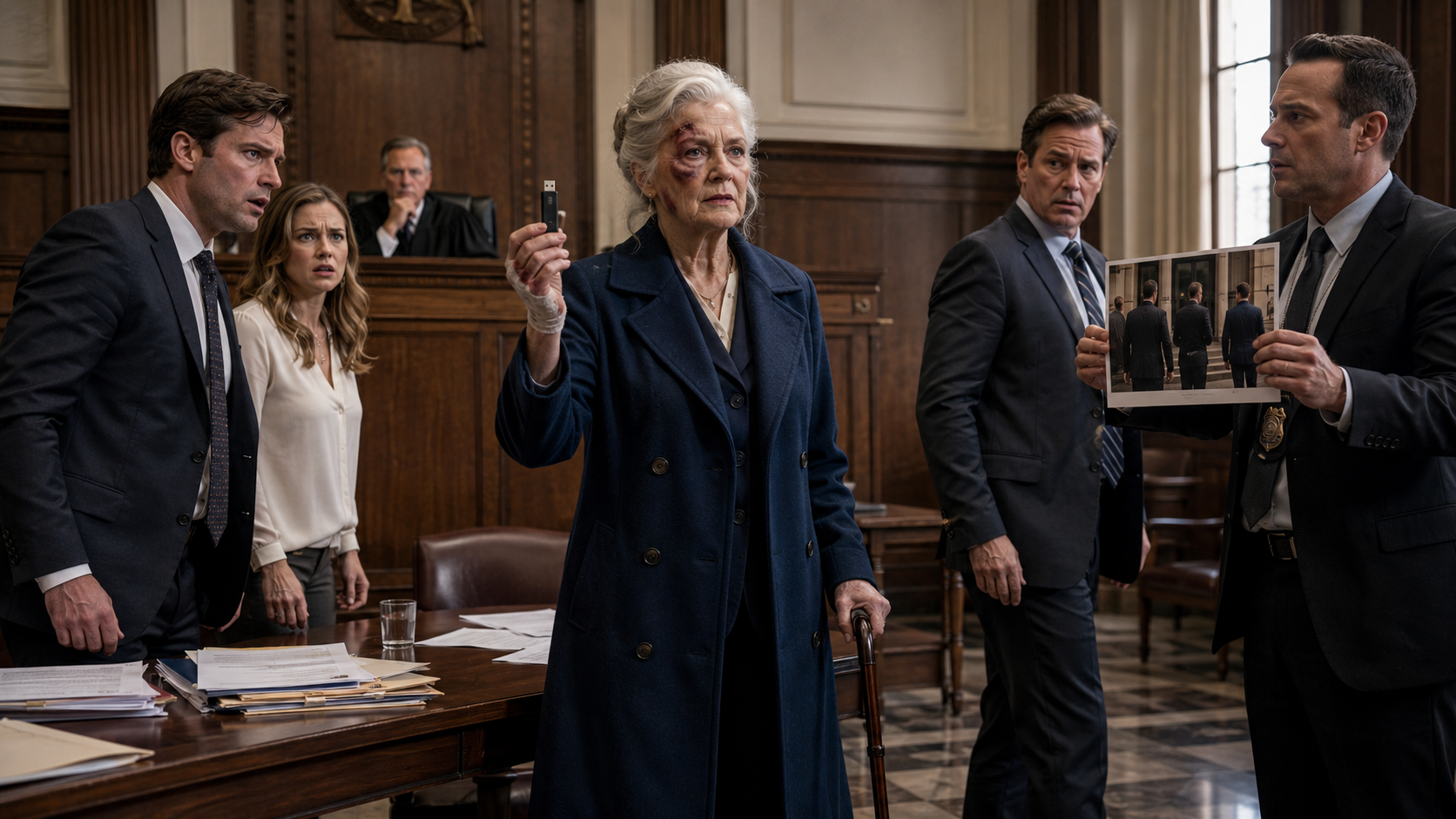
It was a short, ugly sound under his breath as I entered the courtroom with a swollen wrist, a fresh scar above my right eyebrow, and a cane in my right hand.
“There she is,” he whispered to his wife. “After today, she won’t have anything left.”
Vanessa lowered her eyes as though she were embarrassed by his cruelty.
But I saw the smile she was hiding.
I had learned to recognize that smile.
It was the same one she wore when she photographed the bruises she had helped put on my body.
I kept walking.
At seventy-one years old, I knew exactly what I looked like.
My silver hair was pinned neatly at the back of my head. I wore a navy wool coat Richard had bought me during our last winter together. My steps were slow because my left hip still hurt from being thrown against the hallway wall.
I carried no handbag.
No briefcase.
No attorney walked beside me.
To anyone looking at me for the first time, I was the perfect image of the woman Daniel and Vanessa had described in their emergency guardianship petition.
Fragile.
Forgetful.
Unstable.
A grieving widow who could no longer be trusted with her own money.
That was what they needed Judge Adrian Mercer to believe.
Their filing claimed that my mental health had deteriorated sharply after my husband Richard’s death. According to Daniel, I had begun wandering around my house confused. I supposedly forgot conversations, misplaced documents, left doors unlocked, and fell so frequently that I had become a danger to myself.
He had photographs to prove it.
My bruised cheek.
My swollen wrist.
The cut above my eyebrow.
The purple marks along my upper arms.
What the photographs did not show was how those injuries had actually happened.
I remembered every one of them.
I remembered Vanessa trapping me against the kitchen sink after I refused to give her the password to one of my private investment accounts.
I remembered her fingers tightening around my wrist.
“Stop being ridiculous, Elena.”
“It is my account.”
“It’s family money.”
“No,” I told her. “It is my money.”
Her face changed.
People reveal themselves in very small moments.
Sometimes it happens when they think no one important is watching.
Vanessa’s lips tightened.
Then she twisted.
Pain shot from my wrist to my shoulder so quickly that I cried out.
She leaned closer.
“You’re going to give us those passwords eventually.”
I looked directly into her eyes.
“No.”
She twisted harder.
That was the injury Daniel later described in court papers as the result of my “losing balance while attempting to carry a laundry basket.”
Then there was Daniel.
My only child.
The boy whose fever I had sat beside for three nights when he was six.
The teenager Richard taught to drive.
The young man whose first apartment deposit we paid because he had promised us he was finally ready to become responsible.
That same son shoved me against a hallway wall because I would not sign over the deed to my house.
“This house should be mine,” he screamed.
“It will belong to whoever I decide it belongs to.”
“You’re seventy-one!”
“And?”
“What are you saving everything for?”
I stared at him.
“For myself.”
He looked genuinely offended.
That was the moment I finally understood him.
Daniel did not think he was stealing from me.
He believed I was withholding something that already belonged to him.
After each attack, he would change his voice.
The anger would disappear.
His shoulders would soften.
He would crouch beside me and speak gently.
“You scared me, Mom.”
I would be sitting on the floor trying to catch my breath.
“You fell again.”
“You pushed me.”
His expression would become unbearably patient.
“No, Mom. I tried to catch you.”
Then he would touch my shoulder like a loving son.
“You need professional help. One of these days, you’re going to kill yourself in a fall.”
Vanessa would arrive with ice.
And her phone.
She always photographed everything.
Not for my doctor.
For their future court case.
They wrote down imaginary dates.
Invented episodes of confusion.
Told neighbors I had begun forgetting where I was.
Daniel convinced one woman two houses away that I had walked into the street wearing slippers and asked where Richard was.
That never happened.
But grief makes other people willing to believe almost anything about a widow.
Richard had died suddenly eight months earlier.
For forty-six years, he had been the first person I spoke to every morning.
Then one morning he was gone.
There were weeks when I barely slept.
Weeks when I walked into his study just to smell his books.
Weeks when I reached across our bed in the darkness before remembering there would never again be a warm shoulder beneath my hand.
Daniel took my grief and turned it into evidence.
That was the part I could not forgive.
Not the money.
Not even the house.
He weaponized the worst pain of my life against me.
Three weeks before the hearing, he changed my deadbolts.
I came home from a doctor’s appointment and found that my key no longer worked.
Daniel answered the door.
“What did you do?”
“You shouldn’t be staying here alone anymore.”
“Open the door.”
“We’re trying to help you.”
“This is my house.”
He sighed.
“You always make everything difficult.”
I slept at a hotel that night.
At midnight, my phone lit up.
Stop making this difficult.
I read his message twice.
Then I saved a screenshot.
Daniel thought silence meant surrender.
He had forgotten who raised him.
And apparently he had also forgotten what I had done for a living.
His attorney stood when the hearing began.
Julian Vance was elegant, silver-haired, and expensive. Richard had known him professionally for years, although Julian had never been my favorite person. He possessed the kind of courtroom voice that made every sentence sound reasonable before you had time to realize what he was actually saying.
“Your Honor,” he began, “this case is painful for everyone involved. Mr. Sterling loves his mother deeply. Unfortunately, Mrs. Sterling has suffered repeated physical injuries that demonstrate a serious decline in her ability to care for herself.”
Daniel lowered his head.
A grieving son.
A concerned son.
A son asking the state to protect his poor mother from herself.
Julian continued.
“My client is not requesting permanent authority today. He is simply requesting emergency temporary guardianship until qualified professionals can properly evaluate Mrs. Sterling’s condition.”
Temporary.
Such a comforting word.
But if Daniel gained temporary control, he would gain immediate access to my finances.
My accounts.
My property.
My records.
And, most importantly, Richard’s estate documents.
Julian placed several photographs on the display.
My bruises filled the courtroom screen.
“Mrs. Sterling has repeatedly been unable to explain how these injuries occurred.”
That was a lie.
I had explained.
Daniel simply made sure my explanation never appeared in his filings.
Julian turned toward me.
“Her son fears that without intervention, the next fall could be fatal.”
Daniel covered his mouth.
I almost admired the performance.
Then the courtroom clerk announced the judge.
We rose.
Judge Adrian Mercer entered, settled behind the bench, and opened the file.
For perhaps twenty seconds, he read silently.
Then he looked at me.
His eyes narrowed.
“Elena Sterling?”
I inclined my head.
“Good morning, Your Honor.”
He looked again at the file.
Then back at me.
“The Elena Sterling who worked with the state financial crimes division?”
The air changed.
Daniel lifted his head.
I saw confusion first.
Then irritation.
“Yes, Your Honor.”
Judge Mercer leaned slightly forward.
“The senior forensic accountant involved in the pension embezzlement investigation twenty-six years ago?”
“Yes.”
The judge removed his glasses.
“I remember that prosecution.”
So did half of Chicago.
I had spent eighteen months tracing stolen pension money through shell corporations, false invoices, offshore accounts, and relatives who suddenly developed a passion for luxury real estate.
My financial reconstruction eventually helped federal prosecutors prove exactly how the money had moved.
Executives went to prison.
Public officials resigned.
After I retired from state service, I built a small private consultancy specializing in financial elder abuse, fraudulent conservatorships, hidden assets, and stolen inheritances.
Daniel knew that.
At least, I had thought he did.
Apparently he had reduced my entire career to one sentence when speaking to Vanessa.
Mom used to do bookkeeping.
Judge Mercer glanced toward Daniel.
“Your petition makes no mention of your mother’s professional history.”
Daniel’s attorney answered.
“I don’t believe her former employment is relevant to her current cognitive state, Your Honor.”
“No. But it is certainly context.”
The judge turned to me.
“Mrs. Sterling, are you asserting under oath that the injuries shown in these photographs were not caused by accidental falls?”
“Yes, Your Honor.”
Daniel’s jaw tightened.
Judge Mercer studied me.
“How were they caused?”
I reached inside my coat.
For the first time that morning, Daniel stopped looking confident.
I removed a small flash drive.
“May I show you?”
Julian stood.
“Your Honor, we have not reviewed—”
“You’ll have an opportunity to object once I understand what Mrs. Sterling is offering.”
The clerk took the drive from me.
Daniel stared.
Vanessa stopped smiling.
The first video opened on the courtroom monitor.
My kitchen appeared.
The date was visible in the corner.
Vanessa stood between me and the doorway.
Her recorded voice filled the courtroom.
“Give me the password, Elena.”
“No.”
“You’re being childish.”
“It is a private investment account.”
“This money is going to end up ours anyway.”
My recorded voice remained calm.
“Then you should have no difficulty waiting until I’m dead.”
Someone in the courtroom inhaled sharply.
Vanessa grabbed my wrist.
On the video, I tried to pull away.
“Let go of me.”
“Give me the password.”
“No.”
She twisted.
My cry echoed through the courtroom.
Present-day Vanessa shut her eyes.
Daniel turned toward his attorney.
Julian was staring at the screen as if he had never seen either of them before.
I had installed the cameras after the first time Daniel shoved me.
Not large cameras.
Not obvious ones.
Richard and I had once spent our professional lives around people who lied when money was involved. We knew the value of records.
The next video showed my hallway.
Daniel had been drinking.
Richard’s good Scotch was visible in his hand.
“You’re seventy-one years old,” he shouted at me. “What do you need all this money for?”
“Because it belongs to me.”
“This house should belong to me.”
“No.”
The shove happened quickly.
My shoulder hit the wall.
My head snapped sideways.
I fell hard.
The courtroom remained completely silent after the recording ended.
Daniel suddenly stood.
“She provoked me!”
His lawyer grabbed his sleeve.
“Sit down.”
“She knows exactly how to push people!”
Judge Mercer slammed his gavel.
“Mr. Sterling.”
Daniel froze.
“If you offer one more spontaneous justification for assaulting your mother in my courtroom, I will have you removed.”
Daniel sat.
His face had turned red.
I had one recording left.
Richard’s study.
Daniel and Vanessa were kneeling beside Richard’s locked desk.
Vanessa held a small flashlight.
Daniel held a duplicated key.
“What exactly are we looking for?” she asked.
“The modified trust documents.”
“What if they’re in the bank box?”
“Then we’ll deal with that later.”
“And if your dad changed the beneficiaries?”
Daniel pulled open a drawer.
“It won’t matter once Mom is legally incompetent.”
Vanessa looked toward him.
“Why?”
“Because I’ll control everything.”
The video stopped.
Julian Vance stepped away from his clients.
“You told my office that every injury was accidental.”
Daniel glared at him.
“You told me guardianships like this get processed quickly.”
“When legitimate incapacity exists,” Julian snapped. “Not when a petitioner assaults the alleged incapacitated person.”
Judge Mercer denied the petition before Daniel could say another word.
He ordered my immediate access to my home restored.
He issued a protective order barring Daniel and Vanessa from coming within five hundred feet of me.
He directed that the recordings and guardianship filings be forwarded for investigation of domestic violence, coercion, and attempted financial exploitation.
Daniel looked stunned.
Vanessa looked terrified.
I should have felt victorious.
Instead, I felt tired.
A mother can win against her son and still feel like she has lost something no court can restore.
Then the rear courtroom doors opened.
A man in a dark suit entered beside a uniformed officer.
“Your Honor?”
Judge Mercer looked up.
“Yes?”
The man approached.
“Detective Thomas Reed, Chicago Police.”
Daniel stopped breathing.
At least, that was what it looked like.
Detective Reed placed a photograph before the judge.
Then another copy was passed to Julian.
A third eventually reached me.
The image had been taken outside a private bank.
I recognized the entrance immediately.
Richard stood in the center.
My dead husband.
Alive.
Wearing his charcoal coat.
The photograph had been timestamped three days before his death.
Walking beside him was Daniel.
Daniel, who had told me repeatedly that he had not seen his father during the final three weeks of Richard’s life.
And a few steps behind both men was Julian Vance.
In Julian’s hand was a large manila envelope.
The label was clearly visible.
MODIFIED REVOCABLE TRUST — CONFIDENTIAL
I looked up.
Julian had gone pale.
Daniel was worse.
Detective Reed spoke calmly.
“Based on newly recovered evidence and material inconsistencies regarding Mr. Richard Sterling’s final days, his death is being formally reviewed.”
My fingers tightened around the photograph.
Daniel stared at the floor.
For the first time since Richard died, I felt something colder than grief move through me.
Suspicion.
Because three nights before my husband’s sudden death, Daniel had been with him.
And my son had lied about it every single day since.
PART 2: THREE DAYS BEFORE RICHARD DIED
Detective Reed asked me not to leave immediately.
Daniel and Vanessa were escorted from the courtroom through another exit because of the protective order.
Watching my son disappear between two officers should have broken me.
Maybe some part of me had already broken months earlier.
The part that remained simply watched.
Julian stayed behind.
He had lost the polished certainty he carried into court.
“Mrs. Sterling,” he began.
I turned on him.
“Did you meet Richard at that bank?”
He hesitated.
That was enough.
“Answer me.”
“Yes.”
“When?”
“The date shown in the photograph.”
“Three days before he died.”
“Yes.”
My stomach tightened.
“And Daniel was there?”
Julian looked toward Detective Reed.
“I think this conversation should occur formally.”
“That’s a lawyer’s way of saying yes.”
He exhaled.
“Yes.”
I nearly struck him.
Instead, I gripped the handle of my cane until my knuckles hurt.
“For eight months, my son told me he had not spoken to Richard.”
Julian said nothing.
“You represented Richard.”
“On certain estate matters.”
“And today you walked into court representing Daniel in an attempt to have me declared incompetent.”
Julian looked ashamed.
“I was told the guardianship was based on genuine cognitive decline.”
“You still knew about the trust.”
“Yes.”
“Did you tell Daniel what it contained?”
“No.”
“Did you tell him what Richard changed?”
“No.”
I believed him.
Not because I trusted Julian.
Because Daniel’s behavior in Richard’s study made no sense otherwise.
He had been searching for the documents.
If Julian had already told him what they said, he would not have needed to break into Richard’s desk.
Detective Reed stepped between us.
“Mrs. Sterling, I need to ask you about your husband’s last days.”
I sat.
For eight months, I had avoided reconstructing them too carefully.
Grief is strange.
You think you want every memory.
Then certain memories become knives.
Richard’s final week had been full of small things I had replayed a thousand times.
The way he stood too long at the kitchen window.
The untouched coffee.
The phone calls he ended whenever I entered the room.
The evening he asked me, very suddenly, whether I trusted Daniel.
I had almost laughed.
“He’s our son.”
Richard had looked at me.
“That wasn’t my question.”
Now, sitting in that courtroom, I heard the sentence again.
That wasn’t my question.
I closed my eyes.
“Richard was worried about Daniel before he died.”
Detective Reed pulled out a notebook.
“About what?”
“Money.”
Julian looked down.
I continued.
“Daniel had become increasingly interested in our estate. He asked what the house was worth. He asked about my retirement accounts. He asked how Richard’s trust worked.”
“Was that unusual?”
“At first, no. Families discuss inheritance. But Daniel stopped asking like a son and started asking like a claimant.”
One night at dinner, he had pointed toward the dining room.
“When you two are gone, are you keeping all this stuff?”
Richard had stared at him.
“We won’t be doing much keeping after we’re dead.”
Vanessa laughed.
Daniel didn’t.
“I mean, am I getting the house?”
I had changed the subject.
Richard had not.
“This house belongs to your mother and me.”
“Obviously.”
“No, Daniel. Not obviously. Apparently it needs to be said.”
That conversation had lasted less than five minutes.
But Richard was different afterward.
He began reviewing paperwork.
He called Julian twice.
He spent a Saturday morning in his study with old trust documents spread across his desk.
I had assumed he was updating ordinary estate planning.
I asked once.
He kissed my forehead.
“I’m making sure no one can bully you if I’m not here.”
I hated when he said things like that.
“You’re going to be here.”
“Elena.”
“No.”
He smiled.
“You’ve spent forty years preparing for everyone else’s worst-case scenario. Let me prepare for yours.”
I looked toward Julian.
“What did he change?”
Julian rubbed his forehead.
“Detective, am I permitted—”
“You can answer questions concerning your own participation unless you’re asserting privilege.”
Julian looked at me.
“Richard was concerned that Daniel might attempt to exercise control over your finances after his death.”
A cold pressure settled behind my ribs.
“He said that?”
“Repeatedly.”
Julian continued carefully.
“Richard’s previous estate structure assumed Daniel would eventually inherit a substantial portion of the remaining family wealth after your death.”
I nodded.
That had always been our plan.
We were comfortable.
More than comfortable.
Richard had spent decades investing carefully, and my consulting work had done well. We owned our home outright. Our retirement assets were substantial.
We had always expected Daniel to inherit.
Julian’s next words changed everything.
“Richard altered that plan.”
I stared at him.
“How?”
“He removed Daniel’s automatic position as successor trustee. He also added specific safeguards preventing Daniel from gaining control of trust assets through any guardianship or incapacity proceeding involving you.”
My mouth went dry.
Judge Mercer, who had remained in chambers but returned when Reed requested permission to use a conference room, listened from the doorway.
Julian continued.
“Richard was very explicit. If you became incapacitated, control would pass to an independent fiduciary. Not Daniel.”
“So today’s guardianship wouldn’t have given him the trust.”
“Not if Richard’s amendment remained valid.”
I suddenly understood the recording.
What if your dad changed the beneficiaries?
It won’t matter once Mom is declared legally incompetent.
Daniel had not known what Richard changed.
He had been gambling.
He thought if he controlled me, he could somehow control everything else.
“What happened at the bank?” I asked.
Julian did not answer immediately.
Detective Reed did.
“That is exactly what we’re trying to establish.”
I looked at the photograph again.
Richard’s shoulders were rigid.
Daniel was leaning toward him.
Even in a still image, I could see tension.
“Why was Daniel there?”
Julian spoke quietly.
“He wasn’t supposed to be.”
The room went silent.
Julian swallowed.
“Richard asked me to meet him at the bank to complete several estate documents and place executed copies in secure storage. Daniel arrived while we were there.”
“How did he know?”
“I don’t know.”
“Was there an argument?”
“Yes.”
I stood too quickly.
Pain shot through my hip.
Detective Reed reached toward me.
I raised one hand.
“I’m fine.”
Then I looked at Julian.
“What did my son say to my husband?”
Julian seemed to understand there was no gentle version.
“He demanded to know whether Richard was cutting him out.”
I felt Richard’s absence as sharply as I had the morning he died.
“What did Richard say?”
“That his estate belonged to him and that you would be protected first.”
I almost smiled.
That sounded exactly like Richard.
“And Daniel?”
“He became angry.”
“How angry?”
Julian glanced at the detective.
“He accused Richard of allowing you to turn him against his own son.”
I laughed once.
A bitter sound.
Of course.
Even Richard’s decision became my fault.
“Did Daniel threaten him?”
Julian was quiet.
“Not directly.”
“What does that mean?”
“He said Richard would regret humiliating him.”
My skin turned cold.
Detective Reed looked up.
“You didn’t tell investigators this after Richard died?”
Julian’s expression hardened defensively.
“At the time, Mr. Sterling’s death was medically treated as sudden but natural. I had no basis to accuse his son of involvement.”
“You had evidence he’d lied about seeing him.”
“I didn’t know Daniel had told police they hadn’t met.”
That mattered.
It didn’t absolve Julian.
But it mattered.
I sat again.
A memory surfaced.
Richard coming home the afternoon of the bank meeting.
I was in the kitchen.
He entered through the garage and stood for a moment without taking off his coat.
“Everything all right?”
“Yes.”
“You look exhausted.”
He smiled.
“Long afternoon.”
I approached him.
There was a tiny tear along the edge of his shirt cuff.
I remembered touching it.
“What happened?”
“Caught it on something.”
Then he kissed me.
That evening he barely ate.
At eleven, he went into his study.
I followed.
He was sitting in the dark.
“Richard?”
He took my hand.
“If Daniel ever asks you to sign anything quickly, don’t.”
I frowned.
“What happened today?”
He looked at me for a very long time.
Then he said something I had forgotten until that moment.
“Promise me you won’t let guilt make your decisions.”
My eyes burned.
Three days later, I woke at 5:17 in the morning because Richard’s side of the bed felt too still.
He did not respond when I touched him.
By sunrise, my husband of forty-six years was dead.
And by afternoon, Daniel was telling me I should not worry about paperwork.
“I’ll take care of everything, Mom.”
I returned my attention to Detective Reed.
“My son began asking about Richard’s estate before the funeral.”
Reed stopped writing.
“How soon?”
“The same day.”
Julian closed his eyes.
I continued.
“He told me grief would make financial decisions difficult. He offered to become co-signer on my accounts.”
“Did you agree?”
“No.”
“When did the physical abuse begin?”
“About five months after Richard died.”
“What changed?”
I thought about it.
Then I knew.
“I refused to show Daniel the final trust documents.”
Reed leaned back.
“Did you have them?”
“No.”
That answer surprised Julian.
I looked at him.
“Richard never told me where the executed amendment was.”
Julian’s face changed.
“You truly didn’t know?”
“No.”
Daniel had searched Richard’s study because he thought I had it.
Vanessa had demanded passwords because they could not access my accounts directly.
They filed for guardianship because every easier route had failed.
Detective Reed closed his notebook.
“There is one more issue.”
“What?”
“The bank no longer has the envelope shown in the photograph.”
Julian straightened.
“What do you mean?”
“It was removed from temporary document custody shortly after Richard’s death.”
My heartbeat slowed.
“By whom?”
Reed looked directly at Julian.
“That is what we intend to find out.”
For the first time, I understood that the court hearing had not ended anything.
It had only opened the door.
And somewhere beyond that door was the truth about what Richard had been trying to protect me from.
PART 3: THE HOUSE THEY TRIED TO STEAL
I returned home that evening under police supervision.
The first thing I noticed was Richard’s whiskey glass.
It sat beside his favorite chair.
Daniel had left it there.
A small circle of dried amber remained at the bottom.
I stood in the living room and stared at it.
For three weeks, my son had occupied my house while telling everyone I was too unstable to live there.
He had moved furniture.
Opened drawers.
Gone through cabinets.
The violation was worse than I expected.
Richard’s study had suffered the most.
Desk drawers hung open.
Books had been removed from shelves.
File boxes were stacked on the carpet.
Daniel had searched everything.
Almost everything.
I closed the door.
Then I began working.
That surprised Detective Reed when he returned the next morning.
“You should rest.”
“I’ve been told that too often recently.”
He smiled slightly.
“What are you doing?”
“What I used to do.”
I had spent most of my professional life reconstructing financial behavior from records.
People lied.
Paper rarely did.
I made a timeline.
Richard’s bank meeting.
His death three days later.
Daniel’s first questions about the estate.
The missing trust envelope.
The repeated demands for account access.
The physical attacks.
The staged photographs.
The guardianship petition.
Every event pointed in the same direction.
Control.
Daniel wanted control before he even knew precisely what he could control.
I pulled his guardianship filing from the copy the court had provided.
His declarations were surprisingly detailed.
That was useful.
Liars often believe detail makes a lie stronger.
Sometimes it simply creates more places for the truth to contradict them.
Daniel claimed I had become unable to manage bills in January.
Yet in January I had refinanced nothing, missed no payment, bounced no check, and failed no obligation.
He claimed I forgot investment decisions.
My quarterly account records showed active trades that had performed exactly according to the strategy I had documented months earlier.
He claimed neighbors saw me wandering confused.
One of those supposed incidents occurred while I was in Milwaukee attending a retirement luncheon.
I had hotel receipts.
Photographs.
A train ticket.
I handed the folder to Detective Reed.
He stared at me.
“You were planning for this.”
“Yes.”
“How long?”
“Since Vanessa twisted my wrist.”
“Why didn’t you call police then?”
That question hurt more than I expected.
I looked toward Richard’s empty chair.
“Because he was my son.”
Reed waited.
I continued.
“And because I wanted to know how far they intended to go.”
“That was dangerous.”
“Yes.”
“You could’ve been seriously hurt.”
“I was seriously hurt.”
His expression softened.
I looked down at my hands.
“There is something humiliating about admitting your own child is hurting you. You begin negotiating with yourself. Maybe it won’t happen again. Maybe he’s under pressure. Maybe his wife is influencing him. Maybe if you stay calm, the person you remember will come back.”
My voice broke slightly.
“He never did.”
I had spent my entire career telling clients that exploitation grows in silence.
Then when it happened to me, I learned why people stay silent.
Love creates excuses faster than fear does.
Detective Reed did not lecture me.
For that, I was grateful.
Instead he asked, “When did you install the cameras?”
“After the hallway incident.”
“Did Daniel know?”
“No.”
“Vanessa?”
“No.”
I showed him where one camera had been hidden inside a bookshelf sensor.
Another near the kitchen.
One outside Richard’s study.
“I copied everything automatically.”
“To where?”
I smiled.
Daniel had torn through my house looking for hard drives.
He never understood that my most important records had never been stored in the house.
“Somewhere safe.”
That afternoon, Julian called.
He asked to meet with Detective Reed present.
I agreed.
He arrived looking ten years older than he had in court.
“I’ve withdrawn from representing Daniel.”
“Wise.”
“I should never have represented him.”
“No.”
He accepted that.
Then he placed a thin folder on my table.
“I want you to understand what Richard was trying to do.”
Inside was a draft.
Not the final trust amendment.
But close.
Richard had apparently instructed Julian to restructure our estate so that I remained the sole person with immediate authority over my property after his death.
Daniel would have no managerial role.
If I became legally incapacitated, an independent professional trustee would take over designated assets.
Daniel would never control them.
There was more.
Richard had written a provision directing that Daniel’s eventual inheritance be reconsidered if he attempted to pressure, coerce, or exploit me financially.
I read the paragraph twice.
Richard had anticipated everything.
Not the bruises.
I hoped not.
But the pressure.
The entitlement.
The possibility that Daniel might treat my age as an opportunity.
My hands began trembling.
Julian looked away.
“He loved you very much.”
“I know.”
“Richard wasn’t trying to punish Daniel.”
“I know that too.”
“He hoped the safeguards would remove temptation.”
I laughed quietly.
“Then he still had more faith in our son than I did.”
Julian did not disagree.
“Was this final?” I asked.
“The language changed slightly before execution.”
“And the executed version disappeared.”
“Yes.”
“Who knew where it was?”
“Richard. Me. A bank officer.”
“Daniel?”
“No.”
“Then why was he searching the study?”
Julian looked at me.
“Because he must have known the amendment existed without knowing where Richard ultimately placed it.”
That aligned with the recording.
I felt the old analytical part of my brain taking control.
“Daniel arrives unexpectedly at the bank.”
“Yes.”
“He argues with Richard.”
“Yes.”
“He knows documents are being changed.”
“Yes.”
“Three days later Richard dies.”
Julian nodded reluctantly.
“Then Daniel searches for the amendment.”
“Yes.”
“And when he cannot find it, he tries to gain control of me instead.”
Silence.
Julian finally said, “That appears to be what happened.”
I closed the folder.
“One thing doesn’t fit.”
Detective Reed looked at me.
“What?”
“Why did Daniel think declaring me incompetent would solve the trust problem if he knew Richard had changed the documents?”
Julian answered.
“Because Richard never told him what the safeguards were.”
I looked at him.
“He only told Daniel he was changing the estate?”
“He told him something more specific.”
My heartbeat quickened.
“What?”
Julian hesitated.
Then he said, “Richard told Daniel he had lost the right to expect an inheritance.”
The room became perfectly still.
I heard Richard’s voice in my memory.
Promise me you won’t let guilt make your decisions.
“What happened after Richard said that?”
Julian looked genuinely uncomfortable.
“Daniel became furious.”
“How furious?”
“He called Richard a selfish old man. He said you had manipulated him.”
I closed my eyes.
Julian continued.
“Richard told him, ‘Your mother has spent her life protecting this family. I will not leave behind a system that allows you to destroy her because you can’t wait for her to die.’”
I stopped breathing.
For a moment, Richard was in the room again.
Not as a photograph.
Not as an empty chair.
As himself.
Sharp.
Protective.
Uncompromising.
I covered my mouth.
Julian lowered his voice.
“I’m sorry, Elena.”
I wiped my eyes.
“What did Daniel do?”
“He left.”
“Before Richard?”
“Yes.”
“Did he touch him?”
“I didn’t see him strike Richard.”
“Threaten him?”
“Not explicitly.”
“What did he say before leaving?”
Julian remembered.
Then his face tightened.
“He said, ‘You have no idea what you’ve just done.’”
Detective Reed wrote the sentence down.
I stared at the trust draft.
Richard had seen the danger.
He had tried to put walls around me before he died.
Daniel had spent eight months trying to tear those walls down.
My phone rang.
The detective answered because Daniel was not legally permitted to contact me directly.
It was an investigator from the bank.
Reed listened.
His eyes changed.
“When?”
A pause.
“Are you certain?”
Another pause.
Then he looked at Julian.
“We may have located the executed trust.”
Julian stood.
“Where?”
Reed ended the call.
“It was never removed from the bank.”
I frowned.
“You said the envelope disappeared.”
“The envelope did.”
“Then where are the documents?”
Reed looked at me.
“Richard apparently requested two sealed packages that day.”
Julian went still.
“I only prepared one.”
“Then Richard prepared the second himself.”
A strange chill ran through me.
“Where is it?”
“In a private safe-deposit compartment registered jointly to Richard and Mrs. Sterling.”
I stared at him.
“I have a safe-deposit box there?”
“Yes.”
I almost laughed.
Richard.
Always one more contingency.
Reed continued.
“The bank froze access after his death because of a documentation error. The record was only recovered during today’s internal review.”
I remembered something.
A key.
For eight months, it had remained in a small ceramic bowl on my dressing table.
Richard’s miscellaneous keys.
I had never known what one of them opened.
Suddenly, I did.
I stood.
“Take me to the bank.”
PART 4: RICHARD’S LAST MESSAGE
The safe-deposit room smelled exactly as I remembered banks smelling when I was young.
Metal.
Paper.
Dust.
Cold air.
The employee placed the narrow box on the private table and left us alone.
Detective Reed stood near the door.
Julian remained outside.
My fingers hovered over the lid.
For eight months I had wanted one more conversation with my husband.
Now I was terrified I was about to receive it.
I opened the box.
Inside were two envelopes.
One contained a certified copy of Richard’s executed trust amendment.
The other had my name written across it.
ELENA
Richard’s handwriting.
My knees weakened.
I sat.
Detective Reed quietly moved farther away.
I opened the trust first.
The provisions were almost exactly as Julian had described.
Daniel had been removed as successor trustee.
He had no authority over my finances.
No authority over the family trust.
No authority triggered by my age, illness, incapacity, or guardianship.
Richard had also altered Daniel’s future inheritance.
The language did not completely disinherit him automatically.
Instead, it made his interest conditional upon his conduct toward me.
Any documented attempt to obtain family assets through coercion, abuse, fraud, or misuse of a guardianship proceeding could result in his removal as a beneficiary according to the trust’s procedures and applicable law.
I read that section again.
Daniel had walked into court intending to gain control of my fortune.
Instead, the act of trying could cost him the inheritance he believed he was entitled to.
Then I opened Richard’s letter.
It was only two pages.
I read every line.
He told me that the meeting with Daniel had confirmed his fears.
He told me Daniel had become obsessed with what he might inherit.
He told me he did not believe Daniel was evil.
That sentence hurt.
Richard always searched for the remaining good in people longer than I did.
But then he wrote that love was not the same as trust.
And trust was not something parents owed their children regardless of behavior.
He had changed the estate because he wanted me protected.
Not from strangers.
From guilt.
He knew I would hesitate to defend myself against our son.
He knew I would remember the child Daniel had been and ignore the man he had become.
Near the end, Richard had written:
If Daniel pressures you, do not confuse surrender with love.
I had to stop reading.
I bent forward and cried in that little private room with the cold metal box open in front of me.
Not polite tears.
Not widow’s tears.
I cried with my whole body.
For Richard.
For Daniel.
For myself.
For the family I had spent decades believing would survive us.
Detective Reed waited until I could breathe again.
“There’s something else,” I said.
Inside Richard’s envelope was a single folded sheet.
It contained a brief handwritten timeline of the bank meeting.
Richard had made notes afterward.
Nothing dramatic.
No accusation of violence.
No prediction of death.
Just details.
Daniel had appeared unexpectedly.
Daniel demanded information.
Richard refused.
Daniel became angry.
Julian witnessed the argument.
Then one final sentence:
Daniel believes the money should already be his. That is the problem.
That sentence explained everything.
Detective Reed photographed the note.
“Mrs. Sterling, I need to be careful about what this proves.”
“I know.”
“It proves conflict and motive regarding the estate. It doesn’t prove Daniel caused Richard’s death.”
“I know that too.”
And I did.
I had spent a career distinguishing suspicion from evidence.
Grief did not give me permission to abandon that discipline.
“Do you believe he killed Richard?” Reed asked.
I looked at my husband’s handwriting.
“I believe my son lied.”
“That isn’t what I asked.”
“No.”
I met his eyes.
“I don’t know.”
It was the most painful honest answer I had ever given.
The renewed investigation continued.
Richard’s medical records were reviewed.
His medications were examined.
The timeline was reconstructed.
Julian gave a formal statement.
Bank employees were interviewed.
Security records confirmed Daniel’s presence.
The investigators found no evidence strong enough to conclude that Daniel physically caused Richard’s death.
Richard had suffered from underlying cardiovascular disease that neither of us had fully understood.
The medical review concluded that his sudden death remained consistent with a cardiac event.
I should have felt relief.
Instead I felt something more complicated.
Daniel had probably not killed his father.
But he had lied about seeing him.
He had hidden their final confrontation because that confrontation exposed something Daniel desperately wanted concealed.
Motive.
Entitlement.
Richard’s fear of him.
The trust amendment.
The lie did not make Daniel a murderer.
It did make the rest of his behavior impossible to dismiss as grief.
Within two weeks, investigators and prosecutors had assembled the larger picture.
The fabricated guardianship narrative.
The false statements about my mental condition.
The recordings of physical abuse.
The attempt to obtain account access through coercion.
The search of Richard’s desk.
Daniel’s efforts to enter my home and exclude me from it.
Vanessa’s photographs of injuries she knew were not accidental.
The testimony they had encouraged others to provide.
A scheme did not need a body to be devastating.
Daniel and Vanessa had tried to erase my legal identity while I was still alive.
I had spent years investigating cases exactly like mine.
Adult children who convinced themselves that inheritance was delayed ownership.
Relatives who treated aging as incompetence.
People who used the language of care while stripping someone of control.
I had simply never imagined seeing my son’s name on the other side of the file.
One afternoon, Detective Reed came to my house.
“They’re offering statements.”
“Against each other?”
“Yes.”
I almost laughed.
Of course they were.
“How quickly did the marriage become less important than prison?”
“Very quickly.”
Vanessa claimed Daniel planned everything.
Daniel claimed Vanessa encouraged him.
Each insisted the other escalated the violence.
Neither explanation mattered much to me.
I had watched them work together.
Vanessa had held my wrist.
Daniel had shoved me.
Vanessa had photographed the injuries.
Daniel had described them as falls.
One created the bruises.
The other created the story.
They were partners until partnership became expensive.
“What about Julian?” I asked.
“There’s no evidence he participated in the abuse scheme. His representation of Daniel raises other professional questions, but he cooperated once he understood the guardianship petition was based on fabricated facts.”
I nodded.
I was not interested in making Julian guiltier than the evidence supported.
Justice was not revenge.
That distinction mattered to me.
Especially now.
The criminal proceedings moved slowly.
Court always does.
But something else happened almost immediately.
Daniel challenged Richard’s trust.
I knew he would.
He argued that Richard had been emotionally distressed when the amendment was signed.
He implied I had influenced my husband.
The same story again.
If Daniel did not get what he wanted, some controlling woman must have caused it.
First me.
Then Vanessa.
Anyone except Daniel himself.
But the bank records showed Richard arrived independently.
Julian confirmed his instructions had come directly from Richard.
The draft history established that Richard had been considering protective provisions before the confrontation.
And Richard’s handwritten letter explained his reasoning in his own words.
Daniel had one final argument.
He claimed the amendment had never been properly completed.
Julian answered that one personally.
“It was.”
The original executed documents from the safe-deposit box were valid.
Daniel’s challenge collapsed.
So did his future inheritance.
The irony was almost unbearable.
Had Daniel done nothing, he might still have inherited something substantial eventually.
Had he respected me, Richard’s conditional provisions might never have mattered.
Instead, Daniel’s own conduct supplied exactly the kind of evidence Richard had feared.
My son had not merely failed to steal my fortune.
He had helped destroy his own claim to it.
Still, money was not the part that kept me awake.
One night, months after the guardianship hearing, I sat alone in Richard’s study.
The wall Daniel had shoved me against had been repaired.
The locks had been changed again.
This time by me.
The house was quiet.
I placed Richard’s letter inside the center drawer of his desk.
For the first time since his death, I did not lock it.
I no longer needed to hide from Daniel.
Then my phone rang.
It was Detective Reed.
“Mrs. Sterling?”
“Yes?”
“Daniel has asked whether you would be willing to hear a statement from him before sentencing.”
I looked toward Richard’s photograph.
“Is he asking to apologize?”
“I don’t know.”
“Then I’ll hear him.”
Not because I hoped for reconciliation.
Because after everything my son had done, I wanted to know whether he finally understood what he had actually lost.
PART 5: WHAT HE HAD LEFT
Daniel looked older when I saw him again.
Not older in years.
Older in defeat.
We sat in a courthouse conference room separated by a wide wooden table.
His lawyer sat beside him.
Detective Reed remained near the door.
I had been told I could leave whenever I wanted.
Daniel could not approach me.
He could not touch me.
He could not turn the room into another hallway where I stood alone between him and what he wanted.
For a few seconds, neither of us spoke.
Then he looked at the scar above my eyebrow.
His eyes dropped.
“Mom.”
I said nothing.
“I didn’t think it would go this far.”
There it was.
Not I shouldn’t have done it.
Not I hurt you.
Not I’m sorry.
Just surprise at the consequences.
“How far did you think it would go?”
He swallowed.
“I thought they’d appoint me temporarily.”
“And then?”
“I would’ve handled your finances.”
“You mean taken control of them.”
“I was trying to protect—”
“Don’t.”
He stopped.
“Do not use that word with me again.”
His face tightened.
For a moment, I saw the old anger.
Then he controlled it.
“I thought Dad had turned against me.”
“Your father was protecting me.”
“He changed everything.”
“He changed what belonged to him.”
“I was his son.”
“And I was his wife.”
Daniel looked away.
“He was going to leave me with nothing.”
“No.”
I leaned forward.
“You were going to leave yourself with nothing.”
He looked at me.
“If you had simply lived your life, treated me with dignity, and stopped counting money that wasn’t yours, none of this would have happened.”
His eyes filled.
I did not know whether the tears were real.
That was another thing Daniel had taken from me.
The ability to trust his sadness.
“You don’t understand what it felt like,” he said.
“What?”
“To know everything Dad built was sitting there and I had no control over any of it.”
I stared at him.
Then I understood something Richard had understood before me.
This had never been about need.
Daniel did not need my house.
He did not need access to all my investments.
He needed possession.
The existence of wealth he could not command offended him.
“You were waiting for us to die.”
He flinched.
“No.”
“You were.”
“That isn’t fair.”
“Neither was photographing the bruises your wife gave me and telling a judge I fell down.”
Silence.
His hands clenched.
“Vanessa took things too far.”
I almost smiled.
“There you are.”
“What?”
“The same Daniel.”
He frowned.
“Still looking for someone else to carry your responsibility.”
“She pushed me.”
“So did I, apparently.”
His face went white.
He remembered the courtroom.
She provoked me.
I continued.
“Your father didn’t remove your protections because Vanessa manipulated you. I didn’t install cameras because Vanessa manipulated you. Judge Mercer didn’t deny your petition because Vanessa manipulated you.”
I pointed toward him.
“You made choices.”
He looked down.
For a long time, the only sound in the room was the ventilation system.
Then Daniel said, “I didn’t kill Dad.”
I froze.
No one had mentioned Richard.
“I know the investigation found no evidence that you did.”
His eyes lifted.
“You still think I did.”
“I think you lied.”
“I was scared.”
“Of what?”
He did not answer.
“Of being suspected?”
“No.”
“Then what?”
His voice became quieter.
“Of you finding out what he said to me.”
I already knew.
But I let him continue.
“At the bank, he told me he didn’t trust me around you.”
Something inside me tightened.
Daniel’s eyes reddened.
“He said I looked at you like an obstacle.”
I could hear Richard saying it.
Daniel continued.
“I told him he was being dramatic. I told him you had more money than you could ever spend.”
“And?”
“He said that wasn’t the point.”
“No. It wasn’t.”
Daniel stared at the tabletop.
“He said if I couldn’t understand that, then I didn’t understand either of you.”
For one terrible second, my son looked like a child again.
And I hated my heart for responding.
He rubbed his face.
“I left angry. I didn’t see him again. When he died three days later, I thought if I told people we’d fought, everyone would blame me.”
“So you lied.”
“Yes.”
“And then you spent the next eight months proving Richard’s fears correct.”
Daniel closed his eyes.
“Yes.”
It was the first answer he had given that felt honest.
I waited for satisfaction.
It never came.
Truth is not always satisfying.
Sometimes truth simply leaves fewer places to hide.
Daniel took a breath.
“Is there any chance you’ll change the trust?”
I stared at him.
Even Detective Reed shifted slightly near the door.
Daniel realized too late what he had asked.
“That’s not why I wanted to see you.”
“Apparently part of you still hasn’t learned.”
“Mom—”
“No.”
My voice was calm.
“I spent months wondering what happened to my son.”
His face crumpled.
“The truth is nothing happened to you all at once. There was no single moment when you became this person. You made one entitled choice, then another. You told one lie. Then another. You frightened me and called it concern. You injured me and called it an accident. You tried to take my freedom and called it protection.”
Tears ran down his face.
I did not enjoy them.
“You thought my age made me weak.”
He shook his head.
“I thought you needed me.”
“No. You needed me to need you.”
That landed.
He looked at me as though I had struck him.
I stood carefully.
My wrist had healed.
The bruises were gone.
The scar above my eyebrow would probably remain forever.
I had decided I did not mind.
Some scars are evidence.
Daniel stood too, but his lawyer immediately touched his arm.
He stopped.
“Mom.”
I turned.
“I am sorry.”
I studied him.
Maybe he meant it.
Maybe prison frightened him.
Maybe losing the inheritance frightened him more.
Maybe he had finally looked at the photographs in that courtroom and understood that the elderly woman covered in bruises was still his mother.
I did not need to decide that day.
“Then become someone who deserves to be sorry.”
I walked out.
Daniel and Vanessa were ultimately held accountable through the criminal and civil proceedings that followed. Their lawyers negotiated the exact consequences, and the court considered the evidence, their separate levels of participation, and their eventual cooperation.
I did not ask for cruelty.
I asked for accountability.
There is a difference.
The attempt to place me under fraudulent guardianship failed permanently.
My financial authority remained mine.
My property remained mine.
Richard’s trust remained protected.
The house remained in my name.
Daniel never received the control he had believed was his birthright.
Months later, I sold none of it.
That surprised people.
Friends assumed the house would feel poisoned after everything that happened.
It did, for a while.
Then I realized something.
Daniel had wanted the house because he saw its value.
I wanted it because Richard’s laughter was still in the kitchen.
Because the pencil marks where we measured Daniel’s height as a child were still inside a pantry doorway.
Because one loose floorboard near the stairs still made the same sound it had made for thirty years.
Because the garden outside Richard’s study window still produced terrible tomatoes no matter what I did.
I would not allow Daniel to steal my memories simply because he had tried to steal my property.
So I stayed.
I returned to consulting too.
Only part time.
My first new case involved a sixty-eight-year-old woman whose nephew had begun insisting she could no longer manage her finances.
When she sat across from me, embarrassed and frightened, I recognized the way she kept defending him.
“He’s not a bad person,” she said.
I reached across the table.
“I didn’t ask whether he was bad.”
She looked at me.
“I asked what he did.”
Her eyes filled.
Then she began telling me the truth.
I listened.
Afterward, I went home and sat beside Richard’s photograph.
For years, I had believed expertise protected people from becoming victims.
It doesn’t.
Knowledge helps.
Evidence helps.
Preparation helps.
But love can make even intelligent people hesitate.
That was the lesson Daniel almost made me learn too late.
I had known what he and Vanessa were planning before they realized I knew.
I had recorded them.
Preserved documents.
Tracked dates.
Protected my accounts.
Let them believe their story was working because I needed them to reveal how far they were willing to go.
But there was one thing I had not known.
Richard had been protecting me before I ever began protecting myself.
That was the truth hidden inside the photograph Detective Reed carried into court.
Not a murder.
Not some secret crime more dramatic than the one already unfolding.
Something simpler.
My husband had seen what our son was becoming.
He had confronted him.
He had changed the trust.
And three days before his death, Richard had tried one final time to make certain Daniel could never use my love for him as a weapon against me.
On the first anniversary of Richard’s death, I visited his grave alone.
Chicago was cold that morning.
I placed my gloved hand against the stone.
“I found your letter,” I whispered.
Wind moved through the trees.
For once, thinking about him did not feel like opening a wound.
“I should have listened sooner.”
I stood there for a moment.
Then I laughed softly.
“You were right about the safeguards.”
Richard would have enjoyed hearing that.
He was right so infrequently that he treasured each documented occasion.
I smiled.
Then my smile faded.
“I couldn’t save Daniel from himself.”
That was the truth I had resisted longest.
Parents spend decades believing love means rescue.
Sometimes it doesn’t.
Sometimes love means refusing to help someone destroy you.
I touched Richard’s name once more.
Then I turned toward the path.
My cane was no longer necessary, but I still carried it occasionally on long walks.
The scar above my eyebrow caught the cold air.
I did not cover it.
Daniel had entered that courtroom believing my bruises would prove I was weak.
He believed my age would make the judge doubt me.
He believed my grief would make me confused.
He believed my silence meant I was afraid.
He believed everything I owned was already waiting for him.
He was wrong about every single thing.
The bruises became evidence.
My grief became clarity.
My silence gave him room to expose himself.
And the fortune he tried to steal remained exactly where Richard and I had intended it to remain.
Under my control.
For as long as I chose.
Because I was never the confused old woman Daniel described in those court papers.
I was his mother.
I was Richard Sterling’s wife.
I was a forensic accountant who had spent a lifetime following lies until they reached the truth.
And when my own son decided to build a legal prison around me, he made one fatal mistake.
He assumed I did not know what he was doing.
I had known from the beginning.
Để lại một bình luận