
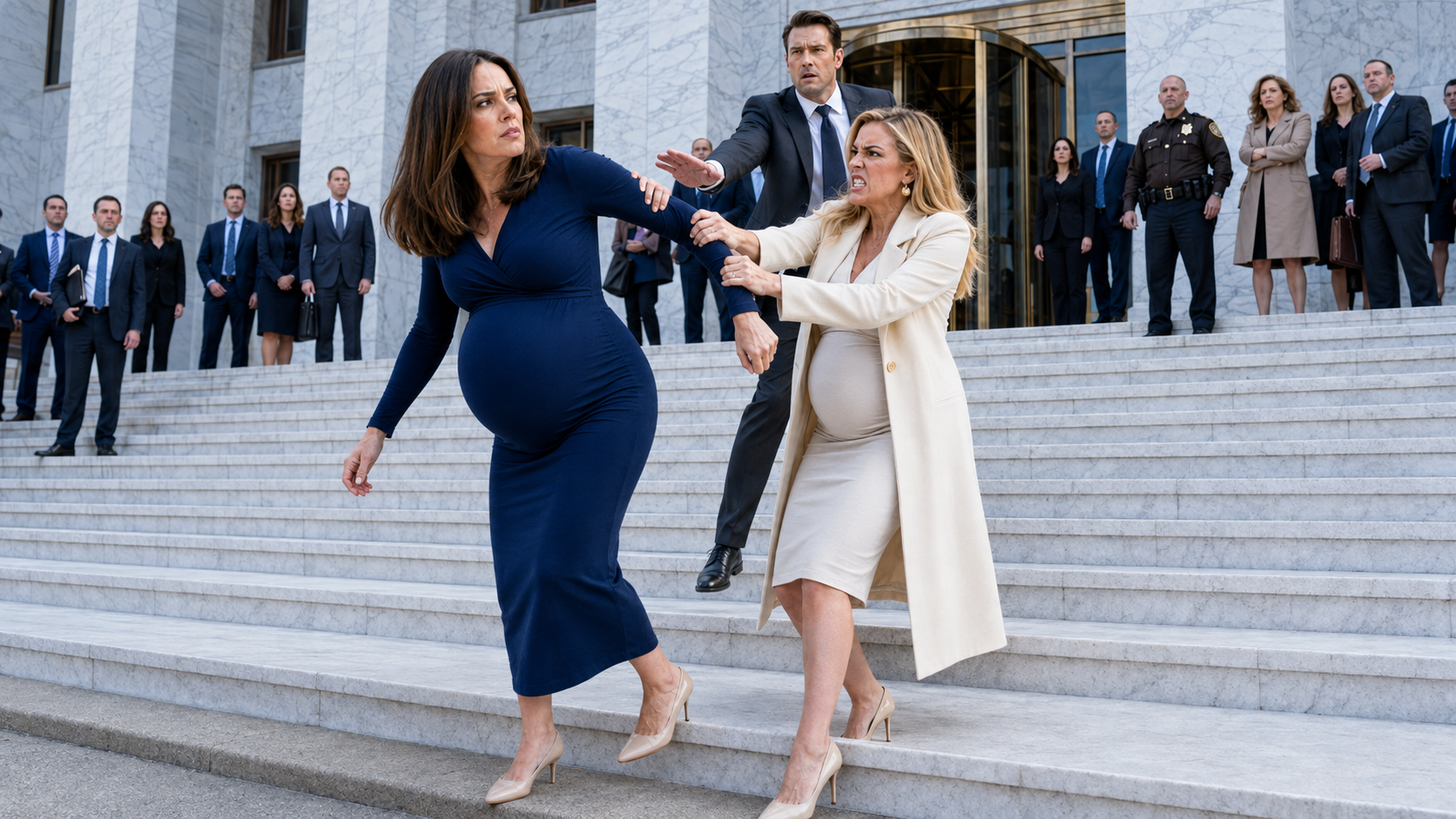
He Thought I Was the Wife He Could Quietly Replace. Then His Mistress Pushed Me Down the Courthouse Steps.
PART 1: THIRTY STEPS
The first thing I remember was not the shove.
It was my husband’s face.
Richard stood at the top of the Montgomery County Courthouse steps while I fell backward with our unborn daughter inside me, and he did absolutely nothing.
For one impossible second, the whole world seemed to slow.
Vanessa Kensington’s hands were still pressed against my shoulders.
My heel slipped from the edge of the marble step.
My stomach tightened beneath my navy maternity dress.
And somewhere behind her, Richard shouted my name.
Too late.
The sky spun.
Stone slammed into my back.
Then my hip.
Then my shoulder.
I tried to curl around my stomach, but there was nowhere to turn and nothing to grab.
Thirty marble steps.
I felt almost every one.
People screamed.
A folder burst open beside me, papers scattering into the wind.
Someone yelled for an ambulance.
Someone else shouted not to move me.
But all I could think was—
My baby.
Not me.
Her.
Please.
Please, God.
Not her.
When I finally stopped falling, my cheek was pressed against freezing marble.
For several seconds, I couldn’t understand why everyone looked so horrified.
Then warmth spread beneath me.
Too much warmth.
Blood.
My blood.
I tried to push myself up.
A pain so violent tore through my abdomen that darkness crowded the edges of my vision.
“No,” I whispered.
My hand went to my stomach.
“Baby?”
I waited for the familiar kick.
Nothing.
“Please.”
My voice barely came out.
“Please move.”
Then someone dropped beside me so hard I heard skin strike stone.
“Khloe.”
Harry.
My brother’s voice.
Except it didn’t sound like Harrison Cole, the attorney who could reduce a hostile witness to silence with three questions.
It didn’t sound like the man executives whispered about in private clubs or the lawyer corporate boards hired when they were terrified someone else might hire him first.
It sounded like the boy who used to carry me home when I scraped my knees.
“Khloe, look at me.”
I tried.
His face kept splitting into two.
“Stay with me.”
His hands hovered over me, terrified to touch me.
Blood already streaked his palms where he’d hit the marble.
“Don’t move,” he said. “Ambulance is coming. Look at me, sweetheart. Look at me.”
I grabbed his jacket.
My fingers left red prints across the charcoal wool.
“Harry…”
“I’m here.”
“The baby.”
His jaw tightened.
“They’re coming.”
“Save her.”
“We’re going to save both of you.”
“No.”
Another cramp ripped through me.
I screamed.
Harrison leaned closer.
“Khloe.”
“Promise me.”
“Don’t do this.”
“Promise.”
His eyes filled.
That frightened me more than the blood.
My brother did not cry.
Not when our father died.
Not when our mother spent her final three months in hospice.
Not when Harrison walked out of court after winning cases that had consumed years of his life.
But tears stood in his eyes now.
“I promise,” he said.
My fingers loosened.
I looked past him.
Up those thirty steps.
Vanessa stood frozen at the top.
Beautiful Vanessa.
Perfect hair.
Cream designer coat.
Gold earrings.
One hand covering her mouth.
Beside her stood my husband.
The man who had once held my face between his hands on a Nantucket beach and told me he wanted a little girl with my eyes.
He stared down at me.
He did not run.
He did not kneel.
He did not ask whether his daughter was alive.
He simply stood beside his mistress.
That was the last thing I saw before the world went black.
Six years earlier, I had believed Richard Harrington was the safest decision I would ever make.
Our wedding had been the kind of event Philadelphia society pages loved.
White roses.
Crystal chandeliers.
A string quartet.
Champagne that cost more per bottle than my first apartment’s monthly rent.
Richard had looked almost unreal standing at the end of the aisle.
Handsome.
Confident.
Polished.
He came from a family that had been rich long enough to pretend money was never discussed, even though money shaped every choice they made.
By thirty-eight, Richard was CEO of Harrington Commercial Group.
His company developed luxury towers, hotels, and mixed-use properties along the East Coast.
Banks courted him.
Mayors returned his calls.
Investors laughed too loudly at his jokes.
Magazine profiles called him visionary.
I called him my husband.
And for a long time, I thought I knew the difference between the public man and the private one.
On our honeymoon in Nantucket, he wrapped a blanket around both of us while we sat on the beach after midnight.
“I don’t care about the company,” he whispered into my hair. “I don’t care about any of it.”
I laughed.
“You absolutely care about the company.”
“Fine. A little.”
“A little?”
He kissed my temple.
“But I want this more.”
“This?”
“You. A family.”
Then he rested his hand against my stomach.
“A little girl with your eyes.”
I built six years around that sentence.
Three IVF cycles.
Two miscarriages.
Hundreds of injections.
Needles lined up beside alcohol pads on our bathroom counter.
Cold exam rooms.
Blood draws.
Ultrasounds.
Waiting rooms filled with women who avoided one another’s eyes because hope felt too fragile to share.
The first miscarriage happened at nine weeks.
Richard held me all night while I cried.
The second came later.
I remember sitting on the bathroom floor with a towel pressed over my mouth so the house staff wouldn’t hear me.
Richard stood in the doorway.
He looked devastated.
Or maybe exhausted.
At the time, I couldn’t tell the difference.
After that, something shifted.
He stopped asking whether I wanted him to come to appointments.
Then he started forgetting them.
Then he stopped coming home on the days he knew I had them.
I blamed grief.
I blamed work.
I blamed myself.
That is the humiliating thing about loving someone who is already leaving you.
You keep inventing kinder explanations for their absence because the truth would destroy the life you’ve built around them.
Then, when I was thirty-six, I bought a pregnancy test on the way home because I was six days late.
I almost didn’t take it.
The specialists had told us spontaneous pregnancy was extraordinarily unlikely.
I had stopped believing in surprises.
But ten minutes later, I sat barefoot on the bathroom floor staring at two pink lines.
I laughed.
Then I cried.
Then I laughed again until I couldn’t breathe.
No clinic.
No injections.
No scheduled procedure.
Just two pink lines on a cheap drugstore test.
I bought tiny cream-colored booties that afternoon.
I put them in a box beside the test and waited in the kitchen of our Lower Merion estate for Richard.
He came home after nine.
His tie was loose.
His phone was already in his hand.
“I have something for you,” I said.
He smiled distractedly.
“Can it wait until after I shower?”
“No.”
Something in my voice made him stop.
I pushed the box toward him.
For years, I had imagined that moment.
I imagined him laughing.
Crying.
Lifting me off the floor.
Maybe dropping to his knees and kissing my stomach.
Instead, he opened the box and stared.
“That’s… great, Khloe.”
Great.
Not incredible.
Not finally.
Not we’re having a baby.
Great.
My smile trembled.
“You’re happy?”
“Of course.”
His phone buzzed.
His gaze dropped immediately.
“I have to take this.”
“Richard—”
“It’s Boston.”
He was already walking away.
I remained at the island with one hand resting over the child we had spent years begging God for.
And because I loved him, I explained his reaction for him.
Shock.
Stress.
Fear.
Men processed things differently.
Once he heard the heartbeat, I told myself.
Once he saw the ultrasound.
Once he felt her kick.
Once we chose a crib.
Once she was real to him.
Everything would change.
I didn’t understand yet.
Everything had changed long before I ever saw those two pink lines.
His phone suddenly had a passcode.
Then face recognition.
Then a privacy screen.
Business trips appeared without warning.
Boston.
Miami.
New York.
Sometimes all three in a month.
He started showering immediately after coming home.
A perfume I didn’t own clung to his jackets.
Sharp flowers.
Something expensive and slightly sweet.
Once, while I was hanging his coat, I found a restaurant receipt from Manhattan.
Two tasting menus.
Two wine pairings.
One room-service charge from a hotel three blocks away.
Richard told me he’d taken a client.
I believed him because believing him hurt less.
Until an ordinary Tuesday afternoon ended my marriage.
I was five months pregnant.
My ankles had begun swelling, and the smell of most food still made me sick.
I sat at the kitchen island trying to finish chicken soup while scrolling through nursery photographs on the family iPad.
Then a notification appeared.
From: V
I still can’t stop thinking about last night. Once you finally get rid of the dead weight, the penthouse nursery will be perfect. Our baby deserves your last name, Ricky.
My spoon slipped from my fingers.
It struck the marble.
I don’t remember hearing it.
I read the message again.
Then again.
Our baby.
Dead weight.
Penthouse nursery.
Ricky.
No one called my husband Ricky.
At least, no one I knew.
My hands started shaking so violently I almost dropped the tablet.
I should have closed it.
Some part of me knew that.
Once you learn the first truth, you can still pretend it was misunderstood.
The second truth makes that harder.
The hundredth makes denial impossible.
I opened the conversation.
Vanessa Kensington.
I knew her.
Everyone in Richard’s professional circle knew Vanessa.
She was thirty.
Beautiful.
Ambitious.
An interior designer whose firm handled several Harrington developments.
I’d met her at two charity dinners.
Once, she had touched my arm and told me pregnancy made me glow.
She had been sleeping with my husband at the time.
For nearly two years, according to the messages.
There were photographs.
Hotels.
St. Barts.
Private villas.
Late-night calls.
Plans for an apartment.
Jokes about me.
My clothes.
My swollen ankles.
My pregnancy weight.
Then I found the messages about my miscarriages.
One from Richard after the second loss.
She barely speaks. House feels like a funeral home.
Vanessa had replied:
Maybe the universe is trying to tell her something.
Three laughing emojis followed.
I ran to the downstairs bathroom and vomited until nothing came up.
Then I sat on the tile floor with the iPad clutched to my chest.
I thought that was the worst of it.
It wasn’t.
Vanessa had written about money.
I went back.
There were references to accounts I didn’t recognize.
Holding companies.
Transfers.
A villa.
A trust.
A bank in the Cayman Islands.
One message from Richard said:
Once she signs, she’ll be stuck with the mortgage and maybe 15% of what she thinks exists. Harrison can’t find what isn’t here.
I stopped breathing.
Harrison.
My brother.
Richard wasn’t merely cheating on me.
He was preparing for war.
And he’d planned it carefully enough to think about the only person he knew I would call.
Another message appeared further down.
Papers get served before the baby. If she delivers first, everything gets uglier.
Vanessa responded:
Then don’t let her drag this out.
That sentence stayed with me.
I took photographs of the screen.
Then screenshots.
Then I forwarded everything I could access to a private email address Richard didn’t know existed.
I photographed account numbers.
Company names.
Dates.
Transfer confirmations.
I forced myself to keep working even while tears dripped onto the screen.
I had spent years drawing architectural plans before I married Richard.
I understood structures.
More importantly, I understood that beautiful things could hide catastrophic weaknesses.
You didn’t discover a failing building by staring at the marble lobby.
You followed the cracks.
When I had copied everything I could find, I called my brother.
He answered after one ring.
“Harrison Cole.”
I opened my mouth.
Nothing came out.
His voice changed immediately.
“Khloe?”
I tried again.
Only a sob escaped.
“Where are you?”
“Home.”
“Were you hurt?”
I looked toward the doorway as if Richard might suddenly appear.
“…Not yet.”
There was a pause.
Then Harrison said, very quietly, “Do not touch anything else. Do not call Richard. Do not call anyone. I’m coming.”
“Harry—”
“Pack medication, identification, and anything you cannot replace.”
I pressed a hand over my stomach.
“What is happening?”
“You’re leaving that house.”
Two hours later, I sat inside Harrison’s Manhattan office while lights from the city shone through the glass walls.
He reviewed every screenshot.
Every account.
Every message.
He didn’t interrupt.
Harrison was forty-two and had spent nearly twenty years mastering the art of frightening people without raising his voice.
Opposing counsel called him surgical.
Judges called him prepared.
Clients called him when they had run out of safer options.
To me, he was still Harry.
The brother who had threatened a twelve-year-old boy for making me cry in seventh grade.
The brother who mailed me groceries every week during my first year away at college because he had noticed I was losing weight.
The brother who never told me he was worried.
He simply appeared.
When he finally set the tablet down, his expression was so calm it scared me.
“You are not going back to that house to beg.”
I wrapped both arms around my stomach.
“What am I supposed to do?”
His eyes met mine.
“Nothing he expects.”
That was the moment my marriage stopped being something happening to me.
And became something I was finally willing to survive.
PART 2: THE CRACK BENEATH THE MARBLE
Harrison did not tell me to divorce Richard that night.
That surprised me.
I expected fury.
Instead, he gave me instructions.
“First, you sleep somewhere secure.”
“Your place?”
“No.”
“Why?”
“Because Richard knows where I live.”
The calm way he said it made my stomach turn.
“I don’t think he’d hurt me.”
Harrison leaned back.
“You called me and said ‘not yet.’”
I looked away.
He continued.
“I’m not telling you Richard is violent. I’m telling you we don’t know what a man who has spent two years hiding a second life will do when he realizes you’ve discovered it.”
That was Harrison’s gift.
He didn’t need certainty to respect risk.
A driver took me to a furnished apartment owned by one of Harrison’s partners.
The next morning, Harrison arranged for two people from his firm to accompany me home while Richard was at work.
I packed clothes.
Photographs.
My mother’s necklace.
My medical records.
A box containing the ultrasound images.
I stood in the nursery doorway for a long time.
The room was half finished.
Soft cream walls.
A white crib still boxed in the corner.
Fabric samples spread across the window seat.
I had planned everything myself after Richard stopped answering questions about it.
I touched the doorframe.
For months, I had imagined bringing my daughter home there.
Now the room felt like a stage set from someone else’s life.
I left without taking the booties.
I don’t know why.
Maybe some small part of me wanted Richard to see them.
Maybe I wanted him to remember what he was destroying.
He called that evening.
Six times.
I didn’t answer.
The seventh call came from his assistant’s number.
Harrison looked at me.
“Your choice.”
I answered.
“Hello?”
“Khloe.”
Richard sounded breathless.
“Where the hell are you?”
I said nothing.
“I came home and half your clothes are gone.”
“Not half.”
“What?”
“I left quite a lot.”
“Don’t be childish.”
That sentence did something to me.
All the fear inside me hardened.
“Do you know Vanessa Kensington?”
Silence.
Three seconds.
Maybe four.
Then he sighed.
Not shocked.
Not confused.
Annoyed.
“Khloe.”
That sigh ended whatever hope remained.
“How long?”
“This isn’t a conversation for the phone.”
“How long?”
“You’re pregnant and emotional.”
I laughed.
It sounded broken.
“I’m pregnant, Richard. Not stupid.”
He changed tactics immediately.
“Tell me where you are.”
“No.”
“I am your husband.”
“Then perhaps you should’ve behaved like one.”
Another silence.
Then his voice cooled.
“You went through my private accounts.”
“Our iPad displayed your mistress’s message.”
“That doesn’t give you the right—”
I hung up.
My whole body shook afterward.
Harrison handed me a glass of water.
“You did fine.”
“I feel sick.”
“That’s also fine.”
“No, it isn’t.”
“Khloe, courage doesn’t feel good while you’re using it.”
I stared at him.
“Did you read that on a motivational poster?”
His mouth almost moved.
“Drink.”
For the next several weeks, I learned what it meant to watch your marriage die by paperwork.
Harrison filed for divorce on my behalf before Richard could serve the papers he’d already prepared.
He requested emergency orders preventing extraordinary transfers of marital assets.
He demanded financial disclosures.
He subpoenaed banks.
He requested records from corporations whose names I had photographed.
Richard hired one of Philadelphia’s most expensive family-law firms.
Then another financial-litigation firm.
Then a public relations consultant.
That was when I understood just how much he feared exposure.
He called me constantly at first.
When I didn’t answer, the messages began.
We can handle this privately.
You are overreacting.
Vanessa means nothing.
Two days later:
I love you.
Then:
Think about what stress is doing to the baby.
That one made me furious enough to call him.
He answered immediately.
“Khloe.”
“Do not use my daughter to frighten me into silence.”
“She’s my daughter too.”
“You remembered?”
“That’s cruel.”
I closed my eyes.
“Do you love her?”
“Of course I do.”
“Then why were you planning to serve me before she was born?”
Silence.
“You misunderstood those messages.”
“The ones where you discussed leaving me with the mortgage?”
“Business structures are complicated.”
“The ones where Vanessa called me dead weight?”
“I didn’t write that.”
“You didn’t object.”
“Khloe—”
“Does Vanessa know I miscarried twice because you told her, or because she somehow obtained my medical records?”
He said nothing.
My throat closed.
I whispered, “You told her.”
“She was someone I talked to.”
“About the children we lost.”
“You wouldn’t talk to me.”
I nearly threw the phone.
Instead, I said, “Don’t call me again unless it’s through counsel.”
Then I disconnected.
Afterward I cried so hard I could barely stand.
Harrison found me sitting on the office floor beside the sofa.
He didn’t say I told you so.
He sat down beside me.
For ten minutes, neither of us spoke.
Finally I whispered, “Was I really that difficult?”
His head turned sharply.
“Don’t.”
“I spent years talking about fertility treatments.”
“You were trying to have his child.”
“I cried all the time after the second miscarriage.”
“You lost a pregnancy.”
“He said the house felt like a funeral.”
“Then he should’ve been grieving with you instead of complaining about the atmosphere.”
I looked at my brother.
“What if I made him miserable?”
Harrison’s expression softened.
“Then he had choices. Counseling. Separation. Divorce. Honesty.”
He paused.
“Two years of deception and financial fraud were choices too.”
Fraud.
At first I thought Harrison was using the word emotionally.
Then the records started arriving.
He wasn’t.
Richard had moved nearly eight million dollars over eighteen months through entities linked to Harrington Commercial projects.
Some transfers were legitimate.
Others were not.
Money had been shifted from accounts in which I had a marital interest into newly created companies.
One company owned a Manhattan penthouse.
Another held title to property in St. Barts.
A third had no apparent purpose except to send money overseas.
Harrison brought in a forensic accountant named Miriam Cho.
She was small, quiet, and relentless.
The first time we met, she placed three binders on the conference table.
“Your husband made a common mistake,” she said.
“What mistake?”
“He believed complicated meant invisible.”
She opened the first binder.
“Money hates disappearing. It leaves fingerprints.”
Together, we traced them.
A transfer from a marital investment account.
A payment to a Harrington subsidiary.
A consulting fee to a shell corporation.
A purchase routed through an entity Vanessa partly controlled.
One trail ended at the Manhattan penthouse she had mentioned in the message.
The nursery wasn’t theoretical.
It already existed.
Richard had bought the apartment six months earlier.
Vanessa had designed it.
I stared at photographs from the property listing.
There was a room painted pale green.
A crib.
A rocking chair.
A changing table.
Our nursery at home was unfinished.
Theirs was ready.
I left the conference room and made it to the restroom before I started crying.
That evening, my daughter kicked hard enough to make my blouse move.
I pressed my palm against the spot.
“You’re not second,” I whispered.
She kicked again.
“You hear me?”
Another kick.
A laugh escaped through my tears.
“You are not second to anybody.”
That promise became the thing I held onto.
Not revenge.
Not money.
Not humiliation.
Her.
I would not let my daughter enter the world believing love meant accepting whatever someone was willing to give you.
Richard became more aggressive as discovery tightened around him.
He stopped asking me to come home.
He started asking me to settle.
His first proposal was insulting.
The mansion, heavily mortgaged.
A lump sum.
No claim against several disputed business holdings.
Strict confidentiality.
In exchange, he would “generously” cover the child’s medical insurance.
Harrison slid the offer across the table.
“What do you think?”
“I think he believes I can’t count.”
“Correct.”
“Reject it.”
Harrison nodded once.
The second offer was larger.
I rejected that too.
Then came the threat.
Not directly.
Richard was too smart for that.
His attorney sent a letter accusing me of improperly obtaining confidential business information.
Another suggested my emotional condition during pregnancy might make shared custody “appropriate until stability could be assessed.”
I stared at that line until I felt physically cold.
“He is threatening to use my miscarriages and pregnancy against me.”
Harrison’s voice went flat.
“He’s trying to frighten you.”
“Can he?”
“Try? Clearly.”
“Win?”
“No.”
“You’re sure?”
“I don’t promise outcomes.”
“Harry.”
He leaned forward.
“But I promise this. If he puts your mental health at issue, we get discovery on the factual basis for every claim. Every message. Every communication. Every person he discussed you with.”
I understood.
“Vanessa.”
“Among others.”
The custody threat disappeared from the next letter.
Then Vanessa contacted me herself.
The first message came from an unknown number.
You need to stop making this uglier than it has to be.
I showed Harrison.
He told me not to answer.
Another arrived.
Richard stopped loving you a long time ago.
Then:
You are humiliating yourself.
Then:
He’s with me. Accept it.
I saved every one.
I did not respond.
Three days later, she sent a photograph.
Her hand resting over a visibly pregnant stomach.
The Manhattan skyline behind her.
No caption.
I stared at it for a long time.
I had already known.
The messages had told me.
But knowing something through words is different from seeing it.
Vanessa was pregnant too.
Far less pregnant than I was.
Richard had gotten his mistress pregnant while I was carrying the miracle child he had once claimed to want more than anything.
My phone rang.
Richard.
I let it ring.
It stopped.
Then came another message from Vanessa.
My child won’t grow up hidden because you can’t let go.
Something inside me became very quiet.
I took a screenshot.
Then I blocked the number.
The next morning, Harrison filed Vanessa’s messages with the court as part of a request limiting direct contact and documenting harassment.
Richard’s attorneys called it inflammatory.
Harrison called it evidence.
The judge called it concerning.
Vanessa did not contact me again.
Not by phone.
But whenever I attended a hearing, she somehow seemed to be nearby.
In a hallway.
Across the street.
Once in the courthouse cafeteria.
She would look at my stomach, then at my face.
I couldn’t understand why she hated me.
She had my husband.
She had the penthouse.
She had his child.
Then I finally realized.
As long as I existed, Richard’s affair could never become the beautiful love story Vanessa wanted to tell herself.
I was evidence.
Evidence that their romance had required lies.
Evidence that the home she wanted had been financed partly with money hidden from his wife.
Evidence that the man promising her forever had once made those same promises to me.
She didn’t just want Richard.
She wanted my history erased.
And I refused to disappear.
The case moved toward a crucial hearing in Montgomery County.
Harrison had obtained enough banking evidence to request stronger restrictions on Richard’s assets and sanctions over incomplete disclosures.
The morning before the hearing, Richard called from a number I didn’t recognize.
I answered because I was waiting for a call from my obstetrician.
“Don’t hang up.”
His voice sounded tired.
I almost did anyway.
“What do you want?”
“We can end this.”
“We are ending it.”
“Not like this.”
“Like what?”
“Publicly.”
I stared out the window.
“Harrison is turning this into a spectacle.”
“No. Bank records are turning it into evidence.”
“Do you even understand what happens if these allegations get attached to the company?”
“Do you understand what happens when you hide marital assets?”
“I built that company.”
“And you tried to hide money from your wife.”
“You weren’t part of the business.”
I nearly laughed.
I had moved cities for him.
Attended dinners.
Hosted investors.
Delayed returning to work because we were trying to have a child.
Spent years arranging my life around his schedule.
But I understood.
In Richard’s mind, sacrifice counted only when it came with a balance sheet.
He lowered his voice.
“Sign the settlement tomorrow.”
“No.”
“I’ll increase it.”
“No.”
“Khloe, be reasonable.”
“I was reasonable for six years.”
“You are letting Harrison poison you.”
That angered me more than anything else.
“My brother didn’t sleep with Vanessa.”
Silence.
“My brother didn’t mock my miscarriages.”
“Khloe—”
“My brother didn’t build a nursery for another baby while ours was still in boxes.”
His breath caught.
That told me he hadn’t known I’d discovered the penthouse.
“Where did you—”
“I’ll see you in court.”
I hung up.
That night, I slept badly.
At three in the morning, my daughter kicked.
I lay awake with one hand over her.
Something felt wrong.
Not physically.
Something in me.
A warning without words.
I considered telling Harrison I wanted to appear by video.
Then I remembered the custody threat.
The accusations that I was unstable.
The whispers that I was allowing my brother to control me.
No.
I would walk into court myself.
I would sit across from Richard.
I would hear what he had done.
And I would not hide.
I didn’t know that by noon the next day, the hearing would become the least important thing that happened inside that courthouse.
Because Vanessa was waiting for me at the top of the stairs.
PART 3: THE WOMAN AT THE TOP OF THE STAIRS
The hearing lasted almost three hours.
Richard sat at one table.
I sat at the other.
Harrison was beside me.
I wore the navy maternity dress because it was one of the few things that still fit.
At eight months pregnant, sitting for that long made my back ache and my feet swell.
But I never asked for a break.
Miriam’s analysis showed transfers Richard had failed to disclose.
His lawyers argued over classifications.
Harrison asked simple questions.
Simple questions were the ones that hurt most.
“Mr. Harrington, did you sign this transfer authorization?”
“Yes.”
“Did you disclose this entity in your initial financial affidavit?”
“I believed it was corporate property.”
“That’s not my question.”
A pause.
“No.”
“Did you authorize the purchase of the Manhattan residence held by that entity?”
“My company—”
“Did you authorize it?”
“Yes.”
“Does Vanessa Kensington reside there?”
Richard looked toward me.
I did not look away.
“Sometimes.”
“Is Ms. Kensington pregnant with your child?”
His attorney stood.
“Relevance—”
The judge cut him off.
Harrison remained still.
Richard answered.
“Yes.”
The word landed differently when spoken aloud.
I felt my daughter shift inside me.
For one awful instant, I wondered if she could hear him.
Harrison continued.
“Did you purchase nursery furnishings for that residence?”
Richard’s jaw tightened.
“Yes.”
“Before or after learning your wife was pregnant?”
His attorney objected again.
This time the judge sustained it.
Harrison sat down.
He had made his point.
By the time the hearing ended, the judge expanded the restrictions on several disputed accounts and ordered additional disclosures.
It was not a final victory.
Nothing in divorce happened that cleanly.
But Richard walked out furious.
I could see it.
His face remained composed.
His neck did not.
A pulse jumped beneath his jaw.
Harrison gathered his documents.
“You okay?”
“I’m tired.”
“Driver can meet us downstairs.”
“I need air.”
He glanced at my stomach.
“Five minutes.”
“Harry.”
“Ten.”
I smiled despite everything.
We left the courtroom.
Harrison was stopped almost immediately by opposing counsel, who wanted to discuss scheduling.
“I’ll be right outside,” I told him.
“Khloe—”
“I’m going down thirty feet, not to Canada.”
His eyes narrowed.
“Stay where security can see you.”
“I will.”
That decision haunted him later.
But it was mine.
I walked toward the courthouse entrance alone.
The doors opened.
Cold March air brushed my face.
The sky was pale, washed almost white above the stone buildings.
I breathed deeply.
For the first time all morning, I felt almost free.
Then I heard heels behind me.
“Khloe.”
I knew the voice before I turned.
Vanessa.
She wore a cream coat over a fitted dress.
Her pregnancy was visible now.
Not large.
But unmistakable.
For a moment, neither of us spoke.
I looked toward the entrance.
People moved through the revolving doors.
Lawyers.
Clerks.
A deputy.
We were not alone.
That mattered.
I told myself it mattered.
“Don’t contact me,” I said.
Her mouth tightened.
“You blocked me.”
“That was the idea.”
“You’ve made Richard’s life hell.”
I almost smiled from disbelief.
“I have?”
“You know what I mean.”
“No. I really don’t.”
“His company is under scrutiny because Harrison is digging through everything.”
“Then Richard should’ve disclosed everything.”
“This is exactly what he said you’d do.”
My stomach tightened, but not from labor.
“What did he say?”
“That you’d turn bitter.”
“Bitter.”
“That you couldn’t handle losing him.”
I stared at her.
There are moments when anger becomes so large it burns itself clean.
I didn’t want to scream at Vanessa.
I didn’t want to slap her.
I almost pitied her.
“He told you I was doing all of this because I want him back?”
“You do.”
“No.”
Her expression changed.
Just slightly.
“No?”
“I want my daughter safe. I want the truth documented. I want what the law says is mine.”
I held her gaze.
“You can keep Richard.”
She flinched.
I saw it.
So I continued.
“I mean that.”
“You’re lying.”
“I’m not.”
“Then settle.”
“Why?”
“So everyone can move on.”
“Everyone?”
She placed a protective hand over her belly.
“Our children don’t deserve this.”
Something in me cracked.
“Our children?”
“Yes.”
“You mocked the two children I lost.”
Her face went still.
“You read private messages.”
“You laughed about my miscarriages.”
“I didn’t know you then.”
“That makes it better?”
“I was defending someone I loved.”
“By making jokes about dead babies?”
Her cheeks flushed.
“It wasn’t like that.”
“It was exactly like that.”
She stepped closer.
“Richard was miserable.”
“Then Richard could’ve left.”
“He tried.”
“He spent two years hiding money first.”
“That isn’t what happened.”
“You don’t know what happened.”
“I know everything.”
I almost laughed.
“No, Vanessa. You know what he needed you to believe.”
That sentence frightened her.
I saw it immediately.
Her eyes flickered.
“You think you’re smarter than me.”
“No.”
“You think because your brother is Harrison Cole, you can destroy anyone you want.”
“I haven’t destroyed anyone.”
“You ruined his reputation.”
“He did that.”
“You froze our accounts.”
“The judge did that.”
“Our home—”
“My money helped buy your home.”
She went silent.
I could see the blow land.
I hadn’t planned to say it.
But it was true.
At least partly.
The penthouse had been purchased through assets now disputed in the divorce.
I lowered my voice.
“Did Richard tell you that?”
Her eyes hardened.
“You need to stop.”
“No. I don’t.”
“I’m serious.”
“So am I.”
She took another step.
I moved back.
My heel reached the edge of the first stair.
I looked behind me.
Then back at her.
“Stay away from me.”
Something in my voice made a man walking past slow down.
Vanessa noticed him too.
She lowered her own voice.
“You are ruining my child’s future because you’re jealous.”
“Your child’s future is Richard’s responsibility.”
“He can’t give us anything while you’re trying to take everything.”
“I’m not trying to take everything.”
“Harrison is.”
“My brother is tracing assets Richard hid from me.”
“You’re using him because you know everyone is terrified of him.”
That almost made me laugh.
Vanessa had misunderstood Harrison the same way most people did.
They thought his power was intimidation.
It wasn’t.
His power was patience.
He could wait longer than almost anyone for someone else’s lie to collapse.
I said, “You should be more worried about why Richard needed to hide so much than about my brother finding it.”
Her face changed again.
There it was.
The crack.
For all her certainty, Vanessa was starting to wonder.
Then Richard came through the courthouse doors.
“Vanessa.”
She turned.
His face drained when he saw us.
“What are you doing here?”
She stared at him.
“Why didn’t you tell me the penthouse was bought with disputed money?”
Richard stopped.
I watched him calculate.
“Not here.”
“Is it?”
“Vanessa.”
“Is it?”
He looked at me.
His eyes narrowed.
“Khloe.”
I almost laughed.
That single word contained an entire accusation.
As if I had created the truth simply by speaking it aloud.
“Don’t,” I said.
Vanessa turned back to me.
“You did this.”
“No.”
“You can’t stand that he chose me.”
“Vanessa, stop,” Richard snapped.
She was breathing hard now.
“So you freeze everything? You drag us through court? You threaten the home where my baby is supposed to live?”
“I didn’t threaten your home.”
“You did.”
“Vanessa—”
Richard reached for her arm.
She pulled away.
“Don’t touch me.”
A few people had stopped now.
I saw a deputy near the doors begin moving toward us.
I should have walked away.
I tried.
“I am done with this conversation.”
I turned slightly.
Vanessa grabbed my wrist.
“Don’t walk away from me.”
“Let go.”
“Answer me.”
“Vanessa.”
Richard’s voice sharpened.
“Let her go.”
I pulled my arm free.
“Do not touch me.”
For one second, Vanessa looked shocked.
Then humiliated.
People were watching.
Richard was watching.
And humiliation can be gasoline when someone has spent too long confusing possession with love.
“I hate you,” she whispered.
I stepped backward.
“That is not my problem.”
Her hands hit my shoulders.
Hard.
I didn’t immediately understand what she’d done.
Then there was no ground beneath my right foot.
I reached for something.
Anything.
My fingers caught the sleeve of her coat and slipped.
I heard Richard shout.
Then I fell.
The world became white marble.
Pain.
Sky.
Stone.
Screaming.
My daughter.
Harry.
Blood.
Then darkness.
I woke to sound before sight.
A rhythmic beeping.
Someone speaking softly.
My mouth felt dry.
My body felt impossibly heavy.
I opened my eyes.
A ceiling.
Hospital.
For one terrified second, I remembered nothing.
Then I remembered everything at once.
The stairs.
Vanessa.
Blood.
My baby.
I tried to sit up.
Pain ripped through my abdomen.
“Khloe.”
Harrison appeared beside me.
His suit was gone.
He wore a white shirt with dried blood on one cuff.
My blood.
“Where is she?”
“Don’t move.”
“Where is my baby?”
“She’s alive.”
The room blurred.
I started sobbing.
“She’s alive?”
“Yes.”
His voice broke.
“She’s alive.”
I pressed both hands over my face.
My abdomen hurt.
There was a dressing.
I understood.
“C-section?”
“Emergency.”
“How bad?”
He hesitated.
That was enough to terrify me.
“Harry.”
“She was in distress. They delivered her immediately.”
“Where is she?”
“NICU.”
“Why?”
“She’s premature. She had some difficulty breathing.”
My chest tightened.
“Is she okay?”
“The doctors are cautiously optimistic.”
“Cautiously?”
“Khloe—”
“I need to see her.”
“You just woke up.”
“I need to see my daughter.”
He looked toward the door.
A nurse entered almost immediately.
Twenty minutes later, I was in a wheelchair.
Everything hurt.
Every bump in the floor.
Every movement.
But then the NICU doors opened.
I saw rows of incubators.
Tiny bodies.
Monitors.
Nurses moving quietly beneath fluorescent lights.
Harrison pushed me toward the far side.
Then I saw her.
My daughter.
So small.
Smaller than she had ever been in my imagination.
Wires crossed her chest.
A tiny breathing device rested beneath her nose.
One hand was curled beside her face.
I stopped breathing.
“Can I touch her?”
The nurse nodded.
“Through the opening. Gently.”
I slid my hand through.
My fingertip touched her palm.
Her fingers closed around me.
Everything inside me broke open.
“Hi,” I whispered.
Tears ran down my face.
“I’m your mom.”
Her fingers tightened.
“I’m sorry.”
Harrison crouched beside the wheelchair.
I looked at him.
“Did I hurt her?”
“No.”
“If I hadn’t gone outside—”
“No.”
“If I’d waited for you—”
“Stop.”
His voice was sharper than I expected.
He lowered it.
“One person caused what happened on those steps.”
I looked back at my daughter.
“Vanessa.”
Harrison’s face changed.
“She was arrested.”
“For what?”
“Aggravated assault. Additional charges are being reviewed.”
“And Richard?”
A long silence.
“He was questioned.”
“Did he help me?”
My brother’s silence told me before his words did.
“No.”
“Why?”
“I don’t know.”
“Did he come down the stairs?”
“Eventually.”
Eventually.
I looked at my daughter again.
Harrison continued.
“There were witnesses.”
“How many?”
“A lot.”
“Security cameras?”
“Yes.”
“Did they capture it?”
“Yes.”
I closed my eyes.
There it was.
The whole truth.
Not buried in an offshore account.
Not hidden inside a message.
Not dependent on Richard’s explanation.
Vanessa had put both hands on me.
And pushed.
My daughter made a tiny movement against my finger.
I whispered, “What’s going to happen now?”
Harrison looked at me.
Years later, I would remember exactly how calm his answer sounded.
“Now they find out you survived.”
PART 4: WHAT THEY COULDN’T HIDE
The attack changed everything.
Not instantly.
Life rarely gives you clean turning points when you’re living inside them.
For the next two weeks, I barely thought about Richard’s money.
I barely thought about Vanessa.
I lived by monitors and medical updates.
My daughter had been born at thirty-three weeks and five days.
Four pounds, seven ounces.
Small.
Angry.
Determined.
The nurses smiled when they told me that last part.
“She has opinions.”
I laughed weakly.
“That runs in the family.”
I named her Grace.
Not because anything about what happened felt graceful.
Because she was alive when she should have been badly hurt.
Because every breath she took felt like something I had no right to take for granted.
Because I needed a word bigger than what had happened to us.
Richard came to the hospital on the second day.
He was not allowed into my room.
Harrison saw to that.
But legally, he was still Grace’s father.
That created complications no amount of anger could erase.
A hospital social worker spoke to me.
My attorney spoke to me.
A separate custody specialist from Harrison’s firm spoke to me because Harrison refused to pretend he could be emotionally objective about everything anymore.
I appreciated him more for admitting it.
Richard asked to see Grace.
I said yes.
That surprised everyone.
Maybe even me.
Harrison stared at me.
“You’re certain?”
“He is her father.”
“That doesn’t mean you owe him access to you.”
“I don’t want him near me.”
“We can arrange that.”
“Then let him see her.”
My voice shook.
“I won’t use her to punish him.”
Harrison nodded.
That was all.
Richard visited Grace under hospital rules while I stayed away.
He later sent me a message through counsel.
She’s beautiful.
I deleted it.
A week later, another arrived.
I am sorry for what happened.
Not for what I did.
For what happened.
As though the last two years had been weather.
As though Vanessa’s rage had appeared from nowhere.
As though he had not stood beside her while I bled.
I saved that message.
Then I returned my attention to Grace.
She improved slowly.
Breathing support decreased.
She learned to take milk.
She gained ounces.
Every ounce felt like winning a lawsuit.
Meanwhile, outside the NICU, the world around Richard began collapsing.
News of the courthouse attack spread quickly because too many people had witnessed it to bury.
A pregnant woman pushed down courthouse steps by her husband’s pregnant mistress was the kind of story reporters didn’t need help sensationalizing.
Harrison refused almost every request for comment.
His only public statement was six sentences long.
He did not mention Richard’s affair.
He did not mention the divorce.
He did not mention his own reputation.
He said that my daughter and I were alive, that the criminal investigation should proceed without interference, and that our family requested privacy.
Nothing else.
Privately, he did what Harrison always did.
He worked.
Vanessa’s attorney initially suggested the fall had been accidental.
That lasted less than forty-eight hours.
Too many witnesses.
Too many camera angles.
One video showed her grabbing my wrist.
Another showed me stepping away.
A third showed both hands extending.
The shove was unmistakable.
Then my earlier harassment reports became important.
The blocked messages.
The photograph.
The accusation that I was ruining her child’s future.
The court filing documenting that she had contacted me despite my requests to stop.
The truth had been there before the stairs.
No one had taken it seriously enough to imagine where it would lead.
Not even me.
The prosecutor handling Vanessa’s case asked to meet.
I agreed once I was medically able.
Harrison offered to sit beside me.
“No.”
His eyebrow lifted.
“I want to do it alone.”
“Khloe.”
“I need to.”
He studied me.
Then nodded.
I told the prosecutor everything.
The affair.
The messages.
The money.
The courthouse conversation.
Vanessa’s words.
The moment her hands struck me.
I did not exaggerate.
I didn’t need to.
Truth sounded terrible enough.
“Did you threaten Ms. Kensington?” the prosecutor asked.
“No.”
“Did you touch her first?”
“No.”
“Did you tell her anything that might reasonably have made her believe you were going to harm her?”
“No.”
“What did you say immediately before the push?”
I remembered.
I hate you.
That is not my problem.
I repeated it.
The prosecutor made a note.
Then she looked at me.
“Mrs. Harrington, there will likely be an argument that this was an impulsive act rather than a planned attack.”
“I understand.”
“Does that concern you?”
I thought about it.
“No.”
“Why?”
“Because she still did it.”
That was the first moment I understood what surviving had changed in me.
I no longer needed everyone to be monsters.
Vanessa did not have to wake that morning planning to kill me.
Richard did not have to plan my fall.
People could ruin lives one selfish decision at a time.
One lie.
One hidden transfer.
One cruel message.
One refusal to walk away.
One shove.
Intent mattered legally.
Choice mattered to me.
And all of them had made choices.
The divorce case resumed after my doctors cleared me to participate.
This time, I joined remotely.
Richard looked different on the screen.
Older.
Less polished.
Harrington Commercial had announced an internal review after questions arose about transactions connected to his personal holdings.
Several investors delayed new commitments.
A lender demanded additional documentation.
None of that was Harrison’s revenge.
It was consequence.
Miriam found more inconsistencies.
Some assets Richard had characterized as corporate had been funded partly by marital money.
There were undisclosed loans.
Payments to entities linked to Vanessa’s design firm.
Personal expenses routed through company accounts.
Harrison turned the material over where required.
He did not threaten.
He did not shout.
He simply stopped allowing Richard’s secrets to remain secret.
One afternoon, Richard requested a private settlement conference.
I agreed.
Not because I wanted reconciliation.
Because I wanted the case finished.
He entered the conference room looking like a man walking into a place where he used to own the building.
Harrison sat beside me.
Richard’s attorneys sat across from us.
For twenty minutes, the lawyers talked.
Numbers.
Properties.
Accounts.
Custody framework.
Then Richard asked, “Can I speak to Khloe alone?”
“No,” Harrison said.
I touched my brother’s arm.
“It’s okay.”
His face turned toward me.
“I’ll be outside.”
Richard’s attorneys left too.
For the first time since I had discovered Vanessa’s message, my husband and I were alone.
He stared at me.
I waited.
“You look different.”
“I nearly died.”
He flinched.
“I didn’t mean—”
“I know.”
Silence.
“How is Grace?”
“Getting stronger.”
“I think about her constantly.”
“You can ask for updates through the agreed channel.”
“I don’t want a channel.”
I almost laughed.
“You created the need for one.”
His eyes lowered.
For a long time, neither of us spoke.
Then he said, “I never wanted you hurt.”
I studied him.
“I believe you.”
He looked surprised.
“You do?”
“Yes.”
Relief flickered across his face.
I destroyed it with the next sentence.
“But that’s not the same as protecting me.”
His mouth opened.
I continued.
“You didn’t push me.”
“No.”
“But you lied to Vanessa about me.”
“I never told her to—”
“You told her I was bitter. Unstable. Clinging to you.”
“I was angry.”
“You let her believe I was the obstacle between her and a perfect future.”
“That doesn’t make me responsible for what she did.”
“Legally? Maybe not.”
I leaned back carefully.
My incision still hurt when I moved too quickly.
“But I’m not talking about the law.”
His face tightened.
“What do you want me to say?”
“The truth would be interesting.”
“I loved her.”
I nodded.
“I know.”
“I loved you too.”
“No.”
His eyes flashed.
“You don’t get to decide that.”
“Maybe not.”
I thought about six years.
The beach.
The injections.
The hospital rooms.
The unfinished nursery.
The laughter emojis beneath a message about my miscarriage.
“Then you loved me in a way I never want our daughter to mistake for love.”
That silenced him.
His eyes filled.
For six years, I had wanted emotional honesty from Richard more than almost anything.
When it finally arrived, it didn’t feel satisfying.
It felt late.
“I was afraid,” he said.
“Of what?”
“Another loss.”
I stared at him.
“Grace?”
“Everything.”
His hands folded.
“After the second miscarriage, I couldn’t do it again. Every appointment. Every time you cried. Every time we hoped.”
“So you had an affair.”
“I found somewhere I didn’t feel like I was failing.”
There it was.
A motive.
Human.
Weak.
Real.
And still not an excuse.
“You could’ve told me you were drowning.”
“I know.”
“You could’ve left.”
“I know.”
“You could’ve asked for counseling.”
“I know.”
“You could’ve done almost anything except make me grieve alone while you built another life.”
His shoulders dropped.
“I know.”
For the first time, I believed that he did.
I asked, “Why hide the money?”
His silence stretched.
“Richard.”
“Because I knew Harrison would make the divorce expensive.”
“No.”
I shook my head.
“You hid it before I knew about Vanessa.”
He looked away.
“Because you thought you deserved more than I did.”
His jaw tightened.
I had my answer.
Money was the part he could not make emotional.
He believed the company was his.
The fortune was his.
The houses were his.
The fact that marriage had made some of those assets legally ours offended something fundamental in him.
He had not merely cheated.
He had decided the rules should not apply to him.
I stood carefully.
He looked up.
“Khloe.”
“I’m signing a fair settlement.”
His eyes widened.
“You’re agreeing?”
“A fair settlement.”
I met his gaze.
“Not your version of fair.”
He understood.
“No confidentiality provision about conduct already in public records. Full disclosure. Correct valuation. Proper child support. Clear custody protections.”
“Your brother wants to ruin me.”
“My brother wants documentation.”
“Same thing, with Harrison.”
“No.”
I looked at the man I had once planned to grow old beside.
“What ruined you was believing nobody would ever look closely enough.”
Then I opened the door.
Harrison stood outside.
I didn’t need to say anything.
He took one look at my face and understood.
“Done?”
“Almost.”
Richard called after me.
“Khloe.”
I turned.
His voice broke.
“I am sorry.”
I waited for the feeling I had imagined.
Vindication.
Rage.
Love.
Something.
Instead, I felt tired.
“I know,” I said.
Then I walked away.
The divorce settled six weeks later.
Not because Harrison crushed Richard.
Because Richard finally understood that trial would expose more than settlement.
I received my lawful share of the marital estate.
The mansion was sold.
Several transfers were reversed or accounted for.
Grace’s support was secured independently of the volatility surrounding Harrington Commercial.
Richard received structured parenting time once Grace was medically stable, subject to conditions negotiated through counsel.
I did not erase him from her life.
I did not forgive him either.
Those were different things.
Vanessa’s criminal case remained.
And unlike the divorce, there was no agreement I could sign that would make those thirty steps disappear.
She eventually accepted a plea that included a serious felony assault conviction.
Before sentencing, I was given the opportunity to speak.
For days, I couldn’t decide whether I wanted to.
Harrison said nothing.
He knew better.
Finally, the night before court, I sat beside Grace’s crib.
She had been home for almost two months.
She slept with one fist beside her cheek.
The NICU wires were gone.
The oxygen was gone.
The alarms were gone.
A small pale scar remained on my abdomen.
My body hurt differently now.
But we were home.
I looked at my daughter.
Then I knew.
Vanessa had tried to turn me into an obstacle.
I would not let her final memory of me be a body at the bottom of a staircase.
I would stand.
And I would speak.
PART 5: I STOOD AT THE BOTTOM ONCE
The courtroom was full on sentencing day.
Reporters sat in the back.
Vanessa’s parents were there.
Richard was not.
I expected that.
Harrison sat behind me instead of beside me.
This part belonged to me.
Vanessa looked smaller than I remembered.
Prison clothes did that.
So did fear.
Her pregnancy had advanced during the case.
She would deliver soon.
For one painful second, I saw the absurd symmetry of us.
Two women.
Two babies.
One man whose lies had helped turn us into enemies.
But I refused to pretend we were the same.
I had never pushed her.
She had pushed me.
Compassion did not require confusion.
When the judge called my name, I stood.
My knees shook.
That surprised me.
I had survived the fall.
The surgery.
The NICU.
The divorce.
Still, crossing fifteen feet of carpet felt difficult.
I reached the lectern.
I unfolded the statement I had written.
Then I looked at Vanessa.
And folded it again.
“I thought I would talk about the stairs,” I said.
My voice trembled.
“So I wrote down every detail.”
I swallowed.
“The first impact. The blood. The emergency surgery. My daughter being born before she was ready.”
Vanessa looked down.
“But the truth is, those things aren’t what I remember most.”
Her eyes lifted.
“I remember your face before you pushed me.”
The courtroom became very still.
“You were angry because you believed I was taking something from you. A home. Money. A future. Richard.”
I gripped the lectern.
“You thought I was standing between you and the life you deserved.”
My throat tightened.
“But I didn’t build that conflict.”
I looked briefly toward the judge, then back at Vanessa.
“Richard lied to me. He lied to you. He hid money. He created promises he could not keep honestly. But when you put your hands on me, that choice belonged to you.”
Vanessa’s face crumpled.
I continued.
“I was thirty-three weeks pregnant. I told you to leave me alone. You knew I was standing at the top of a stone staircase.”
Tears rolled down her cheeks.
“My daughter spent the first weeks of her life inside an incubator because you could not tolerate hearing the word no.”
A sound escaped from someone behind her.
Her mother, maybe.
I didn’t look.
“I don’t know what punishment will change you. That’s not my decision.”
I glanced at the judge.
“But I want the court to understand that this was not a moment that ended when I stopped falling.”
I touched my abdomen unconsciously.
“I still wake up when I dream about stairs. I still reach for a railing before I realize I’m doing it. I still remember asking my brother to save my baby because I thought I was dying.”
Harrison lowered his head.
My voice almost broke.
I forced it steady.
“But my daughter lived.”
Vanessa cried openly now.
“And I lived.”
I drew a breath.
“So I won’t stand here and tell you that you destroyed my life.”
Her eyes met mine.
“You didn’t.”
Something shifted in the room.
“You changed it. You wounded it. You took things from me that I will never get back.”
I paused.
“But you did not destroy it.”
I stepped away from the lectern.
Then I stopped.
There was one final thing I needed to say.
I looked at Vanessa.
“I hope your child grows up never believing love requires another woman to disappear.”
Her face collapsed into her hands.
I returned to my seat.
Harrison did not touch me until I sat down.
Then his hand covered mine.
“You okay?” he whispered.
For once, I didn’t lie.
“I think so.”
The judge imposed a substantial prison sentence, taking into account the severity of the assault, my pregnancy, the risk to Grace, and Vanessa’s eventual guilty plea.
It was not the maximum Harrison had once wanted in the terrible hours after my fall.
It was not nothing.
It was justice as the law understood justice.
Imperfect.
Measured.
Final enough.
Months later, Vanessa gave birth while serving her sentence.
I learned that through attorneys.
I never contacted her.
She never contacted me.
Richard did.
His life after the divorce looked very different from the one he had planned.
Harrington Commercial survived, but not untouched.
An internal investigation resulted in governance changes.
Richard lost significant control.
Several transactions drew regulatory attention.
Some matters ended in financial penalties and settlements.
The magazines that once called him visionary began using words like embattled.
He hated that word.
I knew because he once complained about it during a custody exchange.
I almost laughed.
Grace was nearly a year old then.
She had my eyes.
Richard noticed first.
We were standing in the neutral reception room used for exchanges during the early months of our parenting arrangement.
He held her while she grabbed his tie.
He smiled despite himself.
“She really does.”
“Does what?”
“Have your eyes.”
My chest tightened.
Nantucket.
A blanket.
A promise under the stars.
A little girl with your eyes.
I thought the memory would destroy me.
It didn’t.
It simply existed.
Sad.
Beautiful.
Finished.
Richard looked at me.
“Do you ever think about what would’ve happened if I hadn’t met Vanessa?”
I adjusted Grace’s diaper bag.
“No.”
He seemed surprised.
“Never?”
“I used to.”
“And now?”
“Now I think the affair exposed what was already wrong.”
He absorbed that.
“You mean me.”
“I mean us.”
That was important.
Not because I accepted blame for his choices.
I didn’t.
But I had spent years refusing to look directly at our marriage because I was afraid seeing the cracks would make them real.
I had been lonely before Vanessa’s name ever appeared on the screen.
I had been grieving alone before I knew why Richard stopped coming home.
I had accepted emotional crumbs and called them patience.
I would never do that again.
Richard shifted Grace higher against his shoulder.
“I did love you.”
I looked at him.
This time I didn’t argue.
“I know you believe that.”
Pain passed across his face.
Maybe that was cruel.
Maybe it was simply honest.
I kissed Grace’s forehead.
“See you Sunday, baby.”
Her tiny hand reached toward me.
I smiled.
Then I walked out.
I never returned to the Lower Merion mansion.
After the sale, I bought a smaller house outside Philadelphia.
Not small.
Just human.
No staff.
No marble foyer.
No rooms designed for impressing people who barely liked one another.
I chose it because the morning light filled the kitchen.
Because there was a garden.
Because Grace laughed the first time I carried her through the back door.
And because there was a spare room with large windows where I could work.
I returned to architecture slowly.
At first, I freelanced.
Then I partnered with a small design studio.
The first time someone called me “Khloe Cole” in a meeting after my divorce was finalized, I almost turned around to see who they meant.
I had taken Richard’s surname when we married.
For six years, people had known me as Khloe Harrington.
Changing it back felt strange.
Then right.
Not because marriage had erased who I was.
Because I wanted the name that belonged to me before I had spent years trying to fit inside someone else’s idea of a wife.
Harrison visited every Sunday.
He arrived with food even though I told him to stop bringing food.
He ignored me.
Grace adored him.
The first time she called him something resembling “Harry,” he nearly dropped a cup of coffee.
I laughed so hard I cried.
“No one can know about this,” he warned.
“About what?”
“That I have feelings.”
“I’m calling the newspapers.”
“I’ll sue you.”
“You’re my attorney.”
“Conflict of interest. I’ll refer it.”
Some things survived.
That surprised me too.
The fall had divided my life into before and after, but it hadn’t destroyed everything in between.
There were still jokes.
Still ordinary mornings.
Still laundry.
Still spilled milk.
Still nights when Grace refused to sleep unless I walked around the living room humming badly.
There were also scars.
On cold days, my hip hurt.
For months, I couldn’t stand near the top of a long staircase without feeling the marble rush beneath me again.
The first time I returned to the Montgomery County Courthouse after Vanessa’s sentencing, I stopped at the bottom of those same steps.
Harrison was beside me.
“You don’t have to go this way,” he said.
There was a ramp around the side.
An elevator entrance elsewhere.
I looked up.
Thirty steps.
People hurried past us.
Nobody knew.
To them, it was simply a staircase.
To me, it was the place where one life had ended.
Harrison waited.
He did not tell me what courage was supposed to look like.
He had learned better.
I put my hand on the railing.
Then I stepped onto the first stair.
My pulse jumped.
Second.
Third.
By the fifth, my hands were sweating.
At ten, I almost stopped.
At fifteen, I heard the screams again.
At twenty, I saw Vanessa’s hands.
At twenty-five, I remembered blood.
At twenty-nine, my vision blurred.
Then I reached the top.
I stood there breathing hard.
Harrison came up beside me.
Neither of us spoke.
I looked down.
The staircase seemed smaller from above.
That angered me somehow.
For so long, those steps had lived in my mind like a mountain.
But they were stone.
Only stone.
They had nearly killed me.
They had not kept me.
“I asked you to save her,” I whispered.
Harrison knew exactly who I meant.
“You did.”
“I thought I was dying.”
“I know.”
“I remember your face.”
He looked away.
“I’d rather you didn’t.”
I smiled through tears.
“You were terrified.”
“I was having an unusually emotional afternoon.”
I laughed.
Then he did too.
People walked around us.
Courthouse doors opened and closed.
Cars moved along the street.
Life continued with the almost insulting normality it always had.
I thought about Richard standing at the top that day.
About the second life he’d constructed.
The money he’d hidden.
The penthouse nursery.
The messages.
The woman who believed she could shove me out of the future because she’d already shoved me out of my marriage.
For a long time, I had believed Harrison was the reason they ultimately lost.
After all, he was the feared attorney.
The man Richard mentioned in secret messages before I had even discovered the affair.
The man Vanessa accused me of hiding behind.
The man who could follow bank transfers across borders and make executives reconsider decisions they’d thought nobody would ever question.
But Harrison had never made the first move.
I had.
I was the one who saw the message.
I was the one who kept reading even when the truth hurt.
I was the one who photographed the records instead of confronting Richard.
I called Harrison.
I left the house.
I rejected the settlement.
I walked into court.
I survived the stairs.
I spoke at sentencing.
I chose the life that came afterward.
My brother had protected me.
He had fought for me.
He had loved me when I could barely remember how to love myself.
But he hadn’t saved a helpless woman.
He had stood beside a woman who had finally decided she was worth saving.
That difference mattered.
A year after the fall, on Grace’s first birthday, Harrison gave me a small gift box.
“No legal documents?” I asked.
“Open it.”
Inside were the cream-colored baby booties.
I stopped breathing.
The ones I’d left in the nursery.
The ones I’d placed beside the positive pregnancy test the night I told Richard.
“Where did you get these?”
“Before the house was sold.”
“You went back?”
“I had someone retrieve a few things.”
I held one tiny bootie in my palm.
Memories came rushing back.
The kitchen island.
Richard opening the box.
His empty smile.
That’s… great, Khloe.
For a moment, grief tightened around my throat.
Then Grace crawled toward me across the rug, shrieking happily because Harrison had put a paper birthday crown on his head.
I looked from the booties to my daughter.
They were far too small now.
She had outgrown the symbol before she’d ever worn it.
I began to laugh.
“What?” Harrison asked.
“Nothing.”
I wiped my eyes.
“Everything.”
I picked Grace up.
She immediately grabbed one of the booties and tried to put it in her mouth.
“No,” I laughed. “Absolutely not.”
Harrison took it from her.
She scowled at him.
He looked offended.
“I saved your life.”
“Don’t use emotional blackmail on a one-year-old.”
“She should know.”
“You’re impossible.”
Grace reached for him.
He took her.
And for one quiet moment, I stood in my own living room and looked at the two people I loved most.
No marble.
No chandeliers.
No society photographers.
No husband whose attention I had to earn.
No mistress waiting in the shadows.
No hidden accounts.
No unfinished nursery.
Just afternoon sunlight across the floor.
A half-eaten birthday cake.
My daughter’s laughter.
My brother pretending he hadn’t become completely soft.
And me.
Still here.
There are people who will tell you betrayal breaks your heart.
They’re right.
But they don’t tell you what comes after.
They don’t tell you that sometimes the heart does not return to what it was.
It becomes something else.
More careful.
Less innocent.
Harder in some places.
Stronger in others.
Mine never forgot those thirty steps.
I don’t think it ever will.
But when I remember the woman lying at the bottom of them now, I no longer see someone weak.
I see a woman who had already survived six years of disappointment, two miscarriages, a hidden affair, financial betrayal, humiliation, and the destruction of the future she thought she’d been promised.
Vanessa believed one push would finish what Richard had started.
She was wrong.
They both were.
Because the blood on those courthouse steps was not the end of my story.
It was the last price I ever paid for allowing someone else to decide what my life was worth.
And when I finally stood again, I didn’t need Richard’s love.
I didn’t need Vanessa’s regret.
I didn’t even need Harrison’s reputation.
I had my daughter.
I had the truth.
And, at last, I had myself.
Để lại một bình luận