

PART 1: THE EMPTY PLACE AT MY OWN TABLE
My husband told me to stay away from my own house on Christmas because his ex-wife was coming over.
“The kids’ real mother is going to be here,” Harrison said. “It’ll just be easier if you aren’t around.”
For several seconds, I honestly thought he was making a terrible joke.
I stood at the kitchen island with a roll of gold ribbon in one hand and Valerie’s Christmas present in the other.
Her present.
A cashmere scarf I had picked out myself.
The dining room beyond Harrison’s shoulder looked exactly the way I had imagined it when I started planning Christmas three weeks earlier. Evergreen branches ran down the center of the table between brass candleholders. Six linen napkins rested beside six plates. I had polished my mother’s old silverware the night before until my fingers cramped.
Six places.
One for Harrison.
One for me.
One for Connor.
One for Maya.
One for Valerie.
And one extra because Connor had mentioned he might bring the woman he had been seeing, although he still refused to call her his girlfriend.
There had never been a version of Christmas Eve in which Valerie was unwelcome.
I had invited her.
“You want me to leave?” I asked.
Harrison blew across his coffee.
“Just for tonight.”
I put the ribbon down.
“You’re asking me not to be here on Christmas Eve.”
“I’m asking you not to turn this into a bigger thing than it is.”
“I haven’t turned it into anything yet.”
His jaw tightened.
That should have warned me.
For months, Harrison had developed a habit of sounding defensive before I had even accused him of something.
“Valerie is going to be here,” he repeated. “Connor and Maya haven’t had a Christmas with both their parents in the same room in years. I thought maybe they could have one evening where things feel… normal.”
“Normal.”
“You know what I mean.”
“No. I don’t think I do.”
He finally looked at me.
“Their family.”
The words landed differently than he intended.
Or maybe exactly as he intended.
I had been married to Harrison for seven years.
I met Connor when he was seventeen and Maya when she was fifteen. They had never needed another mother, and I had never tried to audition for the job.
Their mother was alive, involved, stubborn, occasionally infuriating, fiercely protective, and very much their mother.
Valerie and I were never best friends. We were simply two women who eventually decided Harrison’s children deserved better than adults keeping score.
When Maya got into a minor car accident at nineteen and Harrison was trapped on a work trip, Valerie was two hours away helping her sister after surgery.
I sat beside Maya in urgent care until almost three in the morning.
When Valerie arrived, pale with worry and still wearing house slippers, I handed her the paperwork and moved out of the chair beside her daughter.
There had been no competition.
When Connor got fired from his first serious job, he came to our house furious and humiliated.
Harrison told him he needed to toughen up.
I made coffee, opened Connor’s résumé on my laptop, and spent four hours helping him rewrite it.
When either of them complained about Valerie, I never joined in.
“Call your mother,” I would say.
“She won’t understand.”
“Then explain it better.”
Sometimes they listened.
Sometimes they rolled their eyes.
But I never tried to make myself important by making Valerie less important.
That was why Harrison’s words felt so strange.
Not just cruel.
Wrong.
“Did Connor ask you to tell me not to come?” I asked.
Harrison’s eyes dropped to his coffee.
“No. Not exactly.”
“Did Maya?”
He didn’t answer.
“So this was your idea.”
“I’m just trying to make things comfortable.”
“For everyone except your wife.”
“It’s only one evening, Clara.”
“One evening I planned.”
“No one is denying that.”
“One evening in my house.”
His expression changed immediately.
There it was.
A small flicker of resentment.
I noticed it because I had seen it before.
The house had belonged to me before Harrison and I married.
My father helped me buy it when I was thirty-two, years before Harrison entered my life. He was an accountant, the kind of man who kept receipts from appliances he no longer owned and believed paperwork was a love language.
When he helped me with the down payment, he insisted we place the property into a family trust.
At the time, I laughed.
“Dad, I’m buying a three-bedroom house outside Seattle. I’m not acquiring an empire.”
“People only think paperwork is pointless until the day they need it,” he replied.
So I signed everything.
The trust remained.
After Harrison and I married, he occasionally teased me about it.
“Your father really thought somebody was going to steal your suburban castle?”
I usually laughed.
I never changed the paperwork.
A year earlier, Harrison had suggested refinancing and putting both our names directly on the property.
I declined because the existing arrangement worked perfectly well.
He called me overly cautious.
Now, standing in the same kitchen my father had helped me buy, I heard Harrison say, “Do you always have to call it your house when we argue?”
“I don’t.”
“You just did.”
“Because you’re asking me to leave it.”
“For one night.”
“So your real family can be comfortable.”
“I did not say real family.”
“You said their real mother.”
“That is not the same thing.”
“Isn’t it?”
He rubbed a hand over his face.
“Clara, please. Why are you making this difficult?”
I almost laughed.
The question was so absurd that for a moment I didn’t know what to do with it.
I looked through the kitchen doorway.
At the table.
At the greenery I had cut and arranged.
At the candles.
At the six places.
The refrigerator was full of food I had spent two days preparing. The turkey was brining. The potatoes were peeled. Two pies sat beneath glass covers. Valerie’s scarf was waiting to be wrapped.
I had orchestrated every detail of the Christmas from which my husband was now politely removing me.
Something inside me went very still.
“Fine,” I said.
Harrison blinked.
“Fine?”
“I’ll go.”
Relief crossed his face.
It happened too quickly for him to hide it.
His shoulders loosened.
He exhaled.
And that hurt more than the request itself.
If he had looked ashamed, maybe I would have argued.
If he had reached for me, maybe I would have demanded answers.
Instead, he looked relieved that I was disappearing.
“All right,” he said softly. “Good.”
Good.
I walked upstairs.
My overnight bag was on the top shelf of the closet.
I took it down and packed slowly.
Toothbrush.
Sweater.
Clean shirt.
Jeans.
Phone charger.
Underwear.
Medication.
I moved with a strange calm that frightened me more than tears would have.
From downstairs, I heard Harrison moving around the kitchen.
At one point, a cupboard opened.
Then another.
He was already continuing with the day.
By the time I came downstairs, he was checking something on his phone.
“I’ll get a hotel,” I said.
He nodded.
“Probably best.”
Another warning.
He didn’t ask which hotel.
He didn’t offer to pay.
He didn’t tell me to come back after dinner.
He simply wanted me gone.
A few months earlier, Harrison had taken over most of our day-to-day finances.
At the time, it seemed harmless.
He was already paying the utility bills, he said. He might as well monitor the shared accounts, credit card balances, insurance payments, and automatic withdrawals.
“It’s stupid for both of us to waste time checking the same statements.”
I gave him my banking passwords.
He had access to the shared email account where transaction alerts were sent.
I still had my salary deposited into my personal account, but we moved a portion of both incomes into a joint household account.
Harrison watched all of it.
Whenever I asked whether there was anything I needed to review, he would kiss my forehead and say, “I’ve got it.”
And I believed him.
Trust has a humiliating quality when you finally realize it may have been misplaced.
Not because trusting someone makes you stupid.
But because betrayal forces you to revisit every ordinary moment and wonder when ordinary stopped being real.
At the front door, Harrison stepped toward me and kissed my cheek.
“Thank you for understanding.”
I looked directly at him.
His face was familiar.
Seven years familiar.
The faint line between his eyebrows.
The silver beginning at his temples.
The little scar near his chin from falling off a bike when he was nine.
A face I had trusted so completely I had stopped studying it.
“I understand a lot more than you think,” I said.
His smile faltered.
I stepped outside.
The cold hit me immediately.
Seattle had been trapped in a brutal freeze for two days, and the driveway glittered beneath a skin of ice. Christmas lights glowed along the eaves of neighboring houses, strangely cheerful against the gray morning.
I put my bag in the car.
Then I stood there with my hand on the driver’s door.
A hotel.
That was what Harrison expected.
Some quiet room downtown where I would order room service, watch television, and wait until his chosen version of his family finished celebrating inside my house.
The thought made my chest tighten.
I opened the car.
But I didn’t drive toward any hotel.
I drove downtown.
Straight to Safe Haven Lodge.
I had volunteered there off and on for nearly four years.
Safe Haven wasn’t glamorous. It operated out of an old brick building squeezed between a medical office and a parking structure. It housed women, children, and families temporarily displaced by domestic violence, eviction, sudden unemployment, medical crises, or the thousand other disasters capable of turning an address into a luxury.
Three weeks earlier, Miriam, the shelter director, had asked if I could help with Christmas Eve dinner.
“We’ll probably be short-handed,” she warned me.
I apologized.
“I’m hosting my family.”
Miriam smiled.
“Then feed them well.”
Plans change.
When I walked through Safe Haven’s front doors at eleven forty that morning carrying an overnight bag, Miriam was standing behind the reception counter arguing with a supplier on the phone.
She looked up.
Her eyebrows rose.
I waited.
She finished her call.
Then her eyes moved from my face to my bag.
“Everything all right?”
It was the first kind question anyone had asked me that morning.
That almost broke me.
I swallowed.
“My plans changed.”
Miriam studied me for another second.
She was in her late fifties, with silver-threaded hair and the unnerving ability to recognize pain without forcing people to explain it.
She didn’t ask another question.
She reached beneath the counter.
Then she tossed me a commercial apron.
“We really need help peeling the potatoes.”
For the first time that day, I smiled.
“Perfect.”
I tied the apron around my waist.
And for the next few hours, I tried very hard not to think about the six places waiting at a table in my house.
At 3:12 p.m., my phone buzzed.
Maya.
Her message contained only thirteen words.
Where are you? Dad said you decided to give us some family time.
I stared at the screen.
Read it once.
Then again.
Something cold moved through me that had nothing to do with the weather.
I called her.
She answered immediately.
“Clara?”
“Did you ask your father to tell me not to come home?”
Silence.
Then:
“What?”
“Did you ask him?”
“No. Of course not.”
“Did Connor?”
“No way. Why would we—”
“What exactly did your dad tell you?”
Maya’s voice changed.
“He said you decided to volunteer tonight because the shelter was short-staffed. He said you thought Mom being there might be awkward, so you were giving us family time.”
I leaned against the stainless-steel counter.
Around me, volunteers chopped carrots and carried trays.
“He said I decided that?”
“Yes.”
Harrison hadn’t simply asked me to leave.
He had rewritten the story before I even walked out the door.
He had turned my humiliation into generosity.
His decision into mine.
My exclusion into a sacrifice I had supposedly volunteered to make.
“Clara,” Maya whispered, “what happened?”
I closed my eyes.
“Your father asked me not to be there tonight.”
Another silence.
This one was heavier.
“What?”
“He said it would be easier if I wasn’t around.”
“Oh my God.”
“He said your real mother was coming.”
Maya made a sound that was half gasp, half curse.
“No.”
“It’s okay.”
“No, it isn’t.”
“I know.”
“Come home.”
Her voice cracked.
“Clara, please come home.”
I wanted to.
For one raw second, I wanted to untie the apron, drive back to my house, walk into that dining room, and force Harrison to explain himself in front of everyone.
But then I imagined Connor furious.
Maya crying.
Valerie confused.
Harrison defensive.
Christmas Eve turning into a courtroom.
His children standing in the middle of a marriage they had not broken.
“No,” I said.
“Why?”
“Because I’m not making you and Connor referee this.”
“You wouldn’t be.”
“Yes, I would.”
“Then I’m leaving.”
“Maya.”
“I mean it.”
“Please don’t.”
“Why are you protecting him?”
“I’m not protecting him.”
I looked around the shelter kitchen.
“I’m protecting you from having to spend Christmas Eve choosing which adult to believe.”
Her voice went very quiet.
“I already know which one I believe.”
That hurt in a completely different way.
“Stay,” I told her. “Have dinner. Be with Connor. Be with your mom.”
“What about you?”
I watched Miriam carry three aluminum trays toward the ovens.
“I’m staying here tonight.”
“Clara—”
“You didn’t cause this.”
“But Dad—”
“I’ll deal with your father.”
“When?”
I looked at the clock.
“After Christmas.”
I believed that when I said it.
But the truth had already started moving.
And before the night was over, it would reach me faster than I was ready for.
PART 2: THE CHRISTMAS DINNER I WASN’T SUPPOSED TO SEE
At 4:07, Connor called.
I let it ring twice before answering.
“Hey.”
“Where are you?”
His voice was tight.
“At Safe Haven.”
“Maya told me.”
I closed my eyes.
Of course she had.
“Connor—”
“Dad said you wanted to volunteer.”
“I know.”
“He said you thought Mom might feel weird having you there.”
“I know.”
“Mom doesn’t feel weird.”
“I know that too.”
“Then what the hell is going on?”
Across the kitchen, a little boy wearing a sweater with a plastic reindeer sewn to the front was trying to steal a dinner roll.
His mother caught him.
He froze.
She raised one eyebrow.
Slowly, he returned the roll to the basket.
Under any other circumstances, I would have laughed.
Instead, I lowered my voice.
“Your father and I are having a problem.”
“What kind of problem?”
“A marriage problem.”
“Because he told you to leave?”
“Among other things.”
There was a pause.
“What other things?”
I looked down at the steel countertop.
I didn’t know yet.
That was the terrifying part.
“I’m not sure.”
Connor was quiet for so long I thought the call had dropped.
Then he said, “Clara, Dad’s been acting weird for months.”
Every muscle in my back tightened.
“How?”
“I don’t know. Just… weird.”
“Connor.”
“I’m trying to explain it.”
I waited.
“He keeps talking about money.”
“What about it?”
“He asked me two months ago what I thought the house was worth.”
The noise in the kitchen seemed to fade.
“What house?”
“Yours.”
Mine.
I gripped the phone.
“What exactly did he say?”
“He asked if I knew what houses in your neighborhood were selling for. I told him I had no idea. Then he said you two were thinking about restructuring some things.”
My mouth went dry.
“Restructuring?”
“That was the word.”
I remembered Harrison standing in our bedroom almost a year earlier with mortgage paperwork in his hand.
We could refinance.
We could put both names directly on the property.
It would be simpler.
More equal.
More normal.
I had said no.
Not because I expected my marriage to fail.
Because my father had spent half his life teaching me that good paperwork was not an accusation.
It was preparation.
“Harrison never told me we were restructuring anything,” I said.
Connor swore softly.
“Maybe I misunderstood.”
“Maybe.”
But I didn’t believe that.
Not anymore.
“Don’t confront him about that,” I said.
“Why?”
“Because I need to know what’s happening before he knows I’m looking.”
The sentence surprised me.
So did the woman who said it.
Until that morning, I had been trying to understand my husband.
Now I was thinking about what information he had.
What information I had.
And what I needed to protect.
Connor must have heard the change in my voice.
“Okay,” he said.
“Have dinner.”
“I don’t think anybody’s having dinner.”
“Connor.”
“I’m serious.”
“Your mother came all the way over there.”
“Mom’s furious.”
My heart sank.
“At me?”
He almost laughed.
“No.”
Before I could ask another question, someone called his name in the background.
Then I heard Valerie.
Not clearly.
Just my name.
Connor sighed.
“She wants to talk to you.”
“Connor, don’t—”
Too late.
“Clara?”
Valerie’s voice came through the phone.
I had known that woman for almost a decade.
I had heard her irritated, amused, exhausted, angry, impatient, relieved.
I had never heard her sound like that.
“Hi, Valerie.”
“What did he say to you?”
I leaned against the counter.
“Maybe we should talk tomorrow.”
“No.”
“Valerie.”
“No. Harrison told me you were volunteering because you wanted the kids to have Christmas with both of us.”
I shut my eyes.
Of course he had.
“He said you insisted,” she continued.
“I didn’t.”
“He said you thought I’d be uncomfortable.”
“I invited you.”
“I know you invited me. That’s why I thought it was strange.”
I could hear her breathing.
Then she said, very quietly, “I almost didn’t come.”
“Why?”
“Because I didn’t want you to think I was taking your place.”
Those words hurt more than I expected.
I pressed my fingers against my forehead.
“You weren’t.”
“I know that now.”
“You never were.”
“I know.”
Behind her, I heard Harrison’s voice.
“Valerie, can we not do this?”
Then Maya:
“Don’t tell her what to do.”
Connor said something I couldn’t make out.
I straightened.
“Valerie, please. I don’t want this turning into a fight.”
She gave a short, humorless laugh.
“You’re a little late for that.”
“Please don’t let the kids—”
“The kids?”
Her voice sharpened.
“Clara, they’re adults. And right now they’re asking their father why he lied to every person in this house.”
My house.
I pictured them standing in my kitchen.
Valerie near the island.
Maya probably with her arms folded.
Connor pacing because he always paced when he was angry.
Harrison trapped between them.
For seven years, I had tried to keep peace in that family without demanding credit for it.
Now Harrison had apparently used that instinct against me.
He had counted on me being quiet.
He had counted on Valerie being polite.
He had counted on his children accepting the version of events he gave them.
He had counted on all of us staying in our assigned places.
The mistake he made was lying to us separately about the same thing.
“Clara,” Valerie said, “I’m leaving.”
“You don’t have to.”
“Yes, I do.”
“Please don’t leave because of me.”
“I’m not.”
Her voice softened.
“I’m leaving because I refuse to sit at a table you set, eat food you cooked, in a house you were told to leave, while Harrison pretends that makes us a family.”
I couldn’t speak.
Then Valerie said something I never forgot.
“He doesn’t get to use me to humiliate you.”
My eyes filled.
I turned away from the volunteers.
“Thank you.”
“No,” she said. “Don’t thank me for meeting the minimum requirement of being a decent person.”
Despite everything, I laughed once.
It came out broken.
Valerie sighed.
“I’ll call you tomorrow.”
“All right.”
“And Clara?”
“Yes?”
“The scarf is beautiful.”
I froze.
“You opened it?”
“No. It’s sitting on the island with my name on it.”
Of course it was.
I had left it there unfinished, gold ribbon beside it.
Valerie’s voice cracked.
“You bought me a Christmas present, and that idiot told you I was the reason you couldn’t be in your own home.”
A tear slipped down my cheek.
“Take the scarf.”
“I will.”
We hung up.
For a while, I stood there staring at my phone.
Then Miriam appeared beside me.
She didn’t ask what had happened.
She handed me a clean dish towel.
“Your mascara.”
I wiped beneath my eyes.
“Thanks.”
“Do you need to leave?”
I thought about it.
Then shook my head.
“No.”
“Good. Because seventy-three people are expecting turkey and our carving volunteer has disappeared.”
I stared at her.
“Seventy-three?”
“Seventy-two if the little boy in the reindeer sweater keeps stealing bread and explodes before dinner.”
I laughed again.
A real laugh this time.
“Give me the knife.”
For the next two hours, I carved turkey.
I spooned mashed potatoes.
I carried trays.
I poured gravy.
I found crayons for three children who had started arguing over a plastic truck.
At 6:41, Maya sent me a photograph.
The dining table.
The candles were lit.
The greenery was exactly where I had placed it.
But no one was sitting down.
Valerie’s chair was empty.
Connor’s was empty.
Maya’s was empty.
And the chair Harrison had asked me to vacate sat at the head of an untouched place setting.
Under the picture, Maya had written:
Nobody wanted the Christmas Dad created.
A minute later, another message arrived.
We left.
I stared at those two words.
We left.
Not me.
Them.
The family Harrison had supposedly been protecting from my presence had walked out because of my absence.
My phone rang again.
This time it was Harrison.
I watched his name glow on the screen.
I didn’t answer.
He called again.
Then a third time.
Finally, a text appeared.
This has gotten completely out of control. Come home so we can fix it.
I read the message twice.
Not I’m sorry.
Not I lied.
Not I hurt you.
Come home so we can fix it.
We.
I typed a reply.
Then deleted it.
Typed another.
Deleted that too.
Finally I wrote:
I’m staying here tonight. We’ll talk tomorrow.
His response came almost instantly.
Clara, stop being dramatic.
I stared at the words.
Then something in me changed.
It wasn’t rage.
Rage would have been easier.
It was clarity.
I opened my banking app.
For the first time in months, I didn’t look only at the balance.
I opened the transaction history.
Then the statements.
Then the linked accounts.
And as Christmas dinner was being served around me, I began looking at the life Harrison had repeatedly told me he had under control.
PART 3: THE THINGS I HAD STOPPED LOOKING AT
The first thing I discovered was not theft.
In some ways, that made it worse.
There was no dramatic transfer draining our account.
No secret hotel bill.
No obvious second life hiding behind a merchant name.
There were simply dozens of ordinary financial decisions I had stopped participating in.
Insurance adjustments.
Automatic transfers.
Payments moved between dates.
Household expenses I had not reviewed.
A credit card balance considerably higher than I remembered.
Nothing I could point to and say, There. That is the betrayal.
But I realized I had no idea what was happening with money I helped earn.
That frightened me.
Harrison had not needed to steal from me to make himself the gatekeeper.
I had handed him the keys because I trusted him.
“I’ve got it,” he always said.
Standing in a shelter on Christmas Eve, I finally understood how dangerous those three words could become when they replaced transparency.
I changed the password on my personal bank account.
Then I changed the password on my personal email.
I paused before touching anything joint.
I was angry, but I wasn’t reckless.
The joint money was his too.
I wasn’t going to play games.
I simply wanted access to my own information.
At 8:03, Harrison called again.
This time I answered.
“Hello.”
“Finally.”
I said nothing.
He exhaled sharply.
“Where are you?”
“You know where I am.”
“You need to come home.”
“No.”
“Clara, everybody left.”
“I know.”
“Maya told you?”
“Yes.”
“This is exactly what I was trying to avoid.”
That sentence stunned me.
“You were trying to avoid everyone finding out what you did?”
“I was trying to avoid drama.”
“You created it.”
“I asked my wife for one evening.”
“You asked your wife to disappear from Christmas in her own home, then told everyone else it was her idea.”
“I was trying to spare feelings.”
“Whose?”
Silence.
“Name one person whose feelings you were sparing.”
“Valerie’s.”
“She knows.”
“I know she knows.”
“She wasn’t uncomfortable with me.”
“I know that now.”
“You knew it before.”
“Clara—”
“I invited her.”
His voice hardened.
“You always have to be the reasonable one, don’t you?”
I actually pulled the phone away from my ear.
“What?”
“You invite Valerie. You help Connor. You take Maya to the hospital. You volunteer at the shelter. Everybody thinks Clara is wonderful.”
For a moment, I couldn’t process what I was hearing.
“These are things you’re angry about?”
“I’m saying you make it impossible for anybody else to do anything without being compared to you.”
“Who is comparing you to me?”
He didn’t answer.
“Harrison.”
“You don’t understand.”
“Then explain it.”
He laughed bitterly.
“There. That. You always sound so calm.”
“I’m standing in a hallway at a family shelter trying not to scream at my husband on Christmas Eve.”
“Well, maybe screaming would at least be honest.”
My hand tightened around the phone.
Something had been wrong long before that morning.
I knew that now.
This wasn’t about Valerie.
It wasn’t even really about Christmas.
Christmas had simply forced Harrison to say aloud what resentment had been whispering inside him for months.
Maybe years.
“Why did you want me gone?” I asked.
“I told you.”
“No. You gave me an excuse. I’m asking for the reason.”
He was silent.
Then he said, “I wanted one night where I didn’t feel like a guest in your life.”
The words struck me so hard I sat down on a bench.
“A guest?”
“In that house.”
“You’ve lived there seven years.”
“And you never let me forget whose house it is.”
“That isn’t true.”
“Your father’s trust. Your paperwork. Your decision whenever anything happens to the property.”
“Because legally—”
“Exactly.”
His voice rose.
“Legally. Always legally. I’m your husband, Clara.”
“And?”
“And I shouldn’t have to ask permission to feel like that house is mine too.”
“You don’t.”
“I do.”
I remembered the refinancing conversation.
The resentment when I said no.
His questions about paperwork.
Connor telling me Harrison had talked about “restructuring.”
Suddenly the argument was no longer about a Christmas table.
“Is that why you asked Connor what the house was worth?”
Silence.
Complete silence.
My heart began pounding.
“Harrison?”
“Connor needs to learn to keep private conversations private.”
There it was.
Not denial.
I closed my eyes.
“What restructuring were you talking about?”
“Nothing.”
“You told Connor we were restructuring things.”
“It was hypothetical.”
“You never discussed it with me.”
“Because every time I bring up the house, you shut down.”
“I said no to refinancing.”
“Because your father told you to.”
“My father has been dead six years.”
“And somehow he still has more authority in our marriage than I do.”
I stood.
“Do not do that.”
“Do what?”
“Turn my father protecting me into an insult to you.”
“I’m not insulting anybody.”
“Yes, you are.”
I was shaking now.
“You wanted your name on the house. I said no. You became angry. Then you took over our finances. Tonight you told me to leave that house so you could sit there with your former wife and your children pretending I wasn’t part of the family. And when they objected, you blamed me for causing drama.”
“That is not what happened.”
“It is exactly what happened.”
“You’re connecting things that aren’t connected.”
“Maybe.”
I took a breath.
“But tomorrow, I’m going to find out.”
“What does that mean?”
“It means I’m reviewing everything.”
His silence lasted half a second too long.
“Everything?”
“Our accounts. Insurance. Household bills. Property records. Everything.”
“Jesus Christ, Clara.”
That reaction told me more than reassurance would have.
“If there’s nothing wrong,” I said, “you shouldn’t be worried.”
“I’m not worried. I’m offended.”
“You’ll survive.”
“You’re really going to blow up our marriage because I asked you to give my kids one Christmas with their mother?”
“No.”
My voice was steady now.
“I’m going to decide what happens to our marriage because you lied to me, lied about me, and apparently resent the fact that I have something you cannot control.”
He went quiet.
Then he said, “Come home.”
“No.”
“It’s Christmas Eve.”
“I noticed.”
“Where am I supposed to go?”
The question was so astonishing that I almost missed its meaning.
“Go?”
“If you’re going to turn the house into some kind of legal battlefield.”
“I haven’t told you to leave.”
“Not yet.”
I thought of the morning.
My overnight bag.
His relief.
Probably best.
Thank you for understanding.
“No,” I said. “Not yet.”
Then I ended the call.
I slept badly that night in a small staff room Miriam arranged for me.
At six in the morning, I woke to the sound of pipes knocking in the wall.
For several seconds, I didn’t know where I was.
Then Christmas Eve came back all at once.
Harrison.
Valerie.
The empty table.
The finances.
The house.
I reached for my phone.
There were twelve messages.
Three from Harrison.
Four from Maya.
Two from Connor.
One from Valerie.
Two automated banking notifications.
I ignored Harrison first.
Maya had written:
Merry Christmas. I love you. Please don’t spend today alone.
Connor’s message was shorter.
Coffee whenever you’re ready.
Valerie had sent:
For what it’s worth, your scarf is warmer than my ex-husband’s personality.
I laughed into the pillow.
Then I cried.
Not because it was funny.
Because kindness becomes almost unbearable when you’ve spent hours convincing yourself you might be unreasonable for expecting it.
At eight, I finally opened Harrison’s messages.
The first:
I’m sorry last night got out of hand.
The second:
I shouldn’t have said some of the things I said.
The third had arrived at 2:17 a.m.
We need to talk before you start involving lawyers or banks. You’re making assumptions that could hurt both of us.
I stared at that message for a long time.
I had never mentioned lawyers.
Not once.
Harrison had.
I got out of bed.
By nine-thirty on Christmas morning, I was sitting in my car outside my own house.
I did not go inside immediately.
I looked at the windows.
The wreath on the door.
The lights I had hung along the porch railing.
For seven years, Harrison had lived there with me.
I had wanted him to feel at home.
I had never wanted him to feel temporary.
But somewhere along the way, he had apparently decided that sharing my home was not enough.
He needed ownership to prove belonging.
And when I wouldn’t give it to him, my security became evidence that I didn’t love him enough.
I walked inside.
The dining room looked like the aftermath of a party nobody attended.
Candles burned halfway down.
Food sat covered in the refrigerator.
One wineglass stood on the counter.
Harrison was at the kitchen table.
He looked exhausted.
“Where were you?”
“Safe Haven.”
“All night?”
“Yes.”
He rubbed his face.
“Merry Christmas.”
I put my keys on the counter.
“Merry Christmas.”
For a moment, neither of us moved.
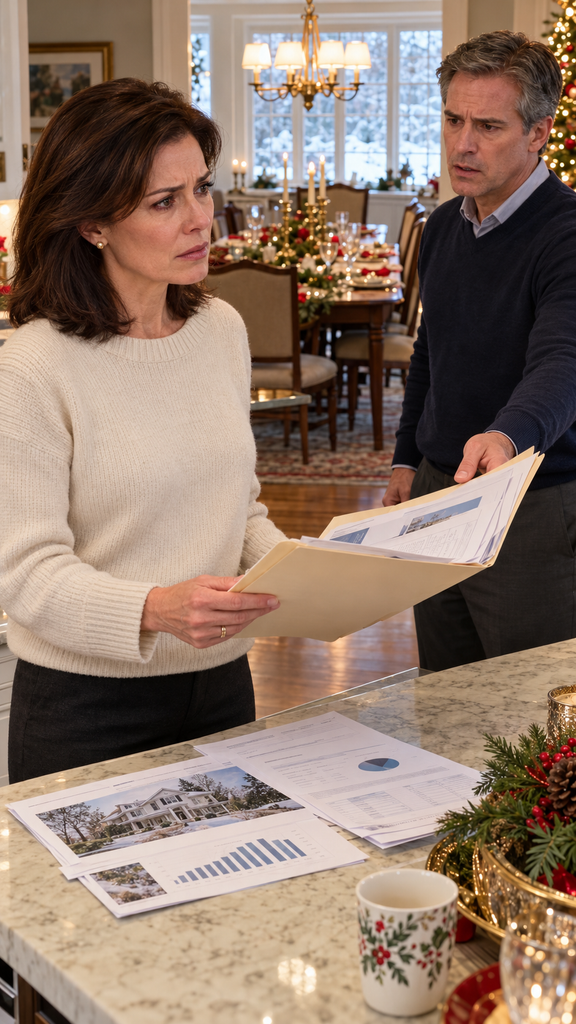
Then I saw the folder beside his elbow.
Plain manila.
Thick.
He noticed me looking at it.
And immediately placed his hand over it.
That tiny movement changed the entire room.
“What’s in the folder?”
“Nothing.”
“Harrison.”
“It’s paperwork.”
“What paperwork?”
“Household stuff.”
I held out my hand.
“Give it to me.”
His expression hardened.
“This is exactly what I mean.”
“What?”
“The interrogation.”
“Give me the folder.”
“No.”
I stared at him.
He stared back.
Seven years of marriage sat between us.
And for the first time, I was frightened not by what my husband might have done.
But by how strongly he believed I had no right to ask.
Then I noticed the corner of a document protruding from beneath his hand.
A familiar word was printed near the top.
Trust.
My father had been dead for six years.
But in that moment, I heard his voice as clearly as if he were standing beside me.
People only think paperwork is pointless until the day they need it.
I reached for the folder.
And Harrison grabbed it first.
PART 4: WHAT MY FATHER LEFT ME
We stood on opposite sides of the kitchen table, each with one hand on the folder.
“Let go,” Harrison said.
“No.”
“Clara.”
“What are you hiding?”
“I’m not hiding anything.”
“Then let go.”
His face flushed.
For one ugly second, neither of us moved.
Then Harrison released it.
Not gently.
He shoved the folder toward me.
“Fine.”
I opened it.
Most of the papers were exactly what he claimed.
Household documents.
Mortgage statements.
Insurance records.
Copies of old tax forms.
Property information.
Nothing illegal.
Nothing forged.
Nothing that proved some elaborate scheme.
But buried among them were printed estimates.
Home values.
Refinancing calculations.
Loan scenarios.
Notes in Harrison’s handwriting.
My address appeared again and again.
So did numbers.
Equity.
Monthly payments.
Potential cash.
I looked up.
“What is this?”
“Research.”
“For what?”
“I told you. Options.”
“Options for my house?”
“Our house.”
“The property is held in my family trust.”
“There you go again.”
“No. We’re not doing that anymore.”
I laid the papers flat.
“You don’t get to make reality offensive because you don’t like it.”
His face changed.
“Do you hear yourself?”
“Yes.”
“I’ve paid bills here for seven years.”
“And I appreciate that.”
“I’ve paid for repairs.”
“So have I.”
“I renovated the upstairs bathroom.”
“We paid for that together.”
“I built the deck.”
“You wanted the deck.”
He slammed his palm against the table.
“I built a life here!”
“And nobody said you didn’t.”
“You did every time you said the house was yours.”
My anger finally broke through.
“Because it is!”
The words echoed through the kitchen.
Harrison stared at me.
I stared back.
There it was.
The sentence I had spent years softening because I loved him.
The truth.
The house was mine.
That did not mean the marriage was mine.
It did not mean Harrison had been a tenant.
It did not erase his contribution to our life.
But the property existed before him, protected by an arrangement my father created before I ever knew Harrison.
And I was done apologizing for that.
“I wanted this to be your home,” I said. “I wanted you to feel safe here. I wanted us to build a marriage here. But those things do not require me to surrender ownership to prove I love you.”
His jaw tightened.
“That’s easy for you to say.”
“Why?”
“Because you’re the one with all the security.”
There.
Finally.
The truth beneath the truth.
I sat down.
Harrison remained standing.
“What happened?” I asked.
He frowned.
“What do you mean?”
“When did you start thinking about me this way?”
“I don’t.”
“You do. Last night you practically accused me of making everyone love me just to make you look bad.”
“I was angry.”
“Anger doesn’t invent resentment. It reveals it.”
He looked away.
I waited.
Eventually, he pulled out the chair across from me.
“I don’t know,” he said.
That was the first honest thing he had said since Christmas Eve began.
He stared at his hands.
“Maybe when Connor lost his job.”
I remembered.
“You told him to toughen up.”
“I was trying to help.”
“He thought you were disappointed in him.”
“He needed motivation.”
“And then he came to me.”
Harrison nodded.
“You fixed his résumé. He got another job. Suddenly you were the one he called when something went wrong.”
“I didn’t ask him to.”
“I know.”
“Then why punish me for it?”
“I wasn’t punishing you.”
“You told me to leave Christmas.”
His face twisted.
“I know.”
“Maya called me after her accident because you were out of town. Was I supposed to ignore her?”
“No.”
“Valerie and I stopped fighting over territory because it was better for your children. Was I supposed to create conflict so you could feel more necessary?”
“No.”
“Then what exactly did you want from me?”
He looked at me.
“I wanted to feel like the center of my own family.”
I sat very still.
There are sentences that explain everything and excuse nothing.
That was one of them.
Harrison had not wanted a peaceful blended family.
Not really.
He wanted to be the bridge holding everyone together.
But somewhere along the way, the rest of us had built relationships that no longer required him as translator, gatekeeper, or referee.
His children could call me.
I could call Valerie.
Valerie could sit at my table.
Connor and Maya could love their mother without proving anything to me.
And Harrison had mistaken our stability for his disappearance.
“So you created a problem,” I said.
He frowned.
“What?”
“You created a situation where everyone had to revolve around you again.”
“That’s ridiculous.”
“Is it?”
“I wanted one Christmas with my kids and their mother.”
“You could have had that.”
“With you sitting there.”
“Yes.”
He looked at me as if that proved his point.
And suddenly I understood.
“You didn’t want a Christmas with them,” I said.
His face went still.
“You wanted a Christmas without me.”
He said nothing.
“That’s why Valerie being comfortable didn’t matter. That’s why Connor and Maya never asked for it. It wasn’t about giving them something.”
I felt my throat tighten.
“It was about taking something from me.”
“That’s not fair.”
“Neither was telling me to pack a bag.”
He stood abruptly.
“I said I was sorry.”
“No. You said you were sorry it got out of hand.”
“What do you want me to say?”
“The truth.”
“I’ve been telling you the truth.”
“No. You’ve been giving me explanations that make you the victim.”
He stared at me.
Then his eyes dropped to the papers.
I followed his gaze.
“Were you planning to refinance the house without me?”
“No.”
“Could you?”
“No.”
That answer came quickly.
Too quickly to be a lie.
And suddenly the significance of the trust became clear again.
He could research.
He could calculate.
He could resent.
But he could not simply take control of property he did not own.
My father had made sure of that.
“Then why all this?”
Harrison’s shoulders dropped.
“I thought if I showed you what we could do with the equity, you might change your mind.”
“Why didn’t you show me?”
“Because I knew you’d say no.”
“So you never asked.”
“I asked last year.”
“And I said no.”
He looked exhausted.
“I’m fifty-one, Clara.”
I waited.
“I’ve spent years putting money into a place where, if you decide tomorrow that you’re done with me, I have nothing.”
There it was again.
Fear.
Not justification.
But fear.
For the first time since Christmas Eve, I could see the human wound beneath his behavior.
It did not make what he did acceptable.
But it made it comprehensible.
“You should have told me you were afraid,” I said.
He laughed once.
“What was I supposed to say? Hi, honey, I’m terrified that if our marriage ends, I’ll discover I spent seven years building a life that legally belongs to somebody else?”
“Yes.”
He looked at me.
“Yes,” I repeated. “That is exactly what marriage is supposed to be for. The humiliating conversations. The ugly fears. The things you don’t want to admit.”
“I tried.”
“No. You proposed a financial solution. When I rejected it, you treated that as rejection of you.”
His eyes filled with anger again.
“You don’t understand what it’s like.”
“No. And you don’t understand what it’s like to realize your husband resents the security your dead father left you.”
Silence.
I closed the folder.
“I’m going to have someone review our finances.”
His expression tightened.
“I haven’t stolen from you.”
“I didn’t say you had.”
“You’re acting like I committed a crime.”
“No. I’m acting like I discovered I stopped paying attention.”
“That isn’t my fault.”
“No.”
I nodded.
“That part is mine.”
He seemed surprised.
“I trusted you so completely that I stopped reviewing things I should have continued reviewing. That was my choice. I won’t make it again.”
“So that’s it?”
“I don’t know.”
“Are you leaving me?”
“I don’t know.”
His voice cracked.
“Clara.”
I stood.
“I know you lied to me. I know you lied about me. I know you asked me to leave my own home on Christmas so you could create some fantasy of a family that never asked to exclude me. And now I know you’ve been carrying resentment toward me for things I thought were signs that our family was working.”
He looked down.
“I need time.”
“Where am I supposed to go?”
Again.
That question.
But this time, I heard the fear inside it.
I did not enjoy it.
I did not want revenge.
I simply refused to rescue him from the consequences of what he had done.
“I’m not throwing you out today,” I said. “But I don’t want to pretend everything is normal.”
He nodded slowly.
Then the front doorbell rang.
We both looked toward the hallway.
“I’m not expecting anyone,” Harrison said.
Neither was I.
I opened the door.
Maya stood on the porch holding two coffees.
Connor stood behind her carrying a bakery box.
And beside him, wrapped around her neck, was Valerie.
Wearing the cashmere scarf.
Maya looked past me toward her father.
Then back at me.
“We brought Christmas breakfast.”
I almost cried.
Harrison appeared behind me.
Nobody said anything.
Valerie touched the scarf.
“Thought I should wear my present.”
Harrison looked like he wanted the floor to open beneath him.
I stepped aside.
“Come in.”
Maya hugged me first.
Hard.
Connor followed.
Then Valerie.
When she released me, she whispered, “You okay?”
“No.”
“Good.”
I blinked.
She gave me a sad smile.
“I’d be worried if you were.”
We carried the coffee and pastries into the kitchen.
Harrison stood near the counter like a man who had suddenly become a visitor in the home he had spent years accusing me of making him feel like one.
No one attacked him.
No one shouted.
That was worse.
Finally Connor looked at his father.
“Why?”
Harrison rubbed his forehead.
“Connor, this is between Clara and me.”
“No.”
Maya’s voice was calm.
“You made it about us when you used us as the reason.”
Harrison looked at her.
“I was trying to give you two something.”
“We didn’t ask for it.”
“I know that now.”
Valerie folded her arms.
“You also used me.”
“I apologized.”
“To me.”
Harrison frowned.
“What?”
“You apologized to me last night.”
She nodded toward me.
“Did you apologize to your wife?”
His face reddened.
“This is not a tribunal.”
“No,” Valerie said. “It’s Christmas breakfast.”
She opened the bakery box.
“But apparently honesty is on the menu.”
Despite myself, I laughed.
Maya did too.
Even Connor smiled.
Harrison didn’t.
Then Maya looked at me.
“Are you staying?”
It took me a second to understand.
“In the house?”
“In the marriage.”
The room went silent.
I looked at Harrison.
He looked at me.
“I don’t know,” I said.
And for once, I didn’t soften the truth to make everyone else comfortable.
PART 5: THE PLACE I CHOSE FOR MYSELF
The week between Christmas and New Year’s changed my marriage more than the previous seven years.
Not because anything dramatic happened.
Because I started looking.
I reviewed every account.
Every automatic payment.
Every insurance policy.
Every shared obligation.
I requested copies of documents I should have kept myself.
I changed passwords where appropriate.
I made a list of what belonged to me, what belonged to Harrison, and what belonged to both of us.
And I discovered something important.
There was no hidden fortune.
No secret second family.
No forged deed.
No criminal conspiracy.
Harrison had not secretly stolen my house.
Reality was less sensational and, in some ways, more painful.
He had simply allowed resentment to grow until he believed my independence was something being done to him.
He had taken over practical responsibilities and gradually turned competence into control.
I had allowed convenience to become dependence because I thought dependence was safe inside a good marriage.
Neither of those things required a villain.
But only one of us had used the other person’s trust to rewrite reality.
That mattered.
On December twenty-eighth, Harrison and I sat in the living room.
The Christmas tree was still up.
Half the lights had gone out on one strand.
Normally I would have fixed them immediately.
I didn’t.
Some things could stay imperfect for a while.
“I found an apartment,” Harrison said.
I looked at him.
He swallowed.
“I haven’t signed anything.”
“Okay.”
“I can stay there month to month.”
I nodded.
“Okay.”
His face tightened.
“That’s all you’re going to say?”
“What do you want me to say?”
“I don’t know.”
He looked around the room.
“I guess I thought you’d ask me not to go.”
A week earlier, I probably would have.
Not because it was what I wanted.
Because I hated making people feel unwanted.
That instinct had shaped too much of my life.
“I think you should go,” I said.
He looked at me.
The pain on his face was real.
I didn’t look away.
“I’m not saying our marriage is over today,” I continued. “I’m saying I need to know whether there’s anything left when neither of us is acting out of habit.”
“You think I don’t love you?”
“I think you love me.”
That seemed to hurt him more.
“Then why?”
“Because love didn’t stop you from humiliating me.”
He lowered his eyes.
“Love didn’t stop you from lying about me. Love didn’t stop you from turning your fear about the house into resentment toward me. So right now, love isn’t the only question.”
“What is?”
“Whether I trust you.”
He sat very still.
“And do you?”
“No.”
It was the hardest word I had ever said to him.
He nodded once.
A tear ran down his face.
I had seen Harrison cry twice before.
At his mother’s funeral.
And when Maya graduated from college.
Every part of me wanted to cross the room.
I didn’t.
Not because I wanted him to suffer.
Because comforting him at that moment would have required me to abandon myself again.
“I am sorry,” he said.
This time there was no qualification.
No “but.”
No explanation.
No accusation.
“I’m sorry I asked you to leave. I’m sorry I lied to the kids. I’m sorry I used Valerie as an excuse. And I’m sorry I made you feel like protecting something your father left you was an attack on me.”
I cried then.
Quietly.
He did too.
“I wish you’d said that Christmas Eve.”
“I wish I had too.”
“But you didn’t.”
“No.”
He moved out two days later.
Connor helped him.
I offered to leave while they packed.
Harrison shook his head.
“No.”
He looked at me.
“You’ve left this house for me enough.”
That sentence stayed with me.
After he drove away, I stood in the living room listening to the silence.
I expected to feel victorious.
I didn’t.
I felt grief.
Relief.
Anger.
Love.
Disappointment.
Fear.
Freedom.
All of them at once.
Real endings rarely arrive with one emotion.
Sometimes neither do beginnings.
In January, Harrison and I started counseling.
Separately at first.
Together later.
I made no promises.
Neither did he.
For months, we talked about things we should have discussed years earlier.
Money.
Ownership.
Fear.
Age.
His children.
My father.
The difference between being needed and being loved.
The difference between sharing a home and owning property.
The difference between generosity and self-erasure.
Harrison admitted that watching Connor and Maya become close to me had triggered something he was ashamed to name.
Jealousy.
Not romantic jealousy.
Parental jealousy.
He had spent years after his divorce afraid that his family had fractured because he had failed.
Then I entered the picture and, without trying to replace anyone, became another stable person his children trusted.
Instead of feeling grateful, part of him felt diminished.
He hated that part of himself.
So he ignored it.
Ignored feelings do not disappear.
They find disguises.
His disguised itself as money.
Then property.
Then fairness.
Then Christmas.
Eventually, it became a request for his wife to pack a bag so he could sit at her table without her.
Understanding that did not erase it.
But understanding mattered.
By spring, I knew what I wanted.
Not the old marriage.
That marriage was gone.
I wanted to know whether Harrison and I were capable of building a different one.
One in which I did not hand over access to my life because vigilance felt unromantic.
One in which he did not measure love by how much control I surrendered.
One in which difficult feelings were spoken before they became punishments.
He remained in his apartment.
We had dinner sometimes.
We took walks.
Occasionally he came to the house.
The first time he did, he stopped at the front door.
I almost laughed.
“You can come in.”
“I know.”
“Then why are you standing there?”
He looked embarrassed.
“I don’t know.”
I understood.
For years he had complained that he felt like a guest.
Now he was one.
But this time, instead of resenting me for the feeling, he named it.
“This is hard.”
“I know.”
“I hate that I did this.”
“I know.”
Then I opened the door wider.
“Come in.”
He did.
That was how we began again.
Not with grand declarations.
With permission.
With boundaries.
With the truth.
Christmas came around again faster than I expected.
By early December, Maya started a group message.
Her first text read:
IMPORTANT QUESTION. Who is hosting this year and is Dad allowed to make decisions?
Connor replied:
Absolutely not.
Valerie:
I nominate Clara.
Harrison:
I deserve that.
I stared at my phone for a long time.
Then I wrote:
My house. Christmas Eve. Everyone invited.
A few seconds later, Harrison sent a private message.
Including me?
I smiled despite myself.
Especially you.
Then I added:
But I’m not leaving.
His reply came almost immediately.
Never again.
On Christmas Eve, exactly one year after I carried an overnight bag through my own front door, I stood in the same kitchen tying gold ribbon around gifts.
The dining room was warm.
Evergreen ran down the table.
My mother’s silverware gleamed beneath the candlelight.
Valerie arrived first.
She was wearing the scarf.
“You know,” she said, touching it, “at this point I wear this mostly to make Harrison uncomfortable.”
“You’re a terrible person.”
“I’ve been told.”
Maya arrived carrying wine.
Connor came ten minutes later with the woman he had finally agreed to call his girlfriend.
And Harrison came last.
He stood outside holding a pie.
For a second, neither of us spoke.
Our marriage was not magically healed.
He still had his apartment.
We were still in counseling.
There were still days when I remembered his relief as I walked out the door and wondered whether I would ever stop hearing that quiet “Good.”
Trust returned slowly.
Maybe that was the only honest way for it to return.
Harrison held up the pie.
“Peace offering?”
“What kind?”
“Apple.”
“I’ll consider it.”
He smiled.
Then his expression became serious.
“Can I come in?”
A year earlier, that question would have broken my heart.
Now I understood what it meant.
He wasn’t asking whether he belonged.
He was acknowledging that belonging did not mean entitlement.
I stepped aside.
“Yes.”
Dinner was loud.
Connor’s girlfriend laughed so hard at one of Valerie’s stories that she nearly spilled her wine.
Maya complained about work.
Connor argued with his father about football.
Valerie criticized my potatoes even while taking seconds.
Nobody tried to make the evening look like a perfect family.
That was what made it feel like one.
At one point, I stood to get another bottle of wine.
Harrison caught my hand.
I looked down.
“What?”
He glanced around the table.
Then back at me.
“I’m glad you’re here.”
The sentence was simple.
But I knew what lived behind it.
I squeezed his fingers once.
“So am I.”
Later, after everyone had gone, I found myself alone in the dining room.
Six used plates.
Empty glasses.
Crumbs on the tablecloth.
One candle still burning.
I thought about the previous Christmas.
About the empty place setting.
About the shelter kitchen.
About Maya’s phone call.
About Valerie wearing the scarf.
About my father and his ridiculous folders and his stubborn belief that paperwork could be an act of love.
I thought about the woman I had been when Harrison told me to leave.
She had believed keeping peace was the same thing as protecting a family.
She had believed trust meant not checking.
She had believed generosity required making herself easy to live with.
She had been wrong.
But I didn’t hate her for it.
She had loved people.
There was nothing shameful about that.
She simply had to learn that loving people did not require disappearing for them.
Harrison came into the dining room carrying two glasses of water.
“You okay?”
I looked at the table.
“Yes.”
He followed my gaze.
After a moment, he said, “I think about it too.”
“Last Christmas?”
He nodded.
“I still can’t believe I asked you to leave.”
“I can.”
He winced.
I almost smiled.
“That wasn’t meant to hurt you.”
“I know.”
I touched the back of the chair where I had been sitting.
“My mistake was thinking the worst part was that you asked me to leave my house.”
“What was the worst part?”
“That I almost believed I should.”
His face changed.
I looked at him.
“I spent hours wondering whether I was being selfish. Whether maybe you were right. Whether maybe I was standing in the way of something Connor and Maya needed.”
“They never needed you gone.”
“I know.”
“I never should have made you think they did.”
“I know that too.”
Outside, snow had begun falling.
Softly.
Not enough to stick.
Just white flecks passing through the glow of the porch lights.
Harrison came to stand beside me.
He didn’t touch me until I reached for his hand.
For a while, we stood there looking at the room.
My room.
Our Christmas.
Two truths that no longer needed to cancel each other out.
My father had protected the house.
But the lesson he left me was bigger than property.
Security was not selfish.
Boundaries were not betrayal.
Love that demanded proof through surrender was not made stronger by surrendering.
And family was not defined by who had the oldest claim to a chair.
Family was Valerie wearing the scarf I bought her.
It was Maya calling when a story didn’t sound right.
It was Connor refusing to let silence protect a lie.
It was Miriam handing me an apron instead of demanding an explanation.
It was Harrison finally learning that being loved was not the same as being obeyed.
And it was me.
Still there.
Not because someone had finally given me permission to stay.
Because I had stopped believing anyone else had the right to make me leave.
I reached over and extinguished the final candle.
For years, I thought my father had protected my house with paperwork.
It took one terrible Christmas for me to understand what he had really protected.
My right to choose what happened inside it.
And my right to choose my own place at the table.
Leave a Reply