
PART 1: THE WOMAN WHO DIDN’T BELONG
“Who let you in? Get out. Now. You’re humiliating me in front of my unit.”
My younger brother Nolan was smiling when he said it.
That was the part I remember most clearly.
Not the anger in his voice. Not the pressure of his fingers around my upper arm. Not even the fact that nearly forty officers and their spouses were standing only a few yards away.
It was the smile.
The polished, practiced smile Nolan had learned to wear whenever people were watching.
To everyone else in the room, Lieutenant Colonel Nolan Hart looked like a decorated officer quietly helping an awkward relative find the exit.
Only I could hear what he was saying through clenched teeth.
“You need to leave, Evelyn.”
His fingers tightened.
I looked down at his hand.
Then I looked back at him.
“Take your hand off me.”
My voice was quiet.
That seemed to make him angrier.
Nolan had always confused volume with strength. Our father had taught him that without ever saying it directly. The person telling the funniest story at dinner was important. The person holding the biggest trophy was successful. The person everyone turned to when he entered a room mattered.
I had spent most of my life being the opposite.
I was the person who noticed the leaking pipe before the ceiling collapsed.
The person who remembered that Mom’s car registration expired on Tuesday.
The person who balanced Dad’s business accounts when he was recovering from surgery.
The person who read every page before signing anything.
Useful.
Reliable.
Forgettable.
At least to my family.
“You shouldn’t even be here,” Nolan whispered.
I glanced toward the ballroom behind him.
The promotion reception was being held in a private event hall near Fort Belvoir. There were white tablecloths, polished glasses, framed photographs from Nolan’s deployments, and a large display near the podium documenting his career from ROTC to lieutenant colonel.
Our mother had helped arrange it.
Naturally, there were more photographs of Nolan in that room than there were photographs of me in my parents’ entire house.
“This is a family event,” I said. “Mom invited me.”
“That was before.”
“Before what?”
His jaw tightened.
“Before I realized you were going to show up like this.”
I looked at myself.
Dark navy suit. White blouse. Black heels. Hair pinned neatly behind my head.
Nothing unusual.
“What exactly is wrong with how I showed up?”
“You look like you’re attending a congressional hearing.”
Despite myself, I almost smiled.
He had no idea how close that was to being funny.
“I came straight from work.”
“That’s exactly what I mean.”
“What does that mean?”
“People keep asking who you are.”
“And?”
“And I don’t know what to tell them.”
That hurt more than his hand.
I didn’t show it.
Twenty years earlier, I would have.
At eighteen, I might have demanded to know how my own brother could say something like that.
At twenty-five, I might have explained myself.
At thirty-five, I might even have listed accomplishments, hoping that one of them would finally make my family look at me differently.
At forty-six, I simply said, “You could tell them I’m your sister.”
Nolan stared at me.
“You know that’s not what I mean.”
Unfortunately, I did.
Across the room, Dad was holding a glass of bourbon and talking to two retired officers.
Even from where I stood, I could hear pieces of his story.
“…knew from the time he was ten…”
“…natural leader…”
“…always had something special…”
Dad had been telling versions of that story for decades.
Nolan made varsity baseball.
Natural leader.
Nolan became class president.
Natural leader.
Nolan joined ROTC.
Born for command.
Nolan commissioned into the Army.
Destined for greatness.
Meanwhile, when I left home, Dad described it as Evelyn getting “one of those government jobs.”
That description followed me for years.
Evelyn works in Washington.
Evelyn does government stuff.
Evelyn can’t really talk about her job.
Eventually the family stopped asking.
That had made things easier.
It had also allowed them to construct an entire version of my life that existed only in their imagination.
In that version, I worked behind a desk somewhere.
I attended meetings.
I wrote reports.
I was probably reasonably competent.
And because I never corrected them, they assumed there was nothing to correct.
Dad noticed us.
His eyes moved from Nolan’s face to the hand gripping my arm.
Then he looked at me.
I knew that expression.
Don’t ruin this for your brother.
He had given me the same look at birthday parties, graduations, baseball banquets, Thanksgiving dinners, and once at my own college graduation when Nolan announced that he had been accepted into the ROTC program he wanted.
I had learned to read that look before I learned to drive.
Be easy, Evelyn.
Be mature.
Don’t make a scene.
Let your brother have this.
Nolan followed my gaze.
“See?” he whispered. “Dad understands.”
That was when something inside me went very still.
Not angry.
Still.
There is a point when disappointment becomes so familiar that it stops surprising you.
I had reached that point with my family years ago.
The only person who had ever understood what silence cost me was my grandfather.
Walter Hart.
Dad’s father.
Thirty-three years in the Army.
He had retired before Nolan and I were old enough to understand what the ribbons in the shadow box on his wall meant.
To us, he was simply Grandpa Walter.
He lived in a white house with green shutters outside Staunton, Virginia, about fifteen minutes from ours. His porch leaned slightly on the left side, the screen door never closed properly, and every summer he made lemonade so weak that Nolan used to complain it tasted like water that had heard about lemons.
Grandpa would laugh.
Then he would ask me the same question.
“What did you fix today?”
Not what grade did you get.
Not did you win.
Not who praised you.
What did you fix?
When I was fourteen, Nolan received a baseball trophy at the end of a season in which he had spent more time on the bench than on the field.
Dad acted as if the Baltimore Orioles had called.
He invited neighbors over.
Mom bought a cake.
Nolan carried that trophy around all evening.
I had received the highest score in the county mathematics competition two days earlier.
Dad had said, “That’s great, honey,” without looking up from the newspaper.
That night, I slipped out and walked to Grandpa’s.
He was sitting on the porch.
He looked at my face and moved his chair aside without asking what happened.
I sat beside him.
After a while, he said, “Your father is proud of Nolan.”
“I noticed.”
“He should be.”
I looked at him sharply.
Grandpa took a sip of lemonade.
“He should also be proud of you.”
I stared at the yard.
“He isn’t.”
“Your father understands things he can see.”
“What does that mean?”
“It means some people need a trophy before they recognize an achievement.”
I hated that answer.
“It’s not fair.”
“No.”
That surprised me.
Adults usually told children that life was fair in some complicated way they simply didn’t understand yet.
Grandpa never did.
“No,” he repeated. “It isn’t.”
My eyes burned.
“Then what am I supposed to do?”
He looked at me for a long moment.
“Become the kind of person who doesn’t need a room to clap before she knows what she’s worth.”
I didn’t understand how difficult that would be.
Not then.
Before I left, he said something else.
“One day your family is going to understand exactly who you are.”
I laughed.
“And what if they never do?”
Grandpa leaned toward me.
“Then make sure you do.”
Thirty-two years later, standing in that ballroom with Nolan’s fingers digging into my arm, I heard Grandpa’s voice as clearly as if he were standing beside me.
Then the room changed.
The laughter stopped first.
Not all at once.
It disappeared in pieces.
A conversation behind Nolan faded.
A glass touched a table.
Someone near the podium straightened.
Then another officer did the same.
Nolan noticed.
His grip loosened.
He looked over my shoulder toward the entrance.
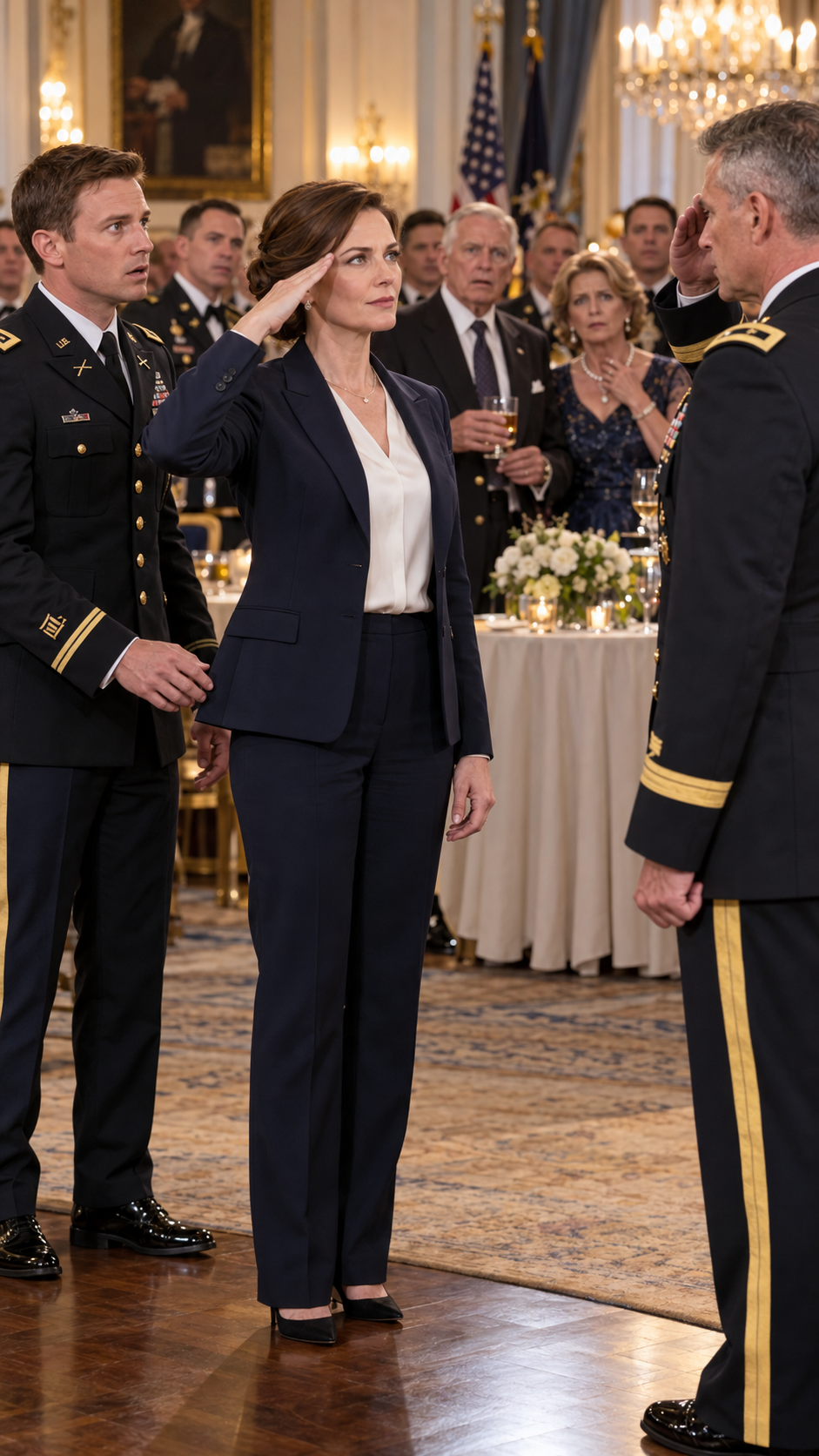
Colonel Marcus Reed had entered the room.
Nolan’s brigade commander.
I had known Marcus professionally for almost three years. We weren’t friends, exactly, but we had sat in secure conference rooms together, argued over readiness assessments, reviewed force modernization problems, and once spent six miserable hours waiting for weather to clear at an airfield in Germany.
Nolan did not know any of that.
Marcus looked across the room.
He saw me.
Then he saw Nolan’s hand on my arm.
His entire expression changed.
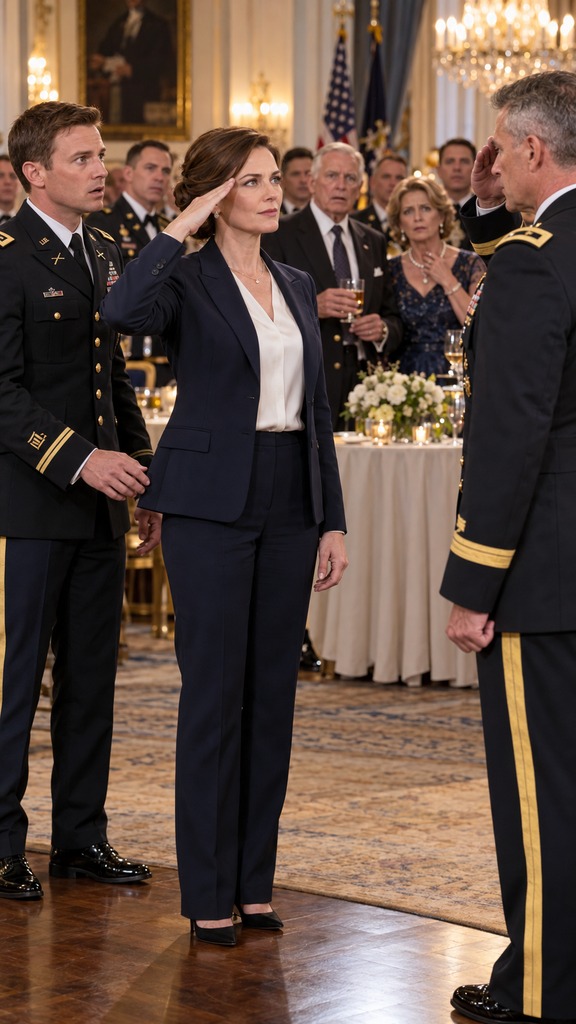
He stopped.
Came to attention.
And saluted.
Instinct took over.
I returned the salute.
Nolan’s hand fell from my arm.
Marcus crossed the room.
Nobody spoke.
He stopped in front of me.
His eyes flicked once toward Nolan.
“General,” he said, “is there a problem?”
I could feel Nolan staring at me.
Dad had stopped talking.
Mom was moving toward us.
For several seconds, my brother looked from Marcus to me and back again, as if there had been some administrative mistake reality would correct if he waited long enough.
Dad reached us first.
“Evelyn?”
I turned.
His bourbon glass was still in his hand.
“Did he just call you General?”
Mom touched the necklace at her throat.
Nolan gave a nervous laugh.
“No. Wait. There has to be some misunderstanding.”
Marcus’s face hardened.
Nolan realized immediately what he had done.
“Sir, I didn’t mean—”
“Lieutenant Colonel Hart.”
Two words.
Nothing loud about them.
But Nolan straightened.
Marcus looked directly at him.
“Your sister is Major General Evelyn Hart.”
Nolan stopped moving.
Marcus continued.
“She was confirmed for her second star six weeks ago.”
Mom whispered, “Second star?”
Nolan looked at me.
“You’re a two-star general?”
“Yes.”
One word.
That was all I gave him.
I watched disbelief become memory.
I knew exactly what he was remembering.
The email.
Six weeks earlier, I had sent Mom and Dad the formal announcement.
Mom replied with a thumbs-up emoji.
Dad answered fifteen minutes later.
Good for you, Ev. Nolan’s promotion ceremony is October 18. Hope you can make it.
Neither of them attended my ceremony.
Neither asked what the promotion meant.
Neither even called.
Now my mother stared at me as if she had just discovered I spoke another language.
“Why didn’t you tell us?”
I looked at her.
“I did.”
Her face changed.
Before she could answer, Nolan spoke.
“But how?”
I almost asked what he meant.
How had I become a general?
How had I done it without his permission?
How had I lived an entire professional life beyond the limits of his curiosity?
Marcus glanced at me.
He understood enough to know this was no longer a military conversation.
“I’ll give you some space, ma’am.”
“Thank you, Colonel.”
He started to turn.
Then Nolan said, “Sir.”
Marcus stopped.
My brother swallowed.
“How long have you known her?”
Marcus looked at me before answering.
“Professionally?”
“Yes, sir.”
“Several years.”
Nolan stared.
Several years.
Two simple words, and I watched another piece of his certainty collapse.
Then Marcus added something I wished he hadn’t.
“General Hart’s office has influenced a significant amount of the work this brigade has been doing.”
Nolan looked at me.
“What work?”
Marcus hesitated.
That was when I knew the evening was no longer going to end with a salute.
Because Nolan had finally asked a question about my work.
And once he started asking, there were answers waiting for him that were going to hurt far more than discovering my rank.
PART 2: WHAT MY FAMILY NEVER ASKED
My mother was the first to recover.
“We should sit down.”
It was such a Mom response that for one absurd second I almost laughed.
As though chairs could make the situation smaller.
As though putting four people around a table would transform years of indifference into a misunderstanding that could be cleared up before dessert.
Dad looked around.
People were pretending not to watch.
Military officers are often very good at maintaining professional expressions.
Their spouses were less successful.
“Nolan,” Dad said quietly, “maybe we should go somewhere private.”
“No.”
My brother’s answer came too quickly.
He was still looking at me.
“What did Colonel Reed mean?”
“Nolan.”
“What work?”
I could see the panic underneath his anger.
He had spent his entire adult life understanding hierarchy.
Rank.
Authority.
Command.
Reputation.
Now the sister he had just tried to physically remove from his promotion party occupied a position in that hierarchy he had never imagined.
But rank wasn’t what frightened him most.
It was the possibility that our lives had intersected without his knowledge.
I looked around the room.
“This is your reception.”
“You were leaving anyway.”
That landed badly.
Even Dad winced.
I studied my brother’s face.
“All right.”
Mom whispered, “Evelyn.”
“No. He wants an answer.”
Nolan folded his arms.
I noticed that he had shifted from embarrassment to defensiveness.
That was familiar too.
When Nolan was cornered, he attacked the shape of the corner.
“What did you think I did?” I asked.
He frowned.
“What?”
“All these years. What did you think my job was?”
“You worked for the government.”
“Doing what?”
“I don’t know.”
“Exactly.”
His face reddened.
“That’s not fair. You never talked about it.”
“You never asked.”
“That’s because you always said you couldn’t talk about it.”
“Sometimes I couldn’t.”
“So what was I supposed to do?”
“Ask what I could tell you.”
Silence.
Dad shifted his weight.
Mom looked down.
That answer had reached more than Nolan.
I had not planned this confrontation.
I had not attended my brother’s promotion reception intending to reveal anything.
I had come because Mom called three weeks earlier and said, “Please come, Evelyn. It would mean a lot to your brother.”
Apparently, nobody had asked Nolan whether that was true.
I had even considered not attending.
My schedule was brutal. I had returned from Europe forty-eight hours earlier and had a Monday briefing I still needed to prepare for.
But I came.
Because family invitations had a strange power over me.
No matter how old I became, some small part of me still hoped the next gathering might be different.
That perhaps Dad would ask about my life before telling me about Nolan’s.
Perhaps Mom would remember an important date without Facebook reminding her.
Perhaps Nolan would introduce me with pride instead of confusion.
Hope can be remarkably stubborn.
Nolan gestured toward Marcus.
“He said your office influenced our brigade.”
“It did.”
“How?”
“Readiness restructuring. Logistics integration. Deployment modeling. A number of modernization programs.”
His expression changed slightly.
He knew those words.
Of course he did.
He had lived inside their consequences.
“Our logistics overhaul?”
“Partly.”
“The rotational readiness framework?”
“I was involved.”
Nolan stared.
Dad looked completely lost.
Mom asked, “What does that mean?”
Nolan didn’t answer her.
His eyes remained fixed on mine.
“The framework that changed our pre-deployment cycle?”
“Yes.”
“You worked on that?”
“Yes.”
“How much?”
I paused.
“Enough.”
He shook his head.
“No. Don’t do that.”
“Do what?”
“That thing where you give half an answer and act like everyone else is stupid for not knowing the rest.”
For the first time that evening, anger moved through me.
Clean and sharp.
“I have never thought you were stupid, Nolan.”
“Then why didn’t you tell me?”
“Because you never asked.”
“There it is again.”
“Because it’s true.”
His jaw flexed.
I lowered my voice.
“Do you remember Christmas four years ago?”
He stared at me.
“What?”
“At Mom and Dad’s house. You had just come back from Germany.”
“I guess.”
“You talked for almost an hour about your unit’s readiness problems.”
Something flickered in his expression.
I remembered every minute.
Dad had opened an expensive bottle of whiskey.
Nolan sat beside the fireplace describing equipment shortages, maintenance delays, training schedules, and a reporting system that punished commanders for problems they couldn’t control.
Dad understood almost none of it.
He nodded anyway.
I had asked Nolan three questions.
He answered the first.
Interrupted the second.
Then laughed and said, “Trust me, Ev, this stuff would put you to sleep.”
Two weeks later, I carried several of his observations—stripped of identifying details—into a working group already examining the same structural problems across multiple commands.
Nolan had not created the solution.
Neither had I.
That was not how large institutions worked.
Hundreds of people contributed.
Commanders.
Analysts.
Logisticians.
Policy staff.
Soldiers.
Civilian experts.
But I had remembered what my brother said because underneath his arrogance, he had been right about several things.
And because good ideas did not become bad ideas simply because the person who voiced them underestimated you.
“You told me the reporting system was hiding problems instead of solving them,” I said.
Nolan’s arms slowly dropped.
“You remember that?”
“I remember most things.”
He knew that.
Everyone in the family did.
I continued.
“You said commanders were spending too much energy protecting readiness numbers instead of identifying what they actually needed. You complained that maintenance data arrived too late and that units were training to satisfy calendars rather than operational requirements.”
His face had gone still.
“I raised similar concerns in a working group.”
“You used what I told you?”
“I used an observation that aligned with evidence we were already seeing elsewhere.”
Nolan’s voice changed.
“And that became the new framework?”
“No. Dozens of people worked on that framework. I was one of the senior officers responsible for moving parts of it forward.”
He looked around the ballroom.
The displays celebrating his career suddenly seemed to make him uncomfortable.
“Why didn’t you tell me?”
“Would you have listened?”
“Yes.”
I said nothing.
His eyes dropped.
We both knew the answer.
Mom stepped toward me.
“Evelyn, honey, we didn’t know.”
There it was.
The sentence I had expected.
I turned to her.
“You didn’t know because you didn’t ask.”
Her eyes filled immediately.
I hated that.
Not because I wanted her to hurt.
Because tears had always ended difficult conversations in our family.
Mom cried.
Dad defended her.
Nolan changed the subject.
I apologized for being too harsh.
The machine reset.
Not tonight.
Dad set his bourbon on a nearby table.
“Well, you have to admit you kept things pretty private.”
I looked at him.
“Dad, I invited you to my promotion.”
His mouth opened.
“You said it was some ceremony in Washington.”
“Yes.”
“We thought it was work-related.”
“It was my promotion to major general.”
He looked genuinely confused.
“I didn’t know that was what two stars meant.”
That answer hurt more than I expected.
My father had spent my entire childhood worshiping military accomplishment because his own father had served.
He knew what two stars meant.
Or at least he had once.
He had simply never connected that knowledge to me.
Mom whispered, “I thought the stars were some kind of department level.”
Nolan closed his eyes.
He understood exactly how absurd that sounded.
I could have humiliated them.
For one brief, ugly second, part of me wanted to.
I wanted to list every ceremony they had missed.
Every promotion they had minimized.
Every holiday dinner when they spent hours discussing Nolan’s career and less than five minutes asking about mine.
Every time Dad had introduced Nolan as “my son, the Army officer,” then introduced me as “our daughter Evelyn—she works in government.”
But Grandpa Walter had taught me something else.
Rank did not make you taller by making someone else smaller.
So I said only, “You didn’t know.”
Dad looked relieved.
Until I finished.
“But you had opportunities to know.”
That silence was harder.
Behind us, the reception had begun moving again.
Quiet conversations resumed.
Someone turned the music slightly louder.
Marcus had deliberately crossed to the opposite side of the room.
He was giving us privacy.
Nolan stared toward the display documenting his career.
Then he said, “The battalion command recommendation.”
I knew immediately what he meant.
My stomach tightened.
“Nolan.”
His eyes snapped toward me.
“Were you involved?”
“No.”
He exhaled.
But I wasn’t finished.
“I was asked about you.”
The relief vanished.
“By who?”
“I’m not discussing names.”
“When?”
“Before your command selection.”
His face changed.
“What did you say?”
“The truth.”
“What truth?”
“That you were capable. Operationally strong. Good under pressure. That you had a tendency to care too much about how senior leaders perceived you.”
He flinched.
Dad said, “Evelyn.”
I ignored him.
Nolan stepped closer.
“You said that?”
“Yes.”
“And they still selected me?”
There was so much disbelief in his voice that I almost felt sorry for him.
“I also said you listened to your soldiers when it mattered, learned quickly after mistakes, and had the ability to become a very good commander if you stopped treating every room like an audition.”
His face turned dark red.
“That’s what you think of me?”
“That’s what I thought then.”
“And now?”
I looked at the faint red marks his fingers had left on my arm.
Nolan followed my eyes.
His face drained.
For the first time all evening, he looked ashamed.
He opened his mouth.
Before he could speak, an older retired officer approached.
Brigadier General Samuel Avery.
Retired.
One of Dad’s guests.
I had met him years earlier.
He nodded to me.
“General Hart.”
“General Avery.”
Then he smiled at Nolan.
“Congratulations, Colonel.”
“Thank you, sir.”
Avery looked between us.
“I suppose tonight’s a proud night for the Hart family.”
Nobody answered.
His smile faded slightly.
Then his eyes landed on a photograph near the display.
Nolan receiving an award several years earlier.
Avery chuckled.
“You know, your sister gave me an earful about that assignment.”
Nolan went rigid.
I felt the floor drop beneath the conversation.
“Avery.”
He looked at me.
Too late.
Nolan turned.
“What assignment?”
Avery realized immediately that he had stepped into something.
He cleared his throat.
“Well…”
“What assignment, sir?”
I closed my eyes for half a second.
There were some truths I had hoped Nolan would never need to know.
Not because I was ashamed of them.
Because I had never wanted him to believe his career belonged to me.
It didn’t.
But families have strange ways of turning help into debt.
And I had spent years making sure Nolan never owed me anything.
Avery looked at me.
I gave the smallest nod.
He sighed.
“Germany.”
Nolan stared at him.
“My Germany assignment?”
“Yes.”
“What did she do?”
Avery glanced at me again.
“She didn’t get you the assignment, if that’s what you’re asking.”
Nolan’s shoulders loosened.
“But,” Avery continued, “your name had been pushed toward a staff slot after your previous evaluation. Your sister argued that officers with strong field instincts shouldn’t automatically be buried behind a desk because their paperwork wasn’t elegant enough.”
Nolan looked at me.
I remembered the conversation.
I had never asked anyone to select him.
I would never have done that.
I had argued against a broader personnel habit that I believed was wasting capable officers.
Nolan happened to be one of several cases under discussion.
His record did the rest.
Still, the distinction would not matter emotionally.
Not tonight.
Avery continued.
“She said, ‘Put him where consequences are real. He’ll either grow up or wash out.’”
Nolan stared at me.
Dad stared too.
I almost smiled.
“That sounds harsher when you repeat it.”
Avery laughed once.
“It worked.”
Then he noticed nobody else was laughing.
His expression sobered.
“I should probably congratulate someone across the room.”
He disappeared.
Nolan remained motionless.
Germany had changed his career.
We all knew that.
It was where he earned the evaluations that later positioned him for battalion command.
Where he met mentors who advocated for him.
Where he gained the operational credibility Dad had spent years bragging about.
Finally Nolan whispered, “How many times?”
I knew what he meant.
“How many times what?”
“How many times have you done that?”
I didn’t answer.
His eyes widened.
“Oh my God.”
“Nolan.”
“How many?”
“Not the way you’re thinking.”
“Then tell me.”
I looked at my brother—the golden child, the decorated officer, the man who had spent his entire life believing he had climbed alone.
And I realized that discovering my rank had only embarrassed him.
This truth could break him.
Because the worst thing you can tell a proud man is not that someone is more successful than he thought.
It is that someone he dismissed once stood quietly between him and a closed door.
PART 3: THE THINGS I NEVER TOOK CREDIT FOR
“I never built your career.”
I said it before Nolan could ask again.
His eyes stayed on mine.
“Then what did you do?”
“Occasionally, your name crossed my professional field of view.”
“How often?”
“Not often.”
“How many times, Evelyn?”
“Enough that I was careful.”
That answer did not help.
Nolan laughed once, but there was nothing amused in it.
“Careful?”
“Yes.”
“About what?”
“About never giving you something you hadn’t earned.”
His face tightened.
I continued before he could interrupt.
“I never ordered anyone to promote you. I never manipulated a selection board. I never asked anyone to falsify an evaluation, move you ahead of someone more qualified, or create a position for you.”
“Then why did Avery say—”
“Because your name came up during a larger personnel discussion. I gave an opinion.”
“You defended me.”
“I defended an assignment philosophy.”
“That included me.”
“Yes.”
“So you helped me.”
The words sounded like an accusation.
I nodded.
“In that instance, probably.”
Dad stepped between us slightly.
“Isn’t that a good thing?”
Nolan turned on him.
“You don’t understand.”
Dad recoiled.
“No, Dad. You don’t understand. My entire career—”
“Is yours,” I said.
Nolan looked at me.
“Don’t.”
“It is.”
“You don’t get to decide how this feels.”
That stopped me.
He was right.
So I waited.
His voice lowered.
“Do you know what Germany meant to me?”
“Yes.”
“No. You know what it did for my record. That’s not the same thing.”
He looked toward the photographs.
“When I got those orders, I thought somebody had finally seen what I could do.”
“They had.”
“Did they?”
“Yes.”
“How can I know that?”
“Because one conversation cannot sustain a twenty-year career.”
He said nothing.
“You passed every evaluation after that. You led soldiers. You made decisions. You deployed. You made mistakes and recovered from them. You earned command. I was not standing behind you during any of that.”
“But you were in the room before I got there.”
That sentence stayed with me.
Because beneath the anger, I finally understood what he was afraid of.
Nolan had built his identity around earning Dad’s admiration.
He needed to believe every step upward proved something.
Not only that he was good.
That he was special.
If my unseen influence existed anywhere in the story, then he feared the whole story was contaminated.
I softened my voice.
“Nolan, listen to me.”
He looked away.
“I could open a door. I could not make you survive what was on the other side.”
His jaw moved.
“You think I opened doors?”
Dad asked.
Nobody answered him.
I almost felt sorry for him.
Almost.
Mom touched Nolan’s shoulder.
He pulled away.
“Did you know?”
She looked startled.
“Know what?”
“About Evelyn.”
“No.”
“Any of it?”
Mom’s eyes moved toward me.
“No.”
Nolan laughed again.
“Unbelievable.”
Dad bristled.
“Watch your tone.”
That was when I saw something shift in my brother.
He looked at Dad.
Really looked at him.
Perhaps for the first time that evening, Nolan was seeing our father not as the man who had always believed in him, but as the man who had somehow failed to notice that his daughter had become a major general.
“How did you not know?” Nolan asked.
Dad’s face hardened.
“She didn’t tell us.”
“I sent announcements,” I said.
Dad shot me a look.
Nolan noticed.
“When was her first star?”
Dad said nothing.
“Dad?”
“I don’t remember.”
Nolan turned to Mom.
She looked down.
“Three years ago,” I said.
Nolan stared.
“You were a general three years ago?”
“Yes.”
“Were we invited then too?”
I hesitated.
“Yes.”
His face crumpled for only a second.
“Where were we?”
I remembered exactly.
“Your change-of-command weekend.”
Nolan stopped.
Dad said quickly, “That had been planned for months.”
“I know.”
“You told us you understood.”
“I did.”
And I had.
That was the terrible part.
I had understood everything.
Nolan’s ceremony mattered.
His guests were coming.
Dad had already booked rooms.
Mom had ordered food.
My ceremony came with less notice.
So when they said they couldn’t attend, I told them not to worry.
Grandpa Walter had been dead eleven years by then.
I remember sitting alone in my quarters the night before that ceremony, holding the old brass compass he had given me when I commissioned.
He had engraved four words inside the lid.
KNOW WHO YOU ARE.
I had carried it through every assignment.
Every promotion.
Every deployment.
Every lonely room.
The next afternoon, when the star was pinned on my uniform, I smiled for photographs.
My family was not there.
I told myself it didn’t matter.
Maybe it didn’t.
But that didn’t mean I had felt nothing.
Nolan whispered, “You missed your family being at your first-star ceremony because of me.”
“No.”
“Yes.”
“They made a choice.”
Dad stiffened.
“We supported both of you.”
Nolan turned.
“Did you?”
Dad’s face changed.
It was the first time I had ever heard my brother ask that question.
Not for himself.
For me.
Mom began crying quietly.
I wanted to stop the conversation.
Old habits.
Protect Mom.
Protect Dad.
Protect Nolan.
Absorb the discomfort.
I almost did.
Then I remembered Grandpa.
Know who you are.
So I let the silence stand.
Dad looked at me.
“We were proud of you.”
“Then why didn’t you ever say it?”
He opened his mouth.
Nothing came.
I had not meant to ask that.
It escaped before I could stop it.
Once spoken, it changed the room more than Marcus’s salute had.
Dad’s shoulders dropped.
“I thought you knew.”
I stared at him.
Maybe that was the saddest answer possible.
He thought I knew.
He thought pride could exist without attention.
Love without curiosity.
Support without presence.
Maybe, in his mind, it could.
I nodded slowly.
“I didn’t.”
Mom covered her mouth.
Dad looked down.
Nolan walked away.
Not out of the hall.
Just toward the far wall.
I watched him stop beside the career display Mom had built.
There was a photograph of him as a young lieutenant.
Another from Afghanistan.
Another from Germany.
Another from his battalion command ceremony.
A life arranged in frames.
Visible.
Documented.
Celebrated.
I wondered whether he was seeing those photographs differently now.
I followed him.
He heard my footsteps but didn’t turn.
After a while, he said, “Was Grandpa proud of you?”
The question surprised me.
“Yes.”
“More than me?”
“No.”
He looked at me then.
“He was proud of us differently.”
Nolan swallowed.
“I always thought I was his favorite.”
I smiled faintly.
“You probably were.”
That almost made him laugh.
“He gave you the compass.”
I looked at him.
“How do you know about that?”
“I saw it once.”
I had forgotten.
He must have been sixteen.
He had gone through my desk looking for batteries and found the compass.
“What did it say?” he asked.
“Know who you are.”
Nolan looked back at the photographs.
“He knew, didn’t he?”
“Knew what?”
“That you were going to do something big.”
“I don’t think that’s what he meant.”
“What did he mean?”
“That I shouldn’t need you to know.”
The words landed between us.
I regretted them immediately.
Not because they were false.
Because Nolan looked as though I had struck him.
“I’m sorry,” he said.
It was so quiet I almost didn’t hear it.
“For tonight?”
“For not knowing.”
I had imagined apologies from my family before.
In those imaginary conversations, they were dramatic.
Dad confessed everything.
Mom cried.
Nolan admitted he had been jealous.
I delivered some perfect speech that made everyone understand exactly what they had done.
Real apologies are rarely that satisfying.
They are small.
Awkward.
Incomplete.
And sometimes they arrive before the person apologizing even understands the full shape of the wound.
I nodded.
Then Nolan looked at the marks on my arm.
“And for grabbing you.”
“That too.”
He rubbed both hands over his face.
“I thought you were embarrassing me.”
“I know.”
“I told you to leave.”
“Yes.”
“I told my commanding general’s commanding—”
He stopped.
I raised an eyebrow.
“Don’t try to calculate it. You’ll hurt yourself.”
He laughed.
A real laugh this time.
Brief.
Humiliated.
Human.
Then his expression became serious again.
“Why did Reed say your office influenced our brigade?”
I answered carefully.
“Because it did.”
“No, I mean specifically.”
I looked toward Marcus.
He was speaking to another officer but watching us occasionally.
“There are things I can discuss and things I can’t.”
“Tell me what you can.”
That was new.
Not tell me why you matter.
Not prove it.
Tell me what you can.
So I did.
I explained my current role in broad terms.
Strategic readiness.
Force integration.
Operational planning.
The boring words behind enormous consequences.
I told him about years spent moving between field commands and staff positions, overseas assignments and Washington, command tours and policy work.
He listened.
Actually listened.
Then I mentioned a deployment support initiative his brigade had used the previous year.
Nolan’s expression froze.
“What?”
I stopped.
“That initiative.”
“Yes?”
“The one that accelerated our equipment replacement?”
“Yes.”
He stared at me.
“That kept us from losing almost six weeks.”
“I know.”
“How?”
“Because I read the reports.”
“No.”
His voice had changed.
I waited.
He looked pale again.
“Evelyn, that delay would have gutted our training cycle.”
“I know.”
“We were told the request was dead.”
“I know.”
“Then forty-eight hours later it came back approved for review.”
I said nothing.
His eyes widened.
“You.”
“Not me alone.”
“But you touched it.”
“Yes.”
“What did you do?”
“I asked why a readiness-critical request supported by the data had been stalled at an administrative level.”
“And?”
“And people answered.”
He stared.
I shrugged.
“Sometimes asking the right question from the right chair helps.”
Nolan turned away.
I knew what he was remembering.
His battalion had received the equipment.
His soldiers had trained.
His evaluation from that period had been exceptional.
Later, at Christmas, he had told Dad that he had “fought through bureaucracy” and saved the training cycle.
I had been sitting six feet away.
I had smiled.
I never corrected him.
Now he remembered too.
“You knew.”
“Yes.”
“You sat there while I took credit.”
“You did fight for it.”
“But you were the reason—”
“I was one reason the issue received another look.”
“Why didn’t you say something?”
“Because it wasn’t about me.”
He stared at me.
I continued.
“It was about your soldiers getting what they needed.”
That was when Nolan’s eyes filled.
He looked away immediately.
I pretended not to notice.
For his sake.
Then he asked the question that finally brought Grandpa Walter back into the room.
“Why would you do that for me?”
I looked at my younger brother.
At the man who had grabbed my arm.
At the boy who once waved a baseball trophy around our kitchen while I slipped quietly out the back door.
At the officer who had spent years taking up all the space our family willingly gave him.
And I answered with the simplest truth I had.
“Because you’re my brother.”
PART 4: THE SPEECH THAT CHANGED
The reception should have ended there.
In another family, perhaps it would have.
We could have gone home, slept badly, and spent the next several months deciding what all of it meant.
But Nolan still had a speech to give.
At eight-thirty, one of his officers approached and quietly reminded him that the formal remarks were scheduled in ten minutes.
Nolan looked toward the podium.
Then at me.
“I can’t do this.”
“Yes, you can.”
He gave me a disbelieving look.
“You think I can stand up there after this?”
“You’ve stood in worse places.”
“Not in front of my family.”
I almost smiled.
“That may be the most dramatic thing you’ve said all night.”
He shook his head.
“I had a whole speech.”
“I assumed.”
“I thank Dad.”
I waited.
“And Mom.”
I waited.
His face tightened.
“You’re not in it.”
There it was.
Another wound.
Small compared with everything else.
But real.
I could have lied.
I could have said it didn’t matter.
Instead I said, “I figured.”
He looked ashamed again.
“God.”
“Nolan.”
“I’m such an ass.”
“Frequently.”
He stared at me.
Then laughed despite himself.
It sounded like us.
Not General Hart and Lieutenant Colonel Hart.
Evelyn and Nolan.
For the first time all evening, I saw my little brother.
He rubbed the back of his neck.
“What am I supposed to say?”
“The truth.”
“That seems dangerous tonight.”
“It usually is.”
The officer near the podium signaled.
Five minutes.
Nolan inhaled.
Then he looked at me.
“Stay.”
One word.
It meant more than it should have.
I nodded.
“I’ll stay.”
The room gathered around the podium.
Mom and Dad stood near the front.
I moved toward the back.
Habit.
Nolan noticed.
He almost said something, then didn’t.
Colonel Reed gave the introductory remarks.
He spoke about Nolan’s leadership, his operational experience, his battalion command, and the responsibilities that came with his new position.
Nothing excessive.
Nothing unearned.
I watched Nolan listening.
Earlier, he would have absorbed every compliment like sunlight.
Now he seemed almost uncomfortable.
When Marcus finished, Nolan stepped to the podium.
Applause filled the room.
He waited.
Then looked down at his prepared notes.
For a long moment, he said nothing.
Finally, he folded the pages.
“I wrote a speech.”
A few people laughed.
Nolan looked at the folded pages.
“It was a pretty good speech.”
More laughter.
“It thanked the people I thought had helped me get here.”
His eyes found Dad.
Then Mom.
Then me.
“The problem is, I discovered tonight that I don’t know as much about that as I thought I did.”
The room went silent.
My stomach tightened.
I had told him to tell the truth.
I was beginning to regret it.
Nolan continued.
“Most of you know my sister is here.”
Heads turned.
I wanted to disappear.
“Some of you apparently knew considerably more about my sister than I did.”
A few officers smiled.
Marcus did not.
He understood what this cost Nolan.
“My sister is Major General Evelyn Hart.”
This time the applause came quickly.
I hated it.
Not because it wasn’t kind.
Because I did not want Nolan’s night to become mine.
I shook my head slightly.
He saw.
“I’m not going to turn my promotion reception into hers,” he said. “She’d probably have me reassigned.”
Laughter broke the tension.
I gave him a look.
He almost smiled.
Then his face became serious.
“But I am going to correct something.”
He gripped the podium.
“For years, I’ve introduced my sister by saying she works for the government.”
People laughed again.
Nolan didn’t.
“I said that because I never bothered to understand what she actually did.”
Dad lowered his eyes.
“So tonight, when she showed up, I treated her like she didn’t belong here.”
My chest tightened.
“Nolan.”
He heard me.
He continued anyway.
“I was wrong.”
No excuses.
No explanation.
Just that.
“I was wrong.”
The room became completely still.
“My sister has spent her career doing something I’m only beginning to understand. She solves problems most people never know existed. She helps people who may never know her name. And apparently, on more than one occasion, I was one of those people.”
He looked at me.
I shook my head.
He nodded.
“I know. She doesn’t want credit.”
His voice roughened.
“That’s probably why I should give her some.”
I looked down.
For one dangerous second, I was fourteen again.
Sitting on Grandpa’s porch.
Watching through the trees as lights glowed from our house where Dad was celebrating Nolan’s baseball trophy.
I heard Grandpa.
One day your family is going to understand exactly who you are.
I had stopped waiting for that day.
Maybe that was why it hurt when it finally came.
Nolan finished his speech without turning it into an apology performance.
He thanked his soldiers.
His mentors.
Mom.
Dad.
And me.
Not for his career.
For being his sister.
That distinction mattered.
When the applause ended, I stayed where I was.
Dad approached first.
For once, he had no story.
No joke.
No explanation.
He stood beside me for several seconds.
Then said, “I failed you.”
I looked at him.
I had expected defensiveness.
That sentence disarmed me more effectively than any argument could have.
“Dad.”
“No.”
His voice trembled.
“I did.”
Mom came to stand beside him.
Dad stared at the floor.
“My father used to tell me you were going to surprise us.”
I smiled faintly.
“He told me something similar.”
“I thought he meant you’d get some big job.”
Despite everything, I laughed.
Dad smiled sadly.
“I guess I still don’t know how to say this right.”
“You don’t need to.”
“Yes, I do.”
He looked at me.
“I paid attention to what was easy for me to understand.”
That was exactly it.
Nolan’s accomplishments came in forms Dad recognized.
Uniforms.
Commands.
Ceremonies.
Stories.
My path had been quieter, partly by necessity and partly by personality.
Instead of becoming curious, Dad had treated what he didn’t understand as less important.
“I should have asked,” he said.
“Yes.”
The word hurt him.
But I would not lie to make the truth easier.
“I should have come to your ceremony.”
“Yes.”
Mom was crying again.
This time nobody rushed to rescue her from the conversation.
She reached for my hand.
“I saw the invitation.”
I looked at her.
“I know.”
“I read the first few lines, and I thought…”
She stopped.
“What?”
“I thought there would be another ceremony.”
I closed my eyes.
Of course.
Nolan’s events had always been urgent.
Mine could wait.
Mom squeezed my hand.
“I’m sorry.”
I nodded.
“I believe you.”
That was not the same as saying it was fixed.
She understood.
Later, when the crowd had thinned, Marcus approached me.
“Interesting evening.”
“That’s one word for it.”
He looked toward Nolan.
“He all right?”
“He will be.”
Marcus nodded.
“He’s a good officer.”
“I know.”
“He’s also occasionally an idiot.”
I looked at him.
“Colonel.”
“Professionally speaking, ma’am.”
I laughed.
He lowered his voice.
“For what it’s worth, nobody in this room thinks less of him because of what happened.”
“He thinks they do.”
“He’s a lieutenant colonel. Thinking everyone is evaluating him is practically part of the job description.”
I smiled.
Then Marcus grew serious.
“You handled that with more grace than I would have.”
“I’ve had practice.”
He seemed to understand there was more behind that sentence.
He didn’t ask.
That was one of the reasons I respected him.
Across the room, Nolan was dismantling the display with Mom.
Dad was carrying gifts to the car.
For the first time in my life, nobody expected me to handle the logistics.
I stood there doing nothing.
It felt strangely luxurious.
Then Nolan came toward me holding one of the framed photographs.
It was the Germany picture.
He handed it to me.
“What am I supposed to do with this?”
“Keep it?”
He shook his head.
“I mean with what I know now.”
I studied the photograph.
He was younger.
Thinner.
Standing beside a vehicle, smiling like a man who believed his life was finally beginning.
“You remember what Grandpa used to ask me?”
“What did you fix today?”
I looked at him, surprised.
“You remember?”
“He asked me something too.”
“What?”
Nolan looked at the photograph.
“What did you learn today?”
That sounded exactly like Grandpa.
I smiled.
“What did you tell him?”
“Usually nothing useful.”
“That also sounds right.”
He laughed.
Then he became serious.
“So what do I do with this?”
I tapped the photograph.
“You learn.”
He looked at me.
“Your career is still yours, Nolan.”
“But you helped.”
“Yes.”
“Why is it so hard for me to accept that?”
“Because Dad taught you being helped meant you hadn’t earned something.”
Nolan looked toward our father.
I immediately regretted saying it so bluntly.
But Nolan nodded.
“Probably.”
“Everyone gets helped.”
“You?”
“Of course.”
“By who?”
“Hundreds of people.”
“Grandpa?”
“Yes.”
“Mentors?”
“Yes.”
“People I don’t know?”
“Most of them.”
He considered that.
“Did you ever feel like it made your achievements less yours?”
“No.”
“Why?”
“Because help is not the same as carrying.”
He looked down at the photograph.
Then he nodded.
That was the moment I thought the night had finally exhausted all its surprises.
I was wrong.
Because Nolan looked at me and asked one last question.
“Was the equipment request the biggest thing you ever did for my unit?”
I hesitated.
Too long.
His eyes narrowed.
“Evelyn.”
I sighed.
“No.”
“What was?”
I looked toward Marcus.
He saw my expression.
And from across the room, he slowly shook his head.
Nolan noticed.
“What?”
“Nolan, leave it.”
“No.”
“This is exactly the problem. You’ve spent years deciding what I should and shouldn’t know.”
“That isn’t why.”
“Then tell me.”
I looked at him.
There was no arrogance in his face now.
Only a need to understand.
So I made a decision.
Not to tell him everything.
Some things still belonged to secure rooms.
But enough.
“There was a deployment plan two years ago.”
His expression sharpened.
“Which one?”
“You know which one.”
He did.
I saw it immediately.
His brigade had been scheduled into an operational rotation under a timeline many officers privately considered dangerously compressed.
The schedule changed late in the process.
At the time, Nolan had called it a miracle.
It wasn’t.
PART 5: WHAT I FIXED
We moved away from the remaining guests.
Marcus joined us after I waved him over.
Nolan looked between us.
“The rotation change?”
I nodded.
His face became serious.
“That came from above.”
“Yes.”
“How far above?”
Marcus said, “Be careful, Nolan.”
My brother straightened automatically.
“Yes, sir.”
I chose my words.
“The original timeline created readiness concerns.”
“We knew that.”
“So did we.”
Nolan stared.
“We sent reports.”
“I read them.”
His mouth opened.
I continued.
“The problem was that each report looked manageable in isolation. Personnel shortages here. Maintenance problems there. Training compression somewhere else. Nobody had put the whole picture together.”
“You did?”
“My team did.”
That distinction mattered.
Always.
“We modeled what happened when those problems interacted.”
Nolan’s face slowly changed.
I could see him remembering those months.
The exhaustion.
The uncertainty.
The pressure commanders had been under to meet a timeline they privately feared.
“We concluded the schedule created unnecessary operational risk.”
“And you stopped it.”
“I recommended a delay.”
“To who?”
I gave him a look.
He nodded.
“Right. Can’t tell me.”
“I can tell you the recommendation was challenged.”
“By who?”
“Nolan.”
“Right.”
He rubbed his forehead.
“How bad was it?”
I looked at Marcus.
He answered.
“Bad enough.”
Nolan went quiet.
Then he looked at me.
“Did you know my unit was part of it when you made the recommendation?”
“Yes.”
His face tightened.
I knew what he was thinking.
“You weren’t the reason I made it.”
He blinked.
“I was going to ask.”
“I know.”
“Would you have done the same thing if I wasn’t there?”
“Yes.”
Immediately.
No hesitation.
That answer mattered more to him than if I had said I did it to protect him.
He nodded slowly.
“Good.”
I understood.
He did not want a sister who used stars to protect her little brother.
He wanted to know the officer standing in front of him would have protected any unit facing the same unnecessary risk.
That was who I wanted to be too.
“But,” I said, “knowing you were there made it harder.”
His eyebrows drew together.
“Why?”
“Because I knew if I recommended the delay, people could accuse me of exactly what you just worried about.”
He stared at me.
“So you almost stayed out of it?”
“No.”
“Why not?”
“Because the data was right.”
Grandpa would have understood that.
What did you fix today?
Sometimes fixing something meant touching a problem that could hurt you.
Sometimes it meant refusing to touch it for the wrong reason.
The hardest part was knowing the difference.
Nolan leaned against the wall.
“For two years I thought some anonymous staff officer finally listened.”
Marcus smiled faintly.
“Anonymous is a little insulting.”
Nolan looked at me.
“You never told me.”
“No.”
“You never told anyone.”
“People involved knew.”
“You know what I mean.”
“Yes.”
“Why?”
I thought about it.
“Because if you knew, what would it have changed?”
“I would have thanked you.”
“That wasn’t necessary.”
“I would have respected you.”
There it was.
The sentence that hurt most.
Nolan realized it as soon as he said it.
His face collapsed.
“I didn’t mean—”
“Yes, you did.”
“Evelyn.”
“It’s all right.”
“No, it isn’t.”
Marcus quietly walked away.
Smart man.
Nolan looked miserable.
“I should have respected you without knowing any of this.”
“Yes.”
“I should have respected you because you were my sister.”
“Yes.”
“And tonight I put my hands on you because I thought you made me look bad.”
I said nothing.
“I don’t know how to fix that.”
Finally, a question Grandpa would have liked.
I looked at him.
“You don’t fix twenty years tonight.”
He nodded.
“You start tomorrow.”
“How?”
“Ask questions.”
“That’s it?”
“No. Listen to the answers.”
He almost smiled.
Then he nodded.
“Okay.”
We left shortly before ten.
Mom hugged me in the parking lot.
Not the quick sideways hug she usually gave me while asking when I would visit again.
She held on.
Dad stood beside the car with his hands in his pockets.
Before I got into mine, he called my name.
“Evelyn.”
I turned.
“Your next ceremony.”
I waited.
“We’ll be there.”
I studied his face.
There were many answers I could have given.
You said that before.
There may not be another one.
You shouldn’t need a ceremony.
Instead I said, “Then I’ll save you seats.”
Dad nodded.
That was enough.
For now.
Nolan remained beside my car after everyone else moved away.
“Can I ask you something?”
“You’ve developed quite a habit tonight.”
He ignored that.
“When did you know?”
“Know what?”
“That you wanted this career.”
I leaned against the car.
Nobody in my family had ever asked me that.
Not once.
So I told him.
I told him about Grandpa taking me to a military museum when I was seventeen.
About the female officer we met there who spoke to me for twenty minutes.
About the first time I realized service could involve solving problems, not just leading charges in movies.
About college.
My commission.
The first platoon that terrified me because thirty people suddenly expected me to know what I was doing.
The mentor who taught me that saying “I don’t know” was acceptable if followed by “I’ll find out.”
The first soldier I lost.
The first command I almost turned down because I was afraid I wasn’t ready.
The years when I considered leaving.
The years when staying became a choice instead of momentum.
Nolan listened.
The parking lot emptied around us.
At one point he asked, “Why didn’t I know any of this?”
I looked at him.
He raised a hand.
“Right. I didn’t ask.”
“Yes.”
He nodded.
“Still hurts.”
“It should.”
He accepted that.
Then he asked, “Do you hate me?”
“No.”
“Were you ever jealous of me?”
That answer was harder.
“Yes.”
His eyes widened.
“When?”
“When we were younger.”
“Because Dad liked me more?”
I considered correcting him.
Then decided not to.
“Yes.”
He looked away.
“I didn’t know.”
“I know.”
“I was jealous of you too.”
That surprised me.
“For what?”
“You could leave.”
I stared.
He shrugged.
“You went to college and suddenly you had this whole life nobody understood. Grandpa respected you. Dad never knew what to say to you, which meant he couldn’t tell you what to do.”
I almost laughed.
“You thought that was freedom?”
“From where I was standing.”
“What were you standing in?”
Nolan looked toward the building.
“Expectations.”
I had never considered that.
Dad’s favoritism had hurt me.
But perhaps it had also built a cage around Nolan.
A beautiful cage.
Full of trophies.
Still a cage.
“He loved everything I did,” Nolan said. “As long as it was the thing he expected me to do.”
I stayed quiet.
“I don’t know if I joined the Army because I wanted it or because Grandpa had served and Dad lit up every time I talked about it.”
“Do you want to be there now?”
“Yes.”
The answer was immediate.
“Then the beginning doesn’t matter as much as what you choose now.”
He smiled faintly.
“Is that general advice?”
“No. Sister advice.”
“Which is more expensive?”
“You can’t afford general advice.”
He laughed.
Then, unexpectedly, he hugged me.
Nolan and I were not huggers.
Our family had always used sarcasm where healthier people used affection.
For a second, I stood stiffly.
Then I hugged him back.
“I’m sorry,” he whispered.
“I know.”
“I mean it.”
“I know.”
He pulled away.
“Are we okay?”
“No.”
He looked startled.
I smiled.
“But I think we can be.”
That was the truth.
And the truth was better than an easy ending.
The next morning, at 7:12, my phone buzzed.
A message from Nolan.
Are you awake?
I stared at it.
Then replied.
I’m a general. We don’t sleep.
Three dots appeared.
That sounds medically concerning.
I smiled.
Then another message arrived.
What did you fix today?
I stopped breathing for a moment.
Grandpa.
The porch.
Weak lemonade.
A fourteen-year-old girl trying not to cry because nobody had noticed what she had accomplished.
I typed slowly.
It’s 7:12 in the morning.
Give me time.
His answer came immediately.
Fair.
Then:
What are you trying to fix today?
I looked out my apartment window at Washington waking beneath a gray October sky.
Traffic beginning.
Lights appearing in offices.
Thousands of people starting lives I would never fully know.
I thought about my family.
About Dad promising to come next time.
About Mom’s unread invitation.
About Nolan standing at a podium and throwing away the speech he had planned.
About the red marks his fingers had left on my arm.
Apologies did not erase those marks.
Love did not erase years of neglect.
Rank did not heal childhood.
And a salute from a colonel could not magically turn my family into people they had never learned to be.
But maybe revelation did not have to repair everything at once.
Maybe it only had to make pretending impossible.
For the first time, Nolan knew me.
Not completely.
But enough to understand how much he had missed.
For the first time, Dad had looked at the daughter standing in front of him instead of the son beside her.
For the first time, Mom understood that an invitation ignored was still an absence remembered.
And for the first time, I did not feel responsible for making their guilt disappear.
That might have been the most important change of all.
I typed my answer to Nolan.
Us, maybe.
The three dots appeared.
Then disappeared.
Then appeared again.
Finally:
I’d like that.
Three weeks later, Nolan called me on a Sunday afternoon.
Not because he needed something.
Not because Mom had asked him to.
Not because there was a ceremony.
He called to ask about my week.
The first time, it was awkward.
He interrupted twice.
Caught himself both times.
The second call was better.
By Christmas, he had developed a habit of asking me questions so specific that I suspected he was preparing beforehand.
Dad changed too, though more slowly.
He began forwarding articles about military policy with messages like:
Is this the kind of thing you work on?
Usually the answer was no.
Once, hilariously, the article was about naval procurement.
I called him.
“Dad, I’m in the Army.”
“I know that.”
“Do you?”
He laughed.
It was imperfect.
But it was effort.
Mom framed one of the photographs from my second-star ceremony.
She put it in the living room.
Right beside Nolan’s battalion command photograph.
When I visited at Christmas, I stood looking at those two frames longer than I meant to.
Dad noticed.
“Too much?”
I shook my head.
“No.”
Nolan came up behind me holding two glasses.
He handed me one.
Lemonade.
I took a sip.
It was terrible.
Weak.
Almost flavorless.
I looked at him.
“Did you make this?”
“Grandpa’s recipe.”
“He didn’t have a recipe. He was just cheap with lemons.”
Nolan laughed.
Dad heard us from the kitchen.
“Your grandfather made perfectly good lemonade.”
“No, he didn’t,” Nolan and I said together.
For a moment, the house became that old white place outside Staunton.
Green shutters.
Crooked porch.
Summer heat.
Grandpa Walter sitting between two grandchildren who had no idea what adulthood would do to them.
I could almost hear him.
What did you fix today?
For most of my life, I thought fixing meant solving the problem.
Stopping the leak.
Correcting the numbers.
Changing the plan.
Finding the weakness before it became failure.
But families are not machines.
You cannot repair them by replacing one broken part.
Sometimes all you can do is tell the truth and refuse to return to the old arrangement.
Sometimes you give people the chance to meet you again.
And sometimes they surprise you.
Later that evening, Dad raised his glass.
I braced myself for another speech about Nolan.
Instead he said, “To my children.”
Both of us looked at him.
Dad smiled.
“To Lieutenant Colonel Nolan Hart.”
Nolan lifted his glass.
Then Dad turned to me.
“And Major General Evelyn Hart.”
He paused.
“My daughter, who apparently does considerably more than ‘government stuff.’”
Everyone laughed.
I did too.
Then Dad’s expression softened.
“To Evelyn.”
Mom raised her glass.
Nolan raised his.
I looked around the table.
Once, I would have needed that moment desperately.
I would have stored it like proof.
Proof that I mattered.
Proof that they finally saw me.
Proof that Grandpa had been right.
But standing there, I discovered something strange.
I no longer needed it.
I appreciated it.
I loved them for trying.
But I did not need their recognition to complete the story of my life.
Grandpa had been right in a different way.
One day your family is going to understand exactly who you are.
And what if they never do?
Then make sure you do.
That had been the real lesson.
Not that someday everyone who underestimated me would be forced to watch someone salute.
Not that rank would make them regret ignoring me.
Not that success was revenge.
The lesson was that I had needed to know who I was before anyone else recognized me.
Because if Colonel Reed had never entered that ballroom, I still would have been Major General Evelyn Hart.
If Nolan had succeeded in pushing me through the door, I still would have been the woman who had spent decades serving soldiers he would never know I had helped.
If Dad had never understood what two stars meant, those stars would not have become lighter.
If Mom had never framed my photograph, the ceremony would still have happened.
Their recognition changed our relationship.
It did not change my worth.
That difference had taken me most of my life to understand.
Nolan clinked his glass gently against mine.
“What?” he asked.
I realized I had been staring at him.
“Nothing.”
“You’ve got the general face.”
“What general face?”
“The one where you look like you know something everyone else doesn’t.”
“I usually do.”
He rolled his eyes.
There was my brother.
I smiled.
Then he leaned closer.
“By the way, Colonel Reed called me yesterday.”
“Oh?”
“He said I should tell you he still expects that readiness assessment Monday.”
I laughed.
“He would.”
Nolan hesitated.
“Can I ask you one professional question?”
“One.”
“Do you think I’m ready for what comes next?”
I looked at him.
Months earlier, he would have wanted praise.
Reassurance.
A prediction.
Now he looked like a man prepared to hear an answer he might not enjoy.
That was growth.
So I gave him the answer Grandpa would have respected.
“I think you have things to learn.”
Nolan nodded.
“And?”
“And so do I.”
He smiled.
“That’s it?”
“That’s it.”
“No secret general wisdom?”
“Ask better questions.”
He laughed.
“I walked into that one.”
“Yes, you did.”
He started to turn away.
“Nolan.”
He looked back.
“I am proud of you.”
His expression changed.
Not dramatically.
Just enough.
“Thanks, Ev.”
Then he nodded toward the two photographs on the wall.
“I’m proud of you too.”
For once, neither of us made a joke.
Outside, evening settled over the house.
Inside, Dad was arguing with Mom about dinner, Nolan was complaining about the lemonade, and two photographs stood side by side on the living-room shelf.
No golden child.
No invisible daughter.
Just two complicated people who had spent years misunderstanding what the other carried.
I touched the old brass compass in my pocket.
I still carried it sometimes.
My thumb found the engraving without needing to look.
KNOW WHO YOU ARE.
I smiled.
Grandpa had known the answer long before I did.
The most important promotion of my life had never been the first star.
Or the second.
It was the day I stopped waiting for the people I loved to tell me I mattered.
Everything after that was simply recognition.
Leave a Reply