
They forgot the cameras were still recording.
PART 1: THE BIRTHDAY THEY WANTED TO ERASE
My daughter was supposed to be blowing out two candles.
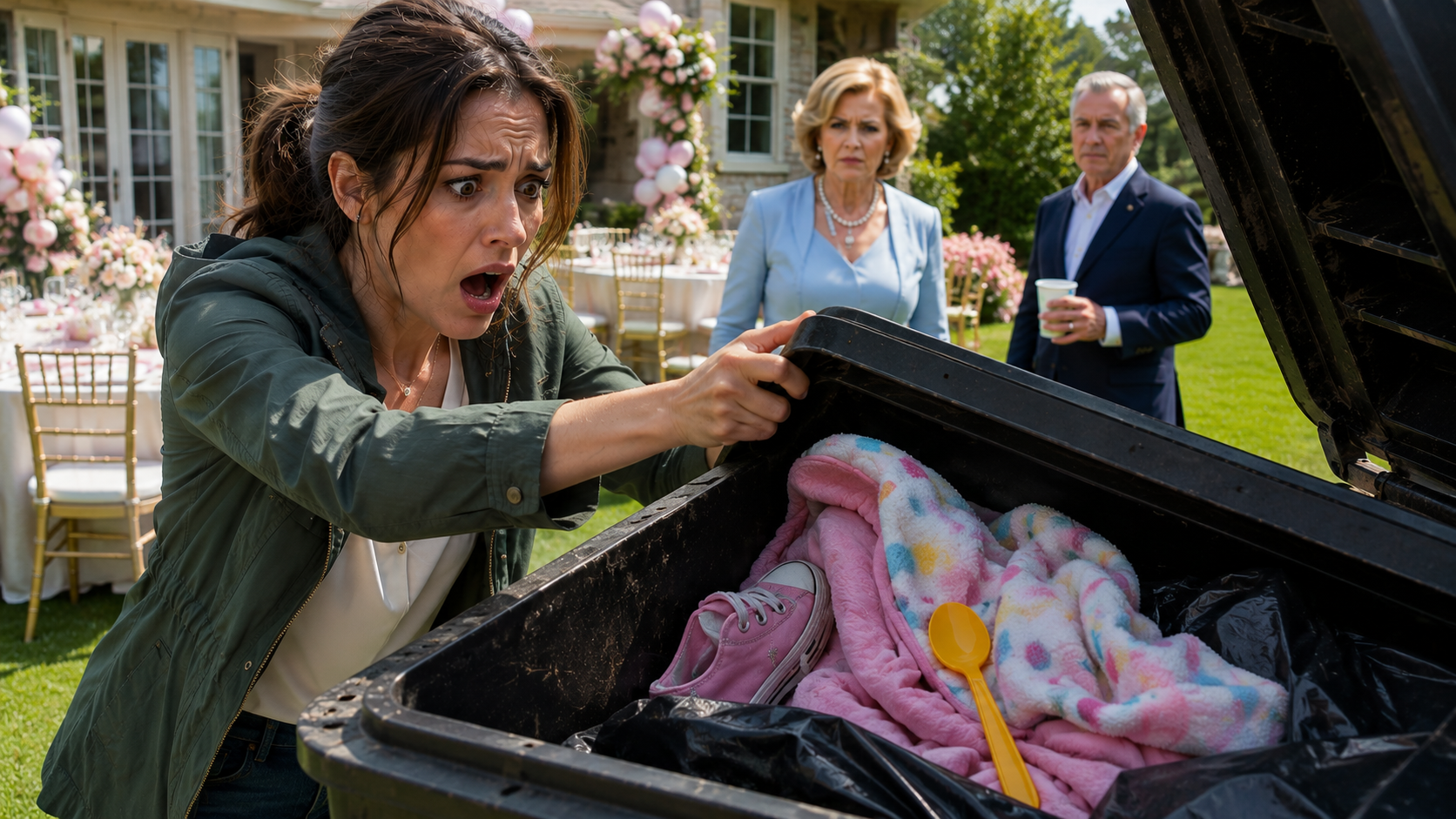
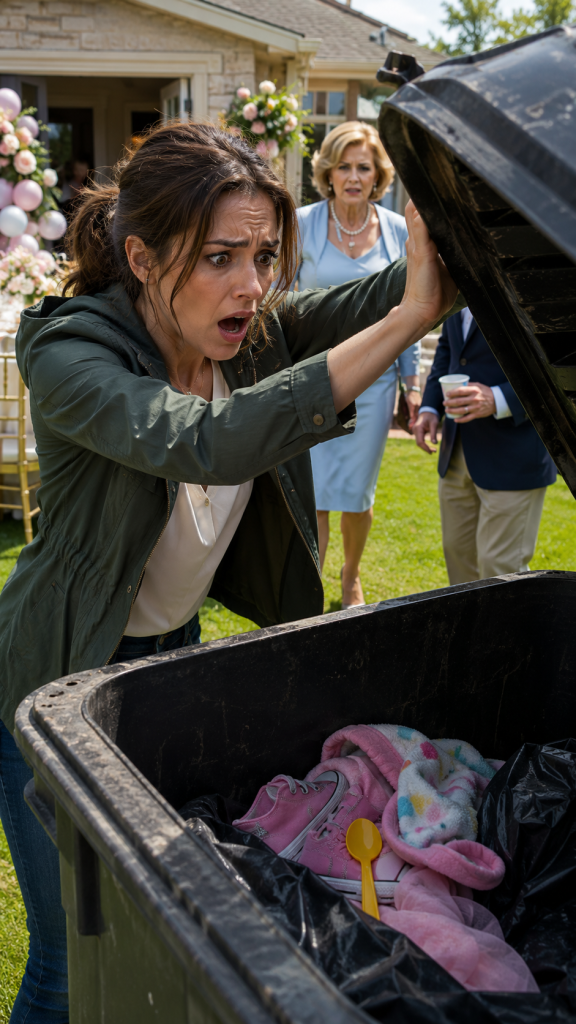
Instead, I found one of her pink sneakers beneath a black trash bag.
For one terrible second, my mind refused to understand what I was looking at.
Pink canvas.
White rubber sole.
A tiny scuff near the toe from where Sophie had dragged her foot along the sidewalk the week before.
Her shoe.
My baby’s shoe.
Inside a dumpster.
“No.”
The word came out of me like something torn.
My phone was already connected to emergency services.
The dispatcher was saying something in my pocket, but I could barely hear her over the pounding in my ears.
I grabbed the heavy black lid with both hands and threw it open.
“Sophie!”
She was curled on her side beneath the birthday blanket I had packed the night before.
Her face was pale.
Her lips were slightly parted.
Her brown curls clung damply to her forehead.
Black trash bags had been arranged around her body, not directly on top of her but close enough that anyone glancing into the dumpster would have seen nothing except garbage.
And her breathing—
God.
Her breathing was wrong.
Too shallow.
Too slow.
Too uneven.
I climbed halfway into the dumpster without thinking about what was underneath my hands.
“Sophie. Baby. Mommy’s here.”
She didn’t answer.
Her body was heavy when I lifted her.
Not sleeping-heavy.
Limp.
The kind of limp that turns your blood to ice.
Her little yellow plastic spoon was still clutched in one hand.
Sophie carried that spoon everywhere.
She slept with it.
Bathed with it.
Once cried for almost forty minutes when a waitress at a diner tried to replace it with a clean spoon because the yellow one had fallen onto the floor.
Now it was pressed against her palm while her body hung against mine.
And in her hair was a smell I knew.
Sweet.
Medicinal.
Familiar.
My mother kept bottles with that smell inside the kitchen cabinet above the microwave.
“I found her,” I said into the phone.
My voice didn’t sound like mine.
“I found my daughter. She’s breathing, but she won’t wake up.”
The dispatcher became sharper.
More focused.
She told me not to give Sophie anything to eat or drink.
She told me to move her into fresh air.
She told me to keep the phone connected.
Help was coming.
I carried Sophie away from the dumpster, one hand supporting the back of her head.
That was when my mother came around the corner of the house.
Carol Parker.
Perfect hair.
Pale blue party dress.
Pearl earrings.
Lipstick still flawless.
She saw me holding her unconscious granddaughter.
She saw the open dumpster behind me.
She saw my face.
And she looked angry.
Not frightened.
Not horrified.
Angry.
“Put her down,” she said.
I stared at her.
“What?”
“You’re making this look much worse than it is.”
For a moment, I could only hear Sophie breathing against my neck.
Soft.
Shallow.
Wrong.
“She was inside a dumpster.”
My mother lifted her chin.
“She was wrapped in a clean blanket.”
That sentence broke something inside me.
Not completely.
That would happen later.
But enough.
“What did you give her?”
My mother glanced toward the house.
“Nothing dangerous.”
“What did you give my daughter?”
“Natalie, lower your voice.”
I almost laughed.
“Lower my voice?”
My father appeared behind her holding a paper cup.
Robert Parker had spent most of my life believing calmness made him right.
At church meetings.
At family dinners.
During arguments.
He could say something cruel in an even tone and then accuse you of being unstable when you reacted.
He looked at Sophie.
Then at me.
“She was only supposed to sleep through the photographs,” he said.
The dispatcher heard him.
I know because the woman on the phone immediately asked, “Ma’am, did that man say the child was given something to make her sleep?”
I pulled my phone from my jacket pocket.
Speaker on.
Volume high.
I held it between us.
“Tell emergency services what you gave her.”
Dad’s expression changed.
Only slightly.
But I saw it.
He hadn’t known I was already on the phone.
My mother spoke first.
“It was children’s medicine.”
“What kind?”
“A sleep aid.”
My stomach turned.
“There is no sleep medicine approved for Sophie in your cabinet.”
“You’re being dramatic.”
“She won’t wake up.”
“She’s sleeping.”
“In a garbage bin.”
Dad made a small, irritated motion with his hand.
“The container was clean.”
I looked at him.
I actually looked at him.
And I realized he believed that detail helped him.
As though the problem was sanitation.
Not that they had medicated a two-year-old.
Not that they had carried her away from me.
Not that they had hidden her among trash.
“The container was clean,” I repeated.
“Yes.”
“You put my daughter in a dumpster.”
“She kept crying,” my mother snapped. “The entire schedule was being delayed.”
“She was crying because you hid her birthday cake.”
“That cake was inappropriate.”
“She is two years old.”
“And Madison is beginning a new life.”
There it was.
The entire Parker family hierarchy contained in one sentence.
Madison’s engagement mattered.
Sophie’s birthday did not.
Lauren mattered.
I did not.
Appearance mattered.
My daughter’s safety did not.
But I need to go back.
Because none of this began at the dumpster.
It began the night before, with a small white cake covered in sugar daisies.
And with me ignoring the part of myself that already knew my family could not be trusted.
My name is Natalie Parker.
I was thirty-one years old when my family decided my daughter belonged in the trash.
Sophie had turned two that morning.
She had serious gray eyes, soft brown curls and a habit of staring at people as if she were considering whether they were worth the trouble.
Her father used to joke that she had inherited that from me.
Ethan never got to meet her.
He died in a construction accident before she was born.
We had planned to marry.
There had been a ring.
A small apartment we wanted to leave as soon as we could afford something better.
Arguments about baby names.
A half-built crib.
Then a phone call.
Then a hospital hallway.
Then silence.
My parents had never forgiven me for grieving in a way that embarrassed them.
That sounds absurd until you understand my family.
My mother cared deeply about appearance.
My father cared deeply about reputation.
My older sister, Lauren, had always been the child who made those things easy for them.
She was beautiful.
Popular.
Social.
She married young.
Bought a large house.
Had Madison, the first grandchild.
Her photographs were everywhere in my parents’ home.
Graduations.
Dance recitals.
Vacations.
Madison holding trophies.
Madison in white dresses.
Madison beside Christmas trees.
I was the daughter who asked why.
Why did Lauren get a new dress while I wore her old one?
Why was money saved for my college suddenly needed for Lauren’s wedding?
Why did I need to attend every family event when nobody ever came to mine?
Why was my grief considered embarrassing?
Why did my unmarried pregnancy matter more than the fact that the man I loved had died?
Questions made me “difficult.”
Boundaries made me “selfish.”
Leaving made me “ungrateful.”
When Sophie was born, my mother referred to her as “Natalie’s little situation.”
The first time she did it, I was too exhausted to fight.
The second time, I told myself I had misheard her.
The third time, at Christmas dinner, I stood up with Sophie in my arms and said, “If you call my daughter that again, you will never see her.”
After that, Mom used Sophie’s name.
Usually.
I should have remembered all of this when she called three weeks before Madison’s engagement party.
Madison had become engaged to Chase Holloway, a young real-estate developer from a wealthy family.
My parents treated the engagement as though Madison had married into royalty.
Mom rented floral arches.
A photographer was hired.
Custom napkins were ordered with Madison and Chase’s initials.
There would be an announcement video.
Champagne.
Caterers.
Matching decorations.
My mother sent everyone a color palette.
Then she told me Sophie’s birthday celebration could be included.
I said no.
Not angrily.
Not dramatically.
Just no.
“Sophie deserves her own day.”
Mom laughed softly.
“She’s two, Natalie.”
“Yes.”
“She won’t remember.”
“I will.”
There was silence.
Then the warm voice she used when she wanted something.
“Family should be together.”
I almost said, In our family, together usually means one person is celebrated while everyone else learns to disappear.
Instead, I agreed to bring a small cake.
I told myself it was for Sophie.
She liked Madison.
Madison, to her credit, had always been gentle with her.
And I had spent years trying to create a version of family that perhaps existed only in my imagination.
The night before the party, Sophie and I stayed at my parents’ house because Mom wanted everyone ready for photographs early.
I carried Sophie’s overnight bag upstairs.
Her pajamas.
Extra clothes.
Her birthday blanket.
The yellow spoon.
And the cake.
White frosting.
Tiny sugar daisies.
A yellow number-two candle.
My mother stared at it.
“That should stay in the kitchen until after the engagement photographs.”
“It’s her birthday cake.”
“Yes, I understand what a birthday cake is.”
“Then we’re good.”
“Natalie.”
I looked at her.
She gave me that exhausted smile she had perfected when I was a teenager.
The smile that said I had already disappointed her by making her speak twice.
“This is Madison’s only engagement.”
I almost laughed.
“You say that as though she plans to collect several.”
Mom did not smile.
“This day matters to her.”
“It also matters to Sophie.”
“A two-year-old won’t remember.”
“I told you. I will.”
Lauren walked in carrying garment bags over both arms.
“Can we please not create conflict before we even start?”
I looked at her.
“I brought a cake.”
“You always make simple things complicated.”
There it was.
The family slogan.
You always make simple things complicated.
Ask where your college money went?
Complicated.
Object when your father insults your dead fiancé?
Complicated.
Want your child acknowledged on her birthday?
Complicated.
I had learned something over the years.
When people accuse you of making everything difficult, sometimes what they really mean is that you have refused to make things easy for them.
So I kept my car in the driveway.
I left Sophie’s bag packed.
I placed the keys in the outer pocket of my purse.
We would sing happy birthday.
We would cut the cake.
Then we would leave.
That was my plan.
At seven the next morning, Sophie climbed onto my childhood bed and pressed her yellow spoon against my cheek.
“Cake?”
I opened one eye.
“Good morning to you too.”
“Cake?”
“Later.”
She leaned closer.
“Two?”
“Yes. You’re two today.”
She held up four fingers.
“Exactly.”
She laughed.
I pulled her against me.
Sunlight came through the old curtains.
For one small moment, the house felt safe.
By eight, relatives began arriving.
By nine, the photographer had positioned Madison beneath the floral arch.
My mother moved through the yard with a clipboard.
Lauren followed Madison with powder, tissues and a portable curling iron.
I dressed Sophie in a pink dress with a white cardigan and matching pink sneakers.
When we walked outside, Mom looked at her as if I had put her in a clown costume.
“Why is she dressed like that?”
“Because it’s her birthday.”
“She’ll draw attention in the photographs.”
“She’s wearing pink, Mom. Not fireworks.”
Madison heard us.
She stepped away from the arch, crouched and opened her arms.
“Happy birthday, little bug.”
Sophie smiled.
“Two.”
“I know. You’re ancient.”
“Cake.”
Madison laughed.
Before I could answer, my mother called sharply, “Madison, please. No distractions before the main portraits.”
Madison gave Sophie a quick kiss and went back.
Sophie watched everyone walk away.
Then she looked at me.
“Cake now?”
“Soon.”
I carried her toward the folding table.
The cake was gone.
I checked under the table.
Then the outdoor refrigerator.
Then the kitchen.
Nothing.
Mom appeared behind me.
“I moved it.”
“Where?”
“Somewhere cooler.”
“What does that mean?”
“It means we are not cutting it until after the engagement toast.”
“That could be hours.”
“Natalie, do not make a scene.”
“I am asking where my daughter’s birthday cake is.”
Lauren passed through the kitchen carrying champagne glasses.
“Garage refrigerator,” she said.
I turned.
“Thank you.”
For just a second, her eyes slid away from mine.
It was a small thing.
The kind of thing you remember only afterward.
At the time, Sophie started crying because she was hungry.
I gave her crackers and fruit.
At ten thirty, the photographer called the immediate family toward the front yard.
My mother approached me.
“Leave Sophie with me.”
“No.”
“Natalie.”
“She can come.”
“The photographer wants a few photographs without children wandering through.”
“She is a child. Children wander.”
Mom sighed.
“I’ll keep her inside for five minutes. Give her a snack. Put on cartoons.”
I hesitated.
That hesitation has followed me into nightmares.
Because the truth is, my instincts spoke.
Quietly.
They reminded me that my parents had never spent much time alone with Sophie.
They reminded me of the comments.
The favoritism.
The cake.
But the house was full of relatives.
Lauren was inside.
Dad was nearby.
And then Sophie reached toward my mother.
“Grandma.”
I hated that it reassured me.
I kissed Sophie’s forehead.
“I’ll be right outside.”
She held up the spoon.
“Cake?”
“After pictures.”
Those were the last words I said to her before they drugged her.
The photographs lasted longer than five minutes.
The engaged couple.
Both families.
Grandparents.
Another picture because Dad blinked.
Another because my mother didn’t like the angle.
Pictures beside the champagne table.
Pictures beneath the floral arch.
Pictures of Madison showing her ring.
Every few minutes, I looked toward the windows.
I expected Sophie’s face.
I never saw it.
At eleven fifteen, I walked inside.
The television was off.
The living room was empty.
“Sophie?”
Nothing.
I checked the kitchen.
Mom stood near the sink talking to a caterer.
“Where is she?”
My mother looked at me.
“Who?”
That single word frightened me more than anything she could have said.
“Who?”
Too casual.
Too smooth.
“My daughter.”
“She was tired.”
“Where did you put her?”
“In one of the rooms.”
“Which room?”
“Everyone is waiting for the toast.”
“Which room?”
She turned back toward the caterer.
I ran upstairs.
My childhood bedroom.
Empty.
Guest room.
Empty.
Lauren’s old room.
Empty.
Den.
Bathroom.
Closets.
“Sophie!”
I called louder.
My father appeared at the top of the stairs.
“What are you shouting about?”
“Where is she?”
He looked over my shoulder toward my mother.
Then he smiled.
Not kindly.
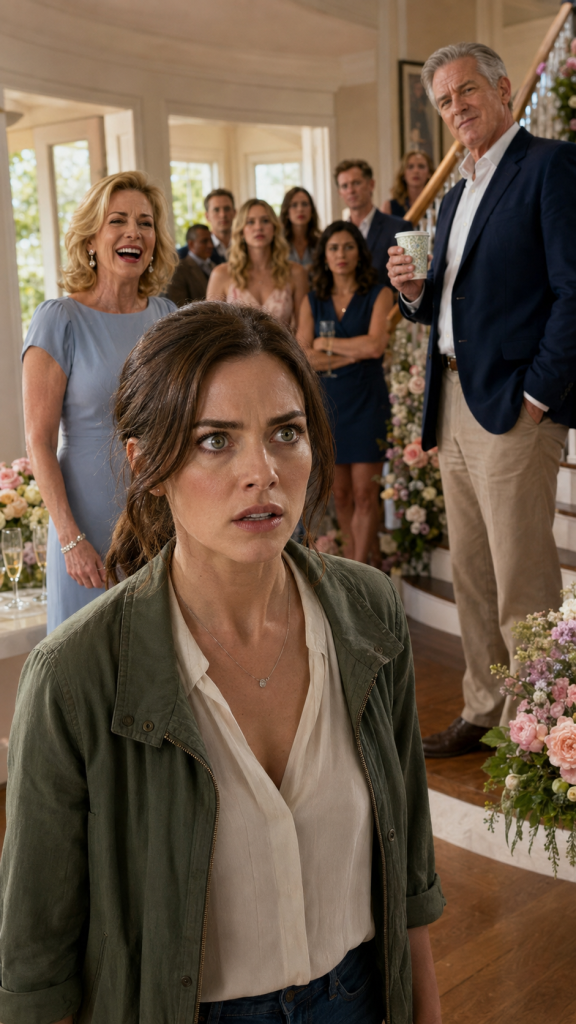
“Maybe you should check the garbage.”
I stared at him.
“What?”
Behind me, my mother laughed.
A sharp little sound.
“She was ruining every photograph.”
My body went cold.
“Where is my daughter?”
Dad lifted his paper cup.
“Maybe you’ll find her where garbage belongs.”
Guests had started entering the foyer.
A few laughed uncertainly.
Because that was what people did around my parents.
Someone said something cruel.
People laughed.
Then everyone pretended it was harmless.
Lauren stood beside the dining-room doorway.
Madison was next to Chase.
No one told me Sophie was safe.
No one told me my father was joking.
No one moved.
So I ran.
And less than five minutes later, I was standing beside a dumpster with my unconscious daughter in my arms while the people who raised me tried to explain why what they had done was reasonable.
Then my mother said the sentence that changed everything.
She pointed toward my sister.
“Ask her.”
Lauren froze.
My mother’s face twisted with fury.
“Ask her whose idea it was to make sure that child disappeared before the party began.”
For the first time all morning, Lauren looked afraid.
And I understood that what had happened to Sophie was bigger than a cruel decision made in a moment.
There was something underneath it.
Something they had not told me.
Something my sister was terrified I was about to discover.
Then the sirens reached the end of the street.
And my family began turning on itself.
PART 2: EVERYONE STARTED TALKING
The first paramedic came running up the driveway with a medical bag.
The second carried equipment behind him.
Until that moment, part of me had been moving through instinct alone.
Find Sophie.
Lift her.
Keep her breathing.
Get help.
But when a stranger in a dark uniform touched my daughter and immediately stopped smiling, terror became real.
“What did she take?” he asked.
“I don’t know.”
“How old?”
“Two. Today. She turned two today.”
He checked her breathing.
Her pulse.
Her pupils.
Another paramedic knelt beside him.
“Any medical conditions?”
“No.”
“Prescription medication?”
“No.”
“Any allergies?”
“No. They gave her something.”
I pointed at my parents.
“They said it was medicine to make her sleep.”
The paramedic looked up.
“What medicine?”
My mother folded her arms.
“I don’t remember exactly.”
“You gave a two-year-old medication and you don’t remember what it was?”
“It was ordinary children’s medicine.”
Dad stepped in.
“One spoonful.”
Beside the porch, Lauren whispered, “Two.”
Everyone heard her.
I turned.
“What?”
Lauren covered her mouth.
My mother snapped, “Be quiet.”
The paramedic looked directly at Lauren.
“You said two?”
She nodded.
“Two spoonfuls.”
“How do you know?”
Lauren began crying.
Not loudly.
Not dramatically.
Just tears sliding down her face while she stared at the ground.
I took one step toward her.
“How do you know?”
“It was supposed to be children’s allergy medicine.”
“Why did Sophie need allergy medicine?”
“She didn’t.”
“Then why?”
Lauren’s face crumpled.
“Because she wouldn’t stop asking for the cake.”
I actually thought I had heard her incorrectly.
“My daughter was drugged because she wanted her birthday cake?”
“No.”
She shook her head rapidly.
“No, that wasn’t—Mom said the engagement video had to be perfect.”
My mother stepped forward.
“Do not put this on me.”
“You said the crying was ruining the announcement.”
“You agreed.”
“I thought you were taking her upstairs.”
“You brought the medicine.”
“I brought what you asked me to bring.”
Madison backed away from her mother.
“Mom?”
Lauren looked at her.
“Not now.”
“What are they talking about?”
“Nothing.”
“You gave Sophie medicine?”
“It wasn’t supposed to hurt her.”
Madison went still.
“Did you know they put her outside?”
Lauren didn’t answer.
That was enough.
“Mom.”
“I knew they were moving her somewhere quiet.”
“A dumpster?”
“I didn’t know where.”
My father pointed at Lauren.
“She said Sophie had to disappear before the photographer started filming.”
Lauren stared at him.
“You said you would put her in the car.”
The paramedic’s head snapped around.
“You considered putting a sedated toddler inside a vehicle?”
Dad straightened.
“No. We rejected that.”
He said it with the satisfaction of a man explaining that he had made the responsible choice.
My mother closed her eyes.
“Robert, stop talking.”
But Dad was already losing control.
The guests had gathered along the porch.
Several held phones.
That mattered to him.
I could see it happening.
He had spent years being a successful businessman.
Church elder.
Reliable neighbor.
The kind of man who shook hands firmly and remembered people’s names.
Now phones were pointing at him.
People were whispering.
The story he told about himself was collapsing in public.
So he did what my family had always done.
He found someone lower on the ladder and tried to push them beneath him.
“Carol panicked.”
My mother spun toward him.
“I panicked?”
“She decided the child had to be moved.”
“You carried her!”
“Because you told me to.”
“You said the medicine would keep her asleep!”
“You measured it.”
“You bought it.”
Every sentence made them worse.
Lauren stepped between them.
“Stop talking.”
My mother looked at her.
“Why?”
“Because emergency services are listening.”
That sentence has stayed with me longer than almost anything else.
Not because Sophie may die.
Not because we hurt her.
Not because Natalie found her in a dumpster.
Because someone was listening.
Their fear was not what they had done.
Their fear was being heard.
Mom finally seemed to understand how bad things looked.
Her entire posture changed.
She moved closer to me.
Her voice dropped.
“Natalie.”
I stepped back.
“We can handle this privately.”
“No.”
“We’ll pay the medical bills.”
“You should.”
“I mean more than that.”
I looked at her.
Her eyes moved toward the phones.
The guests.
The ambulance.
“We can help with your rent.”
I could not believe her.
“What?”
“For a year.”
“You’re offering me money?”
“For Sophie.”
“No. You’re offering me money for silence.”
Her eyes hardened.
“Do not be foolish.”
Sophie made a tiny sound against the paramedic’s arm.
I dropped beside her.
Her fingers moved weakly.
Just a little.
That tiny movement gave me more clarity than anything my family could have said.
For years, I had kept small doors open.
Maybe Sophie could know her grandparents.
Maybe Lauren and I could repair things.
Maybe Madison could have a relationship with her cousin.
Maybe one day the Parkers would become the family I had spent my life wishing they were.
Watching my daughter struggle to wake on the driveway ended that fantasy.
No matter what happened next, none of them would ever be alone with her again.
Police arrived before the ambulance left.
An officer separated my parents.
Another pulled Lauren away.
A third began collecting names from the guests.
“Anyone with phone recordings, do not delete them,” he said.
Several people lowered their phones.
One woman looked ashamed.
She had been among those laughing when Dad told me to check the garbage.
“I thought it was a joke,” she said to me.
I looked at her.
I did not answer.
Because I didn’t yet have language for what I felt.
The paramedics loaded Sophie onto the stretcher.
I climbed into the ambulance.
Before the doors closed, a man hurried toward me.
The photographer.
His name was Caleb, though I only learned that later.
“I have footage,” he said.
An officer stopped him.
“What kind?”
“My second camera.”
He pointed toward the house.
“I set it up in the kitchen for behind-the-scenes footage. It was recording while we were outside.”
My mother’s face changed.
“What footage?” I asked.
He looked at her.
“Your family forgot the camera was running.”
The ambulance doors closed.
I rode to the hospital holding Sophie’s yellow spoon.
I had found it in her hand.
I wrapped my fingers around it so tightly that the plastic edge left a mark in my palm.
The paramedic inserted a line into Sophie’s arm.
I watched the monitor.
Every sound frightened me.
Every pause frightened me.
Every time one of the paramedics looked at the other, I tried to read meaning into it.
“Is she going to be okay?”
“We’re taking care of her.”
“That isn’t what I asked.”
The paramedic met my eyes.
“She’s breathing. Her heart rate is stable right now. The hospital will run tests.”
Right now.
Those two words nearly destroyed me.
At the hospital, everything became fluorescent light and questions.
Name.
Age.
Weight.
Medical history.
Possible medication.
Time of ingestion.
I didn’t know the answer to the most important question.
How much had they given her?
My mother didn’t remember.
Dad said one spoonful.
Lauren said two.
Doctors treated Sophie for an excessive dose of a sedating antihistamine.
They told me the amount could have caused a serious medical emergency in a child her size.
I sat beside her bed and watched the rise and fall of her chest.
Hours passed.
Police came and went.
A nurse brought me water I forgot to drink.
Someone asked if they should call another relative.
I almost laughed.
At three in the morning, Sophie moved.
Her eyes opened halfway.
“Mommy?”
I stood so quickly my chair scraped the floor.
“I’m here.”
Her gray eyes tried to focus.
“Cake?”
I began to cry.
Not quietly.
Not gracefully.
I pressed her little hand against my cheek.
“Yes, baby.”
“Cake.”
“Yes.”
Her eyelids fluttered.
“Grandma said no birthday.”
That sentence hit harder than the sight of the dumpster.
I leaned down until my forehead touched her hand.
“Grandma was wrong.”
Sophie fell asleep again.
I stayed there, holding her.
Just before sunrise, a woman entered the room carrying a folder.
“Ms. Parker?”
I nodded.
“I’m Detective Lena Ortiz.”
She pulled a chair closer.
“I know you’re exhausted.”
“I’m fine.”
“You’re not.”
“No.”
She studied me for a moment.
“I’ve reviewed the emergency call, several guest recordings and the photographer’s footage.”
My stomach tightened.
“What did the camera show?”
“Before we discuss that, I need your statement.”
“I’ll give you everything.”
“Your parents are blaming one another.”
“That sounds right.”
“Your sister claims she believed Sophie would be placed in a bedroom.”
I looked at her.
“She watched them carry my daughter out the back door.”
“Yes.”
“Then she knew Sophie was not in a bedroom.”
“Yes.”
Lena opened the folder.
“There’s something else.”
The way she said it made my skin go cold.
“What?”
“We’re trying to understand whether removing Sophie from the party was only about photographs.”
“What else could it be?”
She watched me carefully.
“Was Sophie’s father named Ethan Parker?”
My chest tightened.
“Yes.”
“Did he have life insurance?”
For a moment, I simply stared at her.
“What does Ethan have to do with this?”
“Did he?”
“Yes. Through his employer.”
“Who received it?”
“Sophie.”
“All of it?”
“The majority went into a trust for her.”
“How much?”
“Just over a million dollars.”
Lena’s expression did not change.
“Who controls the trust?”
“There’s an independent structure. I can use distributions for Sophie’s care, but it’s her money.”
“Can another family member gain control?”
“Not unless a court changed the arrangement.”
Lena slid a document across the table beside Sophie’s hospital bed.
I saw my name.
Then Sophie’s.
Then Lauren’s.
“What is this?”
“A petition filed three weeks ago.”
I read the first page.
Then the second.
My hands started shaking.
The petition alleged that I was emotionally unstable.
Financially irresponsible.
Neglectful.
Unfit to serve as the primary person making requests concerning Sophie’s trust.
It asked the court to appoint a family co-trustee.
The proposed co-trustee was Lauren.
“I’ve never seen this.”
“That’s why I’m showing you.”
I turned another page.
Statements.
My mother’s.
My father’s.
Lauren’s.
My mother claimed I sometimes ignored Sophie during emotional episodes.
My father said I used my daughter to gain sympathy.
Lauren claimed Sophie appeared frightened around me.
I read the sentences again.
Then again.
They were not misunderstandings.
They were not exaggerations.
They were lies.
Carefully written lies.
Placed inside a legal filing.
My throat closed.
“Why?”
Detective Ortiz turned another page.
“Your sister and her husband appear to be in significant debt.”
I looked up.
“How significant?”
“Enough that their home is facing foreclosure.”
I thought of Lauren’s enormous kitchen.
The car in her driveway.
The expensive clothes.
The vacations she posted online.
Madison’s engagement party.
“The party,” I whispered.
Lena nodded.
“Nearly fifty thousand dollars.”
I felt sick.
“My parents paid for most of it.”
“Your parents have financial problems too.”
“No.”
“They do.”
She showed me numbers.
Loans.
Withdrawals.
Retirement accounts nearly emptied.
Debt I had never known existed.
The perfect Parker family was broke.
And Madison had become engaged to a family they desperately wanted to impress.
“Chase’s family has money,” I said.
“Yes.”
“Oh my God.”
“We believe your family hoped that if Lauren gained enough authority over Sophie’s trust, they could justify withdrawals under broad categories connected to housing, childcare or family support.”
I stared at my sleeping daughter.
My baby.
Ethan had died before he could hold her.
The money had never felt like a gift.
It was the cruelest kind of compensation.
Money instead of a father.
Money I wished every day had never existed.
And my family had looked at it and seen rescue.
Not for Sophie.
For themselves.
Lena tapped the petition.
“We believe today’s incident may have been designed to support this filing.”
I looked at her.
“No.”
“We’re still investigating.”
“No. Explain.”
Her voice stayed calm.
“They wanted Sophie removed temporarily.”
My mouth went dry.
“They expected you to discover she was missing.”
I felt the room tilt.
“They expected you to panic.”
Images came back.
My mother insisting Sophie stay inside.
The endless photographs.
The missing cake.
Dad smiling at the top of the stairs.
Maybe you should check the garbage.
“They wanted people to record me,” I whispered.
“Yes.”
The words in the petition became clear.
Emotionally unstable.
Attention-seeking.
Neglectful.
“They wanted me to scream.”
“Yes.”
“To look crazy.”
“Yes.”
“They were going to say I lost her.”
“That is what the evidence currently suggests.”
The medicine had kept Sophie quiet.
The hiding place kept her out of sight.
My panic would become evidence.
Their cruelty was not merely punishment.
It was strategy.
And suddenly the birthday cake made sense too.
If Sophie’s birthday was acknowledged, then the story of me arriving unprepared and creating chaos became weaker.
If Sophie cried because her cake had been taken, guests might understand my anger.
So the cake had to disappear.
Sophie had to disappear.
And I had to become the problem.
I looked at Detective Ortiz.
“They put my daughter in a dumpster to steal her inheritance.”
“We believe controlling the trust was part of the motive.”
My hands curled around the yellow spoon.
“No.”
My voice surprised me.
It was calm.
Much calmer than I felt.
“No, they didn’t just try to steal her inheritance.”
Lena waited.
“They tried to turn my love for her into evidence against me.”
For the first time, the detective’s expression softened.
“Yes,” she said.
“That appears to be exactly what they tried to do.”
Then she closed the folder.
“But they made several mistakes.”
“What mistakes?”
“The dispatcher recorded them.”
I stared at her.
“The guests recorded them.”
My breathing slowed.
“The trust petition establishes motive.”
She leaned closer.
“And the photographer recorded the beginning.”
PART 3: THE CAMERA THEY FORGOT
I watched the kitchen footage inside a hospital conference room.
Detective Ortiz warned me before she played it.
I told her to continue.
The camera angle was wide.
Nothing dramatic.
Just my parents’ kitchen.
The refrigerator.
The table.
Cabinets.
A portion of the back door.
For the first few seconds, all I saw were familiar things.
The fruit bowl my mother had owned for twenty years.
The crooked cabinet handle Dad always promised to fix.
A row of champagne glasses.
Then Sophie walked into the frame.
My heart stopped.
She was wearing her pink dress.
White cardigan.
Pink sneakers.
The same clothes I had later pulled from the dumpster.
She held her yellow spoon.
“Cake?”
Her voice came faintly through the recording.
My mother appeared.
“Not yet.”
“Cake.”
“Shh.”
Sophie pointed toward the garage.
“Mommy cake.”
“I know.”
“Cake now.”
My mother looked toward the doorway.
Lauren stepped into frame.
She was holding something.
A bottle.
I covered my mouth.
Mom crouched in front of Sophie with a small plastic medicine cup.
Sophie looked at it.
Then at her.
My mother smiled.
The same smile she used in photographs.
The same smile she had used when Sophie reached for her and said Grandma.
“Drink this,” she told her, “and Grandma will take you to the cake.”
I made a sound.
Detective Ortiz paused the video.
“Do you need a minute?”
“No.”
“Natalie.”
“Play it.”
She did.
Sophie trusted her.
Of course she did.
She lifted the little cup with both hands.
Drank.
Made a face.
My mother laughed.
“That’s a good girl.”
Lauren stood near the refrigerator.
Watching.
Not stopping her.
Not asking why.
Watching.
Minutes passed on the recording.
Sophie became unsteady.
She sat on the floor.
Tried to stand.
Wobbled.
My mother picked her up.
Then handed her to Lauren.
Dad entered carrying Sophie’s birthday blanket.
He opened the back door.
Lauren asked, “Where are you putting her?”
My father answered, “Somewhere Natalie won’t find until the party is over.”
My mother laughed.
Then she said it.
“She said garbage belongs with garbage.”
My nails dug into my palm.
Lauren glanced toward the camera area.
“Don’t say that where the microphones can hear.”
The room went silent around me.
That was the part that mattered.
Lauren had not said, Don’t call a child garbage.
She had not said, Put Sophie down.
She had not said, This is insane.
She had said not to say it where microphones could hear.
She knew.
Maybe she had not chosen the dumpster.
Maybe she had not lowered Sophie into it.
But she knew enough to worry about being recorded.
Enough to know what they were doing could not survive daylight.
Dad carried Sophie through the back door.
The camera did not show the dumpster.
It didn’t need to.
I already knew where he had taken her.
The video ended.
I stared at the blank screen.
“I want copies.”
“You’ll get them through the proper process.”
“I want everything preserved.”
“It already is.”
“Every recording.”
“Yes.”
“Every message.”
“We’re working on the phones.”
“They will delete things.”
“They no longer have access to some of the devices.”
I looked at the detective.
“You arrested them?”
“Your parents were taken into custody this morning.”
I felt nothing at first.
No relief.
No triumph.
Just emptiness.
“What about Lauren?”
“She’s being questioned separately.”
“She was part of it.”
“We know she was involved.”
“She knew.”
“Yes.”
“She watched Sophie leave.”
“Yes.”
“She lied.”
“Yes.”
I closed my eyes.
Lauren and I had never been close.
But she was still my sister.
There are betrayals that shock you because you never believed a person capable of them.
Lauren’s betrayal was different.
I had known she could choose our parents over me.
She had done it our entire lives.
What I had never imagined was that she could choose them over Sophie.
A two-year-old.
Her own niece.
And yet the footage showed exactly that.
When I returned to Sophie’s room, she was awake.
A nurse was helping her drink.
I rushed to the bed.
“Mommy.”
“Hi, baby.”
“Home?”
“Soon.”
She looked toward the door.
“Grandma?”
My throat tightened.
“No.”
“Grandpa?”
“No.”
“Aunt Lauren?”
I sat beside her.
“No.”
Sophie thought for a moment.
Then she said, “Cake?”
I laughed through tears.
“Yes. Cake.”
We stayed another night.
By then, the story had escaped the family.
Guests had talked.
Phones had recorded.
People from my parents’ church were calling.
Neighbors were asking questions.
My father’s reputation had been built over decades.
It collapsed in less than a day.
My mother tried to control the story from police custody.
She claimed Sophie had been given the wrong amount by mistake.
Dad claimed he thought the dumpster had been cleaned and therefore believed it was safe.
Lauren claimed she had been afraid of our parents and had not understood what they intended.
Then investigators recovered their messages.
Detective Ortiz showed them to me.
Three weeks before the party, my mother had written to Lauren:
Keep Natalie outside for the family photographs. Once Sophie is asleep, your father will move her behind the house.
Lauren replied:
Make sure she isn’t visible from the porch.
Another message:
How long will she sleep? We need at least ninety minutes.
I read the messages twice.
Then I handed the phone back.
“She knew.”
“Yes.”
“She knew Sophie would be drugged.”
“Yes.”
“She knew they were hiding her outside.”
“Yes.”
The only thing Lauren might not have known was the exact container.
That distinction mattered legally.
It did not matter to me.
She had known my medicated daughter would be carried behind the house.
She had helped keep me occupied.
She had stood beside the refrigerator while Sophie drank the medicine.
She had watched our father carry her away.
Then she had returned to the party.
For photographs.
Madison called me that evening.
I almost didn’t answer.
Then I remembered her face on the driveway.
The way she had stepped away from Lauren.
The horror.
“Natalie?”
Her voice shook.
“Yes.”
“Is Sophie okay?”
“She will be.”
Madison began crying.
“I’m sorry.”
“You didn’t do it.”
“It was my engagement party.”
“That doesn’t make it your fault.”
“They kept saying everything had to be perfect because of Chase’s parents.”
“I know.”
“I didn’t ask for this.”
“I know.”
She became quiet.
Then she whispered, “Mom knew.”
“Yes.”
“I thought she didn’t.”
“She knew enough.”
Madison breathed shakily.
“I keep thinking about Sophie asking me for cake.”
I closed my eyes.
“I do too.”
“I walked away.”
“You were called back for pictures.”
“I still walked away.”
“Madison.”
“I should have stayed with her.”
“You did not know they were going to drug her.”
“No.”
“You did not know they were going to hide her.”
“No.”
“Then you are not responsible for choices you didn’t know they were making.”
She cried harder.
Maybe I should have felt anger.
I did feel anger.
At almost everyone.
But I knew the difference between guilt and responsibility.
My family had spent years confusing those things.
I would not continue the tradition.
The engagement party ended without the toast.
The champagne remained mostly unopened.
The floral arch stayed in the yard while police photographed the garbage bins.
Chase’s parents left early.
Guests sent me messages.
I thought it was a joke.
I didn’t understand.
I would have helped if I knew.
I didn’t respond.
Because a joke ends when someone realizes another person may be in danger.
My father had told me to check the garbage.
My mother had laughed.
I had run outside screaming my daughter’s name.
People had kept laughing.
Maybe they were uncomfortable.
Maybe they were confused.
Maybe they had spent too many years learning that cruelty became acceptable when my parents delivered it with a smile.
Whatever the reason, their laughter followed me.
The trust petition was immediately challenged.
Lauren did not become co-trustee.
Instead, the court moved quickly to protect Sophie’s inheritance.
An independent institution was given stronger authority over the money.
My family lost access.
Completely.
For years, I had thought Ethan’s insurance money was protected by paperwork.
I learned it was protected only as long as I paid attention.
So I paid attention.
I sat through meetings.
Read every page.
Asked questions.
Requested copies.
Documented everything.
My parents had expected me to become hysterical.
Instead, I became organized.
Their entire plan had depended on the assumption that my emotions made me weak.
They had never understood that being emotional and being careless are not the same thing.
I cried.
I shook.
I woke at night hearing Sophie’s shallow breathing in my head.
And every morning, I made another phone call.
I spoke with prosecutors.
Attorneys.
Trust administrators.
Doctors.
Investigators.
I wrote down dates.
Times.
Names.
Statements.
When people asked what I wanted, my answer stayed the same.
“I want the truth documented.”
Not revenge.
Not yet.
Truth.
Because my family had survived for years by deciding whose version of events counted.
My father’s calm version.
My mother’s polished version.
Lauren’s convenient version.
I had spent half my life being told that what I remembered had not happened quite the way I said it had.
This time there were cameras.
This time there were recordings.
This time their own words existed outside their control.
And once the evidence started speaking, they could not make me disappear inside their version of the story.
PART 4: THE PERFECT FAMILY COLLAPSES
Sophie recovered physically faster than I did.
Children can be astonishing that way.
Her appetite returned.
Her energy came back.
She ran through our apartment again.
She insisted on wearing one pink sneaker with one blue shoe because she liked the “different feet.”
But the fear appeared in small places.
The first time I changed the kitchen trash bag after we came home, Sophie screamed.
Not cried.
Screamed.
She backed herself into the corner and covered her head.
“No black bag!”
I dropped it immediately.
“Okay. Okay, baby.”
“No black!”
“Gone.”
I moved it outside.
For months after that, I bought light-colored bags.
Medicine became another battle.
Even when a pediatrician prescribed something she needed, Sophie clamped her mouth shut.
“No Grandma medicine.”
The first time she said it, I had to leave the bathroom so she wouldn’t see me cry.
Then came the question that hurt worst.
“Birthday make people mad?”
I was washing strawberries.
Sophie sat at the table kicking her feet.
“What?”
“Birthday.”
She pointed at herself.
“Mine.”
“Yes.”
“Make Grandma mad?”
I put down the knife.
“No.”
“Cake make mad?”
“No, baby.”
She studied me.
“Why hide me?”
There was no correct answer for a two-year-old.
There might never be one.
So I sat beside her.
“Some grown-ups made very bad choices.”
“Bad?”
“Very bad.”
“Me bad?”
“No.”
That answer came instantly.
“No. You did nothing wrong.”
“Cake?”
“Cake did nothing wrong either.”
She smiled slightly.
That became how we healed.
Tiny answers.
Tiny promises.
Tiny safe moments.
Her real second-birthday celebration happened at home after she recovered.
Just the two of us.
The original cake had become evidence and had been damaged during everything that happened at my parents’ house, so I bought another from the same bakery.
White frosting.
Sugar daisies.
Two yellow candles.
Sophie sat in my lap while I lit them.
“People coming?” she asked.
“No.”
“Grandma?”
“No.”
“Grandpa?”
“No.”
“Aunt Lauren?”
“No.”
She stared at the flames.
Then looked up at me.
“Safe birthday?”
My heart cracked.
I kissed her curls.
“Yes.”
“A safe birthday.”
I started singing.
She blew out the candles before I reached the second line.
Then shouted, “Again!”
So I relit them.
She blew them out.
“Again.”
I relit them again.
We did it five times.
By the fifth, I was laughing so hard I could barely hold the lighter.
For the first time since the dumpster, Sophie’s birthday belonged to her.
Not to Madison.
Not to my mother.
Not to the family image.
Not to evidence.
To Sophie.
The criminal case moved slowly.
Too slowly for my anger.
My mother’s attorney argued she had misread the medication.
My father’s attorney emphasized that the dumpster had supposedly been empty and recently cleaned.
Lauren’s attorney described years of pressure from our parents.
Every defense tried to isolate one decision.
The dose.
The container.
The location.
The messages.
But what saved me from doubting myself was remembering the sequence.
They hid the cake.
They kept Sophie away from the photographs.
They gave her medicine she did not medically need.
They waited for it to make her sleepy.
They carried her outside.
They concealed her.
They arranged for me not to know where she was.
They laughed when I asked.
They told me to search the garbage.
Then, when I found her unresponsive, they tried to convince me I was overreacting.
Then they offered money.
Then they blamed one another.
None of that was one mistake.
It was a chain.
A series of choices.
The investigation into the trust scheme made the chain even clearer.
Lauren’s debts were real.
Her home was facing foreclosure.
Credit cards.
Loans.
Payments overdue.
My parents had helped her again and again.
Their retirement savings had been drained trying to maintain the life everyone assumed they could afford.
Madison’s engagement had created new pressure.
Chase came from money.
His parents expected a wedding that matched their social world.
My mother saw the engagement as a chance to preserve the Parker image.
Maybe improve it.
Lauren needed money.
My parents needed money.
Sophie had money.
Money they could not touch.
Unless they changed who controlled it.
Unless they changed how a court viewed me.
The party had been designed to create a story.
Natalie arrives demanding attention for her daughter.
Natalie disrupts Madison’s engagement.
Natalie loses track of Sophie.
Natalie becomes hysterical.
Natalie screams at relatives.
Natalie creates chaos.
Look how unstable she is.
Look how irresponsible.
Look how emotional.
Give Lauren oversight.
That was why the cake mattered.
That was why my mother’s comment about Sophie drawing attention in photographs mattered.
That was why Lauren had watched the time.
Ninety minutes.
Long enough to manufacture my failure.
The worst part was realizing how well they knew me.
They knew I would panic if Sophie disappeared.
Of course I would.
Any mother would.
They were counting on the most normal response in the world and planning to label it instability.
But they made one mistake.
They had spent so many years convincing themselves I was irrational that they underestimated how I behaved in an actual crisis.
I called emergency services before opening the dumpsters.
I left the line connected.
I asked direct questions.
I made them answer while the dispatcher listened.
When Mom offered money, people heard it.
When Dad admitted Sophie had been moved to protect the photographs, people recorded it.
When Lauren admitted the dose, the paramedics heard her.
They wanted footage of me losing control.
Instead, they created footage of themselves confessing.
Months after the party, Madison came to my apartment.
When I opened the door, I almost didn’t recognize her.
Her hair was shorter.
No engagement ring.
No carefully coordinated outfit.
She stood there in jeans and a sweatshirt holding something in her hand.
A yellow plastic spoon.
I stopped breathing.
“Where did you get that?”
“The police released it.”
I stared at it.
I had thought the yellow spoon I carried at the hospital was the same one, but Sophie owned two nearly identical ones. In the chaos, I had never realized one had been recovered later from the dumpster blanket itself.
Madison held it out.
“They found this one under the blanket after the ambulance left.”
I took it.
There was a tiny bite mark on the handle.
Definitely Sophie’s.
“Thank you.”
Madison looked past me.
“Can I see her?”
I hesitated.
She saw it.
“I understand if you say no.”
Sophie ran into the hallway before I could answer.
“Maddy!”
Madison covered her mouth.
Sophie ran toward her.
I watched Madison kneel and hold her.
Not too tightly.
Not possessively.
Just carefully.
Later, after Sophie became distracted with blocks, Madison sat at my kitchen table.
“I ended the engagement.”
I looked at her hand.
“I noticed.”
“Chase didn’t leave me.”
I waited.
“I left him.”
“Why?”
“Because everyone expected me to continue.”
“Continue what?”
“Pretending nothing happened.”
She rubbed her palms against her jeans.
“His parents were horrified by the publicity. My friends kept telling me to distance myself from Mom and Grandma without talking about what happened. Grandma wanted me to release a statement saying Sophie’s medical emergency had been misunderstood.”
I stared at her.
“She called it misunderstood?”
“She said the family had been torn apart by exaggerations.”
“That sounds like her.”
“Chase wanted me to postpone things until it disappeared.”
“And you didn’t.”
“No.”
Madison looked toward Sophie.
“I kept thinking about that morning.”
“So do I.”
“I should have stopped them.”
“You didn’t know.”
“I knew some things.”
I said nothing.
She swallowed.
“I knew they hated sharing attention.”
“That isn’t the same as knowing they would hurt Sophie.”
“No.”
She picked at a loose thread on her sleeve.
“But I heard Grandma call her garbage before.”
I went still.
“When?”
“Not that day.”
Madison’s eyes filled.
“Other times.”
My stomach tightened.
“She would say things when you weren’t there. That Sophie was baggage. That you used her to get sympathy. That Ethan’s money had made you arrogant.”
I could barely speak.
“And you never told me.”
“I laughed sometimes.”
The words were barely audible.
“Why?”
Madison looked at me.
“Because everyone else did.”
I had no answer.
That sentence became one of the most important things anyone said to me after the party.
Because cruel families rarely begin with crimes.
They begin with jokes.
A child is too loud.
A daughter is too sensitive.
A grieving woman is dramatic.
A single mother is irresponsible.
Someone is mocked.
Everyone laughs.
The person who objects is told to relax.
The person being hurt is told to stop making things complicated.
Over time, people learn where they are allowed to feel empathy.
They learn who counts.
They learn who can be insulted without consequence.
They learn when to laugh.
Then one day something terrible happens.
And everyone acts shocked.
But the room had been practicing for years.
Madison wiped her face.
“I’m sorry.”
I looked at Sophie building a tower on the floor.
“Then do something different with the rest of your life.”
Madison nodded.
That was all I could give her.
Not forgiveness.
Not then.
But a direction.
The legal agreements came later.
Lauren eventually accepted responsibility for her part in the trust scheme and agreed to cooperate.
She admitted she had known Sophie would be medicated.
She admitted she helped keep me outside.
She admitted she knew Sophie would be removed from the house.
Her debt explained pressure.
It did not excuse her.
Her fear of our parents explained years of compliance.
It did not excuse what she did.
She was an adult.
She had watched a sedated two-year-old leave through the back door.
Then she chose photographs.
My parents eventually pleaded guilty to charges connected to child endangerment, unlawfully administering medication and conspiring to interfere with my parental rights.
During sentencing, I sat behind the prosecutor with my hands folded.
My mother did not look at me.
My father looked once.
Lauren stared at the floor.
The judge reviewed the evidence.
The video.
The messages.
The trust filing.
The emergency recording.
Then he said something I never forgot.
“You did not lose control for one terrible moment. You made a sequence of decisions, and at every step, preserving an image mattered more than preserving a child.”
That was it.
The truth.
Not one mistake.
A sequence.
When people asked later how my own parents could do something like that, I never knew what to say.
Because they imagined a cliff.
One giant leap from normal people to monsters.
I had lived the staircase.
One joke.
One insult.
One act of favoritism.
One lie everyone agreed to repeat.
One boundary dismissed.
One humiliation defended.
One person always chosen.
Another always blamed.
Step after step.
Until hiding a two-year-old in a dumpster seemed, to them, like an acceptable solution to a scheduling problem.
The family house did not survive the legal aftermath.
Attorneys cost money.
Loans surfaced.
Debts could no longer be hidden.
Eventually the property went into foreclosure.
I saw the listing online by accident.
There was the backyard.
The same grass.
The same fence.
The place where the floral arch had stood.
The photograph showed a clean patio and bright afternoon light.
No police tape.
No garbage bins.
No screaming mother running through the yard.
The listing described the property as ideal for entertaining.
I closed the page.
For years, my parents had spent money they did not have to create an image of success.
In the end, even the house became an image being sold to strangers.
PART 5: THE CHILD THEY COULD NOT ERASE
My mother called me once after sentencing.
I did not recognize the number.
I answered because I was waiting for a call from Sophie’s preschool.
“Natalie.”
My entire body tightened.
I knew her voice immediately.
“Mom.”
“You destroyed this family.”
No hello.
No apology.
No question about Sophie.
Just an accusation.
I looked across the living room.
Sophie was sitting on the floor with crayons spread around her.
She was older now.
Stronger.
Her curls had gotten longer.
She was drawing yellow circles on a piece of paper.
“No,” I said.
My mother gave a bitter laugh.
“You sent your own parents to prison.”
“You sent yourselves.”
“You could have handled this privately.”
“You drugged my daughter.”
“It was an accident.”
“You hid her in a dumpster.”
“Your father chose the container.”
“You both knew.”
“I was trying to save Madison’s day.”
“And Sophie?”
Silence.
That silence told me everything.
Then Mom said, “You always hated Lauren.”
“This was never about Lauren.”
“It has always been about attention with you.”
I almost smiled.
Even after court.
Even after the recordings.
Even after the judge.
Even after losing the house.
My mother still needed the same story.
Natalie was difficult.
Natalie was jealous.
Natalie was dramatic.
Natalie wanted attention.
Because if that story died, she would have to face who she was without it.
I watched Sophie switch from a yellow crayon to pink.
“This was about my daughter.”
“You ruined your sister’s life.”
“Lauren participated.”
“She was under pressure.”
“So was I.”
“You had Ethan’s money.”
I went still.
There it was.
Not Sophie’s money.
Not her inheritance.
Ethan’s money.
As though grief had made me rich.
As though his death had given me something instead of taking everything.
“You wanted it,” I said.
My mother did not answer.
“You wanted my dead fiancé’s money.”
“For the family.”
“No.”
My voice became very quiet.
“I stopped you from using my daughter to finance the family.”
“You selfish little—”
I ended the call.
She called again.
I blocked the number.
That was the last time I heard my mother’s voice.
Life afterward was not magically simple.
Justice is not the same thing as healing.
A courtroom can determine guilt.
It cannot remove a memory from a child’s body.
Sophie still avoided black trash bags for a long time.
For months she asked where her cake was whenever we entered someone else’s house.
She needed to know it would not disappear.
At preschool birthday parties, she stayed close to me until the candles came out.
Medicine remained difficult.
If a doctor prescribed anything, I let her hold the closed bottle first.
We read the label together even though she could not read.
I explained what it was for.
I never told her, “Because I said so.”
Trust had been stolen from her before she understood the word.
I wanted to rebuild it carefully.
On her fourth birthday, Sophie chose a park.
Yellow balloons.
Six preschool friends.
Pizza.
Juice boxes.
A cake with daisies because, somehow, she still loved them.
When the bakery employee delivered the box, Sophie kept one hand on it all the way to the picnic table.
“You can let go,” I told her gently.
She shook her head.
“After table.”
So we carried it together.
When the cake was placed in front of her, she inspected it.
Two layers.
Yellow flowers.
Four candles.
Then she looked at me.
“Nobody hides it?”
“Nobody.”
“And nobody hides me?”
My chest tightened.
“Never.”
She smiled.
Children should not need promises like that.
But when they do, adults must keep them.
Madison came to the party.
She stood slightly apart at first, as though she did not know whether she belonged.
Sophie solved the problem by running over and demanding help with a balloon ribbon.
Madison spent twenty minutes tying yellow balloons to the fence.
We still did not talk much about Lauren.
Some wounds do not need constant examination.
Madison had built her own relationship with the truth.
I had built mine.
Sophie only needed room to be a child.
When it was time for cake, everyone gathered around.
The other children shouted.
Parents lifted phones.
For half a second, the sight of cameras made me tense.
Then Sophie climbed onto the bench.
Four candles burned in front of her.
She held her yellow spoon in one hand.
Not the original one.
That one stayed in a small memory box at home.
This spoon was newer.
Bright.
Scratched from ordinary use.
Perfect because there was nothing special about it.
“Ready?” I asked.
“Ready.”
Everyone started singing.
Sophie looked around at the faces.
No one was frowning.
No one was telling her she was drawing attention.
No one was moving the cake.
No one was asking her to disappear.
She blew out all four candles.
The children cheered.
Sophie threw both hands into the air.
For years, my parents had acted as though attention was a resource people had to fight over.
If Lauren received love, I received less.
If Madison was celebrated, Sophie had to disappear.
If one person stood in the photograph, another person became clutter.
But children do not think that way until adults teach them.
Sophie did not become smaller because Madison had once been engaged.
Madison did not become less important because Sophie had a birthday.
There had always been room.
My parents had simply built a family where love was distributed like permission.
And power belonged to whoever decided who deserved it.
I think about the engagement party sometimes.
Not every day anymore.
But sometimes.
I remember the floral arch.
The champagne glasses.
My mother’s clipboard.
Madison’s ring.
The disappeared cake.
The camera quietly recording in the kitchen.
I remember the moment I left Sophie with my mother.
That memory once tortured me.
I replayed it constantly.
What if I had said no?
What if I had carried her into every photograph?
What if I had left the night before?
What if I had listened to the hesitation in my chest?
Therapy taught me to ask a different question.
Who made the decision to hurt Sophie?
Not me.
Who measured the medicine?
Not me.
Who lied to her?
Not me.
Who carried her outside?
Not me.
Who hid her?
Not me.
Who planned to use my panic as evidence?
Not me.
I had trusted my daughter’s grandparents in a house full of relatives for a few minutes.
They had weaponized that trust.
The guilt belonged to them.
The responsibility belonged to them.
My responsibility came afterward.
And I accepted it completely.
I found Sophie.
I called for help.
I kept the dispatcher listening.
I refused money.
I told the truth.
I protected the recordings.
I fought the trust petition.
I showed up for every meeting.
Every hearing.
Every difficult night.
Every frightened question.
Every birthday after.
My parents wanted evidence that I was an unstable mother.
Instead, the evidence showed exactly what I became when my daughter needed me.
Focused.
Protective.
Unwilling to be silenced.
My family had wanted photographs proving they were successful.
Beautiful.
Generous.
United.
Sophie’s birthday did not fit that picture.
Neither did I.
So they decided to remove her.
First from the photographs.
Then from the house.
Then, if their plan succeeded, partly from my control.
They gave her medicine.
Carried her behind the house.
Placed her inside a dumpster.
Arranged trash bags around her so she would not be seen.
Then laughed while telling me where garbage belonged.
They expected me to lose control.
They expected phones to record my panic.
They expected witnesses to remember the difficult daughter ruining Madison’s perfect day.
They expected to take those recordings to court.
Instead, I called emergency services.
The dispatcher recorded their admissions.
The guests recorded the attempted bribe.
The photographer recorded my mother deceiving Sophie into drinking the medicine.
Their messages proved the plan.
The trust petition proved the motive.
And when my mother tried to protect herself by blaming Lauren, the entire family turned against itself before the ambulance had even left the driveway.
They spent their lives teaching me that appearances mattered.
In the end, appearances destroyed them.
Because cameras do not care who the golden daughter is.
Recordings do not care who the church elder is.
Documents do not care who speaks calmly.
Evidence does not care who the family usually believes.
It only preserves what happened.
And what happened was simple.
They chose an engagement photograph over a child.
They chose money over a child.
They chose reputation over a child.
Again.
And again.
And again.
Until there was nowhere left to hide from the sequence of their own decisions.
Sophie is older now.
Some memories faded.
Others changed shape.
She no longer fears trash bags.
She takes medicine when she needs it, although she still asks what it is first.
She loves birthdays.
Really loves them.
She still wants to know where the cake is.
Every year, when I bring it home, she follows me into the kitchen and watches me place the box on the counter.
Then she asks some version of the same question.
“Stays here?”
“Yes.”
“Nobody takes it?”
“No.”
And sometimes, quietly:
“Nobody takes me?”
I always answer the same way.
“Never.”
Maybe one day she will stop asking.
Maybe she won’t.
Either way, I will keep answering.
Because my parents thought Sophie was the easiest person to remove from the photograph.
She was small.
Two years old.
Too young to defend herself.
Too young to understand money.
Too young to understand cruelty.
Too young to understand why adults who called themselves family could look at her birthday and see an inconvenience.
They believed that made her powerless.
They were wrong.
Sophie became the reason every hidden lie finally came into focus.
Her missing cake exposed the favoritism.
Her disappearance exposed the cruelty.
The medicine exposed the planning.
The dumpster exposed the contempt.
The recordings exposed the lies.
The trust petition exposed the motive.
And my refusal to protect my family from the consequences exposed something I should have understood years earlier.
Family is not the people who demand silence from you while they hurt someone you love.
Family is not a title.
Not blood.
Not photographs.
Not matching smiles beneath a floral arch.
Family is safety.
Family is truth.
Family is the person who stays when everything becomes ugly.
The person who does not laugh when you are afraid.
The person who does not ask you to disappear so someone else can look perfect.
On Sophie’s fourth birthday, after the other children had gone home, we remained at the park for a little while.
Yellow balloons bounced against the picnic table.
Crumbs covered the paper plates.
Sophie had frosting on her cheek.
She climbed into my lap.
“Tired?” I asked.
She nodded.
Then pointed toward the remaining cake.
“Take home.”
“Of course.”
“All of it?”
“All of it.”
She thought about that.
Then smiled.
“Good.”
I kissed the top of her head.
The sun was beginning to set.
Madison was across the grass gathering ribbons.
For once, there were no photographers telling us where to stand.
No one arranging our bodies into a prettier version of the truth.
No one deciding who belonged in the picture.
Sophie rested her head against me.
I wrapped both arms around her.
And for the first time in years, I did not think about the dumpster.
I did not think about my mother.
Or the court.
Or the trust.
Or the house that had been lost.
I thought about the warm weight of my daughter against my chest.
The way she smelled like frosting and grass.
The way her fingers still curled around a yellow spoon.
The ordinary miracle of being allowed to carry your child home.
Two years earlier, I had held her in almost the same position while sirens came screaming toward us.
Her body had been limp.
Her breaths had been shallow.
I had not known whether she would open her eyes.
Now she was talking sleepily about taking extra cake home for breakfast.
“Cake isn’t breakfast,” I told her.
“It is birthday.”
“That is not a legal argument.”
“It is.”
I laughed.
She laughed too.
And that sound—
That small, ridiculous, perfect laugh—
was worth more than every photograph my parents had ever tried to protect.
They wanted a beautiful family picture.
I wanted my daughter alive.
In the end, only one of those things mattered.
And Sophie was still here.
Safe.
Visible.
Loved.
Impossible to erase.
Để lại một bình luận