

PART 1: THE ACCUSATION
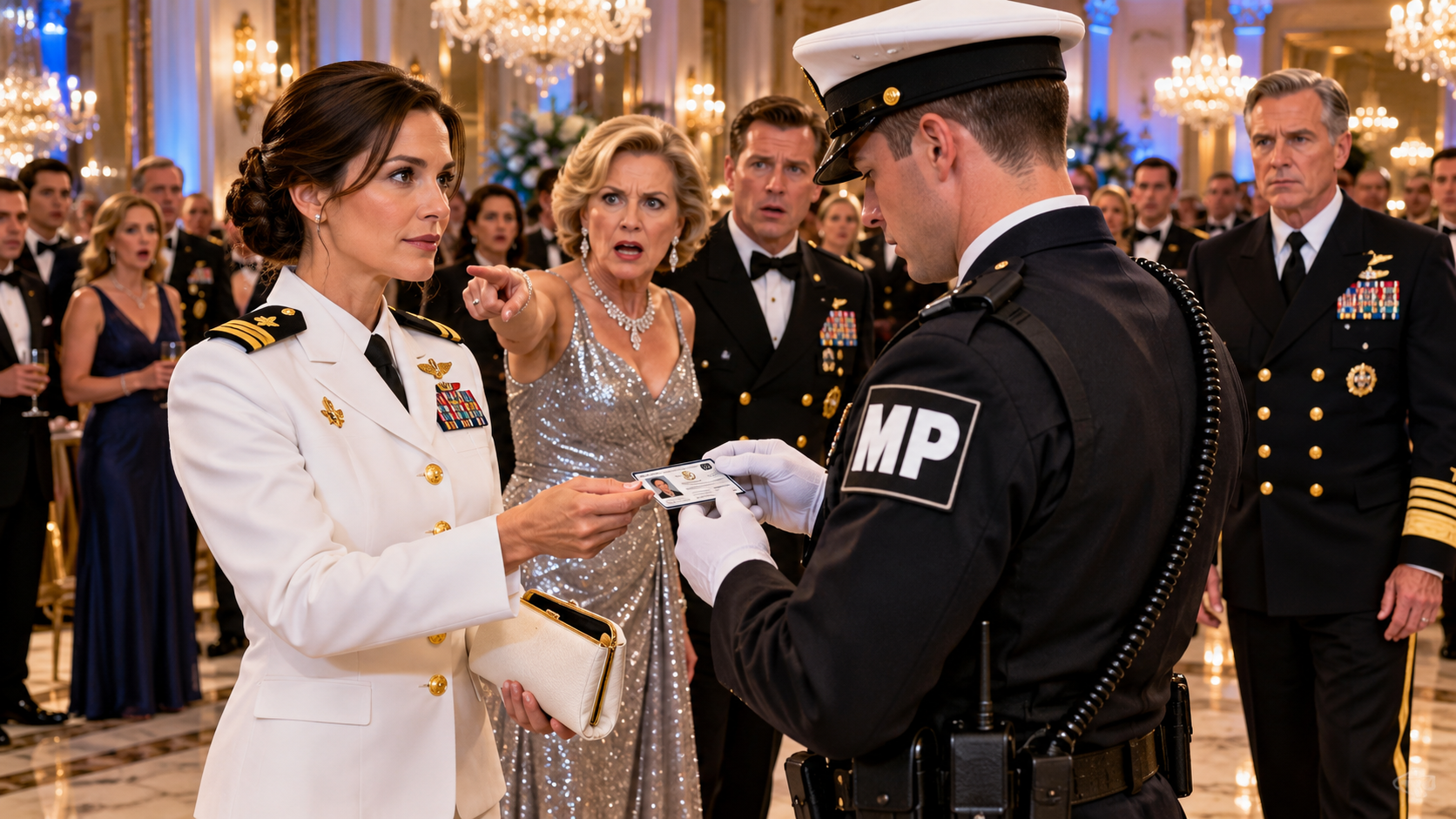
My mother-in-law pointed at me across a ballroom filled with admirals, senators, decorated commanders, and military families and said, “Arrest her. She’s impersonating an officer.”
The words carried farther than they should have.
Maybe it was because the quartet near the far wall had just finished a song. Maybe it was because Helen Whitmore had the kind of voice that had never learned how to enter a room quietly. Or maybe it was because people instinctively understood when something ugly was happening and went still before they even knew why.
Whatever the reason, the ballroom seemed to stop breathing.
A Military Police officer standing near the entrance turned.
Helen pointed again.
“At that woman,” she said. “She is not a captain.”
The MP looked toward me.
Then he started walking.
I stood beneath a chandelier the size of a small car, dressed in my Navy dinner dress whites, one hand resting lightly at my side.
Beside me, my husband, Frank, went pale.
Not because he believed his mother.
Not because he was afraid I was about to be exposed.
He went pale because after seven years of warning her, correcting her, defending me, arguing with her, and finally begging her to stop, he knew exactly what she had just done.
There are mistakes you can apologize for privately.
Then there are mistakes you make in a ballroom full of flag officers.
Helen had just chosen the second kind.
She stood near the entrance in a silver gown with diamonds around her throat, looking almost triumphant. Her chin was raised. Her shoulders were straight. Her eyes were fixed on me with the satisfaction of someone who believed she had finally caught a liar.
That expression hurt more than I expected.
Not because I doubted myself.
I had stopped needing Helen Whitmore’s approval years ago.
What hurt was realizing that after everything Frank had told her, after every correction, after every opportunity she had been given to reconsider, she had not merely misunderstood me.
She had wanted me to be lying.
She needed it.
Because if I was telling the truth, then the story she had built around her son—and around me—collapsed.
The MP crossed the polished floor.
Behind him, heads turned.
A two-star admiral stopped speaking.
A congressional staffer lowered his champagne glass.
Several officers I knew exchanged looks.
Frank leaned toward me.
“Evie,” he whispered.
I touched his wrist.
“Don’t.”
His jaw tightened.
“My mother just accused you of a federal crime.”
“I noticed.”
“I’m going to—”
“No.”
The MP reached us.
He was young, maybe late twenties, with the controlled expression of someone who understood that everyone in the room was watching him.
“Ma’am,” he said.
“Captain,” Frank corrected automatically.
The MP’s eyes flicked to him, then back to me.
I almost smiled.
“Sir,” I said calmly, “you’re responding to an allegation. Do what you need to do.”
That seemed to steady him.
“Yes, ma’am.”
Across the ballroom, Helen folded her arms.
“She isn’t Navy,” she called.
Frank closed his eyes.
I heard someone inhale sharply behind me.
The MP glanced toward Helen, then back at me.
“Ma’am, may I see identification?”
“Of course.”
My wallet was inside the small white clutch I had placed on a nearby cocktail table.
I reached for it slowly, deliberately, because I was very aware that the worst thing I could do was make the officer uncomfortable while he was trying to handle an absurd situation professionally.
I opened the clutch.
Helen smiled.
That smile transported me seven years backward.
Back to the first time Frank took me home to meet her.
Back before I understood that Helen did not insult people impulsively.
She categorized them.
And once she had put you into a category, she would defend that version of you against reality itself.
Frank and I had been dating six months when he introduced me to his parents.
His father, Richard, had died several years earlier, and Frank warned me beforehand that his mother could be “a little intense.”
That phrase turned out to be an impressive understatement.
Helen lived in a large colonial outside Annapolis filled with framed photographs of Frank in uniform. Frank at commissioning. Frank aboard his first ship. Frank receiving a commendation. Frank shaking hands with an admiral.
I remember standing in the foyer the first time and realizing there were more photographs of Frank’s Navy career in Helen’s house than in our apartment.
She hugged him for a full ten seconds.
Then she looked at me.
“So,” she said, “Frank tells me you’re Navy too.”
“I am.”
“What do you do?”
“Operations.”
Her expression brightened in a way I would later learn meant she had just decided something for me.
“Oh, administrative work.”
I could have corrected her immediately.
Technically, I tried.
“Not exactly.”
But Helen had already turned toward Frank.
“He always needed organized people around him. Even as a child.”
Frank frowned.
“Mom, Evelyn is an officer.”
Helen glanced at me again.
“How nice.”
Then she asked me whether I enjoyed living near the base.
That was the beginning.
A tiny misunderstanding.
An assumption so small it would have been ridiculous to fight over.
So I didn’t.
I had no idea then that Helen would spend the next seven years feeding that assumption until it became an entire alternate biography.
In Helen’s version of my life, I worked behind a desk.
I answered phones.
I scheduled meetings.
I sometimes traveled to conferences.
I wore what she called “one of those office uniforms.”
And, most importantly, I existed somewhere below Frank.
Frank was a commander.
Helen treated that rank like a family heirloom.
Every promotion became a story she told at dinner. Every assignment became proof that her son was extraordinary. Every new responsibility became evidence that the Whitmores had produced a man destined for important things.
There was nothing wrong with being proud of him.
I was proud of him too.
Frank was talented, disciplined, and deeply committed to the people he led.
But Helen’s pride came with a requirement I didn’t understand at first.
For Frank to remain impressive in her mind, I apparently had to remain small.
At our first Thanksgiving together, she asked whether my “little desk job” came with free parking.
At Christmas, she gave Frank antique gold cufflinks in a velvet box and handed me a clearance candle with the orange price sticker still attached.
I thanked her.
Later, Frank found me washing dishes.
He stood beside me, furious.
“You know she does that on purpose.”
“Yes.”
“Why didn’t you say something?”
“Because yelling at your mother over a candle on Christmas seems excessive.”
“It isn’t about the candle.”
“I know.”
That became our pattern.
Helen would say something.
Frank would get angry.
I would stop him from turning dinner into a war.
For years, I thought I was protecting him.
Then I began to wonder whether I was protecting Helen.
At our wedding, she gave a speech about Frank’s demanding career.
She talked about sacrifice, leadership, long deployments, and the strength required to support a man with “a real military career.”
That tiny word landed harder than almost anything else she said.
Real.
I looked at Frank.
He had heard it too.
His hand tightened around mine beneath the table.
Later that night, he asked me to let him confront her.
I told him no.
Not at our wedding.
Not when everyone was celebrating.
Not when I wanted to remember the evening for something other than Helen.
So once again, I made myself smaller to keep the peace.
And Helen learned the wrong lesson.
She learned there would never be a consequence.
Now, seven years later, inside the Admiral’s Winter Ball, the Military Police officer waited while I removed my identification card from my wallet.
Helen’s smile widened.
I held the card between two fingers.
And for the first time that night, I looked directly at her.
She had absolutely no idea what was about to happen.
PART 2: THE VERSION OF ME SHE NEEDED
The strangest part about Helen’s refusal to believe me was that the truth had never been hidden.
Frank told her.
I told her.
Invitations told her.
Programs told her.
People addressed me by rank in front of her.
Reality had been practically shouting at Helen Whitmore for years.
She simply kept translating it into a language she preferred.
After Frank and I married, he tried being more direct.
We were having dinner at Helen’s house when she asked whether I could help organize a charity luncheon because, as she put it, “You’re good with schedules.”
I said I was leaving for several weeks and probably wouldn’t have time.
Helen looked disappointed.
“A work conference?”
“Operational travel,” I said.
“Where?”
“I can’t discuss it.”
She laughed.
Not cruelly, exactly.
Worse.
Dismissively.
“Oh, Evelyn. You make your office sound very mysterious.”
Frank put his fork down.
“Mom.”
“What?”
“She is not an administrative assistant.”
“I never said she was.”
“You constantly imply it.”
Helen looked at me.
“Well, what exactly are you?”
I answered carefully.
“A Navy officer.”
“Yes, dear. We established that.”
“I’m in command.”
“Of what?”
There were questions I could answer and questions I could not.
That was something Helen never respected.
If I declined to discuss an assignment, she treated the absence of detail as proof there was nothing important to tell.
“I have command responsibilities,” I said.
She waved one hand.
“So does everyone these days. Department heads, office managers…”
Frank stared at her.
“She commands sailors.”
Helen smiled.
“I’m sure they appreciate her organizational skills.”
“Mom, Evelyn outranks me.”
Silence.
Helen blinked.
Then she laughed.
It was not a nervous laugh.
It was a laugh of genuine disbelief.
“Oh, Frank.”
“I’m serious.”
“You don’t have to exaggerate your wife’s position to protect her feelings.”
My husband’s face changed.
I remember that clearly.
Frank was not a man who lost his temper easily. At work, he had the kind of patience that made people straighten themselves out without needing to be shouted at.
But that night, his expression went cold.
“I am not exaggerating anything.”
Helen looked at me.
Then back at him.
“Well, perhaps in her specialty they use different titles.”
I stared at her.
Even now, years later, I can almost admire the flexibility of that denial.
Frank could have brought out my records and laid them next to the mashed potatoes, and I suspect Helen would have decided the Navy had made a clerical error.
On the drive home, Frank apologized.
Again.
I watched streetlights slide across the windshield.
“You don’t have to apologize for your mother.”
“I brought you into this.”
“You married me. You didn’t invent Helen.”
He almost smiled.
Then his hands tightened on the steering wheel.
“I hate the way she talks to you.”
“So do I.”
That surprised him.
I usually brushed Helen off.
That night, I was tired.
Not physically.
I knew physical exhaustion. I knew twelve-hour watches, long flights, nights where coffee stopped tasting like anything and became simply another piece of equipment.
This was different.
This was the exhaustion of repeatedly being told that your life did not count because someone had decided it would be more convenient if it didn’t.
“I’m not made of steel, Frank,” I said quietly.
His eyes moved toward me.
“I know.”
“No, I don’t think you do. You think because I don’t react, it doesn’t bother me.”
“I never thought that.”
“Sometimes I think I did.”
He was silent.
I looked out the passenger window.
“I kept telling myself she was your mother. I kept telling myself it wasn’t worth a fight. But every time I swallow it, she thinks she was right.”
Frank said nothing for a long moment.
Then he reached across the console and took my hand.
“You never have to make yourself smaller for me.”
I turned toward him.
That sentence stayed with me.
Because until then, I had not realized that was exactly what I had been doing.
Not for Frank.
For peace.
There is a kind of pride in restraint.
It can be noble.
It can also become a trap.
You tell yourself you are choosing your battles.
Then one day you look back and realize the other person believes there was never a battle to begin with.
The years passed.
My career advanced.
So did Frank’s.
His mother celebrated every one of his achievements with increasingly elaborate dinners.
When I was promoted, Frank sent her a photograph.
She responded with a thumbs-up emoji.
Later, at dinner, she asked whether the promotion came with a better office.
Frank nearly choked on his wine.
I told her, “Not exactly.”
That was the point when the situation became almost surreal.
She did not know my pay grade.
She did not know my responsibilities.
She did not know what I had done for twenty-two years.
Yet she spoke about my career with absolute confidence.
I had completed two combat deployments.
I had spent months separated from people I loved.
I had stood in rooms where decisions had consequences far beyond anyone at Helen’s dinner table.
I had written letters to families.
I had watched young officers grow into leaders.
I had made mistakes, learned from them, carried them with me, and kept going.
I had earned every stripe I wore.
None of that required Helen’s permission to be real.
But I would be lying if I said her words never hurt.
The hardest insults are not always the loud ones.
Sometimes they arrive disguised as jokes.
Sometimes they come wrapped in family tradition.
Sometimes they sit beside you at Thanksgiving and ask whether you still “play Navy.”
Frank confronted her more than once.
Each time, Helen found another exit from reality.
When he told her I supervised senior personnel, she decided that meant clerical staff.
When he said I had spent time overseas, she said conferences were exhausting.
When he mentioned that I had responsibility for operational planning, she called me “Frank’s little strategist.”
Eventually Frank asked why I never gave her the entire résumé.
I knew he was frustrated, not accusing me.
Still, the question stayed with me.
Why didn’t I?
I could have printed my service history.
I could have shown her promotion orders.
I could have listed commands, awards, assignments, schools, responsibilities.
I could have buried her in documentation.
The answer embarrassed me at first because it sounded almost childish.
I didn’t want to prove that I deserved basic respect.
Not to family.
Not after seven years.
If someone needs your résumé before they decide whether to treat you with dignity, the résumé is not the real problem.
Then the invitation arrived.
Heavy cream paper.
Embossed lettering.
A formal envelope addressed to our home.
Frank opened it at the kitchen counter.
I was pouring coffee when he stopped moving.
“What?”
He handed me the card.
Across the front, in dark formal lettering, were the words:
Captain Evelyn Whitmore, United States Navy, and Commander Frank Whitmore, United States Navy.
I looked at it.
Then I looked at Frank.
His mouth tightened.
“My mother will be there.”
“I know.”
The Admiral’s Winter Ball was one of those events that combined ceremony with networking, tradition with pageantry.
Senior officers.
Civilian leadership.
Military families.
Retired commanders.
People who understood uniforms, rank, protocol, and the difference between a captain in the Navy and a captain in other branches without needing an explanation.
Frank leaned both hands on the counter.
“I’m calling her.”
“No.”
He looked at me sharply.
“Evie.”
“No.”
“I’m going to tell her exactly what your rank is, exactly what you’ll be wearing, and exactly what she is not going to say.”
I slipped the invitation back into its envelope.
“You’ve told her for seven years.”
“This is different.”
“No. This is exactly the same.”
“She could embarrass you.”
I gave him a tired smile.
“She can only embarrass herself.”
He watched me.
I knew him well enough to see the concern behind his anger.
“What are you planning?”
“Nothing.”
“That answer worries me.”
“I’m serious. I’m not setting a trap.”
“Then what are you doing?”
I considered the question.
“Giving her one last chance.”
Frank frowned.
“To do what?”
“To believe me without being forced.”
He understood then.
At least part of it.
The plan was simple.
I would arrive in a civilian evening gown.
My dress whites would be upstairs for the formal procession later.
Helen would have an hour.
One hour in which she could choose not to belittle me.
One hour in which she could accept what Frank had told her.
One hour in which she could decide that being family mattered more than preserving her version of the hierarchy.
Frank sighed.
“This is going to go badly.”
“Maybe.”
“You know it will.”
I looked down at the invitation.
“Then at least I’ll stop wondering.”
That was how I walked into the Admiral’s Winter Ball wearing a midnight-blue gown while my uniform waited upstairs.
And Helen, given one final opportunity to be kind, looked at me and smiled.
“How nice they let civilian spouses arrive early.”
Frank stiffened.
I felt something inside me go very quiet.
Helen looked over my shoulder toward the officers entering the ballroom.
“At least you didn’t wear one of those little office uniforms.”
“Mom,” Frank snapped.
I touched his sleeve.
“Not yet.”
Helen raised her eyebrows.
“Not yet what?”
“Nothing.”
She smiled.
Then she walked into the ballroom and spent the next forty minutes proving that I had made the right decision.
PART 3: THE UNIFORM SHE CALLED A COSTUME
Helen knew people.
That was part of the problem.
She had spent decades orbiting military social circles through her late husband and then through Frank.
She understood enough of the culture to sound authoritative to outsiders.
But she had also developed a dangerous habit of believing proximity to service was the same thing as understanding it.
That evening, she moved through the ballroom as though hosting it.
Frank and I stayed close at first.
Helen made that difficult.
She introduced Frank enthusiastically.
“My son, Commander Whitmore.”
She would touch his arm when she said it.
Then she would gesture toward me.
“And this is Evelyn.”
Sometimes she added, “She works in scheduling.”
Once she said, “She does something administrative.”
Frank corrected her.
Every time.
Helen ignored him.
I watched the reactions around us.
Most people were too polite to intervene.
A few people already knew me.
Those were the uncomfortable moments.
One retired rear admiral stared at Helen as though waiting for the punchline.
A captain from another command started to say, “Actually, Evelyn—”
I shook my head.
He stopped.
Frank saw.
“You’re enjoying this,” he murmured.
“No.”
“You have a strange expression.”
“I’m watching how far she’ll go.”
“That is not reassuring.”
Helen went farther.
Of course she did.
A senator’s wife whom I had met at a defense policy dinner several months earlier approached us.
Helen immediately took control of the introduction.
“Margaret, this is my son Frank. Commander Frank Whitmore.”
The woman smiled.
“We’ve met.”
“And his wife, Evelyn.”
Margaret looked directly at me.
“Yes. Captain Whitmore and I—”
Helen laughed.
“No, no, Frank is the career officer. Evelyn avoids discussing her job because it isn’t terribly impressive.”
There are moments when embarrassment becomes so intense it almost circles back into comedy.
Margaret’s expression went blank.
Frank made a sound under his breath that I had never heard before.
I stepped in.
“Helen.”
She turned.
“Yes?”
“Why don’t you get something to drink?”
She blinked.
It was the first time that evening I had spoken to her in a tone that sounded less like a daughter-in-law and more like the officer I was everywhere else.
Something in my voice made her pause.
Then she smiled tightly.
“Of course.”
She walked away.
Margaret watched her go.
Then she looked at me.
“I’m going to assume there is a story.”
“A long one.”
“Do you want me to say something?”
“No.”
Her eyebrows rose.
“Are you sure?”
“I am.”
Frank was not.
The second Margaret left, he turned to me.
“Enough.”
“Almost.”
“Evelyn.”
“She has twenty minutes.”
“To what?”
“To surprise me.”
Frank stared at me.
Then he looked toward his mother, who was already talking animatedly to another couple.
“She won’t.”
“I know.”
That was the moment I realized the final piece of hope was gone.
Not hope that Helen would suddenly become warm or humble.
I had stopped expecting miracles.
I had hoped, perhaps foolishly, that confronted by an environment where rank was visible and formal, she might finally question herself.
She didn’t.
Instead, she became more confident.
At exactly 7:20, an admiral’s aide approached.
Lieutenant Avery.
Young, efficient, impossible to rattle.
He stopped beside us.
“Captain Whitmore.”
I turned.
“Lieutenant.”
“Admiral Hargrove is ready for the formal procession.”
“Thank you. I’ll be upstairs in five minutes.”
Before he could leave, Helen stepped back toward us.
“Captain?”
Avery looked at her.
Helen actually laughed.
It was a light laugh.
The kind people use when they believe everyone else is in on the joke.
“Do they call every wife captain at these events?”
Avery’s face became professionally empty.
“No, ma’am.”
Helen looked at me.
Then at Frank.
I expected hesitation.
Instead, her mouth tightened.
“Frank.”
My husband looked exhausted.
“Mom, she is telling you the truth.”
“About what?”
“Everything.”
Helen stared at him.
Then at me.
For one second, I saw uncertainty.
It was there.
A crack.
She could have stopped.
She could have asked.
She could have said, Evelyn, have I misunderstood?
Instead she shook her head.
“This is ridiculous.”
Avery wisely excused himself.
I looked at Frank.
“I need to change.”
“I’m coming with you.”
“No. Stay.”
“Why?”
I glanced at Helen.
“Because I think your mother needs someone nearby when she realizes the world is not rearranging itself for her.”
I walked away.
Upstairs, the noise from the ballroom softened behind thick carpet and closed doors.
My uniform was hanging where I had left it.
White jacket.
White trousers.
Black shoulder boards.
Ribbons.
Insignia.
The uniform looked ordinary to me because uniforms become ordinary after enough years.
That does not mean they become meaningless.
I closed the door.
For several seconds, I stood there looking at it.
Then I thought about every time Helen had called it a costume without using the word.
Every time she had dismissed an assignment.
Every time she had reduced twenty-two years to paperwork because that version made her more comfortable.
I thought about all the times I had chosen silence.
Not because I was weak.
Because I believed restraint was strength.
Sometimes it is.
Sometimes strength is refusing to enter a pointless fight.
But there is another kind of strength in finally refusing to surrender the truth simply because someone else finds it inconvenient.
I changed slowly.
Button by button.
I secured my insignia.
Checked my ribbons.
Smoothed the jacket.
Then I opened my wallet and looked at my military identification card.
Captain Evelyn Whitmore.
United States Navy.
O-6.
The same information Frank had told his mother.
The same reality she had rejected.
I put the card away.
When I looked into the mirror, I did not see Helen’s daughter-in-law.
I did not see Frank’s wife.
Not first.
I saw myself.
Twenty-two years.
Thousands of hours.
Mistakes.
Losses.
Promotions.
Deployments.
People I had led.
People who had led me.
Moments when I had been afraid and acted anyway.
Moments when I had doubted myself and kept moving.
The woman in the mirror did not need to convince Helen Whitmore of anything.
That was the strangest comfort of all.
I went downstairs.
The ballroom doors were open.
As I approached, conversations near the entrance quieted.
People noticed uniforms.
They noticed rank.
They noticed the gold eagle.
I saw Frank first.
His back was toward me.
Helen faced him.
She was angry.
I could tell from twenty feet away.
“You expect me to believe she’s a captain?”
Frank’s shoulders stiffened.
“She is a captain.”
“She would have told me.”
“She did.”
Helen shook her head.
“No. She said she was in operations.”
“She said a lot more than that. You refused to hear it.”
Then Frank saw me.
He stopped speaking.
Helen followed his gaze.
I will remember her expression for the rest of my life.
Confusion first.
Then surprise.
Then anger.
Not embarrassment.
Not yet.
Anger.
Because I was standing in front of her in the truth she had spent seven years refusing.
She stared at my uniform.
Her eyes moved over the shoulder boards.
The ribbons.
The insignia.
The name.
“Where did you get that?”
I almost laughed.
Not because it was funny.
Because after seven years, she had somehow found one more exit.
“I was issued it.”
Her face hardened.
“No.”
Frank stepped forward.
“Mom.”
Helen ignored him.
“You can’t just put on a uniform.”
The first people nearby began to turn.
“Helen,” I said quietly.
“Take that off.”
Frank looked stunned.
I did too.
She took another step toward me.
“You are embarrassing my son.”
That sentence changed something.
Not in me.
In Frank.
His expression went still.
“My wife is embarrassing me?”
Helen gestured toward me.
“Look at her.”
“I am.”
“She is pretending to be a captain.”
“No, Mom. She is a captain.”
“I know Navy ranks.”
“Apparently not.”
Her face flushed.
“Don’t speak to me that way.”
“Then stop accusing my wife of lying.”
More people were watching now.
I hated that.
Despite everything, I did not want a spectacle.
I lowered my voice.
“Helen. Stop.”
She looked at me.
“If you leave this alone right now, this ends here.”
I meant it.
She had one last exit.
A graceful one, if she chose to take it.
Walk away.
Ask Frank privately.
Check the program.
Ask literally anyone in the room.
But Helen was not interested in the truth anymore.
She was interested in winning.
She looked toward the entrance.
There were two Military Police personnel near the doors.
And before Frank or I understood what she intended, she lifted her hand.
“Officer!”
One of them turned.
Helen pointed at me.
“Arrest her.”
The room went silent.
“She’s impersonating an officer.”
That was how we arrived at the moment I had never imagined possible.
A ballroom full of military leaders watching an MP cross the floor toward me.
Frank pale beside me.
Helen smiling.
And my identification card waiting in my clutch.
PART 4: CHECK HER ID
The MP stood in front of me.
“Ma’am, may I see identification?”
I opened my clutch.
Across the room, Helen said, “You need to check whether it’s real.”
Frank whispered, “Oh my God.”
I removed the card.
The MP took it.
He looked down.
His eyes moved once across the front.
Then again.
His posture changed.
It was subtle.
Most civilians would not have noticed.
I did.
So did every senior officer within ten feet.
He looked up at me.
Then back at the card.
“Captain Whitmore.”
“Yes.”
He handed it back.
“Thank you, ma’am.”
Helen’s smile disappeared.
“That’s it?”
The MP turned toward her.
“Ma’am?”
“You looked at it for two seconds.”
“It is a valid military identification card.”
“How do you know?”
Frank made a strangled sound.
The MP remained polite.
“Because checking identification is part of my job, ma’am.”
Helen looked around as though someone else might support her.
No one did.
She pointed at my uniform.
“But she’s wearing captain’s insignia.”
“Yes, ma’am.”
“She isn’t a captain.”
The MP paused.
Then said, “Her identification indicates that she is.”
Helen stared at him.
“No.”
I watched the word fall out of her with less confidence than before.
For seven years, no had been enough.
No, Evelyn did not outrank Frank.
No, Evelyn did not command anyone important.
No, Evelyn’s travel was not operational.
No, Evelyn’s career was not demanding.
No, Evelyn had not earned the title people used.
Helen had built an entire reality out of that word.
But now there were too many witnesses.
And too many facts.
A voice came from behind me.
“Is there a problem here?”
I recognized it immediately.
Admiral Thomas Hargrove approached in full dress uniform, accompanied by his aide.
Several people shifted instinctively.
The MP straightened.
“Sir.”
Hargrove looked from him to me.
Then to Helen.
“Captain?”
I took a breath.
“A misunderstanding, sir.”
Helen interrupted.
“This woman is claiming to be a captain.”
Hargrove looked at me.
Then back at Helen.
For a moment, his expression was so unreadable I could almost hear Frank praying for the floor to open.
Finally Hargrove said, “She is a captain.”
Helen’s face went white.
Not pale.
White.
Hargrove continued.
“Captain Whitmore has been on my operational planning staff for the last eighteen months.”
I felt every pair of eyes turn toward Helen.
She opened her mouth.
Nothing came out.
Hargrove looked at me.
“You’re due in the procession.”
“Yes, sir.”
His gaze shifted to the MP.
“Anything else required?”
“No, sir. Identity confirmed.”
Hargrove nodded.
Then he looked at Helen once more.
There was no anger in his expression.
That would have been easier for her.
There was simply certainty.
“Then I suggest we continue with the evening.”
“Yes, sir,” I said.
He walked away.
The MP returned to his position.
And Helen stood beneath the chandeliers with the entire story she had told about me lying broken at her feet.
Nobody applauded.
I was grateful for that.
Real life rarely needs the theatrical things people imagine.
No one laughed at her.
No one shouted.
No one pointed.
The silence was worse.
Helen looked at Frank.
“Why didn’t you tell me?”
For the first time all evening, my husband actually recoiled.
“What?”
“Why didn’t you tell me?”
His face changed from disbelief to something much sadder.
“I did.”
“No, you didn’t.”
“I told you for seven years.”
“You never said—”
“I told you she outranked me.”
Helen glanced around.
People were pretending not to listen.
They were failing.
“I thought you meant…”
“What?”
She said nothing.
Frank stepped closer.
“What did you think I meant?”
Her eyes filled with anger again because anger was safer than shame.
“You could have explained it better.”
I watched something break inside my husband.
Not loudly.
There was no dramatic collapse.
Just a final piece of patience disappearing.
“I explained it every possible way.”
“Frank—”
“I told you she commanded sailors.”
“I thought—”
“I told you she had operational responsibilities.”
“You never gave me details.”
“Because some details were none of your business.”
Helen flinched.
Frank continued.
“I told you she had senior rank. I told you she had deployed. I told you she had twenty years of service. I told you she was not administrative support. I told you tonight, five minutes ago, standing right there, that she was telling the truth.”
Helen turned toward me.
“You let me embarrass myself.”
There it was.
For one ridiculous second, I almost admired the escape attempt.
I looked at her.
“No.”
“Yes, you did. You knew.”
“I knew what?”
“That I didn’t understand.”
“I corrected you for years.”
“You could have shown me proof.”
“I am not a defendant in your courtroom.”
Her eyes flashed.
“You made a fool of me.”
“No, Helen.”
My voice was quieter than hers.
That made the words land harder.
“I gave you seven years not to do this.”
She stared at me.
“I never wanted tonight to happen.”
“Then why did you wear the gown first?”
Frank looked at me.
It was a fair question.
Not kind.
But fair.
I answered it.
“Because I wanted to know whether you could treat me with respect before you were forced to.”
Helen’s face tightened.
I continued.
“I wanted one hour where you didn’t have visible rank in front of you. One hour where you had to decide whether my word mattered. Whether Frank’s word mattered. Whether I deserved basic dignity even if I were exactly what you believed I was.”
Helen looked away.
“You failed.”
The words escaped before I could soften them.
I did not take them back.
“You called my career unimpressive. You told people I was administrative staff. You mocked the idea that I could be a captain. Then when I appeared in uniform, you did not ask one question. You accused me of committing a crime.”
Her lower lip trembled.
I felt no triumph.
That surprised me.
For years, in my darker moments, I imagined Helen finally learning the truth.
I imagined satisfaction.
Vindication.
Some clean, bright sense of justice.
Instead I felt tired.
Deeply tired.
Because humiliation does not become pleasant merely because the other person earned it.
Frank reached for my hand.
I took it.
Helen noticed.
That seemed to hurt her more than anything else.
“The procession,” I said.
Frank nodded.
“I’m coming.”
“You’re part of it.”
“I know.”
We turned.
Helen spoke behind us.
“Frank.”
He stopped.
I felt his hand tighten around mine.
For a moment, I wondered whether he would turn.
He did.
Helen stood alone beside the cocktail table.
Her diamonds glittered.
Her makeup was perfect.
Her posture had collapsed.
“What?” he asked.
She looked at him with an expression I had seen many times.
The expression she used when she expected her son to rescue her.
“Are you just going to leave me standing here?”
Frank’s eyes moved briefly toward me.
Then back to his mother.
“Yes.”
The word was quiet.
Helen flinched.
“Tonight, yes.”
And we walked away.
The formal procession began six minutes later.
When my name was announced, I stepped forward.
“Captain Evelyn Whitmore, United States Navy.”
I did not look toward Helen.
I did not need to.
For the first time in seven years, the room knew exactly who I was.
More importantly, so did I.
PART 5: WHAT THE UNIFORM COULD NOT FIX
The ball did not end after Helen’s accusation.
That would have been easier.
Ceremonies continued.
Speeches were given.
Dinner was served.
Music resumed.
People danced.
That is one of the strange things about public disaster.
The world does not always stop just because your family has detonated itself beside the champagne table.
For the next two hours, I performed the social version of damage control.
People asked whether I was all right.
I told them I was.
Some meant well.
Some were curious.
A few senior officers looked furious on my behalf.
Admiral Hargrove approached once after dinner.
“Captain.”
“Sir.”
“You need anything?”
“No, sir.”
He studied me.
“I’ve met difficult family members before.”
Despite everything, I laughed.
“Yes, sir.”
His expression softened.
“For what it’s worth, you handled it professionally.”
“Thank you.”
Then he changed the subject.
That kindness mattered.
He did not make me relive it.
Helen stayed for another forty minutes.
I do not know why.
Pride, probably.
Leaving immediately would have meant admitting defeat.
She sat at a table near the back and spoke to almost no one.
Frank did not go to her.
Neither did I.
When she finally left, she walked past us without saying goodbye.
I watched her disappear through the ballroom doors.
Frank exhaled.
“I’m sorry.”
I turned.
“For what?”
He looked at me as if the answer were obvious.
“For all of it.”
“You didn’t accuse me.”
“She’s my mother.”
“That doesn’t make her behavior your responsibility.”
He looked away.
For years, Helen had made him responsible for her emotions.
I could see that now more clearly than ever.
Her pride.
Her disappointments.
Her expectations.
Her version of his life.
Maybe that was why he had fought so hard to correct her about me.
It was not only about defending his wife.
It was about trying to make his mother accept that he belonged to a life larger than the one she had designed for him.
I squeezed his hand.
“You warned her.”
“I should’ve done more.”
“You tried.”
“I should’ve stopped dinners. Holidays. All of it.”
“Maybe.”
He looked at me.
I let the word sit between us.
Because he was not completely wrong.
I had tolerated too much.
So had he.
We had both believed patience would eventually produce insight.
Instead, it had produced permission.
Frank nodded slowly.
“No more.”
I knew what he meant.
No more pretending an insult was a misunderstanding.
No more asking me to endure something because confronting it would be uncomfortable.
No more sacrificing my dignity to preserve Helen’s mood.
“Okay,” I said.
“No more.”
We stayed until the ball ended.
Not because we wanted to prove anything.
Because I refused to let Helen take the evening too.
I danced with my husband.
I spoke with colleagues.
I laughed.
At one point, I caught my reflection in a window.
The uniform looked bright against the dark glass.
For years, I thought the climax of this story would be Helen finally seeing me in it.
It wasn’t.
A uniform cannot fix a relationship.
An identification card can prove rank.
It cannot force respect.
The truth can defeat a lie without healing the person who believed it.
I learned that in the weeks that followed.
Helen called Frank the next morning.
He did not answer.
She called again.
Then she sent a message.
I think everyone overreacted.
Frank showed it to me.
I handed his phone back.
Three hours later, another arrived.
I was humiliated in front of people I have known for years.
Frank stared at the screen.
Still no apology.
That evening:
Evelyn could have handled things differently.
Frank finally responded.
I did not ask what he wrote.
He showed me anyway.
You accused my wife of impersonating a Navy officer and tried to have her arrested after I told you repeatedly that she was a captain. We will speak when you are ready to take responsibility for that.
Helen did not reply for four days.
When she did, she asked whether Frank was really willing to destroy their relationship “over one misunderstanding.”
He read the message at the kitchen table.
I was across from him with coffee.
“Do you want to call her?” I asked.
“No.”
“You sure?”
“Yes.”
He put the phone facedown.
“She still thinks the problem is the ball.”
I knew what he meant.
The ball was not the problem.
The ball was merely the first time Helen’s behavior became impossible to hide.
The real problem was seven years of choices.
Seven years of needing me to be lesser.
Seven years of treating Frank’s corrections as exaggerations because accepting them threatened the hierarchy she preferred.
Seven years of believing respect was something she could ration according to status.
A week later, an envelope arrived.
My name was written on the front.
Not Captain Whitmore.
Not Commander Frank Whitmore’s wife.
Just Evelyn.
Inside was a handwritten letter from Helen.
It began badly.
She explained that she had been confused.
That military ranks were complicated.
That Frank had never made my position “fully clear.”
That the lighting in the ballroom had made the insignia hard to see.
I almost stopped reading.
Then halfway down the second page, something changed.
The sentences became shorter.
The excuses disappeared.
She wrote:
I have been trying to find a way to explain what I did that does not make me ashamed of myself, and I cannot.
I read that sentence twice.
Then continued.
She admitted she had always imagined Frank as the military success in the family.
She admitted that when he married me, she initially liked the idea that I would understand his career without competing with it.
The word competing made my jaw tighten.
But I kept reading.
She said that once she had decided my career was minor, every correction felt like a challenge to the picture she had built of her son.
So she dismissed the corrections.
Then she dismissed me.
The final paragraph was the first real apology I had ever received from her.
Not perfect.
Not enough to erase seven years.
But real.
You should not have needed a rank, a uniform, an admiral, or an identification card for me to treat you with respect. I understand that now. I am sorry.
I placed the letter on the table.
Frank was watching me.
“Well?”
“She apologized.”
His shoulders dropped slightly.
“Actually apologized?”
“Yes.”
“Do you believe her?”
That question was harder.
I looked at the pages.
“I believe she’s ashamed.”
“That’s not what I asked.”
“I know.”
I folded the letter.
“I don’t know yet.”
And that was the truth.
People sometimes imagine forgiveness as a door.
Someone apologizes.
You open it.
Everything returns.
But relationships are rarely that simple.
Sometimes trust is a staircase.
You rebuild it one step at a time.
Sometimes you discover there is no reason to climb at all.
I did not know which one Helen and I had.
Not yet.
A month passed before I saw her.
Frank invited her to our house for dinner under one condition.
No excuses.
No rewriting what happened.
No blaming me for embarrassing her.
Helen agreed.
I almost canceled twice.
When the doorbell rang, I felt more nervous than I had standing in front of the MP.
Frank opened the door.
Helen stood outside holding flowers.
For one absurd second, I remembered the clearance candle.
I nearly laughed.
She stepped inside.
Her eyes found mine.
“Evelyn.”
“Helen.”
Silence.
Then she held out the flowers.
“These are for you.”
“Thank you.”
We moved into the living room.
Nobody sat.
Finally Helen spoke.
“I owe you an apology in person.”
I said nothing.
She took a breath.
“What I did at the ball was wrong.”
Frank remained beside me.
Helen looked at him, then deliberately returned her attention to me.
“I did not believe you because I did not want to believe you.”
That was the sentence I had been waiting seven years to hear.
Not that she was confused.
Not that rank was complicated.
Not that Frank had failed to explain.
The truth.
She had not wanted to believe me.
“Why?” I asked.
Helen’s face tightened.
“I was proud of Frank.”
“You can be proud of your son without diminishing his wife.”
“I know that now.”
“Didn’t you know it then?”
She looked down.
“I should have.”
“That isn’t an answer.”
Frank shifted slightly.
I could tell he was uncomfortable.
I did not rescue him.
I had spent seven years rescuing people from discomfort.
Not anymore.
Helen finally looked at me.
“When Richard died, Frank became the center of everything for me.”
Her voice was quieter.
“He was already grown, but I think I started treating his accomplishments as if they were… mine too.”
I listened.
“When he brought you home, and you were Navy, I thought that was good. You would understand him. Support him.”
“And when you found out I had my own career?”
“I felt foolish.”
I frowned.
“Why?”
“Because I had already told people about Frank. About his future. About how important his work was. And then every time he told me you were senior to him…”
She stopped.
I finished for her.
“You thought it made him smaller.”
“Yes.”
Frank’s face changed.
Helen turned toward him.
“I know how terrible that sounds.”
“It sounds terrible because it is terrible,” he said.
“I know.”
He shook his head.
“You thought my wife succeeding somehow diminished me?”
“I didn’t think of it that clearly.”
“You didn’t have to.”
His voice was controlled.
“That’s what you acted like.”
Helen’s eyes filled.
Frank did not stop.
“I’m proud of her.”
“I know.”
“No. I don’t think you do.”
He took my hand.
“I have always been proud of her. Her rank never threatened me. Her experience never threatened me. Her accomplishments never took anything away from mine. You were the only person turning our marriage into a competition.”
Helen looked at our joined hands.
“I understand.”
I spoke.
“Understanding it tonight is not the same as changing.”
“No.”
“If you want a relationship with us, I need you to understand something.”
She nodded.
“I am not going to prove myself to you again.”
Her eyes returned to mine.
“I will not explain whether my work is important enough. I will not list my deployments. I will not show you my résumé. I will not use my rank to justify why I deserve respect.”
“I understand.”
“And if you belittle me again, we leave.”
Helen swallowed.
“Okay.”
“If you undermine Frank because you’re angry with me, we leave.”
“Okay.”
“If you tell people a false story about my career because the truth makes you uncomfortable, we leave.”
She nodded.
“Okay.”
I waited.
Then added the most important part.
“And if I were a secretary, an assistant, a scheduler, a civilian spouse, or unemployed, none of what you did would have been acceptable.”
Helen looked at me.
That landed.
I saw it.
The final misconception.
For weeks, she had probably been thinking she was wrong because she underestimated someone important.
But that was not the lesson.
The lesson was that she had decided importance determined dignity.
“I know,” she said softly.
I studied her.
Then nodded.
Dinner was awkward.
Of course it was.
Real reconciliation is less cinematic than public humiliation.
There was no swelling music.
No sudden hug.
No perfect speech that erased the past.
Helen asked about my work once.
Then stopped herself.
“What can you tell me?” she asked instead.
That small correction mattered.
I answered.
Not everything.
Just what I chose.
Later, she asked Frank about an upcoming assignment.
For the first time I could remember, she listened without turning the conversation into a monument to him.
When she left, she hugged her son.
Then she looked at me.
I could see her wondering whether a hug would be welcome.
I extended my hand.
She shook it.
That was enough.
Months later, I stood in another formal reception wearing the same dress whites.
Frank was beside me.
Helen attended too.
She did not introduce me as a captain.
I noticed that immediately.
Instead she said, “This is my daughter-in-law, Evelyn.”
Nothing else.
No résumé.
No explanation.
No comparison.
No hierarchy.
Just my name.
And strangely, that felt better than hearing the rank.
At one point, a woman asked Helen whether Frank was the only one in the family serving.
Helen paused.
I saw the old habit flicker across her face.
Then she glanced at me.
“No,” she said. “Evelyn serves too.”
The woman smiled.
“How wonderful. What do you do?”
Helen did not answer for me.
She turned toward me.
And waited.
It was such a small thing that nobody else noticed.
I did.
“I’m in operations,” I said.
Helen smiled.
This time she did not translate it.
That night, on the drive home, Frank looked over at me.
“I saw that.”
“So did I.”
“You okay?”
I looked out the window.
Streetlights passed across the glass.
Seven years earlier, I had sat in another car with him after another dinner, trying to convince both of us that Helen’s behavior did not matter.
I would not say that anymore.
It had mattered.
It had hurt.
It had damaged things.
Pretending otherwise would only repeat the same mistake in a different direction.
But something had changed.
Not because Helen finally discovered I was a Navy captain.
The identification card had settled that question in seconds.
The more important change came later, when she finally understood that my worth had never depended on what was printed on it.
I reached across the console and took Frank’s hand.
“Yeah,” I said. “I’m okay.”
And I meant it.
For years, Helen believed the truth would make her son smaller.
Instead, the truth did something else.
It forced all of us to stop living inside the roles she had assigned.
Frank did not need to be the most important person in the room to be worthy of pride.
I did not need to display my rank to deserve respect.
And Helen could no longer call cruelty a misunderstanding simply because admitting the truth was uncomfortable.
I still have the identification card that ended the argument.
Of course I do.
It expired eventually, like all of them do.
The Navy issued me another.
But I kept the old one tucked into a box with a few photographs and pieces of my career I could not quite bring myself to throw away.
Sometimes I think about that ballroom.
The silver gown.
The chandeliers.
The silence.
The MP walking toward me.
Helen smiling because she believed, for one final moment, that reality was about to prove her right.
She had pointed at me and demanded that someone expose who I really was.
In a way, that was exactly what happened.
Just not to me.
Leave a Reply