
PART 1: THE DOOR MY MOTHER WOULD NOT LET ME CROSS
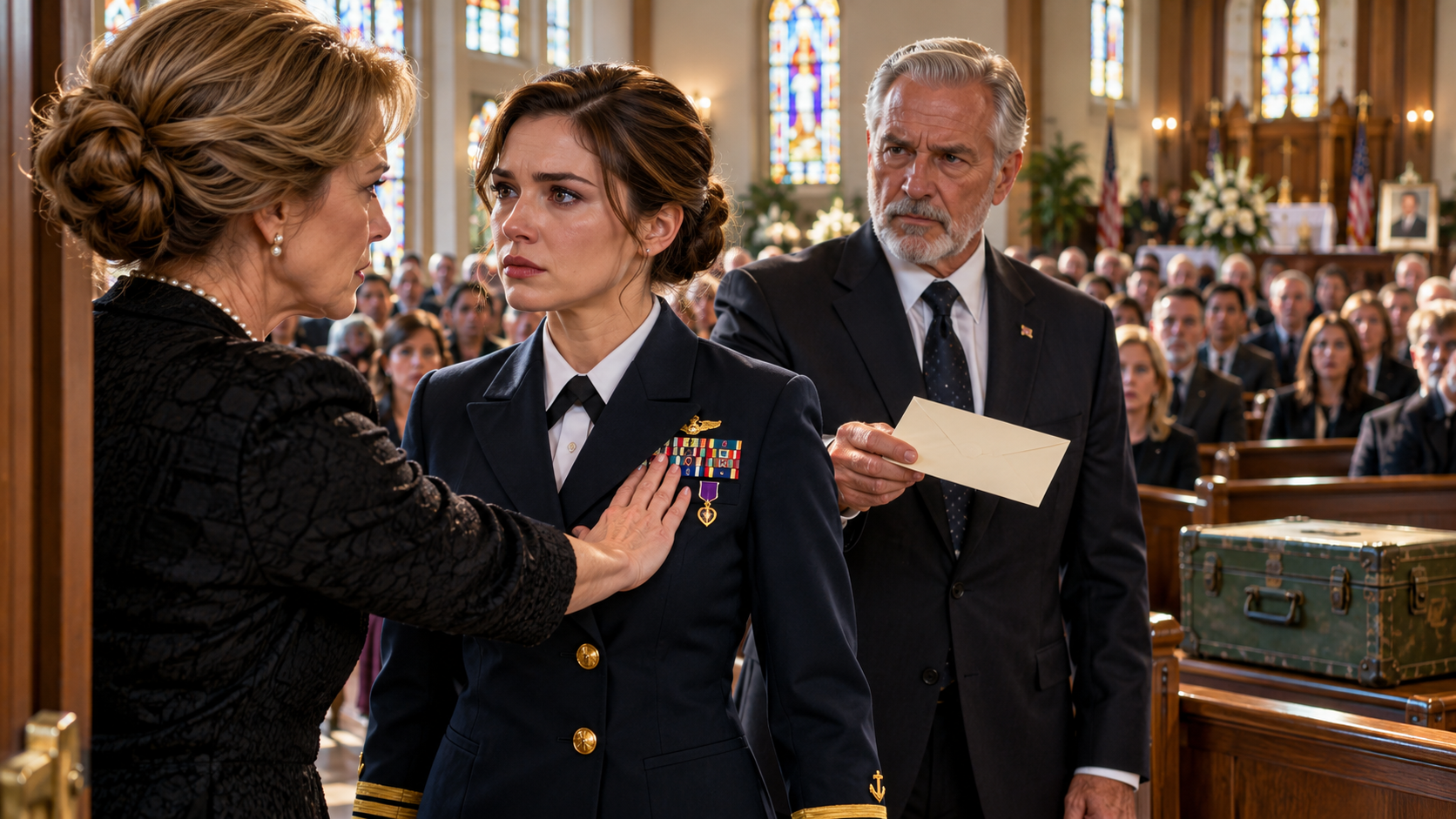
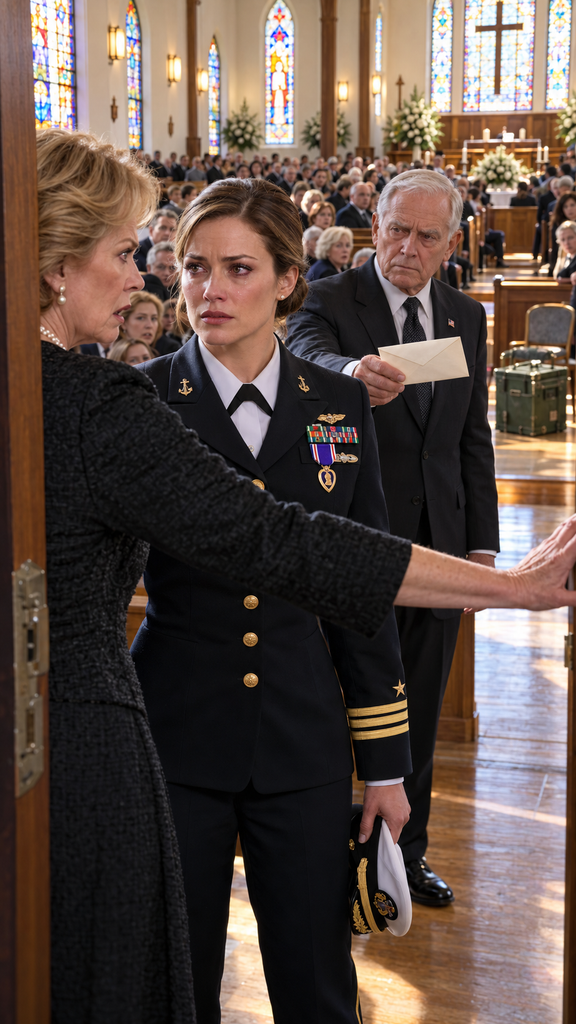
My mother stopped me at the doors of First Baptist Church with one hand pressed flat against my Navy dress uniform.
“Your father’s memorial is not about you.”
She did not whisper it.
That was the first thing I remember clearly.
Not the church bells.
Not the smell of lilies drifting out from the sanctuary.
Not the photograph of my father in his Army dress uniform standing beside the guest book.
I remember my mother’s palm against my chest and her voice carrying through the lobby.
Nearly two hundred people were already inside.
Enough of them heard her that the room went silent.
I saw heads turn.
Faces I had known since childhood.
Mr. Dillard, who used to coach my softball team.
Mrs. Patterson from the pharmacy.
The Carters, who had lived three houses down from us for twenty years.
Men from Dad’s veterans group.
Women from Mom’s Bible study.
People who had brought casseroles when my grandfather died and sent graduation cards when Emily and I finished high school.
For twelve years, most of those people had believed I had abandoned my family.
My mother had made sure of it.
She had never stood at a podium and announced that her oldest daughter was selfish. She was too careful for that.
Mom did things softly.
Painfully.
Effectively.
She would sigh when people asked about me.
“She’s very busy.”
Or:
“The Navy comes first for Sarah.”
Or:
“We don’t hear from her much anymore.”
None of those sentences was technically a lie by itself.
That was what made them powerful.
Mom understood that if you gave people enough pieces of a story, they would assemble the accusation for you.
Eventually, Cedar Creek stopped asking where I was.
They decided they knew.
And when I missed my father’s funeral six weeks before his memorial, the last pieces fell into place.
The daughter who had chosen the military over her family had not even come home to bury her father.
Standing in that church lobby, I could feel twelve years of judgment looking at me.
Mom’s gaze dropped to the ribbons above my left breast.
Her mouth tightened.
“You should have worn black.”
“I’m wearing what Dad asked me to wear.”
Her eyes snapped back to mine.
For one second, something moved behind them.
Not grief.
Not anger.
Fear.
Then it disappeared.
“If that were true,” she said, “you would have been here six weeks ago.”
That hurt more than I expected.
Maybe because part of me had been saying the same thing to myself every night since I woke up in Germany.
You should have been there.
You should have known.
You should have found a way.
I looked past Mom into the sanctuary.
At the front, next to the pulpit, was the large photograph of Colonel James Mitchell that Emily had texted me three days earlier.
Dad was sixty-two in the picture.
Gray at his temples.
Army dress uniform immaculate.
The half smile he always gave photographers because he hated having his picture taken.
Underneath the photograph was a wooden plaque.
JAMES EDWARD MITCHELL
HUSBAND. FATHER. SOLDIER. SERVANT.
I nearly laughed when I saw the word father.
Not because it was wrong.
Because there were mornings when I still could not believe I would never hear him answer the phone again.
Six weeks earlier, while my family stood in a cemetery under Tennessee rain, I had been unconscious in a military hospital in Germany.
I had no memory of the explosion itself.
Only pieces.
Dust.
A pressure wave.
Someone shouting my last name.
The metallic taste of blood.
Then nothing.
Shrapnel had entered through my right side, fractured two ribs, punctured my lung, and torn enough tissue that the surgeons spent hours deciding what they could save.
For three days, I did not know what country I was in.
For another two, I barely knew what day it was.
On the sixth day, a nurse placed my phone in my hand after I asked for it for the third time.
There were seventy-two unread messages.
The first one I opened was from my sister.
SARAH, PLEASE CALL ME WHEN YOU WAKE UP.
The second one was shorter.
DAD DIED.
I had stared at those two words until they stopped looking like language.
Dad died.
Not Dad is sick.
Not Dad had another episode.
Not Dad is in the hospital.
Died.
I learned later that he had suffered a massive cerebral hemorrhage at home. He had been conscious only briefly. By the time the ambulance reached Nashville, he was gone.
My family had known I was injured.
A military liaison had notified them.
Emily had asked whether the funeral could be delayed.
Mom had said no.
“The whole town is expecting Saturday,” she told her.
I knew because Emily confessed it to me after I returned to the United States.
Mom had never called my command.
Never contacted the liaison.
Never asked when I might be stable enough to know what had happened.
And Cedar Creek never heard I was lying in intensive care.
They heard only that Sarah Mitchell had not come home.
I should have been angry about that.
I was.
But grief had a way of making anger feel selfish.
So when Dad’s veterans organization arranged a larger public memorial six weeks later, I almost did not come.
Then I found the letter.
Dad had mailed it nine days before he died.
It had been sitting with forwarded mail in Virginia while I was overseas.
I opened it the first night I could sleep without medication.
Most of it was ordinary Dad.
The neighbor’s dog had dug under the fence again.
Emily was thinking about changing jobs.
The Vols were going to disappoint him for another season.
Then, near the end, he wrote:
Sarah,
Your mother and I still disagree about more things than I know how to explain. One of them is you.
Do not let her disappointment become your shame.
If there ever comes a day when they honor me and you are there, wear what you earned. Don’t wear it for them.
Wear it for me.
Love,
Dad
That letter was folded in the inside pocket of my uniform.
I could feel its edge against my ribs.
“I couldn’t be here six weeks ago,” I told Mom.
Her expression hardened.
“You always have a reason.”
The old instinct rose inside me.
Leave.
That was how I had survived my mother for most of my adult life.
Leave before the argument.
End the phone call.
Change the subject.
Deploy.
Volunteer.
Tell yourself peace is more important than being understood.
There were church doors five feet behind me.
I could have turned around.
Driven back to Nashville.
Changed out of the uniform.
Taken the first flight east.
Mom would have told people I had made a scene.
Someone would have said I looked angry.
Someone else would have said grief affected everyone differently.
By Thanksgiving, Cedar Creek would have one more story about Sarah Mitchell.
For one painful second, I nearly let them have it.
Then I heard wood scrape against tile.
A chair.
Someone had stood up inside the sanctuary.
People turned.
A tall elderly man in a dark suit stepped into the center aisle.
Command Sergeant Major Thomas Reed, United States Army, retired.
Dad’s oldest friend.
When I was little, I thought Uncle Tom was actually my uncle because he was in our kitchen so often. He and Dad had served together early in their careers. They had argued about football, politics, coffee, trucks, and which one of them had been responsible for getting a Humvee stuck in mud somewhere in Germany in 1987.
I had not seen him in almost seven years.
He looked smaller now.
Age had bent his shoulders slightly.
But as he walked toward us, I saw the same deliberate expression I remembered from childhood.
His eyes went first to my face.
Then to the ribbons on my uniform.
They paused on one.
The Purple Heart.
I had not wanted to wear it.
My commanding officer had told me I was being ridiculous.
“You earned it whether you like how you earned it or not.”
Reed looked at that ribbon for a long second.
Then he looked at Mom.
“Elaine.”
Mom’s hand dropped from my chest.
“Tom, this is family.”
His jaw tightened.
“Yes,” he said. “That’s why I’m standing.”
A murmur moved through the church.
Reed stopped beside me and reached inside his jacket.
When his hand came out, he was holding a cream-colored envelope.
Three words were written across the front.
FOR SARAH MITCHELL.
I knew the handwriting before I could breathe.
Dad’s.
My fingers went numb.
“Your father gave me this three months ago,” Reed said.
I looked from the envelope to him.
“Three months?”
“He gave me instructions.”
Mom went pale.
“Tom.”
He ignored her.
“He said I was not to hand this to you unless two things happened. First, he had to be gone.”
My throat closed.
“And second?”
Reed looked directly at my mother.
“Someone had to try to make you ashamed of doing exactly what he asked you to do.”
Nobody spoke.
Not Mom.
Not Emily.
Not the people packed inside the sanctuary.
Dad had known.
The realization frightened me more than I expected.
He had not merely worried that Mom might disapprove.
He had anticipated this moment closely enough to prepare for it.
Mom stepped toward Reed.
“You promised James.”
Reed’s expression did not change.
“I am keeping my promise.”
He held the envelope toward me.
I reached for it.
Then he pulled it back.
“Sarah.”
I looked at him.
“This isn’t the only letter.”
He turned toward the front pew.
That was when I saw the box.
An old green Army field box sat beside the seat Reed had left.
Scratched metal.
Faded stenciling.
Two dented corners.
A black combination lock.
I recognized it instantly.
Dad had kept that box in the bottom of his study closet for most of my childhood.
Emily and I used to joke that it held classified government secrets.
Once, when I was fourteen, I asked him what was inside.
He had smiled.
“Things a man doesn’t want to lose.”
Mom followed my gaze.
Her face changed.
There was no hiding it this time.
She was afraid.
Reed saw it too.
“James gave me that as well,” he said.
And suddenly I understood that my uniform had never been the real reason Mom tried to stop me at the door.
Something was inside that box.
Something my father had protected.
Something my mother desperately did not want me to see.
I looked at Reed.
“Open it.”
Mom whispered my name.
“Sarah.”
For once, I did not turn toward her.
“Open the box.”
PART 2: THE THINGS MY FATHER DIDN’T WANT TO LOSE
The memorial did not begin on time.
Nobody seemed to know what to do.
Pastor Harlan stood near the pulpit holding his service folder against his chest. Emily had moved beside me. Mom remained near the doors.
And two hundred mourners waited while Thomas Reed carried my father’s old field box down the aisle.
I followed him.
Every step felt unreal.
The last time I had walked through that sanctuary, I was nineteen years old and leaving for officer training.
Dad had sat in the third pew.
Mom had not come.
She had told people she had a migraine.
Later, Dad admitted she had stayed home because she was angry.
At the time, I believed she would get over it.
Twelve years taught me otherwise.
Reed placed the field box on a small table normally used for communion trays.
“Your father gave me the combination,” he said.
Mom had followed us.
“You cannot do this here.”
Reed looked at her.
“Where would you suggest?”
“This is James’s memorial.”
“Exactly.”
She glanced at the crowd.
“This is private.”
That word almost made me laugh.
Private.
For twelve years, Mom had discussed my absence with anyone willing to listen.
My failures were apparently public.
Only the reasons for them were private.
I turned to Pastor Harlan.
“Did my father tell you anything about this?”
His eyes moved toward Mom before returning to me.
“Your father asked me to let Sergeant Major Reed speak during the service if necessary.”
“If necessary?”
“That was his phrase.”
Mom closed her eyes.
That was when I knew Dad had not improvised.
Whatever he had done, he had planned it carefully.
I looked at Reed.
“Open it.”
The lock clicked after four turns.
He lifted the lid.
For years I had imagined old medals, classified papers, maybe photographs Dad did not want Mom throwing away.
Instead, I saw folders.
Letters.
Dozens of them.
Some were tied with string.
Some were sealed in plastic sleeves.
There was a small digital recorder.
A leather notebook.
A thick brown envelope.
And one photograph.
Reed lifted the photograph first.
It showed Dad and me standing outside my commissioning ceremony.
I was twenty-two.
My uniform looked too new.
Dad was grinning so hard his eyes were almost closed.
On the back, in his handwriting, he had written:
PROUDEST DAY OF MY LIFE.
I had never seen those words.
Mom turned away.
I touched the edge of the photograph.
“Why was this in here?”
Reed said nothing.
Instead, he handed me the envelope marked with my name.
My hands shook as I opened it.
Inside were four pages.
Dad’s handwriting started neat and became less steady toward the end.
Sarah,
If Tom is giving you this, then I am gone, and something I hoped would never happen has happened anyway.
Your mother tried to make you believe you failed me.
Before you read anything else, understand this:
You did not.
I had to stop.
I pressed the paper against my mouth.
Emily took my arm.
Mom said quietly, “James was sick when he wrote that.”
Reed turned on her.
“He was not confused.”
“I didn’t say confused.”
“You were going to.”
Her face hardened.
I continued reading.
I know the story people in this town have been told about you.
I also know I allowed too much of it to stand.
For that, I owe you an apology I should have given while I was alive.
I kept telling myself I was protecting the family.
Sometimes silence protects nothing except the person telling the lie.
My heart started pounding.
I looked at Mom.
She stared at the floor.
Dad’s letter continued.
Your mother loves you.
I believe that, even if you do not.
But love and fear can live in the same house, and fear can turn cruel when nobody names it.
She hated the military long before you joined it.
Not because she hated service.
Because she spent twenty-eight years waiting for uniforms to take someone from her.
First me.
Then you.
When you chose the Navy, she did not see your future.
She saw every goodbye she had survived starting again.
That explains some things.
It excuses fewer than she thinks.
I swallowed.
That sounded exactly like Dad.
Fair even when he was angry.
Careful even when someone had hurt him.
My mother’s eyes were wet now, but I could not tell whether she was grieving Dad or the fact that his words were being heard.
I read on.
The box contains copies of the letters you sent me, copies of the letters I sent you, and notes I kept because your mother and I disagreed about what people were being told.
You did not abandon me.
You never stopped being my daughter.
If there is ever a question about why you missed my funeral, Tom knows where the final document is.
My hands stopped shaking.
The final document.
I looked at Reed.
He reached into the field box and removed the brown envelope.
Mom moved so quickly that Emily flinched.
“No.”
One word.
Sharp.
Desperate.
Reed held the envelope against his chest.
“What is it?” I asked.
Mom answered before he could.
“Nothing that belongs in front of all these people.”
I stared at her.
“Does it concern me?”
Silence.
“Mom.”
She lifted her chin.
“You were injured. We know that now.”
My skin went cold.
Now.
Not then.
I stepped closer.
“You knew then.”
Her face tightened.
“Sarah—”
“You knew before Dad’s funeral.”
Emily whispered, “Mom.”
Mom looked at my sister.
“Not here.”
Reed opened the brown envelope.
Inside was a printed military casualty notification summary, a copy of the liaison officer’s contact record, and three pages of handwritten notes.
I recognized the date immediately.
The notification had been made forty-eight hours before my father’s funeral.
The contact section listed next of kin notified.
ELAINE MITCHELL.
There were notes underneath.
LT CMDR MITCHELL REMAINS HOSPITALIZED FOLLOWING OPERATIONAL INJURY.
UNABLE TO TRAVEL.
FAMILY ADVISED CONDITION SERIOUS BUT STABLE FOLLOWING SURGERY.
My vision blurred.
I knew Mom had been notified.
Emily had told me.
But knowing something privately was different from holding proof while half the town watched.
Reed pointed to another line.
FOLLOW-UP REQUEST FROM FAMILY REGARDING EXPECTED RECOVERY / TRAVEL CAPABILITY.
I looked at Emily.
“Was that you?”
She nodded, crying now.
“I called them.”
I continued reading.
PATIENT NOT MEDICALLY CLEARED FOR TRANSATLANTIC TRAVEL.
The date.
The time.
The liaison officer’s name.
All of it.
Everything necessary to destroy the story Cedar Creek had believed for six weeks.
Mom had known I could not attend the funeral.
Not chose not to.
Could not.
And she had let everyone believe otherwise.
Mrs. Patterson began crying somewhere behind me.
A man muttered, “Good Lord.”
I wanted to turn around.
I wanted to see every face.
Instead, I looked at my mother.
“Why?”
Her eyes flashed.
“You don’t understand.”
“Then explain it.”
“Not like this.”
“You explained me to this town for twelve years.”
Her face crumpled for half a second.
Then anger rebuilt it.
“You left.”
There it was.
Not the funeral.
Not Dad.
Not the uniform.
Twelve years collapsed into two words.
You left.
“I joined the Navy.”
“You left.”
“I was twenty-two.”
“You had choices.”
“So did Dad.”
“That was different.”
“Why?”
Her voice rose.
“Because I knew what I was marrying!”
The sanctuary went still again.
Mom seemed shocked by her own volume.
I stared at her.
Then the answer arrived.
Not all at once.
In pieces.
The missed commissioning.
The clipped phone calls.
The way she changed the subject whenever Dad asked about my promotions.
The Christmas she refused to display my photograph in uniform because she said it made the living room “look political.”
Her anger had never really been about patriotism.
It was about abandonment.
Or what she considered abandonment.
For decades, she had waited through Dad’s deployments.
Then her oldest daughter chose a life that required the same goodbyes.
And instead of admitting she was terrified, she punished me for becoming someone she could not keep close.
Reed reached into the box again.
“James wrote about this too.”
Mom closed her eyes.
“Please.”
I had rarely heard my mother say that word.
Not to me.
Not like that.
I looked down at the field box.
There were dozens of letters inside.
My letters.
Dad’s letters.
Years of a relationship my mother had told people barely existed.
Reed touched the leather notebook.
“Your father kept dates.”
“What kind of dates?”
“Phone calls. Letters. Visits. Things he thought might matter someday.”
I stared at him.
Dad had built a record.
Not because he wanted to prosecute someone.
Not because he wanted revenge.
Because he knew memory could be rewritten.
And he wanted the truth to survive him.
Pastor Harlan stepped forward carefully.
“Sarah.”
I looked at him.
“We can postpone the service.”
I turned toward Dad’s photograph.
No.
Dad had planned this for his memorial.
Maybe not the humiliation.
Maybe not the exact confrontation.
But he wanted the truth told here if necessary.
I folded his letter.
“No.”
Mom stared at me.
I looked toward the sanctuary full of people who had come to honor my father.
“We’re going to have the memorial.”
Then I picked up Dad’s notebook.
“And after that, nobody in this room is going home with the wrong story.”
PART 3: THE STORY MY MOTHER TOLD FOR TWELVE YEARS
I sat in the front row beside Emily.
Mom sat three seats away.
There was an empty space between us that felt wider than the Atlantic.
Thomas Reed took the seat on my other side.
Dad’s field box remained at his feet.
Pastor Harlan walked to the pulpit.
For the first several minutes, I barely heard him.
He spoke about service.
Duty.
Faith.
Community.
He talked about Dad repairing the roof of the American Legion building himself because he refused to let the younger veterans climb a ladder in August heat.
People laughed.
I did too.
That hurt.
Grief is strange that way.
You think tears are the worst part.
Sometimes laughter is worse.
Because for half a second you forget the person is dead.
Then the memory finishes arriving.
Emily squeezed my hand.
The memorial continued.
A retired captain told a story about Dad getting his soldiers home before Christmas.
Mrs. Carter talked about him bringing groceries after her husband’s stroke.
A young former soldier I did not recognize stood and said Dad had talked him out of quitting school.
With every story, my anger became more complicated.
Dad had been so many things to so many people.
And yet he had failed at one thing that mattered deeply to me.
He had allowed Mom’s version of me to stand.
He had known.
His letter admitted that.
I loved him.
I was furious with him.
Both feelings existed together.
Maybe that was adulthood.
Realizing love did not erase failure.
It simply made failure hurt more.
Then Pastor Harlan introduced Thomas Reed.
Reed rose slowly.
He did not take the field box with him.
Instead, he carried one folded sheet of paper.
When he reached the pulpit, he looked toward me.
Then toward Mom.
“James Mitchell was my friend for forty-one years,” he began.
His voice was rough.
“We served together when we were young enough to believe our backs would never hurt and dumb enough to think getting shot at made for good stories.”
Soft laughter.
“He was stubborn.”
More laughter.
“He was occasionally arrogant.”
Someone said, “Amen.”
Even Mom smiled.
“And he was one of the most loyal men I ever knew.”
Reed looked down at the paper.
“Three months before James died, he asked me to do something I did not want to do.”
The room quieted.
“He asked me to keep a box.”
My pulse increased.
“He told me there had been a misunderstanding in his family that had gone on so long it had become something worse than a misunderstanding.”
Mom stared straight ahead.
Reed continued.
“I told him if he had something to say, he should say it himself.”
My throat tightened.
“He told me, ‘I’m trying.’”
Reed paused.
“I wish now that I had pushed him harder.”
Then he unfolded the paper.
“This is a statement James asked me to read only if circumstances required it.”
Mom whispered, “Tom.”
He looked at her.
There was sadness in his face.
Not triumph.
That mattered.
Then he read.
If you are hearing this, then apparently I died before I managed to clean up a mess I helped make.
A few people smiled faintly.
That was Dad.
He could make an apology sound like an after-action report.
Reed continued.
There is a story in Cedar Creek that my oldest daughter, Sarah, walked away from her family when she joined the United States Navy.
That story is false.
Sarah and I wrote each other throughout her service. We spoke when we could. She visited when duty allowed. There were periods when we could not communicate because of the nature of her assignments, and there were periods when tension between Sarah and Elaine made coming home difficult.
I knew people were being allowed to believe Sarah simply did not care.
I should have corrected that publicly.
I did not.
I thought doing so would embarrass my wife and worsen the conflict between mother and daughter.
Instead, my silence embarrassed my daughter and strengthened a lie.
That was my failure.
I stared at my hands.
For twelve years, I had wanted someone to say exactly that.
Now that Dad had, I would have traded every word for five minutes with him.
Reed’s voice shook slightly.
My daughter chose a difficult profession.
I know something about difficult professions.
I was proud when she earned her commission.
I was proud when she qualified.
I was proud when she was promoted.
I was proud when she received assignments she was not permitted to discuss with me.
And if she is standing in my memorial wearing her uniform, understand that she is doing so because I asked her to.
Nobody should shame her for honoring the request of her father.
A sob escaped someone behind me.
I did not turn.
I could not.
Reed folded the page.
Then he added, in his own voice, “James also knew Sarah might not be present at his funeral.”
Mom’s head snapped toward him.
This part had not been in the statement.
Reed looked at me.
“Your father knew you were deployed.”
I nodded.
“He told me three weeks before he died, ‘If something happens to me while Sarah’s gone, don’t let anybody say she chose not to come.’”
I stopped breathing.
Three weeks before he died.
He had thought about it.
Maybe because he had been feeling unwell.
Maybe because soldiers spend their lives imagining contingencies.
Maybe because he knew my mother.
Reed stepped down.
The memorial continued, but something had changed in the church.
People no longer looked at me the same way.
That should have felt satisfying.
Instead, I felt exposed.
I had spent years pretending I no longer cared what Cedar Creek thought.
Now I discovered I had lied to myself too.
I cared.
Not because I needed their approval.
Because false judgment leaves a bruise even when you tell yourself you are too strong to feel it.
After the closing prayer, people did not immediately leave.
They gathered slowly.
Uncertain.
Some approached Mom.
Others approached me.
Mr. Dillard was first.
He removed his glasses and rubbed them against his tie.
“Sarah.”
“Coach.”
“I owe you an apology.”
I almost told him he did not.
That was another old habit.
Making other people comfortable when they hurt me.
Instead, I waited.
He swallowed.
“I believed what I heard.”
“Why didn’t you ask me?”
His face fell.
“That is exactly what I’ve been asking myself for the last twenty minutes.”
I nodded.
“Thank you.”
Mrs. Patterson hugged me without asking.
Then three men from Dad’s veterans group shook my hand.
A woman I barely remembered whispered, “We didn’t know.”
I heard that sentence over and over.
We didn’t know.
By the tenth time, I wanted to scream.
Of course they didn’t know.
People rarely know anything about a family except what the loudest person is willing to repeat.
But I also understood something Dad had understood too late.
A lie does not always require invention.
Sometimes it survives because good people never check.
Mom stood near the front pew.
Almost nobody approached her.
That was painful to watch too.
I had imagined vindication for years.
In my imagination, it felt warm.
Clean.
Justice arriving like sunlight.
Reality was uglier.
My mother looked sixty-three years old and suddenly very small.
Emily went to her.
They spoke quietly.
I could not hear.
Then Mom looked at me.
“Sarah.”
I walked toward her.
She glanced at the field box.
“Are you going to read everything?”
“I don’t know.”
“That notebook is private.”
“So were my letters.”
Her mouth tightened.
“I never opened your letters.”
“I didn’t say you did.”
She looked wounded.
I was too tired to care.
Not because I hated her.
Because I had spent most of my life managing the distance between what she did and what she was willing to call it.
She lowered her voice.
“You are enjoying this.”
That stopped me.
“What?”
“People apologizing to you.”
I stared at her.
“You think I wanted this?”
“You came in uniform.”
“Dad asked me to.”
“You knew what people would think.”
“I knew what you would think.”
She flinched.
I stepped closer.
“You want to know what I wanted? I wanted to walk into this church, sit beside my mother, listen to people talk about Dad, and go home.”
“You could have.”
“No.”
My voice remained quiet.
“You would not let me through the door.”
Emily whispered, “Mom, she’s right.”
Mom looked at her as if betrayed.
“I was trying to protect your father’s memory.”
“From what?” I asked. “Me?”
She did not answer.
I felt something inside me settle.
For years, I had believed there had to be a perfect sentence that would make my mother understand me.
A correct combination of words.
A better explanation.
A softer tone.
A less threatening success.
A smaller life.
Maybe there wasn’t.
“Dad wrote that you loved me,” I said.
Her face changed.
“He was right.”
“Maybe.”
“Sarah.”
“But love doesn’t make what you did harmless.”
Tears filled her eyes.
“You have no idea what it was like.”
I knew immediately what she meant.
Dad’s career.
The deployments.
Waiting.
“I know what it was like for you,” I said. “You told us our whole childhood.”
“You don’t.”
“Then tell me.”
She looked toward the remaining people.
“Not here.”
I almost refused.
Then I remembered Dad’s letter.
Love and fear can live in the same house.
“Fine.”
I picked up the field box.
It was heavier than I expected.
Reed tried to take it from me.
I shook my head.
“No. I’ve got it.”
Mom watched me carry it toward the side hallway.
For the first time that day, I understood why Dad had left the box to me instead of letting Reed reveal everything himself.
The evidence could clear my name.
But it could not fix my family.
That part, if it was going to happen at all, was mine.
PART 4: WHAT FEAR DID TO MY MOTHER
The Sunday school classroom smelled like coffee, crayons, and old carpet.
Someone had decorated one wall with construction-paper sheep.
It was possibly the least dignified place imaginable for a twelve-year family confrontation.
Maybe that helped.
Mom sat at a child-sized table.
Emily remained near the door.
I put Dad’s field box between us.
For several seconds, no one spoke.
Then Mom said, “Your father should not have kept records.”
I almost smiled.
“That is what bothers you?”
“It makes everything sound calculated.”
“It was calculated.”
“Not the way you think.”
“Then tell me what I think.”
She looked tired.
“You think I hated your career.”
“You did.”
“I hated what it did to you.”
“It gave me a life.”
“It took you away.”
There it was again.
I leaned back.
“Mom, I was going to leave Cedar Creek regardless.”
Her eyes filled.
“That is easy for you to say.”
“It’s true.”
“I gave up everything for this family.”
The words sounded rehearsed because they were.
I had heard versions of them since I was fifteen.
She continued.
“When your father was gone, who was home? Me. When you had pneumonia in second grade, me. When Emily broke her arm, me. When the water heater exploded while James was in Korea, me.”
“No one is denying that.”
“But it never counted.”
“Yes, it did.”
“No.”
Her voice cracked.
“Because he came home in uniform and everybody stood up straighter. He had medals. Ceremonies. Promotions. People called him Colonel. Nobody gave me a ribbon for raising two girls alone half the time.”
For the first time, I heard the wound underneath the anger.
It did not excuse her.
But it made sense.
“You resented Dad.”
She immediately shook her head.
“I loved your father.”
“That wasn’t my question.”
Silence.
Emily stared at the floor.
Mom wiped her face.
“There were years I hated the Army.”
“Dad knew.”
“Of course he knew.”
“And when I joined the Navy?”
She laughed once, bitterly.
“I thought God had a sense of humor.”
I almost laughed too.
Almost.
“You had spent your childhood waiting for him. You knew what deployments did to families. You knew exactly what it did to me.”
“So you wanted me to choose differently.”
“I wanted you to choose us.”
“No. You wanted me to prove that your sacrifice had been a warning.”
She stared at me.
Maybe that was cruel.
Maybe it was also true.
I opened Dad’s notebook.
The first pages were ordinary notes.
Dates.
Names.
Phone numbers.
Then I found my name.
SARAH — CALLED FROM NORFOLK. 23 MINUTES. ELAINE LEFT ROOM.
Three pages later:
SARAH HOME FOR 4 DAYS. ELAINE REFUSED DINNER FIRST NIGHT. BETTER SATURDAY.
Then:
SARAH PROMOTED. VERY PROUD. ELAINE SAID NOT TO TELL CHURCH BECAUSE PEOPLE WILL ASK QUESTIONS.
My throat tightened.
I looked up.
“What questions?”
Mom looked away.
“What questions, Mom?”
“About where you were.”
“I was in San Diego.”
“That time.”
I understood.
My assignments had become inconvenient for her story.
If people knew I called Dad regularly, visited when I could, sent gifts, remembered birthdays, and came home between deployments, then I could not easily be described as a daughter who had simply walked away.
“You needed me to be absent.”
“No.”
“Yes.”
“I needed people to stop asking.”
“Why?”
“Because every time someone asked about you, I had to explain why you weren’t here.”
“You could have said I was serving.”
“And hear them tell me how proud I should be?”
Her voice snapped.
“That was what your father said. Be proud. Be grateful. She’s doing important work.”
She laughed bitterly.
“Do you know what nobody ever said? Elaine, are you afraid?”
The anger left me for one second.
Mom looked down.
“When James deployed the first time after you were born, you were eight months old. Every car that slowed in front of the house made me sick.”
Her hands were trembling.
“Later there were phone calls in the middle of the night. News reports. Casualty numbers. Years when I slept with the television on because silence was worse.”
She looked at me.
“Then you stood in our kitchen and told us you had signed papers.”
I remembered.
Dad had hugged me.
Mom had left the room.
“I heard your father congratulating you,” she said. “And all I could think was, I have to do this again.”
The room seemed smaller.
Emily was crying quietly.
I said, “You could have told me.”
“I tried.”
“No. You punished me.”
Mom recoiled.
“That is not fair.”
“It is exactly fair.”
I pointed at the field box.
“When I came home, you froze me out. When I left, you told people I chose the Navy over all of you. When I called Dad, you acted like I was interrupting your life. When I got promoted, you barely spoke to me for three months.”
“You became just like him.”
“Is that supposed to be an insult?”
Her face collapsed.
“No.”
For a while, nobody spoke.
Then I asked the question I had been afraid to ask.
“Why didn’t you tell people I was injured?”
Mom went still.
That was the deepest wound.
Not twelve years of gossip.
Not the church door.
That.
She knew I was in a hospital.
She knew I had almost died.
She knew I physically could not attend Dad’s funeral.
And she let Cedar Creek believe I could not be bothered.
“I was angry,” she whispered.
Emily covered her mouth.
I stared at Mom.
“About what?”
“Everything.”
“That’s not an answer.”
Her voice became smaller.
“Your father had been asking for you.”
I froze.
“What?”
“The week before he died.”
The floor seemed to move under me.
Mom continued.
“He had headaches. He said they were nothing. Then that Thursday, he said he wanted you home.”
My eyes burned.
“Did he call me?”
“He said he couldn’t reach you.”
Of course he couldn’t.
We had been operating under communications restrictions.
“He asked me whether there was a way to contact your command.”
My hands went cold.
“And?”
“I told him no.”
Emily said, “Mom.”
Mom began crying.
“I did not know he was going to die.”
I could not speak.
“I thought it was another headache. He had appointments. He was supposed to see the neurologist.”
“Did you try to reach me?”
“No.”
My chair scraped backward.
I stood.
The room tilted.
For one terrible second, anger became something physically hot.
“You had a way.”
“I didn’t—”
“There was an emergency contact number.”
“Yes.”
“You had it.”
She nodded.
“And you didn’t use it.”
“I thought he wanted you because he was being sentimental.”
I laughed.
The sound scared me.
“Sentimental?”
“Sarah, please.”
“My father asked for me.”
“I know.”
“You knew how to reach me.”
“I know.”
“And you didn’t.”
Tears ran down her face.
“I was angry that even when you were thousands of miles away, everything was still about whether you could come home.”
I could not look at her.
I walked to the other side of the classroom.
Construction-paper sheep smiled down at me.
It would have been funny if I had not wanted to break something.
Emily came closer.
“Sarah.”
I held up a hand.
“No.”
Dad had asked for me.
That knowledge hurt more than missing the funeral.
I had always believed he died suddenly.
That there was no chance.
Now I knew there had been a window.
Maybe small.
Maybe impossible.
But a window.
And Mom had closed it because she was angry.
Then another thought came.
I turned around.
“You said the liaison called you after I was injured.”
She nodded.
“Did you tell Dad?”
Silence.
My stomach dropped.
“Mom.”
“He was dead by then.”
“When exactly did they call?”
She looked at Emily.
Emily answered.
“The afternoon before Dad collapsed.”
I stared at my mother.
“You knew I had been injured while Dad was still alive.”
“He was at the hospital for testing that afternoon.”
“That is not what I asked.”
Mom’s face crumpled.
“Yes.”
I could barely hear her.
“Yes.”
“Did you tell him?”
“No.”
The room disappeared.
I gripped the back of a chair.
“Why?”
“Because they said you were stable.”
“After surgery.”
“I didn’t understand how serious it was.”
“The liaison called because I was a casualty.”
“I know that now.”
“You knew then.”
Her voice broke.
“I thought if I told James, he would panic. His blood pressure was already high. He had been having headaches. I thought I was protecting him.”
I wanted to hate her.
Hatred would have been easier.
But looking at her, I saw what Dad had written.
Fear.
Fear turned into control.
Control turned into secrecy.
Secrecy turned into cruelty.
And every step probably felt reasonable to the person taking it.
That was the terrifying part.
Not that my mother had become some monster.
That she had remained herself.
A frightened woman making one defensive choice after another until the total of those choices became something monstrous.
I returned to the table.
“Dad knew.”
Mom looked confused.
“What?”
“He knew something was wrong between us. That’s why he made the box.”
She wiped her face.
“He started keeping those notes after we had a terrible fight.”
“About me?”
“Yes.”
“When?”
“Three years ago.”
I remembered the period.
I had returned from a deployment and discovered two family friends believed I had not spoken to Dad in nearly a year.
I confronted Mom.
She denied saying it directly.
Technically, she was probably telling the truth.
Dad and I argued because I wanted him to correct her publicly.
He said family problems should stay inside the family.
I told him that stopped being possible once the family problem became public gossip.
We did not speak for almost a month.
Dad had called me first.
I opened the notebook again.
Near the back, I found an entry dated the day after our reconciliation.
SARAH IS RIGHT.
Four words.
Underneath:
MY DESIRE FOR PEACE HAS BECOME PARTICIPATION.
I pressed my fingers against my eyes.
Dad had known.
Maybe too late.
But he knew.
Mom saw the page.
“He apologized to me for writing that.”
“Did he say it was wrong?”
She did not answer.
I closed the notebook.
“I’m taking the box.”
Her head lifted.
“All of it?”
“Yes.”
“Those letters involve me too.”
“Some probably do.”
“You cannot just take our marriage apart and decide what everything meant.”
I looked at her.
“I’m not trying to judge your marriage.”
“Then what are you doing?”
“Finding out what my father wanted me to know.”
She stared at me.
I lifted the box.
At the door, she said my name.
I stopped.
“I am sorry.”
I had imagined hearing those words from her for years.
They should have changed something immediately.
They did not.
“I believe you’re sorry right now,” I said.
Her face twisted.
“What does that mean?”
“It means I don’t know what happens next.”
“Sarah—”
“I almost died.”
“I know.”
“No. Listen to me.”
She did.
“I almost died. Dad died before I woke up. And while I was lying unconscious, you let people believe I had simply decided not to come home.”
Tears ran down her cheeks.
“I cannot make that small enough for you to feel forgiven today.”
She nodded.
Barely.
I looked at Emily.
“Can you take Mom home?”
Emily nodded.
Then I left the classroom carrying my father’s field box.
For once, I did not leave because I was afraid to fight.
I left because I had said what needed to be said.
PART 5: WEAR WHAT YOU EARNED
I stayed in Cedar Creek three more days.
That surprised everyone, including me.
I checked out of the hotel near Nashville and moved into Dad’s house.
Mom stayed with Emily.
I slept in my old bedroom.
The wallpaper had been changed years earlier, but the closet door still had a small dent where Emily threw a hairbrush at me when we were thirteen and eleven.
Dad’s study looked almost untouched.
His reading glasses were beside the lamp.
A yellow legal pad contained a grocery list.
Coffee.
Batteries.
Cinnamon.
That one broke me.
Dad put cinnamon in pancake batter.
Too much, according to Mom.
Exactly enough, according to him.
I sat in his chair and cried until my ribs hurt.
Then I opened the field box.
It took two days to read everything.
Dad had kept letters going back eleven years.
Mine.
His.
Christmas cards.
Printed emails.
Photographs.
Notes.
Nothing inside changed the basic truth.
That mattered.
There was no secret second life.
No hidden fortune.
No crime.
No shocking betrayal beyond the one I already knew.
The box contained something simpler.
A record.
Proof that love had existed even while the story of our family became distorted.
One envelope contained every birthday card I had sent him.
Another held photographs from my visits.
There was a napkin from a diner in Virginia where Dad and I had eaten breakfast when he came to see me after my first major promotion.
On it, he had written:
SARAH MADE O-4. PRETENDED NOT TO BE PROUD. TERRIBLE ACTRESS.
I laughed so loudly in the empty study that I startled myself.
Then I cried again.
The recorder was the last thing I touched.
It held only one file.
Recorded four months before Dad died.
For nearly an hour, I stared at it.
Finally, I pressed play.
There was static.
Dad cleared his throat.
Then his voice filled the room.
“Sarah, if you’re listening to this, Tom ignored at least one of my instructions because I told him the recording was optional.”
I laughed through tears.
Dad continued.
“I don’t like talking into machines. Makes a man feel ridiculous.”
A pause.
“I owe you an apology.”
I closed my eyes.
“I spent years telling myself your mother would come around. Then I spent more years telling myself correcting her would humiliate her. Somewhere in there, I forgot that allowing another person to be falsely blamed is not neutrality.”
I pressed my fist against my mouth.
“I should have stood up sooner.”
His voice sounded tired.
Older than I remembered.
“You and your mother are alike in one unfortunate respect. Neither of you knows what to do with fear except turn it into stubbornness.”
I smiled.
“That probably includes me too.”
Another pause.
“You may learn things after I’m gone that make you angry. Be angry. You are entitled to the truth.”
My eyes opened.
“But do not confuse truth with punishment.”
I stared at the recorder.
“Your mother has spent much of her life afraid of losing people. Fear does not excuse what she has done. I want that understood. But if you decide what comes next, decide based on who you want to be, not based on what will hurt her most.”
I bowed my head.
That was such a Dad thing to do.
Clear my name and then assign me homework.
His voice softened.
“And for the record, if you are still carrying guilt because you weren’t here when I died, stop.”
I stopped breathing.
“You have missed enough birthdays, holidays, funerals, weddings, and ordinary Tuesdays because duty put you somewhere else. I knew what your service required when I encouraged you to go.”
A long silence.
“I never once believed you abandoned me.”
I started crying again.
“If I go before you get home, then I went knowing my daughter loved me.”
The recording ended a minute later.
I sat alone in Dad’s study until sunset.
That was the moment something shifted.
Not forgiveness.
Not yet.
Something more basic.
For six weeks, I had carried the belief that Dad died wondering why I was not there.
Now I knew he had not.
My mother could not take that from me.
Death could not take it either.
The next morning, I put on civilian clothes.
Jeans.
Boots.
Dad’s old University of Tennessee sweatshirt.
Then I drove to Emily’s house.
Mom was sitting on the back porch.
She looked nervous when she saw me.
“I listened to Dad’s recording.”
She closed her eyes.
“I wondered if he left one.”
“He did.”
“Was it awful?”
“No.”
That seemed to hurt her more.
I sat across from her.
For a while, we listened to wind move through the trees.
Finally, Mom said, “People are calling.”
“I imagine.”
“Some angry.”
“At me?”
She gave me a tired smile.
“No.”
I waited.
“I deserve some of it.”
“That’s not why I came.”
She looked at me.
“I’m going back to Virginia tomorrow.”
Her face fell.
Old Sarah would have immediately softened the sentence.
Added assurances.
Promised a Christmas visit.
Made leaving sound temporary enough not to trigger her.
I did not.
“But before I go, I need you to understand what happens now.”
She folded her hands.
“I’m listening.”
“You do not tell people what I feel.”
She nodded.
“You do not explain why I’m absent.”
Another nod.
“If somebody asks about me, and you don’t know the answer, you say you don’t know.”
“All right.”
“You do not tell Emily she has to choose sides.”
“I wouldn’t.”
I gave her a look.
She lowered her eyes.
“Okay.”
“And you do not use Dad’s death to punish me.”
Her chin trembled.
“I won’t.”
I believed she meant it.
Whether she could live it was another question.
Mom looked toward the yard.
“Are you going to forgive me?”
There it was.
The question everybody asks because forgiveness sounds like a finish line.
“I don’t know.”
She began crying.
I let her.
Not to punish her.
Because comforting her too quickly would turn her pain into my responsibility again.
After a moment, I said, “I want to try to have a relationship with you.”
She looked up.
“That’s more than I deserve.”
“Maybe.”
I almost apologized for the word.
I did not.
“But it cannot be the old relationship.”
She nodded.
“No.”
“And I’m not leaving the Navy to make you feel safe.”
A sad smile appeared.
“I assumed not.”
“Good.”
She wiped her eyes.
“Your father would be proud of you.”
I felt the old resistance rise.
“You don’t have to speak for him anymore.”
She flinched.
Then nodded.
“You’re right.”
That sentence was small.
But it was new.
Before I left, Mom went inside and returned carrying something wrapped in a dish towel.
She placed it on the table.
Dad’s old pancake pan.
I stared at it.
“He always said you were the only one who understood the cinnamon.”
I laughed.
“So now it’s mine?”
“I thought it should be.”
I took it.
It was not forgiveness.
But it was something.
Three months later, Cedar Creek held a Veterans Day ceremony.
I almost declined the invitation.
Thomas Reed had apparently nominated me to speak without asking.
When I called him to complain, he said, “Your father would find this funny.”
“Dad is dead. Stop recruiting him into your arguments.”
Reed laughed for nearly a minute.
I eventually agreed.
Mom came.
That mattered too.
I wore my Navy dress uniform.
Not because I was making a statement.
Not because I wanted Cedar Creek to see my ribbons.
Not because I had anything left to prove.
I wore it because it was appropriate.
And because I was finally tired of calculating whether other people were comfortable with what I had earned.
Mom sat beside Emily in the second row.
When I entered the community hall, she looked at the uniform.
For an instant, I saw the old fear in her face.
Then she stood.
That was all.
She stood.
I gave my speech.
I talked about Dad.
About service.
About families who serve in ways uniforms never show.
I talked about the danger of assuming absence means indifference.
I did not mention Mom.
I did not need to.
Afterward, an elderly woman approached me.
Her husband had served with Dad years earlier.
“I knew your father,” she said.
“I know.”
“He talked about you.”
I smiled carefully.
“Good things, I hope.”
“All the time.”
The answer struck deeper than she could have known.
She squeezed my hand and walked away.
Reed appeared beside me.
“Your speech was too short.”
“Your speeches are too long.”
“That is because I have more wisdom.”
“That is because nobody can get you away from a microphone.”
He laughed.
Then his expression softened.
“You all right?”
I looked across the room.
Mom was talking to Emily.
She caught my eye.
For years, whenever she looked at me in uniform, I had seen accusation.
That day, I saw discomfort.
Grief.
Pride, maybe.
Fear certainly.
But she did not look away.
“I think so,” I said.
Reed nodded.
“James would have liked today.”
This time, I let him say it.
When I returned to Virginia that night, Dad’s green Army box was in the trunk of my car.
It now sat in my apartment beneath a bookshelf.
I kept the letters inside.
The photograph from my commissioning.
The notebook.
The military notification.
Even the record of Mom’s worst choices.
Not because I needed evidence anymore.
Cedar Creek knew.
Emily knew.
Mom knew that I knew.
I kept the box because Dad had been right about what it contained.
Things a man did not want to lose.
Years later, when I thought about that morning at First Baptist Church, I rarely remembered the apologies.
I did not remember the whispers.
I barely remembered who looked embarrassed when the truth came out.
I remembered my mother’s hand against my uniform.
I remembered the church falling silent.
I remembered Thomas Reed standing.
I remembered Dad’s handwriting on the envelope.
Most of all, I remembered the moment I almost turned around and left.
That was the real choice.
Nobody could control the story people had told about my past.
But I could decide whether I would keep letting that story choose my future.
For twelve years, I had believed walking away made me the stronger person.
Sometimes it had.
Sometimes leaving was survival.
But sometimes silence simply gave the loudest person permission to become the historian.
My father understood that too late.
So did I.
A few weeks after the Veterans Day ceremony, I made pancakes in my apartment.
I used Dad’s old pan.
I called Emily while I cooked.
Mom happened to be at her house.
There was an awkward pause when Emily told me.
Then I heard Mom in the background.
“Ask her if she remembered the cinnamon.”
I smiled.
“Tell her I use more than Dad did.”
Emily relayed the message.
Mom said something I could not hear.
“What did she say?”
Emily laughed.
“She said that’s impossible.”
For a second, the three of us laughed together.
Nothing was repaired completely.
Maybe some things never are.
Forgiveness, I learned, was not pretending the wound never happened.
It was not giving the person who hurt you unlimited access to do it again.
It was not erasing records.
It was not destroying the box.
For me, it was simply refusing to spend the rest of my life standing at the same church door.
Dad’s last letter remained in my uniform pocket for years.
The fold eventually tore.
The ink faded slightly.
But I never needed to read the final lines again.
I knew them by heart.
Wear what you earned.
Don’t wear it for them.
Wear it for me.
For a long time, I thought Dad meant the uniform.
Eventually, I understood he meant something bigger.
My life.
My choices.
My truth.
I had earned all of them.
And nobody—not my mother, not my hometown, not twelve years of whispers—had the right to stand in a doorway and tell me I could not walk through.
Leave a Reply