
Then the Major General Behind Him Stepped Out of Line
PART 1: GATE C27
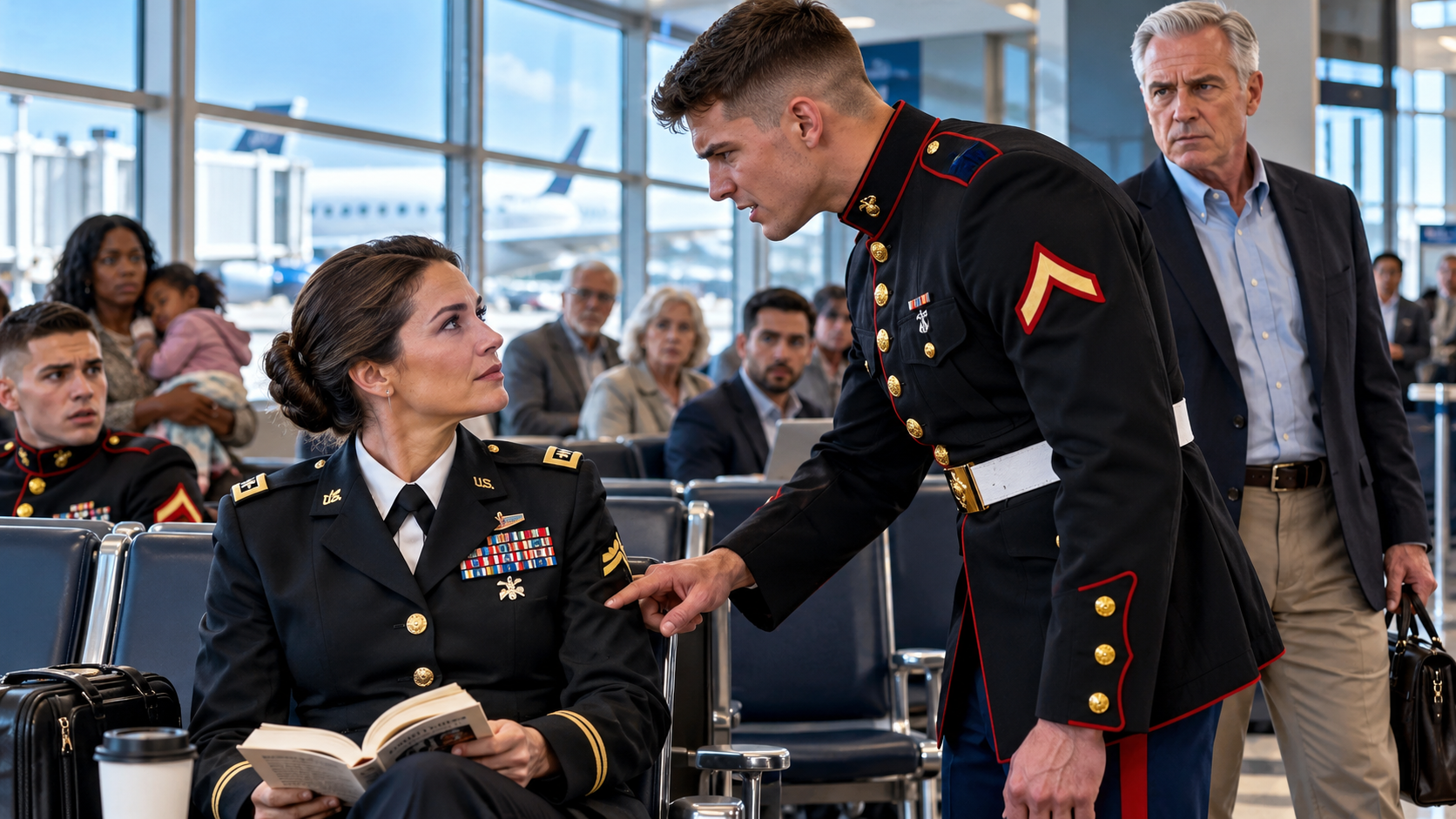
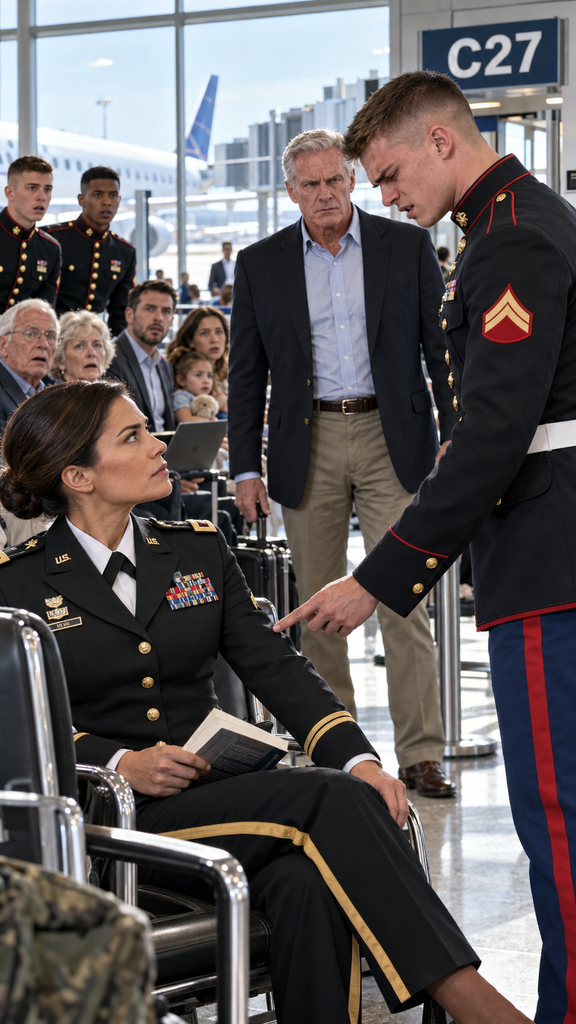
The young Marine flicked the sleeve of my Army uniform and said, “Real officers don’t look like you.”
He had no idea a major general was standing a few yards behind him.
He had no idea that general had heard almost everything.
And he definitely had no idea I had been ordered to make that trip in full uniform for a reason I had not explained to anyone at Gate C27.
The moment Major General Thomas Avery stepped out of the boarding line and started walking toward us, I knew Lance Corporal Evan Carter’s little joke had just become something much bigger.
But ten minutes earlier, none of that had seemed inevitable.
I had been sitting near the windows with a garment bag beside my chair, a paperback open across one knee, and a paper cup of airport coffee cooling near my boot.
Four hours remained in my layover.
I was tired.
Not exhausted in the dramatic sense people use after a long workweek. Military tiredness was different. It accumulated quietly. Early formations. Red-eye flights. Briefings that stretched past midnight. Years of sleeping lightly because some part of your mind never stopped waiting for a phone to ring.
After twenty-three years in the Army, I had learned how to rest almost anywhere.
I had also learned how to ignore people.
That skill mattered more than most civilians realized.
The uniform attracted attention.
Sometimes it was kind.
A nod.
A whispered thank you.
A little boy staring at my ribbons while his embarrassed mother tried to pull him away.
Sometimes people asked questions about places I had served.
Sometimes they asked questions they shouldn’t.
That morning, I wanted none of it.
I was traveling in my Army service uniform because my orders required it. The flight schedule left almost no time between landing and a formal rehearsal that evening, so the directive had been simple: travel ready.
I didn’t love the idea.
Uniforms and airports created complications.
But orders were orders.
So there I was.
Service coat.
Gold oak leaves.
Ribbons aligned.
Shoes polished.
Everything where it belonged.
And across the aisle, three young Marines had noticed me.
I became aware of them the way you become aware of a mosquito in a dark room.
Not because I was listening for it.
Because eventually the sound became impossible not to hear.
The first thing I noticed was the glancing.
One of them would look over.
Then another.
Then they’d lean together.
Then somebody would smile.
I kept reading.
The loudest one looked twenty-one or twenty-two.
Later I would learn his name was Lance Corporal Evan Carter.
At that moment he was just a young Marine with close-cut hair, restless energy, and the unmistakable expression of someone trying to make his friends laugh.
His friend Mason Reid sat beside him.
Mason laughed at first.
Not much.
Just enough.
The third Marine mostly stared at his phone.
I turned a page.
Then Carter said, “Guess costume shops are getting realistic these days.”
He spoke loudly enough for me to hear.
More importantly, he spoke loudly enough for everyone else to hear.
A small laugh came from his side of the gate.
I didn’t look up.
My first instinct wasn’t anger.
It was disappointment.
There’s a difference.
Anger burns hot and fast.
Disappointment settles deeper.
I had spent enough years around young service members to recognize insecurity disguised as confidence. I had seen privates act tough because they were terrified. I had seen lieutenants talk too much because silence made them feel exposed. I had seen junior NCOs confuse aggression with authority.
Carter was performing.
That was obvious.
And every performance needed an audience.
I decided not to give him one.
I read another paragraph.
“I’m serious,” he said to his friends. “Look at those ribbons.”
Mason shifted.
“Evan.”
“What?”
“Just leave it.”
“I’m just saying.”
His voice grew louder.
“I’ve seen Army officers.”
I almost smiled at that.
Twenty-three years in uniform had taught me that whenever someone began a sentence with I’ve seen, what usually followed was much less impressive than they imagined.
I turned another page.
Carter kept talking.
At first, I thought he would get bored.
Most people did when provocation failed.
But my silence irritated him.
I could feel it.
When he made another comment and I didn’t respond, he leaned forward.
When I continued reading, he whispered something to Mason.
Mason didn’t laugh that time.
That should have ended it.
Instead, Carter got up.
I heard his boots before I saw him.
He crossed the aisle and dropped into the chair one seat away from me.
I kept my eyes on the page.
He leaned forward.
“Hey.”
I said nothing.
“That’s a costume, right?”
I finished the sentence I was reading.
Then the next one.
It wasn’t because I was afraid to answer.
It was because experience had taught me something Carter hadn’t learned yet.
You do not owe every provocation a response.
Sometimes the most disciplined thing you can do is deny foolishness the attention it is begging for.
Carter apparently considered discipline a challenge.
His eyes moved over my uniform.
He stared at the gold oak leaves on my shoulders.
Then at my ribbons.
Then at the service coat itself.
“I’ve seen Army officers before,” he said.
His tone had changed.
There was less humor now.
More certainty.
“That isn’t right.”
Mason spoke from across the aisle.
“Evan.”
Carter ignored him.
I looked at the paragraph again, although I was no longer reading it.
“Man,” Mason said, “come back over here.”
Carter grinned.
Then he reached out with two fingers.
And flicked my sleeve.
Not hard.
Not enough to hurt.
That wasn’t the point.
The point was that he had decided I was an object in his performance.
Something he could touch.
Something he could mock.
Something he could reduce to a joke because he had already decided I didn’t belong in the uniform I had spent more than two decades earning the right to wear.
“Real officers don’t look like you,” he said.
That was when I closed my book.
The sound wasn’t loud.
But the gate seemed to become silent around it.
A tired mother holding a sleeping child looked over.
An elderly couple stopped reading.
A businessman lowered the screen of his laptop slightly.
Mason’s face went pale.
Even Carter’s third friend finally put his phone down.
I placed the paperback on my lap and looked directly at Carter.
For the first time, his grin weakened.
I wasn’t thinking about myself.
That surprised me.
The insult should have made me angry.
Instead, what bothered me most was the confidence behind it.
Carter knew nothing about me.
He didn’t know where I had served.
He didn’t know the commands I had held.
He didn’t know the people who had trusted me with decisions I still occasionally revisited at three in the morning.
He didn’t know the soldiers whose faces returned whenever somebody spoke carelessly about sacrifice.
He didn’t know the letters I had written.
The families I had called.
The young officers I had mentored.
The mistakes I had made.
The lessons I had paid for.
He didn’t know the reason I was flying in uniform that day.
He knew nothing.
And yet he had needed less than ten minutes to decide what a “real” officer was supposed to look like.
Then he had measured me against the picture in his head.
And because I didn’t match it, he decided I was fake.
I had opened my mouth to answer when I noticed movement behind him.
A silver-haired man stepped out of the boarding line.
He placed his leather bag beside an empty chair.
No uniform.
No visible rank.
No entourage.
Just a dark jacket, gray slacks, polished shoes, and the kind of controlled posture that decades of military service never completely leave behind.
I recognized him immediately.
Major General Thomas Avery.
I had seen him earlier but had made no attempt to approach him.
There was an unwritten mercy among senior officers in civilian airports.
If nobody needed anything, sometimes you let each other be anonymous.
Apparently anonymity had ended.
General Avery looked at me.
Then at Carter.
Then at the hand that had just touched my sleeve.
Carter followed my eyes.
He turned.
And his entire face changed.
“Lance Corporal.”
General Avery didn’t raise his voice.
He didn’t need to.
Carter shot to his feet so quickly that his knee hit the chair.
“Yes, sir.”
The confidence vanished.
The grin disappeared.
Even his shoulders seemed to shrink.
General Avery stopped directly in front of him.
“Would you care to repeat what you just said?”
Carter swallowed.
“No, sir.”
The general held his eyes for a second.
“I didn’t ask whether you wanted to.”
Nobody at Gate C27 moved.
Carter stared straight ahead.
The airport suddenly seemed too bright.
Too quiet.
Too public.
Exactly the way Carter had wanted it to be five minutes earlier.
Only now he no longer controlled the room.
General Avery took one step closer.
“Go ahead, Marine.”
Carter’s jaw tightened.
General Avery’s voice stayed calm.
“Tell me what a real officer looks like.”
And for the first time since Carter had started talking, he had absolutely nothing to say.
PART 2: THE QUESTION HE COULDN’T ANSWER
Silence does strange things to people.
When Carter had been making jokes, the gate felt crowded.
Now it felt enormous.
I could hear announcements from two concourses away.
A rolling suitcase rattled over tile somewhere behind us.
The coffee machine at the kiosk hissed.
Carter stood rigidly in front of General Avery, looking as if movement itself might make things worse.
The general waited.
He had always been good at that.
I’d attended two briefings with him years earlier.
Avery was not the kind of leader who rescued people from their own words.
If you said something foolish in his presence, he had a habit of leaving enough silence afterward for you to hear exactly how foolish it sounded.
Carter finally spoke.
“I didn’t mean anything by it, sir.”
General Avery’s expression didn’t change.
“That wasn’t my question.”
“No, sir.”
“What does a real officer look like?”
Carter’s eyes shifted.
For half a second, they moved toward me.
Then immediately forward again.
“I don’t know, sir.”
“You seemed remarkably certain thirty seconds ago.”
Carter said nothing.
General Avery glanced toward Mason.
“You.”
Mason stood.
“Yes, sir.”
“Was your friend uncertain?”
Mason looked miserable.
“No, sir.”
“Did you hear what he said?”
“Yes, sir.”
“Did you hear him say it more than once?”
Mason hesitated.
“Yes, sir.”
Carter’s face tightened.
I watched Mason struggle between loyalty to his friend and the understanding that lying now would create a much larger problem.
General Avery saw it too.
“How many times?”
“I don’t know exactly, sir.”
“Was it once?”
“No, sir.”
“Twice?”
Mason swallowed.
“More than twice, sir.”
Avery nodded.
Then he looked back at Carter.
“So this wasn’t a misunderstanding.”
“No, sir.”
“It wasn’t a sentence that accidentally came out wrong.”
“No, sir.”
“You spent several minutes discussing this officer loudly enough for half the gate to hear you.”
Carter’s ears had turned red.
“Yes, sir.”
“Then you crossed the aisle.”
“Yes, sir.”
“You sat beside her.”
There it was.
The first public acknowledgment of something Carter had apparently failed to process from the beginning.
Not my rank.
Not my decorations.
Not even my branch.
Me.
A woman in senior-officer rank.
Carter looked at me again.
Only briefly.
But something in his expression told me I finally understood what had bothered him.
It had not been one detail on my uniform.
It had been the entire picture.
He had seen the oak leaves.
Seen the ribbons.
Seen the years suggested by the uniform.
Then looked at the person wearing them.
And somewhere in his mind those things had not matched.
General Avery continued.
“You then touched a stranger without permission.”
“Yes, sir.”
“You touched a uniformed officer.”
Carter’s voice dropped.
“Yes, sir.”
“And while doing so, you informed a lieutenant colonel that real officers do not look like her.”
“Yes, sir.”
The words seemed heavier when someone else said them.
I saw Mason close his eyes for half a second.
The third Marine stared at the floor.
Carter looked as though he wished the terminal would open beneath him.
General Avery turned to me.
“Colonel?”
“Sir.”
“Do you know this Marine?”
“No, sir.”
“Have you spoken to him before today?”
“No.”
“Did you initiate this conversation?”
“No, sir.”
Avery nodded once.
Then he faced Carter again.
“Identification.”
Carter immediately reached for his wallet.
His hands weren’t steady anymore.
The general didn’t snatch it.
He simply held out his hand.
Carter placed his military identification into it.
Avery studied the card.
“Unit?”
Carter answered.
“Travel status?”
“Official, sir.”
“Destination?”
Carter named the same city I was flying to.
That caught my attention.
So did General Avery’s.
“You’re traveling for the joint-service ceremonial support detail?”
“Yes, sir.”
The irony landed so cleanly that I almost believed I had misheard him.
General Avery looked toward me.
I saw the faintest change in his expression.
Not amusement.
Something closer to disbelief.
Then he looked back at Carter.
“You are traveling to support tonight’s rehearsal?”
“Yes, sir.”
I sat very still.
Of all the flights.
Of all the gates.
Of all the people Carter could have chosen to humiliate.
He was headed to the same rehearsal I had been ordered to attend.
The reason I wore that uniform suddenly mattered much more.
General Avery returned Carter’s identification.
“Sit down.”
Carter hesitated.
“Sir?”
“That was not unclear.”
“No, sir.”
He sat.
General Avery looked at Mason and the third Marine.
“You too.”
They obeyed.
Then he surprised everyone by sitting across from them.
Not beside me.
Across from them.
That changed the atmosphere completely.
He was no longer simply a general correcting a junior Marine.
He was a commander preparing to understand exactly what had happened.
I knew the difference.
“Colonel,” he said, “would you join us?”
I picked up my coffee, moved across the aisle, and sat one chair away.
My drink was completely cold.
General Avery glanced toward the civilians watching.
“Show’s over, folks.”
A few people looked away.
Most pretended they had never been watching.
The businessman reopened his laptop.
The elderly couple returned to their newspaper.
But I noticed nearly everyone still listening.
Avery leaned forward slightly.
“Lance Corporal Carter, we’re going to try something difficult.”
“Yes, sir.”
“You’re going to tell the truth.”
Carter stared at him.
“Yes, sir.”
“Why did you believe her uniform was fake?”
Carter’s mouth opened.
Closed.
He looked at me.
This time General Avery didn’t stop him.
Finally Carter said, “It just didn’t look right, sir.”
“What didn’t?”
“The uniform.”
General Avery looked at me.
Then back to him.
“Be specific.”
Carter swallowed.
“The rank, sir.”
“What about it?”
“I don’t know.”
“You have strong opinions for a man who knows very little.”
“Yes, sir.”
The words came out barely audible.
Avery leaned back.
“Did you think an Army lieutenant colonel would be older?”
“No, sir.”
“Larger?”
Carter didn’t answer.
“Male?”
There it was.
Carter stared at the floor.
The truth arrived through his silence.
Not all of it.
Maybe even Carter didn’t completely understand all of it.
But enough.
General Avery spoke carefully.
“Look at the officer sitting across from you.”
Carter raised his eyes.
He looked at me.
For the first time since he had approached me, the mockery was gone.
Now he actually looked.
Not at the ribbons as decorations.
Not at the oak leaves as something to challenge.
At me.
“Lieutenant Colonel,” General Avery said, “twenty-three years of service.”
Carter’s expression changed.
I had not told the general that number.
Then I remembered.
Of course he knew.
The ceremony packet.
My biography.
The rehearsal list.
The reason we were all going to the same place.
General Avery continued.
“Multiple leadership assignments. Joint-service experience. More years in uniform than you’ve been alive.”
Carter’s jaw tightened.
“You saw none of that,” Avery said. “You saw a person who failed to match your expectation. Then instead of asking yourself whether your expectation might be wrong, you decided she was fraudulent.”
Carter stared ahead.
“Yes, sir.”
“No. Don’t give me ‘yes, sir’ because you think it ends the conversation.”
Avery’s voice was still quiet.
That made it sharper.
“I want you to understand something. Confidence without knowledge is not courage. It is not leadership. And when you put a uniform behind it, it becomes dangerous.”
Nobody moved.
General Avery looked toward Mason.
“And laughter is participation.”
Mason’s face fell.
“Yes, sir.”
“You knew he was going too far.”
“Yes, sir.”
“You told him once to stop.”
“Yes, sir.”
“Then what?”
“I didn’t do anything else, sir.”
“Why?”
Mason’s eyes moved toward Carter.
“He’s my friend.”
General Avery nodded.
“Then you owed him more than laughter.”
That sentence hit Mason harder than the others.
I could see it.
Avery looked at me.
“Colonel, anything you’d like to add?”
For the first time since Carter touched my sleeve, everyone was waiting for me to speak.
I could have embarrassed him.
Part of me wanted to.
I am not proud of that, but I won’t lie about it.
Twenty-three years of service did not make me immune to anger.
Rank did not make insults painless.
Discipline simply taught me not to let the first emotion make the final decision.
I set the coffee on the floor.
“Lance Corporal Carter.”
His posture straightened.
“Ma’am.”
“You said you’d seen Army officers before.”
“Yes, ma’am.”
“How many?”
“I don’t know, ma’am.”
“Enough to know every possible version of one?”
His face reddened again.
“No, ma’am.”
“Enough to know what twenty-three years of service looks like on every person who has lived it?”
“No, ma’am.”
I nodded.
“Then what exactly were you defending when you came over here?”
He seemed confused by the question.
“I don’t understand, ma’am.”
“Yes, you do.”
I kept my voice level.
“You weren’t protecting the Marine Corps. You weren’t protecting uniform standards. You weren’t correcting a safety issue. You weren’t reporting suspected impersonation to airport security.”
His eyes dropped.
“You wanted your friends to laugh.”
Carter said nothing.
“So say that.”
His face tightened.
General Avery watched him.
Mason watched him.
The entire world seemed to wait again.
Finally Carter whispered, “I wanted them to laugh, ma’am.”
I held his gaze.
“And was it worth it?”
“No, ma’am.”
I believed that answer.
But regret after consequences is easy.
The harder question is what someone does after embarrassment stops being fresh.
General Avery checked his watch.
“We have a flight in forty minutes.”
He stood.
Carter immediately stood with him.
“You will remain at this gate. You will board when instructed. You will not approach the colonel unless she speaks to you first.”
“Yes, sir.”
“I’ll notify your chain of command before departure.”
Carter’s face drained.
“Yes, sir.”
“And Lance Corporal?”
“Yes, sir?”
General Avery picked up his leather bag.
“The consequences will not be determined by how embarrassed you feel right now.”
Carter looked straight ahead.
“They’ll be determined by what you chose to do.”
Then Avery walked away.
Carter remained standing.
So did Mason.
I picked up my book.
But when I opened it again, I realized I was still staring at the same page.
And the day was nowhere close to finished.
PART 3: THE FLIGHT
People imagine that once someone powerful intervenes, humiliation disappears.
It doesn’t.
It changes shape.
When boarding began, Carter looked like a man trying to occupy as little physical space as possible.
He no longer joked.
He no longer looked toward me.
Mason sat quietly beside him.
Their third friend disappeared twice to get water, probably because standing near Carter felt unbearable.
General Avery made a phone call near the windows.
I didn’t hear most of it.
I wasn’t trying to.
But military conversations develop a recognizable rhythm.
Unit.
Rank.
Location.
Incident.
Witnesses.
Arrival time.
Then a phrase no junior service member ever wants associated with his name:
“We’ll discuss this when we land.”
A few minutes later, Avery ended the call and approached me.
“Walk with me?”
I stood.
We moved several yards away.
“How are you?”
It was such an ordinary question that I almost laughed.
“Fine, sir.”
He raised an eyebrow.
I had seen that eyebrow in briefings.
It meant Try again.
So I did.
“Annoyed.”
“That sounds more accurate.”
“I’ve had worse.”
“That isn’t the same as acceptable.”
“No, sir.”
He glanced toward Carter.
“I know.”
I followed his eyes.
“He’s young.”
“So were you once.”
“I did stupid things.”
“So did I.”
Avery adjusted the strap on his bag.
“But neither youth nor stupidity creates immunity from accountability.”
“I agree.”
“You seem like you’re about to ask me not to end his career.”
I smiled despite myself.
“Am I that predictable?”
“Only after twenty years.”
I looked through the windows at the aircraft waiting outside.
“I don’t want one stupid airport incident to define him forever.”
Avery nodded.
“Neither do I.”
“But?”
“But consequences and destruction are not the same thing.”
I thought about that.
It was easy, especially after being publicly disrespected, to imagine justice as pain transferred from one person to another.
You embarrassed me.
Now I’ll embarrass you.
You hurt me.
Now I’ll hurt you.
Command taught a harsher and more complicated lesson.
Real discipline wasn’t revenge.
It had to serve a purpose.
“What did his unit say?” I asked.
“Their staff duty officer notified his first sergeant. Somebody will meet him on arrival.”
I nodded.
“He’s already scheduled for tonight’s ceremonial support rehearsal.”
“Yes.”
“And so am I.”
Avery looked at me.
“Still want him there?”
I knew what he was asking.
He could remove Carter.
Probably should, from one perspective.
The safest answer would be yes.
Remove him.
Keep him away from me.
Keep the problem contained.
Instead I said, “Is his behavior a safety concern?”
“No.”
“Is he incapable of performing the detail?”
“Not that I know of.”
“Then removing him teaches him that the consequence of disrespect is getting out of an uncomfortable duty.”
Avery smiled slightly.
“There she is.”
I ignored that.
“Keep him on the detail.”
“Your choice.”
“No, sir. His command’s choice.”
“Fair correction.”
“And if they ask my view, that’s it.”
He nodded.
“I’ll pass it along.”
We boarded ten minutes later.
I was in an aisle seat several rows ahead of Carter.
General Avery sat farther forward.
For the first hour, I tried to sleep.
Instead my mind kept returning to one sentence.
Real officers don’t look like you.
At twenty-two, I might have obsessed over it.
At thirty-two, I might have become angry enough to confront him immediately.
At that point in my career, the words themselves were almost less important than what they revealed.
Every organization had pictures in its head.
What leadership looked like.
What competence sounded like.
Who seemed authoritative before speaking.
Who had to prove everything first.
Most of those assumptions survived not because people openly defended them, but because they rarely examined them.
Carter had simply been foolish enough to say his assumption out loud.
Then foolish enough to put his hand on my uniform.
I stared through the window across the aisle.
Clouds covered the ground below us.
I thought about all the people who had underestimated me over the years.
Some had apologized.
Some never knew they had done it.
Some had become mentors after discovering they were wrong.
Others spent years searching for different explanations every time I succeeded.
Eventually you learn not to build your identity out of other people’s expectations.
If somebody thinks you cannot lead, you lead anyway.
If somebody thinks you don’t belong, you do the work anyway.
If somebody refuses to respect what you’ve earned, you don’t get to control their mind.
You control your conduct.
That sounds noble when written on a poster.
In real life, it is exhausting.
A flight attendant stopped beside me.
“Coffee?”
I looked at the cup on my tray.
I had forgotten I’d ordered one.
“Yes, please.”
She poured.
Then she hesitated.
“I saw what happened at the gate.”
I gave her a small smile.
“Airports are public places.”
“He was out of line.”
“He was.”
She looked as if she expected something more.
Maybe a joke.
Maybe anger.
Maybe a dramatic comment about young people.
I offered none.
Finally she said, “For what it’s worth, you handled it better than I would’ve.”
“I had twenty-three years of practice.”
She smiled.
“That’ll do it.”
Then she moved on.
When we landed, I stayed seated until most passengers had left.
Not because of Carter.
Because rushing to stand in an aircraft aisle only to wait ten minutes had never made sense to me.
As I eventually walked toward the exit, I noticed Carter waiting near the jet bridge.
Not alone.
Mason was beside him.
And at the end of the corridor stood a Marine first sergeant.
I knew immediately who he was there for.
Carter did too.
The first sergeant’s face was unreadable.
General Avery approached him first.
They spoke quietly.
Then the first sergeant looked past him at me.
He walked over.
“Lieutenant Colonel.”
“First Sergeant.”
“First Sergeant Marcus Bell, ma’am.”
We shook hands.
“I understand one of my Marines behaved inappropriately toward you.”
“He did.”
“I’d like to apologize on behalf of the command.”
“I appreciate it, but you don’t owe me an apology for his behavior.”
Bell’s eyes hardened slightly.
“No, ma’am. But I’m responsible for what happens next.”
That, I respected.
He glanced toward Carter.
“He’s scheduled on ceremonial support tonight.”
“I know.”
“General Avery said you recommended we not remove him.”
“I recommended that you decide based on the needs of the detail, not my comfort.”
Bell studied me.
“You comfortable seeing him there?”
“That isn’t the question.”
His mouth almost became a smile.
“No, ma’am.”
“He made himself uncomfortable. That’s not the same thing as making me unsafe.”
Bell nodded.
“He’ll report.”
Then he stepped away.
I collected my garment bag.
A driver was waiting outside to take several of us to the installation.
As I reached the sliding doors, Mason called behind me.
“Ma’am?”
I stopped.
Carter stood several yards away with First Sergeant Bell.
Mason approached alone.
His expression had changed since the gate.
Less frightened.
More ashamed.
“Can I say something?”
“You’re saying it.”
He nodded nervously.
“I should’ve stopped him.”
“You tried once.”
“Not enough.”
I waited.
He looked toward Carter.
“I laughed before that.”
“Yes.”
Mason’s face tightened.
“I knew it wasn’t right.”
“Then why did you laugh?”
He took a long breath.
“Because everybody else was.”
I looked at him for several seconds.
“That answer causes more damage in military organizations than people realize.”
He nodded.
“Yes, ma’am.”
“Don’t apologize because you got caught beside the wrong person.”
His eyes returned to me.
“Decide what you’re going to do the next time your friend starts walking toward a bad decision.”
“I will.”
I picked up my garment bag.
Then I stopped.
“Mason.”
“Ma’am?”
“If he’s really your friend, don’t help him become worse just because stopping him feels awkward.”
His face changed.
That line stayed with him.
I could tell.
“Yes, ma’am.”
I left him there.
Three hours later, I walked into the rehearsal hall.
Carter was already inside.
And when he saw where I was headed, his face went completely still.
PART 4: THE REHEARSAL
The rehearsal took place in a large ceremonial hall on the installation.
Rows of chairs had been arranged in precise blocks.
Service flags stood behind the stage.
Army.
Marine Corps.
Navy.
Air Force.
Space Force.
Coast Guard.
Every branch represented.
Every detail measured.
Lighting technicians adjusted fixtures above us.
An honor guard practiced entrances along the center aisle.
Junior service members moved programs, checked seating cards, and rehearsed escort routes.
That was why I’d been ordered to travel in uniform.
There would have been no time to change.
The ceremony the following morning was a joint-service leadership commemoration honoring decades of service across multiple commands, including personnel who had carried responsibilities in combat, training, logistics, medicine, and family support.
It wasn’t about one person.
That mattered to me.
Ceremonies sometimes looked like polished speeches and shiny shoes from the audience.
Behind them were hundreds of quiet acts of preparation.
Carter was part of that preparation.
His job was simple.
Escort support.
Seating coordination.
Movement cues.
Nothing glamorous.
Exactly the kind of responsibility that revealed whether someone could perform professionally even when nobody was applauding.
I entered with my folder under one arm.
A civilian coordinator met me near the stage.
“Colonel, General Avery wants senior principals in the first two rows for the walk-through.”
“Understood.”
She handed me a revised sequence.
I looked over it.
My name appeared midway down the page.
Nothing unusual.
I had a speaking role and an official part in the rehearsal.
Carter stood near the aisle holding a stack of seating cards.
He saw the folder.
Then the stage.
Then me.
I watched realization move across his face.
At Gate C27, I had simply been a stranger in a uniform he doubted.
Here, there was no ambiguity.
People approached me for decisions.
A captain asked about timing.
A senior NCO confirmed movement order.
A civilian coordinator requested approval for a sequence change.
Nobody questioned why I was there.
Nobody examined my oak leaves.
Nobody asked whether the uniform was real.
They already knew.
And Carter was forced to stand twenty feet away watching reality dismantle the version of me he had invented in his head.
I could have enjoyed that.
For a moment, I did.
I’m human.
But satisfaction faded faster than I expected.
Watching someone realize he had made himself foolish is less entertaining when you’ve commanded enough young people to know how easily shame can become defensiveness.
Humiliation rarely teaches by itself.
Sometimes it makes people better.
Sometimes it simply makes them bitter.
What mattered was what Carter did next.
First Sergeant Bell called his name.
“Carter.”
“First Sergeant.”
“Center aisle. Escort sequence.”
“Yes, First Sergeant.”
Carter moved immediately.
Professional.
Focused.
No complaint.
During the first walk-through, he missed a cue because he was looking at me instead of the coordinator.
Bell stopped everything.
“Carter.”
“First Sergeant.”
“Where are your eyes?”
“On my responsibility, First Sergeant.”
“They were not.”
“No, First Sergeant.”
“Try again.”
“Yes, First Sergeant.”
Nobody yelled.
Nobody needed to.
We reset.
The second time, Carter hit the cue exactly.
During a break, General Avery approached me near the stage.
“How’s our traveler?”
“Which one?”
He glanced toward Carter.
I smiled.
“He’s doing his job.”
“Bell says he’s been quiet.”
“That might be the wisest decision he’s made today.”
Avery almost laughed.
Then his expression became serious.
“His command is documenting the incident.”
I nodded.
“They asked whether you want to make a formal complaint.”
I looked toward Carter.
He was helping Mason align cards on a row of reserved seats.
“What happens if I do?”
“That’s their process. Not mine.”
“That wasn’t what I asked.”
Avery knew me well enough not to pretend otherwise.
“It becomes one more formal element in whatever action his command takes.”
“And if I don’t?”
“The witnessed conduct still exists.”
I nodded.
People often imagine rank means enjoying punishment.
Anyone who does probably shouldn’t have much rank.
I had signed counseling statements.
Recommended adverse action.
Removed people from positions.
I had also argued for second chances.
Both can be leadership.
The difficult part is knowing which one the situation requires.
“I’m not filing a separate complaint,” I said.
Avery studied me.
“You sure?”
“Yes.”
“Why?”
“Because the facts aren’t disputed. There are witnesses. His leadership knows. Adding my personal complaint doesn’t make the behavior more wrong.”
Avery nodded.
“And if somebody thinks you’re going easy on him?”
“They can think whatever they want.”
A slight smile appeared.
“Twenty-three years finally taught you something.”
“About time.”
He walked away.
Ten minutes later, the rehearsal resumed.
We moved through the ceremony from beginning to end.
Introductions.
Entrances.
Seating.
Music.
Speeches.
Transitions.
One section included a moment of recognition for those who had served and never returned.
The hall changed during that portion.
Even in rehearsal.
No audience.
No families.
No formal lighting.
Just names on a screen and empty chairs representing absence.
I felt the familiar tightening in my chest.
Twenty-three years creates ghosts.
Not supernatural ones.
Ordinary ghosts.
Voices you remember.
Laughs.
Bad jokes.
Arguments.
People leaning over maps.
People complaining about coffee.
People promising to call home.
People whose families keep getting older while they remain frozen at the age you last saw them.
I looked down at the rehearsal script until the feeling passed.
When I raised my eyes, I noticed Carter watching the screen.
He was no longer watching me.
That mattered.
The rehearsal director called a break.
I walked toward a side hallway for water.
Behind me, I heard footsteps.
Then they stopped.
“Ma’am?”
I recognized the voice.
I turned.
Carter stood several feet away.
Not close enough to invade space this time.
His hands were at his sides.
“First Sergeant Bell gave me permission to speak with you.”
I glanced past him.
Bell stood near the door.
He gave a slight nod.
I looked back at Carter.
“All right.”
Carter swallowed.
“I owe you an apology.”
“Yes.”
He hadn’t expected that answer.
Most people say, You don’t have to.
I wasn’t going to rescue him.
He did have to.
Carter took a breath.
“What I said at the airport was disrespectful.”
I waited.
“And touching your uniform was worse.”
I waited again.
He looked at the floor.
“I was trying to be funny.”
“You told me that already.”
“Yes, ma’am.”
“So what’s different now?”
He looked up.
For several seconds, he struggled.
Then he said, “I think I had already decided you were fake before I even looked carefully.”
That was the first honest thing he had said without being pushed.
“Why?”
He hesitated.
“I don’t know.”
“Try.”
His jaw tightened.
“I had an idea of what somebody with that rank was supposed to look like.”
“What idea?”
He took another breath.
“Not you, ma’am.”
It was uncomfortable.
Good.
Some truths should be.
“And because I didn’t match it?”
“I figured something must be wrong.”
“With the uniform.”
“Yes, ma’am.”
“Not with your assumption.”
His eyes dropped.
“No, ma’am.”
There it was.
The center of it.
Not evil.
Not conspiracy.
Not some grand hatred.
Something more common and therefore, in its own way, more dangerous.
An assumption that had never been challenged.
Until it was.
Carter continued.
“When you ignored me, I got mad.”
“Why?”
“Because I felt stupid.”
“You hadn’t been corrected yet.”
“I know.”
“So you felt stupid because I didn’t react?”
“Yes, ma’am.”
I understood.
His friends had been watching.
Every joke that failed needed a bigger one.
Every attempt to get my attention raised the stakes.
By the time he crossed the aisle, he was no longer trying to discover whether my uniform was legitimate.
He was trying to win.
“That is something you need to remember,” I said.
“Yes, ma’am.”
“Sometimes when people feel embarrassed, they attack the person who made them feel that way even when that person did nothing.”
Carter nodded.
“I did that.”
“You did.”
His eyes moved toward the memorial screen.
“I heard what General Avery said.”
“About what?”
“Confidence without knowledge.”
I said nothing.
“I thought I knew.”
“Yes.”
“And I didn’t.”
“No.”
He swallowed.
“I’m sorry.”
This time the apology sounded different.
No performance.
No audience.
No general behind him.
No expectation that the words would erase consequences.
That made it worth hearing.
“I accept that you’re sorry,” I said.
His face shifted slightly.
I had chosen the wording carefully.
Not I forgive everything.
Not we’re good.
Not forget it.
“I accept that you’re sorry.”
“Yes, ma’am.”
“Now decide whether this becomes the worst story people tell about you or the story you learned from.”
Carter looked directly at me.
“Yes, ma’am.”
I started to leave.
“Colonel?”
I stopped.
He glanced toward the screen again.
“Can I ask you something?”
“What?”
“Why didn’t you say anything at the airport?”
I thought about that.
Because I knew men like you?
Because I was tired?
Because I had learned that dignity doesn’t require a defense every time someone questions it?
All of those were true.
But none were complete.
“Because I didn’t need you to believe me for my service to be real.”
Carter stared at me.
I let the sentence sit between us.
Then I walked back into the hall.
The rehearsal resumed five minutes later.
Carter never missed another cue.
PART 5: WHAT A REAL OFFICER LOOKS LIKE
The next morning, the hall looked completely different.
Every seat was filled.
Families lined the center rows.
Uniforms from every service branch moved through the lobby.
Medals caught the light.
Programs rustled.
Quiet conversations blended beneath the music.
The empty ceremonial space from the night before had become something alive.
I stood backstage reviewing my remarks.
General Avery entered.
“Ready?”
“Too late to say no.”
“That has never stopped people before.”
I closed the folder.
“Carter?”
“Working.”
“Consequences?”
Avery nodded toward the stage entrance.
“Formal counseling. Additional corrective instruction through his chain. His leadership will make the rest of the determination after they return.”
“Reasonable.”
“No dramatic firing squad.”
“Disappointing.”
Avery smiled.
“Thought you’d appreciate restraint.”
“I’ve been practicing.”
An aide signaled that we had two minutes.
Before Avery moved toward the stage, he stopped.
“One thing.”
“Sir?”
“You handled yesterday correctly.”
I disliked compliments from generals almost as much as criticism.
Both usually meant more work.
“I sat in a chair while you did most of the talking.”
“No.”
He looked at me.
“You had the opportunity to turn embarrassment into revenge.”
I said nothing.
“You didn’t.”
Then he walked away.
The ceremony began.
I took my assigned seat.
From where I sat, I could see Carter along the side aisle.
He stood at his position in dress uniform.
Straight.
Focused.
Invisible in the way good ceremonial support personnel are supposed to be.
Mason stood farther back.
Once, their eyes met.
Mason gave him the smallest nod.
Carter returned it.
That was all.
The program continued.
Speeches.
Recognition.
Music.
The kind of carefully organized dignity that looked effortless only because dozens of people had spent hours making sure it would.
Then came the memorial portion.
The names appeared.
The room became silent.
Families held hands.
A senior chaplain spoke briefly.
No theatrics.
No long speech.
Just remembrance.
As I listened, I thought again about Carter’s hand flicking my sleeve.
A uniform is fabric.
Thread.
Buttons.
Metal insignia.
Measured placements.
Regulations.
On a hanger, it is only an object.
What gives it meaning is everything people carry while wearing it.
Responsibility.
Fear.
Mistakes.
Service.
Loss.
Friendship.
Long absences.
Missed birthdays.
Decisions that never leave you.
Promises made to people who trusted you.
Carter had seen fabric.
He had assumed the rest.
That had been his mistake.
At the end of the ceremony, people began leaving slowly.
I spoke with several families.
Shook hands.
Answered questions.
Thanked the support staff.
By the time the hall emptied, almost an hour had passed.
I was heading toward the side exit when I saw Carter and Mason helping collect programs.
First Sergeant Bell stood nearby.
He saw me and walked over.
“Ma’am.”
“First Sergeant.”
“Wanted to thank you for yesterday.”
“You don’t need to.”
“I do.”
He looked toward Carter.
“He needed correction.”
I followed his eyes.
“Yes.”
Bell folded his arms.
“Been a decent Marine up until now.”
“I assumed he had more to him than one bad afternoon.”
“He does.”
“Then make sure he remembers it.”
Bell smiled slightly.
“Oh, he will.”
Carter noticed us.
He approached.
This time he stopped at a respectful distance.
“Ma’am.”
“Lance Corporal.”
He seemed nervous, but different from yesterday.
Yesterday’s nervousness had been fear.
Today there was thought behind it.
“First Sergeant said we’re leaving in twenty minutes.”
“All right.”
“I just wanted to thank you.”
“For what?”
That question caught him.
He glanced at Bell.
Bell offered no help.
Carter looked back at me.
“For not trying to ruin me.”
I studied him.
“Don’t thank me for that.”
His eyebrows drew together.
“You’re responsible for what happens to your career, Carter. Not me.”
“Yes, ma’am.”
“And don’t turn this into a story where some colonel saved you.”
He straightened slightly.
“Yes, ma’am.”
“You behaved badly. Your chain addressed it. What happens next depends on what you do after everybody stops watching.”
Carter nodded.
“I understand.”
“I hope so.”
There was a pause.
Then Mason approached.
He looked at me.
“Ma’am.”
“Mason.”
He seemed surprised I remembered his name.
“I wanted to say something too.”
I waited.
“You were right.”
“That narrows it down very little.”
A nervous smile appeared.
“About friends.”
I understood.
“If I had shut it down harder at the beginning, maybe he wouldn’t have crossed the aisle.”
Carter looked at him.
For a second I worried he might resent that.
Instead Carter said, “He’s right.”
Mason continued.
“I thought loyalty meant not embarrassing him.”
“And now?”
Mason looked at Carter.
“Maybe sometimes you have to.”
Carter gave him a tired smile.
“Preferably before a major general does it.”
I almost laughed.
Even First Sergeant Bell looked away to hide a grin.
It was the first joke Carter had made in my presence that didn’t require somebody else’s humiliation.
Progress can be small.
I adjusted the folder under my arm.
“You both have somewhere to be.”
“Yes, ma’am.”
They turned.
Then General Avery’s voice came from behind us.
“Lance Corporal Carter.”
Carter stopped.
His expression suggested that life had just betrayed him again.
He turned.
“Sir.”
Avery approached.
Unlike at Gate C27, no crowd gathered.
No passengers stared.
No one held up a phone.
Just two Marines, a first sergeant, a lieutenant colonel, and a major general in an almost-empty hall.
General Avery stopped in front of Carter.
“I asked you a question yesterday.”
Carter swallowed.
“Yes, sir.”
“Remember it?”
“Yes, sir.”
“What was it?”
Carter glanced at me.
Then back at him.
“You asked what a real officer looks like, sir.”
Avery nodded.
“So?”
Carter stood quietly.
Nobody rushed him.
Finally he answered.
“I don’t think you can tell by looking, sir.”
General Avery said nothing.
Carter continued.
“You’d have to know how they serve.”
Avery’s expression didn’t change, but I saw approval in his eyes.
“And?”
Carter took another breath.
“You’d probably need to stop assuming you know before you actually know.”
General Avery nodded once.
“Better answer.”
“Yes, sir.”
Avery looked at Mason.
“And what does a real friend look like?”
Mason froze.
Carter nearly smiled.
Mason thought about it.
“Somebody who stops you before you make yourself an idiot in an airport, sir.”
This time I did laugh.
So did Bell.
Even Avery smiled.
“Also acceptable.”
The tension finally broke.
General Avery walked toward the exit.
Bell followed.
Mason started after them.
Carter remained for another moment.
He looked at my uniform.
Not suspiciously.
Not skeptically.
Just looking.
Then his eyes came back to mine.
“Have a good day, Colonel.”
“You too, Marine.”
He turned and left.
I watched him go.
I never saw Evan Carter again.
At least not in person.
Months later, Mason sent a brief note through official channels after receiving my contact information from the ceremony staff.
Carter was doing fine.
Nothing dramatic.
No miraculous transformation.
No sudden promotion.
No heroic act designed to prove that one airport confrontation had changed his entire life.
I was glad.
Real change rarely announces itself with music.
According to Mason, Carter had become annoyingly quick to shut down careless jokes.
Especially when younger Marines made assumptions about people they didn’t know.
Mason added one line at the bottom.
He still hates airports.
That made me smile.
I kept the note for a while.
Not as a trophy.
Not because I believed I had taught Carter some profound lesson.
Mostly because it reminded me of something I had spent twenty-three years learning myself.
People are going to look at you and decide things.
Sometimes instantly.
They will decide you’re too young.
Too old.
Too quiet.
Too aggressive.
Too soft.
Too small.
Too different from whatever image they have built in their head.
They will mistake familiarity for truth.
They will mistake confidence for knowledge.
And occasionally, one of them will be foolish enough to walk across an airport gate and announce his assumptions in front of a major general.
But leadership cannot depend on being correctly perceived.
If I had needed Carter to believe I was a lieutenant colonel before I could act like one, then perhaps he would have been right about me.
My uniform did not become legitimate when General Avery defended it.
My rank did not become real when Carter finally understood it.
My service had existed before Gate C27.
It existed while Carter laughed.
It existed while I stayed silent.
And it still existed after he apologized.
That was the part I hoped he eventually understood.
Years in uniform had taught me that rank can force obedience for a moment.
Fear can create silence.
Embarrassment can create an apology.
But none of those things necessarily create respect.
Respect begins when people learn to see beyond their assumptions.
Sometimes they learn gently.
Sometimes experience teaches them.
And sometimes experience arrives in civilian clothes, carrying a leather bag, after hearing a lance corporal say something he desperately wishes he could take back.
I still remember Carter’s face when General Avery stepped out of that boarding line.
But what I remember more clearly is his face the next morning.
No swagger.
No audience.
No joke.
Just a young Marine who finally understood how little he had known when he was most certain.
He had wanted everyone at Gate C27 to know that I didn’t look like a real officer.
By the end, he had discovered something more useful.
Real officers do not have one face.
Neither do real leaders.
The uniform tells you the rank.
The record tells you some of the history.
But character?
You usually discover that only when something goes wrong.
At Gate C27, Evan Carter showed us his worst moment.
What happened afterward showed me something else.
A bad moment did not have to become a permanent identity.
Not if he was willing to own it.
Not if his leaders were willing to correct instead of simply destroy.
Not if his friends learned that loyalty sometimes meant saying stop.
And not if I remembered that justice was supposed to build better service members, not merely satisfy my anger.
That lesson belonged to me as much as it belonged to him.
Because when General Avery asked Carter what a real officer looked like, the young Marine couldn’t answer.
By the next morning, he finally could.
You couldn’t tell by looking.
You had to watch what they did when it mattered.
Leave a Reply