
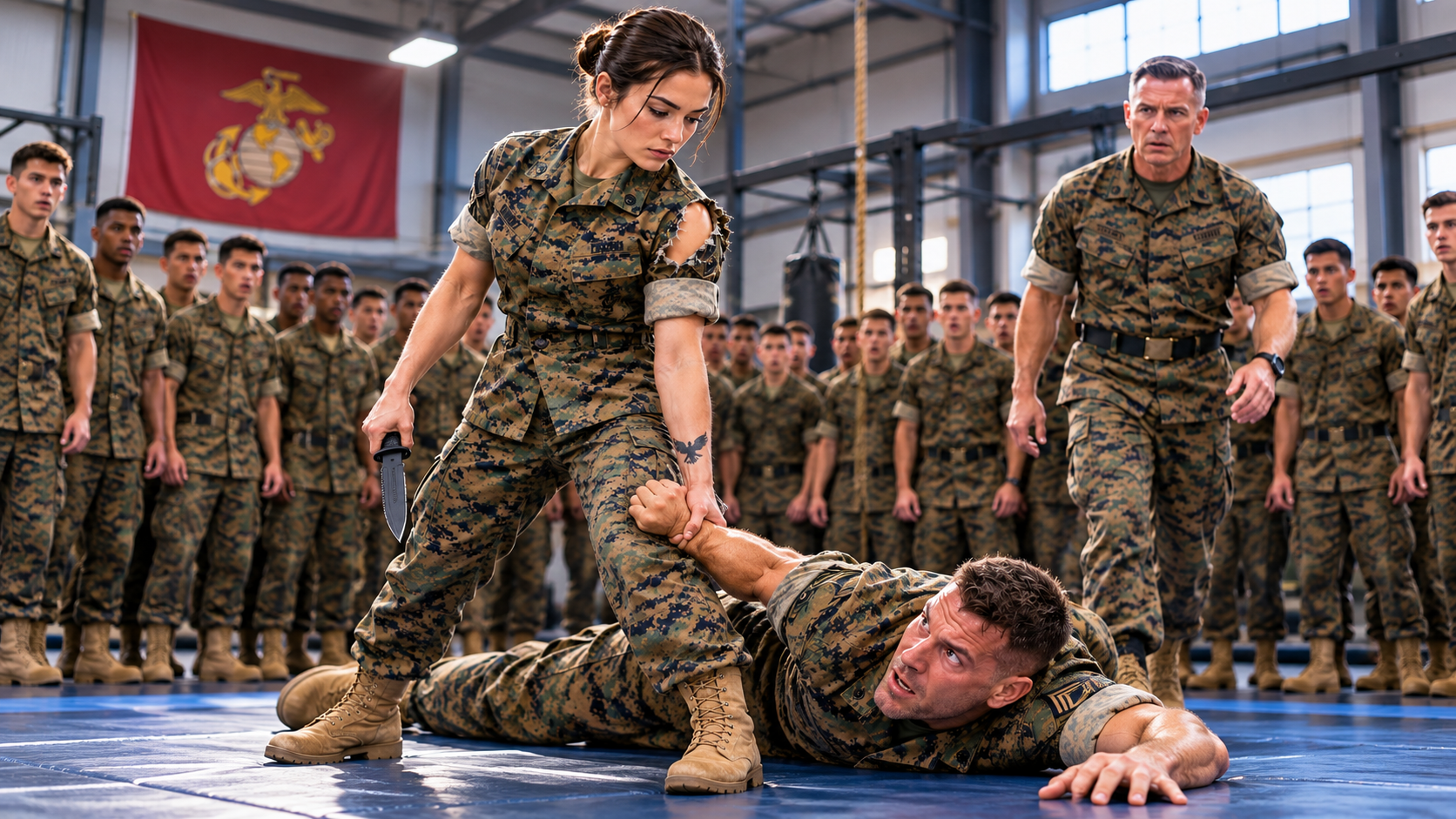

PART 1: STAY STILL, SWEETHEART
“Stay still, sweetheart, or this gets a lot worse for you.”
The training knife pressed against the side of my throat.
Gunnery Sergeant Kyle Vance had one knee driven into my ribs and one hand twisted into the collar of my blouse. My right arm was trapped underneath me. My left wrist was pinned against the mat hard enough that my fingers had started to go numb.
Thirty Marines stood around us in a rough circle.
Nobody moved.
Nobody spoke.
They thought they were watching a stress test.
I knew I was watching a man make a mistake.
A very large one.
The rubber mat smelled like sweat, disinfectant, and old canvas. Vance’s breath came hard through his nose. Not because he was tired. He wasn’t. He was angry.
That was worse.
I stared past his shoulder at the overhead lights and counted my options.
His weight was too far forward.
His right elbow was locked.
His left foot had shifted six inches outside his base.
The knife was rubber-edged composite, stiff enough to bruise and sharp enough along the serrated practice spine to rip cloth if enough pressure was applied.
Two seconds.
Maybe less.
That was all I needed.
But I didn’t move.
Not yet.
“Lieutenant,” Vance said, loud enough for everyone to hear, “you planning to do something?”
A few Marines shifted uncomfortably.
Nobody laughed.
They had been laughing ten minutes earlier.
That had stopped when the drill stopped looking like a drill.
I swallowed carefully against the pressure at my throat.
“I’m evaluating the position, Gunnery Sergeant.”
That made his mouth twitch.
“Evaluating.”
He repeated the word like it offended him.
Then his gaze dropped to the strip of fabric he had already cut through near the shoulder of my camouflage blouse.
“This isn’t a staff meeting, ma’am.”
The knife hooked beneath another fold of my uniform.
Fabric tore.
A sharp ripping sound cracked across the warehouse.
Someone behind him inhaled.
Vance looked at me.
“You freeze like this outside a training room, somebody goes home in a bag.”
I felt the heat rise into my face.
Not fear.
Not exactly.
Memory.
Four names.
Four voices.
Four faces I had spent years learning how not to see every time someone used the word bag.
My left sleeve had pulled upward during the struggle, exposing the small black eagle tattooed on the inside of my wrist.
Its wings were spread.
Its talons were extended.
Vance didn’t notice it.
Almost nobody ever did.
And even when they did, they never knew what it meant.
That was the point.
He leaned closer.
“Nothing to say?”
“No, Gunnery Sergeant.”
“Maybe Headquarters should’ve sent somebody who actually knows how to fight.”
I heard a boot scrape behind him.
Someone wanted to intervene.
No one did.
At the far end of the mat, Lieutenant Colonel Marcus Breerlin had stopped holding his coffee.
He was staring at us.
Until that morning, I had never seen surprise on his face.
I had been at Quantico for four days.
Four days of silence.
Four days of sideways looks.
Four days of people reading the version of my personnel file they had been authorized to see.
First Lieutenant Mara Tannin.
Twenty-six years old.
Five feet six inches.
Logistics officer.
MOS 0402.
No combat decorations beyond what looked normal for an officer of my age and service history.
No visible deployment résumé that justified my assignment.
No famous instructor certifications.
No reason anyone at the Marine Corps Martial Arts Center of Excellence could understand why Headquarters Marine Corps had ordered them to put me on an advanced combatives integration team.
Especially not Vance.
From the moment I arrived, he had looked at me as if I were an administrative problem wearing lieutenant bars.
I understood why.
That didn’t make him right.
At 0545 that morning, I had stood at the edge of the main training floor watching his Marines cycle through ground-fighting drills beneath hard industrial lights.
Quantico was still dark outside.
The training complex wasn’t glamorous. Nothing about it was supposed to be. Exposed ductwork crossed the ceiling. Heavy bags hung from steel frames. Grappling dummies were stacked against one wall. The mats had been patched so many times that some sections were more tape than original surface.
It smelled honest.
Sweat.
Rubber.
Coffee.
Effort.
Places like that usually told the truth about people.
Vance had stood in the center of the room calling cadence.
Thirty-five years old.
Built like somebody had carved a human being out of an armored vehicle.
Two Purple Hearts.
Eight deployments.
A Silver Star nobody mentioned around him because he apparently hated people mentioning it.
Third-degree black belt instructor.
A combat record that could silence almost any room in the Corps.
He deserved respect.
That was what made the rest of it complicated.
I respected him.
I just didn’t fear him.
He could tell.
Men like Vance often could.
He finished the drill, dismissed the squad to water, then walked toward me.
“Morning, Lieutenant.”
“Gunnery Sergeant.”
His eyes traveled from my boots to my collar.
“Ready to teach us how Headquarters fights?”
There had been no humor in it.
“I’m here to integrate the curriculum they assigned me.”
“That what we’re calling it?”
I looked at him.
“What would you call it?”
His jaw shifted.
“An experiment.”
Behind him, two corporals suddenly became very interested in their water bottles.
I had been warned not to take the bait.
My orders were simple.
Observe.
Evaluate.
Introduce selected modules only after the schoolhouse demonstrated its existing baseline.
Do not disclose restricted training history unless specifically authorized.
That last instruction was the one that mattered.
Because the service record Vance had seen was true.
It just wasn’t complete.
I had been a logistics officer.
I had run convoys, inventories, movement schedules, maintenance reports, and enough supply reconciliation to make a person question every decision that had led them to adulthood.
But for fourteen months, I had also belonged to a Marine Forces Special Operations Command pilot program that technically did not exist outside restricted funding lines and a handful of classified personnel records.
We had not been told we were special.
We had been told we were replaceable.
Then instructors had spent fourteen months proving it.
Selection had begun with candidates from multiple specialties.
The program wanted people who could move unnoticed between conventional support roles and specialized close-protection environments.
It had been less about brute strength than judgment.
When to move.
When not to move.
How to think while exhausted.
How to control panic.
How to protect someone without turning every room into a battlefield.
Six men washed out before I completed the final phase.
I never considered that proof that I was better than they were.
I considered it proof that selection did not care what anyone thought they deserved.
Vance knew none of that.
He saw a logistics officer assigned to his schoolhouse because somebody in an office had signed a directive.
And by the fourth morning, he had apparently decided to find out how quickly I would break.
He started with ordinary pressure.
Drills.
Rotations.
Questions designed to expose hesitation.
Then he paired me with increasingly aggressive instructors.
I gave them exactly what the drill required.
No more.
That bothered him.
“You keep disengaging,” he told me after the third rotation.
“The objective is control and separation.”
“The objective is survival.”
“In this drill, the objective is control and separation.”
He stared at me.
“Real violence doesn’t follow lesson plans, ma’am.”
“No. Which is why people need to know when not to escalate.”
That was when I saw the change in his eyes.
To him, I was lecturing him about violence.
A twenty-six-year-old lieutenant with a logistics MOS.
He had buried friends.
I could see the insult landing before he said anything.
“Put your gear back on.”
The room went quieter.
“For what?”
“Pressure evaluation.”
Lieutenant Colonel Breerlin stepped out of his office.
“Gunny.”
Vance turned.
“Sir.”
“Keep it professional.”
A beat passed.
“Yes, sir.”
That should have been the end of it.
Instead, fifteen minutes later, I was on my back with Vance’s knee against my ribs and a practice blade touching my throat.
He had escalated gradually enough that every individual decision had looked almost reasonable.
Harder resistance.
More pressure.
A simulated weapon.
Verbal distraction.
Then the insults started.
“Come on, Lieutenant.”
Pressure.
“You wanted to teach Marines?”
More pressure.
“Fight.”
I had tried to reset twice.
He followed.
The third time, he hooked my arm and drove me down.
I let him.
That was important.
I needed to know whether he could recognize the moment when a training partner stopped contesting the drill.
He didn’t.
Or he chose not to.
Now the practice knife scraped across my blouse again.
Vance looked down at me.
“Cry baby.”
Nobody laughed.
The words themselves barely registered.
What mattered was his hand.
His breathing.
The angle of the knife.
The pressure on my ribs.
The way the Marines around us had stopped watching technique and started watching him.
He had lost the room.
He just hadn’t realized it yet.
Vance lowered his voice.
“Maybe you should tell Headquarters this billet isn’t for you.”
Something inside me went completely still.
For fourteen months, instructors had tried to make me angry.
They failed.
People thought anger made you faster.
Sometimes it did.
Mostly, it made you obvious.
The best thing one of my instructors ever taught me was that control was not the absence of violence.
Control was having the capacity for violence and deciding exactly how much of it the moment deserved.
I looked directly into Vance’s eyes.
“Gunnery Sergeant.”
“What?”
“This drill is over.”
His face hardened.
“You don’t decide that.”
“Yes,” I said quietly. “I do.”
Then he shifted the knife.
And I moved.
The Marines around us never saw the beginning.
They only saw the end.
One second Vance was above me.
The next, the knife was in my hand.
His arm was controlled against his own chest.
His balance disappeared underneath him.
And all two hundred-plus pounds of Gunnery Sergeant Kyle Vance hit the mat face-first with a sound that silenced thirty Marines at once.
I was on my feet before his brain caught up with the fall.
The training knife rested loosely in my right hand.
His wrist was controlled in my left.
I could have driven him back down.
I could have locked the joint.
I could have embarrassed him.
I did none of those things.
I released him immediately and stepped away.
Nobody breathed.
Vance rolled onto one knee.
His expression wasn’t anger anymore.
It was disbelief.
I placed the knife on the mat between us.
Then I pulled my torn sleeve down over the eagle tattoo.
“Now,” I said, “the drill is over.”
Behind me, Lieutenant Colonel Breerlin finally set his coffee down.
And Vance stared at me as if he had just realized the personnel file he had been reading was missing pages.
PART 2: THE FILE THEY WERE ALLOWED TO SEE
Nobody said anything for several seconds.
Thirty Marines can create an astonishing amount of silence when they all decide at once that speaking would be dangerous.
Vance stood slowly.
His face had gone red, though I couldn’t tell whether it came from anger, embarrassment, or the impact.
Probably all three.
He flexed his right hand.
I watched the movement.
Not because I expected him to attack again.
Because habit had taught me never to assume a confrontation was finished simply because everyone wanted it to be.
Breerlin crossed the mat.
“Lieutenant.”
“Sir.”
“Gunny.”
“Sir.”
His eyes dropped to my torn blouse.
Then to the practice knife.
Then back to Vance.
“What happened?”
Vance answered immediately.
“Pressure testing, sir.”
Breerlin’s voice stayed level.
“I was watching.”
That hurt more than shouting would have.
Vance’s jaw tightened.
I said nothing.
Breerlin turned to the formation.
“Everybody except instructors, take ten. North classroom.”
Nobody needed to be told twice.
The Marines filed out.
Most avoided looking at me.
A few didn’t.
One corporal near the back gave me a strange, almost cautious glance.
Not admiration.
Recalculation.
I knew that look.
I had seen it before.
It was the expression people wore when a category in their head stopped working.
When the last Marine disappeared through the door, only Breerlin, Vance, two senior instructors, and I remained.
Breerlin pointed toward the knife.
“Whose decision was the blade?”
“Mine,” Vance said.
“Cutting her uniform?”
No answer.
Breerlin waited.
Vance finally said, “The exercise escalated.”
“That wasn’t my question.”
“No, sir.”
“Then answer the one I asked.”
Vance looked straight ahead.
“My decision, sir.”
Breerlin nodded once.
Then he turned to me.
“Did you tell him to stop?”
“Yes, sir.”
“When?”
“Twice during the last sequence. The third time I stated the drill was over.”
Vance looked at me.
“You weren’t injured.”
I met his eyes.
“That isn’t the standard.”
His expression sharpened.
Breerlin lifted a hand.
“That’s enough.”
Again, silence.
Then he looked at me in a way he hadn’t during my first four days at Quantico.
Not suspiciously.
Carefully.
“Lieutenant, where did you learn that reversal?”
There it was.
The question I had been ordered not to answer unless authorized.
“I’m not cleared to discuss portions of my previous training in an open setting, sir.”
One of the instructors actually blinked.
Vance gave a short laugh with no amusement in it.
“Previous training.”
I looked at him.
“Yes.”
“You expect us to believe there’s some classified combatives school hiding in your logistics record?”
“No, Gunnery Sergeant.”
His brows pulled together.
“I don’t expect you to believe anything.”
That was the wrong answer if I wanted to make peace.
I knew it as soon as I said it.
But I was tired.
My ribs hurt.
My blouse was torn open at the shoulder.
And four days of being treated like someone’s political experiment had finally cost me some patience.
Vance took one step toward me.
Breerlin moved between us.
Not dramatically.
He didn’t need to.
“Gunny, go cool off.”
“Sir—”
“That was not a suggestion.”
Vance’s eyes stayed on me.
Then he turned and walked away.
I watched him disappear into the corridor.
Part of me expected satisfaction.
I had put him down in front of his own Marines.
The man who had called me a cry baby had barely seen me move.
That should have felt good.
It didn’t.
Humiliation was a terrible teaching tool.
I knew because I had been given enough of it.
Breerlin studied me.
“Come to my office.”
The torn fabric at my shoulder moved in the air-conditioning as I followed him.
His office overlooked part of the training floor through reinforced glass.
There were almost no decorations.
A framed MCMAP emblem.
Two deployment photographs.
A shelf of binders.
A coffee mug that looked older than I was.
Breerlin closed the door.
“Sit.”
I remained standing.
“With respect, sir, I’d rather stand.”
His eyes dropped briefly to my ribs.
“That bad?”
“No, sir.”
“That means yes.”
I said nothing.
He sat behind his desk and opened a folder.
My name was on the tab.
I recognized the visible portion immediately.
It was the sanitized file.
Logistics.
Staff assignments.
Routine qualifications.
Enough truth to be convincing.
Not enough truth to explain anything.
Breerlin tapped the folder.
“You know what I received before you arrived?”
“Yes, sir.”
“You do?”
“A restricted assignment notice, abbreviated service history, and a directive telling you I was authorized to evaluate advanced close-protection modules without explaining why.”
His eyebrows rose.
“That’s exactly what I received.”
I almost smiled.
Almost.
He leaned back.
“You see my problem.”
“Yes, sir.”
“My senior instructor sees a junior logistics officer sent here under headquarters authority to change his curriculum.”
“I understand.”
“Do you?”
“Yes.”
His eyes narrowed.
“Then why didn’t you tell me enough to prevent what just happened?”
Because I had tried that once.
Not at Quantico.
Somewhere else.
A different program.
A different room.
I had disclosed more than I was required to because I thought honesty would create trust.
It created resentment instead.
One of the candidates spent the next two weeks trying to prove the instructors had lowered the standard for me.
He pushed too hard during a movement exercise.
Someone ended up with a fractured wrist.
After that, I learned something unpleasant.
Sometimes telling people your credentials did not make them respect you.
It only told them where to aim.
“My orders restricted disclosure, sir.”
Breerlin leaned forward.
“Your orders also tell you to exercise judgment.”
“Yes, sir.”
“So exercise it.”
I hesitated.
Then I rolled my left sleeve above my wrist.
The eagle appeared.
Breerlin looked at it.
“That mean something?”
“Yes.”
“What?”
I stared at the ink.
Four names existed behind that bird.
Not written on my skin.
I never wanted strangers asking me to read them.
The eagle was enough.
“It reminds me why control matters.”
Breerlin waited.
I knew he wanted more.
I gave him what I was allowed to give.
“Fourteen months ago, I completed a restricted MARSOC developmental program focused on close protection, confined-space control, weapons retention, and decision-making under pressure.”
His face changed.
Only slightly.
But I saw it.
“How restricted?”
“Enough that it was omitted from the file you were given.”
“And your role?”
“Candidate, then operational evaluator.”
“Deployment?”
“I can’t discuss locations.”
His eyes stayed on me.
“Real-world application?”
“Yes, sir.”
That one word settled heavily between us.
Breerlin exhaled.
“So Headquarters sends me someone with advanced training, hides the training, and tells me to integrate her into a schoolhouse already hostile to outside interference.”
“That appears to be what happened.”
“Wonderful.”
Despite everything, I almost laughed.
He rubbed a hand over his face.
“Vance is one of the best instructors I’ve ever had.”
“I believe that.”
“He thinks this place is being turned into a laboratory.”
“I know.”
“He also crossed a line.”
“Yes, sir.”
“Do you want to file a formal complaint?”
The question hit me harder than I expected.
Not because I hadn’t considered it.
Because I had.
The moment the knife cut my uniform, Vance stopped merely testing me.
He had made the exercise personal.
I could report it.
There would be statements.
Reviews.
Questions.
Maybe disciplinary action.
Maybe removal.
And perhaps that was appropriate.
But I also remembered his face before the drill.
The anger had not begun with me.
I represented something.
A threat to standards he had spent years protecting.
He was wrong about me.
That did not make every fear underneath his anger imaginary.
“I want the training reviewed,” I said.
“That wasn’t what I asked.”
“I know.”
Breerlin leaned back.
“I’m not asking what makes the schoolhouse comfortable, Lieutenant.”
Neither was I.
“I don’t want this buried. Document the stop calls. Document the knife. Document the uniform. Document the escalation.”
“And Vance?”
“I want him in the room when we review it.”
Breerlin watched me for a long moment.
“You planning to make a point?”
“Yes, sir.”
“What point?”
“That he wasn’t wrong about everything.”
That surprised him.
“He was wrong about you.”
“Yes.”
“He was wrong to continue after you stopped the drill.”
“Yes.”
“He was wrong to cut your uniform.”
“Yes.”
I lowered my sleeve.
“But he was right about one thing.”
Breerlin waited.
“Real violence doesn’t follow lesson plans.”
He stared at me.
Then, slowly, he nodded.
Before he could respond, someone knocked on the door.
Vance stood outside.
His face was controlled again.
Professional.
Almost.
Breerlin opened the door.
“You need something?”
Vance looked past him at me.
“Yes, sir.”
“What?”
“I want a rematch.”
I actually thought I had misheard him.
Breerlin’s expression went flat.
“No.”
Vance didn’t move.
“Not like before.”
“No.”
“I want to see the technique.”
I studied him.
The anger was still there.
But something else had joined it.
Doubt.
Not doubt in me.
Doubt in himself.
For men like Vance, that could be worse.
Breerlin said, “Gunny, go home.”
Vance looked at me.
“You caught me once.”
There it was.
The sentence that told me everything.
He still thought the important question was whether I could beat him.
I stood.
“No, Gunnery Sergeant.”
His eyes narrowed.
“I didn’t catch you.”
I stepped closer.
“You stopped paying attention.”
His face hardened.
“And you still are.”
I left the office before he could answer.
But as I walked down the corridor, I understood something that made my ribs ache less important.
The real test hadn’t ended on the mat.
It had just changed.
PART 3: THE FOUR NAMES
The bruise appeared by noon.
Purple along my ribs.
Another dark line near my collarbone.
Medical cleared me for duty with the predictable advice to avoid hard contact for forty-eight hours.
I lasted six.
At 1830, I was alone in the training room working through footwork when the lights over the far mats came on.
Vance walked in.
No uniform blouse.
Just boots, trousers, and an olive-green undershirt.
He carried no training weapon.
I stopped.
“If you’re here for the rematch, Colonel Breerlin said no.”
“I heard him.”
“Then we’re done.”
He stayed where he was.
For the first time since I arrived, he didn’t look at my rank insignia before he spoke.
“My guys think I lost control.”
I said nothing.
“Did I?”
It would have been easy to say yes.
I could have used the moment.
Pressed the wound.
Made him admit what everyone had seen.
Instead I asked, “Why did you cut my blouse?”
His jaw worked.
“To increase pressure.”
“That’s the official answer.”
“It’s the answer.”
“No. Pressure was the knife at my throat. Pressure was the pin. Pressure was thirty people watching.”
He looked away.
“The uniform was something else.”
His silence confirmed it.
I took a breath.
“What did you think I represented?”
His eyes returned to mine.
“You really want to know?”
“Yes.”
“A standard being lowered until everyone can say it stayed the same.”
There it was.
Not hatred.
Fear.
Hard, ugly, defensible-in-his-own-mind fear.
He walked toward the mat but stopped several feet away.
“I’ve watched people die because somebody wasn’t ready.”
“So have I.”
His face changed.
Not much.
Enough.
I continued.
“You thought I was sent here because somebody wanted a symbol.”
“You came with a logistics MOS and a sealed directive.”
“That’s not an answer.”
“Yes,” he said.
The word dropped between us.
“Yes. That’s what I thought.”
I nodded.
“At least now we’re being honest.”
“You could’ve told me.”
“I couldn’t.”
“You could’ve shown me something.”
“Why?”
His brow furrowed.
“Because you were evaluating my program.”
“No. Why did I need to prove I deserved basic professionalism before you gave it to me?”
His face tightened.
“That’s not what happened.”
“You used a training knife to cut my uniform after I called stop.”
“I know.”
“You called me sweetheart.”
Silence.
“You called me a cry baby.”
More silence.
“Would you have done that to Captain Hollis?”
Captain Hollis was one of his male instructors.
Six feet two.
Former infantry platoon commander.
Vance did not answer.
That was answer enough.
I folded my arms.
“This isn’t about whether I can beat you.”
“I never said it was.”
“You asked for a rematch.”
That shut him up.
For a moment, neither of us moved.
Then his eyes dropped to my left wrist.
I had changed into a short-sleeved training shirt.
The eagle was visible.
“What’s the tattoo?”
I almost covered it automatically.
I didn’t.
“Four people.”
“Family?”
“No.”
“Team?”
I looked down at the bird.
I could still see them when I wanted to.
And sometimes when I didn’t.
Mason complaining about coffee.
Ruiz tapping his fingers against his leg whenever he was thinking.
Hale laughing at exactly the wrong moments.
Keating telling me, during the worst week of selection, that pain was information and panic was just bad interpretation.
They were the reason I had stopped caring whether strangers thought toughness had a particular shape.
“They were people who taught me things I didn’t understand until later.”
Vance’s expression changed.
“You lose them overseas?”
“I can’t talk about it.”
He nodded.
For once, he didn’t push.
I stared at the tattoo.
The four of them had died during an assignment I could never discuss openly.
Not all at once.
Not dramatically.
There had been no perfect final words.
No cinematic sacrifices.
Just bad minutes in a place where bad minutes lasted forever.
Afterward, I had carried a question that no training could answer.
Why had I survived?
The program psychologist hated that question.
Said it pretended survival was a reward handed out according to merit.
It wasn’t.
Sometimes you survived because you were positioned three feet to the left.
Sometimes because someone else moved first.
Sometimes because chaos pointed somewhere else.
The eagle had been Keating’s idea.
Not the tattoo.
The symbol.
During selection, he had drawn one on the corner of a wet notebook and said, “Everybody thinks the talons are the dangerous part. They aren’t. It’s the eyes. The bird wins before it touches anything because it sees first.”
After the fourth funeral, I put the bird on my wrist.
Not because I thought I was an eagle.
Because I needed to remember to see.
Especially when I was angry.
Vance sat on the edge of the mat.
His shoulders looked heavier than they had that morning.
“I shouldn’t have said what I said.”
I looked at him.
That was not quite an apology.
He knew it.
“I shouldn’t have continued after the stop call.”
Closer.
“And I shouldn’t have cut your uniform.”
There it was.
I nodded once.
“No. You shouldn’t have.”
He rubbed his jaw.
“You could’ve broken my arm.”
“Yes.”
The speed of my answer made him look up.
“You could’ve?”
“Yes.”
“But you didn’t.”
“No.”
“Why?”
“Because the drill was over.”
He stared at me.
Then he laughed once.
Quietly.
Not because anything was funny.
Because he finally understood what I had been trying to tell him.
Control.
Not domination.
Not humiliation.
Control.
“You know what bothers me most?” he asked.
“What?”
“I didn’t even see what you did.”
“You weren’t supposed to.”
He looked toward the empty room.
“Show me.”
I hesitated.
Then I walked onto the mat.
“No rematch.”
“Fine.”
“No winning.”
He frowned.
“What does that mean?”
“It means you’re still thinking in the wrong language.”
I positioned him where he had been that morning.
Then I lay down carefully because my ribs protested.
“Your weight was here.”
I touched the side of his knee.
“Your elbow was here.”
I adjusted his arm.
“Your attention was here.”
I tapped the imaginary blade position beside my neck.
“What were you watching?”
“You.”
“No. What were you watching?”
He thought about it.
Then his expression changed.
“My face.”
“Why?”
“To see if you were scared.”
I nodded.
“That’s why you lost.”
He looked offended for half a second.
Then he realized I was right.
“You were waiting for an emotional result,” I said. “You wanted me to prove your theory about me.”
He slowly sat back.
“So I stopped reading the rest of you.”
“Yes.”
I stood.
“That’s what bias does in a fight. It tells you the answer before the other person moves.”
The door opened behind us.
Breerlin walked in.
He looked from me to Vance.
Then to the mat.
“I told you no rematch.”
Vance stood.
“It wasn’t one, sir.”
Breerlin looked at me.
I nodded.
“He’s telling the truth.”
Breerlin sighed.
“I hate when that happens.”
For the first time, Vance smiled around me.
Barely.
Then Breerlin’s expression became serious.
“Good. Because Headquarters sent the access authorization.”
My stomach tightened.
“For what?”
“Your supplemental file.”
Vance’s smile disappeared.
Breerlin held up a sealed folder.
“And tomorrow morning, the three of us are going to discuss why you were actually sent here.”
PART 4: WHAT HEADQUARTERS REALLY WANTED
At 0600 the next morning, Lieutenant Colonel Breerlin locked his office door.
Vance sat to my left.
I sat across from Breerlin.
The sealed folder rested on the desk between us.
For four days, that folder had been the invisible object in every room I entered.
Now that it was physically there, I wanted it opened less than I expected.
Breerlin read the cover page.
Then the second.
Then he stopped.
His eyes lifted toward me.
“You completed the full cycle?”
“Yes, sir.”
“All fourteen months?”
“Yes.”
Vance said nothing.
Breerlin continued reading.
His expression became progressively harder to interpret.
The program had been experimental.
Not because anyone was trying to invent super-soldiers.
Nothing that ridiculous.
The objective was far more practical.
Modern protection assignments had exposed gaps between traditional martial arts instruction and the kind of close-range judgment required in crowded, ambiguous environments.
Not every threat could be answered with maximum force.
Not every attacker presented cleanly.
Sometimes civilians were inches away.
Sometimes the person you were protecting complicated everything.
Sometimes the “enemy” was a confused ally.
Sometimes the most dangerous person in the room was the one who panicked first.
The pilot program trained candidates to operate inside that uncertainty.
And Headquarters wanted selected concepts introduced into conventional combatives instruction.
Which meant they needed someone who understood both worlds.
Someone junior enough to train.
Senior enough to evaluate.
Conventional enough to understand the institution.
And experienced enough to know what happened when a training room lied to itself.
That was why they sent me.
Not to replace Vance.
Not to lower standards.
To identify where the existing system assumed a fight would behave more cleanly than real violence did.
Breerlin finished reading.
Then he slid one page toward Vance.
Vance looked at it.
I watched his eyes move.
Whatever was written there changed the set of his shoulders.
He looked at me.
“You were an evaluator?”
“Yes.”
“Operational?”
“Yes.”
His eyes dropped to the page again.
“And they still list you as logistics?”
“That’s my primary specialty.”
“Why go back?”
The question didn’t offend me.
Most people would have asked it.
“Because logistics is still my job.”
He stared.
“That’s it?”
“Were you expecting a speech?”
He almost smiled.
Breerlin closed the folder.
“Headquarters wants the pilot curriculum trial to begin Monday.”
Vance leaned back.
“So she takes over?”
“No.”
His expression tightened.
Breerlin pointed at both of us.
“You do.”
Neither of us spoke.
Breerlin continued.
“Together.”
Vance looked at me.
I looked at him.
The silence lasted long enough to become absurd.
Finally Vance said, “Sir, with respect—”
“No.”
Breerlin didn’t raise his voice.
“I know what comes after ‘with respect’ when you say it.”
Vance closed his mouth.
Breerlin turned to me.
“Lieutenant, your advanced experience does not make you an expert in running this schoolhouse.”
“No, sir.”
“Gunny, your experience does not give you permission to reject anything unfamiliar.”
Vance’s jaw tightened.
“No, sir.”
“The two of you managed to demonstrate the entire problem in less than a week.”
That stung because it was true.
Breerlin stood.
“By Friday, I want a joint block of instruction ready for evaluation.”
Vance stared at him.
“A week?”
“Five days.”
“That’s not enough.”
“Then stop wasting time arguing.”
He unlocked the door.
Meeting over.
Vance and I walked into the corridor together.
Neither of us spoke until we reached the training floor.
Then he said, “I hate this idea.”
“I know.”
“You hate it too.”
“Yes.”
That stopped him.
He looked at me.
“Why?”
“Because now if it fails, neither of us gets to blame the other.”
A slow grin appeared.
It was the first real one I had seen.
“Maybe you do understand Marines.”
“Unfortunately.”
We started that morning.
The first hours were ugly.
Vance taught from experience.
I taught from problems.
He wanted clean sequences.
I wanted interrupted sequences.
He wanted repetition until response became instinctive.
I wanted trainees to recognize when instinct had become inappropriate.
Neither approach was wrong.
That was the problem.
We argued over almost everything.
“Too many variables,” he said.
“Real environments have variables.”
“You can’t teach beginners chaos.”
“You can’t teach them certainty either.”
“They need fundamentals.”
“Then teach the fundamentals and test their judgment.”
He stared at the whiteboard.
“That’s annoyingly reasonable.”
“Thank you.”
“It wasn’t a compliment.”
“Still taking it.”
By Wednesday, something changed.
We stopped defending territory.
We started solving the problem.
Vance took one of his standard weapon-retention drills.
I added a second trainee whose only job was to create confusion without attacking.
The first attempt was a disaster.
One Marine shoved the non-threat so hard he nearly sent him off the mat.
Vance blew the whistle.
“What happened?”
The Marine looked embarrassed.
“He was in my way.”
“Was he attacking you?”
“No, Gunnery Sergeant.”
“Then why’d you treat him like an attacker?”
The Marine didn’t answer.
Vance looked at me.
I said nothing.
He turned back.
“Again.”
The second attempt was better.
The third was better still.
By Thursday, the Marines were beginning to understand.
Not every obstacle was a threat.
Not every aggressive movement required maximum response.
And sometimes someone who looked harmless was the person you should have been watching first.
During a break, the same corporal who had stared at me after Vance’s takedown approached.
“Ma’am?”
“Yes?”
“Can I ask something?”
“If it’s about the tattoo, probably not.”
His eyes widened.
I smiled.
“Go ahead.”
He glanced toward Vance.
“Did you know you could take Gunny down before the drill started?”
I thought about it.
“No.”
He looked disappointed.
I continued.
“I knew I could create an opportunity if he made certain mistakes.”
“That sounds like yes.”
“It isn’t.”
He frowned.
I picked up a water bottle.
“The fastest way to lose a fight is to decide you already know how it ends.”
His eyes moved toward Vance.
I knew exactly what he was thinking.
“That applies to me too,” I added.
The corporal nodded.
Then he left.
Vance had heard the entire exchange.
“Good answer,” he said.
“Don’t sound so surprised.”
“I’m adjusting.”
Friday arrived.
So did observers from Headquarters.
Not many.
No ceremony.
No cameras.
That was how you knew something actually mattered.
Breerlin briefed the group.
Vance ran the fundamentals.
Then I introduced the uncertainty sequences.
The last event was simple.
One trainee.
One simulated protectee.
Three people entering a confined space.
Only one was the threat.
No one knew which.
The first Marine failed because he attacked the most aggressive-looking person.
The second failed because he froze.
The third succeeded.
Not because he was faster.
Because he watched.
He saw.
Afterward, one of the Headquarters evaluators asked Vance, “What changed?”
I expected him to talk about curriculum.
Instead, he looked across the room at me.
“Attention.”
The evaluator waited.
Vance continued.
“We train people to recognize threats. Sometimes we don’t train them enough to recognize their own assumptions.”
I said nothing.
He didn’t need my help.
The evaluator nodded and wrote something down.
The block ended at 1600.
No applause.
No dramatic announcement.
The observers left with their notes.
The Marines began cleaning the mats.
I was carrying training gear toward storage when Vance stepped into my path.
He held something in his hand.
A folded piece of woodland MARPAT fabric.
I looked at it.
“What’s that?”
“Your blouse.”
The one he had cut.
It had been repaired.
Not perfectly.
A visible seam crossed the shoulder.
“You had it fixed?”
“Best I could do.”
I took it from him.
The stitching was rough.
“You did this?”
“My wife helped.”
I looked at him.
“Mostly my wife.”
“That sounds more believable.”
He nodded.
Then his expression became serious.
“I owe you something better than what I gave you Tuesday.”
I waited.
“I judged you before you walked onto the mat.”
“Yes.”
“I told myself I was protecting standards.”
He paused.
“Some of that was true.”
“I know.”
“Some of it wasn’t.”
I said nothing.
He looked at the repaired fabric.
“I’m sorry, Lieutenant.”
No excuses.
No “if.”
No “but.”
Just the words.
That mattered.
I folded the blouse over my arm.
“Thank you, Gunnery Sergeant.”
He nodded.
Then he started to leave.
“Vance.”
He stopped.
I almost never used his name.
He turned.
“You were right too.”
His expression puzzled.
“About what?”
“Pressure matters.”
A faint smile appeared.
“Careful. People might think we’re learning something.”
Then he walked away.
I looked down at the repaired cut.
The seam would always show.
Strangely, I didn’t mind.
Some damage deserved to remain visible.
Not because you wanted to live inside the moment forever.
Because pretending it never happened was another kind of lie.
PART 5: THE EYES BEFORE THE TALONS
Three weeks later, I stood at the same edge of the same mat where I had first watched thirty Marines train under predawn lights.
Only now nobody wondered why I was there.
At least not openly.
The pilot block had been approved for an extended evaluation period.
Not adopted.
Not declared revolutionary.
Military institutions rarely changed because of one dramatic moment.
They changed through paperwork, repetition, argument, testing, and somebody somewhere signing a form after everyone involved had become exhausted enough to agree.
I preferred it that way.
Vance remained the senior instructor.
Breerlin remained professionally allergic to unnecessary enthusiasm.
I remained a logistics officer with an incomplete public record.
The world had not transformed.
But the room had.
That morning, Vance stood in front of a new group.
Twenty-eight Marines.
Most had never met me.
He gestured in my direction.
“Lieutenant Tannin is assisting with this phase.”
A Marine near the front glanced at my rank.
Then at my size.
I recognized the calculation immediately.
Too young.
Too small.
Officer.
Probably staff.
I almost smiled.
Vance saw it too.
His eyes met mine.
He didn’t rescue me.
Good.
I didn’t need him to.
“Today,” he continued, “we’re talking about control.”
One Marine raised a hand.
“Control as in restraints, Gunnery Sergeant?”
Vance shook his head.
“Control as in not letting your ego make tactical decisions.”
That got their attention.
He looked toward me.
“Lieutenant?”
I stepped onto the mat.
My repaired blouse fit normally.
The seam at the shoulder was barely visible unless you knew where to look.
My sleeve covered the eagle.
“For the next two hours,” I said, “some of you are going to win the physical problem and fail the exercise.”
Several Marines exchanged glances.
One smiled skeptically.
“Others are going to look like they’re losing and actually be in control.”
The smile disappeared.
I continued.
“Your job is to learn the difference.”
We began.
An hour later, I watched a nineteen-year-old lance corporal stop himself halfway through an aggressive response because he realized the person in front of him was not actually the threat.
He changed direction.
Created distance.
Protected his partner.
Completed the drill without throwing a single strike.
Vance blew the whistle.
“Good.”
The Marine looked confused.
“I didn’t take him down.”
“You didn’t need to.”
The Marine looked at me.
I nodded.
Something clicked behind his eyes.
There it was.
That was why Headquarters had sent me.
Not for the takedown.
Not for the classified file.
Not because I had once survived a selection course that had broken other people.
And certainly not because I had put Gunnery Sergeant Kyle Vance face-first on a mat.
Those were details.
The lesson was smaller.
And harder.
Knowing what you could do was only half of competence.
Knowing what you should do was the rest.
At the end of the session, the Marines filed out.
One stayed behind.
The skeptical one from earlier.
“Ma’am?”
“Yes?”
“Gunny says you two had some kind of disagreement when you got here.”
From across the room, Vance suddenly became extremely interested in reorganizing training pads.
I looked at him.
Then back at the Marine.
“You could call it that.”
“Who won?”
Vance stopped moving.
I stared at the young Marine.
Three weeks earlier, I might have answered differently.
Maybe I would have said the question was wrong.
Maybe I would have turned it into a lesson.
Instead, I thought about the knife.
The torn uniform.
The thirty silent Marines.
The office.
The arguments.
The apology.
The new curriculum.
And the four names behind the eagle on my wrist.
“Nobody,” I said.
The Marine frowned.
“But I heard you dropped him.”
“I did.”
“So you won.”
I shook my head.
“The moment a training partner forgets the purpose of the training, nobody wins.”
Behind him, Vance gave a single approving nod.
The Marine considered that.
Then he left.
When the door closed, Vance walked toward me.
“You’re getting soft, Lieutenant.”
“Careful.”
“Why?”
“I know your weakness.”
He raised an eyebrow.
“What weakness?”
“You watch faces.”
He laughed.
I picked up a training knife from the edge of the mat and tossed it to him.
He caught it.
For half a second, we were back there.
Same room.
Same blade.
Same people, almost.
But not the same lesson.
Vance looked at the knife, then at the repaired seam on my shoulder.
“You know,” he said, “I still think I could stop that reversal if you tried it again.”
I stared at him.
He waited.
I let the silence stretch.
Then I smiled.
“Still not paying attention.”
His expression changed.
He looked down.
I was already holding the second training knife.
He swore under his breath.
I laughed.
Not because I had beaten him.
Because this time he laughed too.
Later that evening, after everyone left, I stood alone beside the darkened mat.
Sunset burned orange through the high warehouse windows.
Quantico had gone quiet.
I rolled up my left sleeve.
The eagle looked exactly the same as it had before I arrived.
Black wings.
Open talons.
Four invisible names.
I touched the ink with my thumb.
For years, I had thought the tattoo reminded me of the dead.
Standing there, I finally understood that wasn’t entirely true.
It reminded me of the moment before action.
The space where choice still existed.
Keating had been right.
Everybody noticed the talons.
They noticed strength after it became visible.
The strike.
The takedown.
The weapon.
The person hitting the floor.
That was what stories remembered.
But the dangerous part had always been the eyes.
Seeing before moving.
Understanding before judging.
Recognizing the difference between fear and caution.
Between pride and principle.
Between somebody who looked weak—
and somebody who was simply choosing not to hurt you.
On my first week at Quantico, thirty Marines had watched Gunnery Sergeant Kyle Vance pin a twenty-six-year-old logistics officer beneath his knee.
They had watched him press a training knife against my throat.
They had heard him call me sweetheart.
They had heard him call me a cry baby.
They had watched him cut my uniform while I stayed still.
And every person in that room had assumed the same thing.
That I wasn’t fighting because I couldn’t.
They were wrong.
I stayed still because I was watching.
I was counting.
I was waiting.
I was deciding how much force the moment deserved.
And when the moment finally crossed the line, I needed less than two seconds to end it.
The takedown was never the part that mattered.
The choice was.
I pulled my sleeve back over the eagle, turned off the training-floor lights, and walked toward the door.
Behind me, the mats disappeared into darkness.
Tomorrow morning, another class would arrive.
Another group of Marines would walk into that room believing strength meant moving first, hitting hardest, and never backing down.
Vance and I would spend the day teaching them something harder.
Sometimes the strongest person in the room is the one everyone has underestimated.
And sometimes the most dangerous move they can make—
is deciding they already know who that person is.
Leave a Reply