
PART 1: THE NAME IN THE DEED
Three nights after I threw Sloane Harrow out of my house, my mother asked me to sell it.
Not sell the engagement ring.
Not sell my stake in Harrow Development.
Not sell any of the things that had tied me to Sloane and her family for almost four years.
The house.
“Sell the house, Graham.”
My coffee stopped halfway to my mouth.
It was not yet six in the morning. The Connecticut River beyond the kitchen windows was still a black strip beneath a gray sky, and the old estate seemed to be holding its breath around us.
My mother stood beside the windows in a faded robe she had owned for nearly ten years.
Forty million dollars of stone, oak, glass, and inherited grandeur surrounded her, and Marianne Voss looked like the only thing in the room that had not been purchased to impress someone.
“Mom,” I said carefully, “Sloane is gone.”
“I know.”
“She’s not coming back.”
“I know.”
“I changed the gate codes. Security has her photograph. The staff has instructions not to let anyone from the Harrow family onto the property without calling me first.”
My mother kept staring across the lawn.
“She’ll never come through those doors again.”
“I heard you.”
That made me set the cup down.
There was faint discoloration along her left cheek.
She had covered most of it with makeup.
Most.
Not enough.
The sight of that fading bruise took me straight back to Saturday night.
Two hundred guests.
Champagne.
A string quartet beneath the ballroom balcony.
Politicians, investors, board members, old Connecticut families whose names were carved into libraries and hospital wings.
And Sloane.
Beautiful, furious Sloane.
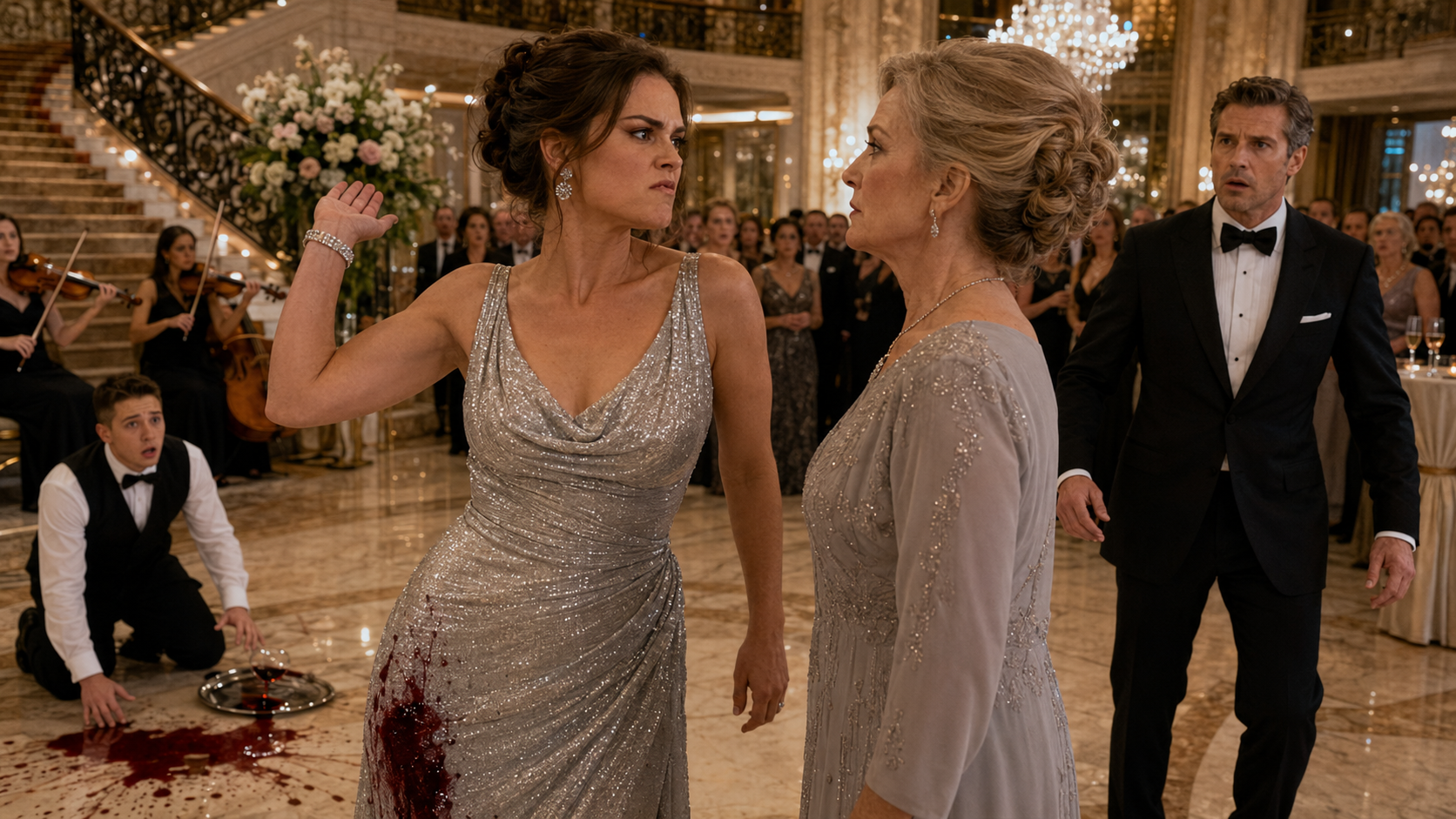
She had been wearing a silver dress and my grandmother’s diamond bracelet, which I had loaned her because she had told me she wanted to feel like she was already part of my family.
I should have understood the irony.
The argument had started over nothing.
At least, that was what Sloane kept saying afterward.
Nothing.
A young server dropped a tray after Sloane changed direction without looking and walked directly into him. Red wine splashed across the hem of her dress.
The kid could not have been more than twenty.
He turned white.
“I’m sorry, Ms. Harrow.”
Sloane looked at the stain.
Then at him.
“You’re sorry?”
My mother happened to be standing nearby.
She had been talking to one of the caterers.
“Leave him alone, Sloane,” she said.
That should have ended it.
Anyone else would have laughed, changed dresses, and gone back to the party.
But Sloane had spent her entire life mistaking humiliation for authority.
She looked at my mother.
“Excuse me?”
“It was an accident.”
“No one asked you.”
My mother’s expression changed.
Not much.
Most people would have missed it.
I did not.
Marianne had a particular stillness she used whenever someone tried to make her feel small. I had seen it when landlords threatened us with eviction. I had seen it when hospital clerks spoke slowly to her because her cleaning uniform made them assume she was stupid. I had seen it when I was thirteen and a school administrator asked whether she understood what tuition cost.
She did not shrink.
She became quiet.
That silence had raised me.
“Sloane,” she said, “you’re embarrassing yourself.”
People heard.
That was the mistake.
Not my mother’s.
Sloane’s.
Because suddenly there were eyes on her.
Sloane Harrow could survive cruelty.
She could not survive embarrassment.
Her hand moved so quickly that for half a second I did not understand what I had seen.
Then the sound cracked across the ballroom.
My mother’s head turned.
The quartet stopped.
Someone gasped.
And Sloane said, “Get on your knees and apologize to me.”
I was crossing the room before the last word left her mouth.
But I heard laughter.
Not everyone.
Three or four people, maybe.
Nervous laughter.
The kind people use when they know something terrible has happened and have not yet decided which side is powerful enough to stand behind.
My mother looked at Sloane.
Then she looked at the marble floor.
And something passed across her face that I had never seen before.
Not fear.
Recognition.
That was what haunted me later.
At the time, all I felt was rage.
I stepped between them.
“Sloane.”
She turned.
Whatever she saw in my face made her stop smiling.
“Graham, she—”
“Get out.”
The ballroom went silent.
Her mouth opened.
“What?”
“Get out of my house.”
“You cannot be serious.”
I looked toward security.
“Take Ms. Harrow’s coat to the front entrance.”
Sloane’s cheeks flushed.
“My father has nine figures tied into your riverfront project.”
“I know.”
“Our families have contracts together.”
“I know.”
“You embarrass me in front of everyone because your mother doesn’t know when to keep her mouth shut?”
That was when I stopped being angry.
Anger is hot.
What I felt then was cold enough to make everything clear.
I took my grandmother’s bracelet off Sloane’s wrist myself.
She stared at me.
“We’re done.”
“Graham.”
“The engagement. The partnerships. Everything.”
“You’re throwing away four years over one slap?”
“No.”
I closed the bracelet in my fist.
“I’m throwing away four years because it took one slap for me to finally see you.”
Then I had her removed from the house.
By Monday morning, my attorneys were reviewing every shared company, contract, parcel, loan participation, and investment vehicle connected to Conrad Harrow.
By Tuesday, Conrad had called me seventeen times.
By Wednesday, Sloane had sent forty-three messages.
I answered none of them.
And now, before sunrise on Wednesday, my mother wanted me to sell the house.
“This isn’t about Sloane,” she said.
I looked at her bruised cheek.
“Then what is it about?”
Her eyes moved beyond me.
Toward the corridor.
Toward the ballroom.
The doors were closed.
They had remained closed since Saturday night.
“Did you ever find out who owned this place before you?”
The question was so unexpected that I almost smiled.
“Some old-money family.”
My mother did not move.
“Bellamy, I think.”
Her fingers tightened around her cup.
“Why?”
The cup slipped.
Barely.
Porcelain clicked against the counter.
But I saw it.
“Mom?”
She swallowed.
“August Bellamy?”
My smile disappeared.
“You know him?”
She set the cup down with both hands.
Very carefully.
“I knew his family.”
I stared at her.
My mother had spent most of my childhood working two jobs.
There had been years when she cleaned hotel rooms during the day and worked overnight at a private nursing facility. She had skipped meals and pretended she was not hungry. She had washed our clothes in a bathtub when the machines in our building broke. Once, when I was sixteen, she sold her wedding ring so I could stay enrolled at a private school after my scholarship was unexpectedly reduced.
She had never described herself as unlucky.
She had never complained.
She had never let me romanticize poverty either.
“Being poor isn’t noble,” she once told me. “It’s expensive, exhausting, and dangerous. So learn something useful.”
I had.
By thirty-eight, I had built and sold pieces of three companies.
I had more money than either of us had once known how to imagine.
I had bought this estate eighteen months earlier because the boy inside me who once slept beside a radiator for warmth wanted proof that nobody could throw us out again.
And now my mother stood inside it looking frightened.
More frightened, somehow, than she had when Sloane hit her.
I walked closer.
“How did you know the Bellamys?”
She stepped away.
That hurt more than I expected.
“Mom.”
“I want you to promise me something.”
“What?”
“Whatever you find out about this house, leave it alone.”
I almost laughed.
Not because it was funny.
Because she knew me too well to believe that sentence would work.
“What am I supposed to find out?”
“Nothing, if you listen to me.”
“Why would there be something to find?”
Her eyes filled.
My mother almost never cried.
Even then, no tears fell.
“Because there are debts people pay with money, Graham.”
She paused.
“And there are debts that ruin everyone who tries to collect them.”
Then she walked out of the kitchen.
I did not follow her.
For ten minutes I stood beside the window listening to the old house settle around me.
Then I called my attorney.
By noon, I had the original property chain.
The estate had belonged to the Bellamy family for sixty-three years.
August Bellamy’s grandfather bought it in 1948.
August’s parents raised their children there.
The family sold it in 1997, after which it passed through two private owners before I purchased it.
That alone should not have meant anything.
It was history.
Nothing more.
Then my attorney sent another file.
Her message contained one sentence.
Graham, you need to look at the capitalization records from Voss Systems.
My first company.
The one I had started twelve years earlier with two laptops, three maxed-out credit cards, and an office whose ceiling leaked whenever it rained.
I opened the file.
I remembered almost every early investor.
How could I not?
Back then, every check had felt like oxygen.
Twenty-five thousand dollars.
Fifty thousand.
One hundred thousand from an angel investor who told me during our first meeting that my product was interesting but my shoes were terrible.
Then I saw a name buried in the earliest financing round.
Bellamy Family Trust.
I leaned closer to the screen.
Initial investment: six hundred thousand dollars.
I read it twice.
Then a third time.
The date was twelve years earlier.
I had been twenty-six.
Broke.
Unknown.
Sleeping four hours a night.
My mother and I had been living in different states.
I had never met anyone named Bellamy.
At least, I had believed I hadn’t.
The trust had taken ordinary equity.
No unusual preference.
No board seat.
No demand for control.
No personal guarantee.
Just money.
Six hundred thousand dollars at precisely the point when my first company had been less than two months away from missing payroll.
I remembered that round.
Of course I remembered it.
I remembered being told an investment office had joined through one of our lead backers.
I remembered not asking enough questions because I was twenty-six and terrified and convinced that anyone willing to wire money into my collapsing little company must have been temporarily insane.
The trust had quietly remained on the cap table through two additional rounds.
When Voss Systems was acquired four years later, that six-hundred-thousand-dollar investment had become a fortune.
So it had not been charity.
Whoever invested had made money.
A lot of it.
But that did not answer the question burning inside my skull.
Why me?
I called my attorney again.
“Who authorized the original investment?”
“I’m tracing it.”
“Trace faster.”
“Graham.”
“What?”
She hesitated.
“There’s something else.”
My stomach tightened.
“What?”
“The trust’s counsel requested confidentiality beyond the usual investor terms.”
“What does that mean?”
“It means they specifically requested that the identity of the family principals not be disclosed to company management unless legally necessary.”
I looked across my study.
Through the open door, I could see the end of the corridor leading toward the ballroom.
“Was that unusual?”
“Yes.”
“How unusual?”
Another pause.
“Unusual enough that I don’t think this was an accidental investment.”
I closed my eyes.
Somewhere downstairs, a door opened and shut.
My mother.
Leaving, maybe.
Avoiding me.
I looked back at the screen.
Bellamy Family Trust.
Twelve years.
Six hundred thousand dollars.
And a mother who had gone pale at the name August Bellamy.
By sunset, I knew the Bellamys had helped keep my first company alive.
What I still did not know was why.
Or why my mother seemed more afraid of the answer than of the people who had once made us poor.
That evening, I opened the ballroom doors.
The room smelled faintly of polish and flowers left too long in water.
Broken-down tables had been removed after the party, but the grand piano remained near the north wall.
So did the staircase.
I stood exactly where my mother had been when Sloane hit her.
Then I looked toward the marble floor where Sloane had ordered her to kneel.
For the first time, I noticed something carved into the stone beneath the balcony.
A small letter B.
Old.
Nearly hidden by later restoration work.
Bellamy.
My mother had not looked afraid because a rich woman had slapped her.
She had looked afraid because somehow, after almost forty years, she had been standing in a room she remembered.
And I had just realized the house had remembered her too.
PART 2: THE ROOM SHE REMEMBERED
Sloane came back the next afternoon.
She did not ask permission.
She arrived in a black SUV with her driver and two suitcases, apparently believing that being my former fiancée gave her some temporary diplomatic immunity from the gate instructions.
Security called me.
“She says she’s here for her personal belongings.”
“Let her retrieve them.”
“Sir, she wants to speak with you.”
I looked down at the Bellamy records spread across my desk.
“Of course she does.”
I met her upstairs.
Sloane had already changed tactics.
That was one of her talents.
She could sense when aggression had stopped working and become vulnerable without ever actually becoming sorry.
She wore no makeup.
Her hair was pulled into a loose knot.
The effect was designed to say I have not slept.
I knew because I had watched her construct the same look for sympathy photographs after a charity-board scandal two years earlier.
“Graham.”
“Sloane.”
Her eyes moved over my face.
“You look terrible.”
“You hit my mother.”
Pain flashed through her expression.
Not guilt.
Annoyance.
“Are we still doing this?”
I stared at her.
She exhaled.
“I apologized.”
“You texted me, ‘I’m sorry things got out of hand.’”
“They did.”
“You hit her.”
“She provoked me.”
“You ordered her onto her knees.”
Sloane lowered her voice.
“I was humiliated.”
I almost admired the sentence.
Not because it was intelligent.
Because it was pure.
It contained everything wrong with her.
Someone else had been struck, but Sloane was the injured party because people had seen her lose control.
I folded my arms.
“Take your things.”
“Graham, stop.”
“We have nothing else to discuss.”
“My father says you’re cancelling the Riverside arrangements.”
“I am.”
“You can’t dissolve three years of financing over a family argument.”
“Watch me.”
Her eyes hardened.
There she was.
The woman from the ballroom.
“You think you’re better than us now?”
I felt something inside me go still.
“Now?”
“You know what I mean.”
“No. Say it.”
She looked away.
That was answer enough.
“You were never ashamed of where I came from when my money was useful,” I said.
“Oh, don’t start.”
“You loved telling people I was self-made.”
“You are.”
“You loved it because it made you look adventurous.”
Her jaw tightened.
“That isn’t fair.”
“No. What happened to my mother wasn’t fair.”
“She shouldn’t have interfered.”
“With you abusing a server?”
“With something that was not her place.”
There it was again.
Place.
The invisible architecture people like Sloane built around the world.
Who stood.
Who served.
Who spoke.
Who apologized.
Who was allowed to embarrass whom.
My mother had spent my childhood teaching me that money bought freedom.
Sloane had spent hers learning that money bought hierarchy.
I had confused the two.
For years.
Sloane picked up her purse.
“I hope proving a point is worth what this costs you.”
“It already is.”
“You’re angry now. Eventually you’ll understand that families like ours survive because we don’t destroy relationships over emotional scenes.”
Families like ours.
I thought of the Bellamy trust.
The ballroom.
My mother’s pale face.
“Take your things, Sloane.”
She studied me one last time.
Then she left.
I waited until I heard the front door close before I called my mother.
She did not answer.
So I drove to her apartment.
I had offered to buy her a house after my first exit.
She refused.
I had offered again after my second.
She threatened to stop speaking to me.
Eventually we compromised on a comfortable apartment overlooking a park, purchased in her name, with a building superintendent she liked and exactly one guest bedroom because, according to her, “anything more than that is how rich people end up collecting chairs they never sit in.”
She opened the door after my third knock.
“You’re stubborn.”
“You raised me.”
“That is not the defense you think it is.”
I stepped inside.
She glanced at the folder in my hand.
Her face changed.
“Graham.”
“Six hundred thousand dollars.”
She closed her eyes.
“You knew.”
It was not a question.
She turned away.
I followed her into the living room.
“You knew the Bellamy trust invested in my company.”
“I knew eventually.”
“Eventually?”
“Not when it happened.”
“When?”
“After your company was sold.”
“How?”
She sat down.
Suddenly she looked tired.
Older than she had that morning.
I remained standing.
“Mom.”
“I received a letter.”
“From who?”
She looked at me.
“August.”
There was no fear in the way she said his name now.
Only grief.
Old grief.
The kind that had lost its sharp edges but never disappeared.
“What did he say?”
“That he had followed your career. That he had invested in your company. That he would never interfere with your life.”
“You didn’t think I needed to know?”
“No.”
I laughed once.
The sound was ugly.
“No?”
“You were happy.”
“I was being secretly financed by someone you knew.”
“He invested.”
“Why?”
Silence.
“Why?”
She stood.
“I told you to leave this alone.”
“And I told you I’m not twenty years old anymore.”
“This has nothing to do with your age.”
“Then tell me what it has to do with.”
Her eyes moved to the folder.
I opened it.
“August Bellamy’s trust put six hundred thousand dollars into my company when I was two months away from not making payroll.”
Her lips parted.
I continued.
“He specifically asked to remain anonymous. You found out later, and you still didn’t tell me. Three nights ago, you stood in the Bellamy ballroom while Sloane slapped you and ordered you to kneel.”
My mother went completely still.
I knew then.
“You had been in that room before.”
She said nothing.
“Hadn’t you?”
Her eyes filled.
I lowered my voice.
“What happened there?”
“Nothing that belongs to you.”
“It became mine the second you were hit in my house and looked like you had seen a ghost.”
“That is exactly what I was trying to prevent.”
“What?”
“You doing this.”
“Doing what?”
“Digging.”
I stared at her.
She pressed both hands against the back of a chair.
“You think truth is always a cure because you have spent your life solving problems. Company fails? Find the flaw. Deal collapses? Find the leverage. Someone lies? Find the document.”
Her voice shook.
“Some truths do not fix anything.”
“Maybe I should decide that.”
“No.”
“Why?”
“Because I already paid for the right to keep this one buried.”
The room went silent.
I had never heard bitterness like that in my mother’s voice.
“Paid how?”
She looked toward the window.
For several seconds I thought she would refuse.
Then she said, “I was twenty-one when I first entered that house.”
My chest tightened.
She sat again.
This time, I sat opposite her.
“The Bellamys hired temporary staff every summer,” she continued. “Parties, dinners, charity weekends. I had a friend who worked for an agency. She got me a position.”
“As a maid?”
“Server. Housekeeping when they needed it. Whatever paid.”
She smiled faintly.
“I was very good at folding towels.”
Despite myself, I almost smiled.
It vanished when she continued.
“August was twenty-seven.”
Six years older.
“He lived there?”
“Sometimes. He had an apartment in New York, but his parents expected him home constantly. His father was preparing him to take over the family investment office.”
“What was he like?”
She looked at me so quickly that I immediately regretted asking.
Not because she was angry.
Because for one second I saw the young woman she had been.
“He was funny.”
That was not the answer I expected.
“He hated those parties. He would disappear into the kitchen because the cooks would feed him and nobody asked about bonds or political donations.”
She gave a quiet laugh.
“I thought he was ridiculous.”
“And then?”
“And then I stopped thinking he was ridiculous.”
I said nothing.
“We were careful at first,” she said. “Then we were young. Young people always think being sincere makes them safe.”
My throat tightened.
“You were together.”
“Yes.”
“Did his family know?”
“Not at first.”
“What happened?”
She stared at her hands.
“They found out.”
“How?”
“It doesn’t matter.”
“It matters to me.”
“No, Graham. This is the part you need to understand. Details are how people convince themselves revenge is justice.”
“I’m not asking for revenge.”
“Not yet.”
I sat forward.
“Mom.”
Her eyes lifted to mine.
“What did they do to you?”
She took a breath.
“His mother invited me into the ballroom during a dinner.”
Every muscle in my body tightened.
“The same ballroom?”
“Yes.”
The word was barely audible.
“There were people there?”
“A few dozen.”
My hands curled into fists.
“She accused me of trying to trap August. Said girls like me always believed a pregnancy could become a ladder.”
The room disappeared around me.
Pregnancy.
I heard the word but could not fit it into anything.
My mother kept talking, perhaps because stopping would have been harder.
“I told her I had never asked August for money. She said that made me dishonest as well as ambitious.”
“Mom.”
“She slapped me.”
I stopped breathing.
My mother smiled.
It was the saddest smile I had ever seen.
“When Sloane hit me, I knew exactly what the marble felt like beneath my shoes.”
I stood.
I could not sit anymore.
“What happened after she slapped you?”
“She told me to apologize.”
“For what?”
“For embarrassing the family.”
My stomach turned.
“And when I refused, she told me to kneel.”
The glass in my mother’s water trembled against the table.
I saw Saturday night again.
Sloane’s silver dress.
My mother looking down at the floor.
Recognition.
Not fear.
Memory.
I paced to the window.
“Did August see it?”
Silence.
That silence told me more than an answer could have.
I turned.
“Did he?”
My mother’s eyes closed.
“He was in the room.”
Something violent moved through me.
“What did he do?”
“He hesitated.”
Two words.
That was all.
“He hesitated?”
“His mother was screaming. His father was there. Everyone was staring. He—”
“He let them do that to you?”
“For a few seconds.”
“A few seconds?”
“Graham.”
“Then what?”
“He told his mother to stop.”
“After she hit you?”
“Yes.”
“After she ordered you to kneel?”
“Yes.”
My jaw ached from clenching it.
“I left before he could follow me.”
“And you never went back.”
“No.”
I stared at my mother.
At the woman who had worked nights.
Who sold her ring.
Who had never once told me she had stood in front of a room full of wealthy strangers while a family decided poverty made her humiliation acceptable.
Then one earlier word returned.
Pregnancy.
My mother saw the moment I remembered it.
Her face crumpled.
Not dramatically.
Just enough.
“Mom.”
She looked away.
“You said his mother accused you of trapping him with a pregnancy.”
“Graham.”
My heartbeat became loud.
The room seemed too warm.
“Were you pregnant?”
She said nothing.
I already knew.
“Were you pregnant with me?”
Her eyes came back to mine.
And suddenly every strange thing from the last three days arranged itself into one terrible, perfect line.
The house.
The ballroom.
August Bellamy.
The anonymous investment.
My mother’s warning.
The money.
The silence.
Her fear.
I whispered, “August Bellamy is my father.”
She closed her eyes.
That was the answer.
PART 3: THE DEBT HE PAID IN MONEY
I left my mother’s apartment without remembering the elevator ride down.
I remember the sidewalk.
Cold air.
A taxi horn.
A woman walking a golden retriever.
Ordinary details became painfully clear because everything inside me had stopped making sense.
For thirty-eight years, I had known who I was.
Or thought I did.
Daniel Voss had been my father.
That was the name on my birth certificate.
That was the man in the photographs.
He had been the one who taught me to throw a baseball badly and change a tire correctly. He died when I was eleven, leaving my mother with medical bills, a cheap watch, and a wedding ring she eventually sold for my tuition.
I had missed him my entire life.
Now another man had entered the story without permission.
August Bellamy.
A man whose family once owned my house.
A man whose money had entered my company before his name entered my life.
I drove for nearly an hour before realizing I was going nowhere.
Then my attorney called.
“I found the original authorization.”
I pulled into an empty parking lot.
“Tell me.”
“The Bellamy trust investment was approved by August Bellamy personally.”
Of course it was.
I laughed.
“What?”
“Nothing.”
“Graham, are you all right?”
“No.”
Silence.
Then she said, “Do you want me to stop?”
I thought of my mother.
Whatever you find out about this house, leave it alone.
“No.”
I hated myself a little for saying it.
“Keep going.”
I returned home after dark.
The ballroom doors were still open.
I stood in the doorway and imagined my mother at twenty-one.
Not Marianne Voss the woman who could terrify a contractor by asking one quiet question about an invoice.
Not my mother.
A girl.
Poor.
Pregnant.
Surrounded.
August somewhere in the room.
Hesitating.
I understood then why Sloane’s slap had affected her differently than every insult she had survived afterward.
My mother had not simply been assaulted.
History had repeated itself in front of her.
Only one thing had changed.
This time, the man she loved did not hesitate.
I had not thought.
Had not calculated contracts.
Had not looked around to see who was watching.
I crossed that ballroom because someone had touched my mother.
Maybe that was why she wanted the house sold.
Not because Sloane had contaminated it.
Because the room had forced her to remember another man who had not crossed it quickly enough.
At midnight, I searched for August Bellamy.
I found photographs first.
Older now.
Seventy-four.
White hair.
A narrower face than mine.
Or maybe I imagined the resemblance because I was looking for it.
He had never married.
That surprised me.
There were articles about foundations, investment funds, environmental donations, hospital endowments.
Old photographs showed him with senators, actors, bankers.
I found one from thirty-seven years earlier.
August stood on the steps of the estate in a tuxedo.
My house.
My front door.
My father.
I shut the laptop.
Then opened it again.
Near four in the morning, my mother called.
“I know you’re awake.”
“How?”
“You’ve been incapable of sleeping when you’re angry since you were six.”
“I’m not angry.”
“That is how I know you are very angry.”
I leaned back.
“Why did you marry Daniel?”
“Because I loved him.”
That answer came instantly.
Something inside me eased.
“Did he know?”
“Yes.”
I closed my eyes.
“He knew I wasn’t his?”
“He knew before we married.”
“And he still—”
“Daniel never thought loving someone made him less because another person came first.”
My throat tightened.
“Why put his name on my birth certificate?”
“Because he wanted to be your father.”
“He was.”
“I know.”
The words broke something in her voice.
We stayed quiet for several seconds.
Then I asked, “Did August know about me?”
“Not at first.”
“When did he find out?”
“Years later.”
“How?”
“I told him.”
That surprised me.
“You contacted him?”
“After Daniel died.”
“Why?”
“Because I was frightened.”
My mother rarely admitted fear.
“We had nothing, Graham. You were eleven. Bills were arriving every week. I had two jobs and still couldn’t see a way through.”
“So you asked August for money.”
“No.”
Of course she hadn’t.
“I wrote because I thought if something happened to me, someone should know you existed.”
I swallowed.
“What did he do?”
“He came to see me.”
“You saw him?”
“Once.”
“When?”
“You were at school.”
“What happened?”
“He wanted to help.”
“And you refused.”
“Yes.”
“Why?”
“Because by then I had spent twelve years building a life that did not belong to the Bellamys.”
She inhaled slowly.
“I told him if he wanted to give me money to relieve his conscience, he could find another method.”
“That’s brutal.”
“He deserved some brutality.”
Despite everything, I smiled.
Only for a second.
“Did he ask to meet me?”
“Yes.”
“And?”
“I said no.”
My smile disappeared.
“Why?”
“You had just lost your father.”
“Daniel.”
“Yes. Your father.”
She emphasized it.
“You were angry at the world. You were grieving. I was not going to place another man in front of you and tell you blood meant he was entitled to a role in your life.”
I rubbed my eyes.
“And later?”
“He wrote occasionally.”
“You answered?”
“Rarely.”
“Did you ever tell him about my company?”
“No.”
“He found it himself.”
I looked at the dark windows.
“So twelve years ago, he invested.”
“Yes.”
“You said you found out after the sale.”
“He wrote to me.”
“What exactly did he say?”
My mother was quiet.
“That he had done the one thing I had not forbidden.”
“What was that?”
“Believed in you from a distance.”
I stared at nothing.
My first instinct was anger.
My second was worse.
Doubt.
“Would Voss Systems have survived without that money?”
“I don’t know.”
“I do.”
The truth came out harder than I intended.
“We were running out of cash.”
“Graham.”
“We had maybe eight weeks.”
“That company succeeded because you built something people needed.”
“With his money.”
“With investment.”
“From my biological father.”
“On the same terms as everyone else?”
I hesitated.
“Yes.”
“Did he ask for control?”
“No.”
“Did he force customers to buy from you?”
“No.”
“Did he write your software?”
“No.”
“Did he make you sleep on an office couch for six months?”
I said nothing.
“Did he make your second company succeed?”
“No.”
“Your third?”
“No.”
“Then stop turning one check into the story of your life because you’re angry I kept something from you.”
I closed my eyes.
She was right.
I hated that.
“I’m still going to meet him.”
The silence on the other end changed.
Cold entered it.
“No.”
“You don’t get to decide that anymore.”
“I am asking you.”
“And I’m telling you I need to see him.”
“For what?”
“I don’t know.”
“That is exactly why you should not go.”
I stood.
“Mom, I have spent three days finding out a stranger knew enough about me to put six hundred thousand dollars into my company while I didn’t even know his name.”
“He is not a stranger.”
“That’s worse.”
She breathed my name.
I softened.
“Aren’t you tired?”
“Of what?”
“Carrying the whole thing by yourself.”
Her answer took a long time.
“Yes.”
One word.
Barely there.
I pressed my hand against the desk.
“Then let me carry part of it.”
“No. That isn’t what children are for.”
“I’m thirty-eight.”
“You’re still my child.”
“And he is still my biological father.”
She flinched on the other end.
I could hear it.
“I’m not going there to replace Daniel. I’m not going to collect money. I’m not going to ask for a place in some family.”
“Then why?”
Because I needed to know whether August Bellamy had looked at my mother on that ballroom floor and chosen his family name over her.
Because I needed to know whether the money had been guilt.
Because some part of me needed to look into his face and see whether I recognized anything.
“I need to ask him what he thought those few seconds were worth.”
My mother went quiet.
When she finally answered, there was no anger left.
“That is the question that ruins people, Graham.”
“Maybe.”
I stared toward the ballroom.
“But I still have to ask it.”
The next afternoon, August Bellamy’s office returned my call.
He agreed to see me immediately.
He did not ask why.
That frightened me more than if he had refused.
PART 4: THE MAN WHO HESITATED
August Bellamy did not live in a mansion.
That annoyed me.
I had prepared myself to hate a palace.
Instead, his home sat on six wooded acres outside Greenwich, large enough to be expensive but restrained enough that nobody would mistake it for a monument.
A housekeeper opened the door.
“Mr. Bellamy is in the library.”
My pulse changed.
I had negotiated acquisitions worth billions.
I had faced rooms full of men waiting for me to fail.
Nothing had prepared me for walking toward an old man I had never met while knowing half my blood came from him.
August stood when I entered.
For several seconds, neither of us spoke.
He was thinner than the photographs suggested.
His hair was almost entirely white.
His eyes were gray.
Mine were gray.
I noticed that immediately and resented myself for noticing.
Then August said, “Graham.”
Not Mr. Voss.
Not hello.
My name.
Like he had practiced it.
“August.”
Something moved through his expression.
Pain, maybe.
He gestured toward a chair.
I remained standing.
“So,” I said, “you know who I am.”
“Yes.”
“How long?”
“Since you were eleven.”
I laughed without humor.
“Twenty-seven years.”
“Yes.”
“And you never thought I should know you existed?”
“Your mother thought you should not.”
“That stopped you from contacting me?”
“Yes.”
“You listened to her?”
“I learned to.”
The answer irritated me because it contained history I did not have.
I walked toward the windows.
On a side table stood several framed photographs.
None showed children.
None showed a wife.
“You invested in my company.”
“Yes.”
“Why?”
“Because I thought it would succeed.”
“That simple?”
“No.”
At least he did not lie.
I turned.
August sat slowly.
“I had followed your career.”
“That sounds less comforting when the person doing it is secretly your father.”
“I imagine it does.”
“You knew where I went to school?”
“Yes.”
“What I studied?”
“Yes.”
“My jobs?”
“Yes.”
“Did you ever come near me?”
His face changed.
“Once.”
My stomach tightened.
“When?”
“Your college graduation.”
I stared at him.
“You were there?”
“Across the courtyard.”
“Did my mother know?”
“No.”
“Why didn’t you speak to me?”
“Because she had asked me not to.”
“That didn’t stop you from coming.”
“No.”
“Why?”
He looked down.
“Because I am not as disciplined as your mother.”
That sounded almost like affection.
I did not want to hear affection from him.
Not yet.
“The investment.”
He nodded.
“You were raising a seed extension. I read the material. I spoke to one of your lead investors without disclosing our relationship.”
“You mean without disclosing that I didn’t know we had one.”
“Yes.”
“You put six hundred thousand dollars into Voss Systems.”
“Yes.”
“Did you know we were running out of money?”
“I knew your position was difficult.”
“So you saved it.”
“No.”
The answer came sharply enough that I stopped.
August leaned forward.
“I invested in it.”
“You can call it whatever you want.”
“I call it what it was because I knew your mother would despise me if I did anything else.”
He almost smiled.
“She probably despised me anyway.”
“That seems possible.”
His smile vanished.
“I took the same terms as the round.”
“I know.”
“I asked for no board seat.”
“I know.”
“No special rights.”
“I know.”
“I never contacted a customer, partner, lender, or employee on your behalf.”
“I checked.”
“I assumed you would.”
That irritated me too.
“You made almost eight million dollars when we sold.”
“Just under.”
“So it wasn’t charity.”
“No.”
“Was that intentional?”
“Yes.”
“Why?”
His eyes stayed on mine.
“Because I did not want the first thing I gave you to be something that suggested you could not create value yourself.”
Something inside me shifted.
I hated that too.
I had come prepared for guilt.
Arrogance.
Excuses.
I had not prepared for careful answers.
“So what was it?” I asked. “Guilt?”
“Partly.”
“At least you admit it.”
“I have had thirty-seven years to become accurate about my failures.”
There it was.
The ballroom.
My body went cold.
“You watched her.”
August’s face changed.
He knew immediately what I meant.
“You watched my mother get slapped.”
“Yes.”
“And you hesitated.”
His gaze dropped.
“Yes.”
“How long?”
He looked up.
“Three or four seconds.”
I laughed.
“Interesting.”
“Graham—”
“She remembered.”
His jaw tightened.
“Three nights ago, Sloane slapped her in the same ballroom.”
August went completely still.
“In the Bellamy house?”
“My house.”
“Yes.”
The correction came automatically.
I continued.
“Sloane ordered her onto her knees.”
August closed his eyes.
For the first time since I entered, the composure disappeared.
He looked sick.
“What did you do?”
“I threw Sloane out.”
His eyes opened.
“Immediately?”
I stared at him.
“What kind of question is that?”
His mouth tightened.
“The only one that matters.”
Neither of us spoke.
Then August stood and walked toward the fireplace.
“I loved your mother.”
“Don’t.”
He stopped.
“You don’t get to use that sentence to clean up what happened.”
“I am not.”
“You let your family humiliate her.”
“Yes.”
“You stood there.”
“Yes.”
“You hesitated.”
“Yes.”
His willingness to agree made my anger worse.
“Why?”
He looked at me.
And for the first time I saw something in his face that I understood completely.
Shame.
“Because I had been trained my entire life to hesitate.”
I said nothing.
“My father controlled everything,” he continued. “Money. Careers. Friendships. My mother controlled the social part of it. Who belonged. Who embarrassed us. Who needed to be corrected.”
His voice hardened.
“That is not an excuse.”
“No.”
“I knew my mother was wrong the moment she called Marianne into that room.”
“But you waited.”
“Yes.”
“Why?”
“Because I thought I could calm everyone down.”
I almost laughed.
“There were guests. My father was furious. My mother was shouting. Marianne was frightened, though she would never admit it. I thought if I could find the right words—”
“There are no right words when someone hits a pregnant woman.”
“I know.”
“Apparently you didn’t.”
“No.”
That stopped me.
August stared at the floor.
“I learned it approximately three seconds too late.”
The anger in me had nowhere to go because he was not defending himself.
I wanted him to.
I wanted him to become the villain I had driven there to confront.
It would have been easier.
“What happened after she left?”
“I followed her.”
“She said she left before you could.”
“She did.”
“Did you find her?”
“Not that night.”
“And then?”
“My parents told me she had taken money.”
I frowned.
“What?”
“They told me Marianne had accepted a settlement and left.”
“She didn’t.”
“I know that now.”
“Did you believe them?”
“For two days.”
Two days.
“Then I found the settlement agreement unsigned.”
My pulse changed.
“What did you do?”
“I confronted my father. He told me Marianne would destroy my future.”
“And?”
“I told him I did not want the future he was protecting.”
August looked toward the window.
“I left the family investment office six weeks later.”
That surprised me.
“You walked away?”
“From the position. Not all the money.”
At least he was honest.
“My grandmother left me a separate trust. I kept it. I was not heroic, Graham.”
“You didn’t find my mother?”
“For years, no.”
“How is that possible?”
“Because your mother did not want to be found.”
That sounded like her.
“She left the agency. Moved. Later married Daniel. Changed addresses several times. There was no internet database. And the people I hired were not particularly competent because I was attempting to search without alerting my father.”
“You hired investigators?”
“Yes.”
“And when you found her?”
“She told me never to contact her again.”
“Why?”
August laughed softly.
There was no humor in it.
“Because she had survived me.”
The sentence hit harder than I expected.
He continued.
“She said she had built a life with a man who had never made her feel ashamed of where she came from. She said Daniel knew about me. Knew about you. He had chosen both of you without needing to be threatened into courage.”
My eyes burned.
I looked away.
August gave me the dignity of pretending not to notice.
“She was right,” he said.
“You never married.”
“No.”
“Because of her?”
“Partly.”
“Don’t romanticize it.”
“I’m not.”
He met my eyes.
“I had relationships. Some long. Some happy. None became marriage. Marianne was not responsible for every choice I made afterward.”
Again, accurate.
Again, irritating.
I went to the mantel.
A photograph stood there.
August at perhaps sixty.
My mother beside him.
I picked it up.
My head snapped toward him.
“When was this?”
“After Daniel died.”
The photograph was taken in a diner.
Not romantic.
Not secretive.
Two exhausted adults sitting across from each other.
My mother looked furious.
August looked devastated.
“She met you once,” I said.
“Yes.”
“She told me.”
August nodded.
I returned the photograph.
“Why do you have this?”
“Because someone took it from outside.”
I stared at him.
“One of the investigators?”
“Yes.”
“That is deeply strange.”
“I agree.”
“Yet you framed it.”
“I did not say I became less strange with age.”
Despite everything, a laugh escaped me.
One sound.
Brief.
I hated him for causing it.
August smiled once, then the sadness returned.
“Your mother told me you had lost your father. She said I would not appear in your life and confuse biology with parenthood.”
“That sounds exactly like her.”
“She also told me if I ever attempted to use money to reach you, she would make me regret being born.”
“That sounds even more like her.”
“So you waited twelve years and invested in my company.”
“I did.”
“Which was using money to reach me.”
“No.”
I looked at him.
“You never knew.”
“That’s your defense?”
“It is the distinction.”
He was right.
I did not like it.
“Why that company?”
“Because you were good.”
“You expect me to believe there wasn’t emotion involved?”
“Of course there was.”
He leaned against the mantel.
“But your company was also good. I reviewed dozens of terrible businesses started by children of people I knew. I did not invest because they shared somebody’s blood.”
“And if Voss Systems had been terrible?”
“I would not have invested.”
That answer mattered.
I wished it didn’t.
August went to a desk and removed a thin folder.
He did not hand it to me.
Instead, he placed it on the table between us.
“What is that?”
“The original investment memorandum.”
“I already have the documents.”
“This is my analysis.”
I stared at the folder.
“No.”
He looked surprised.
“I don’t need it.”
“Why?”
“Because if I read it, I’ll spend the next ten years trying to decide which line came from an investor and which came from my father.”
August considered that.
Then closed the folder.
“That is probably wise.”
I took a breath.
“One question.”
“Anything.”
“Why did my mother ask me to sell the house after Sloane hit her?”
August looked genuinely confused.
“You would have to ask Marianne.”
“What do you think?”
He was quiet for a long time.
Then he said, “Because houses can become witnesses.”
I frowned.
“She went into that ballroom as a young woman with very little power. People watched her be humiliated. I watched.”
His face tightened.
“Then almost forty years later, she stood in the same room while another wealthy family’s daughter tried to make her small.”
I waited.
“But this time her son owned the room.”
My throat tightened.
“And you did not hesitate.”
The anger drained out of me so quickly it left exhaustion behind.
August looked at me.
“If I know Marianne, that would have been almost as painful as it was comforting.”
“Why?”
“Because sometimes receiving what you should have received years ago only reminds you how long you lived without it.”
The room became very quiet.
I understood then.
Not everything.
Enough.
I had driven there wanting to calculate a debt.
Three seconds.
One humiliation.
Twenty-seven years of silence.
Six hundred thousand dollars.
Eight million returned.
A father at a graduation across a courtyard.
A mother protecting the life she built.
There was no equation.
No number that balanced it.
My mother had already told me that.
I just had not understood her.
I walked toward the door.
“Graham.”
I stopped.
August did not ask me to call him Dad.
He did not ask to see me again.
He did not offer money.
He simply said, “Is she all right?”
I looked back.
“My mother?”
“Yes.”
“No.”
His face fell.
“But she will be.”
He nodded.
I reached the doorway.
Then I said, “If she ever wants to speak to you, that is her decision.”
“Of course.”
“I won’t carry messages.”
“I understand.”
“I won’t repair what happened between you.”
“You shouldn’t.”
“And don’t invest in anything else I start without telling me.”
For the first time, August smiled properly.
“I can agree to that.”
I left.
On the drive home, I finally understood that meeting my biological father had not changed who my father was.
Daniel Voss still existed in every part of me that mattered.
He had chosen me.
August Bellamy was something else.
Not nothing.
Not Dad.
A man whose blood I carried.
A man who had loved my mother and failed her.
A man who had spent decades trying to compensate for three seconds that money could never erase.
When I reached the estate, the lights in the ballroom were on.
My mother was standing inside.
Waiting for me.
PART 5: WHAT THE HOUSE WAS WORTH
“You met him.”
My mother did not phrase it as a question.
I closed the ballroom doors behind me.
“Yes.”
She nodded once.
I had expected anger.
Instead, she looked tired.
“What did he say?”
“The truth, as far as I can tell.”
“That would be a late improvement.”
I almost smiled.
She stood near the north wall, exactly where Sloane had struck her.
I hated seeing her there.
“What are you doing in this room?”
“Testing something.”
“What?”
“Whether I still hate it.”
“And?”
She looked around.
“Yes.”
I moved closer.
“That seems conclusive.”
She laughed.
A small sound.
Then her eyes returned to me.
“Are you angry with me?”
“Yes.”
She nodded.
“I expected that.”
“I’m also not sure I would have done anything differently.”
That surprised her.
I stopped several feet away.
“You had just lost Daniel. I was eleven. If you had told me some rich stranger was actually my biological father, I probably would have hated both of you.”
“Probably.”
“I was not an emotionally sophisticated child.”
“You once stopped speaking to me for two days because I bought the wrong cereal.”
“I remember having principles.”
“You remember being unbearable.”
I smiled.
Then the smile faded.
“You should have told me later.”
“I know.”
That answer took some of my anger with it.
“You knew?”
“For years.”
“Why didn’t you?”
She looked around the ballroom.
“Because every year I waited, it became harder.”
I understood that.
Not forgive.
Understand.
“At first you were grieving Daniel. Then you were a teenager. Then you were in college, and you were finally happy. Then you were building the company.”
She rubbed her palms together.
“Every time I thought, Now, something in me said, Why put this burden on him now?”
“And the investment?”
“I almost told you.”
“Almost.”
“Then the company sold.”
“And?”
“I thought if I told you, you would believe exactly what you believed yesterday.”
“That I didn’t build it myself.”
“Yes.”
She walked toward one of the tall windows.
“You spent your entire childhood watching money control what happened to us. Rent. Schools. Doctors. Food. Everything. I knew what success meant to you.”
“What?”
“Escape.”
The word landed quietly.
“You didn’t want me thinking Bellamy money created the escape.”
“No.”
“Did it?”
She turned.
“What do you think?”
I considered the question.
For years, I had told the story of Voss Systems the same way.
We were weeks from running out of money.
Then we closed our extension round.
Then we signed our first major customer.
Then another.
Then another.
Without the round, perhaps we would have failed.
Without the customer, definitely.
Without the product, certainly.
Without me and my team working ourselves half to death, none of it mattered.
The Bellamy trust had opened a door.
I had still walked through it.
“No,” I said.
My mother nodded.
“Good.”
“But it helped.”
“Yes.”
“I need to be able to say that too.”
“Yes.”
There it was.
Not denial.
Not erasure.
Truth.
Complicated enough to be real.
I walked beside her.
“August said your mother—his mother—told him you took money.”
Marianne’s mouth tightened.
“She wanted me to.”
“She lied to him.”
“Yes.”
“He found out.”
“Eventually.”
“He left the family office.”
“I know.”
“You knew?”
“He told me years later.”
“Did that change anything?”
My mother looked at me as though the answer should have been obvious.
“No.”
“Why not?”
“Because leaving six weeks later did not change what happened in that room.”
I looked at the marble floor.
“He said the same thing.”
“That it didn’t change anything?”
“That he failed you.”
Her expression flickered.
I continued.
“He didn’t defend himself.”
“That sounds like August.”
“Is that good?”
“It took him a very long time to stop explaining his mistakes.”
I let that sit between us.
“Did you love him?”
My mother turned toward the windows.
“That is an unfair question.”
“Probably.”
“Yes.”
The word was soft.
“I did.”
“Do you still?”
She shook her head.
“Not the way you mean.”
“What does that mean?”
“It means people become part of you even when you stop wanting a life with them. It means I can remember being twenty-one and believing he was the funniest man I had ever met without wanting to be twenty-one again.”
She touched the edge of the window frame.
“It means I can forgive parts of him without pretending the wound never existed.”
“Have you forgiven him?”
“Some days.”
I laughed quietly.
“That seems inconvenient.”
“Most truth is.”
We stood together.
For several minutes neither of us spoke.
Then she asked, “Are you going to keep digging?”
“No.”
She looked at me.
“You mean that?”
“I know enough.”
“What changed?”
I thought about August’s folder.
The investment memorandum I had refused to read.
The answers I had wanted reduced to numbers.
“I realized I was trying to turn pain into accounting.”
My mother’s expression softened.
“Three seconds versus six hundred thousand dollars.”
She stared at me.
“How did you—”
“He told me how long he hesitated.”
“Oh.”
“He remembers.”
“I’m sure he does.”
“I wanted to know what he thought those seconds were worth.”
“And?”
“He never gave me a number.”
“Good.”
“I don’t think there is one.”
“No.”
She looked at the marble.
“That is what I was trying to tell you.”
Debts people pay with money.
Debts that ruin everyone who tries to collect them.
Finally I understood.
The Bellamy investment was money.
It could be measured.
It could be returned, multiplied, recorded on a capitalization table.
What happened to my mother in that ballroom was something else.
The moment August hesitated, something in their relationship broke.
He could regret it.
He could spend decades behaving differently.
He could invest in their son.
He could walk away from part of his family.
None of those things could travel backward in time and make a frightened twenty-one-year-old woman feel less alone on a marble floor.
Trying to force repayment for that kind of debt would only keep the wound open forever.
My phone vibrated.
Sloane.
I looked at the screen.
My mother noticed.
“You should answer eventually.”
“No.”
“You were going to marry her.”
“Not anymore.”
“That does not make four years disappear.”
“I don’t want them to disappear.”
That surprised even me.
I looked at the unanswered call.
“I want to remember exactly how long it took me to see her.”
My mother said nothing.
“The contracts with Conrad will be fully separated by the end of the month.”
“Will it hurt your company?”
“Yes.”
“How much?”
“Enough to be annoying.”
“Not dangerous?”
“No.”
“Then good.”
I raised an eyebrow.
“You don’t sound conflicted.”
“I spent thirty-seven years learning what happens when people keep bad relationships because the cost of leaving seems too high.”
Fair.
My phone stopped vibrating.
Then rang again.
Conrad.
I answered.
My mother gave me a look.
I put the call on speaker.
“Graham.”
Conrad Harrow did not bother with hello.
“Conrad.”
“This performance has gone far enough.”
“It’s not a performance.”
“You are cancelling binding relationships because Sloane lost her temper.”
“My attorneys have explained which agreements permit termination.”
“My attorneys disagree.”
“Then the attorneys can entertain each other.”
My mother covered a smile.
Conrad’s voice hardened.
“You think this makes you principled?”
“No.”
“Then what exactly are you trying to prove?”
I looked across the ballroom.
At my mother.
At the place where two wealthy families, separated by almost four decades, had each assumed they possessed the right to decide how much dignity a poorer woman was allowed.
“Nothing.”
“Excuse me?”
“That’s what you don’t understand. I’m not trying to prove anything.”
“You are burning millions of dollars.”
“I have more.”
“That attitude is how fortunes disappear.”
“Maybe.”
I watched my mother.
“But some things are supposed to cost you.”
Conrad went silent.
I continued.
“Your daughter hit my mother.”
“I have already told you Sloane regrets the incident.”
“No. Sloane regrets the consequences.”
“That is not your decision to make.”
“Yes, Conrad. It is.”
His voice dropped.
“You were very happy to become part of this family when it suited you.”
There it was.
Family.
Not love.
Not Sloane.
Access.
Position.
Permission.
“I know.”
“Do you?”
“Yes.”
I looked at my mother.
“That was my mistake.”
Then I ended the call.
Marianne shook her head.
“What?”
“You have become dramatic.”
“I bought a ballroom. The warning signs were there.”
She laughed.
A real laugh this time.
It filled the room.
And for the first time since Saturday night, the ballroom sounded like mine.
Then she became quiet.
“Are you going to sell it?”
I looked around.
When I purchased the estate, I thought I was buying proof.
Proof that the cold apartments were over.
Proof that overdue notices could never frighten us again.
Proof that no landlord, school administrator, banker, or wealthy family could decide whether we belonged somewhere.
I had confused size with safety.
That was the strange thing about surviving scarcity.
Sometimes, after you escaped, you kept building walls against disasters that had already happened.
I had bought forty million dollars’ worth of walls.
But my mother looked at those walls and saw a cage.
“Yes,” I said.
Her eyes widened.
“You’re sure?”
“Yes.”
“You love this house.”
“I loved what I thought it meant.”
“And now?”
“Now it means something else.”
She looked guilty.
I immediately understood.
“Mom.”
“I don’t want you selling it because of me.”
“I’m not.”
“You are.”
“No.”
I walked toward the center of the ballroom.
“I’m selling it because I bought it to prove nobody could force us out again.”
She watched me.
“And I don’t need the proof anymore.”
Tears filled her eyes.
This time, one fell.
She wiped it away angrily.
“Terrible investment,” she muttered.
“What?”
“Forty million dollars just to discover emotional maturity.”
“The real estate market is strong.”
That made her laugh through the tears.
I walked over and held out my hand.
“Come on.”
“What?”
“Walk outside with me.”
“I’m wearing house shoes.”
“I own the driveway.”
“For now.”
We crossed the ballroom.
My mother slowed near the exact place where Sloane had hit her.
I felt it.
Her hand tightened around mine.
I did not pull.
I did not hurry her.
She looked down at the marble.
Then toward the balcony.
I wondered what she saw.
Twenty-one.
Pregnant.
A wealthy woman’s hand.
Guests pretending not to understand cruelty because understanding would require courage.
August hesitating.
My mother standing alone.
Then she looked at me.
“You know the strangest part?”
“What?”
“When Sloane told me to kneel, for one second I was back here.”
I squeezed her hand.
“I know.”
“No. You don’t.”
She smiled faintly.
“Then you came across the room.”
My throat tightened.
“You looked furious.”
“I was.”
“You did not look at the guests.”
“No.”
“You didn’t look at Conrad.”
“No.”
“You didn’t calculate anything.”
“I’m not always calculating.”
“Graham.”
“Fine.”
Her smile disappeared.
“You just came.”
Three words.
They hurt more than anything August had told me.
“I should have recognized this house sooner,” she continued.
“Why didn’t you?”
“I had only been here twice when I was young. Most staff used the service areas. The property looked different. You renovated before moving in.”
“The ballroom?”
“The ballroom was closed almost every time I visited you until the engagement party.”
Of course.
That explained it.
“When I walked in Saturday and saw the staircase, I knew.”
“And you didn’t tell me.”
“I almost left.”
“Why didn’t you?”
“Because you were happy.”
That sentence again.
Always her reason.
My happiness.
Even when protecting it hurt her.
Then Sloane had struck her.
And suddenly the past she had buried was standing in front of her wearing diamonds.
“I’m sorry,” I said.
“For what?”
“I brought you back here.”
“You didn’t know.”
“Still.”
She shook her head.
“No more inherited guilt.”
“What?”
“August carried enough for all of us. You are not taking his.”
We reached the front doors.
I opened them.
Cold evening air swept inside.
My mother stepped across the threshold.
Then stopped.
“Graham.”
“Yeah?”
“If you sell this place, buy something with a normal kitchen.”
I stared at her.
“That’s your condition?”
“I’m tired of walking a quarter mile for tea.”
“I’ll put that in the broker instructions.”
“And fewer bedrooms.”
“How many?”
“Four.”
“I have staff.”
“They can live in their own homes.”
“Mom.”
“And no ballroom.”
I smiled.
“Definitely no ballroom.”
The estate went on the market six weeks later.
Sloane never returned.
Her father’s attorneys fought over two contracts and lost one dispute, won another, and eventually discovered what most rich men discover when threatening other rich men: litigation becomes much less satisfying when both sides can afford it.
The financial damage was real.
So was the relief.
I met August one more time.
Not secretly.
Not emotionally.
We had coffee in New York.
I told him the estate was being sold.
He stared into his cup for a moment.
Then he said, “Good.”
I had expected nostalgia.
Instead, he looked relieved.
“Did you love that house?” I asked.
“No.”
“Why keep it so long?”
“My parents loved what it represented.”
“What was that?”
He looked at me.
“Permanence.”
I smiled without humor.
“That seems to be a common mistake.”
He nodded.
Before we left, he asked whether Marianne knew we were meeting.
“Yes.”
“What did she say?”
“That I was old enough to make my own bad decisions.”
August laughed.
It was the first time I heard the laugh my mother had described.
For one strange second, I understood exactly why a twenty-one-year-old woman might once have loved him.
Then the moment passed.
He did not ask me to call again.
I did not promise.
That was enough.
Some relationships do not begin with a reunion.
Sometimes they begin with boundaries.
The house sold four months later.
I bought a smaller place ten miles away.
Still expensive.
I had not become a monk.
But the kitchen was twenty steps from the living room.
There were four bedrooms.
No ballroom.
My mother approved.
Mostly.
On the morning I handed over the Bellamy estate, I walked through it alone one final time.
Kitchen.
Library.
Study.
Guest rooms.
Staircase.
Ballroom.
The room was empty.
No piano.
No chairs.
No flowers.
Nothing remained except sunlight and marble.
I stood where Sloane had slapped my mother.
Then I stepped across the floor to the place where I had been when I saw it happen.
It took me eleven strides.
I counted.
Eleven.
I wondered how many August had needed.
Maybe the same.
Maybe fewer.
That was the cruelest part.
Three seconds did not sound like much until you understood what could be lost inside them.
A woman could discover whether the man beside her would protect her.
A relationship could break.
A child could inherit a secret.
A fortune could spend decades trying to apologize.
I looked at the tiny carved B beneath the balcony.
Bellamy.
For weeks, I had thought the letter meant the house belonged to them.
It didn’t.
Not anymore.
Maybe houses never belonged to anyone in the way people imagined.
We occupied them.
Changed them.
Hurt one another inside them.
Loved one another inside them.
Then left.
The next family arrived and mistook the walls for permanence.
I walked out without taking anything.
My mother was waiting beside my car.
“You’re late.”
“You came?”
“Someone had to make sure you actually left.”
I looked back at the estate.
The new owners would arrive that afternoon.
“They’ll probably put in another ballroom.”
“Then they deserve whatever happens to them.”
I laughed.
She opened the passenger door.
Before getting in, she looked at the house one last time.
No fear.
No recognition.
Just a building.
That was worth more to me than whatever I lost selling it.
As we drove away, I thought about all the debts I had wanted to calculate.
What August owed my mother.
What his family had taken.
What Sloane had exposed.
What that anonymous investment meant.
Whether six hundred thousand dollars had changed my life.
Whether blood created obligation.
Whether silence could be forgiven.
I never found clean answers.
Maybe clean answers were another luxury people invented because messy truths frightened them.
August Bellamy was my biological father.
Daniel Voss was my dad.
August helped save my first company from failing.
I still built it.
My mother loved August once.
She still had every right to leave him.
She had been humiliated in that ballroom.
Decades later, she had survived the same cruelty again.
Only this time, she had not been alone.
None of those truths cancelled the others.
That was what I finally understood.
Some debts can be paid with money.
Others cannot be paid at all.
They can only teach you what not to repeat.
I stopped asking what the Bellamys owed us.
I stopped wondering whether Sloane had cost me millions.
I stopped treating every wound as something that required repayment.
Instead, I thought about the woman sitting beside me, complaining about my driving while sunlight moved across the river.
The woman who had spent her life teaching me how to stand.
And I understood that if I owed her anything, the debt was simple.
Never hesitate when it mattered.
Never confuse wealth with worth.
And never, ever let anyone make her kneel again.
Để lại một bình luận