
PART 1: THE RING IN MY LAP
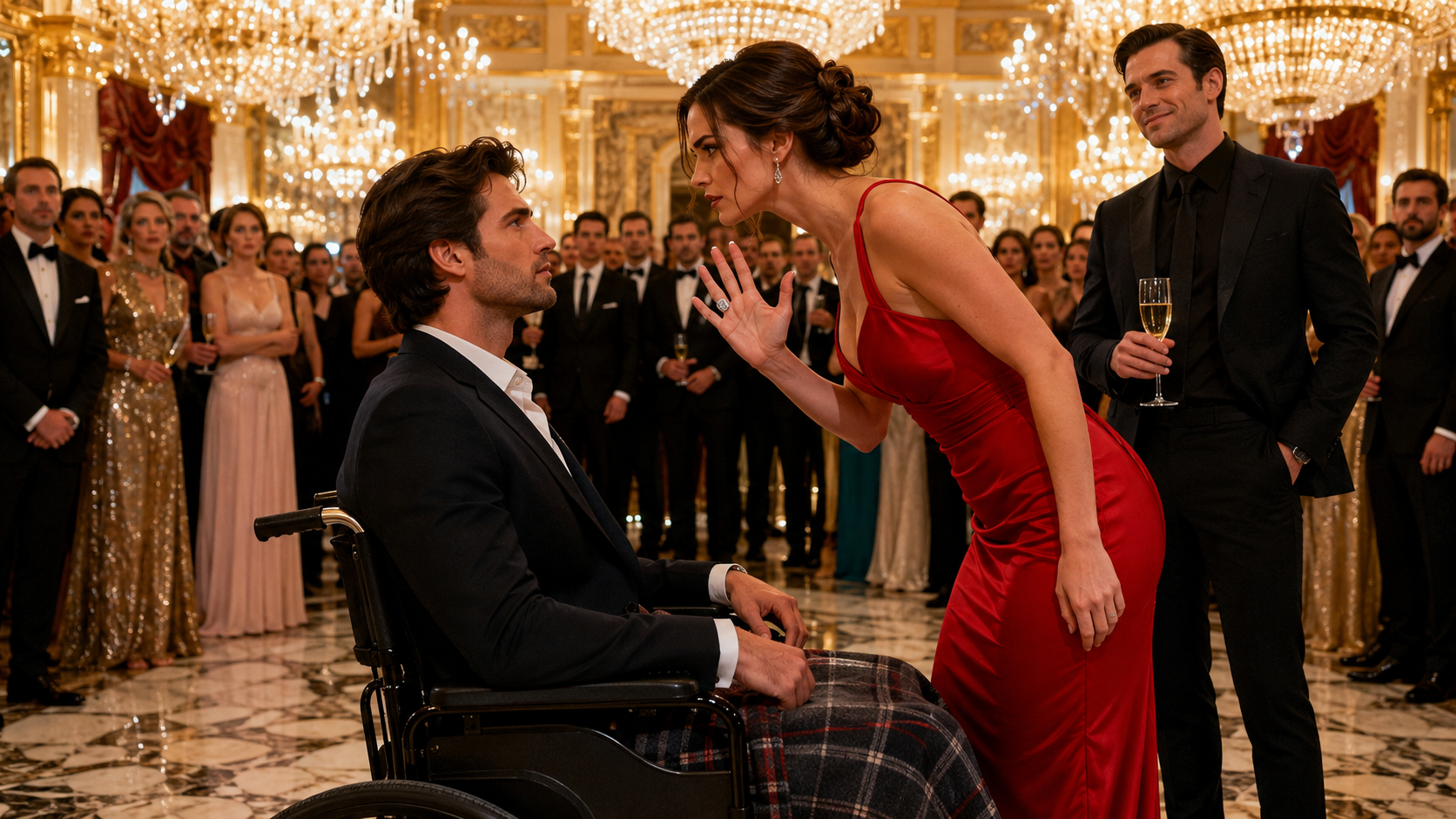
Vanessa ended our engagement by throwing the ring into my lap in front of nearly two hundred people.
“You’re completely useless now, Gabriel!”
Her voice cut through the ballroom louder than the string quartet.
For half a second, no one moved.
The violinist nearest the marble staircase dragged his bow across the strings and produced one long, wounded note before the music died completely.
Vanessa kept walking toward me.
Her red dress caught the light from the chandeliers with every step. I had watched her choose that dress three years earlier in Paris. She had laughed when I told her the color made everyone else in the room disappear.
That night, I wished she would.
Instead, every eye in the ballroom followed her.
She stopped directly in front of my wheelchair.
Her face was beautiful.
It was also completely empty of tenderness.
Six months earlier, I would have noticed the beauty first.
That night, I noticed the emptiness.
“You told everyone tonight was supposed to end the rumors,” she said.
My fingers tightened beneath the plaid blanket covering my legs.
“That was the idea.”
“The idea?” she repeated. “Do you know what people are saying about me?”
I almost laughed.
About her.
Of course.
Not about the coastal road.
Not about the crushed metal.
Not about the surgeons cutting into my back while my family waited outside an operating room.
Not about waking up unable to feel my left foot.
Not about the first three months when moving from my bed to a chair felt like climbing a mountain with broken bones.
People were apparently saying things about Vanessa.
“How terrible for you,” I said.
The room went colder.
Vanessa’s mouth tightened.
A few feet behind her stood Adrian.
He had a champagne glass in one hand and the expression of a man who had arrived early for an execution.
For the last several months, Adrian had been everywhere Vanessa was.
At dinners I had been too exhausted to attend.
At charity meetings she claimed I no longer had the strength for.
At lunches.
At parties.
At my own house.
He always had an explanation.
He was keeping her company.
Helping her through a difficult time.
Protecting her from gossip.
I had stopped asking questions because I had discovered something during my recovery.
When people think you are helpless, they become careless.
They speak too loudly.
They exchange looks directly in front of you.
They stop believing you are capable of understanding what is happening around you.
Adrian lifted his glass slightly.
“Don’t be bitter, Gabriel.”
Vanessa glanced back at him.
That glance told me more than any confession could have.
She looked relieved when she looked at him.
Then she looked back at me.
She looked burdened.
“I have given you six months,” she said.
“Given me?”
“Yes.”
The word came out sharp.
“I stayed while you recovered. I defended you. I told people the wedding was only postponed. I sat through dinners while everyone whispered that I was going to spend the rest of my life pushing my husband around in a chair.”
A woman near the fireplace lowered her eyes.
Someone else shifted uncomfortably.
I could feel humiliation spreading through the room like heat.
Vanessa leaned closer.
“I am thirty years old, Gabriel. I want a life.”
There had been a time when those words would have destroyed me.
Three months earlier, probably.
Maybe even six weeks earlier.
That night, they only made something inside me become very quiet.
“I never asked you not to have one.”
Her face changed.
She had expected pleading.
That was when I understood it.
This was not merely a breakup.
She had wanted me to beg.
She had wanted me to make my weakness public so that what she was about to do would somehow seem merciful.
Instead, I sat there looking at her.
My silence infuriated her.
With one violent movement, Vanessa pulled the engagement ring from her finger.
Gasps moved around the ballroom.
She held it up between us.
The diamond caught the chandelier light.
I remembered placing that ring on her finger beside a lake at sunset.
I remembered the way her hands had trembled.
I remembered believing I had never been happier.
Then she threw it.
The ring hit the plaid blanket over my legs, bounced once, and settled near my knee.
The sound was almost nothing.
A tiny metallic click.
Still, I heard it more clearly than anything else in the room.
Adrian smiled.
“A broken man belongs in the trash, sweetie.”
Someone whispered his name in warning.
He ignored them.
Vanessa gave a short laugh.
“Exactly.”
There it was.
Not fear.
Not exhaustion.
Not even selfishness.
Contempt.
That was what finally killed whatever remained of our engagement.
Not the ring.
Not Adrian.
That laugh.
I looked down at the diamond in my lap.
For six months, I had imagined this night differently.
I had imagined Vanessa crying when she saw me stand.
I had imagined my mother covering her mouth.
I had imagined applause.
I had imagined taking three slow steps toward my fiancée and saying, The doctors were wrong to tell us what might never happen. Look at me now.
My rehabilitation specialist had warned me not to expect miracles.
My body had ignored him.
Sensation had returned gradually.
First pain.
Then heat.
Then pressure.
Then the smallest movement in my toes.
I had spent months behind closed doors learning to stand again.
I had fallen so many times Maya stopped flinching when I hit the mat.
At first, I could stand for three seconds.
Then twelve.
Then a minute.
Then I took one step between parallel bars.
Then another.
Two weeks before the party, I had crossed the rehabilitation room without assistance.
Maya had cried.
I had laughed at her.
Then I had cried too.
I had kept my progress private.
Partly because I wanted to be certain.
Partly because I couldn’t endure watching hope turn to pity again if my body failed.
And partly because by then I had begun seeing the people around me more clearly than I ever had while standing.
Vanessa visited less often as I improved.
She did not know that I improved.
Adrian stopped speaking softly around me.
Several acquaintances stopped calling altogether.
But Maya?
Maya was there every morning.
Every bad afternoon.
Every night when my legs shook with muscle spasms.
Every humiliating moment when I hated needing help.
She had been working in our household long before the accident, mostly assisting with guest rooms, meals, and the endless small tasks that kept the house moving.
After I came home from the hospital, she volunteered to work my recovery schedule.
I had tried to refuse.
She had ignored me.
The first time I attempted to stand at home, I collapsed against her so hard we both went down.
I had cursed.
She had sat on the floor beside me and said, “Are you finished?”
I had stared at her.
“Finished what?”
“Feeling sorry for yourself.”
I nearly fired her.
Instead, I laughed for the first time since the accident.
Now, in the ballroom, Maya stood near the wall behind me.
I could feel her anger before I saw her move.
Vanessa turned as Maya crossed the polished floor.
“Maya,” I said quietly.
She did not stop.
She came straight to me, dropped to one knee, and took my cold hand between both of hers.
Her fingers were trembling.
“Sir Gabriel,” she said, and her voice almost broke. “Please don’t listen to them. You are so much more than what they see.”
The ballroom disappeared.
For one moment, all I saw was her.
Maya’s dark hair had been pulled back simply for the evening. She wore a plain black dress because she had been helping coordinate the staff, and there was nothing dramatic about her except the emotion in her eyes.
She looked furious on my behalf.
Not embarrassed.
Not pitying.
Furious.
Something inside me settled.
“Thank you, Maya.”
I squeezed her hand.
Then I looked at Vanessa.
She rolled her eyes.
“Oh, please. This is pathetic.”
Adrian chuckled.
“Careful, Maya. He might promote you to saint.”
I smiled.
It was the first real smile I had given either of them all night.
Adrian’s amusement faded.
I reached for the edge of the plaid blanket.
Vanessa frowned.
“What are you doing?”
I pulled it away.
The blanket slid from my knees and pooled beside the chair.
Several people leaned forward.
Maya rose.
She knew.
Of course she knew.
Her eyes met mine.
I placed both feet against the floor.
Adrian stared.
Vanessa stopped breathing.
I gripped the arms of the wheelchair.
Then I pushed myself upward.
My legs shook.
They always shook during the first second.
I straightened.
Silence swallowed the ballroom.
I stood.
Vanessa’s hand flew toward Adrian’s arm.
His champagne glass tilted enough for pale liquid to spill across his fingers.
Someone screamed.
Someone else whispered, “Oh my God.”
I released the chair.
Nothing held me except my own legs.
I took one step.
Then another.
Slowly.
Carefully.
But upright.
Vanessa looked as if I had risen from a coffin.
“No,” she whispered.
I almost laughed.
“No?”
“You—you can walk?”
“I can.”
“For how long?”
“Long enough.”
Her face drained of color.
“You lied to me.”
That was extraordinary.
I had spent months fighting for every inch of my body while she had spent months deciding I was no longer worth loving, and somehow my recovery had become a betrayal of her.
“You never asked how rehabilitation was going,” I said.
“That isn’t true.”
“When was my last appointment?”
Her mouth opened.
Nothing came out.
I turned toward Adrian.
“What exercises am I doing?”
He stared at me.
I looked back at Vanessa.
“Which leg regained strength first?”
Still nothing.
My voice remained calm.
“You didn’t know because you stopped caring.”
Vanessa swallowed.
“I was overwhelmed.”
“No. You were finished with me.”
“That isn’t fair.”
“You threw your engagement ring at a man you believed would never walk again.”
The room seemed to contract around her.
“And you laughed.”
I stepped toward the wheelchair.
The movement hurt.
I didn’t let it show.
I picked up the ring.
For a moment, I looked at it in my palm.
Then I held it out to Vanessa.
“Take it.”
She stared.
“Gabriel—”
“You made your choice while you thought I was broken. You don’t get to make a different one because I stood up.”
Her eyes filled.
Whether with shame, anger, or calculation, I did not know.
I did not care.
When she refused the ring, I set it on a nearby table.
Then I reached for Maya’s hand.
She looked startled.
I drew her gently to my side.
“I don’t need this wheelchair anymore,” I said. “And when I did, Maya was the only one who stayed beside me without making me feel ashamed of needing it.”
Maya’s fingers tightened around mine.
Vanessa looked at our hands.
Something ugly flashed across her face.
Then a glass shattered near the back of the ballroom.
Everyone turned.
An elderly woman stood frozen beside one of the columns.
I knew her only vaguely.
Mrs. Evelyn Hart.
She lived near the stretch of coastal road where my accident had happened. I had been told she was one of the first people to call for help that night.
I had invited her because my mother insisted anyone connected to saving my life belonged in the room when I announced my recovery.
Mrs. Hart was staring at Maya.
Not at me.
At Maya.
The blood had vanished from her face.
“Stayed?” she whispered.
Maya went rigid beside me.
Mrs. Hart pointed at her with a shaking hand.
“That’s not all she did.”
I looked at Maya.
Her expression terrified me more than the old woman’s words.
“Maya?”
She released my hand.
Mrs. Hart’s voice cracked.
“She was in the car that night.”
And suddenly, standing on my own legs no longer felt like the biggest revelation in the room.
PART 2: THE WOMAN IN THE WRECK
For several seconds, I thought I had heard Mrs. Hart incorrectly.
I looked from her to Maya.
Then back again.
“What did you say?”
Mrs. Hart seemed to realize the entire ballroom was staring at her.
“I—I’m sorry.”
She covered her mouth.
Maya had gone pale.
“Maya,” I said.
She would not look at me.
That was my first real answer.
Vanessa recovered before I did.
“What does she mean?”
“Vanessa,” I warned.
But she was already moving toward us.
“You were in Gabriel’s car?”
Maya’s hands were clenched at her sides.
“I can explain.”
Adrian let out a low laugh.
“Can you?”
My stomach tightened.
A memory flashed through me.
Rain hammering glass.
Headlights.
A scream.
Then nothing.
I had experienced fragments like that for months.
My doctors called them trauma memories.
Pieces without order.
Sounds without faces.
I could remember leaving the city that evening.
I could remember driving.
I could remember rain beginning somewhere along the coast.
After that, the night existed in pieces.
Metal screaming.
Cold air.
The smell of gasoline.
A woman crying.
I had always assumed the crying belonged to someone who found me afterward.
Now I looked at Maya.
She had begun working beside me almost immediately after I returned home from the hospital.
I remembered asking her why.
She had said, “Because you need someone who isn’t afraid of you when you’re angry.”
At the time, I thought it was a joke.
Now another detail came back.
The scar.
A pale, uneven mark crossed Maya’s left wrist and disappeared beneath her sleeve.
I had seen it hundreds of times.
Once, during a rehabilitation session, I asked where she got it.
She told me, “A long time ago.”
I had not asked again.
“Maya.”
She finally looked at me.
Her eyes were wet.
“Yes.”
One word.
It made the room tilt.
“You were with me?”
“Yes.”
Vanessa made a sharp sound.
“Oh my God.”
“Be quiet,” I said.
She stared at me.
I had never spoken to her like that before.
I didn’t care.
My attention stayed on Maya.
“Why don’t I remember that?”
“You were injured.”
“Why didn’t you tell me?”
Her lips parted.
No answer came.
That hurt more than I expected.
For months, she had helped me dress when my hands shook too badly from medication.
She had sat beside me during physical therapy.
She had argued with me when I wanted to stop.
She had held my shoulders while I screamed through muscle spasms.
She had been there the first time sensation returned to my foot.
The first time I stood.
The first time I fell after standing.
The first time I crossed a room.
I knew how she took her coffee.
I knew she hated lilies because she said they smelled like funerals.
I knew she hummed under her breath when she was nervous.
I knew she called everyone else by their first names but insisted on calling me “Sir Gabriel” whenever she wanted to annoy me.
I thought I knew her.
Yet she had been inside the car on the night that divided my life into before and after.
And she had never told me.
Adrian stepped closer.
“What exactly happened that night, Maya?”
I turned toward him.
“This is none of your business.”
“If she caused—”
“I said it is none of your business.”
My voice echoed.
He stopped.
Vanessa folded her arms.
“You defended her five minutes ago.”
“I still do.”
“Even after this?”
I looked at Maya.
“I don’t know what this is yet.”
That was the truth.
I had spent too many months being judged by people who only looked at a wheelchair.
I wasn’t going to make the same mistake with Maya because of one sentence spoken in a ballroom.
But something inside me had cracked.
Trust is strange.
It can survive anger.
It can survive distance.
Sometimes it can even survive betrayal.
What it cannot survive easily is the sudden discovery that a part of your life you considered solid has a hidden door in it.
Mrs. Hart stepped forward.
“I didn’t mean to cause trouble.”
“You recognized her?” I asked.
“Yes.”
“From the accident?”
She nodded.
Maya closed her eyes.
“How?”
Mrs. Hart looked at Maya with a strange mixture of pity and disbelief.
“I saw her beside the car.”
A noise moved through the guests.
Vanessa whispered, “Beside it?”
Mrs. Hart continued.
“It was raining. The car had gone through the barrier and struck the lower rocks. I was coming home from my sister’s house when I saw the broken guardrail.”
My pulse thudded.
I had never asked for details.
Everyone around me had learned quickly that descriptions of the accident could trigger nightmares.
My mother avoided it.
My doctors avoided it unless necessary.
I avoided the entire road.
Mrs. Hart swallowed.
“I stopped and called emergency services. Then I heard someone screaming.”
I looked at Maya.
She stared at the floor.
“A woman,” Mrs. Hart said. “She was down near the wreck. I could barely see her in the rain.”
“What was she doing?”
Mrs. Hart’s gaze shifted toward me.
“Trying to get someone out.”
The room changed again.
Vanessa’s certainty faltered.
Adrian frowned.
Maya shook her head.
“Mrs. Hart, please.”
“No,” I said.
Maya looked at me.
I hated the fear in her eyes.
But I needed the truth.
“All of it.”
Mrs. Hart’s voice softened.
“I don’t know all of it. I only know what I saw.”
She pointed toward Maya.
“That young woman was bleeding. Her clothes were torn. One of her arms looked badly burned.”
I looked at Maya’s scar.
She instinctively covered her wrist.
Mrs. Hart continued.
“She kept going back toward the car.”
My mouth went dry.
“For me?”
“Yes.”
Maya whispered, “Stop.”
Mrs. Hart did.
I stared at Maya.
“Why?”
Her eyes met mine.
“There were too many people here.”
“Then we go somewhere without people.”
Vanessa stepped toward me.
“Gabriel, you can’t seriously—”
I turned.
Something in my face made her stop.
“This evening is over.”
“Gabriel.”
“Leave.”
She stared at me.
“You’re throwing me out?”
“You ended our engagement.”
“I was upset.”
“You humiliated me because you believed I was disabled forever.”
“I didn’t mean—”
“You meant every word until I stood.”
Her face crumpled.
For one dangerous second, the old instinct rose in me.
Comfort her.
Protect her.
Tell her we could speak later.
Then I remembered the ring striking my lap.
A broken man belongs in the trash.
“Goodbye, Vanessa.”
Adrian put his hand on her shoulder.
I saw the intimacy in the gesture.
Maybe it had existed for months.
Maybe I had simply refused to see it.
Vanessa looked at Maya one final time.
“This isn’t finished.”
“No,” I said. “It is.”
She left with Adrian.
People followed slowly after that.
Some tried to speak to me.
I barely heard them.
Within twenty minutes, the ballroom that had been full of music and whispers was nearly empty.
Broken glass remained near the column where Mrs. Hart had stood.
My wheelchair waited beside the table.
The engagement ring still lay untouched next to a champagne flute.
Maya stood near the windows.
I walked toward her.
My legs were beginning to ache.
She noticed immediately.
“Sit down.”
Despite everything, irritation flashed through me.
“Don’t.”
“Your left leg is shaking.”
“I know.”
“You’ve been standing too long.”
“Maya.”
“Please.”
I hated that she was right.
I lowered myself into a chair.
Not the wheelchair.
A normal chair.
She remained several feet away.
For the first time since my recovery began, there seemed to be an impossible distance between us.
I looked at her wrist.
“Show me.”
She knew what I meant.
Slowly, she pulled back her sleeve.
The scar covered more than I remembered.
It started at her wrist, curled over the inside of her forearm, and disappeared near her elbow.
A burn.
My throat tightened.
“That happened that night?”
“Yes.”
“How?”
She looked away.
“Maya.”
“The car started smoking after the impact.”
I stopped breathing.
Another memory.
Heat.
A hand at my shoulder.
Someone coughing.
A woman shouting my name.
My fingers dug into the chair.
“I heard you.”
She went still.
“In my dreams,” I said. “I kept hearing a woman.”
Her eyes filled.
“It was me.”
The room blurred.
“How long were you in the car before the crash?”
“From the house.”
I stared.
“You were with me the entire drive?”
“Yes.”
“Why?”
She pressed her lips together.
“You offered to take me home.”
I almost laughed because the answer was so ordinary.
“You were working?”
“There had been a dinner here. Staff finished late. The buses had stopped because of the storm.”
“And I offered you a ride.”
“Yes.”
I searched my mind.
Nothing.
Only rain.
“You sat beside me.”
“Yes.”
“And after the crash?”
Her voice became almost inaudible.
“I woke up first.”
“What happened?”
She shook her head.
“Not tonight.”
Anger flashed through me.
“You don’t get to decide that.”
“I know.”
“Six months, Maya.”
“I know.”
“You watched me wake up terrified because I couldn’t remember.”
“I know.”
“You watched me blame myself.”
She flinched.
That told me something.
“What?”
“Gabriel…”
“What aren’t you telling me?”
Her face broke.
Not dramatically.
Quietly.
Like someone who had carried weight too long and finally lost the strength to pretend it wasn’t heavy.
“I thought you would hate me.”
I stared at her.
“For being in the car?”
“No.”
My heart began pounding.
“For what, then?”
Maya wiped a tear from her cheek.
She looked toward the dark windows.
Then she whispered the sentence that followed me into every nightmare that night.
“Because if I hadn’t been there, you never would have taken that road.”
PART 3: THE ROAD I COULDN’T REMEMBER
I did not sleep.
At three in the morning, I gave up pretending I could.
The house was silent.
The ballroom had been cleaned.
The broken glass was gone.
The flowers still stood beneath the chandeliers as though nothing ugly had happened among them.
I walked slowly down the corridor with one hand against the wall.
Every step sent a dull ache through my left hip.
Normally Maya would have appeared by then.
She somehow knew whenever I pushed too hard.
She would have said, “You are trying to prove something again.”
And I would have told her to mind her own business.
Then I would have sat because she was usually right.
That night, she wasn’t there.
She had gone to her room after speaking to me.
I had let her.
I didn’t know what else to do.
Her final words kept repeating in my head.
If I hadn’t been there, you never would have taken that road.
What did that mean?
Had I changed direction for her?
Was the accident truly an accident?
Had she distracted me?
Had we argued?
The worst possibilities grew naturally in darkness.
By sunrise, I despised myself for imagining them.
Then I despised her for giving me reasons to.
Shortly after seven, I found Maya in the kitchen.
She was sitting alone at the long wooden table with a cup of untouched coffee.
There were shadows beneath her eyes.
She stood when I entered.
“You should be using the cane.”
“I don’t want to discuss my cane.”
“You’re limping.”
“Maya.”
She went quiet.
I sat across from her.
For several seconds, neither of us spoke.
Finally, I said, “Tell me what happened before the crash.”
Her hands tightened around the cup.
“Everything?”
“Everything you remember.”
She inhaled slowly.
“There had been a dinner at the house.”
I nodded.
That much I remembered.
“Your guests left late. The storm was getting worse. Most of the staff had rides arranged, but mine didn’t come.”
“Why?”
“Road closures.”
“And I offered to drive you.”
“Yes.”
“Was that unusual?”
She almost smiled.
“You complained first.”
That sounded like me.
“What did I say?”
“You said if I slept in the staff room, I would probably complain about the mattress for three weeks.”
A faint memory stirred.
Not an image.
A feeling.
Warm kitchen light.
Maya arguing.
I pressed my fingers against my temple.
“Go on.”
“You were going into the city anyway.”
“Why?”
Her expression changed.
“Vanessa called you.”
I looked up.
“She was at a dinner.”
“With Adrian?”
Maya hesitated.
“I didn’t know then.”
“But?”
“She sounded upset. You said you were coming.”
The room seemed to shrink.
“Vanessa never told me that.”
“I don’t know what she told you after the accident.”
Apparently, not much.
Maya continued.
“You said you could drop me home on the way.”
“Which meant the coastal road.”
“Yes.”
There it was.
If Maya had not needed a ride, I might have taken the highway.
But Vanessa’s call had been the reason I left the house at all.
The accident sat at the intersection of ordinary choices.
No conspiracy.
No villain.
Just rain, timing, and a road.
“What happened in the car?”
“At first? Nothing.”
She looked down.
“You were quiet.”
“Were we arguing?”
“No.”
“Were you distracting me?”
“No.”
“Did you touch the wheel?”
Her eyes snapped to mine.
“No.”
The strength of the answer surprised me.
“Then why did you think I would hate you?”
“Because I asked you to take the coast.”
I frowned.
“You asked?”
“The highway was already backing up because of flooding. You wanted to wait. I told you the coastal road would be faster.”
Guilt filled her voice.
I leaned back.
“Maya.”
“I was wrong.”
“You could not know we would crash.”
“If I had kept my mouth shut—”
“Then perhaps we would have been stranded somewhere else.”
“You don’t know that.”
“Neither do you.”
Her jaw trembled.
I recognized the expression.
It was the same one I had worn for months while asking questions nobody could answer.
What if I had left ten minutes later?
What if I had driven slower?
What if I had canceled?
What if I had seen the danger sooner?
Trauma feeds on imaginary roads.
Every path except the one that happened begins to look safer.
“What caused the crash?” I asked.
Maya stared into her coffee.
“The rain got heavier.”
I waited.
“We were approaching one of the bends.”
My hands became cold.
She noticed.
“Do you want me to stop?”
“No.”
“There was water running across the road.”
Images flashed.
Wipers.
Darkness.
White lines disappearing beneath rain.
“You slowed down,” she said. “You were driving carefully.”
Something inside me loosened.
I had always feared the opposite.
That perhaps I had been careless.
“You told me not to worry. You said we’d be through the worst part soon.”
Her voice shook.
“Then the rear tires lost traction.”
I saw it.
Not as memory exactly.
As fragments.
A violent sideways movement.
My hands fighting the steering wheel.
Maya shouting.
“The car turned,” she continued. “You corrected it once.”
I tasted metal.
“Then?”
“The tires caught again too suddenly.”
My chest tightened.
“We hit the barrier.”
Her eyes closed.
“The first impact broke it.”
The kitchen vanished.
I heard steel.
I heard myself grunt.
Then weightlessness.
“The car went down the slope,” Maya said. “It struck rock on the driver’s side.”
My left leg began trembling under the table.
“And you?”
“The airbag went off. I hit my head.”
“You were unconscious.”
“I think only briefly.”
I swallowed.
“What do you remember next?”
“Smoke.”
My eyes dropped to her arm.
“Yes,” she said.
I forced myself to ask.
“What did you do?”
“I tried my door. It wouldn’t open.”
I could almost hear her breathing faster.
“The windshield was cracked. Your window had shattered. You weren’t moving.”
Her voice broke.
“I thought you were dead.”
I looked away.
She continued because I had asked for everything.
“I called your name.”
The nightmare voice.
Gabriel.
Again.
Gabriel, wake up.
My heart hammered.
“I remember that.”
Maya froze.
“I remember your voice.”
Tears immediately filled her eyes.
“I couldn’t wake you,” she said. “There was smoke coming from the front of the car. I found my phone, but it was broken. I didn’t know if anyone had seen us go over.”
“How did you get out?”
“I kicked at the passenger window.”
Her hands had begun shaking.
“It took several tries. I cut my leg climbing through.”
I glanced beneath the table automatically.
She noticed.
“There’s a scar.”
I said nothing.
“I climbed back to your side. Your door was crushed.”
My throat closed.
“Maya—”
“You asked.”
She was right.
I nodded.
She continued.
“I tried pulling you through the window.”
“You couldn’t.”
“No.”
She gave a tiny, broken laugh.
“You were heavier then.”
Despite everything, I almost smiled.
Almost.
“The seat belt wouldn’t release,” she said. “I found a piece of broken glass and tried cutting it.”
Her fingers moved unconsciously toward the scar on her wrist.
“Something sparked under the dashboard.”
I understood.
“The burn.”
She nodded.
“I don’t remember feeling it at first.”
“You kept trying?”
“Yes.”
“Why?”
The question escaped me before I could stop it.
Maya stared at me.
“Because you were alive.”
Simple.
No speech.
No dramatic declaration.
Because I was alive.
She looked down again.
“I finally got the belt loose. I pulled you through the window and down into the rain.”
“You pulled me out by yourself?”
“Mostly dragged you.”
I pictured Maya—smaller than me, bleeding, burned, terrified—trying to move my unconscious body down wet rocks.
My anger did not disappear.
But it changed shape.
“Mrs. Hart found you then?”
“Not immediately.”
“What happened?”
“I couldn’t move you far enough.”
Her voice became thin.
“I thought the car was going to catch fire.”
My breathing stopped.
“I kept pulling.”
She wiped her cheek.
“You started making a sound.”
“What sound?”
“Like you were trying to breathe but couldn’t.”
Another memory hit.
Rain against my face.
Hands under my shoulders.
A woman sobbing.
Please.
I gripped the edge of the table.
“Maya.”
She stood immediately.
“Gabriel?”
My vision darkened at the edges.
She moved around the table but stopped herself before touching me.
That hesitation hurt.
I reached for her wrist.
Her skin was warm.
And then memory broke open.
Not completely.
Enough.
I saw her face above mine in the rain.
Blood running from her forehead.
I heard her screaming toward the road.
I remembered opening my eyes for one second.
“Maya.”
She stopped breathing.
“I saw you.”
Tears spilled down her face.
“On the rocks.”
She covered her mouth.
“You were holding me.”
“Yes.”
“And you kept telling me not to sleep.”
“Yes.”
My eyes burned.
“You said help was coming.”
“Yes.”
I looked at the scar beneath my fingers.
“Why didn’t you tell me?”
Her face folded.
“Because when you woke up in the hospital, you didn’t remember.”
“That wasn’t your decision to make.”
“I know.”
“Did my family know?”
“That there had been a passenger, yes.”
I stared.
“They knew it was you?”
“My name was in the report. Your mother knew.”
Anger flared again.
“Why did everyone hide this from me?”
“They weren’t trying to hide me.”
“Then what?”
“Your doctors told them not to force the missing memories. You were having panic attacks whenever anyone talked about the accident.”
That was true.
For weeks, even the sound of heavy rain made me shake.
“The doctors said memories might return naturally,” she said. “Your mother asked the staff not to discuss details unless you asked.”
“And you?”
“I should have told you later.”
“Yes.”
“I tried.”
“When?”
“Many times.”
I thought back.
Her strange silences.
The way she sometimes went pale when rain hit the windows.
The time I asked about her scar and she left the room a minute later.
All clues I had noticed without understanding.
“What stopped you?”
Maya sank back into her chair.
“You were learning to walk again.”
“That isn’t an answer.”
“You trusted me.”
“That is exactly why you should have told me.”
“I know.”
Her voice cracked.
“I was afraid that once you remembered the road, you would look at me and see the reason you were there.”
I stared at her.
“You think I would blame you because you suggested a route?”
“I blamed myself.”
“That’s not the same thing.”
“It felt the same.”
I understood that too well.
For six months, I had blamed my own hands on the steering wheel.
My own decision to leave home.
My own body for failing to protect itself.
Guilt does not need logic.
It only needs somewhere to live.
“Why did you stay?” I asked.
She looked at me.
“After I came home.”
Her answer took a long time.
“At first?”
“Yes.”
“Because I owed you.”
The words hurt.
She saw it.
“Gabriel—”
“So Vanessa was wrong about one thing and right about another.”
“What?”
“You weren’t beside me because I mattered. You were there because you felt guilty.”
“At first,” she repeated.
I released her wrist.
She went pale.
“And later?”
Maya looked directly at me.
“Later, I stayed because you mattered.”
Neither of us moved.
She continued quietly.
“I stayed because you were furious at the world and pretending you weren’t afraid.”
I swallowed.
“I stayed because everyone celebrated when you moved your foot, but no one stayed with you afterward when you cried because moving one foot wasn’t the same as having your life back.”
My eyes dropped.
“I stayed because the first time you stood for five seconds, you apologized for falling.”
A laugh escaped me.
It hurt.
“You yelled at me.”
“You needed yelling at.”
“I probably did.”
“You definitely did.”
For one moment, we were ourselves again.
Then the truth settled between us.
Maya’s expression became serious.
“But I should have told you.”
“Yes.”
“I am sorry.”
I nodded.
Sorry mattered.
It simply did not erase six months of silence.
“What happens now?” she asked.
I looked toward the rain-streaked windows.
“I don’t know.”
She stood slowly.
“I’ll pack my things.”
My head snapped toward her.
“I didn’t tell you to leave.”
“You shouldn’t have to.”
“Maya.”
She shook her head.
“Everything is confused now. Vanessa. The party. The accident. Me.”
“So your answer is disappearing?”
“No.”
“Sounds like it.”
Her eyes flashed.
“My answer is giving you room to decide whether you can ever trust me again without me standing beside you every hour making you feel obligated.”
“I have never felt obligated to you.”
“You might now.”
She was right.
I hated it.
Maya walked toward the door.
My chest tightened.
“Where are you going?”
“To give you the one thing I should have given you months ago.”
“What?”
“A choice made with the truth.”
Then she left.
And for the first time since the accident, I realized I had become terrified of recovering alone.
PART 4: WHAT THE RAIN GAVE BACK
Maya did not leave the house immediately.
She moved out of the rooms near mine and returned to the small staff wing where she had lived before my accident.
She stopped attending my rehabilitation sessions.
I told myself that was what I wanted.
Three days later, I nearly fell trying to walk down the eastern staircase.
My therapist caught me.
Maya would have mocked me for attempting stairs before my left knee was stable.
Instead, the hallway remained painfully quiet.
Vanessa called fourteen times.
I answered none of them.
Adrian sent one message.
You made everyone look foolish.
I deleted it.
That sentence told me everything I needed to know about him.
He was not sorry for what he had said.
He was angry that I had stood.
On the fourth day, Mrs. Hart visited.
I almost refused to see her.
Then I remembered Maya bleeding in the rain.
I invited her into the library.
Mrs. Hart carried a small handbag in both hands.
“I owe you an apology.”
“No.”
“I caused a scene.”
“The scene had already happened.”
She smiled sadly.
“I suppose that’s true.”
I gestured toward the chair opposite mine.
She sat.
“You recognized Maya immediately?”
“Yes.”
“Why didn’t you say anything when you arrived?”
“I wasn’t certain at first.”
She looked embarrassed.
“It was six months ago. Dark. Raining. She was covered in blood.”
I nodded.
“Then she knelt beside you.”
Mrs. Hart’s expression softened.
“I saw her profile.”
She stared toward the window.
“And suddenly I was back on that road.”
I understood that.
“Tell me what you remember.”
She hesitated.
“I don’t want to upset you.”
“I spent six months avoiding being upset.”
I leaned back.
“It didn’t help.”
So she told me.
She told me about seeing my broken taillight below the barrier.
About calling emergency services.
About climbing partway down the slope before realizing the ground was too unstable for someone her age.
She told me Maya had screamed until her voice went hoarse.
“She kept trying to move you farther from the vehicle,” Mrs. Hart said.
I looked at my hands.
“Was there fire?”
“Not the way you’re imagining. Smoke. Sparks. Then flames began near the engine after rescue crews arrived.”
“So she believed it could burn.”
“She had every reason to.”
Mrs. Hart became quiet.
“There is something else.”
I looked up.
“When the paramedics came, they tried to treat her first.”
“Because she was conscious.”
“Yes.”
“She refused?”
Mrs. Hart nodded.
“She kept pointing at you.”
My throat tightened.
“She told them your name. She told them you had hit the driver’s side harder. She kept insisting they take you before her.”
I stared toward the floor.
“She collapsed shortly afterward.”
“How badly was she hurt?”
“Concussion. Burns. Cuts. Cracked ribs, if I remember.”
I closed my eyes.
During those same weeks, I had been waking up in a hospital asking why my legs would not move.
Maya had been injured too.
And when she recovered enough to work, she had come back.
“Did she tell you she caused it?”
Mrs. Hart looked startled.
“No.”
“She blamed herself for suggesting the coastal road.”
The old woman sighed.
“People who survive frightening things become very creative about finding reasons to punish themselves.”
I looked at her.
She smiled gently.
“I speak from experience.”
For the first time, I understood why Mrs. Hart had looked at Maya with pity rather than anger.
“You didn’t think she was responsible.”
“Responsible?”
Mrs. Hart shook her head.
“The police said the road surface and weather were enough to explain it. Your vehicle lost traction.”
No hidden enemy.
No secret attack.
No mysterious driver.
Just rain.
A road.
Bad luck.
And two people who lived.
I sat with that for a long time.
Before Mrs. Hart left, she touched my shoulder.
“That young woman should have told you.”
I looked at her.
“But those are two different questions, Mr. Gabriel.”
“What are?”
“Whether she was wrong to hide the truth.”
She paused.
“And whether she stayed because she cared.”
After she left, I went upstairs.
Slowly.
With the cane this time.
I found Maya packing.
Her room looked smaller than I remembered.
A suitcase sat open on the bed.
She folded a sweater without looking at me.
“You should knock.”
“I did.”
“No, you didn’t.”
“I thought about knocking.”
“That isn’t the same thing.”
“I’ll improve.”
She almost smiled.
Then she saw my expression.
Her hands stopped.
“Mrs. Hart came.”
Maya looked down.
“She told me what happened after the crash.”
Silence.
“You didn’t owe me,” I said.
Maya frowned.
“You said you stayed because you owed me.”
“I did.”
“You had it backward.”
She went still.
“You pulled me out of a wreck.”
“Gabriel—”
“You got burned trying to free me.”
“I was already outside.”
“You went back.”
She looked away.
“You refused treatment until they reached me.”
“Anyone would have.”
“No.”
The word came out sharper than I intended.
“No, Maya. Not everyone would have.”
Vanessa’s face flashed through my mind.
Adrian’s smile.
A broken man belongs in the trash.
I looked at Maya.
“Some people leave when staying becomes inconvenient.”
Her eyes filled.
“Don’t turn me into something better than I am.”
“I’m not.”
I stepped farther into the room.
“You lied by omission for six months.”
She flinched.
“You let me trust you without knowing something you knew I would want to know.”
“I know.”
“I am still angry about that.”
“You should be.”
“But I understand it now.”
Her eyes lifted.
“You were ashamed.”
“Yes.”
“You thought the accident was your fault because you suggested the road.”
“Yes.”
“And the longer you stayed, the harder it became to tell me.”
“Yes.”
I nodded.
“That was cowardly.”
A tear slipped down her cheek.
“I know.”
“But it wasn’t cruel.”
She stared at me.
“There is a difference.”
I walked toward the suitcase.
I wasn’t steady enough to do it elegantly.
I didn’t care.
“What are you doing?” she asked.
I removed the sweater she had just folded.
“Gabriel.”
I put it back in the drawer.
“Stop.”
I took out another shirt.
She grabbed it from me.
“You cannot unpack my things while I am packing.”
“Apparently I can.”
“Why?”
Because the answer mattered, I did not say it quickly.
“I don’t want you staying because you think you owe me.”
Her expression tightened.
“And I don’t want you leaving because you think I can’t separate your mistake from everything else you’ve done.”
Her fingers loosened around the shirt.
“I need you to understand something.”
I waited.
“When I came back after the hospital, it was guilt.”
I nodded.
“I would sit outside your room before every shift and tell myself I had to help fix what I had caused.”
Her voice shook.
“Then one morning you threw a water glass at the wall because you couldn’t stand without assistance.”
“I remember.”
“You were horrible.”
“I remember that too.”
“You told me to leave.”
“Yes.”
“I went home that night.”
She swallowed.
“And I realized I could leave.”
I stared at her.
“No one was forcing me to come back.”
She pressed the shirt against her chest.
“I wasn’t trapped here.”
Her eyes met mine.
“But the next morning, I came back.”
“Why?”
“You had made me laugh.”
I blinked.
“That was your reason?”
“One of them.”
“When?”
“After you threw the glass.”
I stared.
“You said, ‘At least my aim still works.’”
A laugh escaped me.
“I did say that.”
“You were unbearable.”
“So I’ve heard.”
She smiled through tears.
“And stubborn.”
“Yes.”
“And angry.”
“Yes.”
“And terrified.”
My smile disappeared.
Maya continued softly.
“And still yourself.”
My throat tightened.
“I stopped coming because of the accident.”
She placed the shirt on the bed.
“I came because I wanted to see you stand again.”
I could not speak.
“I wanted to be there when you stopped looking at the wheelchair as if it had stolen your name.”
She wiped her cheek.
“And when you finally stood, I thought maybe I had stayed long enough.”
“That was why you were going to leave?”
“Eventually.”
“Without telling me?”
“I didn’t know how.”
I exhaled.
“You have a serious problem with conversations.”
She laughed unexpectedly.
It broke something open between us.
Not completely.
But enough.
I sat on the edge of the bed because my leg had begun trembling.
Maya noticed.
She didn’t tell me to rest.
She waited.
That small act mattered.
After a moment, I said, “Vanessa called.”
Maya’s expression closed.
“I don’t want to talk about Vanessa.”
“I do.”
“Why?”
“Because I finally understand what she did to me.”
Maya sat in the chair opposite.
I looked at the cane in my hand.
“When I thought I might never walk again, I became desperate to be the version of myself everyone remembered.”
She listened.
“I tried to talk the same. Dress the same. Run things from bed. Pretend none of it frightened me.”
My voice became quieter.
“And every time Vanessa looked at me, I felt like she was measuring what had disappeared.”
Maya said nothing.
“The chair wasn’t what broke us.”
“No.”
“She believed it did.”
I nodded.
“But it only showed me what was already there.”
I looked at Maya.
“Maybe that’s what the accident did to everything.”
“What do you mean?”
“It didn’t create Adrian.”
“No.”
“It didn’t create Vanessa’s contempt.”
“No.”
“It didn’t create your guilt.”
Her eyes lowered.
“It just made all of us unable to hide forever.”
For a while, we sat quietly.
Then Maya glanced at the suitcase.
“What do you want me to do?”
I thought about it carefully.
“Nothing because you owe me.”
She nodded.
“Nothing because you saved me.”
Another nod.
“And nothing because you feel sorry for me.”
Her mouth twitched.
“I have never felt sorry for you.”
“I know. It’s one of your better qualities.”
“Thank you.”
“I want you to choose.”
Her expression became uncertain.
“Choose what?”
“Whether you stay.”
She stared at me.
“As your employee?”
That question had no easy answer.
So I gave her the truthful one.
“For now, as the person who has been standing beside me while I learned how to stand by myself.”
Her eyes filled again.
“And later?”
I looked at her.
“Later, we stop letting guilt decide things for us.”
She said nothing.
But she closed the suitcase.
PART 5: THE PEOPLE WHO STAY
Vanessa returned one week later.
She did not call first.
I was in the rehabilitation room when someone told me she was waiting downstairs.
Maya stood beside the parallel bars with a stopwatch.
“Do you want me to go?”
“No.”
“It might be easier.”
“That has never been your preferred method.”
She smiled faintly.
“No.”
“Then stay.”
I completed another length between the bars.
My gait was still uneven.
My left foot dragged slightly when I became tired.
I was learning that recovery did not happen in one dramatic moment.
Standing in the ballroom had looked miraculous.
Living afterward remained work.
That distinction mattered to me now.
I was no longer interested in performing recovery for anyone.
When I entered the sitting room twenty minutes later, Vanessa was standing near the fireplace.
Adrian was with her.
Of course he was.
Vanessa looked different.
No red dress.
No diamonds.
She wore cream and looked deliberately fragile.
Once, I would have responded to that.
I sat in an armchair.
Maya remained near the doorway.
Vanessa noticed her.
Her mouth tightened.
“You brought her?”
“She was already here.”
Adrian laughed under his breath.
I looked at him.
“Why are you here?”
His smile disappeared.
Vanessa answered for him.
“I didn’t want to come alone.”
“You weren’t frightened of humiliating me alone.”
“Gabriel, please.”
She sat across from me.
“We need to talk about what happened.”
“No. You need to talk. I already understand what happened.”
“You embarrassed me.”
The sentence was almost identical to Adrian’s message.
I felt nothing.
“You ended our engagement publicly.”
“Because I thought—”
She stopped.
“Say it.”
Her eyes lowered.
“I thought you were never going to recover.”
There it was.
Not regret.
Calculation.
“You thought I would remain disabled.”
“Yes.”
“And that made me useless.”
“No.”
“You said exactly that.”
“I was angry.”
“Why?”
Her eyes flashed.
“Because my entire life changed too!”
For the first time, I saw something genuine.
Not flattering.
But genuine.
“You weren’t the only person who lost something,” she said. “Our wedding disappeared. Our plans disappeared. Everything became hospitals and therapy and people asking me how you were doing.”
“That must have been exhausting.”
“Don’t mock me.”
“I am not.”
I leaned forward.
“I wish you had told me you couldn’t handle it.”
She blinked.
“I wish you had walked into my room three months ago and said, ‘Gabriel, I cannot live this life.’”
Her lips parted.
“It would have hurt.”
I nodded.
“But I would have respected the truth.”
Silence.
“Instead, you stayed just long enough to resent me for needing you.”
Her face tightened.
“I tried.”
“I believe you.”
That surprised her.
“So you understand?”
“I understand.”
Hope flickered in her eyes.
Then I finished.
“And I still don’t want you back.”
The hope disappeared.
Adrian shifted near the fireplace.
Vanessa stared at me.
“You hid that you could walk.”
“I hid nothing from someone who was present.”
“That isn’t fair.”
“Maya knew.”
Her eyes flashed toward the doorway.
“Of course Maya knew.”
“Yes.”
“Because she made herself indispensable.”
Maya stiffened.
I lifted one hand before she could respond.
Vanessa leaned closer.
“Have you even considered that she manipulated you?”
“Yes.”
Maya looked at me in surprise.
“I considered everything after Mrs. Hart spoke.”
Vanessa seemed encouraged.
“She lied to you for months.”
“Yes.”
“She was in the car.”
“Yes.”
“She admits the reason you took that road was because of her.”
“Yes.”
Vanessa smiled.
“So how can you trust her?”
I looked at Maya.
Her face was pale.
She was not asking me to defend her.
That mattered.
I turned back to Vanessa.
“Because when the lie became exposed, Maya admitted it.”
Vanessa’s smile faded.
“She didn’t blame someone else.”
I continued.
“She didn’t change her story depending on what benefited her.”
Adrian looked toward the window.
“She told me something shameful about herself even though she believed I might ask her to leave.”
Vanessa sat very still.
“And then she gave me room to decide.”
I watched understanding reach her.
“You are comparing us.”
“No.”
I shook my head.
“I stopped doing that.”
That hurt her more.
Vanessa stood.
“I loved you.”
“I think you did.”
“Then why isn’t that enough?”
Because once I would have asked the same question.
I answered carefully.
“Because love that survives only while someone is strong isn’t the kind of love I want.”
Her face crumpled.
For the first time that morning, I felt sorry for her.
Not enough to take her back.
Enough to stop being angry.
She looked toward Maya again.
“Are you in love with her?”
The room became silent.
Maya looked at me.
I could have made a dramatic declaration.
Months earlier, perhaps I would have.
But I had learned something about dramatic declarations.
They were easy.
Staying was harder.
“I don’t know what Maya and I will become.”
Maya’s eyes widened slightly.
I continued.
“And I won’t turn gratitude into a romance because she saved my life.”
Maya’s shoulders softened.
“I won’t make her responsible for fixing what you broke either.”
Vanessa swallowed.
“But?”
I looked at Maya.
“But whatever comes next between us will begin with the truth.”
Maya held my gaze.
Vanessa understood.
She picked up her handbag.
At the doorway, she stopped.
“I really was afraid, Gabriel.”
I believed her.
“I know.”
“I didn’t know how to watch you become someone else.”
I looked down at my legs.
Then back at her.
“That was the problem.”
She frowned.
“I didn’t become someone else.”
My voice stayed quiet.
“I was still me.”
Vanessa lowered her eyes.
A second later, she left.
Adrian followed.
He did not say goodbye.
I never expected him to.
The door closed.
For a long time, Maya and I said nothing.
Then she looked at me.
“You handled that well.”
“I was magnificent.”
“You were tolerable.”
“There she is.”
She smiled.
I pushed myself upright.
My knee buckled slightly.
Maya instinctively stepped forward.
Then stopped.
She waited for me to decide.
I steadied myself.
“I’m fine.”
“I know.”
Three weeks later, I asked the driver to take me to the coastal road.
Maya came with me.
We stopped near the repaired guardrail.
The weather was clear.
I had imagined returning there a thousand times.
In every version, the place was monstrous.
In reality, it was only a road.
Gray pavement.
Rock.
Ocean.
Wind.
The guardrail was newer than the sections around it.
That was the only obvious evidence anything had happened.
I stepped from the car using my cane.
Maya stood beside me.
Neither of us spoke for a while.
Below us, the water struck the rocks in slow white bursts.
“I thought I’d remember everything when I came back,” I said.
“Do you?”
“No.”
Some fragments had returned.
Her voice.
The impact.
Rain.
Her hand beneath my shoulder.
Enough.
Maybe the rest would come someday.
Maybe it would not.
For the first time, that possibility did not terrify me.
Maya looked toward the bend in the road.
“I’m sorry.”
I sighed.
“We are banning that sentence.”
She looked at me.
“What?”
“You are no longer allowed to apologize for suggesting this road.”
“I can apologize if I want.”
“No.”
“You are extremely controlling for someone who nearly fell putting on socks yesterday.”
“That was a complicated situation.”
“It was a sock.”
“It was an aggressive sock.”
She laughed.
The sound carried into the wind.
I stared at her.
Months earlier, the scar on her wrist had been only an unexplained mark.
Now I knew what it meant.
Not perfection.
Not sainthood.
Not debt.
A choice.
She had been terrified and injured, and she had gone back toward the wreck anyway.
Then, later, she had made another choice.
She stayed.
Imperfectly.
Guiltily.
Silently for too long.
But she stayed.
“I remember something else,” I said.
Her smile faded.
“What?”
“After you pulled me out.”
She became very still.
“I remember opening my eyes.”
Her throat moved.
“You told me not to sleep.”
“Yes.”
“I asked you if you were hurt.”
Maya blinked rapidly.
“You remember that?”
“Just now.”
Her eyes filled.
“What did I say?”
“You lied.”
A tear slipped down her cheek.
“I said I was fine.”
“You were bleeding everywhere.”
“I didn’t want you to panic.”
“You were terrible at lying.”
She gave me a look.
I smiled.
Then another memory came.
Small.
Warm.
Painful.
I heard my own broken voice beneath the rain.
Don’t leave.
Maya had answered immediately.
I won’t.
My breath caught.
She noticed.
“What is it?”
I looked at her.
“You promised me something.”
Her face changed.
I knew she remembered.
“You told me you wouldn’t leave.”
Tears filled her eyes.
“I thought you were unconscious.”
“Apparently I was listening.”
She looked toward the ocean.
“I stayed until the ambulance came.”
“No.”
I stepped closer.
“You stayed longer than that.”
Neither of us spoke.
The wind pushed a strand of hair across her cheek.
Without thinking, I reached for her hand.
She looked down at our fingers.
Then at me.
There was no ballroom.
No audience.
No Vanessa.
No Adrian.
No one waiting to applaud because I was standing.
I did not need any of them.
I only needed to know that when I reached for Maya, she was choosing to reach back.
“I’m not asking for forever,” I said.
She studied my face.
“Good.”
I laughed.
“That would have been embarrassing.”
“Very.”
“I’m asking whether you want to walk with me.”
Her gaze dropped deliberately to my cane.
“That feels like a dangerous choice of words.”
“You know what I mean.”
She smiled.
“Yes.”
I waited.
“Yes what?”
“Yes, Gabriel.”
I raised an eyebrow.
“No ‘Sir Gabriel’?”
“Absolutely not.”
“Disrespectful.”
“You’ll survive.”
I looked down the coastal road.
Six months earlier, I had believed everything important had been taken from me there.
My legs.
My future.
My certainty.
The life I expected to live.
I had been wrong.
The road had taken something.
But not what I thought.
It had taken away my ability to believe that standing made a person strong.
Vanessa could stand perfectly and still abandon me.
Adrian could walk into any room and still be small.
Maya had crawled over broken glass.
I had learned to cross a room one shaking step at a time.
Strength had never been about whether your legs held you.
It was about what you did when they didn’t.
I took one step.
Then another.
Maya matched my pace without pulling me and without rushing ahead.
Halfway toward the bend, my left leg began to ache.
I stopped.
Months earlier, I would have hidden it.
“I need a minute.”
Maya nodded.
So we stood together beside the road.
Not because I was helpless.
Not because she owed me.
Because neither of us was pretending anymore.
When we started walking again, the ocean stretched bright and endless beside us.
I did not know whether I would ever run.
I did not know whether the pain would disappear completely.
I did not know what Maya and I would call whatever was growing between us.
For once, I did not need to know.
I had spent months believing my life would begin again the day I rose from the wheelchair.
I had been wrong about that too.
My life began again the moment I understood that standing up was only the beginning.
The harder thing was learning who deserved to stand beside me.
And this time, when I reached for Maya’s hand, neither of us let go.
Để lại một bình luận