
PART 1: THE ROOM AT THE END OF THE HALL
When I pushed open the bedroom door at the far end of the hallway, I realized the worst thing a person could discover was not that someone had lied to them.
It was discovering how carefully they had prepared the lie.
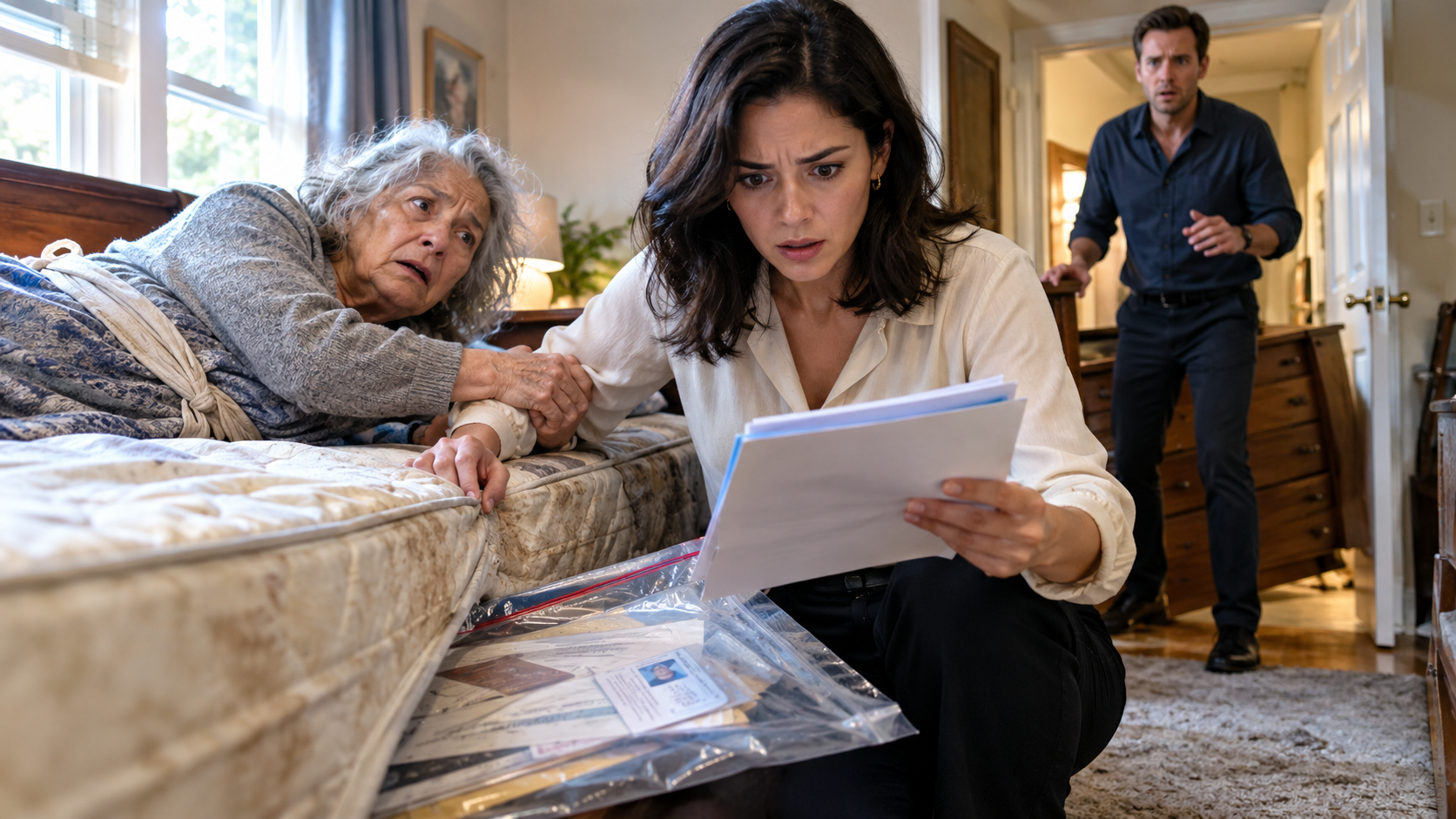
My seventy-one-year-old mother was lying on a stained mattress beneath a window with yellowed blinds.
A strip of torn cloth was wrapped around her waist and tied to the metal bedframe.
Her lips were cracked.
Her cheeks had collapsed inward.
Her silver hair, once brushed every morning no matter how much pain she was in, hung in greasy knots around her face.
Two cockroaches crawled across the wall beside a plastic plate containing what looked like several-day-old mashed potatoes.
For a moment, I couldn’t breathe.
“Mom?”
My voice came out so softly I barely heard it myself.
Rose Morales opened her eyes.
I had spent thirty-four months imagining this moment.
Sometimes during my lunch break in Doha, I would sit behind the luxury hotel where I worked and imagine walking through the front door in Florida without warning.
Mom would be sitting near the window.
She would see me.
She would cry.
I would cry.
I would kneel beside her chair and bury my face in her lap the way I had when I was ten years old.
Instead, when my mother saw me standing in the doorway, she recoiled.
Actually recoiled.
Her body pressed against the thin pillow.
Her hands came up protectively.
“Mom, it’s me.”
Her eyes moved past me.
Toward the hallway.
“Don’t untie me yet,” she whispered.
I stared at her.
“What?”
Her voice was so dry that every word sounded painful.
“Look under the mattress first.”
Behind me, footsteps thundered up the staircase.
“Elena!”
My husband’s voice.
Mark.
I didn’t turn around.
Two hours earlier, I had landed in Miami after an eighteen-hour journey from Doha.
Nobody knew I was coming.
Not Mark.
Not his mother, Brenda.
Not his sister, Heather.
That had been deliberate.
For almost three years, I had worked as a housekeeping supervisor at a luxury hotel in Qatar.
The job paid better than anything I could find in Florida.
It came with staff housing.
Overtime.
Health coverage.
And, most importantly, the ability to send enough money home to pay for my mother’s care.
Three years earlier, Mom had fallen outside her apartment building and shattered her hip.
The surgery was complicated.
Recovery would be slow.
Doctors told me she would need months of physical therapy and probably long-term assistance afterward.
At first, I had suggested a rehabilitation facility.
Mark had objected immediately.
“Don’t do that to her, Elena.”
We had been sitting at our kitchen table then.
I still remembered the way he reached across and covered my hand with his.
“My mom’s house has plenty of room. Heather’s there half the time anyway. We’ll take care of Rose.”
I hesitated.
Mark squeezed my fingers.
“She’ll be family.”
That sentence destroyed my life.
Because I believed it.
When the Qatar contract became available through an old coworker, Mark encouraged me to take it.
“It’s temporary,” he said. “You can make enough to pay off the medical bills and get your mother whatever she needs.”
I cried the night before I left.
Mom cried too.
She was still recovering from surgery, sitting in a wheelchair beside Brenda’s living-room window.
Brenda hugged me at the airport and promised, “You take care of your future. We’ll take care of Rose.”
For thirty-four months, I wired money home.
Every payday.
Never late.
When Mark told me Mom needed specialized physical therapy, I sent more.
When Brenda said insurance wouldn’t cover a motorized hospital bed, I worked two extra weekend shifts.
When Heather texted that Mom needed prescription supplements, adult care supplies, new bedding, and a private home health aide three mornings a week, I skipped vacations.
I stopped buying new clothes.
I ate in the staff cafeteria because it was free.
I saved every possible dollar.
And every month, Mark sent photographs.
Mom in a gray sweater beside the window.
Mom wearing a blue blanket beside the same window.
Mom holding a mug beside that same window.
Sometimes she smiled.
But even then, something bothered me.
Her smile never reached her eyes.
Whenever I asked to video call her, there was always a reason it couldn’t happen.
Mom was sleeping.
Mom had a migraine.
Mom was at physical therapy.
Mom was confused that day.
Mom’s phone wasn’t charged.
The Wi-Fi wasn’t working.
The excuses came slowly enough that I didn’t see the pattern at first.
Until eight days before I came home.
I had just finished inspecting a suite on the twenty-seventh floor of the hotel when my phone vibrated.
A voice note from my mother’s number.
Three seconds.
That was all.
I played it.
A loud thud.
A breath.
Then Mom’s voice.
Trembling.
Terrified.
“Don’t sign anything—”
The message disappeared.
Deleted.
I stared at the screen.
Thirty seconds later, Mark called.
It was three in the morning in Qatar.
He sounded irritated, not worried.
“Elena?”
“What happened to Mom?”
“What are you talking about?”
“She sent me a message.”
Silence.
Then a sigh.
“You need to stop panicking every time she gets confused.”
“She said, ‘Don’t sign anything.’”
“She doesn’t know what she’s saying anymore.”
“Put her on the phone.”
“She’s asleep.”
“She just sent me a message.”
“Elena.”
His tone changed.
Lower.
Controlled.
The voice he used whenever he wanted me to believe he was the reasonable one.
“Your mother’s getting paranoid. She’s old. She wakes up confused. Sometimes she thinks people are stealing things.”
My heart pounded.
“What things?”
“Exactly. You’re doing it again.”
“Doing what?”
“Turning everything into some catastrophe because you’re thousands of miles away.”
Then he said the sentence I would remember for the rest of my life.
“Don’t turn this into a tragedy from five thousand miles away.”
I went quiet.
Mark mistook my silence for surrender.
That was his first mistake.
“Okay,” I whispered.
“You understand?”
“Yes.”
“I’ll send you a picture tomorrow.”
“Okay.”
“I love you.”
I closed my eyes.
“I love you too.”
Then I ended the call.
Within ten minutes, I contacted Clara Benitez, a family-law attorney in Miami recommended by another Filipino-American supervisor at my hotel who had dealt with financial abuse in her own family.
I told Clara only the essentials.
My mother was dependent.
My husband controlled access to her.
Money was disappearing.
My mother had sent a frightened message.
Clara did not accuse anyone.
She simply said, “If you genuinely believe your mother may be in danger, do not announce your return.”
So I didn’t.
I took emergency leave.
Booked the first available flight.
Moved the majority of my remaining savings out of the joint account Mark knew about and into an account only I controlled.
Then I came home.
When I entered Brenda’s house that morning, I knew something was wrong before anyone spoke.
The living room had been renovated.
A television larger than the hotel screens I inspected in Doha hung on the wall.
New leather furniture.
A polished espresso machine.
Designer lamps.
Decorative glassware.
A cabinet filled with expensive figurines.
Brenda walked out of the kitchen wearing a gold pendant around her neck.
My mother’s pendant.
The one my father had bought Rose for their twentieth anniversary.
My stomach turned cold.
Then Mark stepped into the foyer.
His face lost all color.
“What… what are you doing here?”
Not welcome home.
Not I missed you.
Not thank God you’re here.
What are you doing here?
“I came to get my mother.”
Nobody moved.
Then I heard it.
A scraping sound.
Upstairs.
Soft.
Rhythmic.
Something dragging over wood.
I dropped my carry-on and ran.
“Elena!”
Mark followed.
At the end of the upstairs hallway, a heavy wooden dresser had been pushed directly in front of a closed bedroom door.
That image told me everything before I even moved it.
I shoved.
The dresser barely moved.
Mark grabbed my arm.
“Wait.”
I spun on him.
“Take your hand off me.”
“Elena, you’re emotional.”
“Take your hand off me.”
He let go.
I shoved again.
The dresser scraped across the floor.
Then I opened the door.
And found my mother.
Now Mark stood behind me as I knelt beside the stained mattress.
I pulled out my phone and started recording.
Then I dialed 911.
“My mother is being restrained in a bedroom,” I told the dispatcher. “She’s elderly. She’s severely underweight. There is furniture blocking the door. Please send police and an ambulance.”
Mark stepped inside.
“Elena, put the phone down.”
I looked directly at him.
“No.”
“You don’t understand what’s happening.”
“Good. Explain it to the camera.”
His expression changed.
Just slightly.
But I saw it.
Fear.
Mom touched my wrist.
Her fingers felt frighteningly light.
“The mattress,” she whispered.
I remembered.
Carefully, I lifted one corner.
A sealed plastic folder had been wedged between the mattress and box spring.
Inside were copies of wire-transfer receipts.
Dozens of them.
My driver’s license.
Medical forms.
Pages containing signatures resembling mine.
One document was a power-of-attorney authorization.
I stared at the signature.
It looked almost perfect.
Except for the E.
I always looped mine backward.
This one didn’t.
“I never signed this.”
Mark said nothing.
I turned another page.
Then another.
And found the insurance folder.
My name appeared near the top.
INSURED: ELENA MORALES VANCE.
PRIMARY BENEFICIARY: MARK VANCE.
I stopped breathing.
Then I saw the effective date.
Two days from now.
My hands went numb.
Behind me, Mark whispered, “Elena, listen to me.”
I turned slowly.
He was trembling.
“I can explain.”
Mom shook her head weakly.
“Elena.”
I leaned close.
She whispered, “Don’t drink anything they give you.”
From downstairs came the unmistakable sound of my suitcase being opened.
A zipper.
Then another.
Heather’s voice rose from the foyer.
“Mark!”
Silence.
Then:
“The money isn’t in her bag!”
Mark closed his eyes.
I stared at him.
I had spent the flight home wondering whether I was being paranoid.
Whether stress had distorted everything.
Whether there was some innocent explanation waiting for me.
There wasn’t.
But there was something Mark, Brenda, and Heather still didn’t know.
The money they expected me to bring home was nowhere in that house.
And hidden in the front pocket of my carry-on was a tiny wireless camera I had bought at the airport electronics shop before boarding my connection.
It had been recording since I stepped through Brenda’s front door.
Every word.
Every reaction.
Every panicked question.
Including Heather asking where my money was.
Then, somewhere outside, sirens began to scream.
And for the first time since I opened that bedroom door, Mark stopped trying to explain.
He turned toward the window.
And looked afraid.
PART 2: EVERYTHING THEY SAID BEFORE THE POLICE ARRIVED
Sirens sound different when you’re waiting for help.
For years, I had associated them with accidents.
Emergencies.
Other people’s worst days.
That morning, the sound moving closer through Brenda’s neighborhood felt like something alive.
Something coming for us.
Mark heard it too.
His shoulders stiffened.
“Elena,” he said quietly, “we need to talk before they get here.”
I kept my phone pointed toward him.
“No. We really don’t.”
Brenda appeared behind him.
She looked furious.
Not frightened.
Not ashamed.
Furious.
“What have you done?”
I almost laughed.
What had I done?
My mother was tied to a bed behind her.
“What have I done?”
Brenda pointed toward Rose.
“She falls.”
Mom flinched.
Brenda continued.
“She gets up at night, she forgets where she is, and she falls. The restraints are for her safety.”
“Then why was the door blocked?”
No answer.
“Where’s the hospital bed I paid for?”
Brenda looked at Mark.
“Where is the home health aide?”
“Elena—”
“Where is the wheelchair ramp?”
“Elena.”
“Where is the physical therapist?”
Mark lowered his voice.
“Stop.”
I stood.
My entire body shook.
Not from fear anymore.
From rage.
“You sent me invoices.”
“We paid expenses.”
“You sent me photographs.”
“Because you demanded updates constantly.”
“Of my mother sitting in one chair.”
“She liked that chair.”
Mom gave a tiny sound from the mattress.
A sound that was almost a laugh but contained no humor.
Mark glanced at her.
That single glance made my skin crawl.
Mom looked away immediately.
I saw it.
So did my camera.
I stepped between them.
“Don’t look at her.”
“Elena, you’re being insane.”
“No. I’m finally paying attention.”
Heather came upstairs carrying my open handbag.
She froze when she saw my phone.
For a second, nobody spoke.
Then Heather dropped the bag onto the hallway floor.
“I was looking for your passport.”
“Why?”
“You travel. I thought maybe you’d need it.”
“My passport is in my purse.”
Her eyes flicked toward Mark.
A tiny movement.
One second.
But there it was again.
A contradiction.
A crack.
I had spent almost three years trusting photographs.
Now I was studying faces.
Mom’s fingers closed around mine.
“Water,” she whispered.
I reached toward a plastic cup on the nightstand.
Mom grabbed me surprisingly hard.
“No.”
I looked at her.
“Not that.”
Her eyes filled with tears.
“The bottle.”
There was an unopened bottle of water on the floor beneath the nightstand.
I opened it carefully and helped her drink.
She took only two small sips.
Then coughed.
I wanted to untie her immediately, but the dispatcher had instructed me not to disturb more than necessary unless she was in immediate danger, because police and paramedics needed to see the condition of the room.
So I stayed beside her.
That might have been the hardest thing I ever did.
To sit inches away from my mother while cloth cut into her waist and force myself to wait.
I kept telling her:
“They’re coming.”
Again.
“They’re coming.”
Again.
“You’re not alone.”
Finally, heavy footsteps pounded up the stairs.
Two police officers entered first.
Then paramedics.
Everything moved quickly after that.
Questions.
Names.
Instructions.
Photographs.
The dresser.
The restraints.
The condition of the room.
One paramedic knelt beside Mom while another cut the cloth from around her waist.
When they lifted it away, I saw bruising beneath.
Old yellow bruises.
New purple ones.
My knees nearly failed.
The paramedic asked, “Ma’am, do you know where you are?”
Mom nodded.
“Do you know what day it is?”
She gave the correct day.
“Do you know who this is?”
She looked at me.
“My daughter.”
Her voice broke.
“My Elena.”
I covered my mouth.
Mark had told me for months that she was confused.
Paranoid.
Losing touch with reality.
But Mom answered every orientation question.
Her full name.
Her age.
The president.
The city.
The year.
She knew all of it.
One officer separated me from Mark.
Another spoke to Brenda and Heather downstairs.
I handed over my phone.
Then the folder.
Then I told them about the hidden camera.
The officer’s expression sharpened.
“You’ve been recording since you entered?”
“Yes.”
“Did you tell them?”
“No.”
He glanced toward the staircase.
“Keep that device secure.”
I nodded.
They loaded Mom onto a stretcher.
As the paramedics carried her toward the stairs, her hand shot out toward me.
“Elena.”
“I’m here.”
“Come with me.”
“I’m coming.”
Mark stepped forward.
“I’ll follow you to the hospital.”
Mom screamed.
It wasn’t loud.
She didn’t have enough strength for loud.
But the terror inside it silenced the room.
“No.”
Everyone froze.
Mom grabbed the paramedic’s sleeve.
“No Mark.”
I looked at my husband.
His face hardened.
Not much.
Just enough.
Then he noticed me watching and softened it again.
“Rose, I’m not going to hurt you.”
She closed her eyes.
I turned to the officer.
“He doesn’t come near her.”
The officer nodded.
“We’ll handle it.”
Outside, neighbors were standing on lawns.
Curtains moved.
A dog barked.
Brenda kept insisting there had been a misunderstanding.
Heather cried.
Mark followed me to the ambulance.
“Elena.”
I kept walking.
“Elena, please.”
I stopped.
Maybe some part of me needed to see whether he would finally tell the truth.
“I made mistakes,” he said.
My heart dropped.
Not because it was an admission.
Because it was so small.
Mistakes.
A stained mattress.
Restraints.
Forged signatures.
A blocked door.
A life insurance policy.
Mistakes.
“You need to hear me out.”
“No.”
“Your mother’s condition got worse.”
“Stop.”
“We couldn’t manage her.”
“Stop.”
“Your money wasn’t enough.”
I stared at him.
I had sent more money home every month than many families earned.
“You told me it was.”
“Things cost more than you think.”
“What things?”
He looked at me.
“The house. Food. Utilities. Everything.”
“The house?”
He realized what he had said.
Too late.
I stepped closer.
“How much of my mother’s care money did you use on this house?”
“Elena—”
“How much?”
He glanced toward the officer near the doorway.
Then lowered his voice.
“You abandoned us for three years.”
That sentence hit harder than I expected.
“You think I wanted to leave?”
“You chose the job.”
“For her.”
“For money.”
“For her!”
“You weren’t here!”
“And you were!”
My voice cracked across the driveway.
I pointed toward the second floor.
“You were here.”
Mark’s face changed.
His anger disappeared.
In its place came something colder.
“You have no idea what it was like.”
“What?”
“Living with her.”
For one second, I heard it.
The truth beneath everything.
Resentment.
Not helplessness.
Not exhaustion.
Resentment.
Mom had become a burden.
And instead of telling me that they could no longer care for her, they had kept taking my money.
Because my money was useful.
Even if my mother wasn’t.
A paramedic called my name.
I turned away.
Mark grabbed my elbow.
The officer moved instantly.
“Sir, step back.”
Mark released me.
Before I climbed into the ambulance, he said, “You don’t know what you’re doing.”
I looked at him.
“No,” I said. “For three years, I didn’t.”
Then the ambulance doors closed.
At the hospital, doctors discovered that Mom was severely dehydrated and malnourished.
She had pressure sores.
Her muscles had weakened from lack of movement.
Her medications were inconsistent.
Some prescriptions in her medical file should have been refilled months earlier.
Others, according to Mom, were pills Brenda gave her without explaining what they were.
A social worker sat beside me while a nurse cleaned Mom’s hair.
Every few minutes, I found myself staring at Mom’s hands.
They looked so small.
My mother had raised me after my father died.
She had worked cafeteria shifts at an elementary school.
Cleaned offices at night.
Sold homemade empanadas on weekends.
I once watched her walk home in the rain because she had given me her bus money so I could pay for a school field trip.
And while she lay upstairs tied to a bed, I had been polishing marble floors beneath chandeliers in Doha so Brenda could buy an espresso machine.
I went into the hospital bathroom and vomited.
Then I washed my face.
When I returned, Mom was awake.
“Elena.”
I sat beside her.
“I’m sorry.”
She frowned.
“For what?”
“For leaving you.”
Her expression tightened.
“No.”
“I should’ve known.”
“No.”
“I should’ve come back.”
“You sent what they asked for.”
“I believed him.”
“So did I.”
That silenced me.
Mom looked toward the closed hospital door.
Then whispered, “They wanted signatures.”
“What signatures?”
“Papers.”
My stomach tightened.
“What papers?”
“I don’t know all of them. They said you sent them.”
“I didn’t.”
“I knew.”
“How?”
She almost smiled.
“You always explain everything ten times.”
Despite everything, I laughed.
Then I cried.
Mom continued.
“Mark brought papers. Said you needed me to sign because you were overseas.”
“What kind?”
“Medical forms. Bank things. Something about the house.”
“Did you sign?”
“Some.”
My heart sank.
“Mom—”
“I didn’t understand at first.”
She closed her eyes.
“Then I saw your signature on something.”
“The power of attorney?”
“I don’t know. But it wasn’t yours.”
She looked at me.
“I told him.”
“What did he say?”
“He said I was confused.”
I swallowed.
“And after that?”
“They stopped letting me call you alone.”
There it was.
Not one sudden act.
A process.
Control.
First the phone.
Then the money.
Then the documents.
Then the door.
Then the restraints.
“What about the insurance policy?”
Mom’s eyes changed.
Fear returned.
“I heard them talking.”
“Who?”
“Mark and Brenda.”
“About me?”
She nodded.
“They knew you might come home.”
“How?”
“Heather saw an airline alert on something. Maybe an account. I don’t know.”
That didn’t make sense.
Then I remembered the old shared travel email address Mark and I had used for years.
I had changed the booking contact information before flying, but perhaps something had still synced to an old account.
“When?”
“Yesterday.”
My blood turned cold.
“They knew before I arrived?”
“Maybe.”
“But Mark looked shocked.”
“He didn’t know exactly when.”
I thought about the effective date on the insurance policy.
Two days in the future.
“Mom, what did you hear?”
She hesitated.
“Brenda said, ‘If she comes back early, everything changes.’”
My skin prickled.
“What else?”
“Mark said they just had to keep things normal.”
“Normal?”
Mom nodded.
Then she whispered:
“Heather asked what would happen after the policy started.”
I gripped the bedrail.
“What did Mark say?”
Mom’s eyes filled with tears.
“He told her not to talk about it around me.”
A knock sounded.
I jumped.
Clara Benitez stepped into the room carrying a leather bag.
I had never met her in person.
She looked from me to Mom.
Then she said, “I spoke with the responding officer.”
I stood.
“Is Mark being arrested?”
“Things are moving quickly, but we need to separate what we know from what we fear.”
Her calmness steadied me.
I nodded.
Clara placed a folder on the table.
“The forged documents matter. The conditions your mother was found in matter. The financial records matter.”
“And the insurance policy?”
“Potentially very much.”
“It’s in my name.”
“I understand.”
“I never applied for it.”
“That is what we need to establish.”
She looked at me carefully.
“Do not confront your husband privately.”
“I won’t.”
“Do not sign anything.”
“I won’t.”
“Do not return to the house alone.”
“I won’t.”
Mom made a sound.
Clara turned.
Rose was staring at me.
“What?” I asked.
Mom’s lips trembled.
“The tea.”
My stomach tightened.
“What tea?”
“When Mark called you that night.”
“What night?”
“The night I sent the voice message.”
She swallowed.
“They were downstairs.”
“Who?”
“All three.”
“What were they doing?”
“Talking about when you came home.”
She looked directly into my eyes.
“And Brenda said they already knew what you drank every morning.”
I felt the room tilt.
Coffee.
Every morning of my adult life.
Coffee.
Black when I was tired.
With cream when I was home.
Brenda knew that.
Heather knew that.
Mark knew that.
I remembered Mom’s warning upstairs.
Don’t drink anything they give you.
Clara’s voice became very quiet.
“Elena, did you consume anything inside that house today?”
“No.”
“Are you sure?”
Then I remembered.
The kitchen.
Before I ran upstairs.
Brenda had seen me standing in the foyer.
After the shock wore off, she’d said something I barely registered at the time.
You must be exhausted. I’ll make you coffee.
I had said no.
Because I wanted my mother.
Nothing else.
I stared at Clara.
“No.”
She nodded once.
“Good.”
My phone rang.
Unknown number.
I almost ignored it.
Clara said, “Answer on speaker.”
I did.
“Hello?”
A man’s voice responded.
“Mrs. Vance? This is Daniel Keller with Meridian Life Services. I’m calling regarding the verification appointment scheduled for your policy.”
I stopped breathing.
“What verification appointment?”
A pause.
“Your husband indicated you’d be available Friday morning to finalize the remaining acknowledgement.”
Friday.
Two days away.
The exact date the policy was supposed to become effective.
I looked at Clara.
She was already writing something down.
I forced myself to remain calm.
“Can you tell me when this application was submitted?”
Another pause.
“I’ll need to verify your identity before discussing account details.”
“I understand.”
I stared through the hospital window at the parking lot below.
Then I said:
“Before we do that, there’s something you need to know.”
“What is it?”
“I never applied for a life insurance policy.”
Silence.
Then the man’s voice changed completely.
“Mrs. Vance…”
I closed my eyes.
“Yes?”
“Please don’t sign anything.”
And suddenly, my mother’s three-second message made perfect sense.
PART 3: THE MONEY TRAIL
By sunset, my marriage had become evidence.
Photographs.
Bank statements.
Recorded conversations.
Transfer receipts.
Digital messages.
Forms.
Dates.
What had once been a life together was being dismantled page by page.
Clara sat with me in a small family consultation room at the hospital while an investigator reviewed copies of the documents found under Mom’s mattress.
The first thing we discovered was that the insurance policy had not yet fully activated.
That mattered.
The application existed.
My personal information was on it.
Mark was listed as beneficiary.
But a final verification step remained incomplete.
Someone had apparently expected me to complete that step after returning to Florida.
Without understanding what I was approving.
I kept staring at the page.
“How?”
Clara looked at me.
“How what?”
“How could they think I would sign something like this?”
“People sign digital documents without reading them every day.”
I remembered how many forms Mark had emailed me over the years.
Tax documents.
Household paperwork.
Insurance renewals.
Bank notices.
He would text:
Need this tonight.
Or:
Just routine paperwork.
Or:
Sign page four and send it back.
How many times had I trusted him?
My stomach clenched.
The investigator asked, “Mrs. Vance, have you ever given your husband authorization to sign on your behalf?”
“No.”
“Have you ever granted him power of attorney?”
“No.”
“Have you ever discussed purchasing additional life insurance?”
I shook my head.
“Never.”
“Did your husband know your identifying information?”
I gave a bitter laugh.
“He’s my husband. Social Security number. Birthday. Passport details. Driver’s license. Everything.”
The investigator nodded.
“And he had access to copies?”
“Yes.”
I thought about the folder under Mom’s mattress.
My license photocopy.
Forms.
Signatures.
Suddenly I understood why Mom had hidden everything there.
“Why didn’t they find the papers?” I asked her later.
Mom was propped upright in the hospital bed.
“Because Brenda never changes the sheets.”
I stared at her.
Mom smiled faintly.
It was the first joke she had made since I found her.
I laughed so hard that tears ran down my cheeks.
For a few seconds, she laughed too.
Then her face tightened from pain.
I held her hand.
“How did you get the folder?”
“I collected things.”
“What things?”
“Whatever they left where I could reach it.”
“You couldn’t walk.”
“No.”
“So how?”
She looked almost embarrassed.
“I dropped my comb a lot.”
I frowned.
She demonstrated weakly with her hand.
“They’d leave papers on the dresser. I couldn’t reach the dresser. So I would drop something. Heather would get annoyed. Sometimes she’d put things on the bed while she picked it up.”
“You stole paperwork from them?”
“Borrowed.”
I laughed again.
My seventy-one-year-old mother, malnourished and tied to a bed, had built an evidence file one dropped comb at a time.
That was Rose Morales.
She had always been stubborn.
For the first time in years, I was grateful for it.
“What about the transfer receipts?”
“Brenda printed them.”
“Why?”
“She kept a binder.”
“For Mom’s expenses?”
“No.”
Mom looked away.
“For the house.”
I went still.
“What do you mean?”
“The renovations.”
My mouth went dry.
“She talked about every payment you sent.”
Mom closed her eyes, remembering.
“Whenever money arrived, she’d say what they could finally buy.”
The television.
The sofas.
The coffee machine.
The decorations.
The pendant around Brenda’s neck.
I had sent money labeled physical therapy.
Home aide.
Medication.
Medical equipment.
And they had apparently treated it like household income.
“How long?”
Mom whispered, “Most of the time you were gone.”
I felt something inside me collapse.
Not loudly.
Quietly.
Like the final support beam of a damaged building.
Mom must have seen it in my face.
“Elena.”
“I gave them everything.”
“I know.”
“I worked Christmas.”
“I know.”
“I missed your birthday twice.”
“I know.”
“I missed your follow-up surgery.”
Her fingers squeezed mine.
“You were trying to take care of me.”
“But I wasn’t.”
“That is not the same thing.”
I looked down.
Mom waited until I met her eyes.
“The people who hurt me were in the house with me.”
Her voice shook.
“You were five thousand miles away trying to help.”
I wanted to believe her.
I wasn’t ready yet.
Maybe someday.
That night, police obtained the hidden camera from my carry-on.
The footage began the moment I entered the house.
It showed Brenda touching Mom’s gold pendant when she saw me.
Mark demanding to know why I had returned.
Heather whispering, “She wasn’t supposed to be here until later.”
That sentence had barely registered when it happened.
Now it mattered.
The camera captured Mark grabbing my arm upstairs.
It captured Brenda describing Mom’s restraints as necessary.
It captured Heather opening my luggage.
Most importantly, it captured Heather shouting:
“The money isn’t in her bag!”
The investigator replayed the line.
“What money was she expecting?”
“I don’t know.”
But I did know one thing.
Before I returned, I had moved my savings.
During the final year in Doha, I had accumulated more than Mark realized.
Because after Mom’s voice message, something inside me told me to protect it.
Not because I understood the entire situation.
Because I no longer trusted him.
Mark believed I was bringing home cash.
Or perhaps access to accounts.
Why?
That question became the center of everything.
Clara requested records connected to our joint finances.
I provided years of transfer confirmations.
Payment references.
Messages from Mark.
Screenshots from Brenda.
Requests from Heather.
The amounts made me sick when I saw them together.
A few hundred here.
Two thousand there.
Four thousand for the motorized hospital bed.
Money for a therapist who apparently never existed.
Money for a private aide who, according to Mom, came only once.
Money for medical supplies.
Money for prescriptions.
Money for a wheelchair ramp that had never been built.
Every payment came with a story.
Every story came with urgency.
Mom needs it.
Insurance won’t cover it.
The doctor says it’s necessary.
Please, Elena.
I had been so afraid of failing my mother that they had learned exactly which words opened my wallet.
The following morning, Detective Samuel Ortiz visited the hospital.
He placed several printed photographs on the table.
One showed Brenda’s renovated living room.
Another showed the bedroom where Mom had been kept.
Another showed unopened boxes in the garage.
Adult care supplies.
Still sealed.
A folded wheelchair.
Never assembled.
And leaning behind several storage bins—
the missing motorized bed frame.
I stared at the picture.
“You found it?”
“In the garage.”
“Why wasn’t she using it?”
“We’re still documenting statements.”
I covered my face.
Mom had slept on a filthy mattress while the bed I bought her gathered dust fifteen yards away.
Detective Ortiz continued.
“We also found medication bottles.”
Mom tensed.
“What kind?”
“That’s being evaluated.”
He did not speculate.
I appreciated that.
I had spent twenty-four hours imagining terrible possibilities.
But imagination wasn’t evidence.
Evidence was stronger.
And there was enough.
I asked, “Is Mark in custody?”
“He’s been interviewed.”
“That isn’t what I asked.”
Ortiz looked at me.
“I can’t discuss every procedural detail. But the circumstances involving your mother’s condition are being treated seriously.”
I leaned forward.
“What about Brenda and Heather?”
“Same answer.”
I hated the calmness.
Then I understood.
He wasn’t there to satisfy me.
He was there to build something that could survive scrutiny.
So I forced myself to stop asking for immediate punishment.
Instead, I asked:
“What do you need from me?”
That question changed everything.
For the next several days, I became useful.
I created a spreadsheet of every transfer I had made.
Date.
Amount.
Purpose.
Who requested it.
What documentation they provided.
I searched years of messages.
Physical therapy invoice — sent by Mark.
Medication increase — sent by Brenda.
Private aide emergency — sent by Heather.
I found repeated names.
Repeated numbers.
Repeated excuses.
Clara helped organize everything.
One invoice supposedly came from a rehabilitation provider.
The address listed on it was wrong.
Another receipt contained the same typo three months apart.
A home-care company name appeared on multiple documents, but Mom had no memory of consistent visits.
None of these facts alone proved the entire scheme.
Together, they formed a pattern.
Then Clara found something else.
“Elena.”
We were sitting in the hospital cafeteria.
I had not slept properly in four days.
“What?”
“Look at these.”
She placed three documents side by side.
One was a medical authorization.
One was the power of attorney.
One was part of the insurance application.
My signature appeared on all three.
They looked convincing.
But once they were aligned, I saw it.
The same exact shape.
The same angle.
The same tiny break between the first and last name.
“It’s copied.”
Clara nodded.
“Possibly a scanned signature inserted onto multiple forms.”
I felt cold.
“How long have they been doing this?”
“We don’t know yet.”
“When was the oldest one?”
She pointed.
“Fourteen months ago.”
Fourteen months.
This wasn’t panic after Mom sent the message.
This wasn’t a sudden desperate plan.
Whatever they had been doing had evolved over time.
Maybe it began with stealing care money.
Then lying.
Then forged paperwork.
Then control.
Then insurance.
Each step made the next one easier.
My phone rang.
Mark.
I stared at his name.
Clara noticed.
“Has he contacted you before?”
“Messages.”
“What does he say?”
“Mostly that we need to talk.”
“Do you want to answer?”
“No.”
Then I reconsidered.
Not because I wanted closure.
Because I wanted information.
I looked at Clara.
“Can I record?”
Florida recording laws were something I was not about to guess about.
Clara shook her head slightly.
“Don’t improvise. Let investigators handle evidence collection appropriately.”
So I rejected the call.
Seconds later, a message arrived.
Please stop this before you destroy everyone.
I read it twice.
Then another.
Your mother needs help. She doesn’t understand what’s happening.
Then:
Come home. Alone. We can fix this.
I handed the phone to Clara.
She read the messages.
“What do you want to say?”
I thought about it.
Then typed nothing.
Silence had protected Mark for three years.
Now it could work for me.
That afternoon, Mom told me something else.
“The photographs.”
“What about them?”
“The ones they sent you.”
“Yes?”
“They took a lot on the same day.”
I stared at her.
“What?”
“The sweaters. The blanket. The mug.”
My chest tightened.
“They changed my clothes.”
“When?”
“I don’t remember exactly. A long time ago.”
“All those pictures?”
“They told me to smile.”
My eyes burned.
Mom continued.
“Mark said they needed enough so you wouldn’t worry while everyone was busy.”
The same window.
The same light.
The same chair.
Different clothes.
I had noticed.
But I had chosen the explanation that hurt less.
I opened my phone and scrolled through every picture Mark had sent.
Once I knew what to look for, it was obvious.
The angle of the sunlight barely changed.
A plant behind Mom had the same bent leaf in image after image.
A magazine on the table remained open to the same page.
In one photograph, Mom wore a gray sweater.
In another, supposedly taken six weeks later, she wore blue.
But the clock on the wall behind her showed the same time.
10:17.
My hands trembled.
They hadn’t just neglected her.
They had staged proof of care.
I forwarded everything to Detective Ortiz.
That evening, as the sun turned the hospital window orange, Mom asked me a question.
“Are you going back to him?”
I looked at her.
“To Mark?”
She nodded.
“No.”
She studied my face.
“You loved him.”
I swallowed.
“Yes.”
“You may still love part of who you thought he was.”
I started crying before I could stop myself.
“That makes me stupid.”
“No.”
“Mom—”
“It makes you married.”
Despite myself, I smiled.
Then she became serious.
“But don’t confuse grief with doubt.”
I knew exactly what she meant.
I could mourn my husband.
I could mourn my marriage.
I could mourn the future I thought we had.
But none of those feelings changed what I had found behind the blocked bedroom door.
The next morning, Clara called.
Her voice was different.
“Elena, the insurance company preserved the application records.”
I sat up.
“And?”
“There was an emergency contact number associated with the submission.”
“Whose?”
“Mark’s.”
I closed my eyes.
“And an email address.”
“His?”
“No.”
My heart jumped.
“Brenda?”
“Not Brenda.”
I tightened my grip on the phone.
“Whose?”
“Heather’s.”
For several seconds, I said nothing.
Then Clara continued.
“They were both involved in communications connected to the application.”
The three people who had promised to care for my mother.
Mark.
Brenda.
Heather.
I looked through the hospital-room door at Mom sleeping.
Then I asked the question I had been avoiding.
“Why was the effective date two days after I came home?”
Clara was silent.
“We don’t know yet.”
But now we had something better than guesses.
We had a timeline.
And somewhere inside it was the answer.
PART 4: THE DAY THE POLICY WAS SUPPOSED TO BEGIN
Friday morning arrived beneath a clear blue Florida sky.
It was the day my life insurance policy was supposed to become effective.
Instead of waking in Brenda’s house beside my husband, I woke in a vinyl hospital chair beside my mother.
For the first time in days, that felt like victory.
Mom was improving.
Slowly.
Her hydration levels were better.
She had eaten half a bowl of oatmeal the night before.
A physical therapist had helped her sit upright for several minutes.
The damage from neglect would not disappear quickly, but her doctors believed rehabilitation could help.
I held on to that.
At 8:12 a.m., my phone rang.
Detective Ortiz.
“We need to speak with you.”
My stomach tightened.
“About what?”
“The insurance application.”
I looked at Mom.
She was awake.
Watching me.
“When?”
“As soon as you’re available.”
“I’m available now.”
Two hours later, I sat in a conference room with Ortiz, another investigator, Clara, and a representative from the insurance company connected by video call.
The representative explained carefully.
The policy application had been started weeks earlier.
Personal identifying information had been submitted.
The beneficiary was Mark.
The coverage amount was significant.
Large enough to make my mouth go dry.
I stared at the figure.
“That much?”
“Yes.”
“I never agreed to that.”
“We understand.”
The representative continued.
Certain steps had already been completed electronically.
But the process still required confirmation associated with me.
The appointment scheduled for that morning was intended to finalize outstanding documentation before full activation.
“Who scheduled the appointment?”
A pause.
“Communications came through contact information associated with the application.”
“Mark?”
“We’ve preserved the records for investigators.”
That answer told me enough.
I leaned back.
“And if I had gone home?”
Nobody answered.
Because that wasn’t something anyone could prove.
Not yet.
Maybe Mark intended to pressure me into signing.
Maybe he planned to hide the insurance language among other papers.
Maybe Brenda would put a stack of “routine forms” beside my morning coffee.
Maybe nothing physical would have happened to me at all.
Maybe the entire plan depended only on deception.
But Mom’s warning echoed in my head.
Don’t drink anything they give you.
I forced myself to focus on facts.
“Did they know I was returning?”
Ortiz slid a printout toward me.
It was from the old travel email account Mark and I had once shared.
An airline notification.
My itinerary.
Not the full booking details.
But enough.
Arrival in Florida.
Week of return.
They knew approximately when I was coming.
Not because I told them.
Because they still had access to an account I had forgotten existed.
A mistake.
My mistake.
But not permission.
“So they knew.”
“Yes.”
“And the policy was scheduled around my return?”
Ortiz said, “The dates are close enough to be relevant. We are documenting the sequence.”
I nodded.
Again, he would not give me conclusions.
Only facts.
Then Clara placed another page in front of me.
A message recovered from an account voluntarily provided through the investigation.
I couldn’t see everything.
Only the portion legally shown to me.
The conversation was between Mark and Heather.
Heather:
Is she bringing the savings home?
Mark:
She usually keeps emergency cash when she travels.
Heather:
Mom says don’t ask too soon.
Mark:
I know.
I read it three times.
“What savings?”
Clara looked at me.
“The money Heather was searching for may have been related to your personal savings.”
“Why would they expect cash?”
“No one knows yet.”
I thought about their behavior when I entered the house.
Shock.
Then Brenda offering coffee.
Then Mark trying to control the conversation.
Then Heather opening my luggage.
They hadn’t expected me at that exact moment.
But they had expected me soon.
And they had a plan.
That was the part I couldn’t escape.
Not every detail was clear.
But there was a plan.
“How much money had you told Mark you saved?” Ortiz asked.
“Not the exact amount.”
“Did he have access?”
“To our joint account, yes. But I had personal savings from overtime.”
“Where?”
“In an account he didn’t control.”
“Did he know?”
“He knew it existed. Not the details.”
Ortiz nodded.
Everything fit into another pattern.
My mother’s care funds had become household money.
My identity had become paperwork.
My return had become an opportunity.
I felt ashamed all over again.
Then anger replaced it.
They had counted on me being tired.
Trusting.
Guilty.
Jet-lagged.
They expected the Elena who had spent three years saying yes.
Yes, send more.
Yes, sign here.
Yes, I trust you.
Yes, take care of Mom.
That woman had walked through Brenda’s front door.
But she didn’t survive the upstairs hallway.
At noon, Mark’s attorney contacted Clara.
Mark wanted to speak through counsel.
Not privately.
Not at the house.
Not without documentation.
For the first time, I agreed.
The conversation happened in a conference room with attorneys present.
I had imagined confronting Mark a thousand times since finding Mom.
In every version, I screamed.
In reality, when he walked into the room, I felt strangely calm.
He looked exhausted.
Unshaven.
His eyes were red.
For one dangerous second, my body remembered him as my husband.
The man who carried me into the kitchen after I sprained my ankle.
The man who once drove six hours overnight because my father had been hospitalized.
The man who used to leave ridiculous notes in my lunchbox.
Love does not disappear simply because truth arrives.
Sometimes love remains after respect is gone.
That’s what hurts.
Mark sat across from me.
“Elena.”
I said nothing.
His attorney spoke first.
The conversation remained careful.
Controlled.
No dramatic confessions.
No theatrical accusations.
Just positions.
Explanations.
Disputes.
Mark claimed Mom had become increasingly difficult to care for.
He claimed Brenda and Heather were overwhelmed.
He claimed household expenses blended with caregiving expenses.
He said the restraint was intended to prevent falls.
He said the blocked door was temporary.
He said he had not known the severity of Mom’s condition.
I listened.
Then I asked:
“Where was the home health aide?”
Mark looked at his attorney.
I continued.
“Where was the physical therapist?”
“Elena—”
“Where were the prescriptions?”
His attorney interrupted.
I raised my hand.
“I’m not asking for legal conclusions. I’m asking my husband a question.”
Mark looked at me.
“We were trying.”
“No.”
His eyes hardened.
“You weren’t here.”
There it was again.
His favorite defense.
I nodded.
“You’re right.”
He looked surprised.
“I wasn’t here.”
Silence.
“I was in Doha.”
He said nothing.
“I was cleaning rooms while you told me my mother was receiving physical therapy.”
“Elena—”
“I was inspecting bathrooms at midnight so I could send you extra money for a hospital bed.”
He looked down.
“I missed Christmas.”
No answer.
“I missed Mom’s birthday.”
Nothing.
“I missed our anniversary.”
His jaw tightened.
“Because you said we needed the money.”
“I never forced you to stay.”
I smiled.
A sad, exhausted smile.
“No. You just gave me reasons.”
He looked away.
Then I placed a photograph on the table.
Mom’s room.
The mattress.
The restraints.
The stained wall.
“You had thirty-four months to tell me you couldn’t care for her.”
He said nothing.
“One phone call.”
Silence.
“One sentence.”
I leaned forward.
“We can’t do this anymore, Elena.”
Mark’s face changed.
“That was all you had to say.”
His eyes became wet.
“I thought I could fix it.”
“By hiding her?”
“No.”
“By lying?”
“No.”
“By forging my signature?”
“I didn’t—”
His attorney touched his arm.
Mark stopped.
I nodded.
There.
Another crack.
Then I placed the insurance policy on the table.
Mark stared at it.
“Explain this.”
He didn’t touch it.
“It wasn’t what you think.”
“What do I think?”
He remained silent.
I waited.
Finally he said, “We needed security.”
“For what?”
“Our future.”
I almost laughed.
“Our future?”
“You had been away almost three years.”
“That policy lists you as beneficiary.”
“I know.”
“I never applied for it.”
“I know.”
The room went still.
His attorney closed his eyes briefly.
Mark seemed to realize what he had admitted.
But I didn’t move.
“You knew.”
He rubbed his face.
“Elena—”
“You knew I didn’t apply for it.”
“It wasn’t finished.”
“That isn’t what I asked.”
He looked at me.
And for the first time since I came home, he stopped trying to persuade me that I had misunderstood reality.
“Yes.”
The word was barely audible.
But I heard it.
Everyone did.
I swallowed.
“Why?”
He stared at the table.
“I thought once you were home, I could explain.”
“Explain what?”
“That we needed protection.”
“From what?”
“What if something happened to you?”
My skin crawled.
“Why would something happen to me?”
“Nothing. That’s not what I meant.”
Mom’s warning echoed again.
Don’t drink anything they give you.
But I refused to make an accusation I could not prove.
Instead, I asked the question that mattered.
“Why did you need my signature after I came home?”
Mark didn’t answer.
I already knew.
They needed me physically present because something remained incomplete.
Maybe a verification.
Maybe an acknowledgement.
Whatever it was, they planned to put it in front of me.
And they expected me to comply.
I stared at the man I had married.
“You thought I would sign it.”
He whispered, “You trusted me.”
There are sentences that end marriages.
That was ours.
Not because it was cruel.
Because it was true.
He had not merely benefited from my trust.
He had built his plan around it.
I stood.
Mark looked up.
“Elena.”
I collected the policy.
“Don’t.”
I stopped.
He looked terrified.
“Don’t throw everything away because of one horrible situation.”
I stared at him.
“One?”
His face collapsed.
For once, he had no answer.
I walked toward the door.
“Elena.”
I turned.
Mark’s voice broke.
“I did love you.”
I believed him.
That was the tragedy.
I believed he had loved me.
Maybe part of him still did.
But love without honesty had become permission.
Love without responsibility had become exploitation.
Love without protection had left my mother tied to a bed.
So I answered:
“That should have mattered sooner.”
And I walked out.
That afternoon, formal proceedings accelerated.
The details would take months to resolve.
Financial investigation.
Elder-abuse allegations.
Questions involving forged documents.
Questions involving the insurance application.
Questions involving misuse of funds.
I stopped expecting one dramatic arrest to repair everything.
Real justice moved slower.
Paper by paper.
Interview by interview.
Bank record by bank record.
But for the first time, the truth was moving too.
And they could no longer block the door.
PART 5: WHAT WAS UNDER THE MATTRESS
Three months later, Mom stood for eleven seconds.
I know because I counted every one.
“One,” I whispered.
Her hands gripped the rehabilitation bars.
“Two.”
Her knees shook.
“Three.”
The therapist stayed beside her.
“Four.”
Mom glared at me.
“Stop counting.”
I laughed.
“Five.”
“Elena.”
“Six.”
She started laughing too.
“Seven.”
By eleven, she lowered herself back into the wheelchair.
Her face was pale.
Sweat covered her forehead.
But she was smiling.
Really smiling.
Not the staged smile from those photographs.
Not the smile she had been ordered to give beside Brenda’s window.
Hers.
I crouched in front of her.
“You did it.”
“Eleven seconds.”
“That’s eleven more than last month.”
She reached up and touched my cheek.
“You look tired.”
“So do you.”
“I’m seventy-one.”
“What’s my excuse?”
“Bad taste in husbands.”
I stared at her.
Then burst out laughing.
Mom did too.
People sometimes imagine recovery as a beautiful straight line.
It wasn’t.
Mom had nightmares.
She panicked when doors were locked.
She refused tea for weeks.
She hid crackers beneath her pillow because part of her still feared food might disappear.
Some mornings she woke disoriented.
Not because Mark had been right about her dementia.
Because trauma and illness had consequences.
I had consequences too.
I couldn’t sleep if I heard furniture scrape across a floor.
I checked every document before signing.
Then checked it again.
Whenever someone said trust me, my entire body tensed.
I began therapy.
So did Mom.
We rented a small accessible apartment not far from her rehabilitation center.
Nothing luxurious.
Two bedrooms.
A tiny balcony.
A kitchen with cabinets Mom complained were too high.
I bought her a plant.
She named it Brenda.
“Why?”
“So I can neglect it.”
“Mom!”
She grinned.
Then watered it anyway.
That was Rose.
The legal cases were still developing.
Some parts moved faster than others.
Investigators traced significant portions of the money I had sent for Mom’s care into household spending.
Not every dollar.
Life had expenses.
Care did cost money.
But enough records existed to challenge the story I had been told.
The medical equipment in the garage mattered.
The inconsistent care records mattered.
The forged documents mattered.
The photographs mattered.
The hidden camera mattered.
Most of all, Mom’s condition when police entered the room mattered.
Reality had witnesses now.
Brenda stopped wearing Mom’s pendant after police documented it.
Eventually, it was returned.
The first time I held it again, I couldn’t give it directly to Mom.
My hands shook too badly.
So I placed it on the table.
She stared at it for a long time.
Then pushed it toward me.
“No.”
“It’s yours.”
“It was.”
“Dad gave it to you.”
“And one day I was going to give it to you.”
“Not like this.”
“No.”
Her expression softened.
“Not like this.”
I placed it around her neck myself.
She touched the gold pendant.
Then whispered, “Later.”
“What?”
“Later, I’ll give it to you properly.”
I understood.
She wanted one thing in our lives not to be transferred through fear.
Not stolen.
Not recovered as evidence.
Given.
Freely.
So I nodded.
“Later.”
My divorce from Mark became its own kind of grief.
People asked whether I hated him.
The truth was more complicated.
I hated what he had done.
I hated every false photograph.
Every excuse.
Every time he told me Mom was comfortable while she was trapped upstairs.
I hated that he had used my guilt as a tool.
I hated that he had allowed resentment to become cruelty.
But hatred was exhausting.
Eventually, I wanted something else.
Distance.
Clarity.
A life in which his name did not control my blood pressure.
Mark sent letters through his attorney.
At first, I didn’t read them.
Then one day I did.
He wrote that he had never planned to hurt me physically.
He insisted the insurance policy was financial planning taken too far.
He said he had been drowning in debt.
He said Brenda pushed him.
He said Heather complicated things.
He said Mom’s care overwhelmed everyone.
He said he panicked.
He said he made decisions he could not defend.
Maybe some of those things were true.
Maybe all of them were.
None changed the room at the end of the hallway.
That became my test.
Whenever explanations became complicated, I returned mentally to the simplest fact.
A seventy-one-year-old woman was tied to a stained bed behind a barricaded door.
Everything else came after that.
One afternoon, Clara visited our apartment.
Mom was at therapy.
Clara carried copies of documents related to ongoing proceedings.
I made coffee.
Then laughed when I realized what I was doing.
“What’s funny?” she asked.
“Coffee.”
She understood.
“You okay?”
“Yes.”
I poured it myself.
That mattered.
We sat at the small kitchen table.
Clara updated me.
I won’t pretend everything ended with one perfect courtroom speech.
It didn’t.
Some allegations were contested.
Some financial records required experts.
Different legal issues followed different paths.
Statements contradicted one another.
Mark blamed Brenda.
Brenda blamed Mark.
Heather claimed she did not understand the full situation.
Maybe she didn’t.
But she understood enough to search my luggage for money.
And she understood enough to be connected to communications surrounding the insurance application.
Responsibility would be determined through the proper process.
I no longer needed to decide everyone’s fate myself.
I had already done my job.
I came home.
I opened the door.
I called for help.
I preserved evidence.
I believed my mother.
That was enough.
Before leaving, Clara handed me a sealed plastic evidence copy.
“What is this?”
“Something your mother asked whether you could keep.”
Inside was a photocopy of the first page from the folder she had hidden.
The insurance policy.
My name.
Mark’s name.
The date.
The date that had once terrified me more than anything else.
I stared at it.
“Why would Mom want me to keep this?”
Clara smiled slightly.
“You’ll have to ask her.”
So I did.
That night, Mom sat on our balcony beneath a pale Florida sunset.
Traffic hummed below.
She wore a cardigan around her shoulders.
The gold pendant rested against her chest.
I placed the copy on the table.
“Why this?”
Mom looked at it.
Then at me.
“Because it saved us.”
I shook my head.
“That thing didn’t save us.”
“It made you understand.”
“You already tried to warn me.”
“You were still going to need proof.”
Her fingers moved across the plastic sleeve.
“They kept telling me I was confused.”
Her voice became quieter.
“They said nobody would believe me.”
I felt my throat tighten.
“They were wrong.”
“I know.”
Then she looked toward the balcony rail.
“I started hiding papers because I thought if something happened to me, maybe someday you’d find them.”
I couldn’t speak.
Mom continued.
“I didn’t know when.”
Her voice broke.
“I didn’t know if you’d come home while I was still alive.”
“Mom.”
“But I knew you.”
I wiped my eyes.
She smiled.
“You always look under things when you clean.”
I laughed through my tears.
“So your master plan depended on me having worked housekeeping?”
“Yes.”
“Terrible plan.”
“It worked.”
We both laughed.
Then I asked the question I had avoided for months.
“Were you really afraid something would happen to me?”
Her smile disappeared.
“Yes.”
“Because of the insurance?”
“Partly.”
“What else?”
She stared at her hands.
“They were desperate.”
“For money?”
“Yes.”
“And because I was coming home?”
“Yes.”
I waited.
Mom looked at me.
“They were afraid you’d see me.”
That simple sentence explained almost everything.
They had built their lives around my absence.
My money arrived.
My questions could be delayed.
My mother could be controlled.
Photographs could replace reality.
Documents could carry signatures I never wrote.
As long as I remained far away, the system worked.
My return threatened the entire structure.
The renovated house.
The missing care money.
The forged paperwork.
Mom’s condition.
Everything.
“What do you think they would have done?” I whispered.
Mom shook her head.
“I don’t know.”
Neither did I.
And I eventually accepted that I might never know.
Maybe the insurance policy represented greed.
Maybe desperation.
Maybe something darker.
But there was no need to invent horrors when the truth was already terrible enough.
They had taken a vulnerable woman entrusted to their care and isolated her.
They had lied to me for years.
They had used money intended for her.
They had created documents in my name.
They had prepared an insurance policy I never requested.
Those facts were enough.
A year after I came home, Mom walked thirty-seven steps with a walker.
Again, I counted.
Again, she told me to stop.
Again, I didn’t.
My old employer in Qatar offered me another contract.
More money.
Better title.
This time, I declined.
Not because I was afraid to leave Mom.
Not because Qatar had been the mistake.
The mistake had been believing that sending money was the same as seeing the truth.
Instead, I found work in Florida.
The salary was smaller.
Our apartment was smaller.
My life became smaller in some ways.
And infinitely larger in others.
I was there for breakfast.
I drove Mom to physical therapy.
I learned the names of her nurses.
I attended appointments.
We argued about salt.
She cheated at cards.
She complained about television commercials.
Ordinary life became precious.
One evening, almost exactly a year after the morning I opened that bedroom door, Mom called me into her room.
She was wearing the gold pendant.
“Sit.”
I sat.
She unclasped the chain.
“Mom.”
“Don’t argue.”
“You said later.”
“It’s later.”
She placed the pendant in my palm.
I stared at it.
My father’s gift to her.
Brenda had worn it while Mom was imprisoned upstairs.
Police had recovered it.
Mom had reclaimed it.
Now she was giving it to me.
Properly.
Freely.
“Are you sure?”
“Yes.”
She closed my fingers around the gold.
“When people take something from you,” she said, “sometimes you spend too much time thinking about the taking.”
I looked at her.
“What should I think about?”
“Who gets to decide what happens next.”
My eyes filled.
“And who decides?”
She smiled.
“You do.”
That night, after Mom went to sleep, I sat alone at our kitchen table.
The pendant rested against my chest.
My laptop was open.
On the screen were old photographs Mark had sent from Florida.
Mom in gray.
Mom in blue.
Mom beneath a blanket.
Same window.
Same clock.
Same bent leaf.
For months, I couldn’t look at them.
Now I studied each one.
Not to punish myself.
To remember.
The warning signs had been there.
But so had something else.
Mom’s eyes.
In every photograph, she was looking directly at the camera.
Not smiling with her eyes.
Watching.
Waiting.
Surviving.
I reached the final photograph.
The last one Mark sent before her voice message.
Mom wore the blue blanket.
Her hands rested in her lap.
The room looked clean.
Peaceful.
Normal.
But near the bottom corner of the photograph, barely visible beneath the blanket, one of her fingers pointed downward.
Toward the mattress.
I had never noticed it before.
I stared at the image for a long time.
Then I began to cry.
She had been trying to tell me.
Even then.
Not with words.
Not with messages they could delete.
With whatever she still controlled.
Her eyes.
Her hands.
Her memory.
Her refusal to give up.
The folder beneath the mattress had not been just evidence.
It had been a message.
If I ever came home.
If I ever opened the right door.
If I ever stopped trusting the photographs.
Look closer.
So I did.
I closed the laptop.
Then I walked down the hallway toward Mom’s room.
Her door was open.
It would always be open unless she chose otherwise.
I stood there for a moment listening to her breathe.
No restraints.
No barricade.
No staged photograph.
Just my mother asleep beneath a clean blanket.
Alive.
I touched the pendant around my neck.
For thirty-four months, I believed love meant working harder, sending more, sacrificing more, trusting the people who promised to care for someone in my place.
I know better now.
Sometimes love means questioning the photograph.
Sometimes it means showing up without warning.
Sometimes it means turning on a camera.
Sometimes it means calling the police before anyone can talk you out of what your own eyes are seeing.
And sometimes the difference between losing someone and saving them is one frightened whisper sent across an ocean before somebody deletes it.
Don’t sign anything.
They thought the message disappeared.
They thought the evidence was hidden.
They thought my mother was too weak to fight.
They thought I was too far away to see what they had done.
They were wrong.
Because beneath the mattress of a room they had tried to hide from me, my mother had preserved the truth.
And once I lifted that mattress, none of us could ever bury it again.
Leave a Reply