
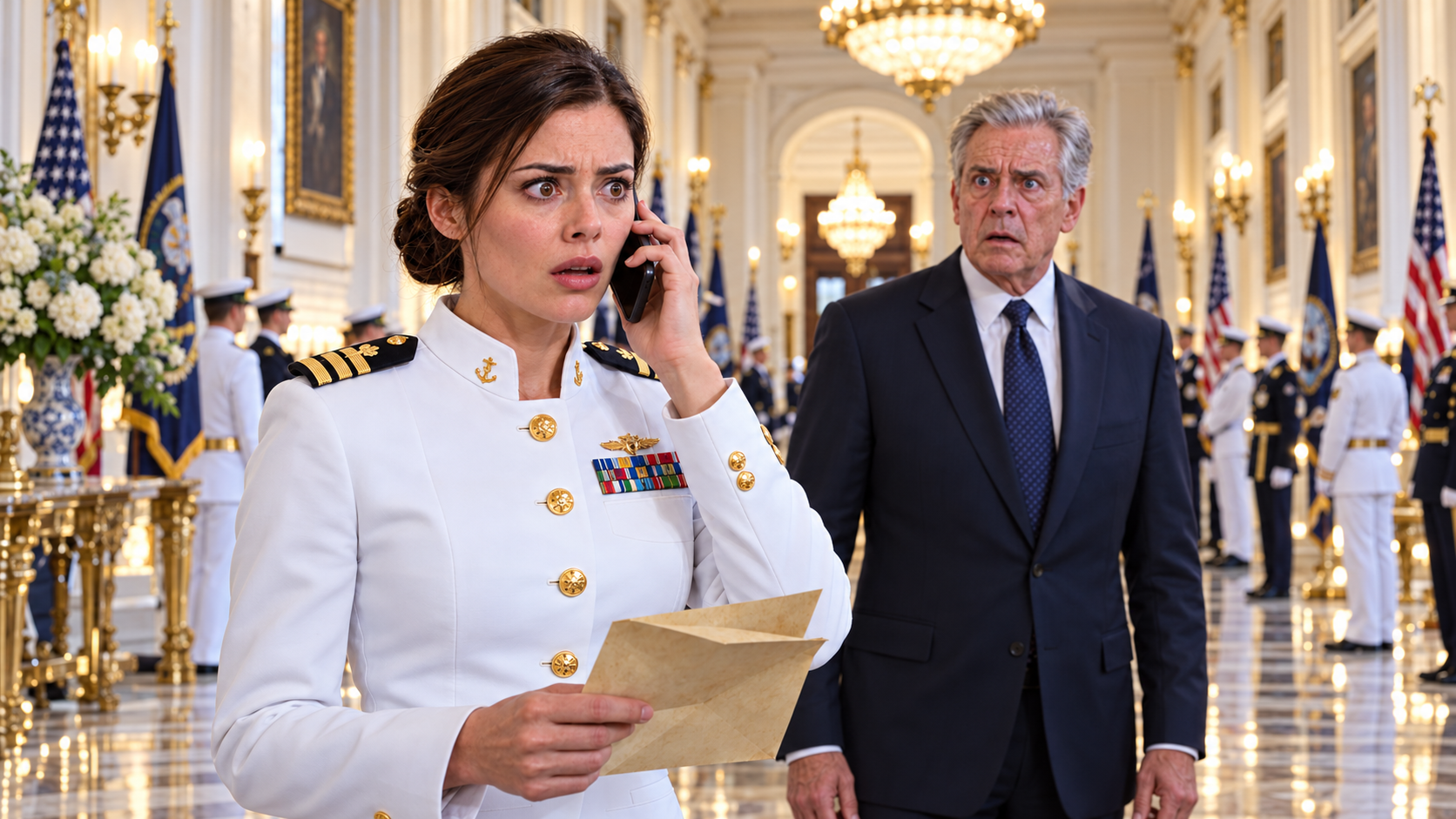
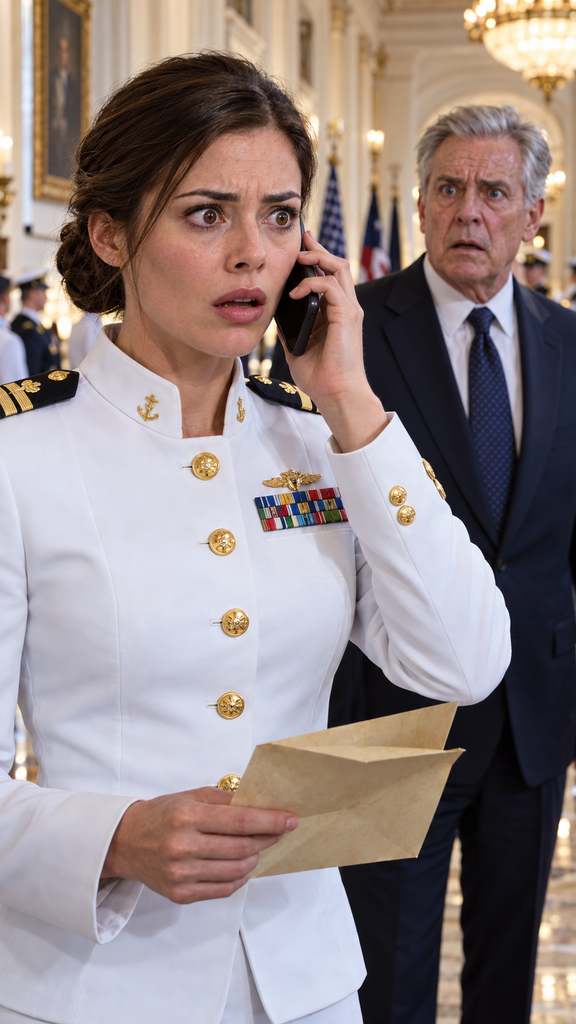
PART 1: ADMIRAL ON DECK
The morning my father ordered me to hide my Navy uniform, I realized something I should have understood years ago.
He wasn’t embarrassed by my career.
He was afraid of what that uniform represented.
At 6:42 a.m. on a Friday in Washington, D.C., I stood in front of the mirror in my hotel room, adjusting the collar of my dress whites when my phone vibrated against the dresser.
My father.
Adrian Hale.
A retired businessman who could command a room full of executives without raising his voice, who had built companies, bought houses, negotiated contracts worth more money than I would make in a lifetime—
and who had somehow never learned how to tell his only daughter, “I’m proud of you.”
His first message was short.
“Make sure you don’t wear your uniform today.”
I read it twice.
Before I could decide whether to answer, another message appeared.
“Nobody is there to celebrate your Navy career, Rebecca.”
Then a third.
“Wear something normal. Don’t make this about yourself.”
I stared at the screen.
I was thirty-four years old.
I had spent more than half my adult life serving in the United States Navy. I had crossed oceans while my father complained that I missed Thanksgiving. I had spent birthdays in windowless operational spaces, slept four hours in forty-eight, signed orders that affected hundreds of sailors, and learned how to sound calm over a radio when every instinct inside me was screaming.
Yet three messages from Adrian Hale could still make me feel twelve years old.
Twelve years old, standing in our kitchen with a report card full of A’s while he glanced at it and asked why I had gotten a B-plus in algebra.
Seventeen, telling him I wanted a military career and hearing him say, “You’ll grow out of it.”
Eighteen, leaving home with two suitcases while he stood in the doorway and told me there was still time to choose a normal life.
My mother had hugged me that day.
She had whispered into my hair, “Don’t let anyone make you smaller just because your courage makes them uncomfortable.”
Sixteen years later, I could still hear her voice.
Beside me, laid carefully across the bed, was my white uniform jacket.
Gold buttons.
Shoulder boards.
Ribbons aligned perfectly.
Medals representing years my father had never asked about.
Deployments he could not name.
Commands he had never visited.
People whose names he had never heard.
Sacrifices I had stopped trying to explain.
I picked up my phone.
Typed:
Why does it bother you so much?
Deleted it.
Typed:
Today matters to me, even if it doesn’t matter to you.
Deleted that too.
Then I wrote:
I’ll see you there.
I didn’t send it.
I turned the phone face down.
And put on my uniform.
By 8:15, Washington had become a sheet of polished gray beneath a thin September sky. The city had that strange early-morning mixture of urgency and ceremony—black SUVs at intersections, tourists taking photographs, officers moving between buildings with coffee cups and folders tucked under their arms.
The National Naval Officers Hall stood beyond a row of flags snapping sharply in the wind.
I stopped outside.
For one second, I considered taking off my jacket.
Not because I was ashamed.
Because some wounds become reflexes.
You learn to protect yourself before anyone has even struck.
Then I thought of my mother.
Don’t let anyone make you smaller.
I walked inside.
The hall was already crowded.
Families stood beneath portraits of admirals and photographs of ships. Children tugged at sleeves. Spouses adjusted collars and straightened ribbons. Senior officers moved through the room exchanging quiet greetings.
I recognized faces from commands, deployments, Pentagon briefings, joint operations.
There were officers from surface warfare.
Aviation.
Intelligence.
Special operations.
Near the front, several Navy SEAL officers were talking beside a display case.
I entered alone.
A young lieutenant near the doorway was laughing at something his wife had said.
Then he saw me.
His smile disappeared.
His eyes went first to my uniform.
Then to my face.
His posture changed instantly.
“Ma’am.”
The officer beside him turned.
Then another.
The change moved across the room almost invisibly at first.
A conversation stopping.
A head turning.
Someone lowering a coffee cup.
Then a chair scraped against the floor.
One officer stood.
Another followed.
Then five.
Then twenty.
My steps slowed.
Across the hall, the SEAL officers straightened.
Every one of them.
A strange pressure filled my chest.
I had stood before sailors before.
I had walked onto decks where hundreds came to attention.
I understood protocol.
I understood rank.
But this felt different.
Because somewhere inside me, I was still hearing my father’s message.
Nobody is there to celebrate your Navy career.
More chairs moved.
Within seconds, nearly everyone in the hall was standing.
For me.
For the daughter Adrian Hale had spent years treating as if she had chosen an elaborate hobby instead of a life.
I swallowed hard.
Then Captain Michael Torres stepped away from the front row.
Michael and I had served together years earlier. He had once spent thirty-six straight hours coordinating an operation with me and later claimed my ability to survive on terrible coffee was the most frightening thing he had ever witnessed.
Now there was no humor in his face.
He stood at attention.
His voice thundered across the hall.
“Admiral on deck!”
Silence.
Absolute silence.
I had known the promotion was coming.
Of course I had.
The paperwork, the confirmation, the calls, the formalities—I had lived through all of it.
But hearing the word spoken like that still hit me with unexpected force.
Admiral.
My mother should have been there.
That was my first thought.
Not my father.
My mother.
I breathed once and continued forward.
Then I saw him.
Near the back of the room.
Dark suit.
Silver hair.
One hand resting on the back of a chair.
Adrian Hale.
My father.
His face had gone pale.
He was staring at me as though I had walked into the room wearing someone else’s face.
For the first time in my life, he wasn’t looking at me with criticism.
He wasn’t disappointed.
He wasn’t irritated.
He wasn’t searching for something I had done wrong.
He looked shocked.
Almost frightened.
And I knew immediately that his fear had nothing to do with my rank.
The ceremony passed in fragments.
An oath.
Applause.
Hands on my shoulders.
Photographs.
Congratulations.
Michael leaned close afterward and said, “Your mother would have torn the roof off this place.”
I froze.
He immediately looked uncomfortable.
“I’m sorry.”
“No.”
I forced a smile.
“You’re right.”
My mother, Evelyn Hale, had been gone sixteen years.
People used different words for it.
Passed.
Lost.
Gone.
My father had always preferred gone.
I had eventually learned to prefer it too.
It hurt less than dead.
After the ceremony, I slipped away from the crowd and found my father waiting in a quiet hallway lined with old photographs.
For several seconds, neither of us spoke.
Then he said my name.
“Rebecca.”
“What?”
His eyes moved slowly over my uniform.
The stars.
The ribbons.
The medals.
“I didn’t know.”
Something inside me tightened.
“Didn’t know what?”
“That it was…” He swallowed. “This serious.”
I almost laughed.
Instead, I stared at him.
“Serious?”
“I didn’t mean—”
“Did you think I was playing sailor for sixteen years?”
“No.”
“You never asked what I did.”
“I knew what you did.”
“No, Dad. You knew where I worked.”
He looked away.
I stepped closer.
“You didn’t know my rank?”
Silence.
“You didn’t know I’d been selected?”
His jaw tightened.
“Rebecca—”
“You didn’t know what any of these mean, did you?”
I touched the ribbons over my heart.
His eyes followed my hand.
“I knew enough.”
“No. You didn’t.”
The words came out more quietly than I intended.
“Because you never asked.”
That hurt more than anger would have.
His shoulders dropped slightly.
For a moment, he looked old.
Not retired.
Not tired.
Old.
Then something changed in his expression.
The shame disappeared.
Fear replaced it.
“Rebecca, there’s something you need to know about today.”
My anger vanished.
“What?”
He glanced toward the ballroom.
People were still talking beyond the doors.
He lowered his voice.
“I hoped this would never happen.”
“What would never happen?”
“You getting this far.”
The words hit me like a slap.
He saw it.
“No. That’s not what I meant.”
“Then explain it.”
He reached inside his suit jacket.
His hand trembled.
My father’s hands never trembled.
Not even at my mother’s funeral.
He pulled out an envelope.
Old.
Yellowed slightly along the edges.
My name was written across the front.
Rebecca.
One word.
I recognized the handwriting immediately.
My mother’s.
The hallway seemed to tilt.
“Where did you get this?”
He didn’t answer.
I took it from him.
The paper felt fragile beneath my fingers.
The seal had already been broken.
I looked at him.
“You opened it.”
He closed his eyes.
“Sixteen years ago.”
My pulse began pounding.
Inside was a single sheet.
One sentence.
Nothing more.
Rebecca, if your father ever tries to stop you from becoming who you were meant to be, it means he knows what happened that night.
I read it again.
Then again.
My mouth went dry.
“What night?”
My father said nothing.
I looked up.
“What night, Dad?”
His face had gone colorless.
Then he stepped backward.
“Not here.”
“You carried this for sixteen years.”
“Rebecca—”
“You told me Mom was dead.”
His eyes flicked toward mine.
And that tiny movement told me something I had never allowed myself to question.
I felt cold all over.
“You told me she died.”
“I told you she was gone.”
I stared at him.
“What does that mean?”
He turned away.
“Dad!”
He started walking.
I followed.
“Stop.”
He didn’t.
“What happened that night?”
Still nothing.
“Dad!”
He reached the corner.
Then my phone rang.
The sound was so sudden that both of us stopped.
I looked down.
Unknown number.
But beneath it, my phone displayed a name pulled from an old contact I had never deleted.
A name I had kept for sixteen years even though there had never been any reason to keep it.
Mom.
For several seconds, I forgot how to breathe.
My father turned.
He saw the screen.
And whatever was left of the color in his face disappeared.
“Don’t answer that,” he whispered.
I looked at him.
Then I pressed the green button.
“Hello?”
For three seconds, there was only static.
Then a woman inhaled.
And said the name nobody except one person had ever called me.
“Becca?”
My knees nearly gave out.
Because my mother was dead.
And my mother was on the phone.
PART 2: THE WOMAN WHO WAS SUPPOSED TO BE DEAD
I could hear my heartbeat louder than the voice on the phone.
“Becca?”
No one had called me that since I was eighteen.
Not Michael.
Not my father.
Not friends.
Not anyone.
Rebecca was what the Navy called me.
Rebecca was who I had become.
Becca belonged to a kitchen that no longer existed, to Saturday mornings, cinnamon toast, my mother singing badly to old songs while sunlight came through yellow curtains.
I gripped the phone.
“Who is this?”
Silence.
Then:
“You know who it is.”
My father moved toward me.
“Hang up.”
I stepped away.
“Who is this?”
The woman’s voice broke.
“It’s Mom.”
The hallway disappeared.
Sixteen years collapsed into two words.
I remembered a closed casket.
Rain against black umbrellas.
My father standing beside me like stone.
I remembered asking why I couldn’t see her.
He said the accident had been too severe.
I remembered asking where it happened.
He told me details didn’t matter.
I remembered screaming at him.
I remembered leaving for training three weeks later because staying in that house felt like drowning.
“You’re dead,” I whispered.
My father flinched.
The voice on the phone went quiet.
“No,” she finally said. “I’m not.”
I looked at him.
He wouldn’t meet my eyes.
My hand began shaking.
“You knew.”
“Rebecca—”
“You knew she was alive.”
“It’s complicated.”
I almost laughed.
Sixteen years of grief.
Sixteen birthdays.
Sixteen Christmases.
Sixteen years of visiting a grave.
Complicated.
“Where are you?” I asked.
My mother hesitated.
“Not far.”
“Where?”
“Becca, before you come, I need you to understand something.”
“No.”
My voice hardened automatically.
Command voice.
The one sailors obeyed.
The one my father had apparently never heard.
“No more half-truths. No more protecting me. No more deciding what I can handle. Tell me where you are.”
She gave me the name of a small hotel less than twenty minutes away.
Room 814.
“I’ll be there.”
“Come alone.”
My eyes moved to my father.
“Why?”
“Because your father has already had sixteen years to tell his version.”
The line went dead.
I lowered the phone.
My father stood motionless.
I wanted to hit him.
I had never struck another person out of anger in my life.
But in that moment, I understood how rage could become physical.
“How long?”
He rubbed a hand over his face.
“How long have you known she was alive?”
“Since the beginning.”
Something inside me cracked.
I stepped backward.
“You buried an empty coffin?”
“No.”
“What?”
“It wasn’t empty.”
The words stopped me.
“Then who was in it?”
“A woman who died in the crash.”
My stomach turned.
“What crash?”
He closed his eyes.
“The crash your mother survived.”
I felt suddenly sick.
“You let me bury a stranger.”
“We never identified the body to you.”
“You told me it was Mom.”
“I let you believe it.”
“That is the same thing.”
“No.”
His voice rose.
“It isn’t.”
Several people at the far end of the corridor turned.
My father lowered his voice again.
“I made mistakes.”
“Mistakes?”
“Rebecca.”
“No. A mistake is forgetting my birthday. A mistake is missing a flight. You watched your eighteen-year-old daughter put flowers on a stranger’s grave for sixteen years.”
His face tightened.
“You don’t understand what was happening.”
“Then make me understand.”
He stared at me.
And for one moment, I thought he would.
Instead he said, “Ask your mother.”
I shook my head.
“You’re coming with me.”
“She asked you to come alone.”
“I don’t care.”
“I do.”
Something in his voice made me stop.
He looked toward the ballroom.
“Today is yours. Go back inside.”
I couldn’t believe what I was hearing.
“You think I can go pose for photographs now?”
“You earned this.”
“You told me not to wear the uniform.”
His expression collapsed.
“That was before.”
“Before what?”
“Before I knew she was coming.”
There it was.
I stared at him.
“You knew she might come today.”
He didn’t answer.
“The message this morning wasn’t about me embarrassing you.”
“No.”
“You were trying to keep her away.”
His silence confirmed it.
I looked down at the uniform.
Suddenly I understood.
He hadn’t been afraid of the stars on my shoulders.
He had been afraid they would act like a beacon.
A signal.
A reason for someone who had stayed hidden for sixteen years to finally step out of hiding.
“My promotion brought her back.”
“Yes.”
“Why?”
His eyes filled with something I had almost never seen there.
Regret.
“Because it proved I failed.”
Before I could ask what he meant, he walked away.
This time, I let him.
Twenty-five minutes later, still wearing my dress whites, I stood outside room 814.
My hand hovered near the door.
I had faced moments in my career when hesitation could cost lives.
But I couldn’t knock.
Because as long as the door stayed closed, my mother existed only as a voice.
A possibility.
If I opened it, one of two things would happen.
Either she would be there.
Or the last piece of my childhood would disappear forever.
I knocked.
Nothing.
Then footsteps.
The lock turned.
The door opened.
A woman stood inside.
She was sixty-three.
Her hair, once dark brown, was almost completely silver.
There were lines around her eyes that hadn’t existed sixteen years ago.
A thin scar ran from her left temple toward her ear.
She looked smaller.
Older.
Different.
And exactly the same.
Her eyes were mine.
Or mine were hers.
For a long moment, neither of us spoke.
Then she lifted one trembling hand toward my face.
“My God.”
I couldn’t move.
“You became exactly who you said you would.”
That broke me.
Not gently.
Completely.
Sixteen years of discipline disappeared.
I stepped into the room and wrapped my arms around her.
She made a sound against my shoulder that I had never heard another human being make.
Half sob.
Half apology.
I held her tighter.
Then anger came back.
I pulled away.
“You were alive.”
“Yes.”
“You were alive.”
“I know.”
“You let me think you were dead.”
Tears filled her eyes.
“Yes.”
“Why?”
She sat slowly on the edge of the bed.
I remained standing.
“I need to tell you about the night I left.”
“The accident?”
“Yes.”
“What happened?”
She looked at my uniform.
“Your father and I had been fighting about you.”
I frowned.
“Me?”
“You had been accepted into your military program. You were leaving home. Your father hated it.”
“I knew that.”
“No. You knew he disapproved. You didn’t know why.”
She folded her hands.
“Your father had planned your life since you were a child. College. Business school. Eventually his company. He believed he was giving you security.”
“That sounds like him.”
“He believed the military would take you away from him.”
I almost smiled bitterly.
“It did.”
“No, Becca. He thought I was the reason you wanted to go.”
I stared at her.
“You encouraged me.”
“I did.”
“Because you wanted me away from him?”
“No.”
She shook her head.
“Because you came alive whenever you talked about serving. I saw it. He saw it too. That was what frightened him.”
She took a breath.
“The night before the accident, I discovered he had tried to interfere with your future.”
My body went still.
“How?”
“He made calls.”
“To whom?”
“People he knew. People he thought might convince someone to reconsider an appointment, delay paperwork, create enough trouble that you would give up.”
I stared at her.
“He tried to sabotage me?”
“Yes.”
The room felt suddenly too small.
“I confronted him.”
She looked down.
“We fought. I told him if he interfered with your life again, I would leave him.”
“What happened?”
“He told me I was destroying the family.”
Her mouth trembled.
“I told him the family was already being destroyed because he couldn’t understand that loving a child and owning a child were not the same thing.”
I sat across from her.
“And then?”
“I left.”
“That night?”
“Yes.”
“In the car?”
“Yes.”
She touched the scar near her temple.
“It was raining. I was angry. I shouldn’t have been driving.”
I waited.
“There was another vehicle. I remember headlights. Glass. Then nothing.”
“And the woman who died?”
“In the other car.”
My stomach tightened.
“I woke in the hospital two days later.”
“Dad was there?”
“Yes.”
“Did he tell me?”
“No.”
“Why?”
Her eyes met mine.
“Because I asked him not to.”
That answer hurt almost as much as his lie.
I stood.
“You asked him?”
“Yes.”
“You let him tell me you were dead?”
“No. I told him I needed time. I was injured. I was confused. I was furious. I thought I would recover and contact you myself.”
“But you didn’t.”
“No.”
“Sixteen years.”
“I know.”
“Why?”
She looked toward the window.
“Because by the time I was strong enough to come back, you were already gone.”
“Gone where?”
“Training. Your new life. Your father told me you blamed me.”
I frowned.
“For what?”
“For leaving that night.”
My breath caught.
“He said you knew?”
“He told me you had discovered we fought because of you. That you said you never wanted to see me again.”
“I never said that.”
“I know that now.”
I stared at her.
“He told you I hated you?”
“Yes.”
“And he told me you were dead.”
“Yes.”
The shape of the betrayal became visible between us.
Not one lie.
Two.
Perfectly placed.
One for each of us.
Each designed to keep the other away.
My mother reached for something on the table.
An old photograph.
Me at seventeen in a Navy sweatshirt, grinning beside her.
“I wrote you dozens of letters.”
My eyes lifted.
“What?”
“I sent the first one to the house.”
“The one Dad gave me?”
She nodded.
“I sent others.”
“I never received them.”
“I know.”
“How?”
“Because years later, one was returned. Your father had redirected the mail.”
My jaw tightened.
“Why didn’t you find me?”
“I tried.”
“You could have found me.”
“Yes.”
She didn’t defend herself.
That mattered.
She looked directly at me.
“I could have tried harder. I could have refused to believe him. I could have shown up at a gate somewhere and demanded to see you. I could have done a hundred things differently.”
Her voice cracked.
“But I was ashamed.”
“Of what?”
“Leaving.”
Tears slipped down her face.
“And every year I waited made coming back harder.”
I understood that more than I wanted to.
Shame does that.
It turns a mistake into a prison, then convinces you the locked door is protecting everyone outside.
“But why today?”
She looked at my uniform.
“Because three weeks ago I saw your name.”
“Where?”
“An announcement.”
My promotion.
She nodded.
“Rear Admiral Rebecca Hale.”
Her smile broke through tears.
“I read it twenty times.”
I looked away.
“I knew then that your father had failed to stop you.”
My mother stood.
“And I realized something else.”
“What?”
“If you had become this despite believing I was dead, then maybe you were strong enough to hear that I wasn’t.”
I should have felt comfort.
Instead, I remembered my father’s words.
Because it proved I failed.
I looked toward the door.
“There’s something you’re not telling me.”
My mother became very still.
“What?”
“The letter.”
She said nothing.
“You wrote that if Dad ever tried to stop me from becoming who I was meant to be, it meant he knew what happened that night.”
“Yes.”
“You didn’t mean the accident.”
“No.”
The room seemed to darken.
“What happened before the accident?”
My mother’s eyes filled with fear.
Then someone knocked on the door.
Three slow knocks.
My mother went pale.
I stood.
“Are you expecting someone?”
“No.”
The knock came again.
Then my father’s voice.
“Evelyn.”
My mother closed her eyes.
And whispered:
“He finally came.”
PART 3: WHAT HAPPENED THAT NIGHT
My father entered the room without waiting to be invited.
For sixteen years, I had imagined impossible versions of this moment.
My parents reunited.
My mother alive.
My father explaining everything.
But there was nothing beautiful about watching them look at each other.
They looked like survivors standing on opposite sides of the same wreckage.
My mother spoke first.
“You kept the letter.”
“Yes.”
“You opened it.”
“Yes.”
“You never gave it to her.”
“Not until today.”
My mother laughed once.
There was no humor in it.
“Sixteen years late.”
My father looked at me.
“I knew this day might come.”
“You keep saying that.”
I stepped between them.
“Tell me what happened before the accident.”
Neither answered.
I looked at my mother.
“You said there was more.”
My father interrupted.
“Evelyn.”
“No.”
She faced him.
“You’ve had sixteen years.”
His jaw tightened.
“You think telling her now fixes anything?”
“No,” my mother said. “But continuing to lie guarantees nothing ever gets fixed.”
I looked between them.
“What happened?”
My mother walked to the window.
“The night I left, your father and I weren’t only arguing because he made calls about your career.”
My father stared at the floor.
“He had prepared documents.”
“What documents?”
“For you.”
I looked at him.
“What did you do?”
His voice was low.
“I had arranged a place for you at a business program.”
“I never applied to a business program.”
“I did it for you.”
“You applied for me?”
“I believed once you saw the opportunity—”
“You mean once you destroyed my other option.”
He looked up sharply.
“I never destroyed anything.”
“You tried.”
“Yes.”
The word landed harder because he didn’t deny it.
He took a breath.
“I called people. I asked questions. I tried to delay things.”
“Why?”
“Because you were eighteen.”
“So?”
“You thought you understood the world.”
“I understood what I wanted.”
“You wanted danger.”
“I wanted service.”
“You wanted to leave.”
His voice cracked.
There it was.
Not patriotism.
Not career.
Not practicality.
Abandonment.
My father had built his whole life around control because he was terrified of people leaving him.
And in trying to stop it, he had driven everyone away.
My mother turned from the window.
“That night I told him I would expose everything he had done.”
“Expose it to whom?”
“To you.”
My father flinched.
“I had copies of the calls he made. Notes. Names. I was going to tell you before you left.”
“And then you crashed.”
“Yes.”
“What happened to the documents?”
My father answered.
“I destroyed them.”
I stared at him.
“You destroyed evidence that you tried to interfere with my career?”
“Yes.”
“Why?”
“Because I was ashamed.”
I laughed bitterly.
“No. Shame makes you admit something. Fear makes you destroy proof.”
His eyes met mine.
For the first time that day, he looked at me not as his daughter but as an officer trained to hear what people avoided saying.
“You were afraid Mom would tell me.”
“Yes.”
“So when she woke up and asked for time, you saw an opportunity.”
He said nothing.
“You told her I hated her.”
His face tightened.
“Not immediately.”
“That’s your defense?”
“No.”
I stepped closer.
“When did you tell me she was dead?”
“After you left.”
“Why?”
His eyes reddened.
“Because you kept asking for her.”
I felt as if the floor had shifted.
“That’s why?”
“I thought she would come back.”
“But she didn’t.”
“No.”
“So you decided for both of us.”
He looked down.
“I thought if you believed she had chosen to leave you, it would destroy you.”
“And apparently believing she was dead was better?”
“At the time, I thought grief would heal.”
My mother stared at him.
“And hatred wouldn’t?”
He turned toward her.
“You asked me not to tell her you survived.”
“For weeks, Adrian. Not forever.”
“You disappeared.”
“Because you told me she despised me.”
“And you believed me!”
His voice broke.
Silence followed.
That was the first time I understood something uncomfortable.
My father had committed the greater betrayal.
But my mother had made choices too.
Fear had done what anger could not.
It had separated us.
I sat down.
For years I had imagined grief as something that happened to me.
Now I saw it as something constructed.
Brick by brick.
Lie by lie.
Silence by silence.
“Why did you keep trying to stop my career after Mom was gone?”
My father looked at my uniform.
“I didn’t.”
I stared at him.
“You criticized every promotion.”
“Yes.”
“You told me to resign after my first deployment.”
“Yes.”
“You called my career a phase for ten years.”
“Yes.”
“That sounds like trying to stop me.”
He swallowed.
“I was trying to stop you from becoming her.”
I turned toward my mother.
“What does that mean?”
She seemed confused too.
My father sat in the chair near the door.
“Your mother was the brave one.”
She stared at him.
“Adrian—”
“No. She should know.”
He looked at me.
“When I met your mother, she had plans. Graduate school. Public service. Work that mattered to her. Then we married. I started the company. You were born.”
His mouth tightened.
“She kept giving things up.”
My mother shook her head.
“I made choices.”
“Yes,” he said. “Choices I was happy to let you make because they benefited me.”
No one spoke.
“I watched Rebecca become exactly like you. Determined. Independent. Impossible to control.”
His eyes moved toward me.
“And I knew eventually she would look at me the way you did that night.”
My anger softened by one degree.
Not forgiveness.
Understanding.
They are not the same thing.
“So every time I advanced…”
“I knew I was losing the ability to pretend I had been right.”
“And today?”
His eyes went to the stars on my shoulders.
“Today there was nowhere left to hide.”
I finally understood the fear in his face at the ceremony.
Hundreds of officers had stood for me.
People he had never met knew what I had accomplished.
He couldn’t dismiss it anymore.
Couldn’t call it a phase.
Couldn’t reduce it.
And if my mother saw it too, the entire structure of his sixteen-year lie would collapse.
My mother folded her arms.
“You texted her this morning.”
He nodded.
“How did you know I was coming?”
“I received a message yesterday.”
“From whom?”
“You.”
My mother froze.
“I didn’t message you.”
He reached for his phone.
Then stopped.
“What?”
My mother shook her head.
“I never contacted you.”
A new silence entered the room.
I looked at my father.
“What did the message say?”
He opened his phone.
Showed me.
One sentence.
Tomorrow she becomes what you tried to prevent.
No name.
No signature.
My pulse quickened.
“Who sent this?”
“I assumed Evelyn.”
My mother stared at the number.
“That isn’t mine.”
I took a screenshot.
“Did you respond?”
“No.”
“Call?”
“The number was disconnected this morning.”
My mother looked at me.
Then suddenly covered her mouth.
“What?”
“There’s only one person who knew.”
“Knew what?”
“That I was coming.”
“Who?”
She looked toward my father.
Then back at me.
“Michael Torres.”
I stared at her.
“Captain Torres?”
“He found me.”
My father stood.
“What?”
My mother nodded.
“Six months ago.”
“How?”
“He was trying to put together a private collection of photographs and messages for Rebecca’s promotion.”
I remembered Michael emailing former friends, commanders and family contacts.
I had ignored most of it.
“He found an old address connected to me,” she continued. “He wrote a letter. I answered.”
My throat tightened.
“Michael knew you were alive?”
“Yes.”
“For six months?”
“He promised me he wouldn’t tell you until I was ready.”
Anger flared again.
“Everyone keeps deciding when I’m ready.”
“I know.”
My mother lowered her head.
“I told him last week I was coming.”
I walked to the door.
“Where are you going?”
“To find Michael.”
My father called after me.
“Rebecca.”
I turned.
He looked at me with an expression I couldn’t read.
“What?”
“There’s one more thing.”
Of course there was.
He reached into his jacket again.
This time he removed a small brass key.
I stared at it.
“What is that?”
“Your mother left a box in the car the night of the accident.”
My mother turned sharply.
“You told me it was destroyed.”
“I lied.”
He held the key toward me.
“I kept it.”
“Where is the box?”
“At the house.”
“Why?”
His answer was barely audible.
“Because it contains every reason you should never forgive me.”
PART 4: THE BOX
We drove to my father’s house in silence.
Not the house where I grew up.
He had sold that one nine years earlier.
This was a narrow brick townhouse in Georgetown filled with expensive furniture and almost no evidence that anyone actually lived there.
My mother sat in the back.
I sat beside my father.
No one spoke.
Three people who had once been a family.
Sixteen years separated us even though our shoulders were only inches apart.
My father led us upstairs.
His study smelled like leather and old paper.
He walked to a built-in cabinet, removed several books, and pressed a small release hidden behind the shelf.
A compartment opened.
Inside was a metal box.
My mother made a sound.
“That’s it.”
My father set it on the desk.
I used the brass key.
The lock clicked.
Inside were papers.
Dozens of them.
Letters.
Copies of phone records.
My original acceptance documents.
My mother’s handwriting.
And photographs.
I picked up the first letter.
Becca,
Your father told me you don’t want to hear from me. I understand why you’re angry, but please know that leaving the house was never leaving you.
The next.
Becca,
I called again today. Your father says you’re doing well. He says you’ve asked me not to contact your command.
Another.
Becca,
I don’t know whether these letters are reaching you.
Another.
Becca,
If silence is what you need, I will respect it. But I need you to know I have never stopped loving you.
I couldn’t continue.
I put the letter down.
There were twenty-seven.
Twenty-seven letters.
My father had kept every one.
“You read them?”
“Yes.”
“Every one?”
“Yes.”
“Why keep them?”
He stared at the box.
“I don’t know.”
“Yes, you do.”
His eyes filled.
“Because destroying them would have made the lie permanent.”
I looked at him.
“It was permanent to me.”
“I know.”
“No. I don’t think you do.”
I held up the letters.
“These were years.”
My voice shook.
“This wasn’t one decision. Every time a letter arrived, you made the decision again.”
“Yes.”
“Every birthday.”
“Yes.”
“Every deployment.”
“Yes.”
“Every time I came home.”
“Yes.”
“Every time you watched me visit her grave.”
He closed his eyes.
“Yes.”
My mother began crying quietly.
I turned away from both of them.
Then I noticed another envelope at the bottom.
It was addressed to my father.
Adrian.
My mother recognized it.
“What is that?”
He didn’t answer.
I opened it.
Inside was a short letter.
Adrian,
I know what you told Rebecca.
If you still love our daughter at all, tell her the truth before your fear becomes the only thing she remembers about you.
Evelyn.
I looked at my father.
“When was this?”
“Fourteen years ago.”
Two years after the accident.
He had known.
Not suspected.
Known.
My mother had discovered at least part of his lie and demanded that he correct it.
He hadn’t.
I put the letter down.
“Why?”
He sat heavily.
“Because by then you were doing well.”
I stared at him.
“That’s your answer?”
“You were advancing. You were focused. Strong.”
“So you thought the truth would ruin me.”
“I thought it would take everything away from you.”
“No.”
I shook my head.
“You thought it would take me away from you.”
He looked up.
That was the truth.
Finally.
Simple.
Ugly.
Human.
He had already lost his wife.
If I discovered what he had done, he believed he would lose his daughter too.
So he preserved the lie.
And lost me anyway.
My phone vibrated.
Michael.
I answered.
“Where are you?”
His voice came quickly.
“Rebecca, are you with your mother?”
“Yes.”
A pause.
“And your father?”
“Yes.”
Another pause.
“Then you found the box.”
I looked at it.
“You knew about it?”
“No. Evelyn suspected it still existed.”
“Did you send my father that message?”
“Yes.”
Anger rose.
“Why?”
“Because I needed him to show up today.”
“You manipulated him.”
“Yes.”
“Why?”
“Because your mother was afraid she would lose her nerve.”
I closed my eyes.
“Michael.”
“I know.”
“No, you don’t. Everyone has spent sixteen years making decisions for me.”
He went quiet.
Then he said, “You’re right.”
The immediate admission disarmed me.
“I should have told you.”
“Yes.”
“But your mother asked me not to.”
“She asked my father not to once too.”
“I know.”
Silence.
Then Michael said, “There’s something else you need to know.”
I almost laughed.
Apparently that sentence was following me now.
“What?”
“The promotion reception begins in forty minutes.”
“I’m not going.”
“You should.”
“I just discovered my mother is alive.”
“I know.”
“My father buried sixteen years of letters.”
“I know.”
“And you think I should go smile for photographs?”
“No.”
His voice softened.
“I think you should go because your entire life, other people have made your choices about them.”
I said nothing.
“Your father made your career about his fear. Your mother made her silence about her shame. I made today about forcing a confrontation.”
He paused.
“But the ceremony was always about you.”
I looked down at my uniform.
For the first time that day, I saw it differently.
Not as something my father hated.
Not something my mother had encouraged.
Mine.
Every button.
Every ribbon.
Every year.
Mine.
“What do you want me to do?” my father asked after I ended the call.
I looked at him.
“I don’t know.”
“I’ll do anything.”
“That’s the problem.”
He frowned.
“You always want to do something. Fix something. Control something.”
I closed the box.
“You can’t fix this.”
His shoulders fell.
“I know.”
“No. You need to actually know it.”
I handed the box to my mother.
Then reconsidered.
I took it back.
“These letters were written to me.”
She nodded.
“They’re yours.”
I turned toward the door.
My mother called my name.
“Becca?”
I stopped.
“Will I see you again?”
I looked at her.
There were a thousand possible answers.
Angry ones.
Loving ones.
Cruel ones.
Forgiving ones.
I wasn’t ready for any of them.
So I gave her the only honest answer I had.
“Yes.”
She covered her mouth.
“But not because sixteen years disappears today.”
“I understand.”
“We start with the truth.”
“Yes.”
“No more disappearing.”
“No more disappearing.”
I looked at my father.
“And no more deciding what’s best for me.”
He nodded.
I walked downstairs.
Outside, the afternoon sun had broken through the clouds.
I stood on the sidewalk holding sixteen years of letters against my white uniform.
Then my father came outside.
“Rebecca.”
I turned.
He remained several feet away.
“I am proud of you.”
I had waited my entire life to hear those words.
I thought they would heal something.
They didn’t.
Not yet.
Maybe some words arrive too late to be medicine.
But they can still be a beginning.
I nodded once.
“Then learn who I am.”
And I walked away.
PART 5: THE THINGS WE CHOOSE TO CARRY
I returned to the Naval Officers Hall forty-three minutes late.
No one asked why.
That is one thing military people understand better than most.
Sometimes a person walks into a room carrying something invisible.
You don’t always need to ask them to name it.
Michael met me near the entrance.
He looked at the metal box under my arm.
Then at my face.
“I’m sorry.”
“I know.”
“Are you angry?”
“Yes.”
“Fair.”
I almost smiled.
“You sent the message.”
“Yes.”
“You scared ten years off my father’s life.”
“That part may have been intentional.”
I gave him a look.
He straightened.
“Poor judgment, Admiral.”
“Extremely.”
We walked inside.
The reception was still crowded.
People applauded when they saw me.
For once, I didn’t feel embarrassed by the attention.
I let it happen.
Not because rank made me important.
Because for years I had minimized every accomplishment before my father could minimize it first.
I had learned to say things like:
It was just a promotion.
Just another assignment.
Just doing my job.
I had become so good at protecting myself from his indifference that I had started practicing it on myself.
Not anymore.
That evening, after everyone left, I sat alone in my hotel room.
The uniform jacket hung beside the window.
The box rested on the bed.
I read every letter.
Twenty-seven.
I cried through fourteen.
Got angry during six.
Could barely finish three.
One made me laugh.
In another, my mother described seeing a woman in a grocery store who walked like me.
The last was written nine years earlier.
Becca,
I don’t know whether I have the right to call myself your mother anymore.
But I know this: you were never abandoned because you were unwanted.
You were lost because two frightened people made terrible choices and then became too ashamed to undo them.
If I ever see you again, I won’t ask you to forgive me.
I’ll only ask for the chance to know the woman you became.
Love,
Mom.
I folded the letter.
Then I called her.
She answered on the first ring.
“Becca?”
“I read them.”
Silence.
“All of them?”
“Yes.”
“I’m sorry.”
“I know.”
Another silence.
“Mom?”
“Yes?”
“Tell me something true.”
She began crying.
“What?”
“Anything.”
She thought for several seconds.
Then said:
“When you were seven, you told your teacher you wanted to command a ship.”
I laughed despite myself.
“I remember.”
“She told you girls could be anything.”
“I remember that too.”
“You came home furious.”
“Why?”
“Because you said, ‘I know that. Why does everyone keep telling me?’”
I covered my eyes.
That sounded like me.
My mother laughed through her tears.
“You’ve always been impossible.”
“Dad said something similar.”
“He probably meant it differently.”
“He did.”
We talked for two hours.
Not about the accident.
Not about betrayal.
Not mostly.
We talked about ordinary things.
Her apartment.
My terrible cooking.
Her arthritis.
My first command.
Books.
Coffee.
The kind of things mothers and daughters are supposed to accumulate naturally over years.
We were trying to compress sixteen lost years into one night.
Eventually I stopped us.
“We don’t have to do everything today.”
“No.”
“We have time.”
She became quiet.
“Yes.”
That word hurt beautifully.
Time.
For sixteen years, I thought we had none.
Now we did.
The next morning, I met my father in the hotel lobby.
He looked as though he hadn’t slept.
Maybe he hadn’t.
He sat across from me.
For once, he didn’t begin with an explanation.
That helped.
“I’m not going to forgive you today,” I said.
“I know.”
“I may never forgive everything.”
“I know.”
“I’m going to be angry for a long time.”
“You should be.”
I studied him.
“But I want to understand something.”
“What?”
“Why did you come yesterday?”
He frowned.
“To the ceremony?”
“Yes.”
“You told me not to wear my uniform. You were terrified Mom might appear. You knew everything could come apart. Why come at all?”
He looked down at his hands.
“Because I thought it might be the last time you let me see you.”
That answer stayed with me.
Not because it excused anything.
It didn’t.
But because for the first time, my father had given me an answer without turning fear into authority.
He had simply admitted he was afraid.
“I spent my life trying to keep people from leaving,” he said.
His eyes lifted.
“And I never noticed I was giving them reasons to.”
I didn’t rescue him from that realization.
Some truths should hurt.
That is how we know we finally touched them.
Three months later, my mother attended a Navy dinner with me.
She stood beside Michael when I entered.
The room came to attention.
She cried.
Not quietly.
I pretended not to notice until she shouted, “That’s my daughter.”
Everyone laughed.
I did too.
My father was there.
He stood farther back.
For once, he hadn’t asked where he should sit.
Hadn’t tried to manage the evening.
Hadn’t offered advice about what I should wear.
He simply came.
Afterward, the three of us stood outside beneath the winter lights.
It was awkward.
Painfully so.
My mother and father still had decades of unresolved history between them.
I had stopped imagining that one conversation could turn us back into a family.
There was no back.
Only forward.
My mother touched my sleeve.
“You cold?”
“I’m fine.”
My father almost said something.
Then stopped himself.
I noticed.
“So,” my mother said, “Christmas?”
I looked at her.
Then at him.
My father waited.
That mattered too.
“We’ll see.”
My mother smiled.
“We’ll see is good.”
She hugged me.
My father didn’t.
He had learned to ask.
“May I?”
I nodded.
He hugged me briefly.
When he stepped away, he looked at the stars on my shoulders.
Months earlier, the sight of them had terrified him.
Now he smiled.
Not proudly enough to erase the past.
But honestly enough that I believed him.
I thought about that Friday morning.
6:42 a.m.
My father’s message.
Make sure you don’t wear your uniform today.
For years I believed the deepest wound between us was that he wasn’t proud of me.
I had been wrong.
Pride had never been the real problem.
Fear was.
My father feared losing control.
My mother feared facing what she had done.
I feared discovering that I had never mattered enough for either of them to come back and tell me the truth.
All three of us had been wrong.
The uniform my father wanted me to hide did not expose some shameful secret about me.
It exposed his.
It represented every choice he had tried to make on my behalf.
Every future he had tried to redirect.
Every lie he had used to keep his world from changing.
And ultimately, it represented his failure to stop me.
I became myself anyway.
Not because I was never afraid.
Not because I was never hurt.
Not because I had somehow escaped the damage my parents caused.
I became myself because eventually I learned something neither of them had understood when I was eighteen.
Love does not give another person ownership of your future.
Fear does not become wisdom just because it comes from a parent.
And forgiveness, when it comes at all, does not require pretending the wound never happened.
A year after my promotion, I visited the cemetery where I had spent sixteen years mourning my mother.
My father came with me.
So did she.
The three of us stood in front of the grave.
The stone still carried Evelyn Hale’s name.
My mother stared at it for a long time.
“Well,” she finally said, “that’s unsettling.”
I laughed.
Then she did.
Even my father smiled.
But after a moment, his expression changed.
“I’ll have it corrected.”
My mother looked at him.
“No.”
He frowned.
“No?”
She touched the stone.
“Leave it for now.”
“Why?”
She looked at me.
“Because someone did die that night.”
The smile left my face.
My mother took my hand.
“The family we were.”
My father lowered his eyes.
She continued.
“We spent sixteen years pretending we could preserve it by lying about what happened.”
She squeezed my fingers.
“We couldn’t.”
I understood.
We would never recover the family from before the crash.
The mother I remembered was gone.
The father I thought I knew had never entirely existed.
And the eighteen-year-old girl who had stood beside this grave begging for one more conversation with her mother was gone too.
Maybe healing wasn’t bringing dead things back.
Maybe it was finally letting them be dead.
I placed the last copy of my mother’s first letter beneath a small stone near the marker.
The original remained in my apartment.
Not hidden.
Not locked away.
Not destroyed.
I wanted the truth where I could see it.
My father watched me.
“Rebecca?”
“Yes?”
“I should have asked you years ago.”
“Asked me what?”
He looked at my uniform.
I had come directly from an official event, still wearing my service dress.
His eyes moved over the ribbons.
But this time there was no fear in them.
“What do they mean?”
I looked down.
For a moment, I didn’t understand.
Then I did.
My medals.
My ribbons.
All the pieces of my life he had never bothered to ask about.
I touched the first one.
“This one?”
He nodded.
So I told him.
Then the next.
And the next.
He listened.
My mother interrupted twice because she had questions.
For nearly an hour, we stood beside the grave of a woman who wasn’t dead while I told my parents about the life I had built while both of them were absent from it.
When I finished, my father was crying.
He wiped his eyes quickly.
The old Adrian Hale would have pretended it was the wind.
This one didn’t.
“I missed a lot,” he said.
“Yes.”
“I’m sorry.”
“I know.”
He looked at me.
“I can’t change that.”
“No.”
“What can I do?”
I thought about it.
Then I gave him the answer I wished he had understood when I was eighteen.
“Be here for what comes next.”
He nodded.
My mother slipped her arm through mine.
We started toward the cemetery gates.
My father walked beside us.
Not ahead.
Not directing.
Not deciding where we should go.
Just beside us.
And for the first time in my life, that was enough.
Because I finally understood what my uniform represented.
Not rank.
Not medals.
Not the ceremony where hundreds of officers stood when I entered a room.
It represented choice.
Mine.
The right to become the person I had chosen to become.
My father had spent years trying to protect himself from that truth.
My mother had spent years believing she had lost the right to witness it.
And I had spent years believing their silence meant I had not been worth seeing.
We were all wrong.
I had been seen.
By sailors who trusted me.
By officers who stood beside me.
By people whose lives had crossed mine across oceans, commands, deployments, failures, and victories.
And eventually, finally, by my parents.
But the most important person who had learned to see me was the woman staring back from the mirror each morning.
That was why, when my father texted me one year later before another ceremony, I stopped in the hotel room and stared at the message for a long time.
For a second, I remembered that Friday morning.
The command.
Hide your uniform.
Wear something normal.
Don’t make this about yourself.
Then I opened his new message.
It said:
“Your mother says I’m supposed to remind you not to forget your cover. Apparently admirals can still forget things.”
I laughed.
A second message appeared.
“And Rebecca?”
I waited.
The third arrived.
“Wear the uniform.”
I looked at myself in the mirror.
Gold buttons.
Ribbons.
Stars.
History.
Scars.
Choices.
Mine.
I picked up my cover.
Then I walked out the door.
Leave a Reply