
My Husband Brought His Mistress Into My Home. Her Livestream Exposed What He Was Really Stealing.
PART 1: THE WOMAN IN MY KITCHEN
The woman drinking from my wedding crystal smiled into her phone and called my kitchen her future home.
By morning, that vanished livestream would become the first crack in the perfect life my husband thought he could still control.
But what Daniel did not know was that the affair was only the doorway to something far worse.
My name is Claire Ashford Vale, and the day Daniel underestimated me was the day he destroyed himself.
I was standing inside my own pantry when my marriage ended.
Not in a courtroom.
Not across a dinner table.
Not with a confession.
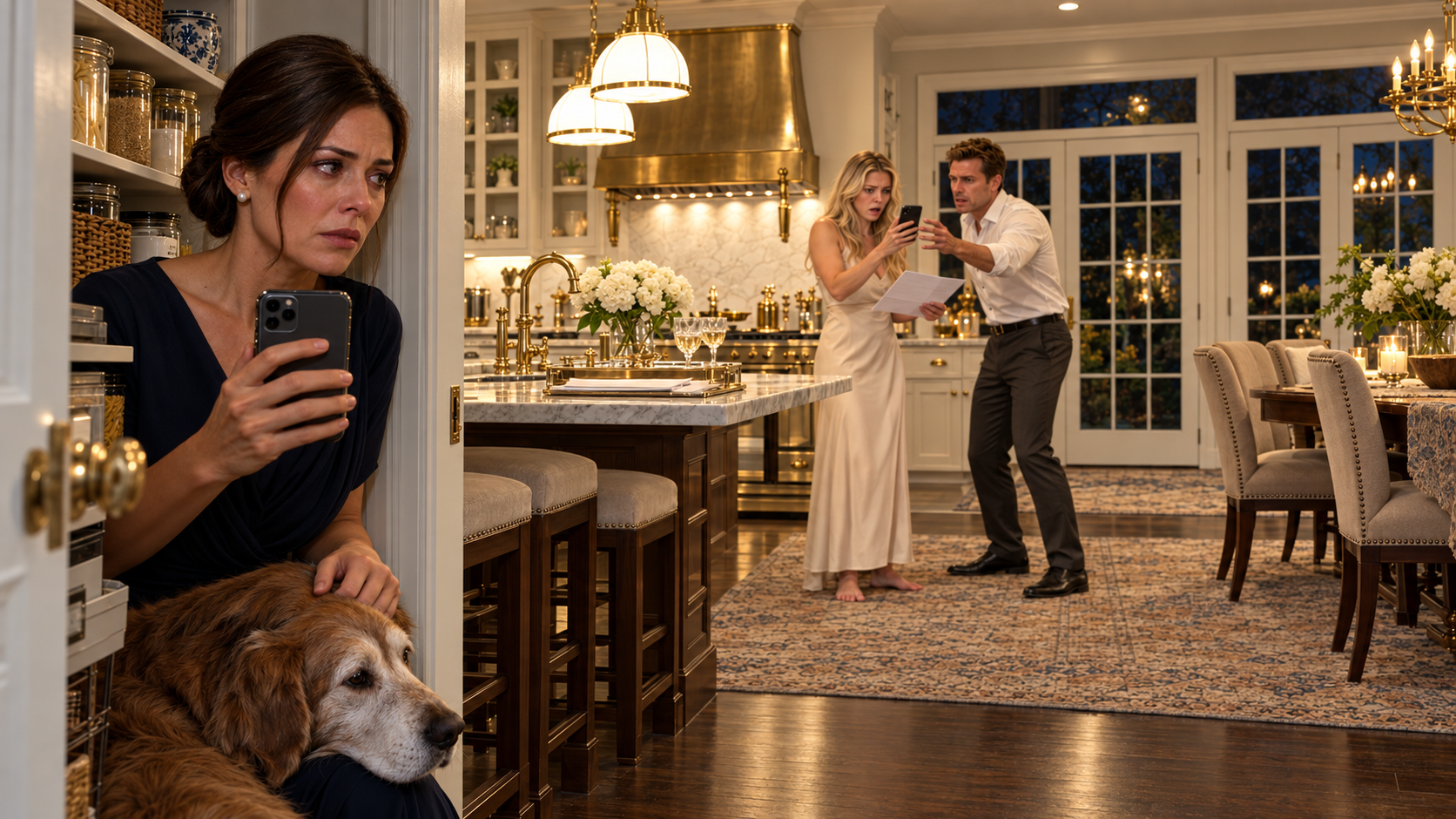
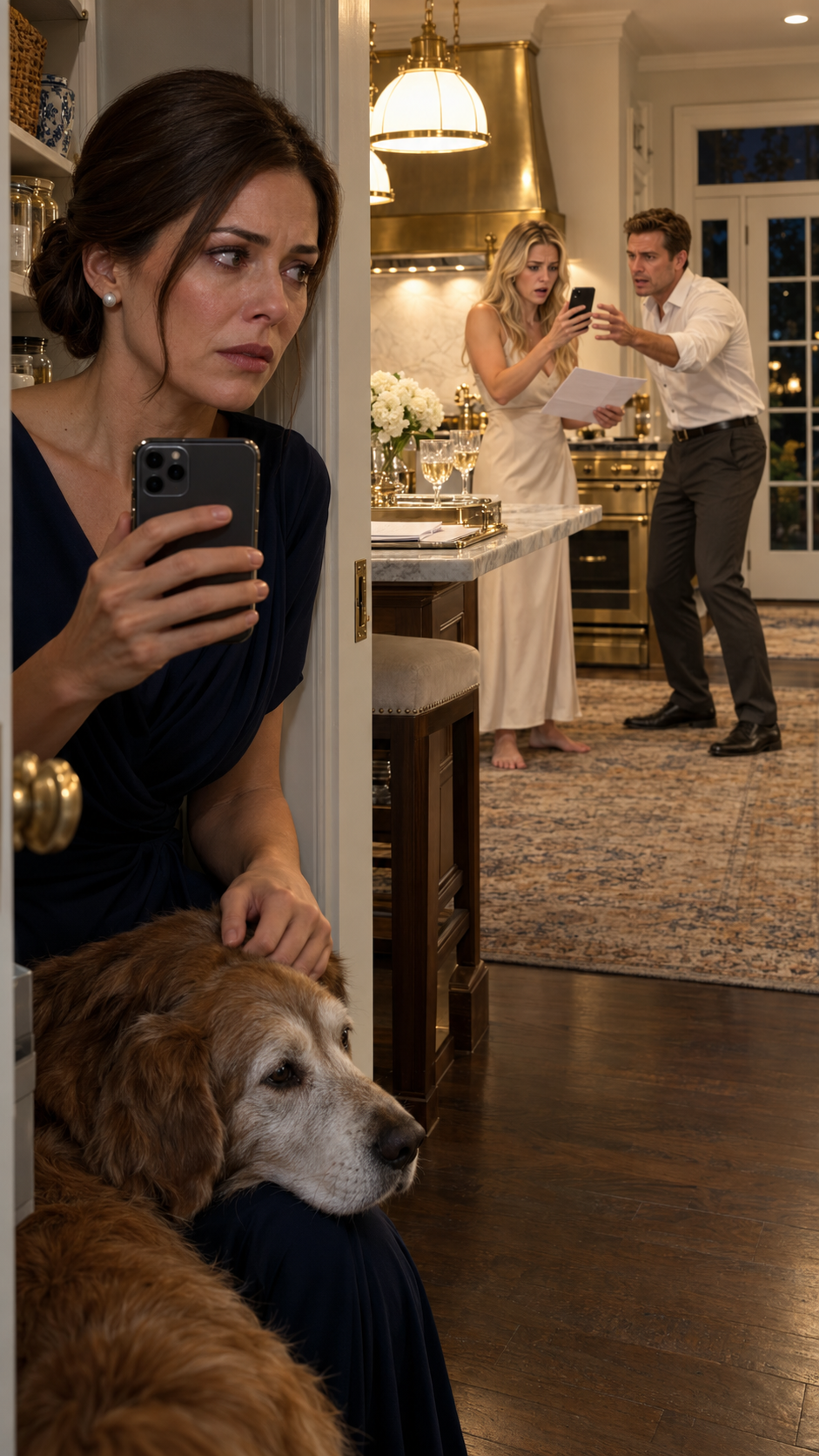
It ended while my husband’s mistress leaned across my marble island and performed ownership of my home for thousands of strangers.
Savannah Cole smiled into her phone as though the house already belonged to her.
Behind her, Daniel stood with a bottle of my wine in his hand.
My wine.
My kitchen.
My wedding crystal.
He poured burgundy into the glass my mother had chosen for my wedding registry, and when Savannah laughed, he laughed too.
That sound did something to me.
It did not break me.
It woke me.
I pressed one hand against the pantry shelf and held my phone with the other. A jar of orange marmalade dug painfully into my palm, but I didn’t move.
I would not give them the screaming wife they expected.
I would not burst through the pantry door.
I would not throw the wine.
I would not slap her.
And I would not ask him why.
Not yet.
Henry, my thirteen-year-old Weimaraner, stood pressed against my legs. His gray muzzle rested against my knee. I kept one hand buried between his ears because I was terrified he might whine.
Somehow, he seemed to understand.
One sound could change everything.
Twenty-three minutes earlier, I had entered the house through the mudroom and heard Savannah’s voice before I saw her.
I knew that voice.
Three weeks earlier, I had heard it through Daniel’s car speakers.
He had disconnected the call too quickly.
“Work,” he’d said.
I’d pretended to believe him.
That night, I had been expected to remain at the Ashford Foundation dinner downtown until after eleven. A burst pipe ended the event early, so I came home at nine-thirty.
Daniel apparently believed he had the entire house to himself.
I heard laughter from the kitchen.
Then Savannah announced to her livestream that she was standing in “the most gorgeous kitchen in Connecticut.”
My kitchen.
I slipped into the pantry before either of them saw me.
Maybe some part of me already knew.
Maybe I simply needed to see how far Daniel’s lies went when he believed nobody was watching.
Savannah dragged one pink fingernail along the edge of the marble island.
“Some women don’t know when to leave,” she said.
Hearts exploded across her screen.
Hundreds.
Then thousands.
Daniel didn’t stop her.
He only smiled.
Careful.
Nervous.
Like a man enjoying a fire while calculating the distance to the nearest smoke detector.
That hurt more than the kiss I’d seen twenty seconds earlier.
A kiss could be blamed on impulse.
A smile like that required permission.
Savannah lifted the crystal toward the camera.
“Look at this place.”
Daniel glanced toward her phone.
“Maybe don’t show the whole house.”
“Why?”
“Privacy.”
She laughed.
“You didn’t care about privacy ten minutes ago.”
He gave her a warning look.
She ignored it.
I called Meredith Shaw from inside the pantry.
Meredith had handled my mother’s estate after her death. She negotiated contracts for Ashford Marine. She had sat beside me during the ugliest business meeting of my life and once told me that panic was usually just information arriving faster than the brain wanted to receive it.
I didn’t say hello.
I whispered, “They’re live.”
For one second, she said nothing.
Then her voice changed.
“Record everything.”
“I am.”
“Do not engage.”
My fingers trembled so badly I almost dropped the phone.
“Meredith—”
“Claire. Listen to me. Whatever you feel right now, you can feel tomorrow. Tonight, you document.”
I looked through the narrow crack in the pantry door.
Savannah walked barefoot across the tile I had chosen six weeks after my mother died.
At the time, I could barely make decisions.
White or cream.
Brass or nickel.
Oak or walnut.
Daniel had told me not to worry.
“I’ll handle everything.”
I had thought that was love.
Savannah opened one of my drawers.
Touched my linen napkins.
Picked up one of the white tulips from the vase and held it like a microphone.
“She’ll get over it,” she told her followers.
Daniel set the wine bottle down too hard.
“Stop saying things like that.”
For one foolish heartbeat, I wondered if he was defending me.
Then he glanced toward the phone.
Not toward the room.
Not toward the life we’d built.
Toward the audience.
He was protecting himself.
Savannah smiled wider.
“Oh, come on. You said—”
“Savannah.”
His voice changed.
She stopped.
And I understood something important.
She knew only the version of our marriage Daniel had sold her.
Probably one in which I was cold.
Absent.
Controlling.
A wife who loved a shipping company more than her husband.
Maybe he’d told her we slept in separate rooms.
We didn’t.
Maybe he’d told her divorce papers were being prepared.
They weren’t.
Maybe he’d told her the house belonged to him.
It didn’t.
The property had been purchased by the Ashford family trust before I ever met Daniel.
Savannah panned the camera across the room.
The brass stove.
The breakfast nook.
The antique clock.
Then the framed black-and-white photograph of my parents standing beside the first Ashford Marine vessel launched under their joint leadership.
My father had his arm around my mother.
She was twenty-nine.
He was thirty-two.
They looked exhausted and invincible.
The camera moved toward the silver tray beside the mudroom door.
Mail.
My skin went cold.
Daniel saw it too.
“Savannah, leave that alone.”
“It’s just mail.”
“It’s private.”
“So is your marriage, apparently.”
Then she lifted an envelope bearing the Ashford Marine letterhead.
I knew it.
Corporate counsel had sent it that morning. I’d seen it in my mail-preview notification but hadn’t opened it yet.
Daniel stepped toward her.
“Put it down.”
Savannah laughed.
“You’re acting weird.”
“Put it down.”
Something changed in his face.
Not the expression of a guilty husband.
Something worse.
The blood drained from his cheeks.
His mouth went pale.
His eyes fixed on that envelope as if Savannah had opened a grave.
That was when I understood.
This wasn’t only about an affair.
Savannah frowned.
“What is Ashford Marine?”
Daniel moved toward her.
She stepped away playfully.
“You’re being dramatic.”
“Give it to me.”
Instead, she slid one manicured finger beneath the flap.
The sound of tearing paper was tiny.
From inside the pantry, it sounded like thunder.
Savannah unfolded the letter.
“What does this say?”
Daniel reached for it.
She twisted away.
“Special board review?”
His face changed again.
This time Savannah noticed.
“What are you so nervous about?”
I hit send.
The first recording went to Meredith.
Then another.
Then another.
My phone vibrated.
DO NOT LEAVE THE RECORDING APP.
Another message appeared.
SHE JUST OPENED MAIL ADDRESSED TO YOU ON CAMERA.
Then:
LET HER KEEP GOING.
I stared at those words until my hands stopped shaking.
Savannah read aloud.
“‘Review of executive authorization procedures, vendor relationships, related-party disclosures…’”
Daniel grabbed for the page.
She held it above her shoulder.
“What is Greyhaven?”
Silence.
Absolute silence.
Daniel stopped moving.
And I remembered the name.
Greyhaven Strategic Partners.
I had seen it twice before.
Once on an expense summary Daniel brought home six months earlier.
Once in a board packet the previous spring.
A consulting vendor.
Nothing remarkable.
One of dozens.
I’d asked Daniel what they did.
“Commercial expansion modeling.”
I’d accepted the answer.
Savannah looked at him.
“Wait.”
Her voice changed.
“Greyhaven?”
Daniel whispered, “Turn off the phone.”
She stared at the letter.
“That’s your company.”
My heart slammed against my ribs.
Daniel moved so quickly the camera shook.
“What did you just say?”
Savannah laughed nervously.
“You told me Greyhaven was your investment company.”
“Turn it off.”
“The apartment payments say Greyhaven.”
“Savannah.”
The livestream comments exploded.
WHAT APARTMENT?
GIRL WHAT???
DANIEL???
ISN’T ASHFORD MARINE CLAIRE’S FAMILY COMPANY?
SCREEN RECORD THIS
Savannah finally looked frightened.
“Daniel, what is this?”
He seized the phone.
The livestream ended.
For three seconds, I saw only my reflection in my black screen.
A pale woman crouched beside shelves of preserves and flour while an old dog leaned against her.
My phone buzzed.
CALL ME WHEN THEY LEAVE.
I stayed where I was.
Outside, Savannah’s voice rose.
“What did I just read?”
“Nothing.”
“Don’t do that.”
“It’s confidential.”
“You said Greyhaven was yours.”
“It is.”
“Then why is it in a letter from her company?”
“You don’t understand the structure.”
“So explain it.”
“I can’t.”
“You can’t or you won’t?”
A chair scraped.
“The letter is none of your business.”
“The money paying for my apartment is my business.”
Apartment.
Greyhaven.
Ashford Marine.
Daniel.
The pieces were scattered.
But now I could see their edges.
“You told me you built Greyhaven before you married her.”
“I said enough.”
“You said the money was yours.”
“It is.”
“Then why do you look terrified?”
Silence.
Then Daniel said, very quietly, “You need to delete the video.”
“Why?”
“Because you were in someone else’s home, you opened private mail, and you made statements you don’t understand.”
“You’re worried about my statements?”
“I’m trying to protect you.”
Those words hit me harder than they should have.
I’m trying to protect you.
He had said them after my mother died.
When he suggested I step away from operational meetings.
When he said financial reports would only exhaust me.
When he volunteered to become the liaison between me and senior executives.
When he discouraged me from questioning vendor restructuring because I was “still grieving.”
When he told me trusting him was the same as trusting myself.
Protection.
The favorite word of men who wanted women to stop looking.
Savannah’s heels clicked across the floor.
“I’m leaving.”
“Give me the letter.”
“No.”
“Don’t make this—”
“Don’t touch me.”
The front door slammed.
Daniel remained.
I heard drawers opening.
Cabinets.
Paper shifting.
He was searching.
Then he made a call.
“Paul,” he said.
I froze.
He walked toward the living room, and I couldn’t hear the rest.
Minutes later, he returned.
The garage door opened.
An engine started.
Silence.
Henry exhaled.
I stayed in the pantry another full minute.
When I finally opened the door, the kitchen looked exactly as it had an hour earlier.
And completely different.
Two wineglasses stood on the island.
One carried Savannah’s lipstick.
The letter was gone.
Daniel had taken it.
But he’d been too late.
Thousands of people had seen it.
And I had every second saved.
I stared at Savannah’s glass.
For one ugly moment, I wanted to smash it.
Instead, I put it carefully into a plastic storage container.
Then I called Meredith.
“I have everything.”
“Good.”
“I think Daniel has been stealing from Ashford Marine.”
There was a long silence.
Then she said something that frightened me more than surprise would have.
“I think you need to come to my office.”
“When?”
“Now.”
“Meredith?”
“Yes?”
“How long have you suspected him?”
She didn’t answer immediately.
And suddenly the affair became the least important betrayal in my house.
“Claire,” she said quietly, “there are things the board has been trying to tell you.”
PART 2: THE THINGS I REFUSED TO SEE
Meredith’s office was on the nineteenth floor of a glass building overlooking the river.
At eleven forty-three that night, it felt like the only room in Connecticut where nobody was pretending.
I sat across from her conference table with Henry at my feet.
I hadn’t changed clothes.
I hadn’t cried.
That frightened me.
Meredith set a thick folder in front of me.
“Before I show you this, I need you to understand something.”
“Don’t protect me.”
She stopped.
Maybe she heard Daniel in those words too.
“All right.”
She opened the folder.
The first page was a payment summary.
Greyhaven Strategic Partners.
I knew enough about Ashford Marine’s finances to recognize the numbers.
Not enough, apparently, to recognize what they meant.
“How much?”
“That isn’t the right question yet.”
“How much, Meredith?”
She looked at me.
“Over the period currently under review, several million dollars in payments went to Greyhaven and related consulting arrangements.”
The room seemed to tilt.
“Several million?”
“We don’t yet know what portion was legitimate.”
“Does Greyhaven do legitimate work for us?”
“We are trying to establish that.”
I stared at the columns.
Daniel’s name appeared beside multiple authorizations.
Not alone.
Sometimes he had approval from other executives.
Sometimes the amounts were divided.
Sometimes the descriptions were vague enough to mean almost anything.
Market assessment.
Expansion strategy.
Executive advisory services.
Operational transition analysis.
Words designed to sound expensive without saying anything.
“Why didn’t anybody tell me?”
“We tried.”
I looked up.
Meredith didn’t flinch.
“The board requested a review last spring. You postponed it.”
“I did not.”
“You signed the postponement.”
“I never—”
Then I remembered.
Daniel standing at the foot of our bed with a folder.
My mother’s death had been less than four months earlier.
I had been sleeping three hours a night.
There were condolence letters on my dresser.
Foundation paperwork on the chair.
Probate documents on the nightstand.
Daniel had kissed my forehead.
“Just routine board housekeeping,” he’d said.
I had signed where he pointed.
My stomach turned.
“What else?”
“Audit committee questions were sent to you in June.”
“I never received them.”
“They were acknowledged from your executive email.”
I stopped breathing.
“Daniel had access.”
Meredith nodded once.
I’d given it to him willingly.
During my mother’s illness, Daniel had started helping manage my calendar. After her death, that expanded to correspondence.
He had framed it as kindness.
He would filter the noise.
He would protect me.
I pressed both hands against the table.
“Show me everything.”
So she did.
Not proof of every suspicion.
Meredith was careful about that.
She showed me questions.
Patterns.
Missing documentation.
Repeated approvals.
Greyhaven invoices that described work no department seemed able to remember receiving.
A vendor address that had changed twice.
A payment structure that appeared designed to keep individual transactions from attracting attention.
And always, somewhere near the chain, Daniel.
Not necessarily committing a crime on every page.
But present.
Guiding.
Approving.
Explaining.
Reassuring.
The same thing he had done to me.
“What about Paul?”
Meredith’s expression tightened.
“Paul Mercer?”
Daniel’s call from my living room returned to me.
“Yes.”
“He’s Daniel’s closest ally in finance.”
“Daniel called him after Savannah left.”
That got her attention.
“What exactly did he say?”
“Only his name. He walked away.”
Meredith wrote it down.
“Don’t contact Paul.”
“I wasn’t planning to.”
“Don’t contact Daniel either.”
I laughed once.
It sounded wrong in the room.
“My husband brings another woman into my house, lets her tell thousands of people I’m being replaced, she accidentally announces that a vendor under board review is paying for her apartment, and I’m supposed to go home and sleep?”
“No.”
Meredith closed the folder.
“You’re supposed to go home and behave as though you know less than you do.”
That was worse.
“You want me to pretend.”
“I want you to give the board’s counsel time to preserve records before anyone realizes how much Savannah exposed.”
I looked at her.
“Daniel realizes.”
“Daniel knows she said too much. He doesn’t know what you heard.”
“He might know I saw the livestream.”
“Did he see you?”
“No.”
“Did Savannah?”
“No.”
“Then right now, uncertainty is useful.”
I looked toward the windows.
The city reflected back at me.
For years, I had believed power meant being the loudest person in a room.
My mother never believed that.
She could sit silently through an hour of argument and then ask one question that changed the entire meeting.
I heard her voice in my memory.
Never interrupt someone while they’re explaining who they are.
I had interrupted Daniel too many times by trusting him.
Not anymore.
“What do you need from me?”
Meredith’s face softened for the first time.
“Access.”
“To what?”
“Everything.”
“You have it.”
“No, Claire. I need you to understand what that means.”
I did.
Ashford Marine was not just a company.
It was my grandfather’s first leased warehouse.
My father’s first vessel.
My mother’s thirty years of work.
Employees who had known me since I was a child.
Families whose mortgages and college tuition depended on decisions made in our boardroom.
If Daniel had used my grief to turn that company into his private account, then what he had stolen wasn’t simply money.
He had stolen trust wearing my name.
“You have it,” I repeated.
At two-fifteen in the morning, I returned home.
Daniel was waiting in the kitchen.
Of course he was.
The wineglasses were gone.
The counters were clean.
The tulips had been rearranged.
He had erased Savannah from the room.
He stood when I entered.
“Where were you?”
I looked at him.
Seven years of marriage.
Seven years of knowing how he took his coffee.
How he rubbed his left eyebrow when tired.
How he hated sleeping with the closet door open.
How he reached for my hand during airplane turbulence even though I wasn’t afraid of flying.
All those intimate details remained true.
That was the cruelty of betrayal.
A lie did not erase every real thing that came before it.
It contaminated them.
“Foundation problem,” I said.
His eyes searched mine.
“At two in the morning?”
“Tonight has been strange.”
His shoulders tightened.
There.
A tiny reaction.
“Did you see something online?”
I took off my coat.
“What would I have seen?”
“Nothing. Savannah posted something from here.”
I let the silence stretch.
He stepped closer.
“Claire, I can explain.”
I almost smiled.
Not because anything was funny.
Because I finally understood the architecture of his confidence.
He had always expected another chance to explain.
Every contradiction became context.
Every suspicion became misunderstanding.
Every boundary became something I was too emotional to interpret correctly.
“Was she here?”
He closed his eyes briefly.
“Yes.”
“Did you sleep with her?”
“Claire—”
“That’s a yes.”
“It isn’t that simple.”
“It rarely is.”
He seemed unsettled by my calm.
Good.
“I made a mistake.”
I looked at him.
“One?”
His face changed.
Only slightly.
But I saw it.
He didn’t know what I meant.
The affair?
Greyhaven?
My email?
The board review?
For the first time in years, Daniel had too many lies and no idea which one I had discovered.
I walked past him.
“Where are you going?”
“To bed.”
“We need to talk.”
“Tomorrow.”
“Claire.”
I turned at the stairs.
He looked frightened.
Not remorseful.
Frightened.
“Did Savannah say anything to you?”
“No.”
“Did she contact you?”
“No.”
“Did anyone send you her livestream?”
I waited one beat too long on purpose.
“No.”
He nodded.
Too quickly.
I went upstairs.
At the bedroom door, I stopped.
“Daniel?”
“Yes?”
“What’s Greyhaven?”
His face emptied.
Completely.
And in that one second, I knew Meredith had been right.
He was terrified.
Then the mask returned.
“A consulting company.”
“That’s what I thought.”
I went inside and locked the door.
At 3:07 a.m., my phone lit up.
Unknown number.
I nearly ignored it.
Then a message appeared.
THIS IS SAVANNAH.
I sat up.
Another message came.
I THINK DANIEL LIED TO BOTH OF US.
Then a third.
AND I SAVED SOMETHING BEFORE HE TOOK MY PHONE.
PART 3: GREYHAVEN
I met Savannah the next afternoon in a hotel café forty miles from my house.
Not because I trusted her.
Because I didn’t.
Trust had become too expensive to hand out casually.
She arrived wearing oversized sunglasses and a cream coat that made her look younger than she had on the livestream.
She stopped when she saw me.
For a moment, neither of us spoke.
This was the woman who had kissed my husband in my kitchen.
The woman who had drunk from my wedding crystal.
The woman who had told strangers I needed to learn when to leave.
I expected rage to rise when I saw her.
Instead, I felt something colder.
Disappointment.
She removed her glasses.
Her eyes were swollen.
“I didn’t know.”
“Which part?”
She flinched.
Fair.
“Most of it.”
“Sit down.”
She did.
Her hands shook when she reached for the water.
“I’m not asking you to forgive me.”
“Good.”
“I knew he was married.”
There it was.
No excuse.
At least not that one.
“But he told me you were separated. He said you were staying married temporarily because of the company and family trusts.”
“We had breakfast together yesterday.”
Her face went still.
“He stayed in my bed Sunday night.”
Savannah looked down.
I let that sit between us.
Then she whispered, “He told me he was in Boston.”
“He wasn’t.”
“I’m sorry.”
I didn’t answer.
Sorry was a word for later.
“Tell me about Greyhaven.”
She looked around the café.
“Daniel told me it was his private investment firm.”
“When?”
“Almost a year ago.”
“How long have you been seeing him?”
“Ten months.”
The precision hurt more than I expected.
I nodded.
“And the apartment?”
“He said he didn’t want payments coming from his personal accounts because of the separation. Greyhaven pays the rent.”
“How much?”
She told me.
I wrote it down.
“He bought furniture too?”
She nodded.
“Trips?”
“Some.”
“Jewelry?”
“Yes.”
“Through Greyhaven?”
“I don’t know. I didn’t ask.”
“Why not?”
Her eyes flashed.
“Because when a wealthy man tells you his investment company is paying for something, you don’t automatically assume he’s stealing it from his wife’s family.”
“He’s not wealthy.”
She stared at me.
That surprised her.
Daniel lived like a wealthy man because he had married into wealth.
There was a difference.
His salary was substantial.
His life was comfortable.
But the houses, the trust, the family holdings, the foundation interests—those weren’t his.
I had never cared about that distinction inside our marriage.
Apparently, Daniel had.
Savannah opened her bag.
“I saved this.”
She placed her phone on the table.
It was a screenshot from before the livestream ended.
The board-review letter filled most of the image.
Not all of it.
But enough.
Greyhaven Strategic Partners.
Vendor relationships.
Related-party disclosures.
Authorization review.
And a reference number.
Meredith had already obtained the original from corporate counsel by then, but the screenshot mattered for another reason.
It proved what Savannah had seen before Daniel removed the letter.
“Why save it?”
“Because of his face.”
She swallowed.
“I’ve never seen him look like that.”
Neither had I.
“Then what happened?”
“He made me delete the livestream.”
“I know.”
“He watched me delete it.”
“But?”
“I have automatic cloud backup.”
For the first time, I almost laughed.
Daniel had spent years telling me technology wasn’t my strength.
Apparently, it wasn’t his either.
Savannah continued.
“He kept asking exactly what I had said. Exactly what the comments had seen. He wanted to know if I had ever mentioned Greyhaven before.”
“Had you?”
“Once.”
“When?”
“Months ago. I posted flowers he sent me and tagged the card.”
“What did the card say?”
She looked embarrassed.
“Something about Greyhaven taking care of its best investment.”
My stomach tightened.
“Do you still have it?”
“The post?”
“The card.”
She nodded slowly.
“Yes.”
“Don’t destroy anything.”
“I’m not planning to.”
“Don’t post anything either.”
Her mouth tightened.
“You sound like your lawyer.”
“You spoke to Meredith?”
“No. Daniel said you’d lawyer up and destroy me.”
There it was.
Another version of me.
“Did he tell you I was unstable?”
Savannah looked away.
“Controlling?”
Silence.
“Vindictive?”
“I’m sorry.”
“Stop saying that.”
She looked at me.
“If you want to help, tell the truth. All of it.”
So she did.
Not every detail mattered.
Some hurt anyway.
The hotel where they’d first slept together.
The restaurants Daniel told me were client dinners.
The weekend he claimed to be visiting Paul after Paul’s father became ill.
A bracelet.
A ski trip.
The apartment.
Promises.
So many promises.
He told Savannah that after the “separation” was finalized, they would travel.
That my house would probably be sold.
That he was considering buying something larger.
That Greyhaven would eventually become his full-time focus.
That he was building a future independent of Ashford Marine.
Independent.
With money apparently coming through an Ashford Marine vendor.
When she finished, I asked the question I had been avoiding.
“Did he ever discuss the company with you?”
“Not details.”
“Think.”
She rubbed her forehead.
“He complained about the board.”
“What did he say?”
“That they were old-fashioned. That they didn’t understand growth. That your mother had surrounded you with people who treated you like a child.”
That sounded like Daniel.
“What else?”
“He said you had voting control but didn’t like confrontation.”
I stared at her.
She saw the significance immediately.
“He talked about my voting rights?”
“Yes.”
“Often?”
“Not often.”
“But more than once.”
She nodded.
My pulse slowed.
That was the strange thing about real fear.
Sometimes it didn’t make the heart race.
Sometimes it made everything precise.
“What did he say?”
“That you signed whatever your advisers put in front of you.”
The words cut deeper than Savannah intended.
Because Daniel had not been entirely wrong.
During the worst year of my grief, I had signed too much.
Trusted too much.
Delegated too much.
I had called it survival.
Daniel had apparently called it opportunity.
My phone vibrated.
Meredith.
I stepped outside to answer.
“We found something,” she said.
“What?”
“Greyhaven’s ownership filings are layered.”
“Meaning?”
“Meaning we’re still working through them.”
“Is Daniel the owner?”
“We can’t say that yet.”
“Savannah says he told her he was.”
“That’s useful as a statement, not proof.”
“What did you find?”
“A connection.”
I waited.
“One of Greyhaven’s registration addresses traces back to an office service used by an entity Paul Mercer helped establish several years ago.”
Paul.
The man Daniel called from my living room.
“Is Paul involved?”
“We don’t know.”
“Meredith.”
“We do not know, Claire.”
I hated those words.
But I trusted them more than Daniel’s certainty.
“What do I do?”
“Come to the office after you finish with Savannah.”
“How did you know—”
“Because Savannah called me twenty minutes before she called you.”
I looked through the café window.
Savannah sat alone, staring at her hands.
“Can we trust her?”
“No.”
The answer was immediate.
“But we can verify what she gives us.”
That distinction mattered.
When I returned to the table, Savannah stood.
“Are you going to sue me?”
“I don’t know.”
She nodded.
“Fair.”
I almost walked away.
Then she said, “Claire.”
I turned.
“He kept one thing at the apartment.”
“What?”
“A folder.”
“What kind?”
“I don’t know. He told me never to touch it.”
“Where?”
“In the desk.”
“Do not go get it.”
Her eyebrows rose.
“I thought you’d want it.”
“I want you to stop touching things that don’t belong to you.”
The words landed.
She nodded.
“Right.”
“If it’s his property, let the lawyers deal with it.”
“What if he removes it?”
“Then that’s his decision.”
She stared at me as if she didn’t understand.
I barely understood myself.
A day earlier, I would have thought winning meant grabbing every secret before Daniel could hide it.
Now I understood something else.
We didn’t need to become him to expose him.
We needed records.
Timelines.
Lawful access.
Facts he couldn’t explain away.
I left Savannah at the café and drove directly to Meredith’s office.
When I arrived, three people were waiting.
Meredith.
The chair of Ashford Marine’s audit committee.
And our outside forensic accountant.
On the conference-room screen was a diagram.
Ashford Marine sat on the left.
Greyhaven on the right.
Between them ran a web of invoices, approvals, consulting descriptions, and payments.
At the bottom was a name I recognized.
Paul Mercer.
At the top was Daniel Vale.
Not as owner.
Not yet.
But as the executive who had repeatedly vouched for Greyhaven’s work.
“How bad?” I asked.
The accountant folded his hands.
“We’re still determining that.”
“Everyone keeps saying that.”
“Because accuracy matters.”
He pointed to the screen.
“We can establish that Mr. Vale was involved in bringing Greyhaven into multiple projects. We can establish that he defended its invoices when questioned. We can establish that Mr. Mercer approved or facilitated certain payments. We can establish that documentation is incomplete.”
“And the apartment?”
Meredith answered.
“Potentially significant, if Greyhaven paid it.”
“Can we prove that?”
“Savannah has provided statements.”
I looked at her.
“You already have them?”
“She sent them before meeting you.”
So Savannah had been telling the truth about at least that.
The accountant enlarged a section of the chart.
“We also found attempts to characterize some Greyhaven expenses as strategic-development costs associated with executive outreach.”
“Executive outreach.”
My voice sounded dead.
“Is that what we’re calling my husband’s mistress now?”
Nobody answered.
Good.
I wasn’t asking for an answer.
Then Meredith slid a printed email across the table.
It had been recovered from company archives.
Daniel had written it eleven months earlier.
I read one sentence twice.
Claire is comfortable with the existing authorization structure and does not want unnecessary escalation while she is dealing with family matters.
Family matters.
My mother’s death.
He had used my grief as an authorization.
I looked at the date.
Three days before the first Greyhaven payment currently under special review.
“Did I ever say this?”
“No,” Meredith said.
“Did anyone ask me?”
“Not directly.”
“Because Daniel said he spoke for me.”
“Yes.”
Something inside me settled.
The affair had humiliated me.
This was different.
This had endangered something larger than my marriage.
“When is the board meeting?”
“Tomorrow morning.”
“Move it earlier.”
Meredith studied me.
“Claire—”
“I want every person with preservation authority notified tonight. No records deleted. No accounts altered. No quiet calls giving Daniel time to prepare a story.”
“That process has already begun.”
“Good.”
I looked at Daniel’s email again.
Then I understood what I needed to do.
“For the meeting,” I said, “don’t tell Daniel what Savannah gave us.”
Meredith’s eyes sharpened.
“Why?”
“Because I want to hear what he says before he knows what we know.”
PART 4: THE STORY DANIEL CHOSE
Daniel wore the navy suit I had bought him for our anniversary.
That almost made me angry enough to lose control.
Almost.
The emergency board meeting began at eight the next morning.
Daniel entered three minutes early.
Paul Mercer arrived behind him.
When Daniel saw me seated beside Meredith, he stopped.
Only for half a second.
Then he smiled.
“Claire.”
“Daniel.”
He looked around the room.
The audit committee chair.
Outside counsel.
Forensic accountants.
Senior directors.
No one returned his smile.
Paul sat down.
Daniel remained standing.
“What exactly is this?”
The chair answered.
“A continuation of the special vendor and authorization review.”
“Without notice?”
“You received notice.”
“At six this morning.”
“Correct.”
Daniel looked at me.
“This is because of Savannah.”
Nobody answered.
He laughed once.
“Unbelievable.”
Then he sat.
For the next forty minutes, I watched my husband build a version of reality.
It was impressive.
That was the worst part.
He did not rant.
He did not panic.
He explained.
Greyhaven was a legitimate consulting firm.
Its work was unconventional but valuable.
Documentation gaps were administrative.
Paul’s approvals were routine.
Daniel’s involvement had been disclosed.
Any suggestion of self-dealing was absurd.
The board review had been triggered by people who resented his growing influence.
And Savannah?
A personal mistake.
Nothing more.
Then he looked directly at me.
“I understand Claire is hurt.”
There it was.
Not angry.
Not deceived.
Hurt.
A wife.
An emotional woman.
A private humiliation bleeding into corporate governance.
“But I hope this board can separate a marital issue from legitimate business.”
I said nothing.
He continued.
“Claire has been through an extraordinary amount in the last two years. I have tried to protect her from unnecessary pressure.”
Meredith’s pen stopped moving.
Daniel didn’t notice.
“After Eleanor died, Claire asked me to take on more responsibility.”
My mother’s name in his mouth nearly broke my calm.
Nearly.
“She trusted my judgment.”
Past tense.
Interesting.
“Are you saying Claire approved Greyhaven?” the audit chair asked.
Daniel hesitated.
“I am saying she was aware of the broader strategy.”
“Did she approve Greyhaven specifically?”
“Not every vendor requires her direct approval.”
“That wasn’t the question.”
Daniel leaned back.
“She knew I was restructuring certain advisory relationships.”
I finally spoke.
“When?”
His eyes moved to me.
“What?”
“When did you tell me?”
“Claire, this isn’t—”
“Give me a date.”
He frowned.
“I don’t have my calendar in front of me.”
“A month.”
“You’re asking me to remember conversations from more than a year ago.”
“So you told me more than a year ago?”
“I said we discussed the strategy.”
“What did I say?”
He looked toward Meredith.
“This is turning into a cross-examination.”
“No,” I said. “It’s a memory test.”
“Claire.”
“You’ve spent two days asking what I know. I’m asking what you claim I knew.”
The room became silent.
Daniel’s face hardened.
“I don’t appreciate the implication.”
“I don’t appreciate being quoted in emails I never saw.”
Meredith placed the recovered message on the screen.
Daniel looked at it.
Something flickered across his face.
Gone immediately.
He recovered.
“That reflects my understanding at the time.”
“You wrote that I was comfortable with the authorization structure.”
“You were.”
“I wasn’t.”
“Claire, you signed the postponement.”
There.
He had finally stepped into it.
I leaned forward.
“What postponement?”
His eyes changed.
Too late.
Meredith answered for the record.
“The audit review postponed after Eleanor Ashford’s death.”
Daniel looked at her.
Then back at me.
I said, “You told me that document was routine board housekeeping.”
“I don’t remember saying that.”
“I do.”
“You’re remembering a conversation from one of the most traumatic periods of your life.”
The cruelty of the sentence was almost elegant.
He wasn’t merely denying my memory.
He was using my grief to discredit it.
I felt my mother’s absence then.
Not as weakness.
As anger.
“You accessed my executive email.”
“With your permission.”
“For calendar management.”
“And correspondence.”
“Not to impersonate me.”
“I never impersonated you.”
Meredith spoke.
“Responses were sent from Ms. Vale’s account acknowledging audit questions she says she never saw.”
Daniel’s jaw tightened.
“Then perhaps she forgot.”
I stared at him.
Seven years.
This man had held me while I cried after my mother’s funeral.
He had brought me tea when I couldn’t eat.
He had taken my phone away when condolence calls became too much.
And somewhere inside that same period, he had apparently learned that my grief could be used as camouflage.
Paul shifted in his chair.
I noticed.
So did Meredith.
The accountant began walking through Greyhaven’s payment history.
Daniel challenged terminology.
Questioned assumptions.
Demanded proof.
On several points, he was right to do so.
Suspicion wasn’t proof.
Incomplete records weren’t automatically fraud.
A bad invoice wasn’t automatically theft.
Meredith had warned me about that.
We were not there to invent certainty.
We were there to establish facts.
Then the accountant displayed Greyhaven payments associated with an apartment lease.
Daniel’s face did not change.
“Do you recognize the address?” the audit chair asked.
“No.”
“Never seen it?”
“Not that I recall.”
I watched him.
“Daniel.”
He looked at me.
“Think carefully.”
“I said I don’t recognize it.”
I nodded.
Meredith placed Savannah’s lease records on the screen.
Greyhaven Strategic Partners had paid the apartment.
Daniel looked at them.
“That proves nothing about me.”
“No,” I said. “It proves Greyhaven paid for Savannah’s apartment.”
“Assuming these are authentic.”
“They’ve been verified with the property manager,” Meredith said.
Daniel looked at her sharply.
Then he turned to me.
“She’s manipulating you.”
“Who?”
“Savannah.”
“Why?”
“Because she’s angry.”
“At whom?”
“Me.”
“For lying to her?”
His eyes hardened.
“This has nothing to do with company business.”
“Greyhaven paid her rent.”
“I don’t control every Greyhaven expenditure.”
That sentence changed the room.
I heard the accountant’s chair creak.
Meredith didn’t move.
I said, “I thought Greyhaven was just a vendor.”
“It is.”
“Then why would you be expected to control its expenditures?”
“I said I don’t.”
“But you understood the question.”
Daniel’s mouth tightened.
“I understand what you’re trying to do.”
“What am I trying to do?”
“Punish me.”
For the first time, anger broke through.
Not mine.
His.
“You found out about Savannah and now you’re trying to turn a personal failure into some grand conspiracy.”
I let him finish.
Then I asked, “Did you tell Savannah Greyhaven belonged to you?”
Silence.
Paul looked at Daniel.
Daniel looked at me.
There it was.
The first true crack.
“She misunderstood.”
“So you discussed Greyhaven with her.”
“I may have mentioned it.”
“You told us five minutes ago she had nothing to do with company business.”
“She doesn’t.”
“But you discussed a company vendor with her.”
“Socially.”
“And allowed that vendor to pay her rent.”
“I didn’t allow anything.”
“Did you know?”
“No.”
The answer came fast.
Too fast.
I looked at Meredith.
She nodded once.
The video played.
Savannah in my kitchen.
The letter in her hand.
Daniel going white.
Her voice:
“You told me Greyhaven was your investment company.”
Then:
“The apartment payments say Greyhaven.”
Daniel’s voice from the recording:
“Turn it off.”
The clip ended.
Nobody spoke.
Daniel stared at the black screen.
Then at me.
“You recorded us.”
“No.”
He seemed confused.
“Savannah did.”
For the first time, Daniel looked genuinely cornered.
Then Paul spoke.
“I want separate counsel.”
Every head turned.
Daniel went still.
“Paul.”
Paul didn’t look at him.
“I said I want separate counsel.”
Daniel’s voice dropped.
“Don’t be ridiculous.”
The audit chair intervened.
“Mr. Mercer is entitled to counsel.”
“Of course he is. I’m saying this entire thing is being distorted.”
Paul pushed his chair back.
Daniel turned toward him.
“Sit down.”
That was the moment Daniel lost Paul.
Not because Paul suddenly became honorable.
Not because truth magically transformed him.
Because Daniel forgot where he was.
He spoke to Paul like a subordinate who knew too much.
Paul stared at him.
Something old and frightened moved across his face.
Then he said, “You told me Claire approved Greyhaven.”
Daniel’s expression froze.
Paul continued.
“You told me the disclosures had been handled.”
“Paul, stop talking.”
“You said she knew.”
“Stop.”
“You said her signature covered the review delay.”
“Counsel,” Meredith said calmly, “I think we should suspend substantive questioning until Mr. Mercer has representation.”
But the damage was done.
Daniel looked around the table.
For the first time, he had no version of the story large enough to contain all of us.
The meeting was adjourned.
Daniel followed me into the corridor.
“Claire.”
I kept walking.
“Claire!”
His hand caught my arm.
I stopped.
Looked down at his fingers.
He released me.
“You don’t understand what you’re doing.”
There it was again.
The old language.
Protection.
Confusion.
My supposed inability to see the larger picture.
“I understand more every hour.”
“You are going to destroy the company over this.”
I almost admired the audacity.
“The company?”
“Public scandal. Litigation. Board instability. Do you think clients care whose fault it is?”
“Then you should have considered that.”
His face twisted.
“This isn’t you.”
I looked at him.
“No. This is me without you explaining me to myself.”
For once, Daniel had nothing to say.
Then his phone rang.
He glanced at the screen.
His expression changed.
I didn’t need to know who it was.
The machinery he had trusted was beginning to move without him.
And for the first time, he couldn’t stop it.
PART 5: WHAT BELONGED TO ME
The final truth did not arrive in one dramatic envelope.
That would have been easier.
It came in pieces.
Invoices.
Archived emails.
Approval chains.
Corporate registrations.
Bank records obtained through the proper process.
Statements.
Metadata.
Dates.
The dull machinery of facts.
Over the following weeks, the special review expanded.
Daniel was placed on leave.
Paul obtained separate counsel.
Greyhaven’s relationships with Ashford Marine were frozen pending investigation.
Outside advisers were brought in to determine what services had actually been provided, which payments were legitimate, and which transactions required further action.
I learned to stop demanding that every question be answered immediately.
That had been Daniel’s gift to me, though not the one he intended.
He had taught me what false certainty sounded like.
Real investigations said:
We don’t know yet.
We need documentation.
This appears connected, but we must verify it.
This statement is inconsistent with that record.
This payment requires explanation.
Truth was slower than Daniel.
But it didn’t need to be charming.
Paul eventually provided records.
I never asked Meredith what pressure made him cooperate.
I didn’t care.
His records showed that Daniel had repeatedly represented that I supported the Greyhaven relationship.
They showed that Paul had accepted those representations far too easily.
They showed exceptions, shortcuts, and questions that should have been escalated.
They also showed something that hurt more than I expected.
Daniel had understood exactly when I was least likely to challenge him.
The first significant changes began during my mother’s illness.
The most aggressive period came after her death.
He had not created my grief.
He had simply studied it.
He knew when I stopped reading every board packet.
He knew when I let him answer emails.
He knew when I signed documents without asking Meredith to review them first.
He knew when exhaustion made gratitude feel like judgment.
And he called that trust.
Savannah’s apartment became one of several transactions examined during the review.
Her records helped establish a connection between Greyhaven spending and Daniel’s personal life that he had initially denied knowing about.
She gave statements.
She provided messages.
She turned over the Greyhaven card Daniel had sent with the flowers.
I never became her friend.
That mattered to me.
Some stories would have required that.
Two women discover a lying man and become sisters in revenge.
That wasn’t ours.
Savannah had knowingly slept with a married man.
She had stood in my kitchen and mocked me to strangers.
She had opened my mail.
Those choices belonged to her.
Daniel’s lies did not erase them.
But her worst choices did not require me to invent worse ones.
She had been cruel.
She had also been deceived.
Both could be true.
The last time I saw her, she came to Meredith’s office to sign a statement.
She found me alone near the elevators.
“I wanted to say something.”
I waited.
“I deleted the videos about you.”
“I know.”
“I should never have posted them.”
“No.”
She looked down.
“I thought I was winning.”
That sentence stayed with me.
Winning.
A house she didn’t own.
A man who lied to her.
An apartment paid for by a company she didn’t understand.
Promises built from somebody else’s name.
“I thought you were this woman keeping him trapped,” she said. “He made everything sound like you were standing between him and his real life.”
I looked at her.
“And now?”
“Now I think he told each of us whatever made him necessary.”
That was probably the truest thing Savannah ever said to me.
She left.
I never saw her again.
My marriage ended more quietly.
Daniel fought the divorce at first.
Not because he wanted me back.
Because control had become expensive to lose.
He disputed terms.
Challenged interpretations.
Insisted that company matters and marital matters remain separate whenever separation benefited him, then tried to blur them whenever it didn’t.
I let Meredith handle it.
The hardest part wasn’t fighting Daniel.
It was learning not to answer him.
He sent long messages.
Some angry.
Some tender.
Some almost convincing.
He reminded me of our first apartment.
The rainstorm in Charleston when we had run six blocks laughing because neither of us had an umbrella.
The Christmas Henry ate half a pecan pie and Daniel stayed awake all night beside him.
The morning after my father’s memorial when Daniel made pancakes because I couldn’t bear to leave the kitchen table.
Those memories were real.
That was why they hurt.
One night, he sent:
I loved you, Claire. Whatever you think of me now, don’t rewrite our entire life.
I stared at the message for almost an hour.
Then I wrote a response.
You don’t get to ask me to preserve the parts of our history that make you feel innocent.
I didn’t send it.
I deleted it.
Silence was no longer weakness.
It was a boundary.
Months later, I returned to a full Ashford Marine board meeting.
Not as the grieving daughter.
Not as Daniel’s wife.
As myself.
I had spent weeks rereading documents I should have read years earlier.
I met department heads without Daniel in the room.
I asked embarrassing questions.
Sometimes I discovered that I had misunderstood something.
Sometimes I discovered that other people had.
We changed approval procedures.
We reduced the ability of any one executive to speak informally for a controlling shareholder without documented authorization.
Vendor reviews were strengthened.
Access permissions were changed.
I asked the board to create safeguards that would have protected the company even from me.
That surprised some people.
It shouldn’t have.
The lesson wasn’t that I needed to become suspicious of everyone.
The lesson was that a healthy institution should not depend on one person’s perfect judgment.
My mother had understood that.
I had forgotten.
After the meeting, Meredith found me staring at the old photograph in the executive corridor.
My parents beside that first vessel.
Exhausted.
Invincible.
Or so I had always imagined.
“You all right?” she asked.
“No.”
She smiled slightly.
“Better answer than you used to give.”
I laughed.
“Did everyone know?”
“Know what?”
“That I was disappearing after Mom died.”
Meredith took her time.
“People knew you were grieving.”
“That’s not what I asked.”
She stood beside me.
“Some of us worried you were letting Daniel become too central.”
“Why didn’t you force me to see it?”
“Because you were an adult, Claire.”
I looked at her.
“We advised you. Sometimes badly. Sometimes too cautiously. But we couldn’t live your life for you.”
That answer hurt.
Which was how I knew it was useful.
For months, I had wanted a version of events in which Daniel was the only reason I had missed what was happening.
He wasn’t.
He lied to me.
Manipulated access.
Misrepresented conversations.
Used my grief.
Those were his choices.
But I had also withdrawn.
I had signed things I should have read.
I had allowed love to become a substitute for governance.
Admitting that did not make me responsible for Daniel’s betrayal.
It made me responsible for what I did next.
“Do you think Mom would be disappointed?”
Meredith looked at the photograph.
“Your mother once approved a warehouse expansion that cost the company almost twice what she expected.”
I stared at her.
“She never told me that.”
“Of course not. Parents edit.”
I laughed.
Meredith continued.
“She spent the next three years fixing it.”
“What’s your point?”
“Your mother wasn’t formidable because she never made mistakes.”
She looked at me.
“She was formidable because she didn’t waste time pretending she hadn’t.”
That night, I went home alone.
For the first time since Daniel left, the house didn’t feel empty.
It felt quiet.
There was a difference.
Henry followed me into the kitchen.
His nails clicked slowly across the tile.
I opened the cabinet where I had stored the plastic container holding Savannah’s wineglass.
I’d kept it because Meredith initially told me not to discard anything connected to that night.
By then, it was no longer needed.
I removed the glass.
Savannah’s lipstick had faded into a dull pink stain.
For months, I had thought of that glass as the symbol of my humiliation.
A stranger drinking from my wedding crystal.
A mistress claiming my home.
My husband smiling behind her.
But standing there, I realized the glass didn’t belong to that moment.
It belonged to me.
The kitchen belonged to me.
The house belonged to the trust.
My name belonged to me.
My mother’s company did not belong to Daniel simply because I had once allowed him to speak too loudly inside it.
I washed the glass.
Slowly.
Warm water.
Soap.
A white cloth.
The lipstick disappeared.
That was all.
No dramatic shattering.
No blood.
No revenge speech.
I put the crystal back in the cabinet with the others.
Henry watched me.
“What?” I asked him.
His tail hit the floor once.
I smiled.
Then my phone rang.
Meredith.
I answered.
“Tell me.”
“The board’s final internal review has been circulated.”
I gripped the counter.
“And?”
“There are findings that will be referred to the appropriate outside authorities and pursued through the relevant civil processes. There are also governance failures the company has to own.”
I closed my eyes.
Not a perfect ending.
Not a movie ending.
No single document stamped GUILTY.
No judge waiting in my kitchen.
No instant restoration of everything Daniel had damaged.
Real consequences took time.
Real accountability required more than satisfaction.
“What happens now?” I asked.
“We keep going.”
I opened my eyes.
Through the windows, morning light was beginning to reach the lawn.
For a second, I thought of the woman I had been inside the pantry.
One hand gripping marmalade.
The other gripping a phone.
Terrified that Henry might make a sound.
She had believed she was hiding.
She hadn’t understood that she was finally watching.
“Claire?” Meredith said.
“I’m here.”
“There is one other thing.”
“What?”
“The communications review found the first time Daniel represented himself as authorized to speak for you on the Greyhaven restructuring.”
I waited.
“When?”
“The day after your mother entered the hospital.”
I didn’t speak.
There it was.
The last cruelty.
Not a new crime.
Not a secret villain.
Just a date.
A date that explained the entire shape of what came afterward.
Daniel had not waited for my mother to die.
He had waited for me to become afraid of losing her.
I sat down at the island.
For a moment, grief returned with such force that I couldn’t breathe.
Not grief for Daniel.
For myself.
For the woman who had been moving between hospital corridors and board calls, answering doctors, signing forms, sleeping in chairs, and believing the man beside her was carrying some of the weight because he loved her.
Maybe part of him had.
That was what made people dangerous sometimes.
They didn’t need to be monsters every minute.
They only needed to decide that your weakest moment was useful.
“Claire?”
“I’m okay.”
“You don’t have to be.”
“I know.”
And I did.
That was new too.
After the call ended, I stayed at the island.
The same marble island Savannah had touched.
The same place Daniel had poured the wine.
The same room where my life had split open.
Henry rested his head on my knee.
I looked at my parents’ photograph across the room.
For years, I thought inheritance meant keeping what they built exactly as they left it.
The company.
The house.
The foundation.
The name.
I was wrong.
Inheritance was deciding what deserved to continue.
Trust deserved to continue.
But not blind trust.
Love deserved to continue.
But not love that required ignorance.
Loyalty deserved to continue.
But not loyalty purchased with silence.
And grief?
Grief continued whether I wanted it to or not.
The difference was that it no longer got to sign my name.
Six months after the livestream, I hosted the Ashford Foundation dinner again.
Same ballroom.
Same chandeliers.
Same speeches.
The previous year, Daniel had stood beside me.
This time, I stood alone.
Not lonely.
Alone.
There is a difference there too.
Before I went onstage, Meredith found me behind the curtain.
“Nervous?”
“Terrified.”
“Good.”
“Why is that good?”
“Means you’re paying attention.”
I laughed.
Someone announced my name.
Applause rose beyond the curtain.
I thought of Daniel saying I didn’t like confrontation.
He had been right.
I still didn’t.
Courage had never meant enjoying the fight.
It meant knowing what the fight cost and stepping forward anyway.
I walked onto the stage.
The lights were brighter than I remembered.
For a second, I couldn’t see the audience.
Then my eyes adjusted.
Board members.
Employees.
Donors.
People who knew pieces of what had happened.
People who knew none of it.
I approached the microphone.
I did not tell them about Savannah.
I did not tell them about the pantry.
I did not turn my humiliation into entertainment.
I spoke about stewardship.
About systems stronger than personalities.
About asking questions before trust becomes habit.
About the difference between protecting a legacy and protecting the appearance of one.
And then I said something I wished I had understood years earlier.
“A strong institution is not one where nobody makes mistakes. It is one where no person becomes too important to question.”
The room became very quiet.
I thought of my mother.
Then I continued.
Later that night, after everyone left, I returned home.
I entered through the mudroom.
Henry was too old to rush to the door anymore, but I heard his slow footsteps approaching.
I knelt and kissed his gray head.
Then I walked into the kitchen.
The white tulips on the island were fresh.
I had bought them myself.
There was no wine.
No livestream.
No stranger performing ownership.
No husband explaining what I should believe.
Only my house at midnight.
I poured myself a glass of water in one of the wedding crystals.
For years, I had called them wedding crystal.
That night, I caught myself.
They were simply mine.
I carried the glass to the pantry.
The door was open.
I stood where I had hidden that night and looked back into the kitchen.
It seemed impossible that such a small space had contained so much fear.
I remembered Meredith’s first instruction.
Record everything.
At the time, I thought she meant the livestream.
Now I understood the larger lesson.
Pay attention.
To the hesitation before an answer.
To the document someone tells you not to read.
To the person who constantly volunteers to speak for you.
To the difference between help and control.
To the moment love begins requiring blindness.
And most of all, pay attention to yourself when something inside you whispers that the story you’re being given doesn’t fit the facts in front of you.
I switched off the pantry light.
Henry waited in the kitchen.
I stepped out and closed the door behind me.
The woman who had hidden there no longer existed.
Daniel had thought bringing Savannah into my home would be his private betrayal.
He had thought the worst thing I could discover was another woman.
He was wrong.
Savannah exposed Greyhaven.
Greyhaven exposed the lies.
The lies exposed how thoroughly Daniel had mistaken my grief for permanent weakness.
And Daniel’s greatest mistake was not cheating on me.
It wasn’t bringing another woman into my kitchen.
It wasn’t even believing he could explain away every contradiction if he stayed calm long enough.
His greatest mistake was believing that because I had trusted him once, I would keep trusting him after the truth arrived.
I didn’t destroy Daniel.
I didn’t need to.
I stopped protecting him from the consequences of his own choices.
Then I reclaimed the things he had mistaken for his.
My voice.
My judgment.
My name.
My company.
My home.
My life.
And in the end, the woman in my kitchen never took anything that truly belonged to me.
She only opened the envelope that showed me what I had almost allowed someone else to steal.
Leave a Reply