
PART 1: THE DAUGHTER WHO QUIT
My brother called me a Navy dropout at his SEAL ceremony and smirked.
“Must be hard watching someone actually make it all the way to the end.”
My father heard every word.
He said nothing.
That silence hurt more than Daniel’s insult.
It shouldn’t have.
I was thirty-four years old. I had sat inside windowless rooms while people discussed operations that could destabilize governments. I had crossed borders under names that didn’t belong to me. I had spent nights listening to gunfire roll across cities whose names would never appear on any résumé I was allowed to show.
I had learned how to stop bleeding with one hand.
How to sleep sitting upright.
How to identify a lie before the person speaking it had finished their sentence.
I should have been beyond caring whether my father defended me.
But there are wounds that don’t care how old you are.
Some part of me was still seventeen, standing in our kitchen while Captain Robert Hayes looked at Daniel’s report card and smiled, then looked at mine and found the one grade that wasn’t perfect.
Some part of me was still twenty-two, coming home after leaving the Navy program my father had bragged about to anyone who would listen.
Some part of me was still standing in that doorway while he asked the question that shaped the next twelve years of my life.
“You quit?”
I hadn’t answered.
Not because the truth was shameful.
Because the truth was classified.
That distinction had destroyed almost everything.
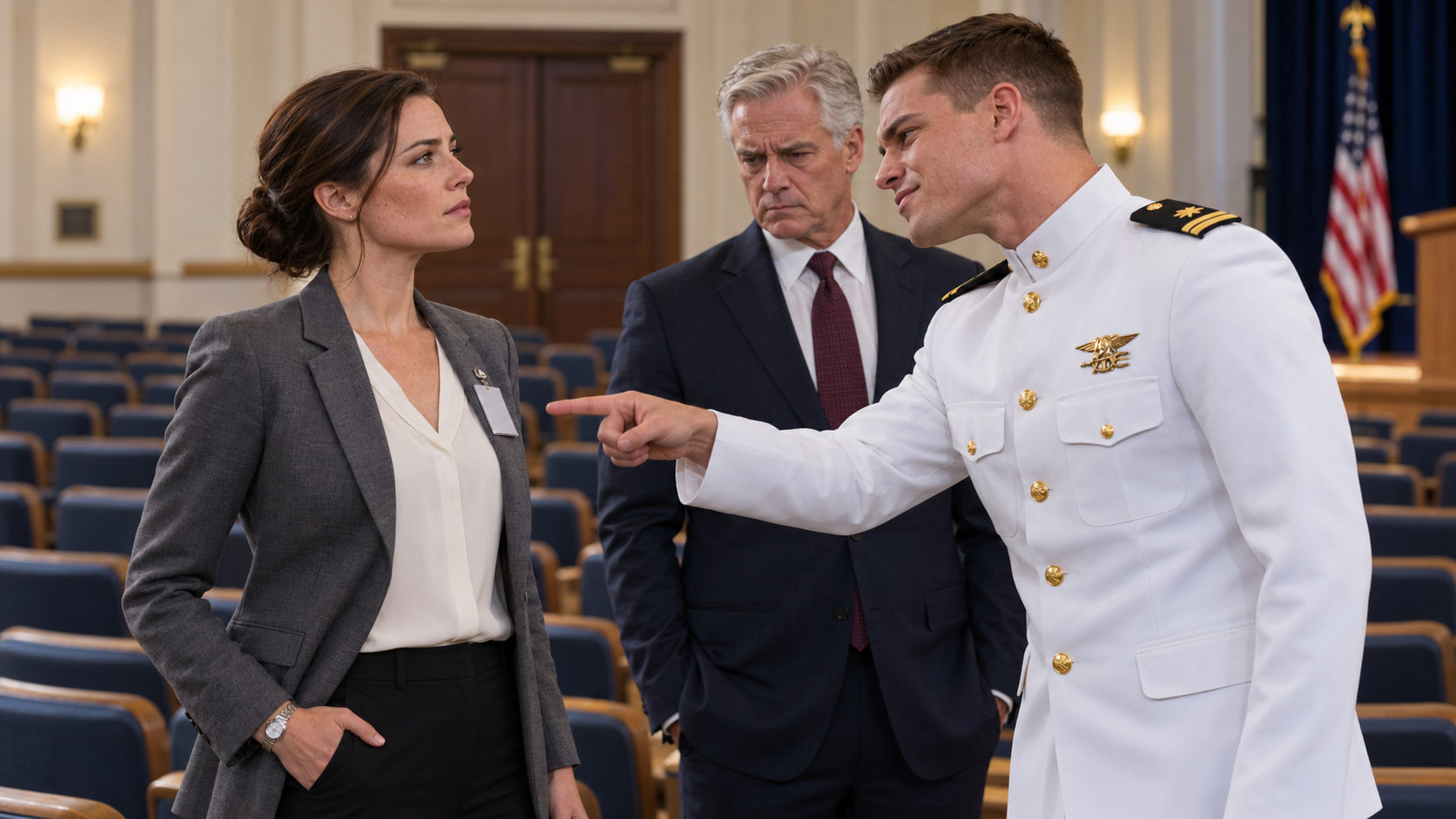
And now I stood near the rear wall of a naval auditorium in Coronado wearing charcoal slacks, a gray blazer, low black heels, and a visitor badge clipped to my lapel.
No medals.
No ribbons.
No uniform.
Nothing to suggest I belonged anywhere near the men and women gathered beneath the flags at the front of the room.
That was deliberate.
Daniel stood thirty yards away in dress whites.
The lights caught the new trident pinned above his left breast.
My mother, Elaine, had cried when it was placed there.
Dad hadn’t cried.
He wasn’t that kind of man.
But I knew him well enough to recognize what emotion did to his posture.
His shoulders had moved half an inch higher.
His chin had lifted.
He looked ten years younger.
Retired Navy Captain Robert Hayes had waited his entire life for that moment.
Not his own moment.
His son’s.
“My son,” he kept saying.
He said it to old officers.
He said it to Daniel’s teammates.
He said it to a commander I didn’t recognize.
“My son just finished training.”
“My son earned his trident today.”
“My son.”
Never my children.
Never my daughter served too.
To be fair, he could not say much about my service because he believed there was almost nothing to say.
That had been the point.
The room buzzed around me with photographs, handshakes, relieved laughter, and families trying to preserve a moment that had cost years of pain to reach.
I understood their pride.
Whatever else existed between Daniel and me, earning that trident mattered.
He had worked for it.
He had bled for it.
He had failed evolutions, repeated them, rebuilt himself, and gone back.
I knew enough to respect that.
Which was why I had come.
Not because Mom begged.
Not because Dad had sent me a text three weeks earlier that said simply:
Daniel graduates Friday. If you can make it.
Not even because Daniel had invited me.
He hadn’t.
I came because Daniel was my brother.
Family could be cruel.
Family could be unfair.
Family could decide who you were years ago and refuse to learn anything new.
But he was still my brother.
And I knew what it meant to finish something no one else could finish for you.
I had been standing quietly near the back for almost twenty minutes when Daniel finally noticed me.
His expression changed.
Not dramatically.
Just a slight tightening around the mouth.
Then that familiar smirk.
He broke away from three men in white uniforms and walked toward me.
Dad saw him moving.
Mom did too.
She gave me a nervous smile.
That smile told me she already knew what was coming.
Daniel stopped in front of me.
His eyes went from my shoes to my blazer.
“No uniform?”
“Congratulations, Daniel.”
“That wasn’t what I asked.”
“I heard you.”
One of his teammates stood close enough to hear. Then another joined him.
Daniel glanced toward them.
The smirk deepened.
“Didn’t think you’d actually show up.”
“I said I would.”
“You’ve said things before.”
Mom’s face tightened.
“Daniel.”
He ignored her.
I looked at the trident on his chest.
“You earned it. That’s what matters today.”
Something about my refusal to fight irritated him.
Daniel had always preferred opponents who swung back.
If you stayed calm, he hit harder.
“You know,” he said, adjusting one cuff, “I kept thinking about you during training.”
Dad was standing six feet away now.
He heard every word.
I knew because his eyes flicked toward me.
Daniel continued.
“There were days I wanted to walk.”
His friends went quiet.
“I thought, I could just stop. I could decide this isn’t for me and go home.” He smiled. “Then I remembered how that looked on you.”
My mother whispered his name again.
He wasn’t finished.
“Guess I should thank you.”
“For what?”
“For being the example of what not to do.”
The words landed exactly where he intended them to.
Dad’s jaw tightened.
For one second, I thought he might finally say something.
Daniel gave a quiet laugh.
“Must feel weird watching someone actually finish what they started.”
I looked at my father.
He looked away.
There it was.
Twelve years condensed into one movement.
Not cruelty.
Something worse.
Agreement.
For twelve years, they had repeated the same version of my story.
Samantha couldn’t handle the pressure.
Samantha quit.
Samantha embarrassed her father.
Samantha walked away when things became difficult.
At first, I had tried correcting little pieces.
“I didn’t exactly quit.”
“What does that mean?” Dad would demand.
“I was reassigned.”
“To what?”
“I can’t discuss it.”
He hated that answer.
My father had spent twenty-eight years in the Navy. Rank and structure were how he understood the world.
In his mind, if something legitimate had happened to me, he should have known.
If he didn’t know, then I was hiding failure behind secrecy.
Eventually I stopped defending myself.
That made things easier.
For them.
Not for me.
Daniel stepped closer.
“So?” he asked. “Nothing to say?”
I was about to answer when I felt the vibration against my ribs.
Not my personal phone.
The other one.
The secure device sat inside a fitted holster beneath my blazer.
I had almost left it outside in the controlled vehicle.
Almost.
But there were six people in the world who knew where I was that morning, and one of them had said, Keep it on you until we close the operation.
So I had.
I looked past Daniel.
“Excuse me.”
His eyebrows rose.
“That’s it?”
I walked away.
I could feel his disbelief behind me.
The nearest hallway was crowded, so I kept moving until I reached an alcove near a service exit.
Then I pulled out the phone.
No recognizable number appeared.
Only a protected channel.
One encrypted message filled the screen.
EXTRACTION CONFIRMED.
ALL PERSONNEL ACCOUNTED FOR.
I closed my eyes.
For three seconds, the noise of the auditorium disappeared.
Fourteen people.
A burned intelligence network.
A compromised route.
Seventy-two hours during which every contingency had failed one after another.
Fourteen people had been trapped behind a border that was officially closed and unofficially lethal.
Three of them had children.
One was injured.
One had refused to leave without destroying equipment that could have exposed every asset we had spent six years building.
Two nights earlier, I had been sitting inside a secure communications suite outside Washington, directing pieces on three continents while commanders argued over options.
That morning, I had flown west only because my deputy told me I was useless once the extraction aircraft crossed the final checkpoint.
“Go see your brother,” he had said.
I had almost laughed.
Instead, I had gotten on the plane.
Now I stared at those four words.
ALL PERSONNEL ACCOUNTED FOR.
Nobody in the auditorium knew what they meant.
Nobody could.
That was how it had to be.
I typed one response.
CONFIRMED.
Then deleted the local display, locked the device, and slid it under my blazer.
“You always were dramatic.”
Daniel’s voice came from behind me.
I turned.
He had followed me.
“What?”
“The secret phone thing.” He leaned against the wall. “What are you supposed to be now? Some kind of contractor?”
I looked at him for a second.
“Go back to your ceremony.”
“You know Dad still thinks you’re embarrassed.”
“Daniel.”
“He won’t say it. But he does.”
“I know.”
That answer caught him off guard.
He straightened.
“You could’ve at least tried again.”
“You don’t know what I tried.”
“Because you never tell anyone anything.”
“I can’t.”
He laughed once.
“There. That. You’ve been using that line for twelve years.”
“It’s not a line.”
“Sure.”
A door opened behind us.
One of Daniel’s teammates leaned through.
“Hayes, group photo.”
Daniel pushed off the wall.
Before leaving, he looked back at me.
“You know what your problem is, Sam?”
I didn’t answer.
“You always need everyone to think there’s some secret explanation.”
His expression softened just enough to become almost pitying.
“Sometimes quitting is just quitting.”
He disappeared through the door.
I stood there after he left.
Then I whispered to the empty hallway,
“And sometimes silence is the price.”
I returned to the auditorium.
The atmosphere changed less than five minutes later.
The band near the front stopped mid-conversation.
Two senior officers straightened almost simultaneously.
People turned toward the main entrance.
I noticed because noticing rooms had become second nature to me.
Then I saw him.
General Thomas Carter.
Four stars.
Dress uniform.
Silver hair.
A scar at the edge of his jaw.
He walked with the easy, dangerous calm of someone who never needed to announce authority because everyone else did it for him.
Dad’s entire face transformed.
He knew Carter by reputation.
Almost everyone in uniform did.
My father immediately moved toward Daniel.
“Stand straight,” he murmured.
Daniel looked confused.
Then he saw the general.
Dad adjusted Daniel’s shoulder without thinking.
My mother’s eyes widened.
I knew exactly what my father was imagining.
A photograph.
Retired Captain Hayes.
His newly minted SEAL son.
General Thomas Carter.
The kind of picture that would sit in his office forever.
Carter entered the reception area with two aides and a Navy commander beside him.
Dad stepped forward.
“General Carter.”
Carter gave him a brief nod.
“Captain.”
Dad smiled at being recognized.
“This is my son, Daniel Hayes. He graduated today.”
Daniel moved forward.
“Sir.”
Carter looked at him.
“Congratulations.”
“Thank you, sir.”
Dad’s pride radiated from him.
Then Carter kept walking.
Past Daniel.
Past my father.
Straight toward me.
Every step seemed to remove sound from the room.
He stopped three feet away.
His expression was formal.
But his eyes weren’t.
He knew.
I knew.
And suddenly the twelve years between my family and me felt as fragile as glass.
“Samantha Hayes.”
Daniel turned.
Mom stared.
Dad’s smile disappeared.
I nodded once.
“General.”
Carter’s eyes dropped briefly toward the hidden secure phone beneath my blazer.
Then he asked the question no one in my family was prepared to hear.
“Did Washington confirm the extraction?”
I could feel my father looking at me.
“All personnel accounted for,” I said.
Carter exhaled.
For the first time that morning, some of the tension left his shoulders.
“Thank God.”
He reached inside his dress coat.
When his hand came out, it held a sealed black folder.
The room had gone completely silent.
General Carter held the folder toward me.
“This came through final approval thirty-seven minutes ago.”
I looked at the seal.
Then at him.
“What is it?”
His expression changed.
Not quite a smile.
“Something that has been twelve years overdue.”
Behind him, my father whispered,
“Samantha?”
And for the first time in my life, he said my name like he had no idea who I was.
PART 2: THE STORY THEY CHOSE TO BELIEVE
I did not take the folder immediately.
That probably confused everyone watching.
My father had spent my childhood teaching Daniel and me that when a senior officer handed you something, you accepted it first and asked questions second.
But General Carter wasn’t just some senior officer to me.
He had been there at the beginning.
Before the false story.
Before the silence.
Before my father decided I had embarrassed him.
“You did this here?” I asked.
Carter lowered his voice.
“I didn’t choose the timing.”
His eyes moved briefly toward my family.
“But I’m beginning to think the timing chose itself.”
That was very Carter.
He could turn a sentence into both an answer and a warning.
I accepted the folder.
It was heavier than it looked.
Dad stepped closer.
“General Carter, forgive me.”
Carter turned.
My father hesitated.
I had almost never seen Robert Hayes hesitate in front of anyone.
“You know my daughter?”
Carter studied him.
“Yes.”
One word.
It destroyed twelve years.
Daniel glanced at me.
Then at the folder.
Then back at Carter.
“From where?” he asked.
Dad shot him a look.
Daniel stiffened.
“Sir.”
Carter did not seem offended.
He seemed curious.
“Your sister and I have worked together.”
Daniel frowned.
“In the Navy?”
My pulse quickened.
There were limits.
Even now.
Especially now.
Carter understood them too.
“Across several assignments,” he said.
Dad stared at me.
“What assignments?”
“I can’t discuss operational details here.”
The old anger flickered across his face.
For a second, I saw the same man from twelve years ago.
What does that mean?
Reassigned where?
Who authorized it?
Why wasn’t I told?
Then he remembered he was questioning a four-star general.
His mouth closed.
Carter looked at me.
“Open it.”
I slid one finger beneath the seal.
The black folder unfolded.
Inside was a single cream-colored document backed by an embossed cover.
The first line carried my legal name.
SAMANTHA ELIZABETH HAYES.
Below it were words I had seen in drafts but never expected to see publicly.
Not fully.
Not like this.
The citation itself had been sanitized.
No country names.
No unit designation.
No operation title.
No dates beyond a broad range.
But it acknowledged leadership during “multiple national security operations conducted under conditions of extreme personal risk.”
It mentioned protection of American personnel.
Coordination of joint assets.
Intelligence recovery.
Lives saved.
And at the bottom was the authorization for a decoration that had been delayed because the operations remained compartmented.
I read it once.
Then again.
My throat tightened.
I hated that.
Emotion in public had always made me uncomfortable.
Carter saw it.
Of course he did.
“You can breathe, Hayes.”
The old form of address hit me harder than the citation.
I looked up.
“You told me once none of this needed a medal.”
“It doesn’t.”
“Then why?”
“Because classified does not have to mean forgotten.”
The sentence cut through me.
My mother covered her mouth.
I heard someone behind Daniel quietly ask, “What the hell?”
Dad looked from the document to Carter.
“What decoration?”
Carter answered him.
Dad went still.
He knew enough to understand what the words meant.
Not the details.
But the level.
The significance.
The fact that whatever his daughter had been doing for twelve years had not consisted of filing paperwork at some contractor office.
Daniel’s face changed more slowly.
He was still trying to fit new information into the shape he already had for me.
That shape did not bend easily.
“That doesn’t make sense,” he said.
Mom whispered, “Daniel.”
But he looked at me.
“You left.”
I closed the folder.
“Yes.”
“You left the program.”
“Yes.”
“So how—”
“Daniel.”
Dad’s voice was sharp now.
Not because he was defending me.
Because Daniel was questioning a general’s reality in public.
Carter glanced at me.
He was asking without asking.
Do you want this private?
I should have said yes.
For twelve years, privacy had been my instinct.
Protect the mission.
Protect the compartment.
Protect the people.
Absorb everything else.
But something inside me was tired.
Not reckless.
Not angry enough to violate an oath.
Just tired enough to stop protecting my family from the consequences of assumptions they had chosen to make.
“You can tell them the part they’re cleared to know,” I said.
Carter’s eyebrows rose slightly.
Dad caught the phrase.
“Cleared to know?”
I looked at him.
“That’s the problem, Dad. You always thought if you weren’t allowed to know, it meant there was nothing worth knowing.”
His face tightened.
“That’s not fair.”
I almost laughed.
Twelve years.
And fairness had finally entered the conversation.
Carter gestured toward a side conference room.
“This isn’t the place.”
Dad nodded immediately.
Daniel didn’t.
“This is my ceremony.”
The words came out harder than he probably intended.
For a second nobody spoke.
Then I understood.
Underneath his shock was something I recognized.
Fear.
The room had belonged to him five minutes earlier.
His achievement.
His father’s pride.
His teammates.
His day.
Now people were staring at me.
I didn’t want that from him.
I had not come to steal his moment.
I turned toward Carter.
“Not here.”
He nodded.
“We’ll use the conference room.”
Then I looked at Daniel.
“This is still your day.”
He stared at me.
I meant it.
“You earned what’s on your chest. Nothing about me changes that.”
Something uncertain moved across his face.
Dad looked between us.
Mom began crying again, but these tears were different.
Carter started toward the conference room.
His aides stayed outside.
My parents followed.
Daniel remained where he was.
I paused.
“You coming?”
His jaw clenched.
“Yes.”
Inside, Carter closed the door.
The room contained a polished table, twelve chairs, a wall-mounted screen, and a framed photograph of a carrier cutting through dark water.
Dad remained standing.
So did I.
Carter sat at the head of the table.
“Captain Hayes,” he said, “I need to be precise. There are things your daughter has done that I cannot disclose. There are locations I cannot name, programs I cannot confirm, and people whose identities remain protected.”
Dad nodded.
“I understand classified information.”
I almost looked away.
Carter did not.
“I’m sure you do. But what happened with Samantha was unusual.”
Dad’s gaze moved to me.
Carter continued.
“Twelve years ago, your daughter did not leave naval service because she could not handle pressure.”
Silence.
My mother gripped the back of a chair.
Daniel’s eyes narrowed.
“What happened?”
Carter looked at me.
I answered.
“I was selected out.”
Daniel blinked.
“For what?”
“A program.”
“What kind of program?”
“The kind nobody was supposed to know existed.”
He gave a disbelieving laugh.
“That sounds convenient.”
Dad turned on him.
“Enough.”
I held up a hand.
“No. Let him ask.”
Daniel’s eyes locked on mine.
“You expect me to believe you were secretly recruited out of your pipeline?”
“Yes.”
“Why you?”
That one hurt.
Not because it was unfair.
Because it was honest.
Why me?
For years, my family had believed the most important thing about me was that I had failed where Daniel later succeeded.
Now Daniel was being asked to imagine that someone had looked at the same woman and seen something valuable enough to remove her from the path entirely.
I pulled out a chair and sat down.
“When I entered the Navy, I tested into language tracks almost nobody cared about. I spoke Arabic from college. I picked up Dari faster than expected. I had signals training. Pattern analysis. And I’d spent two summers overseas with a humanitarian logistics group before I enlisted.”
Daniel frowned.
“I knew about the language stuff.”
“You made fun of the language stuff.”
His face hardened.
I continued.
“During an assessment exercise, I identified a compromised communications pattern that wasn’t part of the exercise.”
Dad’s eyes sharpened.
That was the officer in him.
“What kind of compromise?”
“I still can’t tell you.”
He exhaled through his nose.
I ignored it.
“The people evaluating us thought I had gotten lucky. So they tested me again.”
Carter spoke.
“She didn’t get lucky.”
I looked down at my hands.
“They pulled me for interviews. Then additional screening. Then more screening. Polygraphs. Psychological evaluation. Languages. Surveillance detection. Field work.”
Daniel’s expression slowly changed.
“You were intelligence?”
“Among other things.”
Dad finally sat.
“You told me you were being reassigned.”
“I was.”
“You let me believe you quit.”
“No.”
His head snapped up.
“I told you I could not discuss the reassignment.”
“You knew what I thought.”
“Yes.”
“Then why didn’t you correct me?”
“With what?”
The room went still.
I leaned forward.
“What exactly was I supposed to say? ‘Dad, I didn’t fail. I’ve been recruited into a compartmented program and I’m prohibited from telling you what it is, where I’m going, who I’ll work with, or whether I’m even still technically attached to the organization you think I left’?”
His face went pale.
“I would have understood.”
“No. You wouldn’t.”
“You don’t know that.”
“I do because I tried.”
A memory rose before I could stop it.
Our kitchen.
My father in khakis.
His coffee untouched.
Me with a travel bag upstairs already packed.
“You asked me if I quit,” I said quietly. “I told you no.”
Dad frowned.
“I don’t remember that.”
“I do.”
He opened his mouth.
I kept going.
“I told you I had been reassigned.”
“You wouldn’t say where.”
“I wasn’t allowed.”
“You said you couldn’t explain anything.”
“That was true.”
“You disappeared for eight months!”
“And when I came back, you asked me if I was ready to admit I couldn’t make it.”
He stopped.
Mom looked at him.
“Robert.”
He rubbed one hand over his mouth.
I remembered every second.
Dad had stood near the sink.
Daniel had been home from college.
Mom had made lasagna because she thought food could fix tension.
I had returned eight hours earlier from an assignment I still couldn’t discuss.
I had lost eleven pounds.
I hadn’t slept for more than three consecutive hours in months.
Dad had looked at me and said,
Maybe now you understand that wanting something and being strong enough for it are different things.
I had gone upstairs.
Daniel followed.
For one beautiful second, I thought he was going to comfort me.
Instead he leaned against my bedroom door and said,
At least Dad finally has one kid who won’t embarrass him.
Daniel looked away now.
He remembered too.
I could tell.
Carter folded his hands on the table.
“Captain Hayes, your daughter was placed in a position where revealing the truth to defend her pride could have compromised people.”
My father swallowed.
“And she chose not to.”
Carter nodded.
“For twelve years.”
Mom sat beside me.
Her hand moved toward mine, then stopped short.
“I asked you so many times what you did for work.”
“You did.”
“You said consulting.”
“It was the closest legal answer.”
Her voice cracked.
“And all those trips?”
“Work.”
“Jordan?”
“Some of the places I told you were real.”
She stared at me.
That answer told her enough.
Daniel paced toward the window.
“What about Dad’s retirement?”
I knew which day he meant.
“I was there.”
He turned.
“No, you weren’t.”
“I was in Norfolk.”
“You missed the ceremony.”
“Yes.”
“So you weren’t there.”
“I was forty minutes away.”
Dad stared.
“Why?”
I hesitated.
Even sanitized, the answer tasted dangerous.
“There was an active threat investigation involving personnel connected to the base.”
My father’s expression changed.
“What threat?”
“Nothing reached the ceremony.”
“That isn’t what I asked.”
“I know.”
He stared at me for several seconds.
Then he understood the boundaries again.
“You were working.”
“Yes.”
The anger drained out of his face.
It left something worse behind.
Regret.
Daniel stopped pacing.
“What about my college graduation?”
I looked at him.
“That one I missed.”
He laughed bitterly.
“Of course.”
“I was in a hospital.”
His expression froze.
Mom made a sound.
“A hospital?”
“I was fine.”
“What happened?”
“I was injured.”
“How?”
“I can’t tell you.”
Dad’s hand tightened around the edge of the table.
“How badly?”
I hesitated.
Daniel noticed.
“How badly, Sam?”
“Bad enough that they wouldn’t let me fly.”
My mother covered her face.
I had not meant to hurt her.
That was the problem with truth.
People imagined disclosure as relief.
Sometimes it was an explosion.
Carter watched us without interrupting.
Finally Dad asked,
“Why now?”
Carter understood the question.
Why the folder?
Why this acknowledgment?
Why at Daniel’s ceremony?
“The operation Samantha was supporting reached a major closure point today. Several connected activities have been declassified enough for a sanitized recognition package to be authorized.”
Daniel looked toward the secure phone beneath my blazer.
“The extraction.”
Nobody answered him.
He looked at me.
“You were working during my ceremony.”
“I was monitoring the final phase.”
“And you still came.”
“Yes.”
“Why?”
The question was so simple that it almost broke me.
“Because you’re my brother.”
He looked down.
For the first time that day, Daniel had nothing to say.
Then someone knocked on the conference room door.
One of Carter’s aides stepped inside.
“Sir.”
The general looked at him.
The aide handed over a small note.
Carter read it.
His expression sharpened.
Then he looked at me.
“Washington wants you on a secure line.”
Dad stared at me.
“When?”
Carter rose.
“Now.”
And just like that, the family conversation ended.
Because somewhere beyond those walls, there were people who knew exactly who Samantha Hayes was.
And they needed me.
PART 3: THE LIFE THEY NEVER SAW
The secure call lasted eleven minutes.
I took it alone in a communications room two corridors away while an officer waited outside.
Washington did not congratulate me.
That was not how those calls worked.
We reviewed the extraction.
A medical issue.
A damaged package.
Two individuals requiring relocation.
One intelligence concern that would need immediate containment.
Then my deputy said, “You saw the confirmation?”
“Yes.”
“Everyone’s breathing again.”
“So am I.”
A pause.
“Your brother graduate?”
I looked through the narrow window in the door.
Daniel stood fifty feet away with Dad.
“Yes.”
“How’d that go?”
I almost smiled.
“You don’t have clearance.”
He laughed once.
Then the line disconnected.
For several seconds I remained alone.
That was the strange part of my life.
One minute, fourteen people getting out alive felt like the only thing in the world that mattered.
The next, I was thinking about something my brother had said when we were both nearly children.
I returned to the hall.
Dad was waiting by himself.
He had taken off his service-style blazer and held it over one arm.
Without the posture, without the practiced expression, he looked older.
“Samantha.”
I stopped.
“Where’s everyone?”
“Your mother took Daniel back to the reception.”
“That’s where he should be.”
Dad nodded.
“General Carter is speaking with the base commander.”
I started toward the auditorium.
Dad fell into step beside me.
After a few seconds, he said, “I owe you an apology.”
I kept walking.
“I’m not doing this here.”
“I know.”
“Today is Daniel’s.”
“I know.”
We reached the corner.
He stopped.
I did too.
My father looked at me with a kind of helplessness I had never associated with him.
“When?”
“When what?”
“When did you stop trying to tell me?”
I knew immediately what he meant.
I wished I didn’t.
“Years ago.”
“How many?”
“Does it matter?”
“Yes.”
I studied him.
“Twelve years ago I tried to tell you the reassignment was real.”
He closed his eyes briefly.
“After that?”
“Eight years ago, I tried again.”
He frowned.
“When?”
“Christmas.”
Memory moved between us.
Daniel had just announced he was considering the SEAL pipeline.
Dad had opened a bottle of expensive bourbon.
At dinner he made a joke about the Hayes family finally getting another shot at finishing something difficult.
I had set down my fork.
Dad, you don’t actually know what happened with me.
He had laughed.
Not cruelly.
That would have been easier.
He laughed as if I were trying to rewrite history to save face.
Then tell me, Samantha.
I can’t.
Exactly.
Conversation over.
“I remember,” he whispered.
“So do I.”
He looked toward the floor.
“I thought you were hiding behind classified language.”
“You thought I was lying.”
“Yes.”
The admission surprised me.
He did not soften it.
He did not defend himself.
“I thought you were embarrassed and had found a way to make it impossible for anyone to challenge your explanation.”
I crossed my arms.
“That’s what you thought of me?”
“At the time.”
“For twelve years?”
His jaw tightened.
“I was angry.”
“Why?”
“Because I had told people about you.”
There it was.
The truth under the truth.
Dad looked ashamed before I said anything.
“I told people my daughter was going places. I bragged about you. I told admirals. Former shipmates. Everyone.” He swallowed. “Then suddenly you were out of the pipeline, and when people asked what happened, I didn’t know what to say.”
“So you decided I had humiliated you.”
“Yes.”
The word came quietly.
I felt something inside me go cold.
“You weren’t ashamed because I failed.”
“No.”
“You were ashamed because you couldn’t explain me.”
He flinched.
That was answer enough.
I turned away.
Dad reached for my arm, then stopped before touching me.
“I was wrong.”
“That doesn’t give me twelve years back.”
“I know.”
“No. You don’t.”
My voice rose for the first time.
A few people farther down the corridor glanced at us.
I lowered it immediately.
“You got to tell yourself a story where you were disappointed because I quit. Do you know what I got?”
He said nothing.
“I got birthdays where Daniel asked whether I had finally found a real career. Christmas dinners where you compared his promotions to my ‘consulting work.’ Mom sending me articles about resilience because she thought I was still ashamed of failing.”
Dad looked sick.
“I got you introducing him as your son while standing ten feet from me.”
His face crumpled for half a second before he recovered.
“I didn’t mean—”
“That’s the problem. You didn’t have to mean it anymore.”
He absorbed that.
I had spent years imagining this conversation.
In those fantasies, I destroyed him.
One sentence after another.
Perfectly delivered.
He would finally understand.
I would finally feel free.
Reality was uglier.
He was my father.
Seeing pain on his face didn’t heal mine.
It only added another kind.
“I loved you,” he said.
I stared at him.
“Don’t use the past tense.”
His eyes widened.
“I love you.”
“Then you should have trusted me.”
He looked away.
“I should have.”
The corridor fell quiet.
Finally he asked, “Were you ever in danger?”
I almost smiled because it was such a father question.
Everything else had collapsed, and underneath Captain Robert Hayes was simply a man who wanted to know whether his daughter had been hurt.
“Yes.”
“How often?”
“I’m not answering that.”
He nodded.
“Were you alone?”
“No.”
“Good.”
That single word nearly broke my composure.
Not congratulations.
Not what rank are you.
Not who do you work for.
Just good.
Because whatever else he had failed to understand, my father understood the terror of dangerous work.
He had buried friends too.
I looked toward the auditorium.
“You should go back to Daniel.”
Dad hesitated.
“He said terrible things to you.”
“He learned some of them from somewhere.”
My father closed his eyes.
“I know.”
“But today still matters.”
“You’re defending him.”
“No.”
I looked at him.
“I’m refusing to become him.”
Then I walked away.
The reception was quieter than before.
News moved fast in military spaces even when no one actually knew anything.
People knew General Carter had spoken to me.
They knew I had been pulled for a secure call.
They knew my father looked like he had seen a ghost.
That was enough to generate whispers.
I hated whispers.
I found Mom near the refreshments.
She pulled me into a hug before I could prepare.
For a moment I stood stiffly.
Then I hugged her back.
She cried into my shoulder.
“I’m sorry.”
“Mom.”
“I’m so sorry.”
“We’re not doing this here.”
“I know.”
“You’re getting makeup on my blazer.”
She laughed through tears.
It was such an ordinary sound that I almost cried too.
When she pulled away, she touched my face.
“You were hurt.”
“I’m okay.”
“You said hospital.”
“Twelve years is a long time. People get hurt.”
“You make jokes exactly like your father.”
“That might be the worst thing anyone has said to me today.”
She laughed again.
Daniel stood across the room watching us.
Our eyes met.
He looked away first.
The reception ended an hour later.
People drifted toward photographs outside.
Families separated into groups.
Daniel’s teammates pulled him into conversation.
I stayed at the edges.
Exactly where I preferred to be.
Then one of the men who had heard Daniel mock me earlier approached.
Tall.
Dark hair.
A lieutenant from Daniel’s class.
He glanced toward my brother.
“Ma’am?”
I nearly smiled.
“Please don’t.”
He looked embarrassed.
“Sorry. Samantha.”
“That’s better.”
He hesitated.
“I wanted to apologize.”
“For what?”
“I laughed earlier.”
I remembered.
Not loudly.
But yes.
When Daniel called me the example of what not to do, this man had smiled.
“You didn’t know.”
“No.”
“You were backing your teammate.”
He nodded.
“Still.”
I appreciated that he did not try to excuse it.
“Accepted.”
He looked at me curiously.
“Can I ask you something?”
“Depends.”
“Were you military?”
“Technically, that answer is complicated.”
He grinned.
“I figured.”
“What did you want to ask?”
He looked toward Daniel again.
“How did he not know?”
I followed his gaze.
Daniel was laughing with two teammates.
For the first time all day, he looked like the man he had worked so hard to become.
I answered quietly.
“Because he was more comfortable with the answer he already had.”
The lieutenant absorbed that.
Then he nodded.
“I think I know what you mean.”
After he left, Daniel came over.
He stood beside me without speaking.
Thirty seconds passed.
Then a minute.
Finally he said, “Everyone thinks I’m an asshole.”
I almost laughed.
“That seems like a problem you should discuss with everyone.”
His mouth twitched.
Then flattened again.
“I didn’t know.”
“No.”
“You could’ve told me something.”
“We already covered this.”
“Not classified stuff. Just…” He struggled. “Something.”
“What did you want me to say?”
“I don’t know.”
“That’s always been the issue.”
He looked at me.
“Did you ever hate me?”
The question surprised me.
“For what?”
“For being the one Dad…”
He stopped.
I finished it.
“Was proud of?”
His face tightened.
“I didn’t say that.”
“You didn’t have to.”
He looked down.
I thought about lying.
I chose not to.
“Sometimes.”
He nodded slowly.
“Fair.”
“But mostly I hated how easy it was for you to believe the worst version of me.”
His eyes met mine.
“Dad believed it.”
“So?”
“I was twenty-two.”
“So was I.”
That landed.
He rubbed a hand over the back of his neck.
“I spent years thinking you quit because it got hard.”
“I know.”
“I used you during training.”
“What?”
“When things sucked.”
His face reddened with embarrassment.
“I’d tell myself I wasn’t going to do what you did.”
I stared at him.
“That’s twisted.”
“I know.”
“No, seriously. You built your motivational strategy around insulting me?”
“When you say it like that—”
“How else would I say it?”
He gave the smallest laugh.
Then his eyes turned serious.
“I’m sorry.”
I waited.
No explanation followed.
No but.
No defense.
Just the words.
“I’m sorry I said that today. I’m sorry I’ve said it before. I’m sorry I didn’t ask whether the story made sense.”
I looked at him.
“What changed?”
He glanced toward the place where Carter had stood.
“A four-star general calling you by name helped.”
I laughed before I could stop myself.
Daniel smiled.
Then I shook my head.
“That’s not enough.”
His smile faded.
“What?”
“You shouldn’t need a general to tell you your sister deserves basic respect.”
He went still.
I continued.
“You don’t get credit for believing me now that someone powerful validated me.”
He swallowed.
“You’re right.”
I had not expected agreement.
He looked toward his trident.
“I think I spent a long time needing you to be the one who failed.”
The honesty startled me.
“Why?”
“Because then I was the one who succeeded.”
There it was.
Not just Dad.
Not just family mythology.
Identity.
Daniel had built part of his image of himself against the shadow of the sister who supposedly couldn’t finish.
“If you weren’t the quitter,” he said quietly, “then I had to figure out who I was without that.”
I looked at his chest.
“You’re the man who earned that.”
He followed my gaze.
“You don’t need me underneath you for it to mean something.”
His eyes grew wet.
He looked away immediately.
“Yeah.”
I touched his shoulder.
“Go take pictures.”
He nodded.
Then he stopped.
“Sam?”
“What?”
“What exactly was the extraction?”
I gave him a flat look.
He smiled for real.
“Worth a shot.”
He walked away.
I watched him join his team.
And for the first time all day, I began to think maybe the truth did not have to destroy everything.
Then General Carter appeared beside me.
“You ready?”
“For what?”
“The second reason I came.”
My stomach tightened.
“I thought the folder was the second reason.”
“No.”
He handed me another sealed envelope.
This one was smaller.
No ceremony.
No audience.
Only my name on the front.
I looked at him.
“What is this?”
Carter’s expression turned serious.
“A decision.”
PART 4: THE THING I HAD BEEN RUNNING FROM
I opened the envelope in the parking lot.
Carter waited beside a black government sedan while families moved around us carrying flowers and garment bags.
Inside was a one-page memorandum.
I read it once.
Then stared at the general.
“No.”
“That was quick.”
“You already know my answer.”
“I knew your answer six months ago.”
“Then why are we standing here?”
“Because six months ago you were still confusing punishment with duty.”
I folded the paper.
“I’m not having this conversation.”
“Then listen.”
I looked toward the auditorium.
Dad, Mom, and Daniel were still inside.
“What exactly do you think I’m punishing myself for?”
Carter’s expression softened.
“That is the wrong question.”
“Convenient.”
“You have spent twelve years accepting assignments nobody else wanted, extending rotations, volunteering for forward work, and avoiding anything that would put your name on a door.”
“I like field work.”
“You like disappearing.”
I said nothing.
He pointed toward the envelope.
The memorandum offered me a senior leadership position in Washington.
Not glamorous.
Not public.
But significant.
For the first time in my career, I would lead a permanent interagency operations cell instead of moving between temporary commands.
More responsibility.
Less field exposure.
A real office.
A real team.
A version of life that might contain weekends.
I hated it immediately.
Carter knew why.
“You think staying still makes you vulnerable,” he said.
“That’s very psychological of you.”
“I read your evaluations.”
“That feels invasive.”
“I sign some of them.”
“Still invasive.”
His mouth almost twitched.
Then he became serious again.
“You are not twenty-two anymore, Samantha.”
“I’m aware.”
“Are you?”
I looked down at the memorandum.
He continued.
“You built a life where nobody could accuse you of quitting again because you never stopped.”
That hit harder than anything my family had said.
I looked at him.
“You don’t know that.”
“I’ve watched you for twelve years.”
“My work matters.”
“Yes.”
“I’m good at it.”
“Yes.”
“Then stop making this about my father.”
“I’m making it about you.”
I turned away.
He lowered his voice.
“The operation that closed today almost killed three people.”
“I know.”
“One of them was you four months ago.”
I went still.
Carter continued.
“You were not supposed to be on that leg.”
“The team needed—”
“Someone. The team needed someone. You decided it had to be you.”
I looked toward the cars.
Nobody nearby could hear us.
“I got them out.”
“Yes.”
“You’re welcome.”
“That reflex is exactly why you’re being offered command.”
I hated when he did that.
Turned my argument into his evidence.
“I need an answer by Monday.”
“I have three days?”
“You’ve had six months.”
“You said the position wasn’t approved.”
“I lied.”
I stared at him.
“That’s comforting.”
“I wanted you to decide based on whether you were ready, not whether the slot existed.”
“That’s manipulative.”
“Yes.”
At least he was consistent.
Carter opened the sedan door.
Before getting in, he paused.
“You don’t owe your family an explanation.”
“I know.”
“You also don’t owe them continued punishment.”
“I know.”
“And you do not have to keep risking your life to prove to people who misunderstood you that you can endure pain.”
I looked at the envelope again.
That one stayed with me.
He got into the car.
Then lowered the window.
“Monday.”
The sedan pulled away.
I remained there for several minutes.
By the time my family came outside, I had hidden the memorandum inside the same black folder as the citation.
Mom noticed my expression.
“What happened?”
“Work.”
Dad looked at the folder.
“More classified?”
“Mostly.”
Daniel laughed.
It was the first time the word classified did not sound like an accusation in my family.
We went to dinner.
That had been Mom’s plan from the beginning.
A waterfront restaurant.
Private room.
Cake with Daniel’s name on it.
Dad had invited several friends, but after the events at the ceremony, he quietly canceled the larger gathering.
So there were only four of us.
The Hayes family.
For the first time in years, nobody knew the script.
Usually our dinners followed predictable lines.
Dad asked Daniel about work.
Mom asked me whether I was seeing anyone.
Daniel teased me about consulting.
I changed the subject.
That night, silence sat with us like a fifth person.
Finally Daniel raised his glass.
“To surviving family dinners.”
Mom kicked him under the table.
“Ow.”
I laughed.
Dad did too.
The sound startled all of us.
Then Dad lifted his glass.
“To Daniel.”
We followed.
Dad looked at his son.
“What you accomplished today belongs to you. Nobody can take that away.”
Daniel’s expression softened.
“Thanks, Dad.”
Then my father looked at me.
I felt my shoulders tighten.
He did not raise his glass again.
He simply said, “And I’m sorry I made your life into a competition.”
Mom inhaled quietly.
Daniel stared at the table.
Dad continued.
“I did it when you were children. I did it when you were adults. I praised one of you in ways that diminished the other.”
I had never heard my father speak like that.
“I told myself competition made both of you stronger.”
He shook his head.
“It made me lazy. It meant I didn’t have to understand either of you separately.”
Daniel looked at him.
Dad’s voice roughened.
“I am proud of you because you earned your trident.”
Then he looked at me.
“And I should have been proud of you before I knew what was in that folder.”
I could not speak.
That was the sentence.
Not the medal.
Not Carter.
Not the extraction.
That.
I should have been proud of you before I knew.
My eyes burned.
I looked toward the window until the feeling passed.
Mom reached across the table and took my hand.
For once, I let her.
After dinner, Daniel left to meet his teammates.
Mom went ahead with him to take photographs outside.
Dad and I remained in the private room.
He stared at the folded napkin in front of him.
“Can I ask one question?”
“You can ask.”
“Will you answer?”
“Depends.”
He nodded.
“Were you happy?”
Of all the questions he could have asked, I had not expected that one.
I thought about twelve years.
Safe houses.
Airports.
Secure rooms.
People whose names I still remembered even though I was required to pretend I had never known them.
The rush of solving impossible problems.
The cost.
The loneliness.
The times I came home to an apartment that looked exactly as I had left it because no one knew when I would return.
The nights I sat outside my own family’s celebrations in rental cars while finishing calls.
The pride.
The anger.
The purpose.
“Sometimes,” I said.
Dad nodded.
“Are you happy now?”
I looked at the black folder beside me.
“I don’t know.”
“That sounds like something worth figuring out.”
I smiled faintly.
“You getting philosophical in retirement?”
“I have a lot of unused wisdom.”
“Mostly unused.”
He smiled.
Then his expression changed.
“I need to tell you something.”
I waited.
“Every year after you left, I kept expecting you to ask me for help.”
I frowned.
“With what?”
“Your career. Money. A recommendation. Anything.”
“I never needed it.”
“I know.”
His eyes dropped.
“I resented you for that too.”
I stared at him.
“Why?”
“Because part of me wanted proof that you had made a mistake.”
The admission was ugly.
Which made me believe it.
He continued.
“If you came back and needed me, then I could be right and still be your father.”
I said nothing.
“You never did.”
“No.”
“And instead of wondering whether that meant I misunderstood what was happening, I decided you were stubborn.”
“That sounds like you.”
He smiled sadly.
“Yes.”
I leaned back.
“Dad, I don’t know what happens after today.”
“I know.”
“We’re not fixing twelve years over dinner.”
“I know.”
“I’m still angry.”
“You should be.”
“And Daniel saying sorry doesn’t erase anything.”
“No.”
I studied him.
“You’re agreeing with me a lot. It’s disturbing.”
That got a real laugh.
Then he looked at me.
“I’m trying something new.”
“What?”
“Listening.”
I nodded.
It was not forgiveness.
But it was a beginning.
That night, I stayed at a hotel instead of my parents’ house.
I needed space.
At 2:17 a.m., I woke from a dream I could not remember.
My hand was already reaching beneath the pillow for a weapon that wasn’t there.
I sat upright in darkness.
For several seconds, I did not know what country I was in.
Then the air conditioner hummed.
A car passed outside.
San Diego.
Safe.
I rubbed both hands over my face.
On the desk across the room sat the black folder.
Beside it, the memorandum.
The command offer.
I got out of bed and opened it again.
Lead the cell.
Build the team.
Stop being the person always sent through the door.
Become the person responsible for deciding whether anyone needed to go through it at all.
I thought of Carter’s words.
You built a life where nobody could accuse you of quitting again because you never stopped.
I hated how true they felt.
At 2:24 a.m., my personal phone lit up.
A text from Daniel.
You awake?
I typed:
Unfortunately.
Three dots appeared.
Then:
Can I ask you something classified?
I smiled despite myself.
Try me.
His answer came quickly.
Did you actually think I could make it?
I stared at the screen.
That question reached further back than anything else.
Daniel at sixteen, trying to beat my swim time.
Daniel at nineteen, calling me from college because he was failing calculus.
Daniel at twenty-four, telling Dad he wanted to become a SEAL.
Daniel earlier that day, standing in white beneath bright lights.
I typed:
Yes.
Then another message.
I always did.
The dots appeared.
Disappeared.
Returned.
Finally:
Even when I was being an asshole?
I wrote:
Unfortunately.
His reply was a single sentence.
I wish I’d done the same for you.
I sat in the dark for a long time.
Then I opened the command memorandum one final time.
At the bottom was a secure contact number.
I picked up the other phone.
And made my decision.
PART 5: WHAT FINISHING REALLY MEANS
Monday morning, General Carter answered on the second ring.
“Hayes.”
“I’ll take it.”
No greeting.
No buildup.
Silence.
Then:
“The command?”
“Yes.”
“Say it again.”
I frowned.
“Why?”
“Because I’ve waited six months.”
“I’ll take the command.”
I could hear satisfaction in the pause.
“Good.”
“You’re enjoying this too much.”
“I’m four-star. I’m allowed hobbies.”
“When do I start?”
“Transition immediately. Full authority in thirty days.”
I looked around my apartment.
For years, I had kept it almost intentionally temporary.
Minimal furniture.
No photographs in the living room.
Two packed emergency bags.
Documents arranged so I could disappear within thirty minutes.
Thirty days.
“Carter?”
“Yes?”
“The field restriction.”
“It’s not a prison sentence.”
“That wasn’t my question.”
“You will still travel when the mission requires it.”
“And when it doesn’t?”
“You stay home like a functional adult.”
“That may be beyond my training.”
“You’ll adapt.”
I smiled.
Then his voice became quieter.
“You made the right decision.”
I looked out the window.
“I don’t know yet.”
“No.”
He paused.
“That’s why it’s a decision.”
The line ended.
Three weeks later, I returned to Washington.
The office they gave me had no windows.
Some things did not change.
But my name was on the door.
Not the whole truth.
Never the whole truth.
Just:
S. HAYES
DIRECTOR
I stood staring at it longer than I should have.
My deputy appeared beside me.
“You planning to go inside?”
“Considering it.”
“It’s your office.”
“That’s what worries me.”
He handed me a stack of briefing folders.
“Congratulations on becoming management.”
“I already regret this.”
“You’ll hate the meetings.”
“I already hate meetings.”
“You’ll be excellent.”
“That sounds threatening.”
He walked away laughing.
I entered.
On my desk sat a small package.
No return address.
Inside was a wooden display case.
I opened it.
A photograph.
Daniel in dress whites on graduation day.
Mom beside him.
Dad on the other side.
And me.
I had forgotten we took it.
Someone—probably Mom—had caught me just before I left.
In the photograph, I still wore the gray blazer.
Visitor badge.
No uniform.
No visible rank.
Nothing that would tell a stranger who I was.
Daniel’s trident shone under the light.
Dad stood between us.
For once, his hands rested on both our shoulders.
Inside the lid, Daniel had written a note.
Turns out finishing doesn’t always look the way you think.
I stared at it for a long time.
Then I put the photograph on my desk.
The first personal object in the room.
Things did not become perfect after that.
Dad and I still fought.
The first time he asked whether I could “at least tell him what region” I was traveling to, I hung up on him.
He called back ten minutes later and apologized.
Mom developed a habit of asking, “Is this a question you’re allowed to answer?” before asking anything about work.
It made me laugh every time.
Daniel became worse in a completely different way.
Now whenever anyone in the family tried to praise him at my expense, he stopped them.
At Thanksgiving, one of my uncles raised a glass and said, “Daniel finally gave Robert the military legacy he wanted.”
Daniel put down his fork.
“Actually, Sam served too.”
Dad looked at me.
I said nothing.
My uncle frowned.
“I thought she left.”
Daniel’s eyes met mine across the table.
Then he smiled.
“No. We were wrong about that.”
We.
Not they.
That mattered.
He did not expose anything.
He did not boast.
He simply corrected the lie.
Months passed.
My new team took shape.
For the first time, younger officers and analysts came into my office asking questions I used to carry alone.
One afternoon, a woman named Lieutenant Maya Brooks remained behind after a briefing.
She was twenty-five.
Sharp.
Quiet.
The kind of person who saw the entire room before most people noticed the door.
“You wanted something?” I asked.
She hesitated.
“I’m considering leaving the pipeline.”
The phrase stopped me.
“What pipeline?”
She told me.
Not my old one.
Nothing close.
But demanding.
Prestigious.
Something her family had built expectations around.
“Why?”
“I got offered another assignment.”
“Do you want it?”
“Yes.”
“Then what’s the problem?”
“My father thinks leaving means I couldn’t make it.”
For one second, the room disappeared.
I saw my father’s kitchen.
His coffee.
His disappointment.
You quit?
Maya continued.
“He told everyone I was going to finish.”
I leaned back.
“What do you think?”
“I think the other assignment fits me better.”
“Then take it.”
She looked surprised.
“That simple?”
“No.”
I folded my hands.
“It may cost you something.”
Her expression tightened.
“Family?”
“Maybe.”
“Did that happen to you?”
I looked at the photograph on my desk.
Daniel’s trident.
Mom’s smile.
Dad’s hand on my shoulder.
Me in a gray blazer with a visitor badge.
“Yes.”
“What did you do?”
“For a long time?”
I smiled faintly.
“I confused endurance with strength.”
She waited.
I continued.
“They’re not always the same.”
Her eyes dropped to the desk.
“What if people think I quit?”
“People will think whatever lets them preserve the story they already understand.”
“That doesn’t bother you?”
“It used to control me.”
“And now?”
I considered the question.
“Now I try to care whether I made the right decision, not whether everyone understands it.”
Maya nodded.
Then she left with the application packet.
I sat alone after she was gone.
On the wall beside my desk hung the sanitized citation Carter had handed me at Daniel’s ceremony.
I had resisted putting it up.
It felt strange displaying something that represented events no visitor could ever fully understand.
But Carter insisted.
“People need evidence that invisible work is still work,” he had said.
I thought that sounded suspiciously sentimental for him.
Still, I hung it.
Dad saw the office six months later.
He had business in Washington and asked if we could have lunch.
For the first time in my career, I was allowed to bring him through the unclassified section of the building.
He passed security.
Surrendered his phone.
Signed forms.
Complained about the visitor badge.
“Looks familiar,” I told him.
He gave me a look.
Then we reached my office.
He saw the name on the door.
Stopped.
Read it.
S. HAYES
DIRECTOR
His face changed.
Not with the explosive pride I had seen at Daniel’s ceremony.
Something quieter.
He stepped inside.
Then he saw the photograph.
His eyes remained on it.
“You kept that?”
“Daniel sent it.”
He nodded.
Then he noticed the citation.
Dad moved closer.
He did not touch it.
“May I read it?”
“You’re allowed.”
He read every word.
Slowly.
When he finished, he stood with his back to me.
“I spent years wishing you had something like this to prove you hadn’t failed.”
I felt my stomach tighten.
He turned.
“Now I understand that was the failure.”
I said nothing.
“You never should have needed proof.”
There it was again.
The sentence beneath everything.
He looked at the citation.
“I’m proud of this.”
Then at me.
“But I’m trying to learn to be proud of the things I don’t understand too.”
My throat tightened.
“You’re getting better.”
“High praise.”
“Don’t get used to it.”
He smiled.
We went to lunch.
He did not ask where I traveled.
He did not ask what operations I ran.
He did not ask who worked for me.
Instead, halfway through his sandwich, he asked,
“Are you happy?”
I remembered our dinner after Daniel’s ceremony.
“I think I’m getting there.”
Dad nodded.
“That’s good.”
A year after Daniel earned his trident, he called me on the anniversary.
I answered from my office.
“You remembered,” I said.
“How could I forget the day I publicly humiliated myself in front of a four-star general?”
“I thought it was the day you became a SEAL.”
“That too.”
I laughed.
He was quiet for a moment.
Then he said, “I’ve been thinking about what I said to you.”
“You’ve apologized.”
“I know.”
“You don’t need to keep doing it.”
“I’m not apologizing.”
“Then what are you doing?”
He exhaled.
“Trying to explain something.”
I waited.
“When I said it must be hard watching someone finish what they started…”
I leaned back.
“I remember.”
“I thought finishing meant staying on the same path no matter what.”
His voice became thoughtful.
“I don’t think that anymore.”
I looked at the folders across my desk.
Outside my office, members of my team moved through the operations floor.
Some were military.
Some civilian.
Some intelligence.
All carrying pieces of stories most people would never hear.
“What do you think it means now?” I asked.
Daniel paused.
“Finishing means completing the thing that actually became yours.”
For once, my little brother said something smarter than I expected.
“Careful,” I said. “People might think you’ve matured.”
“Don’t spread it around.”
“I can classify it.”
“That would be helpful.”
We laughed.
After we hung up, I looked at that photograph again.
For twelve years, my family thought my story ended when I walked away from the path they recognized.
They thought I quit because they could not see what came next.
Maybe I had helped them believe it by staying silent.
Maybe there had been moments when I could have pushed harder.
Maybe secrecy became more than an obligation.
Maybe it became armor.
But I had learned something since Daniel’s ceremony.
You can spend half your life trying to force people to understand you.
Or you can live long enough, honestly enough, that eventually the truth no longer depends on their permission.
My brother had earned his trident.
I was proud of him.
My father had been wrong about me.
He was learning to live with that.
My mother was learning that loving someone did not require access to every part of their life.
And I was learning that I did not need to disappear just because disappearing was something I knew how to do.
Sometimes courage meant walking through a door.
Sometimes it meant staying in the room.
Sometimes finishing meant refusing to abandon a mission.
And sometimes it meant realizing the mission had changed.
I reached for the secure phone as a message appeared.
Nothing dramatic.
No emergency.
Just an operational update from one of my teams.
I read it.
Approved the recommendation.
Then set the phone down.
On my desk, beside the classified folders, stood the photograph from my brother’s ceremony.
Gray blazer.
Visitor badge.
No medals.
No visible proof.
For years, I thought that photograph captured the moment my family finally discovered who I really was.
I was wrong.
That happened later.
In quieter ways.
My father asking instead of assuming.
My mother listening instead of worrying.
Daniel defending my name when I was not in the room.
Me choosing a life because I wanted it instead of because I needed to prove I could survive it.
General Carter had handed me a black folder that day.
But the folder was never the real revelation.
The real revelation was that I had spent twelve years waiting for my family to learn the truth about me while avoiding a truth of my own.
I had nothing left to prove.
Not to Daniel.
Not to my father.
Not to anyone who had ever mistaken silence for failure.
And most importantly—
not to myself.
Leave a Reply