
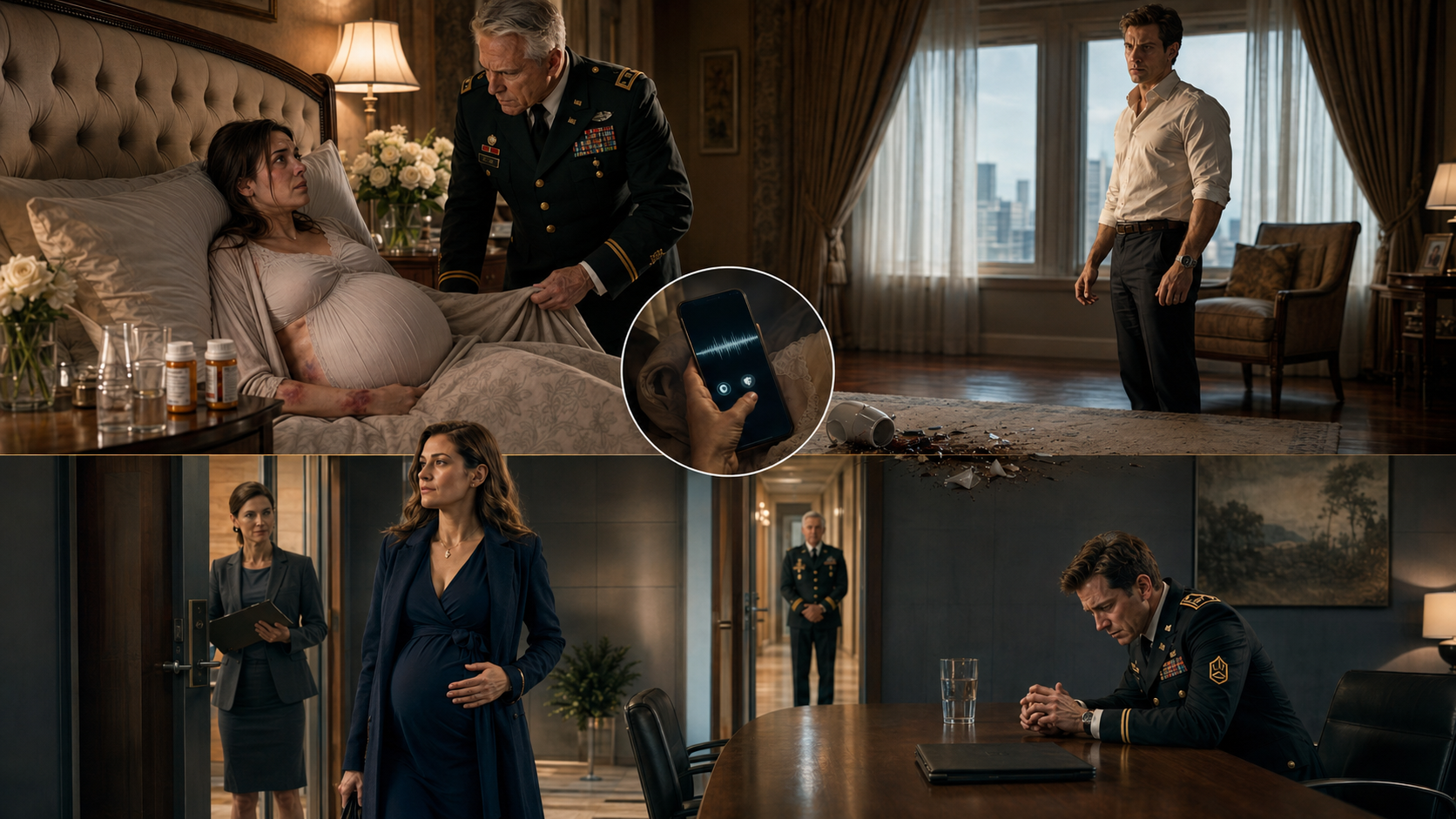
PART 1: THE TRUTH BENEATH THE BLANKET
The first thing my father noticed wasn’t my face.
It was the bruises.
He had been standing beside my bed for less than thirty seconds when his eyes dropped to the edge of the blanket tucked too carefully beneath my arms.
Julian had arranged it that way.
He always arranged things.
The curtains had been opened exactly halfway so the room looked bright but not cheerful. A glass of water sat untouched on my nightstand. My medication bottles had been lined up with their labels facing outward. Beatrice had even put a vase of white roses on the dresser.
Everything looked peaceful.
Everything looked cared for.
Everything was a lie.
My father reached for the blanket.
Julian moved first.
“She gets cold,” he said.
His voice was light, almost amused.
The kind of voice a patient husband used when explaining his difficult wife.
My father paused.
He looked at Julian.
Then he looked at me.
I don’t know what he saw in my face, but something changed in his expression.
Not anger.
Not yet.
Recognition.
He pulled the blanket down.
The room went silent.
Behind him, Julian’s coffee mug slipped from his hand.
Porcelain exploded against the hardwood floor.
Dark coffee spread across the pale rug while every pair of eyes fixed on my body.
Purple fingerprints circled my ribs beneath my nightgown.
My left wrist was swollen and yellowing at the edges where the bruising had started to fade.
Higher on my arm were four oval marks from Beatrice’s fingers.
And just above the curve of my seven-month pregnant stomach, half-hidden beneath the fabric, was a dark bruise that had frightened me every time I looked at it.
My father stared at it.
For one terrible second, I thought I saw him stop breathing.
Then Colonel Arthur Sterling lifted his eyes to mine.
“Who did this to you, Vivienne?”
He didn’t raise his voice.
That made it worse.
Julian had seen my father angry before. Anyone could survive anger. Anger was loud. Anger made mistakes.
This was different.
My father’s voice was almost gentle.
Controlled.
Measured.
The voice of a man who had already noticed ten things no one else had realized mattered.
Julian stepped forward.
“She slipped in the bathroom,” he said quickly. “The pregnancy has made her dizzy lately.”
My father’s gaze didn’t move from me.
Julian continued.
“My wife keeps losing her balance.”
From the doorway, Beatrice folded her arms.
She was still wearing the cream cardigan she had chosen because my father was visiting.
Soft colors.
Pearl earrings.
Concerned mother-in-law.
“Vivienne has become extremely emotional,” she said. “We’ve been doing everything we can to protect her from herself.”
My stomach tightened.
Not from the baby.
From fear.
I knew that sentence.
I knew what came next.
They had been building the story for six months.
It started so slowly I didn’t recognize it as a cage.
At first, Julian only answered questions for me.
If someone asked whether I wanted to go somewhere, he smiled and said I was tired.
If a friend called, he told them I was sleeping.
If my father asked why I looked pale during a video call, Julian laughed from just outside the camera.
“Pregnancy is hitting her harder than she expected.”
Then Beatrice joined in.
Vivienne was anxious.
Vivienne was overwhelmed.
Vivienne was having trouble sleeping.
Vivienne had become suspicious.
Vivienne was overly sensitive.
Vivienne wasn’t herself.
The repetition did something terrible.
It turned their lies into an atmosphere.
Neighbors stopped asking why they hadn’t seen me.
Friends accepted canceled lunches without arguing.
Even my obstetrician had begun looking at Julian before answering questions about my own body.
He attended every appointment.
He carried my purse.
He held my hand.
He told everyone he was terrified something might happen to me.
At home, that same hand closed around my wrist until I begged him to stop.
The first time Julian shoved me, I told myself he hadn’t meant to.
We had been arguing because I wanted to visit my father for a weekend.
Julian said traveling was irresponsible.
I told him my doctor hadn’t forbidden it.
He said, “You always need someone to tell you what you want to hear.”
I tried to leave the room.
He grabbed my arm.
I pulled away.
His hands hit my shoulders.
My back struck the wall.
For several seconds, neither of us moved.
Then he started apologizing.
He cried.
Actually cried.
He pressed both hands against his face and said the pressure of becoming a father was changing him.
I comforted him.
That memory shamed me more than the bruise.
The second time, he didn’t cry.
The third time, Beatrice was in the house.
She watched him grab me.
Then she shut the kitchen door.
A week later, she left marks of her own when I tried to retrieve my phone from the drawer where Julian had hidden it.
“No one believes a hysterical pregnant woman,” she whispered into my ear.
Julian heard her.
He smiled.
After that, the sentence became their private joke.
Whenever I threatened to tell someone, Julian leaned close and said it.
Whenever I refused to take whatever sedating medication he insisted would “help me rest,” Beatrice said it.
Whenever I demanded my passport, my car keys, or my phone, they reminded me how the world saw me now.
Fragile.
Unstable.
Confused.
Hormonal.
Eventually, there were moments when I almost believed them.
I learned to cry without making a sound.
I wore long sleeves during the hottest weeks of summer.
During video calls with my father, Julian stood just beyond the camera’s view.
Sometimes I could see his reflection in the black television screen.
Watching.
Waiting.
If I answered too slowly, he would tap his finger against his wrist.
If I sounded sad, he would silently mouth, Smile.
So I smiled.
And my father would ask, “You sure you’re all right, sweetheart?”
And I would say, “Just tired.”
Every time I said it, something inside me grew smaller.
Until two weeks earlier.
Two weeks earlier, Julian and Beatrice had gone downstairs after one of our arguments, and I had heard them talking through the heating vent.
They thought I was asleep.
Beatrice said, “Once the baby comes, she’ll be easier to manage.”
Julian answered, “She won’t have a choice.”
I remember lying there in the dark with one hand over my stomach.
For the first time, I understood that surviving until the birth wasn’t enough.
Whatever they were doing to me wasn’t temporary.
The baby would become another reason I couldn’t leave.
Another thing they could threaten me with.
That night, fear finally became useful.
I stopped begging.
I stopped warning them.
I started watching.
And then I found the trust documents.
I had been searching for my passport in Julian’s office while he was at work.
He had changed the lock on one drawer, which told me immediately that I needed to open it.
I found the spare key taped beneath the desk.
Inside were my passport, my old phone, several pieces of mail addressed only to me—
and a thick envelope from the law firm that had handled my mother’s estate.
I sat on the floor and read every page.
My mother had placed the house into a protected family trust before she died.
The property had never belonged to Julian.
His name wasn’t on the deed.
His name wasn’t on the trust.
His name wasn’t anywhere.
The house I had spent months feeling imprisoned inside was legally mine.
I almost laughed.
Then I almost screamed.
Instead, I put every paper back exactly where I had found it.
And I made a decision.
If Julian and Beatrice wanted everyone to believe I was irrational, I would give them no warning that I had stopped being afraid of their story.
I found my old phone.
I charged it only when they were asleep.
I recorded everything I could.
Threats.
Arguments.
Beatrice telling me I was lucky Julian still “put up with me.”
Julian warning me that if I embarrassed him, he’d tell my doctor I had become a danger to myself.
The sound of him slamming me against the bedroom door.
His voice afterward, cold and unmistakable.
“You make me do this when you refuse to listen.”
I photographed every bruise.
I emailed copies to an account Julian didn’t know existed.
Then I waited.
I was waiting for one person.
My father.
Julian believed Arthur Sterling was simply my widowed father who lived several states away and worried too much.
He knew Dad had served in the Army.
He didn’t know much else because my father never bragged about himself and Julian had never bothered asking questions that weren’t useful to him.
He didn’t know Colonel Arthur Sterling was still on active duty.
He didn’t know my father worked with the Army Inspector General’s office.
He didn’t know the man he dismissed as an aging father had spent decades recognizing deception, coercion, intimidation, and fear.
Julian had built his entire prison around one assumption.
That no one would know what they were looking at.
My father knelt beside my bed.
He gently took my hand.
“Look at me.”
I did.
“Did you fall?”
Across the room, Julian gripped the bedpost so tightly the wood creaked.
I looked at him.
Then Beatrice.
Then back at my father.
There was no pity in his face.
No disbelief.
No hesitation.
Only certainty.
For the first time in months, I understood what safety felt like.
“No,” I whispered.
The room froze.
Beatrice gave a nervous little laugh.
“She’s confused.”
My father’s expression didn’t change.
“The medication is affecting her judgment,” Beatrice continued.
Dad rose slowly.
“Julian.”
Julian straightened.
“Step away from my daughter.”
“This is my home, Colonel.”
He emphasized the rank with a faint sneer, as if it were an honorary title belonging to an old man whose authority had expired.
“You don’t have the authority to tell me what to do.”
Before my father could answer, I heard my own voice.
“No.”
Both men turned toward me.
My throat hurt.
My heart hammered.
But I said it again.
Louder.
“No.”
Julian stared at me.
“The house isn’t his,” I said.
Beatrice’s arms dropped from her chest.
I pushed myself higher against the pillows.
“It’s mine.”
Julian blinked.
For once, he had no prepared answer.
“My mother put it in a protected trust before she died.”
His face changed.
Not dramatically.
That was what frightened me.
His eyes sharpened.
Calculating.
Trying to understand how much I knew.
“Vivienne,” he said carefully, “you don’t understand those documents.”
“I understand my name.”
“You’re upset.”
“I understand yours isn’t on them.”
Beatrice stepped forward.
“This is ridiculous.”
I looked at her.
“You knew, didn’t you?”
That stopped her.
Only for half a second.
But my father saw it.
So did I.
Julian turned toward his mother.
And in that tiny movement, another lie cracked.
Dad reached inside his jacket and removed a government-issued phone.
Julian’s confidence finally slipped.
“Who are you calling?”
My father looked directly at him.
“Local law enforcement.”
Julian went still.
“The Army Family Advocacy Program.”
His jaw tightened.
“And your commanding officer.”
Every trace of color drained from Julian’s face.
Because my husband wasn’t simply an abusive man with a respectable job.
Captain Julian Mercer was an active-duty Army officer.
His spotless reputation mattered to him more than almost anything.
He had built his life around being seen as disciplined, dependable, honorable.
At unit functions, he was the husband who brought me water before I asked.
The officer who volunteered.
The man who remembered birthdays.
The future father who showed ultrasound pictures to anyone willing to look.
And he had spent six months constructing a second version of me to protect the first version of himself.
Unstable wife.
Patient husband.
But as my father started making calls, Julian realized something I had already learned.
A lie can control a room for a long time.
Until one person stops cooperating.
And I was done cooperating.
PART 2: THE STORY THEY BUILT AROUND ME
Julian didn’t explode immediately.
That was never his style when witnesses were present.
Instead, he breathed in slowly and looked at my father with the expression he used when speaking to junior soldiers who had disappointed him.
“Colonel, with respect, this is a family matter.”
Dad finished giving the dispatcher the address.
Then he ended the call.
“No,” he said. “It stopped being a private family matter when my daughter became afraid to answer a question in her own bedroom.”
Julian looked at me.
That look had controlled me for months.
There was no visible rage in it.
Only a warning.
Fix this.
I felt my pulse jump automatically.
My body still knew him better than my courage did.
He saw the reaction.
His eyes softened.
“Viv,” he said.
That was the voice.
The loving voice.
The one he used in public.
“Baby, you’re overwhelmed. I know you’re scared. But this is getting out of control.”
My father shifted slightly so he stood between us.
Julian stopped.
Beatrice rushed into the silence.
“Arthur, you don’t understand what’s been happening.”
Dad glanced at her.
“Then explain it.”
She seized the invitation.
“Vivienne hasn’t been well for months. She gets confused. She accuses Julian of things and then forgets what happened. She refuses to rest. She becomes agitated. We’ve been terrified for the baby.”
Every word sounded practiced because it was.
She continued, gaining confidence.
“There were nights she tried to leave the house in the middle of an argument. Julian had to stop her. Once, she almost fell on the stairs.”
“I wasn’t going down the stairs,” I said.
Beatrice faltered.
I swallowed.
My mouth had gone dry.
“You dragged me away from the front door.”
Her face hardened.
Only for a second.
Then concern returned.
“See?” she whispered to my father. “That’s what I mean. She remembers things differently.”
Something inside me went cold.
For months, that sentence had been enough to end any argument.
I remember it differently.
I was mistaken.
I was confused.
But my father didn’t look at Beatrice.
He looked at me.
“What happened at the front door?”
I closed my eyes.
The memory came with sound first.
My keys hitting the floor.
Beatrice’s shoes scraping against the tile.
Julian saying, “Don’t make this worse.”
“I wanted to go to my doctor’s office alone,” I said.
Julian exhaled sharply.
“Vivienne—”
Dad held up one hand.
Julian stopped speaking.
I continued.
“Julian wouldn’t let me take the car. I said I’d call a rideshare. Beatrice took my phone. I tried to leave anyway.”
My fingers curled into the blanket.
“She grabbed me from behind. Julian blocked the door.”
“Because you were hysterical,” Beatrice snapped.
My father finally looked at her.
“Was she free to leave?”
Beatrice opened her mouth.
Nothing came out.
Dad repeated it.
“Was my daughter free to leave the house?”
“We were trying to keep her safe.”
“That wasn’t my question.”
Julian stepped in.
“She could leave whenever she wanted.”
I laughed.
It came out broken.
All three of them looked at me.
I reached toward the nightstand.
Julian took one step forward.
Dad immediately moved.
“Don’t.”
Julian stopped.
I opened the bottom drawer and pulled out the old phone.
For the first time, Beatrice looked frightened.
Julian didn’t.
Not yet.
“What is that?” he asked.
I unlocked it.
My hands were shaking so badly I entered the passcode wrong twice.
Then I found the folder.
Dates.
Photos.
Audio files.
I had named every recording by day and time.
I hadn’t known if I would ever be brave enough to use them.
I pressed one.
My own voice filled the room.
Thin.
Tired.
“Give me my phone.”
Then Beatrice.
“You don’t need it.”
“I want to call my father.”
“Why? So you can upset him again?”
“Please give it back.”
A pause.
Then Julian.
“Vivienne, you’re not calling anyone while you’re like this.”
“I am not like anything. Give me my phone.”
A crash.
My breath catching.
Julian’s voice lowered.
“Stop fighting me.”
The recording ended.
No one spoke.
I played another.
This one was newer.
Julian’s voice came first.
“If you tell your doctor I grabbed you, I’ll tell her exactly what you’ve been like at home.”
“What have I been like?”
“Paranoid. Unpredictable. Emotional.”
“You hurt me.”
“Because you wouldn’t calm down.”
“You left bruises.”
“You bruise easily.”
Then Beatrice’s voice, from farther away.
“No one believes a hysterical pregnant woman.”
The recording ended.
My father became frighteningly still.
Julian looked at me as if I had transformed into someone he didn’t recognize.
“You recorded us.”
I finally looked directly at him.
“Yes.”
His mask slipped.
“You recorded private conversations in my house?”
“My house,” I said.
The words hit harder the second time.
His face tightened.
Then headlights washed across the bedroom wall.
A car door slammed outside.
Another followed.
Julian looked toward the window.
Beatrice whispered his name.
My father took the phone from my hand carefully.
“Anything else?”
I nodded.
“Photos.”
“Backed up?”
“Yes.”
Something like relief moved across his face.
“Good.”
Julian heard him.
I saw the moment he understood this wasn’t going away when he took the phone.
This wasn’t one frightened wife making one accusation.
There was a record.
A timeline.
Proof created before my father entered the house.
The doorbell rang.
Julian moved toward the bedroom door.
My father blocked him.
“You’re not meeting them alone.”
“This is still my residence.”
“It’s her property.”
Julian stared at him.
Dad held his gaze.
Then he said something so quietly I almost missed it.
“And you’re done controlling the first version of the story people hear.”
The doorbell rang again.
Beatrice suddenly turned to me.
“Do you understand what you’re doing?”
I looked at her.
Her voice trembled with anger.
“You could destroy his career.”
For one second, the old guilt rose in me.
Julian’s career.
His reputation.
His future.
Things I had been trained to protect.
Then the baby shifted beneath my ribs.
I placed one hand over my stomach.
And I remembered the heating vent.
Once the baby comes, she’ll be easier to manage.
I looked at Beatrice.
“No.”
My voice was quiet.
“He did that.”
My father went downstairs to open the door.
I heard voices.
Two local police officers.
Then more footsteps.
Julian stayed near the bed, staring at me.
The moment Dad disappeared from view, his expression changed completely.
“Tell them you exaggerated.”
My lungs tightened.
“Julian—”
“Tell them now.”
Beatrice moved closer too.
“We can still fix this.”
There it was.
Not Are you okay?
Not We’re sorry.
Not We didn’t mean to hurt you.
We can still fix this.
Meaning the story.
Meaning me.
Meaning whatever needed to be rearranged so Julian remained untouched.
I stared at the man I had married.
Once, I had loved the confidence in his face.
I mistook certainty for strength.
I mistook control for protection.
I mistook being needed for being loved.
Now I saw something else.
Fear.
Not fear for me.
Fear of consequences.
Footsteps approached the bedroom.
Julian leaned closer.
“If you do this, Vivienne, there is no coming back.”
I felt tears burn behind my eyes.
For months, he had used that kind of sentence to frighten me.
This time, I understood it differently.
There was no coming back.
Thank God.
Two officers entered with my father.
A female officer came straight toward me.
“Ma’am, can I speak with you privately?”
Julian answered before I could.
“Of course. My wife—”
“I asked her.”
The officer looked at me.
“Can we speak privately?”
My heart pounded.
I looked at Julian.
Then Beatrice.
Then my father.
He gave me the smallest nod.
Not an order.
Permission.
Choice.
Something I hadn’t been given in a long time.
“Yes,” I said.
“I want them out.”
Julian’s face went blank.
The officer turned.
“Sir, ma’am, please step outside.”
“This is absurd,” Beatrice said.
Julian didn’t move.
The second officer stepped closer.
“Captain, let’s go.”
That word changed something.
Captain.
Not husband.
Not homeowner.
Not victim.
A rank attached to a man standing in a room where his pregnant wife had visible injuries.
Julian finally walked out.
Beatrice followed.
At the doorway, she looked back at me.
For the first time, she didn’t look superior.
She looked betrayed.
As if my silence had been something I owed them.
The door closed behind her.
And I began to tell the truth.
Everything.
PART 3: THE MOMENT I STOPPED PROTECTING HIM
Telling the truth hurt more than I expected.
I thought I would feel relief.
Instead, I felt exposed.
The officer sat in a chair beside my bed while my father waited across the room.
He didn’t interrupt.
He didn’t answer for me.
That mattered.
For months, people had spoken around me as if I were a patient who couldn’t be trusted with her own life.
Now every question came to me.
“When did he first hurt you?”
“Did you ever fear he would seriously injure you?”
“Did anyone prevent you from leaving?”
“Who controlled your phone?”
“Who gave you the medications?”
“Were the medications prescribed?”
That question made me pause.
“They were prescribed,” I said. “But Julian always wanted me to take them more often than I wanted to.”
“Did he force you?”
“Sometimes he stood there until I swallowed them.”
The officer wrote something down.
Shame crawled over me.
I hated how weak the facts sounded when I said them aloud.
Why hadn’t I screamed?
Why hadn’t I run?
Why hadn’t I told my doctor?
Why hadn’t I simply walked out?
The questions attacked me from inside even though the officer never asked them.
My father must have seen something in my face.
“Vivienne.”
I looked at him.
He spoke carefully.
“Answer what happened. You don’t have to explain why you survived it the way you did.”
My throat closed.
I nodded.
So I kept talking.
I told them about the first shove.
The locked drawer.
The missing keys.
The way Julian stood behind the bathroom door while I called friends.
The way Beatrice canceled appointments using my phone.
The times she told people I was asleep while I stood upstairs listening.
The night Julian squeezed my wrist until my fingers went numb because I had asked him why my passport was missing.
I told them about my prenatal appointments.
How Julian sat beside me.
How he corrected me.
How he laughed when I said I wasn’t sleeping because I was afraid.
“She’s always been a worrier,” he told the doctor.
The officer asked whether my obstetrician had ever examined the bruises.
“No.”
“Why?”
“I hid them.”
Saying it made me cry.
Not because it was the worst thing that had happened.
Because it was the clearest proof of how completely they had trained me.
I had sat three feet from a doctor with bruises on my body and spent the entire appointment making sure no one saw them.
My father looked away.
That was the only moment his control cracked.
He walked to the window and pressed one hand against the sill.
I knew that posture.
He was angry.
Furious.
But he wasn’t angry at me.
That realization broke something open inside my chest.
The female officer asked whether I wanted medical attention.
“Yes.”
The answer came instantly.
I wanted someone to check the baby.
I had wanted that for days.
But Julian had refused to take me back to the hospital after the bruise appeared.
He said the baby was moving, so everything was fine.
Beatrice agreed.
“Doctors make nervous mothers worse,” she said.
Now an ambulance was called.
Outside the bedroom, I heard Julian’s voice rise.
“You have no reason to detain me.”
Then my father’s.
“I suggest you stop talking.”
The officer glanced toward the door.
I almost smiled.
It was the first time anyone had ever told Julian that silence might be in his best interest.
When the paramedics arrived, the room became busy.
Questions.
Blood pressure.
Heart rate.
A monitor.
Hands moving around me without hurting me.
Someone asked permission before touching my wrist.
That nearly made me cry again.
I had forgotten what it felt like for another person to ask.
The baby’s heartbeat came through the portable monitor.
Fast.
Steady.
Alive.
I covered my face with both hands.
My father turned away again, but not before I saw his eyes fill.
“They need to take you in,” the paramedic said.
I nodded.
The female officer asked whether I felt safe with my father accompanying me.
I looked at Dad.
He stood there in the bedroom where I had spent months shrinking.
“Yes.”
More than safe.
I felt visible.
As they prepared to move me, Julian appeared in the hallway.
One officer stood beside him.
His posture was rigid.
He looked less like my husband now and more like an officer struggling to maintain military bearing.
“Vivienne.”
The paramedics paused.
I looked at him.
He took one step closer.
“I need to speak to my wife.”
The officer blocked him.
“No.”
Julian ignored him.
“Viv, look at me.”
My whole body reacted.
My shoulders tightened.
My breathing shortened.
My father noticed.
So did the officer.
Julian noticed too.
He softened his voice immediately.
“Tell them this is a misunderstanding.”
I stared at him.
“We can go to counseling.”
I said nothing.
“I’ll stay somewhere else tonight.”
Still nothing.
“I know I’ve been under pressure. I know I’ve lost my temper.”
That was the closest he had ever come to admitting anything.
Because he was afraid.
Not sorry.
Afraid.
“Please,” he said.
That word almost undid me.
Julian never said please.
I remembered the man from the beginning of our marriage.
The one who cooked breakfast on Sundays.
The one who rested his hand on the small of my back in crowded rooms.
The man who cried when I showed him the positive pregnancy test.
I had loved him.
That truth didn’t disappear just because another truth was uglier.
Part of me wanted him to become that man again.
Part of me wanted him to say exactly the right thing and make the last six months dissolve.
Then his eyes dropped to the old phone in the officer’s hand.
And for one fraction of a second, his face changed.
Calculation.
Again.
Always calculation.
How much had I recorded?
Who had copies?
What had I said?
What could he deny?
My grief hardened.
I had spent months loving his potential more than his behavior.
I wasn’t going to do it anymore.
“You told me no one would believe me,” I said.
His jaw moved.
I kept looking at him.
“I believed you.”
He didn’t answer.
“For a while.”
Beatrice appeared behind him.
“Vivienne, don’t do this.”
I turned toward her.
She was crying now.
Real tears.
But even then, they were for him.
“He’s worked his entire life for his career.”
I felt something inside me finally settle.
“And I was supposed to sacrifice mine?”
She stared.
“My life? My baby? My mind?”
“That’s not what I meant.”
“It is exactly what you meant.”
My voice shook, but I didn’t stop.
“You watched him hurt me.”
“No.”
“You helped him.”
“I was trying to protect my son.”
“From what?”
She had no answer.
“From consequences?”
Her face crumpled.
The paramedic touched my arm.
“We should go.”
I nodded.
As they wheeled me toward the stairs, I saw Julian standing beneath the family photographs lining the hallway.
Our wedding.
Our first Christmas.
An ultrasound picture framed beside a photograph of us smiling at a military banquet.
It looked like someone else’s life.
At the front door, two additional men were speaking with my father.
One wore civilian clothes.
The other I recognized from Julian’s unit.
Major Daniel Ross, his executive officer.
I had met him twice at formal events.
The second Julian saw him, he stopped walking.
Major Ross looked past the police officer toward me.
His eyes moved to the bruises visible beneath the hospital blanket.
Then back to Julian.
“Captain Mercer,” he said.
Julian’s face emptied.
“Sir.”
“I’ve been informed of the allegation.”
“It’s not what it looks like.”
Major Ross’s expression didn’t move.
“You’ll have an opportunity to address that through the proper channels.”
“Sir, my wife is experiencing—”
My father cut in.
“Careful.”
One word.
Julian looked at him.
Dad stepped closer.
“For six months, you benefited from describing her before she could describe herself.”
His voice remained calm.
“That ends now.”
Major Ross turned toward Julian.
“Do not contact her until you are given further guidance.”
Julian looked at me.
That was when I saw it.
Not anger.
Not love.
Not even fear.
Disbelief.
He truly had never imagined losing control of the room.
I was carried through the front door into warm evening air.
The sun was setting.
For the first time in weeks, I was outside without permission.
I started crying before we reached the ambulance.
My father climbed in beside me.
He took my hand.
“I’m sorry,” I whispered.
His face tightened.
“For what?”
“I should’ve told you.”
“No.”
“I lied to you.”
“You survived long enough to tell me now.”
My mouth trembled.
“I thought you’d think I was crazy.”
His eyes closed briefly.
When he opened them, there was pain there.
“Vivienne, every time you told me you were tired, I knew something was wrong.”
I stared at him.
“Then why didn’t you—”
“I didn’t know what.”
His voice cracked for the first time.
“And I was afraid if I pushed too hard, you’d stop taking my calls.”
I thought of Julian standing outside the camera.
The television reflecting him.
Smile.
“Why did you come?”
Dad squeezed my hand.
“Three nights ago, you told me you were fine.”
I waited.
“You said it four times in six minutes.”
A tear slid down my cheek.
“So?”
“So your mother used to do that.”
I stopped breathing.
“When she was frightened,” he said. “She’d repeat the same reassurance until she could hear herself believing it.”
He looked at me.
“You sounded exactly like her.”
The ambulance doors closed.
And for the first time, I understood that Julian’s mistake hadn’t been underestimating my father’s rank.
It had been underestimating how well my father knew me.
PART 4: WHEN THE PERFECT STORY COLLAPSED
The baby was fine.
Those were the first words that mattered.
The doctor repeated them because I made her.
“The heartbeat is strong. The monitoring looks reassuring.”
“You’re sure?”
“Yes.”
I cried so hard I couldn’t speak.
My father sat beside the hospital bed.
He didn’t tell me to calm down.
He didn’t tell me everything was okay.
He simply stayed.
The rest was slower.
My wrist wasn’t broken, but it was badly sprained.
The bruises across my ribs were documented and photographed.
So were the marks on my arms and stomach.
Every injury became something outside my memory.
Something visible.
Recorded.
Real.
When the physician asked how I had been injured, I told her.
Every time I said the words, they became easier.
“My husband grabbed me.”
“My mother-in-law restrained me.”
“My husband shoved me.”
I watched the medical staff write them down.
No one rolled their eyes.
No one called me emotional.
No one asked Julian whether my version sounded accurate.
Hours later, my obstetrician arrived.
Dr. Elaine Patel looked exhausted and horrified.
She stood near the foot of my bed holding my chart.
“I didn’t know.”
I believed that she hadn’t known.
That wasn’t the same as saying nothing had gone wrong.
“He told you I was paranoid,” I said.
Her face changed.
“Yes.”
“And you believed him.”
“I believed there was conflict at home and that your anxiety had increased.”
“He answered questions for me.”
Dr. Patel lowered her eyes.
“He did.”
“You let him.”
Silence.
My father shifted in his chair but didn’t intervene.
This was mine.
Dr. Patel looked at me again.
“I did.”
She swallowed.
“I should have asked him to leave the room.”
I felt angry.
Not the explosive kind.
Something heavier.
“You should have asked me.”
“Yes.”
Her answer surprised me.
No excuses.
No speech about medical complexity.
Just yes.
“I am sorry, Vivienne.”
I looked away.
I wasn’t ready to forgive anyone for not seeing what I had worked so hard to hide.
But I also understood the cruelty of what Julian had done.
He had used my silence as evidence that he was telling the truth.
And when my fear made me look nervous, he used the nervousness too.
He had created the symptom and then pointed to it as proof.
Late that night, my father handed me my old phone.
“The files were copied.”
I looked at him.
“By who?”
“The investigating officers have what you agreed to provide.”
My stomach tightened.
“What happens to Julian?”
Dad’s expression became careful.
“Several processes may happen at the same time.”
I knew that tone.
He was making sure I didn’t confuse his position with magic.
He wasn’t going to promise me an outcome he couldn’t control.
“The civilian authorities handle possible criminal conduct under their jurisdiction. His command handles military and administrative matters. Family Advocacy will assess the domestic abuse report and safety concerns.”
“Will he lose his career?”
“I don’t know.”
I looked down.
Part of me hated that answer.
Then I realized it was the first honest answer anyone had given me in months.
Dad continued.
“But this won’t disappear because he outranks you in his own house.”
I let out a breath.
“And Beatrice?”
“Her conduct is being documented too.”
I closed my eyes.
For months, I had imagined justice as something dramatic.
Julian being dragged away.
Beatrice exposed in front of everyone.
People apologizing to me.
Instead, justice began with paperwork.
Statements.
Photographs.
Phone calls.
A safety plan.
An order that Julian stay away.
Instructions about how I could return home.
It was almost disappointingly ordinary.
Then I realized ordinary was what made it powerful.
Julian had controlled me through private moments.
Private threats.
Private bruises.
Private stories.
Now everything was leaving the private space where he could reshape it.
By morning, word had reached his chain of command that something serious had happened.
I learned that not because my father told me confidential details.
He refused to.
I learned it because my phone began filling with messages.
People from Julian’s unit.
Wives I knew from functions.
Old friends.
Neighbors.
At first, I couldn’t read them.
I assumed they would ask what I had done.
Some did.
One message said:
I hope you two can work through this privately.
I deleted it.
Another said:
Julian always spoke so highly of you. I can’t believe this.
I deleted that too.
Then there were different messages.
I thought something was wrong the last time I saw you.
I’m sorry I believed you didn’t want visitors.
Beatrice told us you were too unstable for company.
Julian canceled dinner with us twice and said you had panic attacks.
Each message showed me how wide the story had spread.
I hadn’t imagined it.
They had been isolating me socially as carefully as they isolated me physically.
One friend, Claire, sent a voicemail.
Her voice shook.
“Viv, I came by three weeks ago. Beatrice told me you were sleeping. I said I’d wait. She wouldn’t let me inside. I thought she was protecting you. I am so sorry.”
I listened twice.
Then I cried.
Not because Claire had failed me.
Because I remembered that day.
I had been upstairs.
Awake.
I had heard voices at the front door.
Beatrice came upstairs ten minutes later and said a package had been delivered.
A contradiction.
A clue.
One of dozens I hadn’t understood at the time.
My father sat beside me while I listened.
“They made the lie social,” I said.
He nodded.
“They made it easier for everyone to participate without knowing.”
I stared at the ceiling.
“That’s why it worked.”
“Partly.”
“What’s the other part?”
Dad looked at me.
“You kept trying to prove you were reasonable to people committed to describing you as unreasonable.”
I flinched.
Not because it was cruel.
Because it was true.
Every time Julian said I was hysterical, I lowered my voice.
Every time Beatrice said I was paranoid, I tried to appear trusting.
Every time they called me unstable, I became more careful.
They turned my desire to look sane into another leash.
My father leaned forward.
“You don’t have to perform calmness to deserve protection.”
I started crying again.
“I’m so tired.”
“I know.”
“I don’t want to fight him forever.”
“You don’t have to decide forever tonight.”
That became how I survived the next weeks.
Not forever.
Today.
One statement.
One medical appointment.
One conversation with an advocate.
One night of sleep.
One morning without someone checking my phone.
I stayed temporarily with my father in a furnished apartment arranged near my medical care.
The house remained mine.
That mattered more emotionally than I expected.
Julian had spent months referring to it as my house.
My rules.
My office.
My bedroom.
My wife.
Possession disguised as grammar.
But the trust documents were clear.
And because I was finally willing to assert what they said, Julian couldn’t use the property as leverage over me.
His personal belongings were handled through proper arrangements.
He did not get to return while I was there.
Beatrice called from three different numbers before I blocked them.
The first voicemail was furious.
“You have humiliated this family.”
The second was pleading.
“Julian loves you. He made mistakes.”
The third was cold.
“When this child asks what happened to his father, remember that you chose this.”
I listened to that one once.
Then I saved it with the others.
Not because it proved some new crime.
Because it proved nothing had changed.
She still saw the consequences as something I was doing to Julian.
Never something Julian had done to himself.
The military process moved with a formality that felt almost surreal.
Julian’s image as the perfect officer did not vanish in one dramatic explosion.
It cracked under accumulation.
The recordings.
The photographs.
The medical documentation.
The messages showing how he had described me to others.
His own statements.
The contradiction between the devoted husband he had presented publicly and the voice captured privately telling his pregnant wife no one would believe her.
My father never interfered in the investigation.
He made that painfully clear.
“I am your father first,” he told me. “And in anything involving formal review, I stay out of lanes that aren’t mine.”
At first, I was disappointed.
Some small part of me wanted Colonel Sterling to destroy Captain Mercer with a phone call.
That would have been easier.
But it would also have given Julian another story.
Powerful father ruins son-in-law’s career.
Vindictive family.
Influence.
Bias.
My father understood what I didn’t.
The strongest case against Julian was the one Julian had built himself.
So Dad did what he had done the moment he saw the bruises.
He gave me space to speak.
And the truth did the rest.
The hardest day came when I had to listen to one of my own recordings again during an interview.
Julian’s voice filled the small room.
“If you embarrass me, I will make sure everyone understands exactly how unstable you’ve become.”
Then my voice.
“What if they believe me?”
A pause.
His laugh.
“Who?”
One word.
I gripped the edge of the chair.
The investigator stopped the recording.
“Would you like a break?”
I almost said yes.
Then I thought of all the times Julian had asked Who?
Who would believe me?
Who would help me?
Who would choose my version?
I straightened.
“No.”
My voice shook.
“Keep going.”
So we did.
And when I left the room, my father was waiting in the hallway.
He stood when he saw me.
“How’d it go?”
I looked back at the closed door.
“I didn’t stop it.”
A small smile touched his face.
“Good.”
“No.”
I shook my head.
“I mean I didn’t stop myself.”
He understood.
That night, I slept six hours without waking.
It was the longest I had slept in months.
PART 5: WHAT WAS LEFT WHEN THE LIES WERE GONE
Julian asked to speak to me one final time.
Not alone.
Never alone.
By then, enough time had passed that my body had begun to change again.
The bruises had faded.
My wrist had healed.
My stomach had grown heavier.
The baby kicked constantly now.
Every movement felt like an argument for the future.
The meeting took place in a small conference room.
An advocate sat near the door.
My father waited outside because I asked him to.
That surprised him.
It surprised me too.
But I needed one thing from Julian that no one else could give me.
I needed to look at him without a bedroom wall behind me.
Without Beatrice beside him.
Without a locked door.
Without needing permission to leave.
He entered looking older.
Not destroyed.
Not transformed.
Just stripped of polish.
His uniform was immaculate.
Of course it was.
Julian would probably iron a shirt during an earthquake.
He sat across from me.
For several seconds, neither of us spoke.
Then he looked at my stomach.
“How’s the baby?”
“Healthy.”
His eyes closed briefly.
“Good.”
I had imagined this moment so many times.
In some versions, I screamed at him.
In others, he begged.
In one, ridiculous version, he finally admitted everything with perfect clarity and gave me the apology I had been starving for.
Reality was smaller.
“Why did you want to see me?” I asked.
He rubbed his hands together once.
“I wanted you to hear from me that I never intended for any of this to happen.”
I almost laughed.
“What part?”
He looked at me.
“The way things got.”
“The bruises?”
He flinched.
“The isolation?”
“Viv—”
“The threats?”
“I lost control.”
“No.”
I felt strangely calm.
“You controlled everything.”
His mouth closed.
“You controlled my phone. My keys. Who came into the house. What my friends heard. What the doctor heard. What your mother said. What I was allowed to say without paying for it later.”
I leaned back.
“You didn’t lose control, Julian.”
For the first time, he looked ashamed.
Maybe truly ashamed.
I couldn’t tell anymore.
“You used it.”
He stared at the table.
“My mother made things worse.”
The old instinct in me reacted.
There it was.
An exit.
A way to spread blame until his share became smaller.
“She did,” I said.
He looked up.
“But she didn’t make you hurt me.”
His eyes hardened slightly.
I saw the reflex before he buried it.
“I know.”
“Do you?”
“Yes.”
“Then say it.”
He frowned.
“Say what?”
I had not planned the question.
It simply came.
“Say what you did without explaining why.”
Silence.
He looked toward the advocate.
Then at me.
His face tightened.
“I hurt you.”
My throat burned.
“How?”
He exhaled.
“I grabbed you.”
I waited.
“I shoved you.”
Still I waited.
“I kept your phone from you.”
His voice lowered.
“I tried to control who you spoke to.”
The room seemed to shrink.
“And?”
Julian stared at me.
I knew he knew.
Finally, he said it.
“I told people you were unstable so they wouldn’t believe you.”
I closed my eyes.
There.
The truth.
Not all of it.
Not enough to repair anything.
But the shape of it.
For six months, I had needed someone else to name what was happening.
My father.
A doctor.
An officer.
An investigator.
Now the man who had done it had finally said the words himself.
I opened my eyes.
“Thank you.”
Hope flashed across his face.
It was gone when I continued.
“That’s all I needed.”
“Vivienne.”
I stood carefully.
He stood too.
The advocate immediately shifted in her chair.
Julian noticed and froze.
The humiliation on his face was almost painful to watch.
Once, everyone moved when he entered a room.
Now someone moved because he stood too quickly near me.
“Is there any chance—”
“No.”
The word came easily.
He swallowed.
“You didn’t even let me finish.”
“I know what you were asking.”
“We’re having a child.”
“Yes.”
His voice broke.
“Doesn’t that mean anything?”
“It means everything.”
I placed my hand over my stomach.
“That’s why I’m leaving.”
His eyes filled.
For the first time, I felt no satisfaction.
That surprised me.
I had imagined revenge as a warm thing.
It wasn’t.
His pain didn’t heal mine.
His fear didn’t erase my fear.
Watching his life collapse did not rebuild the months he had taken from me.
Justice was necessary.
But revenge wasn’t the part that saved me.
Choice was.
The ability to stand.
The ability to leave.
The ability to decide what happened next.
Julian sat down again.
I reached the door.
“Viv.”
I stopped.
He spoke without looking at me.
“I did love you.”
My eyes burned.
I believed him.
That was perhaps the saddest part.
“I know.”
He looked up.
“Then how can you walk away like this?”
I thought of the first shove.
The apologies.
The excuses.
The long sleeves.
The locked drawer.
The heating vent.
My father’s face when he pulled back the blanket.
And my answer came with no anger at all.
“Because love that requires me to disappear isn’t enough.”
I walked out.
My father was waiting in the hallway.
He looked at my face.
“Done?”
“Done.”
He offered me his arm.
I shook my head.
Then smiled.
“I can walk.”
Something in his expression softened.
“I know you can.”
He walked beside me anyway.
Not ahead.
Not behind.
Beside me.
Months later, when my baby was born, the first thing I noticed was the sound.
That furious, outraged cry filled the delivery room, and I laughed while tears ran into my hair.
“Strong lungs,” the nurse said.
My father stood near the wall looking completely overwhelmed.
I had never seen Colonel Arthur Sterling overwhelmed by anything.
It was wonderful.
When the nurse placed my baby against my chest, I looked down at that tiny face and felt a fear deeper than anything Julian had ever created in me.
Not fear of danger.
Fear of responsibility.
Of loving someone this much.
Of becoming responsible for making home mean something safe.
I pressed my lips against a soft forehead.
“You will never have to earn the right to be believed,” I whispered.
My father heard me.
He looked away quickly.
The legal and military consequences surrounding Julian continued beyond that day.
I learned not to measure my healing by each development.
His career was no longer mine to protect.
His reputation was no longer mine to manage.
His explanations were no longer mine to correct.
Beatrice eventually stopped calling.
The silence she once used to isolate me became something else when I chose it for myself.
Peace.
I returned to the house after the birth.
My house.
At first, I hated being there.
Every room contained a memory.
The kitchen doorway where Julian once blocked me.
The hallway where Beatrice grabbed my arm.
The bedroom where I learned to cry silently.
For two nights, I nearly left.
Then, on the third morning, I carried a box downstairs.
I removed the white roses Beatrice had dried and kept in a decorative jar.
I packed away the military banquet photographs.
I moved the chair Julian always sat in.
Small things.
Almost stupidly small.
But each one changed the shape of the room.
Claire came over one afternoon and helped me repaint the bedroom.
My father complained that we were doing it wrong.
We ignored him.
He complained louder.
Then he took the roller from me and finished one wall himself.
For the first time in months, laughter filled that room.
Real laughter.
Not the careful sound I used to make when Julian was watching.
One evening, after Dad left and the baby finally fell asleep, I sat alone on the edge of the bed.
The same bed.
The same window.
The same floor where Julian’s coffee mug had shattered.
The rug had been cleaned, but if the light hit it at the right angle, I could still see the faintest shadow of the stain.
I thought about replacing it.
Then I decided not to.
Not yet.
People like to say abuse leaves scars.
I used to think that meant you remained damaged forever.
Now I understood scars differently.
A scar was not the wound.
It was evidence that the wound had closed.
I touched the place on my wrist where Julian’s fingers had once left dark marks.
Nothing remained.
But I remembered.
And remembering no longer made me weak.
It made me accurate.
That was the thing Julian and Beatrice had tried hardest to take from me.
Not my house.
Not my phone.
Not my friendships.
My trust in my own perception.
They taught me to question whether pain counted if someone else explained it away.
Whether fear counted if the person frightening me claimed to love me.
Whether a locked door was really a prison if the person holding the key said it was for my protection.
My father didn’t rescue me by arriving with a rank.
He rescued me first by asking a question and waiting for my answer.
Did you fall?
No.
One word.
That was the beginning.
Everything that came after—the police, the medical records, the recordings, the trust documents, the military investigation—only mattered because I finally gave myself permission to say that word.
No.
No, I didn’t fall.
No, I wasn’t confused.
No, the house wasn’t his.
No, he couldn’t explain my bruises away.
No, Beatrice couldn’t call control protection.
No, his career was not more valuable than my safety.
No, loving him once did not obligate me to keep letting him hurt me.
And no, I was not the woman they had spent six months describing.
I was not hysterical.
I was not helpless.
I was not disappearing.
One night, long after everything had changed, my father came by for dinner.
He found me sitting on the porch with the baby asleep against my chest.
The summer air was warm.
Cicadas hummed in the trees.
Dad sat beside me.
For a while, neither of us spoke.
Then he said, “You know, the day I came here, I thought I was prepared for anything.”
I smiled faintly.
“You usually do.”
“I wasn’t.”
I looked at him.
His gaze remained on the dark yard.
“I keep thinking about how close I came to believing you when you said you were fine.”
My chest tightened.
“Dad—”
“I should have come sooner.”
I knew that guilt.
It sounded too much like mine.
I adjusted the blanket around the baby.
“You came when you understood.”
He looked at me.
“So did I.”
His eyes filled.
Neither of us said anything for a while.
We didn’t need to.
Inside the house, my phone buzzed on the table.
Months earlier, that sound would have filled me with fear.
Who was calling?
Would Julian see it?
Had I answered too slowly?
Would Beatrice ask who it was?
Now the phone buzzed again.
I ignored it.
Because I could.
The baby stirred.
I looked down.
My father smiled.
And in that ordinary moment, I finally understood what freedom looked like.
It wasn’t dramatic.
It wasn’t revenge.
It wasn’t Julian losing everything.
It wasn’t Beatrice being exposed.
It wasn’t even the moment my father pulled back the blanket and every lie in the room began to collapse.
Freedom was quieter than that.
It was a door I could open whenever I wanted.
A phone no one took from my hand.
A doctor I could speak to alone.
A house where no one needed permission to leave.
A child who would grow up knowing that love did not sound like a threat.
And a voice inside me that I trusted again.
Julian had once told me no one would believe a hysterical pregnant woman.
For months, those words had kept me silent.
In the end, he had been wrong about the one person who mattered most.
Me.
I believed her.
Để lại một bình luận