
My Wife Thought Eight Months Away Had Made Me Blind
PART 1: THE SCREAM BEHIND MY FRONT DOOR
The first sound I heard inside my house was my mother’s scream.
Not a startled cry. Not the confused call of an elderly woman waking from a bad dream.
A scream.
Raw. Terrified. Desperate.
I dropped my suitcase in the foyer so hard that one of the wheels cracked against the marble and rushed toward the kitchen.
I had been awake for nearly twenty hours. My shirt still smelled faintly of airplane cabin air and the industrial dust that seemed to follow me everywhere after eight months managing a refinery project in Saudi Arabia. I had imagined coming home a hundred different ways during the flight.
My mother crying because she was happy to see me.
My wife, Vanessa, pretending to be annoyed that I had arrived two days early before throwing her arms around me.
Maybe dinner together.
Maybe sleep.
Instead, I found my seventy-eight-year-old mother on the floor beside her overturned wheelchair.
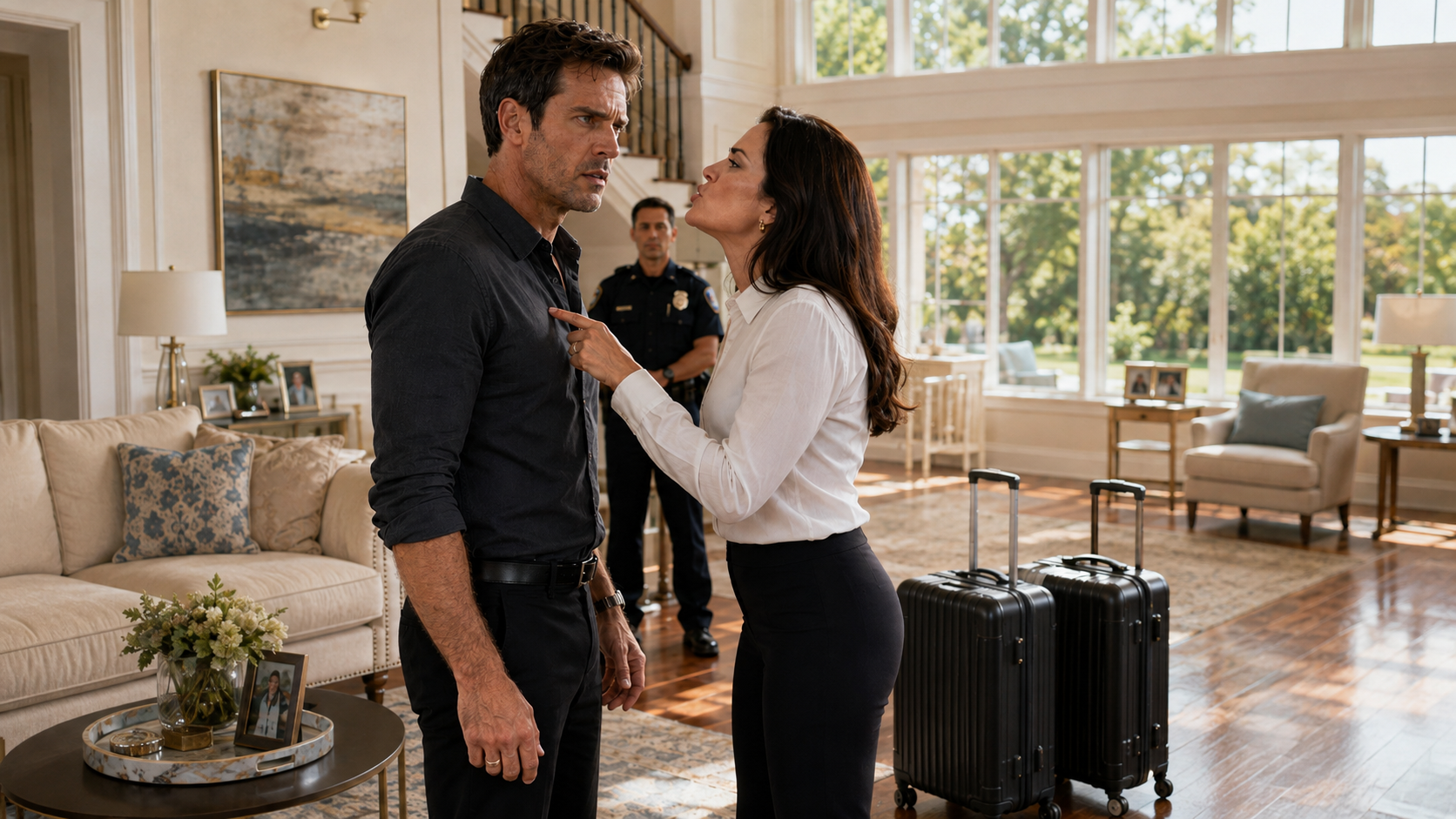
Vanessa stood over her with a wooden spoon raised like a weapon.
And between them crouched Elena, our twenty-six-year-old housekeeper, shielding my mother with her own body.
Blood streamed from a cut above Elena’s eyebrow.
For one second, nobody moved.
My brain rejected what my eyes were telling me.
Then Vanessa lifted the spoon again.
“Stop!”
My voice exploded through the kitchen.
Vanessa froze.
Elena twisted around, one arm still wrapped protectively around my mother.
Mom looked at me.
I will never forget her face.
Relief came first.
Then shame.
My mother—the woman who had raised me after my father died, who had worked two jobs so I could finish engineering school, who had once faced down a hospital administrator because they tried to discharge me too early after an accident—looked ashamed that I had found her helpless on my kitchen floor.
“Daniel,” she whispered.
Vanessa slowly turned.
For a fraction of a second, fear crossed her face.
It disappeared almost immediately.
She lowered the spoon and smiled.
“Daniel, darling.” Her voice became warm, almost amused. “You’re home early.”
I stared at her.
“What happened?”
She glanced at Mom as though my mother were an inconvenience somebody had spilled onto the floor.
“Your mother had another outburst.”
Elena’s breathing became sharper.
Vanessa continued, “She threw her food. Then she tried to hit me. I was only teaching her a lesson.”
Teaching her a lesson.
I looked at the overturned wheelchair.
At the red mark forming across my mother’s forearm.
At Elena’s bleeding forehead.
Something inside me wanted to cross the room and put my hands around Vanessa’s throat.
Instead, I walked past her.
That decision probably saved my life from becoming as ruined as hers was about to become.
I knelt beside Mom.
“Can you move your fingers?”
She nodded weakly.
“Does your neck hurt?”
“No.”
“Your head?”
“No.”
Her hands trembled as she caught Elena’s sleeve.
Then she whispered four words.
“She locks me in.”
I leaned closer.
“What?”
“In my room.”
Vanessa laughed.
It was a small sound.
Almost dismissive.
“She’s confused, Daniel. You know how elderly people become after strokes.”
Mom’s fingers tightened.
“I am not confused.”
Vanessa’s smile thinned.
I reached into my pocket and pulled out my phone.
“What are you doing?”
“Calling an ambulance.”
“You don’t need an ambulance.”
I dialed emergency services.
Vanessa stepped toward me.
“Daniel.”
I gave the dispatcher our address.
“Daniel, hang up.”
I explained that my elderly mother had fallen from her wheelchair and appeared injured. I added that another woman had a head wound.
Vanessa’s face changed.
“You’re humiliating me.”
I ended the call.
“No,” I said. “You did that yourself.”
She stared at me as if she no longer recognized the man standing in front of her.
Maybe she didn’t.
For most of our seven-year marriage, I had avoided conflict whenever I could. Vanessa called it maturity. My mother sometimes called it patience.
Looking back, I think Vanessa had mistaken restraint for weakness.
The paramedics arrived in less than ten minutes.
Those ten minutes felt like an hour.
Vanessa followed me through the house while I got Mom a blanket.
“You have no idea what I’ve been dealing with.”
I ignored her.
“You’ve been gone eight months.”
I helped Elena press a clean towel against her forehead.
“Your mother is impossible,” Vanessa continued.
Elena flinched.
Vanessa saw it.
“And that girl has been filling her head with lies.”
Elena looked up.
For the first time since I had come through the door, there was anger in her face instead of fear.
“I didn’t have to fill anyone’s head with anything.”
“Elena,” Vanessa snapped.
“No.”
The word came quietly.
But Elena did not look away.
“Not anymore.”
The paramedics came through the kitchen doorway.
Everything became movement after that.
Questions.
Blood pressure cuffs.
A neck brace they eventually decided Mom did not need.
A stretcher.
One of the paramedics examined Elena’s forehead and told her she would need stitches.
Vanessa hovered near me, performing concern.
“She falls sometimes,” she said.
Mom turned her face away.
One paramedic gave Vanessa a long look.
As they prepared to take Mom out, Elena caught my wrist.
“Mr. Reed.”
Her fingers were cold.
“Please check the blue sewing box in your mother’s closet.”
Vanessa heard her.
She moved so quickly that I almost missed it.
“Elena, shut your mouth.”
She lunged toward us.
A paramedic stepped between them.
“Ma’am, back up.”
Vanessa stopped.
And I saw it.
Not irritation.
Not embarrassment.
Panic.
Real panic.
That was the moment I understood that what I had walked into was not one terrible afternoon.
It was a system.
Something had been happening in my house while I was gone.
Something Vanessa believed she had successfully hidden.
I looked at Elena.
“The blue sewing box?”
She nodded.
“Please.”
Vanessa’s voice sharpened.
“She’s lying.”
I said nothing.
I watched Mom being wheeled toward the ambulance.
Eight months earlier, before I left for Saudi Arabia, my mother had moved into our home after a minor stroke affected her balance and weakened her left leg. Her mind was clear, but she needed help bathing, preparing meals, and moving safely around the house.
Vanessa had insisted she could handle it.
“We don’t need a stranger living here,” she had told me.
I hired Elena anyway.
Elena had been recommended by the rehabilitation clinic. She had experience caring for elderly patients, although we technically hired her as a live-in housekeeper because Mom already had visiting nurses twice a week.
Vanessa called Elena’s salary “an insulting waste of money.”
At the time, I thought she was simply frustrated about losing privacy.
Now I understood why she had wanted no witness.
I followed the ambulance to the hospital.
Vanessa tried to get into my car.
I locked the door.
She slapped her palm against the window.
“Daniel!”
I lowered it two inches.
“I’ll call you.”
“I’m your wife.”
“And that was my mother on the floor.”
Her expression hardened.
“So you’re choosing her?”
The question stunned me.
As though love were a courtroom where only one person was allowed to survive.
“I’m choosing the truth.”
Then I drove away.
At the hospital, the truth became uglier.
Mom had bruises on both upper arms.
Her lips were cracked from dehydration.
She had lost almost fourteen pounds since my last visit home.
The doctor found an untreated fracture in her right wrist.
Not fresh.
At least several weeks old.
“Did she fall recently?” he asked me.
I looked at Mom.
She looked toward the window.
“Mom.”
Silence.
“Please.”
Her eyes filled.
“Vanessa said if I told you, you’d put me in a nursing home.”
I felt something cold move through my chest.
“She told you that?”
“She said you were tired of paying for me.”
My mouth went dry.
I had sent thousands of dollars each month specifically for Mom’s care.
I sat beside her bed.
“Look at me.”
She did.
“I never said that.”
“I know now.”
“No. I need you to really hear me. I never said that. I never thought it. I never wanted you gone.”
Her chin trembled.
Then, to my horror, she apologized.
“I’m sorry I caused trouble in your marriage.”
I had to stand up because I could not breathe sitting down.
“You didn’t cause this.”
Elena needed six stitches.
When she came back from treatment, she stood awkwardly near the hospital room door.
“I should go,” she said.
“No.”
Her gaze flicked toward Mom.
“I mean—I can find somewhere.”
“You’re hurt.”
“Mrs. Reed will not want me in the house.”
I almost laughed.
Not because anything was funny.
Because it suddenly seemed insane that any of us were still considering what Vanessa wanted.
“She won’t be deciding that.”
Elena said nothing.
I waited until Mom fell asleep.
Then I opened my laptop.
For fifteen years, I had worked with industrial surveillance and automated monitoring systems. Refineries were filled with places where one unseen failure could become a catastrophe. I had learned long ago that the obvious camera was often the least useful one.
Before leaving for Saudi Arabia, I had upgraded our home security.
Vanessa knew about the visible cameras.
What she did not know was that the system also contained compact backup units integrated into smoke detectors, motion sensors, and two hallway fixtures.
Not because I distrusted her.
Because I distrusted systems that depended on a single point of failure.
Three months after I left, Vanessa complained that the cameras made her feel watched.
She had the visible ones removed.
She sent me a picture of the empty mounting brackets with a laughing emoji.
Now I can finally walk around my own home without Big Brother staring at me.
I had told her it was fine.
The hidden cameras kept recording.
Every file was encrypted.
Every recording uploaded automatically to a private server only I controlled.
I logged in.
The archive loaded.
One hundred and twelve days of footage.
I stared at the number.
Then I opened the first file.
Twenty minutes later, I understood why Elena had been afraid to speak above a whisper.
And after forty minutes, I stopped seeing Vanessa as my wife.
PART 2: ONE HUNDRED AND TWELVE DAYS
The first recording I watched looked harmless.
Vanessa entered Mom’s bedroom carrying a breakfast tray.
The timestamp showed 8:12 a.m.
Mom smiled.
Even through the laptop speakers, I could hear her thanking Vanessa.
Vanessa set down the tray.
Then she held out her hand.
“Phone.”
Mom looked confused.
“Why?”
“Because you called Daniel yesterday.”
“He’s my son.”
“You upset him while he’s working.”
“I told him I missed him.”
“You complained about being tired.”
“I was tired.”
Vanessa’s face changed.
It was subtle.
I had seen that look before.
Usually at restaurants when a waiter made a mistake.
At parties when somebody disagreed with her.
A tiny tightening around the mouth.
“I said give me the phone.”
Mom hesitated.
Vanessa snatched it from the nightstand.
“You can have it back when you learn not to create problems.”
The footage ended twenty-three minutes later.
I sat completely still.
Then I opened another.
Vanessa wheeled Mom into her bedroom.
“You stay here until Elena stops acting like she works for you.”
“I need the bathroom.”
“You should have gone earlier.”
“Vanessa.”
The door slammed.
A moment later came the sound of a lock turning from the outside.
I paused the video.
My hands were shaking.
I remembered asking Mom during one of our video calls why she always seemed to be in bed.
Vanessa had answered for her.
“She tires easily now.”
Mom had smiled.
Too quickly.
I had believed them.
I opened another recording.
Elena was in the kitchen.
Vanessa stood inches from her face.
“If you ever call Daniel behind my back again, you’re done.”
“Mrs. Reed needs a doctor.”
“She has nurses.”
“Her wrist is swollen.”
“She fell.”
“She cannot hold a cup.”
Vanessa leaned closer.
“You are a housekeeper. Do you understand me?”
“I take care of her.”
“You do what I pay you to do.”
“Mr. Reed pays me.”
The slap came so suddenly that I almost missed it.
Elena staggered backward.
Vanessa pointed toward her.
“Try saying that again.”
Elena’s hand rose slowly to her cheek.
But she did not cry.
She looked directly at Vanessa.
“Mr. Reed hired me to help his mother.”
For the first time that night, I noticed something I would later understand mattered more than I could explain.
Elena had been afraid.
But fear had never made her cruel.
It had never made her abandon Mom.
I opened file after file.
Vanessa withholding meals after Mom complained.
Vanessa locking the bedroom door.
Vanessa mocking her limp.
Vanessa taking away her phone.
Vanessa screaming because Mom had spilled tea.
Elena secretly carrying food upstairs after midnight.
Elena helping Mom exercise her damaged leg.
Elena slipping ice onto Mom’s wrist.
Elena standing in doorways.
Arguing.
Deflecting.
Absorbing Vanessa’s anger whenever she could.
Once, Vanessa grabbed Elena by the arm and said, “You think Daniel will believe some hired girl over his wife?”
Elena answered, “I think the truth doesn’t care who he believes first.”
I replayed that sentence.
The date was nearly two months earlier.
Why hadn’t Elena called me?
Then another recording answered the question.
Vanessa held Elena’s passport in one hand.
I leaned closer to the screen.
My stomach dropped.
Elena’s voice trembled.
“Give it back.”
“You’ll get it when I know I can trust you.”
“You have no right.”
“You live under my roof.”
“This is Mr. Reed’s house too.”
Vanessa smiled.
“You think Daniel is coming to rescue you?”
She tucked the passport into her purse.
“He barely has time to call his own mother.”
That sentence hit harder than I expected.
Because it was partly true.
I had called.
But not enough.
I had asked questions.
But not enough.
I had believed the easy answers because I was thousands of miles away and exhausted, and because believing my wife was simpler than imagining she might be tormenting the woman who raised me.
There are moments when guilt is useful.
It tells you where you failed.
Then there are moments when guilt becomes vanity—when you make somebody else’s suffering about your own pain.
I could regret my blindness later.
For now, I needed facts.
I opened my banking records.
Vanessa had always handled household spending while I was overseas.
I had questioned the increases.
Groceries had doubled.
“Special food for your mother,” she had told me.
Medical expenses appeared every month.
“Extra therapy.”
Cash withdrawals.
“Emergencies.”
I had called once after seeing a particularly large charge at a luxury department store.
Vanessa laughed.
“Daniel, do you want me to photograph every receipt now?”
I apologized.
Sitting in the hospital at three in the morning, I stopped apologizing.
The money I had transferred for home nursing visits had been moved repeatedly into our general household account.
The expensive “mobility equipment” charge was followed two days later by a designer handbag purchase for almost the exact amount.
Some of the therapy appointments never appeared on the calendar.
Meanwhile, my mother had an untreated broken wrist.
I closed the bank screen before rage overruled judgment.
The sewing box.
I looked toward Mom.
She was sleeping.
Elena sat in the chair by the window, holding an ice pack against her swollen forehead.
“I need to go back to the house.”
Her eyes widened.
“Not alone.”
“I’m not confronting her.”
“She may destroy it.”
That possibility had already occurred to me.
I called the police.
By sunrise, an officer had taken initial statements from Mom and Elena. I told them I had video evidence and showed them several clips.
The officer’s expression changed before the second one ended.
“Do not edit these,” he said.
“I won’t.”
“Preserve the originals.”
“They already exist redundantly.”
He glanced at me.
“What do you do for work?”
“Surveillance systems.”
For the first time all night, something almost resembling satisfaction moved through me.
We returned to the house with officers present.
Vanessa was gone.
Her car was missing.
The kitchen had been cleaned.
The wooden spoon was gone too.
But blood remained between two floor tiles where Elena had fallen.
One officer photographed it.
I went upstairs.
Mom’s bedroom smelled wrong.
Closed.
Stale.
There was a glass on the nightstand with a thin film of dust on the rim.
I opened her closet.
Behind a stack of folded blankets sat a blue sewing box I remembered from childhood.
My mother had owned it for at least forty years.
The brass latch stuck before it opened.
Inside were needles.
Thread.
Buttons.
And beneath the removable tray, a folded notebook.
Receipts.
Photocopies.
A small envelope.
I opened the notebook first.
The handwriting changed after the first few pages.
At the beginning, it was Mom’s.
June 4 — Vanessa took my phone again. Said Daniel does not want complaints.
June 8 — locked door after lunch until Elena returned.
June 11 — fell near bathroom. Wrist very painful.
Later, the handwriting became Elena’s.
June 14 — asked Mrs. Reed to allow doctor visit. Vanessa refused.
June 20 — food withheld after argument.
June 23 — Vanessa took Mrs. Reed’s phone and my passport.
July 2 — told me Daniel would fire me if I contacted him.
The entries continued.
Dates.
Times.
What happened.
Who said what.
No dramatic language.
No exaggeration.
Just documentation.
Elena had been building a record.
The receipts were copies of charges from the household account, matched with notes about what Mom had actually received.
The envelope contained a spare memory card.
I stared at it.
Elena explained later.
She had bought a small audio recorder after Vanessa ordered the visible security cameras removed.
She had hidden it when she could.
Not every day.
Not enough to capture everything.
But enough.
Vanessa had believed she controlled the house because she controlled the phones, the keys, the money, the locks, and the story.
She had never considered that the two women she considered weak might start collecting the truth.
An officer looked through the notebook.
“Who wrote these later entries?”
“Elena.”
“Where is she?”
“At the hospital.”
He nodded.
“We’ll need her statement.”
Downstairs, my phone rang.
Vanessa.
I answered.
“Where are you?” she demanded.
“At home.”
Silence.
Then her voice softened.
“Daniel, I think we both got emotional.”
I looked at the bloodstain on the kitchen floor.
“We?”
“You walked into a stressful situation without context.”
“I have context now.”
“What does that mean?”
I walked toward the hallway camera hidden inside a smoke detector.
I looked directly at it.
“You removed the cameras three months ago.”
Another silence.
Longer this time.
“Yes.”
“No, Vanessa.”
My voice stayed quiet.
“You removed the cameras you could see.”
She stopped breathing for a second.
I heard it.
Then—
“You recorded me?”
“Our security system recorded my home.”
“You had no right to spy on me!”
Behind me, one of the officers slowly raised his eyebrows.
I almost admired Vanessa’s instinct.
Even now, she believed she could become the victim if she said it confidently enough.
“You fractured my mother’s wrist.”
“She fell.”
“You locked her in her room.”
“For her safety.”
“You withheld food.”
“That’s a lie.”
“You hit Elena.”
“She attacked me.”
“I watched it.”
Nothing.
I continued.
“I watched you take Elena’s passport. I watched you threaten my mother. I watched you slap Elena. I watched you lock doors. I watched you take Mom’s phone.”
Her breathing changed.
“Daniel.”
“There are one hundred and twelve days of recordings.”
“Listen to me.”
“And I haven’t finished watching them.”
“Daniel.”
Her voice cracked.
That was when I knew she finally understood.
This was not an argument she could win by exhausting me.
There was a record.
A timeline.
A witness.
More than one witness.
“Where are you?” I asked.
She hung up.
Ten minutes later, I called our bank.
I did not touch money that legally belonged solely to Vanessa.
I froze the joint credit lines I was authorized to control, removed her access to the household management card linked to my business-funded account, and placed fraud alerts on accounts that had been used for Mom’s care.
Then I called a lawyer.
By noon, I had begun two processes I never imagined starting on the day I came home.
One was protecting my mother.
The other was ending my marriage.
But Vanessa was not finished.
At 2:17 that afternoon, she sent me a message.
You’re making the biggest mistake of your life.
A second message appeared.
That girl is using you.
Then a third.
Ask her why she stayed if things were so terrible.
I stared at the screen.
For the first time since opening the archive, doubt tried to slip through the cracks.
Not doubt about what Vanessa had done.
The videos had destroyed that possibility.
Something else.
Why had Elena stayed?
Why had she risked herself for months instead of leaving?
And why had she hidden the sewing box in my mother’s closet instead of taking it somewhere safer?
When I returned to the hospital, I intended to ask her.
Instead, Elena handed me a resignation letter.
And what she said next made me understand exactly why Vanessa had been so afraid of her.
PART 3: THE WOMAN WHO STAYED
“I can’t work for you anymore.”
Elena held the envelope with both hands.
I did not take it immediately.
“Because of Vanessa?”
“Because of everything.”
Mom was sleeping again. The medication had finally eased the pain in her wrist.
I looked at Elena.
The swelling around her stitches had turned purple.
“You don’t have to make any decisions today.”
“I already made this one.”
“Elena—”
“Please.”
Something in her voice stopped me.
I took the envelope.
“You asked why I stayed.”
I had not asked yet.
She gave me a tired smile.
“Your face asks loud questions.”
I pulled the chair closer.
“Then tell me.”
She glanced at Mom.
“When I first realized what Vanessa was doing, I thought I could manage it.”
“Manage abuse?”
“I thought I could keep Mrs. Reed from being alone with her.”
I almost corrected her—Mom, not Mrs. Reed—but I let her continue.
“Vanessa was different when anyone else was around. The nurse came, and she became kind. Neighbors came, she became kind. On video calls with you, she became kind.”
I remembered those calls.
Vanessa adjusting Mom’s blanket.
Vanessa bringing tea.
Vanessa smiling into the camera.
My stomach turned.
Elena continued.
“I tried telling your mother we should call you.”
“Why didn’t you?”
“She begged me not to.”
I looked toward the bed.
“She was scared I’d put her in a nursing home.”
“Yes.”
“And when you tried anyway?”
“Vanessa took my passport.”
I nodded.
“I saw.”
Elena looked down.
“She also told me she would accuse me of stealing.”
“Did you believe her?”
“Yes.”
The answer came without hesitation.
“She controlled the house. She was your wife. I was an employee. If she told police I stole jewelry or money, who would you have believed?”
The question hurt because I could not answer it quickly enough.
Elena noticed.
“That is why I stayed.”
“To prove it?”
“To protect her until I could.”
She nodded toward Mom.
“I started writing everything down. Mrs. Reed started first. Then her hand hurt too much.”
“The sewing box.”
“She said you would recognize it.”
I swallowed.
Of course I would.
When I was a boy, Mom kept rent money in that sewing box during the worst months after Dad died. She used to joke that nobody would steal from a container full of needles.
Why had she chosen it now?
Because she knew if I ever looked seriously, I would open it.
The truth had been hidden inside something I had known my entire life.
Elena continued.
“I was trying to get enough evidence that Vanessa could not simply say we were both lying.”
“You already had the notebook.”
“Words can be denied.”
“The audio card?”
“I bought the recorder with my own money.”
“And then?”
“Then Vanessa became worse.”
Her voice grew quieter.
“Your mother tried to call you one night. Vanessa found out. After that, she started locking the bedroom more often.”
I closed my eyes.
“When?”
“Three weeks ago.”
I remembered Vanessa calling me three weeks earlier.
She had been affectionate.
Playful.
She had asked whether I could extend my project by another month because the travel would be “too exhausting” for me.
At the time, I had thought she missed me enough to worry about me.
Now the memory felt poisonous.
“She wanted me to stay away.”
Elena did not answer.
She did not need to.
I looked at her resignation letter.
“If you leave, where will you go?”
“I have a friend.”
“Do you have your passport?”
“No.”
Of course Vanessa still had it.
“We’ll recover it.”
“I know.”
“And your medical costs—”
“I don’t want money for what happened.”
“This isn’t payment.”
“I know.”
She met my eyes.
“I just need to stop being your employee.”
There was dignity in the way she said it.
Not anger.
A boundary.
Only later did I understand how important that moment would become.
At the time, I simply nodded.
“All right.”
Relief softened her face.
“But I’m paying every dollar of wages you’re owed.”
“That is different.”
“And the hospital bill.”
“Mr. Reed—”
“Daniel.”
She hesitated.
“Daniel.”
It was the first time she called me by my first name.
There was nothing romantic about it.
Not then.
Only two exhausted people in a hospital room surrounded by the consequences of somebody else’s cruelty.
But I remembered it.
The police located Vanessa that evening at her sister’s house.
Her first attorney advised her not to speak.
For once, she listened.
A protective order barred her from contacting Mom or Elena and restricted her access to the house while the investigation continued.
With an officer present, Vanessa returned two days later to collect clothes and personal items.
I stood in the living room while she packed.
She looked immaculate.
White blouse.
Hair perfect.
Makeup flawless.
If I had not seen the footage, I might have wondered whether I had imagined the kitchen.
She came down carrying two suitcases.
“Are you really doing this?”
“Yes.”
“Seven years.”
I said nothing.
“You’re throwing away seven years because of one bad period.”
“One hundred and twelve days.”
Her face tightened.
“You keep saying that like you understand what it was like.”
“I watched it.”
“Clips.”
“All of it will be reviewed.”
“Your mother hated me from the beginning.”
“That’s not true.”
“She judged me.”
“She questioned you.”
“Same thing.”
“No.”
I finally understood something about Vanessa that I should have understood years earlier.
To her, disagreement felt like betrayal.
A boundary felt like rejection.
Accountability felt like humiliation.
And anybody who refused to confirm the version of herself she wanted to believe became an enemy.
She stepped closer.
“You’re letting a maid destroy your marriage.”
“Elena didn’t raise that spoon.”
Vanessa’s nostrils flared.
“You think she’s some saint?”
“No.”
“You think she protected your mother because she cares about her?”
“I know she did.”
“She wants something from you.”
I looked at her.
“What?”
“She wants this house. Your money. Maybe you.”
The accusation was so transparent I almost pitied her.
Almost.
“Elena resigned.”
Vanessa blinked.
“What?”
“She resigned before she ever asked me for anything.”
For the first time, Vanessa looked uncertain.
I continued.
“She asked for nothing. Mom asked for nothing. You’re the only person in this room who keeps talking about money.”
That landed.
Her gaze hardened.
“You’ll regret humiliating me.”
“You keep using that word.”
“Because that’s what you’ve done.”
“No.”
I stepped aside and opened the front door.
“Accountability isn’t humiliation.”
She stared at me.
“Where am I supposed to go?”
“You were staying with your sister.”
“And my cards?”
“Your personal accounts are yours. The joint household and care accounts you were misusing are restricted while everything is reviewed.”
“Misusing?”
“You charged luxury purchases against money I transferred for my mother’s care.”
Her face went pale.
“I was reimbursing myself.”
“For what?”
“For taking care of her!”
“You didn’t take care of her.”
The words came harder than I intended.
“You starved her. Locked her up. Left her wrist broken. Then you charged me for doing it.”
She slapped me.
The sound cracked across the living room.
An officer standing ten feet away immediately stepped forward.
Vanessa realized what she had done.
Again.
In front of a witness.
She stared at her own hand.
Then at me.
I did not touch my cheek.
I did not raise my voice.
“Are you finished?”
Her eyes filled with tears.
“You used to love me.”
That sentence hurt more than the slap.
Because I had.
I had loved her laugh.
Her ambition.
Her confidence.
The way she entered every room as if she had been expected.
I had loved the woman I thought she was.
Maybe parts of that woman had been real.
Maybe not.
But love did not erase what I knew.
“I loved you enough to trust you with my mother.”
Her face collapsed.
“And you used that trust to hurt her.”
She picked up her suitcases.
At the door, she turned.
“What happens when your mother dies, Daniel?”
My blood went cold.
She smiled through her tears.
“You’ll be alone.”
The officer stepped closer.
“Ma’am, leave.”
Vanessa did.
I locked the door behind her.
Then I leaned against it and finally let myself shake.
Over the next several weeks, my life became interviews, medical reports, statements, lawyers, financial records, and video files.
The district attorney’s office reviewed the recordings.
The footage was not a single explosive moment.
It was worse.
It was a pattern.
A pattern of intimidation.
Isolation.
Physical aggression.
Neglect.
Control.
The final kitchen attack became only the last visible piece.
Elena gave her statement.
Mom gave hers.
I gave mine.
The doctor documented the age of the fracture and the dehydration.
Financial records showed that money intended for care had repeatedly been redirected while actual care was denied.
My lawyer filed for divorce.
Vanessa fought everything.
First, she claimed Mom was mentally confused.
A neurological evaluation destroyed that argument.
Then she claimed Elena had manipulated Mom.
The videos showed Vanessa threatening Elena months before Elena began documenting anything.
Then she claimed the recordings were misleading.
The timestamps showed continuous sequences.
Then she claimed she had been under extraordinary stress.
That part, at least, I believed.
Caring for an elderly parent can be exhausting.
Living with somebody after a stroke can test patience.
Being alone while your spouse works overseas can create anger and resentment.
But pressure can explain cruelty.
It cannot excuse it.
Vanessa had choices.
She could have told me she could not cope.
She could have asked me to come home.
She could have requested additional help.
She could have moved out.
She could have left my mother alone.
Instead, she chose somebody weaker than herself and made that person pay for her unhappiness.
Elena later told me the hardest part of testifying was not describing the violence.
It was hearing Vanessa’s attorney ask why she had stayed.
“As if staying means you wanted it,” she said.
We were sitting in the courthouse cafeteria.
By then she had found another job assisting at a physical therapy clinic.
She looked healthier.
The scar above her eyebrow had faded to a thin line.
“What did you want to say?” I asked.
“The same thing I said before.”
“To protect Mom.”
She smiled.
“You call her Mom when you talk to me now.”
“She told me to stop letting you call her Mrs. Reed.”
Elena laughed.
It surprised me.
I had never heard her laugh freely before.
The sound made something in my chest loosen.
Then I remembered where we were and why.
I looked away.
Months passed.
Mom improved slowly.
Her wrist healed badly enough that she needed therapy, but she recovered more movement than the doctor initially expected.
The first time she walked six steps with her cane, she cried.
So did I.
She moved into a bright ground-floor apartment near me because she told me she never wanted to sleep behind a locked bedroom door again.
I offered to modify my house.
She refused.
“This isn’t punishment,” she told me. “I need something that is mine.”
I understood.
Vanessa had not only injured her body.
She had made home itself feel unsafe.
Giving Mom choices became part of giving her life back.
Then, one rainy Thursday, my lawyer called.
“Vanessa wants to discuss a plea.”
I looked through my office window.
“For what?”
“She knows the footage is devastating.”
“What does the prosecutor want?”
“A guilty plea on the strongest charges they believe they can sustain, plus restitution and a custodial sentence.”
I said nothing.
“You don’t have to decide anything,” he reminded me. “This isn’t your plea to offer.”
“I know.”
“Daniel?”
“Yes?”
“There’s something else.”
I waited.
“They recovered additional messages from Vanessa’s phone during discovery.”
My stomach tightened.
I had promised myself I would stop being surprised.
I was wrong.
“What messages?”
“Messages about getting you to extend the Saudi project.”
I closed my eyes.
And suddenly I was back three months earlier, listening to my wife tell me how dangerous international travel was, how tired I sounded, how much easier it would be if I stayed away a little longer.
I had thought she was worried about me.
She had simply wanted more time.
PART 4: WHEN THE TRUTH SPOKE FOR ITSELF
The messages did not reveal a new crime.
They revealed intent.
That was somehow worse.
Vanessa had complained to her sister that Mom was “becoming impossible.”
She wrote that I was asking too many questions about the bank charges.
Then, days before she encouraged me to extend my assignment, she wrote:
If Daniel comes home early, everything becomes complicated.
Everything.
My mother’s bruises.
The missing appointments.
The money.
Elena.
The locked doors.
Everything.
I read the message once.
Then I stopped.
There are truths that need detail.
Others need only one sentence.
Vanessa eventually entered a plea rather than force Mom and Elena through a full trial on every charge.
At sentencing, I sat beside my mother.
Elena sat on Mom’s other side.
Vanessa wore navy blue.
She looked smaller than I remembered.
Her attorney spoke about stress.
Isolation.
The collapse of a marriage.
A lack of previous convictions.
Then Vanessa stood.
For one moment, I wondered whether she would apologize.
She looked directly at me.
“I made mistakes.”
Mom’s hand tightened around mine.
Vanessa continued.
“I was overwhelmed. I felt abandoned. Daniel was overseas for months, and I became responsible for a situation I never agreed to.”
I felt Mom stiffen.
“I am sorry that things went too far.”
Things.
Not I.
Not what I did.
Things.
The judge noticed too.
He asked Vanessa whether she accepted responsibility for her conduct.
“Yes.”
“Then describe the conduct.”
Her lawyer shifted.
Vanessa swallowed.
“I lost my temper.”
“Repeatedly?”
Silence.
“Yes.”
“With an elderly woman recovering from a stroke?”
“Yes.”
“And with an employee attempting to assist her?”
“Yes.”
The courtroom felt completely still.
The judge looked down at the file.
“Stress is not a license to terrorize vulnerable people.”
Vanessa’s face crumpled.
I did not feel victory.
That surprised me.
For months, I had imagined that moment.
I thought I would feel satisfaction when somebody with authority finally said what she had done.
Instead, I felt grief.
Grief for Mom.
For Elena.
For myself.
Even for the marriage I had once believed I had.
Justice does not restore the past.
It simply refuses to let the person who destroyed it rewrite what happened.
Vanessa received a prison sentence.
Not forever.
Long enough.
There were also protective orders, restitution requirements, and conditions that would follow her after release.
When officers moved to take her away, she turned toward me.
“Daniel.”
I looked up.
“Please.”
It was the first time she had sounded like the woman I remembered from years earlier.
Not powerful.
Not cruel.
Just afraid.
I hated that part of me still recognized her.
She whispered, “Don’t let this be the only thing you remember about me.”
I considered lying.
I could have said I wouldn’t.
Instead, I told her the truth.
“It won’t be.”
She stared at me.
“I’ll remember the good things too.”
Her eyes filled.
“But they don’t erase this.”
She nodded once.
Then she was taken away.
Outside the courthouse, reporters waited near the stairs because the case had attracted local attention.
I hated that.
Mom hated it more.
Elena looked ready to disappear.
I stepped between them and the cameras.
“No statements.”
We walked toward the parking garage.
Halfway there, Mom stopped.
“Elena.”
Elena turned.
Mom opened her arms.
It was awkward because one wrist was still stiff.
Elena went to her anyway.
My mother hugged her.
“You saved me.”
Elena shook her head.
“We saved each other.”
Mom smiled.
“No. I was scared.”
“So was I.”
“You stayed.”
Elena’s eyes filled.
“So did you.”
I looked away because suddenly I felt like I was watching something private.
The divorce became final several months later.
Vanessa contested property issues until her own attorneys persuaded her there was little benefit in dragging things out.
I sold the house.
People were surprised.
It was a beautiful place.
Large kitchen.
High ceilings.
Pool.
The kind of home Vanessa had once spent entire weekends decorating.
But every time I entered the kitchen, I saw Mom on the floor.
Every time I passed the hallway, I thought of the locked bedroom.
So I sold it.
I bought a smaller place twenty minutes from Mom’s apartment.
For the first time in years, I cooked for myself.
Badly.
Mom complained.
“You make too much money to treat vegetables this way.”
“I’m learning.”
“You’re committing crimes against broccoli.”
Elena, who had come by to check on Mom after work, laughed so hard she nearly dropped her glass.
By then she visited often.
Not because I asked.
Mom did.
They had built something together during those terrible months that existed independently of me.
Sometimes I would arrive at Mom’s apartment and find them watching game shows.
Sometimes Elena brought food.
Sometimes Mom gave her unsolicited advice.
Mostly about men.
I learned this when I walked in one evening and heard Mom say, “Anyone who makes you cry more than twice should need an appointment to see you again.”
Elena noticed me.
“Your mother is giving relationship advice.”
Mom corrected her.
“I am giving civilization advice.”
I set down the groceries.
“Should I leave?”
“Yes,” Mom said.
“No,” Elena said at the same time.
We all laughed.
Something had changed.
I felt it.
I think Elena did too.
That frightened me more than I expected.
She had been my employee.
She had been trapped in my house because of my wife.
She had been injured protecting my mother.
I refused to let gratitude become pressure.
So I did nothing.
Months passed.
I returned to work, but I refused another long overseas posting.
Not because Mom demanded it.
She actually told me I was being ridiculous.
“You cannot spend the rest of my life proving you love me.”
“I’m not.”
“You are.”
“I like working here.”
“You complained about your office yesterday for forty minutes.”
“I can like something and complain about it.”
She smiled.
“You learned that from your ex-wife.”
“Mom.”
“Too soon?”
“Very.”
She patted my hand.
But she was right about something.
I could not build my future entirely around guilt.
Neither could Elena.
So we lived.
Separately.
Slowly.
Normally.
Until almost a year after the day I came home early.
Mom invited both of us to dinner for her birthday.
Afterward, Elena and I walked toward our cars.
The night was warm.
She stopped beneath a streetlight.
“Can I ask you something?”
“Sure.”
“Why have you been avoiding being alone with me?”
My heart stopped.
“I haven’t.”
She gave me a look.
“You are not a good liar.”
“I design surveillance systems. Lying isn’t normally part of the job.”
“Daniel.”
I exhaled.
“I don’t want you to ever wonder whether you owed me something.”
Her expression changed.
“Owed you?”
“For helping Mom. For testifying. For everything.”
She stared at me.
Then she almost looked offended.
“You think that’s why I spend time with you?”
“No.”
“You do.”
“I’m afraid you might think it someday.”
She folded her arms.
“I resigned.”
“I know.”
“I found my own job.”
“I know.”
“I have my own apartment.”
“I know.”
“I paid you back for the hospital bill.”
“I told you not to.”
“You tore up the check.”
“I did.”
“I sent another.”
“I tore up that one too.”
Her mouth twitched.
“That was annoying.”
“I was making a point.”
“So am I.”
I looked at her.
Elena stepped closer.
“What happened in that house belongs to my past too.”
I said nothing.
“I don’t want Vanessa choosing my future.”
The words landed softly.
Powerfully.
She looked up at me.
“And I don’t want your guilt choosing yours.”
My pulse hammered.
“Elena…”
“Ask me.”
“Ask you what?”
She smiled.
“Whatever you’ve been too afraid to ask.”
For months, I had controlled every word around her.
For once, I stopped.
“Would you have dinner with me?”
She pretended to consider it.
“Your cooking?”
“No.”
“Then yes.”
And just like that, the next part of my life began.
PART 5: WHAT REMAINED AFTER THE DOOR OPENED
Our first date was terrible.
The restaurant lost our reservation.
It started raining while we waited outside.
My car battery died.
Elena laughed through almost all of it.
“This is your idea of romance?” she asked while we sat in the dead car waiting for roadside assistance.
“I had a reservation.”
“Had.”
“And a functioning vehicle.”
“Past tense again.”
“I’m sensing judgment.”
“Observation.”
I looked at her.
She smiled.
Then the smile slowly faded.
“You’re nervous.”
“Yes.”
“Why?”
“Because this matters.”
She looked down at her hands.
“Good.”
“Good?”
“I’m nervous too.”
That was how we began.
Not dramatically.
Not because she had saved Mom and I decided she deserved a reward.
Not because tragedy magically turned into romance.
We began because after everything was over, after she was no longer dependent on me, after the case was finished and the divorce was final, we discovered we liked each other when nobody needed saving.
Elena was stubborn.
Funniest when she did not try to be.
Terrible at answering texts.
Protective of people she loved.
She hated being called courageous.
“Courage sounds like I wasn’t terrified,” she once told me.
“You can be both.”
“No. I was terrified every day.”
“That’s what makes it courage.”
She rolled her eyes.
But she took my hand.
Dating after Vanessa was difficult.
I mistrusted easy answers.
I checked tones of voice.
I overanalyzed silence.
Once, Elena became angry because I apologized three times for working late.
“You told me you were working.”
“I know.”
“Then why do you keep apologizing?”
“Because I don’t want you to think—”
“That you abandoned me?”
I went quiet.
She understood immediately.
“This is not your old marriage.”
“I know.”
“Do you?”
I wanted to say yes.
Instead, I told the truth.
“I’m learning.”
She squeezed my hand.
“So am I.”
Mom watched everything with shameless satisfaction.
Six months into our relationship, she asked Elena when we were getting married.
I nearly choked.
“Mom.”
“What?”
“We’ve been dating six months.”
“I am seventy-nine. My scheduling concerns are different.”
Elena laughed until she cried.
But we did not rush.
That mattered to both of us.
The proposal came another year later.
No restaurant.
No audience.
No hidden photographer.
We were at Mom’s apartment helping her sort old boxes.
Elena opened a cardboard container and found the blue sewing box.
Nobody spoke.
For months, it had been kept in evidence.
After the case ended, it was returned to Mom.
She had not opened it since.
Elena ran her fingertips over the scratched lid.
“I hated this thing for a while,” she said.
Mom nodded.
“So did I.”
I sat beside them.
The box had once held rent money when I was a child.
Then evidence when my mother was trapped.
Now it was simply a sewing box again.
Mom opened it.
The notebook was gone, stored safely with her legal records.
Inside were needles, buttons, thread, and a faded photograph of me as a boy.
Mom laughed.
“Look at your hair.”
“Close it.”
Elena grabbed the picture.
“Oh, no.”
“Elena.”
“You had a bowl cut.”
“I was eight.”
“This is incredible.”
I tried to take the photograph.
She held it away.
That was when I realized I was laughing.
Not remembering.
Not replaying security footage.
Not imagining locked doors.
Just laughing.
The house was gone.
The case was over.
The marriage was over.
The fear was not completely gone, but it no longer controlled every room we entered.
I looked at Elena.
She was still laughing at my childhood picture.
And suddenly the proposal I had been rehearsing for three weeks seemed stupid.
Too polished.
Too planned.
Life had taught me enough about performances.
So I reached into my jacket pocket.
“Elena.”
She looked up.
Then she saw the box in my hand.
Her mouth opened.
Mom gasped.
“You’re doing it now?”
I looked at her.
“Mom.”
“What? I need warning.”
Elena started crying and laughing at the same time.
I knelt.
“I had a speech.”
“Of course you did.”
“It was good.”
“How many pages?”
“Two.”
She laughed harder.
I took her hand.
“So I’m not using it.”
Her eyes shone.
I swallowed.
“You met me during the worst chapter of my life.”
Her fingers tightened around mine.
“And I met you during one of the worst chapters of yours.”
She nodded.
“I don’t love you because you saved my mother.”
A tear slipped down her cheek.
“I love you because after you were free to leave, you kept choosing kindness. You kept choosing your own life. And somehow, when you didn’t need anything from me, you chose me too.”
Elena covered her mouth.
“I don’t want a debt between us. I don’t want a rescue. I don’t want gratitude pretending to be love.”
I opened the ring box.
“I want a life where every door opens from the inside.”
Mom started crying.
That nearly destroyed me.
“Elena, will you marry me?”
She looked at the ring.
Then at me.
“Yes.”
I exhaled so hard she laughed again.
“Yes?”
“Yes, Daniel.”
She pulled me up and kissed me.
Behind us, Mom was openly sobbing.
“I knew it,” she said.
I turned.
“You asked us every month.”
“Persistence is not the same as interference.”
“It absolutely is.”
Elena hugged her.
Our wedding was small.
Mom sat in the front row wearing blue.
Not because of the sewing box.
She claimed the color made her look younger.
Elena wore a simple dress and the thin scar above her eyebrow was barely visible.
I noticed it anyway.
I always would.
Some marks should not control us.
But neither should we pretend they were never there.
Before the ceremony, Mom took my hand.
“You happy?”
“Yes.”
“You sure?”
I smiled.
“Very.”
She looked toward Elena.
“She saved my life.”
“I know.”
Mom shook her head.
“No.”
I waited.
“She protected me when she thought nobody was coming.”
My throat tightened.
“I know.”
“And you came.”
“Late.”
Mom gave me the look she had used since I was a child whenever I said something foolish.
“But you came.”
I looked away.
For a long time, I had tortured myself with the question of what would have happened if I had arrived two days later as scheduled.
Another injury?
Something worse?
I could never know.
That question had no useful answer.
The useful questions were different.
What did I do when I saw the truth?
What did Mom do once she knew I believed her?
What did Elena do when fear told her to run?
What did all of us do afterward?
We chose.
Again and again.
Mom chose to speak.
Elena chose to document.
I chose not to look away.
The doctors chose to record what they saw.
The investigators chose to follow the evidence.
And eventually, a court refused to let Vanessa’s excuses replace what had happened.
People later asked whether I had suspected anything before I came home.
That question bothered me.
Because the answer was complicated.
I had noticed things.
Mom spoke less during calls.
Vanessa answered for her.
Expenses rose.
Elena stopped appearing in the background.
Visible cameras disappeared.
Mom always seemed tired.
Every clue had an explanation.
Individually.
Together, they formed a warning I had failed to recognize.
I cannot change that.
What I can do is never again confuse trust with refusing to see.
Months after our wedding, Elena and I visited Mom one Sunday afternoon.
She had made coffee.
I was in the kitchen when I heard her complain from the living room.
“Elena, stop treating me like I’m made of glass.”
“I’m helping you stand.”
“I can stand.”
“You almost fell yesterday.”
“I did not fall.”
“You grabbed the table.”
“That table was there for a reason.”
I smiled.
Some arguments were signs of life.
Then Mom called, “Daniel!”
I walked in.
“What?”
“Tell your wife I can walk to the balcony alone.”
I looked at Elena.
She raised one eyebrow.
I looked at Mom.
She raised both.
“I’m staying out of this.”
“Coward,” Mom said.
“Smart man,” Elena corrected.
I laughed.
Sunlight poured through the balcony doors.
Mom stood beside her cane.
Elena stood close enough to catch her but far enough to let her decide.
And suddenly I remembered another room.
Another day.
My mother on the floor.
Elena bleeding.
Vanessa holding that wooden spoon.
For years, I had believed the worst moment of my life was the moment I opened my front door and heard Mom scream.
I was wrong.
That scream was terrible.
But it was also the end of silence.
Everything Vanessa had built depended on silence.
On distance.
On fear.
On the belief that nobody would listen to an elderly woman.
That nobody would believe a young employee over a wealthy homeowner.
That a husband far away would accept whatever explanation his wife gave him.
She almost succeeded.
What she never understood was that truth does not need to be stronger than a lie every single day.
It only needs one day when somebody finally sees it clearly.
She removed the cameras she could see.
She controlled the phones she could reach.
She locked doors.
She hid injuries.
She spent money meant for care and assumed the numbers would disappear inside a comfortable life.
She frightened two women and believed fear would make them silent.
But Mom kept notes.
Elena kept records.
And the cameras Vanessa never found kept watching.
The footage did not save my mother by itself.
Technology never does that.
People do.
Elena put her body between Mom and a weapon.
Mom found the courage to whisper four words when I finally came home.
She locks me in.
And I believed her.
That was the beginning.
Not the cameras.
Not the police.
Not the divorce.
Belief.
Years later, I still have the original archive.
I have never watched it again.
I do not need to.
The evidence served its purpose.
Vanessa faced the consequences of what she did.
My mother recovered what mattered most to her: not perfect health, but choice.
Elena built a life that belonged completely to her before choosing to share it with me.
And I learned something I wish I had understood before any of us needed to suffer for it.
Love is not proved by how much cruelty you tolerate.
Family is not protected by keeping ugly truths private.
Trust is not closing your eyes.
And kindness without boundaries can become permission for the wrong person.
That Sunday, Mom finally walked to the balcony.
Elena hovered behind her.
Mom turned.
“Stop following me.”
“I’m not following you.”
“You are six inches away.”
“I enjoy this part of the room.”
“You are impossible.”
“So I’ve been told.”
Mom reached the balcony doors.
She stepped into the sunlight.
Alone.
No locked door behind her.
No one telling her where she could go.
No one controlling her phone.
No one deciding whether she deserved food, dignity, or freedom.
She sat in her chair and looked back at us.
“Well?” she called. “Are you two coming?”
Elena slipped her hand into mine.
I looked at my wife.
At the woman who had once been called that girl as if her courage could be reduced to her job title.
Then I looked at my mother.
Two women Vanessa had considered powerless.
Both standing on the other side of everything she had done.
“Yes, Mom,” I said.
“We’re coming.”
And together, we walked through the open door.
Để lại một bình luận