
PART 1: THE RED FOLDER
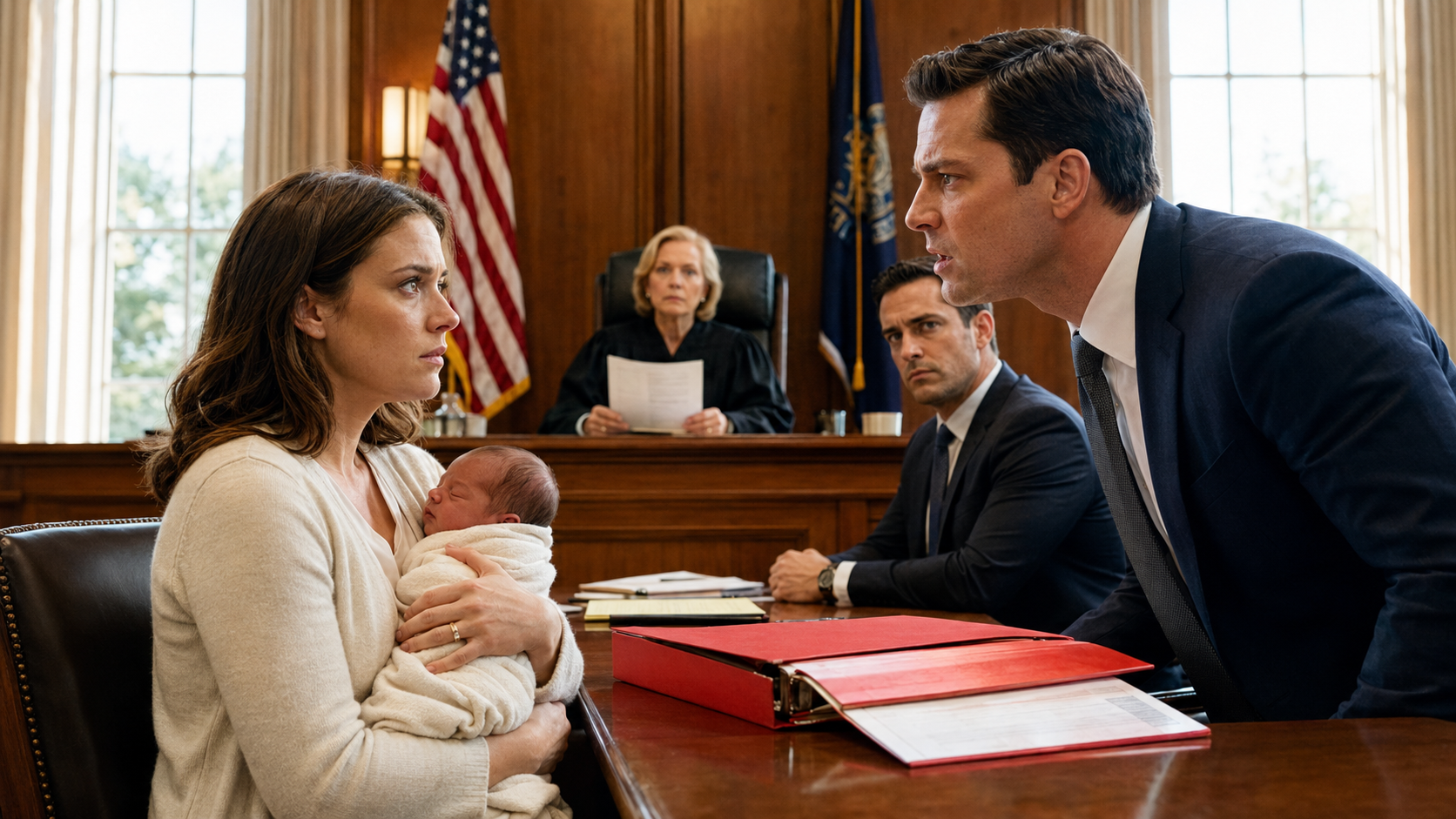
I walked into family court six days after giving birth with my son sleeping against my chest and my husband’s lawyer already smiling like I’d lost.
Marcus Vail leaned toward Evan and whispered, “She brought the baby for sympathy.”
He didn’t whisper quietly enough.
Maybe he wanted me to hear.
Maybe humiliation was part of the strategy.
For the last three years, everything with the Reed family had been a strategy.
I adjusted the blanket around my son’s head and kept walking.
Noah made one soft sound against me, more sigh than cry, and his tiny fist tightened against the cream cardigan I had chosen because it covered the yellowing bruise on my shoulder.
The cardigan was too warm for the courthouse.
I wore it anyway.
In my right hand was a thick red folder.
Marcus looked at that folder and smiled again.
He thought it was desperation.
He thought I had printed articles about postpartum depression. He thought I had gathered sentimental photographs. He thought I was going to stand in front of a judge and cry about how much I loved my baby while he explained, patiently and professionally, why love did not make a woman stable.
He didn’t know the first tab carried a hospital seal.
He didn’t know the last tab carried Evan’s signature.
And he definitely didn’t know the dates.
Evan sat at the front table in a navy suit I used to iron before every board meeting.
That detail hurt more than it should have.
I knew the crease in those trousers.
I knew the faint line near the left cuff where the fabric had caught on a metal chair in Zurich two years earlier.
I knew the tie.
Dark gray. Italian silk.
I had given it to him on our second anniversary.
He wore it when he wanted people to believe he was calm.
Beside him sat his mother, Claudia Reed, glittering in pearls like family court was a luncheon at the country club.
Claudia’s spine was perfectly straight. Her silver-blond hair did not move. She had spent my entire marriage speaking softly enough that people mistook cruelty for manners.
On Evan’s other side sat Vanessa, his older sister.
She was wearing my wedding bracelet.
Not my ring.
That was still on my finger, though I had spent the entire drive to the courthouse wondering why.
The bracelet had been Claudia’s gift to me on the morning of my wedding—a slim antique band of diamonds and sapphires that Reed women had supposedly worn for three generations.
“You’re family now,” Claudia had told me as she fastened it around my wrist.
Vanessa wore it now like the family had already voted me out.
Like my place had passed back to its rightful owner.
She saw me looking at it.
Her mouth curved.
Then her eyes dropped to Noah.
That smile disappeared.
For months, Vanessa had been decorating the nursery at the Reed estate as though I were carrying a baby for all of them.
She chose the wallpaper.
She rejected the crib I wanted.
She told the decorator the room needed to feel “timeless, not maternal.”
I had laughed the first time she said it.
I hadn’t understood yet.
Six days earlier, I had given birth alone.
Not technically alone.
There had been a nurse named Tessa who held my hand while the contractions came hard enough to turn the ceiling lights white around the edges.
There had been an obstetrician.
There had been two residents.
There had been a hospital social worker who came in after a nurse noticed the bruising near my shoulder blade.
But my husband had not been there.
Evan knew I was in labor.
He knew I had been admitted.
He knew Noah was coming early.
He knew I was afraid.
And he refused to come unless I signed a custody agreement.
The first message arrived when I was four centimeters dilated.
Marcus is bringing documents. Sign them and I’ll come.
I had stared at my phone through a contraction, certain I was misunderstanding.
Then another message appeared.
It’s temporary care until you’re emotionally stable. Don’t make this dramatic.
Temporary care.
That was their phrase.
Not custody.
Not taking my child.
Temporary care.
The same way Claudia called firing household staff “restructuring.”
The same way Evan called locking my credit cards after an argument “protecting our finances.”
The same way Vanessa called taking over my nursery “helping.”
At six centimeters, Marcus Vail walked into my recovery room wearing a charcoal suit and carrying a leather briefcase.
I was sweating.
My hands were shaking.
There was an IV taped to my wrist.
He set a stack of papers beside it.
“Evan wants to be here,” he said.
I looked at the door behind him.
“Then where is he?”
Marcus didn’t answer.
He turned the papers so the signature lines faced me.
The words blurred.
Temporary physical custody.
Exclusive decision-making authority.
Residence at the Reed estate.
Supervised maternal contact as recommended by treating professionals.
Treating professionals.
I didn’t have treating professionals.
I had seen a therapist twice after Evan shoved me backward into the pantry door during an argument and I started waking up with my heart hammering at three in the morning.
At the time, Evan had gone with me to the doctor.
He had sat beside me while the doctor examined the swelling on my shoulder.
“What happened?” she asked.
I opened my mouth.
Evan put his hand over mine.
“She slipped.”
He smiled when he said it.
I said nothing.
Two weeks later, when I admitted to a therapist that I couldn’t breathe whenever I heard Evan’s key in the front door, he started calling me unstable.
Now Marcus tapped the hospital papers with one manicured finger.
“Judges don’t trust unstable women with panic attacks, Mara.”
I still remember how calm he sounded.
I remember the monitor beside me.
The thin green line.
The steady beat of my son’s heart.
I remember looking at the signature page.
“My son isn’t even born.”
“Which is why this is the best time to make sensible arrangements.”
Best time.
I was in labor.
I had to grip the bed rail because another contraction was tearing through me.
Marcus waited for it to end.
Then he offered me a pen.
“Sign, and Evan comes upstairs.”
I looked at him.
“You’re bargaining my husband against my baby.”
His expression changed.
Just slightly.
“You’re being emotional.”
A nurse walked in then.
Tessa.
She took one look at my face, one look at Marcus, and one look at the documents beside my IV.
“Sir,” she said, “you need to leave.”
“I represent the patient’s husband.”
“You don’t represent the patient.”
“I have authorization to—”
“You need to leave.”
Marcus gathered most of the papers.
Most.
That mattered later.
At the time, I didn’t notice.
I was too busy trying not to scream.
Noah was born at 11:43 that night.
Evan never came.
At 12:06 a.m., I received a message.
You chose this.
I read it while my son slept beneath a warming blanket three feet away.
Something inside me became very quiet.
Not peaceful.
Quiet.
The kind of quiet that comes when fear has finally repeated itself so many times it stops sounding like a warning and starts sounding like an answer.
The next morning, the hospital social worker came back.
This time, when she asked about my bruises, I did not say I slipped.
I told her the truth.
Not all at once.
I couldn’t.
Truth, after years of living with Evan, came out of me in pieces.
The pantry door.
His hand around my upper arm.
The nights he stood between me and the bedroom door until I apologized.
The bank card that stopped working after I contradicted Claudia at dinner.
The therapist.
The nursery.
Vanessa telling me, when I was thirty-four weeks pregnant, “You should be grateful Noah will have all of us if motherhood becomes too much for you.”
The custody documents.
Marcus.
Evan’s ultimatum.
The social worker listened without interrupting.
Then she said, “Would you like the hospital to document this formally?”
My first instinct was to say no.
That was how deep the training went.
Protect Evan.
Protect the family.
Protect the name.
Protect everyone except myself.
Then Noah moved in his bassinet.
His face turned toward me even though his eyes were closed.
“Yes,” I said.
That single word was the beginning.
By afternoon, I had spoken to a patient advocate.
A doctor documented the bruising.
A psychiatric clinician evaluated me because Marcus had already begun calling the hospital demanding information about my “mental condition.”
I answered every question.
Did I know where I was?
Yes.
Did I know the date?
Yes.
Did I understand I had just delivered a child?
Yes.
Did I have thoughts of harming myself?
No.
Did I have thoughts of harming my baby?
No.
Was I frightened?
“Yes.”
“Of whom?”
I looked through the glass panel in the door.
No one was there.
I whispered anyway.
“My husband.”
The clinician wrote it down.
That report became Tab One.
But it wasn’t the only thing the hospital gave me.
When Tessa helped gather my belongings, she found several pages wedged beneath the chair where Marcus had placed his paperwork.
“Are these yours?”
I almost told her to throw them away.
Then I saw Evan’s name.
I took them.
I didn’t read them until the following afternoon.
When I did, I had to read the first paragraph three times.
It was an affidavit.
Evan’s affidavit.
The language was almost identical to the emergency custody petition Marcus filed two days later.
My husband claimed I had become unstable after giving birth.
He claimed I had refused reasonable requests to let him see our son.
He claimed I had threatened to leave the Reed estate with Noah.
He claimed I had become “irrationally fearful” of him during the postpartum period.
He claimed he feared I would remove our child from the jurisdiction.
At the bottom was his signature.
Evan Reed.
Below that was a notary stamp.
I stared at the date.
Then I looked at Noah.
Then I looked at the date again.
Evan had signed it four days before Noah was born.
Four days before I became “unstable after giving birth.”
Four days before I supposedly refused to let him see a baby who had not yet taken his first breath.
Four days before I supposedly threatened to run away with my newborn.
They had written my breakdown before I had one.
They had written my kidnapping before there was a child to kidnap.
They had prepared my guilt in advance.
And then they had tried to make me sign away my son while I was in labor.
That affidavit became the last tab in the red folder.
Now, six days after Noah’s birth, I stood in family court while the people who had planned my disappearance waited for a judge to complete it.
The clerk called our case.
“Reed versus Reed.”
Judge Helen Marlowe entered.
Everyone rose.
Noah stirred.
I kissed his head.
“It’s okay,” I whispered, though I wasn’t sure which of us I was talking to.
We sat.
The judge reviewed several papers.
Then she looked at Marcus.
“Mr. Vail, this is your emergency application?”
“Yes, Your Honor.”
“And you’re requesting immediate temporary physical custody of the minor child to the father?”
“Yes.”
“Based on concerns regarding the mother’s mental stability, alleged threats to abscond with the child, and refusal to allow contact?”
“That is correct.”
Marcus’s voice was smooth.
Practiced.
Then the judge looked at me.
“Mrs. Reed, do you have counsel?”
Marcus smiled wider.
Evan laughed under his breath.
Claudia didn’t move.
Vanessa touched my bracelet.
“No, Your Honor,” I said. “Not today.”
The judge studied me for a moment.
“You understand the seriousness of these proceedings?”
“Yes.”
“And you’re prepared to respond?”
My heart was pounding so hard I could feel it in the incision-deep soreness still running through my body from labor.
“Yes.”
I stepped forward.
Marcus stood.
“Your Honor, I object to Mrs. Reed approaching the bench without—”
“Sit down, Mr. Vail.”
I placed the red folder in front of the clerk.
My hands did not shake.
That surprised me.
The clerk passed it to the judge.
Evan looked at me for the first time.
Not past me.
Not through me.
At me.
I met his eyes.
“Your Honor,” I said, “this baby is not the reason I’m asking for protection.”
The courtroom went silent.
I put one hand over Noah’s back.
“He is the proof.”
Judge Marlowe opened the folder.
She lifted the first page.
The hospital seal was printed at the top.
Marcus stopped smiling.
Evan half rose from his chair.
“Your Honor—”
The judge’s eyes moved down the page.
Then to the next.
Then the next.
She looked up.
“Mr. Reed.”
Evan froze.
Very quietly, Judge Marlowe said, “Sit down.”
He did.
And for the first time since I married him, Evan Reed looked afraid.
PART 2: WHAT THEY HAD WRITTEN BEFORE NOAH WAS BORN
Judge Marlowe read in silence.
No one in the courtroom moved.
Noah’s breathing was the loudest thing I could hear.
The first section of the hospital report documented when I had arrived, when labor began progressing, and when Noah had been born.
11:43 p.m.
That time mattered.
So did the date.
The next pages documented my mental-status evaluation.
Alert.
Oriented.
Coherent.
Appropriate bonding with infant.
No evidence of psychosis.
No suicidal ideation.
No homicidal ideation.
No observed behavior suggesting risk to newborn.
I had stared at those words for nearly an hour the first time I received the report.
Not because I believed a piece of paper could define whether I was a good mother.
Because I knew exactly what Evan planned to do with the absence of one.
He had money.
He had Marcus.
He had Claudia’s certainty.
He had a surname printed on hospitals and university wings.
I had six hours of sleep spread across nearly a week and a newborn who needed to eat every two hours.
Without documentation, my tears became instability.
My fear became paranoia.
My exhaustion became proof.
With documentation, they were forced to call things by their names.
Judge Marlowe turned another page.
The bruising photographs were not dramatic.
That was almost worse.
There was no movie-perfect handprint.
No blood.
No broken bone.
Just bruises in different stages of healing along my shoulder and upper arm.
The kind easily hidden beneath silk blouses and cardigans.
The kind I had spent years telling myself did not count because I could still move my arm afterward.
Judge Marlowe looked up.
“When were these taken?”
“The morning after my son was born.”
“And according to the hospital note, you reported they were caused by your husband?”
“Yes.”
Marcus rose.
“Your Honor, these allegations were made only after my client expressed concerns about her mental health. There is no independent evidence connecting Mr. Reed to any injury.”
The judge looked at him.
“I did not ask you a question, Mr. Vail.”
He sat.
Evan’s jaw tightened.
I knew that expression.
At home, it meant I would pay later.
For one terrible second, my body forgot we were in a courtroom.
My stomach clenched.
My fingers went cold.
I could see the pantry again.
The narrow strip of light beneath the door.
Evan blocking the exit while saying, Look at what you make me do when you won’t stop.
Noah shifted.
I felt the weight of him against me.
The courtroom returned.
Judge Marlowe kept reading.
Her eyes narrowed.
“What is this notation from hospital security?”
I swallowed.
“Mr. Vail contacted the hospital several times asking whether I had been evaluated for postpartum psychiatric symptoms.”
Marcus stood immediately.
“As counsel for the child’s father, I was attempting to understand a potentially dangerous situation.”
“Before or after the child was born?”
He hesitated.
“Your Honor?”
“The first call listed here is at 8:12 p.m.”
She looked at the hospital record.
“The child was born at 11:43 p.m.”
No one spoke.
The judge continued.
“The second call is at 9:37 p.m. According to this note, you specifically asked whether the patient had been diagnosed with postpartum depression.”
Marcus’s face changed.
Barely.
But I saw it.
The judge looked directly at him.
“Mr. Vail, how exactly did you expect the hospital to diagnose postpartum depression in a woman who had not yet delivered?”
Claudia shifted in her seat.
Vanessa looked at Marcus.
Evan stared at the table.
Marcus cleared his throat.
“It may have been a general inquiry regarding anticipated concerns.”
“Anticipated.”
“Yes, Your Honor.”
The judge made a note.
I felt something loosen in my chest.
Not relief.
Not yet.
But the first small crack in the wall they had built around me.
Judge Marlowe moved deeper into the folder.
Text messages.
I had printed them at the hospital business center with shaking hands while Noah slept beside me.
Sign the agreement and I’ll come.
This is temporary care until you’re emotionally stable.
Don’t make this dramatic.
If you leave the hospital without agreeing to the plan, you’re proving our point.
Vanessa already has the nursery ready.
That last message made the judge stop.
She looked toward Vanessa.
“Who is Vanessa?”
Vanessa straightened.
“I am.”
“Relationship?”
“Mr. Reed’s sister.”
“And you prepared a nursery for the child?”
Vanessa glanced at Claudia.
“It was already part of the family residence.”
That was a lie.
I spoke before fear could stop me.
“She finished it three weeks before my delivery date.”
Vanessa’s eyes flashed.
“I helped decorate.”
“You replaced everything I chose.”
“This isn’t relevant.”
Judge Marlowe looked at her.
“I’ll determine relevance.”
Vanessa’s mouth closed.
I could almost hear Claudia’s voice in her head.
Don’t argue with the judge.
Claudia had taught all of us how to behave in public.
Some of us had learned too well.
The judge turned another page.
The original temporary-care agreement.
My name printed at the top.
Evan’s name beside it.
A section stating that because of my “documented history of acute anxiety,” our child’s primary residence would remain at the Reed estate under Evan’s control until a treating psychiatrist approved unsupervised maternal care.
I had never been treated by a psychiatrist.
I had never been diagnosed with an acute disorder.
I had attended two therapy sessions.
Two.
The first after Evan shoved me.
The second after he convinced me the first therapist was “too eager to blame spouses.”
Then he canceled the third appointment.
At the time, I told myself he was embarrassed.
Now I understood.
He hadn’t wanted me getting better.
He had wanted a record thin enough to distort.
Judge Marlowe lifted her eyes.
“This agreement was presented to you while you were in active labor?”
“Yes.”
“You were represented by counsel?”
“No.”
“Did anyone advise you not to sign?”
“A nurse asked Mr. Vail to leave.”
“Did your husband come to the hospital?”
“No.”
Evan finally spoke.
“I was trying to protect my son.”
His voice was controlled, but I could hear strain under it.
Judge Marlowe turned toward him.
“From what?”
“From her.”
The word landed exactly where he intended it to.
I looked at him.
For five years, I had loved that face.
I had learned every version of it.
The laughing version.
The exhausted version.
The version that pressed against my neck in bed and said he couldn’t sleep unless I was touching him.
The version that cried when his father died.
The version that apologized after the pantry incident and held an ice pack against my shoulder.
The version that whispered, “You know I would never actually hurt you.”
And now there was this one.
The man asking a stranger in a robe to protect my newborn from me.
Judge Marlowe said, “What specific conduct by your wife after the child’s birth caused you to believe the child was in immediate danger?”
Evan glanced at Marcus.
The judge noticed.
“Mr. Reed, I’m asking you.”
He looked back at her.
“She refused to let me take him.”
“That is not what I asked.”
“She was erratic.”
“How?”
“She was accusing me of abuse.”
My breath caught.
Judge Marlowe’s face became unreadable.
“You consider the allegation itself evidence of instability?”
“No. That’s not what I meant.”
“Then what did you mean?”
Evan’s composure slipped.
Only for a second.
“She was making things up. She suddenly decided everyone was against her. My mother. My sister. Me. She said we’d been planning to take the baby.”
I almost laughed.
Not because it was funny.
Because the last tab in the folder suddenly felt hot in my mind.
Judge Marlowe asked, “Had you been planning to seek custody before the birth?”
“No.”
Marcus turned toward him.
Evan didn’t see it.
I did.
A warning.
Too late.
The judge’s pen stopped.
“You had not discussed seeking custody?”
“We discussed precautions.”
“Did you authorize Mr. Vail to prepare documents before the birth?”
“Standard contingency documents.”
“Did you sign any sworn statement concerning your wife’s behavior after delivery before the baby was delivered?”
Evan looked at me.
That was the moment he understood.
Not when he saw the hospital seal.
Not when the judge read the security calls.
Now.
His eyes dropped to the red folder.
To the unopened section near the back.
I watched the blood leave his face.
“Mara,” he said.
It was the first time he had spoken my name all day.
Not Mrs. Reed.
Not she.
Mara.
Marcus stood so quickly his chair scraped the floor.
“Your Honor, before we proceed further, I would request a brief recess to review any materials my client may not have previously—”
“No.”
“Your Honor, procedural fairness requires—”
“Mr. Vail, you filed an emergency petition asking me to remove a six-day-old infant from his mother today.”
The judge’s voice remained level.
“You represented that delay would expose this child to immediate danger. We are not delaying now because the documents are inconvenient.”
Marcus went still.
Judge Marlowe turned the pages.
One.
Two.
Three.
I knew exactly where she was.
The petition they filed said I had threatened to flee with Noah on the second day after his birth.
The abandoned draft used almost the same sentence.
Only it had been signed four days before his birth.
I had circled both passages.
The same strange phrase appeared in each:
Increasingly irrational intent to abscond.
Not normal language.
Marcus’s language.
Prepared language.
Copied language.
Judge Marlowe reached the last tab.
She removed the affidavit.
I watched her read the first paragraph.
Then the second.
She looked at the signature.
Then the notary stamp.
Then the date.
Her face changed.
“Mr. Vail.”
Marcus didn’t answer immediately.
“Mr. Vail.”
“Yes, Your Honor.”
“What date was Noah Reed born?”
His throat moved.
“August ninth.”
Judge Marlowe held up the affidavit.
“What date is this document notarized?”
Silence.
Evan stared at him.
Claudia’s fingers tightened around her handbag.
Vanessa whispered, “What document?”
The judge’s voice hardened.
“Answer me.”
Marcus looked down.
“August fifth.”
A sound came from somewhere behind me.
Someone in the gallery inhaling sharply.
Judge Marlowe looked at Evan.
“This affidavit, bearing your signature, states that your wife displayed severe postpartum instability, refused access to your newborn son, and threatened to leave the jurisdiction with him.”
She paused.
“It was sworn and notarized four days before the child was born.”
Evan said nothing.
The judge placed the hospital birth record beside his affidavit.
The seal on one page.
His signature on the other.
There it was.
The collision.
“You swore,” Judge Marlowe said slowly, “that events had already occurred when they had not yet happened.”
Evan’s mouth opened.
“Mara was already threatening—”
“No.”
The judge’s voice cracked through the courtroom.
“No, Mr. Reed. This affidavit does not say she was threatening hypothetical conduct. It describes postpartum behavior. It describes denial of access to a newborn. It describes statements allegedly made concerning a child who had not yet been delivered.”
Marcus stepped forward.
“Your Honor, this may have been a drafting error.”
I finally looked at him.
“A drafting error?”
My voice surprised even me.
Marcus turned.
“You should address the court, Mrs. Reed.”
“I am.”
I faced the judge.
“They didn’t predict my breakdown.”
My throat tightened.
I forced the words through.
“They wrote it.”
Nobody moved.
“They wrote what I was supposed to do after Noah was born. Then they came to my hospital room and tried to force me into signing away custody. When I refused, they used the story they’d already prepared.”
Evan leaned forward.
“Mara, that’s insane.”
There it was.
The word.
The weapon he always reached for when facts stopped obeying him.
Insane.
I looked at him.
“No, Evan.”
My voice shook now.
I let it.
“I was scared when you shoved me.”
His face darkened.
“I was scared when you controlled the money.”
“Mara—”
“I was scared when your sister decorated my child’s room without asking me.”
Vanessa stood.
“You asked for help!”
“I asked you to help choose a rocking chair. You removed my crib.”
“That is not—”
Judge Marlowe struck the desk once with her palm.
“Sit down.”
Vanessa sat.
I looked back at Evan.
“I was scared when Marcus put custody papers beside my IV and told me judges don’t trust women with panic attacks.”
Marcus’s expression hardened.
“That characterization is—”
“I was scared when you refused to come while I gave birth to your son.”
My voice broke.
For six days, I had been trying not to cry because every tear felt like evidence they could use against me.
This time, I didn’t stop it.
One tear ran down my face.
Then another.
Noah stirred against my chest.
I held him closer.
“But fear isn’t insanity.”
I wiped my cheek.
“And refusing to give you my baby isn’t kidnapping.”
Evan stared at me.
I could see fury building behind his eyes.
The judge could see it too.
Because when Evan pushed back his chair, Judge Marlowe immediately said, “Mr. Reed, remain seated.”
He froze.
“I was trying to save my son from a woman who was falling apart.”
I heard the old certainty in his voice.
The certainty that had controlled every room in our house.
Then the judge lifted the affidavit bearing his signature.
“Four days before his birth?”
Evan had no answer.
For once, nobody gave him one.
PART 3: THE FAMILY PLAN
The judge called a twenty-minute recess.
I didn’t feel relief when she left the bench.
I felt terror.
Because the second Judge Marlowe disappeared through the side door, Evan stood.
Not slowly.
Not calmly.
He came toward me.
The bailiff stepped between us before he reached the aisle.
“Sir.”
“I need to speak to my wife.”
“No.”
“Mara.”
I backed away.
Noah started crying.
The sound went straight through me.
I turned my body so Evan couldn’t see his face.
“Don’t,” I said.
Evan stopped.
Maybe it was the baby.
Maybe it was the bailiff.
Maybe it was the fact that, for the first time, I had said the word where other people could hear it.
Don’t.
Marcus grabbed Evan’s arm.
“Not here.”
Not don’t threaten her.
Not leave her alone.
Not here.
That told me everything.
Claudia approached next.
She moved with the careful dignity of someone crossing a ballroom.
“Mara.”
I almost laughed at the performance.
Six days ago, she hadn’t answered when I texted her from the hospital.
Now she wanted a private conversation.
“No.”
Her expression chilled.
“Don’t be childish.”
The bailiff looked at her.
Claudia lowered her voice.
“This can still be handled within the family.”
“The family filed an emergency petition to take my child.”
“Because you forced everyone’s hand.”
I stared at her.
There were sentences that clarified an entire marriage.
That was one.
You forced everyone’s hand.
Evan shoved me.
I forced his hand.
Marcus threatened me during labor.
I forced his hand.
Vanessa built a nursery for my son as if I were temporary.
I forced her hand.
They prepared a false affidavit before Noah’s birth.
Somehow, if Claudia talked long enough, I knew she would explain how I had forced that too.
“I want you away from me.”
Her mouth tightened.
“You are exhausted.”
“No.”
“Mara—”
“I said no.”
Claudia’s eyes flicked toward the bailiff.
Public rules.
She understood those.
So she stepped back.
Vanessa remained near the counsel table.
Her fingers touched the bracelet again.
I looked down at Noah.
He was fussing now, rooting weakly against my cardigan.
My body answered with an ache.
I had spent the entire morning terrified he would need to eat during the hearing.
Now I no longer cared.
I went to a bench near the back wall and covered myself with a muslin wrap from the diaper bag.
The courthouse could wait.
The Reeds could wait.
My son could not.
That realization steadied me more than anything Judge Marlowe had said.
For years, I had lived according to the urgency of other people.
Evan needed a suit pressed.
Claudia needed me at a benefit.
Vanessa needed access to the house.
The family needed photographs.
The foundation needed a smiling wife.
Evan needed silence.
Everyone always needed something immediately.
I learned to delay myself.
Hunger.
Sleep.
Anger.
Fear.
Medical appointments.
Phone calls to friends I slowly stopped making because Evan said they made me “agitated.”
Noah didn’t care about Reed urgency.
He was hungry.
So I fed him.
Simple.
Necessary.
True.
I was burping him when Vanessa came over.
She stopped several feet away.
“I didn’t know about the affidavit.”
I looked at her.
She sounded different.
Not kind.
Just less certain.
“Okay.”
“I didn’t.”
“Then why are you here?”
Her face tightened.
“To support my brother.”
“In taking my baby.”
“Our baby.”
The words left her mouth before she could stop them.
Everything inside me went cold.
Vanessa blinked.
I stared at her.
“What did you say?”
“I meant the family’s baby.”
Noah was asleep again against my shoulder.
I held him tighter.
“He’s not the family baby.”
“Mara, that’s not what I—”
“He’s my son.”
“And Evan’s.”
“Yes.”
“And he’s a Reed.”
There it was again.
The surname.
The inheritance of entitlement.
I understood something then that I should have understood when Vanessa rejected the crib I chose.
They didn’t think they were stealing Noah.
They thought I was refusing to return something that belonged to them.
Claudia joined us.
“Vanessa.”
A warning.
Vanessa looked away.
I studied both women.
“When did you decide I wasn’t going to raise him?”
Claudia’s expression barely shifted.
“Don’t be melodramatic.”
“When?”
“No one decided that.”
“The agreement put him at the estate.”
“His home.”
“It required supervised contact for me.”
“Temporarily.”
“Based on a diagnosis I don’t have.”
Claudia sighed.
It was the same sigh she used with waiters who misunderstood her wine order.
“Mara, you have always been sensitive.”
I felt an old instinct rise.
Defend myself.
Explain.
Prove I was reasonable.
I pushed it down.
“Did you know?”
She glanced toward Marcus.
That was answer enough.
“Did you know Evan signed the affidavit before Noah was born?”
Her eyes came back to mine.
“I knew counsel was preparing for contingencies.”
I stopped breathing for a second.
Vanessa turned toward her mother.
“What?”
Claudia’s face hardened.
“This is not the place.”
Vanessa stared.
“You knew?”
“Lower your voice.”
“You said the documents were because she panicked at the hospital.”
“I said lower your voice.”
A strange feeling went through me.
It wasn’t satisfaction.
It wasn’t even anger.
It was recognition.
Claudia had lied to Vanessa too.
Not because Vanessa mattered less.
Because truth mattered less.
The plan was what mattered.
The family.
The estate.
Control.
Vanessa looked at me.
For the first time all morning, she seemed unsure what role she was supposed to play.
I looked at the bracelet on her wrist.
“When did you take that?”
Her hand immediately covered it.
“Evan gave it to me.”
“From my jewelry box?”
“It belongs to the Reed family.”
“Claudia gave it to me at my wedding.”
Claudia said, “Under circumstances that no longer apply.”
Six days after childbirth.
Before a divorce had been filed.
Before a judge had made a custody ruling.
Before my stitches had healed.
The circumstances no longer applied.
I almost admired the efficiency.
“Keep it,” I said.
Vanessa stared at me.
“What?”
“The bracelet.”
I looked at Claudia.
“The estate. The portraits. The china. The nursery wallpaper. Keep all of it.”
Claudia’s face sharpened.
I kissed Noah’s head.
“But you don’t get him.”
Claudia took one step closer.
Her voice dropped.
“You need to think very carefully before you burn your life down over one emotional week.”
Something inside me snapped cleanly into place.
“My life?”
“Yes.”
“You mean the life where I ask permission before spending money?”
Her eyes flicked toward the bailiff.
I continued.
“The life where your son can put his hands on me and then tell doctors I fell?”
“Mara.”
“The life where your daughter plans my baby’s nursery while a lawyer writes an affidavit describing the breakdown I’m supposedly going to have?”
Claudia’s lips went white.
“You are making allegations you may regret.”
“No.”
I looked at her.
“I regret not making them sooner.”
The bailiff announced that court would resume in five minutes.
Marcus pulled Claudia aside.
Evan stood near the counsel table, staring at me.
He looked furious.
But beneath the fury was something I had almost never seen in him.
Confusion.
He could not understand why I wasn’t coming back under control.
He had seen me cry before.
He had seen me frightened.
He had seen me apologetic.
He had seen me exhausted and desperate to make peace.
He had never seen me done.
I returned to my seat.
Judge Marlowe came back.
We rose.
When everyone sat, she didn’t touch the emergency petition immediately.
Instead, she looked at Marcus.
“Mr. Vail, during the recess I compared the signed affidavit provided by Mrs. Reed with the affidavit filed in support of your emergency application.”
Marcus’s face gave nothing away.
“They contain extensive identical language.”
“Yes, Your Honor. Templates are often—”
“Including descriptions of specific alleged incidents.”
Marcus stopped.
The judge continued.
“The dates were changed. Certain verb tenses were changed. But the allegations are substantially the same.”
Evan whispered something.
Marcus ignored him.
Judge Marlowe held up the earlier affidavit.
“I want a clear answer. Was this document prepared in anticipation of removing the child from his mother’s care before the child was born?”
“No, Your Honor.”
“Then why does it describe events that could only occur after birth?”
“It was a working draft.”
“A notarized working draft signed under oath?”
Marcus had no good answer.
Neither did Evan.
The judge turned to me.
“Mrs. Reed, did you ever tell your husband before delivery that you intended to deny him all access to his son?”
“No.”
“Did you threaten to leave the state?”
“No.”
“Did you tell anyone you intended to harm the child?”
“No.”
“Did you leave the hospital against medical advice?”
“No.”
“Where have you been since discharge?”
I hesitated.
I had not wanted Evan to know.
Judge Marlowe noticed.
“You may write the location for the court if there is a safety concern.”
“I’ve been at a confidential temporary residence arranged after the hospital assessment.”
Evan surged upright.
“You hid my son!”
The bailiff stepped toward him.
Judge Marlowe’s expression hardened.
“Mr. Reed.”
“She took him!”
“There was no custody order prohibiting her from leaving the marital residence.”
“She disappeared!”
I stared at Evan.
He had not come to the hospital.
He had not held Noah.
He had made his presence conditional on my surrender.
Now he was enraged that I had gone somewhere he couldn’t reach.
The judge said, “Sit down.”
“This is exactly what I warned about.”
“No,” I said.
Everyone looked at me.
I hadn’t meant to interrupt.
But the words were out.
I stood.
“This is exactly what you wrote before it happened.”
Evan froze.
My fear disappeared.
Just for that moment.
“You said I would run.”
“Mara—”
“So you made home unsafe.”
“You said I would keep Noah from you.”
“You wouldn’t come unless I signed custody away.”
“You said I’d become afraid of you.”
My voice dropped.
“You made sure I had a reason.”
Evan’s face changed.
The mask slipped.
“You ungrateful—”
He stopped himself.
Too late.
Judge Marlowe had heard.
So had everyone else.
For years, Evan’s greatest talent had been knowing exactly how far he could go when someone else was watching.
But anger is greedy.
Once it starts losing control, it wants all of it.
Judge Marlowe folded her hands.
“Mr. Reed, I have one more question.”
He sat slowly.
“Did you tell your wife that you would refuse to attend the birth unless she signed the temporary custody agreement?”
Evan looked at Marcus.
“Answer the question.”
“I was trying to get her to cooperate.”
“That is not an answer.”
He breathed through his nose.
“Yes.”
My chest tightened.
Even after everything, hearing him admit it hurt.
Judge Marlowe looked down at the petition.
Then at Noah.
Then at me.
“I am prepared to rule on the emergency request.”
Marcus stood.
“Your Honor—”
“No.”
She looked directly at him.
“I have heard enough.”
Noah stirred beneath my hand.
Judge Marlowe picked up the petition Evan had used to try to erase me.
And began tearing their story apart.
PART 4: THE THING EVAN NEVER EXPECTED ME TO DO
“The petition for immediate transfer of physical custody to Mr. Reed is denied.”
For several seconds, I did not understand the sentence.
Denied.
The word floated somewhere outside me.
Then Noah moved against my chest.
My knees almost gave out.
Judge Marlowe continued before anyone could react.
“Based on the evidence presented today, I find no credible basis for concluding that Mrs. Reed presently poses an immediate danger to the child.”
I closed my eyes.
One second.
That was all I allowed myself.
One second to feel it.
Then I opened them again.
Because the judge wasn’t finished.
“I do, however, have significant concerns regarding coercive conduct directed toward Mrs. Reed during labor, the documented allegations of physical abuse, and apparent inconsistencies in sworn materials submitted to this court.”
Evan leaned toward Marcus.
Marcus whispered something back.
Judge Marlowe continued.
“Pending a full evidentiary hearing, the child’s primary physical residence will remain with Mrs. Reed.”
Claudia’s head snapped up.
Vanessa went pale.
Evan stood.
“This is insane.”
The courtroom froze.
Judge Marlowe stared at him.
His face changed when he realized what he had said.
“I apologize, Your Honor.”
“Sit down.”
He sat.
I felt something almost like laughter trying to rise in my throat.
Not because anything was funny.
Because for years, insane had been Evan’s word for every woman who refused him.
Me.
An assistant who quit.
A former girlfriend who blocked him.
A board member who questioned his spending.
Now he had used it on a judge.
And it didn’t work.
Judge Marlowe addressed him.
“Mr. Reed, you will have no unsupervised contact with the child until the court conducts further review.”
His face went rigid.
“I am his father.”
“Yes.”
“You can’t keep me from him based on accusations.”
“I am not making a final custody determination today. I am setting temporary conditions based on the record before me.”
“This is my son.”
The possessive sounded different now.
Not love.
Ownership.
Judge Marlowe’s gaze did not move.
“And he is a six-day-old infant whose stability and care are my primary concern in this proceeding.”
Evan looked at me.
There was a promise in his eyes.
Not a legal one.
The old one.
This isn’t over.
My body recognized it immediately.
My heartbeat accelerated.
My shoulder began aching even though he hadn’t touched me.
Then I remembered the red folder.
The hospital report.
His affidavit.
The bailiff.
The judge.
The room.
I was not standing in the pantry anymore.
I looked back at him.
For the first time, I didn’t lower my eyes.
Judge Marlowe issued a temporary protective order covering me and Noah.
Evan was not to approach my temporary residence.
He was not to contact me directly except through approved channels regarding Noah.
He was not to remove Noah from my care.
Any visitation before the next hearing would be professionally supervised.
The court ordered preservation of relevant communications and documents.
Then Judge Marlowe looked at Marcus.
Her voice became colder.
“As to the inconsistencies between the pre-birth sworn affidavit and the materials filed in this matter, the original document will be marked and preserved.”
Marcus’s expression finally cracked.
“Your Honor, I would renew my concern that Mrs. Reed came into possession of privileged—”
“Your concern is noted.”
“It appears the document was inadvertently left—”
“Then perhaps greater care should have been taken when counsel entered a laboring woman’s hospital room to seek her signature on custody documents.”
Silence.
Marcus stopped speaking.
Judge Marlowe made another notation.
“The court will determine what additional referral or review, if any, is appropriate after the record is developed.”
That was all she said.
No dramatic arrest.
No handcuffs.
No instant destruction of Marcus’s career.
Real consequences did not arrive like thunder.
Sometimes they arrived as a clerk taking a document from a judge and placing an evidence sticker across the bottom.
Sometimes they looked like a lawyer who had entered smiling refusing to look at anyone while his own paperwork was preserved against him.
The hearing ended.
The judge scheduled the next one.
The clerk gave me copies of the temporary orders.
I held them with one hand because Noah had started waking in the other.
People stood.
Chairs moved.
Paper shuffled.
The room became ordinary again.
Except my life wasn’t.
I had won the morning.
Not the war.
I knew that.
Evan knew it too.
As the bailiff escorted me toward the side exit, Claudia called my name.
“Mara.”
I stopped.
I shouldn’t have.
But I did.
Claudia stood beside the counsel table.
For the first time since I met her, she looked old.
Not weak.
Never that.
But old.
The pearls suddenly looked heavy.
“This didn’t need to happen,” she said.
I stared at her.
She still believed that.
After everything, she still believed the problem was that it had happened publicly.
“You’re right.”
Her expression shifted.
I continued.
“Evan could have come to the hospital.”
Silence.
“He could have held my hand.”
Evan looked away.
“He could have met his son.”
My throat tightened.
“He could have apologized for hurting me. He could have told Marcus not to come near me. You could have told Vanessa that Noah already had a mother.”
Vanessa flinched.
Claudia’s face hardened again.
“But none of you did.”
“This family gave you everything.”
There it was.
The invoice.
The estate.
The vacations.
The jewelry.
The surname.
Every gift retroactively converted into permission.
I looked at Vanessa’s wrist.
She followed my gaze.
Slowly, she unfastened the bracelet.
For one second, I thought she was going to give it back.
Instead she placed it on the counsel table between us.
“I don’t want it,” she said.
Claudia turned.
“Vanessa.”
Her daughter’s voice shook.
“You told me Mara agreed Noah would spend most of his time at the estate.”
“I said—”
“You told me she was overwhelmed.”
“She was.”
“You told me the nursery was because we were helping.”
Claudia’s nostrils flared.
“This is not the time.”
Vanessa looked at me.
There was shame in her face now.
Not enough to undo what she had done.
But real.
“I didn’t know they wrote that before.”
I believed her.
It changed less than she wanted it to.
“You still knew I didn’t want you taking over my nursery.”
Her eyes dropped.
“Yes.”
“You knew I asked for my bracelet back.”
“Yes.”
“You knew Evan wasn’t at the hospital.”
She swallowed.
“Yes.”
“Then you knew enough.”
Her eyes filled.
I felt no triumph.
Only exhaustion.
“I’m sorry,” she whispered.
I nodded once.
Not forgiveness.
Acknowledgment.
Then Evan laughed.
Low.
Bitter.
“You’re all acting like she’s won something.”
He looked at me.
“You think that piece of paper changes anything?”
The bailiff took a step toward him.
Evan ignored him.
“The house is mine.”
I said nothing.
“The accounts are mine.”
Still nothing.
“The people you know are people you know because of me.”
My heart beat steadily.
“You have no idea what you’ve done.”
He wanted me frightened.
So badly.
He needed fear to put the old order back in place.
I looked down at Noah.
His eyes were open.
Dark blue-gray newborn eyes that couldn’t focus properly yet.
He didn’t know about houses.
Accounts.
Reputation.
He only knew warmth.
Milk.
Heartbeat.
Voice.
I looked back at Evan.
“I know exactly what I did.”
His mouth twisted.
“Oh?”
“Yes.”
I held up the temporary protection order.
“I said no where you couldn’t punish me for it in private.”
For once, Evan Reed had nothing to say.
I walked out.
The courthouse hallway was bright with afternoon sun.
I made it twelve steps.
Then my legs started shaking.
I sat on the nearest bench before I fell.
Noah began crying.
So did I.
Not quietly.
Not elegantly.
Not in the careful way I had cried during our marriage, face buried in a towel so no one would hear.
I cried until my ribs hurt.
A woman passing with a stack of files glanced at me and then politely looked away.
The bailiff stood far enough back to give me privacy.
I pressed my lips against Noah’s forehead.
“I’m sorry,” I whispered.
He cried louder.
“I know.”
My tears fell onto his blanket.
“I know.”
I had spent the entire hearing proving I was stable.
But stability wasn’t the absence of tears.
It wasn’t silence.
It wasn’t smiling while someone hurt you.
It wasn’t making other people comfortable.
I had misunderstood that for years.
Stable did not mean unbreakable.
Sometimes it meant knowing what mattered after you broke.
I opened my cardigan enough to check Noah’s face.
He was red and furious.
Alive.
Mine to protect.
Not mine to own.
There was a difference.
The Reeds had never understood it.
I was learning.
PART 5: MY SON’S FIRST HOME
The full hearing took place seven weeks later.
By then, Noah had changed so much I sometimes stared at photographs from his first week and barely recognized him.
His cheeks had filled out.
His eyes stayed open longer.
He had developed a habit of gripping one of my fingers while he ate.
I had changed too.
Not in the clean, inspirational way people like to describe after something terrible happens.
I was still afraid.
I still checked the lock twice before sleeping.
Sometimes three times.
I still woke when footsteps passed outside my apartment.
I still had panic attacks.
That turned out to be one of the hardest things to accept.
Evan had spent years using my fear as proof that something was wrong with me.
Part of me believed I had to stop being afraid in order to prove him wrong.
My new therapist corrected me.
“Fear after being threatened does not prove the threat was imaginary.”
I wrote that sentence down.
I kept it beside Noah’s feeding schedule.
The temporary apartment was small.
There was no marble staircase.
No staff.
No heated bathroom floors.
No rose garden.
No east wing.
The refrigerator made an irritating clicking noise at night.
The bedroom barely fit my bed and Noah’s bassinet.
I loved it.
Every object inside it stayed where I put it.
No one entered without knocking.
No one took my phone.
No one asked why I had spent twenty-seven dollars at a pharmacy.
No one told me my feelings were embarrassing the family.
The first night there after court, I had sat on the floor beside Noah’s bassinet because I didn’t own a chair yet.
I ate takeout noodles from the carton.
I was exhausted.
My breasts hurt.
My shoulder hurt.
My entire life fit inside four suitcases and a diaper bag.
And I had never felt so rich.
A lawyer took my case the week after the emergency hearing.
I chose her carefully.
Her name was Diana Hale.
She did not promise to destroy Evan.
That was one of the reasons I trusted her.
She said, “My job is not revenge. My job is to make the court see the pattern clearly enough that it cannot be rewritten.”
Pattern.
That word mattered.
Because a shove by itself could be explained.
A bruise could be explained.
A canceled therapy appointment could be explained.
A locked credit card could be explained.
A controlling mother-in-law could be explained.
An overbearing sister could be explained.
A husband missing a birth could be explained.
A lawyer appearing with custody papers during labor could be called bad judgment.
A false affidavit could be called a drafting mistake.
Evan had survived for years by separating every piece.
Nothing was ever connected.
Diana connected them.
Not with invented evidence.
Not with dramatic accusations.
With dates.
Messages.
Records.
The things they themselves had already written.
At the full hearing, Marcus no longer represented Evan.
He had withdrawn.
Evan arrived with two new attorneys.
Claudia came.
Vanessa did not.
Three days before the hearing, I received a letter from her through Diana.
I almost refused to read it.
Then I did.
Vanessa did not ask me to forgive her.
That helped.
She admitted Claudia had told her months before Noah was born that I was “too emotionally fragile” to manage a Reed heir without family supervision.
She admitted she participated in planning how Noah would spend his first months at the estate.
She admitted she believed I would eventually accept it because, in her words, everyone eventually accepts how our family works.
That sentence made me sit down.
Because I had.
For years.
Until I didn’t.
Vanessa also confirmed that the nursery plan had been completed before the hospital.
She confirmed Claudia repeatedly referred to Noah’s first months as a “transition period.”
Transition from what to what, Vanessa said she had never asked.
I believed that too.
Families built on control survive partly because people learn not to finish certain questions.
At the hearing, Evan’s attorneys tried a different strategy.
They stopped calling me unstable.
Instead, they called the situation a marital misunderstanding.
They said the pre-birth affidavit was a poorly prepared contingency document.
They said Marcus had acted too aggressively at the hospital without Evan fully appreciating the manner in which the papers would be presented.
That almost made me angry enough to laugh.
Evan had texted me himself.
Sign and I’ll come.
No lawyer had typed that for him.
Diana showed the message.
Then she asked Evan a simple question.
“Why didn’t you go to the hospital?”
He looked at me before answering.
“I believed Mara needed to understand the seriousness of the situation.”
“What situation?”
“Her resistance to making a safe plan.”
“For a child who was being born?”
“Yes.”
“And your way of communicating that seriousness was to withhold your presence during labor unless she transferred temporary custody?”
His jaw tightened.
“I wouldn’t characterize it that way.”
“How would you characterize it?”
He paused.
Diana waited.
The courtroom waited.
Finally Evan said, “Leverage.”
Something went through the room.
Tiny.
Almost invisible.
But even Evan’s attorney shifted.
Diana did not react.
“You used your presence at the birth of your son as leverage?”
Evan realized too late what he had said.
“I meant—”
“Thank you.”
She sat down.
That was Evan’s problem.
He had spent his entire life in rooms where leverage was an acceptable word.
Contracts.
Acquisitions.
Board votes.
Employment negotiations.
Family dinners.
He had never understood that marriage wasn’t supposed to be one of those rooms.
Neither was childbirth.
Neither was love.
The court did not grant Evan what he wanted.
The temporary arrangement remained in place while longer-term custody was evaluated.
I remained Noah’s primary residential parent.
Evan’s contact increased gradually only under structured conditions.
The protective provisions concerning me stayed.
The court made clear that future decisions would depend on conduct, honesty, and Noah’s welfare—not the Reed family’s preferences.
It wasn’t the cinematic ending Claudia feared.
The Reed name did not collapse.
The estate did not burn.
Evan did not leave the courthouse in handcuffs.
Marcus did not disappear in disgrace before my eyes.
Real life was slower.
Messier.
Evan still had money.
Still had lawyers.
Still had a family name people recognized.
But he no longer had something more important.
Control of the story.
The affidavit did that.
One signed page.
Four impossible days.
The truth was there before Noah ever opened his eyes.
They had accused me of becoming exactly what they had already decided to call me.
Unstable.
Dangerous.
Vindictive.
A kidnapper.
They had expected me to fight the labels emotionally.
To scream.
To plead.
To become so frightened that I performed the version of me they had written.
Instead, I brought dates.
At the end of the final hearing, Evan caught me in the corridor.
He was not supposed to approach me directly, and his attorney immediately called his name.
But he stopped several yards away.
“Mara.”
I turned.
Noah was sleeping in a carrier against my chest.
He was almost two months old now.
Bigger.
Stronger.
Evan looked at him.
For a moment, all the anger disappeared.
I saw grief.
Real grief.
That was harder than hatred.
Because some part of Evan loved Noah.
I believed that.
I also believed he had loved me, in whatever way he understood love.
That had been one of the hardest truths to accept.
People can love you and still hurt you.
They can love you and still believe they own you.
Love without respect does not become safe merely because the feeling is sincere.
Evan’s eyes lifted to mine.
“You’re really doing this.”
“Yes.”
“You’re ending our marriage.”
“Yes.”
His throat moved.
“You could come home.”
For half a second, I saw it.
The estate at dusk.
The huge front windows glowing gold.
My clothes in the dressing room.
The nursery I had never slept beside.
The kitchen where someone else made coffee before I woke.
The life everyone told me I was lucky to have.
Then I remembered the pantry door.
The hospital room.
Marcus’s pen.
Evan’s empty chair while Noah entered the world.
I remembered his affidavit.
I remembered the date.
“No,” I said.
His face tightened.
“I can change.”
Maybe he could.
I hoped he did.
For Noah’s sake, I genuinely hoped he did.
But change was not a password back into my life.
“I hope you do.”
He stared at me.
“That doesn’t mean I come back.”
Pain crossed his face.
Then anger rushed in to cover it.
The old pattern.
But this time, it no longer belonged to me.
His attorney approached and touched his arm.
Evan let her lead him away.
I watched him go.
Then I walked in the opposite direction.
That night, I laid Noah in his bassinet in our little apartment.
Rain tapped softly against the windows.
The refrigerator clicked.
A neighbor upstairs dropped something heavy and cursed.
Noah opened his eyes.
I leaned over him.
His fingers stretched toward nothing.
I offered mine.
He wrapped his hand around it.
I thought about the first thing Marcus had said when I entered court.
She brought the baby for sympathy.
They had misunderstood everything.
I had not brought Noah because I was weak.
I had not brought him because I wanted anyone to pity me.
I brought him because six days earlier, the people across that courtroom had claimed I became dangerous after he was born.
And hidden inside the papers they tried to force beside my IV was proof that they had written that story before his first breath.
Noah had not caused my instability.
His birth exposed their plan.
He had given the lie a timestamp.
11:43 p.m.
A tiny fact they could not intimidate.
Could not rewrite.
Could not buy.
I had spent years thinking power looked like the Reed estate.
Money.
Lawyers.
Boardrooms.
A husband whose name opened doors.
A mother-in-law who could silence a table with one glance.
I knew better now.
Sometimes power was much smaller.
A hospital seal.
A forgotten piece of paper.
A date.
A woman saying no.
A six-day-old baby breathing against his mother’s chest while the truth was finally read aloud.
I bent over Noah and kissed his forehead.
“You weren’t my weakness,” I whispered.
His eyes slowly closed.
“You never were.”
Outside, the rain kept falling.
Inside, no one raised their voice.
No one controlled the door.
No one told me what I remembered.
No one told me what I felt.
No one had written tomorrow for me.
For the first time in years, tomorrow belonged to us.
Để lại một bình luận