
PART 1: THE TATTOO
A five-year-old boy stopped me in the middle of my morning patrol, stared at the tattoo on my forearm, and said something that made the entire street disappear around me.
“My dad has the exact same one.”
For a second, I forgot how to breathe.
Downtown was moving around us the way it did every weekday morning—delivery trucks coughing exhaust into the cool air, coffee shop doors swinging open and shut, shoes striking pavement as commuters hurried toward offices they were already late for.
My radio hissed near my shoulder.
A bus groaned at the intersection.
Someone laughed across the street.
But all of it seemed to move several miles away.
I looked down at the boy.
He couldn’t have been older than five. He had dark brown hair that had been combed at some point that morning but had already fallen over his forehead, sneakers with one lace threatening to come undone, and a small blue backpack hanging crookedly from his shoulders.
There was nothing frightening about him.
Nothing dangerous.
Still, something cold had started moving through my chest.
Because the boy wasn’t looking at my badge.
Kids usually looked at the badge first.
Sometimes the radio.
Occasionally the handcuffs.
This kid didn’t seem interested in any of it.
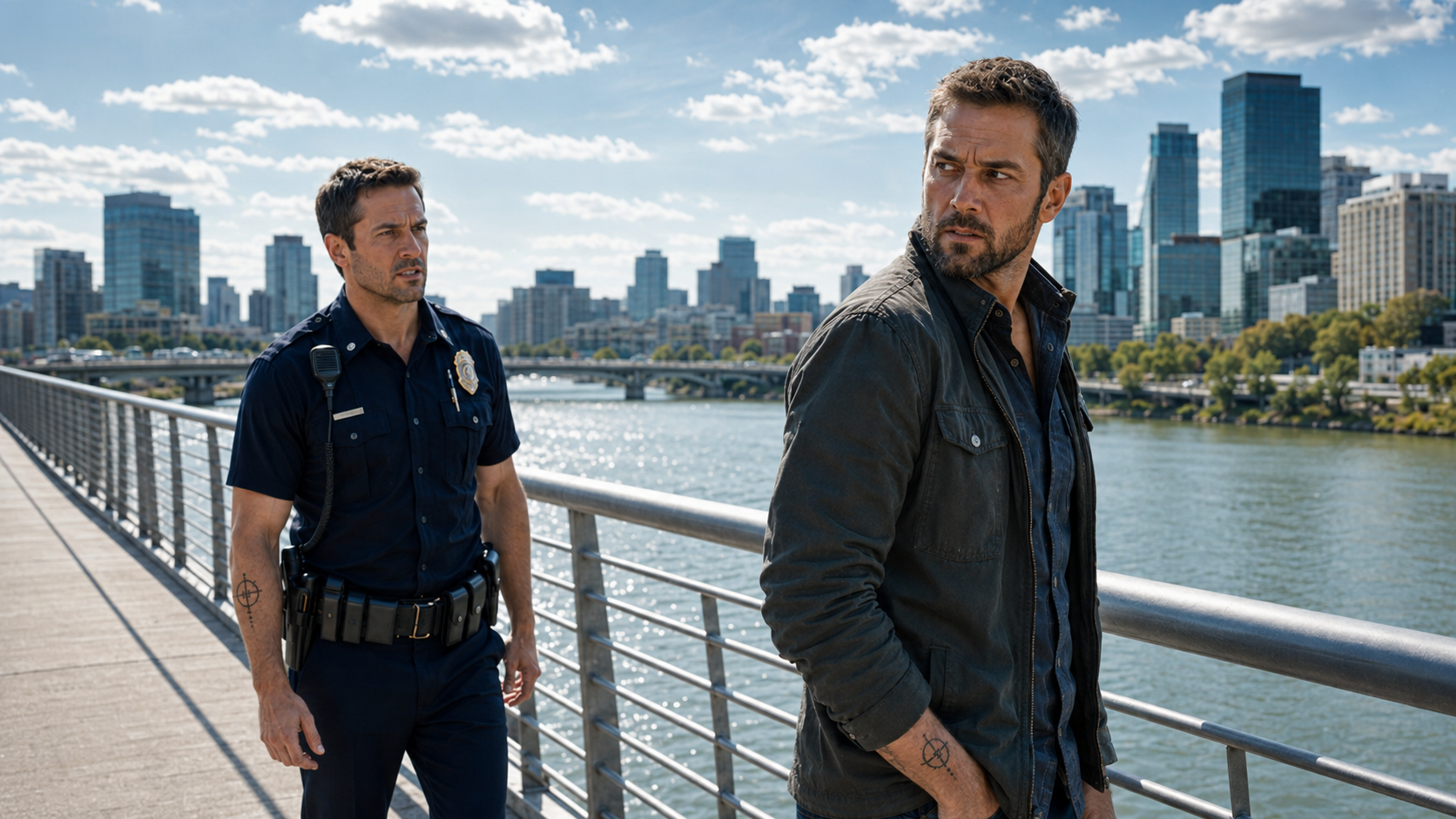
His eyes remained locked on my right forearm, where my uniform sleeve ended just above the black tattoo wrapped around my skin.
Two narrow lines crossed beneath a stylized compass. One line broke just before reaching the center, while the other curved around it and completed the circle. Beneath the compass were four tiny marks that looked meaningless unless you knew what they represented.
Two brothers.
Two birth dates.
One promise.
There were thousands of tattoos in the city.
There was only one other tattoo exactly like mine.
At least, there had been.
I crouched until I was closer to the boy’s height.
“What did you say?”
He pointed.
“My dad has that.”
I stared at him.
“The exact same tattoo?”
He nodded with absolute confidence.
“Right there.” He touched his own small forearm. “Except his is on this arm.”
The correct arm.
My heartbeat stumbled.
I swallowed.
“What’s your name?”
“Eli.”
“Okay, Eli. Where’s your mom?”
He glanced behind him.
I followed his gaze toward a bakery half a block away. People were moving in and out, and I saw a woman standing just inside the glass door, apparently speaking to someone behind the counter.
“She’s getting our breakfast.”
“You came out here by yourself?”
His expression immediately became guilty.
“I saw you.”
That answer shouldn’t have affected me.
It did.
“You saw me?”
He nodded again.
“And I thought maybe…”
He stopped.
“Maybe what?”
His fingers tightened around one of the straps of his backpack.
“Maybe you knew my dad.”
I heard my own pulse in my ears.
“What’s your dad’s name?”
The question came out quieter than I intended.
Eli studied me as if he was deciding whether I could be trusted with the answer.
Then he said, “Logan.”
My knees almost gave out despite the fact that I was already crouching.
There are moments when the mind protects itself by refusing to understand something all at once.
That was one of them.
Logan was a common enough name.
A child could be mistaken about a tattoo.
Patterns looked similar.
Memories distorted themselves.
Seven years was a long time.
There were explanations.
There had to be explanations.
Then Eli reached for his backpack.
“Wait.”
My police instincts returned before the rest of me did.
“What are you getting?”
“A picture.”
He unzipped the front pocket and pulled out a photograph that had been folded in half so many times a white line ran down the center.
He opened it carefully.
Three people stood in front of a lake.
Eli was in the middle, younger by maybe a year, grinning with two missing front teeth. A woman had one arm around him.
And beside her stood a man.
My breath caught before I even touched the photograph.
Seven years vanished.
The gray appearing at his temples didn’t matter.
Neither did the beard.
Neither did the deeper lines beside his eyes or the extra weight on his shoulders.
I knew that face.
Of course I did.
For the first twenty-five years of my life, I had seen a version of it every time I looked in a mirror.
Logan.
My twin brother.
Alive.
Smiling.
Holding his son.
My fingers shook as I took the photograph.
I had imagined meeting Logan again more times than I would ever admit.
Usually it happened at three in the morning, when sleep wouldn’t come and old memories became louder than common sense.
Sometimes I imagined him walking into the station.
Sometimes I imagined spotting him across a crowded restaurant.
Sometimes I imagined a phone call.
A knock at my apartment.
A letter with his name on the return address.
As the years passed, I imagined it less.
Eventually I had taught myself not to imagine it at all.
That was how I survived losing a brother who was still somewhere in the world.
You convinced yourself he was gone.
Not dead.
Something stranger.
Something harder.
Gone by choice.
I stared at the photograph.
“When was this taken?”
Eli leaned over it.
“Last summer.”
Last summer.
Logan hadn’t disappeared into some distant past.
He hadn’t become the frozen twenty-five-year-old version of himself I carried inside my head.
He had been standing beside a lake less than a year ago.
He had laughed.
He had grown a beard.
He had become a father.
He had been living an entire life.
Without me.
“Officer?”
Eli’s voice pulled me back.
I realized I had been holding the picture too tightly.
I loosened my grip.
“Sorry.”
“You know him?”
I looked into Eli’s eyes.
That was when I understood what had unsettled me about them.
They were Logan’s.
Not exactly.
Nothing about children was ever that exact.
But the shape was there.
The slight upward tilt when he was curious.
The way his brow tightened when he was waiting for an answer.
I had seen that expression across bunk beds when we were eight years old.
Across school desks at fifteen.
Across a tattoo parlor at twenty-one.
Across a hospital corridor at twenty-five.
I looked back at the photograph.
“Yeah,” I said.
My voice barely worked.
“I know him.”
Eli’s face brightened.
Before he could say anything else, a woman’s voice tore across the sidewalk.
“Eli!”
The woman from the photograph came running toward us.
Her face was pale with panic.
“Eli, what did I tell you about leaving without me?”
She rushed forward, grabbed him by the shoulders, and pulled him against her.
“I was right there,” he protested.
“You were supposed to stay inside.”
“I saw the police officer.”
“That doesn’t mean—”
She finally looked at me.
Then she looked at my face.
Her anger vanished.
Not faded.
Vanished.
Her gaze dropped to the photograph in my hand.
Then to my tattoo.
Then back to my face.
I stood slowly.
She did not ask my name.
That was the first thing I noticed.
Instead she whispered, “Oh my God.”
I felt every muscle in my body tighten.
“You know who I am.”
It wasn’t a question.
She looked toward Eli as though suddenly realizing how much he could understand.
“Sweetheart, can you go stand right beside the bakery door for me? Right where I can see you.”
“But—”
“Please.”
Something in her voice made him obey.
He shuffled toward the bakery, stopping beside the door.
The woman waited until he was several yards away.
Then she faced me again.
Up close, I recognized her from the photograph.
“My name is Emma,” she said.
I held out the picture.
“I figured.”
She took it carefully.
“I’m sorry. He carries that picture everywhere. He shouldn’t have walked away from me.”
“He’s fine.”
“I know, but—”
“Where is Logan?”
She stopped.
It was remarkable how much fear could appear in someone’s face without them moving a single muscle.
“Colin…”
Hearing my name from a stranger nearly knocked the air out of me.
I stepped closer.
“Where is my brother?”
Emma’s eyes filled.
Not with fear now.
With something worse.
Sadness.
“He’s here.”
I looked around instinctively.
“Here where?”
“In the city.”
My radio crackled again.
I ignored it.
“How long?”
“Four days.”
Four days.
Logan had been in the same city as me for four days.
“Does he know I work this district?”
“Yes.”
That answer hurt more than it should have.
I gave a short, humorless laugh.
“Of course he does.”
“Colin—”
“So he knows I’m here.”
“Yes.”
“He knows where to find me.”
“Yes.”
“And he hasn’t.”
Emma’s shoulders lowered.
“It’s not that simple.”
“It looks pretty simple from where I’m standing.”
She looked toward Eli.
The boy was tracing something on the bakery glass with one finger.
Then Emma lowered her voice.
“He came back because of you.”
I stared at her.
“What?”
“He came back to see you.”
My anger collided with confusion.
“Then where is he?”
Emma hesitated.
“He’s been trying to work up the courage.”
I almost laughed again.
The idea was absurd.
Logan Carter had climbed onto the roof of our elementary school when we were eleven because some older kids said he wouldn’t.
At sixteen he’d stood between me and three seniors after a football game without considering that all three were bigger than us.
At twenty-one he’d walked into a tattoo shop first because I was pretending I wasn’t nervous about the needle.
Logan had been reckless.
Stubborn.
Infuriating.
Brave to the point of stupidity.
“What does Logan need courage for?”
Emma looked directly at me.
“You.”
That shut me up.
She reached into her purse.
“I think we need to talk.”
I glanced at my watch, then at my radio.
Duty was still duty, even when your dead past suddenly walked back into the city.
I radioed my position and requested fifteen minutes.
Then I followed Emma into the bakery.
Eli was waiting for us at a corner table.
He smiled when I approached.
“I told Mom you know Dad.”
Emma sat beside him.
I took the chair across from them.
“That’s true.”
“How?”
I looked at Emma.
She gave the smallest nod.
I returned my eyes to the boy.
“Your dad is my brother.”
Eli’s mouth fell open.
I added, “My twin brother.”
For three full seconds, he simply stared.
Then his eyes grew huge.
“You’re Uncle Colin?”
Everything inside me stopped.
Uncle Colin.
Not Officer Carter.
Not some brother his father never discussed.
Not a stranger.
Uncle Colin.
I looked at Emma.
She was watching me carefully.
Eli leaned across the table.
“Dad said you were really tall.”
Despite everything, a laugh escaped me.
“Your dad is the same height I am.”
“He says he’s half an inch taller.”
“He’s lying.”
Eli grinned.
It was Logan’s grin.
Sudden and crooked.
My chest hurt.
Then Eli said something that hurt even more.
“Dad said you don’t like him anymore.”
Emma closed her eyes.
“Eli.”
“What?”
I couldn’t answer.
Because seven years earlier, in the worst moment of my life, I had said something very close to that.
And apparently my brother had believed me.
Emma put her hand on her son’s shoulder.
“Finish your muffin for me.”
Then she looked at me.
“There’s something Logan never understood.”
My jaw tightened.
“And something I think you never understood either.”
She reached into her purse again.
This time, she removed a sealed envelope.
My name was written across the front.
Not typed.
Written.
I recognized the handwriting immediately.
COLIN.
Seven years could not erase that.
I looked up.
“What is this?”
“Something he asked me to give you.”
“When?”
“This morning.”
“Why?”
Emma’s expression was almost apologetic.
“In case he couldn’t make himself do it.”
I stared at the envelope.
Then at her.
“Do what?”
She answered quietly.
“Face you.”
And suddenly the question wasn’t whether my brother was alive.
The photograph had already answered that.
The real question was what had happened during the seven years between the last time I saw Logan Carter and the morning his son found me on a sidewalk.
And whether either of us could survive hearing the answer.
PART 2: THE YEARS WE LOST
I didn’t open the letter immediately.
That probably sounds strange.
I had spent seven years pretending I didn’t want answers, and now one was sitting six inches from my hand.
But wanting the truth and being ready for it are different things.
I turned the envelope over.
Still sealed.
Emma watched me.
“You don’t have to read it here.”
“Where is Logan?”
She exhaled.
“He went walking.”
“Walking where?”
“He wouldn’t tell me.”
I gave her a look.
She almost smiled.
“Apparently stubbornness runs in the family.”
“You have no idea.”
“I have six years of evidence.”
Six years.
They had known each other for six years.
I did the math automatically.
Eli was five.
Logan had met Emma less than a year after leaving.
There it was again.
That quiet knife.
A whole life.
“You’re married?”
I asked.
Emma nodded.
“Five years.”
My twin brother had gotten married.
I hadn’t known.
“Where do you live?”
“Outside Portland.”
“Oregon?”
“Yes.”
I leaned back.
There were more than two thousand miles between Oregon and this city.
Logan hadn’t simply moved away.
He had put a continent between us.
Emma must have seen something change in my face.
“He didn’t go there to get away from you.”
“That’s generous.”
“He went because an old friend offered him work.”
“What kind?”
“Finish carpentry. Then he started his own business.”
That almost made me smile.
Logan had always been better with his hands than I was.
When we were kids, he could take apart anything mechanical and usually get it back together with only one mysterious screw left over.
At nineteen he’d built our mother a dining table because she had admired one in a furniture store we couldn’t afford.
I still had that table.
I had spent seven years eating alone at something my brother had made.
“What has he told you about me?”
Emma glanced at Eli.
“Enough.”
“Meaning?”
“That you were close.”
“Were.”
Her eyes returned to mine.
“That you were closer than most brothers.”
I said nothing.
“He told me about the tattoo.”
My fingers touched it without thinking.
“He told me you got them on your twenty-first birthday.”
“Twenty-second.”
Emma smiled faintly.
“He always says twenty-one.”
“He’s terrible with dates.”
“No. He remembers yours.”
That landed harder than I wanted it to.
Emma continued.
“He told Eli the tattoo means that no matter how far two brothers go, they’re still connected.”
I looked toward the window.
Outside, ordinary people continued their ordinary mornings.
I hated them for it for about half a second.
Then I hated myself for caring.
“That’s a nice story.”
“It wasn’t a story to him.”
I looked back.
Emma didn’t flinch.
“Then why didn’t he call?”
There it was.
The question I had asked myself until asking became unbearable.
Why didn’t he call?
Why didn’t he write?
Why didn’t he appear at Christmas?
Why didn’t he answer when I searched for the first address I found for him and discovered he’d already moved?
Why wasn’t he there when I became an officer?
Why wasn’t I there when he became a husband?
A father?
At first I had been angry.
Then embarrassed.
Then too proud to admit how badly I wanted my brother back.
Eventually anger turned into habit.
Habit became silence.
And silence, given enough time, starts pretending it is peace.
Emma folded her hands around her coffee.
“You should ask Logan.”
“I am asking you.”
“I know.”
“So answer.”
Her expression hardened slightly.
I recognized that look.
It was the look of someone who loved my brother.
For some reason, that made me trust her more.
“Because he thought you meant what you said.”
A familiar ache entered my chest.
“Which part?”
Emma held my gaze.
“Don’t come back.”
I looked down.
Seven years disappeared.
I was twenty-five again.
Standing in our mother’s kitchen.
Half the food from her funeral reception still covered the counters.
People had finally left.
The sympathy flowers were already beginning to smell too sweet.
Logan and I hadn’t slept properly in four days.
Our mother had spent eleven months dying from cancer, and somehow her death had still surprised us.
For nearly a year, Logan and I had taken turns.
Doctor visits.
Medication.
Meals.
Laundry.
Hospital chairs.
Bad news followed by worse news followed by the cruel little bursts of hope that made the bad news hurt twice.
I had just finished my probationary year with the police department.
I worked constantly.
Logan complained that I wasn’t around enough.
I accused him of acting like he was the only one making sacrifices.
Neither of us was completely wrong.
Neither of us was fair.
The night our mother died, I had been on duty.
Logan called twice.
The first time, I was dealing with a collision.
The second time, I was already trying to get relieved.
By the time I reached the hospital, she was gone.
Logan was sitting beside her bed.
He looked at me and said, “You missed her.”
Three words.
No accusation in his voice.
That somehow made them worse.
At the funeral, we avoided each other.
Afterward, everything exploded.
“You always choose that uniform,” Logan had said.
“And you always need someone to blame.”
“I needed my brother.”
“I was there for eleven months.”
“Not when it mattered.”
Something in me had broken.
“Don’t you dare.”
“You think putting on that badge means you can save everyone, but you couldn’t even—”
“Shut up.”
“Mom kept asking if you were coming.”
“I said shut up.”
Then Logan said the sentence that changed everything.
“Maybe this family stopped mattering to you a long time ago.”
Grief can make cruelty feel like truth.
I stared at him.
“Then maybe you should leave.”
He went silent.
I kept going.
“That’s what you want, isn’t it? To run somewhere and start over so you never have to look at this house again?”
His face changed.
I saw it.
Even then.
I saw the damage.
And instead of stopping, I drove the knife deeper.
“Go.”
“Colin.”
“Go wherever you want.”
“You don’t mean that.”
“I mean don’t expect me to chase you.”
He stared at me for a long time.
Then he whispered, “Fine.”
The next morning, Logan was gone.
I had expected him back by evening.
Then by the weekend.
Then by Christmas.
He never came.
Now, sitting across from his wife, I rubbed a hand over my mouth.
“I didn’t tell him never to come back.”
Emma’s answer was gentle.
“You told him you wouldn’t chase him.”
“That’s different.”
“To you.”
I looked at her.
She didn’t back down.
“He was grieving too, Colin.”
“So was I.”
“I know.”
“He left.”
“I know.”
“He could have called.”
“Yes.”
“So could I, right? That’s what you’re going to say.”
“No.”
That surprised me.
Emma shook her head.
“I’m not here to decide which one of you failed more.”
My jaw tightened.
“Good.”
“I’m here because both of you have spent seven years being absolutely certain the other one made the choice.”
I stared at her.
“What choice?”
“To stop being brothers.”
I had no answer.
Eli was dismantling his muffin one crumb at a time, completely unaware that his mother had just placed a mirror in front of me I had spent years avoiding.
Emma pushed the envelope closer.
“Read it.”
I looked down.
The paper made a soft tearing sound when I opened it.
Inside were two pages.
Logan’s handwriting was rougher than I remembered.
I read.
Colin,
I have started this letter more times than I can count. Emma says writing something you don’t send is just arguing with an empty room, and she’s probably right.
That sounded like Logan.
I kept reading.
I don’t know what you remember about the last night we saw each other. I remember all of it. That’s part of the problem.
For a long time I told myself you threw me out. Then I got older and had to admit that isn’t exactly what happened.
My throat tightened.
You told me to go.
I went.
Those are not the same thing.
I stopped.
Emma remained silent.
I continued.
I was angry at you because Mom died and you weren’t there, which wasn’t fair. I knew you were trying to get to the hospital. I knew you loved her. I knew you had spent months helping. None of that mattered to me that night because I needed someone to blame more than I needed the truth.
Then you said you wouldn’t chase me.
I wanted you to.
I closed my eyes.
For seven years, I had imagined Logan leaving without looking back.
I had never imagined him waiting to be stopped.
I forced myself to continue.
I drove three hours the first day. I stopped at a gas station and sat there until midnight expecting my phone to ring.
It hadn’t.
Because I had been sitting in our mother’s empty kitchen doing the same thing.
Waiting for him to call.
After the first week, calling felt harder.
After the first month, it felt humiliating.
After the first year, I didn’t know how to explain the year.
Then one year became two.
I blinked hard.
I met Emma. Then Eli came. Every good thing made calling you harder because every good thing was another thing I had failed to tell my brother.
I glanced at the little boy.
He had chocolate on one cheek.
When Eli started asking whether I had brothers, I lied the first time.
I told him no.
My chest constricted.
I hated myself immediately.
So I told him about you.
I breathed through my nose.
I told him the good things first.
The treehouse we built.
The time you took the blame when I broke Dad’s windshield.
The night we drove two hours because I said I had never seen the ocean at sunrise.
The tattoo.
My hand went to my forearm.
I didn’t tell him the bad part until he asked why he had never met you.
I told him his uncle and I had forgotten how to talk to each other.
The final lines blurred.
I blinked until they cleared.
I’m in town now.
I don’t know whether you want to see me.
I don’t know whether you hate me.
But I finally understand something I should have understood at twenty-five.
If I walk away again without trying, that’s my choice.
Not yours.
Logan.
I sat there holding the letter.
Seven years.
Seven years reduced to two sheets of paper and one devastating truth.
Neither of us had been abandoned.
We had both been waiting.
I looked at Emma.
“Where would he go?”
She frowned.
“What?”
“When he’s trying to think. Where would he go here?”
“I don’t know the city well enough.”
I did.
There had been a place when we were younger.
A pedestrian bridge over the river on the north side.
Our father used to take us fishing beneath it.
After Dad died, Logan and I still went there.
Whenever one of us was angry.
Whenever one of us had a decision to make.
Whenever home felt too small.
I stood.
Emma watched me.
“You know?”
“I might.”
I took money from my wallet and put it on the table, even though no one had asked me to pay for anything.
Then I looked at Eli.
He looked up.
“Are you going to see Dad?”
I nodded.
“I hope so.”
He considered that.
Then he said, “Don’t yell at him.”
Emma covered her mouth to hide a smile.
I almost smiled too.
“No promises.”
Eli frowned.
I sighed.
“Okay. I’ll try.”
I turned toward the door.
“Colin.”
Emma stopped me.
When I looked back, she said, “He drove past your precinct three times yesterday.”
My anger stirred again.
“He could’ve walked in.”
“I know.”
“He didn’t.”
“No.”
“Why tell me?”
“Because every time he drove away, he looked like a man leaving a funeral.”
That silenced me.
Emma glanced at the letter in my hand.
“He didn’t come here because he doesn’t care.”
She looked toward the street.
“He came because he never stopped.”
I folded the letter carefully and slid it inside my uniform pocket.
Then I stepped outside.
This time, I wasn’t waiting for my brother to come back.
I was going to find him.
PART 3: THE BROTHER ON THE BRIDGE
The bridge was twenty minutes away on foot.
I made it in thirteen.
The closer I got, the more ridiculous I felt.
I was a police officer.
I had been trained to walk into situations without knowing what waited on the other side.
Domestic disputes.
Accidents.
People having the worst day of their lives.
I knew how to slow my breathing.
Read hands.
Read faces.
Control a scene.
None of that prepared me for seeing my own brother.
The river appeared between the buildings.
Then the bridge.
And there he was.
Logan stood with his forearms resting against the railing, looking down at the water.
For several seconds, I couldn’t move.
He wore jeans, work boots, and a gray jacket.
His hair was shorter than in Eli’s photograph.
There was more gray in it than I wanted there to be.
Then there was the posture.
That was what nearly destroyed me.
Some things survive time.
Logan always leaned slightly more heavily onto his left leg.
A football injury from high school.
I’d forgotten.
Or thought I’d forgotten.
My radio crackled.
Logan turned.
His eyes found me.
Neither of us moved.
People talk about twins having some mystical connection.
Logan and I never did.
We couldn’t read each other’s thoughts.
I never knew when he was hurt from hundreds of miles away.
We were simply two brothers born seven minutes apart who had spent so much of our lives together that sometimes familiarity felt supernatural.
Standing twenty feet away from him after seven years, I knew exactly what he was thinking.
Run.
I knew because I was thinking it too.
Instead, I walked forward.
Logan straightened.
His eyes moved over my uniform.
Then my face.
Then my tattoo.
Finally he said, “You got old.”
My throat tightened.
“You look terrible.”
A tiny smile appeared.
“You always were jealous.”
“You’re still shorter.”
“Half an inch taller.”
“Still lying.”
For one second, we were twenty-two again.
Then the smile disappeared.
Silence returned.
I stopped several feet away.
Logan looked toward the river.
“I guess Emma found you.”
“Eli did.”
His head snapped back.
“What?”
“He walked out of a bakery and grabbed my pant leg.”
Logan closed his eyes.
“Oh, God.”
“He showed me the picture.”
“I’m going to kill Emma.”
“She didn’t send him.”
“I know.”
“He saw the tattoo.”
That made Logan look at my arm again.
Something shifted in his expression.
“I told him about it.”
“I heard.”
Another silence.
Logan shoved his hands into his jacket pockets.
“I was coming to see you.”
“Apparently you’ve been coming to see me for four days.”
His jaw tightened.
“Emma told you that too?”
“She likes me.”
“She met you twenty minutes ago.”
“Still likes me more.”
That almost earned another smile.
Almost.
Then the anger surfaced.
Mine first.
“Seven years, Logan.”
He looked away.
“Yeah.”
“That’s all you have?”
“What do you want me to say?”
“I don’t know. Maybe start with why the hell it took your five-year-old son to introduce us.”
His eyes flashed.
“I didn’t plan that.”
“No kidding.”
“I was going to find you.”
“When?”
“Today.”
“You drove past my precinct three times yesterday.”
His face hardened.
“Emma talks too much.”
“Stop blaming Emma.”
“I wasn’t—”
“She isn’t the problem.”
“I know that.”
“Then what is?”
Logan stared at me.
“You really want to do this on a bridge?”
“I’ve had seven years to prepare.”
“No. You’ve had seven years to decide I’m the bad guy.”
The words struck cleanly.
I stepped closer.
“You left.”
“You told me to.”
“I told you to go because we were angry.”
“You said you wouldn’t chase me.”
“I wasn’t supposed to!”
Logan laughed without humor.
“There he is.”
“What is that supposed to mean?”
“The guy who’s always technically right.”
I felt my hands close into fists.
“And there’s the guy who runs the second life hurts.”
His expression changed.
Immediately, I wished I could take it back.
Some habits age better than people.
Logan looked at the river again.
“Maybe this was a mistake.”
Then he turned to leave.
Something inside me broke open.
Seven years earlier, I had watched my brother walk away.
I had promised myself afterward that if I ever got another chance, I would say something different.
Yet there he was.
Walking away again.
And there I was.
Letting him.
For three steps.
“Logan.”
He kept moving.
I followed.
“Logan.”
He stopped.
I caught up.
“What?”
“No.”
He frowned.
“No what?”
“No, you’re not doing that.”
“Doing what?”
“Walking away.”
His jaw flexed.
“You don’t get to tell me—”
“Then I’ll follow you.”
That stopped him.
I was breathing harder than the short walk justified.
“You heard me.”
Logan stared.
“I told you seven years ago I wouldn’t chase you.”
Something hot burned behind my eyes.
“That might be the stupidest thing I’ve ever said.”
His expression cracked slightly.
“So if you’re leaving, fine.”
I stepped closer.
“But I’m chasing you this time.”
Neither of us spoke.
The river moved beneath us.
A bicycle bell rang somewhere behind me.
Logan looked down.
When he finally spoke, his voice had lost its edge.
“I came back once.”
I froze.
“What?”
He rubbed a hand over his beard.
“Two years after I left.”
I stared at him.
“You were here?”
“For one day.”
“When?”
“Your academy ceremony.”
My heart thudded.
That ceremony.
I remembered every detail.
Standing in uniform.
Our mother gone.
Our father gone years before her.
Seats filled with other people’s families.
I’d told everyone I was fine.
Afterward, I went home alone.
“You were there?”
“Outside.”
“Outside where?”
“The auditorium.”
I couldn’t speak.
“I saw you come out.”
“With who?”
“Some officers. Your captain. A woman.”
“My training officer.”
“I didn’t know that.”
My anger flared.
“So you saw me talking to somebody and decided I had a whole replacement family?”
“I didn’t say it was rational.”
“No, it was stupid.”
“Yes.”
“You came all that way and didn’t say anything?”
“Yes.”
“Why?”
Logan looked at me.
For the first time since I’d found him, he looked afraid.
“Because you looked happy.”
I stared.
“And?”
“And I thought maybe leaving had been the right thing.”
“Based on what?”
“You were laughing.”
The absurdity was so enormous I nearly shouted.
“I laughed, so you disappeared for another five years?”
“I said it wasn’t rational.”
“You don’t get points for recognizing that now.”
His expression hardened again.
“I was ashamed, Colin.”
That shut me up.
Logan swallowed.
“I had already missed two years. What was I supposed to say? Congratulations on becoming a cop, sorry about vanishing after Mom’s funeral?”
“Yes!”
My voice echoed off the water.
“Yes, Logan. Exactly that.”
People farther down the bridge glanced toward us.
I didn’t care.
“You could have walked over and said anything.”
“I know.”
“You could have told me you were alive.”
“I know.”
“You could have told me you got married.”
“I know.”
“You could have told me I had a nephew!”
“I know!”
His voice cracked.
We stared at each other.
Logan looked away first.
“I know.”
Quieter now.
“I know all of it.”
His shoulders lowered.
“I missed your graduation. You missed my wedding. I missed your promotions. You missed Eli being born.”
Each sentence felt like an accounting of a life someone had stolen.
Except no one had stolen it.
We had thrown it away ourselves.
Logan laughed bitterly.
“Do you know what the worst part is?”
I said nothing.
“Every year made the next year harder.”
I thought of the letter.
He continued.
“When Eli was born, I almost called you from the hospital.”
My eyes burned.
“I had your number on the screen.”
“Why didn’t you?”
“I didn’t know if it was still your number.”
“You could’ve found out.”
“I know.”
“Stop saying that.”
“What do you want me to say?”
“I want you to explain why being scared mattered more than being my brother.”
The second I said it, I understood the cruelty.
Logan stared at me.
Then he answered.
“It didn’t.”
My anger faltered.
“It just felt easier.”
He took a breath.
“Every day, it felt easier to wait one more day.”
That was the most honest thing either of us had said.
Because I understood it.
I had done exactly the same thing.
Not with a phone call.
With searching.
The first year after Logan left, I tried.
I called friends.
I searched social media.
I found an address from an old coworker and mailed a card.
It came back because he’d moved.
After that, I told myself I had done enough.
I hadn’t.
I had simply reached the point where trying and failing hurt more than pretending I didn’t care.
“I looked for you,” I said.
Logan blinked.
“What?”
“The first year.”
His expression changed.
“I didn’t know.”
“You didn’t give me much opportunity to tell you.”
“I thought you were done with me.”
“I thought you were done with me.”
We stood there staring at each other.
Then Logan gave a hollow laugh.
“That’s pathetic.”
“Completely.”
“Seven years.”
“Yeah.”
“Two grown men.”
“Debatable.”
That earned the first real smile.
It vanished quickly.
Logan’s eyes dropped to my tattoo.
“Did you ever think about covering it?”
The question surprised me.
“No.”
“Removing it?”
“No.”
“Why?”
I looked at the ink.
The lines had faded slightly with time.
The meaning hadn’t.
“I told myself it was because I liked the design.”
Logan nodded.
“Liar.”
“Yeah.”
He pulled up his jacket sleeve.
There it was.
The same compass.
The same broken line.
The same four marks.
Older.
Slightly faded.
Still there.
“I thought about covering mine,” he said.
My stomach tightened.
“But you didn’t.”
“No.”
“Why?”
He looked at me.
“Same reason.”
For a moment, neither of us needed to explain.
Then Logan reached into his jacket.
He pulled out his phone.
The screen lit.
A photograph appeared.
Eli sat on Logan’s shoulders.
Emma stood beside them.
All three were laughing.
“My son knows you exist,” Logan said.
I looked at him.
“I know.”
“He knows the tattoo.”
“I know.”
“He knows the story about the treehouse.”
I smiled despite myself.
“That thing nearly killed us.”
“He thinks it was a castle.”
“It was eight boards and a stolen tarp.”
“We borrowed the tarp.”
“From Mr. Donnelly.”
“He never asked for it back.”
“He filed a complaint with Dad.”
Logan smiled.
And suddenly there he was.
My brother.
Not the ghost.
Not the wound.
The person.
The realization hurt worse than anger.
I had missed him.
God, I had missed him.
Logan’s smile faded as if he were thinking the same thing.
“You want to meet him properly?”
My throat tightened.
“I already met him.”
“You know what I mean.”
I looked back toward downtown.
Then at Logan.
“What did you tell him about me?”
His expression became uncomfortable.
“Mostly good stuff.”
“Mostly?”
“You did put gum in my hair when we were nine.”
“You told your kid that?”
“He needed to know the truth.”
“You put a frog in my bed.”
“You screamed.”
“I was eight.”
“You still screamed.”
I shook my head.
Then I asked the question that mattered.
“Did you tell him I hated you?”
Logan stopped smiling.
“No.”
“He said you told him I don’t like you anymore.”
Logan stared at the river.
“I said we weren’t friends.”
“We’re brothers.”
“I know.”
“That’s not the same thing.”
“No.”
I watched him.
“Do you hate me?”
He looked genuinely startled.
“No.”
“Were you angry?”
“Yes.”
“Still?”
Logan thought about it.
“Some.”
“Me too.”
“Good.”
“Good?”
“I’d be worried if you weren’t.”
I almost laughed.
Then Logan’s face became serious.
“Do you hate me?”
I answered before pride could interfere.
“No.”
He blinked.
“I hated what you did.”
“That’s fair.”
“I hated myself too.”
He frowned.
“For what?”
“For letting you.”
The air changed.
Logan looked at me for a long time.
“You weren’t supposed to save everything, Colin.”
“I know.”
“You definitely weren’t supposed to save me from being an idiot.”
“That might have required federal resources.”
He laughed.
A real laugh.
It sounded older.
But it was his.
I looked down at his phone again.
“Where are Emma and Eli?”
“The bakery, I assume.”
“Eli was under strict instructions to keep eating a muffin.”
“That won’t last.”
“No.”
Logan put his phone away.
For several seconds, neither of us moved.
Then I said, “Come on.”
“Where?”
“Breakfast.”
He frowned.
“Right now?”
“You waited seven years. I’m not giving you another hour.”
He stared at me.
Then a faint smile appeared.
“You’re still bossy.”
“And you’re still shorter.”
“Half an inch taller.”
“Keep telling yourself that.”
We started walking.
Side by side.
It felt wrong.
Then familiar.
Then wrong again.
Healing, I would eventually learn, rarely feels graceful at the beginning.
Sometimes it just feels strange.
But we kept walking.
And for the first time in seven years, neither one of us walked away.
PART 4: WHAT THE TATTOO REALLY MEANT
Eli saw us through the bakery window.
His reaction was immediate.
He jumped out of his chair so quickly it nearly tipped over.
“Dad!”
Logan opened the door.
Eli launched himself at him.
Logan caught him automatically.
“Hey, trouble.”
“I found Uncle Colin!”
“I heard.”
“You said I wasn’t supposed to leave Mom.”
“That part I also heard.”
Eli looked less enthusiastic.
“Am I in trouble?”
“Yes.”
Then Logan glanced at me.
“But apparently something good happened anyway.”
Emma stood near the table.
She looked from Logan to me as if trying to determine whether there had been bloodshed.
“There are two of you.”
I frowned.
“You’ve seen photographs.”
“That isn’t the same.”
Logan set Eli down.
Emma stepped closer to him.
“You okay?”
He nodded.
Then, after a moment, he said, “No.”
Emma touched his arm.
“Better, though.”
He looked at me.
“Yeah.”
“Better.”
That single word carried more than I expected.
We sat.
I called my sergeant and explained enough to get my lunch break moved earlier.
I did not explain that a five-year-old had detonated seven years of family damage before nine in the morning.
Some things weren’t meant for radio traffic.
At first, conversation came in fragments.
Emma filled the spaces.
Eli destroyed whatever seriousness remained.
He wanted to know whether Logan and I had always looked the same.
Whether we had switched places in school.
Whether I had ever arrested his father.
“No,” I told him.
Logan leaned closer.
“Not yet.”
“Give me time.”
Eli thought this was hilarious.
Then he demanded to see both tattoos.
Logan and I looked at each other.
Slowly, we placed our right forearms on the table.
Eli stared.
His mouth opened.
“They really are the same.”
“That’s generally how matching tattoos work,” I said.
He traced the air above mine without touching it.
“What does this part mean?”
I looked at Logan.
He looked back.
Neither of us had explained the design out loud in years.
“The compass was Dad’s idea,” Logan said.
“Our dad?” Eli asked.
“Your grandpa.”
“Why?”
I answered.
“He used to say you should always know how to find your way home.”
Eli pointed to the two lines.
“What are those?”
“Us,” Logan said.
“One is me. One is Uncle Colin.”
“Which one?”
I smiled.
“We argued about that for twenty minutes at the tattoo shop.”
“I’m obviously the straight one,” Logan said.
“You’ve never done anything straight in your life.”
Emma laughed.
Eli pointed at the little marks beneath the compass.
“And those?”
“Our birthday,” I said.
He studied both arms.
“So the tattoo means you’re brothers?”
“Yes.”
“Even when you’re mad?”
The question hit with frightening accuracy.
Logan looked at me.
I answered.
“Especially then.”
Eli nodded, satisfied.
Children accept truths adults spend years complicating.
He returned to his muffin.
Emma caught my eye.
She didn’t say anything.
She didn’t need to.
We stayed in the bakery for nearly an hour.
I learned Logan had built a business with four employees.
I learned Emma was a physical therapist.
I learned Eli had broken his wrist the previous year after jumping off a swing because another child told him he couldn’t.
“Genetic,” I said.
Logan looked offended.
“From your side.”
“We have the same side.”
“Exactly.”
I learned about a small house with a cedar fence Logan had built himself.
A dog named Rocket.
A neighbor who apparently complained whenever Rocket barked.
Christmas mornings.
Preschool disasters.
A camping trip ruined by rain.
Six years of ordinary life.
That was the part that hurt most.
Not the dramatic things.
Not the wedding I missed.
Not even Eli’s birth.
It was realizing there had been hundreds of normal Tuesdays I knew nothing about.
Hundreds of dinners.
Bedtime stories.
Arguments over dishes.
Trips to the hardware store.
Birthdays.
Sick days.
Nothing important enough for anyone outside a family to remember.
Everything important enough for family.
At one point, Emma took Eli to wash chocolate off his hands.
The moment they disappeared, Logan became quiet.
I knew something was coming.
“What?”
He rubbed his thumb along the edge of his coffee cup.
“We’re supposed to leave tomorrow.”
The happiness inside me recoiled.
“Tomorrow?”
“Yeah.”
“When were you planning to mention that?”
“Now.”
“Convenient.”
“Colin.”
“You come back after seven years and stay four days?”
“We’ve been planning this trip for months.”
“Then change the plan.”
Logan stared at me.
I heard how demanding I sounded.
I didn’t care.
“You have a business,” I continued. “You can take another day.”
“I can.”
“Then take it.”
He looked down.
I recognized the hesitation.
The same reflex.
Leave before leaving becomes difficult.
I leaned forward.
“If you’re going tomorrow because you have to, fine.”
He said nothing.
“If you’re going because this is uncomfortable, don’t.”
His jaw tightened.
“That’s not fair.”
“Probably not.”
“You think one conversation fixes everything?”
“No.”
“Good.”
“I think one conversation proves another one is worth having.”
That silenced him.
I continued.
“You want to be angry with me? Be angry.”
“I am.”
“You want to tell me every stupid thing I did? Make a list.”
“It’ll be long.”
“Use both sides of the paper.”
He almost smiled.
“But stop disappearing.”
His expression changed.
“I can’t do that again.”
That was harder to admit than I expected.
My voice dropped.
“I won’t do it again either.”
Logan stared at me.
Then he nodded once.
“Okay.”
“Okay what?”
“We’ll stay another day.”
“Two.”
He laughed.
“One.”
“Fine.”
“We have to get back.”
“I know.”
A strange thought occurred to me.
“Why did you come now?”
Logan looked toward the restroom where Emma and Eli had disappeared.
“I turned thirty-two.”
“So?”
“So I realized seven years had passed.”
“You couldn’t do math before thirty-two?”
He ignored me.
“Eli started kindergarten paperwork a few months ago.”
I waited.
“There was a section asking for emergency family contacts.”
His expression tightened.
“I wrote Emma’s sister. Her parents.”
He looked at me.
“Then there was another blank.”
I understood before he said it.
“And I thought about you.”
I looked down.
“I didn’t even know your address anymore.”
His voice roughened.
“I couldn’t put my own brother’s phone number on a form.”
That had been the moment.
Not a medical emergency.
Not some dramatic tragedy.
A blank line on school paperwork.
Sometimes life changes because of things that small.
“I went home and told Emma I wanted to come back.”
“And she agreed?”
“She said she’d been waiting six years.”
I smiled faintly.
“I like her.”
“Everybody does. It’s exhausting.”
Emma returned with Eli.
“I heard that.”
Logan smiled.
“Good.”
Eli climbed into the chair beside me instead of beside his father.
I noticed.
So did Logan.
There was something absurdly emotional about it.
Eli leaned toward my arm again.
“Can I ask something?”
“Sure.”
“Why don’t you have pictures of us?”
I froze.
Logan looked at Emma.
Emma looked at me.
Eli continued, unaware of the damage.
“Dad has pictures of you.”
I turned toward Logan.
“What?”
His face went red.
“They’re old.”
“How many?”
“Don’t.”
“How many?”
“Some.”
Emma sat down.
“He has a box.”
Logan gave her a betrayed look.
“Emma.”
“What? We’re doing honesty now.”
I smiled despite myself.
“A box?”
“Shut up.”
Eli was delighted.
“There’s one where you’re wearing matching Halloween costumes.”
“No.”
“Yes,” Logan said immediately.
“You burned that.”
“I lied.”
“What costumes?” Emma asked.
“Nothing,” I said.
“Cowboys,” Logan said.
“We were six.”
“Matching cowboy hats.”
“I hate you.”
Emma laughed.
There it was.
I hate you.
A sentence that could mean completely different things depending on how safely it was spoken.
Seven years ago, words like that had become weapons.
Now, somehow, it sounded like family again.
Eli looked at me.
“You can have pictures of us.”
I swallowed.
“I’d like that.”
“I’ll send you one.”
“Your dad has my number.”
Logan stared at me.
I took out my phone.
“Actually, he doesn’t.”
For the first time that morning, Logan looked genuinely nervous.
I slid the phone across the table.
“Put yours in.”
He picked it up.
His fingers paused above the screen.
Then he entered his number.
My phone returned to me.
A simple contact appeared.
Logan Carter.
Seven years earlier, I had deleted the old number after calling it for the hundredth time and hearing that it was disconnected.
I’d told myself deleting it was closure.
Now I stared at his name restored to my phone.
I tapped the message icon.
Logan’s phone buzzed.
He checked it.
My message contained two words.
Don’t disappear.
He read it.
Then typed.
My phone buzzed.
You either.
I looked at him.
Neither of us smiled.
We didn’t need to.
Some promises were too important to make dramatically.
Sometimes two words were enough.
PART 5: FINDING THE WAY HOME
Logan stayed two extra days.
I won that argument.
He will deny this if asked.
The first evening, I took them to my apartment.
Logan stopped in the doorway.
I knew why immediately.
The dining table.
He had built it thirteen years earlier for Mom.
Dark oak.
Heavy legs.
A faint burn mark near one corner from when she’d placed a hot pan directly on the wood and then blamed both of us.
Logan walked toward it slowly.
“You kept this.”
“Of course I kept it.”
His fingers ran over the edge.
“I thought the house was sold with everything.”
“Most of it.”
“But not this.”
“No.”
He looked at me.
I didn’t explain.
Neither did he.
Emma watched from the kitchen.
Eli crawled beneath the table.
“This is Dad’s?”
“He built it.”
Eli stared up at the underside as though expecting buried treasure.
“Really?”
Logan crouched.
“Really.”
“Can you build me one?”
“You have a table.”
“I want this table.”
“You can’t have Uncle Colin’s table.”
I glanced at Logan.
“You said Uncle Colin.”
He froze.
Emma smiled.
Logan rolled his eyes.
“Don’t make it weird.”
It was already weird.
It was also wonderful.
Over the next two days, we did nothing extraordinary.
That mattered.
We walked the neighborhood where Logan and I had grown up.
Our old house belonged to another family now.
The maple tree where we’d carved our initials was still standing.
The convenience store had become a pharmacy.
Our high school had a new athletic building.
The tattoo shop was gone.
In its place stood a nail salon.
Logan stared through the window.
“Think they do matching tattoos?”
“Definitely.”
“We could get another one.”
“Absolutely not.”
“Scared?”
“Of you picking the design.”
Eli insisted we recreate the old photograph of Logan and me standing beneath the river bridge.
Emma took the picture.
In the original, we were seventeen.
Skinny.
Smirking.
Convinced life had not yet invented anything strong enough to separate us.
In the new photograph, we stood with gray starting in our hair.
Logan had one arm around Eli.
I stood beside them.
We weren’t touching at first.
Then Logan looked at me.
“For God’s sake, Colin.”
“What?”
“Get over here.”
He grabbed my shoulder and pulled me closer.
Emma took the picture.
That night she sent it to me.
I stared at it for a long time.
The next morning, I made it my phone background.
I didn’t tell Logan.
Eli did.
“Dad! Uncle Colin put us on his phone!”
Traitor.
On their final morning, I met them outside their hotel.
Their bags were packed in the SUV.
I hated seeing them there.
Suitcases had become dangerous objects in my mind.
Logan noticed me looking.
“We’re not disappearing.”
“You better not.”
“You have my number.”
“Numbers can change.”
“You have Emma’s.”
“Good.”
“And the address.”
“I checked it on the map.”
He stared at me.
“You checked our address?”
“Occupational habit.”
“Creepy.”
“Professional.”
Emma hugged me.
That surprised me.
I hugged her back.
“Thank you,” I said quietly.
“For what?”
I looked toward Eli.
“For raising a kid who wanders out of bakeries.”
Emma laughed.
“I’ll try not to encourage that.”
Then her expression softened.
“He was going to find you eventually, Colin.”
I wasn’t sure whether she meant Eli or Logan.
Maybe both.
Eli demanded his own goodbye.
He wrapped both arms around my waist.
“When are you coming to our house?”
The question caught me off guard.
Logan leaned against the car.
“Good question.”
I looked at him.
“Soon.”
Eli pulled back.
“How soon?”
“Your dad can buy me a plane ticket.”
Logan laughed.
“Police officers don’t make their own travel arrangements?”
“Not when visiting rich carpenters.”
“I am not rich.”
“Then start saving.”
Eli looked between us.
“Christmas?”
The word hit me.
Seven Christmases.
Gone.
I looked at Logan.
He stopped smiling.
For a second, I saw the same calculation happening in his head.
Christmas used to mean Mom’s kitchen.
Bad decorations.
Arguments over music.
Logan eating cookies before dinner.
Me pretending to be annoyed.
After she died, I worked Christmas whenever possible.
It was easier than sitting alone.
Logan cleared his throat.
“We could come here.”
I stared at him.
“You would?”
Emma answered first.
“Yes.”
Logan looked at her.
She shrugged.
“We’ll figure it out.”
Eli bounced.
“Christmas with Uncle Colin!”
The words did something to me.
I had spent years believing the punishment for what happened between Logan and me was permanent.
You make one terrible choice.
You say one terrible thing.
You miss one phone call.
Then another.
And eventually the lost years become too large to cross.
But I was beginning to understand something.
You don’t cross seven lost years all at once.
You cross one day.
Then another.
One phone call.
One dinner.
One Christmas.
One ordinary Tuesday at a time.
Logan loaded the final bag.
Then he stood beside the driver’s door.
Neither of us seemed to know how brothers were supposed to say goodbye after spending years afraid of goodbye.
He finally stuck out his hand.
I stared at it.
“What is that?”
“A handshake.”
“I know what a handshake is.”
“Then shake.”
“No.”
His face tightened.
Then I stepped forward and hugged him.
Logan went completely still.
For half a second, I thought I’d made a mistake.
Then his arms closed around me.
Hard.
Not polite.
Not careful.
Seven years disappeared inside that embrace.
I remembered us at six, fighting over the top bunk.
At fourteen, sneaking home after midnight.
At twenty-two, sitting beside each other while a tattoo artist turned a stupid promise into permanent ink.
At twenty-five, standing in our mother’s kitchen and destroying something neither of us understood how to repair.
My eyes burned.
Logan’s voice came quietly near my ear.
“I’m sorry.”
I closed my eyes.
“Me too.”
“I should’ve called.”
“I should’ve chased you.”
He laughed once.
“You’d have caught me.”
“Obviously.”
We stepped apart.
His eyes were wet.
So were mine.
Neither of us mentioned it.
Twin privilege.
Logan got into the vehicle.
Emma waved.
Eli pressed both palms against the rear window.
I stood on the sidewalk until they turned the corner.
For one terrifying instant, an old feeling returned.
They’re leaving.
Then my phone buzzed.
I pulled it out.
A message from Logan.
Already miss me?
I laughed.
Typed back.
Drive safely. You’re transporting my nephew.
Three dots appeared.
Your nephew?
Then another message.
Pretty sure he’s my son.
I typed:
Shared custody.
His response came immediately.
You get weekends.
I stood there smiling like an idiot.
Then my radio called me back to work.
Life resumed.
Traffic.
Reports.
Noise.
Coffee getting cold before I could drink it.
People needing directions.
Someone complaining about a blocked driveway.
The same streets.
The same uniform.
The same city.
And somehow none of it felt quite the same.
Three weeks later, I flew to Oregon.
I met Rocket, the dog.
I saw Logan’s workshop.
Eli showed me his room before I had taken off my jacket.
Emma made dinner.
Logan burned the garlic bread and blamed the oven.
We argued about it for ten minutes.
It was the best argument I’d had in seven years.
At Christmas, they came back.
The dining table Logan had built for our mother held four plates instead of one.
Eli taped a paper compass he’d drawn himself above my fireplace.
The lines were crooked.
The circle wasn’t complete.
I considered correcting it.
Then I decided it was perfect.
Months became a year.
The scar between Logan and me didn’t magically vanish.
There were difficult conversations.
Things we remembered differently.
Things one of us apologized for that the other wasn’t ready to forgive immediately.
There were moments when Logan became quiet and I worried he was pulling away.
Moments when I became angry and he assumed I regretted letting him back in.
We had to learn each other again.
That surprised me.
I had expected reconciliation to feel like restoring an old photograph.
Instead, it felt like meeting someone familiar who had continued living while I wasn’t watching.
Logan had changed.
So had I.
The goal wasn’t to become twenty-five again.
Those men had been grieving and proud and stupid.
We had to become brothers as the men we were now.
One summer afternoon, nearly a year after Eli stopped me on the sidewalk, Logan and his family came to visit again.
We returned to the river.
Eli walked between us.
He had grown enough that his hand no longer disappeared completely inside mine.
We reached the bridge.
The same place where Logan and I had nearly turned our reunion into another goodbye.
Eli ran ahead.
Emma followed.
Logan and I remained behind.
He leaned against the railing.
“You ever think about that morning?”
I knew which one.
“Sometimes.”
“Kid basically saved our relationship because he can’t follow instructions.”
“Heroic disobedience.”
“We shouldn’t teach him that phrase.”
“Definitely not.”
Logan looked at my forearm.
My sleeves were rolled up.
The tattoo showed clearly.
He pulled up his own sleeve.
Two matching compasses.
Older now.
Our skin had changed around them.
They had faded.
One day, if we were lucky, they would fade much more.
“You know,” Logan said, “the tattoo didn’t work.”
I frowned.
“What?”
“We got these because we said we’d never lose each other.”
I looked at the design.
“We did.”
“For seven years.”
I thought about that.
Then I shook my head.
“No.”
He gave me a skeptical look.
“Pretty sure we did.”
“We stopped talking.”
“That’s generally how losing someone works.”
I looked toward Eli.
He was crouching near Emma, throwing small stones into the river.
Then I looked back at my brother.
“You told your son about me.”
Logan said nothing.
“You kept the pictures.”
His expression softened.
“I kept the table.”
I touched the ink on my arm.
“You came back.”
Logan smiled faintly.
“And you chased me.”
“Eventually.”
“Very slowly.”
“Shut up.”
He laughed.
Then I looked once more at the two matching tattoos.
Maybe we had misunderstood the promise when we were twenty-two.
We thought the compass meant we would never get lost.
We had been young enough to believe loving someone prevented distance.
That brothers couldn’t become strangers.
That promises were shields.
They weren’t.
People get lost.
Families fracture.
Grief says things in your voice that you spend years wishing you could take back.
Pride turns days into months and months into years.
Sometimes the person you love can be alive somewhere beneath the same sky and still feel completely unreachable.
A promise can’t prevent that.
Maybe the real promise was something else.
Maybe it was that if you ever found the road again, you had to be brave enough to take it.
Logan nudged my shoulder.
“What are you thinking about?”
“That you’re still shorter.”
He groaned.
“Unbelievable.”
We started toward Emma and Eli.
Halfway there, Eli turned.
“Dad!”
“What?”
“Uncle Colin!”
“Yeah?”
He pointed toward the river.
“Look what I found!”
He held up a smooth stone shaped almost like a heart.
Logan looked at me.
I looked at him.
Then we walked toward the boy together.
The strange thing is, I spent seven years thinking the worst moment of my life was the night my brother left.
It wasn’t.
The worst part was every day afterward when I chose not to follow.
But life, when you’re fortunate, sometimes gives you a second chance in a form you would never recognize.
Mine came on an ordinary morning.
No emergency call.
No flashing lights.
No dramatic warning.
Just a tiny hand tugging gently on my uniform.
A five-year-old boy looking at the tattoo on my arm.
And one impossible sentence.
My dad has the exact same one.
I used to think that tattoo represented a promise we had broken.
Now I know better.
The compass was never there to keep us from getting lost.
It was there to remind us how to find our way home.
Để lại một bình luận