
PART 1: THE HOUSE THEY THOUGHT WAS THEIRS
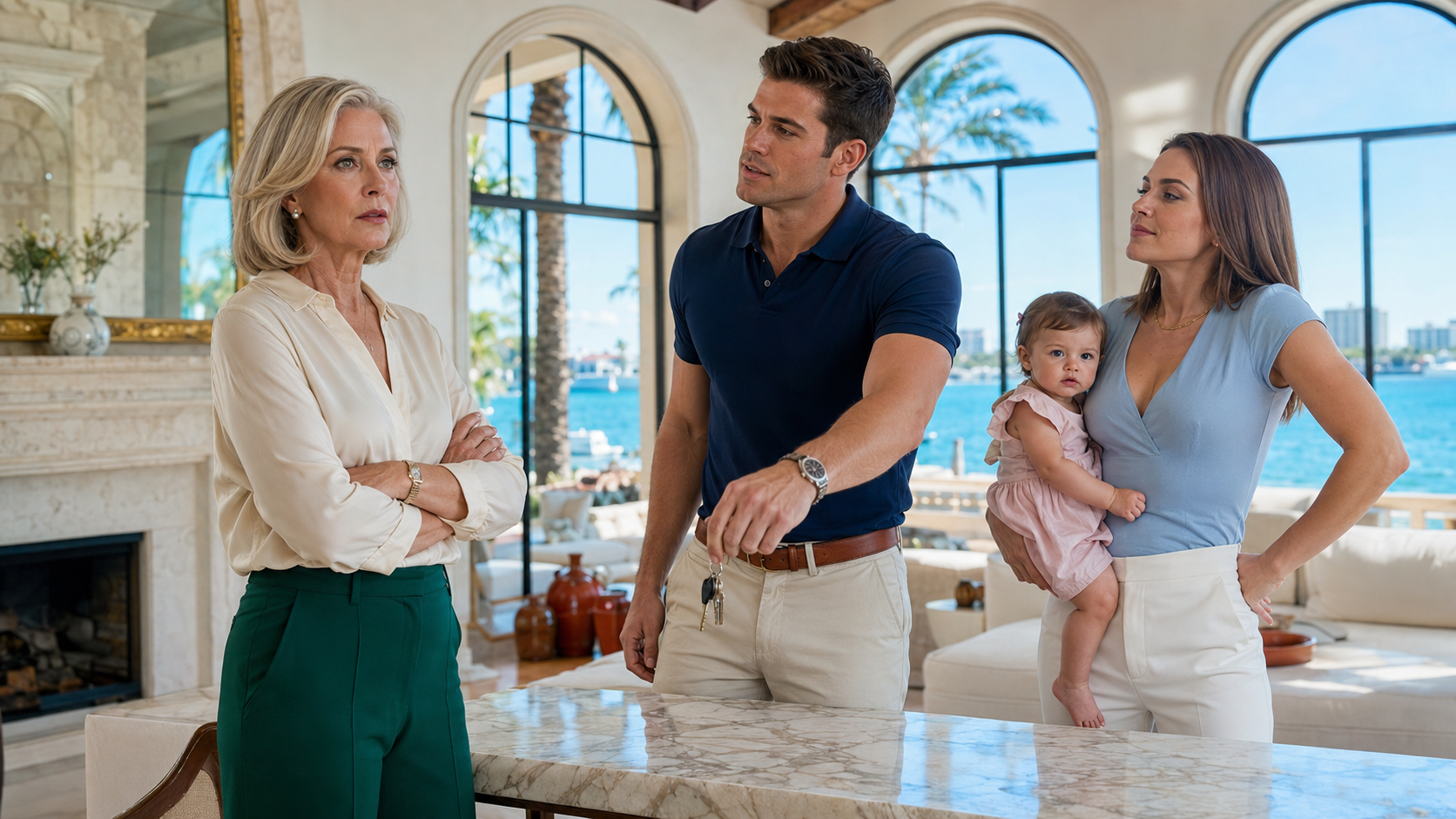
Three weeks after my son told me I was too old to start over, he walked into my new villa, dropped his keys on my marble table, and announced I would be moving into the guesthouse.
His wife smiled like the decision had already been made.
My granddaughter giggled in her arms.
And for one stunned second, I realized they were not visiting me.
They were claiming me.
Preston stood in my living room with the confidence of a man who had never paid a mortgage here, never signed a deed, never spent a sleepless night wondering whether he would survive another month alone.
He looked around at the arched windows, the pale stone fireplace, the vaulted ceiling, and the bright blue stretch of Sarasota Bay beyond the terrace.
Then he smiled.
“You can take the guesthouse, Mom,” he said. “Kendra and I need the villa more than you do.”
I stared at him.
At first, I genuinely wondered whether I had heard him wrong.
Grief did strange things to the brain. So did exhaustion.
The past year had given me enough of both.
Only three weeks earlier, Preston had visited the tiny rented apartment I had taken behind a laundromat after my divorce.
The kitchen cabinets were peeling at the corners. The refrigerator hummed so loudly at night that I sometimes unplugged it just to sleep. Dryer vents rattled through the wall behind my bedroom, and every time someone opened the laundromat’s rear door, the whole apartment smelled faintly of detergent, hot metal, and fabric softener.
It had been temporary.
I knew that.
But Preston had walked through it like he was inspecting the wreckage of my life.
At sixty-one, I had already survived the end of a thirty-four-year marriage, the collapse of the consulting firm where I had worked for nearly two decades, and the quiet humiliation of watching the life I had built disappear room by room.
The house went in the divorce.
Most of the furniture went with it.
Friends who had once invited us to dinner as a couple stopped calling because apparently divorce made people nervous, as if loneliness were contagious.
I had not asked Preston for money.
I had not asked him for pity.
I had not asked him to rescue me.
But he gave me both anyway.
“Mom,” he had said, leaning against my narrow kitchen sink, “you have to be realistic. You’re not starting over from scratch at your age.”
Kendra had been sitting at my little two-person table stirring coffee she never drank.
“There’s nothing wrong with renting,” she added sweetly. “It’s perfectly fine for some people.”
Some people.
I remembered staring at her manicured hand circling that spoon.
Some people.
Not the mother who worked overtime when Preston was seventeen so we could afford the college preparatory program he insisted he needed.
Not the woman who delayed replacing her own car so he could graduate without student loans.
Not the mother who sold two gold bracelets and a sapphire ring when his first business ran into trouble and he called me at midnight saying he couldn’t make payroll.
Not the grandmother who never missed Lila’s birthdays, pediatric appointments when Kendra needed help, fevers, emergency babysitting calls, family dinners, or those frantic messages that always seemed to begin with, Mom, are you busy?
Just some divorced woman living behind a laundromat.
I had smiled.
Not because it didn’t hurt.
Because somewhere between losing my marriage and losing my job, I had finally learned that certain people only remembered your sacrifices when they needed another one.
What Preston did not know was that my grandmother had left me two small commercial buildings years earlier.
Nothing glamorous.
One was a brick storefront with a dentist downstairs and accounting offices above it. The other was an aging little retail strip my grandmother had bought when no one thought that part of town would ever be worth much.
I had kept them separate from everything else.
Quietly.
Carefully.
During my marriage, the rental income went back into repairs, taxes, maintenance, and savings. I never talked about them because they were the last thing in my life that felt entirely connected to me.
To my grandmother.
To the woman who had once told me, while teaching me to knead biscuit dough at her kitchen counter, “Always keep one thing in your own name, Evie. Not because you expect people to betray you. Because you should never need permission to stand on your own feet.”
At twenty-seven, I had thought she sounded old-fashioned.
At sixty-one, I finally understood.
After the divorce, I sold both properties.
Quietly.
Then I bought the house I had admired for nearly twenty years.
A white Mediterranean villa overlooking the bay.
Lemon trees in the courtyard.
Bougainvillea spilling over warm stucco garden walls.
A marble fireplace climbing toward vaulted ceilings.
Terracotta tiles warmed by the afternoon sun.
Three bedrooms upstairs, a wide kitchen with windows facing the water, and a detached guesthouse large enough to become the art studio I had abandoned decades earlier because everyone else’s needs always seemed more urgent than mine.
I paid for most of it outright and financed a manageable portion because I refused to make myself cash-poor merely to prove I could buy something.
For three weeks, I told almost no one.
Every morning, I drank coffee on the terrace while the bay brightened from gray to silver to blue.
I unpacked slowly.
I put my grandmother’s china cabinet exactly where I wanted it.
Not where a husband wanted it.
Not where a decorator thought it should go.
Not where it would be easiest for Thanksgiving traffic.
Where I wanted it.
I painted one bedroom pale blue because the color reminded me of the sky before a summer storm.
I bought linen curtains without asking whether beige had better resale value.
I put a deep green chair beside the upstairs window simply because I liked reading there.
For the first time in decades, silence did not feel empty.
It felt like ownership.
Then my neighbor Marianne posted photographs from my small housewarming dinner.
Nothing extravagant.
Eight people.
Wine.
Pasta.
Flowers from the courtyard.
Me laughing on the terrace with the sunset behind me.
Apparently Preston saw the pictures.
By Saturday morning, his black SUV rolled through my front gate without permission.
Kendra stepped out with baby Lila on her hip, her eyes traveling over the balconies, the courtyard fountain, the lemon trees, the wide glass doors.
She wasn’t looking at my house.
She was evaluating it.
Preston didn’t knock.
The front door had been open because I was carrying flowerpots from the terrace.
He walked straight inside.
“It’s perfect,” he said.
“Yes,” I answered. “It is.”
He turned toward Kendra.
“My wife is going to love living here.”
I thought he was making some kind of joke.
I actually laughed once.
A short, confused sound.
“Excuse me?”
He removed his sunglasses.
“Come on, Mom. This place is ridiculous for one person. Kendra and I will take the main house. You can move into the guesthouse.”
Kendra bounced Lila gently.
“It’ll be wonderful for the baby. She’ll have a yard. And the schools around here are much better.”
My heart softened only for the child.
Lila had Preston’s brown eyes and Kendra’s tiny pointed chin. She was eighteen months old and fascinated by anything shiny. At that moment she had one fist wrapped around Kendra’s necklace and was making happy little noises at the sunlight moving across the wall.
“You’re not moving into my house,” I said.
Preston’s smile vanished.
Kendra’s did too.
“Evelyn,” she said, “family helps family.”
“How interesting.”
I folded my arms.
“When I lived behind a laundromat, you called that realism.”
Preston stepped closer.
“Don’t be dramatic.”
Then he dropped his keys onto my marble table as if the house had already chosen him.
“Our lease expires next month,” he said. “Renting again would be stupid when you have all this space.”
“No.”
It was one word.
One word I should have learned twenty years earlier.
Maybe thirty.
Kendra stared at me.
“So you’d rather your granddaughter grow up cramped while this house sits half empty?”
I looked at Lila.
Then at her mother.
“I’d rather she grow up knowing someone else’s home is not an inheritance you can steal early.”
Preston’s face turned red.
“You think buying one fancy house suddenly makes you somebody?”
“No,” I said softly.
I could hear my own heartbeat.
“I think I’m finally home.”
That was when Preston reached into his pocket and pulled out his phone.
For a second, I thought he was going to call someone.
Instead, he opened his email and held the screen toward me.
“I already notified our landlord that we won’t be renewing.”
I stared at the message.
There it was.
A polite email sent two nights earlier.
We have made alternate housing arrangements and will be vacating at the end of the lease term.
Alternate housing arrangements.
My house.
Without asking me.
I looked from the phone to my son.
“You did this before speaking to me?”
“We saw the pictures Wednesday.”
“And?”
“And obviously you had room.”
Obviously.
The word struck harder than I expected.
Not we hoped.
Not we wondered.
Not we thought maybe you could help.
Obviously.
Kendra shifted Lila to her other hip.
“We didn’t think you’d make this difficult.”
Something inside me went perfectly still.
“You made a decision about where I would live,” I said, “and you didn’t think I would make it difficult?”
“You’d still be here,” Preston said impatiently. “The guesthouse is nicer than your old apartment.”
I almost laughed.
That was his argument.
He was offering me a better version of being displaced from my own life.
“I bought the guesthouse too,” I said.
“Mom.”
“No.”
“Stop saying that like you’re talking to a child.”
“Then stop behaving like one.”
His jaw tightened.
I had rarely spoken to Preston that way.
Even as a teenager, I had been the parent who explained.
Negotiated.
Softened consequences.
Gave one more chance.
His father had been the hard line. I had been the bridge.
Eventually, Preston learned that if he pushed hard enough, the bridge moved.
Now he was thirty-five years old, standing in my living room, furious because for the first time the bridge had decided to stay where it was.
“You know what?” he said. “Fine. Let’s talk numbers.”
“There are no numbers.”
He held up the phone again.
“This house has to be worth at least two million.”
“That is none of your business.”
“You’re sitting on this much money while we’re paying ridiculous rent.”
“You chose your apartment.”
“We chose it because it was close to Kendra’s work.”
Kendra jumped in.
“And we need another bedroom for Lila. We were already trying to figure out what to do.”
“I understand that.”
“Do you?” she demanded. “Because you keep talking about ownership like we’re strangers.”
There it was again.
That assumption that family erased borders.
Erased deeds.
Erased consent.
Erased the word no.
“I am not treating you like strangers,” I said. “Strangers would have had the manners to knock.”
Preston stared at me.
Lila suddenly squealed and reached toward me.
“Gamma.”
The word almost broke me.
I moved automatically.
Kendra hesitated before letting me take her.
That hesitation was tiny.
Barely a second.
But I felt it.
I held Lila against me, breathing in the clean warm smell of her hair.
She patted my cheek.
“Pretty,” she said, looking toward the chandelier.
“Yes, sweetheart.”
My throat tightened.
“Very pretty.”
Over her shoulder, I saw Preston exchange a glance with Kendra.
A glance I knew too well.
They thought Lila would change my mind.
Maybe once she would have.
That was the cruelest part.
Not that they loved their daughter.
Of course they did.
It was that they understood how much I loved her and had already calculated the weight of that love.
Preston lowered his voice.
“She could grow up here, Mom.”
I kissed the top of Lila’s head.
“She can visit here.”
“And live in some cramped rental the rest of the time?”
“You survived rentals.”
“That isn’t the point.”
“No,” I said.
I handed Lila carefully back to Kendra.
“It is exactly the point.”
I picked up Preston’s keys from my marble table and held them out to him.
He didn’t take them.
“I’m not doing this with you.”
“You came into my house and told me to move out of it.”
“You keep saying my house like—”
“Because it is my house.”
Silence.
Even Kendra had nothing ready for that.
I placed the keys in Preston’s hand and folded his fingers around them.
“You need to leave.”
His eyes widened.
“You’re throwing us out?”
“You don’t live here.”
The sentence landed harder than shouting could have.
Kendra’s mouth tightened.
“Come on, Preston.”
He stayed where he was.
For one moment, I saw something beneath the anger.
Not sadness.
Not exactly.
Disbelief.
My son truly had not imagined this outcome.
That realization frightened me more than anything he had said.
Because entitlement is most dangerous when the person carrying it believes it is love.
Finally, Preston shoved his phone back into his pocket.
“Fine.”
He walked toward the door.
Then he turned.
“When the rest of the family hears about this, don’t expect them to understand.”
I looked at him.
“Understand what?”
“That you chose a house over your own family.”
He left before I could answer.
Kendra followed him without saying goodbye.
The front door slammed.
Through the window, I watched Preston strap Lila into her car seat.
My granddaughter kicked her little feet happily, unaware of everything.
Then the SUV disappeared through the gate.
I stood alone in the entryway.
The villa seemed enormous around me.
For the first time since I bought it, the silence didn’t feel peaceful.
It felt like a threat.
My phone rang less than twenty minutes later.
And when I saw my sister’s name on the screen, I knew Preston had wasted no time.
PART 2: THE PRICE OF SAYING NO
My sister Diane did not say hello.
“Tell me Preston is exaggerating.”
I closed my eyes.
Outside, a gull cried somewhere over the water.
“He usually does when he’s angry.”
“He says you bought some enormous waterfront house and won’t let them stay with you even though they’re about to lose their apartment.”
I opened my eyes again.
There it was.
Already rewritten.
Not their lease is ending.
They were about to lose their apartment.
Not they announced they were taking my house.
I wouldn’t let them stay.
I walked into the kitchen and poured myself a glass of water.
“My son informed his landlord he wasn’t renewing because he decided he and Kendra would move into my house.”
Diane was quiet.
“He didn’t ask?”
“No.”
“Well…”
That one word told me everything.
I set the water down.
“Well what?”
“You do have the room.”
I laughed.
I couldn’t help it.
It came out tired rather than amused.
“So the size of my house determines whether I get to live in it?”
“Don’t twist what I’m saying.”
“I don’t need to.”
“Evelyn, they’re young. Things are expensive. They have a baby.”
“And?”
“And you know how hard it is.”
“Yes.”
I looked through the kitchen windows toward the guesthouse.
“I know exactly how hard it is.”
There was a pause.
Diane’s voice softened.
“Maybe you could let them stay for six months.”
“No.”
“Three?”
“No.”
“Until they find somewhere else?”
“They haven’t even looked yet.”
“They thought they had a solution.”
“They thought they had my solution.”
She sighed.
“You’re angry.”
“I am.”
“Maybe don’t make a permanent decision while you’re angry.”
That sentence touched a nerve so deep I nearly dropped the phone.
Because it sounded reasonable.
Reasonable had been the language used against me my entire adult life.
Be reasonable, Evelyn.
Your husband works long hours.
Be reasonable.
Preston is stressed.
Be reasonable.
Kendra just had a baby.
Be reasonable.
Your boss needs you this weekend.
Be reasonable.
Your mother-in-law didn’t mean it like that.
Be reasonable.
It always seemed to mean the same thing.
Give something up so everyone else can stay comfortable.
“I’ve spent thirty-four years making reasonable decisions,” I said.
Diane went quiet.
“This one is mine.”
I ended the call gently.
The next one came from my cousin.
Then an aunt.
Then two texts from relatives who had not called me once during the worst months of my divorce.
Heard Preston and Kendra are in a bind.
Could be nice having family close.
That house looks huge, Evie! Why not share?
I watched the messages stack up.
By afternoon, Preston had turned my refusal into a referendum on my character.
I did not answer.
At six that evening, Marianne appeared at my gate holding a bottle of wine.
She lived two houses down and had been one of the few people I invited to the housewarming.
“I’m either here to apologize,” she said, “or to hide.”
I opened the gate.
“For what?”
“The photos.”
I managed a smile.
“You didn’t know.”
“I tagged the neighborhood. Your son must have seen them through a mutual friend. I’m sorry.”
“Don’t be.”
I led her toward the terrace.
“It would have happened eventually.”
She studied my face.
“Bad?”
“My son is offended that I won’t move into my own guesthouse so he can have my bedroom.”
Marianne stopped walking.
“He actually said that?”
“Almost word for word.”
She stared at me for two seconds.
Then she said, “I need more wine.”
I laughed for the first time all day.
That mattered.
More than she knew.
We sat outside until the sky turned dark.
Marianne did not tell me what to do.
She did not remind me that family was important.
She did not ask whether I had enough bedrooms.
She simply listened.
When she left, she hugged me and said, “You don’t have to defend owning something you bought.”
I stood at the gate long after she had gone.
Such a simple sentence.
Such an unfamiliar feeling.
The next morning, I changed the gate code.
Not because Preston had threatened me.
He hadn’t.
Not because I thought he would break in.
I didn’t.
I changed it because I had given him the old code months earlier when he helped me move a few boxes, and I suddenly understood that access given in one context was not permanent permission.
At eleven, he texted.
Seriously?
I looked at the message.
A second appeared.
You changed the gate code?
Then a third.
This is getting ridiculous.
I typed three different responses.
Deleted all of them.
Finally I sent:
Yes. Please call before visiting.
He answered almost immediately.
Unbelievable.
I put the phone facedown.
That became the rhythm of the next week.
Pressure.
Silence.
Pressure.
Silence.
Kendra posted nothing directly about me, but she didn’t need to.
A photograph of Lila sitting beside half-packed moving boxes appeared online with the caption:
Nothing more stressful than not knowing where your baby will be living next month.
Underneath, someone commented:
Family should be helping you.
Kendra replied with a heart.
That one little heart made my stomach turn.
I shut off my phone.
For two days, I told myself I didn’t care.
On the third, I admitted that I did.
Of course I cared.
He was my son.
She was the mother of my granddaughter.
Those relationships didn’t stop hurting merely because I had finally identified what was wrong with them.
Saturday was Lila’s birthday party.
I almost didn’t go.
Then I hated myself for considering it.
Lila had done nothing.
So I wrapped a wooden dollhouse I had ordered weeks earlier and drove to Preston and Kendra’s apartment.
The party was held in the complex clubhouse.
Pink balloons floated against the ceiling.
A cake shaped like a rabbit sat on the table.
Parents chased toddlers between folding chairs while someone played children’s music too loudly through a Bluetooth speaker.
The moment I entered, conversation shifted.
Not stopped.
Shifted.
That was worse.
I saw Diane look away.
My cousin gave me an awkward wave.
Preston was helping a little boy with a juice box.
He saw me.
His expression hardened for half a second before he smiled for the room.
“Mom.”
“Happy birthday party.”
I held up the gift.
“Where’s my girl?”
Kendra appeared beside him.
“She’s with my mother.”
There was no warmth in her voice.
I nodded.
“I’ll go say hello.”
Kendra blocked me with one small step.
“So you came.”
The accusation was quiet enough that no one else heard it.
“Of course I came.”
She looked toward the gift.
“That’s big.”
“It’s a dollhouse.”
“We don’t really have room.”
I held her gaze.
For a moment neither of us said anything.
Then Kendra added, “Obviously.”
It was deliberate.
A tiny knife.
I smiled.
“You can return it.”
Her face changed.
She had expected me to flinch.
I had.
Inside.
But I was beginning to understand that feeling pain and obeying pain were not the same thing.
“I’ll put it by the others,” I said.
I found Lila across the room with Kendra’s mother.
The child saw me and immediately reached both arms out.
“Gamma!”
Every muscle in my body softened.
I took her.
She put both hands on my cheeks and laughed.
For ten perfect minutes, nothing else existed.
I showed her the balloons.
She fed me frosting with her fingers.
She tried to steal my earrings.
Then Kendra came over.
“Time for pictures.”
I handed Lila back.
Kendra took her and said, very quietly, “You know, this whole situation is going to affect how often we’re comfortable bringing her around.”
There it was.
The sentence I had been waiting for without admitting I was waiting for it.
I felt the room tilt.
“Are you threatening to keep my granddaughter from me?”
“No one said threatening.”
“You just did.”
“We’re her parents.”
“I know that.”
“And we decide what’s healthy for our family.”
Across the room, Preston was laughing with one of his friends.
I looked at him.
“Does he know you’re saying this?”
Kendra followed my gaze.
“We agree.”
Something inside me cracked.
Not loudly.
There was no dramatic explosion.
Just a clean internal sound.
Like ice splitting beneath weight.
I could have begged.
I wanted to.
God help me, I wanted to.
I wanted to tell her I would reconsider.
That maybe they could stay temporarily.
That perhaps we could make rules.
That they could use two bedrooms.
That I would take the guesthouse.
Anything to prevent that little girl from disappearing from my life.
And that was exactly why I could not do it.
Because if I surrendered my home to keep access to Lila, I would spend the rest of my life knowing love had been turned into currency.
So I looked Kendra in the eye.
“If you decide to punish Lila because I won’t surrender my house, that will be your decision.”
Her lips parted.
I continued before my courage failed.
“But I won’t buy my place in her life.”
For the first time, Kendra looked uncertain.
I walked away before she could answer.
I stayed through the cake.
I sang happy birthday.
I kissed Lila goodbye.
I drove home with both hands tight around the steering wheel.
And when the villa gates closed behind me, I made it halfway through the courtyard before I started crying.
Not delicate tears.
Not cinematic tears.
I sat on the edge of the fountain and sobbed until my ribs hurt.
I cried for my marriage.
For the apartment behind the laundromat.
For every yes I had given when I meant no.
For the horrible possibility that my son might actually withhold his daughter because I would not give him a waterfront house.
Then I cried for something else.
The fact that a small part of me still wanted to surrender.
That scared me most.
I eventually went inside.
On the marble table where Preston had dropped his keys, I found an old cardboard box I had carried in from storage but never opened.
I don’t know why I opened it that night.
Maybe because grief makes archaeologists of us.
Inside were photographs.
Receipts.
School programs.
Old birthday cards.
A paper Father’s Day tie Preston had made when he was seven.
And near the bottom, folded inside a yellowed envelope, was a note from my grandmother.
Not some hidden will.
Not money.
Just four lines she had written in a birthday card decades earlier.
Evie, generosity is beautiful.
But remember that generosity offered freely is love.
Generosity demanded is tribute.
Know the difference.
I sat on the floor with that card in my hand until midnight.
And for the first time, I did know the difference.
PART 3: WHAT THEY CALLED FAMILY
Preston did not call for eleven days.
I knew because I counted.
I hated that I counted.
Every morning, I checked my phone before coffee.
Every evening, I told myself I wouldn’t check again.
Then I did.
No pictures of Lila.
No silly videos.
No question about whether I could babysit.
Nothing.
The silence was punishment.
And the worst part was that it worked.
By day five, I had mentally rearranged the villa a dozen times.
They could have the upstairs bedrooms.
Maybe I could keep the primary suite.
Maybe the guesthouse could become theirs instead.
Maybe—
Each thought ended the same way.
With me negotiating against myself.
So I made a rule.
Whenever I caught myself planning how to surrender, I went to the guesthouse.
It still smelled faintly of fresh plaster and cedar from the built-in shelves.
At first, there was almost nothing inside.
An easel.
Two stools.
Boxes of art supplies I had not touched in twenty-eight years.
I had studied illustration in college before changing majors because my father called art “a lovely hobby.”
After Preston was born, the remaining paints had gone into storage.
Life got busy.
Then life got permanent.
One Tuesday morning, I opened a box and found a set of old brushes.
Most were ruined.
One wasn’t.
I drove into town, bought canvas and paint, and came home before I could talk myself out of it.
I painted badly.
Spectacularly badly.
The lemon tree I attempted looked like it had survived a hurricane.
I laughed until I cried.
Then I painted another one.
The second looked worse.
But every hour I spent in that guesthouse made something clearer.
It was not extra space.
It was not wasted space.
It was not a smaller place where I could be tucked away so other people could expand.
It was mine too.
Two days later, Diane called.
This time she sounded uncomfortable.
“I think you and Preston need to talk.”
“I’ve been available.”
“He says you won’t compromise.”
“What compromise has he suggested?”
Silence.
I waited.
Finally she said, “He told everyone you originally bought the house with family in mind.”
I stood slowly.
“He said what?”
“That you wanted a place where everyone could be together.”
“I said I wanted room for visitors.”
“Well, maybe he misunderstood.”
“No.”
I walked toward the terrace.
“That isn’t a misunderstanding.”
I remembered the conversation.
Months earlier, during one of the worst weeks after my divorce, Preston had called while I was walking past the bay.
I told him that someday I wanted a place where Lila could visit.
A garden.
A room for her to sleep in.
A kitchen big enough for family dinners.
That was all.
Somewhere in his mind, visit had turned into move in.
Or maybe it hadn’t.
Maybe it was simply a better story to tell relatives.
“Diane,” I said, “did he mention that he told me I was too old to start over?”
“No.”
“Did he mention walking into this house and telling me I would live in the guesthouse?”
Another silence.
“No.”
“Did he mention that Kendra suggested I might see Lila less if I didn’t agree?”
This time Diane inhaled sharply.
“She said that?”
“Yes.”
“I didn’t know.”
“That’s because none of you called me to ask what happened. You called to tell me what I should give him.”
She was quiet for a long moment.
“You’re right.”
I leaned against the terrace railing.
It was the first apology anyone in the family had offered.
Not a full one.
But enough to let air into a room that had been sealed shut.
“I should have asked,” she said.
“Yes.”
“I’m sorry.”
I closed my eyes.
“Thank you.”
That afternoon, Preston finally texted.
We need to resolve this.
Not talk.
Resolve.
Like my ownership was a dispute between equal claimants.
I wrote back:
Come Sunday at six. You and Kendra. No one else.
He sent a thumbs-up.
Sunday evening, I cooked chicken piccata.
It was Preston’s favorite.
That wasn’t strategy.
It was muscle memory.
Motherhood leaves habits in the body long after the children stop being children.
They arrived at six-fifteen.
Without Lila.
I noticed immediately.
“Where is she?”
“With Kendra’s mom,” Preston said.
Kendra walked past me into the living room.
Her eyes went automatically toward the windows.
Toward the terrace.
Toward the staircase.
Even now, she looked at the house like it was a missed opportunity.
We sat at the dining table.
No one touched the food at first.
Finally Preston said, “So what’s your proposal?”
I almost smiled.
“My proposal?”
“You invited us.”
“I invited you to talk.”
“Okay. Talk.”
I folded my hands.
“I love you.”
His face flickered.
“This isn’t about whether I love you. It isn’t about whether I love Kendra. And it certainly isn’t about whether I love Lila.”
Kendra looked away.
“But you are not moving into this house.”
Preston leaned back.
“Then why are we here?”
“Because I want you to understand why.”
“We understand.”
“No. You understand that I said no. You don’t understand that you never had the right to ask in the way you did.”
“We didn’t exactly hold a gun to your head.”
“No. You just decided where I would live before speaking to me.”
“Because it made sense.”
“To you.”
“To anyone.”
I looked at Kendra.
“Does it make sense to you that the person who purchased a house should be assigned the smaller building because she lives alone?”
She crossed her arms.
“You keep making it sound ugly.”
“I haven’t changed the facts.”
“You don’t need four bedrooms.”
“And you don’t need a waterfront villa.”
Her cheeks flushed.
“We need space.”
“Then rent more space.”
“Do you hear yourself?” Preston snapped. “You know what rent costs.”
“Yes.”
I leaned forward.
“I lived behind a laundromat while you told me renting was perfectly acceptable.”
His expression shifted.
He remembered.
Kendra did too.
“That was different,” she said.
“How?”
“You were between things.”
I looked around the room.
“So are you.”
Neither of them answered.
I let the silence sit.
Then I said the thing I had been afraid to say.
“I think the two of you assumed I would always be the person who needed less.”
Preston frowned.
“What does that even mean?”
“It means when you needed tuition help, I needed fewer vacations. When your business struggled, I needed less jewelry. When you needed childcare, I needed less time. When holidays came, my schedule moved. When you were upset, my feelings waited.”
“That’s what mothers do.”
The sentence came so quickly he clearly had not thought about it.
I stared at him.
Kendra stared at him too.
He seemed to realize how it sounded.
“That’s not what I meant.”
“It is exactly what you meant.”
He rubbed his forehead.
“You’re keeping score now?”
“No.”
My voice shook, but I did not stop.
“I am finally noticing the score existed.”
His chair scraped as he leaned back.
“This is crazy. Parents help their kids.”
“Yes.”
“And someday everything you have comes to me anyway.”
There it was.
The sentence.
The real one.
It entered the room so quietly that at first I wasn’t sure Kendra had heard it.
Then I saw her face.
Preston saw mine.
He immediately tried to soften it.
“You know what I mean.”
“I do.”
“Mom—”
“No. I do know what you mean.”
I stood.
My palms were cold.
“You are looking at me like I am the temporary custodian of things that already belong to you.”
“That’s not fair.”
“You just said someday everything I have comes to you anyway.”
“I meant eventually.”
“Eventually.”
The word tasted bitter.
I walked toward the windows.
Below us, the bay was darkening.
Lights were coming on across the water.
“You know what I learned after the divorce?” I asked.
Neither answered.
“I learned how quickly people start talking about a woman’s life as though it is already over when she gets older.”
Preston looked down.
“People asked whether I’d move into a condo. Whether I’d downsize. Whether I’d move closer to you so I could help with Lila. Whether I really wanted to work again. Whether I needed all my furniture.”
I turned.
“No one asked what I wanted to build next.”
“Mom, I didn’t mean—”
“You told me I was too old to start over.”
His face changed.
For the first time since this began, he looked ashamed.
“I was worried about you.”
“You were dismissing me.”
“I didn’t want you burning through your savings trying to prove something.”
“I wasn’t proving anything.”
“Well, how was I supposed to know you had money?”
That hit me strangely.
I looked at him.
“What would have changed if you knew?”
He opened his mouth.
Stopped.
I already knew.
His eyes moved, involuntarily, around the room.
The marble.
The view.
The architecture.
The answer was everywhere.
I nodded.
“Exactly.”
Kendra finally spoke.
“Our financial situation is not terrible, Evelyn.”
“I didn’t say it was.”
“We just don’t want to keep throwing money away on rent.”
“Then buy something you can afford.”
“We can’t afford what we want.”
I almost smiled from sadness.
Neither could I for most of my life.
That was adulthood.
“We thought this could benefit everybody,” she continued. “You’d have us nearby. Lila would be here. We could help you maintain the property. You wouldn’t be alone.”
There it was.
The polished version.
The one they should have brought first.
And maybe, before everything else, it might have moved me.
But now I could hear the hidden assumption underneath it.
My loneliness was being offered as justification for their access.
“I am alone,” I said. “I am not helpless.”
Kendra looked down.
Preston said nothing.
“I want a relationship with you. I want Lila here. I want Sunday lunches and birthdays and Christmas mornings if that’s what we decide together.”
I looked at both of them.
“But I will not trade ownership of my life for family closeness.”
Preston’s jaw flexed.
“So that’s it.”
“Yes.”
“You’re really willing to let us scramble for housing.”
“Your lease ends in three weeks. You both work. You have savings. You have options.”
“We were counting on this.”
“You were counting on something that was never offered.”
He pushed his chair back.
“This was a waste of time.”
I followed him with my eyes.
“No. It wasn’t.”
“For you maybe.”
“Preston.”
He stopped.
I forced myself to speak calmly.
“If you keep Lila from me because of this, I will be devastated.”
His expression tightened.
“But I still won’t give you the house.”
Something flickered across his face.
He had not expected me to say both things.
Pain and refusal.
Love and boundary.
Maybe he had always assumed one canceled the other.
Kendra stood.
“Come on.”
They walked toward the door.
Before Preston left, he turned around.
“You’ve changed.”
I looked at my son.
“No.”
I thought of my grandmother’s card upstairs.
“I think I finally stopped disappearing.”
The door closed behind him.
I stood there listening to their car leave.
Then I looked at the table.
Three untouched plates.
A dinner cooked from love and abandoned because love had finally come with limits.
I carried the dishes into the kitchen.
And when I picked up Preston’s plate, I noticed something that made me stop.
He had taken one bite.
Just one.
His favorite chicken piccata.
For some reason, that tiny detail hurt more than the shouting.
Because no matter how angry he was, some part of him had still remembered home.
PART 4: THE THING I ALMOST GAVE AWAY
The week before Preston’s lease expired was the hardest.
Not because he called.
He didn’t.
Because he didn’t.
There were no more family messages either.
Diane had apparently told people there was more to the story than they had heard, and the flood of advice stopped almost overnight.
Silence replaced it.
I should have been relieved.
Instead, I woke every morning with a dull ache behind my ribs.
I missed Lila.
I missed Preston before he became a battle.
I missed the version of our relationship I had believed existed.
That was the grief no one warns you about.
Sometimes you do not lose a person.
You lose your interpretation of them.
And the body mourns both.
On Wednesday afternoon, I stood in the guesthouse with a paintbrush in my hand and seriously considered calling him.
The lemon tree on my canvas had become almost recognizable.
The leaves were uneven.
The shadows were wrong.
But it was alive.
Through the open doors, the real lemon trees moved in the breeze.
I put down the brush.
I picked up my phone.
I opened Preston’s name.
My thumb hovered over the call button.
I imagined saying, Let’s try three months.
I imagined the relief in his voice.
Kendra arriving with boxes.
Lila running through the courtyard.
I imagined myself waking in the guesthouse and telling myself I was lucky to have them close.
I imagined slowly losing access to the kitchen because they had routines.
Losing the terrace because Lila was sleeping.
Moving my furniture because Kendra preferred something else.
Explaining to guests that yes, technically I owned the villa, but I stayed out back.
I imagined Preston saying, “Mom, it’s easier this way.”
And suddenly I understood something.
The problem was not that they would definitely become terrible tenants.
Maybe they wouldn’t.
Maybe we would have had lovely dinners.
Maybe Lila would have run to see me every morning.
Maybe Preston would have fixed the gutters and Kendra would have planted herbs in the courtyard.
That possibility was what made surrender tempting.
But a good outcome built on an unwilling yes would still require me to teach them that my no did not matter.
I could not do that anymore.
I locked my phone.
Then I painted until sunset.
Two days later, Preston came to the gate.
Alone.
I saw him through the security camera.
For one foolish second, joy went through me.
I pressed the intercom.
“Hi.”
“Can I come in?”
No demand.
No sarcasm.
Just a question.
I opened the gate.
He drove up and parked beside the courtyard.
When he got out, he looked exhausted.
Not destroyed.
Not desperate.
Just tired.
He was wearing an old University of Florida T-shirt and jeans. No sunglasses. No Kendra.
He looked younger that way.
More like the boy who used to come home from school carrying a backpack half his size.
I resisted the urge to hug him.
“What happened?”
“We found a place.”
I breathed out.
“Good.”
“Townhouse near Bee Ridge. Two bedrooms.”
“That sounds nice.”
“It is.”
He shoved his hands into his pockets.
“Not this.”
I said nothing.
He looked toward the villa.
Then the guesthouse.
“You really use that thing?”
I almost laughed.
“Come see.”
I led him across the courtyard.
The doors were open.
Canvases leaned against the walls.
Paint tubes covered one table.
My disastrous first lemon tree was propped in a corner.
Preston stared at it.
“You painted that?”
“Yes.”
He tilted his head.
“It’s bad.”
I laughed.
“It is.”
He smiled despite himself.
For about three seconds, my son came back.
Then his expression changed.
“You used to draw.”
“I did.”
“I remember.”
That surprised me.
“You were little.”
“You drew dinosaurs for my lunch bags.”
I had forgotten.
The memory arrived whole.
Brown paper bags.
Black marker.
A different dinosaur every morning because Preston had once declared that ordinary lunch bags were boring.
“I did.”
He walked farther into the studio.
“You stopped.”
“Yes.”
“Why?”
There were a hundred answers.
Work.
Marriage.
Parenthood.
Bills.
Exhaustion.
Choice.
I settled for the truth.
“Life got crowded.”
He ran one finger along the back of a chair.
Then he looked at me.
“Were we that bad?”
The question was so quiet that it stripped away my prepared defenses.
“No.”
I shook my head.
“You weren’t bad.”
“Sounds like we ruined your life.”
“You were my life for a long time.”
I swallowed.
“And I loved that. But those are not the same thing.”
He nodded slowly.
Outside, leaves scraped softly against the courtyard wall.
Finally he said, “Kendra’s still furious.”
“I assumed.”
“She thinks you embarrassed us.”
“I didn’t tell your landlord you were moving into my home.”
His mouth tightened.
“I know.”
That was new.
Not you’re twisting this.
Not you don’t understand.
I know.
I waited.
He stared at the painting.
“I shouldn’t have sent that email.”
“No.”
“I really thought you’d say yes.”
“I know.”
“I thought you’d be happy.”
That surprised me enough to hurt.
“Happy to move out of my house?”
“When you say it like that—”
“How else should I say it?”
He gave a tired laugh.
“Fair.”
For a moment we stood side by side.
Then he said, “I wasn’t trying to steal from you.”
“I know.”
His head turned quickly.
“You do?”
“Yes.”
I looked at him.
“I think that’s what has been hardest to explain. I don’t believe you woke up intending to hurt me. I think you genuinely believed what you wanted from me was reasonable.”
He looked away.
“That doesn’t make it better.”
“No.”
“No,” he repeated.
He walked outside.
I followed him into the courtyard.
At the fountain, he stopped.
“Kendra said you told her we were punishing Lila.”
“I said if you kept her from me because I wouldn’t give you the house, that would be your choice.”
“She shouldn’t have said that.”
“No.”
“She was angry.”
“I was angry too.”
“I know.”
He rubbed his face.
“We’ve been under pressure, Mom.”
I waited.
“Our rent jumped last year. Childcare is insane. Kendra wants another kid eventually. My commissions have been unpredictable. Every place we looked at felt like paying more for less.”
There was the pressure.
Not evil.
Not conspiracy.
Fear.
Pride.
Expectation.
All ordinary things.
That almost made what happened sadder.
“So when you saw this…” I said.
“I thought it solved everything.”
“For you.”
He nodded.
“For me.”
The admission sat between us.
Then he said, “And yeah, part of me thought…”
He stopped.
“Thought what?”
His eyes moved toward the house.
“That eventually it would be mine anyway.”
I felt the old pain.
But this time he didn’t hide from the sentence.
“I don’t know when I started thinking that way.”
“You probably didn’t start all at once.”
He looked at me.
“I sound horrible.”
“You sounded entitled.”
He winced.
I didn’t soften it.
“But entitlement can be unlearned.”
His eyes narrowed slightly.
“Is that a mom lecture?”
“Absolutely.”
A small smile.
Then gone again.
“I was angry when you bought this.”
I hadn’t expected that.
“Why?”
“Because you didn’t tell me.”
“You told me not to start over.”
“I know.”
“Why would I tell you?”
He swallowed.
“I guess that’s the part I’ve been thinking about.”
I folded my arms lightly against the evening breeze.
“I spent my whole life thinking I was the person you called first.”
“You were.”
“Then suddenly you had this whole thing. The buildings. The sale. This house. And I knew nothing.”
His voice changed.
There it was.
The deeper wound beneath the greed.
Not justification.
But motive.
My son had discovered his mother had a private life.
A private plan.
A future he had not been consulted about.
And he had mistaken exclusion from my decision for betrayal.
“You were my child,” I said gently. “Not my financial partner.”
“I know that now.”
“Do you?”
He smiled without humor.
“I’m standing in a townhouse full of boxes paying more rent than I wanted to, so yeah. I’m learning.”
I almost smiled.
Then his face hardened again.
“Kendra isn’t ready to come here.”
“I won’t force her.”
“She thinks you’re judging her.”
“I am judging how she behaved.”
“Mom.”
“You asked.”
He sighed.
“I didn’t.”
“You came here.”
That made him laugh despite himself.
He looked around the courtyard.
“I don’t know how to fix this.”
The old Evelyn rose inside me immediately.
I knew exactly what she would have done.
She would have hugged him.
She would have said it was fine.
She would have invited them for dinner that night.
She might even have offered money for moving expenses.
She would have rushed to erase his discomfort because his discomfort hurt her.
Instead, I let him have it.
Not cruelly.
Not as punishment.
Simply because regret is sometimes the room where people finally grow.
“You don’t fix it in one conversation,” I said.
His eyes dropped.
“You start behaving differently.”
He nodded.
I waited.
He took a breath.
Then he said, “I’m sorry.”
I had imagined those words a hundred times.
In every version, they made everything better.
They didn’t.
They made something possible.
That was different.
“For which part?”
He looked at me.
“All of it.”
“Preston.”
“I know.”
He rubbed the back of his neck.
“For telling you what we’d decided instead of asking. For the landlord email. For the guesthouse thing. For saying the house would be mine someday.”
He hesitated.
“And for what Kendra said about Lila. I should have stopped that.”
Tears burned my eyes.
I did not let them fall yet.
“Thank you.”
“Are we okay?”
“No.”
His face fell.
Then I continued.
“But I think we can be.”
He nodded slowly.
That answer was harder than saying yes.
And kinder.
Before he left, he stood beside his SUV awkwardly.
“Lila keeps asking for you.”
That was when my tears came.
Just two.
I wiped them away quickly.
“I keep asking for her too.”
He looked ashamed.
“I’ll bring her Sunday.”
“Only if you and Kendra both agree. I don’t want Lila in the middle of this.”
“I know.”
He opened the driver’s door.
Then he looked back at me.
“Mom?”
“Yes?”
“The blue bedroom.”
“What about it?”
“Was that supposed to be hers?”
I smiled.
“For visits.”
He nodded.
“Visits.”
“Yes.”
He got into the SUV.
This time, when he drove through my gate, I did not feel abandoned.
I stood beneath the bougainvillea and watched the gate close.
Then I went back into my studio.
My phone rang thirty minutes later.
Kendra.
For several seconds, I simply stared at her name.
Then I answered.
“Hello?”
Her voice was tight.
“Preston told me he came to see you.”
“Yes.”
“He says Lila is visiting Sunday.”
“He told me only if you both agreed.”
Silence.
Then:
“I don’t agree.”
My stomach dropped.
But this time, I did not beg.
“Okay.”
The word startled her.
“What?”
“I said okay.”
“You don’t care?”
“I care very much.”
My hand tightened around the phone.
“But I’m not going to fight over Lila.”
Another silence.
Kendra sounded almost angry that I would not give her the resistance she had prepared for.
“You’ve made this impossible.”
“No, Kendra.”
My voice stayed calm.
“I said you couldn’t live in my house. Everything after that was a choice.”
She inhaled sharply.
“So you’re blaming me?”
“I am asking you to take responsibility for what you decide next.”
Silence.
Longer this time.
Then the call ended.
I stared at the dark screen.
My heart was pounding.
I had no idea whether I would see Lila Sunday.
But for the first time in my life, uncertainty did not make me abandon myself.
PART 5: THE ROOM I KEPT
Sunday came bright and hot.
At nine in the morning, I was already awake, dressed, and pretending I wasn’t listening for tires on the driveway.
At ten, nothing.
At eleven, nothing.
At eleven-thirty, I went to the guesthouse because otherwise I would have stood at the front window like a fool.
I painted one leaf.
Then another.
At eleven-forty-seven, the gate intercom chimed.
I dropped the brush.
The security screen showed Preston’s SUV.
My hands shook as I pressed the button.
The gate opened.
Preston climbed out first.
Then Kendra.
Then the back door opened, and Preston lifted Lila from her car seat.
I had promised myself I would stay calm.
I lasted three seconds.
Lila saw me.
“Gamma!”
She kicked wildly until Preston put her down.
She ran.
Not gracefully.
Toddlers do not run gracefully.
She came at me like a tiny drunk sailor, arms wide and hair flying.
I dropped to my knees.
She crashed into me.
I held her so tightly Preston laughed.
“Mom, she needs air.”
I loosened my arms.
Barely.
“You’ve grown.”
She had not grown noticeably in three weeks.
I didn’t care.
She touched my face.
“Gamma house.”
“Yes.”
I kissed her.
“Grandma’s house.”
Over her shoulder, I saw Kendra.
She stood several feet away with a diaper bag over one shoulder.
Her expression was guarded.
I stood slowly with Lila in my arms.
“Thank you for coming.”
Kendra nodded.
Preston took the diaper bag.
“We brought sandwiches.”
“I made too much food.”
“Of course you did.”
There was almost humor in his voice.
We went inside.
The first hour was awkward.
Painfully so.
Preston asked about the air-conditioning.
I asked about the townhouse.
Kendra complimented the curtains like we were strangers at a work function.
Lila saved us.
Children are ruthless enemies of tension.
She demanded blueberries.
Then dropped them.
She discovered the echo in the foyer and shouted “HELLO!” fifteen times.
She insisted Preston wear one of my sun hats.
She found the blue bedroom upstairs and immediately climbed onto the bed.
Kendra froze in the doorway.
It was the first time she had been upstairs.
The room was simple.
Pale blue walls.
White bedding.
A small shelf of children’s books.
A stuffed rabbit I had bought for Lila.
Nothing extravagant.
Kendra looked around.
“You already made her a room.”
“Yes.”
“Before we came that day?”
“Yes.”
She touched the edge of the dresser.
“So you did want her here.”
I felt something inside me soften.
“Kendra.”
She looked at me.
“I never said I didn’t want you in my life.”
Her eyes dropped.
“I know.”
“No. I don’t think you did.”
I sat on the edge of the bed while Lila dragged books from the shelf.
“I wanted my granddaughter to sleep here sometimes. I wanted pancakes in the morning. I wanted toys in the courtyard and fingerprints on the glass doors.”
My throat tightened.
“I just didn’t want to be evicted from my own future to get those things.”
Kendra closed her eyes for a moment.
When she opened them again, some of the defensiveness had gone.
“Preston said I owe you an apology.”
I said nothing.
Her mouth twisted.
“I hated that he said it like that.”
Despite everything, I understood.
“I probably would too.”
That surprised a small laugh out of her.
Then she sat in the chair near the window.
“After we saw the photos, I got carried away.”
I waited.
“It wasn’t just the space.”
“I know.”
She looked toward the bay.
“It was this.”
The water glittered beyond the glass.
“The neighborhood. The garden. The whole… life.”
She looked embarrassed.
“I pictured Lila here. I pictured having people over. I pictured not feeling like we were falling behind.”
There it was.
Not need.
Comparison.
The quiet poison underneath so many adult decisions.
“I’ve spent the last year watching friends buy houses,” she continued. “Bigger houses. Second babies. Vacations. Everyone seems ahead.”
“Everyone always seems ahead from the outside.”
She nodded.
“When Preston said you’d bought this, I think I felt cheated.”
I almost flinched at the word.
She noticed.
“I know how that sounds.”
“Why cheated?”
“Because you had been living in that apartment and we thought you were struggling. Then suddenly you had this. And I thought…” She stopped.
“That I had resources I should have been using on you?”
Her cheeks reddened.
“Yes.”
The honesty stunned me.
Kendra looked toward Lila.
“I didn’t think of it like stealing. I thought family money stayed in the family.”
“It is staying in the family.”
She looked at me.
“I am the family too.”
Her eyes filled.
Not dramatically.
Just enough.
She nodded.
“I know.”
Lila dropped a book and shouted, “Uh-oh!”
Both of us laughed.
The tension cracked.
Not disappeared.
Cracked.
That was enough.
Kendra wiped beneath one eye.
“I shouldn’t have said that thing about Lila.”
“No.”
“I was angry.”
“I know.”
“I wanted you to feel what I felt.”
That confession hurt.
But it also mattered.
“What did you feel?”
“Powerless.”
I looked around the room.
“And you decided to make me feel powerless too.”
Her face crumpled slightly.
“Yes.”
For a moment, I saw her differently.
Not as the woman trying to take my house.
As a thirty-two-year-old mother afraid she wasn’t giving her child enough, measuring her life against everyone else’s, making ugly choices from fear and pride.
Understanding was not absolution.
But it was a door.
“I forgive you,” I said.
Her eyes rose.
“But it cannot happen again.”
She nodded quickly.
“It won’t.”
“If Lila is ever used as leverage between us, I will step back rather than bargain.”
She swallowed.
“I understand.”
“And no one moves into the villa.”
A laugh escaped her.
“Preston told me you’d say that.”
“Then he’s learning.”
We went downstairs.
Lunch was still awkward.
But less.
Afterward, Preston followed Lila into the courtyard while Kendra helped me clear plates.
At one point I looked through the kitchen window and saw my son crouched beside the fountain, showing his daughter how to float a lemon leaf on the water.
Something in my chest ached.
Families rarely break in one clean motion.
They fray.
They pull.
They knot themselves again.
Sometimes the repaired place remains visible forever.
Perhaps it should.
A scar is not proof something failed to heal.
It is proof healing had work to do.
Over the next several months, Preston and Kendra settled into the townhouse.
It was not glamorous.
It had beige carpet.
A tiny patio.
The second bedroom barely fit Lila’s crib, dresser, and toy chest.
The kitchen cabinets were builder-grade oak that Kendra hated.
And somehow, they survived.
The first time I visited, Preston stood in the kitchen and handed me coffee.
“Perfectly fine for some people,” I said.
He stared at me.
Then groaned.
“Oh, come on.”
Kendra nearly choked laughing.
I laughed too.
That was the first time the old sentence stopped hurting.
Not because it hadn’t been cruel.
Because it no longer defined me.
Preston stopped making jokes about inheritance.
More importantly, he started asking instead of assuming.
Are you free to watch Lila Friday?
Not:
We need you Friday.
Would you like us to come for dinner?
Not:
We’ll be there at six.
Small changes.
But relationships are made of small things long before they are made of dramatic ones.
Kendra took longer.
She was polite before she was warm.
Warm before she was relaxed.
I let her take the time.
I had learned that forcing closeness was another kind of control.
By Christmas, we were sitting around my dining table again.
Diane was there.
Marianne too.
Lila wore a red velvet dress and spent most of dinner trying to feed peas to the dog Marianne had brought.
At one point Diane lifted her wineglass and said, “To Evelyn’s new beginning.”
Preston looked across the table at me.
Months earlier, he would have made some joke.
Something about starting over at sixty-one.
Something about how big the house was for one person.
Instead, he raised his glass.
“To Mom.”
Kendra did too.
I felt tears threaten.
I smiled.
“Don’t make this sentimental.”
Preston laughed.
“God forbid.”
After dinner, Lila fell asleep upstairs in the pale blue bedroom.
Not because she lived there.
Because she was visiting.
Exactly as I had imagined before anyone tried to turn my dream into an obligation.
Preston stood in the doorway watching me pull the blanket over her.
“She likes it here,” he whispered.
“I know.”
He looked around.
“You were right.”
I turned.
“About what?”
He leaned one shoulder against the doorframe.
“That this wasn’t about a house.”
My throat tightened.
“No.”
He stared at his daughter.
“I think I got used to you always making room for me.”
I said nothing.
“And when you finally made room for yourself, I thought you were taking something away.”
That was the closest he ever came to explaining everything.
I touched his arm.
“I’ll always make room for you.”
He smiled sadly.
“Just not your bedroom.”
“Definitely not my bedroom.”
We both laughed quietly so we wouldn’t wake Lila.
Later, after everyone left, I walked across the courtyard to the guesthouse.
My studio.
The air was cool enough that I opened the doors.
Moonlight touched the lemon trees.
My grandmother’s note was framed now on the wall beside my worktable.
Generosity offered freely is love.
Generosity demanded is tribute.
Know the difference.
Below it hung my newest painting.
A lemon tree.
Not perfect.
But recognizably alive.
Its trunk bent slightly toward the water.
Roots disappeared into dark earth.
Branches stretched upward.
I had painted the light carefully this time.
For weeks I had struggled with that part.
Too bright and the leaves looked flat.
Too dark and the whole thing felt sad.
Eventually I understood that light only looked real when I let the shadows remain.
I thought families might be the same.
Preston had hurt me.
Kendra had hurt me.
I had helped create some of Preston’s entitlement by making sacrifice look effortless for too many years.
None of those truths erased the love.
And love did not erase any of those truths.
Both could exist.
That had once frightened me.
Now it felt like freedom.
I turned off the studio lights and stood in the courtyard.
Across from me, the villa glowed softly beneath the night sky.
My villa.
I still said the words sometimes.
Not aloud.
Just inside myself.
Not because I was obsessed with ownership.
Because for most of my adult life, everything I possessed had been connected to what someone else needed from me.
My time.
My money.
My energy.
My patience.
My home.
My silence.
Even my forgiveness.
I had confused being needed with being loved for so long that I did not notice the difference until people became angry when I stopped giving.
The villa taught me something the apartment behind the laundromat never could.
Starting over was not about proving that I could still acquire beautiful things.
It was not marble.
Not bay views.
Not lemon trees.
Not money.
Starting over meant deciding that the years I had left were not leftovers.
They belonged to me as completely as the years I had already spent on everyone else.
I was sixty-one.
Maybe I had twenty years ahead of me.
Maybe thirty.
Maybe five.
No one knew.
That was precisely why I refused to live them in a guesthouse simply because someone else had decided the main house would suit them better.
A few days after Christmas, Lila came over while Preston and Kendra went to dinner.
She followed me into the studio wearing tiny pink sandals and carrying the stuffed rabbit from her bedroom.
She pointed toward the largest canvas.
“Gamma tree.”
“Yes.”
“Pretty.”
I looked at my crooked lemon tree.
The one I had almost thrown away three times.
“Thank you.”
She climbed onto a stool and reached toward my brushes.
I handed her a clean one.
She waved it like a wand.
I laughed.
Then she pointed toward the villa.
“Gamma house.”
“Yes.”
I crouched beside her.
“Grandma’s house.”
She considered that with the seriousness only a toddler can give to obvious facts.
Then she pointed toward the guesthouse floor.
“Gamma house too.”
I froze.
Then I smiled.
“Yes, sweetheart.”
I looked around the studio.
At the paint.
At the framed note.
At the open doors.
At the life I had almost packed away again because saying no frightened me.
“This is Grandma’s too.”
Lila seemed satisfied.
She went back to waving the brush.
And I stood there thinking about the morning Preston had dropped his keys on my marble table.
He had walked into my home believing the biggest room should belong to the person with the biggest need.
For most of my life, I might have agreed.
That was how I had been trained to love.
By subtracting myself.
But I had finally learned something.
Love did not require me to become smaller so someone else could feel larger.
Family did not mean surrender.
Generosity did not mean access without permission.
And motherhood did not end with me handing over everything I had simply because my child had grown accustomed to receiving.
I still loved Preston.
I loved Kendra.
I adored Lila.
There would always be room for them at my table.
There would always be a bed upstairs for my granddaughter.
There would always be Sunday lunches, Christmas dinners, emergency phone calls, birthday cakes, babysitting afternoons, arguments, apologies, and second chances.
But the house remained mine.
So did the guesthouse.
So did the years ahead of me.
That afternoon, Lila dipped her clean brush into a cup of water and dragged it across the corner of one of my unfinished canvases.
A clear line appeared, darkening the paint for only a moment before slowly disappearing.
She gasped.
“Again!”
I laughed.
“Again.”
Outside, sunlight moved through the lemon leaves.
The bay flashed blue beyond the courtyard wall.
And in the room I had once nearly surrendered because someone else believed I needed it less, I picked up my brush and began again.
Để lại một bình luận