
PART 1: THE BROKEN GLASS
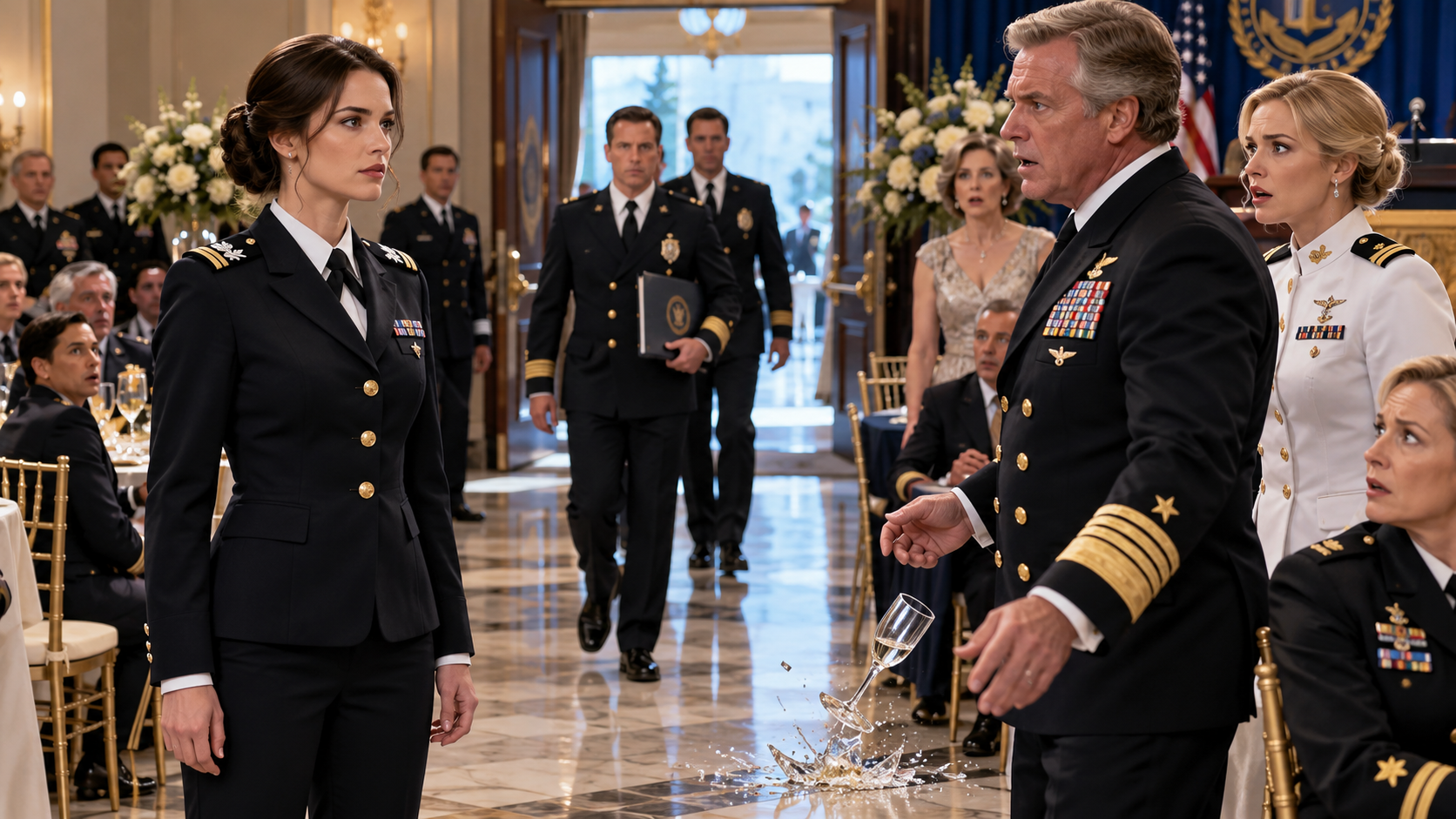
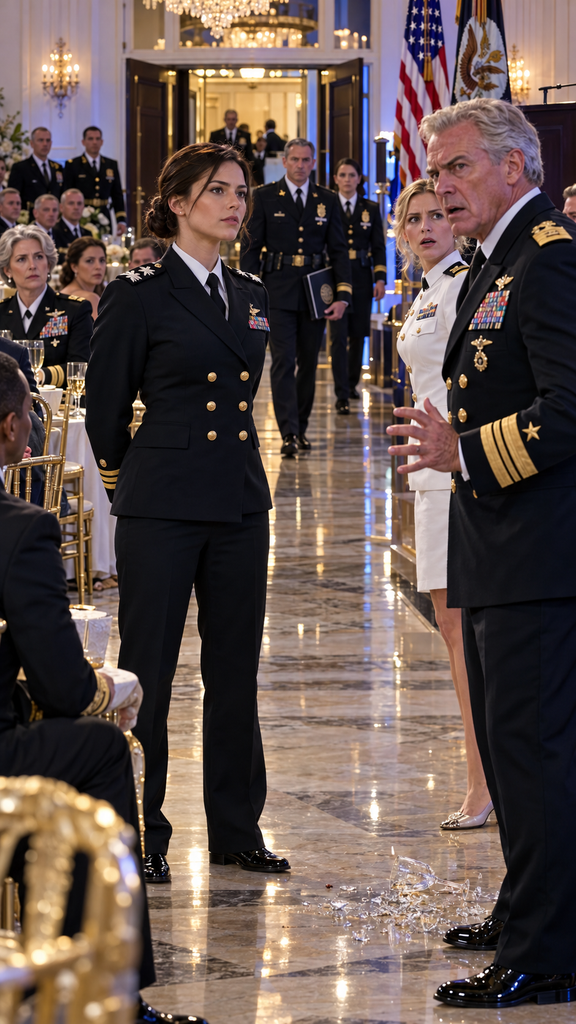
My father was raising a champagne glass to my stepsister when I walked into the Navy reception wearing the exact rank he had told everyone I would never receive.
Admiral Marcus Vale stood beneath a row of blue-and-gold command banners, one hand resting proudly on Tessa’s shoulder while photographers crowded near the stage.
“To Commander Tessa Vale,” he said, his voice carrying effortlessly through the reception hall. “The youngest commander in our family.”
People applauded.
Tessa smiled.
My stepmother, Claire, dabbed at the corner of one eye as though she were watching a wedding.
Then my father saw me.
His glass slipped from his hand.
It struck the polished floor and shattered.
The applause died almost immediately.
I had imagined that moment more times than I wanted to admit.
Sometimes, in the weaker versions of the fantasy, Marcus crossed the room and hugged me.
Sometimes he simply stared at the silver oak leaves on my shoulders before giving the smallest nod, the one he reserved for officers who had finally met some invisible standard.
But I had never imagined the question he actually asked.
“Who authorized that rank?”
He didn’t sound confused.
He sounded offended.
That distinction mattered.
For several seconds, no one moved.
I stood halfway down the center aisle in dress whites, surrounded by people who suddenly found the floor, the ceiling, and their champagne glasses fascinating.
Tessa was still standing beside him.
Her smile had not completely disappeared, but it had changed shape.
She kept looking from my face to my shoulders.
Commander.
The same rank she wore.
The same rank Marcus had spent the evening celebrating as though it belonged exclusively to her.
“This is not your stage, Rowan,” my father said.
His voice was cold and controlled.
I had known that voice all my life.
At home, he used it instead of shouting.
When I was sixteen and challenged him at dinner, he used it.
When I chose the Naval Academy instead of the civilian university he preferred at the time, he used it.
When I selected operational duty instead of the staff assignment he had arranged through one of his old friends, he used it.
Marcus never needed volume.
He could turn a family conversation into a disciplinary hearing with six words and a look.
For years, that had been enough to make me start explaining myself before anyone had even accused me of anything.
That night, something inside me finally refused.
“I never said it was,” I replied.
His eyes hardened.
Behind him, Claire stepped toward the edge of the stage.
“Rowan,” she said softly.
There was warning in her voice.
I ignored it.
My father had spent most of my adult life as one of those men whose reputation entered rooms before he did.
Admiral Marcus Vale.
Thirty-five years of service.
Decorations.
Command appointments.
Strategy panels.
Pentagon assignments.
Photographs with people whose names appeared in newspapers.
He knew personnel officials, senior officers, selection-board veterans, detailers, and people who could change the direction of a career through a five-minute conversation that never appeared in an official record.
Growing up, I had believed that kind of influence was proof of importance.
By the time I was thirty, I understood that influence could also become a weapon.
Tessa accepted his mentoring.
I didn’t.
That was the fracture line between us.
My stepsister was fourteen months older than me, although because our parents married when we were teenagers, strangers often assumed we were biological sisters.
Tessa was disciplined, intelligent, polished, and very good at knowing which doors mattered.
Marcus loved that about her.
He advised her on every assignment.
Which headquarters job would look right.
Which admiral she should work for.
Which professional association dinner she should attend.
Which officers were worth calling after a promotion board.
Tessa listened.
And, to be fair, she worked hard.
Her career wasn’t fake.
She earned her qualifications and her evaluations.
But Marcus had built a road around her and installed signs every hundred yards.
I took a different road.
Operational tours.
Deployments.
Uncomfortable commands.
Assignments that didn’t put me near the people Marcus believed mattered.
I wanted to know whether I could stand on my own.
To my father, that wasn’t independence.
It was defiance.
“You were passed over,” he said.
The words struck harder than his first question.
Something shifted in the room.
Admiral Joanna Price, seated near the front table, slowly lifted her eyes toward him.
Captain Miles Arden, standing near the wall with two other officers from my former command, stopped moving entirely.
Tessa turned toward our father.
That was when my stomach tightened.
She hadn’t merely assumed I failed to promote.
Someone had told her.
Marcus had told her.
I looked directly at him.
“Was I?”
His expression barely changed.
“I saw your status.”
There was absolute certainty in his voice.
The same certainty he had carried into every argument we had ever had.
For a moment I was seventeen again, standing in our kitchen while he told me exactly what I thought, exactly what I wanted, exactly why I was wrong.
Except I wasn’t seventeen.
I wasn’t standing in his kitchen.
And I wasn’t asking his permission.
“You saw what you expected to see,” I said.
His jaw tightened.
Before he could answer, the master of ceremonies touched his earpiece.
His expression changed.
He looked toward the double doors behind me.
They opened.
Two uniformed officers entered.
I recognized the insignia and the identification badges before I recognized either face.
Inspector General.
The senior investigator carried a sealed Navy folder beneath one arm.
I turned toward my father.
Marcus stared at that folder for one second too long.
Not surprise.
Recognition.
Fear.
It vanished quickly, buried under irritation, but I had already seen it.
“Admiral Vale,” the investigator said.
His voice was professional and quiet.
“We need to speak with you.”
Marcus didn’t move.
Instead, he looked directly at me.
“What did you do?”
There it was.
Not congratulations.
Not confusion.
Not even concern.
Accusation.
As if my appearance in commander insignia and the arrival of two investigators had to be parts of the same conspiracy against him.
I almost laughed.
Instead, I said nothing.
“Admiral,” the investigator repeated.
Marcus turned toward him.
“This is a private reception.”
“No, sir,” the investigator replied. “It is an official Navy function.”
A few people looked down.
Marcus knew he’d been corrected.
That made what happened next worse.
His face tightened, and he looked back at my shoulders.
“Those promotion results weren’t supposed to be released until Monday.”
Silence.
Not awkward silence.
Not family silence.
Operational silence.
The kind that falls when everyone in a room realizes something important has just happened.
Admiral Price stood.
Captain Arden lowered his eyes for a moment.
Tessa stared at Marcus.
Even Claire seemed to stop breathing.
Until that sentence, people could have believed my father was simply shocked by an unexpected promotion.
Maybe embarrassed that he had announced the wrong thing publicly.
Maybe hurt that his daughter hadn’t told him.
But now every senior officer in the room was thinking the same question.
How did Admiral Marcus Vale know when my promotion result was supposed to become public?
I let the silence stretch.
Then I said, “My promotion was approved forty-three days ago.”
Tessa looked at me.
I continued.
“My orders were issued last week.”
My father’s expression hardened.
“And my date of rank is three weeks before Tessa’s.”
Tessa actually stepped down from the stage.
“What?”
The word came out barely above a whisper.
She looked at my insignia again.
Then at Marcus.
“She was promoted before me?”
Nobody answered.
Tessa’s face changed slowly as the implications reached her.
“You told me she was passed over.”
“Tessa,” Marcus said. “Not now.”
“You said the board rejected her.”
Claire moved forward quickly.
“There has obviously been some administrative misunderstanding.”
Admiral Price turned toward her.
“No, Mrs. Vale.”
Her voice was calm.
“That possibility was eliminated several weeks ago.”
Several weeks.
The words landed inside me differently from everything else.
Several weeks.
I knew there had been an inquiry.
I knew personnel had reviewed an irregular hold attached to my file.
I knew Captain Arden had been interviewed.
I knew Admiral Price had told me, cryptically, that my promotion status was valid and that I should not discuss the matter outside official channels.
What I had not known was how far the investigation had gone.
Or who it had reached.
The senior investigator stepped closer.
“Admiral Vale, we need you to come with us.”
Marcus stared at me.
“What did you do?”
This time his voice was lower.
Almost dangerous.
I reached inside my jacket.
For one absurd second, half the room seemed to watch my hand.
I removed a folded copy of my promotion orders.
I didn’t give them to my father.
I walked past him and handed them to Admiral Price.
She looked at the first page, then passed them directly to the investigator without the slightest surprise.
That was the moment Marcus understood.
My commander insignia wasn’t the reason the Inspector General had entered the room.
They had been investigating something before I walked through those doors.
Long before his champagne glass shattered.
And when the sealed folder was placed on the table beside the broken pieces of crystal, I realized the question was no longer whether my father had tried to interfere with my promotion.
It was what the Navy had already found inside that file.
PART 2: THE STORY MY FATHER TOLD ABOUT ME
Six months earlier, Marcus had told me I was ruining my career over coffee.
He had invited me to breakfast at a private club near the Pentagon, the kind of place where everyone pretended not to notice rank while noticing absolutely nothing else.
I almost didn’t go.
Then he texted me three times.
Family breakfast.
Important.
Don’t be difficult.
That last message was vintage Marcus.
I went.
He was already seated when I arrived.
No uniform.
Dark suit.
Coffee untouched.
A folder beside his elbow.
For the first ten minutes, we discussed weather, Claire’s upcoming charity event, and Tessa’s latest assignment.
Then he opened the folder.
Inside was a printed career timeline.
Mine.
“You’re reaching the point where choices become consequences,” he said.
I stared at him.
“Good morning to you too.”
“I’m serious.”
“I know.”
He slid the paper toward me.
“You’ve had strong operational evaluations, but you’ve made yourself difficult to place.”
“That’s an interesting way to describe deployments.”
“Don’t be childish.”
There it was.
I leaned back.
He tapped the page.
“You turned down Halsey’s staff.”
“I declined to compete for it.”
“You embarrassed him.”
“No. I told his aide I wanted another sea-duty assignment.”
“Exactly.”
He said it as though I had confessed to sabotage.
“You keep choosing hard assignments because you think hardship proves something.”
“I choose jobs I want.”
“You choose jobs that isolate you from the people who make decisions.”
That sentence stayed with me.
Not because I believed him.
Because he believed himself.
Marcus saw careers as maps of relationships.
Performance mattered, of course.
Competence mattered.
But access mattered too.
I had watched him spend years cultivating people.
Birthdays remembered.
Retirements attended.
Recommendations made.
Calls returned.
Favors accumulated.
He wasn’t corrupt.
At least, I hadn’t believed he was.
He simply understood institutions the way navigators understood currents.
And he believed refusing to use those currents was arrogance.
“You’re up for commander soon,” he said.
“I know.”
“This board matters.”
“They all matter.”
“Don’t do that.”
“Do what?”
“Pretend you don’t understand what I’m saying.”
I folded my arms.
“Then say it plainly.”
He studied me for a long moment.
“You need advocates.”
“I have advocates.”
“You have commanding officers who respect your work. That isn’t the same thing.”
I almost smiled.
“You mean I don’t have your friends.”
“I mean you’ve spent ten years proving you don’t want help.”
“Maybe I want to know what I can earn without it.”
His expression cooled.
“That sentence is exactly your problem.”
I looked toward the window.
Outside, people were moving through the morning rain.
“What do you want from me, Dad?”
It was one of the last times I called him that without thinking.
“I want you to stop treating experience as control.”
“You mean your experience.”
“Yes.”
At least he was honest.
He reached for his coffee.
“Tessa understands this.”
I laughed once.
Of course she did.
Marcus frowned.
“What?”
“Nothing.”
“Say it.”
“You always get to Tessa eventually.”
“This isn’t about Tessa.”
“It becomes about Tessa every time.”
“She listens.”
“And I don’t.”
“You resist advice simply because it comes from me.”
“No. I resist instructions disguised as advice.”
His eyes narrowed.
“Your board will see a record with unnecessary risk.”
“My board will see my record.”
“Boards see what they’re given.”
I looked at him.
Something about the way he said it bothered me.
Not enough to understand why.
Not then.
I pushed the career timeline back toward him.
“I’ll take my chances.”
Marcus stared at the paper between us.
“Stubbornness eventually sends a bill, Rowan.”
I stood.
“Then I’ll pay mine.”
As I walked away, he said my name.
I turned.
For just a second, he looked less like an admiral and more like my father.
Tired.
Frustrated.
Almost afraid.
“You think I’m trying to run your life.”
“Aren’t you?”
“No.”
He paused.
“I’m trying to stop you from learning too late that institutions do not reward people simply because they deserve it.”
I remember that sentence because, months later, I realized it had been both a warning and a confession.
At the time, I just left.
The board convened four months later.
I tried not to think about it.
That was impossible.
Every officer says the same thing during promotion season.
You can’t control the board.
Focus on your job.
Whatever happens, happens.
Then everyone checks their phone every six minutes when results approach.
I was serving as executive officer on an operational planning staff when the first strange thing happened.
Captain Miles Arden called me into his office.
Miles had been my commanding officer during one of the hardest deployments of my career.
He rarely wasted words.
That afternoon, he closed the door before speaking.
“Has anyone contacted you regarding an administrative review?”
I frowned.
“No, sir.”
“Anyone in personnel?”
“No.”
“Legal?”
“No.”
He leaned back.
“Your father?”
That surprised me.
“No.”
Miles watched my face.
“Why?”
He didn’t answer immediately.
“An inquiry came through yesterday requesting documentation related to an evaluation from four years ago.”
I almost laughed.
“Four years?”
“Yes.”
“Which evaluation?”
He named it.
I remembered the deployment instantly.
We had been operating under brutal conditions.
During a logistics crisis, I had authorized a change in schedule that delayed one exercise but protected maintenance hours for exhausted personnel.
The decision had been reviewed.
Approved.
Documented.
My final evaluation had praised my judgment.
“What are they reviewing?”
“That,” Miles said, “is what I asked.”
“And?”
“No clear answer.”
I sat still.
“Is this connected to the board?”
“I don’t know.”
Miles had a way of saying I don’t know that meant he had theories he wasn’t willing to share yet.
He folded his hands.
“Did your father ever discuss that incident with you?”
My stomach tightened.
Once.
At Christmas.
Marcus had called the decision “operationally defensible but professionally visible.”
I had asked what that meant.
He told me senior officers remembered officers who created complications.
I told him exhausted sailors weren’t complications.
The argument lasted twenty minutes.
“Yes,” I said.
Miles nodded once.
“That’s all I needed.”
“Sir.”
He stopped.
“Am I under investigation?”
“No.”
“Then what is happening?”
“I don’t know yet.”
That was the first lie Miles ever told me.
A protective lie, maybe.
But still a lie.
Two weeks later, my father called.
“You heard anything?”
I was standing outside a briefing room.
“About?”
“The board.”
“No.”
A pause.
Then Marcus said, “Prepare yourself.”
Every muscle in my shoulders tightened.
“For what?”
“Disappointment.”
I felt cold.
“Why would you say that?”
“Because I know how these things work.”
“That isn’t an answer.”
“Rowan.”
“No. You called me. Tell me what you’re talking about.”
His voice changed.
“Your record has vulnerabilities.”
“You’ve been saying that for years.”
“And you’ve been refusing to listen for years.”
“Do you know something?”
Silence.
Not long.
Maybe two seconds.
But I heard it.
Then he said, “I know enough.”
The call ended badly.
Most calls with Marcus did.
Three days later, Tessa texted me.
I didn’t know what had happened between you and Dad, but you don’t have to turn everything into a war.
I stared at the message.
Then typed:
What did he tell you?
The typing indicator appeared.
Disappeared.
Appeared again.
Finally:
Nothing. Forget it.
I called her.
She didn’t answer.
The next morning, an administrative hold appeared in my personnel account.
No explanation.
No accusation.
Just a code.
Temporary review.
I sat at my desk staring at the screen until the letters blurred.
Then I called personnel.
The lieutenant who answered sounded uncomfortable almost immediately.
“Commander—”
“I’m not a commander.”
A pause.
“Right. Sorry. Lieutenant Commander Vale.”
My heart jumped.
Why had he said commander?
“What is the hold?”
“I’m not authorized to discuss the underlying review.”
“What review?”
“I can tell you it’s administrative.”
“Based on what?”
“I don’t have that information.”
“Who initiated it?”
Another pause.
“I can’t provide that.”
I thanked him because training dies hard, disconnected, and sat completely still.
Five minutes later, Admiral Joanna Price called me.
I had met her only twice.
She was three levels above me in my reporting chain.
“Lieutenant Commander Vale.”
“Yes, ma’am.”
“You’ve seen the hold.”
It wasn’t a question.
“Yes, ma’am.”
“Do not contact outside personnel channels about it.”
I frowned.
“Ma’am?”
“Do not call anyone privately. Do not ask family members to make inquiries. Do not engage with anyone who claims they can fix it.”
My mouth went dry.
“I wasn’t planning to.”
“I know.”
Her tone softened by half a degree.
“Continue performing your duties.”
“Yes, ma’am.”
“And Rowan?”
It was the first time she had used my first name.
“Yes?”
“Keep copies of everything.”
The line disconnected.
That night, Marcus called again.
I watched the phone ring.
Then stop.
He called a second time.
I answered.
“What?”
He didn’t react to my tone.
“I heard there’s an issue.”
Every instinct in my body sharpened.
“What issue?”
“With your record.”
“Where did you hear that?”
“People talk.”
“Which people?”
“Don’t interrogate me.”
“Then stop calling with information you shouldn’t have.”
His silence told me more than his words.
Finally, he said, “This is what I warned you about.”
I looked at the dark window of my apartment.
“What exactly did you warn me about?”
“That eventually your choices would be reviewed by people who don’t share your interpretation of them.”
“My interpretation?”
“You’ve always assumed good intentions excuse poor positioning.”
There was something beneath the sentence.
Something ugly.
For years, I had heard criticism from my father and translated it into concern.
High standards.
Tough love.
Generational differences.
That night, for the first time, I wondered whether I had been translating him incorrectly.
“Did you have something to do with this?”
The silence was different now.
Longer.
Then he laughed once.
“You think I control Navy personnel?”
“I think you know a lot of people.”
“So do you.”
“Not like you.”
“Be careful, Rowan.”
My grip tightened around the phone.
“Is that advice?”
“Yes.”
“It sounds like a threat.”
“That says more about you than me.”
He hung up.
I stood in my apartment for a long time with the phone still pressed to my ear.
Three days later, Inspector General personnel requested an interview.
That was when everything changed.
PART 3: WHAT HE KNEW
The investigator’s name was Commander Ethan Ross.
He didn’t tell me what the investigation concerned.
He told me what it did not concern.
“You are not the subject.”
We were sitting in a secure conference room with no windows.
A legal officer sat beside him taking notes.
I placed my phone in a lockbox outside before entering.
“Then why am I here?”
“To establish a timeline.”
“Of what?”
Ross studied me.
“Any conversations you’ve had with Admiral Vale concerning your promotion board, personnel status, assignments, evaluations, or administrative record during the last twelve months.”
Hearing my father’s name made something inside me go still.
I had suspected.
I hadn’t wanted to be right.
“You’re investigating my father.”
“I didn’t say that.”
“You didn’t have to.”
His expression didn’t change.
“Start with the earliest relevant conversation you remember.”
So I did.
The breakfast.
The career timeline.
The discussion about advocates.
His warning that boards saw what they were given.
The Christmas argument about my old deployment decision.
His call telling me to prepare for disappointment.
His claim that he “knew enough.”
Ross interrupted only to clarify times and dates.
When I finished, he asked, “Did Admiral Vale ever offer to contact anyone on your behalf?”
“Many times.”
“For this promotion cycle?”
“Yes.”
“What did you say?”
“No.”
“Every time?”
“Yes.”
“Why?”
I looked at him.
“Because he’s my father.”
Ross waited.
“That isn’t illegal.”
“I didn’t say it was.”
“I wanted my record considered on its own.”
He wrote something.
“Did Admiral Vale object?”
“Yes.”
“How?”
“He called me stubborn.”
“Anything else?”
I almost smiled.
“You want the complete list?”
The legal officer lowered her eyes, hiding what might have been amusement.
Ross didn’t smile.
“Yes.”
So I gave it to him.
Difficult.
Naive.
Proud.
Self-sabotaging.
Ungrateful.
Idealistic.
Professionally immature.
Most had been delivered in calm tones over expensive dinners.
Ross finally closed his notebook.
“One more question.”
“All right.”
“Did Admiral Vale ever tell you that you had been passed over?”
“No.”
Not yet.
“Did he imply it?”
“Yes.”
“When?”
“The call I mentioned.”
“Exact words?”
“Prepare yourself. I asked what for. He said disappointment.”
Ross nodded.
The interview ended.
I walked outside feeling as though someone had opened a door in my family and shown me a room that had always been there.
I still didn’t know what was inside.
But I couldn’t pretend the wall was solid anymore.
Weeks passed.
The administrative hold remained.
Marcus called twice.
I didn’t answer.
Claire texted me once.
Your father is under enormous stress. Whatever disagreement you two are having, please don’t make it worse.
I stared at that message for several minutes.
Then I deleted it.
Not because I hated Claire.
I didn’t.
She had spent twenty years trying to smooth every sharp edge in our family.
When Marcus insulted me, she translated.
He worries about you.
When I fought back, she softened it for him.
Rowan is under pressure.
When Tessa and I became competitive, Claire called it sibling tension.
Nothing was ever what it was.
Everything had another name.
I was tired of renamed wounds.
A week before the reception, Admiral Price summoned me.
This time we met in her office.
She pointed to the chair opposite her desk.
I sat.
“Your promotion status has been cleared.”
For several seconds, I forgot how to speak.
“Ma’am?”
“The administrative review found no basis to delay your advancement.”
My heart slammed once against my ribs.
“Was I selected?”
Price looked at me.
“Yes.”
The room went very quiet.
I had spent months telling myself I could accept either result.
That promotion did not define competence.
That careers ended.
That boards were imperfect.
That I had chosen my path with open eyes.
None of those truths stopped the rush of relief.
I looked down at my hands.
“When?”
“Your selection was approved thirty-six days ago.”
I looked up sharply.
“Thirty-six?”
“Yes.”
“Then why wasn’t I told?”
“Because your name was temporarily withheld pending administrative review.”
The pieces began moving.
Marcus telling me to prepare for disappointment.
His strange certainty.
The unexplained hold.
“Who initiated the review?”
Price’s expression became unreadable.
“I can’t discuss an active Inspector General matter.”
My pulse quickened.
“Is it connected to my father?”
She paused.
That pause was enough.
“Ma’am.”
“Lieutenant Commander Vale, what I can tell you is that your record was independently reviewed. The underlying issue raised against you was determined to have no material basis.”
“What issue?”
“The judgment call during your deployment under Captain Arden.”
I almost laughed.
“That was four years ago.”
“I know.”
“It was already reviewed.”
“I know.”
“My evaluation praised the decision.”
“I know.”
I looked at her.
“Then why was it raised now?”
Price folded her hands.
“That is part of the inquiry.”
I felt anger then.
Not the explosive kind.
The cold kind.
The kind that makes everything sharpen.
“Someone used that incident to hold my promotion.”
“Someone caused it to be reexamined.”
“And it delayed notification.”
“Yes.”
“Could it have stopped the promotion?”
“If the review had found actionable material, your status could have remained withheld.”
I looked away.
Outside her office, the Navy continued functioning.
Phones rang.
Doors opened.
People moved down corridors.
Inside that room, my entire understanding of the previous six months changed.
“What happens now?”
“Your orders will be issued.”
“And the investigation?”
“Continues.”
I looked back at her.
“Do I need to do anything?”
“Yes.”
“What?”
“Do your job.”
I almost laughed again.
Price’s expression softened.
“And attend the reception next Friday.”
My stomach tightened.
Tessa’s reception.
It had been planned for weeks.
Marcus had practically turned her promotion into a family ceremony.
“I don’t think that’s a good idea.”
“I didn’t ask whether it was comfortable.”
That sounded like something Marcus would say, but without the control behind it.
Price continued.
“You were invited before your promotion status was resolved.”
“Yes.”
“You remain invited.”
“Yes, ma’am.”
“Your date of rank will precede Commander Tessa Vale’s by three weeks.”
I stared at her.
She let me absorb that.
Then she added, “Wear the appropriate uniform.”
I understood immediately.
“You want me to wear commander insignia.”
“I want you to wear the rank you hold.”
“Does my father know?”
“I cannot discuss what Admiral Vale knows.”
There was something strange in her tone.
Not evasive.
Careful.
I stood to leave.
At the door, she stopped me.
“Rowan.”
I turned.
“If anyone asks you questions concerning the investigation, do not speculate.”
“Yes, ma’am.”
“And if someone reacts badly to your promotion, allow them to react.”
I frowned.
“Ma’am?”
“Do not protect people from the consequences of their own words.”
I thought about that sentence while dressing for the reception.
I thought about it while fastening the silver oak leaves to my uniform.
I thought about it while sitting in my car outside the venue, hands resting on the steering wheel.
Part of me wanted to leave.
Not because I was ashamed.
Because I knew exactly what Marcus would see when I walked inside.
Not my achievement.
Disobedience.
I almost texted Tessa.
I didn’t.
Then I remembered being twenty-three and calling Marcus after earning my warfare qualification.
He had congratulated me.
Then immediately asked how I ranked against the other officers.
I remembered earning my first department-head recommendation.
He asked why it hadn’t come six months earlier.
I remembered returning from deployment exhausted and proud, waiting for him to ask what I had learned.
Instead, he told me Tessa had been selected for a prestigious staff billet.
For years, I had believed there was some achievement large enough to cross the distance between us.
One more qualification.
One more strong evaluation.
One more deployment.
One more rank.
Sitting in that car, I understood something painful.
The distance had never been created by my lack of achievement.
It came from my refusal to let him own it.
So I got out.
I walked into the reception.
And his champagne glass hit the floor.
PART 4: INSIDE THE FOLDER
After Marcus’s remark about the Monday release, the reception effectively ended without anyone announcing it.
The music stopped.
The photographer lowered his camera.
Someone quietly moved junior officers away from the center of the room.
Tessa remained near the stage, staring at our father.
Marcus finally turned toward the investigator.
“I assume you have written authorization for whatever this is.”
Commander Ross answered, “Yes, sir.”
I recognized him immediately.
The same investigator who had interviewed me.
That realization made my chest tighten.
Marcus glanced toward me.
He saw recognition in my face.
His own expression changed.
“You knew.”
“No,” I said.
“You knew they were coming.”
“I knew there was an investigation.”
Claire made a small sound.
Tessa stared at me.
“You knew Dad was being investigated?”
“I knew there was an investigation connected to my personnel hold.”
Marcus stepped toward me.
“Be very careful what you imply.”
For the first time in my life, his anger did not make me afraid.
Maybe because there were too many witnesses.
Maybe because the insignia on my shoulders felt heavier than his voice.
Or maybe because I finally understood the mechanism.
Marcus had always possessed power over me partly because I believed he knew more.
About the Navy.
About people.
About my career.
About what was possible.
Once I realized he had been using certainty as a substitute for truth, the spell broke.
“I don’t have to imply anything,” I said.
Ross stepped between us without making the movement dramatic.
“Admiral Vale, we’ll continue this conversation elsewhere.”
Marcus looked toward Admiral Price.
“Joanna.”
She didn’t respond.
“You allowed this?”
Price’s face remained calm.
“I complied with the Inspector General.”
“At my daughter’s promotion event.”
“Tessa’s promotion event,” Price corrected.
A flicker of humiliation crossed his face.
He looked around the room.
People were watching.
For Marcus, that might have been the worst part.
Not the investigation.
Not the accusation.
The audience.
He had spent decades controlling how rooms understood him.
That night, the room was forming its own opinion.
Tessa moved closer.
“Dad, tell me the truth.”
“Tessa, go home.”
“No.”
His head turned sharply.
She almost stepped back.
Almost.
Then she said, “You told me Rowan failed the board.”
“I told you what I believed.”
“No.”
Her voice cracked.
“You told me you knew.”
He didn’t answer.
Tessa’s face went pale.
I had spent years resenting her for being the daughter Marcus celebrated.
In that moment, I saw something I had missed.
She had been living inside his system too.
The difference was that she had followed the rules.
That didn’t mean she understood who had written them.
Claire touched Marcus’s arm.
“We should go.”
He pulled away.
Ross lifted the sealed folder.
“Sir.”
Marcus stared at it.
“What exactly are you alleging?”
“I am not discussing findings in this room.”
“Then stop creating theater.”
Ross’s expression remained neutral.
“I asked to speak with you privately twice.”
Several officers looked away.
Marcus had no answer.
He walked out with the investigators.
Claire followed.
Before leaving, she looked at me.
There was fear in her expression.
And something else.
Not anger.
Not quite.
Recognition.
As though some argument she had been having with herself for years had finally become impossible to avoid.
The doors closed behind them.
For several seconds, nobody spoke.
Then Tessa turned toward me.
“Did you know?”
I shook my head.
“Not that he was the focus.”
“But you suspected.”
“Yes.”
She looked down.
“Why didn’t you tell me?”
I nearly said, Because you never asked.
The sentence reached my mouth.
I stopped it.
Because that would have been Marcus speaking through me.
So I gave her the truth instead.
“Because I didn’t know what was true yet.”
She looked toward the doors.
“He told me you were passed over two weeks ago.”
My stomach tightened.
“Two weeks?”
“Yes.”
That was before my orders were issued.
Before the public release.
Before anyone in our family should have known the result.
“What exactly did he say?”
Tessa swallowed.
“We were having dinner. I asked whether you’d heard anything. He said your name wasn’t moving forward.”
“Those words?”
“Yes.”
“Did he say how he knew?”
“He said he had checked.”
Admiral Price had approached quietly.
Tessa looked at her.
“Is that important?”
Price answered carefully.
“It may be.”
Tessa’s eyes filled.
She blinked hard.
“I thought she lost.”
The confession was barely audible.
Then she looked at me.
“And part of me was relieved.”
I appreciated that more than an apology.
Because it was true.
We had been turned into a competition so gradually neither of us remembered when it began.
Every milestone compared.
Every assignment measured.
Every compliment balanced.
Marcus had never needed to tell us we were competing.
He simply placed our achievements side by side until we learned to do it ourselves.
“I know,” I said.
Tessa looked startled.
“I was jealous of you too.”
“For what?”
I almost laughed.
“For being easy for him to love.”
Her face broke.
Not dramatically.
Just enough.
“Oh, Rowan.”
That was the first time I understood she had never felt easy either.
Admiral Price gave us a moment, then said, “Commander Vale.”
Both Tessa and I looked at her.
For one absurd second, she almost smiled.
“Rowan.”
“Yes, ma’am.”
“You may be contacted for another interview.”
“I understand.”
“Tessa may be as well.”
Tessa nodded.
Price left.
Captain Arden approached next.
He had remained near the wall through everything.
“You all right?” he asked.
“No.”
“Good answer.”
I looked at him.
“You knew more than you told me.”
“Yes.”
“How much?”
“Enough to know the review smelled wrong.”
“Why?”
“Because the question they asked about your old deployment decision didn’t come through normal channels at first.”
My stomach tightened.
“What do you mean?”
“Someone called me privately.”
“Who?”
Miles hesitated.
“An officer on Admiral Vale’s staff.”
I felt cold.
“He called you?”
“Asked whether I’d ever had concerns about your judgment.”
“Before the administrative review?”
“Yes.”
“How long before?”
“Two days.”
That was the moment the last part of me that wanted an innocent explanation finally went quiet.
“What did you say?”
“I said your decision had been reviewed four years ago and I considered the matter closed.”
“And then?”
“He asked whether I’d be willing to put concerns in writing.”
My jaw tightened.
“Concerns you didn’t have.”
“Correct.”
“Why didn’t you tell me?”
“Because I reported the contact.”
“To Price?”
“Eventually.”
He looked toward the doors.
“Rowan, I didn’t know where it would go. At first I thought someone was doing an overly aggressive records check. Then another officer called.”
“Who?”
“Personnel.”
He lowered his voice.
“They asked why I had raised concerns about you.”
I stared at him.
“But you hadn’t.”
“No.”
“So somebody told personnel you had.”
Miles nodded.
That was worse.
Not because it was more dramatic.
Because it was more precise.
Someone had tried to manufacture the appearance of concern.
Not fabricate an incident.
The incident was real.
That was what made the strategy clever.
Take a documented decision.
Strip away context.
Suggest unresolved questions.
Trigger a review.
Delay the promotion.
Nothing obvious enough to look like sabotage from a distance.
Everything deniable.
“Was it him?” I asked.
Miles held my gaze.
“That is what the Inspector General has been determining.”
I looked toward the table where Marcus’s broken champagne glass had been cleared away.
The sealed folder was gone.
For the first time, I wanted desperately to know what was inside it.
Three days later, I found out.
Commander Ross called me back.
Same secure room.
Same legal officer.
This time Admiral Price was present.
Ross placed a folder on the table.
Not the original.
A working copy.
“We have concluded the portion of the inquiry concerning your promotion status.”
I sat very still.
“What did you find?”
Ross opened the folder.
“Admiral Vale accessed pre-release promotion information through an authorized system available to his office for official personnel-planning purposes.”
I felt my heartbeat in my throat.
“Was he allowed to see my result?”
“His office had access to the broader data set.”
“That isn’t what I asked.”
“No.”
Ross looked directly at me.
“There was no official requirement for him to query your individual status.”
I said nothing.
He continued.
“Records show your promotion status was accessed from his credentials eleven days before he told Commander Tessa Vale that you had been passed over.”
My mouth went dry.
“But I wasn’t passed over.”
“No.”
“Then why did he tell her that?”
“We cannot establish motive as fact.”
Price spoke next.
“What we can establish is sequence.”
Ross turned a page.
“Your name was selected.”
Another page.
“Admiral Vale accessed the pre-release list.”
Another.
“Within forty-eight hours, a member of his staff contacted Captain Arden regarding the deployment decision in your record.”
Another page.
“Two days later, an informal personnel query was made asking whether unresolved judgment concerns existed.”
Another.
“Personnel interpreted the query as originating from a legitimate senior-level concern and initiated a temporary administrative review.”
I stared at the pages.
Each event alone could be explained.
Together, they formed a line.
A line leading directly from my father seeing my selection to my promotion being withheld.
“Did he order his staff officer to call Captain Arden?”
Ross paused.
“Yes.”
The word hurt more than I expected.
I looked down.
For months, part of me had hoped Marcus had simply heard rumors.
Maybe someone had misunderstood.
Maybe his arrogance had made him overconfident.
Maybe he had meddled without understanding the effect.
That last possibility disappeared.
“What exactly did he ask his staff to do?”
“Determine whether the deployment decision reflected a pattern of judgment concerns that had not been adequately documented.”
I almost laughed.
There was no humor in it.
“He knew it didn’t.”
Ross didn’t respond.
“He knew because I argued with him about the report. He knew Miles had defended the decision.”
Still no response.
I looked at Price.
“He wasn’t checking.”
“No,” she said quietly.
“He was looking for something.”
“Yes.”
“After he found out I had been selected.”
Price did not answer.
She didn’t need to.
Ross continued.
“We also recovered correspondence showing Admiral Vale contacted a personnel official after the hold was created.”
My fingers curled against my knees.
“What correspondence?”
“He asked whether the review could remain in place through the public release date.”
For several seconds, I heard nothing.
No ventilation.
No pen moving.
Nothing.
I looked at Ross.
“Why?”
“He stated that releasing your selection while questions remained could create institutional embarrassment.”
I felt something inside me collapse.
Institutional embarrassment.
Marcus had spent my entire life taking personal desires and dressing them in respectable language.
Control became guidance.
Criticism became standards.
Favoritism became mentorship.
And now sabotage had become concern for institutional embarrassment.
“Did the personnel official agree?”
“No.”
Ross turned another page.
“The request was considered unusual and was referred upward. That referral contributed to the Inspector General review.”
I looked at Price.
“So that’s how you got involved.”
“Yes.”
“Did he ask anyone to remove me from the list?”
Ross chose his words carefully.
“We found no evidence that Admiral Vale attempted to alter the selection board’s vote or falsify the official result.”
I exhaled.
That distinction mattered.
“However,” he continued, “we found evidence that after learning you had been selected, he used his position to initiate scrutiny outside ordinary channels and subsequently advocated extending the resulting hold.”
There it was.
Not a dramatic conspiracy.
Not a forged document.
Something more believable.
My father had found out I had succeeded without him.
And he had tried to create enough doubt to stop the success from becoming visible.
I thought of the breakfast.
Boards see what they’re given.
I thought of his warning.
Prepare yourself.
I thought of his call after the hold appeared.
This is what I warned you about.
My stomach turned.
He hadn’t predicted the consequence.
He had helped create it.
“Why did he think I was passed over?”
Ross answered.
“We believe he assumed the hold would remain through the release cycle.”
“So when he told Tessa I had been rejected…”
“He could not have known that from official results,” Ross said.
“Because it wasn’t true.”
“Correct.”
I sat back.
That was why he had looked at my insignia as though it were an administrative error.
His plan had failed somewhere he hadn’t expected.
The hold had been reviewed.
The allegation had collapsed.
My promotion had cleared.
And nobody had told him in time.
His shock at the reception had been genuine.
Just not for the reason anyone initially thought.
Price closed the folder.
“There is another matter.”
I looked at her.
“Tessa’s promotion.”
My body tensed.
“What about it?”
“There is no evidence Admiral Vale improperly influenced her selection.”
Relief came so quickly I almost felt guilty.
Tessa had earned it.
Whatever else existed between us, I didn’t want her career destroyed because Marcus had built too much of his identity around it.
Price continued.
“Her record and selection are not part of the misconduct finding.”
I nodded.
“Good.”
Ross looked at me.
“You may be asked to provide testimony during subsequent administrative proceedings.”
“What happens to him?”
“I can’t predict final disposition.”
Of course he couldn’t.
The Navy moves carefully when careers, due process, and senior officers are involved.
Real accountability rarely arrives with dramatic music.
It arrives through memoranda.
Statements.
Reviews.
Recommendations.
Findings.
Signatures.
But before I left, Ross said one thing I would remember for the rest of my life.
“Commander Vale.”
I turned.
“Your promotion was not restored.”
I frowned.
He continued.
“It was never his to take.”
I walked out of that building wearing silver oak leaves that suddenly felt lighter.
PART 5: THE RANK WAS NEVER THE POINT
Marcus called me that night.
I almost let it ring.
Then I answered.
“Rowan.”
His voice sounded tired.
Not weak.
Marcus never sounded weak.
But something had been stripped from him.
“What do you want?”
“We need to talk.”
“We are talking.”
“Not by phone.”
“No.”
A pause.
“I’m still your father.”
For years, those words would have worked.
Not because they meant anything specific.
Because they carried obligation.
Family.
History.
Guilt.
This time I heard the sentence differently.
“I know who you are.”
He inhaled slowly.
“You’ve heard their version.”
I closed my eyes.
“Their version?”
“The Inspector General has reduced months of legitimate concern into a narrative.”
“You accessed my result.”
Silence.
“You had your staff call Captain Arden.”
Silence.
“You triggered a review of something that had been resolved four years earlier.”
“I raised a concern.”
“After you found out I was selected.”
“You don’t understand the responsibility senior leaders have.”
I almost laughed.
There he was.
Back behind the uniform.
“I understand perfectly.”
“No, you don’t.”
His voice sharpened.
“Your record contained a decision that could have been interpreted differently under board scrutiny.”
“The board had already selected me.”
“That doesn’t make the decision irrelevant.”
“It made it irrelevant to you until you saw the result.”
Silence.
I continued.
“You didn’t question that decision when I made commander candidate lists.”
“You don’t know what I questioned.”
“You didn’t question it when I deployed again.”
“Rowan—”
“You didn’t question it when I received my evaluation.”
“Stop.”
“You didn’t question it until you found out I had been selected without taking the path you built for me.”
“Stop.”
For the first time, he raised his voice.
I went silent.
He breathed heavily into the phone.
Then, quieter, he said, “You think this was about punishing you.”
“What was it about?”
“You were becoming exactly the officer I warned you not to become.”
I stared at the wall.
“Meaning?”
“Talented. Respected. And convinced talent protects you from politics.”
“So you tried to teach me a lesson.”
“No.”
“You tried to delay my promotion.”
“I tried to make sure the institution had examined the whole record.”
“By extending the hold past public release.”
He said nothing.
“They found the message, Marcus.”
I called him by his first name deliberately.
He noticed.
“Don’t.”
“Why?”
“I am your father.”
“And I am an officer whose personnel status you accessed without a legitimate reason.”
His breath caught.
Not much.
Enough.
“You don’t get to switch between those identities depending on which one gives you power.”
“That is an outrageous thing to say.”
“No. It’s accurate.”
I stood and walked toward the window.
The city outside was scattered with lights.
“You told Tessa I failed.”
“I believed the hold would—”
“You lied to her.”
“I believed—”
“You knew the board selected me.”
Silence.
“You knew.”
More silence.
“You saw the list.”
Finally, he said, “Yes.”
The word settled between us.
I expected anger.
Instead, I felt something close to grief.
Not because I had lost my father that night.
Because I realized how long ago I had been losing him.
Piece by piece.
Every achievement turned into criticism.
Every disagreement treated as insubordination.
Every independent choice interpreted as rejection.
Marcus didn’t want me to fail in life.
That would have been simpler.
He wanted me to succeed in a way that proved he had been right.
When I succeeded differently, the success itself became threatening.
“Why?” I asked.
He didn’t answer.
“Why did it matter so much?”
“You don’t understand.”
“Then explain it.”
Another long pause.
When he finally spoke, his voice was lower.
“I spent my career learning how this institution works. I tried to give you everything I knew.”
“I didn’t want everything.”
“That was the insult.”
There it was.
Small.
Human.
Ugly.
Not strategy.
Not institutional concern.
Not leadership.
Hurt pride.
I closed my eyes.
“I wasn’t insulting you.”
“You rejected every opportunity I created.”
“I chose my own opportunities.”
“You made a point of it.”
“Because every time I accepted your help, it became proof that I owed you the next decision.”
“That isn’t true.”
“It is.”
“You always needed someone to fight.”
“No.”
My voice stayed calm.
“I needed a father who could watch me choose differently without treating it as betrayal.”
He said nothing.
So I said the thing I had spent years trying not to admit.
“I kept thinking there would be one achievement big enough for you.”
His breathing changed.
“One qualification. One deployment. One evaluation. One promotion. Something that would finally make you proud without adding a correction afterward.”
“Rowan—”
“But there wasn’t.”
“That isn’t fair.”
“I made commander.”
Silence.
“Your first question was who authorized it.”
He had no answer.
That hurt more than I expected.
Eventually, he said, “I was shocked.”
“No.”
I looked at my reflection in the glass.
“You were angry.”
“You walked into Tessa’s reception wearing an unreleased promotion.”
“It was my rank.”
“You knew what it would do.”
I almost smiled.
There it was again.
My achievement transformed into an action against him.
“I walked into a Navy reception wearing the uniform I was ordered to wear.”
“You could have told me.”
“You told everyone I had been passed over.”
He went quiet.
Then he said something astonishing.
“I was trying to protect the family.”
I actually laughed.
One short sound.
“From what?”
He didn’t answer.
“From having two commanders?”
“Don’t be ridiculous.”
“From Tessa not being first?”
“This had nothing to do with Tessa.”
“Then what were you protecting?”
His silence answered.
His story.
The family Marcus had built in his head had roles.
He was the architect.
Tessa was the daughter who listened and succeeded.
I was the daughter who resisted and eventually learned the cost.
If I succeeded without learning his lesson, the story broke.
He had needed me to fail long enough to make the lesson true.
“You weren’t protecting us,” I said.
“You were protecting your version of us.”
He disconnected.
Three weeks later, the Navy announced that Admiral Marcus Vale had been temporarily reassigned from duties involving personnel oversight while administrative proceedings continued.
The wording was careful.
It always is.
Months later, the findings became final.
He received formal administrative action for misuse of position, improper involvement in a subordinate personnel process, and unauthorized use of pre-release information for a purpose unrelated to his official duties.
There was no dramatic courtroom.
No handcuffs.
No public confession.
His stars weren’t ripped from his uniform in front of cameras.
Real institutions rarely deliver justice that way.
But he lost the advisory role that had given him access to personnel systems.
He was removed from several panels.
His retirement, already approaching, came earlier than he had planned.
People who once returned his calls immediately began taking longer.
Some never called back.
For a man like Marcus, that may have been the punishment he understood best.
Tessa called me the day the findings were finalized.
We met at a small restaurant halfway between our apartments.
No uniforms.
No parents.
No champagne.
For the first ten minutes, we talked about nothing important.
Then she put down her fork.
“I owe you an apology.”
“You don’t owe me his apology.”
“No.”
She looked at me.
“I owe you mine.”
I waited.
“I liked being the one he approved of.”
I appreciated the precision of the sentence.
She continued.
“I knew he compared us. I knew it hurt you. And sometimes I let it happen because being on the winning side felt good.”
I looked down at my glass.
“I did things too.”
“Like what?”
“I assumed everything came easily to you.”
She smiled sadly.
“It didn’t.”
“I know that now.”
Tessa leaned back.
“He planned my entire career.”
“You let him.”
“I thought that was what love looked like.”
That sentence hurt.
Because I had thought the opposite.
I believed love from Marcus looked like pressure.
Tessa believed it looked like direction.
Neither of us had understood that love wasn’t supposed to require obedience.
“Are you angry about the date of rank?” I asked.
She blinked.
Then laughed.
For real.
The sound surprised both of us.
“God, yes.”
I laughed too.
“Three weeks.”
“Twenty-one days.”
“I know.”
“Of course you know.”
We sat there laughing over the stupidest part of the entire disaster.
Then Tessa’s expression softened.
“But I’m glad.”
“For what?”
“That you were selected.”
I studied her.
She held my gaze.
“I mean it.”
“I know.”
And I did.
That mattered.
Claire took longer.
She sent me several messages I didn’t answer.
Then, one Sunday afternoon, she arrived outside my apartment.
I almost didn’t open the door.
When I did, she looked older.
“I won’t stay.”
“Okay.”
She held her purse with both hands.
“I knew he made calls.”
My chest tightened.
“How much did you know?”
“Not enough.”
“That isn’t an answer.”
She nodded.
“I knew he was worried about your promotion. I knew he spoke to people. I thought he was trying to help.”
“After I told him not to?”
Claire looked down.
“Yes.”
“Did you know he found out I was selected?”
“No.”
“Did you know he caused the review?”
“No.”
I believed her.
Mostly because Claire had spent her life avoiding direct knowledge of anything that would force her to choose a side.
“But when he told everyone I was passed over?”
Her eyes filled.
“I believed him.”
“You didn’t ask me.”
“I know.”
“Neither did Tessa.”
“I know.”
I stepped back from the door.
For once, Claire didn’t try to translate Marcus.
She didn’t say he loved me.
Didn’t say he was under pressure.
Didn’t say families were complicated.
She simply said, “I should have asked you.”
It wasn’t enough to repair twenty years.
But it was true.
Sometimes truth is where repair starts.
Marcus and I didn’t speak for nearly a year.
People expected that to bother me more than it did.
Maybe I had spent too many years in conversation with him while never actually being heard.
Silence, by comparison, was uncomplicated.
I made commander officially.
There was a small pinning ceremony at my command.
Captain Arden attended.
Admiral Price sent a handwritten note.
Tessa stood beside me.
I had the right to choose who pinned the insignia onto my uniform.
For weeks, I avoided thinking about it.
Tradition made the answer feel obvious.
Parents.
Mentors.
Family.
In the end, I asked two sailors who had served under me during the deployment Marcus later tried to use against me.
One had been a young petty officer during that maintenance crisis four years earlier.
The other had been the chief who told me, quietly, that half the watch team was too exhausted to keep pretending everything was fine.
They were the reason I made the decision Marcus called professionally dangerous.
When they pinned the silver oak leaves onto my shoulders, I remembered exactly why I had chosen the harder path.
Not because hardship made me noble.
Not because suffering proved independence.
Because leadership had to mean something when nobody important was watching.
After the ceremony, I stood alone for a few minutes in the empty room.
I touched the insignia on my collar.
For most of my career, I had imagined rank as evidence.
Evidence that I belonged.
Evidence that Marcus had underestimated me.
Evidence that my choices had been right.
But the strangest thing about finally wearing commander insignia was realizing I didn’t need it to prove any of those things.
The board had selected me.
The Navy had investigated the interference.
The facts had survived.
That mattered.
But the deeper victory happened before the reception.
It happened when I put on my uniform knowing Marcus might disapprove and walked through the door anyway.
Nearly eighteen months after the broken champagne glass, I saw him again at another Navy event.
He was retired by then.
No uniform.
Dark suit.
Silver hair.
For once, no cluster of officers around him.
He saw me across the room.
I saw the hesitation.
Then he walked over.
“Commander.”
It was the first time he had used my rank without irony.
“Admiral.”
“Retired.”
“I know.”
We stood facing each other.
Neither of us seemed to know what came next.
Finally, he looked at my shoulders.
“You’re doing well.”
“I am.”
“I’ve heard.”
Of course he had.
Marcus always heard.
He nodded.
“I was wrong.”
Three words.
No speech.
No excuse.
I had imagined hearing them many times.
In my imagination, they healed something.
Reality was quieter.
“About what?” I asked.
He looked at me.
The old Marcus might have become angry.
This version seemed to understand why I was asking.
“About believing that if you didn’t follow the path I understood, you were choosing the wrong one.”
I waited.
“And?”
His jaw tightened.
Even retired, even diminished, apology did not come naturally.
“And I had no right to interfere with your promotion.”
There it was.
Not perfect.
Not enough to erase anything.
But true.
“Thank you.”
He nodded.
For a moment, I thought he might hug me.
He didn’t.
I was glad.
Some endings shouldn’t be forced into shapes they haven’t earned.
He started to walk away.
“Marcus.”
He stopped.
I had one thing left to say.
“When I walked into Tessa’s reception, you asked who authorized my rank.”
His face tightened.
“I remember.”
“I spent years thinking you were the person who had to.”
He looked at me.
“The promotion board?”
“No.”
I touched the silver oak leaf on my shoulder.
“My life.”
Neither of us spoke.
Then I said, “You weren’t.”
Something in his face changed.
Pain, maybe.
Understanding, if I was generous.
He gave one slow nod.
Then he walked away.
I watched him disappear into the crowd.
For years, I had wanted to defeat my father in some final confrontation.
I had imagined exposing him, proving him wrong, watching him regret every comparison and criticism.
But standing there, I understood that revenge had never been what I wanted.
I wanted ownership.
Of my career.
Of my choices.
Of my failures.
Of my success.
Of the story Marcus had spent years trying to narrate for me.
That was what he had nearly taken.
Not the promotion.
Not the rank.
The right to decide what my own life meant.
He failed.
The silver oak leaf on my shoulder caught the light as I turned back toward the reception.
This time, no glass shattered.
No room went silent.
No one demanded to know who had authorized me to stand there.
And for the first time in my life, I didn’t look for my father’s face to see whether I had done enough.
I already knew.
The rank had never been his to give me.
Neither had the permission.
Leave a Reply