

PART 1: THE WOMAN HE ERASED
His mistress canceled my dress fitting for the Whitmore Foundation Gala and told the designer my husband wanted “a cleaner image.”
By the end of that night, the room he planned to erase me from would no longer belong to him.
But the dress was not the secret that made his face go pale.
My name is Isabel Whitmore Hawthorne, and the day Beckett underestimated me was the day he destroyed himself.
It started at 9:04 on a Tuesday morning.
I remember the exact time because I was standing barefoot on cold marble in the bathroom of our Greenwich mansion, staring at a pregnancy test I had forgotten to throw away.
Not the last one.
An older one.
Negative.
I had found it behind a box of cotton pads while clearing out a drawer I hadn’t opened in months.
For several seconds, I simply stood there with it in my hand.
There had been a time when those little white sticks controlled my entire life.
Negative meant crying in the shower so Beckett wouldn’t hear.
Positive meant standing absolutely still because happiness suddenly felt too dangerous to touch.
Then, finally, after almost three years of treatments, appointments, injections, whispered prayers, and pretending I didn’t envy pregnant strangers in grocery stores, there had been two lines.
For eleven weeks, I had believed I was going to become a mother.
Then came the blood.
The hospital.
The ultrasound technician’s silence.
The doctor who wouldn’t quite meet my eyes.
And Beckett, telling me from across a fluorescent room that he had an important board dinner he couldn’t miss.
My phone rang.
I put the old pregnancy test on the marble counter.
Elise Marlowe.
My dress designer.
“Elise?”
“Mrs. Hawthorne.”
Her voice was calm.
Too calm.
People who worked around families like mine learned how to deliver humiliations as if announcing changes to the weather.
“There has been a complication regarding Thursday evening.”
I looked at myself in the mirror.
Pale skin.
Dark hair tied carelessly at the nape of my neck.
No makeup.
My wedding ring still on my finger.
“What complication?”
Elise hesitated.
“A woman named Sloane Mercer contacted my assistant this morning.”
Of course she had.
“And?”
“She informed us that your attendance at the Whitmore Foundation Gala has been withdrawn by your husband’s office.”
For a moment, the entire room seemed to go perfectly still.
Not because I was shocked.
That was the strange part.
Three months earlier, the words might have broken something inside me.
That morning, they only confirmed what I already knew.
“Did she say anything else?”
Another pause.
“She said Mr. Hawthorne wants the evening to reflect stability, legacy, and…”
Elise stopped.
“Say it.”
“A cleaner image.”
I almost laughed.
A cleaner image.
Not a happier marriage.
Not an honest separation.
Not a divorce.
Not even a decent lie.
A cleaner image.
That was what I had become to Beckett.
Something inconvenient in the photograph.
Something that could be cropped.
“Elise.”
“Yes?”
“Don’t cancel the fitting.”
Her answer came immediately.
“Of course not.”
“In fact, make the dress sharper.”
I heard the smile she was trying to hide.
“How sharp?”
I looked at the woman in the mirror again.
For nearly a year, I had avoided my own reflection.
After the miscarriage, my body stopped feeling like mine.
Doctors touched it.
Nurses measured it.
Specialists discussed it.
Beckett stopped touching it at all.
I had spent months wearing soft colors and forgiving silhouettes because everyone told me I needed gentleness.
I was finished being gentle for other people’s comfort.
“Deep silver,” I said. “No softness.”
“I understand.”
“No train. No lace. Nothing bridal.”
“Mrs. Hawthorne?”
“Yes?”
“I’ll have it ready.”
Five minutes after I ended the call, Beckett called.
Of course he did.
He had always preferred to let someone else commit the cruelty first so he could arrive afterward pretending to manage the consequences.
“Isabel.”
His voice carried the controlled warmth that once made investors trust him and strangers tell me how lucky I was.
“I heard there was some confusion about your fitting.”
“Was there?”
“Sloane got ahead of herself.”
Mistresses always did.
Especially when husbands made promises they had not yet earned the right to keep.
“I see.”
“I was going to speak with you tonight.”
“You mean after she canceled my dress?”
He sighed.
Not apologetically.
Impatiently.
“Can we not do this?”
“Do what?”
“Turn everything into a confrontation.”
I looked at the wedding ring on my hand.
There had been a time when Beckett could make me question the evidence of my own life simply by sounding tired enough.
I would wonder whether I was being unreasonable.
Emotional.
Suspicious.
Difficult.
That had been before I started keeping copies.
“I think it would be better if you skipped the gala,” he said.
“Better for whom?”
“For everyone.”
He said it gently.
As if humiliating me were mercy.
As if removing Isabel Whitmore from the Whitmore Foundation Gala were an act of compassion.
“You’ve had a difficult year.”
A difficult year.
That was what he called my miscarriage.
Not the baby we had tried almost three years to conceive.
Not the blood.
Not the hospital room.
Not the night I lay under fluorescent lights while my husband sent me a message saying the board dinner was running late.
Not the fertility appointment he missed two weeks later.
Not the lipstick I found on his collar.
Not the hotel receipt from the same afternoon as my follow-up appointment.
A difficult year.
“I agree,” I said. “I’ve had a difficult year.”
His voice softened with relief.
A mistake.
“So you understand.”
“I understand perfectly.”
“Good.”
“That’s why I think I should wear something memorable.”
Silence.
Then the warmth disappeared.
“Isabel.”
“Beckett.”
“Don’t make this ugly.”
I turned the ring around my finger once.
The metal had become loose after I lost weight.
“Beckett,” I said, “I haven’t even started.”
Then I hung up.
For weeks, my husband had treated my silence like weakness.
He did not know I had been reading everything.
Not because I had suddenly become brilliant at espionage.
Because Beckett had become careless.
That happens when someone mistakes your grief for stupidity.
The first email had appeared by accident.
Our household calendar still synced to the tablet in the breakfast room. One morning, a notification appeared while I was drinking coffee.
GALA TABLE REVISION — FINAL APPROVAL.
I opened it.
The seating chart appeared.
The Whitmore Foundation had held the gala every autumn for twenty-eight years. My mother used to choose the flowers. My father personally approved the scholarship recipients. I gave my first speech there when I was nineteen and terrified of microphones.
The head table had always included a Whitmore.
That year, my name was gone.
In my place:
SLOANE MERCER.
Then another notification appeared.
A message from Beckett to his mother, Evelyn Hawthorne.
Isabel is unstable but manageable until the gala.
I read it three times.
His mother replied twelve minutes later.
Then manage her.
That was the morning something inside me changed.
Not loudly.
There was no shattered glass.
No screaming.
No suitcase thrown down the staircase.
I took screenshots.
Then I called Mason Bell.
Mason had been my father’s attorney before he became mine.
“How long have you known?” he asked.
“About Sloane?”
“Yes.”
“Long enough.”
“Does Beckett know you know?”
“I don’t think so.”
“Keep it that way.”
Then he asked for every communication related to the gala, the council, my voting authority, and any proposed appointments.
“My voting authority?”
“The stewardship agreement, Isabel.”
After my father died, control of the Whitmore family’s charitable interests passed to me through the family trust. Beckett became executive chair of the foundation council two years later.
Not because he inherited anything.
Not because his name was Whitmore.
Because I appointed him.
After the miscarriage, I signed a limited stewardship proxy allowing Beckett to exercise my council vote on administrative matters while I recovered.
Temporary authority.
Revocable authority.
Beckett kissed my forehead afterward.
“Let me carry this for you,” he’d said.
I thought he meant the burden.
I understood now that he meant the power.
Mason reminded me of Section Fourteen.
The proxy gave Beckett administrative voting authority.
It did not give him independent authority to change the composition of the council.
Every appointment required my written consent.
He didn’t have it.
And when Beckett accepted executive stewardship, he signed a governance covenant stating that any material attempt to alter Whitmore Foundation leadership while knowingly misrepresenting the principal trustee’s consent allowed immediate suspension pending council review.
“If he announces Sloane without my approval?” I asked.
“He exposes himself.”
“Can we remove him?”
Mason paused.
“We can do better than that.”
My husband’s executive position existed through my delegated authority.
The moment my proxy ended, his right to exercise my vote ended with it.
The empire he had spent the year presenting as his own could disappear with one signature.
Mine.
I signed the revocation that afternoon.
Mason didn’t file it immediately.
“Why wait?”
“Because we know what he’s planning,” he said. “We don’t yet know whether he’s foolish enough to do it publicly.”
“He is.”
“You sound certain.”
I thought of the seating chart.
Sloane’s name.
Her white dress fitting.
Beckett’s words.
Legacy.
Cleaner image.
“Yes,” I said. “I’m certain.”
For three weeks, I did exactly what Beckett expected.
Nothing.
At least nothing he could see.
I attended therapy.
I had lunch with my mother.
I reviewed foundation records with Mason.
I reread every clause of every agreement I’d signed during the worst months of my life.
And I learned something humiliating.
Beckett had not stolen my power.
I had handed it to him because I was drowning, then forgotten I was allowed to ask for it back.
There is a particular kind of shame that comes from realizing the cage was never locked.
But shame is useful only for a moment.
After that, it needs to become something else.
Mine became patience.
On Thursday afternoon, Elise came to the house herself.
The dress arrived inside a black garment bag.
When she unzipped it, silver caught the light.
Not glitter.
Not sparkle.
Something colder.
The fabric moved like steel poured over water.
“You’ve been hiding for months,” Elise said.
“Elise.”
“Yes?”
“Call me Isabel.”
She smiled.
“Then stop dressing like you’re apologizing, Isabel.”
At six thirty-seven, while Maribel fastened my mother’s diamond necklace around my throat, my phone lit up.
Beckett.
Please don’t come.
Four words.
No explanation.
No apology.
No mention that this was my family’s foundation.
I turned the phone facedown.
At seven-oh-three, my car stopped beneath the awning outside the Metropolitan Club.
Cameras flashed before the door had fully opened.
For one heartbeat, I almost stayed inside.
Not because I was afraid of Beckett.
Because I remembered another set of doors.
Hospital doors.
I remembered leaving through them empty-handed while Beckett walked three paces ahead, taking a call.
I remembered thinking that if I could survive quietly enough, maybe one day he would love me the way he used to.
The memory passed.
I stepped from the car.
The photographers turned.
Then the guests.
And at the top of the staircase stood my husband.
Beside him stood Sloane Mercer.
She was wearing white.
One hand rested over her stomach.
Beckett saw me.
His jaw tightened.
And for the first time in almost a year, I knew exactly what my husband was afraid of.
Me.
PART 2: THE WOMAN IN WHITE
There are moments when a room changes before anyone speaks.
That happened when I reached the top of the staircase.
Conversations didn’t stop completely.
They thinned.
Heads turned.
Champagne glasses paused halfway to mouths.
People who had known me since childhood tried very hard not to look as though they were staring.
Beckett recovered first.
He always did.
His smile appeared like a switch had been flipped.
“Isabel.”
He stepped toward me.
To anyone watching, he looked like an attentive husband greeting his recovering wife.
Only I saw his eyes.
Furious.
“What are you doing here?”
His lips barely moved.
I smiled for the cameras.
“Attending my family’s gala.”
“I asked you not to come.”
“No. You told me not to come.”
Sloane stood beside him.
She was thirty-one, blond, beautiful, and polished in the expensive, effortless way that actually required several people and most of an afternoon.
Her white dress was fitted closely through the waist.
Her hand still rested over her stomach.
That hand bothered me more than the dress.
I looked at it.
Then at her face.
Sloane noticed.
Something like triumph appeared in her eyes.
“Isabel,” she said softly. “I didn’t realize you’d decided to attend.”
“Apparently there has been a great deal you didn’t realize.”
Beckett touched my elbow.
His fingers tightened.
“Walk with me.”
I looked down at his hand.
He released me.
“Now,” he said.
I turned toward the ballroom.
“No.”
“Isabel.”
“People are watching.”
That stopped him.
Of course it did.
Reputation was the only language Beckett still understood.
I entered the ballroom.
For twenty-eight years, the Whitmore Foundation Gala had raised money for scholarships, maternal-health programs, pediatric research, and community clinics.
My father used to say wealth became obscene when it forgot obligation.
He had not been a perfect man.
But he believed that sentence.
So did I.
The room looked almost exactly as it had when he was alive.
Tall arrangements of white orchids.
Silver place settings.
Crystal chandeliers reflected in black windows overlooking Manhattan.
My father’s portrait still hung near the entrance.
And beneath it, someone had placed a plaque bearing Beckett’s name.
EXECUTIVE CHAIRMAN BECKETT HAWTHORNE WELCOMES YOU.
I stared at it.
My mother’s voice came from behind me.
“He had that changed yesterday.”
I turned.
Margaret Whitmore looked elegant in midnight blue, her silver hair swept back from her face.
She didn’t hug me.
My mother had never been a woman who used affection to hide tension.
Instead, she looked at my dress.
Then at my face.
“Good,” she said.
I almost smiled.
“That’s all?”
“You came.”
“I did.”
“Then good.”
Her eyes moved past me toward Beckett and Sloane.
The muscles around her mouth hardened.
“Your father would have thrown him down the staircase.”
“Mother.”
“He would have.”
“I know.”
She took my hand.
Her thumb touched my wedding ring.
“You don’t have to do anything tonight that you aren’t ready to do.”
That nearly broke me.
Not because I wanted to leave.
Because for so long everyone had been telling me what I was too fragile to do.
My mother had simply reminded me that I could choose.
“I know,” I said.
Across the room, I saw Mason.
He gave me one small nod.
Ready.
My heartbeat changed.
Not faster.
Steadier.
Beckett joined us.
“Margaret.”
My mother looked at him as though he’d tracked mud onto her carpet.
“Beckett.”
“I need a moment alone with my wife.”
“Then perhaps you should have tried spending one with her sometime this year.”
“Mother.”
She looked at me.
“I’m getting champagne.”
She left.
Beckett leaned close.
“What exactly do you think you’re doing?”
“I told you.”
“Stop playing games.”
“I wasn’t aware I was playing.”
“You disappeared from foundation business for nearly a year. You refused meetings. You wouldn’t answer calls. And now you decide to make some dramatic entrance because you’re angry about a seating arrangement?”
There it was.
The version of reality he needed.
My grief became irresponsibility.
His betrayal became administration.
My return became drama.
I studied him.
“How long have you been sleeping with her?”
His face changed.
Barely.
But enough.
“Not here.”
“How long?”
“This isn’t the place.”
“The hotel receipt was dated March seventeenth.”
His eyes flickered.
March seventeenth.
He remembered.
So did I.
That had been the afternoon of my first follow-up appointment after the miscarriage.
The appointment where the doctor explained that physically I was healing normally.
I had sat alone in the parking garage afterward for forty minutes because I couldn’t make myself turn the key in the ignition.
Beckett had told me he was meeting donors.
Instead, he had been at the Mercer Hotel.
With Sloane.
“Isabel—”
“How long?”
He lowered his voice.
“It didn’t happen the way you think.”
I almost admired the sentence.
A classic.
Old enough to have dust on it.
“Then tell me how it happened.”
His gaze shifted toward the room.
Toward the donors.
Toward the cameras.
Never toward me for long.
“You shut me out.”
There it was.
I actually smiled.
He looked startled.
“You’re blaming the miscarriage?”
“No.”
“You’re blaming me for what happened after it.”
“I am saying our marriage had been broken for a long time.”
“Funny. You never mentioned that while I was injecting myself with hormones because you said you wanted a family with me.”
His jaw tightened.
“You were obsessed.”
The word hit harder than I expected.
For a second, I wasn’t standing beneath chandeliers.
I was back in our bedroom, holding a syringe while Beckett sat on the edge of the bed reading the dosage instructions because my hands were shaking.
We had laughed that night.
He kissed the bruise afterward.
He told me our child would be worth every needle.
“You wanted that baby too,” I said.
His expression closed.
“I wanted us to be happy.”
“No. You wanted us to look happy.”
A waiter passed.
Neither of us moved.
Then Sloane appeared.
“Beckett, they’re asking for you near the stage.”
She said it to him.
But she was looking at me.
Her hand was over her stomach again.
I finally asked the question.
“Are you pregnant?”
Beckett went completely still.
Sloane inhaled.
And that was enough.
Something inside my chest seemed to fold in half.
I had known betrayal.
I had prepared for humiliation.
I had even prepared myself to see her beside him.
I had not prepared for that hand.
That silence.
That possibility.
I looked at Beckett.
His face had gone pale.
Not guilty.
Afraid.
“Isabel,” he said.
“How far along?”
Sloane’s eyes moved to him.
He didn’t answer.
She did.
“Thirteen weeks.”
Thirteen.
I counted automatically.
I hated myself for it.
Thirteen weeks.
The gala planning.
The seating change.
The whispered calls.
The sudden urgency around “legacy.”
The cleaner image.
It all rearranged itself.
I understood what tonight was.
Not merely an affair becoming public.
A replacement.
Wife removed.
Mistress installed.
Future child presented.
Whitmore name attached.
I swallowed.
My throat hurt.
Sloane’s expression softened.
I almost hated that more than the triumph.
“I didn’t want you to find out like this,” she said.
“Then how did you want me to find out?”
She looked away.
Beckett stepped between us slightly.
“Enough.”
I stared at him.
“Enough?”
“You’re upset.”
“Careful.”
“What?”
“That word. You keep using my emotions as evidence against me.”
“I didn’t say—”
“You told your mother I was unstable.”
The blood drained from his face.
That was the first moment all evening when Beckett truly lost control.
“What?”
“I read the message.”
He stared at me.
“How?”
I didn’t answer.
Behind him, a bell sounded.
Dinner.
Guests began moving toward their tables.
Mason appeared at the edge of my vision.
He did not approach.
He didn’t need to.
Beckett looked at me differently now.
The arrogance remained.
But beneath it was calculation.
“How much have you seen?”
“Enough.”
“Isabel.”
I stepped around him.
“Dinner’s starting.”
His hand caught my wrist.
Not hard enough to hurt.
Hard enough to stop me.
I looked down.
Then up.
He released me instantly.
“You need to leave.”
“No.”
“I’m serious.”
“So am I.”
“You have no idea what you’re interfering with.”
That sentence stayed with me.
Not our marriage.
Not my recovery.
Not his affair.
What I was interfering with.
A plan.
I glanced toward the head table.
There were nine place cards.
Beckett Hawthorne.
Evelyn Hawthorne.
Sloane Mercer.
Seven others.
Mine was nowhere.
I walked toward it anyway.
One of the event coordinators intercepted me.
“Mrs. Hawthorne, I believe your—”
“My seat appears to be missing.”
The poor woman froze.
Beckett had reached us.
“I’ll handle this.”
I looked at the table.
Then at a young staff member carrying a chair.
“Would you bring that here, please?”
He glanced at Beckett.
Then at me.
“Of course, Mrs. Hawthorne.”
Beckett whispered, “Don’t.”
The chair was placed beside his.
I moved Sloane’s place card one setting to the right.
Then I sat down.
The room watched.
Sloane remained standing.
For perhaps two seconds, I felt cruel.
Then I remembered who had canceled my dress fitting.
She took the chair on Beckett’s other side.
Dinner began.
For the first course, nobody at our end of the table spoke more than necessary.
During the second, Evelyn leaned toward me.
“You look well.”
“I am getting better.”
“I’ve been worried.”
“Were you?”
Her eyes sharpened.
I took a sip of water.
“Manageable until the gala,” I said.
The fork stopped halfway to her mouth.
That was answer enough.
By dessert, I knew something was coming.
Beckett checked his phone four times.
Sloane barely ate.
Two council members whispered together.
Then the lights dimmed.
Beckett stood.
Applause began.
He walked toward the podium beneath my father’s portrait.
And as I watched my husband place both hands on the lectern, I finally understood Mason’s warning.
We knew what Beckett planned.
We had been waiting to see whether he was foolish enough to do it publicly.
He smiled at three hundred people.
Then he began.
“Tonight marks a new chapter for the Whitmore Foundation.”
Across the table, Mason closed his folder.
And I knew Beckett had just stepped onto the trap.
PART 3: THE ANNOUNCEMENT
Beckett was good on a stage.
That was one of the reasons I had trusted him with the foundation.
He never stumbled over names.
Never lost his place.
Never looked nervous.
He knew exactly when to lower his voice so people leaned closer.
My father used to say Beckett could make a grocery list sound like a declaration of principles.
That night, he talked about continuity.
Legacy.
Responsibility.
Words that belonged to my family long before they belonged in his mouth.
I sat beneath the lights and listened.
“For nearly three decades,” he said, “the Whitmore Foundation has understood that true stewardship requires evolution.”
Applause.
“Our responsibility is not simply to honor the past. It is to prepare for the future.”
Beside me, Sloane’s breathing changed.
I turned slightly.
She was smiling.
Not broadly.
Privately.
The smile of someone waiting for a promise to become official.
Beckett continued.
“That future requires new voices and new leadership.”
Mason looked at me.
I gave the smallest nod.
Not yet.
Beckett glanced toward our table.
His eyes touched mine and moved away.
Then he smiled at Sloane.
“I am therefore delighted to announce that Sloane Mercer will join the Whitmore Foundation Council as Director of Strategic Development.”
Applause began automatically.
Sloane stood.
The room blurred at its edges.
Not because I was surprised.
Because I suddenly understood how complete Beckett believed his victory was.
He had removed my name from the table.
Placed his mistress in my chair.
Prepared to introduce her publicly.
And he had done it inside an institution that existed because my grandfather had built factories, my grandmother had funded libraries, my parents had spent thirty years expanding the trust, and my father had put his final signature on the succession papers from a hospital bed.
Beckett had mistaken possession for ownership.
Sloane walked toward the stage.
Mason stood.
The applause weakened.
Beckett saw him.
Then he saw me rise.
The applause stopped.
I didn’t hurry.
My heels sounded against the floor.
One step.
Then another.
The ballroom became so quiet that I could hear the faint clink of glassware from the service corridor.
Beckett’s smile remained in place.
But his eyes were furious.
I stopped beside the stage.
“Isabel,” he said into the microphone, “we’ll speak afterward.”
“No.”
The microphone carried his next breath through the ballroom.
I held out my hand.
He stared at it.
“The microphone, Beckett.”
Someone near the back shifted in their chair.
Sloane stood three feet away, one hand again resting protectively over her stomach.
Beckett leaned toward me.
“Don’t humiliate yourself.”
I looked directly at him.
“Give me the microphone.”
Perhaps he saw something in my face.
Perhaps he understood that refusing would look worse.
He handed it to me.
I stepped behind the podium.
My father’s portrait was above me.
For one terrible second, grief rose so suddenly that I almost couldn’t breathe.
The last time I had stood on that stage, my father had been alive.
He had sat at the head table and smiled while I gave a speech about a scholarship program for first-generation college students.
Afterward, he had hugged me backstage.
“You don’t have to be fearless,” he’d told me. “You only have to know what matters more than your fear.”
I had forgotten that.
I remembered it now.
I looked at the room.
“My husband is correct about one thing.”
A few nervous smiles appeared.
“The Whitmore Foundation is entering a new chapter.”
Beckett’s expression tightened.
I continued.
“But there appears to be some confusion regarding who has the authority to write it.”
Nobody moved.
“My absence from council meetings this year was personal. Many of you know that Beckett and I lost a pregnancy.”
My voice almost failed on the word.
I let myself feel it.
Then continued.
“I stepped away because I was grieving. During that time, I granted my husband a temporary administrative proxy over my council vote.”
I turned slightly toward Beckett.
“Temporary.”
His face changed.
Just enough.
I knew then that Mason had been right.
Beckett had not expected me to understand the agreement.
“The proxy did not transfer ownership of the Whitmore trust. It did not transfer my position as principal trustee. And it did not authorize Beckett Hawthorne to appoint new council members without my written consent.”
The silence sharpened.
Sloane turned toward him.
“Beckett?”
He didn’t look at her.
Instead, he stepped toward the microphone.
“This is neither the time nor the place for a technical governance dispute.”
“It became the place when you announced an unauthorized appointment from this stage.”
A murmur moved through the room.
Beckett smiled tightly.
“Isabel has been under tremendous emotional strain.”
There.
He did it.
Publicly.
Exactly as I knew he would.
I looked toward Mason.
He walked forward carrying a folder.
“My emotional state,” I said, “does not alter the trust documents.”
Mason reached the stage.
I continued.
“Nor does it alter the governance covenant you signed when you accepted executive stewardship.”
Beckett looked at the folder.
For the first time, genuine fear entered his face.
“Mason.”
“Mr. Hawthorne.”
“What is this?”
Mason handed me the folder instead of answering.
I opened it.
“My revocation of administrative proxy,” I said.
Sloane’s face went blank.
Evelyn stood abruptly from the head table.
“Isabel, think very carefully.”
I looked at her.
“I have.”
“You’re angry.”
“Yes.”
It felt good to say it.
Not unstable.
Not hysterical.
Not confused.
Angry.
A human emotion.
One I was entitled to.
“But I was also angry yesterday,” I continued. “And three weeks ago when I signed this document. Mason?”
He took the microphone briefly.
“For clarity, the revocation was properly executed three weeks ago and held pending service. It has now been served upon Mr. Hawthorne and the council secretary.”
A council member near the front opened the envelope a staff member had just handed him.
Beckett stared at me.
“You planned this.”
“No.”
His mouth tightened.
“No?”
“I prepared for it. You planned this.”
I looked at Sloane.
“You planned her appointment. You removed my name. You represented my consent where none existed.”
Sloane turned toward him.
“You said she approved.”
There it was.
A tiny sentence.
But it changed the air.
Beckett’s eyes snapped toward her.
“Not now.”
“You said—”
“Sloane.”
She stopped.
I looked at Mason.
He had heard it too.
So had everyone close enough to the stage.
Beckett stepped forward.
“This has gone far enough.”
“It has.”
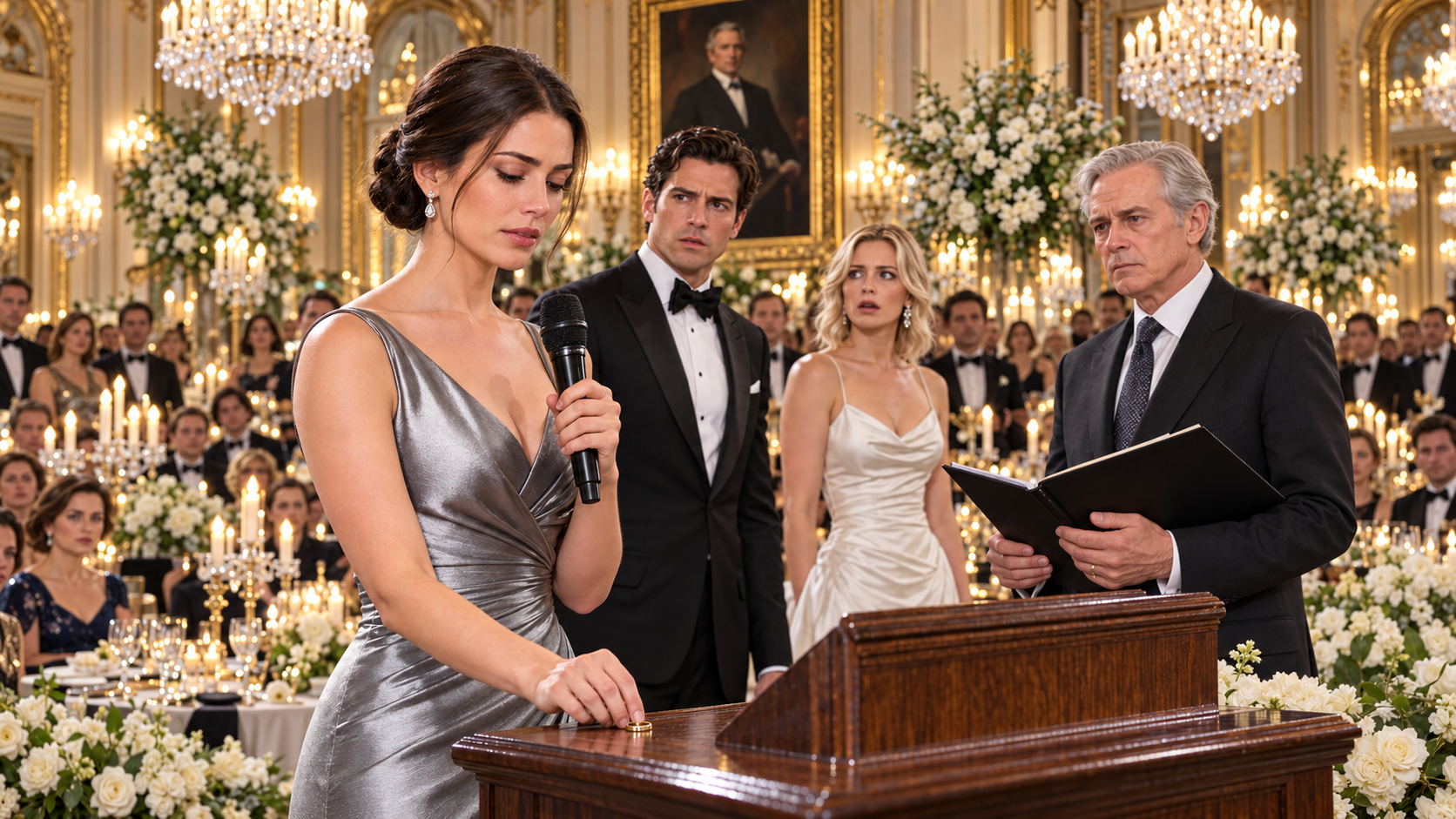
I removed my wedding ring.
For months, it had been loose.
That night, it slipped off without resistance.
I placed it on the podium.
A flash exploded from somewhere near the ballroom doors.
Then another.
Beckett looked at the ring.
His face emptied.
“I will not discuss the private details of my marriage here,” I said. “But I will discuss the foundation.”
I looked toward the council members.
“As principal trustee, I am resuming my voting authority effective immediately.”
Applause started somewhere near the back.
Then stopped, uncertain.
This wasn’t a victory speech.
Not yet.
I continued.
“Under the governance covenant, Mr. Hawthorne’s attempted appointment without trustee consent requires suspension of his executive stewardship pending council review.”
Beckett’s voice cut through the room.
“You can’t do this.”
I looked at him.
“I just did.”
“You don’t know what you’re doing.”
The old Isabel might have flinched.
That sentence had worked on me for years.
When I questioned an investment, he knew better.
When I challenged a donor strategy, he knew better.
When I wanted to return to work after my father’s death, I needed rest.
When I suspected Sloane, I was paranoid.
When I grieved, I was unstable.
When I returned, I was emotional.
Every path led to the same conclusion.
Beckett should decide.
I smiled.
“You’re right about something else.”
His eyes narrowed.
“I didn’t know what I was doing when I gave you my proxy.”
A murmur moved through the room.
“I do now.”
The council secretary approached the stage.
He looked uncomfortable.
“Mr. Hawthorne, pending review, the covenant requires you to relinquish executive authority.”
Beckett stared at him.
“You’re taking legal advice from her?”
“From the trust agreement.”
“Charles.”
“I’m sorry.”
Beckett laughed once.
It was an ugly sound.
Then he looked at me.
“This is revenge.”
“No.”
“What would you call it?”
“Correction.”
He came closer.
“This foundation doubled its donor commitments under me.”
“And no one disputes the work you did while properly authorized.”
That stopped him.
I wasn’t going to rewrite history just because he had hurt me.
Beckett had been effective.
Brilliant, sometimes.
That was what made his arrogance so dangerous.
He had begun believing competence entitled him to things that were never his.
“You’re throwing away years of work because our marriage failed,” he said.
“No. I’m separating our marriage from the foundation because you refused to.”
I looked toward Sloane.
“You appointed the woman you’re sleeping with to a council position while presenting it as an institutional decision.”
Her face flushed.
Beckett’s voice dropped.
“Enough.”
Then Evelyn reached us.
She didn’t ask for the microphone.
She simply hissed, “Do you have any idea what you’re doing to this family?”
I almost laughed.
“This family?”
“You are still my daughter-in-law.”
“For the moment.”
Her expression cracked.
“You would destroy your husband in public?”
I thought about the hospital.
About the hotel receipt.
About “manageable until the gala.”
About the text telling me not to attend my own family’s event.
Then I looked at the woman who had replied, Then manage her.
“No, Evelyn. Your son did this in public. I simply stopped protecting him from the consequences.”
She stared at me.
Then her eyes dropped to the wedding ring on the podium.
Behind us, Sloane made a small sound.
I turned.
She had one hand gripping the edge of a chair.
Her face was white.
Beckett moved instantly.
“Sloane?”
She shook her head.
“I’m fine.”
But she wasn’t looking at him.
She was looking at me.
And there was something in her expression I hadn’t expected.
Not triumph.
Not hatred.
Fear.
“I need to talk to you,” she whispered.
Beckett’s head turned.
“No.”
Sloane ignored him.
“To Isabel.”
“No,” he repeated.
That one word told me everything I needed to know.
There was something Beckett did not want her to say.
I stepped down from the stage.
“What is it?”
Sloane swallowed.
Her eyes filled.
“Not here.”
Beckett reached for her.
She stepped away from him.
And that was the moment his face truly went pale.
PART 4: WHAT HE PROMISED HER
Sloane and I ended up in the powder room on the second floor.
Of all the conversations I had imagined having with my husband’s mistress, none took place beneath flattering lights while a foundation gala collapsed one floor below us.
For several seconds, neither of us spoke.
Sloane stood at the sink with both palms against the marble.
I stood near the door.
Her white dress suddenly looked less like a declaration and more like a costume she’d been given for a role she no longer understood.
“Are you all right?” I asked.
The question surprised both of us.
She nodded.
Then shook her head.
“I’m not having a medical emergency, if that’s what you mean.”
“Good.”
She looked at my reflection.
“You hate me.”
“I don’t know you well enough to hate you.”
“That might be worse.”
I said nothing.
She turned.
“Beckett told me you knew.”
“I knew about the affair.”
“No. About me joining the foundation.”
“I learned about that.”
“He said you agreed.”
“I didn’t.”
Her eyes closed.
“He said you wanted to step away permanently.”
“I didn’t.”
“He said after the miscarriage you couldn’t bear being involved anymore.”
My stomach tightened.
“He told you that?”
“He said the foundation reminded you of your father and the pregnancy and that you wanted a clean break.”
Clean.
There was that word again.
Cleaner image.
Clean break.
As if my grief were a stain everyone else needed to remove.
Sloane looked down.
“He said you were discussing a separation.”
“We weren’t.”
Her eyes lifted.
“I thought—”
“You thought what he needed you to think.”
The sentence came out colder than I intended.
She flinched.
I didn’t apologize.
Compassion did not require pretending she was innocent.
She had known he was married.
She had called my designer.
She had removed me from my own event.
Whatever lies Beckett told her, she had made choices too.
“I knew you were still married,” she said.
“Yes.”
“I knew this was wrong.”
“Yes.”
Her mouth trembled.
“But he told me it was over.”
“They always do.”
She almost smiled.
Almost.
Then her face changed.
“He told me the council appointment was your idea.”
“Why would it be my idea?”
“Because of the baby.”
The room went quiet.
I looked at her stomach.
She covered it automatically.
“What does your pregnancy have to do with the Whitmore Foundation?”
Sloane stared at me.
“You really don’t know.”
A cold feeling moved through me.
“Know what?”
She sat down on the velvet bench near the wall.
“Beckett said once the divorce was announced, we’d marry.”
I had expected that.
It still hurt.
“He said the baby would need stability. That tonight was supposed to show donors there was continuity.”
“Continuity.”
“He kept using that word.”
I remembered his speech.
Prepare for the future.
New leadership.
Legacy.
My skin went cold.
Sloane continued.
“He said your family name couldn’t disappear from the foundation just because you didn’t want children anymore.”
I couldn’t speak.
Not because the statement was cruel.
Because it was absurd.
“I didn’t want children anymore?”
“He said after what happened, you told him you couldn’t go through it again.”
I gripped the edge of the counter.
After the miscarriage, I had told Beckett I couldn’t go through another fertility cycle immediately.
I had been bleeding when I said it.
I remembered lying in bed while he stood by the window.
I can’t do this again, Beckett.
Not now.
He had turned those words into a permanent refusal.
Into a story.
Into justification.
Sloane wiped beneath one eye.
“He said eventually the foundation would need a family face again.”
I stared at her.
“And that would be you?”
She looked ashamed.
“Us.”
Us.
Beckett.
Sloane.
Their baby.
The cleaner image.
Suddenly the entire architecture of the humiliation became visible.
It wasn’t enough to remove me from a gala.
He was building a narrative in which I had voluntarily disappeared.
The grieving heiress too fragile to continue.
The devoted husband carrying the burden.
The new woman providing stability.
A child providing legacy.
And somewhere inside that story, my family’s institution became his.
“He told you the Whitmore trust could pass through him?”
Sloane hesitated.
“He said the distinction was technical.”
I laughed.
I couldn’t help it.
A sharp, exhausted sound.
“That’s Beckett’s favorite kind of distinction.”
“What?”
“The kind that prevents him from owning something.”
Her face crumpled.
“I was stupid.”
“No.”
She looked at me.
“Don’t comfort me.”
“I’m not.”
I stepped closer.
“You were selfish.”
Her face tightened.
“You knew he was married. You called my designer. You removed my name from an event you knew belonged to my family. You were willing to stand beside my husband in white while I was told to stay home.”
Tears slipped down her face.
I continued.
“But being selfish isn’t the same as being responsible for his lies.”
She looked away.
“Why are you saying that?”
“Because I spent a year letting him tell me every problem was mine.”
Silence.
“I won’t help him do the same thing to you.”
The door opened.
Beckett entered.
Of course he did.
Sloane stood.
“I asked you to wait downstairs.”
He ignored her.
His eyes fixed on me.
“Mason is turning this into a circus.”
“Mason is reading your contract.”
“Come home.”
I stared at him.
“What?”
“We’ll leave. Now. We’ll discuss everything privately.”
Sloane gave a broken laugh.
Beckett turned.
“Sloane.”
“You lied to me.”
“This isn’t the time.”
“You said she approved.”
“We discussed possibilities.”
“No. You said she approved.”
He glanced at me.
I saw the calculation begin again.
“Sloane is upset.”
I almost admired the consistency.
Women were always upset when Beckett needed them to be unreliable.
“I heard what she said,” I replied.
He stepped closer.
“Isabel, whatever happened between us, don’t dismantle your father’s work because you’re hurt.”
The sentence was designed perfectly.
My father.
My guilt.
My grief.
My responsibility.
A blade built specifically for me.
For one second, it worked.
Then I remembered my father teaching me to read annual reports at sixteen.
Not because he expected me to become an accountant.
Because, he said, never sign what you don’t understand and never let love make you careless with responsibility.
I had failed that lesson once.
I would not fail it twice.
“My father’s work is exactly what I’m protecting.”
“You think you can run this?”
There it was.
Not grief.
Not concern.
Contempt.
“You haven’t attended a full council session in ten months.”
“I can learn what I missed.”
“Donors trust me.”
“Then I hope they continue supporting the programs rather than the man.”
“You’ll lose half of them.”
“Maybe.”
That answer unsettled him.
He expected me to claim certainty.
I didn’t have certainty.
I had authority and responsibility.
Those were different things.
“You don’t know what happens tomorrow,” he said.
“No.”
“You could destroy the foundation.”
“I could fail.”
He blinked.
I continued.
“But if I do, it will be while making my own decisions. Not because I was too frightened to take back responsibility from someone who abused my trust.”
His face hardened.
“Abused your trust?”
Sloane stared at him.
He heard it too late.
The phrase had more than one meaning.
He looked between us.
Then he laughed quietly.
“So that’s what this is. The two of you have decided I’m the villain.”
“No,” I said. “You keep confusing consequences with persecution.”
His phone buzzed.
He looked at the screen.
Whatever he saw made him curse.
“What?”
Sloane asked.
He ignored her.
I didn’t need to ask.
Downstairs, the council review had begun.
Mason appeared in the doorway.
“Isabel.”
I turned.
“They’re ready.”
Beckett stepped forward.
“Mason, if you have any respect for her father—”
Mason’s expression did not change.
“I respected Thomas Whitmore enough to read the documents he paid me to draft.”
Beckett’s face flushed.
Mason looked at me.
“The council secretary has confirmed receipt of the revocation. They need you downstairs.”
I nodded.
Sloane touched my arm.
I looked at her hand.
She pulled it away.
“There’s something else.”
Beckett’s entire body went still.
“Sloane.”
She looked at him.
“No.”
It was the first time I had heard her say that word to him.
She turned back to me.
“The emails.”
“What emails?”
“The appointment documents Beckett sent me.”
Beckett crossed the room.
“Sloane, stop.”
She backed away.
“He told me your consent was already handled.”
My heartbeat quickened.
“Did he send you anything showing that?”
“Yes.”
Beckett’s voice sharpened.
“Those were drafts.”
Sloane looked at him.
“You said they were approved.”
“They were preliminary.”
“You told me to keep them.”
His face changed.
Mason spoke.
“Ms. Mercer, do you still have those communications?”
Sloane nodded slowly.
“On my phone.”
Beckett stared at her.
And in that instant, I understood why he had been so afraid of us speaking alone.
The evidence had not appeared from nowhere.
It had been sitting in Sloane’s hand the entire evening.
She unlocked her phone.
Beckett moved toward her.
I stepped between them.
It was instinctive.
He stopped.
Not because I could physically overpower him.
Because three people were watching.
Because the door was open.
Because, finally, everything he did had witnesses.
Sloane held the phone out to Mason.
He read.
His expression did not change.
Then he looked at Beckett.
“This appears to be a message from you stating that Mrs. Hawthorne had approved Ms. Mercer’s appointment.”
Beckett said nothing.
Mason scrolled.
“And another instructing Ms. Mercer that the written consent was ‘a formality already taken care of.’”
Silence.
I looked at my husband.
Not the man from our wedding photographs.
Not the man who held my hand through the first fertility appointment.
Not the man who once fell asleep beside me with a baby-name book open on his chest.
The man standing in front of me had used my grief as administrative cover.
Perhaps that was the hardest truth.
People don’t always become monsters.
Sometimes they become people who discover that your weakness is convenient.
And then they choose convenience again and again until you no longer recognize them.
Mason returned the phone to Sloane.
“Please preserve these messages.”
She nodded.
Beckett looked at me.
“Isabel.”
I waited.
For an apology.
For anger.
For anything honest.
Instead he said, “We can still contain this.”
Contain.
Not repair.
Not confess.
Not apologize.
Contain.
That was the moment my marriage ended.
Not when I found the hotel receipt.
Not when I saw Sloane in white.
Not when she told me she was pregnant.
Right there.
Because even after everything, Beckett’s first instinct was still to manage the image.
I looked at Mason.
“Let’s go downstairs.”
PART 5: THE NAME ON THE DOOR
The council review lasted forty-three minutes.
It felt longer.
There was no dramatic vote beneath chandeliers.
No shouting.
No security guards dragging Beckett through the ballroom.
Real power usually moves more quietly than people imagine.
Documents were read.
Dates were confirmed.
Emails were reviewed.
The council secretary verified that no written consent bearing my signature existed for Sloane’s appointment.
Mason presented the revocation.
Sloane voluntarily provided the messages Beckett had sent her.
Beckett argued that he had acted in the foundation’s best interest.
Then he argued that I had verbally agreed.
Then that he had believed I would agree.
Then that the appointment announcement was ceremonial rather than final.
Each explanation contradicted the one before it.
I didn’t have to destroy him.
I barely had to speak.
That was perhaps the strangest part.
For months, I had imagined confrontation as something explosive.
I thought justice would feel like shouting every cruel thing he’d done while he finally understood what he had lost.
Instead, I sat at the end of a polished conference table and watched Beckett lose authority one clause at a time.
At 10:18 p.m., the council confirmed his suspension as executive chair pending formal governance review.
His administrative proxy was terminated.
My voting authority was restored.
Sloane’s appointment was declared invalid because it had never legally existed.
When the secretary finished reading the resolution, nobody applauded.
I was grateful.
This wasn’t entertainment.
It was the wreckage of a marriage spilling into an institution I loved.
Beckett pushed his chair back.
“So that’s it?”
Mason closed the folder.
“For tonight.”
Beckett looked at the council members.
Several wouldn’t meet his eyes.
Others did.
He turned to me.
“You think this makes you strong?”
The room became still.
I could have answered cruelly.
Part of me wanted to.
Instead, I said the truth.
“No.”
His expression shifted.
“I think coming here while terrified made me strong.”
I stood.
“Taking back my responsibility made me strong.”
Then I looked at the man I had loved for almost nine years.
“What happened to us just made me sad.”
For once, Beckett had nothing to say.
I left the conference room.
The gala was ending.
Some guests remained in the ballroom, pretending not to wait for news.
Others had gone.
Staff quietly cleared glasses from abandoned tables.
My father’s portrait watched over the mess.
I walked toward it.
My mother joined me.
“Well?”
“He’s suspended.”
She closed her eyes.
Not with satisfaction.
Relief.
Then she touched my cheek.
“Your father would be proud of you.”
I looked at the portrait.
“No.”
My mother frowned.
“He’d be furious I let it get this far.”
A small smile touched her mouth.
“He was capable of both.”
That made me laugh.
And then, unexpectedly, I cried.
Not elegantly.
Not one cinematic tear.
My face crumpled.
My mother pulled me against her.
I cried for my father.
For the baby.
For the marriage I had kept trying to save after Beckett had already begun converting it into a public-relations problem.
For the woman I had been when I signed that proxy.
For the woman who had believed needing help meant surrendering authority over her own life.
“I loved him,” I whispered.
“I know.”
“I still—”
The words wouldn’t come.
My mother understood anyway.
“I know.”
That was the cruelty of endings.
Love didn’t disappear merely because the facts became unbearable.
Sometimes the facts arrived first.
Your heart limped after them.
When I finally stepped away, Sloane was standing near the ballroom entrance.
Alone.
She had put on a coat over the white dress.
For a moment, we simply looked at each other.
Then she approached.
“I sent Mason copies of everything.”
“Thank you.”
She nodded.
“I didn’t do it for you.”
“I didn’t assume you did.”
That surprised her.
“I did it because he lied to me.”
“That’s reason enough.”
She looked toward the conference room.
“Is he coming home with you?”
“No.”
Her eyes lowered.
“Is he coming with me?”
“I think that’s a question for Beckett.”
She laughed bitterly.
“I don’t think I know who Beckett is.”
I understood that sentence too well.
“You know more than you did this morning.”
She looked at me.
“So do you.”
“Yes.”
She hesitated.
“I’m sorry about the fitting.”
It was such a small apology compared with everything else that I almost laughed.
Instead, I said, “That was cruel.”
“I know.”
“And unnecessary.”
“I know.”
“You wanted me to understand I’d been replaced.”
Her eyes filled.
“Yes.”
There was honesty in that.
Ugly honesty.
But honesty.
“Why?”
She looked down at her stomach.
“Because I was terrified he would go back to you.”
For the first time, I saw the entire shape of her insecurity.
Not an excuse.
A reason.
She had been competing with a woman Beckett told her was already gone.
I had been fighting to save a marriage Beckett told me was merely struggling.
He kept us both uncertain because uncertainty made us easier to control.
I looked at her.
“Don’t ever let fear make you cruel on someone else’s behalf again.”
She nodded.
Then she walked away.
I never became her friend.
Some wounds don’t need that kind of ending.
Forgiveness is not always reunion.
Understanding is not absolution.
Sometimes closure is simply refusing to carry a stranger’s guilt along with your own.
I returned home after midnight.
Beckett arrived twenty minutes later.
I was in the library.
My silver dress was still on.
My mother’s diamonds were still around my neck.
My wedding ring was not on my hand.
He stood in the doorway.
His tie was gone.
For the first time in years, he looked tired in a way that had nothing to do with performance.
“Where’s my ring?” he asked.
“On the gala podium, unless someone moved it.”
His face tightened.
“You left it there?”
“Yes.”
He entered.
“You humiliated me.”
I looked at him.
“No.”
“Three hundred people watched you strip me of my position.”
“You announced an appointment you had no authority to make.”
“We could have handled that privately.”
“You were replacing me publicly.”
“I was not replacing you.”
“Sloane was sitting in my chair.”
“It was a seating chart.”
“You told her I approved her appointment.”
He looked away.
“You told her we were separating.”
“We should have been.”
“You told her I didn’t want children.”
Silence.
That one landed.
He walked toward the drinks cabinet.
“Don’t.”
He stopped.
“You don’t get to drink your way through this conversation.”
He turned.
“What do you want from me, Isabel?”
The question almost made me laugh.
A year earlier, I would have had a list.
Hold me.
Choose me.
Come to the appointments.
Tell me the miscarriage hurt you too.
Tell me I wasn’t alone in that hospital even when you weren’t physically there.
Tell me Sloane meant nothing.
Tell me our marriage still mattered.
That night, I wanted none of it.
“I want you to leave.”
His face changed.
“This is my home.”
“No. This house belongs to the Whitmore family trust.”
He stared at me.
I hadn’t known that detail mattered until I said it.
Then I saw the old calculation return.
Property.
Position.
Reputation.
Everything becoming an asset again.
“You’ve been talking to Mason.”
“Yes.”
“For how long?”
“Long enough.”
He sat down.
For the first time, he looked defeated.
Not destroyed.
Not broken.
Simply smaller than the man I had built in my mind.
“I didn’t plan for any of this to happen.”
“Which part?”
“Sloane.”
“The affair?”
“The pregnancy.”
I closed my eyes.
There it was.
The secret I thought would break me.
It didn’t.
It hurt.
But pain and destruction are not the same thing.
“I was lonely,” he said.
I opened my eyes.
“So was I.”
“You shut me out.”
“I was grieving.”
“I was grieving too.”
“Then why didn’t you tell me?”
His jaw worked.
“I didn’t know how.”
For the first time that night, he sounded like the man I had married.
Human.
Afraid.
And that was more dangerous than his arrogance because part of me still wanted to understand him.
He looked at his hands.
“When we lost the baby, I couldn’t walk into that bedroom.”
My chest tightened.
“I couldn’t look at the things we’d bought. I couldn’t listen to you cry. Every time I looked at you, I felt like I’d failed.”
“So you left me alone with it.”
“I know.”
“And slept with Sloane.”
His eyes closed.
“Yes.”
No excuse.
Just yes.
The honesty came far too late.
I sat opposite him.
“Do you love her?”
He took too long.
“I don’t know.”
“Does she think you do?”
“Yes.”
“Did you promise to marry her?”
Another pause.
“Yes.”
The last piece settled into place.
Not with drama.
With exhaustion.
“You should go.”
“Isabel.”
“I mean it.”
“What happens to us?”
I looked at him.
“There is no us.”
His face tightened.
“You don’t mean that.”
“I do.”
“You can’t erase nine years overnight.”
“No.”
My voice shook.
“I can’t.”
That was the truth.
I couldn’t erase the mornings we drank coffee in bed.
The first apartment.
The road trip through Vermont where the car broke down and we laughed in the rain.
The night my father died and Beckett sat on the bathroom floor with me until sunrise.
The fertility injections.
The positive test.
His hand over mine when we heard a heartbeat.
The life we had once tried to build had been real.
So was what he had done to it.
“I don’t need to erase our marriage to end it,” I said.
He stared at me.
Then he nodded once.
When he stood, I expected another argument.
There wasn’t one.
At the door, he stopped.
“I did love you.”
I looked at him.
“I know.”
That seemed to hurt him more than if I’d called him a liar.
He left.
Three days later, Mason filed the divorce petition.
The formal foundation review took six weeks.
Beckett resigned before it concluded.
The council accepted his resignation.
There were no criminal revelations.
No hidden fortune.
No dramatic arrest.
Just the consequences of a man who had been given temporary authority and started behaving as if temporary meant permanent.
Some donors left.
Beckett had been right about that.
Not half.
But enough to hurt.
For months, I worked harder than I had in years.
I attended every council meeting.
I called donors personally.
When I didn’t understand something, I asked.
When I made mistakes, I corrected them.
I stopped pretending leadership meant never being uncertain.
The foundation survived.
More importantly, the programs survived.
The scholarship checks still went out.
The clinics remained funded.
The maternal-health initiative my father had approved before his death expanded into two additional counties.
That one mattered most.
At the first board meeting after the divorce became final, I arrived early.
The conference room was empty.
Morning sunlight fell across my father’s old chair.
For years, I had avoided sitting there.
It felt too large.
Too symbolic.
Too much like admitting he was really gone.
I stood beside it.
Then pulled it out.
And sat down.
Nothing happened.
No lightning.
No sudden transformation.
It was only a chair.
That made me smile.
Mason entered carrying coffee.
He stopped when he saw me.
“About time.”
“Don’t ruin the moment.”
“I’ve been waiting three years to say that.”
He placed a folder in front of me.
“What is it?”
“Next year’s gala planning.”
I groaned.
He smiled.
“First decision. Theme.”
I opened the folder.
On top was the proposed branding sheet.
LEGACY, RENEWED.
I stared at the words.
Then shook my head.
“No.”
Mason sat opposite me.
“No?”
“Too much legacy.”
“Your father would be offended.”
“My father is not here to complain.”
“An advantage of the deceased.”
I laughed.
Then I looked through the windows toward the city.
For so long, legacy had sounded like something inherited.
A name.
A building.
A trust.
A child.
Something you either preserved perfectly or failed.
Beckett had used the word that way too.
He wanted a picture of continuity.
A beautiful woman.
A future child.
A polished family.
A cleaner image.
But my father had never built the foundation because he wanted our surname to survive.
He built it because he believed resources were supposed to move outward.
Into schools.
Hospitals.
People.
Possibility.
Legacy wasn’t a photograph.
It was what remained useful after you were gone.
“Call it Forward,” I said.
Mason raised an eyebrow.
“Just Forward?”
“Just Forward.”
He wrote it down.
One year after the night Beckett tried to remove me from the Whitmore Foundation Gala, I stood backstage at the same event.
Elise had made my dress again.
This time it was dark blue.
Simple.
Strong.
No armor required.
My mother waited at the head table.
Mason was arguing with someone about seating cards.
Some things never changed.
I looked at the program in my hand.
At the top:
WHITMORE FOUNDATION ANNUAL GALA
Hosted by Isabel Whitmore.
Not Hawthorne.
Whitmore.
My name.
I heard the emcee introduce me.
Applause rose beyond the curtain.
For one second, I remembered the woman who had sat barefoot on cold marble holding an old negative pregnancy test.
I wished I could reach backward through time and touch her shoulder.
Not to tell her everything would be fine.
Some things would never be fine.
The baby was still gone.
My father was still dead.
My marriage still ended.
Healing had not returned what I lost.
It had simply taught me that loss was not the same thing as disappearance.
I stepped toward the stage.
Then stopped.
In the reflection of a black glass panel, I saw myself.
For years, I had been looking into mirrors and seeing what was missing.
A child.
A father.
A husband.
A future I had expected.
That night, I finally saw what remained.
Me.
The stage manager lifted the curtain.
I walked into the light.
Three hundred people rose.
I reached the podium and placed my hands on either side.
My father’s portrait was still behind me.
But this time, I didn’t look back at it before I began.
“Good evening.”
The room settled.
“One year ago, I stood on this stage because I was afraid something important was being taken from me.”
Silence.
“I was wrong about one thing.”
I paused.
“Power is not the same as identity. A title can be delegated. A seat can be moved. A name can be removed from a card. None of those things decides who you are.”
My mother smiled from the front table.
I continued.
“The work decides what remains.”
Applause began.
This time, I let myself hear it.
Not because I needed three hundred strangers to tell me I had survived.
I already knew.
After the speech, I stepped away from the podium.
For the first time in years, I did not wonder whether Beckett would have approved.
I did not wonder whether my father would have changed a sentence.
I did not wonder whether the room thought I looked fragile.
Or difficult.
Or emotional.
Or clean enough.
I walked through the ballroom greeting scholarship recipients, doctors, teachers, donors, and volunteers.
Near midnight, when the final guests began leaving, I returned to the staircase where I had seen Beckett and Sloane one year earlier.
For a moment, I could almost see us.
Sloane in white.
Beckett beside her.
Me in silver.
Three people standing inside three different versions of the same lie.
Then the image disappeared.
A staff member approached.
“Ms. Whitmore?”
“Yes?”
“We’re ready to close the ballroom.”
I looked back one last time.
At the flowers.
At the empty tables.
At my father’s portrait.
At the podium where I had left my wedding ring.
“Go ahead.”
Outside, the city was cold.
I stepped beneath the awning.
No cameras waited this time.
I was grateful.
My car pulled forward.
Before I got in, I looked up at the building.
A year earlier, Beckett had tried to keep me outside those doors because he wanted a cleaner image.
He had believed grief made me weak.
Silence made me manageable.
Love made me blind.
And temporary surrender meant permanent ownership.
He had been wrong about all of it.
The room he tried to erase me from had never belonged to him.
Neither had the foundation.
Neither had my name.
And, though it took me far too long to understand it, neither had I.
I got into the car.
The door closed.
And for the first time in years, when I thought about the life ahead of me, I didn’t picture the one I had lost.
I pictured the one I was finally choosing for myself.
Leave a Reply