
He Missed Our Daughter’s School Play for His Mistress’s Newborn. Then His Family Asked Me to Rewrite the Date My Marriage Ended.
PART 1: THE EMPTY CHAIR
My husband missed our seven-year-old daughter’s school play because he was in a private hospital suite with his mistress and her newborn baby.
I learned that less than twelve hours later.
But the part that destroyed my marriage was not the affair.
It was the empty chair.
I can still see it.
Third row from the front. Aisle seat. A folded program resting across the velvet cushion.
Lily had decorated the cover herself because Saint Margaret’s Lower School believed seven-year-olds needed to participate in every possible stage of a production, including tasks involving glitter, glue, and catastrophic artistic judgment.
She had drawn three stick figures on the back.
Me.
Grant.
Her.
Above us, in purple marker, she had written:
MY FAMILY.
Grant’s stick figure had absurdly broad shoulders because Lily believed her father was the strongest man alive.
That chair stayed empty for the entire performance.
At first, Lily pretended not to notice.
She stood beneath a cardboard moon in a silver dress, singing with the other children while her eyes moved across the audience whenever she thought her teacher wasn’t watching.
The first time, I smiled.
The second time, I lifted Grant’s program so she could see I had saved his seat.
By the third time, I stopped pretending.
At 7:43 p.m., during the song Grant had practiced with her in our kitchen for two weeks, Lily looked directly at the empty chair.
Her voice faltered.
Only for half a second.
Nobody else would have noticed.
I did.
Mothers notice the half seconds that break their children.
When the curtain closed, Lily ran toward me with silver paper stars tangled in her hair.
“Did Daddy call?”
“No, sweetheart.”
“He probably got stuck.”
“Probably.”
“He said he would come.”
“I know.”
“He promised twice.”
I swallowed.
“I know.”
That was the worst part.
Grant had not forgotten.
He had promised.
That afternoon, he had crouched in front of Lily while she wore one sparkly shoe and one sock.
“Front row,” he had said.
“Third row,” I corrected.
“Closest seat your terrifying mother could obtain.”
Lily giggled.
Then Grant pressed two fingers over his heart.
“I’ll be there.”
“You swear?”
“Twice.”
“What does twice mean?”
“It means even if the building catches fire.”
She gasped.
“Daddy!”
“Fine. Bad example.”
He kissed her forehead.
“I’ll be there, bug.”
At 6:15, he texted me.
Emergency. Don’t wait for me.
That was all.
Grant Harrow did not have emergencies.
He had assistants.
He had drivers.
He had a chief of staff whose entire salary existed to make emergencies disappear before they reached him.
Yet I spent the play manufacturing explanations for him.
A board crisis.
His father.
A sick employee.
A legal problem.
Anything except the truth.
By the time Lily was asleep that night, still wearing traces of silver glitter at her temples, Grant had not come home.
He arrived shortly after two in the morning.
I heard him enter our bedroom.
I kept my eyes closed.
His movements were careful.
Shoes removed.
Jacket placed over the chair.
Phone connected to the charger.
A shower.
Then the mattress shifted beside me.
He smelled like expensive soap.
Not his.
Hospital soap.
I knew the scent because Lily had once needed stitches after falling from a pony.
I lay in the dark listening to my husband breathe.
I said nothing.
The next morning, Grant left before breakfast.
He kissed my cheek while I stood at the kitchen counter.
“Sorry about last night.”
I turned.
“That’s it?”
He was already checking his phone.
“We’ll talk tonight.”
“Lily waited for you.”
His expression changed.
Not enough.
“I know.”
“No. You know I told you she waited. That’s different.”
“Amelia.”
“She kept looking at your chair.”
Grant exhaled.
“I said I’m sorry.”
And there it was.
Irritation.
Not guilt.
I watched him walk away.
Thirty minutes later, I found the valet ticket in the pocket of his tuxedo jacket because the dry cleaner collected formalwear on Thursdays.
Saint Anselm Medical Center.
Women’s and Children’s Pavilion.
Arrival: 6:51 p.m.
Behind the valet ticket was a visitor badge.
GRANT HARROW.
SUITE 9B.
GUEST OF SIENNA COLE.
For several seconds, I did absolutely nothing.
No screaming.
No trembling.
No cinematic collapse.
I stood inside our dressing room with sunlight falling across rows of Grant’s perfectly arranged suits and read the name again.
Sienna Cole.
I knew Sienna.
Not well.
But well enough.
She had attended two Harrow Foundation dinners.
Once, at a Christmas reception, she had stood beside me in a red velvet dress and told me how much she admired my marriage.
“You two seem so solid.”
I remembered smiling.
“We work at it.”
Apparently one of us had been working much harder than the other.
My hand became strangely steady.
I photographed the valet ticket.
Then the badge.
Front.
Back.
Time.
Suite number.
Name.
I checked every image.
Then I put everything precisely where I had found it.
After that, I called Naomi Pierce.
Naomi had been my attorney before she became my friend.
That order mattered.
It was why I trusted her.
She answered on the second ring.
“Tell me you finally decided to sue the contractor who ruined your terrace.”
“I found something in Grant’s pocket.”
Silence.
Then her voice changed.
“What?”
“A visitor badge from Saint Anselm.”
“Okay.”
“Women’s and Children’s Pavilion.”
Another pause.
“Name?”
“Sienna Cole.”
“What suite?”
“Nine B.”
“Did you photograph it?”
“Yes.”
“Send everything.”
I did.
Three minutes later, she called back.
“Do not confront him alone.”
“I’m not planning to confront him.”
“Good.”
“I’m planning to attend dinner.”
Naomi went quiet.
“What dinner?”
I looked at the message Antoinette Harrow had sent twenty minutes earlier.
Family dinner tonight. Seven. Harrow House. Important. Please do not be late.
Grant had received the same message.
“I think his mother is about to explain my marriage to me.”
“Amelia.”
“I won’t sign anything.”
“Promise me.”
“I promise.”
“And photograph whatever they put in front of you.”
“I will.”
“If the conversation becomes coercive, you leave.”
Through the glass doors, Lily was outside with Rosa, our housekeeper, chasing bubbles across the lawn.
My daughter still believed her father had missed her play because something unavoidable had happened.
I watched her laugh.
Then I said quietly, “They don’t get to make me the problem.”
“No,” Naomi said. “They don’t.”
That evening, I wore ivory silk.
I chose the dress because Antoinette had once told me ivory was a dangerous color for women over thirty-five.
I was thirty-eight.
I also wore the diamond bracelet Grant had given me after our first major fight.
There was a particular pleasure in wearing a man’s apology while watching him prepare to betray you again.
Harrow House glowed against the November darkness when my driver pulled through the gates.
The mansion belonged to Grant’s parents.
Technically.
Emotionally, every Harrow believed it belonged to the bloodline.
Portraits.
Silver.
Inherited furniture nobody was allowed to find uncomfortable.
Rooms named after dead men.
Nothing in that house was simply owned.
Everything was inherited, protected, or controlled.
A maid took my coat.
I heard voices in the library.
Antoinette.
Grant.
His father, Charles.
And a woman.
I walked in.
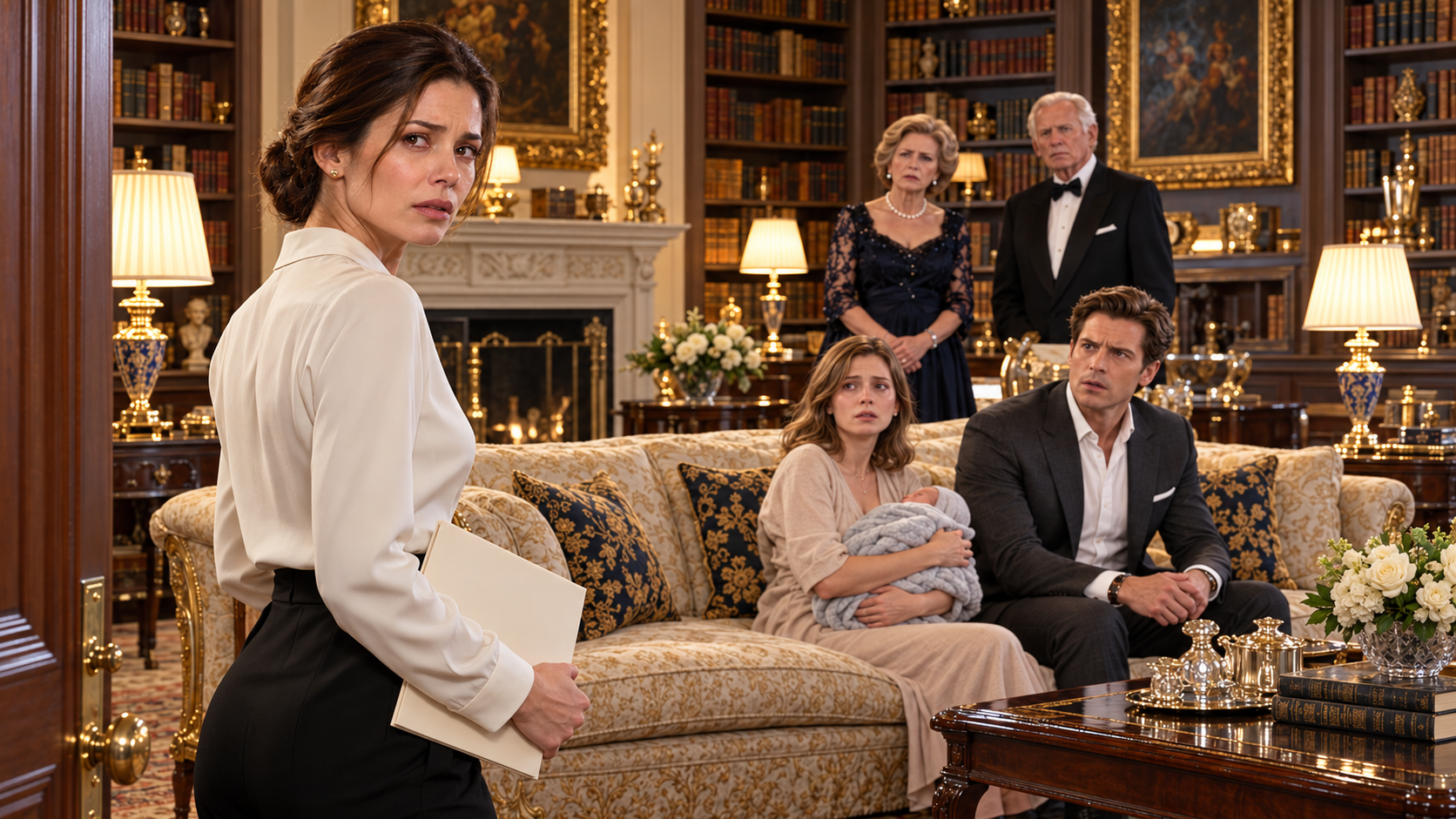
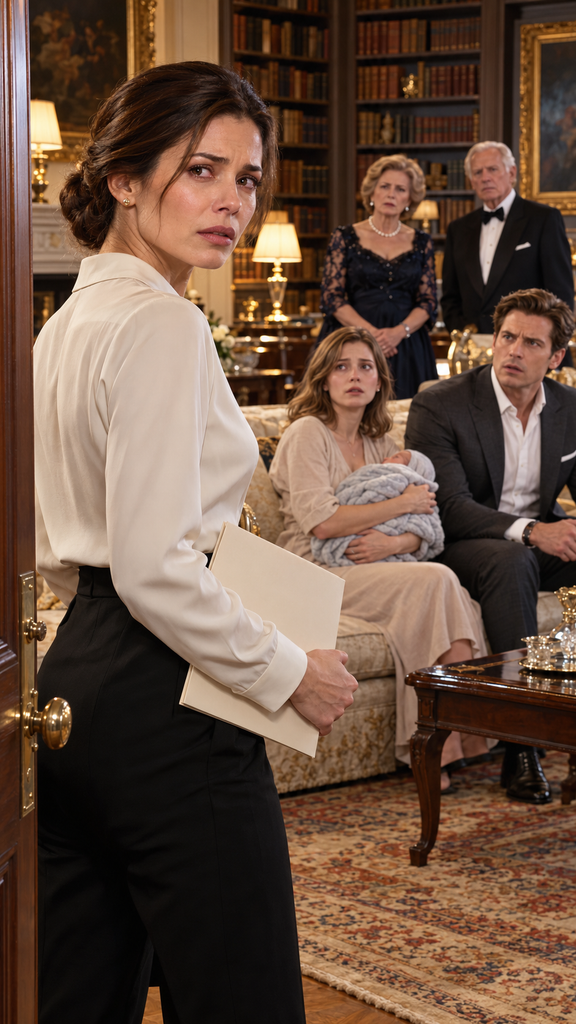
Sienna Cole sat on the sofa holding a newborn wrapped in a pale gray blanket.
She looked up.
And smiled.
Not nervously.
Not apologetically.
Smugly.
Grant stood near the library doors in a dark tailored suit.
Charles Harrow was beside him.
Antoinette waited near the fireplace as though this were an ordinary family meeting.
Nobody offered me champagne.
Nobody asked how Lily was after the play.
I stopped three steps inside the room.
Sienna adjusted the baby against her chest.
Antoinette spoke first.
“Amelia. You remember Sienna.”
“Yes,” I said. “I do.”
Sienna gave me the expression women use when they want witnesses to remember how gracious they were.
“I wish we were meeting under easier circumstances.”
I walked farther into the room.
“Then you should have chosen easier circumstances.”
Silence.
Grant’s jaw tightened.
“Don’t start.”
I turned toward him.
“You missed Lily’s play.”
I watched irritation cross his face.
Not guilt.
Not shame.
Irritation.
As if our daughter’s heartbreak were a scheduling problem I had rudely introduced into a more important conversation.
“I had a responsibility.”
“To whom?”
The baby made a tiny sound.
Sienna looked down.
Grant looked at the child.
Then at me.
I did not cry.
I did not raise my voice.
My fingers rested against the clasp of my evening bag, where my phone waited with photographs Naomi already possessed.
Grant thought I had come unprepared.
He thought I was still the wife who protected his reputation, softened his mistakes, and stayed silent so everyone else could remain comfortable.
He placed one hand against the back of Sienna’s sofa.
“To my son.”
For one second, even his parents seemed to stop breathing.
I looked at the sleeping baby.
Then at the man who had just chosen another child in the same sentence that erased his daughter.
Something inside me went completely still.
“How old?”
Grant frowned.
“What?”
“The baby.”
Sienna answered.
“Three days.”
I nodded.
Grant studied my face.
He wanted hysteria.
That would have helped him.
A screaming wife could be dismissed.
A broken wife could be managed.
A calm wife was harder.
Charles stepped forward.
“We understand this is difficult.”
I looked at him.
“Do you?”
His mouth tightened.
“Everyone here is trying to approach the situation sensibly.”
“Everyone?”
Antoinette moved toward the coffee table.
There was a folder on it.
Cream linen.
My name embossed across the top.
AMELIA HARROW.
I almost laughed.
They had prepared stationery for my humiliation.
Antoinette rested two fingers on the folder.
“There are realities that need to be addressed.”
“My husband had a child with another woman.”
Grant interrupted.
“My child is not a reality to be discussed like a mistake.”
“Lily is your child too.”
His expression flickered.
“Of course she is.”
“She didn’t seem to be yesterday.”
“Amelia—”
“You could have called her.”
“This wasn’t planned.”
“The birth?”
“Yes.”
“The affair?”
Nobody answered.
Good.
I wanted the silence.
I wanted all of them to hear it.
Antoinette finally said, “We are not here to litigate the past.”
“No?”
“We are here to protect the children.”
I glanced at Sienna’s baby.
Then at the folder.
“Both children?”
“Obviously.”
“Interesting.”
Charles stepped in.
“What is that supposed to mean?”
“It means Lily’s name hasn’t been spoken by anyone in this room except me.”
Sienna shifted.
Grant ran a hand over his jaw.
“Can we stop turning this into theater?”
That nearly made me smile.
He had selected the stage.
He had simply assumed I would forget my lines.
Antoinette opened the folder.
“There is a proposed arrangement.”
I looked at Grant.
“You let your mother prepare an arrangement for our marriage?”
“It’s a starting point.”
“A starting point for what?”
He hesitated.
For the first time, I saw uncertainty.
I looked down.
CONFIDENTIAL FAMILY TRANSITION AGREEMENT.
I skipped the paragraphs of expensive legal language and turned to the signature page.
Grant’s signature was already there.
So were Charles’s initials.
Antoinette’s.
There was a blank line for me.
They had not invited me to a conversation.
They had invited me to my own surrender.
“When did you decide?”
Grant frowned.
“Decide what?”
“That I would agree.”
Nobody answered.
I closed the folder.
“I’ll have my attorney review it.”
Antoinette’s expression hardened.
“That isn’t necessary.”
And there it was.
Their first mistake.
“Why?”
“The family’s counsel prepared it.”
“Exactly.”
“They represent all of us.”
“No, Antoinette. They represent the Harrows.”
“You are a Harrow.”
I looked at Grant.
“Apparently not in the way that matters.”
His eyes narrowed.
“Stop making this uglier than it needs to be.”
I stared at the man I had loved for eleven years.
Then I remembered Lily beneath the painted moon.
“Grant,” I said softly, “you have no idea how ugly this already is.”
I picked up the folder.
Sienna spoke before I reached the door.
“He told me you knew.”
I stopped.
Grant’s head snapped toward her.
“Sienna.”
I turned slowly.
She had gone pale.
“He said…” Her eyes moved between us. “He said you and he had been separated privately for almost a year.”
Every person in the room became still.
A strange pressure filled my chest.
Not heartbreak.
Recognition.
I looked at the cream folder.
Family Transition Agreement.
Almost a year.
Suddenly I understood why the document mattered so much.
They weren’t merely asking me to leave.
They were asking me to help rewrite when I had been betrayed.
I met Grant’s eyes.
“When,” I asked, “were you planning to tell me we’d been separated?”
His face changed.
Only slightly.
But enough.
And in that moment, I knew the hospital badge was only the first secret.
The next one was already sitting in my hand.
PART 2: THE DATE THEY WANTED ME TO FORGET
I did not read the agreement at Harrow House.
That disappointed Antoinette.
I could tell.
She followed me into the entrance hall while Grant remained in the library.
“Amelia.”
I kept walking.
“Amelia, stop.”
I turned.
She had always been beautiful in a severe way. Silver-blond hair. Perfect posture. The kind of face that made disapproval look hereditary.
“This does not have to become destructive,” she said.
I held up the folder.
“You embossed my name on the plan for my husband to leave me.”
“That is an emotional characterization.”
“No. It’s a sentence.”
Her mouth tightened.
“There are children involved.”
“Then perhaps someone should have thought of that before Grant missed his daughter’s play to attend the birth of a child she doesn’t know exists.”
“Grant was placed in an impossible position.”
“No. Grant created an impossible position.”
That landed.
She stepped closer.
“The baby is innocent.”
“I know.”
“Then act like it.”
I stared at her.
For years I had wondered how Antoinette could make cruelty sound like etiquette.
Now I understood.
She simply lowered her voice.
“I have said nothing against that baby,” I replied. “Not once. He is innocent. So is Lily. So am I.”
“You are an adult.”
“So is Grant.”
The front door opened.
Cold November air moved through the foyer.
My driver waited beyond the steps.
Antoinette’s voice softened.
“Think carefully before you turn this into a war.”
I looked back toward the library.
Grant stood in the doorway now.
Behind him, I could see Sienna holding the baby.
Charles remained near the fireplace.
Four adults.
One newborn.
One cream folder.
And somewhere across town, my daughter was probably asking Rosa whether she could save Daddy the last piece of chocolate cake.
I looked at Antoinette.
“I didn’t bring a war into your house.”
Then I left.
Naomi was waiting at my kitchen table when I got home.
She had removed her heels and placed them neatly beside her chair. A legal pad sat in front of her. Beside it was a mug of coffee Rosa had made strong enough to dissolve regret.
Lily was asleep upstairs.
That mattered more than anything else.
I put the folder in front of Naomi.
She did not touch it immediately.
“What happened?”
“Sienna had the baby three days ago.”
Naomi’s face remained professionally still.
“Grant says it’s his son.”
“Okay.”
“He missed Lily’s play because he was at the hospital.”
Her jaw tightened.
“What else?”
“Sienna says Grant told her we’d been privately separated for almost a year.”
That got a reaction.
Naomi looked at the folder.
“Did you say anything in response?”
“I asked when he planned to tell me.”
“Good.”
“Is that good?”
“It’s better than agreeing with him.”
She pulled the folder toward herself.
“Did anyone record the conversation?”
“I don’t know.”
“Assume yes.”
She began reading.
I watched her eyes move.
Page one.
Page two.
Page three.
By page four, she stopped drinking coffee.
By page seven, she reached for a pen.
By page nine, she said, “Absolutely not.”
I sat across from her.
“What?”
She rotated the agreement toward me.
A paragraph had been marked.
The language was elegant.
That was the dangerous thing about expensive lawyers.
They could make a knife sound like cutlery.
The agreement described Grant and me as having experienced a “private marital separation” beginning approximately eleven months earlier.
Eleven months.
Not ten.
Not six.
Eleven.
I read it again.
My mind immediately went backward.
Eleven months ago had been December.
Christmas at Harrow House.
Grant standing behind me for the family photograph, his hand at my waist.
Lily asleep between us on Christmas morning after waking at five.
Grant giving me a first-edition novel I had mentioned once in passing.
New Year’s Eve.
His mouth against mine at midnight.
The weekend in Vermont in February.
Our anniversary dinner in April.
Mother’s Day.
Summer in Nantucket.
Eleven months of photographs, flights, dinners, school events, shared rooms, private jokes.
A marriage.
Not a perfect one.
But a marriage.
I looked at Naomi.
“They want me to say we were separated.”
“Yes.”
“Why?”
“I’m not going to speculate until I finish reading.”
So I waited.
It took her forty minutes.
When she finally put the last page down, she folded her hands.
“This document does several things.”
“How many of them are good for me?”
“None.”
I almost laughed.
She continued.
“It establishes a narrative that your marriage effectively ended before the timeline Sienna just described became impossible to hide. It asks you to agree that you and Grant have been living separate emotional lives despite maintaining a shared residence and public appearances.”
“That’s a lie.”
“Yes.”
“It also says we mutually agreed to discretion.”
“I saw that.”
“We never agreed to anything.”
“I know.”
My hands were cold.
Naomi tapped another paragraph.
“This section says both parties acknowledge that subsequent personal relationships were entered into after the private separation.”
I looked at her.
There it was.
The sentence.
The reason for the date.
If I signed, Grant’s affair stopped being an affair on paper.
It became a subsequent personal relationship.
Something that happened after our marriage was already privately dead.
I thought of Sienna at the Christmas reception.
You two seem so solid.
We work at it.
Had she already been sleeping with him then?
Had Grant gone home with me afterward?
Had he lain beside me knowing another woman believed I was already gone?
“Amelia.”
I realized Naomi had said my name twice.
“What?”
“Stay with me.”
“I am.”
“No. You’re remembering.”
I looked down.
“Yes.”
“That comes later. Right now, we document.”
She slid her legal pad toward me.
“Where was Grant living eleven months ago?”
“Here.”
“Bedroom?”
“Ours.”
“Financial arrangements?”
“Shared household accounts for expenses. Separate personal accounts too.”
“Vacations together?”
“Yes.”
“Events?”
“Yes.”
“Messages showing ordinary marital communication?”
“Thousands.”
“Photographs?”
“Thousands.”
“Any written discussion of separation?”
“None.”
“Any discussion at all?”
“No.”
“Did you tell friends or family you were separated?”
“No.”
“Did Grant?”
“Not that I know of.”
Naomi nodded.
“Then we preserve everything.”
My phone vibrated.
Grant.
I stared at his name.
Naomi held out her hand.
“Speaker.”
I answered.
“Hello?”
“Where are you?”
I looked around my own kitchen.
“Home.”
“You left.”
“Yes, Grant. That is generally what happens after someone walks out a door.”
“Can we not do this?”
“Do what?”
“This tone.”
Naomi wrote something on the pad.
I almost admired her.
Grant exhaled.
“My mother said you upset her.”
For a second, I genuinely could not speak.
Then I laughed.
It came out quietly.
“Your mother is upset?”
“I’m trying to handle five things at once.”
“No. You’re trying to make five people accept the same lie.”
Silence.
Then: “What lie?”
I looked at Naomi.
She shook her head once.
Do not feed him the answer.
“The one you need me to sign.”
“It’s legal language.”
“It says we separated eleven months ago.”
“We have been disconnected for a long time.”
“Disconnected?”
“You know what I mean.”
“No. Explain it.”
“Amelia.”
“You slept in our bed last night.”
Nothing.
I continued.
“You kissed me yesterday morning before Lily’s play.”
“That doesn’t mean—”
“You gave me an anniversary gift in April.”
“We were having problems.”
“Married people have problems.”
Naomi underlined something.
Grant’s voice became colder.
“You’re being deliberately literal.”
“Yes,” I said. “Dates are literal.”
Another silence.
Then he said the sentence that finally stripped away whatever part of me still wanted him to sound like my husband.
“This can be handled cleanly if you cooperate.”
Cooperate.
Not heal.
Not forgive.
Not understand.
Cooperate.
I looked at the cream folder.
“Did you tell Sienna we were separated?”
“That situation is complicated.”
“Did you?”
“She understood our marriage was over.”
“Was it?”
“You know we haven’t been happy.”
“That wasn’t my question.”
“Amelia, don’t turn this into some courtroom cross-examination.”
Naomi raised one eyebrow.
I almost smiled.
“You’re asking me to sign a legal agreement containing a false timeline.”
“It is not false.”
“Then when did we separate?”
Silence.
“Give me the date.”
“December.”
“What day?”
He did not answer.
Of course he didn’t.
Because there had been no day.
No conversation.
No packed suitcase.
No closed bedroom door.
No sentence beginning with I think we should—
Nothing.
He had invented the ending of our marriage after he needed one.
“Good night, Grant.”
“Amelia, wait.”
I hung up.
My hands started shaking afterward.
Not during.
After.
Naomi reached across the table and took my phone from me.
“That,” she said, “was useful.”
“I feel sick.”
“That can also be true.”
I looked toward the ceiling.
Lily was sleeping one floor above us.
“How do I tell her?”
“You don’t tell her everything.”
“She’s going to ask where he is.”
“Yes.”
“She already thinks she did something wrong.”
Naomi’s expression softened.
“Then that’s the first thing you correct.”
At 6:40 the next morning, Lily climbed into my bed.
Grant’s side was empty.
She noticed.
Children always notice the spaces adults hope they can ignore.
“Where’s Daddy?”
I pulled the blanket around her.
“He’s staying somewhere else for a little while.”
Her face changed immediately.
“Because of my play?”
The question nearly destroyed me.
“No.”
“Was he mad because I messed up the moon song?”
I sat up.
“Lily.”
Her eyes filled.
“You did not mess up anything.”
“My voice stopped.”
“For half a second.”
“Mrs. Bell heard.”
“Mrs. Bell hears people breathe.”
That earned the smallest smile.
I took her face in my hands.
“Daddy missing your play had nothing to do with you. Nothing you sang. Nothing you said. Nothing you did.”
“Then why didn’t he come?”
There are moments when motherhood is simply choosing which truth a child is old enough to survive.
“Because Daddy made a grown-up choice that hurt us.”
“Is he sorry?”
I could have lied.
Instead I kissed her forehead.
“I think Daddy has a lot he needs to figure out.”
She leaned against me.
After a minute, she whispered, “Can I be mad?”
“Yes.”
“At Daddy?”
“Yes.”
“Will he be mad if I’m mad?”
My throat tightened.
“He doesn’t get to choose your feelings.”
She considered that.
Then she asked, “Are you mad?”
I looked at Grant’s empty side of the bed.
“Yes.”
“A lot?”
“Yes.”
She nodded solemnly.
“Me too.”
Then she curled against me.
And for the first time since I had seen that hospital badge, I understood exactly what I had to protect.
Not the Harrow name.
Not the marriage.
Not Grant’s reputation.
Reality.
Because once a powerful family decides reality is inconvenient, the first thing they ask you to surrender is your memory.
And I was done surrendering mine.
PART 3: THE STORY GRANT TOLD
Over the next week, I learned that betrayal has an administrative side.
Passwords.
Statements.
Calendars.
Photographs.
Messages.
School records.
Travel confirmations.
Receipts.
A marriage can be reduced to evidence with astonishing speed.
Naomi told me not to delete anything.
So I didn’t.
I preserved the ordinary.
That was what made it devastating.
Grant texting me from the airport:
Landing at 8. Dinner?
Me replying:
Lily insists on tacos.
Grant:
Then tacos. Save me two.
A photograph from January of the three of us ice-skating.
Grant holding Lily’s hands while I laughed behind them.
A February hotel reservation in both our names.
A message in March:
Miss you. Home tomorrow.
Our anniversary reservation in April.
Flowers on Mother’s Day signed:
To the best mother and the woman who keeps us all standing. Love, G.
June photographs.
July flights.
August school shopping.
September dinner with friends.
October parent-teacher conference.
November.
The play.
This was the marriage Grant now wanted to describe as privately over.
I sat at my desk one afternoon scrolling through photographs until faces stopped looking like people and became timestamps.
At 3:17, my phone rang.
Sienna.
I stared at the number.
I had not given it to her.
Then I remembered.
Foundation committees.
Christmas events.
The Harrow world was small when it wanted to be.
I answered.
“Yes?”
“Amelia?”
Her voice no longer carried the smooth confidence it had in the library.
“Yes.”
“It’s Sienna.”
“I know.”
A pause.
“I wanted to talk.”
“I don’t think that’s wise.”
“Neither do I.”
That made me stop.
She continued.
“I’m not calling to ask you to forgive me.”
“Good.”
“I’m not calling to justify anything either.”
“Then why are you calling?”
Silence.
Then she said, “Because Grant is angry that I told you what he told me.”
I leaned back.
“That sounds like a problem between you and Grant.”
“It is.”
“Then handle it with Grant.”
“I need to know whether he lied.”
I closed my eyes.
There it was.
Not innocence.
Sienna was not innocent.
She had entered a relationship with a married man.
But perhaps she had not entered the relationship she believed she was entering.
“Which part?”
“That you were separated.”
“We weren’t.”
Nothing came from the other end.
I continued.
“We were not secretly separated. We had never discussed separation. We lived together. We shared a bedroom. We traveled together. We attended events together. We parented Lily together.”
Sienna breathed out slowly.
“He said appearances mattered because of his family.”
“I’m sure he did.”
“He said you both agreed.”
“We did not.”
Another silence.
Then: “He said you had your own life.”
I almost laughed.
“My own life?”
“He implied…”
She stopped.
“What?”
“That there were other people.”
I stood.
The room seemed to sharpen around me.
“He told you I was seeing someone?”
“He never gave me a name.”
“Because there wasn’t one.”
“I understand that now.”
“No, Sienna. You understand what I’m telling you now. That isn’t the same thing as understanding everything.”
Her voice broke slightly.
“I know.”
For the first time, I heard the exhaustion beneath it.
A three-day-old baby had become a one-week-old baby.
Whatever else Sienna had done, she was postpartum, sleep-deprived, and discovering that the man beside her had built their relationship on a story I had never been told.
I refused to hate the baby.
I also refused to rescue his mother from consequences she had helped create.
“Why did you believe him?” I asked.
It was not accusation.
I genuinely wanted to know.
She took a long time to answer.
“Because every time I asked why you still appeared together, he had an explanation.”
“What explanations?”
“Lily. His parents. The foundation. Business. Public perception.”
Of course.
All respectable words.
All useful shields.
“He said you didn’t want a public divorce until the right time.”
“And yet he had a child with you.”
Her breath caught.
“I didn’t plan this.”
Neither had I.
I sat again.
“When did he tell you we separated?”
“At the beginning.”
“Beginning of what?”
“Our relationship.”
I stared at the wall.
“When was that?”
Another pause.
“January.”
January.
The agreement said December.
Of course it did.
They had moved the end of my marriage backward just far enough to place Grant’s affair safely on the other side.
I did not need Naomi beside me to understand that.
“Amelia?”
“I’m here.”
“He said by Christmas it was finished.”
I remembered Christmas morning.
Grant in plaid pajama pants.
Lily climbing onto his back.
My gift under the tree.
His hand finding mine beneath the blanket while we watched Lily fall asleep during a movie.
Finished.
Apparently.
“Did you know me then?” I asked.
“Only socially.”
“You spoke to me at the foundation Christmas reception.”
Silence.
“Yes.”
“You told me you admired my marriage.”
“I know.”
That hurt differently.
Not more.
Differently.
“Why?”
Her voice became small.
“I think I wanted to see what you would say.”
“And when I told you we worked at it?”
“He told me later that you were protecting appearances.”
Grant had made every piece of evidence against his lie into evidence for it.
If I smiled, I was acting.
If I stood beside him, I was protecting the family.
If we traveled together, it was for Lily.
If we shared a home, it was convenience.
If I said we worked at our marriage, I was preserving appearances.
There was no truth I could have accidentally displayed because Grant had already given Sienna an explanation for all of it.
“Why did you tell me in the library?” I asked.
“I thought you knew.”
“You smiled at me.”
She went silent.
“Yes.”
“Why?”
“I was scared.”
“That wasn’t what it looked like.”
“I know.”
“What did it look like?”
“Like I had won.”
I said nothing.
Her next words came almost as a whisper.
“I think I wanted it to look that way.”
At least that was honest.
“I thought you had known about me for months and were refusing to let go because of the family. That’s what he made me believe.”
“You believed I was the obstacle.”
“Yes.”
“And now?”
She started crying.
Quietly.
I felt no satisfaction.
That surprised me.
Maybe I had used all my anger on the empty chair.
“Now I don’t know what I believe.”
“That makes two of us.”
After the call, I contacted Naomi.
I told her everything.
“Write down the time,” she said. “And exactly what you remember.”
“She said January.”
Naomi was quiet.
“The agreement says December.”
“Yes.”
“Interesting.”
“I hate that word.”
“I know.”
“What happens now?”
“We continue doing exactly what we’re doing.”
Which meant nothing dramatic.
No revenge campaign.
No public exposure.
No screaming outside Grant’s office.
We documented.
We waited.
We refused.
Grant came to see Lily two days later.
I had insisted the first visit happen at the house.
Not because I wanted him there.
Because Lily did.
She sat on the living room rug waiting for him with her knees tucked beneath her.
When his car pulled up, she ran to the window.
Then stopped herself.
That tiny hesitation broke my heart.
Grant entered carrying flowers for me and an enormous stuffed moon for Lily.
I looked at the flowers.
“No.”
His brows drew together.
“They’re flowers, Amelia.”
“I know what flowers are.”
“I’m trying to be civil.”
“Then be civil. Don’t perform.”
His mouth tightened.
Lily appeared in the doorway.
“Daddy?”
Everything about Grant changed.
His face softened.
He crouched.
“Hey, bug.”
She ran into his arms.
I looked away.
Because love does not disappear from a child just because an adult has failed to deserve it.
Grant held her for a long time.
“I’m sorry I missed your play.”
Lily pulled back.
“Why did you?”
His eyes flicked toward me.
I did not help him.
“I had something important happen.”
Her little face changed.
“More important than me?”
Grant froze.
There are questions adults spend thousands of dollars trying to avoid that children ask for free.
“No,” he said quickly. “Nothing is more important than you.”
“But you went there.”
“Yes.”
“So it was.”
“Lily—”
She looked at the stuffed moon.
“I don’t want that.”
Grant’s face tightened.
“I got it because of your costume.”
“I know.”
She walked past him and went upstairs.
He stood slowly.
“That went well.”
I stared at him.
“Do not blame a seven-year-old for making you uncomfortable.”
“I’m not.”
“You sound like you are.”
He lowered his voice.
“What have you told her?”
“The truth she can understand.”
“Which is?”
“That you made a grown-up choice that hurt us.”
His expression darkened.
“You’re turning her against me.”
“No, Grant. I’m refusing to tell her that your choices are her fault.”
“I never said they were.”
“She asked whether you missed the play because she messed up her song.”
That silenced him.
For the first time since Harrow House, genuine pain crossed his face.
I watched it happen.
Part of me wanted it to mean something.
Part of me still remembered the man who had sat on the kitchen floor helping Lily glue stars onto a cardboard crown.
People are rarely monsters every minute.
That is what makes betrayal difficult.
If they were cruel all the time, leaving would be easy.
Grant looked toward the stairs.
“She thought that?”
“Yes.”
He rubbed his hand across his mouth.
“I’ll fix it.”
“You can’t fix it with a stuffed moon.”
“I know.”
“Do you?”
His eyes returned to mine.
Then the softness vanished.
“Have you reviewed the agreement?”
And there it was.
The father disappeared.
The Harrow returned.
“My attorney has.”
“You brought Naomi into this?”
“You brought your family’s lawyers into it first.”
“We were trying to avoid exactly this.”
“What is ‘this’?”
“Hostility.”
“You cheated on me, had a child with another woman, lied to her about our marriage, missed Lily’s play, then handed me a document falsely dating our separation to before your affair.”
He looked toward the stairs.
“Keep your voice down.”
I almost laughed.
“Of all the things I just said, volume is your concern?”
He stepped closer.
“The December date reflects when our marriage was functionally over.”
“No. It reflects what you need the story to be.”
“That’s not fair.”
“Neither is rewriting my life.”
He looked tired suddenly.
“Amelia, we were unhappy.”
“Then you should have told me.”
“I tried.”
“When?”
“You knew.”
“No.”
“You had to know.”
And there it was.
The coward’s final defense.
You should have known.
I stared at him.
“I knew we had problems. I knew you worked too much. I knew you were distant sometimes. I knew I was angry at you. I knew you were angry at me. I knew we had gone to bed without speaking after fights. I knew marriage was hard.”
I stepped closer.
“I did not know my husband had declared our marriage dead to another woman while continuing to come home to me.”
His face went still.
“You don’t get to turn my failure to read your mind into consent.”
For once, Grant had nothing to say.
Upstairs, a door opened.
We both looked toward the staircase.
Lily stood halfway down.
She had heard enough to know we were fighting.
Not enough to know why.
I hated him for that too.
I lowered my voice.
“You should go.”
“Amelia—”
“Not because I’m punishing you. Because she needs calm.”
He looked at Lily.
Then at me.
“I’ll call tomorrow.”
“Call her.”
He left.
The flowers remained on the hall table.
That night, I threw them away.
But I kept Lily’s program.
I put it inside the same drawer where I was keeping my copy of the transition agreement.
One was the story my daughter believed about our family.
The other was the story Grant wanted me to certify.
I intended to sign neither.
PART 4: WHAT THE HARROWS COULD NOT CONTROL
Antoinette came to my house the following Monday without calling.
Rosa found me in the study.
“Mrs. Harrow is here.”
For a second, I thought she meant me.
Then I realized.
“Which one?”
Rosa’s mouth twitched.
“The older one.”
“Of course.”
Antoinette was waiting in the sitting room.
She had brought no lawyer.
No Charles.
No Grant.
That made me more cautious, not less.
“Coffee?” I asked.
“No, thank you.”
I sat across from her.
“What can I do for you?”
“You can stop pretending we are strangers.”
I studied her.
“We may not be strangers. That doesn’t make us allies.”
Her gaze moved over the room.
Eleven years earlier, when Grant first brought me to Harrow House, Antoinette had asked what my father did before she asked where I grew up.
I should have understood the family sooner.
They did not evaluate people by affection.
They evaluated risk.
“I know you’re angry,” she said.
“That’s an inadequate word.”
“I also know my son has behaved badly.”
I waited.
It was the closest she had come to saying it.
“But,” she continued, “there is no value in destroying everyone because you have been hurt.”
There it was.
The but.
There was always a but when powerful people apologized.
“I haven’t destroyed anyone.”
“Naomi Pierce has contacted counsel.”
“She’s my attorney.”
“You’re making this adversarial.”
“Your family handed me a legal agreement before I had even been told my husband had a son.”
Antoinette looked away briefly.
That was the first sign I had ever seen that she might be embarrassed.
Not ashamed.
Embarrassed.
“Timing was difficult.”
“No. Timing was deliberate.”
“You think very badly of us.”
“I think accurately of you.”
Her eyes sharpened.
“You were not always this hostile.”
“I was not always being asked to certify a lie.”
“The date is not the central issue.”
“Then change it.”
Silence.
I leaned back.
“If December doesn’t matter, remove it.”
“It provides context.”
“To whom?”
“The situation.”
“What situation?”
She did not answer.
I nodded.
“Exactly.”
Antoinette clasped her hands.
“Grant cares about Lily.”
“I know.”
“He also has responsibilities to his son.”
“I know.”
“You say that as though you resent it.”
“No. I resent that you keep using an innocent baby to excuse choices made before he was born.”
Her expression changed.
Just slightly.
I continued.
“The baby didn’t make Grant lie to Sienna. The baby didn’t make Grant lie to me. The baby didn’t draft that agreement. The baby didn’t decide my marriage ended in December.”
“You are oversimplifying.”
“No. You’re complicating something simple because simple sounds worse.”
“What is simple?”
“Grant cheated.”
Her face went cold.
“He lied.”
I held her gaze.
“He got caught.”
She stood.
Conversation over.
At least she thought so.
Then she looked toward the mantel.
A framed photograph sat there.
Lily between Grant and me on Nantucket in July.
Seven months after the supposed separation.
Antoinette stared at it for several seconds.
“We were happy that day,” I said.
She looked at me.
“You can be happy inside an unhappy marriage.”
“Yes.”
“You can love someone and still know the marriage is ending.”
“Yes.”
“You can remain together for a child.”
“Yes.”
She seemed almost relieved.
Then I finished.
“But you cannot privately decide all those things for the other spouse and call it mutual.”
Her relief disappeared.
She picked up her handbag.
“Grant is under enormous pressure.”
“From consequences?”
“From everyone.”
“I’m one person, Antoinette. Sienna is one person. Lily is seven. Your grandson is a newborn. If Grant feels surrounded, perhaps he should consider what he placed in every direction.”
She walked toward the door.
Then stopped.
“I did not raise him to do this.”
It was the first sentence she had said that sounded like a mother instead of a Harrow.
I believed her.
That did not absolve her.
“No,” I said. “But you’re helping him avoid admitting he did.”
She left without answering.
Two days later, Grant asked to meet me alone.
I refused.
He asked again.
I told him Naomi would attend.
He refused.
So we did not meet.
For eleven years, compromise had been one of the languages of our marriage.
Grant mistook that for weakness because he had never needed to discover the difference.
The difference was simple.
Compromise is something you give voluntarily.
Surrender is something another person expects.
I stopped surrendering.
The transition agreement was withdrawn.
Not dramatically.
No apology.
No admission.
Naomi received a short letter from Harrow counsel stating that the document had been “preliminary” and would not be pursued in its existing form.
I read that sentence three times.
“Preliminary,” I said.
Naomi smiled without humor.
“Expensive people have expensive words for mistakes.”
“Does that mean we won?”
“No.”
I looked at her.
“It means they stopped asking you to sign that version.”
That distinction mattered.
So did everything else.
Grant moved into an apartment.
Sienna did not move in with him.
I knew because Grant told me, not because I asked.
“She needs space,” he said during one of our conversations about Lily.
I almost told him space seemed to be the one thing he had successfully given every woman in his life.
I didn’t.
Some lines feel satisfying for three seconds and expensive for three years.
I was learning to choose the future over the moment.
Lily began seeing a child therapist.
Grant objected at first.
“She’s seven.”
“Exactly.”
“She doesn’t need to think something is wrong with her.”
“She needs a place where she doesn’t have to protect either of us.”
That stopped him.
He agreed.
A month after the play, Lily performed again.
Not a full production.
A winter assembly.
Two songs.
Grant arrived twenty-eight minutes early.
He sat in the second row.
There were no saved seats.
No empty chair.
I sat three seats away.
When Lily came onto the stage, she searched the audience.
She found me.
Then him.
Her shoulders relaxed.
I saw it.
So did Grant.
During the second song, I looked sideways.
He was crying.
Quietly.
Grant Harrow, who had negotiated acquisitions without blinking, wiped tears from his face in a school auditorium while a hundred children sang off-key about snow.
For one dangerous second, I remembered loving him.
Not the idea.
Him.
The man who had held my hair while I was sick during pregnancy.
The man who used to warm Lily’s pajamas in the dryer on winter nights.
The man who knew I hated raisins and picked them out of trail mix without being asked.
The man who had betrayed me.
All of those men were Grant.
That was the truth I finally had to accept.
After the assembly, Lily ran toward us.
Grant crouched.
“You came.”
The words hit him.
I saw them.
He hugged her.
“I came.”
“You were early.”
“I was.”
“Twenty-eight minutes.”
He laughed through tears.
“Were you timing me?”
“Yes.”
She hugged him again.
I looked away.
Not because I wanted to interrupt the moment.
Because I wanted to preserve it.
For her.
Later, in the parking lot, Grant approached me while Lily walked ahead with Rosa.
“Thank you.”
“For what?”
“Not making this harder with her.”
I looked at him.
“I’m not doing it for you.”
“I know.”
He put his hands in his coat pockets.
Snow threatened but had not started.
“I was wrong about the agreement.”
I waited.
“I shouldn’t have asked you to sign it.”
“No.”
“My parents thought—”
“Don’t.”
He stopped.
“If you apologize, use your own name.”
His face tightened.
Then softened.
“I thought if I could make the timeline cleaner, everything after it would be easier.”
“For you.”
“Yes.”
That single word mattered more than every speech he had given me since the hospital.
He looked toward Lily.
“I told myself we were already over.”
“We weren’t.”
“I know.”
“Do you?”
“Yes.”
I waited.
Grant swallowed.
“I think I needed us to be.”
There it was.
Finally.
Not legal language.
Not family strategy.
Not disconnected.
Not complicated.
A confession.
He had needed the marriage to be over because then he did not have to be the man who destroyed it.
I nodded.
“You should have told me.”
“I know.”
“You should have left before Sienna.”
“I know.”
“You should have let me be angry instead of trying to turn me into someone who had already agreed.”
“I know.”
My eyes burned.
I hated that.
I had been so controlled for so long that tears felt like losing.
They weren’t.
That was another thing I was learning.
Grant looked at me.
“Is there any chance?”
I knew what he meant.
I also knew my answer.
“No.”
He closed his eyes.
Only briefly.
“Because of Sienna?”
I looked toward the school.
Through the glass doors, I could see children running through the hallway carrying paper snowflakes.
“No.”
He frowned.
“Then why?”
“The chair.”
He stared at me.
“What?”
“The empty chair at Lily’s play.”
“Amelia, I’ve apologized for that.”
“I know.”
“I can’t undo it.”
“I know.”
“Then what do you want me to say?”
“Nothing.”
He looked frustrated.
I stepped closer.
“You still think the chair matters because you missed a school play.”
“Doesn’t it?”
“No.”
I shook my head.
“It matters because when you had to choose between the life you had secretly built and the life you were still pretending to have, you made the choice without telling either of us the truth.”
His face went still.
“You didn’t call Lily.”
“I was at the hospital.”
“You could have called from the hallway. The elevator. The car. You could have sent her a voice message. You could have told me something real enough that I could protect her from waiting.”
“I panicked.”
“I know.”
“And I’m sorry.”
“I know.”
“But you can’t forgive me.”
That was the first time he said forgive instead of cooperate.
I looked at him for a long moment.
“Maybe someday I will.”
Hope flickered across his face.
I stopped it gently.
“Forgiveness isn’t the same thing as coming back.”
His eyes lowered.
For once, he did not argue.
Snow began to fall.
Small flakes.
Almost invisible.
Grant looked toward Lily.
Then back at me.
“I do love you.”
I believed him.
That was perhaps the saddest part.
“I know.”
I walked away.
PART 5: MY FAMILY
Our divorce was not cinematic.
There was no courtroom speech.
No destroyed company.
No society scandal.
No moment when every person who had wronged me gathered in one room and applauded my strength.
Real endings are quieter.
There were meetings.
Drafts.
Schedules.
Financial disclosures.
Parenting discussions.
Revisions.
Arguments over holidays that made Thanksgiving sound like a military border dispute.
There were nights I cried.
There were mornings I woke furious.
There were afternoons when I missed Grant so intensely that I had to remind myself missing a person did not make their choices disappear.
Sienna remained in his life because their son remained in his life.
That was appropriate.
The baby had done nothing wrong.
I met him once when he was almost four months old.
It happened accidentally.
Grant was returning Lily after a Saturday visit.
Sienna was in the car.
So was the baby.
Lily ran inside to get a drawing she wanted to show Grant.
I stood on the front steps.
Sienna got out.
For a moment, neither of us knew what language existed for two women who had been lied to differently by the same man.
Then she opened the rear door.
The baby was asleep.
“He looks like Grant,” she said.
I looked.
He did.
Around the eyes.
Lily had those eyes too.
Something moved through me.
Not jealousy.
Not hatred.
Grief, perhaps.
For all of them.
For the family Lily had drawn.
For the family this baby had been born into.
For the fact that children inherit consequences long before they understand choices.
“He’s beautiful,” I said.
Sienna looked surprised.
“Thank you.”
I nodded.
That could have been the end.
Then she said, “I’m sorry.”
I looked at her.
“I know that doesn’t fix anything.”
“No.”
“I should have asked harder questions.”
“Yes.”
She absorbed that.
I did not soften it.
Neither did I weaponize it.
“I wanted to believe him,” she said.
“So did I.”
Her eyes filled.
That was the only forgiveness I could offer then.
Recognition.
Nothing more.
Lily came running back outside with the drawing.
“Daddy!”
Grant got out of the car.
For a few minutes, the world became awkward and ordinary.
Lily showed him a picture.
The baby slept.
Sienna stood beside the car.
I stood on the steps.
Grant looked between the three of us with an expression I could not name.
Regret, perhaps.
Or simply the realization that there was no version of his life now in which everyone he loved fit neatly into one room.
He had wanted a clean transition.
Life had refused.
By spring, the divorce was nearly final.
One evening, I found Lily sitting on her bedroom floor with the program from the school play.
I had not realized she knew where I kept it.
She was tracing the purple letters on the back.
MY FAMILY.
The three stick figures were still there.
Me.
Grant.
Her.
I sat beside her.
“Where did you find that?”
“Your drawer.”
“Were you snooping?”
“Yes.”
“At least you’re honest.”
She smiled.
Then she looked at the drawing.
“Is this wrong now?”
The question hurt more than I expected.
“No.”
“But you and Daddy aren’t married.”
“No.”
“So we’re not that family.”
I thought carefully.
“No. We’re not exactly that family anymore.”
Her face fell.
I touched the paper.
“But that doesn’t make the picture wrong.”
“How?”
“Because you drew what was true when you drew it.”
She frowned.
Children understand honesty more naturally than adults.
They simply need fewer words.
“Things can be true and then change,” I said.
“Like being seven?”
“Exactly.”
“I’m still seven.”
“For another month.”
She considered this.
“Daddy says he’s getting me a bike.”
“I know.”
“He says no training wheels.”
“Your father is reckless.”
She giggled.
Then her expression became serious again.
“Do you hate him?”
“No.”
“Do you hate Sienna?”
“No.”
“Do you like her?”
I laughed.
“Those are not the only choices.”
“Oh.”
I put my arm around her.
“You don’t have to pick sides either.”
“I don’t?”
“No.”
“Can I love Daddy when you’re mad at him?”
“Yes.”
“Can I be mad at Daddy and love him?”
“Yes.”
She leaned against me.
“That’s confusing.”
“It is.”
“Grown-ups are weird.”
“Extremely.”
She stared at the program.
Then she picked up a purple marker from her desk.
“What are you doing?”
“Fixing it.”
I held my breath.
She drew another small circle off to the side.
Then a tiny body.
“Who’s that?”
“My brother.”
I swallowed.
She had met him twice by then.
Grant had been careful.
So had I.
Children did not need to inherit adult shame.
Lily added the baby to the page.
Then she stared at the drawing.
“Where does Sienna go?”
I had no answer ready.
That was the problem with children.
They kept asking questions lawyers could not solve.
“Wherever you think she belongs.”
Lily drew another figure.
Not beside me.
Not beside Grant.
Beside the baby.
Then she studied the page.
“It looks weird.”
“Yes.”
“It doesn’t fit.”
“No.”
She looked at me.
“Is it still a family?”
I stared at the crooked figures.
The old three.
The new two.
Grant somewhere between lives.
Me no longer beside him.
Children connected by a man whose choices had broken the original picture.
“Yes,” I said eventually. “Just a different kind.”
She nodded.
Then, with absolute seriousness, she crossed out MY FAMILY.
My chest tightened.
Underneath, she wrote:
MY FAMILIES.
I laughed before I could stop myself.
“What?”
“Nothing.”
“It’s better.”
“It is.”
She handed me the program.
“You can keep it.”
“I will.”
“Forever?”
“Forever.”
The divorce became final three weeks later.
Grant and I met outside the courthouse afterward.
Naomi was with me.
His attorney stood several feet away.
For the first time in eleven years, Grant and I belonged to no legal sentence containing the word spouse.
He looked older.
Maybe I did too.
“You okay?” he asked.
It was such an ordinary question.
I almost smiled.
“Yes.”
“You?”
He considered lying.
Then didn’t.
“Not really.”
I nodded.
“I’ll pick Lily up Friday.”
“Six.”
“I know.”
“She has ballet Saturday morning.”
“Ten thirty.”
“Ten.”
He frowned.
“I thought—”
“Ten.”
He checked his phone.
“You’re right.”
“I know.”
That made him smile.
For half a second, we were ourselves again.
Then the second passed.
“Amelia.”
“Yes?”
“I’m sorry.”
He had apologized before.
Many times.
But this one contained no request.
No explanation.
No agreement waiting behind it.
No mother in a library.
No newborn being used as justification.
No demand that I make his guilt easier to carry.
Just the words.
I nodded.
“Thank you.”
He looked as if he wanted to say more.
He didn’t.
We walked in opposite directions.
That summer, Saint Margaret’s announced another school production.
Lily came home waving the permission form.
“I got a speaking part.”
I put down my coffee.
“You did?”
“Three lines.”
“That is practically Broadway.”
She rolled her eyes.
“I’m serious.”
“So am I.”
“Daddy says he’s coming.”
My heart did not tighten anymore when she said things like that.
Healing was strange.
Sometimes you noticed it only because something that used to hurt no longer did.
“Good.”
“He said he’s going to be an hour early.”
“That sounds excessive.”
“He says excessive is safer.”
I smiled.
“That sounds like your father.”
The night of the performance, I arrived with Lily twenty minutes before call time.
Grant was already there.
Of course he was.
He stood in the lobby holding two programs.
When he saw us, he walked over.
“For you,” he said, handing me one.
“Thank you.”
Lily stared at him.
“What?”
“You’re really early.”
“I promised.”
“Once or twice?”
“Three times.”
She laughed.
Then her teacher called her name.
Lily hugged me.
Then Grant.
“Don’t leave.”
“We won’t,” I said.
Grant nodded.
“We’ll be here.”
She ran backstage.
Inside the auditorium, Grant and I walked down the aisle.
There were two seats reserved for us.
Not together.
A narrow aisle separated them.
I sat on one side.
Grant sat on the other.
Neither of us tried to change it.
The lights dimmed.
Children whispered behind the curtain.
Someone dropped something backstage.
A teacher hissed, “Quiet.”
Grant leaned slightly toward me.
“Do you remember last year?”
I looked at the stage.
“Yes.”
“I think about it all the time.”
I believed him.
“So do I.”
“I wish I could change it.”
“I know.”
The curtain began to open.
I looked at the seat beside Grant.
Occupied.
Then at the one beside me.
Also occupied.
No empty chair.
No folded program waiting for someone who had chosen not to come.
The stage lights rose.
Lily appeared.
She searched the audience.
First me.
Then Grant.
She found us both.
Her smile was immediate.
Certain.
Safe.
And I finally understood something I had been too hurt to understand a year earlier.
The empty chair had destroyed my marriage.
But it had also told me the truth.
Not that Grant had never loved us.
He had.
Not that our entire marriage had been false.
It hadn’t.
The truth was simpler.
Love did not excuse cowardice.
History did not erase betrayal.
And a family was not protected by pretending nothing had changed.
It was protected by telling the truth about what had.
Lily said her first line.
Perfectly.
Grant smiled.
So did I.
At the end, the audience stood.
Lily bowed beneath the lights.
I clapped until my hands hurt.
When she ran into the lobby afterward, she launched herself at us.
“You came!”
Grant caught her on one side.
I caught her on the other.
“Of course we came,” I said.
She looked at her father.
“You promised.”
“I did.”
Then she looked at me.
There were stars pinned in her hair again.
Not silver paper ones this time.
Gold.
For one second, I saw the seven-year-old beneath the cardboard moon, searching for someone who was not there.
Then she was gone.
Not forgotten.
Just older.
Healed a little.
So was I.
Grant took a photograph of Lily and me.
Then I took one of Lily and Grant.
We did not take one of the three of us.
We did not need to.
Some pictures belong to the life that existed before.
You do not have to destroy them.
You only have to stop pretending you still live inside them.
On the drive home, Lily fell asleep against the window.
Her program rested in my lap.
On the back, she had drawn her newest version of the family.
It was messy.
Complicated.
Uneven.
But nobody had been erased.
I traced the purple marker with my thumb.
For years, I had thought protecting my family meant keeping everyone together.
I had been wrong.
Sometimes protecting a family means refusing to let one person rewrite what happened to it.
Sometimes it means leaving.
Sometimes it means forgiving without returning.
Sometimes it means teaching your daughter that love and anger can exist in the same heart.
And sometimes it means nothing more dramatic than looking across a darkened auditorium and seeing that, this time, every chair that matters is occupied.
I looked at Lily sleeping beside me.
Then I folded the program carefully and slipped it into my bag.
The first one had marked the night my marriage ended.
This one marked something better.
The night I realized my family had survived it.
Leave a Reply