
PART 1: FOURTEEN HOURS AND ONE TEXT
Ten minutes after I held my daughter for the first time, my mother asked me for three thousand dollars.
She didn’t ask whether I was alive.
She didn’t ask whether the baby was healthy.
She didn’t even say congratulations.
She wanted money for gaming consoles.
I was still shaking from labor when I read the message.
Fourteen hours.
That was how long it took me to bring Iris into the world.
Fourteen hours beneath fluorescent hospital lights, gripping cold bedrails while pain tore through my body in waves so powerful they made me forget my own name.
My husband, Daniel, was stationed more than a thousand miles away.
He had tried everything.
His commanding officer had tried to help.
There had been phone calls, forms, explanations, requests.
But federal orders were federal orders, and sometimes the military did not care that your wife was thirty-nine weeks pregnant and terrified.
Daniel hated himself for not being there.
I knew that because he had told me at least twenty times during the three days before I went into labor.
And I had told him twenty times that it wasn’t his fault.
Then my water broke at 2:17 in the morning.
I stood alone in our kitchen, one hand resting against the counter while warm fluid ran down my legs.
For several seconds, I simply stared at the dark window over the sink.
My reflection stared back.
Messy hair.
Huge T-shirt.
Bare feet.
Terrified eyes.
Then the first real contraction hit.
I doubled over.
“Oh God.”
I don’t remember grabbing my hospital bag.
I remember calling the hospital.
I remember breathing through another contraction while a nurse calmly told me to come in.
I remember sending two messages before ordering a ride.
One to Daniel.
It’s happening. Heading to the hospital. I love you.
And one to the family group chat.
At the hospital. Baby is coming.
Daniel called before I had even reached the maternity ward.
My mother did not.
Neither did Rachel.
Rachel was my older sister.
For most of my life, those two names—Mom and Rachel—had existed in my head beside another word.
Responsibility.
Not love.
Not family.
Responsibility.
I just hadn’t understood the difference yet.
During the early hours of labor, Daniel stayed on video with me whenever he could.
He watched me walk the hallway.
He watched me breathe.
He watched nurses move in and out of the room.
When the contractions became so severe that I could barely talk, he sat on a tiny phone screen propped against a plastic cup and whispered encouragement I could hardly hear.
At some point his connection dropped.
Duty called him away.
I stared at the black screen after he disappeared.
Then another contraction came.
There wasn’t time to cry.
By hour twelve, I thought I couldn’t do it.
By hour thirteen, I knew I couldn’t do it.
By hour fourteen, I did.
Iris came screaming into the world at 4:43 in the afternoon.
Seven pounds, one ounce.
Dark hair plastered against her tiny head.
Ten fingers.
Ten toes.
Furious lungs.
The nurse placed her against my chest, and everything else disappeared.
The hospital.
The pain.
The stitches I would soon need.
The blood.
The exhaustion.
The fear.
Even Daniel’s absence.
For one perfect moment, there was only my daughter.
I remember touching her cheek with the side of my finger because I was afraid my hand was too large for her.
“Hi,” I whispered.
Her crying softened.
“I’m your mom.”
The words nearly broke me.
My mom.
I had imagined saying those words for months.
But the moment they left my mouth, they meant something different than I expected.
I looked at the tiny human depending completely on me and understood, with terrifying clarity, that love was supposed to make you want to protect someone.
Not own them.
Not use them.
Not keep a running total of everything they owed you.
Protect them.
The nurse helped me settle Iris against my chest and dimmed the lights.
“You did beautifully,” she said.
I almost laughed.
Beautiful was not the word I would have chosen.
I looked like I had survived an explosion.
But I thanked her anyway.
When we were finally alone, I reached for my phone.
There were seventeen notifications.
Nine from Daniel.
Three from coworkers.
Two from friends.
One hospital portal alert.
Two messages in my family chat.
For a second, hope rose inside me.
Maybe Mom had finally written.
Maybe Rachel had asked how I was.
I unlocked the screen.
Daniel had written:
ARE YOU OKAY?
Then:
PLEASE TELL ME YOU’RE OKAY.
Then, after a nurse had apparently managed to send him the photo I’d authorized:
SHE’S PERFECT. ELENA, SHE’S PERFECT. I LOVE YOU BOTH SO MUCH.
My eyes filled immediately.
I swiped downward.
And there it was.
A message from my mother.
No heart.
No congratulations.
No mention of Iris.
No question about the labor she knew I had entered fourteen hours earlier.
Just:
Rachel’s kids are begging for new gaming consoles for their birthdays. I need you to wire me $3,000 tonight before the holiday sale ends.
I read it once.
Then again.
Then a third time.
Three thousand dollars.
Gaming consoles.
My newborn daughter breathed against my skin.
Her entire body was smaller than the stack of folded blankets beside me.
I looked back at the message.
For years, I had trained myself to read my mother’s demands differently.
I need you to send $1,200.
Translation: Family needs you.
Rachel is behind again. Can you cover it?
Translation: Good sisters help each other.
The kids shouldn’t have to suffer because their mother made mistakes.
Translation: If you say no, you’re hurting children.
After everything we’ve done for you.
Translation: You owe us for existing.
It had started with small things.
Two hundred dollars.
Four hundred.
A utility bill.
A car repair.
Then Rachel fell behind on rent.
Then a credit card.
Then another.
There were school expenses.
Birthday parties.
Christmas gifts.
Trips she had already promised her children before checking whether she could afford them.
Every crisis arrived with the same message.
Elena was stable.
Elena was responsible.
Elena had military pay.
Elena didn’t have children yet.
Elena could handle it.
For a while, I had been proud of that role.
The dependable one.
The daughter nobody needed to worry about.
The sister who could fix things.
When I was twenty-three, my mother called me crying because Rachel was going to miss rent.
I sent the money.
Mom told me I had saved the family.
At twenty-five, Rachel maxed out two credit cards.
I helped.
Mom said I was generous.
At twenty-seven, I paid for new tires because Rachel couldn’t safely drive the kids without them.
That one I never regretted.
At twenty-nine, there was a Christmas emergency because the children had already been promised expensive gifts.
At thirty, there was a summer camp emergency.
At thirty-one, another rent emergency.
Sometimes Rachel thanked me.
Sometimes she didn’t.
Mom almost never thanked me.
Eventually, helping stopped being something I chose.
It became something expected.
Then something demanded.
Then something punished if I refused.
But I had always sent the money.
Until Iris.
I looked down at my daughter.
Her lips moved slightly in her sleep.
One fist was tucked beneath her chin.
And something inside me changed.
It wasn’t dramatic at first.
There was no sudden rage.
No speech.
No revenge fantasy.
Just exhaustion so deep that it burned through every excuse I had spent years making for them.
I had just endured fourteen hours of labor alone.
My husband had been forced to watch through a phone screen.
My body had been torn open bringing a child into the world.
And my mother’s first concern was whether Rachel’s children would get the gaming consoles they wanted.
Not needed.
Wanted.
I imagined myself sending the money.
I imagined my mother replying with a thumbs-up emoji.
I imagined Rachel posting pictures of smiling children with expensive boxes while I sat awake at three in the morning feeding Iris.
And I suddenly saw the next thirty years.
School clothes.
Vacations.
Cars.
College.
Emergencies.
Weddings.
Every time I saved something for Iris, someone would tell me Rachel’s children needed it more.
Every time I built something for my own family, I would be accused of selfishness.
Unless I stopped it.
Not someday.
Now.
I turned the phone facedown.
That was it.
No argument.
No explanation.
No money.
For the first time in my thirty-two years of life, I gave my mother nothing.
And my silence started a war.
PART 2: THE COST OF BEING THE RELIABLE ONE
The first message arrived forty-three minutes later.
Mom: Did you see my text?
Then:
Mom: Elena?
Then:
Mom: I need to know you’re sending it because the sale ends tonight.
I was learning how to nurse Iris.
I didn’t answer.
At 7:18 that evening:
Mom: It is incredibly rude to ignore people who are trying to reach you.
I stared at that one for a long time.
Trying to reach me.
I had been in labor since before sunrise.
She had known.
Still, I said nothing.
At 8:06, Rachel joined in.
Rachel: Hey, Mom says you’re not answering. Everything okay?
For one dangerous second, I almost softened.
Everything okay?
There it was.
A normal question.
Then another message appeared.
Rachel: The sale ends at midnight and Mom said you’d cover the consoles. I already told the kids they were getting them.
I actually laughed.
It hurt.
Everything hurt.
But I laughed anyway.
Apparently “Everything okay?” had lasted eleven seconds.
I locked the phone.
The next day I went home with Iris.
A nurse wheeled me to the entrance while I held my daughter against me as if the entire world might try to take her.
Daniel called before I had even gotten into the car.
He cried when he saw her again.
My husband was not a man who cried easily.
That nearly destroyed me.
“She’s so tiny,” he whispered.
“She acts like she pays the mortgage.”
He laughed through the tears.
“You look exhausted.”
“I feel fantastic.”
“Elena.”
“I feel like I got hit by a truck that reversed to make sure.”
“That’s more believable.”
I smiled.
Then he studied my face through the screen.
He knew me too well.
“What happened?”
“Nothing.”
“That’s your ‘something happened and I’m pretending nothing happened’ voice.”
I looked toward the driver.
He was politely focused on the road.
“Later.”
“Your mom?”
My silence answered him.
Daniel exhaled.
“What did she want?”
“Three thousand.”
He closed his eyes.
“For what?”
I almost couldn’t say it.
“Gaming consoles.”
His eyes opened.
“What?”
“For Rachel’s kids.”
“While you were in labor?”
“Technically after.”
“Elena.”
“I didn’t send it.”
That stopped him.
For three years of marriage, Daniel had watched me send money home.
He rarely interfered.
Once, early in our marriage, he asked why I paid Rachel’s electric bill when she had posted photos from a weekend trip two weeks earlier.
I became defensive.
He never asked again.
He understood there were battles I had to choose for myself.
Now his expression changed.
“Say that again.”
“I didn’t send it.”
A slow, careful relief crossed his face.
“Okay.”
“That’s all you’re going to say?”
“It’s your family.”
“So?”
“So I can support you without deciding for you.”
That was Daniel.
He didn’t order me to cut them off.
He didn’t call them parasites.
He didn’t tell me what I should have done five years earlier.
He simply said, “What do you want to do now?”
I looked down at Iris.
“Figure out how much.”
“How much what?”
“How much I’ve actually given them.”
His expression tightened.
“Are you sure?”
“No.”
That was the truth.
“But I need to know.”
I didn’t begin that day.
That day I slept.
Or tried to.
Newborn sleep came in fragments so small they barely deserved the word.
But over the next week, between feedings, diaper changes, calls with Daniel, and long periods walking Iris through the living room because she refused to sleep anywhere except against my chest, I started going backward through my bank records.
At first, I told myself I was only curious.
Then I opened a spreadsheet.
That changed everything.
I started with the previous twelve months.
Transfer to Mom.
Transfer to Rachel.
Credit card payment for Rachel.
Money for the kids.
Money for Mom because she had covered something for Rachel and needed to be “made whole.”
One hundred here.
Eight hundred there.
Two thousand for rent.
Five hundred for a birthday.
Nine hundred for something I couldn’t even remember.
Then I went back another year.
And another.
Some transactions had notes.
Rachel rent
Kids school
Mom emergency
Christmas
Car
Others needed context.
So I searched old text messages.
That was worse.
I found years of conversations I had forgotten.
Mom: Your sister is crying. I hope you’re happy.
That was after I had asked whether Rachel could repay part of a loan.
Rachel: I know you don’t understand because you don’t have children.
That was after I hesitated to pay for a family vacation.
Mom: You have always been the strong one. God gave you more because He knew you’d share.
That one had worked on me for years.
I stared at it until the words blurred.
Then I found another.
Three years earlier.
I had been saving for the down payment on our house.
Rachel needed $4,000.
I had said I couldn’t do the full amount.
Mom replied:
A house can wait. Family cannot.
I had sent $3,500.
Daniel and I delayed our purchase six months.
He never complained.
I remembered telling him the delay was because I wanted a larger emergency fund.
He had looked at me for a long moment.
Then he kissed my forehead.
He knew.
Of course he knew.
He simply loved me enough not to make me admit it before I was ready.
By the fourth day, my spreadsheet had more than a hundred entries.
By the fifth, I stopped crying when I entered them.
By the sixth, I printed everything.
Not every bank statement.
Only the pages that mattered.
Transfers.
Payments.
Messages.
Dates.
I organized them into a thick black binder.
Rachel.
Mom.
Household expenses.
Children.
Credit cards.
Emergencies.
Gifts.
At the front, I placed one summary page.
I checked the figure three times because I thought I must have made a mistake.
Then Daniel checked it with me over video.
I had not made a mistake.
Over ten years, I had sent or directly paid $147,860 for my mother, Rachel, or expenses connected to Rachel’s household.
One hundred forty-seven thousand, eight hundred sixty dollars.
Not including birthday presents I had willingly chosen.
Not including normal holiday gifts.
Not including meals when we were together.
Only the money I had been asked, pressured, or guilted into providing.
I stared at the total until it stopped looking like money.
It looked like time.
Years of overtime.
Deployments.
Missed weekends.
Hazard pay.
Promotions I had worked for.
Every time I had told myself I couldn’t afford something because I needed to be responsible.
I thought of the secondhand couch beneath me.
The car I had driven until its air-conditioning gave out.
The vacations Daniel and I kept postponing.
The savings account we had built slowly.
Then I looked at Iris sleeping in her bassinet.
A terrifying thought came over me.
If I continued at the same pace for another eighteen years, how much of my daughter’s future would disappear into someone else’s expectations?
That evening, I added one final page to the binder.
It contained only three lines.
Total provided over ten years: $147,860
Total repayment requested: $0
Future financial obligation: $0
Underneath, I typed:
My daughter will not inherit this arrangement.
I printed it.
Then I closed the binder.
I didn’t intend to show it to anyone immediately.
I wasn’t planning some grand confrontation.
I simply needed something physical.
Proof.
Because I knew my mother.
Eventually she would make me doubt myself.
She would remind me of childhood sacrifices.
She would tell me Rachel had suffered more.
She would call me selfish.
Cruel.
Cold.
Ungrateful.
And if I was tired enough, guilty enough, frightened enough, there was a chance I would believe her.
So the binder wasn’t really for Mom.
It was for me.
It was evidence against my own conditioning.
On the seventh morning after Iris was born, Rachel sent me another message.
Don’t punish innocent children just because you’re stressed out by your new life. After everything Mom and I have sacrificed for you, is this really the cold, arrogant person you’ve become?
I read it at 6:12 in the morning.
Iris had cried for most of the night.
My hair hadn’t been washed in three days.
There was spit-up on my shirt.
My stitches hurt.
The kitchen contained three dirty bottles, an untouched bowl of cereal, and a mug of coffee I had reheated twice without drinking.
I stared at Rachel’s message.
After everything we sacrificed for you.
A strange calm came over me.
I set the phone down.
Then I moved the black binder from the kitchen counter to the coffee table.
I don’t know why.
Maybe some part of me already knew.
Three hours later, Iris finally drifted to sleep against my shoulder.
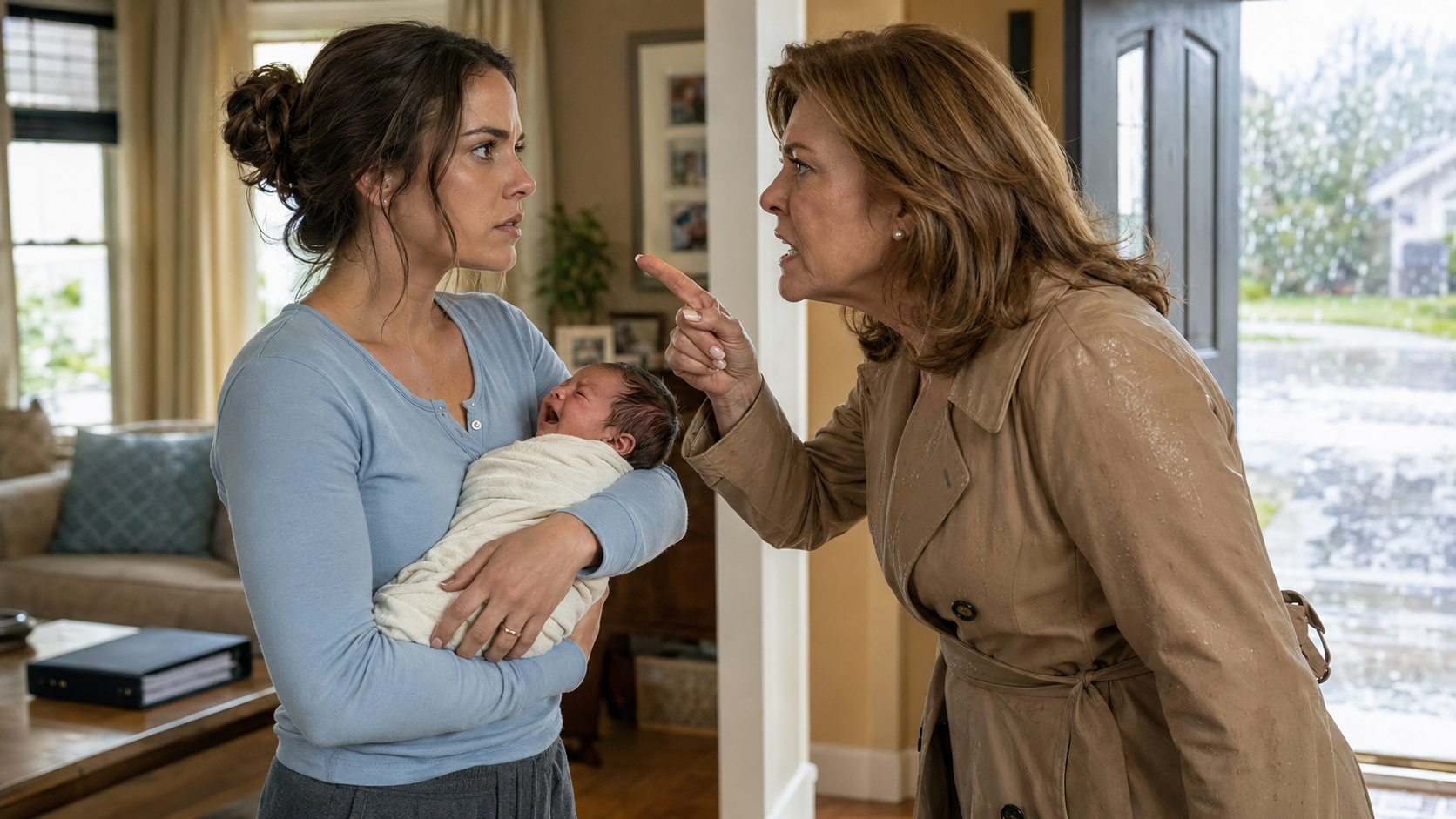
And my front door exploded open.
PART 3: WHO DO YOU THINK YOU ARE?
The door hit the wall so hard the impact sounded like a gunshot.
My entire body reacted before my mind did.
I turned sharply.
Iris jerked awake against my collarbone.
Then my mother stormed into the house.
Wet shoes.
Tan coat.
Perfect nails.
Perfect hair.
Furious face.
She still had the spare key I had given her when Daniel and I bought the house.
At the time, it had seemed practical.
Family should have a key for emergencies.
Apparently, to my mother, three thousand dollars counted as an emergency.
She didn’t look at Iris.
Not once.
She marched across my living room, rainwater darkening the rug beneath her shoes, and pointed one manicured finger directly at my face.
“What on God’s green earth is wrong with you, Elena?”
Iris screamed.
Not cried.
Screamed.
Her tiny body convulsed against me from the shock.
My mother kept talking.
“Do you have any idea what you’ve done?”
Something in me went absolutely still.
I bounced Iris gently.
“Mom.”
“Rachel has been calling me in tears because—”
“Lower your voice.”
She blinked.
“What?”
“Lower your voice.”
Her mouth opened.
Then closed.
I had never spoken to her like that.
Not when I was twelve.
Not when I was twenty-two.
Not even when she told me Daniel was making me selfish because I had started asking questions before sending money.
She took one step closer.
“Don’t you dare take that tone with me.”
I looked her directly in the eyes.
“My one-week-old baby is screaming because you burst into my house like a lunatic. Lower your voice or leave.”
Silence.
For perhaps three seconds.
Then Mom gave a short, disbelieving laugh.
“Oh, I see.”
I continued rocking Iris.
“What do you see?”
“This.”
She waved one hand around the room.
“This attitude. You have a baby and suddenly no one else exists.”
My chest tightened.
“That’s what you think happened?”
“I think you’ve decided you’re too good for your family.”
She gestured toward herself.
“Seven days, Elena. Seven days I’ve been trying to get a simple answer from you.”
“I was recovering from childbirth.”
“And nobody said you weren’t.”
“You didn’t ask.”
That stopped her for half a second.
Then she frowned.
“Ask what?”
I almost smiled.
Not because anything was funny.
Because sometimes cruelty becomes so obvious that it circles back into absurdity.
“How I was.”
She stared.
“How the baby was.”
Her eyes flicked toward Iris.
Finally.
Seven days after her granddaughter was born, my mother looked at her.
The glance lasted maybe two seconds.
“Obviously the baby’s fine.”
I felt the final thread snap.
Not loudly.
Not violently.
It just ceased to exist.
Every instinct I had spent thirty-two years developing—to explain, soothe, apologize, repair—went silent.
Mom continued.
“Rachel’s children were promised those consoles. Do you understand that? They’ve been looking forward to them for weeks.”
“Then Rachel shouldn’t have promised something she couldn’t afford.”
Mom’s face hardened.
“You know how difficult things have been for her.”
“They’re always difficult for her.”
“Because she has children.”
“So do I.”
“One newborn is not the same as raising older kids.”
I stared at her.
There it was.
The rule had already changed.
Before Iris, I was supposed to give because I didn’t have children.
Now I was supposed to give because I only had one.
There would always be a reason.
I could have had six children and Rachel would somehow remain the person whose needs mattered more.
“I am not sending the money,” I said.
Mom stared as though I had spoken another language.
“Excuse me?”
“I’m not sending three thousand dollars.”
“It’s not for Rachel.”
“It’s literally for Rachel’s children.”
“It’s for their birthdays.”
“Gaming consoles are not an emergency.”
“You can afford it.”
I let out a small breath.
“That isn’t the point.”
“It absolutely is the point. You have a good salary. Daniel has a good salary. You have benefits. You have this house.”
Her eyes swept over the room.
“This isn’t about whether you can afford it. This is about whether you care.”
For years, that sentence would have worked.
If you care, you pay.
Love measured in transfers.
Loyalty proven by depletion.
“No,” I said. “It isn’t.”
Her lips pressed into a thin line.
“Who do you think you are, abandoning your own family?”
There it was.
The line she had probably practiced during the drive over.
Iris whimpered.
I kissed the top of her head.
Then I said quietly, “I’m not abandoning my family.”
Mom scoffed.
“Really?”
“No.”
I looked down at my daughter.
“I’m holding her.”
Something changed in my mother’s face.
Not understanding.
Offense.
As if my decision to define my daughter as my primary family was itself an act of betrayal.
“I raised you,” she said.
“I know.”
“I sacrificed everything for you and your sister.”
“I know you worked hard.”
“And this is how you repay me?”
Repay.
That word settled between us.
I looked toward the coffee table.
The black binder sat there exactly where I had left it.
For one week, I had imagined a dozen conversations with my mother.
In every imaginary version, I became emotional.
She interrupted me.
I lost my point.
I cried.
She won.
Standing there with Iris against my chest, I realized I didn’t need to convince her.
I only needed to tell the truth.
“Sit down,” I said.
Mom’s eyebrows lifted.
“What?”
“Sit.”
“I did not come here to—”
“Then leave.”
Another silence.
She looked at me as though trying to locate the daughter she knew.
The daughter who panicked when Mom was disappointed.
The daughter who transferred money to make tension disappear.
The daughter who could be controlled with one phrase:
After everything I’ve done for you.
She couldn’t find her.
Finally, Mom sat on the edge of the couch.
I crossed the room carefully.
I lowered Iris into the bassinet beside the sofa.
Her face crumpled immediately.
“It’s okay,” I whispered.
I rested one hand on her stomach until she settled.
Then I picked up the black binder.
“What is that?” Mom asked.
I placed it on her lap.
“Open it.”
She hesitated.
For the first time since entering my house, she looked uncertain.
Then she opened the cover.
I watched her eyes move across the first page.
TEN YEARS OF FAMILY SUPPORT
Below it was the total.
$147,860
Mom stopped breathing.
Not literally.
But everything about her froze.
Her shoulders.
Her hands.
Her mouth.
The woman who had entered my home shouting had suddenly become completely silent.
She looked at the number.
Then at me.
Then back at the page.
And for the first time in my entire life, my mother had nothing to say.
PART 4: THE BILL THEY NEVER THOUGHT I WOULD COUNT
Mom stared at the page for so long that I heard the refrigerator compressor shut off in the kitchen.
Then she whispered, “What is this?”
“You know what it is.”
“No, I don’t.”
“Turn the page.”
She did.
Bank transfers.
Dates.
Amounts.
Notes.
She flipped again.
More.
Then again.
A payment to Rachel’s landlord.
A payment toward Rachel’s credit card.
A car repair.
Back-to-school expenses.
Money transferred to Mom because she had “covered Rachel temporarily.”
Another rent payment.
Another card.
Another birthday.
Another emergency.
Mom’s fingers began moving faster.
“Why did you print all of this?”
“Because I finally wanted to see it.”
“This is insane.”
“I agree.”
“I meant you doing this.”
“And I meant the amount.”
She slammed the binder shut.
“Family doesn’t keep score.”
I stared at her.
“Interesting.”
“What is that supposed to mean?”
“Because you’ve been keeping score my entire life.”
Her expression changed.
“What?”
“After everything you’ve done for me.”
I repeated the phrase exactly as she had said it minutes earlier.
“After everything Rachel sacrificed for me. Everything I owe. Everything I should be willing to do because you fed me and clothed me and raised me.”
“Those are not the same things.”
“No. They’re not.”
I sat in the chair across from her.
“My list starts when I was twenty-two. Yours starts when I was born.”
She flinched.
“Don’t twist my words.”
“I’m not.”
“You act like we held a gun to your head.”
“No.”
I paused.
“You made sure you didn’t need one.”
Her face reddened.
“How dare you.”
“I sent money because every time I hesitated, you made the alternative feel like I was hurting someone.”
“Rachel needed help.”
“Sometimes she did.”
My mother seemed surprised by the concession.
I continued.
“When her car needed tires and the kids weren’t safe riding in it, I helped. I’d probably help again.”
“Then what is this performance?”
“The fact that it never stopped.”
I opened the binder again.
I turned several pages.
“This was four thousand dollars because Rachel was behind on rent.”
“She had nowhere else to go.”
“I know.”
Another page.
“This was twenty-eight hundred toward credit cards.”
“She was drowning.”
“I know.”
Another.
“Three thousand five hundred when Daniel and I were saving for this house.”
Mom looked away.
“You had the money.”
“We delayed buying by six months.”
“You still bought it.”
I laughed softly.
That was when I understood something I should have realized years earlier.
In my mother’s mind, if I survived the sacrifice, then the sacrifice had cost me nothing.
If I could still pay my bills after helping Rachel, then helping Rachel was free.
If Daniel and I eventually bought our house, then delaying it didn’t matter.
If I still had savings after sending money, then my savings were available.
If I continued functioning after being drained, then I had not truly been drained.
I turned another page.
“Nine hundred dollars for a birthday party.”
“It was an important birthday.”
“Whose?”
Mom frowned.
“What?”
“Whose birthday was it?”
She said nothing.
“You don’t remember.”
“That’s not the point.”
“I paid nine hundred dollars toward a party, and neither of us remembers which kid it was for.”
I turned another page.
“Sixteen hundred for Christmas.”
Then another.
“Twenty-one hundred for another Christmas.”
Another.
“Eight hundred dollars for a tablet because one of the kids broke the previous one.”
“They needed it for school.”
“That’s what you told me.”
“I didn’t lie.”
“I’m not saying you did.”
I looked at her.
“I’m saying every want became a need by the time it reached me.”
Mom stood abruptly.
“I will not sit here while my own daughter puts a price tag on her family.”
I stood too.
“That’s exactly what you came here to do.”
She froze.
“You came into my house over three thousand dollars.”
“Because you made a commitment.”
“No. You made one for me.”
“You always help with birthdays.”
“That does not give you permission to spend my money before asking.”
“They’re children.”
“So is Iris.”
I pointed toward the bassinet.
“She’s seven days old.”
My voice cracked for the first time.
I hated that it did.
Mom noticed.
I didn’t care.
“Do you know what I was doing when you asked me for that money?”
Her eyes shifted away.
“I knew you’d had the baby.”
“No. Tell me what I was doing.”
“Elena—”
“I was bleeding.”
Her face went still.
“I had stitches. I couldn’t stand without help. I had just gone through fourteen hours of labor with my husband watching from a phone when he could. And when I picked up my phone, do you know what I expected?”
Mom said nothing.
“I expected my mother.”
That hurt to say.
More than I had anticipated.
I swallowed.
“I expected you to ask if I was okay.”
Her shoulders lowered slightly.
“I thought you’d tell me if something was wrong.”
“I told you I was in the hospital.”
“You said the baby was coming.”
“Exactly.”
“You’ve always been independent.”
That almost made me lose control.
Independent.
The favorite compliment given to the child nobody wanted to care for.
“Do you know why I’m independent?”
She looked at me.
“Because I learned very young that needing anything made me a problem.”
“That is not true.”
“But being useful made me valuable.”
“Stop.”
“So I became useful.”
“Elena.”
“I fixed things. I sent money. I didn’t complain. I didn’t ask for much. I made it easy for everyone to believe I didn’t need anything.”
“You had a good childhood.”
“I didn’t say I didn’t.”
That silenced her again.
I wasn’t interested in rewriting my childhood into a nightmare.
My mother had worked.
She had packed lunches.
She had sat through school events.
She had taken care of me when I was sick.
Rachel had driven me places before I had a license.
We had laughed.
We had holidays.
There had been love.
That was part of why this hurt.
People wanted bad families to be simple.
They rarely were.
If my mother had been cruel every day of my life, walking away would have been easier.
But she had loved me.
She had simply confused loving me with having permanent rights to me.
“I know you sacrificed,” I said.
Her expression softened just a fraction.
Then I finished.
“But parenting me was not a loan.”
Her face hardened again.
“I never said it was.”
“You remind me of the debt every time I say no.”
“I remind you that family matters.”
“No. You remind me that I’m only allowed to be a good daughter when I’m useful.”
“That is ridiculous.”
“Then why are you here?”
Her mouth opened.
No words came.
“Why are you here, Mom?”
Her eyes moved toward the binder.
“Because Rachel—”
“No.”
I shook my head.
“If this were about family, you would’ve come through that door asking to meet your granddaughter.”
Mom’s face changed.
“You would’ve washed your hands. You would’ve asked how I was healing. You would’ve held Iris. You would’ve asked whether Daniel was okay missing the birth.”
She looked toward the bassinet.
“You came in screaming about money.”
“I was angry.”
“Exactly.”
“Because you ignored us.”
“I had just had a baby.”
“That doesn’t mean the rest of the world stops.”
“No.”
I took a slow breath.
“It means mine changed.”
The room became quiet.
Outside, rain tapped against the windows.
Iris made a soft sound in her sleep.
I walked to the binder again and opened to the final page.
I turned it around.
Mom read.
Total provided over ten years: $147,860
Her jaw tightened.
Then the second line.
Total repayment requested: $0
Then the third.
Future financial obligation: $0
Her eyes moved to the sentence beneath it.
My daughter will not inherit this arrangement.
Mom looked up.
“What does that mean?”
“It means I’m done.”
“Done with what?”
“Being the family bank.”
“No one has ever called you that.”
“You didn’t have to.”
“This is about one request.”
“No. This is about one hundred forty-seven thousand eight hundred sixty dollars.”
“Over ten years.”
“Yes.”
“Which proves it wasn’t that much at any one time.”
I stared at her.
She heard herself.
I watched the realization pass across her face.
She looked down.
For once, I didn’t rescue her from the silence.
Finally she said, “Rachel isn’t like you.”
“I know.”
“She struggles.”
“I know.”
“She’s made mistakes.”
“I know.”
“Her kids didn’t make those mistakes.”
“I know.”
Her voice rose.
“Then what are you saying? That we should let them go without because you suddenly decided you’ve given enough?”
“No.”
I shook my head.
“I’m saying their mother has to decide what she can afford before she promises it.”
“That’s easy for you to say.”
“Yes.”
The answer surprised her.
“Because I have spent my adult life doing exactly that.”
Mom stared at me.
“When I wanted something I couldn’t afford, I waited. When Daniel and I wanted this house, we saved. When my car started dying, I kept driving it because we had other priorities. When I couldn’t take leave, I didn’t take leave.”
My throat tightened.
“And when my husband couldn’t come watch his daughter be born because of orders he couldn’t break, we survived that too.”
I pointed toward the binder.
“Being responsible doesn’t mean I have extra money. It means I made choices before spending it.”
Mom’s face went pale.
“So that’s it.”
“Yes.”
“Your sister is on her own.”
“Financially? Yes.”
“And me?”
I looked at her.
“If you have a real emergency, you can ask.”
She laughed bitterly.
“Oh, how generous.”
“You can ask.”
I emphasized the word.
“You cannot demand. You cannot promise my money to somebody else. You cannot guilt me. And you do not get to walk into my house without knocking ever again.”
Her eyes flashed.
“I’m your mother.”
“And this is my house.”
“I have a key.”
“Give it to me.”
That was the moment she understood that this wasn’t another argument.
I wasn’t going to cool down tomorrow.
I wasn’t going to apologize next week.
There would be no late-night transfer because guilt had finally become unbearable.
Her hand moved slowly toward her purse.
“You’re serious.”
“Yes.”
“You’re going to throw away your family over money.”
“No.”
I held out my hand.
“I’m refusing to let money be the price of admission anymore.”
She stared at my palm.
Then at me.
For a moment, she looked older than she had when she entered.
Not weaker.
Just older.
Almost tired.
Her anger cracked enough for something else to show beneath it.
Fear.
I realized then that Mom had built part of her life around my reliability too.
When Rachel panicked, Mom called me.
When bills arrived, Mom called me.
When she promised something she couldn’t personally provide, she called me.
My boundary wasn’t only taking away money.
It was taking away the illusion that someone else would always absorb the consequences.
That frightened her.
I understood it.
I still did not change my mind.
She dug into her purse and dropped the spare key into my hand.
It felt strangely heavy.
“Your father would be ashamed of you,” she said.
My father had been gone for years.
That sentence was designed to hurt.
It did.
I closed my fingers around the key.
“Maybe.”
She blinked.
She had expected a defense.
I gave her none.
“But I’m not making financial decisions for a dead man.”
Her eyes filled.
For one second, guilt surged through me so powerfully I nearly apologized.
Then Iris stirred.
A tiny squeak came from the bassinet.
I looked toward her.
The guilt loosened.
Mom walked to the door.
Her hand closed around the knob.
I thought she would leave without looking back.
Instead, she turned toward the bassinet.
“Can I see her?”
The question almost broke me.
Not because it fixed anything.
It didn’t.
But it was the first thing my mother had asked me all week that wasn’t about money.
I hesitated.
Then I nodded.
“Wash your hands.”
She looked almost offended by the instruction.
Then she went to the kitchen sink.
When she returned, I lifted Iris carefully.
Mom held out her arms.
I didn’t immediately hand her over.
That hesitation hurt us both.
I saw it in her face.
Eventually, I placed Iris in her arms.
My mother’s expression changed the instant she looked down.
Some of the hardness left.
“She’s beautiful,” she whispered.
My eyes burned.
“Yes.”
“She looks like you.”
“Daniel says she looks like an angry potato.”
Mom almost laughed.
Almost.
For thirty seconds, we stood there like a normal mother and daughter.
Then she gave Iris back.
She looked at me.
“I hope you’re happy with what you’ve done.”
The softness vanished.
I settled Iris against my chest.
“No.”
I told her the truth.
“I’m not happy.”
Mom waited.
“I’m just done being afraid of disappointing you.”
Her face tightened.
Then she left.
This time, she closed the door quietly.
PART 5: WHAT I KEPT FOR MY DAUGHTER
Rachel called twelve minutes after Mom left.
I knew because I watched her name flash across my screen.
I didn’t answer.
She called again.
Then again.
Finally a message arrived.
What did you do to Mom?
I stared at it.
Not:
What happened?
Not:
Are you okay?
Not:
Can we talk?
What did you do to Mom?
For years, I had believed I was the most emotionally fragile person in my family because I was always the one apologizing.
That week, I realized something.
I apologized because I was the only one who could tolerate responsibility.
There is a difference.
I typed a response.
Deleted it.
Typed another.
Deleted that too.
Finally, I wrote:
I showed her the total amount I’ve given the family over the last ten years. I’m not sending the $3,000. I’m also not funding future non-emergency expenses. Please don’t promise the kids money or gifts from me without asking me first.
Rachel responded almost immediately.
Are you seriously keeping a spreadsheet of what you’ve done for us?
I looked at the black binder.
Yes.
Three dots appeared.
Disappeared.
Appeared again.
That’s disgusting.
I felt something twist inside me.
Then I heard Daniel’s voice in my head.
What do you want to do now?
Not what would keep everyone happy.
Not what would end the conflict fastest.
What did I want?
I looked at Iris.
She was beginning to root against my shirt.
I smiled despite myself.
What I wanted was to feed my daughter.
So I put the phone down.
Rachel sent eight more messages.
I read them later.
There were accusations.
I had changed.
Daniel had influenced me.
Military life had made me cold.
I thought I was better than everyone.
I didn’t understand how hard parenting was.
That one almost impressed me.
I was seven days postpartum.
Apparently motherhood counted only when it belonged to Rachel.
Then came the sentence I had been expecting.
After everything Mom did for you, I cannot believe this is how you repay her.
I didn’t answer that either.
That night Daniel called.
I told him everything.
The door.
The shouting.
The binder.
The key.
My father’s name.
For most of the story, Daniel listened quietly.
When I finished, he asked, “How do you feel?”
“Like I got into a fistfight without throwing a punch.”
“Sounds accurate.”
“I made Mom cry.”
“Did you insult her?”
“No.”
“Threaten her?”
“No.”
“Lie to her?”
“No.”
“I think she cried because she heard something she didn’t want to hear.”
I looked down.
“That doesn’t make it easier.”
“No.”
He paused.
“It probably shouldn’t.”
I looked at him.
“What does that mean?”
“It means you love her.”
His voice softened.
“If this felt good, I’d be worried about you.”
That stayed with me.
Because it didn’t feel good.
There was no triumphant music.
No rush of victory.
No pleasure in seeing my mother hurt.
There was grief.
Deep, ugly grief.
Grief for the mother I wanted her to be.
Grief for the daughter I had trained myself to become.
Grief for the years I had confused obedience with love.
But beneath the grief was something else.
Space.
For the first time, I could imagine making a decision without calculating how Mom or Rachel would react.
The next morning, I called a locksmith.
It felt dramatic.
Necessary things sometimes do.
He changed the lock.
I put the new spare key in the kitchen drawer.
When Daniel came home, it would be his.
No one else.
For two weeks, my mother did not speak to me.
Rachel did enough speaking for both of them.
She sent me the occasional message.
Mostly anger.
Sometimes guilt.
Once, a photo of one of her children with the caption:
Hope proving your point was worth disappointing them.
That one nearly worked.
Nearly.
I stared at the child’s face.
I loved my nieces and nephews.
They were innocent.
That had always been the strongest weapon.
But innocent children do not require gaming consoles to survive disappointment.
And protecting children from every disappointment did not prepare them for life.
I wrote back:
Please tell them Aunt Elena loves them. I will choose their birthday gifts myself.
Rachel replied:
Unbelievable.
I didn’t continue.
Three weeks after Iris was born, Daniel finally came home.
I drove to meet him with Iris strapped into her car seat behind me.
The moment he saw us, every controlled military line in his body disappeared.
He dropped his bag.
I barely had time to get out of the car before his arms were around me.
Then he pulled back.
“Where is she?”
I laughed.
“Nice to see you too.”
“I’ve already seen you.”
“Through a phone.”
“I love you. Where is my baby?”
I opened the rear door.
The first time Daniel held Iris, his hands shook worse than mine had.
“Hi,” he whispered.
She opened her eyes.
He stared at her like the universe had personally handed him proof of God.
I looked away because the sight was too private and too beautiful.
That evening, after Iris fell asleep, Daniel noticed the binder.
“You kept it.”
“I almost threw it away.”
“Why didn’t you?”
I ran my fingertips over the cover.
“Because I’m afraid I’ll forget.”
“Forget what?”
“How it felt.”
He sat beside me.
“Then don’t use it to stay angry.”
I looked at him.
“Use it to stay clear.”
That was exactly right.
So I kept it.
Not on the coffee table.
Not as a weapon.
I put it in a box with financial documents in the office.
Life became quieter.
Not immediately.
Boundaries are strange things.
The first time you build one, people who benefited from your lack of boundaries often experience it as aggression.
Mom sent long messages.
Then short ones.
Then none.
Rachel alternated between anger and strategic friendliness.
One month she didn’t speak to me.
The next she sent a picture of the kids.
Then, a week later, she casually asked whether I could “spot her” eight hundred dollars until payday.
I replied:
No, but I hope you get it sorted out.
My hands trembled for twenty minutes after sending those eight words.
That was the part nobody tells you.
Saying no can be simple.
Feeling safe after saying it takes practice.
But each time, the fear passed faster.
I began seeing all the invisible habits money had created in me.
I checked my bank account compulsively, not because I feared overspending, but because I had spent years preparing for someone else’s emergency.
I hesitated before buying anything for myself.
Even inexpensive things.
When Daniel suggested replacing our failing couch, my immediate thought was that we should wait because someone might need money.
Then I realized no one was allowed to need our money more than we did simply because they asked louder.
We bought the couch.
Nothing terrible happened.
When Iris needed a different formula during one difficult week, I didn’t calculate its cost against a possible request from Rachel.
When Daniel and I opened a savings account specifically for Iris, I stared at the first deposit and cried.
Not because the amount was huge.
Because it stayed there.
One afternoon, when Iris was almost three months old, my mother called.
I nearly didn’t answer.
Then I did.
“Hello?”
Silence.
Then: “Hi.”
Her voice sounded different.
Smaller.
“Hi, Mom.”
Another silence.
“I’ve been thinking.”
I waited.
She did not apologize.
Not exactly.
My mother was not transformed by one argument.
Real people rarely are.
She said, “I didn’t realize it had added up to that much.”
I looked toward Iris, asleep beside me.
“Neither did I.”
“I still think the binder was cruel.”
“I know.”
“But…”
She stopped.
I waited.
“But maybe I shouldn’t have asked you that day.”
My throat tightened.
It was not the apology I wanted.
But it was the first admission she had offered.
“No,” I said quietly. “You shouldn’t have.”
“I was worried about disappointing the kids.”
“I understand.”
“I’d already told Rachel I’d figure something out.”
“I know.”
“And then you didn’t answer.”
“I had just had a baby.”
“I know.”
This time, when she said it, it sounded different.
Like she had finally allowed the sentence to mean something.
She took a breath.
“How is Iris?”
I looked at my daughter.
A tiny patch of dark hair stuck straight up from the top of her head.
“She’s good.”
“Does she still look like you?”
“According to you.”
Mom laughed softly.
It was uncomfortable.
Fragile.
Human.
Then she asked, “Could I come see her sometime?”
I looked at the door.
At the new lock.
At the house that finally felt fully mine.
“You can call first.”
A pause.
“Okay.”
“And Mom?”
“Yes?”
“No asking for money.”
Another pause.
Longer.
“Okay.”
I didn’t know whether she meant it forever.
I didn’t need to know.
A boundary wasn’t a prediction about someone else’s behavior.
It was a decision about mine.
If she asked again, I could say no again.
That was the power I had spent my whole life believing I didn’t have.
Mom visited the following Sunday.
She knocked.
That mattered to me more than I expected.
I opened the door.
She stood on the porch holding a small stuffed rabbit.
Nothing extravagant.
Nothing manipulative.
Just a rabbit.
“Can I come in?”
Another thing that mattered.
I stepped aside.
“Yes.”
She washed her hands without being asked.
Then she sat in the living room and held Iris.
For nearly an hour, neither of us mentioned Rachel.
Or money.
Or the binder.
I didn’t pretend everything was fixed.
It wasn’t.
Trust doesn’t regenerate because someone knocks once.
But when Mom left, she kissed Iris’s forehead.
Then she looked at me.
“You look tired.”
I laughed.
“I have a baby.”
“I remember.”
She hesitated.
“Are you okay?”
Three words.
That was all.
The question I had wanted ten minutes after childbirth.
It arrived almost three months late.
I could have punished her for that.
Part of me wanted to.
Instead, I told the truth.
“I’m getting there.”
She nodded.
Then she left.
Months passed.
Rachel did not accept the boundary as easily.
Our relationship became distant.
There were times I mourned it.
There were other times the distance felt like oxygen.
Eventually the financial requests stopped.
Not because Rachel suddenly became responsible.
Not because Mom suddenly understood every mistake she had made.
They stopped because my answer stopped changing.
No.
Not angry.
Not cruel.
Not negotiable.
Just no.
The family survived.
That was almost funny.
The children still had birthdays.
Christmas still happened.
Bills somehow got paid.
Problems got solved.
Rachel made different choices when she could no longer build plans around my income.
Mom stopped making promises on my behalf.
The catastrophe I had spent a decade preventing never came.
Life simply adjusted to the absence of my rescue.
One evening, when Iris was almost a year old, I was cleaning the office and found the black binder again.
I sat on the floor.
For a while, I just looked at it.
Then I opened to the first page.
$147,860.
The number no longer made me angry.
Mostly, it made me sad.
Not because every dollar had been wasted.
Some of that money had genuinely helped people I loved.
Some had kept roofs overhead.
Some had fixed cars.
Some had bought groceries.
I didn’t regret compassion.
I regretted losing the right to choose when compassion was mine to give.
I turned to the final page.
Future financial obligation: $0
Then:
My daughter will not inherit this arrangement.
I heard a little laugh from the doorway.
I looked up.
Iris had learned to stand by holding furniture.
She was gripping the doorframe while Daniel hovered behind her with both hands ready to catch her.
“Look who escaped,” he said.
“Traitor,” I told him.
“She outranks me.”
Iris took one wobbling step toward me.
Then another.
Then fell forward onto her hands and laughed.
I closed the binder.
Daniel nodded toward it.
“You okay?”
“Yeah.”
And I was.
Not perfectly.
Not completely.
But enough.
I slid the binder back into the box.
Then I held out my arms.
Iris stumbled toward me.
I caught her.
She squealed and grabbed my face with both hands.
For years, my mother had taught me that love meant sacrifice.
She wasn’t entirely wrong.
Love does require sacrifice.
I learned that during fourteen hours of labor.
I learned it every sleepless night afterward.
I learned it watching Daniel ache to hold a daughter his orders had kept him from meeting.
But real love does not demand sacrifice simply to prove that it exists.
It doesn’t empty you so someone else never has to change.
It doesn’t send an invoice for childhood.
It doesn’t turn kindness into obligation.
And it doesn’t kick open your front door because you refused to buy someone a gaming console.
I kissed Iris’s forehead.
Someday she would need me.
Someday she would disappoint me.
Someday she would make decisions I hated.
Someday she might grow into a woman whose life looked nothing like the one I imagined for her.
But I made myself one promise as I held her.
She would never grow up believing that my love was a debt she had to repay.
I would not remind her how many diapers I changed.
How many nights I stayed awake.
How much school cost.
How many opportunities I sacrificed.
Those would be my choices.
My responsibility.
My love.
Not her bill.
Daniel sat down beside us.
Iris immediately grabbed his nose.
He pretended to be mortally wounded.
She laughed so hard she hiccuped.
And while I watched them, I thought again about that afternoon in the hospital.
Fourteen hours of pain.
Ten minutes of peace.
One glowing screen.
One demand for three thousand dollars.
At the time, I had believed my mother’s message ruined the first peaceful moment I had with my daughter.
I don’t believe that anymore.
Because that message gave me something too.
Clarity.
For ten years, I had been waiting for permission to stop.
Permission from my mother.
Permission from Rachel.
Permission from someone who would say, You’ve done enough now, Elena. You can keep something for yourself.
That permission was never coming.
The people benefiting from my lack of boundaries had no reason to build them for me.
So I finally understood.
I didn’t need permission.
I needed a decision.
And mine had been made in a hospital bed with my daughter sleeping against my chest.
My phone had lit up.
My mother had asked for money.
And for the first time in my life, I had simply turned it facedown.
That silence had started a war.
But it had also ended something.
The endless debt.
The fear.
The belief that being a good daughter meant never being allowed to say no.
And when the war was over, I still had my mother.
Not in the same way.
Maybe never in the same way again.
I still had a sister, though our relationship now had distance where obligation used to live.
But more importantly, I had myself.
And I had Iris.
My daughter.
My family.
The little girl who had entered the world screaming while I learned, at last, that love was not measured by how much of yourself you allowed other people to take.
Sometimes love was holding on.
Sometimes love was giving.
And sometimes—
when the door flew open, the demands began, and the people you loved insisted your life belonged to them—
love was finally learning how to say:
No.
Để lại một bình luận