
PART 1: THE MAID AT MY WEDDING
I had spent fifteen years imagining what I would say to Lenora Voss if I ever saw her again.
I never imagined I would make her kneel at my feet on my wedding day.
The first time I saw her that morning, she was standing near the service entrance of the Bellamy estate with a silver tray balanced against one hip, wearing a plain gray maid’s uniform that made her look smaller than I remembered.
Older, too.
Her dark hair was streaked with silver now. Fine lines framed her mouth. Her shoulders had the tired stiffness of someone who had learned to keep moving even when she wanted to sit down.
But I knew her immediately.
Some faces are burned into you before you are old enough to understand why.
Lenora had been one of those faces.
She looked up when I entered the corridor.
For a second, neither of us spoke.
Behind me, I could hear the distant chaos of the wedding preparations—florists calling for more white roses, bridesmaids laughing upstairs, glasses clinking in the kitchen, someone testing the string quartet on the lawn.
Everything around me was soft ivory and expensive perfume.
Everything inside me went cold.
“You came,” I said.
Lenora’s fingers tightened around the tray.
“You knew I would.”
I smiled.
“No. I knew you wanted what I offered.”
Her expression barely changed.
That irritated me more than anger would have.
I had spent half my life hating this woman, and she stood in front of me looking almost calm.
“Where do you want me?” she asked.
The question was simple.
But it carried history.
I stepped closer.
“You’ll serve the terrace first. Then the dining room. After dinner, you’ll help wherever the head staff tells you.”
Lenora’s eyes flickered toward my dress.
I wore silk that had taken four fittings to perfect. Tiny pearls had been sewn by hand along the bodice. My mother’s earrings hung from my ears.
I had chosen those earrings deliberately.
Lenora noticed them.
I saw it.
“You remember these?” I asked.
Her face tightened.
“Yes.”
“My mother wore them almost every day.”
“I remember.”
“She stopped wearing jewelry toward the end.”
Lenora lowered her gaze.
There it was.
The first crack.
I wanted it wider.
I had been twelve when my mother began disappearing inside herself.
Before that, she had been loud in a graceful way. She played music while cooking. She sang badly and proudly. She used to open the windows even in winter because she said houses needed to breathe.
Then my father started coming home late.
Then he started taking calls outside.
Then came the arguments behind closed doors.
Then my mother stopped singing.
I remembered untouched breakfast plates.
Half-drunk cups of tea left cold on windowsills.
I remembered finding her once in the upstairs sitting room staring into nothing, both hands pressed together so tightly her knuckles had gone white.
I had asked what was wrong.
She had smiled and told me she was tired.
Children know when adults are lying.
They just don’t always know the name of the lie.
The name was Lenora Voss.
My father, Richard Bellamy, had been sleeping with her while still married to my mother.
And Lenora had known.
I found that out years later, after my mother had left the Bellamy house and taken me with her to my grandparents.
By then, the damage had already settled into everything.
My mother never returned to my father.
She never became the woman she had been before him either.
Richard apologized often.
Apologies had always been one of my father’s favorite currencies.
He spent them freely because they cost him nothing.
Lenora had disappeared from our lives.
Until three months before my wedding.
She had contacted me about an old financial claim involving my father.
I could have refused to meet her.
Instead, I invited her to coffee.
She wanted me to surrender my right to challenge a claim tied to property and business interests Richard had once promised her.
The details were complicated enough to require lawyers, but the emotional truth was simple.
My father had created another mess.
Lenora wanted something from it.
And my signature mattered.
So I had made her an offer.
“One day,” I told her. “Work one day for me. Follow every instruction I give you. When the wedding is over, I’ll sign the waiver.”
Lenora had stared at me across the café table.
“You want me to work at your wedding?”
“As a maid.”
“You’re serious.”
“Completely.”
She could have walked away.
She didn’t.
That mattered to me at the time.
I told myself that meant she deserved whatever happened next.
Now, standing in the service corridor, she said quietly, “You promised the papers would be signed tonight.”
“They will be.”
“If I do what you asked.”
I tilted my head.
“If you do what I ask.”
A voice called my name from the staircase.
“Audrey!”
It was my maid of honor.
I stepped backward.
Lenora moved to pass me.
I caught her wrist.
She looked at my hand.
I lowered my voice.
“One more thing.”
“What?”
“My fiancé knows nothing about this.”
She looked almost offended.
“I haven’t spoken to anyone about our arrangement.”
“Good.”
“And I don’t want your father involved.”
I laughed once.
“For once, we agree.”
I released her.
As she walked away, I felt something close to satisfaction.
That feeling should have frightened me.
It didn’t.
Not yet.
By four in the afternoon, I was married.
Or at least I believed I was going to be.
Julian Mercer stood across from me beneath an arch of white roses, sunlight catching in his dark hair, and when he looked at me I forgot Lenora for almost an entire minute.
Julian had always been able to do that.
He made the room smaller.
Quieter.
He was not from my father’s world. At least, that was what I had loved about him.
He hated society parties. He complained about overpriced restaurants. He had once made me eat tacos on the hood of his car because the reservation I had booked felt “too much like a business merger.”
When we met, I had already spent years trying not to be Richard Bellamy’s daughter.
Julian seemed to understand that.
“I don’t care about your father’s money,” he had told me early in our relationship.
I believed him.
Maybe because I needed to.
I had told Julian that whatever I inherited from Richard one day, I intended to keep separate from the life we built together.
He had shrugged.
“Then keep it separate.”
That answer had meant more to me than he knew.
I thought I had chosen differently than my mother.
I thought I had found a man who saw me instead of my name.
After the ceremony, we moved to the terrace for champagne.
Lenora was there.
Serving.
I watched her from across the crowd.
She offered drinks to women who once would have invited her to charity lunches. Men who had probably known about my father’s affairs and never said a word took glasses from her tray without even looking at her face.
I should have felt finished.
I should have thought: Enough.
Instead, each time I saw her, I remembered my mother sitting alone.
Anger is strange that way.
If you feed it long enough, it stops caring whether the person in front of you is the same person who hurt you years ago.
It only cares that you finally have somewhere to put the pain.
The champagne spilled less than an hour later.
I still don’t know whether Lenora’s hand slipped or someone bumped her.
A glass tilted.
Cold champagne splashed across my white heel.
Lenora immediately crouched.
“I’m sorry.”
She reached for the cloth tucked at her waist.
I looked down at the wet shoe.
Then at her.
Something ugly opened inside me.
“Clean it.”
“I am.”
She bent lower.
I moved my foot back.
“On your knees.”
She stopped.
The conversations nearest us softened.
Not completely.
Just enough.
Lenora looked up.
For one second, I thought she would refuse.
Part of me wanted her to.
I wanted a fight.
I wanted her to tell everyone exactly who she was and exactly why she was there.
Maybe I wanted an audience for fifteen years of grief.
Instead, Lenora lowered herself onto both knees.
Someone behind me laughed.
One of my bridesmaids covered her smile with her hand.
A few guests stared openly.
Lenora began wiping the champagne from my shoe.
Her hands shook.
“That’s what you’re paid for,” I said.
Her jaw tightened.
She kept cleaning.
I remember thinking my mother should have been there to see it.
That thought is one of the things I am most ashamed of now.
Because my mother would have hated what I was doing.
Lenora finished and began to stand.
Our eyes met.
There was something in hers that I misunderstood.
I thought it was defiance.
Maybe it was grief.
Maybe shame.
Maybe pity for me.
Whatever it was, it took me back to being twelve years old outside my parents’ bedroom, hearing my mother cry while my father whispered that he was sorry.
My hand moved before my judgment did.
The slap cracked across the terrace.
Everything stopped.
Lenora stumbled backward.
Somebody said my name.
I barely heard it.
I caught Lenora’s arm.
She jerked away.
“You promised one day,” she hissed.
“And you promised my mother nothing, didn’t you?”
Her face changed.
“Audrey—”
“You knew he was married.”
“Yes.”
“You knew he had a child.”
“Yes.”
“And you did it anyway.”
Her eyes filled with something, but I was too angry to care.
“I have regretted it every day.”
“Good.”
She tried to walk away.
I blocked her.
“Audrey,” someone warned.
I don’t remember who.
Lenora stepped backward.
We were too close to the pool.
She said, “Your mother would not want this.”
That sentence did it.
I shoved her.
The moment my hands left her shoulders, I knew.
There was no taking it back.
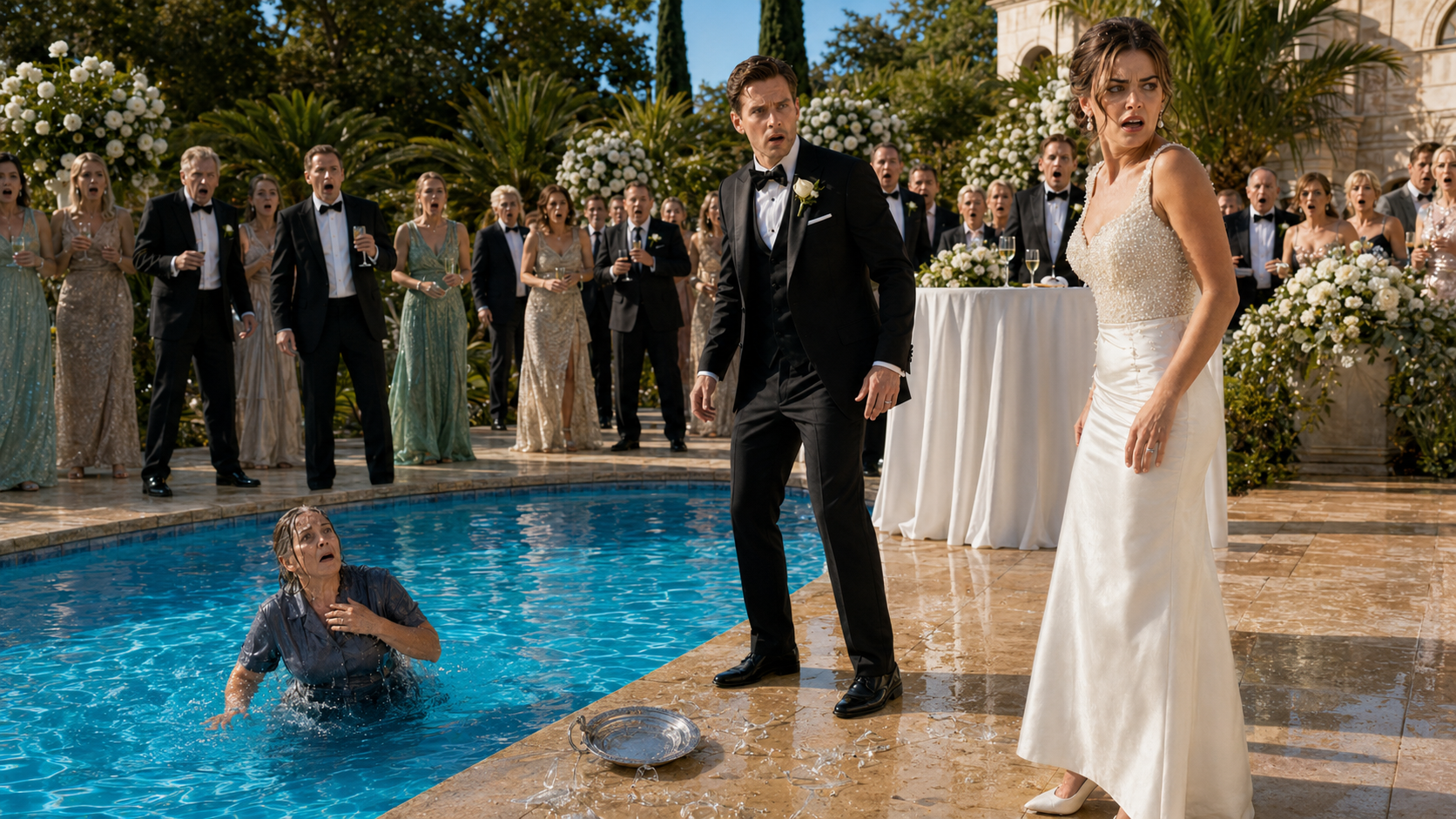
Lenora fell into the pool with a violent splash.
Guests screamed.
The tray hit stone.
Glasses shattered.
Lenora surfaced coughing, her gray uniform soaked dark, her hair plastered across her face.
I stood frozen above her.
Then someone tore through the crowd.
“What the hell are you doing?”
I turned.
Julian.
His face was white.
I looked toward the pool, then back at him.
For one stupid second, I still thought I could explain it later.
“Relax,” I said. “She’s just the maid.”
Julian stared at Lenora.
His expression changed so fast that fear slid through me.
“That’s my mother.”
The world disappeared.
Not literally.
I could still see the guests.
The flowers.
The blue water.
The glass glittering on the stone.
But none of it made sense anymore.
I looked at Lenora.
She stared back at me.
And I knew from her face that she was as shocked as I was.
Julian jumped down and pulled her from the pool.
“Mom.”
His voice broke.
Lenora clutched his arm.
“Julian.”
He stripped off his jacket and wrapped it around her shoulders.
Then he turned toward me.
I had never seen him look at me that way.
Not angry.
Disgusted.
The slap came before I could speak.
My face snapped sideways.
Gasps went through the crowd.
My cheek burned.
Julian stared at me, breathing hard.
“I can’t marry someone like you.”
He pulled off his wedding ring.
“Julian—”
“No.”
He threw the ring onto the wet stone.
It bounced once.
Then stopped near my shoe.
For everyone watching, the story was simple.
The spoiled rich bride had humiliated an older maid.
The maid turned out to be the groom’s mother.
The groom chose his mother.
And the bride got exactly what she deserved.
I didn’t try to stop him.
I should have been looking at Julian.
Instead, I was looking at Lenora.
Because Julian had just ended my marriage in front of everyone.
And Lenora did not look relieved.
She looked terrified.
Then I remembered the papers.
The waiver.
The agreement.
She had endured the uniform.
The insults.
The kneeling.
The slap.
The pool.
All because after the wedding, I was supposed to sign away my right to interfere with the claim tied to my father.
But the wedding was over.
The papers had not been signed.
And Julian knew none of it.
He didn’t know his mother had agreed to work for me.
He didn’t know why.
He didn’t know that she had once slept with my father.
As Julian led her away, Lenora turned her head once.
Our eyes met.
And for the first time that day, I saw something stronger than humiliation in her face.
Fear.
Not of me.
Of what her son was about to learn.
PART 2: WHAT HIS MOTHER NEVER TOLD HIM
I spent my wedding night alone in the bridal suite.
The flowers were still there.
That was the cruelest part.
White roses covered the room in arrangements that had cost more than my first car. Champagne sat untouched in a silver bucket. Two glasses waited beside it.
Someone had placed rose petals across the bed.
I sat on the floor and stared at them until midnight.
My cheek had swollen where Julian hit me.
I touched it once.
Then stopped.
I had hit Lenora first.
There was no moral equation that made me innocent.
But guilt did not erase the other questions.
How had I dated Julian for almost three years without knowing his mother was Lenora Voss?
The answer was embarrassingly ordinary.
He rarely called her Lenora.
To him, she was Mom.
After his parents separated when he was young, she had used her married surname for years. Julian had grown up mostly with his father and had complicated feelings about his mother. They spoke, but they were not close enough for me to have spent much time with her.
Our wedding was supposed to be the first time our families properly met.
Julian had told me she might not come.
He had not shown me recent photographs.
I had not pushed.
And Lenora, apparently, had known her son was engaged to a woman named Audrey Bellamy without understanding exactly which Bellamy I was.
My father’s name was famous in certain circles.
Mine was not.
I had made sure of that.
I kept away from Bellamy Holdings whenever possible. I did not sit on the board. I avoided interviews. I built my own career and lived in a townhouse that did not belong to my father.
Julian knew I was Richard Bellamy’s daughter.
But he had never understood the full structure of my father’s holdings.
I had preferred it that way.
At one in the morning, my phone lit up.
Not Julian.
My father.
I almost ignored it.
Then I answered.
“Audrey.”
His voice was cautious.
“I heard.”
“Of course you did.”
“Are you all right?”
I laughed.
“Which part are you asking about?”
Silence.
Then, “Lenora was there?”
There was something in his voice.
Old fear.
Old guilt.
“You knew she was Julian’s mother?”
“No.”
The answer came quickly enough that I believed him.
I closed my eyes.
“This entire family is diseased.”
“Audrey—”
“She contacted me about the claim.”
My father exhaled slowly.
“What did you do?”
“I made an agreement.”
“What kind of agreement?”
I looked at the wedding dress pooled around me.
Suddenly, hearing it out loud felt different.
“I told her I’d sign the waiver if she worked my wedding.”
My father was quiet for so long that I thought the call had dropped.
Then he said, “Why?”
“You know why.”
“No.”
His voice hardened.
“I know why you hated her. That is not the same thing.”
“She helped destroy Mom.”
“I destroyed my marriage.”
The sentence made me sit straighter.
“You weren’t alone.”
“No. But I was the one who made vows to your mother.”
I hated him for saying it.
Because he was right.
Because it did not make Lenora innocent.
Because it did not make me innocent either.
“What happened today?” he asked.
“You’ll read about it by morning.”
“Audrey.”
“I slapped her.”
Silence.
“I pushed her into the pool.”
My father swore softly.
“And Julian?”
“He hit me.”
“What?”
“Don’t.”
My voice sharpened.
“Do not suddenly become protective. You lost that privilege a long time ago.”
Another silence.
Then he said, “Did you sign the waiver?”
“No.”
I heard him breathe out.
I could almost see the calculations beginning in his head.
That was what Richard Bellamy did.
He turned emotion into contracts.
Damage into settlements.
Regret into numbers.
“I want you to leave it alone tonight,” he said.
“I wasn’t asking permission.”
“Audrey, whatever Lenora tells Julian—”
I sat very still.
“What would she tell him?”
My father went quiet again.
That silence answered more than words.
“What would she tell him?” I repeated.
“There are things he may not know.”
“About you?”
“Yes.”
“About the claim?”
“Yes.”
“About what I could inherit?”
Another pause.
“Yes.”
My stomach tightened.
“Good night, Dad.”
“Audrey—”
I ended the call.
Julian did not contact me that night.
Or the next morning.
By noon, videos from the wedding had begun circulating among people who had attended.
No one posted the full confrontation.
Only pieces.
Lenora kneeling.
My hand striking her.
Her falling into the pool.
Julian pulling her out.
Julian slapping me.
His ring hitting the stone.
Stripped of context, it looked even worse.
The messages began.
Some concerned.
Some horrified.
Some almost excited.
Scandal is entertainment when it happens to people you know.
I shut off my phone.
For three days, nothing happened.
Then Julian called.
I stared at his name until the ringing stopped.
He called again.
I did not answer.
On the fourth call, I did.
“What?”
His breathing changed slightly when he heard my voice.
“Audrey.”
I said nothing.
“I want to talk.”
“You did quite a lot of talking on the terrace.”
“I was angry.”
“So was I.”
“That doesn’t excuse what you did.”
“I know.”
That stopped him.
Maybe he had expected me to defend myself.
“I know what I did,” I continued. “I know it was cruel.”
“She told me.”
My spine stiffened.
“Told you what?”
“Everything.”
I walked toward the window.
Rain streaked the glass.
“Be specific.”
“My mother and your father.”
I said nothing.
“The affair,” he continued. “Your mother. Why you hate her.”
There was a strange softness in his voice now.
Not forgiveness.
Understanding, perhaps.
Then he said, “She also told me about your agreement.”
There it was.
I leaned against the window.
“And?”
“I didn’t know.”
“I assumed that.”
“You made her work the wedding in exchange for the waiver?”
“Yes.”
“That’s insane.”
“Yes.”
“And she agreed.”
“Yes.”
He exhaled.
Then came the question that changed everything.
“What exactly are you giving up?”
Not Why did you do it?
Not Are you okay?
Not even Why did my mother need it so badly?
What exactly are you giving up?
I stared at the rain.
“Why?”
“I’m trying to understand.”
“Understand what?”
“The situation.”
“You ended our marriage.”
“I know.”
“In front of two hundred people.”
“I know.”
“You threw your ring at my feet.”
“Audrey—”
“And now you want to understand my financial agreement with your mother?”
“That’s not what this is.”
I let the silence stretch.
He filled it.
“My mother said the waiver affects your future interests in some of Richard’s holdings.”
“My father has many holdings.”
“She said some of them may eventually pass to you.”
“Some.”
“How much?”
I closed my eyes.
There it was again.
Cleaner this time.
“How much what?”
“How much are we talking about?”
I nearly laughed.
Instead, I said, “You should ask your mother.”
“Audrey.”
“I have to go.”
“Wait.”
I waited.
His voice softened.
“I’m sorry I hit you.”
I touched my cheek without thinking.
“I’m sorry I hit her first.”
“I shouldn’t have done it.”
“No.”
“You humiliated my mother.”
“Yes.”
“But I shouldn’t have hit you.”
“No.”
Another pause.
Then he said quietly, “Maybe we both did things that day we can’t take back.”
My heart hurt.
Because that sounded like Julian.
My Julian.
The man who used to bring me coffee without asking how I wanted it because he already knew.
The man who held my hand during my mother’s memorial service.
The man who had once told me I was the only person he had ever wanted to come home to.
For one dangerous second, I wanted to believe we were standing on the edge of forgiveness.
Then he asked, “Have you signed anything yet?”
I opened my eyes.
“No.”
“Don’t.”
The word came too fast.
“Why?”
“Just don’t do anything until we talk.”
The call ended five minutes later.
I stood at the window long after that.
Julian had spent years telling me he did not care what happened to the Bellamy money.
Four days after our wedding collapsed, he suddenly cared very much.
That night, Lenora called me.
I almost declined.
Then I answered.
“Audrey.”
Her voice sounded tired.
“What?”
“I’m sorry.”
I laughed bitterly.
“For which part?”
“Several.”
I didn’t respond.
“Julian knows about your father and me.”
“I assumed so.”
“He was furious.”
“At you?”
“At everyone.”
I pictured Julian pacing through Lenora’s house.
“He asked about the property,” she said.
My fingers tightened around the phone.
“What did you tell him?”
“The truth.”
“Which truth?”
“That Richard made promises years ago. That some were documented badly. That your signature could keep the matter from turning into another legal fight.”
“And what else?”
Silence.
“Lenora.”
“I told him Richard had reorganized portions of his estate.”
My stomach dropped.
“How much does he know?”
“I don’t know.”
“You told him I might inherit more than he thought.”
“I answered his questions.”
“Why?”
“He’s my son.”
“And?”
Her voice sharpened.
“And I had just been dragged out of a pool in front of two hundred people while he stood there trying to understand why his fiancée hated me.”
I closed my eyes.
She was right to be angry.
But anger did not answer the question.
“You endured the wedding because you wanted my signature,” I said.
“Yes.”
“Julian ended the marriage before you got it.”
Silence.
“Now he wants to talk to me again.”
More silence.
I felt the pieces begin to shift.
“You want us back together.”
“No.”
The answer was immediate.
Too immediate.
“Then why did you tell him about my inheritance?”
“Because he asked.”
“And now he wants me not to sign your waiver.”
Lenora went still on the other end of the line.
“What?”
“You didn’t know?”
“No.”
That sounded real.
For the first time, I understood that whatever Julian was doing, his mother might not be directing it.
“Interesting,” I whispered.
“Audrey, what are you thinking?”
I looked down at the wedding ring still sitting on my dresser.
“I’m thinking Julian and I need to talk.”
PART 3: THE MAN WHO CAME BACK
Julian arrived at my townhouse two nights later.
He brought no flowers.
I was grateful for that.
Flowers would have made me hate him.
He stood outside in a dark coat, looking exhausted.
For almost three years, I had known every version of his face.
Amused.
Irritated.
Half-asleep.
In love.
I had never seen this one.
Careful.
I opened the door but did not invite him in immediately.
“You wanted to talk.”
“Yes.”
His eyes moved over my face.
The swelling was gone.
A faint yellow bruise remained near my cheekbone.
His jaw tightened when he saw it.
“I’m sorry.”
“So you said.”
“I mean it.”
I stepped aside.
He entered.
We sat across from each other in the living room.
For a while, neither of us spoke.
The silence felt almost domestic.
That hurt more than shouting would have.
Finally, Julian leaned forward.
“My mother told me more about what happened with your parents.”
I looked at him.
“She didn’t excuse herself.”
“Good.”
“She said she knew your father was married.”
“Yes.”
“She said she was younger and stupid.”
“She wasn’t nineteen, Julian.”
“I know.”
“She knew my mother existed.”
“I know.”
“She knew I existed.”
His eyes lowered.
“I know.”
I hated how quickly tears pressed behind my eyes.
I stood and walked to the window.
“I spent years wondering why my mother wasn’t enough.”
Julian said nothing.
“I was a child. I thought maybe if I had been quieter, smarter, prettier, easier, my father would have wanted to come home.”
“Audrey.”
“I know now that children think stupid things.”
“They’re not stupid.”
I turned.
“What I did to your mother was wrong.”
He watched me.
“I wanted her ashamed,” I said. “I wanted her small. I wanted one day where she had to feel what I thought she made my mother feel.”
Julian swallowed.
“And did it help?”
“No.”
That was the first completely honest thing I had said about the wedding.
“It didn’t change anything.”
His shoulders dropped slightly.
Then he said, “I didn’t know what she had done.”
“I believe you.”
“I would never have let you go through with that arrangement if I knew.”
“I know.”
Another silence.
There were a thousand ways the conversation could have gone from there.
We could have cried.
We could have apologized.
We could have discussed whether something broken could be repaired.
Instead, Julian asked, “What happens to the Bellamy estate if your father dies?”
I stared at him.
He must have seen the change in my face because he immediately added, “I’m asking because this is obviously connected.”
“No,” I said. “It isn’t.”
“Audrey.”
“My father’s health has nothing to do with your mother’s waiver.”
“He’s had heart issues.”
My blood went cold.
“How do you know that?”
He hesitated.
“Your father mentioned medication once.”
“My father mentions nothing personal to you.”
“He looked unwell at Christmas.”
“You saw him for forty minutes.”
Julian leaned back.
“You’re making this sound sinister.”
“I’m making it sound strange.”
He rubbed a hand over his face.
“All right. Fine. I asked my mother.”
“About my father’s health?”
“About the history. His age. What happens eventually.”
I said nothing.
He continued, “You told me for years that you didn’t want his fortune.”
“I don’t.”
“That’s easy to say when you don’t have to make the decision yet.”
“What does that mean?”
“It means you could be talking about an extraordinary amount of money.”
I almost smiled.
Not because anything was funny.
Because I finally understood why his questions felt different.
Before the wedding, when I talked about my father’s wealth, Julian treated it like bad weather.
Something unpleasant in the distance.
Now he leaned toward it.
“What changed?” I asked.
He looked confused.
“For you.”
“Nothing.”
“Before the wedding, you told me you didn’t care if I inherited a dollar.”
“I don’t.”
“Then why are we discussing it?”
“Because your agreement with my mother could affect you.”
“I made that agreement before you learned what I might inherit.”
His eyes narrowed.
“What are you accusing me of?”
“I’m asking a question.”
“Well, ask it.”
I looked straight at him.
“If Richard Bellamy had no money, would you be sitting here?”
His face went hard.
“That’s insulting.”
“Answer.”
“I came here because I love you.”
A part of me wanted to fall into those words.
Another part noticed he still had not answered.
I sat down.
“Do you want to marry me?”
His eyes flickered.
“After everything?”
“Yes.”
He hesitated.
Then said, “I don’t know.”
It should have hurt.
Instead, I felt something like relief.
At least that answer sounded real.
“I love you,” he said. “But what happened was horrible.”
“I know.”
“And I don’t know whether I can forget it.”
“You shouldn’t.”
His expression softened.
I almost hated myself for what I did next.
Because the idea had come to me the night before.
Not fully formed.
Just a possibility.
A test.
A lie strong enough to strip away every careful answer.
I looked down at my hands.
“My period is late.”
Julian became completely still.
“What?”
I forced myself not to look at him immediately.
“I’m late.”
“How late?”
“Enough.”
His face lost color.
“Are you saying—”
“I don’t know.”
He stood.
“Did you take a test?”
“Not yet.”
“Why not?”
“Because I was afraid.”
That part, strangely, was true.
Not of pregnancy.
Of what I was about to learn.
Julian paced once across the room.
Then he turned.
“You could be pregnant.”
“Yes.”
“With my child.”
“Yes.”
Everything about him changed.
His uncertainty vanished.
Not slowly.
Instantly.
He came closer.
“Audrey.”
I looked up.
“We need to figure this out.”
“We?”
“Yes, we.”
“You said two minutes ago you didn’t know if you could marry me.”
“This changes things.”
There it was.
A small sentence.
A huge door opening.
“Why?”
“Because we’d be a family.”
“Would we?”
“Of course.”
“You threw your ring at me.”
“I was in shock.”
“You said you couldn’t marry someone like me.”
“I was angry.”
“You hit me.”
He flinched.
“I apologized.”
I watched him carefully.
He crouched in front of me.
“Audrey, if you’re pregnant, none of this is just about us anymore.”
His hands closed around mine.
For a moment, I remembered how those hands had once rested on my waist while we danced in our kitchen.
I wanted so badly for this to be love.
Then he said, “You definitely shouldn’t sign anything with my mother until we know.”
My stomach turned.
I withdrew my hands.
“Why does the baby affect that?”
“Because your financial decisions affect our child.”
Our child.
He had already moved from maybe to our.
“So now my father’s money matters?”
“It matters if there’s a child.”
“You told me money didn’t matter.”
“There’s a difference between not caring about wealth and being irresponsible.”
“And giving Lenora what I promised is irresponsible?”
“You could be surrendering millions.”
I stood.
His eyes followed me.
“How many millions?”
“What?”
“You said millions. How many?”
“I don’t know.”
“Then why say it?”
He frowned.
“Audrey, stop.”
“No. I’m curious.”
“I don’t know the details.”
“But you’ve thought about them.”
He stood too.
“Anyone would.”
I nodded slowly.
“Yes.”
Anyone would.
That was what frightened me.
Because greed did not always announce itself like greed.
Sometimes it called itself responsibility.
Sometimes protection.
Sometimes concern for a child who did not exist.
“I’ll take a test,” I said.
“When?”
“Soon.”
“I want to be there.”
“No.”
“Audrey.”
“No.”
He looked frustrated.
Then controlled it.
“All right.”
He stepped closer.
“Call me when you know.”
I nodded.
He kissed my forehead before he left.
Three weeks earlier, that gesture would have melted me.
That night, it felt like a man placing a marker on property he thought might soon belong partly to him.
I hated myself for thinking it.
I hated him more for making the thought possible.
The next morning, I texted him.
Positive.
He called within ten seconds.
His first words were, “We’re getting married.”
Not Are you okay?
Not How do you feel?
Not Are you sure?
We’re getting married.
I sat at my kitchen table, staring at the city through the windows.
“Julian—”
“We can do something small.”
“You ended our marriage.”
“We fix it.”
“You were unsure yesterday.”
“I’m not unsure anymore.”
“Because of the baby?”
“Because I know what matters now.”
My pulse quickened.
“And what matters?”
“You. The baby. Our future.”
Then, after half a breath, he added, “And making sure no one takes advantage of what belongs to you.”
There it was.
I closed my eyes.
“What do you mean?”
“Your mother’s agreement.”
“Your mother.”
“You know what I mean.”
“No, I’d like to hear you say it.”
He exhaled impatiently.
“The waiver. Don’t sign it.”
“I promised.”
“You promised under ridiculous circumstances.”
“She kept her part.”
“She was humiliated.”
“By me.”
“Yes.”
“Which means if anyone owes her anything, it’s me.”
“You don’t owe her millions because you were angry.”
I leaned back in my chair.
“You seem very certain the claim is worth millions.”
He went quiet.
I opened my eyes.
“Julian?”
“My mother explained more last night.”
Of course she had.
“What did she explain?”
“That the claim touches assets that could eventually be consolidated into your portion of the estate.”
“And?”
“If you waive your rights now, it could weaken your position later.”
“My position.”
“Our child’s position.”
The nonexistent baby had become his favorite financial argument in less than twelve hours.
I said quietly, “Maybe my father will put everything into trust for the baby.”
Silence.
I could almost hear his mind move.
“Did he say that?”
“No.”
“But he might?”
“He’s sentimental about legacy.”
That was true enough.
Julian’s voice softened.
“Then we need to be careful.”
I stared at my coffee.
“What does careful mean?”
“It means no signatures. No agreements. And we should probably get married before your father starts restructuring anything.”
There.
I had wanted proof.
I had just found the first piece.
PART 4: THE PREGNANCY THAT NEVER EXISTED
For the next ten days, Julian became the man I had once planned to spend my life with.
Almost.
He called every morning.
He brought food.
He asked if I was tired.
He touched my stomach carefully, even though there was nothing there to touch.
That was the hardest part.
Not maintaining the lie.
Watching him become tender.
I had expected greed to make him obvious.
Greed rarely does.
People are complicated enough to love you and still calculate what you are worth.
That frightened me more than discovering he had never loved me at all.
I began asking questions.
Not interrogating.
Listening.
Julian wanted another wedding quickly.
“Nothing like the first one,” he said.
We were sitting in my living room.
“No guests. Just us.”
“And a marriage certificate.”
He frowned.
“That’s generally how weddings work.”
“And what about a prenup?”
His expression changed.
Barely.
But I saw it.
“We already had one drafted.”
The original agreement kept my Bellamy assets separate.
He knew that.
“I want to strengthen it,” I said.
“Why?”
“For the baby.”
He stared at me.
“You want to make it stronger now?”
“Yes.”
“You’re pregnant with my child.”
“Exactly.”
“That makes no sense.”
“It makes perfect sense. I want financial boundaries clear.”
His jaw tightened.
“Audrey, I’m not trying to take your money.”
“Then it shouldn’t matter.”
He stood and walked toward the fireplace.
“I just don’t understand why you’re treating me like a threat.”
“Because two weeks ago, you ended our marriage in front of everyone.”
“You pushed my mother into a pool.”
“I know.”
“You keep saying that like it erases what happened.”
“It doesn’t.”
“Then why am I the one being tested?”
The word hit me.
Tested.
I kept my face still.
“I didn’t say you were.”
“You don’t have to.”
He turned toward me.
“If we’re having a child, I need to know we’re actually building a life.”
“And building a life means access to my father’s estate?”
“I never said access.”
“No. You say stability. Protection. Responsibility. Family.”
His face hardened.
“You’re twisting everything.”
“Am I?”
He left angry.
Then called an hour later to apologize.
I began to see the pattern.
Every time I moved money away from the center of our imagined future, Julian became nervous.
Every time I suggested preserving it, he became loving.
I told him I was thinking about reconciling with my father.
Julian loved the idea.
I told him Richard might name charitable foundations in his estate.
Julian called that “emotionally impulsive.”
I told him I still intended to sign Lenora’s waiver.
He became furious.
Then something happened I did not expect.
Lenora came to see me.
I almost did not open the door.
She stood outside wearing a dark coat, no makeup, her hair pulled back.
She looked nothing like the woman from the wedding.
She also looked nothing like the woman from my childhood memories.
Just tired.
“Julian says you’re pregnant,” she said.
Straight to it.
I stepped aside.
She entered.
We stood in the living room without sitting.
“I suppose congratulations are inappropriate,” she said.
“You can say whatever you want.”
Her eyes moved over me.
Then she asked, “Are you?”
My heart kicked.
“Am I what?”
“Pregnant.”
“Yes.”
She kept staring at me.
I had the uncomfortable feeling she could see through skin.
Then she said, “Julian wants you to marry him again.”
“He does.”
“Do you?”
I did not answer.
Lenora walked toward the window.
“I told him he should leave you alone.”
That surprised me.
“You did?”
“He’s angry with me.”
“Why?”
“Because I still want you to sign the waiver.”
I almost laughed.
“At least you’re consistent.”
She turned.
“You offered me something. I accepted. I did what you asked.”
A wave of shame moved through me.
“Yes.”
“I did more than you asked.”
“I know.”
“I didn’t agree to be hit.”
“I know.”
“I didn’t agree to be pushed into a pool.”
“I know.”
My voice cracked on the last one.
Lenora looked at me for a long moment.
Then some of the hardness left her face.
“I hurt your mother.”
“Yes.”
“I can’t change it.”
“No.”
“I knew Richard was married.”
“Yes.”
“I knew about you.”
My throat tightened.
“Yes.”
“I told myself many things at the time. That his marriage was already failing. That he was going to leave. That your mother knew. That adults made complicated choices.”
Her mouth twisted bitterly.
“Those were excuses.”
I said nothing.
“I was selfish,” she continued. “Your father was selfish. Your mother paid for it. You paid for it.”
I had waited years to hear her say those words.
They did not feel like victory.
They felt heavy.
“I hated you,” I whispered.
“I know.”
“I wanted you to hurt.”
“I know.”
“I wanted to see you beneath me.”
Her eyes shone.
“And you did.”
I looked away.
“Did it help?”
“No.”
“That is usually the problem.”
I almost laughed, but tears came instead.
I wiped them angrily.
Lenora waited.
Then I asked, “Why do you want the property so badly?”
She sighed.
“Because I spent years believing Richard would keep one promise after breaking every other one.”
“That doesn’t answer me.”
“No.”
She folded her arms.
“The claim is security. Not luxury. I am not trying to become a Bellamy.”
“You were involved with one.”
“A mistake I have paid for in ways you don’t know.”
“You had Julian.”
Her face changed.
“Julian was never a punishment.”
“I didn’t mean—”
“I know.”
She looked down.
“His father and I separated for reasons that had nothing to do with Richard. Julian spent years angry at me anyway. Some deserved. Some not.”
I thought of Julian rushing to the pool.
The terror on Lenora’s face when he found her there.
“Why didn’t he know about my father?”
“Because there are things mothers do not tell their sons.”
I nodded.
“Especially when those things make them look ugly.”
Another silence.
Then she said, “Julian has been asking me questions.”
My body stiffened.
“What kind?”
“About Richard. The estate. The waiver.”
“I know.”
“He wants me to challenge more than I originally intended.”
I stared at her.
“More?”
“He thinks I should demand what Richard verbally promised me in addition to what the documents support.”
“Do you?”
“No.”
The answer surprised me again.
“Why not?”
“Because I know the difference between what I want and what I can justify.”
I studied her face.
“Julian thinks if you and I marry, he can negotiate between us,” I said.
Lenora gave a short, humorless laugh.
“He told me you would want to ‘keep everything in the family.’”
My stomach tightened.
“When?”
“Yesterday.”
I went cold.
Everything in the family.
He had already placed himself inside my family.
Inside my father’s assets.
Inside negotiations that existed before he knew their value.
“What exactly did he say?”
Lenora hesitated.
Then repeated it.
“He said once you were his wife again, and especially with a baby, you would stop making emotional decisions. He said he could make sure you didn’t surrender anything you would regret.”
My mouth went dry.
“And what did you say?”
“That what you sign is your decision.”
I sat down.
Lenora watched me.
“Audrey.”
I pressed my fingers together.
“Did Julian ask whether my father was dying?”
She went still.
“Yes.”
The room seemed to tilt.
“What did you tell him?”
“That I didn’t know.”
“He asked you directly?”
“Yes.”
“When?”
“The night after the wedding.”
Before his first call to me.
Before the apology.
Before the concern.
Before the pregnancy lie.
I felt something tear quietly inside me.
Not dramatically.
No scream.
No collapse.
Just a final thread snapping.
Lenora stared at me.
“What is it?”
I lifted my eyes.
“You asked if I’m pregnant.”
“Yes.”
“I’m not.”
She said nothing.
“I was never pregnant.”
Her eyes widened.
“Audrey.”
“I needed to know why he came back.”
“You lied to him about a child?”
“Yes.”
“That’s cruel.”
“I know.”
She stared at me with open disbelief.
“You cannot keep using cruelty as an investigation method.”
The words hit hard because they were true.
“I know.”
“Do you?”
“Yes.”
I stood.
“That’s why I’m ending it.”
“The lie?”
“All of it.”
Lenora watched me.
“What are you going to do?”
For the first time since the wedding, I felt calm.
“Give Julian exactly what he wants.”
Her brow furrowed.
“What?”
“A conversation about the future.”
PART 5: WHAT JULIAN REALLY WANTED
I asked Julian to meet me at the Bellamy house.
Not the wedding terrace.
I could not stand there again.
Instead, I chose my father’s library.
The room where Richard had conducted decades of business.
Walnut shelves.
Leather chairs.
A long desk that made everyone sitting across from it feel smaller.
As a child, I hated that room.
As an adult, I finally understood why.
Power had architecture.
Julian arrived at seven.
He looked hopeful.
That hurt.
I had loved this man.
Some part of me still did.
Love does not disappear the instant you discover something ugly.
Sometimes it simply becomes something you can no longer safely touch.
“I talked to my father,” I said.
That was true.
Julian sat across from me.
“And?”
“He knows about the pregnancy.”
His expression brightened.
“What did he say?”
“That a grandchild changes things.”
Again, true.
Richard had said many things when I told him what I was doing.
Most of them unprintable.
He hated the pregnancy lie.
He also admitted Julian’s sudden fascination with his health frightened him.
“So what happens?” Julian asked.
I folded my hands.
“My father is considering restructuring part of the estate.”
Julian leaned forward.
“For the baby?”
“Possibly.”
“How much?”
The question came almost immediately.
I looked at him.
He realized.
“That sounded terrible.”
“Yes.”
“I’m just trying to understand.”
“You keep saying that.”
He sat back.
“Audrey.”
“Dad thinks I should keep my interests rather than sign Lenora’s waiver.”
Relief flashed across his face.
Fast.
Unmistakable.
“I agree.”
“I thought you might.”
“It’s the smart decision.”
“And Lenora?”
“My mother will be fine.”
I studied him.
“She endured my wedding because of that agreement.”
“I know.”
“She humiliated herself.”
“You humiliated her.”
“Yes.”
“She shouldn’t be rewarded for that.”
“Rewarded?”
He sighed.
“You know what I mean.”
“No. Explain.”
“She made choices. Years ago. With your father. Why should you be financially responsible for them?”
I almost admired the hypocrisy.
“Interesting.”
“What?”
“You ended our marriage because I mistreated your mother.”
“I ended it because what you did was horrifying.”
“But now that her interests conflict with yours, she becomes a woman who made bad choices.”
His face hardened.
“That’s unfair.”
“Is it?”
“I’m trying to protect our child.”
I leaned back.
“And if there were no child?”
He frowned.
“What?”
“If I weren’t pregnant, would you still be here?”
“Yes.”
The answer came quickly.
I held his gaze.
“Would you still want to marry me?”
“Yes.”
“Even if my father left me nothing?”
A pause.
Small.
But there.
“Yes.”
“What if I gave away every Bellamy interest tomorrow?”
His jaw tightened.
“That would be irresponsible.”
“Why?”
“Because you have a family now.”
“And if I didn’t?”
“What is this?”
“A question.”
He stood.
“I’m tired of being interrogated.”
“You came back four days after throwing your wedding ring away.”
“Because I calmed down.”
“You asked how much I was giving up before you asked if I wanted you back.”
“I was trying to understand what my mother had agreed to.”
“You asked whether my father was dying.”
He stopped.
Silence filled the room.
I watched the blood drain slowly from his face.
“Who told you that?”
There it was.
Not denial.
Who told you?
I almost smiled.
“Does it matter?”
“My mother.”
He said it like an accusation.
I stood.
“She told me because she finally realized what you were doing.”
“I wasn’t doing anything.”
“You wanted to know when my father might die.”
“That is not what happened.”
“Then tell me what happened.”
“I was in shock. She was explaining the affair, the property, your family. I asked questions.”
“You asked about his health.”
“Because the estate matters if he dies.”
“To whom?”
“To you.”
“No. To you.”
He stared at me.
I felt strangely steady.
“I spent years afraid of becoming my mother,” I said.
His expression shifted.
“What?”
“She loved a man who made her question whether she mattered more than what he wanted.”
“Audrey, I am nothing like your father.”
“No. You aren’t.”
I paused.
“My father already had money.”
Julian flinched.
“That’s disgusting.”
“Is it wrong?”
“Yes.”
“Then prove it.”
“How?”
“Tell me to sign Lenora’s waiver.”
His mouth opened.
Closed.
I waited.
“Tell me,” I repeated, “that you don’t care whether my father leaves me ten dollars or ten billion.”
“I don’t.”
“Then the waiver doesn’t matter.”
“It does if it damages the estate.”
“Tell me I should make peace with my father by giving up my claim.”
“That would be stupid.”
“Tell me our prenup stays exactly as written.”
His expression hardened again.
“A child changes financial planning.”
“Tell me you’ll marry me even if every Bellamy asset remains solely mine.”
“Audrey—”
“Tell me.”
He stared at me.
Seconds passed.
That was when I knew.
Not because he shouted.
Not because he confessed.
Because a man who truly did not care about the money would have found that answer easy.
Julian walked toward the desk.
“You’re acting irrationally.”
“Am I?”
“You’re pregnant. You’re emotional. You’re angry at me. You’re angry at my mother. You’re angry at your father.”
Every word lowered my remaining love for him into the ground.
“You want to know what I think?” he said.
“Yes.”
“I think you spent years pretending not to care about money because you knew you would always have it.”
I blinked.
He continued.
“You can talk about walking away from Bellamy wealth because you have never worried about rent. You’ve never wondered what happens if your career collapses. You’ve never had to choose between pride and security.”
There was truth in that.
Enough to make the rest more dangerous.
“And that bothers you?” I asked.
“It bothers me that you treat money like morality.”
“I don’t.”
“Yes, you do. Your father is rich, so you reject the money to prove you’re different from him. My mother wants security, so you make her kneel to prove she’s beneath you.”
I swallowed.
That landed.
He saw it.
And pushed harder.
“And now there is a child involved. Our child. And you want me to pretend your decisions won’t affect us?”
I looked down.
For one terrible second, I wondered if I had been wrong about everything.
Then he said, “If Richard transfers assets into a trust before the baby is born, we need to make sure the terms recognize me as the child’s father and guardian.”
My head lifted slowly.
There it was.
Not love.
Not family.
Control.
“You’ve thought about the trust terms?”
“Obviously.”
“No. Not obviously.”
“You said your father might create one.”
“Yesterday.”
“So?”
“And since yesterday, you have already considered how your name should appear in it.”
His face changed.
He knew.
Finally, he knew that I knew.
“Audrey.”
“Do you love me?”
“Yes.”
“Do you love me enough to walk away from all of it?”
He said nothing.
I stepped closer.
“No Bellamy money. No trust. No claim. No property. No board rights. No future inheritance.”
His eyes narrowed.
“You can’t just throw away—”
“I asked whether you love me.”
“I do.”
“Then walk away with me.”
Silence.
“We’ll live on our salaries,” I said. “Sell this house. No Bellamy safety net. No inheritance.”
“You’re being ridiculous.”
“Why?”
“Because no sane person throws away generational wealth.”
“Maybe.”
“You’re testing me.”
I almost laughed.
“Yes.”
His eyes sharpened.
The room changed.
“What do you mean?”
I took a breath.
“I mean you’re right.”
My heart began pounding.
“I’ve been testing you.”
Julian stared at me.
I reached down and placed the wedding ring he had thrown beside the pool on my father’s desk.
His eyes dropped to it.
Then came back to me.
“There is no baby,” I said.
He did not move.
“I’m not pregnant.”
For several seconds, he looked as though he had forgotten how to understand language.
Then his face transformed.
Shock first.
Then anger.
“What?”
“I was never pregnant.”
“You lied.”
“Yes.”
“You lied to me about my child.”
“There was no child.”
“You let me believe—”
“Yes.”
His voice rose.
“You are insane.”
“Maybe.”
“You think this proves something?”
“Yes.”
“It proves you’re manipulative.”
“Yes.”
That stopped him.
I nodded.
“It was wrong.”
His mouth tightened.
“I shouldn’t have done it.”
“No, you shouldn’t have.”
“But now I know.”
“Know what?”
I looked at the man I had almost married.
“That you came back different.”
His face twisted.
“You think I came back for money?”
“I think you came back because once your mother explained what my name might be worth, losing me became more expensive.”
“That is not true.”
“You wanted reconciliation before the pregnancy.”
“Yes.”
“But you weren’t sure about marriage.”
“I had just watched you assault my mother.”
“Then I said I might be pregnant.”
“A baby changes things.”
“Then I told you my father might create a trust.”
“That would change things too.”
“For our imaginary baby.”
His jaw flexed.
“Everything I said was reasonable.”
“Individually.”
I nodded.
“That’s what made it hard.”
He looked at me.
“I kept waiting for greed to sound ugly. It didn’t. It sounded responsible. It sounded practical. It sounded like you cared about our future.”
I swallowed.
“But every road led back to my father’s money.”
He shook his head.
“You’re choosing the interpretation that lets you punish me.”
“No.”
I looked at the ring.
“I’m choosing the interpretation that explains why you asked about my father’s death before you called to apologize.”
His face went still.
Nothing he said after that mattered as much.
I had my answer.
Julian looked at the ring too.
Then he whispered, “Did you ever love me?”
The question nearly broke me.
“Yes.”
My voice came out thin.
“Yes. I loved you enough that I was prepared to spend the rest of my life with you.”
“And now?”
I looked at him.
“Now I know love doesn’t make people safe.”
He laughed bitterly.
“You’re judging me after what you did to my mother?”
“No.”
I shook my head.
“I’m judging both of us.”
He stared at me.
“What does that mean?”
“It means what I did to Lenora was cruel. What you did after the wedding was something else. One doesn’t cancel the other.”
“You lied about a baby.”
“Yes.”
“And you think you’re better than me?”
“No.”
That was the strangest freedom of all.
I did not need to be better.
I only needed to stop.
“I think we’re bad for each other,” I said.
Julian looked as though I had slapped him.
Maybe that sentence hurt more.
He reached for the ring.
For a second, I thought he would take it.
Instead, his hand stopped.
He left it where it was.
Then he walked out of the library.
This time, I did not watch him go.
I watched the ring.
And understood that some endings do not feel like victory.
They feel like finally putting down something too heavy to keep carrying.
PART 6: THE DEBT I ACTUALLY OWED
Three days later, I met Lenora in the same café where I had first offered her the bargain.
She looked suspicious when she saw the folder in my hands.
“You asked to see me.”
“Yes.”
I sat across from her.
For a moment, neither of us spoke.
Then I slid the folder across the table.
Lenora stared at it.
“What is this?”
“The waiver.”
Her eyes lifted sharply.
“You signed it?”
“Yes.”
She opened the folder.
Her hands began to tremble as she read.
I watched her carefully.
“The terms are the same as before,” I said. “No expansions. No additional demands. No changes.”
She looked up.
“Why?”
The question hurt more than I expected.
“Because I promised.”
“The wedding didn’t finish.”
“I know.”
“Julian ended it.”
“I know.”
“You said afterward.”
“I also said you had to work the day and follow my instructions.”
A shadow passed through her face.
“You did that.”
More than that.
I looked down.
“I turned an agreement into permission to hurt you.”
Lenora was silent.
“I spent years telling myself you deserved humiliation because my mother had been humiliated.”
My fingers tightened together.
“But I wasn’t defending her.”
I shook my head.
“I was using her pain as an excuse for mine.”
Lenora closed the folder.
“Audrey.”
“I’m not forgiving what happened.”
“I didn’t ask you to.”
“I may never forgive it.”
“You don’t have to.”
“But I am done trying to make you pay for it with your body.”
Her eyes filled.
Neither of us looked away.
“I am sorry I slapped you,” I said.
She swallowed.
“I am sorry I pushed you into the pool.”
Her voice was quiet.
“Thank you.”
“I am sorry I made you kneel.”
That one almost would not come out.
Lenora stared at me.
Then she said, “Your mother would have been proud of that apology.”
My breath caught.
“Don’t.”
“I mean it.”
“Please don’t speak for her.”
Lenora nodded.
“You’re right.”
The fact that she stopped immediately mattered.
We sat in silence.
Eventually, she touched the folder.
“Julian won’t like this.”
“I know.”
“He thinks I should refuse it and challenge more.”
“Will you?”
“No.”
That answer came without hesitation.
“I wanted what Richard promised me. Not everything Richard owns.”
I looked at her.
“Then we’re finished.”
“With the claim?”
“With the war.”
Something in her face broke.
Not dramatically.
Her shoulders simply lowered.
Years seemed to settle onto her all at once.
“I am sorry about your mother,” she said.
I looked at the table.
“I know.”
“No. I need to say it.”
I let her.
“I knew he was married. I knew she would be hurt if she found out. I let myself believe that because Richard was unhappy, the marriage was already dead.”
She wiped beneath one eye.
“It was easier to think of her as an obstacle than a person.”
I thought about Lenora on her knees.
The awful symmetry of it made my chest ache.
“I did the same thing to you,” I whispered.
“Yes.”
I nodded.
Neither of us pretended that made us equal.
It only made us understand something terrible about ourselves.
Pain could be inherited without being deserved.
Passed from person to person until someone decided not to hand it forward.
I stood.
Lenora stood too.
At the door, she said, “Julian still loves you.”
I closed my eyes briefly.
“Maybe.”
“He does.”
“That isn’t enough.”
“No.”
She understood.
That surprised me most.
Outside, the air was cold.
I walked three blocks before my phone rang.
Julian.
I almost ignored it.
Then I answered.
“I know what you did,” he said.
His voice was tight.
“You signed the waiver.”
“Yes.”
“Why?”
“Because I promised her.”
“You just weakened your position.”
“Possibly.”
“And my mother accepted it.”
“Yes.”
“She won’t challenge for more.”
“That’s between you and her.”
He was silent.
Then he said, “So this is it?”
I stopped at a crosswalk.
Cars moved through the intersection.
People passed me without knowing that the man on the phone had almost become my husband.
“Yes.”
“All because I asked questions about money?”
“No.”
“All because I cared about protecting a future?”
“No.”
“Then why?”
The light changed.
I did not move.
“Because when I thought you had chosen your mother over me, I hated you.”
He went quiet.
“But later, I realized that was the one thing you did that day that I respected.”
“What?”
“You saw someone you loved being hurt and you acted.”
“Audrey—”
“You were wrong to hit me.”
“I know.”
“But you defended her before you knew about money. Before you knew about my father. Before you knew what I might inherit.”
I looked up at the gray sky.
“That was real.”
Julian said nothing.
“What came after wasn’t.”
His breathing changed.
“You don’t know that.”
“I know enough.”
“I did love you.”
“I believe you.”
That surprised him.
I could hear it.
“Then why can’t we fix this?”
“Because you loved me, and you still started calculating.”
Silence.
“And I loved you,” I continued, “and I still lied about a baby to trap you.”
My voice shook.
“That isn’t a marriage I want.”
For a long time, neither of us spoke.
Then Julian asked, almost quietly, “Did you ever actually want the Bellamy money?”
I thought about my father.
My mother.
The house.
The estate.
The promises and contracts and wounds tied to every dollar.
“I don’t know yet,” I said.
And for once, that was enough.
I did not have to decide my entire life in reaction to Richard.
Rejecting everything he owned would still mean he controlled me.
Clinging to it would mean the same.
I could decide later.
For myself.
“What are you going to do?” Julian asked.
“About what?”
“Your father.”
I looked down the street.
“Talk to him.”
“About the estate?”
“No.”
I almost smiled.
“About my mother.”
After we hung up, I went to see Richard.
Not as an heir.
Not as a Bellamy.
As his daughter.
He was in the same library where I had ended things with Julian.
When I entered, he looked older than he had at the wedding.
For the first time, I allowed myself to see that.
He stood.
“Audrey.”
I placed my mother’s earrings on his desk.
He stared at them.
“I wore these at the wedding.”
“I know.”
“I thought I was honoring her.”
He said nothing.
“I wasn’t.”
Richard lowered his eyes.
“I blamed Lenora for years because blaming you felt worse.”
He swallowed.
“I know.”
“No. I don’t think you do.”
My voice broke.
“You were my father.”
He closed his eyes.
“I know.”
“You were supposed to be the safe person.”
“I know.”
“I needed to believe another woman came into our house and destroyed it because the alternative was that you chose to destroy it yourself.”
His face folded.
No business expression.
No careful language.
Just an old man hearing what his daughter had carried because of him.
“I did,” he whispered.
The words hurt.
But they were clean.
For once, no excuse came after them.
“I did that,” he said. “Not alone. But I did it.”
I sat across from him.
And for the first time in years, I did not feel twelve.
I felt tired.
I felt angry.
I felt sad.
But I also felt like an adult sitting across from another flawed adult, not a child waiting for someone to repair the past.
We talked for hours.
Not about inheritance.
Not about property.
About my mother.
About regret.
About the lies adults tell themselves when they want something badly enough.
When I finally left, the house was dark.
I walked past the terrace.
The pool reflected the moon.
For a moment, I saw everything again.
Lenora on her knees.
My hand across her face.
Her body falling backward.
Julian running.
His ring hitting the stone.
I used to think revenge would look like someone else finally feeling my pain.
Now I understood how easily that could turn me into the person creating it.
Julian had wanted something from me.
Lenora had once wanted something from my father.
My father had wanted whatever made him feel alive without caring who paid for it.
And I had wanted revenge badly enough to call cruelty justice.
Wanting something did not make us monsters.
What we were willing to do for it was the part that mattered.
Months later, I heard through Lenora that Julian had moved away.
I did not ask where.
She and I did not become friends.
That would have been false.
Some relationships do not need transformation.
Sometimes peace is enough.
She received what I had promised her.
Nothing more.
Nothing less.
My father and I began speaking regularly.
Slowly.
Carefully.
I did not absolve him.
He did not ask me to.
And I never told anyone publicly that the pregnancy had been a lie.
Not because I wanted to protect myself.
Because there was nothing noble in that part of the story.
It had shown me the truth, yes.
It had also shown me what I was becoming.
I kept Julian’s ring for a year.
Then one morning, I took it from the drawer and held it in my palm.
It was beautiful.
Cold.
Small enough to hide in my fist.
I remembered him placing it on my finger beneath the white roses.
I remembered believing that being loved by someone different from my father meant I could never repeat my mother’s life.
That had been another mistake.
We do not escape the past by choosing people who look different from those who hurt us.
We escape it by becoming honest enough to recognize the same wounds when they return wearing another face.
I placed the ring in its box.
Closed the lid.
And finally understood something I had been too angry to understand on my wedding day.
Lenora had not been the only person kneeling.
For years, all of us had been kneeling before something.
She had knelt before regret and money.
Julian had knelt before ambition disguised as security.
My father had knelt before appetite.
And I had knelt before revenge.
The difference was that, eventually, I stood up.
This time, I did not need anyone else beneath me to do it.
Để lại một bình luận