
PART 1: THE WORDS I HEARD THROUGH MY OWN BACK DOOR
The sentence that destroyed everything I believed about my mother came through my own open back door.
“In this house, I make the rules. Your wife is only good for giving birth and washing dishes.”
I stopped so suddenly that the cardboard cake box in my hands tilted.
For one stupid second, I thought I had misunderstood.
Maybe the music was too loud.
Maybe someone had said something similar.
Maybe my brain had rearranged the words because I was tired.
Then my mother laughed.
That laugh erased every excuse.
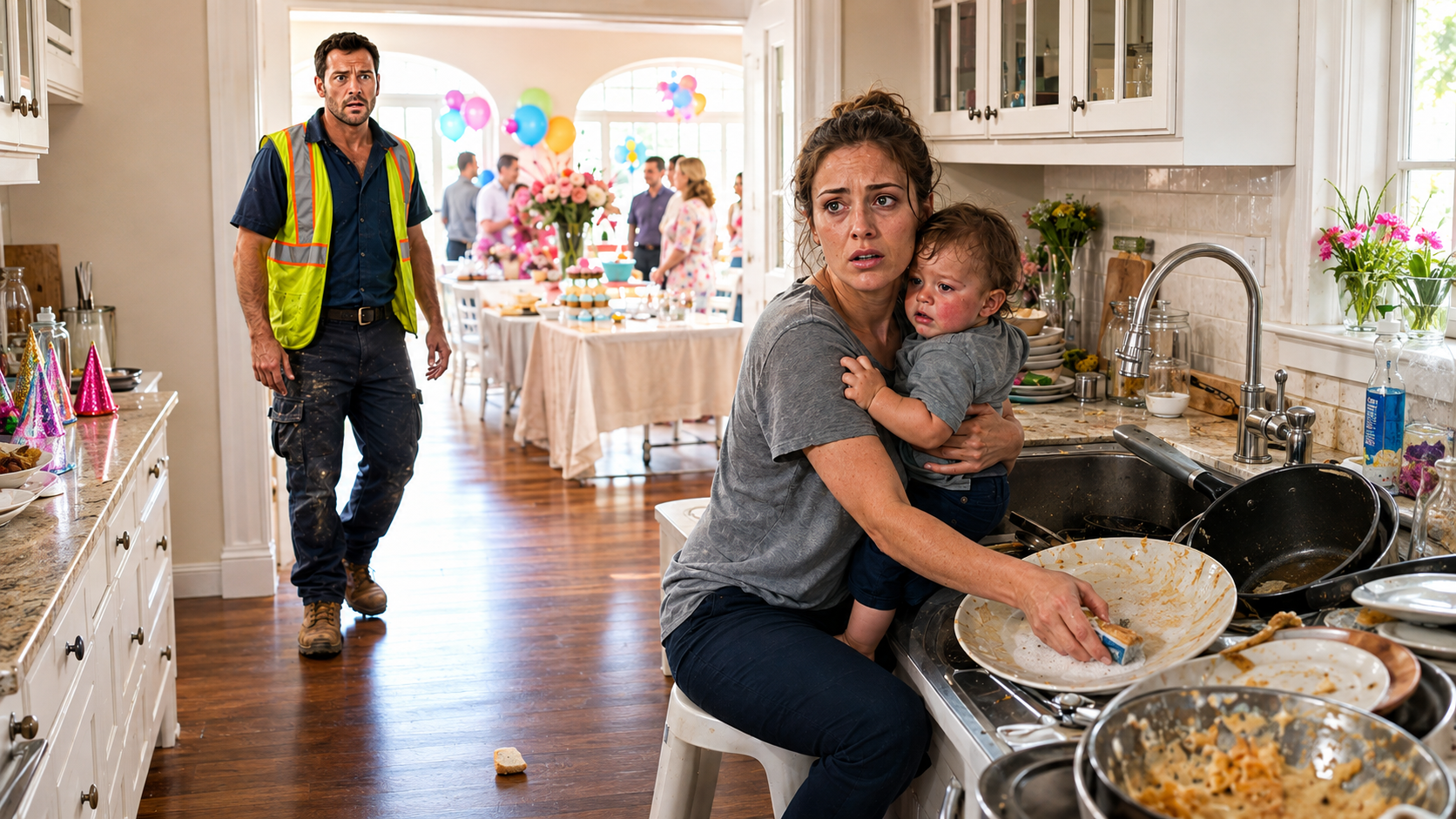
I was standing on the narrow concrete path beside my house in Nashville, still wearing my work boots and reflective construction vest. In one hand, I had a birthday cake with a crooked blue number one candle taped to the box. Under my arm was a shopping bag containing the blue dress my wife, Amy, had stared at online three different times without buying. In my jacket pocket was a small silver pendant engraved with the letter F.
F for Frederick.
Our son.
Our baby.
The reason I had left work three hours early that Friday.
I had imagined Amy’s face when I surprised her.
I had imagined Frederick smashing his hand into the frosting while she laughed.
I had imagined taking pictures we would embarrass him with when he turned eighteen.
Instead, I was standing outside my own home listening to my mother explain to a group of relatives why my wife apparently deserved to be treated like hired help.
My name is Connor Bradley. I’m a construction engineer, and at thirty-four, I had spent most of my adult life believing that if I worked hard enough, planned carefully enough, and took care of the people I loved, I could build something stable.
That belief made sense in my profession.
Concrete carried weight because somebody calculated what it could hold.
Steel beams stayed upright because somebody accounted for pressure before the pressure arrived.
I had always assumed families worked somewhat the same way.
I was wrong.
Sometimes the person weakening the structure was the person you trusted enough not to inspect.
I stayed where I was, just outside the half-open back door.
My mother, Teresa, was holding court on the patio.
I could hear the clink of glasses and bursts of laughter. Somebody had music playing. The smell of grilled shrimp and butter drifted toward me.
This was already strange.
Amy and I had planned Frederick’s first birthday carefully.
Small.
Simple.
Immediate family.
A homemade dinner.
One cake.
No giant party because Frederick had been fussy all week and Amy had texted me that morning to say he felt warm.
I had told her I would try to come home early.
She thought I meant maybe five instead of six-thirty.
I had arranged for another engineer to cover the final site walk and left at three.
Apparently, while I had been worrying about traffic, my mother had turned our house into something that looked like an expensive wedding reception.
“My son works hard,” Teresa was saying. “That’s why he gives me the money. He trusts me to take care of this family.”
Someone murmured approval.
I gripped the cake box tighter.
The money.
For almost a year, I had been transferring three thousand dollars a month to my mother.
Not because she needed support.
At least, that wasn’t how it had started.
After Frederick was born, Amy had struggled.
The delivery had been difficult. Recovery took longer than expected, and I had returned to work sooner than either of us wanted because I was overseeing a major commercial project with deadlines that refused to care that I had just become a father.
Teresa had stepped forward.
“I’ll help,” she had said.
She offered to grocery shop, run errands, sit with Frederick while Amy showered or slept, handle small bills if Amy felt overwhelmed.
My mother had always been forceful.
Organized.
The kind of woman who walked into a room and immediately started deciding where everything belonged.
Growing up, I had sometimes resented it.
As an exhausted new father, I had been grateful for it.
When she suggested that I send her household money directly so Amy wouldn’t have to worry about coordinating expenses during those first difficult months, it had sounded practical.
Three thousand dollars covered groceries, baby supplies, occasional cleaning help, pharmacy trips, and whatever emergency came up while I was at work.
“Let me handle it,” Teresa kept saying.
So I did.
Every month.
Three thousand dollars.
Thirty-six thousand dollars over a year.
I had asked Amy occasionally if things were okay.
She always said yes.
Not happily.
Not enthusiastically.
Just yes.
I had noticed she seemed tense whenever my mother visited, but I had explained it away as personality conflict.
Amy was quiet.
Teresa was not.
Amy hated confrontation.
Teresa treated confrontation like cardio.
I thought I was keeping peace by not getting involved in every disagreement.
Standing outside that door, I suddenly wondered how many times my wife had answered yes because she had learned that telling me the truth only created another argument she would have to survive.
A woman’s voice rose above the music.
“Where is Amy, anyway?”
It was my cousin Rachel.
My mother answered, but before she could finish, Aunt Betsy laughed.
“She’s in the kitchen. I told her to prepare everything.”
My heart started beating harder.
Betsy continued.
“A woman who is financially supported should earn her place.”
Several people laughed.
Not everyone.
I could hear an uncomfortable cough.
Someone said, “Betsy…”
But nobody stopped her.
My mother certainly didn’t.
She said, “Exactly. Connor gives her everything. Beautiful house, no rent, no worries. What else does she have to do?”
I stared at the back step.
No rent.
The house was ours.
Mine and Amy’s.
We had chosen it together.
Amy had spent months saving inspirational photos before we bought it. She had picked the kitchen tile. I had built the shelves in Frederick’s room myself.
She had contributed financially before taking maternity leave, and even if she had never earned a dollar in her life, the idea that living with her husband and raising our child made her some kind of dependent servant made my blood run hot.
Then I heard something worse.
My mother lowered her voice, but I was close enough to catch it.
“She needs to understand who keeps this family together. Connor listens to me. He always has.”
Betsy said, “He certainly sends you enough money.”
My mother laughed again.
“He knows I’m the responsible one.”
My fingers went numb.
A car passed on the street behind me.
Somewhere in the yard, a child shrieked with laughter.
For a few seconds, I stood there trying to reconcile the woman speaking with the mother I thought I knew.
Teresa had raised me alone after my father left when I was eleven.
She had worked two jobs.
She had fought landlords, school administrators, insurance companies, and anyone else who got between us and what she thought we deserved.
My entire childhood, she told me one thing.
Family protects family.
Maybe that was why it took me so long to recognize what her version of protection had become.
Control.
I placed the cake carefully on the patio table just outside the door.
Then I stepped into my house.
Nobody noticed me at first.
There were nearly twenty people in my backyard and living room.
Twenty.
Not six.
Not eight.
Twenty.
My uncle had a glass of bourbon in his hand.
Two cousins were eating crab legs over plates balanced on their knees.
There were bottles of liquor lined across the outdoor bar, trays of shrimp, steaks, expensive cheese, fruit arrangements, decorations, flowers, balloons.
The kind of spread that cost hundreds of dollars.
Possibly more.
My mother stood at the center of it wearing a dark green dress I had never seen before, her hair freshly styled, a gold bracelet on one wrist.
She looked radiant.
Proud.
Like the party belonged to her.
Then Aunt Betsy saw me.
Her smile collapsed first.
“Connor?”
Everything changed at once.
Conversations stopped.
Heads turned.
My mother froze with her wineglass halfway to her mouth.
I looked at her.
She recovered quickly.
Teresa always recovered quickly.
“Connor!” she cried. “You’re early.”
Early.
In my own house.
For my son’s birthday.
“I left work,” I said.
She smiled too widely.
“What a wonderful surprise.”
I didn’t return the smile.
“Where’s Amy?”
The silence that followed was small.
But I noticed it.
My mother gestured vaguely toward the kitchen.
“She’s finishing up.”
“Finishing what?”
Teresa gave me a look I remembered from childhood.
A warning look.
Not now.
Don’t embarrass me.
“Connor, we have guests.”
I stared at her.
Then I walked past everyone.
My house felt unfamiliar.
There were coats thrown over our furniture.
Dirty glasses on the tables.
Wrapping paper on the floor.
Someone had moved Frederick’s playpen.
I crossed the living room and reached the kitchen.
That was where I found my wife.
Amy was sitting on a cheap white plastic stool beside the sink.
I had no idea where the stool had even come from.
Her hair was tied in a loose knot that was falling apart. There was a damp patch near the collar of her faded gray T-shirt. Her face looked pale and exhausted.
Dirty dishes covered both sides of the sink.
Greasy pans were stacked beside the stove.
Half-empty serving trays crowded the counters.
And Amy was holding Frederick against her chest with her left arm while scrubbing a serving plate with her right hand.
Our son was whimpering.
Not crying.
Whimpering.
That weak, tired sound babies make when they don’t have the energy for anything louder.
Amy had a piece of bread between her lips.
Just plain bread.
She turned when my boots hit the tile.
The bread fell from her mouth.
“Connor.”
I will remember the look on her face until the day I die.
It wasn’t relief.
Not at first.
It was fear.
Like she had been caught doing something wrong.
Her eyes moved past me toward the doorway.
Then back.
“Your mother said I couldn’t stop yet,” she whispered. “I still have to serve the coffee.”
Something inside me went very still.
I crossed the kitchen.
“Give me Frederick.”
She hesitated.
Not because she didn’t trust me.
Because she was staring at the doorway again.
“She said—”
“Amy.”
I softened my voice.
“Give me our son.”
She did.
The moment Frederick’s body touched my chest, I knew something was wrong.
He was burning.
I pressed my palm to his forehead.
Hot.
Far too hot.
“How long has he been like this?”
Amy’s eyes filled.
“Since noon. Maybe earlier. He was warm this morning, but it got worse.”
“Why isn’t he in bed?”
She swallowed.
“I tried.”
I looked at her.
“Tried?”
“Your mother said everyone had come for him and I was being rude.”
For him.
The sick one-year-old who wasn’t even outside at his own party.
I pulled out my phone.
Amy reached for my wrist.
“What are you doing?”
“We’re leaving.”
Her eyes widened.
Then came the sentence that hurt worse than everything I had heard outside.
“She’s going to be angry.”
I looked at my wife.
Really looked at her.
There was a faint red mark around one wrist where she had probably been carrying a tray.
Her lips were dry.
Her plate had no food on it.
There was a single piece of bread on the floor.
And she was afraid of my mother.
Inside her own home.
I finally understood that whatever had been happening did not begin that afternoon.
That afternoon was only the first time I had walked in early enough to see it.
I took Amy’s hand.
“Let her.”
Then I carried my feverish son through the kitchen doorway.
My mother was waiting.
And judging by the expression on her face, she already knew the version of me she had controlled for thirty-four years had just disappeared.
PART 2: MY WIFE HAD BEEN AFRAID TO TELL ME THE TRUTH
“Where are you taking him?”
My mother stepped directly in front of me.
Not asked.
Stepped.
As if blocking the hallway would be enough to stop me.
“To get him checked.”
Teresa looked at Frederick and waved a hand.
“He’s tired. Babies get warm.”
“He has a fever.”
“It’s his birthday. Everyone came all this way.”
I stared at her.
“You invited them.”
Her mouth tightened.
“This is family.”
“You invited twenty people into my house without asking me.”
“Your house?”
She gave a short, offended laugh.
I felt Amy go still beside me.
That laugh bothered me.
Not because of the arrogance.
Because of how quickly it came.
Like the idea that I might call the house mine genuinely surprised her.
I shifted Frederick against my chest.
“Yes. My house.”
Teresa’s eyes moved toward the relatives crowded behind her.
She hated being challenged privately.
Being challenged publicly was unforgivable.
“I was trying to do something nice for my grandson,” she said.
“By making his sick mother wash dishes?”
Aunt Betsy appeared behind her.
“Oh, Connor, don’t be dramatic.”
I turned toward her.
Betsy’s expression changed.
I don’t think she had ever seen me look at her that way.
She lifted both hands.
“It’s a party. Everyone helps.”
“Did you wash dishes?”
Her mouth opened.
I looked at my uncle.
“Did you cook?”
Then my cousins.
“Did any of you serve coffee?”
Nobody answered.
My mother scoffed.
“Amy is the hostess.”
“She didn’t invite you.”
“Connor.”
“No.”
The word came out harder than I intended.
Frederick startled against me.
I immediately lowered my voice and kissed the top of his hot head.
My mother saw the movement.
For half a second, something uncertain flickered across her face.
Then she recovered.
“She’s turned you against me.”
Amy flinched beside me.
I felt it.
There it was.
The oldest trick in the world.
Make the person objecting to mistreatment responsible for the conflict.
I looked at my mother.
“Amy hasn’t said anything.”
Teresa’s eyes shifted.
That was my first real clue.
Not what she said.
What she didn’t.
She knew Amy had things she could say.
I turned to my wife.
“Get your purse.”
My mother took one step forward.
“No one is leaving in the middle of Frederick’s party.”
I almost laughed.
Not because it was funny.
Because the statement was so insane that my brain didn’t know what else to do.
I looked at the balloons.
The expensive food.
The liquor.
The relatives.
Then at my sick son.
“He’s not even at his party.”
“He was fussy.”
“So you left him in the kitchen?”
“He wanted his mother.”
“And you made his mother work.”
Teresa’s face hardened.
“I did not make anybody do anything.”
Amy made a tiny sound beside me.
My mother heard it.
Her head snapped toward her.
“You need to be careful right now.”
There are moments when your entire understanding of a relationship changes because of one sentence.
That was one of them.
Not because my mother was threatening Amy physically.
She didn’t need to.
The threat was in the familiarity of the tone.
Amy knew that tone.
She had heard it before.
I stepped between them.
“Don’t talk to my wife like that.”
Teresa stared at me.
Then she laughed again, but this time it sounded brittle.
“Your wife? I’m your mother.”
As if the two roles were competing positions.
As if loving Amy automatically meant betraying Teresa.
I should have seen it years earlier.
Maybe part of me had.
Maybe that was why I had always kept certain details from my mother.
My salary.
The exact amount in our savings.
The access codes to my work accounts.
But I had still given her too much.
Our spare house key.
Household money.
Trust.
A place in our marriage she had gradually expanded until she apparently believed she stood above my wife inside our own family.
I turned to Amy.
“Get your things.”
She ran upstairs.
My mother followed her with her eyes.
Then she looked at me.
“You’re humiliating me.”
I nearly choked on the words.
“You’re worried about being humiliated?”
“Everyone is watching.”
“Good.”
Her face changed.
I had never said something like that to her.
Not as a child.
Not as an adult.
Teresa had always been loud, but I had learned to become quiet.
It was easier.
She could argue for hours.
I preferred ending conflict.
Over time, I had mistaken surrender for maturity.
Standing there with Frederick burning against my chest, I realized my silence had never ended anything.
It had only pushed the consequences onto Amy.
I took out my phone.
My mother’s eyes narrowed.
“Who are you calling?”
I didn’t answer her.
I called emergency services.
I explained that my one-year-old son had a high fever and that I was taking him for medical care.
Then I told the dispatcher there were multiple relatives inside my home who had not been invited by me, that my wife had been pressured into serving them while caring for our sick baby, and that my mother was refusing to respect my request for us to leave peacefully.
The dispatcher asked whether anyone had threatened violence.
“Not directly,” I said.
My mother shouted from across the room, “Tell them this is my son’s house!”
I closed my eyes briefly.
Then I added, “My mother is claiming authority over the house that she doesn’t have, and I want officers here because I don’t know what’s happening.”
That was the truth.
By then, I genuinely didn’t.
When I ended the call, my mother was furious.
“You called the police on your own family?”
“I called because you won’t leave.”
“Nobody asked us to leave.”
“I’m asking now.”
The room became silent.
I raised my voice.
“Everyone needs to leave my house.”
A few relatives immediately began collecting purses and jackets.
Good people can behave badly in groups because they keep waiting for someone else to make the moral decision first.
Once I made it clear, several suddenly looked embarrassed.
My uncle put down his drink.
Rachel whispered, “I’m sorry, Connor. I thought Amy knew about all this.”
Aunt Betsy glared at her.
“Don’t start.”
I looked at Betsy.
“Did Amy know?”
Betsy crossed her arms.
“Your mother said she did.”
I turned back to Teresa.
My mother said nothing.
Footsteps sounded on the stairs.
Amy came down carrying her purse, Frederick’s diaper bag, and his small blue blanket.
She had changed nothing about herself.
No clean shirt.
No brushed hair.
No coat.
She had simply grabbed what our son needed.
That hurt too.
I walked toward her.
Before I reached her, Teresa said, “Amy, if you walk out that door after what you’ve done today, don’t expect me to help you anymore.”
Amy stopped.
I saw the words hit her.
Then I saw something else.
Exhaustion becoming anger.
Small.
Fragile.
But there.
Amy turned.
“What help?”
My mother’s face went blank.
Amy’s voice shook.
“What help are you talking about?”
“Amy,” I said softly.
But she kept going.
“You tell Connor you help me. You tell everyone you help me. You come here and criticize the groceries I buy. You tell me Frederick’s clothes cost too much. You tell me I’m lazy if I sit down while he naps.”
My mother’s lips thinned.
“That’s not—”
“You make me send you pictures of receipts.”
My stomach tightened.
“What?”
Amy looked at me.
Immediately, she looked ashamed.
That made no sense.
She was telling me something my mother had done, and somehow Amy was the one who felt ashamed.
“She said you wanted it that way.”
My mother interrupted.
“Because somebody has to control the spending.”
I turned toward her.
“You make Amy send you receipts?”
“You gave me the household money.”
“For groceries and help.”
“Exactly.”
“No. Not exactly.”
Amy wiped her eyes.
“She told me if I needed anything, I had to ask her first.”
I stared at my mother.
Three thousand dollars every month.
“Amy, how much did she give you?”
Silence.
I already knew I was going to hate the answer.
My wife looked at the floor.
“Usually around eight hundred.”
For a moment, I couldn’t understand the number.
“Eight hundred?”
“For groceries and Frederick.”
My pulse began pounding in my ears.
“What about the rest?”
Amy looked at Teresa.
My mother answered.
“There are expenses you don’t understand.”
I laughed once.
It came out cold.
“I’m an engineer managing multimillion-dollar construction budgets. Try me.”
A few people looked down.
Teresa’s face flushed.
“I pay for things. I bring food. I use gas coming here. I organize this family. Today alone cost—”
She stopped.
Too late.
I looked slowly around the room.
The seafood.
The steaks.
The flowers.
The alcohol.
Her dress.
I understood.
“You used my money for this.”
“It is Frederick’s birthday.”
“You used the money I sent to help my wife and child to throw a party neither of us requested.”
“You’re twisting things.”
“How much?”
“Connor.”
“How much did today cost?”
She refused to answer.
That was an answer.
Amy spoke quietly.
“She bought the dress yesterday.”
My mother turned on her.
“You ungrateful little—”
“Enough.”
My voice cracked through the room.
Frederick began crying.
I held him closer.
The front doorbell rang.
Police.
My mother looked toward the sound.
Then toward me.
For the first time that afternoon, I saw fear.
Not anger.
Fear.
It vanished quickly, but I caught it.
And when her eyes flicked toward the hallway leading to my office, I caught that too.
I followed her gaze.
My office door was slightly open.
I always kept it closed.
Suddenly, the party wasn’t the only thing I was worried about.
I handed Frederick gently to Amy.
“Stay here.”
My mother stepped in front of me.
“Where are you going?”
That was all the confirmation I needed.
“To my office.”
She grabbed my arm.
“Connor, don’t.”
I looked down at her hand.
Then back at her face.
“Why?”
Before she could answer, the front door opened.
And at the same moment, my cousin Mason slipped out of the hallway carrying a thick brown folder pressed against his side.
PART 3: THE FOLDER MY COUSIN TRIED TO HIDE
Mason saw me.
I saw the folder.
Neither of us moved for one second.
Mason was Teresa’s sister’s son, thirty years old, always between jobs, always talking about the next business idea that would finally make him rich.
I had never disliked him.
I had never trusted him much either.
He was the kind of guy who borrowed money and acted insulted when you asked when he planned to return it.
Normally, seeing him carrying a folder would have meant nothing.
But he had come from my office.
He was holding it too tightly.
And the second he noticed me looking at it, he turned toward the side door.
“Mason.”
He kept walking.
“Mason.”
He moved faster.
One of the two officers who had just entered saw it immediately.
“Sir, hold on.”
Mason pushed through the side door.
The officer followed.
Everything happened at once.
My mother shouted, “He’s leaving! What is wrong with that?”
I moved toward the door.
The second officer held up one hand.
“Sir, please stay here.”
I stopped.
Outside, Mason said something I couldn’t hear.
Then the officer told him to put the folder down.
My mother rushed toward them.
“This is ridiculous!”
The second officer stepped between her and the door.
“Ma’am, stay back.”
“This is my family!”
“Stay back.”
“You don’t understand. This is my son’s property.”
I stared at her.
My son’s property.
Not my son’s house.
Not Connor’s home.
Property.
The word sounded different now.
The officer outside came back in with Mason.
He was no longer carrying the folder.
The officer was.
“What’s in it?” I asked.
Mason answered too fast.
“Just papers.”
The officer looked at me.
“Do these belong to you?”
He opened the folder.
I recognized the first document immediately.
The original deed to my house.
Not a copy.
The original.
I knew because it was kept in a fireproof document case inside the locked cabinet in my office.
For two seconds, I couldn’t breathe.
The room disappeared.
All I saw was the paper.
The address.
My name.
Amy’s name.
The document we had received after buying the home.
I looked at Mason.
“Why do you have my deed?”
He said nothing.
My mother stepped in.
“He was putting things somewhere safe.”
I slowly turned toward her.
“Safe?”
“With all these people here, your office was open.”
“My office wasn’t open.”
Silence.
I walked toward the hallway.
The officer told me to move slowly, and I nodded.
When I reached my office, the first thing I saw was the desk drawer pulled out.
Then the cabinet.
The fireproof document case sat on the floor.
Open.
The small key I usually kept hidden in the top desk drawer was still inserted in its lock.
Someone had searched my desk.
I felt suddenly cold.
The party noise behind me had stopped completely.
No music.
No laughter.
Nothing.
I turned.
My mother was in the hallway now.
I pointed at the cabinet.
“Who opened this?”
She crossed her arms.
“No one stole anything.”
“That wasn’t my question.”
“Connor, stop making this into something ugly.”
I almost couldn’t believe her.
“Something ugly?”
“You came home in a mood, you scared everyone, you called the police—”
“I came home with a birthday cake.”
That silenced her.
I took one step closer.
“I came home carrying a cake for my son and a dress for my wife.”
Amy looked at me.
Her eyes dropped to the shopping bag I had left near the kitchen.
My throat tightened.
“I was happy, Mom.”
I rarely called her Mom when I was angry.
I had no idea why I did then.
Maybe because some part of me was saying goodbye.
“I was happy,” I repeated. “I thought I was coming home to my family.”
My mother’s face changed for half a second.
Then the armor came back.
“You are home with your family.”
“No.”
I looked at Amy holding Frederick.
“That’s my family.”
Teresa stared at me as if I had slapped her.
Then her expression hardened into something almost unrecognizable.
“There. That’s what she wanted.”
Amy shook her head.
“I didn’t—”
“She has been waiting for this. Waiting to separate you from us.”
“Stop blaming her.”
“She wants your money.”
I laughed in disbelief.
“My money?”
“Yes.”
“The money I’ve been sending you?”
My mother’s mouth tightened.
The officer holding the folder looked between us.
He asked me to explain who had permission to access my office.
“No one,” I said. “My wife can, obviously. But she wouldn’t need to take the deed out, and she certainly didn’t give Mason permission.”
Amy immediately shook her head.
“I didn’t.”
The officer looked at Mason.
“Did he give you permission?”
“No.”
“Did his wife?”
Mason glanced toward Teresa.
That glance mattered.
My mother saw me catch it.
Her face went pale.
The officer asked again.
“Mason?”
He swallowed.
“Aunt Teresa said she needed it.”
My mother exploded.
“Don’t you put this on me!”
Everybody turned.
Mason looked stunned.
“You told me—”
“Shut up!”
The officer raised his voice.
“Ma’am.”
Teresa pointed at Mason.
“He misunderstood.”
Mason’s face changed.
Fear becoming resentment.
I knew that expression.
He had expected protection.
Instead, my mother had sacrificed him before the police had even asked a second question.
“You told me to get the house papers,” he said.
My mother lunged toward him.
The officer stepped in front of her.
“Enough.”
She shoved him.
It was not a dramatic shove.
Not enough to knock him down.
But she put both hands against a police officer’s chest and pushed.
The entire room froze.
The officer caught her wrists.
“Turn around.”
My mother’s face went blank.
Then she started screaming.
“No! Get your hands off me! Connor!”
I stood where I was.
“Connor!”
The officer moved her arms behind her.
“This is your fault!” she shouted at Amy.
Amy tightened her hold on Frederick.
My mother kept screaming.
“You did this! You poisoned my son!”
“Teresa,” Aunt Betsy whispered.
“Shut up!”
The handcuffs clicked.
I had never heard a sound so small change a room so completely.
My mother looked at me.
For the first time, there was no authority in her face.
Only disbelief.
“You’re going to let them do this to me?”
I didn’t answer.
Because the truth was, I had been letting her do things to other people for years.
Letting her insult Amy and calling it personality.
Letting her control money and calling it help.
Letting her overstep and calling it love.
Letting her make every boundary negotiable because saying no always came with punishment.
Not anymore.
The officer escorted Teresa toward the front of the house.
She fought them verbally every step.
“My son owns this house!”
Then, strangely, she corrected herself.
“This family owns this house!”
The words made my skin crawl.
Mason sat on a dining chair while the other officer spoke to him.
Several relatives quietly left.
Aunt Betsy tried to follow.
I stopped her.
“Did you know?”
She looked at me.
“Know what?”
“The deed.”
“No.”
“Did you know my mother was taking most of the money I sent for Amy?”
Betsy’s expression became defensive.
“Your mother has expenses.”
“That wasn’t my question.”
“She does a lot for everyone.”
“Did you know?”
Her silence answered.
I stepped aside.
“Leave.”
She picked up her purse.
Before walking out, she looked at Amy.
I expected an apology.
Instead, she said, “Families don’t recover from things like this.”
Amy looked at her.
Then at me.
I answered for both of us.
“Maybe they shouldn’t.”
Betsy left.
The room emptied.
For a while, all that remained were several relatives giving statements, two police officers, Mason, Amy, Frederick, and me.
The birthday decorations suddenly looked grotesque.
A HAPPY FIRST BIRTHDAY banner hung over the patio doors.
Under it, a half-eaten lobster tail sat on someone’s abandoned plate.
I looked at my son.
He had fallen asleep against Amy.
His cheeks were flushed.
Everything else could wait.
I walked over.
“We’re going now.”
Amy nodded.
One officer told me they would need a list of anything missing once I had time to check the office carefully.
He returned the deed after documenting what had happened.
I held it in my hands.
I remember staring at our names.
Connor Bradley.
Amy Bradley.
Our house.
Our life.
A piece of paper didn’t create those things.
But someone had gone into a locked cabinet and removed it.
That mattered.
Mason finally spoke while I was sliding the deed into the folder.
“Connor.”
I looked at him.
He appeared smaller than usual.
“I didn’t know she was going to do all this.”
I waited.
He rubbed both hands over his face.
“She said you wanted her to organize your papers because you were thinking about changing how the house was handled.”
My stomach tightened.
“What does that mean?”
“I don’t know.”
“You went through my locked office without knowing why?”
“She said you knew.”
The same sentence Amy had used.
She said you wanted it that way.
The pattern hit me.
My mother had been borrowing my authority.
Using my name as permission.
With Amy.
With Mason.
Probably with other relatives.
I looked at him.
“Why were you leaving through the side gate?”
He looked down.
That was all I needed.
I walked away.
In the car, Amy sat in the back with Frederick while I drove.
Nobody spoke for the first few minutes.
I could hear the soft sound of the baby monitor app on Amy’s phone as she kept checking his temperature.
At a red light, I looked at them in the mirror.
Amy was crying silently.
I pulled into an empty parking lot.
Put the car in park.
Turned around.
“Why didn’t you tell me?”
The second the words left my mouth, I hated them.
Amy’s face crumpled.
“I tried.”
My chest tightened.
“When?”
“Connor…”
“When did you try?”
She looked out the window.
“Do you remember when I told you your mother was checking the refrigerator?”
I did.
Barely.
A few months after Frederick was born.
Amy had said Teresa kept criticizing what food she bought.
I had laughed and said, “That’s Mom. She thinks everyone needs managing.”
I closed my eyes.
Amy continued.
“When I told you she was taking my receipts?”
I remembered that too.
I had said Teresa was just being organized.
“When I told you she came over without calling?”
I remembered.
“When I told you she said I wasn’t holding Frederick correctly?”
Remembered.
“When I said I didn’t want her having a key?”
Remembered.
Every warning.
Every small plea.
I had heard all of them individually.
I had never put them together.
And every time, I had asked Amy to be patient because Teresa meant well.
I opened my eyes.
“I didn’t listen.”
Amy wiped her face.
“I stopped wanting to make you choose.”
“I should have chosen.”
She looked at me.
I shook my head.
“Not between you and my mother. I should have chosen what was right.”
Frederick stirred.
Amy kissed his hair.
Then she whispered, “She kept saying you agreed with her.”
I felt sick.
“About what?”
“The money. The receipts. The key. The visits.”
I gripped the steering wheel.
“She said you thought I was irresponsible since I wasn’t working.”
I stared at her.
“I never said that.”
“I know that now.”
“Now?”
Amy looked at me.
There was no accusation in her face.
That made it worse.
“I didn’t know before.”
That sentence followed me all the way to the emergency clinic.
While we waited for Frederick to be examined, my phone began filling with calls.
Teresa.
Betsy.
Unknown numbers.
Cousins.
Messages.
You need to fix this.
Your mother is devastated.
This has gone too far.
Amy exaggerated.
Mason says it was a misunderstanding.
Family business should stay private.
Then one message came from my uncle.
Connor, I’m sorry. I should have said something earlier. Your mother has been telling people for months that she is the one managing your household now.
I read it twice.
Then I looked through the glass at Amy rocking our son.
My household.
As if we were an account she had taken over.
I silenced my phone.
A doctor examined Frederick.
His fever was high enough to need careful attention but, thankfully, there were no immediate signs of something more dangerous. We were given instructions, medication guidance, and specific symptoms to watch for.
Relief hit me so hard my knees almost weakened.
Only after Frederick finally slept more comfortably did I allow myself to think about anything else.
Amy and I sat beside each other in the quiet clinic room.
I took her hand.
“No more money goes to my mother.”
Amy said nothing.
“No more key.”
Her fingers tightened around mine.
“No more coming into our house unless we both want her here.”
A tear rolled down her cheek.
I swallowed.
“And I’m going through everything.”
“What do you mean?”
“Every transfer. Every bill. Every message. Everything I should have looked at before.”
Amy looked frightened again.
Not of Teresa this time.
Of what we might discover.
I understood.
The party had been ugly.
The deed made it something else.
I had spent my career learning that when you find one structural failure, you don’t just paint over the crack.
You trace it.
You find out how deep it runs.
That night, after we returned home, I opened my laptop.
Thirty-six thousand dollars.
That was the first number I wrote down.
Then I started asking where it had gone.
PART 4: EVERY SMALL LIE LED BACK TO THE SAME PERSON
Our house smelled like old seafood.
That was the first thing I noticed when we returned.
The police and most relatives were gone.
Someone had turned off the music.
Half-deflated balloons floated near the ceiling.
Dirty plates remained everywhere.
Amy stood in the doorway holding Frederick and looked at the mess.
Her shoulders dropped.
I knew exactly what she was thinking.
She had spent the entire day cleaning.
She believed she would have to start again.
“No.”
She looked at me.
“You’re not touching any of this.”
“Connor, it’ll smell worse by morning.”
“I know.”
I took out my phone and called a cleaning service.
Not my mother.
Not a relative.
A professional service.
When they arrived, I paid them directly.
That detail mattered more than it should have.
For the first time in months, help came without humiliation attached.
Amy bathed Frederick while I checked every lock and window.
Then I went into my office.
The desk had clearly been searched.
Nothing dramatic.
No overturned furniture.
That almost made it worse.
Drawers opened carefully.
Files moved.
Someone had tried not to make it obvious.
I checked our financial records.
Passports.
Tax documents.
Insurance.
The deed had been the only major document I could immediately confirm had been removed.
That was enough.
I placed everything important in a new lockbox and arranged to move it outside the house the next morning.
Then I sat at my desk.
Thirty-six thousand dollars.
I pulled up every transfer to my mother.
Three thousand.
Three thousand.
Three thousand.
Month after month.
I opened our household checking account separately.
Amy had been paying for more than I realized.
Small grocery purchases.
Pharmacy charges.
Baby formula.
Diapers.
Things my mother had supposedly been covering.
I found several months where Amy had used money from her personal savings.
I walked upstairs.
She was sitting beside Frederick’s crib.
His fever had started coming down.
I crouched next to her.
“Did you use your savings for groceries?”
Amy looked at me for a long time.
“Yes.”
“Why?”
“Because your mother said I had reached my limit.”
I closed my eyes.
“What limit?”
“She gave me an amount each week.”
“With my money.”
Amy nodded.
“And if you needed more?”
“I had to explain why.”
The room felt too small.
“What happened to the rest?”
“She said she was saving it for household emergencies.”
There it was again.
My money.
My name.
My mother appointing herself manager of a family she did not belong at the center of.
“Did you ever see that savings?”
“No.”
I stood and walked to the window because I didn’t want Amy to see how furious I was.
She saw anyway.
“Connor.”
“I’m not angry at you.”
“I know.”
“No. I need you to understand. None of this is your fault.”
She looked down.
“I should have told you more clearly.”
“You did tell me.”
I turned around.
“I just kept translating what you said into something easier for me to hear.”
She blinked.
I sat beside her.
“You said, ‘Your mother makes me uncomfortable.’ I heard, ‘You two have different personalities.’ You said, ‘She controls the grocery money.’ I heard, ‘She’s helping us budget.’ You said, ‘I don’t want her coming over whenever she wants.’ I heard, ‘Amy needs more patience.’”
My voice broke.
“You told me. I kept editing the truth.”
Amy began crying.
I held her.
For a long time, neither of us spoke.
Later that night, after Frederick finally fell into a deeper sleep, Amy told me the rest.
Not one huge event.
That was important.
People sometimes imagine abuse of power as one obvious explosion.
Our situation had happened in inches.
Teresa would come over and inspect the kitchen.
“You bought this brand? Connor works too hard for you to waste money.”
She would criticize the laundry.
“You’re home all day. Why is there still a basket downstairs?”
She would take Frederick without asking.
“He needs his grandmother. Stop being possessive.”
If Amy objected, Teresa would sigh and say, “Connor trusts me.”
If Amy spent more than Teresa approved, she would ask for receipts.
If Amy said she needed rest, Teresa would remind her that Connor was supporting her.
If Amy threatened to tell me, Teresa would say, “Do you really want to stress him when he’s already working twelve-hour days?”
That line hit hardest.
Because it worked.
Amy loved me.
My mother had used that love as a gag.
The birthday party had begun three days earlier.
Teresa told Amy she had already discussed everything with me.
“She said you wanted the whole family here,” Amy explained.
“I didn’t.”
“I know.”
“What did you say?”
“I said Frederick hadn’t been feeling well and we should keep it small.”
“What did she say?”
Amy gave a tired laugh with no humor in it.
“That I wasn’t going to isolate her grandson from his family.”
My jaw tightened.
“And today?”
“She arrived at nine with Betsy.”
“Nine?”
Amy nodded.
“They brought food. Then more people came. She said since it was happening here, I needed to host.”
“Why didn’t you call me?”
“I did.”
I grabbed my phone.
No missed calls from Amy.
She saw my confusion.
“She made me feel stupid before I finished dialing.”
My chest tightened.
“What did she say?”
“That you were working because somebody in this family needed to be responsible.”
Amy looked away.
“So I put the phone down.”
That was the cruelty of it.
My mother hadn’t locked Amy in a room.
She hadn’t physically forced a plate into her hands.
She had simply spent months teaching Amy that resistance would make her selfish, ungrateful, dramatic, lazy, disloyal, or responsible for ruining my relationship with my family.
By the time the party happened, Amy was already trained to doubt her right to say no.
I thought about the red mark on her wrist.
“How long were you serving them?”
“Most of the afternoon.”
“And Frederick?”
“I had him upstairs at first.”
“What happened?”
“He started crying. I went to him.”
Amy’s face tightened.
“Your mother came upstairs and said people were waiting for food.”
I had to stand again.
I walked into the hallway.
Pressed both hands against the wall.
Breathed.
I wanted to break something.
Instead, I went downstairs and threw Teresa’s spare key into a drawer so I could give it to the locksmith as proof of which lock needed changing.
That was the first practical thing I did.
The next morning, I changed every exterior lock.
Then I changed the garage code.
Then the alarm code.
Then every password Teresa might possibly know.
I stopped the automatic transfer.
I called the bank to make sure she had no authority on any account.
She didn’t.
That was one of the few pieces of good news.
The money I sent her had been voluntary transfers.
She had not had direct access to our banking.
I called the county office and confirmed the house title remained exactly as it should.
Mine and Amy’s.
Holding an original deed did not magically make Teresa the owner.
That mattered.
But it didn’t make what happened harmless.
She had entered my private office, had someone remove an original legal document, and had been telling people the house was effectively under her authority.
Whatever she imagined the next step would be, she wasn’t going to get one.
I also spoke with the officer handling the report.
Teresa had been detained after shoving the officer, and the situation involving the document and unauthorized access was being recorded as part of the incident.
Mason had admitted that Teresa directed him to retrieve “the house papers.”
He claimed she told him I knew about it.
Maybe he was telling the truth.
Maybe he was protecting himself.
Either way, he had known enough to leave through the side gate when I came home.
I stopped trying to decide whether he was stupid or dishonest.
Sometimes a person can be both.
That afternoon, my phone rang from an unfamiliar number.
I almost ignored it.
Something told me to answer.
“Connor.”
My mother.
Her voice.
I nearly hung up.
Then she said, “We need to talk before your wife ruins this permanently.”
I felt every muscle in my body tighten.
“Amy didn’t do this.”
“She called the police.”
“I called the police.”
Silence.
“She told you to.”
“No.”
“She manipulated you.”
“No.”
“You have never spoken to me like this before.”
“That might be the problem.”
Her breathing changed.
“After everything I sacrificed for you.”
There it was.
The debt.
Teresa’s favorite currency.
“I know what you did for me when I was growing up.”
“Do you?”
“Yes.”
“Then how can you let strangers put me in handcuffs?”
“You shoved a police officer.”
“He grabbed me.”
“After you ignored him.”
“Because he was in our family business.”
“Our family business?”
“Yes!”
Her voice rose.
“I was protecting what you built.”
I became very still.
“By taking my deed?”
Another silence.
Then she sighed.
Not guilty.
Annoyed.
As if I were being deliberately difficult.
“Mason wasn’t stealing it.”
“Then why was he leaving through the side gate?”
“He panicked because you came in screaming.”
“I never screamed.”
“He thought you’d misunderstand.”
“I understand perfectly.”
“No, you don’t.”
“Then explain it.”
For the first time, she hesitated.
I waited.
Finally she said, “Amy is weak with money. She doesn’t understand assets. She doesn’t understand what it took for you to get where you are.”
I looked across the room at Amy.
She was on the floor with Frederick, helping him stack soft blocks.
My wife had helped me survive graduate school.
She had paid most of our rent during the year I finished my engineering certification.
She had eaten cheap meals with me when we were saving for the down payment on our first place.
My mother knew that.
She simply found it inconvenient.
“You don’t get to decide what Amy understands.”
“You’re blinded because you love her.”
“Yes,” I said. “I love my wife.”
Teresa made a disgusted sound.
I continued.
“And that doesn’t make me blind. It makes me ashamed that I didn’t protect her from you sooner.”
“Protect her?”
My mother laughed bitterly.
“From me?”
“Yes.”
The silence that followed felt enormous.
I had finally said the thing neither of us could take back.
Teresa’s voice dropped.
“Be very careful, Connor.”
A chill moved through me.
“Is that a threat?”
“It is advice.”
“No. It’s the last time you speak to me that way.”
“You think you can throw away your mother because of one bad afternoon?”
“One afternoon?”
I almost shouted.
Instead, I lowered my voice.
“This wasn’t one afternoon. The afternoon is just when I finally saw it.”
She said nothing.
I continued.
“You took money I sent to help Amy and Frederick. You controlled what my wife was allowed to buy. You used my name to make her obey you. You invited people into our home. You made her work while our son was sick. You went into my office. You had Mason take the deed.”
“I was keeping it safe.”
“Stop lying.”
She inhaled sharply.
I had never said those words to her.
Not once.
“You are lying,” I repeated. “And I’m done helping you pretend otherwise.”
Her voice became icy.
“You will regret choosing her over your family.”
I looked at Amy.
Then at Frederick.
“No.”
I said it quietly.
“I regret how long it took me to realize they are my family.”
Then I ended the call.
My hands were shaking.
Amy had heard enough to understand.
She walked over.
“What did she say?”
I looked at my wife.
“She said I’ll regret choosing you.”
Amy’s face fell.
I reached for her hand.
“I already made the wrong choice too many times.”
She looked confused.
I squeezed her fingers.
“Every time I asked you to tolerate something you shouldn’t have had to tolerate, I chose avoiding conflict over you.”
Her eyes filled.
“I’m not doing that again.”
For the first time since I had walked into that kitchen, Amy looked at me without fear behind her eyes.
Then my phone buzzed.
A message from Mason.
I almost deleted it.
Instead, I opened it.
I’m sorry. Your mom told me you were going to put her in charge of the house paperwork because she said Amy couldn’t be trusted with it. She said everything you have needs to stay under family control. I should never have gone into your office.
I read the final sentence twice.
Everything you have needs to stay under family control.
I handed the phone to Amy.
She read it.
Then whispered, “Connor…”
I looked at the changed locks.
The cleaned kitchen.
Our son playing at our feet.
And I finally understood my mother’s logic.
She had never seen Amy as part of the family.
She saw Amy as someone who had gained access to something Teresa believed still belonged to her.
Me.
My income.
My house.
My loyalty.
My son.
The deed was not the beginning of some sophisticated legal scheme.
It was something more primitive.
Possession.
Control the money.
Control the documents.
Control the house.
Control the wife.
Control the son.
And call all of it family.
That was the structure she had been building around us.
The only way to save my marriage was to tear it down completely.
PART 5: THE BIRTHDAY WE CHOSE FOR OURSELVES
For the next two weeks, I did something I should have done much earlier.
I listened.
Not only to Amy.
To everyone.
Relatives started calling once the shock wore off.
The stories changed depending on who was speaking.
Some apologized.
Some defended Teresa.
Some blamed Betsy.
Some blamed Mason.
A few blamed Amy, because apparently it was easier to accuse the quiet woman who had been washing dishes than the loud woman who ordered her to do it.
I stopped arguing with people who had already decided the truth was inconvenient.
One cousin said, “You know how Teresa is.”
I replied, “Yes. I do now.”
My uncle called me privately.
He apologized for eating and drinking while Amy worked.
“I should have gotten up,” he said.
“Yes.”
I didn’t make it easier for him.
He sighed.
“I thought your mother had arranged it.”
“She did.”
“I thought Amy agreed.”
“She didn’t.”
“I’m sorry.”
This time, I believed him.
Not because the apology fixed anything.
Because he didn’t add a but.
No excuse.
No demand for forgiveness.
Just responsibility.
Rachel came by with a bag of groceries and stood outside because she knew we weren’t accepting surprise visitors anymore.
Amy invited her in.
That was Amy’s decision.
Not mine.
That difference became important.
Our home had spent too long operating according to Teresa’s permission.
Now Amy and I made choices together.
Rachel apologized directly.
“I thought you were upstairs with Frederick because you wanted to be,” she told Amy. “When Betsy said you were preparing everything, I should have checked.”
Amy nodded.
“I wish someone had.”
Rachel cried.
So did Amy.
I made coffee.
Nobody asked Amy to serve it.
That should not have felt revolutionary.
It did.
The financial picture became clearer too.
I never recovered the money I had voluntarily transferred to Teresa.
I had sent it willingly, believing her explanation.
But I stopped sending another dollar.
That mattered more than getting the past back.
Teresa had built part of her power on access.
Access ended.
She had no key.
No household money.
No password.
No permission to enter.
No authority to speak for me.
When relatives called saying, “Your mother says you want—”
I stopped them.
“If it comes from me, I want it. If it comes from her, ask me.”
That single rule exposed how often she had been using my name.
It happened constantly.
Your mother said you wanted everyone together next Sunday.
No.
Your mother said you were helping Mason financially.
No.
Your mother said Amy agreed Frederick could stay with her overnight.
Absolutely not.
Your mother said—
No.
No.
No.
The word became easier every time I used it.
I had spent most of my life thinking boundaries were walls that hurt people.
I learned they were doors.
The point was not to lock everyone out.
The point was deciding who had the right to walk in.
The incident with the deed did not magically transfer ownership of our home, and I made sure Amy understood that immediately.
Teresa had not succeeded in taking the house.
But I no longer minimized what she tried to do simply because she failed.
She had invaded my private office.
She had told Mason to remove an original legal document.
She had repeatedly referred to our home as if she possessed authority over it.
She had controlled money meant for my wife and son.
She had built a system where Amy believed Teresa’s orders came from me.
That system was over.
Mason sent two more messages.
I answered only once.
You knew the office was private. You knew the folder wasn’t yours. Whatever she told you, you made your own choice.
He replied:
I know.
That was the end of our conversation.
My mother tried every strategy she had.
Anger.
Silence.
Guilt.
Relatives.
Apologies that were not really apologies.
“I’m sorry you misunderstood.”
“I’m sorry Amy is sensitive.”
“I’m sorry the party got out of hand.”
“I’m sorry you think I was trying to hurt you.”
Never:
I’m sorry I controlled your wife.
I’m sorry I used your money dishonestly.
I’m sorry I entered your office.
I’m sorry I told Mason to take your deed.
I’m sorry I treated your home like mine.
I learned quickly that regret and accountability are not the same thing.
Someone can regret losing access to you without regretting what they did with that access.
A month after Frederick’s birthday, Teresa sent me a long message.
I read it alone.
She wrote about raising me.
About working double shifts.
About sitting beside me when I had pneumonia at thirteen.
About helping me buy my first used truck.
All of it was true.
That was what made it painful.
People who hurt us are not always monsters in every memory.
My mother had loved me.
I believe that.
She had sacrificed for me.
I believe that too.
But somewhere along the way, she had decided sacrifice purchased ownership.
She believed raising a son gave her permanent authority over the man he became.
And when I built a life with Amy, Teresa did not experience it as growth.
She experienced it as theft.
My mother ended her message with:
One day you will understand that nobody loves you like your mother.
I stared at the sentence.
Then I typed my answer.
I love you. But love does not give you ownership of me, my wife, my child, my money, or my home. Until you can accept that and take responsibility for what happened, there will be distance between us.
I read it three times.
Then I sent it.
She did not respond.
For a long time, I sat in the dark living room.
Amy came downstairs.
She looked at me.
“You okay?”
“No.”
She sat beside me.
I leaned back and stared at the ceiling.
“I thought setting a boundary would feel better.”
“Doesn’t it?”
“It feels terrible.”
Amy thought about that.
Then she said, “Maybe terrible and wrong aren’t always the same thing.”
I turned toward her.
She shrugged.
“I spent a year doing things that felt terrible because your mother convinced me saying no would be wrong.”
That was Amy.
Quiet until she said the sentence that went straight through you.
I took her hand.
“You should’ve become the engineer.”
She smiled.
“Absolutely not.”
It was the first joke we had made about anything in weeks.
We both started laughing.
Softly at first.
Then harder.
Not because anything was funny.
Because we were exhausted.
Because Frederick was asleep upstairs.
Because the doors were locked.
Because nobody could walk in without permission.
Because we had survived the moment our family structure cracked open and discovered that what remained could still be rebuilt.
Three weeks later, Amy found the unopened shopping bag from Frederick’s birthday tucked in the back of our bedroom closet.
The blue dress was still inside.
She held it up.
“You bought this?”
“I was going to surprise you.”
Her expression changed.
“When?”
“That day.”
She pressed the fabric against herself.
Then she looked at me.
“I was wearing a stained T-shirt and washing shrimp grease off plates.”
“I know.”
We stood there in silence.
“I almost returned it,” I admitted.
“Why?”
“Because looking at it made me think about everything that happened.”
Amy ran her fingers over the sleeve.
Then she shook her head.
“No.”
“No?”
“I’m wearing it.”
“Where?”
She looked at me.
“For Frederick’s birthday.”
I stared at her.
“His birthday already happened.”
“No.”
Her face changed.
Not angry.
Certain.
“That was your mother’s party.”
The words landed perfectly.
Amy continued.
“Frederick deserves his birthday.”
So we did it again.
Not officially.
Not for social media.
Not for relatives.
Just us.
One Saturday afternoon, we bought another small cake.
Nothing expensive.
Vanilla with blue frosting.
I cooked burgers in the backyard.
Amy wore the blue dress.
Frederick wore a tiny shirt with a number one on it even though he had already stained it once.
We put the silver F pendant around Amy’s neck.
She touched it and cried.
I cried too.
I had originally bought it as a gift from Frederick to his mother.
Now it felt like something else.
Proof that despite everything my mother had tried to turn him into—a symbol of her importance, the excuse for her party, another person she could claim—Frederick belonged to himself.
And while he was too young to understand that, it was our job to protect it.
No twenty relatives.
No seafood towers.
No expensive liquor.
No woman ordering another woman into the kitchen.
Just three people sitting at a patio table.
Our patio table.
Inside our house.
Our house.
That phrase still mattered to me.
Not because I needed to possess something.
Because Teresa had taught me the difference between ownership and belonging.
Ownership says, “This is mine, so I control it.”
Belonging says, “This is ours, so I protect it.”
Amy lit the little blue candle.
Frederick stared at the flame.
I held him on my lap.
“Ready?” Amy asked.
He had no idea what she meant.
We laughed.
Together, we blew out the candle.
Then Frederick slapped both hands into the cake.
Frosting flew onto my shirt.
Amy laughed so hard she bent over.
I stared at the blue icing on my chest.
“This was a good shirt.”
“Financially supported men shouldn’t complain,” she said.
I looked at her.
She froze.
For half a second, we both remembered.
Then I started laughing.
Amy did too.
And just like that, one of Teresa’s cruelest ideas lost some of its power.
Not all wounds heal because we forget the words.
Sometimes they heal because one day we can hear the echo and realize the person who said them no longer controls the room.
That evening, after Frederick fell asleep, Amy and I sat outside beneath the string lights.
There were no balloons.
No relatives.
No argument.
Just warm Nashville air and the soft hum of insects in the yard.
Amy leaned against me.
“Do you miss her?”
I knew who she meant.
“Yes.”
Amy nodded.
She didn’t judge me.
That was another difference between love and control.
Love leaves room for complicated truth.
“I miss who I thought she was,” I said.
Amy was quiet.
Then I corrected myself.
“No. That’s not fair. She was that person too.”
“What do you mean?”
“My mom worked hard for me. She protected me. She loved me.”
I stared into the yard.
“But somewhere along the way, protecting me turned into owning me.”
Amy slipped her hand into mine.
“I don’t want to hate her.”
“You don’t have to.”
“I also don’t want her back in this house.”
“You don’t have to do that either.”
She looked at me.
“Even if she apologizes someday?”
“If she truly changes someday, we decide together what happens next.”
Together.
The word felt right.
Not me asking Teresa.
Not Amy being told.
Together.
The police incident and everything around it continued through the proper channels, but I stopped measuring justice by whether my mother suffered enough.
For a while, I had wanted her to feel what Amy felt.
Humiliated.
Powerless.
Afraid.
Then I realized that if I built my healing around Teresa’s punishment, she would still be controlling my life.
My responsibility was simpler.
Protect my wife.
Protect my son.
Tell the truth.
Keep the boundaries.
Accept the consequences.
And never again confuse silence with peace.
Months passed.
Frederick started walking.
Badly.
He took three steps, fell onto his diaper, and looked personally betrayed by gravity.
Amy returned to work part-time when she was ready.
Not because Teresa had called her financially supported.
Not because anyone demanded she prove herself.
Because Amy wanted to.
The first morning she left for work, she stood beside the car nervous and excited.
“You’ve got him?”
“I’m his father.”
“That wasn’t an answer.”
“Yes, I’ve got him.”
“Lunch is—”
“In the fridge.”
“His bottle—”
“Already prepared.”
“His nap—”
“Around one.”
She narrowed her eyes.
“You sound very confident.”
“I manage construction sites.”
“You called me last week because you couldn’t find his socks.”
“They were in a highly illogical location.”
“The sock drawer?”
“That’s your interpretation.”
She laughed.
Then she kissed me.
Frederick waved from my arms.
As she drove away, I felt something I hadn’t expected.
Pride.
Not because Amy was going back to work.
Because she was making choices again without asking whether Teresa would approve.
So was I.
Teresa’s name still appeared on my phone occasionally.
Sometimes I answered.
Usually I didn’t.
There was no dramatic reconciliation.
No sudden speech where she admitted everything and became a different person overnight.
That would have been easy.
Life was slower.
Messier.
She eventually stopped insisting she had done nothing wrong.
That was progress.
Then she shifted to saying she had “gone too far.”
More progress.
But she still avoided certain details.
The money.
The receipts.
The deed.
Amy and I agreed that partial accountability did not earn full access.
So the distance remained.
Maybe someday it would change.
Maybe not.
For the first time in my life, I understood that I did not have to know.
My job was not to predict whether my mother would become the person I needed her to be.
My job was to stop sacrificing the people who had already shown me who they were while waiting for Teresa to change.
Almost a year later, I found the original blue number one candle in my office drawer.
The one from the cake I carried home that terrible afternoon.
I had forgotten about it.
I stood there holding it, remembering the back door.
My mother’s voice.
Your wife is only good for giving birth and washing dishes.
I remembered Amy on the plastic stool.
The bread falling from her mouth.
Frederick burning with fever.
She’s going to be angry.
That sentence still hurt most.
Not the deed.
Not the money.
Not even the handcuffs.
My wife had believed my mother’s anger was more important than her own safety inside our home.
And I had helped create the conditions that made her believe that.
That is the part I will carry.
Not as endless guilt.
As a warning.
Because betrayal does not always arrive looking like an enemy.
Sometimes it carries groceries.
Sometimes it offers to help with the baby.
Sometimes it says, “Let me handle everything.”
Sometimes it uses love as proof that boundaries are unnecessary.
And sometimes the most dangerous thing you can give someone is not money.
It is unquestioned authority.
I set the candle on my desk.
I didn’t throw it away.
I kept it because Frederick’s first birthday taught me something I never learned from engineering.
A structure does not fail only because of one dramatic break.
It fails because stress keeps being ignored.
Small fractures spread.
Weight shifts.
Warnings get dismissed.
Until one day, a door opens.
And suddenly you can see the damage.
That Friday, I walked through my back door carrying a cake, a dress, and a tiny silver pendant.
I thought I was surprising my wife.
Instead, I discovered my mother had spent months making Amy feel powerless in her own home while using my money, my name, and my trust to build authority she never had.
She thought I would defend her.
She was so certain of it that she humiliated my wife in front of twenty relatives.
She was so certain of it that she turned my son’s birthday into her celebration.
She was so certain of it that she let Mason walk into my office and carry out the deed to my house.
What Teresa never expected was for me to come home early.
She never expected me to hear her.
She never expected Amy to finally speak.
And she never expected the son who had spent his whole life avoiding conflict to look at the family he had built and understand exactly what he was willing to lose to protect it.
The answer was simple.
Not Amy.
Not Frederick.
Not our home.
Not again.
Never again.
Để lại một bình luận