
PART 1: THE WORDS I WAS NEVER SUPPOSED TO HEAR
The sentence that ended my relationship with my mother was spoken through my own kitchen window.
“In this house, I make the rules. Your wife is only good for giving birth and washing dishes.”
I stopped so suddenly that the cardboard cake box in my hands slid against my chest.
For one stupid second, I thought I had misheard her.
I stood outside the back gate of my house in Nashville, still wearing my work boots and reflective construction vest, with a birthday cake balanced in one arm and two shopping bags hanging from the other.
Inside one bag was a small silver pendant engraved with the letter F.
Frederick.
My son.
One year old that day.
Inside the other was the blue dress Amy had stared at on her phone three different times over the past month before closing the page and saying, “It’s pretty, but I don’t need it.”
Amy always said she didn’t need things.
New shoes.
A nicer diaper bag.
Dinner somewhere that didn’t involve paper napkins and a high chair somebody had wiped down thirty seconds earlier.
She had spent the past year putting Frederick first, me second, and herself somewhere so far down the list that sometimes I wondered if she remembered she was allowed to want anything at all.
So I bought the dress.
I had left the construction site almost three hours early without telling her because I wanted to surprise her.
I pictured opening the door, hearing Frederick squeal, seeing Amy’s tired face brighten.
Instead, I was standing in my own backyard listening to my mother tell a crowd of relatives that my wife was a servant.
Laughter floated through the open kitchen window.
Not uncomfortable laughter.
Not the kind people make when somebody says something inappropriate and everyone is trying to pretend it was a joke.
Real laughter.
My grip tightened around the cake box.
I stepped closer to the window.
My mother’s voice carried easily.
Teresa Bradley had never had trouble making sure a room heard her.
“My son understands family,” she said. “Connor works hard because that is what a man is supposed to do. He provides. I organize. Everybody has a role.”
Someone murmured agreement.
Then my Aunt Betsy said, “Amy should be grateful. Most women would kill to have a husband paying for everything.”
My mother laughed.
“Exactly.”
I felt something cold move through my chest.
Paying for everything.
For the past ten months, I had been sending my mother three thousand dollars every month.
Thirty thousand dollars.
The arrangement had started after Frederick was born.
I worked long days as a construction engineer. Sometimes twelve hours. Occasionally weekends when we were behind schedule or dealing with inspections.
Amy had left her office job near the end of her pregnancy, and after a difficult delivery, she needed help.
At least that was what my mother told me.
“You can’t expect her to heal, care for the baby, cook, clean, and handle every bill,” Teresa had said.
I agreed.
Of course I agreed.
That was my wife.
That was my son.
My mother offered to help manage groceries, household expenses, errands, baby supplies, and whatever Amy needed during the week.
Three thousand dollars sounded like a lot, but between formula, diapers, groceries, utilities, unexpected medical visits, and the occasional cleaning help my mother claimed she was arranging, I didn’t question it closely.
I should have.
God, I should have.
Whenever I asked Amy how things were going, she usually said, “We’re okay.”
Whenever I asked my mother, she said, “Expensive. Babies cost money.”
I trusted both of them.
But Amy’s “we’re okay” and my mother’s “babies cost money” suddenly sounded like two completely different stories.
A burst of cheering came from the backyard patio.
I leaned slightly around the side of the house.
There had to be twenty people outside.
Cousins.
Aunts.
Uncles.
People I had not invited.
People I hadn’t even known were coming.
Long tables were covered with seafood trays, ribs, expensive cheese, desserts, bottles of whiskey, wine, and liquor. Blue-and-gold decorations hung from the fence. There was a balloon arch near the patio doors.
A rented speaker blasted music beside the grill.
I stared.
Frederick’s first birthday party had been supposed to be small.
That was what Amy and I had agreed on.
My mother.
Amy’s parents.
A couple of close relatives.
Cake.
Pictures.
Maybe barbecue if the weather held.
That was it.
Frederick had been fussy the previous night, and Amy had texted me that morning saying he felt warm.
I had told her to cancel everything if he got worse.
She sent back:
Your mom says everyone is already expecting to come. I’ll manage.
I had been in a meeting and barely thought about it.
Now I wondered what “manage” had actually meant.
My mother stood at the center of the patio wearing a deep green dress I had never seen before. New shoes too, unless I was mistaken.
She had a glass in one hand.
“This is what family looks like,” she announced.
Betsy raised her glass.
“To Teresa!”
Several people joined her.
“To Teresa!”
My son’s name wasn’t mentioned.
My mother smiled as if this were her birthday.
Then one of my cousins asked, “Where’s Amy anyway?”
Betsy answered before Teresa could.
“She’s in the kitchen. I told her to prepare everything.”
Another laugh.
Then Betsy added, “A woman who is financially supported should earn her place.”
My stomach dropped.
I looked toward the patio doors.
Through the glass, I could see movement in the kitchen.
Someone bending.
Standing.
Bending again.
Amy.
I set the cake on the outdoor table so carefully that my hands shook.
Then I walked toward the back door.
I didn’t announce myself.
Nobody noticed me.
That became the first thing I was grateful for.
Because I needed to see the truth before my mother had time to change it.
The kitchen looked like a restaurant after closing.
Every counter was covered.
Greasy pans.
Half-empty trays.
Stacks of dishes.
Used glasses.
Serving spoons.
Foil.
Spilled sauce.
Cake frosting smeared across a plate.
The dishwasher was open and already full.
And in the middle of it all, on a cheap white plastic stool I didn’t even recognize, sat my wife.
Amy had Frederick in her left arm.
With her right hand, she was scrubbing a roasting pan.
Her hair was tied into a loose knot that had almost completely fallen apart. Dark strands stuck to her cheek. Her T-shirt had a wet patch on one shoulder where Frederick had apparently been crying against her.
She looked pale.
There were shadows beneath her eyes.
And she was chewing a piece of plain bread.
Not a sandwich.
Not food from the party.
A piece of bread.
Like that was all she had been allowed time to grab.
I stood there for several seconds before she saw me.
When she did, her eyes widened.
The bread fell from her mouth onto her lap.
“Connor?”
My wife looked at me like I had caught her doing something wrong.
That destroyed something inside me.
“What are you doing?”
Her eyes immediately moved toward the patio.
“Your mother said I couldn’t stop yet.”
I stared at her.
“What?”
“I still have to serve the coffee.”
Her voice was quiet.
Too quiet.
Frederick whimpered against her chest.
Amy shifted him automatically, rubbing his back while reaching toward the sink again.
I crossed the kitchen in three steps.
“Amy. Stop.”
Her hand froze.
I took the pan from her.
Then I reached for Frederick.
The moment I touched his forehead, my anger disappeared beneath something worse.
Fear.
He was burning.
I pressed the back of my fingers against his skin.
“Jesus.”
“I gave him infant medicine earlier,” Amy whispered. “His fever came back.”
“How long has he been like this?”
“Since around noon.”
I looked at the clock.
It was after four.
“You’ve been working while holding him like this?”
She swallowed.
“Your mom said babies get fevers.”
I stared at my wife.
“Why didn’t you call me?”
“I did.”
“No, you didn’t.”
Her face changed.
Not much.
Just enough.
“I texted you.”
I pulled out my phone.
Nothing.
Then she shook her head.
“No. I mean… I tried to. Your mother told me you were in an important inspection and said she had already spoken to you.”
My pulse began pounding in my ears.
“She said what?”
“She said you told her not to bother you unless Frederick got worse.”
My mother had not spoken to me.
Not once.
All day.
Amy looked toward the patio again.
That small movement told me more than any explanation could have.
She was checking whether Teresa was coming.
She was afraid of being caught talking to me.
In our house.
I crouched in front of her.
“Amy, look at me.”
She did.
“When was the last time you ate?”
Her lips parted.
She looked embarrassed.
“I had some toast this morning.”
“And the party food?”
“There wasn’t time.”
I closed my eyes.
For maybe two seconds.
Because if I had kept looking at the sink, the plastic stool, my sick baby, and my exhausted wife, I might have walked outside and done something I would regret.
Instead I stood.
“We’re leaving.”
Amy’s face drained.
“She’s going to be angry.”
Those five words hurt more than hearing my mother call her a servant.
I looked at the woman I had married.
The woman who had labored for eighteen hours bringing our son into the world.
The woman whose name was on this home with mine.
And she was afraid my mother would be angry if she stopped washing dishes.
Something had happened in my family while I was busy believing everything was fine.
Something I had been too blind to see.
I picked Frederick up.
“Let her be angry.”
“Connor—”
“No.”
My voice was calm, but I barely recognized it.
“This stops now.”
Amy stared at me.
Then the back door opened.
My mother stepped into the kitchen.
Her smile vanished the moment she saw me.
For the first time that afternoon, Teresa Bradley had nothing to say.
And I knew immediately that she had not expected me home.
PART 2: MY MOTHER’S HOUSE
My mother recovered quickly.
She always did.
Shock lasted less than a second before indignation took its place.
“Connor.” She looked at my work clothes, then at Frederick in my arms. “Why are you here already?”
Already.
Not I’m glad you’re home.
Not Happy birthday to your son.
Why are you here already?
I heard Amy inhale sharply behind me.
“I left work early.”
My mother forced a smile.
“Well, you should have called. We’re still setting things up.”
I looked around the kitchen.
“Setting things up?”
“Yes.”
“For what?”
She blinked.
“The party.”
“Looks like the party started without me.”
“It’s family. Nobody stands on ceremony.”
My gaze moved to the dishes.
Then Amy.
Then Frederick.
Then back to my mother.
“Why is Amy washing dishes?”
Teresa gave me the look she had used since I was a teenager whenever she thought I was being intentionally difficult.
“Because dishes need washing.”
“Why is she doing it while holding a sick baby?”
“He isn’t that sick.”
I took one step toward my mother.
She stopped smiling.
“You touched his forehead?”
“Babies run warm.”
“He has a fever.”
“Amy gave him medicine.”
“You knew?”
“Of course I knew. I’ve raised children.”
Behind her, someone laughed outside.
The normality of it made me feel sick.
Twenty relatives drinking in my backyard while my one-year-old son burned with fever in the kitchen.
I turned to Amy.
“Get your purse.”
My mother’s voice hardened.
“Where do you think you’re going?”
“Away from here.”
“You cannot leave your own guests.”
“My guests?”
Her jaw tightened.
“Our family.”
“I didn’t invite most of them.”
“I did.”
I looked at her.
“My son’s birthday wasn’t yours to turn into a reunion.”
Teresa folded her arms.
“You’re welcome.”
I almost laughed.
Not because anything was funny.
Because I was starting to understand how deep this went.
She genuinely expected gratitude.
I shifted Frederick against my chest.
He made a soft miserable sound and pressed his face into my shoulder.
That settled it.
I looked at Amy.
“Now.”
She stood immediately.
Too immediately.
Like she had been waiting for permission.
My mother stepped in front of her.
“We have coffee to serve.”
I stared at Teresa.
“Move.”
She looked at me as though I had insulted her.
“Excuse me?”
“Move away from my wife.”
“Connor, don’t make a scene.”
“You already made one.”
Amy quietly picked up her purse from beside the pantry.
My mother noticed.
“Amy, put that down.”
Amy froze.
I watched it happen.
Watched my wife’s shoulders tense at the sound of my mother’s voice.
I looked at Amy.
“Come here.”
For a second she didn’t move.
Then she crossed to me.
My mother stared between us.
“You have no idea what she’s been like while you’re gone.”
Amy flinched.
I saw it.
“What does that mean?”
“She’s lazy.”
“Teresa,” Amy whispered.
My mother pointed at her.
“Don’t you start.”
I moved between them.
“Don’t point at my wife.”
“You want the truth? Fine. She barely keeps this house together. She complains she’s tired. She acts helpless. If I didn’t come here, nothing would get done.”
I looked at the kitchen.
Then at Amy’s raw, reddened hands.
“How often do you come here?”
My mother hesitated.
Amy answered.
“Most days.”
I turned.
“You told me she came twice a week.”
Amy’s eyes dropped.
My mother interrupted.
“She needs supervision.”
My entire body went still.
“Supervision?”
“She’s young. She doesn’t understand how to run a family.”
“She’s thirty.”
“You know what I mean.”
“No. I don’t.”
My mother exhaled loudly, turning herself into the injured party with the ease of long practice.
“Connor, I have spent months helping you. I shop. I organize. I make sure bills are handled. I make sure your son has what he needs. And this is how you speak to me?”
That word caught me.
Bills.
“What bills?”
Teresa stared.
“What?”
“What bills are you handling?”
“The household bills.”
“Which ones?”
“This isn’t the time.”
“No, I think this is exactly the time.”
Her eyes sharpened.
“You’re embarrassing me.”
I looked toward the backyard.
“Interesting.”
“What is that supposed to mean?”
“You can embarrass Amy in front of twenty people, but I ask you a question and suddenly public humiliation matters?”
Her face turned red.
“I have never humiliated that woman.”
Behind me, Amy made the smallest sound.
My mother heard it.
“So now you’re going to cry?”
I turned so fast Teresa stepped back.
“Enough.”
The kitchen went silent.
Even the music outside seemed farther away.
My mother stared at me.
I had never spoken to her like that.
Not once.
Growing up, Teresa had been the fixed center of our family. My father had died when I was nineteen, and after that my mother’s authority hardened into something nobody questioned.
She organized holidays.
She decided who hosted Thanksgiving.
She knew everybody’s finances.
Everybody’s arguments.
Everybody’s weaknesses.
And because she had helped me through college after my father died, I had spent years thinking every intrusion was concern.
Every criticism was love.
Every demand was family obligation.
I had mistaken control for care because it had always worn the same face.
“Get out of my way,” I said.
Her expression changed.
“Your father would be ashamed of you.”
There it was.
Her favorite weapon.
For years, those words could reduce me to silence.
That afternoon, I felt nothing except tired.
“My father would have picked up his sick grandson.”
I walked past her.
Amy followed.
We made it through the patio doors before the first person noticed me.
My cousin Rachel smiled.
“Connor! Birthday dad finally made it!”
A few people cheered.
I kept walking.
Then Aunt Betsy spotted Amy.
“Where are you going?”
“To take care of my son.”
She rolled her eyes.
“Oh, please. He’s fine.”
I stopped.
Amy’s fingers tightened around her purse.
I looked directly at Betsy.
“Were you the one who told Amy she needed to earn her place?”
Silence spread across the patio.
Betsy lowered her drink.
“It was a joke.”
“No, it wasn’t.”
“Connor—”
“Did you say it?”
She glanced toward my mother.
That was answer enough.
My mother came through the doors behind us.
“He is overreacting because Amy has been filling his head with nonsense.”
I looked at Amy.
Her face changed immediately.
Fear.
Not guilt.
Fear.
I had spent years reading structural drawings, calculating loads, identifying failures before they happened.
And somehow I had failed to read my own home.
I reached into my pocket and pulled out my phone.
My mother watched me.
“What are you doing?”
“Calling for help.”
“Don’t be ridiculous.”
I dialed 911.
That was when everyone stopped smiling.
I told the dispatcher there were people inside my home who had gathered without my permission, that my wife had been pressured into serving them while caring for our sick child, and that I was concerned about the situation because people were refusing to leave.
The dispatcher asked whether anyone had weapons.
“No.”
Whether anyone was threatening us physically.
“Not at this moment.”
Whether we were safe leaving the property.
“Yes.”
My mother stood ten feet away staring at me as if I had committed the betrayal.
“You called the police on your family?”
“I called the police because my wife is afraid in her own house.”
Amy looked at me.
Her eyes filled.
Not dramatically.
Quietly.
That hurt worse.
I took her hand.
“We’re going to the car.”
My mother followed.
“Connor, if you leave, don’t expect me to clean this mess.”
I turned around.
“I don’t expect you to do anything in this house again.”
Her face changed.
Something flashed across it.
Not hurt.
Alarm.
I noticed.
I did not understand it yet.
But I noticed.
We had almost reached the driveway when my cousin Mason appeared near the side gate.
Mason was Betsy’s son.
Thirty-four.
Always looking for the next business idea.
The next investment.
The next favor.
He was holding something beneath his jacket.
A folder.
When he saw me looking, he stopped.
Then he turned toward the gate.
Not the party.
The gate.
Leaving.
Fast.
At that exact moment, the first police cruiser pulled up.
And Mason started walking faster.
PART 3: THE FOLDER
There are moments when your brain understands danger before you do.
I didn’t know what Mason was carrying.
I didn’t know why he was trying to leave.
But every instinct I had screamed that it mattered.
“Officer,” I called.
Mason looked back at me.
His face went pale.
Two officers had stepped from the cruiser. Another vehicle was arriving behind them.
My mother rushed forward before I could say anything else.
“This is completely unnecessary.”
One officer held up a hand.
“Ma’am, give us a moment.”
“This is my family’s property.”
I looked at her.
“My property.”
She ignored me.
The officer asked, “Who called?”
“I did.”
I gave my name.
Explained that I lived there with my wife and son.
Then I nodded toward Mason, who had reached the gate.
“He’s leaving with something from my house.”
Mason stopped.
“I’m not taking anything.”
“What’s in the folder?”
“Nothing.”
The officer looked at him.
“Sir, come back over here.”
Mason hesitated.
That hesitation was enough.
My mother suddenly stepped toward the officer.
“He does not have to show you anything.”
The officer shifted slightly between her and Mason.
“Ma’am, stay back.”
“You are not going to search my nephew because my son is throwing a tantrum.”
I had never seen Teresa lose control in front of strangers before.
That frightened me more than if she had started shouting immediately.
My mother cared deeply about appearances.
She knew how to become soft-spoken around teachers, police officers, pastors, bank employees, doctors.
Authority made Teresa charming.
Usually.
That afternoon, she was too scared to remember her own rules.
Mason slowly pulled the folder from beneath his jacket.
He tried to smile.
“It’s paperwork.”
“What paperwork?” I asked.
“Family stuff.”
My skin prickled.
“What family stuff?”
“It’s not a big deal.”
The officer said, “Did the homeowner give you permission to remove it?”
Mason glanced at my mother.
I saw everything in that glance.
He was waiting for instructions.
My mother said, “Connor, stop this right now.”
I looked at the folder.
“Open it.”
Mason shook his head.
“It belongs to Teresa.”
That made me laugh once.
A short ugly sound.
“If you got it from my house, open it.”
“I didn’t—”
Amy spoke behind me.
“It came from the office.”
Everyone looked at her.
Amy stood beside our car, one hand pressed against Frederick’s back.
Her face was exhausted, but something had changed.
Maybe because I was there.
Maybe because the police were there.
Maybe because my mother no longer controlled the room.
She pointed toward the house.
“I saw Mason come out of Connor’s office about twenty minutes before Connor arrived.”
My mother turned.
“You don’t know what you saw.”
Amy looked at her.
For the first time that afternoon, she didn’t lower her eyes.
“Yes, I do.”
My mother’s mouth tightened.
The officer looked at Mason again.
“Sir.”
Mason swore under his breath.
Then he opened the folder.
I saw the document before the officer fully unfolded it.
Heavy paper.
County seal.
Our names.
Connor Bradley.
Amy Bradley.
Property address.
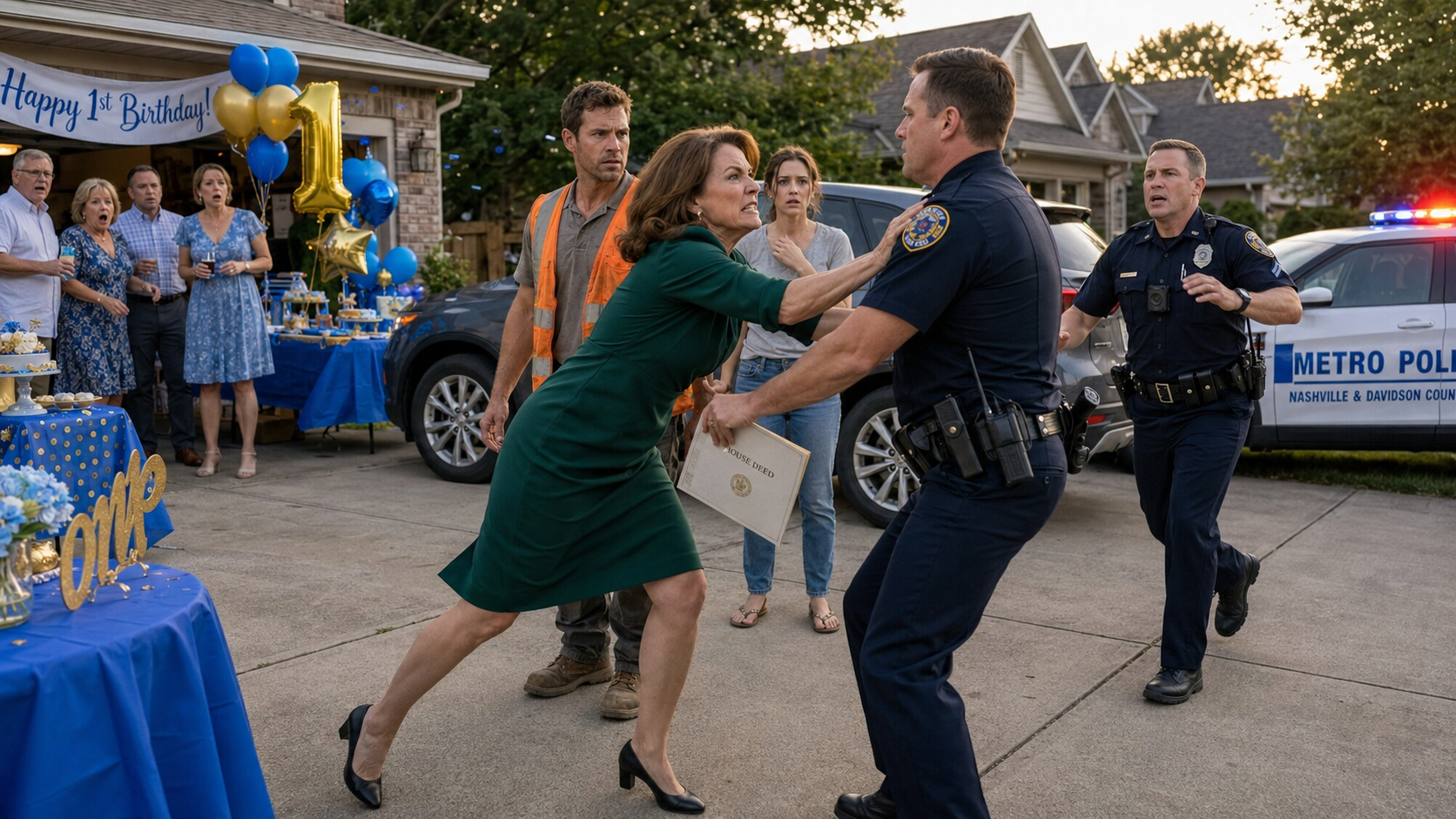
I stopped breathing.
It was the original deed to our house.
For a few seconds I simply stared at it.
I remembered exactly where I had kept it.
Fireproof document box.
Bottom drawer of the office filing cabinet.
Behind tax records and insurance papers.
I had not opened that box in months.
“What are you doing with my deed?”
Mason looked at my mother.
Again.
Always my mother.
She said, “I asked him to bring it to me.”
The world seemed to narrow.
“Why?”
Teresa lifted her chin.
“For safekeeping.”
“Safekeeping.”
“Yes.”
“By hiding it under his jacket?”
“Don’t be dramatic.”
I stared at her.
“You went into my office?”
“It was unlocked.”
“The document box wasn’t.”
Her eyes flickered.
That was the moment another memory surfaced.
Three months earlier, my mother had asked me where I kept our important papers.
At the time, she had claimed she was helping Amy organize insurance information.
I had been replacing a belt on our garage door opener.
I barely looked at her when I answered.
“Fireproof box in the office.”
“Combination?”
“Why?”
“In case of an emergency.”
I had laughed.
“Same four digits I’ve used forever.”
My father’s birthday.
My mother knew it.
Of course she knew it.
I felt sick.
“How long have you been going through our documents?”
“I haven’t.”
“Mason has my deed.”
“Because I told him to get it.”
“That isn’t better.”
People had begun drifting toward the driveway.
The party was no longer a party.
Nobody held drinks now.
Betsy pushed forward.
“This is getting ridiculous.”
I looked at her son.
“Why were you taking my deed?”
Mason’s forehead glistened with sweat.
“Ask Teresa.”
“I’m asking you.”
“I was doing her a favor.”
“What favor?”
My mother stepped toward me.
“Connor, this house exists because of this family.”
I almost didn’t understand the sentence.
“What?”
“You think you built your life by yourself?”
“What does that have to do with my deed?”
“I sacrificed for you.”
The officer tried to interrupt, but Teresa kept going.
“I paid for things when you were in school. I helped after your father died. I watched you struggle. And now you have a good salary, a beautiful house, a child, and suddenly I’m treated like some stranger?”
I stared at her.
There it was.
Not an answer.
A claim.
“You think this house belongs to you because you helped me in college?”
“I think family assets should stay protected.”
“Protected from whom?”
Her eyes moved toward Amy.
It was only a glance.
But I saw it.
So did Amy.
Amy’s hand tightened around the car door.
I felt rage spread through me slowly this time.
Cold instead of hot.
“Say it.”
My mother shook her head.
“I’m not doing this.”
“Protected from Amy?”
“She doesn’t understand money.”
Amy flinched.
I stepped closer to my mother.
“You’ve been telling me you use the money I send you to help Amy.”
“I do.”
I turned toward my wife.
“Amy, how much money does my mother give you each month?”
Amy stared at me.
My mother immediately said, “This is private.”
I ignored her.
“Amy.”
Her lips trembled.
“She doesn’t give me money.”
Everything stopped.
I felt like the ground had shifted under my feet.
“What?”
“She buys some groceries.”
“How much?”
“I don’t know.”
“Diapers?”
“Sometimes.”
“Formula?”
“A few times.”
“Utilities?”
“No.”
“Cleaning help?”
Amy looked confused.
“What cleaning help?”
My heart began pounding.
My mother had told me she was paying a woman twice a month to help Amy clean.
There had never been a cleaner.
I looked at Teresa.
“Where is the three thousand dollars going?”
Her eyes hardened.
“Watch your tone.”
“Thirty thousand dollars, Mom.”
A murmur went through the relatives.
Apparently that number was news to them too.
Betsy’s mouth opened.
“You gave her thirty thousand dollars?”
“Over ten months.”
Teresa’s face turned red.
“For this family.”
“What family?”
“This family!”
She gestured toward the relatives standing around the driveway.
And suddenly the food made sense.
The seafood.
The liquor.
Her new dress.
The way people toasted her.
The way she announced that I gave her money because I trusted her to care for everyone.
My money had become proof of her importance.
My home had become proof of her authority.
My wife had become the person Teresa needed to keep small so nobody questioned why she was running our household.
I looked back at Amy.
She had started crying silently.
“I thought you knew,” she whispered.
Those words nearly broke me.
“Knew what?”
“That she kept it.”
I stared.
“She told me the money was for family expenses. I thought you agreed.”
“Why didn’t you tell me?”
Amy looked at my mother.
And I understood before she answered.
“She said you didn’t want me involved in finances because I wasn’t earning.”
I closed my eyes.
My mother spoke quickly.
“That is not what I said.”
Amy’s voice rose.
“Yes, it is.”
Teresa turned on her.
“You ungrateful little liar.”
One of the officers moved closer.
“Ma’am.”
But my mother was no longer listening.
She stepped toward Amy.
“You had nothing when you married him. Nothing. And now you live in this house, spend his money, sit home all day—”
“Sit home?”
My voice stopped her.
I looked toward the kitchen window.
“I just found her washing your dishes while holding my sick son.”
“He is her child.”
“He is my child too.”
“You work.”
“So?”
“She is the mother.”
“And I’m the father.”
Teresa stared at me like the concept offended her.
I shook my head.
“No. This is done.”
Her face changed again.
“Connor.”
“You are not coming into our house anymore.”
“You don’t mean that.”
“You will not have a key.”
“Connor.”
“You will not handle one dollar for us.”
Her voice sharpened.
“Think carefully.”
“I am.”
“You’ll regret humiliating your mother in front of the family.”
I looked around.
All those faces.
People who had eaten my food.
Drunk my liquor.
Laughed while my wife worked.
Maybe some hadn’t known.
Maybe some had.
At that moment, I didn’t care.
“You should have thought about humiliation before you made my wife eat bread over the sink.”
Teresa stepped toward me again.
The officer raised his hand.
“Ma’am, stay where you are.”
She shoved him.
Everything happened at once.
The officer caught her wrist.
Betsy screamed.
Mason backed toward the gate.
Someone knocked over a planter.
My mother shouted that nobody had the right to touch her.
A second officer stepped in.
Within seconds, Teresa was in handcuffs.
And even then she did not stop.
She twisted around until she could see Amy.
“This is because of you!”
Amy recoiled.
My mother shouted louder.
“You turned him against his own mother!”
I moved in front of Amy.
“No.”
Teresa stared at me.
“This is because of you.”
For the first time, my mother looked uncertain.
I nodded toward the deed in the officer’s hand.
“You came into my home. You took my documents. You lied about my money. You terrorized my wife.”
“I helped you!”
“You controlled us.”
“I protected you.”
“From what?”
Her eyes filled with furious tears.
“From losing everything you worked for.”
I looked at the deed.
Then at Amy.
And suddenly the strangest thought came to me.
That Teresa might actually believe what she was saying.
She might genuinely believe the house, the money, even my marriage were things she had the right to manage because she had once sacrificed for me.
That didn’t excuse her.
It made her more dangerous.
Because people who know they’re stealing sometimes stop when they’re caught.
People who believe they are entitled to what they’re taking rarely do.
The police escorted my mother toward the cruiser.
Mason remained beside the gate, pale and silent.
I looked at him.
“What was supposed to happen to the deed?”
His jaw tightened.
“Mason.”
He glanced at the police.
Then at my mother.
Finally, he said, “She said she needed it before you figured out where the money was going.”
My blood went cold.
Before I could ask anything else, one of the officers told him to stop talking and stepped between us.
But I had heard enough.
The birthday party had never been about Frederick.
It had been noise.
Distraction.
Twenty relatives.
Music.
Food.
Amy trapped in the kitchen.
Me expected to remain at work until evening.
And Mason inside my office.
I looked toward my house.
For the first time since buying it, it didn’t feel like home.
It felt like a place someone had broken into while I was still living there.
PART 4: THE THINGS AMY NEVER TOLD ME
We took Frederick to urgent care before we did anything else.
That mattered to me.
Not the police statements.
Not the ruined party.
Not the relatives calling.
Not the deed.
My son.
The doctor confirmed his fever was high but manageable. An infection was making him miserable, and we were given instructions, medication, and warning signs to watch for.
Amy sat beside me in the examination room with both hands wrapped around a paper cup of water.
She looked smaller than usual.
Not physically.
Somehow emotionally.
Like she was trying not to occupy too much space.
Frederick finally fell asleep against my chest.
For several minutes, neither of us spoke.
Then I said, “I’m sorry.”
Amy looked at me.
“You didn’t know.”
“I should have.”
“Connor—”
“I should have.”
My voice cracked.
That embarrassed me.
I looked down at Frederick.
His tiny fingers were curled against my shirt.
“I kept telling myself I was providing for you.”
“You were.”
“No.”
I shook my head.
“I was sending money and assuming that meant I was taking care of you. Those aren’t the same thing.”
Amy looked away.
I remembered every late night.
Every Saturday inspection.
Every time my mother told me, “Don’t worry. I’ve got things handled.”
And every time I had felt relieved.
I had accepted convenience instead of asking questions.
“Tell me everything.”
Amy was silent.
“Please.”
Her fingers tightened around the paper cup.
“It didn’t start like today.”
“I know.”
“She was helpful at first.”
That made sense.
My mother was always helpful at first.
“She brought groceries after Frederick was born. She made food. She held him so I could shower. She drove me to an appointment when you couldn’t leave work.”
I nodded.
“Then what?”
Amy stared at the floor.
“She started commenting on things.”
“What things?”
“The house. How I folded laundry. What I cooked. How much formula we used. How often I ordered groceries. What time Frederick slept.”
I felt my jaw tighten.
“She said I was wasting money because I bought the wrong brand of diapers.”
“Why didn’t you tell me?”
“I did. Kind of.”
I searched my memory.
Then it came back.
One night Amy had said, “Your mom thinks I spend too much.”
I had laughed and kissed her forehead.
“She thinks everybody spends too much.”
I remembered exactly.
The shame hit hard.
“You tried.”
“I didn’t explain it right.”
“You shouldn’t have needed a presentation for me to listen.”
Amy looked at me then.
There was sadness in her face, but not accusation.
Somehow that made it worse.
“She always had an explanation,” Amy said. “Whenever I pushed back, she said she was only trying to help because you were under pressure.”
“What pressure?”
“She said the mortgage was hurting us.”
I stared.
“Our mortgage is fine.”
“I know that now.”
“What did she tell you?”
“That work had slowed down. That you were worried about money. That you didn’t want me asking questions because you were embarrassed.”
I felt nauseated.
“My work never slowed down.”
“I didn’t know.”
“You have access to our bank account.”
Amy gave a tired laugh.
“Technically.”
“What does that mean?”
“I stopped checking it.”
“Why?”
Her eyes dropped again.
“Your mother said every time I logged in, you got an alert.”
I stared at her.
“That’s not true.”
“I know.”
“Why would she say that?”
“Because she said you were tracking spending.”
“Amy, I have never—”
“I know.”
Her voice broke.
“I know now.”
That sentence contained an entire year of damage.
I reached for her hand.
She let me take it.
“What else?”
“She said the money you sent her was because you didn’t trust me to manage household expenses.”
I closed my eyes.
“She said you wanted her to oversee things.”
“I never said that.”
“I know.”
“She told you I didn’t trust you.”
Amy nodded.
“And what did she tell me?”
She looked at me.
“What?”
“She must have been telling me something about you too.”
Amy thought.
Then her expression shifted.
“She always asked whether I complained about you working.”
I remembered those conversations.
Teresa saying:
Amy doesn’t understand how demanding your job is.
She seems frustrated that you’re gone so much.
Don’t let her make you feel guilty for providing.
At the time, I thought my mother was defending me.
Now I understood.
She had been standing between us, carrying messages neither of us had sent.
Keeping each of us slightly defensive.
Slightly guilty.
Slightly afraid to burden the other.
I looked at Amy.
“She told me you resented my schedule.”
Amy’s mouth fell open.
“I never said that.”
“I know.”
“She told me you thought I was lazy?”
My silence answered.
Amy looked away.
I hated myself.
“I didn’t believe her.”
“Not completely.”
That landed exactly where it needed to.
Not completely.
Because there had been moments.
I would come home exhausted and see toys on the floor.
Laundry unfolded.
Dishes waiting.
And some ugly little voice—my mother’s voice, I realized now—would whisper that Amy had been home all day.
I never accused her.
But maybe I sighed.
Maybe my face showed something.
Maybe she noticed.
Of course she noticed.
“I’m sorry.”
Amy wiped her cheek.
“She kept saying once Frederick was older, you’d start expecting more from me.”
I squeezed her hand.
“I expected you to survive the first year.”
A weak smile touched her mouth.
Then disappeared.
“Today was worse because I told her no.”
“To what?”
“The party.”
I stared at her.
“This morning?”
“Last night.”
“What happened?”
“She came over with decorations and said twenty-three people were coming. I told her Frederick was sick and we should cancel.”
“Then?”
“She said it was too late because she had already spent the money.”
“Whose money?”
Amy looked at me.
We both knew.
Mine.
“She said if I embarrassed her by canceling, she would tell you I had wasted everything.”
My throat tightened.
“Why would I believe that?”
Amy gave me a look I deserved.
“Because I thought you believed her about the money.”
The trap became visible all at once.
My mother had built two versions of the same marriage.
In mine, Amy was dependent, overwhelmed, maybe careless with money, but my mother was helping keep everything stable.
In Amy’s, I was stressed, controlling finances, disappointed in her, and using my mother to supervise the household.
Neither version was completely unbelievable because Teresa built each lie from something true.
I did work too much.
Amy was financially dependent while staying home with Frederick.
My mother did sometimes help.
We were tired.
We communicated in rushed conversations between feedings, deadlines, laundry, and sleep.
Teresa did not create the cracks.
She used them.
Amy leaned back in the chair.
“I told her this morning I wasn’t cooking for that many people.”
“What did she say?”
“That you had already paid.”
I stared.
“She said the party was your gift to Frederick?”
Amy nodded.
“She said you wanted it done properly.”
I looked down at our son.
A one-year-old child who would have been perfectly happy with a cupcake and wrapping paper.
“What happened when he got sick?”
“She told me to give him medicine.”
“And when the guests arrived?”
“She said I couldn’t embarrass you.”
Amy rubbed her forehead.
“At first I was just putting food out. Then people wanted drinks. Then Betsy started telling me which dishes needed washing because there weren’t enough serving plates.”
I swallowed.
“Did anyone help you?”
“Rachel tried.”
I remembered my cousin Rachel.
“She did?”
“Your mom told her I preferred doing things myself.”
I almost laughed at the cruelty of how simple it was.
Not chains.
Not threats.
Just lies delivered confidently enough that nobody questioned them.
“Amy, when my mother told you not to stop…”
She went quiet.
“Did she threaten you?”
“Not physically.”
“What did she say?”
Amy stared at Frederick.
“She said if I made a scene today, she’d make sure you finally understood what kind of wife you had married.”
I felt my chest tighten.
“And you believed her.”
“I believed she could.”
That answer stayed with me.
Not because Amy was weak.
Because my mother had spent months making herself the trusted translator between husband and wife.
Teresa knew my schedule.
My finances.
My childhood.
My guilt.
She knew Amy was exhausted.
She knew exactly how to pressure each of us without leaving fingerprints.
And I had handed her the access.
Literally.
A key.
Money.
Information.
Trust.
We returned home after dark.
Most of the relatives were gone.
The police had cleared the house.
The backyard looked like a storm had passed through.
Half-deflated balloons moved in the night breeze.
Plastic cups covered tables.
A birthday banner hung crookedly over the patio.
FREDERICK TURNS ONE!
I stared at it.
Amy stood beside me.
“Do you want me to clean tomorrow?”
I turned.
Her question shocked me.
“No.”
She looked startled.
“Amy, no.”
“I just meant—”
“I know what you meant.”
I took her hand.
“Nobody cleans tomorrow.”
A small smile appeared.
“Eventually somebody should.”
I looked at the disaster.
“Eventually.”
She actually laughed.
Quietly.
It was the first sound all day that felt like home.
Then my phone rang.
Betsy.
I declined it.
It rang again.
Declined.
Then a text appeared.
You have destroyed this family over a misunderstanding.
Another.
Your mother has done everything for you.
Then another.
Amy has always wanted Teresa gone.
I turned the phone off.
Amy watched.
“You don’t have to stop talking to everyone because of me.”
“I’m not.”
“Connor.”
“I’m stopping because of me.”
She stared.
“I don’t want another person explaining my marriage to me.”
That made her cry again.
This time I pulled her against me.
We stood in the wreckage of our son’s first birthday with Frederick sleeping between us.
Later, after Amy and the baby were asleep, I went into the office.
The document box was open.
Papers had been disturbed.
Nothing else obvious was missing.
But as I stood there looking at the drawer, I remembered something Mason had said.
She needed it before you figured out where the money was going.
I sat at my desk.
Opened my laptop.
And for the first time in ten months, I stopped trusting my mother and started checking.
Thirty thousand dollars had left my account.
Exactly as I remembered.
Three thousand each month.
My mother had always sent short messages afterward.
Got it.
Groceries handled.
Paid the baby things.
Don’t worry about home. Focus on work.
I scrolled through them.
Month after month.
The same sentence hiding beneath every message.
Don’t look.
I’ve got it.
Don’t look.
I’ve got it.
Don’t look.
I’ve got it.
Then I opened my texts with Amy.
They told a different story.
Do we have enough for diapers before Friday?
I had replied:
Mom has the household money. Ask her.
Another.
Your mom says we should delay the pediatrician bill until next week. Is that okay?
I replied:
If Mom says the timing is fine, it’s probably fine.
Another.
Can we talk about the household account tonight?
My reply:
Absolutely. Long day. Remind me when I’m home.
She had.
Frederick had started crying.
We never finished the conversation.
I sat there staring at my own words until they blurred.
My mother had deceived us.
But I had made deception easy by outsourcing attention.
The hardest truth wasn’t that Teresa had betrayed me.
It was that Amy had been asking me to look for months.
I just hadn’t understood what I was seeing.
PART 5: THE HOUSE BECAME OURS AGAIN
Frederick’s real birthday celebration happened three days later.
There were five people.
Me.
Amy.
Frederick.
Amy’s parents.
And Rachel, the cousin who had tried to help in the kitchen before my mother sent her away.
No seafood towers.
No liquor.
No rented speaker.
No balloon arch.
I grilled burgers in the backyard.
Amy wore the blue dress I had bought her.
When I gave it to her that morning, she held it against herself and stared at me.
“You remembered?”
“You looked at it three times.”
She laughed.
“You noticed that?”
The question cut deeper than she intended.
“I’m trying to notice more.”
She looked at me for a long moment.
Then she kissed me.
Frederick smashed both hands into a small cake and somehow got blue frosting behind one ear.
We took pictures.
He cried when everyone sang.
Then laughed thirty seconds later when my father-in-law made a napkin disappear behind his back.
It was ordinary.
It was perfect.
And for the first time, I understood what had been wrong with the first party.
It wasn’t simply that Teresa had been cruel.
She had taken something that belonged to our little family and turned it into a performance of her authority.
Our second celebration had no audience for power.
It was just love.
The consequences of that Friday continued long after the balloons were gone.
My mother faced the results of shoving the officer and taking documents from my home.
Mason tried to minimize his involvement, insisting he had only followed Teresa’s instructions.
Maybe that was true.
Maybe not.
I stopped caring about excuses.
What mattered to me was that he had entered my office and tried to leave with the original deed while my wife was distracted in the kitchen.
I changed every lock.
Changed the garage code.
Changed passwords.
Removed my mother from anything she had ever been authorized to access.
I stopped the monthly transfers immediately.
Then Amy and I sat down together and went through every account.
Every bill.
Every subscription.
Every expense.
Not because I wanted to supervise her.
Because I never wanted either of us to be ignorant about our own life again.
Some conversations were uncomfortable.
I learned Amy had been putting purchases on a credit card in her own name because Teresa sometimes refused to release money for things Frederick needed.
Diapers.
Medicine.
Baby food.
Not huge amounts.
But enough to make me ashamed.
“Why didn’t you use our joint card?”
“She said you were watching it.”
I rubbed both hands over my face.
“I hate that sentence.”
“So do I.”
I paid the balance that night.
Then I handed Amy my phone.
“What?”
“Open the banking app.”
She looked suspicious.
“Connor.”
“Open it.”
She did.
I showed her every account.
Savings.
Mortgage.
Retirement.
Emergency fund.
Everything.
“No more middleman,” I said.
Her expression softened.
“No more middleman.”
Teresa called constantly during the first week.
Then she started using relatives’ phones when I stopped answering hers.
Some messages were angry.
Some tearful.
Some almost reasonable.
I made mistakes, but everything I did was for you.
That sentence came again and again.
For you.
I had heard it my entire life.
She had sacrificed for me.
Therefore she could question my choices.
She had helped me.
Therefore she could enter my home.
She had given.
Therefore she could take.
For years I thought gratitude meant permanent surrender.
It didn’t.
One evening, two weeks after Frederick’s birthday, I finally answered.
Not because I wanted reconciliation.
Because I needed to say something without a crowd around us.
“Connor.”
My mother’s voice broke the moment I answered.
I almost weakened.
Old reflex.
Old guilt.
Then I remembered Amy on the plastic stool.
“What do you want?”
“I want my son.”
“I’m here.”
“No, you’re not.”
I closed my eyes.
“That’s the problem, Mom. You don’t want me. You want control over me.”
“That woman has poisoned you.”
“Her name is Amy.”
“You know what I mean.”
“Yes.”
I did.
Too well.
“You humiliated her.”
“I was teaching her responsibility.”
“In her own house?”
“She lives there because you pay for it.”
“So do I.”
“What?”
“She’s my wife. It’s her home. Frederick’s home. Mine. Not yours.”
“I never said it was mine.”
I thought about the patio.
In this house, I make the rules.
“Yes, you did.”
Silence.
Then she said, “I was angry.”
“You were comfortable.”
“What?”
“You weren’t angry when you said it. You were laughing.”
She had no answer.
I continued.
“You thought I wouldn’t hear you.”
“Connor—”
“You thought I’d stay at work. You thought Amy wouldn’t tell me. You thought Mason would get out with the deed. You thought everything would keep going exactly as it had been going.”
“You don’t understand what that paper was for.”
“Then explain it.”
Silence.
“Why did you need my deed?”
“I wanted it protected.”
“From Amy?”
“She could divorce you.”
The words finally came.
Not shouted.
Not disguised.
Simple.
I leaned back in my chair.
There it was.
The fear she had used to justify everything.
“Did Amy tell you she planned to divorce me?”
“No.”
“Did I tell you we were having problems?”
“No.”
“Then why?”
“Because marriages fail.”
“And stealing the deed prevents that?”
“I was trying to make sure family property stayed with family.”
I almost laughed.
“Amy is family.”
“She married into it.”
“And Frederick?”
“He is my grandson.”
“My son.”
My mother sighed.
“You are determined to misunderstand me.”
“No. For the first time, I understand you perfectly.”
She began crying.
I let her.
That was difficult.
More difficult than yelling.
Teresa’s tears had moved me my whole life.
They still did.
Love does not disappear the instant somebody hurts you.
Sometimes that is the cruelest part.
I loved my mother.
I remembered her working late after Dad died.
I remembered her sitting beside me during college applications.
I remembered her mailing me twenty dollars when she probably needed it more than I did.
Those things were real.
So was Amy on that stool.
One truth did not erase the other.
“Are you ever going to forgive me?” she whispered.
I looked through the window.
Amy was on the living-room floor playing with Frederick.
He had discovered that throwing plastic blocks into a basket was apparently the funniest activity in human history.
Every time one landed inside, Amy clapped.
Frederick shrieked.
I watched them.
“I don’t know.”
My mother cried harder.
“But forgiveness wouldn’t mean giving you a key again.”
She went quiet.
“It wouldn’t mean giving you money.”
Silence.
“It wouldn’t mean letting you make decisions for us.”
“Then what would it mean?”
“I don’t know yet.”
I swallowed.
“But if you’re asking whether things can go back to how they were, no.”
Her voice hardened slightly.
“So Amy wins.”
That sentence removed every doubt I had.
“You still think this is a competition.”
“It is.”
“No, Mom.”
I looked at my wife.
“You’re the only one who made it one.”
I ended the call.
Months passed.
Our home changed in small ways.
Amy began working part-time from home once Frederick’s routine became easier, not because I demanded it and not because Teresa had called her dependent, but because Amy missed having something that belonged to her professional life.
We hired a babysitter for a few afternoons each week.
The first time Amy paid the sitter from our joint account without asking anybody, she sent me a screenshot with the message:
Look at me recklessly destroying the family fortune.
I laughed so loudly at work that the project manager asked what was wrong with me.
I wrote back:
Financial ruin. We may never recover from four hours of childcare.
It became a joke between us.
Some things took longer to heal.
For months, whenever the back door opened unexpectedly, Amy’s shoulders tightened.
Whenever somebody said, “Your mother told me…” I felt anger before the sentence even finished.
We started having one rule about family problems.
No messengers.
If Betsy said Teresa believed something, I told Betsy Teresa could speak for herself.
If somebody told Amy that I supposedly wanted something, Amy asked me directly.
If somebody told me Amy had complained, I asked Amy.
Simple.
Embarrassingly simple.
But it changed everything.
Rachel apologized for not pushing harder that day.
“I thought Amy wanted to handle the food,” she told me.
“That’s what Mom said.”
“I should have asked Amy.”
“So should I.”
We both carried our part.
Other relatives were slower.
Betsy never apologized.
She insisted the comment about Amy “earning her place” had been a joke.
I told her jokes were supposed to make the person they were about laugh.
She stopped calling after that.
I was okay with it.
The strangest part was the deed.
After the police returned it, I held that piece of paper for a long time.
Before the birthday, it had been boring.
A legal document.
Something stored away.
Afterward, it felt heavier.
Not because the paper itself gave my mother ownership.
It didn’t.
But because of what she had believed it represented.
The house.
My salary.
My father’s legacy.
Her sacrifices.
Amy’s dependence.
My obligation.
Everything Teresa had slowly convinced herself she had a right to control.
I put the deed back into a new fireproof safe.
Then I changed the combination.
Amy stood beside me.
“What did you use?”
I smiled.
“Our anniversary.”
She smiled back.
“That’s cheesy.”
“Very.”
“Good.”
A year after the nightmare birthday, Frederick turned two.
This time, we planned the party together.
Twelve guests.
Backyard.
Hot dogs.
Cupcakes.
A ridiculous dinosaur sprinkler Frederick was terrified of for twenty minutes and then refused to leave for the rest of the afternoon.
My mother was not there.
That hurt.
I won’t pretend it didn’t.
Sometimes doing the right thing still leaves an empty chair.
Sometimes boundaries do not feel powerful.
Sometimes they just feel sad.
Amy noticed me looking toward the gate.
“You okay?”
I nodded.
Then changed my mind.
“A little sad.”
She slipped her hand into mine.
“That’s allowed.”
I looked at her.
There had been a time when my mother’s opinion had filled every quiet space between us.
Now there was room for honesty.
“I wish she could have been different.”
Amy squeezed my fingers.
“Me too.”
Not I’m glad she’s gone.
Not I told you so.
Me too.
That was Amy.
Frederick came charging toward us, soaked from head to toe, yelling something that sounded like “Dinosaur Daddy.”
I caught him before he crashed into my knees.
He smelled like sunscreen, grass, sugar, and hose water.
He wrapped both wet arms around my neck.
I laughed.
Behind him, our friends and family were eating.
Nobody was ordering Amy into the kitchen.
Nobody was announcing who paid for what.
Nobody was making speeches about sacrifice.
Nobody was keeping score.
Our home finally felt like ours.
That night, after Frederick fell asleep, Amy and I sat on the patio under the string lights.
Most of the decorations were still up.
A plastic dinosaur lay on its side in the grass.
She rested her head on my shoulder.
“Do you ever think about his first birthday?”
“More than I want to.”
“Me too.”
I looked through the kitchen window.
For a second I could still see her there.
Messy hair.
Raw hands.
Bread falling from her mouth because she was startled to see her own husband.
That image would probably stay with me forever.
Not because I wanted to punish myself.
Because there are moments you should never allow yourself to forget.
They teach you what neglect looks like.
What manipulation looks like.
What happens when trust becomes an excuse not to pay attention.
“I thought providing meant making enough money,” I said.
Amy lifted her head.
“What?”
“Back then.”
I stared at the yard.
“I thought if the mortgage was paid and the refrigerator was full and you had help, then I was doing my job.”
“You were doing your best.”
“My best was incomplete.”
She watched me.
I continued.
“Providing is noticing.”
Her expression softened.
“Sometimes.”
“Listening.”
“Yes.”
“Not letting your mother steal the deed.”
Amy laughed.
“That’s definitely in the husband handbook.”
I smiled.
Then she became serious.
“You came home.”
Three words.
I looked at her.
She touched my hand.
“That day. You came home.”
I knew she didn’t only mean physically.
I had walked through the back door carrying a cake and gifts, believing my family was waiting for me.
Instead, I walked into the truth.
My mother had turned my son’s birthday into a display of power.
She had humiliated my wife.
She had taken my money while pretending to support her.
She had used my trust to divide us.
And while everyone celebrated outside, she sent Mason into my office for the deed to the house I had worked years to buy.
I used to think betrayal always arrived loudly.
A confession.
A slammed door.
A shocking discovery.
Mine had arrived quietly.
Three thousand dollars at a time.
One small lie at a time.
One insult disguised as advice.
One conversation carried through the wrong person.
One exhausted wife saying, “We’re okay,” because she believed telling me the truth would only make things worse.
The birthday party was simply the day all those quiet betrayals finally became visible.
And maybe that was the one thing my mother never planned for.
She planned for me to keep working.
She planned for Amy to stay frightened.
She planned for our relatives to keep laughing.
She planned for Mason to walk out the side gate with my deed hidden under his jacket.
She planned for the party to end, the trash to be cleared, the dishes to be washed, and life to continue exactly as she had arranged it.
But she never planned for me to walk through that back door.
And once I did, I finally saw my own home clearly.
The woman I loved was not a servant.
The money I earned did not buy my mother authority.
Gratitude was not obedience.
Family was not ownership.
And the house Teresa tried so hard to control was never truly protected by a deed locked inside a box.
It was protected the moment Amy and I stopped letting anyone stand between us.
I put my arm around my wife.
Inside, our son slept safely in his room.
The kitchen was messy from his birthday.
There were cups in the sink.
Frosting on the counter.
Toys under the table.
Nobody rushed to clean them.
Nobody was afraid.
I looked at the open back door.
Then at Amy.
“Want to leave the dishes until morning?”
She smiled.
“Absolutely.”
So we did.
Để lại một bình luận