
PART 1: THE MESSAGE
“Nobody gives a damn about your Navy career,” my dad texted.
Funny.
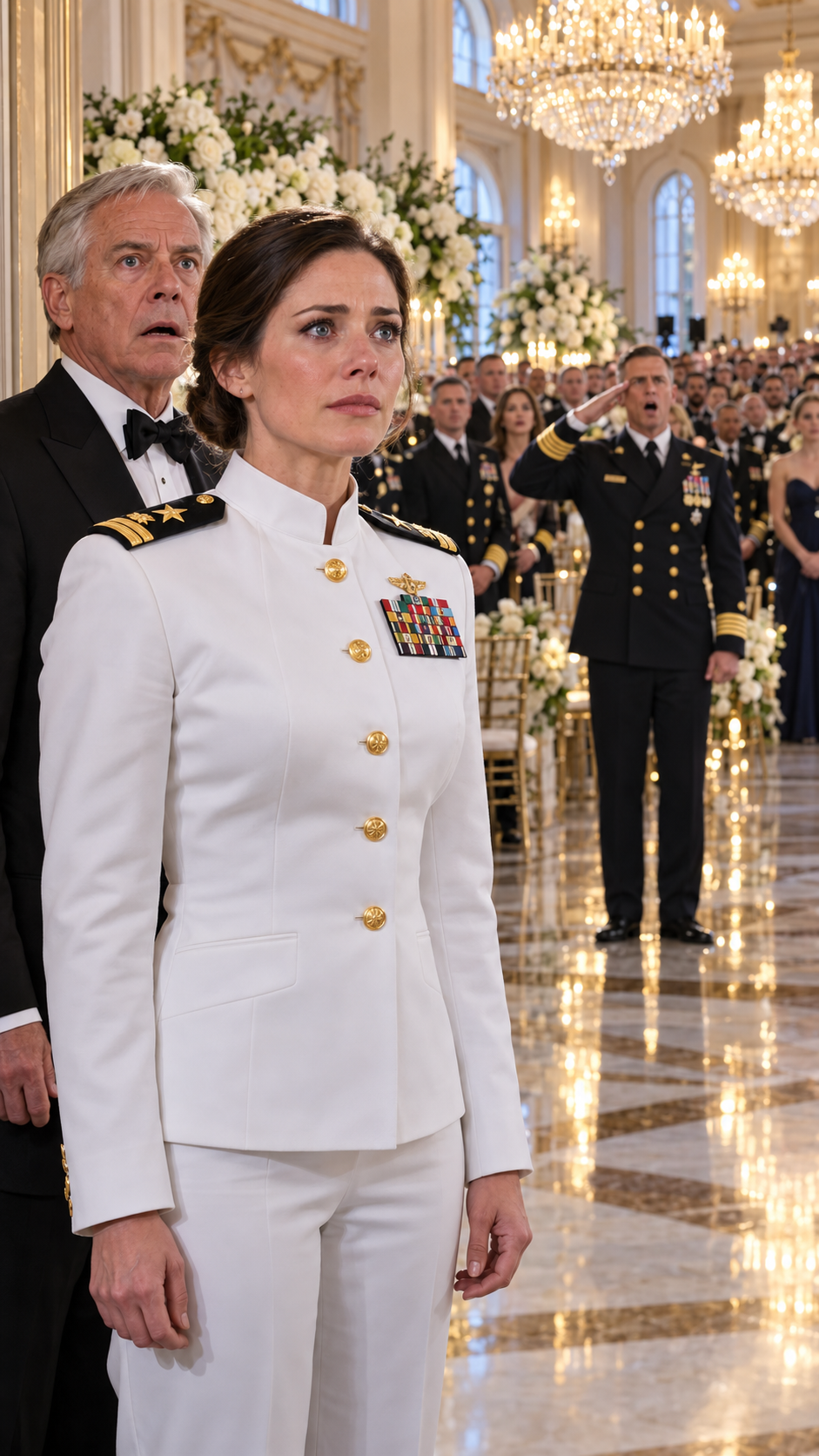
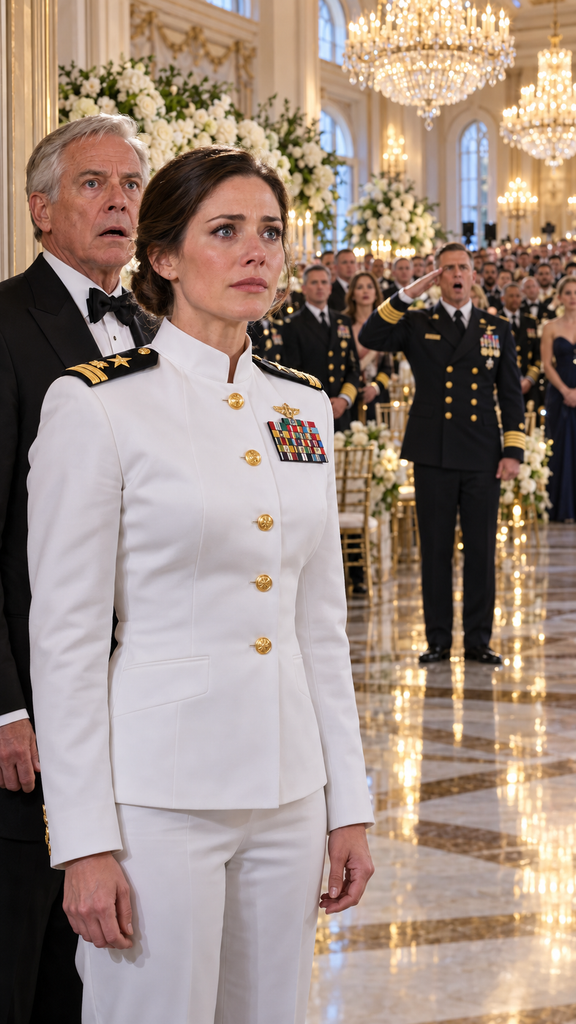
Because the second I walked into my sister’s wedding, nearly three hundred battle-hardened SEALs rose to their feet.
A commander called out, “ADMIRAL ON DECK!”
And then—
complete silence.
But that happened later.
Three hours earlier, I was standing beneath the flickering arrivals board at Norfolk International Airport when my father sent the message that finally broke the last fragile thread still holding us together.
My name is Rebecca Hale, and I was thirty-four years old when I came home from eight months overseas to attend my younger sister’s wedding.
I had been back on American soil for exactly seventeen minutes.
My phone vibrated while I waited beside baggage claim.
Dad.
For one stupid second, I smiled.
I thought maybe he was asking whether I had landed safely.
Instead, I read:
Make sure you don’t wear your uniform today. Nobody cares about your Navy career. The groom’s family expects high society, not government employees.
I read it twice.
Around me, suitcase wheels clattered across tile. A toddler cried beside a vending machine. Somewhere behind the security doors, an announcement crackled through the terminal.
Every time the automatic doors opened, damp pine and jet fuel swept inside and mixed with the smell of burnt airport coffee.
I stared at my father’s message until the screen dimmed.
Eight months.
That was how long I had been gone.
Eight months sleeping in two-hour stretches.
Eight months eating meals while standing over maps.
Eight months living around encrypted briefings, secure rooms, satellite calls, intelligence updates, casualty reports, weather windows, extraction plans, and names I still sometimes heard in my head when everything around me became too quiet.
The location where I had spent most of those months wasn’t something I could discuss.
Neither was the work.
What I could say was that I had served alongside a Naval Special Warfare task force.
I could say there were nights when the decisions made in a windowless room determined whether men came home before sunrise.
I could say there were people whose wives, husbands, children, and parents would never know how close they had come to receiving a knock at the door.
And I could say I had learned long ago that real responsibility rarely looked impressive from the outside.
My father told people I did “computer work for the Navy.”
He had never bothered to ask what kind.
Maybe that was the strangest part.
Not that he misunderstood my career.
That would have been forgivable.
He simply wasn’t interested.
To Dad, success had a visible price tag.
A corner office.
A private club membership.
A house with enough square footage to make other people jealous.
A watch someone recognized from across a dinner table.
My younger sister Madison was marrying into the Ellison family that afternoon.
Her fiancé, Grant Ellison, helped oversee part of his family’s investment company.
That was all my father needed to know.
The Ellisons had money.
Old money, according to my mother, who said the words as if she were describing a hereditary title.
For the past year, every conversation about Madison’s wedding had somehow become a conversation about impressing them.
The flowers had to be imported.
The invitations had to be letterpressed.
The wine had to come from a vineyard whose name my father suddenly pronounced with an accent.
And apparently I had to hide my uniform.
My duffel finally appeared on the carousel.
Then my suitcase.
Inside it was a black garment bag holding my dress whites.
It was the one formal outfit I had carried across an ocean because my little sister was getting married.
I ran my fingers over the garment bag.
My phone buzzed again.
For a moment, I expected an apology.
Instead:
Rebecca, I’m serious. Don’t make today about you.
I almost laughed.
There in the middle of baggage claim, after twenty-one hours of travel and eight months away, I almost laughed until I cried.
Because I had spent most of my life trying not to make anything about me.
When Madison and I were children, she had been the bright one in the family.
Not academically.
Emotionally.
She filled rooms.
She sang while brushing her teeth. She named stray cats. She cried when cartoons ended because she worried the characters would be lonely after the credits.
We built forts beneath the maple tree behind our childhood home.
She drew treasure maps in purple marker, and I led us through the backyard while the neighbor’s sprinkler became incoming enemy fire.
“Captain Rebecca!” she’d yell.
“Stay behind me!”
“Why?”
“Because I’m older.”
“By three years!”
“Still older.”
She would salute me with a crooked grin.
Back then, protecting Madison had been easy.
Stand in front.
Take the hit first.
As we grew older, things became more complicated.
Dad learned that Madison hated conflict, and he used it.
Mom learned that Madison wanted approval, and she used that too.
I left home at eighteen.
Madison stayed close.
I joined the Navy.
Madison learned how to keep everyone happy.
For years, I kept telling myself that survival came in different forms.
Mine involved leaving.
Hers involved adapting.
Maybe that was why I still loved her fiercely even when I didn’t always recognize the woman she had become.
I didn’t answer Dad’s message.
Outside, rain covered the pavement in silver.
I loaded my duffel, suitcase, and garment bag into a rideshare.
“Where to?” the driver asked.
“Bellmere Country Club.”
He glanced at me in the mirror.
“Wedding?”
“My sister’s.”
“You’re cutting it close.”
I checked the time.
1:03 p.m.
Ceremony at two-thirty.
“I’ve had closer calls.”
He laughed.
I didn’t.
Bellmere appeared through the rain twenty minutes later, sitting behind black iron gates and manicured hedges.
Gray stone walls.
Tall windows.
White roses everywhere.
Valets hurried beneath umbrellas while florists carried arrangements through massive carved wooden doors.
The driver pulled up beneath the awning.
I stepped out wearing jeans, boots, and a gray sweater.
One of the valets looked at my duffel.
Then at me.
Then pointed toward the side of the building.
“Service entrance is around there.”
I looked toward the entrance.
Then back at him.
“The main entrance is over here.”
His face changed immediately.
“Of course, ma’am. Sorry.”
I could have been angry.
Instead, I was tired.
At 1:26 p.m., I signed the guest book.
The woman behind the table scanned my name.
“Hale… Hale…”
Her finger stopped.
“Oh. Bride’s sister.”
“Yes.”
She looked over my clothes.
“You’re in the wedding?”
“No.”
That had been another decision made while I was deployed.
Madison had told me it would be “too complicated” because no one knew whether I would make it home.
I had said I understood.
And I did.
Mostly.
A brass sign pointed toward the bridal suite.
I followed it down a hallway filled with framed oil paintings and flower arrangements.
Before I reached the doors, I heard laughter.
Then the sharp pop of a champagne cork.
I knocked once and entered.
The entire room went silent.
Madison sat in front of a mirror wearing a white silk robe. Her veil was already secured in her hair.
My mother stood behind her.
Three bridesmaids held champagne glasses.
Dad stood beside the window.
For a moment, nobody moved.
Madison’s reflection stared at mine.
Her eyes widened.
“You really came.”
Not hello.
Not thank God you’re home.
Not I missed you.
Just surprise.
I swallowed.
“Of course I came.”
Mom crossed the room and kissed my cheek without touching me enough to wrinkle anything.
“You look exhausted.”
“Twenty-one hours of travel.”
“You could have put on some makeup.”
I almost smiled.
There were things so predictable they became comforting.
Then Dad noticed the garment bag.
His eyes narrowed.
“You got my message.”
“I did.”
He nodded toward the bag.
“Then leave that at coat check.”
Madison’s smile disappeared.
One bridesmaid suddenly became fascinated with her champagne.
I looked at Dad.
“I’m changing.”
“Into what?”
He knew.
I let the silence answer him.
His mouth tightened.
“Rebecca.”
Madison turned slightly in her chair.
“Dad—”
He ignored her.
“Today is about your sister. Grant’s family doesn’t need some kind of military spectacle.”
A faucet dripped steadily in the bathroom beside us.
One bridesmaid adjusted the same bracelet twice.
I stared at my father.
I had been yelled at by people with stars on their shoulders.
I had sat across from men who had survived things no person should survive.
I had received casualty reports before breakfast.
Yet somehow my father’s disappointment still knew exactly where to cut.
Maybe because parents get the first map of you.
They learn where everything hurts before you learn how to protect it.
I looked at Madison.
“Do you want me here?”
Her lips parted.
Dad answered first.
“Of course she does. Just behave appropriately.”
I didn’t look away from my sister.
“Madison?”
Her eyes met mine through the mirror.
For one second, I saw the little girl beneath the maple tree.
Then she looked toward my garment bag.
“I just need everything to go smoothly today.”
That hurt more than Dad’s text.
I nodded.
“Understood.”
I picked up my bag.
“Rebecca,” Madison said.
I stopped.
But she didn’t finish.
So I walked out.
I found the women’s lounge at the far end of the corridor and locked myself inside.
For several seconds, I stood with both hands braced against the marble counter.
Then I opened my duffel.
My folded travel orders were inside.
I looked at the release stamp.
9:40 a.m.
Dad’s first message had arrived at 12:08.
Less than three hours separated the official order sending me home from the message telling me to hide who I was.
I stared at my reflection.
My eyes were tired.
My face was thinner than it had been eight months earlier.
There was a pale line near my temple from an accident I didn’t discuss.
I thought about changing into the navy-blue dress my mother had insisted on buying for me months earlier.
It was still at my parents’ house.
I could have asked someone to bring it.
I could have worn civilian clothes.
I could have disappeared into the back row and made everyone comfortable.
I had spent years doing exactly that.
Not because I was ashamed of my service.
Because explaining it was exhausting.
Dad once introduced me at a Christmas party by saying, “Rebecca works with computers for the government.”
I had been a captain then.
I didn’t correct him.
At Thanksgiving, one of his friends asked whether I planned to “get a real job eventually.”
Dad laughed.
I didn’t correct him.
When I was selected for flag rank, I told my mother.
Her response had been:
“That’s wonderful, sweetheart. Madison just chose her venue.”
I didn’t correct that either.
Standing inside Bellmere’s empty lounge, I finally understood something.
Silence could be dignity.
But silence could also become permission.
I unzipped the garment bag.
My dress whites waited inside.
I changed slowly.
Not because I wanted attention.
Not because I wanted revenge.
Because I had earned every stripe.
Every sleepless night.
Every responsibility.
Every name that returned to me whenever a room became too quiet.
When I finished, I looked at myself once.
Then I opened the door.
At 1:52 p.m., I stepped into the hallway.
Dad was waiting outside the ballroom.
His expression hardened the instant he saw me.
“What did I tell you?”
I stopped.
“That nobody cared.”
“Take it off.”
“No.”
His eyes widened slightly.
I rarely told my father no.
Not because I feared him.
Because fighting with him had always felt like trying to reason with weather.
He stepped closer.
“Rebecca, do not embarrass this family.”
The quartet inside the ballroom began playing.
Guests were taking their seats beneath crystal chandeliers.
I could see white roses lining the aisle.
Grant stood near the front speaking to one of the groomsmen.
Dad lowered his voice.
“You walk in there dressed like that and people will think you’re trying to upstage your sister.”
“I’m attending her wedding in my formal uniform.”
“You were specifically asked not to.”
“By you.”
“By this family.”
Something inside me went very still.
“No,” I said. “By you.”
His face reddened.
He reached toward my sleeve.
I lowered my eyes to his hand.
He stopped.
Then slowly pulled it back.
I looked toward the ballroom.
“I’m going to watch my sister get married.”
And I walked inside alone.
I didn’t know that within thirty seconds, everything my father believed about me was about to collapse.
PART 2: ADMIRAL ON DECK
At first, nobody noticed anything except a woman in a white uniform.
A few heads turned.
Someone whispered.
Grant’s mother paused near the front row.
Behind me, I heard Dad following.
His shoes struck the floor quickly.
“Rebecca.”
I kept walking.
Then a broad-shouldered man sitting near the aisle looked up.
I recognized him immediately.
Commander Daniel Mercer.
His expression changed.
His chair slammed backward.
He stood.
The man beside him looked at Mercer, then at me.
He rose too.
Another followed.
Then five.
Ten.
Twenty.
The sound spread through the ballroom like distant thunder.
Chair legs scraped against polished wood.
Conversations stopped.
Heads turned.
Men I knew by face, reputation, call sign, or casualty report began rising.
Some wore dark suits.
Some wore uniforms.
Some had scars visible above their collars.
One walked with a carbon-fiber prosthetic below his right knee.
Another had his left hand resting protectively over the shoulder of a teenage son.
These weren’t men who stood because someone was wealthy.
They weren’t impressed by country clubs.
They didn’t care about floral arrangements.
They stood because protocol mattered.
Because service mattered.
Because the insignia on my shoulders meant something they understood.
Nearly three hundred Naval Special Warfare personnel and veterans were in that ballroom through overlapping circles of service, family, and the groom’s community.
Until that moment, I hadn’t realized how many would be there.
I stopped walking.
Mercer snapped to attention.
His voice hit the room like a command on a flight deck.
“ADMIRAL ON DECK!”
Silence.
Absolute silence.
My father’s footsteps stopped behind me.
I could feel him there.
For one strange second, all I heard was the chandelier humming faintly above us.
Then training took over.
“As you were.”
The room moved again.
Not completely.
People sat, but the atmosphere had changed.
Whispers traveled from row to row.
“Admiral?”
“That’s Madison’s sister.”
“I thought she worked in IT.”
“Rebecca Hale?”
Someone farther back said my name with recognition.
I wanted the floor to open.
Not because I was ashamed.
Because this was exactly what I had not wanted.
My sister’s wedding had become a revelation about me.
I turned.
Dad stood six feet away.
His face had lost all color.
His eyes moved from my shoulders to the rows of men returning to their seats.
Then back to me.
“Admiral?”
He whispered the word as though he’d never heard it before.
I looked at him.
“You told me nobody cared.”
His mouth opened.
Nothing came out.
Before either of us could speak again, a hand touched my arm.
Grant.
He looked stunned.
Not angry.
Stunned.
“Rebecca?”
“Yes?”
“You’re Rear Admiral Hale?”
I studied his face.
Apparently Madison hadn’t told him either.
“I am.”
His eyebrows rose.
Then, unexpectedly, he laughed once under his breath.
“My God.”
“Grant, I’m sorry. I didn’t mean for—”
“No.”
His expression became serious.
“Don’t apologize.”
He looked over my shoulder toward Dad.
Then back at me.
“Please don’t apologize.”
Something in his voice made me stop.
Grant glanced toward the front.
“We’re about to start, but after the ceremony, I want to talk to you.”
“About what?”
He hesitated.
“About why half the men in this room seem to know exactly who you are while your own family apparently doesn’t.”
Before I could answer, the quartet shifted into the opening bars of the processional.
Grant squeezed my shoulder once.
“Sit. Please.”
I took a seat near the front.
Dad sat beside Mom two rows ahead.
He turned around three times before the ceremony began.
Each time, I pretended not to notice.
Then the doors opened.
Madison appeared.
Everything else disappeared.
She stood at the end of the aisle in her wedding dress, holding Dad’s arm.
She was beautiful.
Not because of the silk.
Not because of the veil.
Because for one second, she smiled exactly like the girl with the purple treasure maps.
Then she saw me.
Her eyes dropped to my uniform.
She froze.
Dad murmured something to her.
Madison looked around.
She noticed the men in the room.
She noticed Mercer.
She noticed the sudden awareness in the faces of Grant’s relatives.
Then she looked back at me.
Her expression changed.
I couldn’t name it.
Shock.
Fear.
Confusion.
Maybe shame.
The ceremony began.
I tried to focus.
I really did.
Grant took Madison’s hands.
The officiant spoke about commitment.
About standing beside someone when life stripped away the polished surfaces.
About choosing truth over convenience.
The words landed harder than they were supposed to.
When Madison said, “I do,” her voice trembled.
Grant’s didn’t.
They kissed.
Everyone applauded.
I stood with everyone else.
And for a few minutes, I allowed myself to be only Madison’s sister.
I cried.
Quietly.
Because whatever else had happened, she was still my little sister.
At the reception, that illusion lasted eleven minutes.
Then Dad cornered me beside a marble column.
“What exactly are you?”
I stared at him.
“What?”
“What rank are you?”
“Dad.”
“I asked you a question.”
I almost laughed.
“You could have asked me any time in the last sixteen years.”
“Rebecca.”
“Rear admiral.”
He blinked.
“Since when?”
I looked at him for a long moment.
“Fourteen months.”
His face changed.
Fourteen months.
Which meant Christmas.
Thanksgiving.
Madison’s engagement party.
Mom’s birthday.
The family reunion.
All those dinners where he’d asked Grant about quarterly earnings and never once asked me what I was doing.
He swallowed.
“You never told me.”
“I did.”
His expression hardened defensively.
“No, you didn’t.”
“I called Mom the day I found out.”
Mom had approached behind him.
Her face tightened.
“You said you’d been promoted.”
“Yes.”
“You didn’t say admiral.”
“I said I had been selected for flag rank.”
Mom blinked.
Dad looked at her.
She shrugged helplessly.
“I didn’t know what that meant.”
For a second, none of us spoke.
Then Dad said the sentence that ended whatever patience I had left.
“Well, you should have explained it better.”
I stared at him.
There it was.
Even now.
Even standing beneath the evidence of years he had chosen not to see, my father needed my invisibility to be my fault.
I felt something loosen inside me.
Not break.
Breakage hurt.
This felt different.
It felt like putting down something heavy.
“I shouldn’t have needed to make my life impressive enough for you to ask about it.”
Dad’s face hardened.
“Don’t start.”
“I didn’t.”
I glanced around the ballroom.
“You did.”
Mom whispered, “Rebecca, please. Not today.”
I looked at her.
“That’s what everyone keeps saying.”
She lowered her voice.
“Your sister is already upset.”
My stomach tightened.
“About what?”
Mom looked toward Madison.
“She thinks you deliberately did this.”
I stared at her.
“Did what?”
“Made an entrance.”
I almost couldn’t believe it.
“I walked into a room.”
“In that uniform.”
“Which Dad told me not to wear because he was embarrassed by it.”
“That’s not what he meant.”
I turned toward him.
“Then what did you mean?”
Dad’s jaw tightened.
“This isn’t the place.”
“Convenient.”
I walked away.
I needed air.
Instead, I found Madison.
She was standing in the hallway outside the bridal suite.
Alone.
Still wearing her veil.
Waiting for me.
“Rebecca.”
I stopped.
She folded her arms.
“Did you know?”
“Know what?”
“That all those men would stand.”
“No.”
“You expect me to believe that?”
“Yes.”
Her eyes filled.
“This was supposed to be my day.”
The words hit me harder than they should have.
I lowered my voice.
“It is your day.”
“Then why couldn’t you just wear a dress?”
There are moments when anger arrives hot.
This wasn’t one of them.
Mine arrived cold.
“I came home from deployment this morning.”
“I know.”
“No, Madison. You knew I was traveling. You don’t know where I came from. You don’t know what the last eight months were.”
“You never tell me anything.”
I stared at her.
“Do you ask?”
She flinched.
I regretted it immediately.
But I didn’t take it back.
She looked away.
“Dad said you would do something like this.”
“Like what?”
“Make a point.”
I laughed once.
It sounded exhausted.
“I didn’t even know who was on the guest list.”
She said nothing.
“I came because you’re my sister.”
“You could have changed.”
“I did change.”
“You know what I mean.”
“Yes,” I said quietly. “I do.”
Madison wiped beneath one eye before the tear could ruin her makeup.
“I’ve spent a year trying to make today perfect.”
“I know.”
“You don’t know what that’s like.”
I stared at her.
“No. I suppose I don’t.”
The cruelty of my answer landed immediately.
Madison’s face tightened.
I closed my eyes.
“I’m sorry.”
She didn’t respond.
I took a breath.
“I don’t want to fight with you on your wedding day.”
“Then why won’t you just admit you wanted Dad to feel stupid?”
That stopped me.
I looked at her.
“Is that what you think?”
She didn’t answer.
“Madison.”
Her silence was enough.
I nodded.
“Okay.”
I turned away.
Then she said, “Rebecca.”
I stopped.
Her voice cracked.
“Why didn’t you tell me?”
I looked back.
“Tell you what?”
“That you were an admiral.”
I stared at my little sister.
And suddenly I understood that this wasn’t only about my father.
Somewhere along the way, all of us had become strangers who still used the word family.
Before I could answer, Commander Mercer appeared at the end of the hallway.
He saw us and immediately stopped.
“Ma’am. Sorry.”
“What is it?”
“The presentation is ready.”
Madison frowned.
“What presentation?”
Mercer looked at me.
Then at her.
His expression changed.
“You don’t know?”
I felt the first real unease of the afternoon.
“Know what?”
He hesitated.
Then he said:
“The reason so many of us are here.”
PART 3: THE THINGS THEY NEVER ASKED
I stared at Mercer.
“What do you mean?”
He looked genuinely confused.
“The recognition.”
“I didn’t authorize a recognition.”
“No, ma’am. You weren’t supposed to know.”
Madison looked between us.
“What recognition?”
Mercer rubbed the back of his neck.
For a man who had once briefed senior officers without blinking, he suddenly looked deeply uncomfortable.
“It was supposed to happen after the formal reception. Quietly.”
I narrowed my eyes.
“Daniel.”
He knew that tone.
“Yes, ma’am.”
“Explain.”
He exhaled.
Several members of the task force had learned I would be attending the wedding.
Word spread.
A number of men already had connections to guests through the sprawling military community around Hampton Roads. Others had arranged to attend the evening portion with the knowledge of Grant and his family.
Not to interrupt Madison’s wedding.
Not to create a spectacle.
They had planned a private acknowledgment afterward.
Nothing elaborate.
A plaque.
A few words.
A chance for people I had served beside to say goodbye before reassignment pulled us in different directions.
I stared at Mercer.
“You brought three hundred people for a plaque?”
His mouth twitched.
“Ma’am, you know how these things go.”
Unfortunately, I did.
One person tells five.
Five tell fifty.
Then someone starts a group chat.
Madison was staring at him.
“Why?”
Mercer’s expression softened.
“Because your sister brought people home.”
I felt my entire body tense.
“Commander.”
He stopped.
There were details he could not discuss.
He knew it.
I knew it.
Madison didn’t.
Mercer chose his words carefully.
“There were operations during the deployment where Admiral Hale’s judgment directly affected whether our people made it back safely.”
Madison looked at me.
I looked at the floor.
Mercer continued.
“She doesn’t like being thanked for doing her job.”
“Daniel.”
“Yes, ma’am.”
“Enough.”
He nodded.
But before leaving, he looked at Madison.
“With respect, Mrs. Ellison, nobody stood in that ballroom because of rank alone.”
Then he walked away.
Madison and I remained in the hallway.
For several seconds, she didn’t speak.
Then:
“You saved them?”
I shook my head.
“It’s more complicated than that.”
“He said—”
“I heard him.”
“How many?”
“I can’t discuss it.”
“Rebecca.”
“I can’t.”
She stared at me.
I watched frustration move across her face.
Then something else.
Understanding.
Not of what I had done.
Of why she didn’t know.
“You really can’t tell us.”
“No.”
“All these years…”
“Some things, yes. I could have told you more.”
“Why didn’t you?”
That question deserved an honest answer.
So I gave her one.
“At first, because I was busy. Then because every time I came home, nobody seemed interested.”
She looked down.
I continued quietly.
“Dad would ask about Grant’s work for forty minutes. Mom would ask whether I was seeing anyone. You’d tell me what was happening here.”
“You could have interrupted.”
“I could have.”
“Why didn’t you?”
“Because I got tired of auditioning for my own family.”
Madison closed her eyes.
That was when Grant appeared.
He had removed his jacket.
His tie was slightly crooked.
“There you are.”
He kissed Madison’s temple.
Then he looked at me.
“Everything okay?”
“No,” Madison said.
Grant looked between us.
She took a breath.
“But maybe it can be.”
Grant nodded slowly.
“Your father is telling people he always knew Rebecca was an admiral.”
I stared at him.
Madison closed her eyes.
“Oh God.”
“He’s also explaining that he encouraged her military career.”
I actually laughed.
I couldn’t help it.
Grant smiled reluctantly.
“Thought you should know.”
Of course.
Dad had recovered.
The shame had passed.
Now came reinvention.
If I had been a low-level government employee, I was embarrassing.
As an admiral recognized by hundreds of elite service members, I had suddenly become valuable.
I knew exactly what would happen next.
He would introduce me.
He would tell stories.
He would transform my career into evidence of his parenting.
For the first time that day, I became angry.
Not wounded.
Angry.
I walked back into the ballroom.
Dad was standing with three members of Grant’s extended family.
He saw me approaching.
His smile widened.
“Here she is.”
He placed a hand toward me as though presenting an acquisition.
“My daughter, Rear Admiral Rebecca Hale.”
One of the men smiled.
“Quite an accomplishment.”
“Thank you.”
Dad laughed.
“She gets that determination from me.”
I looked at him.
He kept going.
“We always knew Rebecca would do something extraordinary. I told her from the beginning—”
“Dad.”
He stopped.
The guests looked at me.
I kept my voice calm.
“Could I speak to you?”
“Of course.”
“Privately.”
His smile tightened.
We stepped toward the windows.
Rain streaked the glass.
I turned to him.
“Don’t.”
“Don’t what?”
“Rewrite this.”
His face hardened.
“I was making conversation.”
“You told me less than two hours ago that nobody gave a damn about my Navy career.”
His eyes darted around.
“Lower your voice.”
“I am speaking quietly.”
“You’re misunderstanding what I meant.”
“No. For once, I’m not.”
He crossed his arms.
“I was trying to protect your sister.”
“From my uniform?”
“From exactly what happened.”
“You mean people respecting me?”
“I mean attention shifting away from Madison.”
I studied him.
“If nobody cared, how was my uniform going to steal attention?”
He had no answer.
I continued.
“You weren’t protecting Madison. You were embarrassed because you thought the Ellisons would look down on me.”
“That is ridiculous.”
“Is it?”
He looked away.
There it was.
I nodded slowly.
“You thought I made you look unsuccessful.”
“Rebecca—”
“You didn’t know my rank.”
He said nothing.
“You didn’t know what I did.”
Nothing.
“You didn’t know I’d been promoted fourteen months ago.”
His jaw worked.
“I have a lot going on.”
“So do I.”
“You’ve always been secretive.”
“Classified isn’t secretive.”
“You know what I mean.”
“No, Dad. I don’t think I ever did.”
He stared at me.
For the first time, he looked older.
Not weak.
Not defeated.
Just older.
“I wanted better for you.”
I almost couldn’t believe what I had heard.
“Better?”
“A stable life. Family. Something outside that institution.”
“The institution you were ashamed to have me represent an hour ago?”
He flinched.
I hadn’t raised my voice.
I didn’t need to.
“You think this is about rank,” I said. “It isn’t.”
“Then what is it about?”
“You didn’t respect me when you thought I was ordinary.”
He looked at me.
I continued.
“And now that you know other people consider me important, suddenly you’re proud.”
His mouth opened.
I shook my head.
“That’s the part I can’t forget.”
For once, my father had nothing to say.
I walked away.
Near the dance floor, Mom intercepted me.
“What did you say to him?”
“The truth.”
“He looks devastated.”
I stared at her.
“Mom, he texted me while I was coming home from deployment and told me to hide my uniform because the Ellisons expected high society.”
Her eyes lowered.
“You know how he gets.”
“Yes.”
“You could be more understanding.”
That sentence nearly made me smile.
“Of him?”
“He’s your father.”
“And I’m his daughter.”
She looked at me.
I waited.
Nothing.
Then I asked the question I had never asked before.
“Mom, what do I do?”
She blinked.
“What?”
“In the Navy. What do I do?”
She looked confused.
“Well… leadership.”
“What kind?”
“Rebecca, I don’t understand all the terminology.”
“Where was I stationed before this deployment?”
She hesitated.
“Virginia?”
“Before Virginia.”
Silence.
“What was my last command?”
Her face reddened.
I nodded.
“What’s Madison’s wedding florist?”
She frowned.
“What does that have to do with anything?”
“What’s the name?”
“Fleur de Lis.”
“The caterer?”
“Barrington.”
“The photographer?”
“Celia Marston.”
“Grant’s job title?”
“Senior vice president.”
I let the silence sit between us.
Mom’s eyes filled.
“That isn’t fair.”
“No,” I said softly. “It isn’t.”
Then I walked away before I started crying.
I found a quiet balcony overlooking the golf course.
Rain tapped against the awning.
For the first time since arriving, I was alone.
I gripped the railing.
I had faced harder things than this.
Objectively, I knew that.
But pain isn’t a competition.
You can survive a storm and still bleed from a paper cut if the hand holding the paper belongs to someone you love.
The balcony door opened.
Madison stepped outside.
She had removed her veil.
For a moment, neither of us spoke.
Then she stood beside me.
“Remember the maple tree?”
I looked at her.
She smiled faintly.
“I drew the maps.”
“You always forgot to mark where the treasure was.”
“I was seven.”
“You were terrible at cartography.”
She laughed.
A real laugh.
Small.
Wet-eyed.
But real.
Then she became serious.
“I knew.”
My stomach tightened.
“Knew what?”
“That Dad sent you that message.”
I stared at her.
“He showed it to Mom before he sent it.”
“And you said nothing.”
Madison looked down.
“I told myself it wasn’t my fight.”
The rain grew harder.
“I told myself he was stressed. That he just wanted everything to go well. That you wouldn’t care because you never care what people think.”
I almost interrupted.
She continued.
“But that’s not true, is it?”
I didn’t answer.
“You care.”
“Yes.”
Her eyes filled.
“You just don’t beg people to care back.”
That hurt because it was true.
Madison wiped her cheek.
“I should have stopped him.”
I looked out across the wet golf course.
“Why didn’t you?”
Her answer came quietly.
“Because I’ve spent my whole life being afraid that if I disappoint Dad, he’ll stop loving me.”
I turned toward her.
There it was.
The truth beneath everything.
Not greed.
Not cruelty.
Fear.
Madison had learned a different survival skill than I had.
I escaped pressure by becoming independent.
She survived it by becoming agreeable.
Neither of us had walked away untouched.
“I thought marrying Grant would make Dad relax,” she whispered. “Instead, it made everything worse. Every choice became about what his family would think.”
“What does Grant think?”
She gave a sad laugh.
“That’s the stupid part.”
“What?”
“Grant doesn’t care.”
I frowned.
“He wanted barbecue at the reception.”
I laughed.
“He hates this club.”
Now I really laughed.
Madison covered her face.
“I spent eleven months trying to impress people who weren’t asking to be impressed.”
“Why?”
“Because Dad kept telling me I had one chance to prove I belonged.”
I looked through the glass doors toward our father.
Suddenly the wedding looked different.
This wasn’t only what he had done to me.
It was what his obsession with status had done to all of us.
Madison touched my sleeve.
“I’m sorry.”
I looked at her.
“For what?”
“For being surprised you came.”
My throat tightened.
She continued.
“For not asking about your life. For letting Dad talk about you like your career was some embarrassing hobby. And for what I said in the hallway.”
“You were overwhelmed.”
“That doesn’t make it okay.”
No excuse.
No deflection.
Just responsibility.
It was more than I’d gotten from either of our parents.
I nodded.
“Thank you.”
She looked at my uniform.
Then smiled faintly.
“You look terrifying.”
“Good.”
“And kind of amazing.”
“Better.”
She laughed.
Then she held out her arms.
For a second, I saw the little girl beneath the maple tree.
I hugged my sister.
Carefully at first.
Then tightly.
She whispered into my shoulder:
“I missed you.”
I closed my eyes.
“I missed you too.”
The balcony door opened again.
Grant leaned outside.
“Sorry to interrupt.”
Madison pulled away.
“What?”
He looked at me.
“Commander Mercer says they’re ready.”
I sighed.
“I told him no spectacle.”
Grant smiled.
“He said you’d say that.”
“I’m going to court-martial him.”
“Apparently he also predicted that.”
Madison looked at me.
“Go.”
“This is your reception.”
“And I’m telling you to go.”
“Madison—”
She took my hand.
“Rebecca. Please.”
I studied her face.
She meant it.
So we went inside.
I thought the hardest part of the day was over.
I was wrong.
Because my father was standing beside the microphone.
And he was about to make one final mistake.
PART 4: WHAT RESPECT REALLY COSTS
Dad tapped the microphone.
The room quieted.
I stopped walking.
Madison whispered, “Oh no.”
Grant muttered something under his breath.
Dad smiled at the guests.
“As father of the bride, I wanted to say a few words.”
That part was normal.
The speech began normally too.
He talked about Madison as a child.
Her kindness.
Her determination.
How proud he was of the woman she had become.
I relaxed slightly.
Maybe I had misjudged him.
Then he looked at me.
“And today we’ve had another wonderful family surprise.”
My stomach dropped.
Madison closed her eyes.
Dad smiled broadly.
“My older daughter Rebecca, as many of you apparently already know, has achieved the extraordinary rank of admiral in the United States Navy.”
Applause began.
I wanted to disappear.
Dad raised his glass.
“I’ve always taught my daughters that excellence matters.”
Something inside me went cold.
He continued.
“I pushed them because I knew what they were capable of. Sometimes children don’t appreciate that pressure when they’re young, but eventually—”
“Dad.”
My voice wasn’t loud.
But the microphone carried enough silence that he heard me.
Everyone did.
He looked at me.
I walked toward him.
Madison didn’t stop me.
Neither did Grant.
Dad’s smile tightened.
“Rebecca, I was just—”
“I know.”
I reached the microphone.
Then I looked around the room.
Hundreds of faces stared back.
This was the exact kind of attention I hated.
But some moments become choices.
You either speak.
Or your silence becomes somebody else’s version of the truth.
I took the microphone.
“My father is right about one thing.”
The room was silent.
“I have been fortunate in my career.”
Dad smiled cautiously.
I continued.
“But rank is not a measure of human worth.”
His smile disappeared.
“I’ve known sailors with no decorations whose courage humbled me. I’ve known junior enlisted personnel who carried responsibilities far beyond what anyone outside the service understood. I’ve known spouses who held families together through deployments without receiving a medal, a title, or public recognition.”
Mercer watched from the front.
I looked toward him.
“The people who stood when I entered this room didn’t stand because I was more valuable than anyone else here.”
I paused.
“They stood because service has traditions. Because rank carries responsibility. And because many of us have shared difficult days.”
I turned slightly toward Dad.
“Respect that appears only after discovering someone’s title isn’t respect.”
The silence deepened.
Dad looked down.
I could have humiliated him.
For one sharp second, part of me wanted to.
I could have read his text aloud.
I could have told everyone exactly what he’d said.
I could have watched his carefully maintained image collapse in front of the people he had spent months trying to impress.
But that would have made me exactly what he had accused me of being.
Someone who came to my sister’s wedding to make a point.
So I didn’t.
Instead, I looked at Madison.
“Today belongs to my sister and her husband.”
Madison’s eyes filled.
“I’ve missed more birthdays, holidays, dinners, and ordinary afternoons than I can count. Today, I got to be here.”
My voice almost broke.
“That is enough.”
I handed the microphone back to Dad.
He didn’t take it at first.
Then he did.
I returned to my seat.
No applause.
I was grateful.
The silence was better.
Dad finished his speech in less than thirty seconds.
When he sat down, he didn’t look at me.
The reception continued.
Dinner was served.
The champagne flowed.
The first dance began.
Madison rested her head against Grant’s chest.
I watched from my table.
Mercer sat down beside me.
“Permission to speak freely, ma’am?”
“No.”
He smiled.
“Understood.”
I glanced at him.
“What?”
“You handled that better than I would have.”
“That’s why I’m the admiral.”
“Fair.”
We sat quietly.
Then he slid a small rectangular case across the table.
“What is this?”
“The thing we actually wanted to give you.”
I opened it.
Inside was a simple metal challenge coin.
No expensive engraving.
No dramatic inscription.
Just the task force emblem on one side.
On the other were four words:
You brought us home.
I stared at it.
My throat closed.
“Daniel.”
“Before you say it, yes, I know. It wasn’t just you.”
“It wasn’t.”
“We know.”
“Then why—”
“Because leaders get blamed when things go wrong.”
He looked at me.
“They should occasionally hear when something went right.”
I closed the case.
For several seconds, I couldn’t speak.
Then I said, “Thank you.”
Mercer nodded.
That was all.
No ceremony.
No applause.
Exactly the way I wanted it.
He stood to leave.
Then paused.
“Ma’am?”
“Yes?”
“Your father doesn’t know you.”
I looked at him.
“But that’s his failure.”
He walked away before I could answer.
I turned the case over in my hands.
A few minutes later, someone sat beside me.
Dad.
Neither of us spoke.
The music continued.
Finally he said:
“I was wrong.”
I waited.
He looked at his hands.
“I shouldn’t have sent that message.”
“No.”
“I thought…”
He stopped.
I waited again.
“I thought the Ellisons would judge us.”
“For me.”
He winced.
“Yes.”
“Why?”
His answer took a long time.
“Because I didn’t understand what you did.”
I looked at him.
“And instead of asking, you decided it wasn’t important.”
“Yes.”
There was no defense this time.
That mattered.
Not enough to erase anything.
But enough for me to keep listening.
He rubbed his thumb over his wedding ring.
“When you joined the Navy, I thought it was a phase.”
“I know.”
“When you stayed, I thought you’d eventually realize you could make more money somewhere else.”
“I know.”
“When you got promoted…” He exhaled. “I didn’t understand the ranks. And I was too proud to admit I didn’t understand.”
That surprised me.
He continued.
“So I minimized it.”
I looked toward the dance floor.
“That was easier than learning.”
“Yes.”
The word was barely audible.
He looked at me.
“I embarrassed you.”
I shook my head.
“No.”
His brow furrowed.
“You hurt me.”
The distinction seemed to land harder.
I continued.
“Embarrassment passes. What you did told me something about how you valued me.”
He swallowed.
“I don’t know how to fix that.”
“You don’t.”
His face fell.
“Not tonight.”
I turned toward him.
“And not with one apology.”
He nodded slowly.
“I understand.”
“No,” I said. “But maybe you can.”
He looked at me.
“For starters, stop telling people you always supported my career.”
His face reddened.
“Fair.”
“And stop using my rank to impress people.”
Another nod.
“And don’t ever tell Madison she has to earn the right to belong in her own marriage.”
His head snapped toward me.
I held his gaze.
“She told you?”
“She didn’t have to tell me much.”
He looked toward the dance floor.
Madison was laughing at something Grant had said.
Dad’s expression changed.
“I thought I was helping her.”
“I know.”
That was the tragedy.
He often did.
He just never asked whether the help was wanted.
After a moment, he said:
“I don’t know what you do.”
“No.”
“Will you tell me?”
The question should have made me happy.
Instead, it made me sad.
Because I had wanted him to ask it for sixteen years.
“Some of it.”
He nodded.
“Whenever you’re ready.”
Then he stood.
He took two steps before turning back.
“Rebecca?”
“Yes?”
“I’m glad you came home.”
My eyes burned.
I hated that six words could still do that to me.
“Me too.”
He walked away.
I looked down at the challenge coin.
I wanted to believe that was the beginning of something.
But beginnings are cheap.
Change is expensive.
And my father had spent a lifetime measuring value by the wrong currency.
PART 5: THE UNIFORM
The reception lasted until nearly midnight.
By ten, my feet hurt.
By eleven, Commander Mercer had somehow convinced Grant’s eighty-year-old aunt to dance with him.
By eleven-thirty, Madison had abandoned her heels.
It was the first time all day she looked completely happy.
I was standing near the terrace doors when she approached me barefoot, carrying two pieces of wedding cake.
“One for you.”
“Is this a peace offering?”
“No. Peace offerings get corner pieces. That’s a center slice.”
I took it.
“Then we’re clearly still fighting.”
“Obviously.”
We sat together near the windows.
For a while, we ate cake in silence.
Then Madison asked:
“When do you leave?”
“Two weeks.”
Her fork stopped.
“That soon?”
“I have follow-on orders.”
“Where?”
I gave her a look.
“Right.”
She smiled sadly.
“Classified.”
“Some of it.”
She pushed frosting around her plate.
“Can we do something before you go?”
“Like what?”
“I don’t know.”
She thought.
“Build a fort?”
I laughed.
“We’re in our thirties.”
“So?”
“My knees have changed.”
She laughed too.
Then her expression softened.
“Dinner.”
“Dinner sounds safer.”
“No Dad. No Mom. No Grant.”
“Poor Grant.”
“He’ll survive.”
“Okay.”
“Tuesday?”
“Tuesday.”
She smiled.
“Good.”
Then she leaned against my shoulder.
I looked across the ballroom.
Dad stood alone near the bar.
For once, he wasn’t networking.
He wasn’t telling anyone about his admiral daughter.
He was watching Madison dance with Grant.
Mom joined him.
They spoke quietly.
Then Mom looked toward me.
Our eyes met.
She didn’t wave.
Neither did I.
Not everything needed to be repaired in one night.
Maybe some things never would be.
I had spent too many years believing forgiveness meant pretending something hadn’t happened.
It didn’t.
Forgiveness, when it came at all, could exist beside boundaries.
Love could exist beside disappointment.
Family could be complicated without being abandoned.
But respect required truth.
Around midnight, I went to change.
I stood in the same women’s lounge where I had put on my uniform ten hours earlier.
The woman in the mirror looked different now.
Not because anything visible had changed.
The same tired eyes.
The same insignia.
The same pale scar near my temple.
But the weight I had carried into Bellmere was gone.
I had thought the choice was between keeping peace and defending myself.
It wasn’t.
The real choice had been between performing a smaller version of myself for my family’s comfort and allowing them to face the truth.
I changed back into jeans and my gray sweater.
Then I carefully folded the uniform.
Before placing it into the garment bag, I touched the shoulder board.
Admiral.
The word still felt strange sometimes.
Ranks change.
Commands end.
Uniforms eventually go into closets.
None of those things were supposed to become a person’s entire identity.
That was what my father had misunderstood in both directions.
In the morning, he had thought my uniform made me less important.
By afternoon, he thought my rank made me more important.
Both were wrong.
I was the same woman at 12:08 p.m. when he told me nobody cared as I was at 1:53 when three hundred men stood.
Their respect didn’t create my worth.
His contempt hadn’t erased it.
That realization mattered more than the salute.
When I stepped back into the hallway, Dad was there.
For one awful second, I thought we were going to repeat the afternoon.
Then he looked at the garment bag.
“You changed.”
“The reception’s over.”
He nodded.
“Can I carry that?”
I almost said no.
My instinct was immediate.
I had carried my own weight for a long time.
Then I handed him the garment bag.
He took it carefully.
We walked toward the entrance together.
Outside, the rain had stopped.
The pavement reflected the lights from Bellmere’s windows.
Madison and Grant stood beneath the awning while guests prepared sparklers for their departure.
Grant saw me.
He crossed the driveway.
“Leaving?”
“Soon.”
He hugged me.
“I’m glad you’re my sister.”
“In-law.”
“Technicality.”
I smiled.
“Take care of her.”
He looked toward Madison.
“With everything I’ve got.”
“Good answer.”
Then his expression became more serious.
“And Rebecca?”
“Yes?”
“For what it’s worth, my family never thought you were embarrassing.”
I looked at him.
“I know that now.”
He smiled.
“My mother spent dinner telling everyone she shook hands with an admiral.”
I groaned.
Grant laughed.
“She is never going to recover.”
“Wonderful.”
Madison called my name.
I turned.
She hurried toward me, gathering her dress in both hands.
Then she stopped in front of Dad.
Her eyes dropped to the garment bag he was carrying.
Something passed across her face.
Dad noticed.
He looked down at it too.
Then back at us.
“I’ve got it,” he said quietly.
Madison met my eyes.
I don’t know why that nearly broke me.
Maybe because all day, Dad had wanted me to hide the uniform.
Now he was carrying it.
Not displaying it.
Not bragging about it.
Just carrying it.
A small act.
Maybe meaningless.
Maybe not.
Madison hugged me.
“Tuesday.”
“Tuesday.”
“Don’t cancel.”
“I won’t.”
“You always say that.”
“I’ll be there.”
She pulled back.
“Promise?”
I looked at my sister.
“I promise.”
She smiled.
Then the guests formed two lines.
Sparklers ignited.
Grant took Madison’s hand.
Music spilled through the open doors.
They ran laughing beneath a tunnel of gold sparks toward the waiting car.
For the first time that day, nobody was looking at me.
And I was grateful.
I stood beside my parents as Madison climbed into the car.
She lowered the window.
“Rebecca!”
“What?”
She saluted me.
Badly.
Crooked hand.
Wrong angle.
Exactly the way she had when she was seven years old.
“Captain Rebecca!”
I laughed so hard my eyes filled.
“Still doing it wrong!”
“Don’t care!”
The car pulled away.
I watched the taillights disappear beyond Bellmere’s iron gates.
Dad stood beside me holding my uniform.
After a while, he said:
“Captain?”
I smiled.
“Old story.”
He nodded.
“I’d like to hear it sometime.”
I looked at him.
Maybe once I would have rushed to tell him.
Maybe I would have treated the question like proof that everything was repaired.
I knew better now.
So I simply said:
“Maybe.”
And that was enough.
Two weeks later, before I left Virginia, Dad drove me to the base.
We didn’t discuss the wedding.
Not directly.
He asked questions.
Real ones.
Where had I gone to school after commissioning?
What had my first assignment been?
When had I decided to make the Navy a career?
What did “flag rank” actually mean?
Some answers took thirty seconds.
Others took twenty minutes.
A few I couldn’t give him.
When I said, “I can’t talk about that,” he didn’t complain.
He simply nodded and asked something else.
At the gate, I reached for my bag.
He stopped me.
“Rebecca.”
I looked at him.
He seemed uncomfortable.
My father had always been good at speeches when he knew what he wanted people to think.
Honesty made him awkward.
“I’ve been thinking about what you said.”
“Which part?”
“That I didn’t respect you until I knew other people did.”
I waited.
He looked through the windshield.
“You were right.”
There was no excuse attached.
No but.
No explanation.
Just the words.
I nodded.
“Thank you.”
He looked at me.
“I don’t expect that to fix anything.”
“It doesn’t.”
“I know.”
I opened the door.
Then he said:
“But I’d like to do better.”
I paused.
“Then do better.”
He nodded.
I stepped out.
There was no dramatic embrace.
No instant reconciliation.
No promise that we would suddenly become the family we should have been all along.
Life rarely gives you endings that clean.
What it gives you are opportunities.
Doors.
Questions.
Choices.
I lifted my bag over my shoulder.
Dad lowered the passenger window.
“Rebecca.”
I turned.
He smiled.
“I’m proud of you.”
For years, I had imagined those words.
I thought they would heal something.
They didn’t.
Not completely.
But they no longer had the power to define me either.
I smiled back.
“I’m proud of me too.”
Then I walked toward the gate.
Months later, the moment everyone in my family still remembered from Madison’s wedding was the instant Commander Mercer stood.
Dad remembered the chairs scraping backward.
Mom remembered the silence.
Grant remembered my expression.
Madison remembered nearly three hundred men rising at once.
But that wasn’t the moment I remembered most.
I remembered standing alone in the women’s lounge before the ceremony, holding my uniform in both hands.
I remembered having a choice.
Hide it.
Or wear it.
Shrink.
Or walk through the door exactly as I was.
My father had texted me:
Nobody cares about your Navy career.
He had been wrong about the Navy.
But more importantly, I had spent too many years believing that whether he cared determined whether what I had done mattered.
It didn’t.
The men in that ballroom didn’t give me my dignity when they stood.
My father didn’t take it away when he told me to hide.
The uniform was never the point.
The rank was never the point.
Even the salute wasn’t the point.
The point was that when someone I loved asked me to make myself smaller so he could feel bigger—
I finally said no.
And walked into the room anyway.
Leave a Reply