

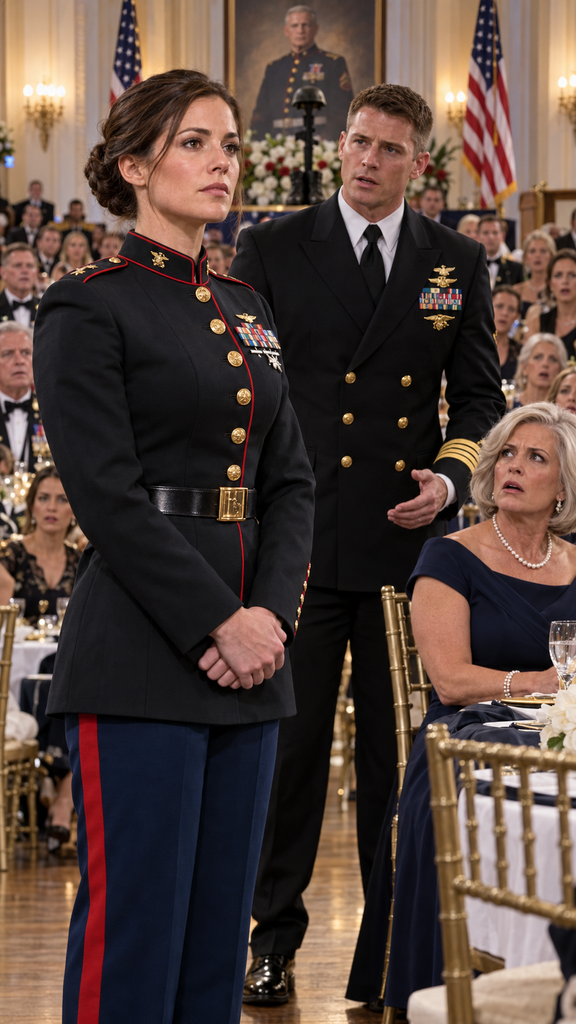
PART 1: THE DAUGHTER WHO BROUGHT HER SHAME
My mother stood in front of nearly two hundred people at the Central Florida Veterans Hall and said, “Everything that girl has ever done has brought me nothing but shame and disappointment.”
She was talking about me.
I stood in the center aisle in my Marine Corps dress uniform while relatives, veterans, local business owners, and people I had never met turned in their chairs to stare.
My shoulders stayed straight.
My hands remained relaxed at my sides.
I had learned a long time ago that humiliation only becomes spectacle when you give the audience the reaction they came to see.
My mother, Judith Bennett, had apparently been waiting years for this particular audience.
She stood behind the podium beneath a banner honoring veterans from our county. American flags framed the stage. A row of service photographs stretched across the wall behind her.
My father’s picture was among them.
That was why I had come.
Not for my mother.
Not for Uncle Dean.
Not for Aunt Paula, who was already holding her phone up to record.
Not for my cousin Tyler, sitting at the head table in a suit that couldn’t disguise the smugness on his face.
I had come because they were dedicating a memorial plaque that included my father’s name.
Daniel Bennett.
United States Army.
Vietnam-era service.
My father had been proud of that uniform until the day he died.
He had also been proud of mine.
My mother had spent eleven years pretending otherwise.
“Now,” she continued brightly, “this is a real elite warrior.”
She placed one hand on the shoulder of the man beside her.
Chief Petty Officer Ethan Rourke.
Navy SEAL.
Even from the center aisle, I could read enough of his uniform to know he had spent years doing work most people in that room would never fully understand. The trident over his left breast caught the light. His ribbons told a story of deployments, combat, sacrifice, and time spent in places where nobody took photographs for Facebook.
He had been invited as the evening’s featured speaker.
My mother had met him perhaps twenty minutes earlier.
Apparently, that had been enough time for her to adopt him.
She smiled at him with the kind of pride I couldn’t remember seeing directed at me.
“This,” she said, “is the son I always wished I’d had.”
There were scattered laughs.
Uncle Dean laughed louder than anyone.
I watched Ethan’s expression.
His polite smile stiffened.
My mother mistook that for modesty.
She squeezed his shoulder.
“I mean it,” she said. “A Navy SEAL. A man who actually served his country instead of using the military as an excuse to avoid real life.”
Several people stopped smiling.
Ethan glanced toward me.
My mother followed his gaze and gave a dismissive wave.
“Oh, yes. Caroline technically serves too.”
Technically.
I almost admired the word.
It had taken her years to reduce fifteen years of my life to one syllable of contempt.
Someone at the nearest table shifted uncomfortably.
My mother continued.
“Not everyone who puts on a uniform is a hero. Some people collect a military paycheck for answering phones and scrubbing toilets on a base.”
Uncle Dean raised his bourbon.
“Tell it like it is, Judy.”
Aunt Paula’s phone stayed pointed at me.
And Tyler smiled.
Tyler had spent ten months at a military academy before being dismissed.
My mother still introduced him as someone who “almost chose a military career.”
I had earned a commission.
Completed training.
Deployed.
Promoted.
Spent years in intelligence assignments I could rarely discuss with people outside my work.
Yet in my mother’s version of our family, Tyler remained the promising young man who had simply decided military life wasn’t for him.
I remained the selfish daughter who had abandoned her dying father.
That was the story everyone knew.
And because I had never publicly fought her about it, it had become the truth.
At least to them.
I slipped one hand into my pocket and pressed the side button on my phone.
The recording began.
It wasn’t revenge.
It wasn’t even anger.
It was habit.
Years of intelligence work had taught me that memory changes under pressure.
Evidence doesn’t.
My mother leaned closer to the microphone.
“She always wanted attention. Even as a child.”
That wasn’t true.
But I let her speak.
“She wanted everyone to think she was tougher than she was.”
Also untrue.
I let her continue.
“She couldn’t stand being ordinary.”
That one almost made me smile.
Nobody who knew me professionally would have described my career as a search for attention.
Most of the work I was proudest of had happened in rooms with no windows.
No cameras.
No applause.
Sometimes no names.
Especially no names.
I looked at Ethan again.
His smile had disappeared.
His eyes moved from my collar to my ribbons.
Then higher.
Then back to my face.
I saw the exact moment something changed.
His posture tightened.
His eyes narrowed.
Then they dropped to the name over my chest.
BENNETT.
His face lost color.
My mother didn’t notice.
She was enjoying herself too much.
“She left when her father was sick,” she said.
There it was.
The old knife.
The room grew quieter.
My fingers curled once inside my pocket.
Then relaxed.
My mother had learned years ago that my father’s death was the one subject capable of getting through every layer of discipline I possessed.
“She knew he needed her,” she said. “We all did. But Caroline had more important things to do.”
My throat tightened.
Suddenly, I wasn’t standing inside a veterans hall anymore.
I was twenty-three again.
Back in my parents’ kitchen.
Dad was sitting at the table in an old gray Army T-shirt.
He had lost nearly thirty pounds.
The treatment had made his hands tremble.
I had an unopened envelope in front of me and a decision tearing me apart.
“I can request a deferment,” I told him.
Dad stared at me.
“I can stay.”
“No.”
“Dad—”
“No.”
“You need help.”
“Your mother is here.”
“That isn’t what I mean.”
He knew that.
Of course he knew.
I had spent months driving him to appointments whenever I could. I knew which foods he could keep down after treatment. I knew which nights the pain became worse. I knew the sound he made when he tried to stand without asking for help.
The idea of leaving him felt like betrayal.
“I can do this later,” I said.
Dad’s palm came down on the kitchen table hard enough to make both coffee cups jump.
“You didn’t work this hard to sit beside my bed and watch me get sick.”
I stared at him.
His face softened.
“Caroline.”
I was already crying.
He reached across the table.
“Go do the thing you were built to do.”
My mother had been standing in the hallway.
She heard every word.
I knew because I looked directly at her afterward.
She said nothing.
Dad died while I was away.
And within months of the funeral, my mother’s version of that conversation had changed.
First, she told Aunt Paula that Dad had been disappointed I left.
Then Uncle Dean heard that Dad had wanted me to stay.
By the second anniversary of his death, the story had become that my father had begged me not to leave.
I had corrected her privately.
Once.
She stared at me across her dining room table and said, “Your father isn’t here to defend himself.”
I remember how cold those words made me feel.
Neither of us mentioned that he wasn’t there to defend me either.
After that, I stopped trying.
Much of my early work was classified anyway. I couldn’t explain where I had been or why. I couldn’t describe operations, teams, or decisions.
So I stayed silent.
My mother filled the silence.
For eleven years.
Now she was doing it in front of nearly two hundred people.
“He died without his daughter beside him,” she said.
A few people looked down.
Others looked at me with pity.
I hated the pity more than the judgment.
My mother sighed dramatically.
“And that’s something she’ll have to live with.”
I swallowed.
“Yes,” I said.
The microphone wasn’t near me, but the room had become quiet enough that people heard.
My mother blinked.
I held her gaze.
“That part is true.”
For half a second, something uncertain crossed her face.
Then she recovered.
“But fortunately,” she said, turning back toward Ethan, “there are still people who understand what sacrifice and loyalty actually mean.”
Ethan took one small step away from her.
My mother looked confused.
Then I saw his hands.
They weren’t still anymore.
His complexion had drained beneath his tan.
He was staring at me as though he’d seen a ghost.
My mother laughed uncertainly.
“Chief Rourke?”
He didn’t answer.
Instead, he brought his heels together.
The movement was automatic.
Military.
Respectful.
He faced me.
The entire room seemed to contract around us.
“Ma’am?”
His voice trembled.
That frightened me more than anything my mother had said.
I knew that tone.
It belonged to someone reaching backward through years of memory.
His eyes locked on mine.
“You’re the One-Eighty-Seven?”
A fork hit the floor somewhere near the front table.
My mother laughed.
“What ridiculous number is that supposed to mean?”
Ethan didn’t even look at her.
I did.
And suddenly I knew.
Seven years disappeared.
I saw a dark operations room.
Cold coffee.
Multiple screens.
A road.
A ridge.
A pattern that felt wrong.
Eight men moving toward an ambush they couldn’t see.
I looked back at Ethan.
“Yes,” I said quietly.
“I’m One-Eighty-Seven.”
And the man my mother had just called the son she wished she’d had looked at her and said:
“Ma’am, your daughter saved my life.”
PART 2: THE NUMBER WITHOUT A NAME
Nobody moved.
For several seconds, the only sound in the veterans hall came from the ventilation system above us.
My mother’s hand was still resting against the podium.
Her fingers slowly tightened around its edge.
“What?”
Ethan swallowed.
“Your daughter saved my life.”
My mother stared at him.
Then at me.
Then back at him.
“No.”
It was such a simple answer that for a moment I almost laughed.
Not because anything was funny.
Because it was so perfectly her.
Presented with information she didn’t like, my mother didn’t question it.
She rejected its existence.
Ethan’s expression hardened.
“I was there.”
My mother shook her head.
“You’re confused.”
“No, ma’am.”
“Caroline works intelligence.”
“Yes.”
“She sits behind a desk.”
“Sometimes the person behind the desk is the reason the people outside come home.”
That shut the room up again.
I saw several veterans nod.
My mother didn’t.
She looked at me as though I had arranged the entire thing.
I recognized that expression too.
Suspicion.
“How do you know her?”
Ethan finally looked back at me.
“I didn’t.”
His voice was quieter now.
“Not then.”
He turned toward the audience.
“Seven years ago, my team was operating overseas. Eight of us were moving toward a route we’d been told was clear.”
I felt my pulse in my throat.
I knew how much he could say.
And how much he couldn’t.
He knew too.
So he kept it simple.
“We had multiple sources telling us the same thing. Route safe. No unusual movement. No immediate threat.”
He looked at me.
“Then somebody came over the network and told us to stop.”
My mother frowned.
“Caroline?”
“We didn’t know her name.”
Ethan’s mouth tightened.
“We knew a designation.”
One-Eighty-Seven.
I hadn’t heard anyone say it outside a secure environment in years.
Hearing it there, beneath fluorescent lights while Aunt Paula recorded and Uncle Dean held a glass of bourbon, felt almost obscene.
That number belonged to another world.
A world my family had never known existed.
Seven years earlier, I had been twenty-eight years old and sitting beneath artificial light in an operations center thousands of miles from the men whose lives depended on what we saw.
The road looked ordinary.
That was the problem.
It looked too ordinary.
Traffic patterns had changed.
Vehicles that normally used the route had disappeared.
A communications anomaly had appeared near a ridge.
Then three sources that were supposedly independent delivered almost identical wording about the road being safe.
People think intelligence work is about knowing secrets.
Sometimes it’s about noticing when everyone suddenly agrees too perfectly.
I remember leaning toward the screen.
“Hold them.”
The officer beside me looked over.
“Based on what?”
I pointed.
“Pattern deviation.”
“That’s thin.”
“I know.”
“We have confirmation from three sources.”
“That’s why I don’t like it.”
He stared at me.
I heard the team moving over the network.
Minutes mattered.
Maybe seconds.
“Bennett,” he said, “if you stop this movement, you’re putting your designation on it.”
“I know.”
“If you’re wrong—”
“I know.”
I was terrified.
People imagine courage feels like certainty.
It doesn’t.
Sometimes courage is being afraid you’re wrong and speaking anyway because being silent would be worse.
I keyed the channel.
“Stop movement.”
A voice answered.
“Confirm?”
I looked at the road again.
The empty road.
The quiet ridge.
The perfect reports.
My stomach twisted.
“Confirmed. One-Eighty-Seven. Hold position.”
They stopped.
Four minutes later, surveillance found armed men positioned along the ridge.
Then the explosives.
A layered ambush.
If the team had continued, they would have entered the kill zone almost exactly on schedule.
Eight men.
One road.
Four minutes.
For years afterward, those numbers stayed with me.
I didn’t know their names.
They didn’t know mine.
That was normal.
I went back to work.
They went back to theirs.
Apparently, the story didn’t disappear.
Ethan faced the audience.
“Four minutes after we stopped, we identified the ambush.”
A murmur moved through the hall.
He continued.
“Whoever One-Eighty-Seven was had seen something everyone else missed.”
My mother looked at me.
Not proudly.
Not yet.
She looked frightened.
As if the daughter she had spent years defining had suddenly become a stranger.
Ethan took a breath.
“We talked about that voice for years.”
I wished he wouldn’t.
The attention made my skin crawl.
I had never wanted this.
My mother had dragged me into the center of the room, but I still wanted to disappear from it.
Ethan gave a faint, disbelieving laugh.
“We argued about who One-Eighty-Seven was. Half the guys thought it had to be some old colonel with thirty years of experience.”
A few people chuckled.
“One guy was convinced it was an entire intelligence cell.”
That drew more laughter.
Ethan looked at me.
“None of us imagined Captain Caroline Bennett.”
I managed a small smile.
“I wasn’t a captain then.”
“No, ma’am.”
My mother interrupted.
“So she made one phone call?”
Ethan turned.
I saw something change in his face.
He had been trying to be respectful.
Now he looked angry.
“No.”
My mother flinched.
“No, ma’am. She made a decision. There is a difference.”
“Well, obviously other people were involved.”
“Of course.”
“Then why are you acting like Caroline single-handedly rescued you?”
“I’m not.”
He spoke calmly.
That made it sharper.
“I’m telling you what happened.”
My mother looked around the room.
She was losing control of it.
That mattered to her.
Maybe more than truth ever had.
She gave a brittle laugh.
“Well, I’m sure Caroline is happy this little coincidence happened tonight.”
There it was.
The escape route.
Make it manipulation.
Make it attention seeking.
Make me responsible for her embarrassment.
“I didn’t know Chief Rourke would be here,” I said.
She ignored me.
“You never told us any of this.”
“I couldn’t.”
“Oh, please.”
“I couldn’t.”
“You expect me to believe you spent all these years doing secret heroic things?”
“No.”
That finally made her look at me.
I took my phone from my pocket but kept the recording running.
“I expect you to believe I served.”
Her face changed.
Just slightly.
Because that was the real wound.
Not that she hadn’t known about One-Eighty-Seven.
Not that she didn’t understand intelligence work.
It was that she had never needed facts in order to condemn me.
I stepped closer to the stage.
“I never asked you to call me a hero.”
“Caroline—”
“I never asked you to understand classified work.”
“Don’t start.”
“I asked you not to lie about Dad.”
The room went silent again.
This silence was different.
Ethan stepped back.
He understood immediately that whatever happened next had nothing to do with him.
My mother stared at me.
Her face hardened.
“I have never lied about your father.”
“Yes, you have.”
Aunt Paula lowered her phone a few inches.
Uncle Dean put his glass down.
My cousin Tyler looked at the table.
My mother whispered, “Don’t you dare.”
I climbed the three steps onto the stage.
I stopped several feet from her.
For eleven years, I had imagined confronting her.
Sometimes I screamed.
Sometimes she apologized.
Sometimes Dad was somehow there to settle it.
Reality was quieter.
“I offered to stay.”
My mother’s face went white.
“I told Dad I’d request a deferment.”
“That’s not what happened.”
“You were in the hallway.”
“Caroline.”
“You heard him tell me to go.”
“Stop.”
“You heard every word.”
Her mouth opened.
Nothing came out.
And in that hesitation, I saw something I had never seen before.
Not grief.
Not anger.
Fear.
She remembered.
Of course she remembered.
That had always been the worst part.
She hadn’t misunderstood.
She had chosen a different story.
“Dad told me I didn’t work that hard to sit beside his bed and watch him get sick.”
My voice cracked.
I hated that.
But I kept going.
“He told me to go do the thing I was built to do.”
My mother stared at me.
“He was sick.”
“I know.”
“He needed you.”
“I know.”
“I was alone.”
That stopped me.
For the first time that night, my anger shifted.
Not disappeared.
Shifted.
Because beneath all the cruelty, there it was.
The thing she had never said.
I was alone.
Not Dad.
Her.
“You wanted me to stay for you,” I said.
Her eyes filled.
“I needed help.”
“Then you should have said that.”
“I shouldn’t have had to!”
Her voice cracked across the hall.
People looked away.
Suddenly, the polished woman behind the podium was gone.
My mother stood there breathing hard.
“I was watching my husband die.”
“So was I.”
“You left.”
“Because he told me to.”
“And I stayed!”
Her words echoed.
There it was.
The truth.
Not all of it.
But enough.
My mother hadn’t spent eleven years punishing me because Dad believed I betrayed him.
She had spent eleven years punishing me because she believed I had escaped something she had been forced to endure.
I looked at her and felt something inside me finally settle.
Understanding wasn’t forgiveness.
But at least the lie had a shape now.
“You stayed,” I said. “And that was hard. And unfair. And lonely.”
Her chin trembled.
“But you don’t get to turn your pain into Dad’s words.”
She looked at me.
“You don’t get to make him accuse me from the grave.”
PART 3: THE STORY SHE BUILT AFTER DAD DIED
My mother left the stage.
Not dramatically.
She simply walked away.
For Judith Bennett, that was more shocking than if she’d thrown something.
She never abandoned a room while she still believed she could control it.
A side door closed behind her.
For several seconds, nobody seemed to know what to do.
Then Ethan stepped toward the microphone.
“This event is supposed to honor service,” he said.
His voice was steady again.
“And service doesn’t always look the way civilians expect it to look.”
I wished he would stop.
Not because he was wrong.
Because I didn’t want my mother’s humiliation replaced with my glorification.
I had seen too many people become myths in other people’s mouths.
My mother had spent years turning me into a villain.
I didn’t need Ethan turning me into a legend.
I walked over and touched his arm.
“Chief.”
He looked at me.
“That’s enough.”
He understood.
He nodded.
“Yes, ma’am.”
I took the microphone.
Nearly two hundred faces looked back at me.
I wanted to be anywhere else.
“My father would hate this.”
A few nervous laughs.
I looked toward his photograph on the wall.
“He hated long speeches.”
That got a little more laughter.
“He also hated people making a fuss over him.”
I paused.
“I think that’s the part of him I inherited.”
My voice steadied.
“I didn’t come here tonight to embarrass my mother. I didn’t know Chief Rourke and I had ever crossed paths professionally. I came because my father’s name is on that wall.”
I looked at his photograph.
“He served. He believed service mattered. He also believed it could take different forms.”
Then I looked toward the door my mother had used.
“My family has heard a version of what happened before my father died for many years. I stayed quiet because I didn’t want to fight about a dead man. That was a mistake.”
Nobody moved.
“Silence doesn’t always keep peace.”
I thought about the operations rooms.
The reports.
The times I had watched bad information become accepted simply because nobody challenged it early enough.
“Sometimes silence just gives the wrong story room to grow.”
I handed the microphone back.
That was all I wanted to say.
The applause started somewhere near the rear.
Then another table joined.
I didn’t enjoy it.
I didn’t hate it either.
I simply stood there and let it happen.
Afterward, people approached me.
Veterans shook my hand.
A retired Army colonel told me intelligence people never got enough credit.
A woman whose husband had served overseas hugged me without asking.
Uncle Dean did not come near me.
Aunt Paula had stopped recording.
Tyler disappeared.
Ethan waited until the crowd thinned.
Then he approached.
Up close, he looked older than I’d first realized.
Not old.
Just worn around the edges in the way people become when they’ve spent too many years carrying memories they don’t discuss at dinner.
“Captain.”
“Chief.”
He smiled.
“Caroline?”
I hesitated.
Then nodded.
“Ethan.”
He let out a breath.
“I can’t believe it’s you.”
“You already said that.”
“I’m probably going to say it about fifty more times.”
Despite everything, I laughed.
It surprised me.
His expression softened.
“Thank you.”
I shook my head.
“Don’t.”
“I have to.”
“No, you don’t.”
“Captain—”
“Ethan, I did my job.”
“So did we.”
“Exactly.”
He looked down for a second.
“Two of the guys from that team have kids now.”
I said nothing.
“One has three.”
My chest tightened.
“He named the youngest Daniel.”
I almost smiled at the coincidence.
Ethan continued.
“Another one got married last year. I was best man.”
He looked at me.
“You say you did your job. Fine. But there are whole lives that happened because you did it well.”
I didn’t know what to say to that.
People think those of us who work at a distance don’t carry the consequences.
We do.
Sometimes more than anyone realizes.
A bad decision can kill someone you’ve never met.
A good decision can save someone whose face you’ll never see.
You learn to live without closure.
Maybe that was why hearing Ethan talk about marriages and children hit harder than medals ever could.
“I’m glad,” I said.
It was all I trusted myself to say.
He nodded.
Then glanced toward the side door.
“You okay?”
“No.”
He gave me an understanding smile.
“Fair.”
“I will be.”
That was also true.
Outside, the Florida night was warm and heavy.
I found my mother near the far end of the parking lot.
She was standing beside her car.
For a moment, I considered leaving.
Then she spoke.
“Did you plan that?”
I stopped.
“No.”
“You expect me to believe—”
“Yes.”
She folded her arms.
“You humiliated me.”
I stared at her.
The old Caroline might have apologized.
The daughter who still believed peace was something she could purchase by accepting blame would have said, I’m sorry it happened like that.
I wasn’t that woman anymore.
“You humiliated yourself.”
Her face tightened.
“There were two hundred people in there.”
“I know.”
“My friends.”
“I know.”
“My family.”
“They’re my family too.”
She looked away.
“You could have stopped him.”
“I did.”
“Not soon enough.”
I almost laughed.
“Mom, you were standing on a stage telling strangers I scrub toilets for a paycheck.”
“I was angry.”
“You called another man the son you wished you’d had.”
Her lips pressed together.
“That was cruel.”
“Yes.”
At least she didn’t deny it.
We stood in silence.
Then she said, “I didn’t know what you did.”
“You didn’t ask.”
“You never told me.”
“I told you what I was allowed to tell you.”
“You always acted like everything was classified.”
“Not everything was.”
“Then why didn’t you explain?”
I looked at her.
“Would you have believed me?”
She didn’t answer.
That answer was enough.
I took out my phone.
Her eyes dropped to it.
“What are you doing?”
“I recorded your speech.”
Her face changed.
“You what?”
“I started recording when you began talking about me.”
“Delete it.”
“No.”
“Caroline.”
“No.”
“You cannot record me without—”
“It was a public event, Mom.”
“Delete it.”
“I won’t post it.”
She stopped.
I slipped the phone back into my pocket.
“But I’m keeping it.”
“Why?”
“Because tomorrow you’re going to remember tonight differently.”
Her mouth opened.
I continued.
“You’ll say you never called me a freeloader. You’ll say you didn’t mention Dad. You’ll say Ethan misunderstood. You’ll say I attacked you.”
“I would not.”
“You already changed one story after Dad died.”
That landed.
She turned away.
I didn’t feel triumphant.
That surprised me.
For years, I had imagined what it would feel like to finally say those things.
I thought there would be satisfaction.
There wasn’t.
Only exhaustion.
My mother opened her car door.
Then stopped.
“Your father was proud of you.”
I couldn’t breathe for a second.
She still didn’t look at me.
“What?”
“He was proud of you.”
My eyes burned.
“Then why did you spend eleven years telling everyone he wasn’t?”
Her shoulders dropped.
And for the first time in my life, my mother looked small.
“Because he made it easy for you to leave.”
I stared at her.
She wiped her face angrily.
“He gave you permission. He made you feel brave and important, and then you left.”
“I didn’t want to leave.”
“You still did.”
“Yes.”
“And I stayed.”
Again.
That sentence.
The center of everything.
“I stayed for every appointment. Every bad night. Every time he couldn’t eat. Every time he was afraid.”
Her voice shook.
“And when he died, everyone told me how strong I had been. Do you know what that means?”
I said nothing.
“It means nobody asks whether you wanted to be strong.”
For one dangerous second, I felt twenty-three again.
Guilty.
Ready to apologize for having a life outside her grief.
Then I remembered Dad’s hand striking the kitchen table.
Go do the thing you were built to do.
“I am sorry you went through that,” I said.
She looked at me hopefully.
“But I am not sorry I obeyed Dad.”
Her face closed.
“I can’t give you that.”
The hope vanished.
I stepped back.
“And I won’t carry your anger for you anymore.”
I walked away.
She didn’t call me back.
PART 4: THE PEOPLE WHO CAME HOME
The video spread anyway.
Not from me.
Aunt Paula had recorded almost the entire thing.
By the next afternoon, half the family had seen it.
By Monday, people from the veterans organization had seen it.
I received messages from relatives who had barely spoken to me in years.
Some apologized.
Some asked questions.
Some wanted details I couldn’t give.
Uncle Dean sent one sentence.
Didn’t know the whole story.
I stared at it for several seconds.
Then deleted it.
Not because I hated him.
Because I no longer felt responsible for helping grown adults feel better about believing the worst of me without asking.
Tyler surprised me.
He called.
I almost didn’t answer.
“Hey,” he said.
“Hey.”
There was a long pause.
Then he said, “I’m sorry.”
I sat down.
“For what?”
“For laughing.”
That, at least, was specific.
“I shouldn’t have.”
“No.”
Another pause.
“Grandma always talked about you like…”
He stopped.
“Like what?”
“Like you thought you were better than everyone.”
I closed my eyes.
“I don’t.”
“I know.”
“How?”
“I watched you that night.”
I said nothing.
“You could’ve destroyed her.”
His voice was quiet.
“You didn’t.”
I leaned back.
“She’s still my mother.”
“Yeah.”
Tyler hesitated.
“Did Grandpa really tell you to go?”
“Yes.”
“Why didn’t you tell us?”
“I did. Years ago.”
“No, I mean all of us.”
That question stayed with me.
Why hadn’t I?
Partly because of classified work.
Partly because grief made every conversation feel like walking through broken glass.
But mostly because I had believed truth should defend itself.
It doesn’t.
Truth needs witnesses.
It needs people willing to say it out loud.
“I thought fighting about it would make things worse,” I told him.
“Did it?”
“No.”
I looked out the window.
“Staying quiet did.”
Three days later, Ethan called.
He had gotten my number through the veterans organization after asking permission.
“I have a weird question,” he said.
“I’ve heard worse.”
“Would you be willing to talk to some people?”
My stomach tightened.
“What people?”
“The team.”
I didn’t answer.
“The guys who were there.”
I stood and walked to the window.
“You told them?”
“I told them I met One-Eighty-Seven.”
I closed my eyes.
“What did they say?”
He laughed.
“You want the clean version?”
“Please.”
“They said I was full of it.”
I smiled.
“That sounds about right.”
“One of them wants photographic evidence.”
“No.”
“I told him you’d say that.”
I hesitated.
“Ethan, I don’t want some big reunion.”
“No big reunion.”
“No speeches.”
“No speeches.”
“No medals.”
“Definitely no medals.”
“No calling me a hero.”
He paused.
“That one’s going to be harder.”
“Ethan.”
“Fine.”
I could hear the smile in his voice.
“Just a call.”
I agreed.
The following Sunday, I sat at my kitchen table with a cup of coffee growing cold beside me and listened as seven voices joined a secure conference call.
Seven.
Not eight.
I noticed immediately.
I didn’t ask.
Maybe I didn’t want to know.
Ethan introduced me simply.
“Guys, this is Caroline Bennett.”
Silence.
Then somebody said, “No way.”
Another voice laughed.
“Rourke, I knew you were lying.”
“I’m not lying.”
A third voice said, “You’re One-Eighty-Seven?”
“Yes.”
“How old are you?”
I laughed.
“Old enough.”
“No, seriously.”
“Don’t answer him,” Ethan said. “He’s an idiot.”
The tension broke.
They started talking.
Not about the ambush at first.
About stupid things.
Someone complained Ethan still owed him fifty dollars.
Someone else insisted the designation had belonged to a sixty-year-old man named Frank.
Then one of them said, “You sounded terrifying.”
“I was terrified.”
Silence.
“What?”
“I was scared I was wrong.”
Another silence.
I leaned toward the phone.
“I know that’s probably not the version you imagined. I didn’t have some magical certainty. I saw something that didn’t fit. That’s all.”
A man named Mason spoke.
“You sounded sure.”
“I needed you to stop.”
“So you faked it?”
“No.”
I thought about that night.
“I made the decision before I had enough evidence to feel comfortable with it.”
Mason laughed softly.
“That’s one way to describe saving our asses.”
Then another voice spoke.
Older.
Quieter.
“My daughter graduates high school next month.”
Nobody interrupted him.
“She wasn’t born yet when that happened.”
My throat tightened.
“If we’d kept moving…”
He stopped.
I stared at the coffee cup.
“I know.”
“No.”
His voice broke.
“I don’t think you do.”
I closed my eyes.
He told me about his daughter.
Then another man told me about his wife.
Another mentioned his son.
Ethan had been right.
Whole lives had happened.
Birthdays.
Marriages.
Arguments.
Christmas mornings.
Broken arms.
Soccer games.
Divorces.
Reconciliations.
First words.
Graduations.
Ordinary things.
Beautiful things.
Things nobody puts on medals.
When the call ended, I stayed at the table for a long time.
Then I cried.
Not the controlled tears I’d allowed myself after Dad died.
Not the silent tears I wiped away in bathrooms and airport terminals.
I cried until my chest hurt.
Because for years my mother had reduced my leaving to one thing.
Abandonment.
And I had allowed part of myself to believe her.
Even when I knew Dad had sent me.
Even when I knew I had served honorably.
Some hidden part of me had kept asking whether I should have stayed.
Now seven voices had answered from the other side of that decision.
I had left one dying man because he told me to go.
And years later, because I went, other fathers came home.
That didn’t make Dad’s death hurt less.
It didn’t make my mother’s loneliness meaningless.
It didn’t transform sacrifice into some clean equation where one life balanced another.
Life wasn’t that simple.
But for the first time, I understood what Dad had seen in that kitchen.
He hadn’t sent me away because he didn’t need me.
He sent me because he knew I needed permission to become myself.
Two weeks later, a package arrived.
No return address I recognized.
Inside was a small wooden box.
Seven challenge coins rested in black felt.
Beneath them was a folded piece of paper.
There were no names.
Just one sentence.
For the voice that told us to stop.
I sat on the floor with the box in my hands.
Then I laughed through my tears.
“Dad,” I whispered.
“You stubborn old man.”
PART 5: WHAT MY FATHER ACTUALLY SAID
My mother didn’t contact me for six weeks.
I didn’t contact her either.
That was new.
Usually, after every fight, I was the one who repaired the bridge.
Sometimes I apologized for my tone when my words had been accurate.
Sometimes I pretended nothing had happened.
Sometimes I called because the silence made me uncomfortable.
This time, I let the silence belong to both of us.
Then, one Saturday morning, she sent me a message.
I found something.
That was all.
An hour later, another message appeared.
It belongs to you.
I considered ignoring it.
Instead, I drove to her house.
The place looked almost exactly as it had when Dad was alive.
Same oak tree.
Same white porch railing.
Same brass numbers beside the door.
My mother opened it before I knocked.
She looked tired.
“Come in.”
I followed her to the kitchen.
That kitchen.
For a moment, I saw Dad sitting at the table again.
Gray shirt.
Thin wrists.
Coffee.
Go do the thing you were built to do.
My mother placed a shoebox on the table.
“I’ve been going through his things.”
I stared at it.
“You’ve had eleven years.”
“I know.”
She sat down.
I remained standing.
“There were some things I couldn’t touch.”
I understood that better than I wanted to.
She pushed the box toward me.
Inside were photographs, old receipts, Army papers, birthday cards, and envelopes.
Near the bottom was a yellow legal pad.
Dad’s handwriting covered several pages.
He had always written in blocky capital letters.
Lists.
Appointments.
Questions for doctors.
Things to fix around the house.
Then I saw my name.
CAROLINE LEAVES THURSDAY.
I sat down.
Underneath it, Dad had written:
MAKE SURE SHE GOES.
My vision blurred.
I touched the words.
There was more.
SHE’LL TRY TO STAY IF I GET WORSE.
DON’T LET HER.
I stopped breathing.
My mother looked down.
I turned the page.
Another note.
CAROLINE CALLED 2100.
SOUNDED TIRED.
TOLD HER I’M FINE.
I remembered that call.
He had lied.
He hadn’t been fine.
Another page.
JUDY ANGRY SHE LEFT.
TOLD HER THIS WAS MY DECISION TOO.
My hand began to shake.
I looked at my mother.
She was crying silently.
“You knew.”
“Yes.”
The word was almost inaudible.
“You knew.”
“Yes.”
“Every time you told them I abandoned him…”
“I knew.”
I stood so quickly the chair scraped across the floor.
She flinched.
For eleven years, I had wondered whether grief had distorted her memory.
Whether she had honestly convinced herself of the story she told.
Now the question was gone.
“You lied.”
“Yes.”
“Why?”
She covered her mouth.
“Why?”
“Because I was angry.”
“At me?”
“At everyone!”
Her voice broke.
“At him. At you. At God. At every doctor who told us to wait. At people who brought casseroles and said they were praying for us. At your father for dying.”
She wiped her face.
“And you were alive.”
I stared at her.
“You were alive, Caroline. You were somewhere else doing something important. Every time you called, he lit up. Even when he could barely get out of bed, he wanted to know what you were doing.”
Her voice became bitter.
“He was proud of you.”
I looked at the legal pad.
“I know.”
“And I hated it.”
That admission seemed to cost her something.
“I hated that he could be proud of you while I was cleaning up after him and helping him walk to the bathroom and pretending I wasn’t terrified.”
I sat again.
She looked at me.
“I wanted you to feel what I felt.”
The words were ugly.
But they were finally true.
“So you told everyone I abandoned him.”
“Yes.”
“You wanted them angry at me.”
“Yes.”
“You wanted me guilty.”
Her eyes dropped.
“Yes.”
I felt strangely calm.
Maybe because I had waited eleven years for the truth.
Maybe because there was nothing left to argue about.
“Thank you.”
She looked up sharply.
“For what?”
“For finally saying it.”
Her face crumpled.
“Caroline, I’m sorry.”
I had imagined those words so many times.
In some versions, they fixed everything.
They didn’t.
I loved my mother.
That was the difficult truth.
Love doesn’t disappear just because someone hurts you.
Sometimes that would be easier.
I loved her.
I also didn’t trust her.
Both things could exist at once.
“I believe you’re sorry.”
Hope flickered across her face.
“But that doesn’t erase eleven years.”
“I know.”
“I don’t think you do.”
She nodded slowly.
“Maybe I don’t.”
I closed the box.
“I need time.”
She looked at my uniform photograph on the refrigerator.
It was old.
I hadn’t noticed it when I came in.
Me as a young second lieutenant.
Dad had put it there.
Apparently, she had never taken it down.
“Are you ever going to forgive me?”
I thought about the question.
“I don’t know.”
Her eyes filled again.
I could have lied.
I didn’t.
“But this is the first conversation we’ve had where forgiveness is even possible.”
She nodded.
That was enough.
I picked up Dad’s box.
At the door, she called my name.
I turned.
She stood in the hallway.
“I was wrong about one more thing.”
“What?”
She struggled to say it.
Then she did.
“You didn’t abandon him.”
My throat tightened.
“No.”
“He sent you.”
“Yes.”
She nodded.
“And he was proud of you.”
I looked at her for a long moment.
“I know.”
Then I left.
Outside, the Florida sun was bright enough to hurt my eyes.
I carried Dad’s box to my car.
Before getting in, I opened it again.
I found the legal pad.
MAKE SURE SHE GOES.
I laughed.
Then I cried.
Then I did both at the same time.
Because that was Dad.
Even while dying, he had apparently been planning around my stubbornness.
I pressed my fingers against his handwriting.
For eleven years, I had allowed my mother’s voice to compete with my memory.
Now I finally understood something I should have understood from the beginning.
The loudest person in a family doesn’t get to decide what happened.
PART 6: ONE-EIGHTY-SEVEN
A year after that night at the veterans hall, I returned.
I almost didn’t.
The organization had invited me to speak at the annual event.
I refused twice.
Ethan called after my second refusal.
“Do it.”
“No.”
“Excellent argument. Do it.”
“I don’t give speeches.”
“You stood in front of two hundred people while your mother publicly executed your childhood and barely blinked.”
“That wasn’t a speech.”
“Fine. Consider this revenge.”
“Absolutely not.”
He laughed.
“Then consider it finishing the story.”
That stayed with me.
Finishing the story.
Not changing it.
Not replacing my mother’s lie with a prettier lie.
Finishing it.
So I agreed.
When I entered the hall, I wore my uniform.
Not because I needed anyone’s approval.
Because Dad would have liked it.
His photograph still hung on the wall.
I stopped in front of it before taking my seat.
“You caused a lot of trouble, old man,” I whispered.
“Still blaming dead people?”
I turned.
My mother stood behind me.
For a second, neither of us spoke.
We weren’t healed.
Real relationships rarely repair themselves as neatly as stories do.
We had spent the previous year learning how to speak without reopening every wound.
Some weeks were better than others.
She had apologized to relatives individually.
Not because I demanded it.
Because I told her that if she wanted to repair what she’d done, she needed to correct the lie in the same places she’d spread it.
She did.
Uncle Dean apologized properly.
Aunt Paula deleted the video after I asked her to.
Tyler and I spoke more often.
My mother started seeing a grief counselor.
I didn’t ask what they discussed.
Some things belonged to her.
That was another lesson I had learned.
Boundaries weren’t punishment.
They were structure.
“You came,” I said.
Mom nodded.
“You invited me.”
“I wasn’t sure you would.”
“I almost didn’t.”
Fair enough.
We stood beside Dad’s photograph.
“He’d be unbearable tonight,” she said.
I smiled.
“Completely.”
“He’d tell everyone you got your brains from him.”
“He already did.”
She laughed softly.
Then her eyes filled.
“I’m proud of you.”
A year earlier, those words would have broken something open inside me.
Now they landed differently.
Warmly.
But not desperately.
I no longer needed them in order to believe in myself.
That mattered.
“Thank you,” I said.
The program began.
Ethan was there.
So were three men from the team.
The others couldn’t attend.
I knew their names now.
I knew their families.
One of them had sent me a photograph of his daughter’s graduation.
Another sent a Christmas card.
The mythology of One-Eighty-Seven had disappeared.
I was glad.
My designation had been a mystery.
I was just a person.
That felt better.
When my name was called, I walked to the podium.
The room applauded.
I waited.
Then I looked at my father’s photograph.
“My mother once stood at this podium and told a room full of people that I had disappointed my family.”
A few people shifted.
Mom remained still.
I continued.
“She was wrong.”
My mother’s eyes met mine.
“But the most important thing I learned afterward wasn’t that she was wrong.”
I looked around the hall.
“It was how easily a story can become truth when the person being described decides silence is easier than conflict.”
The room was quiet.
“I work in a profession where information matters. Context matters. Contradictions matter. And yet, in my own life, I ignored all of those things.”
I smiled slightly.
“Apparently professional training has limits.”
A few people laughed.
“My father was sick when I left for military service. That is true.”
I paused.
“I wanted to stay.”
My mother lowered her eyes.
“He ordered me to go.”
More laughter.
“That is also true.”
I reached into my pocket.
Not for my phone this time.
For one of the seven challenge coins.
I held it between my fingers.
“Years later, I happened to be in a position where I saw something that didn’t make sense. Eight men were moving toward a road. The information said they were safe. The pattern said otherwise.”
Ethan watched me from the front table.
“I told them to stop.”
I looked at the coin.
“That’s the part people like to tell because it sounds dramatic.”
I set the coin on the podium.
“But the part that matters to me happened afterward.”
I looked toward Ethan.
“They went home.”
He nodded.
“They lived ordinary lives.”
My voice tightened.
“They got married. Raised children. Argued with their spouses. Attended graduations. Complained about mortgages. Burned dinner. Changed diapers. Got older.”
A few people smiled.
“Those ordinary things are what service protects.”
I looked back at Dad.
“And sometimes the people who love us make sacrifices that don’t look heroic either.”
My mother started crying.
I let myself look at her.
“My father gave up something too. He gave up having his daughter beside him during the last months of his life because he believed my future mattered.”
My voice nearly failed.
I waited.
Then continued.
“For years, I felt guilty for accepting that gift.”
I touched the edge of the podium.
“I don’t anymore.”
Silence.
Not uncomfortable silence.
Listening silence.
“I miss him.”
My eyes burned.
“I wish I’d had one more day. One more conversation. One more cup of terrible coffee at that kitchen table.”
A few people laughed softly.
“But honoring someone’s sacrifice doesn’t mean undoing the choice they made for you.”
I looked at my mother.
“Sometimes it means living fully enough that the sacrifice meant something.”
She covered her mouth.
I stepped away from the microphone.
Then Ethan stood.
He didn’t clap immediately.
Instead, he came to attention.
For a terrifying second, I thought he was about to recreate the moment from the year before.
“Don’t you dare,” I whispered.
He grinned.
Then he saluted.
The three men beside him stood and did the same.
I stared at them.
This time, I didn’t feel embarrassed.
I didn’t feel like an impostor.
I didn’t feel like the selfish daughter my mother had spent years describing.
I raised my hand and returned the salute.
Then the room applauded.
Later, after almost everyone had gone, I stood beneath Dad’s photograph with my mother.
Ethan approached.
“Mrs. Bennett.”
Mom looked at him.
For one second, I remembered her hand on his shoulder.
The son I always wished I’d had.
Her face reddened.
“I owe you an apology too,” she said.
Ethan blinked.
“Me?”
“I used you to hurt my daughter.”
He considered that.
“Yes, ma’am.”
I almost choked.
Mom stared at him.
Then Ethan smiled.
“But I’m pretty difficult to offend.”
She laughed.
He glanced at me.
“And for what it’s worth, ma’am, I think you got the better deal.”
Mom’s eyes filled.
I groaned.
“Ethan.”
“What?”
“Don’t.”
He lifted both hands.
“I’m leaving.”
He walked away laughing.
Mom watched him go.
Then she looked at me.
“A year ago I called him the son I wished I’d had.”
“I remember.”
“I imagine you do.”
“I have a recording.”
She gave me a look.
Then, unexpectedly, we both laughed.
Not because it hadn’t hurt.
Not because everything was fixed.
Because for once the memory belonged to both of us exactly as it had happened.
No rewritten version.
No convenient lie.
No dead man forced to speak words he’d never said.
Just the truth.
Mom reached toward my arm, then stopped.
That small hesitation meant more to me than people might understand.
A year earlier, she would have grabbed me because she was my mother and believed that gave her the right.
Now she waited.
I closed the distance and hugged her.
She held me carefully.
“I’m sorry,” she whispered.
“I know.”
“I love you.”
“I love you too.”
Neither sentence erased anything.
They didn’t need to.
When we separated, I looked at Dad’s photograph one last time.
I remembered that kitchen.
His thin face.
His trembling hands.
His palm hitting the table.
Go do the thing you were built to do.
For years, I thought those words were permission to leave him.
I finally understood they were something else.
They were permission to become myself.
Outside, Ethan and the others were waiting in the parking lot.
My mother walked beside me.
At the doors, she stopped.
“Caroline?”
“Yeah?”
She looked at the captain’s bars on my uniform.
Then at the name above my chest.
BENNETT.
Her eyes lingered there.
For once, our family name didn’t feel like a burden I was carrying for everyone else.
It was Dad’s.
It was hers.
It was mine.
Mom smiled.
“Your father would’ve been very proud of you tonight.”
I looked through the glass doors at Ethan and the men who had once known me only as a number.
Seven years earlier, I had been a frightened young officer in a cold room telling strangers not to take one more step.
I hadn’t known their names.
I hadn’t known whether I was right.
I hadn’t known that years later, one of those men would stand beside my mother while she tried to humiliate me.
I hadn’t known he would recognize me.
I hadn’t known that the worst public moment of my life would finally force an eleven-year-old lie into the light.
Life doesn’t usually give us justice in the shape we expect.
Sometimes there is no revenge.
No perfect apology.
No moment where every person who doubted you suddenly understands everything.
Sometimes justice is smaller.
A lie finally being called a lie.
A dead man’s real words being remembered.
A mother admitting what grief turned her into.
A daughter deciding she will no longer carry guilt that was never hers.
And seven men getting to go home.
I looked at my mother.
“I know,” I said.
Then I opened the door and walked outside.
Ethan called from across the parking lot.
“One-Eighty-Seven!”
I stopped.
For years, that number had belonged to a faceless voice in a dark room.
For my family, I had been something else entirely.
The disappointment.
The selfish daughter.
The girl who left.
Neither version was really me.
I was Caroline Bennett.
A daughter who had loved her father enough to want to stay.
A Marine who had respected him enough to go.
An officer who had once looked at a road thousands of miles away and realized something wasn’t right.
A woman who had finally learned that silence and peace were not the same thing.
I turned toward Ethan.
He grinned.
“You coming, Captain?”
I looked once over my shoulder.
My mother stood in the doorway.
This time there was no shame on her face.
Only pride.
It had taken me years to understand that I didn’t need it.
But I was glad to see it anyway.
I smiled.
Then I walked toward the men who had come home.
Leave a Reply