
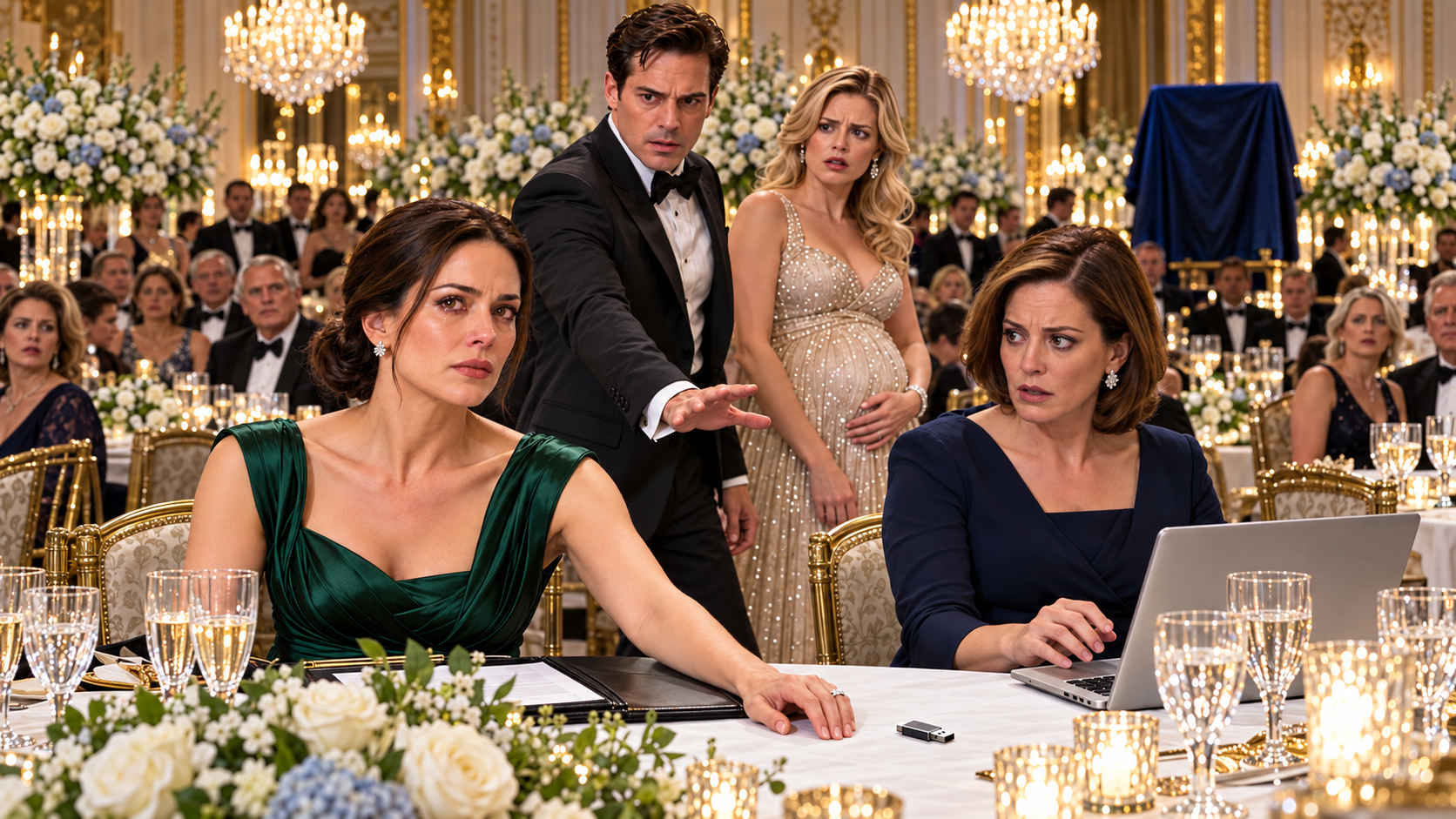

My Husband Brought His Pregnant Mistress to My Mother’s Memorial Dinner. He Didn’t Know I Had Already Read the Fine Print.
PART 1: THE CHAIR THAT WAS MINE
His pregnant mistress asked for my seat at my mother’s naming-rights dinner, and my husband told me not to be bitter.
Before the night ended, the entire ballroom would understand why Graham Caldwell had made the worst mistake of his life.
But the chair was only the beginning.
Because the secret inside my folder was far more dangerous than anyone knew.
My name is Vivienne Hart Caldwell, and the day Graham underestimated me was the day he destroyed himself.
The ballroom went silent when Sienna Vale placed one manicured hand over her pregnant stomach and looked at me as if I were the one who did not belong there.
Not at my family’s dinner.
Not beneath my mother’s name.
Not at the table my trust had paid for.
She stood beside my chair in a pale champagne gown that had been chosen very carefully. Nothing too bridal. Nothing too bright. Nothing that would look cruel in photographs.
Just soft enough to make her look vulnerable.
Just fitted enough to make her pregnancy impossible to ignore.
She smiled.
It was the kind of smile women use when they have already rehearsed being the victim.
“I think it would be better for the optics,” she said.
I looked at her.
Then at Graham.
My husband stood beside her in his black tuxedo, one hand resting low on her back.
He did not remove it.
He did not apologize.
He did not look embarrassed that his mistress was six months pregnant and standing before two hundred donors, hospital executives, trustees, journalists, and nearly every person who had ever pretended to respect our marriage.
He looked irritated.
As if my humiliation had arrived at an inconvenient time.
“It’s just one seat, Vivienne,” he said.
His voice was quiet.
Careful.
Almost reasonable.
“Don’t be bitter tonight.”
Bitter.
That was the word he chose.
Not betrayed.
Not devastated.
Not furious.
Bitter.
His pregnant mistress had arrived at the Hart Family Trust’s naming-rights dinner and asked me to surrender the center chair reserved for the trust’s principal representative, and somehow my reaction was supposed to be the embarrassing part.
I glanced at the place card in front of me.
VIVIENNE HART CALDWELL.
Beside it sat Aunt Eloise’s name.
On my other side stood the empty chair reserved for Claire Donnelly, the hospital foundation director, who would join us after the opening remarks.
Behind us, near the stage, a midnight-blue cloth covered the bronze plaque everyone had come to see.
My mother’s plaque.
Evelyn Hart’s name had been promised that wall before she died.
Not because she wanted vanity.
Because she had spent the last years of her life building a maternal recovery program after watching me lose two pregnancies in rooms that treated grief like an administrative inconvenience.
My mother had sat beside me after the second miscarriage while I stared at a hospital ceiling and apologized for failing.
She had taken my face in both hands.
“You did not fail,” she told me.
Years later, those words would still be the most merciful thing anyone had ever said to me.
Graham had been in the room that day too.
He had cried against my shoulder.
He had promised me that our marriage was bigger than children.
Apparently, promises expired.
Sienna touched the back of my chair.
“Graham explained that this evening is supposed to represent the future of the family.”
I stared at her hand.
Diamonds at her wrist.
My husband had excellent taste when he was spending money on apologies.
“I wasn’t aware you were on the planning committee,” I said.
Her smile tightened.
“I’m not.”
“Then Graham explained incorrectly.”
His jaw shifted.
“Vivienne.”
There it was.
The warning.
The tone husbands use when they have spent years believing a wife’s dignity is another household object they can move around when guests arrive.
Sienna tilted her head.
“I’m not trying to disrespect anyone.”
A woman at table four looked down at her plate.
The mayor’s wife lifted her champagne and did not drink.
Someone near the hospital board table suddenly found his napkin fascinating.
No one defended me.
That is the thing about expensive rooms.
They rarely gasp.
They calculate.
Who has more money?
Who will still matter tomorrow?
Whose side will be safer when the story becomes public?
Sienna lowered her voice.
“Babies are the future.”
Then she looked directly into my eyes.
“Wives are the past.”
A fork stopped against porcelain.
That sound was louder than it should have been.
Graham squeezed Sienna’s waist.
Not to stop her.
To reassure her.
I looked down at the black leather folder in front of me.
Inside it was the donor agreement Graham had signed without properly reading.
Inside my clutch was my wedding ring.
And beneath my plate was something Graham would have paid almost anything to destroy.
But I did not reach for any of them.
Not yet.
Dignity, my mother once told me, is timing.
People misunderstand dignity. They think it means silence.
Sometimes it does.
Sometimes silence is merely the space you give someone to finish ruining himself.
So I smiled.
“The future can start after the DNA test,” I said.
Sienna’s face changed.
Only for a second.
But I saw it.
The color underneath her makeup disappeared.
Graham saw it too.
His jaw hardened.
“Vivienne,” he warned.
I still did not move.
Sienna laughed.
Tiny.
Breathless.
Wrong.
“I didn’t come here to fight.”
“No,” I replied. “You came here to sit in my seat.”
Her fingers curled over her stomach.
“I came here for my child.”
“You came here for a plaque.”
That was when the first real gasp moved through the room.
Graham bent toward me until I could smell the cologne I had once bought him in Paris.
“You are done,” he whispered.
For eleven years I had loved his face.
For eleven years I had known every version of it.
The charming one.
The sleepy one.
The furious one.
The frightened one.
The version he wore when he needed money.
The version he wore when my mother was alive.
The version he wore after her funeral when he held my hand and told everyone Evelyn Hart had been like a second mother to him.
I looked up at him.
“I have been done for weeks.”
For the first time that night, fear touched his eyes.
Not guilt.
Not regret.
Fear.
His gaze dropped immediately to the folder.
Then toward Aunt Eloise.
Then toward the covered plaque.
He was beginning to understand something.
I had not come unprepared.
Men like Graham do not fear betrayal.
They fear paperwork.
Claire Donnelly hurried toward the microphone.
She was fifty-two, elegant, relentlessly discreet, and had spent twenty-five years learning how to keep wealthy donors from killing one another in public.
She looked as though she might resign before dessert.
“Ladies and gentlemen—”
Graham lifted one hand.
“Claire. One moment.”
The room obeyed him out of habit.
That habit had been one of Graham’s greatest advantages.
He had married into the Hart family and then spent eleven years behaving as if proximity were ownership.
He stepped toward the guests.
That polished Caldwell expression appeared on his face.
The one that made people believe cruelty could wear good tailoring.
“I apologize for this unfortunate tension.”
Unfortunate tension.
That was what he called bringing another woman to my mother’s memorial dinner.
He took Sienna’s hand.
“Tonight is about healing, legacy, and having the courage to move forward.”
Sienna lowered her eyes perfectly.
A photographer near the far wall lifted his camera.
Graham saw him.
I watched my husband become warmer.
Smoother.
More sincere.
He had always been at his most dangerous when someone was recording.
“With Vivienne’s blessing,” he continued, “I believe tonight can become larger than old pain.”
Old pain.
My miscarriages were old pain.
His affair was old pain.
My mother’s death was old pain.
Our marriage, apparently, was old pain.
Then Graham made the mistake that ended him.
“We would like to propose that the new maternal recovery wing be named the Caldwell Future Wing, in honor of our child.”
The room went still.
Even Sienna looked surprised by how boldly he had said it.
Our child.
Not my child.
Not Sienna’s child.
Our child.
The Caldwell future.
At the table beside me, Aunt Eloise closed her eyes for a moment.
I knew that expression.
My aunt had worn it when I was fourteen and drove my mother’s Mercedes through the rose garden.
It meant someone had made a mistake too large for immediate language.
Patricia Caldwell rose from her chair.
Graham’s mother had been staring at Sienna’s stomach all evening with the soft, proprietary hunger of a woman who believed bloodlines were an achievement.
“Perhaps,” Patricia said brightly, “we can discuss the final wording privately.”
“No,” I said.
My voice carried.
Because the microphone in front of me was already live.
Every face turned toward me.
I opened the leather folder.
The sound was almost nothing.
A soft release of metal rings.
Paper against leather.
But Graham’s face changed.
“Section fourteen,” I said.
His eyes narrowed.
I placed one finger on the page.
“In the event that any associated party publicly misrepresents donor authority, heirship status, naming privileges, or governance control…”
Patricia went pale.
“Vivienne.”
I continued.
“…the Hart Family Trust reserves the immediate right to revoke that party’s representative status, correct the public record, and reject any naming, governance, or succession representation made without written trustee authorization.”
The room shifted.
Not physically.
Socially.
There is a particular moment when wealthy people realize the balance of power has changed.
Their posture changes first.
Then their eyes.
Then their phones appear.
Graham stared at me.
“What are you doing?”
“Reading.”
“This is neither the time nor place.”
“You chose both.”
Patricia stepped away from her table.
“Vivienne, stop this.”
I looked at her.
“You asked me to think of the family.”
Her lips compressed.
I turned another page.
“And section seventeen requires verified parentage before any child may be referenced in foundation materials, donor communications, governance documents, or official events as a Caldwell heir.”
The whispers started.
Soft at first.
Then everywhere.
“Heir?”
“Verified?”
“What does that mean?”
Phones emerged beneath tables.
A hospital vice president whispered to another board member.
The mayor’s wife finally drank her champagne.
Sienna’s hand slipped out of Graham’s.
“What is she talking about?” she whispered.
Graham did not answer.
That silence told the room more than any confession could have.
I watched Sienna look at him.
Really look at him.
There was something new in her expression now.
Not arrogance.
Confusion.
“What is she talking about, Graham?”
“Ignore her.”
Her face tightened.
“You said—”
He caught her arm.
Not violently.
Just firmly enough to stop the sentence.
That was when I knew I had been right.
About all of it.
About Graham.
About the report.
About what he had told Sienna.
Claire looked at me from beside the microphone.
She knew what remained beneath my plate.
More importantly, she knew what was on the flash drive in my hand.
I removed it from the inner pocket of the folder.
Graham saw it.
His skin turned gray.
I slid the drive across the white tablecloth.
It stopped in front of Claire.
“What is that?” Patricia demanded.
I kept my eyes on Graham.
“Play file one.”
And for the first time in eleven years of marriage, my husband looked at me as if he had finally realized he had never known me at all.
PART 2: THE VOICE ON THE RECORDING
Claire did not touch the flash drive immediately.
That mattered.
The pause lasted perhaps three seconds, but in a ballroom full of people accustomed to controlling outcomes, three seconds can feel like an execution.
Graham recovered first.
“Claire,” he said. “You are not playing anything.”
Claire looked at him.
Then at me.
“The Hart Family Trust is the principal donor to this project,” she said quietly.
Graham laughed.
It was the wrong laugh.
Too loud.
Too sharp.
“Vivienne is emotional.”
I felt something inside me go very still.
There had been a time when that word could control me.
Emotional.
After my first miscarriage, Graham had used it whenever I cried.
After the second, he used it when I did not.
When my mother died, he used it when I questioned a financial statement three days after the funeral.
When I first asked about Sienna, he used it before he lied.
It was a convenient word.
It turned pain into incompetence.
Suspicion into instability.
Anger into embarrassment.
My mother had once told me that the most dangerous person in your life is not always the one who hurts you.
Sometimes it is the one who teaches you to distrust your own reaction to being hurt.
I looked at Claire.
“Play it.”
She inserted the drive into the laptop connected to the ballroom sound system.
Graham stepped forward.
Aunt Eloise stood.
She did not raise her voice.
She did not need to.
“Sit down, Graham.”
He stared at her.
My aunt was sixty-eight years old, silver-haired, narrow-shouldered, and so calm that strangers frequently mistook her for gentle.
They usually made that mistake once.
“This is between my wife and me.”
“No,” Eloise said. “You made it between yourself and two hundred witnesses when you tried to rename my sister’s memorial project after your adultery.”
Patricia inhaled sharply.
“Eloise!”
My aunt turned her eyes toward her.
“Would you prefer ‘extramarital optimism’?”
Someone coughed into a napkin.
I almost smiled.
Almost.
Then the speakers crackled.
And Graham’s voice filled the ballroom.
Clear.
Relaxed.
Unmistakable.
“You don’t need to worry about Vivienne. Once the baby is here, the optics change completely.”
The silence afterward was so complete I could hear the ventilation system above us.
Then Sienna’s recorded voice answered.
“What if she fights it?”
Graham again.
“She won’t. Vivienne hates public scenes. That’s the useful thing about women raised to protect family reputations. They’ll swallow almost anything if you tell them dignity requires it.”
My fingers tightened beneath the table.
I had heard the recording before.
Three times.
The first time, I had vomited.
The second, I had cried.
The third, I had taken notes.
Hearing it in that ballroom was different.
Because I could see the people around me hearing the version of my marriage I had lived privately.
Sienna was staring at Graham.
Her lips parted.
“You recorded me?”
I shook my head.
“I didn’t.”
Her eyes moved to the speakers.
The recording continued.
Sienna’s voice:
“And the wing?”
Graham laughed softly.
“My mother’s already speaking to people. Once we establish the baby as the Caldwell heir, Vivienne’s position becomes impossible socially. She’ll keep the Hart name involved because she’s sentimental about Evelyn. But the public story becomes continuity. Family. Future.”
“Does she have to approve the name?”
A pause.
Then Graham said the sentence that had finally killed whatever remained of my marriage.
“She approves whatever she thinks was her idea.”
I watched him hear himself.
It is strange what betrayal looks like once it has nowhere left to hide.
Not dramatic.
Not cinematic.
Graham did not collapse.
He did not shout.
He simply stood very straight.
A man trying to remain larger than the truth.
Claire stopped the recording.
Graham pointed toward the laptop.
“That conversation was private.”
“So was our marriage,” I said. “You brought that here too.”
He turned on me.
“You have no idea how that recording was obtained.”
“No,” I said. “But I know how I received it.”
That was true.
Three weeks earlier, a plain envelope had arrived at the Hart Trust office.
No return address.
Inside had been a flash drive and a single printed sentence.
YOU SHOULD KNOW WHAT IS BEING DONE IN YOUR MOTHER’S NAME.
I had not known who sent it.
I still did not.
But I knew the voices.
And once I heard Graham discuss the donor agreement, I started reading.
Not the summaries he had always given me.
Not the highlighted pages he placed beside my coffee.
Every page.
Every amendment.
Every signature.
Every representation.
My mother had insisted I learn those documents years ago.
I had resisted.
“They’re boring,” I had complained.
“Good,” she had said. “Important traps usually are.”
I wished she were there.
Not because I needed rescuing.
Because I wanted to see her face when I finally understood what she had tried to teach me.
Sienna took a step backward.
“You told me she agreed.”
Graham’s attention snapped toward her.
“Not now.”
“You told me she knew.”
“Sienna.”
“You said the divorce was already being negotiated.”
A murmur rolled across the ballroom.
There it was.
The contradiction I had been waiting for.
Graham moved closer to her.
“We’ll discuss this privately.”
She stared at him.
“You said she refused to sign because she wanted to punish you.”
I stood.
For the first time that evening, Sienna looked at me without contempt.
She looked uncertain.
Maybe even frightened.
“Graham never asked me for a divorce,” I said.
Her eyes widened.
“He told me—”
“I know what he told you.”
“You don’t know anything about us.”
“No,” I said. “But I know a great deal about him.”
Graham’s voice sharpened.
“Enough.”
I turned toward him.
“No. You have mistaken my silence for permission for so long that you’ve forgotten they are different things.”
Patricia approached the table.
Her face had lost all its softness.
“This can still be handled discreetly.”
I looked at her.
“Your son announced his mistress’s pregnancy at my mother’s memorial dinner.”
Patricia’s eyes flickered toward the guests.
“This is not about morality. It is about preserving institutions.”
“Whose?”
“The family’s.”
“Which family?”
She hesitated.
That was answer enough.
I reached beneath my plate.
Graham saw the envelope.
For the first time, he actually moved toward me.
Eloise stepped between us.
“What is that?” he asked.
I slid the document from the envelope.
Not dramatic.
Just one page.
A copy.
But the original was somewhere safe.
“Three months ago,” I said, “the hospital foundation received a letter.”
Claire lowered her eyes.
Graham looked at her.
“What letter?”
Claire answered this time.
“A request for preliminary approval to use the phrase ‘Caldwell Future Wing’ in donor materials.”
Sienna turned toward Graham.
He said nothing.
I continued.
“The request stated that the Hart Family Trust supported the change.”
Patricia closed her eyes.
“And?” Graham said.
I almost admired the effort it took for him to sound bored.
“The Hart Family Trust never authorized it.”
His face remained still.
But his right hand closed.
That tiny movement was enough.
I placed the paper on the table.
“The request carried your electronic signature.”
Sienna whispered, “Graham…”
He ignored her.
“You’re accusing me of what, exactly?”
“I’m not accusing you of anything.”
I pushed the document toward him.
“I’m giving you the opportunity to explain.”
He did not touch it.
That was when Claire spoke.
“The foundation delayed the request because the donor agreement required Vivienne’s written authorization.”
Every eye returned to me.
Graham’s face changed again.
Not fear this time.
Calculation.
He was searching for an exit.
He had always been brilliant at exits.
An apology that was not an apology.
A technicality.
A misunderstanding.
A vulnerable confession delivered only after every other option failed.
“I was trying to protect Evelyn’s work,” he said.
There it was.
I almost laughed.
He continued.
“Vivienne has been grieving. The trust has been stagnant. I believed attaching the project to a new generation might ensure continued funding.”
“My trust funded it.”
“I know.”
“My mother created it.”
“I know.”
“And you tried to rename it.”
“For the family.”
“Your family.”
“Our family.”
I looked at Sienna’s stomach.
Then back at him.
“Interesting choice of pronoun.”
His face hardened.
Sienna flinched.
For the first time, I felt something unexpected toward her.
Not forgiveness.
Not sympathy exactly.
Recognition.
She had come into that room believing she knew the arrangement.
She had been cruel.
Deliberately cruel.
But cruelty and knowledge were not the same thing.
Graham had lied to both of us.
The difference was that I had stopped believing him.
She had not.
Not yet.
I turned to Claire.
“File two.”
Graham’s voice broke.
“No.”
One word.
Too fast.
Too loud.
Everyone heard the panic.
Sienna looked at him.
“What’s on file two?”
He did not answer.
And suddenly I understood something I had not understood until that exact moment.
She did not know.
Whatever Graham feared most on that drive, Sienna had never heard it.
Claire’s hand hovered over the laptop.
I stared at my husband.
Then I said, “Play it.”
The speakers crackled again.
But this time, the voice that filled the ballroom was Patricia Caldwell’s.
PART 3: THE CHILD THEY CALLED THE FUTURE
Patricia’s recorded voice was lower than I expected.
Cold.
Practical.
Nothing like the warm grandmotherly tone she had used all evening whenever someone glanced toward Sienna’s stomach.
“We cannot make any announcement about succession until the parentage issue is resolved.”
Graham answered.
“There is no issue.”
“There is always an issue when money is attached to blood.”
Across the room, Patricia gripped the back of a chair.
Sienna looked from her to Graham.
The recording continued.
“You told me she was certain,” Patricia said.
“She is.”
“That is not what I asked.”
A pause.
Then Graham sighed.
“She says I’m the father.”
Sienna made a sound.
Small.
Almost inaudible.
I looked at her.
The arrogance was gone.
So was the color in her face.
On the recording, Patricia said, “Then test.”
Graham answered immediately.
“Not before the announcement.”
“Why?”
“Because once the baby is publicly established as the Caldwell heir, challenging it becomes ugly.”
My skin went cold even though I already knew the words.
Patricia replied, “For whom?”
“For Vivienne.”
The recording stopped.
Not because the file ended.
Because Sienna lunged toward the laptop.
“Turn it off.”
Claire did.
Sienna stood there breathing hard.
One hand pressed beneath her stomach.
The other trembled.
I could see the pulse in her throat.
“You knew?” she asked Patricia.
Patricia said nothing.
“You knew he had doubts?”
“Sienna—”
“You smiled at me.”
Patricia glanced around the ballroom.
“This is hardly the environment—”
“You touched my stomach and called him your grandson.”
Her voice cracked on the last word.
Patricia’s expression tightened.
“I was trying to be supportive.”
“No. You were waiting.”
Graham moved toward Sienna.
“Don’t let Vivienne manipulate you.”
Sienna recoiled.
That movement changed something in the room.
Until then, Graham had still been trying to divide us into familiar roles.
Wife and mistress.
Barren past and fertile future.
Bitter woman and chosen woman.
But the recording had broken his structure.
Now there were simply two women looking at the same man and realizing that neither of us had been told the whole truth.
I picked up my water glass.
My hand was steady.
That surprised me.
Three weeks earlier, it had not been.
When I first heard file two, I had sat on the floor of my mother’s old office with the flash drive still plugged into my laptop.
I had listened to Graham turn another woman’s unborn child into leverage against me.
And the worst part had not been the affair.
Not even the pregnancy.
It had been the familiarity.
The same man who once knelt beside a hospital bed and told me children did not determine the worth of our marriage was now planning to use a child to determine my worth inside it.
That was the night I stopped asking whether Graham still loved me.
It was the wrong question.
The correct question was what he believed he could take.
Once I asked that, everything became clearer.
The board seat he had encouraged me to let him “temporarily” handle after my mother died.
The donor meetings he began attending alone because I was “still grieving.”
The documents he summarized instead of showing me.
The repeated suggestion that Caldwell branding would make the Hart Trust feel “less old-fashioned.”
The calls he took outside.
The impatience whenever I asked about foundation expenditures.
The way Patricia began speaking about legacy as though my mother’s money had somehow become a Caldwell inheritance.
None of it had happened at once.
That is how people steal power from you when they love being considered respectable.
Not with a robbery.
With errands.
Let me handle that.
You’re tired.
I already signed.
You don’t need to come.
I’ll explain later.
Trust me.
By the time you notice how many doors you no longer open yourself, someone else is carrying all the keys.
But my mother had left me one thing Graham never understood.
Ownership.
Not emotional ownership.
Legal ownership.
The Hart Family Trust had never been his.
The hospital pledge had never been his.
My voting authority had never transferred to him.
I had merely allowed him to represent me in certain meetings.
Allowed.
That word mattered.
Because permission can be withdrawn.
I opened the folder again.
Graham saw me.
“What now?”
I removed another document.
“Effective at six o’clock this evening, Graham Caldwell’s representative authority on behalf of the Hart Family Trust was revoked.”
A sound moved through the ballroom.
Graham stared at me.
“What?”
Aunt Eloise calmly lifted her champagne.
Claire looked relieved for the first time all night.
I continued.
“The notice was delivered to the hospital foundation, our counsel, the trust administrator, and the relevant board members before tonight’s event.”
“You can’t do that.”
“I already did.”
“I’m your husband.”
“You keep saying that as though it is a corporate title.”
His face flushed.
“For eleven years I have represented this family.”
“For eleven years you represented yourself as more powerful than you were.”
Patricia stepped forward.
“Vivienne, whatever has happened personally, Graham has relationships essential to the foundation.”
“No,” Claire said.
Everyone looked at her.
Claire straightened.
“The foundation has a relationship with the Hart Family Trust.”
Patricia’s mouth tightened.
Claire continued carefully.
“Mr. Caldwell participated as Vivienne’s designated representative. The donor authority remained with the trust.”
I watched Graham absorb that.
For years, people had returned his calls because of my mother’s name.
Invited him to tables because of my family’s donations.
Listened because they believed he spoke for me.
Somewhere along the way, he had confused borrowed authority with his own.
And tonight the loan had been called.
Sienna lowered herself into an empty chair.
Not mine.
A chair near the edge of the table.
She looked exhausted.
“I want the test.”
Graham turned.
“What?”
“The DNA test.”
His face changed.
“We’ll talk later.”
“No.”
Her voice was quiet now.
That made it stronger.
“You brought me here.”
“I know.”
“You told me this was the night everything became official.”
“Sienna.”
“You told me Vivienne already knew about us.”
I said nothing.
“You told me she had agreed that the marriage was over.”
Nothing.
“You told me she was keeping your name because of the foundation.”
Still nothing.
Sienna looked at me.
I could see shame moving across her face.
Not enough to erase what she had done.
But enough to make her understand it differently.
“Did you know about me?” she asked.
“Not until four months ago.”
Her lips parted.
“How long did he say?”
“That you knew?”
I nodded.
She looked down.
“Almost a year.”
There are injuries so absurd they arrive without pain at first.
Almost a year.
For almost a year, Sienna had believed my silence meant consent.
And Graham had depended on exactly that.
I thought of birthdays.
Christmas.
The anniversary dinner when he held my hand across the table.
The weekend he took me to the coast because he said grief had made us strangers and he wanted to find me again.
Had he called her afterward?
Had she believed I knew?
I forced myself back into the room.
Graham was speaking.
“This is exactly what Vivienne wants. She wants us fighting.”
I looked at him.
“No, Graham. What I wanted was my husband not to impregnate his mistress.”
A few people looked away.
Good.
Let them be uncomfortable.
I had spent too many years protecting other people from the discomfort of what they had done to me.
Sienna stood again.
“I’ll do the test.”
Graham’s mouth became a line.
“Not tonight.”
“Why?”
“Because you are upset.”
“No. I was stupid.”
He reached for her.
She moved away.
“Don’t.”
Patricia intervened.
“Sienna, stress is not good for the baby.”
Sienna laughed.
It sounded close to a sob.
“Now you care?”
“I have always cared.”
“About the baby?”
Patricia hesitated.
Sienna saw it.
“So that’s it.”
“What?”
“You don’t care about me. You care whether he’s a Caldwell.”
Patricia’s silence answered.
Sienna looked at me again.
Something passed between us then.
Not friendship.
Never that.
But the collapse of an illusion.
She had thought she was replacing me.
She was discovering she had been recruited into a strategy.
I knew the feeling.
Graham looked around the ballroom.
His humiliation had become visible anger.
“This spectacle is over.”
He turned toward Claire.
“Unveil the plaque.”
Claire did not move.
“Now.”
I spoke before she could.
“Go ahead.”
Graham looked at me suspiciously.
I nodded toward the stage.
“Unveil it.”
For a second, nobody moved.
Then Claire signaled to a staff member.
The midnight-blue cloth was pulled away.
The bronze caught the ballroom lights.
A collective breath moved through the room.
There were no Caldwell words on the plaque.
No “Future Wing.”
No reference to Graham.
No reference to Sienna.
Only the name my mother had chosen months before her death.
THE EVELYN HART CENTER FOR MATERNAL RECOVERY AND FAMILY HEALING
Beneath it was a smaller line.
FOR EVERY FAMILY LEARNING TO LIVE AFTER LOSS.
I could not breathe.
Not because I had not seen the design.
I had approved it.
But seeing my mother’s name there broke through every layer of anger I had used to survive the evening.
I remembered her beside my hospital bed.
Her hands around mine.
You did not fail.
My eyes burned.
For the first time that night, I allowed them to.
Graham looked at the plaque.
Then at me.
“You did this behind my back.”
I almost laughed.
“My mother chose the name.”
“That wasn’t the final agreement.”
“It was her final wish.”
“I told you the branding needed modernization.”
“Her grief program is not your branding opportunity.”
His voice rose.
“I spent years building relationships for this family.”
“And apparently you believed that entitled you to rewrite it.”
“I gave everything to you.”
The room became very quiet.
I looked at him.
“You gave me an affair.”
He flinched.
“You gave me lies.”
“Vivienne—”
“You gave another woman a bracelet while I was signing paperwork for my mother’s hospice care.”
His eyes widened.
Yes.
I knew about that too.
The credit-card statement had been in the folder.
Not because the bracelet mattered.
Because the date did.
Some betrayals become unforgivable not because of what was purchased, but because of what you were doing while they purchased it.
I had been choosing the dress my mother would be buried in.
Graham had been buying diamonds.
Sienna looked at her wrist.
Then slowly unclasped the bracelet.
She placed it on the table.
The diamonds looked very small beneath the ballroom lights.
“I didn’t know,” she whispered.
I believed her.
About that one thing, I believed her.
Graham stared at the bracelet.
And I saw rage enter his face.
Not because he had hurt us.
Because his gifts no longer worked.
Then Aunt Eloise leaned toward me.
“Vivienne.”
Her voice was low.
I looked at her.
She nodded toward the folder.
There was one document left.
The one I had hoped I would not need.
The one that had arrived from our attorney that afternoon.
I placed my hand on it.
Graham followed the movement.
His face went still.
“What is that?”
I removed my wedding ring from my clutch.
Placed it beside Sienna’s bracelet.
And slid the final envelope across the table.
“Your copy,” I said.
He stared at it.
Then at me.
“Copy of what?”
I held his gaze.
“My divorce petition.”
PART 4: WHAT MY MOTHER LEFT ME
Graham did not open the envelope.
For several seconds, he simply stared at my wedding ring.
Eleven years reduced to a circle of platinum on white linen.
I expected grief.
Instead, I felt relief.
That frightened me more than grief would have.
Because it told me the marriage had ended before I admitted it.
Maybe it ended the first time he lied about Sienna.
Maybe it ended when he used my miscarriages as evidence that I represented the past.
Maybe it ended years earlier in smaller ways I had excused because love can become a very sophisticated form of denial.
Graham finally picked up the envelope.
“You filed?”
“Yes.”
“When?”
“This morning.”
“You never said anything.”
I almost smiled.
“You taught me the value of strategic silence.”
His eyes lifted.
For the first time that night, I saw something close to hurt.
It would have moved me once.
But hurt is not always innocence.
Sometimes people are hurt because the person they controlled has stopped cooperating.
“You planned all of this.”
“No.”
I glanced around the ballroom.
“You planned this. I prepared for it.”
“That recording—”
“Was not my plan.”
“The documents?”
“Were.”
His mouth tightened.
“So you wanted to humiliate me.”
I looked at the photographers.
At the trustees.
At the hospital executives.
At Sienna.
Then back at him.
“I asked Claire yesterday to remove you from tonight’s speaking program.”
Claire nodded.
Graham looked at her sharply.
“She did,” Claire said. “You insisted this afternoon that you would be making a family announcement.”
I remembered the call.
Claire’s voice had been strained.
Graham says he has something important planned.
I had almost canceled the dinner.
Almost.
Then I had looked at my mother’s photograph on my desk.
She had hated canceled promises.
So I came.
And I brought the folder.
“I gave you every opportunity not to do this,” I said.
His face twisted.
“Do what? Celebrate my child?”
“No. Use a child as a weapon against your wife at a memorial funded by her dead mother.”
Sienna closed her eyes.
The words hurt her.
I knew they would.
But truth does not become cruelty merely because someone has built a fantasy around the lie.
Graham tore open the envelope.
His eyes moved over the first page.
Then the second.
He looked up.
“You’re seeking exclusive control over the residence?”
“The residence belongs to the Hart trust.”
“You can’t throw me out.”
“I’m not.”
His expression relaxed slightly.
“You moved out three weeks ago.”
The relief vanished.
He stared at me.
I continued.
“The apartment on Westbridge where you have been staying with Sienna is listed in the petition as your current residence.”
Sienna’s head snapped toward him.
“You said that apartment was yours.”
I looked at her.
“It’s leased.”
Her face flushed.
Graham slammed the papers onto the table.
“Enough.”
Aunt Eloise murmured, “You’ve said that several times. It has yet to become true.”
He ignored her.
“You think because your mother left you money, you can erase me?”
There it was.
The wound underneath everything.
Not love.
Not family.
Not even pride.
Ownership.
I stood.
“My mother did not leave me money so I could erase you.”
I stepped closer.
“She left me control because she knew the difference between someone who loved the Hart name and someone who loved what the Hart name opened.”
His eyes narrowed.
“You think she didn’t trust me?”
I remembered my mother in the final month of her life.
Thin.
Tired.
Still sharper than everyone around her.
Graham had left the room after bringing her flowers.
She had watched the door close.
Then she looked at me.
Do you sign what he gives you?
Sometimes.
Stop.
Mom—
Read everything yourself.
I had been annoyed.
Even offended.
I thought illness had made her suspicious.
Now I understood.
“She trusted me,” I said.
That was enough.
Graham heard what I did not say.
Patricia did too.
She approached me more carefully now.
“Vivienne, I understand that you are angry.”
“No. You understand that Graham no longer represents my trust.”
Her expression flickered.
“This family has been connected for eleven years.”
“Our families have.”
“And surely that should matter.”
“It mattered yesterday too.”
She looked toward Sienna.
“This situation with the baby can be resolved.”
I studied her.
“How?”
“A test. Quietly. Then everyone can make rational decisions.”
Sienna laughed again.
“You mean if it’s his, you keep pretending you like me.”
Patricia turned.
“That is unfair.”
“And if it isn’t?”
No one answered.
Sienna’s face crumpled for half a second before she caught it.
I watched her.
For all her cruelty earlier, she was still six months pregnant in a ballroom where everyone had just learned her unborn child was being discussed like a disputed asset.
I knew what it was like to have people talk about your pregnancy as if the body carrying it were secondary.
I hated her for what she had done.
But I would not become Graham to punish her.
“Sit down,” I said.
She looked at me suspiciously.
“I don’t need your pity.”
“It isn’t pity.”
“What is it?”
“Your baby has nothing to do with what you said to me.”
Her face tightened.
I continued.
“You and I can deal with that separately. But nobody in this room gets to turn a child into a share certificate.”
Aunt Eloise’s eyes softened.
Sienna slowly sat.
Graham looked furious.
“You’re enjoying this.”
I turned to him.
“No.”
And that was true.
“I wanted you to tell me the truth four months ago.”
His expression changed.
“I asked you about Sienna after I found the hotel receipt. You said she was a consultant.”
He looked away.
“I asked again after I saw the messages. You told me I was paranoid because of grief.”
“Vivienne—”
“I asked you one final time after I saw the ultrasound appointment in your calendar.”
Sienna stared at him.
“You told her?”
“No,” I said. “He told me it was a fertility clinic appointment for a client initiative.”
Someone near the back actually muttered, “Jesus.”
I nodded.
“Yes. That was approximately my reaction too.”
Graham rubbed a hand across his mouth.
“It was complicated.”
“No. It was inconvenient.”
“You had just lost your mother.”
“And you decided betrayal would be easier for me?”
“I was trying not to destroy you.”
That sentence almost did what nothing else had managed all night.
It almost made me lose control.
I stepped toward him.
“You do not get to call deception protection.”
My voice shook.
I let it.
“You do not get to betray me and then claim the lie was mercy.”
He stared at me.
“You do not get to take the two children I lost, the mother I buried, and the dignity I fought to keep, and turn them into reasons I was too fragile to deserve the truth.”
The room disappeared.
For one second, it was only Graham and me.
Eleven years.
Hospital rooms.
Christmas mornings.
Arguments.
Vacations.
My mother laughing with him over dinner.
His hand around mine beside two empty ultrasound screens.
The life I thought we had.
I wanted him to say something that could make it real again.
Some impossible sentence.
Some explanation that would return us to before.
He did not.
He said, “I never meant for it to happen this way.”
And I knew then that there was nothing left to save.
Because even at the end, his regret was about the way it happened.
Not what he had done.
I nodded.
“Neither did I.”
Then Claire approached the microphone.
“Vivienne?”
I turned.
Her eyes asked permission.
The evening still had a program.
My mother still had a plaque.
Two hundred people were still waiting.
For months, Graham’s choices had forced every room to become about him.
I was finished allowing it.
I took the divorce papers from his hands and returned them to the table.
“Your attorney can respond.”
Then I picked up my wedding ring.
Graham watched.
For one foolish second, hope entered his face.
I walked to Sienna.
She looked up at me.
I placed the ring beside the diamond bracelet.
Not in her hand.
Not as a gift.
As evidence of two things that had once been sold to two women as proof.
“You wanted my seat,” I said quietly.
Her eyes filled.
I looked toward the chair.
Then back at her.
“It was never the chair you needed to worry about.”
I walked to the stage.
Behind me, I heard Graham call my name.
I did not turn around.
Claire handed me the microphone.
I looked out at the room.
My mother’s name shone behind me.
And for the first time that evening, I remembered why I had come.
PART 5: THE NAME THAT REMAINED
“My mother hated speeches.”
That was how I began.
A nervous laugh moved through the ballroom.
Good.
They needed to breathe.
So did I.
I looked at Evelyn Hart’s name behind me.
“She believed that if someone needed twenty minutes to explain why they had done something good, they were probably explaining the wrong part.”
Aunt Eloise smiled.
I continued.
“When my mother first proposed this center, I asked why maternal recovery needed its own program. I thought recovery was already part of medicine.”
My throat tightened.
“Then I lost my first pregnancy.”
The ballroom became still.
“Afterward, people were kind. They sent flowers. They told me I could try again. They told me everything happened for a reason.”
I paused.
“I hated them for that last one.”
A few women lowered their eyes.
“Then I lost another.”
I could feel Graham somewhere behind me.
For once, I did not need to know his expression.
“The medical care was competent. But grief does not end when a patient is discharged. My mother saw that before I did. She saw women leaving hospitals carrying paperwork instead of babies. She saw partners who did not know how to grieve together. She saw families who needed help surviving something nobody wanted to discuss.”
I looked at the plaque.
“She decided silence was expensive.”
My voice almost broke.
I let it.
“This center was her answer.”
A camera clicked.
This time, I did not resent it.
“The Evelyn Hart Center for Maternal Recovery and Family Healing will fund counseling, follow-up care, partner support, grief services, and long-term recovery programs for families after pregnancy loss and maternal trauma.”
I took a breath.
“It will not be renamed.”
Applause began.
Not thunderous.
Not theatrical.
It started near Aunt Eloise.
Then Claire.
Then the hospital staff.
Then the room stood.
I looked down.
Graham was not clapping.
Patricia was.
Slowly.
Because Patricia understood rooms.
Sienna remained seated.
She was crying.
Quietly.
One hand rested on her stomach.
For the first time that night, she did not look like a rival.
She looked like a frightened pregnant woman.
And I realized my mother would have cared about that too.
Even after everything.
Especially after everything.
When the applause faded, I finished the speech.
Then I stepped away from the microphone.
Claire hugged me.
Not the polite embrace of a foundation director.
A real one.
“You okay?” she whispered.
“No.”
She nodded.
“Good answer.”
I almost laughed.
Aunt Eloise reached me next.
“You took your time.”
“I was following Mom’s advice.”
“Which advice?”
“Dignity is timing.”
Eloise frowned.
“Your mother stole that from me.”
I stared at her.
She smiled.
And for the first time in weeks, I laughed.
It hurt.
But it was real.
Across the ballroom, Graham was speaking urgently to Patricia.
His gestures were tight.
Controlled.
Sienna stood alone near the table.
Then she picked up the diamond bracelet.
Not my ring.
Only the bracelet.
She walked toward me.
People noticed.
Of course they did.
People always notice when they expect another explosion.
Sienna stopped several feet away.
“I owe you an apology.”
I said nothing.
She swallowed.
“What I said about wives being the past…”
“You meant it.”
Her face reddened.
“Yes.”
I appreciated the answer more than I expected.
“I thought you knew,” she said.
“That doesn’t excuse it.”
“No.”
She looked down.
“I wanted to hurt you.”
There it was.
No performance.
No optics.
Just the ugly truth.
“Why?”
Her fingers closed around the bracelet.
“Because I thought if you were humiliated enough, you would finally let him go.”
I studied her.
“And now?”
She looked toward Graham.
“I don’t know what I was holding onto.”
That sentence stayed with me.
Maybe because I understood it too well.
She extended the bracelet.
“I don’t want this.”
“It isn’t mine.”
“He bought it with your money.”
My eyes moved to Graham.
He had stopped talking.
He was watching us.
Of course he was.
“How do you know?”
Sienna’s mouth twisted.
“He told me tonight that the Hart trust covered most of your household expenses. I thought he was bragging.”
I almost smiled.
“Keep it.”
She frowned.
“Why?”
“Sell it.”
Her hand dropped.
“For the baby?”
“For yourself.”
Her eyes filled again.
I did not hug her.
I did not forgive her.
Some stories lie when they make women become friends simply because the same man betrayed them.
Sienna had knowingly slept with my husband.
She had come to my mother’s dinner.
She had tried to take my chair.
She had looked into the face of a woman who had lost two pregnancies and said babies were the future and wives were the past.
Understanding how Graham manipulated her did not erase those choices.
But refusing to destroy her did not erase mine either.
“I still want the test,” she said.
“That is between you and Graham.”
“What if he refuses?”
“Then you decide what that tells you.”
She nodded.
“Will the trust come after the baby?”
“No.”
Her eyes lifted sharply.
“The trust never had a claim against your child.”
“But the heir clause—”
“Only prevents Graham from using unverified parentage in official trust or foundation representations.”
She stared at me.
“So you weren’t trying to prove the baby isn’t his?”
“No.”
That seemed to shock her more than anything.
“Then why mention the test?”
“Because Graham was already trying to use your child as a source of authority.”
I glanced toward him.
“And because his reaction told me whether the recording was true.”
She followed my gaze.
Graham looked away.
Sienna exhaled.
“I feel stupid.”
I remembered all the years I had defended him.
“You’ll survive that feeling.”
She almost smiled.
Then she left.
Not dramatically.
No cameras followed.
She simply walked out of the ballroom alone.
Graham waited less than a minute before approaching me.
“Are you satisfied?”
I turned.
“With what?”
“This.”
He gestured toward the room.
“My mother is humiliated. Sienna is hysterical. Half the city has recordings on their phones.”
“You brought Sienna.”
“You could have handled it privately.”
“I tried.”
His jaw tightened.
“You filed for divorce without telling me.”
“You conducted an affair without telling me.”
“That is not the same.”
I stared at him.
He heard himself.
For once, he had the grace to look embarrassed.
I picked up the black leather folder.
“Your representative authority is over. The hospital has been notified. The divorce petition has been filed. Nothing else needs to happen tonight.”
His face changed.
“What about the recordings?”
“What about them?”
“Who sent them?”
“I don’t know.”
He searched my face.
“You expect me to believe that?”
“I no longer care what you believe.”
“Vivienne.”
I started to walk away.
He caught my wrist.
The room around us noticed immediately.
His hand loosened.
Then released me.
“Please.”
That word stopped me.
Graham Caldwell rarely said please.
I turned.
For the first time all night, the polish was gone.
No donor smile.
No calculated warmth.
No authority.
Just a tired man whose borrowed kingdom had disappeared faster than he believed possible.
“I did love you,” he said.
My chest tightened.
I hated him for choosing the one sentence that could still hurt.
“I know.”
His eyes searched mine.
“I still do.”
I believed that too.
That was the tragedy.
People imagine betrayal proves there was never love.
Sometimes there was.
Sometimes love existed beside selfishness, entitlement, cowardice, resentment, hunger, and vanity.
Sometimes someone loves you and still decides their desire matters more than your dignity.
Love is not always the defense people think it is.
“Then you should have loved me better,” I said.
He looked down.
“What happens now?”
It was the first honest question he had asked me all evening.
“You get an attorney.”
He almost laughed.
“I mean us.”
“There is no us.”
His eyes closed briefly.
“And if the baby is mine?”
“Then you become a father.”
His eyes opened.
“You really don’t care?”
I thought about that.
“I care very much.”
My voice softened.
“I hope the child is healthy. I hope you are kinder to your child than you were to the women involved in bringing that child into your life. And I hope you never teach that baby that being the future means somebody else has to become the past.”
He stared at me.
Behind him, my mother’s name gleamed under the lights.
I thought of the chair.
How enormous it had seemed when Sienna put her hand on it.
How humiliating.
How symbolic.
Now it was just furniture.
That was perhaps the strangest lesson of the night.
We attach power to objects because people tell us they represent power.
A chair.
A ring.
A bracelet.
A surname.
A place card.
A board title.
A photograph.
But power had never been the chair.
It was knowing I could stand up from it without disappearing.
I walked past Graham.
At the table, my wedding ring still rested beside my place card.
I picked it up.
Aunt Eloise watched me.
“Keeping it?”
“Yes.”
She raised an eyebrow.
I slipped it into the small pocket of the leather folder.
“Why?”
“Because it belongs to me.”
She nodded.
That answer pleased her.
The ballroom slowly returned to dinner.
It was strange.
After all that destruction, servers still carried plates.
Wine was poured.
People discussed donations.
The string quartet resumed.
Institutions survive scenes that feel like the end of the world to the people inside them.
By ten thirty, three additional donors had pledged money to the maternal recovery program.
By eleven, Claire had received requests for information from two hospital systems interested in creating similar grief-support programs.
By midnight, the plaque remained exactly where my mother intended it to remain.
Graham left before dessert.
Patricia followed twenty minutes later.
Sienna never returned.
The DNA test happened two weeks afterward.
Graham was the father.
I learned because his attorney disclosed it during a procedural conversation related to statements Graham had made about trust succession.
The result surprised me less than my reaction.
I felt nothing.
No triumph.
No disappointment.
No jealousy.
Just relief that an unborn child would no longer be treated like a question mark in someone else’s war.
The divorce took nine months.
Graham contested more than I expected and less than Patricia wanted.
But contracts are stubborn things.
The Hart assets remained Hart assets.
The trust remained under the governance my mother had established.
Graham kept what was his.
I kept what was mine.
And for the first time in years, we stopped arguing over which category I belonged to.
Sienna had a son.
I saw the announcement months later.
I did not contact her.
She did not contact me.
That felt appropriate.
Some people enter your life not to remain in it, but to reveal what was already broken.
A year after the naming dinner, I returned to the hospital alone.
The Evelyn Hart Center was fully open.
There were quiet rooms with warm lamps instead of fluorescent glare.
Counselors who understood that grief after pregnancy loss did not follow discharge instructions.
Support groups for partners.
Follow-up programs.
A small garden where families could sit without being asked to explain why they were crying.
At the end of one corridor was my mother’s plaque.
I stood in front of it for a long time.
A woman passed me carrying a folder against her chest.
Her husband walked beside her.
Neither spoke.
Their hands were linked.
I looked away to give them privacy.
Then I touched my mother’s name.
For years I thought healing meant returning to the person you were before something hurt you.
My mother knew better.
Recovery does not return you.
It introduces you.
To the person who remains.
To the person who learns.
To the person who finally understands what she will never surrender again.
That night, one year earlier, Sienna had asked for my chair.
Graham had told me not to be bitter.
And I had thought the battle was about humiliation.
It wasn’t.
It was about authority.
His over me.
Mine over myself.
He lost his the moment I stopped believing I needed his permission to use mine.
I still have the black leather folder.
The donor agreement is inside.
So is a copy of the divorce decree.
And in the smallest inner pocket, wrapped in tissue, is my wedding ring.
Not because I miss him.
Not because I regret leaving.
I keep it because I refuse to let betrayal rewrite eleven years of my life into something that belonged only to Graham.
I was there too.
I loved.
I trusted.
I lost.
I learned.
And I left.
Sometimes, when people hear the story, they ask what happened to the chair.
I tell them the truth.
Nothing.
It stayed at the table.
Someone probably stacked it with the others after midnight.
Because in the end, it had never been the thing that was mine.
My voice was mine.
My mother’s legacy was mine to protect.
My grief was mine to define.
My future was mine to choose.
And when Graham finally understood that, it was already too late.
He had spent years believing my silence meant weakness.
He never understood what my mother had taught me.
Dignity is timing.
And sometimes silence is merely the space you give a man to finish ruining himself.
Leave a Reply