
PART 1: THE RING ON HER FINGER
The mistress wore my stolen sapphire ring at Oakridge Country Club and smiled like she had already replaced me.
Before dessert was served, the man who gave it to her would learn that silence was not weakness.
But the ring was only the first lie I was about to unlock.
My name is Evelyn Whitmore, and the day Ethan underestimated me was the day he destroyed himself.
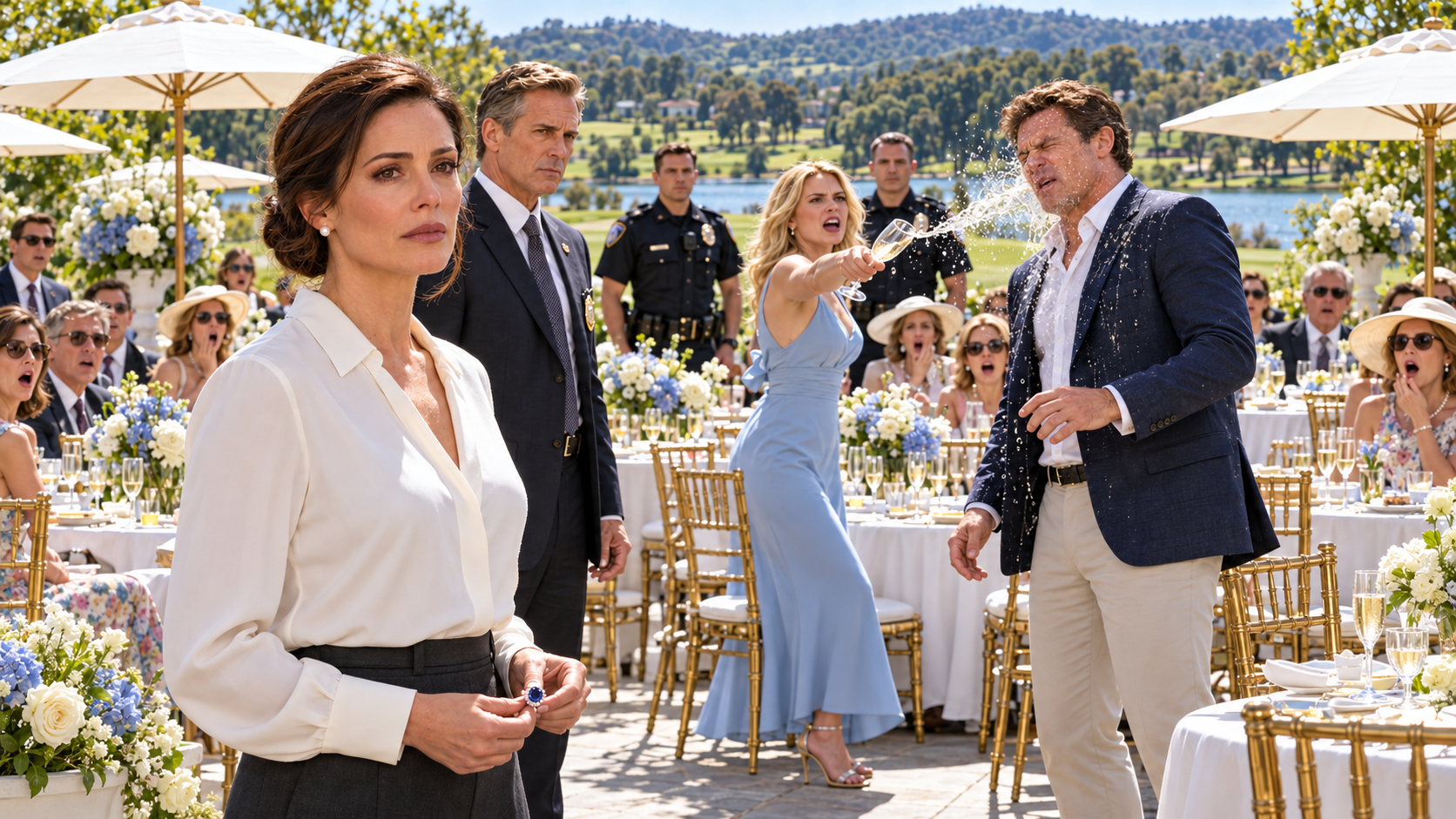
Madison Vale was laughing when I walked onto the west terrace.
Not quietly.
Not gracefully.
She laughed the way people laugh when they want strangers to turn their heads and wonder what wonderful thing has happened to them.
Oakridge Country Club had been built for exactly that kind of performance.
White umbrellas floated above linen-covered tables. Crystal glasses flashed in the afternoon sun. Beyond the terrace, eighteen acres of green fairway rolled toward ancient oak trees that had watched generations of wealthy families pretend money made them respectable.
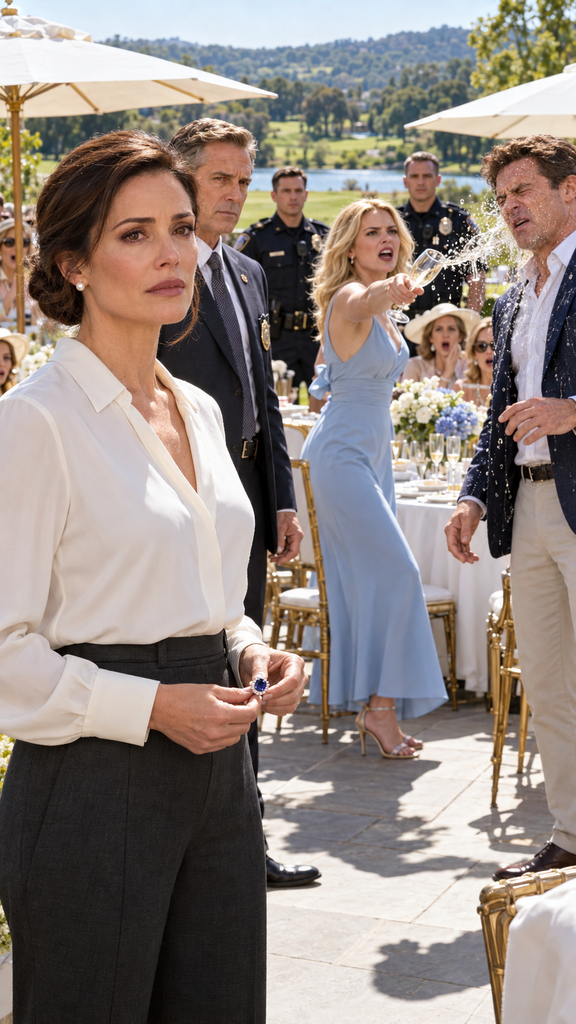
Madison sat at the center table in a pale blue dress.
Every few minutes, she raised her left hand.
And every time she did, the sapphire caught the light.
My sapphire.
Eleanor Whitmore’s ring.
The ring Ethan’s mother had pressed into my palm six years earlier and told me, very clearly, belonged to me.
The ring that had disappeared from the safe in my dressing room three days ago.
The ring my husband had apparently decided would look better on his mistress.
I stopped at the edge of the terrace.
Conversations thinned.
Forks paused.
A woman I knew from the Oakridge Historical Society lowered her champagne glass and stared.
Madison turned.
Her smile remained for perhaps half a second.
Then she noticed the man standing beside me.
Police Chief Daniel Mercer.
And the two uniformed officers behind him.
“Evelyn,” she said.
She tried to sound bored.
“This is a private luncheon.”
I looked at her hand.
“No,” I said. “This is evidence.”
The terrace went still.
Madison laughed.
It was a different laugh now.
Too quick.
Too high.
“I have no idea what you think you’re doing.”
Chief Mercer stepped forward.
“Miss Vale, we need to speak with you about the ring you’re wearing.”
Her right hand immediately covered her left.
“This ring was given to me.”
“Yes,” I said. “By my husband.”
Silence.
Not awkward silence.
Not embarrassed silence.
Gunshot silence.
Madison stared at me.
“He told me you knew.”
“I’m sure he did.”
Her confidence faltered.
Chief Mercer held out his hand.
“May I see the ring?”
Madison looked around the terrace.
And suddenly I understood why she had chosen Oakridge.
She wanted witnesses.
She wanted these women to see Ethan Whitmore’s ring on her finger. She wanted the story spreading through town before dinner.
She had not come here to celebrate an engagement.
She had come here to announce a victory.
She just hadn’t realized Ethan had purchased that victory with stolen property.
Her phone rang.
She glanced down.
I saw the name.
ETHAN.
“Answer it,” I said.
She looked at me.
“Go ahead.”
Her fingers trembled as she accepted the call.
“Ethan?”
“What happened?” His voice came through sharp and breathless. “Are you okay?”
“They’re saying the ring is stolen.”
Silence.
No confusion.
No indignation.
No immediate demand to speak to the police.
Just silence.
I watched Madison hear it.
I watched the first terrible understanding enter her eyes.
She put the call on speaker.
“Tell them,” she said.
Nothing.
“Ethan, tell them you bought it.”
Still nothing.
Chief Mercer looked at me.
I leaned toward the phone.
“Ethan.”
His breathing changed.
“Evelyn?”
“You should come to the club.”
“What are you doing?”
“Correcting something.”
“This is a private matter.”
I almost laughed.
For fifteen years, everything had been a private matter when privacy protected Ethan.
His temper.
His contempt.
His affairs with work that somehow always required women twenty years younger than me to travel with him.
His habit of making decisions about our money before telling me.
The jokes at dinner parties that always ended with me as the punch line.
Private.
Private.
Private.
Privacy had been the locked room where my marriage went to rot.
“No,” I said. “I made the mistake fifteen years ago. This is the correction.”
“Evelyn, you need to stop.”
There it was.
That voice.
Low.
Controlled.
Almost reasonable.
Once, it could make my stomach knot instantly.
Once, I would have looked around and wondered whether I was embarrassing him.
Once, I would have apologized before I even understood what I had supposedly done.
That woman had disappeared by inches for fifteen years.
She wasn’t standing on the terrace anymore.
“Come to Oakridge.”
I ended the call.
Chief Mercer held out his gloved hand again.
“The ring, Miss Vale.”
Madison’s eyes filled.
“He gave it to me.”
“That may be true,” Mercer said. “But it wasn’t his to give.”
She pulled at the ring.
For one awful second it stuck.
Her face reddened as she twisted it over her knuckle.
Then it came free.
She dropped it onto the white tablecloth.
The sound was tiny.
Yet everyone heard it.
I stared at the sapphire surrounded by twelve diamonds in its Edwardian setting.
Eleanor once told me it had survived two wars, three marriages, a bankruptcy, and a house fire.
Apparently it had survived her son too.
Mercer checked the ring against the appraisal photographs I had brought to the station that morning.
Then he returned it to me.
The instant it touched my palm, Oakridge disappeared.
I was standing in Eleanor’s bedroom six years earlier.
Rain tapped against the windows.
A machine hummed beside her bed.
She was dying, although neither of us used that word.
Her body had become fragile.
Her eyes hadn’t.
She pressed a velvet box into my hand.
“This is yours.”
“Eleanor—”
“Not Ethan’s.”
I stopped.
“Not the family’s. Yours.”
She glanced toward the closed bedroom door.
Then she squeezed my hand with surprising strength.
“Don’t let my son teach you to disappear.”
At the time, I thought she meant arguments.
I thought she meant Ethan interrupting me at dinners or answering questions people had asked me.
I thought she meant the way my work had slowly become less important than his schedule.
I thought she meant compromise.
I didn’t understand she was describing erasure.
I closed my fingers around the ring.
“I didn’t,” I whispered.
At least I hoped that was still true.
“Evelyn!”
The terrace doors flew open.
Ethan stormed outside in his navy suit.
He was sweating.
Panic dressed as anger.
Every face turned toward him.
Madison stood beside her table.
Chief Mercer remained where he was.
And I lifted the champagne glass someone had abandoned beside me.
“There he is,” I said.
“The groom.”
Madison went white.
Ethan stopped.
His eyes moved from her to the officers, then to my closed fist.
Finally, he looked at me.
I knew that look.
Calculation.
Who knew what?
Who could be persuaded?
Who could be frightened?
Who mattered?
Who didn’t?
For fifteen years, he had always put me in the second category.
“Evelyn,” he said carefully. “Whatever you think is happening—”
“You stole something from my safe.”
“My mother’s ring.”
“Your mother left it to me.”
“You are my wife.”
“And that makes my property yours?”
He glanced at the women watching us.
“This isn’t the place.”
Madison stared at him.
“You said she gave it back.”
He ignored her.
That was his mistake.
“You told me it belonged to the Whitmore family,” Madison continued. “You said Eleanor wanted it worn by the woman who would be your wife.”
“We’ll discuss this later.”
“You told me Evelyn agreed.”
“Madison.”
“You said the divorce papers were done.”
Whispers moved across the terrace.
I saw Ethan’s face tighten.
“There are no divorce papers,” I said.
Madison turned toward me.
“No separation agreement either. No understanding. No permission to take my ring.”
“He said you were living separate lives.”
“We had breakfast together Tuesday. He kissed me before leaving for work.”
Madison looked at him.
Ethan looked furious.
Not ashamed.
Not guilty.
Furious.
Because two women he had carefully kept in separate rooms were finally comparing notes.
Chief Mercer stepped forward.
“Mr. Whitmore, I’d like you to come with us and answer some questions.”
“This is ridiculous.”
“A theft report was filed this morning. Mrs. Whitmore supplied documentation establishing ownership.”
Ethan looked at me.
“Think very carefully about what you’re doing.”
The old threat.
Quiet enough to deny.
Clear enough for me to understand.
This time, everyone heard it.
I met his eyes.
“For fifteen years, Ethan, that’s exactly what I should have been doing.”
Madison whispered, “Were you ever going to marry me?”
His expression shifted.
“We’ll talk later.”
She gave a broken laugh.
Then picked up her champagne and threw it in his face.
I watched the liquid drip from his chin.
For once, Ethan Whitmore had no answer.
Madison grabbed her purse.
She stopped beside me.
“I didn’t know.”
I believed she hadn’t known about the ring.
I believed she hadn’t known about the nonexistent divorce.
But she had known about me.
“You knew he was married.”
Her gaze dropped.
“Yes.”
“Then you knew enough to ask questions.”
She flinched.
Then nodded and walked away.
Ethan watched her leave.
For one perfect moment, he understood that he had lost control of both women at the same time.
He turned back to me.
“This isn’t over.”
I slipped my sunglasses on.
“No,” I said. “It isn’t.”
Because the sapphire ring had opened the door.
And behind it waited fifteen years of things I had trained myself not to see.
PART 2: THE THINGS I STOPPED ASKING ABOUT
Ethan returned home four hours later.
I knew because I heard his key hit the front door three times before he managed to fit it into the lock.
I was sitting in Eleanor’s old study.
Not our bedroom.
Not the kitchen.
Not the living room where we had performed our marriage for guests.
Her study.
Ethan hated that room.
He always said it smelled old.
I thought it smelled like paper, cedar, and the only person in that family who had ever looked at me without needing me to become smaller first.
I had spent the afternoon going through documents.
Bank statements.
Tax records.
Property files.
Insurance policies.
Fifteen years of marriage reduced to paper.
The police had questioned Ethan and released him while the complaint was reviewed. Chief Mercer had warned me not to expect handcuffs over a family heirloom immediately.
I didn’t need handcuffs.
I needed time.
Ethan entered the study.
His jacket was gone.
His tie hung loose.
“You humiliated me.”
Those were his first words.
Not I’m sorry.
Not I made a mistake.
Not Madison meant nothing.
You humiliated me.
I looked up from the desk.
“You stole my ring.”
“I borrowed a family heirloom.”
“It wasn’t yours.”
“My mother bought that ring with Whitmore money.”
“Your grandmother owned it before your mother. Eleanor’s will transferred it to me.”
His eyes flicked toward the papers spread across the desk.
“What are you doing?”
“Learning.”
“About what?”
“My marriage.”
He laughed once.
There was no humor in it.
“Don’t become dramatic.”
I stared at him.
“You gave your mistress my dead mother-in-law’s ring and told her we were divorcing.”
“I was going to handle Madison.”
“Handle her?”
“It got out of control.”
“How long?”
He said nothing.
“How long have you been sleeping with her?”
“Evelyn.”
“How long?”
His jaw moved.
“Eight months.”
I nodded.
I had expected a year.
Perhaps two.
Eight months should have comforted me.
Instead it made me think of Christmas.
Our anniversary.
The night he brought me soup when I had the flu.
The morning he complained that I had become distant.
Eight months could hold an entire false life.
“Did you love her?”
“No.”
The answer came too quickly.
Somewhere inside me, something unexpectedly painful shifted.
Not because I wanted him to love her.
Because I realized how little any of it meant to him.
“You destroyed two women for something you didn’t even call love.”
“Oh, for God’s sake. Madison knew what she was doing.”
“So did you.”
“She pursued me.”
I laughed.
Ethan stared.
It may have been the first time in years I had laughed at him.
“Is that what you’ll tell everyone?”
“I don’t have to tell anyone anything.”
“You already did. At Oakridge.”
His face hardened.
“I want you to withdraw the complaint.”
“No.”
“Evelyn.”
“No.”
“You’re angry.”
“Yes.”
“You’re not thinking clearly.”
I looked at the files covering Eleanor’s desk.
For the first time in years, I felt painfully clear.
“Actually, I think that may be our problem.”
He stepped closer.
“What does that mean?”
I picked up a bank statement.
“Do you remember when we renovated the lake house?”
His expression changed.
Barely.
But I saw it.
“Of course.”
“You told me the project ran almost two hundred thousand dollars over budget.”
“So?”
“I signed the transfer.”
“You handled household accounts then.”
“Yes. I did.”
I placed another statement beside it.
“And three weeks later, you moved almost the same amount from the construction account into Whitmore Holdings.”
“That was reimbursement.”
“For what?”
He looked at me.
I waited.
There was a time when three seconds of silence from Ethan would have made me fill it for him.
I didn’t.
Finally he said, “Business expenses.”
“What business expenses?”
“Evelyn, I am not auditing fifteen years of our finances because you caught me having an affair.”
“I am.”
His face changed again.
This time the fear was clearer.
“Don’t do this.”
The words were soft.
I looked down at the papers.
That was when I noticed something.
The same initials appeared beside several transfers.
E.W.
My initials.
Except I hadn’t approved them.
I pulled another statement closer.
Another transfer.
Another E.W.
Then another.
My mouth went dry.
“What?”
Ethan had noticed.
I looked at him.
“Nothing.”
It was the first lie I had told him in years.
And he believed me because he still thought I was bad at lying.
He exhaled.
“Look, Madison was a mistake.”
I almost admired the pivot.
“She was?”
“Yes.”
“She thought she was your future wife.”
“I told you. It got out of control.”
“You gave her a ring.”
“I panicked.”
“You broke into my safe.”
“I knew the combination.”
“That isn’t better.”
He rubbed both hands over his face.
“I don’t want a divorce.”
That surprised me.
Not because I thought he loved me.
Because it was the first thing he had said all day that sounded completely sincere.
“Why?”
His hands dropped.
“What?”
“Why don’t you want a divorce?”
“We’ve been married fifteen years.”
“That is a duration, Ethan. Not a reason.”
“We have a life.”
“What life?”
“This house. Our friends. The foundation. My company. Your work. Everything we’ve built.”
There it was.
Not love.
Infrastructure.
I was a load-bearing wall in Ethan’s life.
He didn’t cherish me.
He required me to remain standing.
“What happens to Whitmore Holdings if I divorce you?”
His eyes sharpened.
“Nothing.”
Too fast.
I leaned back.
“Then why did that question frighten you?”
“It didn’t.”
“Good.”
I closed the folder.
“Then you won’t mind when my attorney looks at everything.”
For the first time that night, Ethan lost control.
His hand struck the desk.
“Enough.”
I didn’t move.
The sound echoed through Eleanor’s study.
He stared down at me, breathing hard.
And suddenly I remembered Eleanor’s last Christmas.
Ethan had been arguing with her in this room.
I had heard only fragments from the hallway.
You can’t keep doing this.
It’s my decision.
You don’t understand the company.
Then Eleanor had said something I never forgot.
No, Ethan. You need Evelyn because people trust her.
At the time, I thought they were discussing the family foundation.
Now I wasn’t sure.
Ethan straightened.
He seemed to realize he had shown too much.
“I am going upstairs.”
“Fine.”
“We’ll talk tomorrow when you’ve calmed down.”
“No.”
He stopped at the door.
“Tomorrow, you’ll hear from my attorney.”
He turned.
For the first time since Oakridge, genuine fear appeared on his face.
“You don’t have an attorney.”
“I do now.”
He stared at me.
Then left.
I waited until I heard his footsteps upstairs.
Only then did I look again at the papers.
E.W.
E.W.
E.W.
My initials appeared beside transactions I had never seen.
Transfers.
Authorizations.
Corporate resolutions.
Some dated years apart.
I opened the bottom drawer of Eleanor’s desk, looking for an envelope.
Instead, I found a small leather address book.
Most of the entries were old.
Some names belonged to people who were dead.
One page had been folded at the corner.
There were three words written beside a phone number.
MARGARET SHAW — TRUST RECORDS.
I remembered Margaret vaguely.
Eleanor’s accountant.
A careful woman with silver hair who stopped appearing at family Christmas dinners a year before Eleanor died.
I had asked Ethan once what happened to her.
He said she retired.
I picked up my phone.
It was nearly nine.
I hesitated.
Then dialed.
The line rang five times.
A woman answered.
“Hello?”
“Margaret Shaw?”
A pause.
“Yes.”
“My name is Evelyn Whitmore.”
Silence.
Long enough that I checked whether the call had disconnected.
Then Margaret whispered, “Eleanor’s daughter-in-law?”
“Yes.”
Another pause.
“Mrs. Shaw, I’m sorry to call so late, but I found your number in Eleanor’s desk.”
Her breathing changed.
“What happened?”
I looked at the papers.
“My husband stole something from me.”
Margaret was silent.
“And now,” I continued, “I think he may have been using my name on financial documents.”
This time, she didn’t hesitate.
“Don’t confront him about those documents.”
I froze.
“Why?”
“Because if you’ve finally started looking, you need to look at all of it before Ethan knows what you’ve found.”
My hand tightened around the phone.
“All of what?”
Margaret exhaled slowly.
Then she said the sentence that ended what remained of my marriage.
“Evelyn, the ring isn’t the first thing Ethan took from you.”
PART 3: MY NAME ON HIS LIES
I met Margaret Shaw at seven the next morning in a diner forty minutes outside Oakridge.
Not at her house.
Not at mine.
Her choice.
That told me more than I wanted to know.
Margaret was seventy-one now, smaller than I remembered, with silver hair cut neatly at her jaw and the same watchful gray eyes.
She did not hug me.
She simply said, “Did he follow you?”
“No.”
“You’re certain?”
“I drove around twice before coming here.”
She studied me.
“Eleanor taught you that?”
“No. Fear did.”
Something softened in her face.
We took a booth in the back.
Margaret ordered coffee.
I couldn’t drink mine.
She placed a folder between us.
“I’ve kept this for six years.”
“What is it?”
“Something I promised Eleanor I wouldn’t give you unless you came looking.”
My chest tightened.
“She knew?”
“She knew enough.”
“Enough about what?”
Margaret opened the folder.
Inside were copies of corporate records from Whitmore Holdings.
My name appeared everywhere.
Evelyn Whitmore.
Board consent.
Shareholder authorization.
Loan guarantees.
Asset transfers.
I stared at the signatures.
Some looked like mine.
Very much like mine.
But I had not signed them.
“What am I looking at?”
“Ethan began restructuring portions of Whitmore Holdings after his father died. Eleanor still controlled a substantial voting interest. You held an indirect marital interest in several assets.”
“I never worked for the company.”
“You didn’t need to. Your name mattered because some assets acquired during the marriage involved jointly held funds.”
I looked at her.
“Did Ethan forge my signature?”
“I can’t tell you who physically signed each page.”
“But I didn’t.”
“No.”
“How do you know?”
“Because Eleanor asked you about one of them.”
A memory struck me.
Dinner at Eleanor’s house.
Five years earlier.
She had asked whether I had approved Ethan’s refinancing plan.
I had said, “I sign whatever he puts in front of me.”
Eleanor had gone strangely quiet.
At the time, I thought she disapproved of my carelessness.
Now shame burned through me.
“I told her I signed things without reading them.”
Margaret nodded.
“That frightened her.”
“It should have.”
“She began checking.”
I turned another page.
There were transfers from accounts I recognized.
Our investment account.
The lake house renovation account.
A trust created after my father died.
I stopped.
“My father’s money.”
Margaret’s mouth tightened.
My father had not been wealthy by Whitmore standards.
He had been a surgeon who worked forty years and invested carefully.
When he died, he left me a little over nine hundred thousand dollars.
Ethan had insisted we invest most of it.
For our future, he’d said.
I looked at Margaret.
“Where did it go?”
“Some of it appears to have been loaned to Whitmore Holdings.”
“I never agreed to that.”
“I know.”
“How much?”
She slid a sheet toward me.
I read the number twice.
Then a third time.
Seven hundred and forty thousand dollars.
My hands went numb.
“No.”
“Evelyn—”
“No. I would remember.”
“I believe you.”
“I would remember giving him three quarters of a million dollars.”
“He may have structured it so you didn’t know you were giving it.”
I thought of the documents Ethan brought home.
Sign here.
Initial here.
Tax issue.
Routine paperwork.
Trust me.
I had trusted him.
Or maybe I had simply become tired of the consequences when I didn’t.
“Why didn’t Eleanor tell me?”
Margaret looked down.
“She tried.”
“No, she didn’t.”
“She asked questions. She tried to make you ask questions too.”
Anger rose in me.
“At riddles? She could have told me.”
“She was dying, Evelyn. And Ethan was her son.”
The anger collapsed almost as quickly as it came.
Margaret continued.
“She wanted proof before she accused him. Then her health declined faster than expected.”
I remembered Eleanor’s thin hand closing around mine.
Don’t let my son teach you to disappear.
God.
She hadn’t been speaking metaphorically.
“Why didn’t you tell me after she died?”
“Because I didn’t have enough to prove fraud. And because Ethan made it clear my services were no longer required.”
“He fired you.”
“Yes.”
“He told me you retired.”
Margaret gave me a sad smile.
“That sounds like Ethan.”
I stared out the window.
Cars moved along the wet road.
Ordinary people going to work.
Somewhere in Oakridge, Ethan was probably waking in our bed and deciding which version of reality he would give me next.
“What else?”
Margaret hesitated.
“Eleanor created protections in her estate plan.”
“For me?”
“For several people. Including you.”
“What protections?”
“She knew Ethan might pressure you into signing away certain interests after her death. So some provisions required independent acknowledgment.”
“I don’t remember that.”
“Because the version of the estate documents you were shown may not have been complete.”
I looked at her.
The diner seemed to tilt.
“What?”
Margaret pulled out another page.
“Eleanor left you more than the ring.”
I couldn’t speak.
“She left you a direct interest in one of the Whitmore commercial properties.”
“How much?”
“Twenty-five percent.”
I stared at her.
“No.”
“Yes.”
“Ethan told me Eleanor left everything business-related to him.”
“She didn’t.”
My heart pounded.
“What property?”
“The Whitmore Center.”
I almost laughed from shock.
The Whitmore Center was the family’s most valuable commercial property downtown.
Twelve floors.
Medical offices.
Law firms.
A bank branch.
Ethan complained constantly about taxes on it.
“You’re telling me I own a quarter of that building?”
“Unless you legally transferred your interest.”
“I didn’t.”
Margaret held my gaze.
“That is what we need to determine.”
I thought of the papers upstairs.
The initials.
The signatures.
The fear in Ethan’s eyes when I mentioned divorce.
It wasn’t the house.
It wasn’t reputation.
It wasn’t even marriage.
It was ownership.
My phone vibrated.
ETHAN.
I let it ring.
Then a message appeared.
WHERE ARE YOU?
Another.
WE NEED TO TALK BEFORE LAWYERS GET INVOLVED.
Margaret read my face.
“He knows something changed.”
“He knows I found documents.”
“Did you tell him which ones?”
“No.”
“Good.”
My phone rang again.
This time I answered.
“Hello.”
“Where are you?”
“Out.”
“Where?”
“Why?”
“Because you’re my wife.”
I closed my eyes.
There it was again.
Wife as permission.
Wife as ownership.
Wife as explanation.
“Not for much longer.”
“Evelyn.”
“What?”
His voice softened.
“I’ve been thinking. I was wrong.”
Margaret watched me.
“About Madison?”
“About everything.”
“Everything is a large category.”
“Come home.”
“I will.”
“When?”
“Later.”
“We should handle this privately.”
I looked at the copy of Eleanor’s estate documents.
“I agree.”
He exhaled, relieved.
“Good.”
“That’s why I’m hiring a private forensic accountant.”
Silence.
Then, “What?”
“And a divorce attorney.”
“Evelyn, don’t be ridiculous.”
“And Ethan?”
“What?”
“I’m going to find out what happened to my father’s money.”
He stopped breathing.
Not literally.
But the line went so quiet I could hear the hum of the diner refrigerator.
I had my answer.
“Evelyn—”
I hung up.
Margaret’s face was pale.
“You shouldn’t have told him.”
“I know.”
“Then why did you?”
I looked at my trembling hands.
“Because for fifteen years, he has known exactly what scares me.”
I put the phone facedown.
“I wanted him to know what scares him.”
When I returned home two hours later, Ethan was gone.
So were the files from Eleanor’s desk.
Every single one.
The drawers had been emptied.
The folders were missing.
Even the bank statements I had printed myself were gone.
I stood in the doorway staring at the bare desk.
Then I noticed something.
The small leather address book was still there.
Ethan hadn’t known it mattered.
I picked it up.
A folded sheet of paper slipped from between the pages and landed near my shoe.
I bent down.
It was in Eleanor’s handwriting.
Only one sentence.
If Evelyn ever starts asking questions, tell her to check what Ethan fears losing most.
I read it three times.
Then I looked around the study.
What did Ethan fear losing most?
His reputation?
His company?
His money?
Control?
My phone rang.
Madison.
I almost ignored it.
Then I answered.
“What do you want?”
Her voice was shaking.
“I think I know why Ethan never filed for divorce.”
I sat down slowly.
“Why?”
“Because three months ago, I heard him arguing with someone on the phone.”
“About what?”
“You.”
My pulse quickened.
“What did he say?”
Madison hesitated.
Then repeated the words that Ethan had apparently believed I would never hear.
“If Evelyn leaves before I fix the ownership problem, I lose everything.”
PART 4: WHAT ETHAN FEARED LOSING
Madison met me that afternoon in the parking lot behind a closed garden center.
Her sunglasses covered half her face.
I wondered whether she was hiding from photographers, Oakridge gossip, or herself.
She climbed into my car without speaking.
For several seconds, neither of us looked at the other.
Then she said, “I know you hate me.”
“I don’t know you well enough to hate you.”
“That may be worse.”
“It isn’t meant to be.”
She nodded.
Her hands were clenched around her purse.
“I knew he was married.”
“I know.”
“He told me it had been over for years.”
“I know.”
“He said you stayed because of money and appearances.”
I laughed quietly.
“Of course he did.”
“He said you had separate bedrooms.”
“We don’t.”
“He said you hated his mother.”
I turned toward her.
That one hurt.
Madison saw it.
“He said Eleanor never accepted you.”
“She was the only Whitmore who did.”
Madison closed her eyes.
“I was stupid.”
“No. You were willing to believe a version of me that made what you were doing easier.”
She absorbed that without arguing.
“That’s fair.”
It was the first thing about her that surprised me.
“Tell me about the phone call.”
She opened her purse and removed a second phone.
“I bought this yesterday.”
“Why?”
“Because Ethan pays for my other one.”
Of course he did.
She continued.
“Three months ago, we were at his apartment downtown.”
“His what?”
Madison froze.
“He told me you knew about it.”
I laughed.
This time there was no humor at all.
“Where?”
She gave me the address.
I knew the building.
Whitmore Center.
Of course.
“What did you hear?”
“He was in the bedroom. I was in the kitchen. He thought the door was closed.”
“With whom?”
“I don’t know. He kept saying someone needed to fix documents before you started asking questions.”
“What documents?”
“He didn’t say.”
“Exact words, Madison.”
She swallowed.
“He said, ‘If Evelyn leaves before I fix the ownership problem, I lose everything.’ Then he said, ‘My mother made this mess because she never trusted me.’”
Eleanor.
I stared through the windshield.
Madison continued.
“I asked him about it later. He told me you owned some shares that would automatically transfer back to him in the divorce.”
“That doesn’t make sense.”
“I know that now.”
“Anything else?”
“He said he needed six months.”
“For what?”
“To make the divorce clean.”
My stomach tightened.
Eight months together.
Six months needed.
Madison had not merely been waiting for Ethan to leave me.
Ethan had been waiting until leaving me became financially safe.
The ring suddenly made more sense.
It had not been an engagement.
It had been a promise designed to keep Madison patient.
A stolen promise.
He had taken something belonging to me to buy himself more time with her.
That was Ethan in one act.
“What do you want from me?” I asked.
Madison looked at her hands.
“I want to help.”
“Why?”
“Because he used me.”
“So you’re angry.”
“Yes.”
“That isn’t the same as helping me.”
She looked up.
“No. But I’m also ashamed.”
I waited.
“I kept thinking yesterday about what you said. That I knew enough to ask questions.”
Her eyes filled.
“You were right.”
I didn’t comfort her.
But I didn’t punish her either.
“I have messages,” she said. “Emails too.”
“About me?”
“Some.”
“About money?”
“Maybe. He complained constantly about Eleanor’s estate.”
My heart accelerated.
“Don’t delete anything.”
“I won’t.”
“And don’t tell Ethan you’re speaking to me.”
“He already called sixteen times.”
“Did you answer?”
“No.”
“Keep it that way.”
She handed me the second phone number.
Then she paused.
“There is something else.”
I looked at her.
“The apartment.”
“What about it?”
“He told me it was his.”
“And?”
“Once I found an envelope addressed to you there.”
My skin went cold.
“To me?”
“Yes.”
“What kind?”
“Registered mail. From a law firm.”
“Which law firm?”
“I don’t remember.”
“Think.”
She squeezed her eyes shut.
“Bennett… Bennett and Cole, maybe.”
I knew the name.
They had handled Eleanor’s estate.
“Did you open it?”
“No.”
“What happened to it?”
“Ethan came home. He saw me holding it and grabbed it from me.”
“When?”
“About five months ago.”
“Did he say what it was?”
“He said junk mail.”
Registered mail from Eleanor’s estate attorneys.
Sent to an apartment I didn’t know existed.
Addressed to me.
I called my lawyer before Madison left the car.
By five that evening, we had confirmation.
Bennett & Cole had sent multiple notices to me after Eleanor’s death.
The address on file had been changed from my home address to an office suite at Whitmore Center.
The authorization changing that address supposedly carried my signature.
It wasn’t mine.
More importantly, the firm had sent a notice five months ago after an internal records review discovered an unresolved ownership question involving my twenty-five-percent interest.
Ethan had received it.
I hadn’t.
That evening, I did not go home.
I stayed at a hotel under my maiden name.
At 9:14 p.m., Ethan called.
At 9:16, again.
At 9:22, he texted.
COME HOME.
Then:
MADISON IS LYING TO YOU.
Then:
MY MOTHER WAS CONFUSED AT THE END.
That one made me sit upright.
He knew.
He knew I had found something connected to Eleanor.
I did not answer.
At 10:03, another message arrived.
WE CAN FIX THIS.
I stared at those four words.
Not explain.
Not discuss.
Fix.
At 10:11, he called again.
This time I answered.
“Where are you?”
“Safe.”
“Safe from what?”
I almost smiled.
“You tell me.”
“Evelyn, you are turning a marital problem into something much bigger.”
“No. I think you’ve spent years turning something much bigger into a marital problem.”
He went silent.
“My lawyer contacted Bennett & Cole.”
Another silence.
Then his voice became very soft.
“What did they tell you?”
That question was the closest Ethan ever came to a confession.
“Enough.”
“Evelyn, my mother made mistakes in her estate planning.”
“Did she?”
“She was sick.”
“She knew my name.”
“Don’t do that.”
“Do what?”
“Make this ugly.”
I stood at the hotel window looking down at the city.
“You forged my signature.”
“I did not.”
“You diverted my inheritance.”
“No.”
“You hid estate notices from me.”
“I was handling them.”
“They were addressed to me.”
“You don’t understand the complexity.”
“You always say that when you mean you don’t want me to understand.”
His breathing grew heavier.
“Come home.”
“No.”
“We can work this out.”
“No.”
“I’ll end things with Madison.”
“They’re already over.”
“I’ll return the money.”
I stopped.
He stopped too.
Neither of us spoke.
Then I said, very quietly, “What money?”
He knew immediately.
“Evelyn—”
“What money are you offering to return, Ethan?”
“I meant whatever you’re concerned about.”
“No.”
“Listen to me.”
“No. You listen.”
My voice did not rise.
I didn’t need it to.
“You stole my ring because you believed anything connected to me was yours to use. My money. My signature. My inheritance. My reputation. My silence.”
“That is not what happened.”
“It is exactly what happened.”
“You’ve benefited from this family for fifteen years.”
There.
Finally.
The truth beneath the truth.
I closed my eyes.
“So that’s how you justified it.”
“Justified what?”
“Taking.”
“You lived in my house.”
“Our house.”
“My company paid for your lifestyle.”
“My father’s money went into your company.”
“I gave you everything.”
“You gave me things, Ethan. You never gave me respect.”
He laughed bitterly.
“And what do you think happens now? You destroy me and walk away clean?”
I looked at the ring on my finger.
Eleanor’s sapphire.
“No.”
I said it calmly.
“I walk away with what was mine.”
Then I ended the call.
The next morning, my attorney obtained copies of the relevant estate documents.
By noon, a forensic accountant had traced enough transactions to establish a pattern.
By evening, we knew why Ethan had been terrified of divorce.
My twenty-five-percent interest in Whitmore Center had never been legally transferred.
The documents Ethan had relied upon contained a signature I denied making and lacked the independent acknowledgment Eleanor’s estate plan required.
And because Ethan had used the building as security in later business financing, any successful challenge to his claimed ownership threatened far more than one quarter of one property.
It threatened loans.
Control agreements.
Investor disclosures.
Years of decisions built on the assumption that he owned something he did not.
Eleanor had not left me enough to destroy Ethan.
She had left me enough that Ethan could destroy himself trying to take it.
At 6:40 that evening, Margaret called.
“You understand now?”
“Yes.”
“What he feared losing?”
I looked at the financial report.
“Control.”
“No.”
I frowned.
“What, then?”
“Your consent.”
I went quiet.
Margaret continued.
“Ethan spent years convincing you your signature was a formality. Eleanor understood what he didn’t.”
“What?”
“That one day you might stop signing.”
I looked at my own name on the documents.
For fifteen years, Ethan had treated my agreement like furniture.
Something always present.
Something he never needed to thank.
Something he assumed would remain exactly where he put it.
And suddenly I knew what I had to do.
Not scream.
Not threaten.
Not destroy him in public.
I simply had to stop agreeing.
PART 5: THE WOMAN WHO DIDN’T DISAPPEAR
Three weeks after Oakridge, Ethan and I sat across from each other in a conference room on the eleventh floor of Whitmore Center.
My building.
At least one quarter of it.
Possibly the most expensive truth I had ever learned.
Ethan looked different.
Not ruined.
Not broken.
Just smaller.
I had spent years believing his confidence came from certainty.
Now I understood that much of it came from everyone else being uncertain around him.
His attorney sat beside him.
Mine sat beside me.
Margaret was present as a records witness.
The forensic accountant had submitted his preliminary findings.
Madison had provided copies of messages in which Ethan discussed delays to his supposed divorce, problems with “Evelyn’s ownership,” and his need to “clean up” estate documents.
Nothing in those messages alone proved everything.
Together with the records, they mattered.
Cause and effect.
That was what my attorney kept saying.
We didn’t need dramatic theories.
We needed dates.
Documents.
Transfers.
Signatures.
Who knew what, and when.
For the first time in my marriage, facts were louder than Ethan.
His attorney spoke first.
“My client is prepared to discuss a comprehensive marital settlement.”
I almost smiled.
Three weeks earlier, Ethan had told me there would be no divorce.
Now he wanted comprehensive settlement discussions.
“What is he offering?” my attorney asked.
The number was large.
Once, it would have stunned me.
Now I understood why it was being offered.
I looked at Ethan.
“Does that include my interest in Whitmore Center?”
His attorney answered.
“We believe ownership remains disputed.”
“I asked Ethan.”
My lawyer touched my arm lightly, but I kept looking at my husband.
Ethan’s jaw tightened.
“You always hated business conversations.”
“I hated conversations where you treated me like I was stupid.”
“I never said you were stupid.”
“No. You were more careful than that.”
He looked away.
I continued.
“You interrupted. You simplified. You told me not to worry. You put papers in front of me and pointed to the line.”
“Evelyn—”
“You made ignorance comfortable.”
That landed.
For once, he had no immediate reply.
I removed Eleanor’s ring from my finger and placed it on the table.
His eyes went to it.
“You know what’s strange?” I said. “I thought this started with the ring.”
“It did.”
“No. The ring was simply the first thing you took that I noticed.”
His attorney shifted.
Mine remained silent.
Ethan stared at the sapphire.
“You called the police over a piece of jewelry.”
“No. I called the police because something belonging to me disappeared from a locked safe and appeared on another woman’s hand.”
“You knew it was me.”
“Yes.”
“That makes it different.”
I almost laughed.
That sentence contained our entire marriage.
You knew it was me.
As though betrayal became acceptable when committed by someone entitled to your trust.
“You still don’t understand,” I said.
“Then explain it.”
So I did.
“The ring mattered because Eleanor gave it to me. My father’s money mattered because he gave it to me. My ownership mattered because Eleanor deliberately gave it to me. My signature mattered because it was mine.”
I leaned forward.
“You kept seeing objects. Assets. Technicalities. I see people who trusted me with something.”
Ethan’s expression hardened.
“My mother was trying to punish me.”
“Maybe.”
Everyone looked at me.
I had no intention of turning Eleanor into a saint.
She loved her son.
She feared what he had become.
Both things could be true.
“But even if she was angry with you, she still had the right to decide what happened to her property.”
“You manipulated her.”
The accusation was so absurd that for a moment I said nothing.
Then Margaret spoke.
“No, Ethan.”
His head snapped toward her.
She had barely spoken all morning.
“Your mother made those decisions herself.”
“You hated me.”
“I was your family’s accountant for twenty-eight years.”
“And she fired you.”
Margaret’s face remained calm.
“No. You did.”
The room went silent.
Ethan looked at me.
“You see what this is? Everyone who resented me is suddenly rewriting history.”
I studied him.
Three weeks ago, those words might have worked.
Not because I would have believed them completely.
Because I would have wondered.
Had I misunderstood?
Was Margaret bitter?
Was Madison vindictive?
Was my attorney aggressive?
Was I emotional?
Ethan had lived inside that hesitation.
He had furnished it.
Locked the doors.
Called it marriage.
Not anymore.
“Then we’ll let the documents decide.”
His attorney whispered something to him.
Ethan ignored him.
“Fifteen years, Evelyn.”
“Yes.”
“I protected you.”
“From what?”
He stopped.
“From all of this.”
He gestured at the documents.
The lawyers.
The financial records.
The consequences.
And suddenly I understood that he believed it.
In his mind, control had become protection.
He had made decisions because decisions were difficult.
He had hidden information because information upset me.
He had used my signature because asking took time.
He had taken my money because he believed he could use it better.
He had taken my ring because explaining his delay to Madison was inconvenient.
Every violation had been converted into efficiency.
Every theft into stewardship.
Every lie into protection.
I felt something inside me become very quiet.
“I didn’t need you to protect me from my own life.”
His face changed.
For the first time, I saw regret.
Not enough.
Not pure.
But real.
“Can we speak alone?”
My attorney looked at me.
I nodded.
Everyone left.
Ethan and I remained on opposite sides of the table.
For several seconds, neither of us spoke.
Then he said, “I never meant for it to become this.”
“What did you mean?”
“I don’t know.”
“That isn’t an answer.”
He rubbed his eyes.
“I was trying to keep the company stable after Dad died. Mom wouldn’t cooperate. You didn’t understand what was at stake.”
“So you used my money.”
“I intended to replace it.”
“You didn’t.”
“I intended to.”
“You forged documents.”
“I never personally forged your signature.”
I stared at him.
There it was.
The lawyer’s sentence.
Carefully constructed.
“Did you know signatures appearing as mine weren’t mine?”
He looked away.
That was enough for me.
“Did you know?”
“I knew some documents were handled improperly.”
I felt sick.
Even after everything, some foolish part of me had wanted him to say no.
Not because it would save the marriage.
Because fifteen years is a long time to discover you were sleeping beside someone capable of looking at your name and deciding he had more right to it than you did.
“And Madison?”
He sighed.
“What about her?”
“Why?”
“I was unhappy.”
“So was I.”
He looked at me.
I continued.
“I didn’t steal your mother’s jewelry and give it to another man.”
He almost smiled despite himself.
Then the expression disappeared.
“I felt old.”
That answer surprised me.
He stared at the table.
“After Mom died, after the company problems… everything became obligations. Madison looked at me like I was still becoming something.”
“And I looked at you like I knew what you had become.”
He raised his eyes.
“Yes.”
It was perhaps the most honest answer Ethan had ever given me.
I felt no victory.
Only sadness.
“What did you tell yourself would happen?”
“I’d fix the ownership issue.”
“How?”
He didn’t answer.
“Then divorce me?”
“Eventually.”
“And marry Madison?”
Another silence.
“You weren’t going to.”
“I don’t know.”
“Yes, you do.”
He looked toward the window.
“No.”
There it was.
Madison had been a mirror.
I had been infrastructure.
Neither of us had been loved enough to be treated honestly.
Ethan stood.
“If you challenge the ownership, the company could collapse.”
“Then perhaps you shouldn’t have built it on property you didn’t own.”
“Employees could lose jobs.”
“Don’t.”
“What?”
“Don’t put your choices on people who had no part in making them.”
His face tightened.
“You could prevent it.”
“And there it is.”
“What?”
“The same thing you’ve always done.”
I stood too.
“You create the danger, then tell me protecting everyone is my responsibility.”
He stared at me.
I picked up Eleanor’s ring.
“I will negotiate fairly. I won’t destroy a viable business simply to hurt you. But I will not surrender what belongs to me to protect you from consequences you created.”
“Evelyn.”
“My answer is no.”
It was a small word.
I had used it thousands of times in my life.
No sugar.
No thank you.
No problem.
No worries.
But I had almost never used it with Ethan when the answer mattered.
No.
He looked at me as if I had become a stranger.
Maybe I had.
Or maybe I had finally stopped being one to myself.
Six months later, our divorce became final.
There was no cinematic arrest.
No dramatic courtroom confession.
No single moment when Ethan lost everything and I walked away while applause filled the room.
Reality was slower.
And, in some ways, more satisfying.
The disputed property interest was resolved in my favor as part of a broader settlement acknowledging my ownership and financial claims. My father’s money, including funds traced into Whitmore Holdings, became part of the financial negotiations.
The questionable documents went where they needed to go—to lawyers, accountants, and the appropriate authorities for review.
I stopped needing to know whether every consequence would be spectacular.
Consequences did not have to be spectacular to be real.
Ethan lost the luxury of secrecy.
He lost the ability to make decisions using my name without my knowledge.
He lost the marriage he had assumed would remain available regardless of what he did inside it.
Most of all, he lost control over the woman he thought would always forgive him before she understood what needed forgiving.
Madison contacted me once after the divorce.
She asked if we could meet.
We did.
At a coffee shop.
No country club.
No champagne.
No audience.
She looked different without the armor.
“I owe you an apology,” she said.
“Yes.”
She blinked.
I smiled faintly.
“I wasn’t going to tell you that you didn’t.”
She laughed.
A real laugh this time.
Then her eyes filled.
“I knew he was married. I let him convince me that made me less responsible because he said the marriage was over.”
I stirred my coffee.
“People believe what they need to believe.”
“You did too?”
The question wasn’t cruel.
I looked through the window.
“Yes.”
For years, I believed Ethan’s contempt was stress.
His control was competence.
His secrecy was responsibility.
His dismissiveness was confidence.
His apologies were change.
His mother’s warnings were family tension.
I had believed many things because the alternative required action.
“Yes,” I repeated. “I did.”
Madison nodded.
“I’m sorry.”
“I believe you.”
“Do you forgive me?”
I thought about it.
“I don’t know.”
She looked disappointed but accepted it.
“I hope you do someday.”
“Maybe.”
We finished our coffee.
Then went separate ways.
That felt right.
We were never friends.
We were simply two women who had once been kept in different rooms by the same man’s lies.
Once the door opened, neither of us could pretend the other didn’t exist.
A year after Oakridge, I returned to the country club.
I almost didn’t.
Then the historical society asked me to speak at a fundraiser Eleanor had helped establish decades earlier.
The west terrace looked exactly the same.
White umbrellas.
Crystal glasses.
Old oak trees.
Women talking softly over lunch.
For a moment, I saw Madison in blue.
I saw Ethan dripping champagne.
I saw Chief Mercer holding out his hand.
I saw myself standing at the edge of the terrace, terrified beneath my calm.
A woman approached me after the speech.
She was younger than I was.
Perhaps thirty-five.
“I hope this isn’t inappropriate,” she said, “but I was here that day.”
I knew immediately which day she meant.
“I thought so.”
“I wanted to tell you something.”
“All right.”
“When you walked onto the terrace with the police, everyone thought the story was about the ring.”
I smiled.
“So did I.”
She looked at the sapphire on my hand.
“What was it really about?”
I turned the ring slowly.
Sunlight entered the stone.
For years, I had thought Eleanor gave it to me because she loved me.
She did.
But perhaps she also gave it to me because she understood symbols better than I did.
A ring could mean marriage.
Inheritance.
Ownership.
Promise.
Control.
Or freedom.
It depended entirely on whose hand held it.
“It was about noticing,” I said.
The woman frowned slightly.
“Noticing what?”
“What disappears when you aren’t looking.”
That evening, I went home to a house Ethan had never lived in.
It was smaller than the Whitmore house.
Quieter.
Mine.
Eleanor’s leather address book sat on a shelf in my study.
I had framed her handwritten note.
Not because I needed to remember Ethan.
Because I needed to remember myself.
If Evelyn ever starts asking questions…
Sometimes I wondered what Eleanor would think of everything that happened.
I wished I had asked her more while she was alive.
I wished I had listened differently.
But regret is another kind of room you can disappear inside if you stay there too long.
So I didn’t.
I opened the windows.
I worked.
I traveled.
I rebuilt friendships I had neglected because Ethan found them inconvenient.
I learned my own finances.
I read every contract.
I asked questions even when people sighed.
Especially when people sighed.
And I stopped apologizing for needing to understand things that affected my life.
The sapphire remained on my right hand.
Not my left.
People occasionally asked why.
I never gave them the whole story.
I simply said it belonged there.
One night, almost eighteen months after Oakridge, I found the original velvet box while unpacking the last carton from storage.
Inside the lid, hidden beneath a fold of faded satin, was a tiny piece of paper.
I nearly threw it away.
Then I recognized Eleanor’s handwriting.
Four words.
For the woman you are.
I sat on the floor for a long time holding that note.
Not the woman Ethan married.
Not the woman the Whitmores expected.
Not the woman I had been when Eleanor died.
The woman you are.
Maybe Eleanor had known something I didn’t.
Maybe she had understood that survival wasn’t always dramatic.
Sometimes survival was noticing that your voice had become quieter.
Then using it.
Sometimes courage wasn’t burning everything down.
It was opening a bank statement.
Making a phone call.
Hiring a lawyer.
Asking one more question when someone told you not to worry.
Sometimes freedom began with a single word.
No.
And sometimes the object that exposed your husband’s betrayal became the thing that reminded you that you had once belonged to yourself.
I slipped Eleanor’s note back into the box.
Then I looked at the sapphire on my hand.
The ring had survived two wars.
Three marriages.
A bankruptcy.
A house fire.
And Ethan Whitmore.
So had I.
But survival wasn’t the ending.
That was the final thing I learned.
For fifteen years, I had measured my life by what I could endure.
Now I measured it by what I chose.
And every morning, when sunlight caught the sapphire and scattered blue across my wall, I remembered the woman who had once warned me:
Don’t let my son teach you to disappear.
I hadn’t understood her then.
I did now.
Ethan had spent fifteen years teaching me to become smaller.
In the end, all it took to destroy the life he had built on my silence was for me to become visible again.
Leave a Reply