

PART 1: THE NAME HE NEVER EXPECTED TO HEAR
My brother spent twelve years telling everyone I was the Mercer family failure.
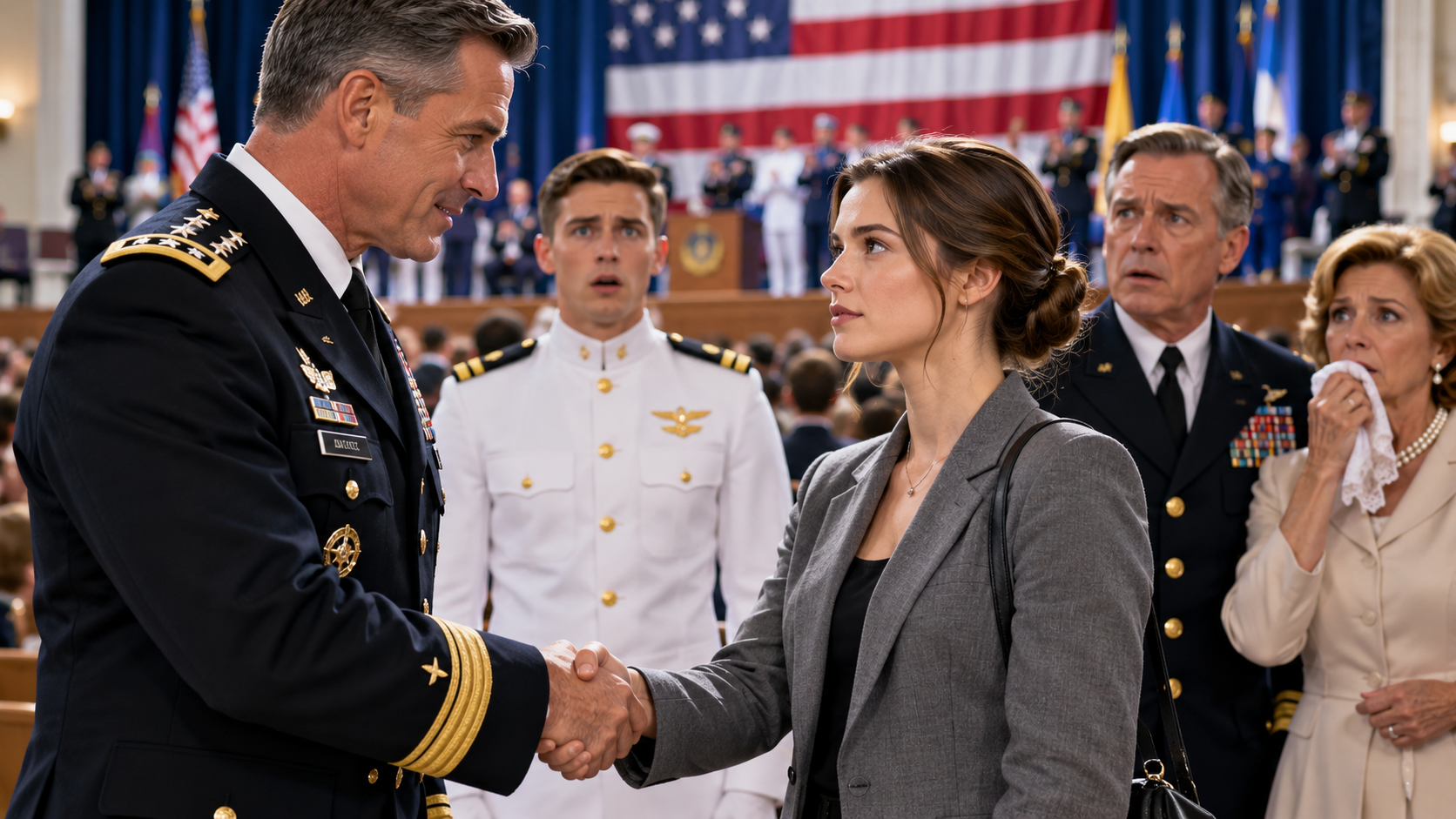
Then, at his Navy SEAL ceremony, a senior general walked past my father, ignored my mother, stopped in front of me, and said, “Oh wow. You actually came?”
The entire room went silent.
And my brother’s face changed.
Not slowly.
Not with confusion.
Instantly.
Like a man who had just realized the joke he had been telling for twelve years had always been about him.
My name is Claire Mercer.
That morning, I stood near the rear exit of a crowded auditorium in a gray blazer, black slacks, and low heels while my younger brother, Luke, waited to receive his SEAL trident beneath a ceiling draped with American flags.
I had deliberately chosen a place where almost nobody would notice me.
Rear of the room.
Near an exit.
Clear sight lines.
Old habits.
My parents sat in the first row.
Dad had taken the aisle seat.
Of course he had.
Even six years after retirement, Captain Edward Mercer still sat like a man expecting someone to call the room to attention.
His back was straight.
His silver hair was trimmed close.
His dark suit looked nearly military.
One hand rested on his knee while the other gripped the program.
He had circled Luke’s name in blue ink.
I knew that because I had seen him do it before taking his seat.
Mom sat beside him in pale blue, already holding the monogrammed handkerchief she brought to graduations, weddings, military ceremonies, funerals, and apparently anything else she considered important enough to cry at.
Neither of them had looked back at me.
They knew I was there.
Mom had seen me enter.
Our eyes had met for less than two seconds.
She gave me the small, careful smile she used with distant relatives and people she felt sorry for.
Then she turned back around.
That was normal.
For twelve years, I had been the disappointment.
The daughter who had gone to the Naval Academy and failed to finish.
The one everyone had expected too much from.
The warning story.
The almost.
Luke made sure nobody forgot.
“Claire couldn’t take the pressure.”
That was his favorite version.
Sometimes he said it with a laugh.
Sometimes he shrugged, as if my failure was simply one of those unfortunate truths a family learned to live with.
Sometimes, after enough drinks, he called me a dropout.
Dad never corrected him.
Mom occasionally did, but only in the weakest possible way.
“Luke, don’t tease your sister.”
Tease.
As if humiliation became harmless when you gave it a smaller name.
I learned a long time ago not to react.
Reaction gave people something to work with.
Silence gave them nothing.
So when Luke’s name was announced, I stood with everyone else.
Dad shot to his feet.
“That’s my boy!”
A few people laughed warmly.
Mom started crying before Luke even reached center stage.
My brother stepped forward in spotless white.
He looked good.
There was no bitterness in admitting that.
Luke had spent years earning the right to stand there.
He had been cold, exhausted, injured, tested, deprived of sleep, pushed beyond limits most people would never voluntarily approach.
Whatever existed between us did not erase that.
When the trident was pinned to his uniform, the auditorium erupted.
Dad clapped hard enough that his palms turned red.
Mom pressed the handkerchief over her mouth.
Luke’s face held the expression I remembered from childhood whenever he won something.
Pride.
Relief.
And the need to know everyone had seen him win.
I applauded too.
Quietly.
Then the secure phone inside my blazer vibrated against my ribs.
One hard pulse.
Two short ones.
Every muscle in my body changed before my expression did.
Priority traffic.
I slipped one hand inside my blazer and pulled out the device.
It looked ordinary.
It wasn’t.
I turned slightly toward the wall and checked the encrypted message.
PACKAGE RECOVERED.
ALL PERSONNEL ACCOUNTED FOR.
PHASE THREE AUTHORIZED.
For one second, the noise around me faded.
Twenty-seven hours earlier, six people had been trapped beyond a collapsing extraction corridor in Eastern Europe.
Their primary route had failed.
Their secondary route was compromised.
Communications were unreliable.
Weather had closed one option.
Political restrictions had eliminated another.
By the time the problem reached my desk, people in three different rooms were already using words like impossible, unacceptable risk, and contingency loss.
I hated that last phrase.
Contingency loss.
It sounded clean.
Administrative.
Like six human beings could become a line in a briefing slide.
I had spent fourteen hours rebuilding the extraction around an assumption everyone else had treated as fixed.
It wasn’t fixed.
Very few things were.
By hour nineteen, we had a route.
By hour twenty-two, people far braver than me were moving through it.
And now they were out.
All six.
Alive.
I read the message twice.
Not because I doubted it.
Because sometimes relief needed a moment to become real.
Then I deleted the message and returned the device to the inner pocket of my blazer.
My breath eased.
The ceremony continued.
Nobody around me knew.
That was the point.
My parents believed I processed insurance claims in a government office near Arlington.
Mom occasionally mailed me links to federal clerical positions because she worried I had “stalled professionally.”
Dad once asked whether I had considered getting an accounting certificate.
Luke told people I had found “a safe desk job after the Academy thing.”
I never corrected them.
Some careers depended on people not knowing what you actually did.
Other truths were classified.
And some truths became private simply because the people closest to you had proven they did not deserve them.
I looked toward the stage again.
That was when Luke noticed me.
Our eyes met.
His smile cracked for half a second.
Then the familiar smirk appeared.
I knew that smile.
Three weeks earlier, he had called me.
Not to ask whether I was coming.
To warn me how to behave when I did.
“This is formal, Claire.”
“I know.”
“There’s a dress code.”
“I’m familiar with dress codes.”
He had laughed.
“This isn’t one of your office mixers.”
I remember looking through the glass wall of a secure conference room while a two-star admiral argued with an intelligence director twelve feet away.
“I’ll manage,” I said.
“And don’t start talking about the Academy.”
I went quiet.
Luke continued.
“Today isn’t about old failures.”
Old failures.
My hand had tightened around the phone.
“Understood.”
He mistook restraint for surrender.
People did that a lot.
Now the ceremony ended.
Families surged forward.
Chairs scraped.
Voices rose.
Cameras appeared.
Children ran into aisles.
Parents embraced sons.
Wives embraced husbands.
Friends shouted congratulations.
I stayed where I was.
I had attended because Luke was my brother.
I had not come to compete.
I had not come to punish him.
And I certainly had not come to turn his ceremony into a referendum on me.
I planned to wait until the crowd thinned, congratulate him privately, and leave.
Then the room shifted.
It happened the way it always did when someone important entered a space already filled with military people.
Conversations lowered.
Spines straightened.
Heads turned.
A senior officer crossed the auditorium from a side entrance.
Major General Marcus Hale.
Two aides followed several steps behind.
Dad noticed him immediately.
So did Luke.
General Hale was the kind of man people recognized even if they had never met him.
Broad shoulders.
Close-cropped gray hair.
A face that looked calm because he had spent decades learning the difference between urgency and panic.
Dad stepped subtly away from the crowd surrounding Luke.
I knew what he was doing.
Making himself available.
He had done the same thing at every military event of my childhood.
Position yourself where the senior officer can notice you.
Not enough to look desperate.
Just enough to create opportunity.
General Hale approached.
Dad smiled.
“General.”
Hale gave him a polite nod.
Then kept walking.
Luke straightened.
The general passed him too.
That got everyone’s attention.
He moved directly toward the rear of the room.
Toward me.
I felt the blood drain slightly from my face.
Not because I was afraid of him.
Because General Hale was not supposed to make my life complicated.
He stopped three feet in front of me.
For a second he simply stared.
Then his professional expression broke.
Genuine surprise.
“Oh wow,” he said. “You actually came?”
Silence rolled outward from us.
I could feel people turning.
My father.
My mother.
Luke.
Former officers.
Current officers.
Families who had never heard my name.
I gave Hale a look that I hoped communicated several things at once.
Mostly: Please do not do this here.
He either failed to understand it or chose to ignore it.
Probably the second.
“I said I would try,” I replied.
“I thought you were still tied up.”
“Finished earlier than expected.”
Something flickered in his eyes.
He understood exactly what I meant.
“Good outcome?”
“All accounted for.”
The general exhaled.
“Outstanding.”
Behind him, I saw Luke’s expression change from confusion to alarm.
General Hale extended his hand.
“Major Mercer.”
That title hit my family harder than any accusation I could have made.
Mom’s handkerchief stopped halfway to her face.
Dad stared at me.
Luke’s mouth opened.
Closed.
Opened again.
I shook the general’s hand.
“Sir.”
“You look exhausted.”
“I’ve looked worse.”
“That is unfortunately true.”
A few people nearby laughed uncertainly.
Nobody in my family did.
General Hale glanced over my shoulder toward the exit.
“Were you planning to disappear before I found you?”
“That was the idea.”
“Typical.”
Then his gaze shifted toward Luke.
He recognized the trident.
His expression warmed.
“This must be your brother.”
There was no way out now.
I turned.
Luke stood ten feet away.
For perhaps the first time in his life, my younger brother looked at me as though he had no idea who I was.
“Luke,” I said quietly, “this is Major General Marcus Hale.”
Luke recovered enough to step forward.
“Yes, ma’am—sir.”
Hale smiled slightly.
“Congratulations.”
“Thank you, General.”
Luke looked from Hale to me.
Then back.
His eyes stopped on the general.
“Did you call her Major?”
No one breathed.
Hale’s eyebrows rose.
“I did.”
Dad stepped closer.
“General, forgive me.”
His voice had changed.
The booming retired-captain certainty was gone.
“What exactly is my daughter a major in?”
I closed my eyes for half a second.
There were moments when classified information was easier than family.
This was one of them.
Hale looked at me.
Not for permission.
For guidance.
I answered before he could.
“The Marine Corps.”
Dad went completely still.
Luke stared at me.
Mom whispered my name.
“Claire?”
I forced myself to meet their eyes.
“Yes.”
Dad’s face tightened.
“No.”
One word.
Flat.
Certain.
As though reality had submitted paperwork incorrectly.
“You left the Academy.”
“I did.”
“You never received a commission.”
“I did.”
“When?”
“Later.”
His voice rose.
“Later when?”
People were watching now.
I hated that.
Luke had earned this ceremony.
Whatever came next should not happen in the middle of it.
“Not here.”
Dad laughed once.
There was no humor in it.
“You’re standing in front of a general who just called you Major Mercer, and you expect me to accept ‘not here’?”
General Hale stepped in gently.
“Captain Mercer.”
Dad looked at him.
The old rank landed differently coming from Hale.
“I realize this is unexpected,” the general said. “But I can tell you one thing without crossing any lines.”
Dad waited.
Hale looked at me.
Then back at my father.
“Your daughter did not fail the United States Navy.”
The silence became absolute.
“And she did not leave because she couldn’t handle the pressure.”
Luke’s face changed again.
This time there was no confusion left.
Only the slow arrival of something much worse.
Memory.
Twelve years of jokes.
Twelve years of stories.
Twelve years of repeating a version of my life he had never once bothered to verify.
General Hale gave me a final nod.
“I’ll let you handle the family briefing.”
I almost laughed.
“Thank you, sir.”
“That wasn’t sympathy, Major.”
“I know.”
He shook Luke’s hand.
“Congratulations again.”
Then he left.
People gradually started talking.
Not normally.
In whispers.
Dad stared at me.
Mom looked close to tears for an entirely different reason.
Luke stood frozen.
Finally he said, “You’re a major?”
“Yes.”
“An actual major?”
I looked at him.
“What other kind is there?”
His cheeks flushed.
Under any other circumstances, I might have regretted the answer.
I didn’t.
Dad lowered his voice.
“We need to talk.”
Mom nodded quickly.
“Yes.”
Luke said nothing.
I looked at the trident on his uniform.
Then at my brother’s face.
“I came here for one reason.”
He swallowed.
“What?”
“To tell you congratulations.”
He flinched.
I don’t think he had expected kindness.
That made two of us.
I held his gaze.
“You earned today, Luke.”
Then I turned toward the exit.
Dad caught my arm.
Not hard.
But enough.
“Claire.”
I stopped.
For twelve years, I had let them believe I was the family failure because duty required silence.
But duty had never required me to accept cruelty.
That part had been my choice.
And as I looked at my father’s hand on my arm, I realized something I should have understood years earlier.
The classified part of my life was not what stood between us anymore.
The unclassified part was.
I gently removed his hand.
“You want to know what happened?”
Dad nodded.
Luke didn’t move.
Mom whispered, “Please.”
I looked at all three of them.
“Then for once, you’re going to hear the version nobody ever asked me for.”
And twelve years after I walked away from Annapolis, my family finally learned that I had never walked away from service at all.
PART 2: THE STORY THEY PREFERRED
The first time Luke called me a dropout, I had been home less than forty-eight hours.
I was twenty-one.
He was seventeen.
Dad was furious.
Mom was terrified.
And I was under written orders not to explain why I had left the Naval Academy.
People imagine major turning points arrive with dramatic music.
They don’t.
Sometimes they arrive in a beige office with fluorescent lights and a document pushed across a table.
Mine began four weeks before I left Annapolis.
I had been in my third year.
Until then, I had done exactly what everyone expected of a Mercer.
I performed well.
Not brilliantly enough to draw attention.
Not poorly enough to invite concern.
I ran when I was supposed to run.
Studied when I was supposed to study.
Passed inspections.
Followed orders.
Learned navigation.
Leadership.
Systems.
History.
Ethics.
The thousand visible things the Academy teaches you.
And then there were the things people noticed when they were trying to figure out what kind of officer you might become.
Under pressure, I got quieter.
When everyone else accelerated, I slowed down.
I liked problems with missing information.
I liked finding the assumption nobody had questioned.
I liked exercises where the obvious plan failed.
During one joint planning simulation, our team was given a deteriorating situation involving a stranded diplomatic group, limited air access, hostile surveillance, and a narrow time window.
It was supposed to be unwinnable.
That was the lesson.
Recognize constraints.
Accept losses.
Prioritize.
I hated the premise.
So I broke one of the assumptions.
Not a rule.
An assumption.
The exercise controllers had treated a damaged coastal transport route as unusable.
I asked whether unusable meant physically impossible or merely operationally undesirable.
Nobody knew.
So I rebuilt the plan around it.
We finished the simulation with every notional civilian recovered and no notional friendly casualties.
Afterward, while everyone else went to dinner, I was told to report to an administrative building.
I expected disciplinary questions.
Instead, there were three people waiting.
One was a Navy captain.
One was a civilian woman who never gave me her job title.
The third was Lieutenant Colonel Marcus Hale.
Years before he became General Hale.
He looked younger then.
Not young.
Just less tired.
They asked me to explain my reasoning.
I did.
They changed variables.
I adapted.
They asked why I had ignored the consensus.
“I didn’t ignore it.”
Hale watched me.
“What did you do?”
“I checked whether it was based on facts.”
The civilian woman smiled.
That should have warned me.
Three interviews followed.
Then six.
I completed assessments I was not allowed to discuss.
Languages.
Pattern recognition.
Operational planning.
Stress interviews.
Psychological screening.
Background investigations so deep that people from my elementary school years later told Mom someone had asked about me.
She assumed it was routine clearance work.
It wasn’t.
At the end, they offered me a path I had never heard of.
A compartmented joint program.
A tiny one.
The kind that used military people, intelligence officers, analysts, planners, language specialists, and operators from different branches without caring much what the public thought their job titles meant.
There was a problem.
My path through the Academy was too visible.
My family was too connected.
Dad knew too many people.
The program required a different educational route, a separate commissioning process later, and a personnel record that would make questions boring enough that most people stopped asking.
Administrative withdrawal.
No scandal.
No misconduct.
No dramatic explanation.
Just gone.
I remember staring at the paperwork.
“What am I supposed to tell my family?”
The civilian woman looked at Hale.
He answered.
“As little as possible.”
“My father is a Navy captain.”
“Which is exactly why he cannot be casually read into this.”
“He’ll think I failed.”
Hale’s eyes stayed on mine.
“That is possible.”
Possible.
I almost laughed.
I knew my father.
It was inevitable.
I asked for two days to decide.
That night I barely slept.
The Academy had been my father’s dream before it became mine.
He had graduated decades earlier.
Our house was full of ship photographs, challenge coins, plaques, framed citations, and one picture of Dad as a young officer standing on a flight deck with a grin I almost never saw in adulthood.
He had raised Luke and me inside the mythology of service.
Duty mattered.
Sacrifice mattered.
Honor mattered.
Mission before self.
I believed him.
That was the problem.
Because when I was finally asked to sacrifice something he cared about, I understood that the words were easier than the act.
If I stayed, I could finish Annapolis.
Wear the uniform.
Make Dad proud.
Follow a respectable career everyone could understand.
If I left, I could enter a world I already knew fit the way my mind worked.
I could become useful in ways I had never imagined.
But nobody I loved would clap for it.
That terrified me more than any test they gave me.
I accepted anyway.
Dad did not come to help me pack.
He sent Mom.
His exact words, relayed by her while we folded clothes into cardboard boxes, were, “She made the decision. She can live with it.”
Mom kept asking what happened.
I told her I couldn’t explain.
She mistook couldn’t for wouldn’t.
“Did someone hurt you?”
“No.”
“Were your grades bad?”
“No.”
“Did you violate something?”
“No.”
“Then why, Claire?”
I looked at my mother and wanted more than anything to tell her.
Instead I said, “It’s complicated.”
She cried in the car.
When we reached home, Dad was in his study.
He waited until dinner.
Luke kept staring at me.
He had spent his entire childhood following me.
When I joined the swim team, he joined.
When I wanted Annapolis, suddenly he talked about special operations.
He loved me.
I knew that.
But siblings can love you and still build their identity by trying to beat you.
Dad put his fork down.
“You understand what you threw away?”
“Yes.”
“I don’t think you do.”
I said nothing.
“What happened?”
“I can’t discuss everything.”
His expression hardened.
“You can’t discuss it with your own father?”
“No.”
“Claire.”
“Dad.”
“Was it discipline?”
“No.”
“Academic?”
“No.”
“Then tell me.”
“I can’t.”
His jaw tightened.
“Then I have to assume the worst.”
That sentence stayed with me for twelve years.
Not because he was wrong to be confused.
Because he chose the worst.
Luke made his first joke two days later.
A family friend stopped by.
He asked why I was home.
Before I could answer, Luke said, “Academy finally broke her.”
He laughed.
I looked at him.
He grinned.
Dad heard.
He did not correct him.
That was how stories begin.
Not with proof.
With silence.
Three months later, people in our community had a version.
Claire Mercer couldn’t handle Annapolis.
Six months later, it became:
Claire washed out.
A year later:
Claire cracked under pressure.
By the time Luke entered his own military path, my failure had become part of his origin story.
“My sister tried the Academy,” he told people. “It wasn’t for her.”
Then came the smile.
“I guess one of us had to finish what we started.”
Meanwhile, I finished my degree through the route the program arranged.
I completed training in buildings with no signs.
I learned how to brief people who outranked me by decades.
I learned what information looked like when six agencies each owned a different piece of it.
I learned how quickly elegant plans died when they touched the real world.
I learned to build alternatives.
Then alternatives to the alternatives.
I received my commission through a path my family never saw.
Marine Corps.
The branch choice surprised people who knew me then.
It made perfect sense to me.
The Marines gave me a professional home.
The joint world gave me my actual work.
My first promotion happened quietly.
So did the next.
When I made captain, Mom called me that evening to tell me Luke had completed another training milestone.
I congratulated him.
She asked about my office.
“Still doing insurance?”
“Something like that.”
“Have you thought about applying for management?”
“I’ll consider it.”
When I made major, Dad mailed me a newspaper clipping about federal retirement benefits.
I kept it.
I don’t know why.
Maybe because pain sometimes becomes funny if you preserve it long enough.
Or maybe because some part of me kept waiting for the day I could tell them.
That day never came.
There was always another assignment.
Another restriction.
Another reason.
And eventually, something inside me changed.
At first, I kept the truth because I had sworn to.
Later, I kept it because I had learned something about my family I didn’t want to admit.
They treated me differently when they believed I had no impressive title.
Dad interrupted me more.
Luke mocked me freely.
Mom pitied me.
At reunions, people asked about Luke’s career before they asked whether I was still living in Virginia.
And I began wondering:
If respect only appeared after they knew my rank, what exactly would that respect be worth?
So I stopped wanting to tell them.
Not forever.
Just not for them.
Which was how I ended up twelve years later, sitting in a private lounge near the auditorium while my father paced in front of me like he was preparing for a board of inquiry.
Luke stood by the window.
Mom sat on a couch with her handkerchief twisted between both hands.
Nobody spoke for almost thirty seconds.
Dad broke first.
“Start at the beginning.”
I looked at him.
“No.”
His eyebrows lifted.
“What?”
“I’m not giving you a classified briefing because General Hale accidentally used my rank in public.”
“I am not asking for classified material.”
“You’re asking me to justify my life.”
“I’m asking my daughter how she secretly became a Marine Corps major.”
“Those are different questions.”
Dad stopped pacing.
Luke finally turned around.
“Were you really doing government insurance work?”
I looked at him.
“No.”
He let out a breath.
Mom whispered, “Then what do you do?”
“I work in joint operational planning.”
Dad’s stare sharpened.
“For whom?”
“I’m not answering that.”
“Where?”
“I’m not answering that either.”
Luke folded his arms.
“You expect us to believe this?”
That almost made me smile.
“You watched a major general call me by rank.”
“I know what I saw.”
“Then why are you asking me to prove it?”
His face tightened.
Because proof was not really what he wanted.
He wanted the world to go back to making sense.
In that world, Luke was the success.
I was the cautionary tale.
He had just received one of the proudest symbols of his career.
And somehow, in less than five minutes, a single word had shattered the hierarchy our family had lived inside for more than a decade.
Major.
Mom stared at me.
“Were you deployed?”
“Sometimes.”
Her face went pale.
“Overseas?”
“Mom.”
“Were you in danger?”
I softened.
“Sometimes.”
She covered her mouth.
Dad looked away.
Luke said, “You said you worked near Arlington.”
“I often do.”
“You let us think you filed claims.”
“I told you I worked for the government.”
“You never corrected us.”
“No.”
His voice rose.
“For twelve years?”
I felt something old wake up inside me.
Not rage.
Rage burns hot.
This was colder.
“For twelve years,” I said, “you never asked me a question you didn’t already think you knew the answer to.”
Luke stared at me.
“That’s not fair.”
“Isn’t it?”
“I asked what happened at the Academy.”
“No. You told me what happened.”
“I was seventeen.”
“At first.”
That landed.
“You were eighteen when you repeated it at Dad’s retirement dinner.”
Luke looked down.
“Nineteen when you told your friends I cracked under pressure.”
Silence.
“Twenty-one when you said I couldn’t hack military life.”
His jaw tightened.
“Twenty-four when you introduced me to your girlfriend as ‘the Mercer who washed out.’”
Mom whispered, “Luke.”
I kept going.
“And three weeks ago, you told me not to talk about old failures at your ceremony.”
He looked at me.
I had never seen my brother without an answer before.
It should have felt good.
It didn’t.
It felt tired.
Dad stepped between us emotionally if not physically.
“That still doesn’t explain why you didn’t tell me.”
I turned toward him.
“You really want that answer?”
“Yes.”
“No, Dad.”
My voice was calm.
“You want an answer that leaves you innocent.”
His face changed.
I saw the officer rise in him.
The man who could command.
Control.
Correct.
“What is that supposed to mean?”
“It means the first time I came home, I told you there were things I couldn’t explain.”
“You were twenty-one.”
“Yes.”
“You had just abandoned the Academy.”
“I transferred out of a visible path.”
“I did not know that.”
“Exactly.”
He opened his mouth.
I continued.
“You didn’t know. So you made a choice.”
“What choice?”
“To assume the worst.”
His own words.
Twelve years later.
Returned intact.
Dad went silent.
Mom began crying.
Not loudly.
That would have been easier.
She just sat there with tears slipping down her cheeks.
I looked away because I could handle anger better.
Luke pushed away from the window.
“Why did General Hale know about whatever happened yesterday?”
I turned back.
He had caught that.
Of course he had.
He was trained now to notice fragments.
I almost felt proud.
“He’s in my chain of professional relationships.”
“What happened yesterday?”
“I can’t tell you.”
“Were people in danger?”
I hesitated.
“Yes.”
“And you were involved?”
“Yes.”
“How?”
“Planning.”
He stared at me for a long moment.
“Did it work?”
I thought of the message.
ALL PERSONNEL ACCOUNTED FOR.
“Yes.”
“How many?”
I should not have answered.
Maybe I was tired.
Maybe I wanted my brother to understand one inch of the world he had mocked.
“Six.”
Luke looked toward the floor.
When he raised his eyes again, the arrogance was gone.
Not permanently.
People do not transform in seconds.
But it had cracked.
“What kind of planning?”
“The kind where mistakes come home in flag-covered boxes.”
Mom made a small sound.
I immediately regretted the line.
Dad sat down.
For the first time since entering the room, he looked his age.
Luke touched the trident on his chest.
Then he looked at me differently.
Not as his failed sister.
Not even as Major Mercer.
As someone whose work had suddenly become adjacent to his own future.
“You plan missions for people like us?”
I chose my words carefully.
“Sometimes.”
He swallowed.
The room fell quiet.
Then he said the one thing I had not expected.
“Why did you come today?”
I frowned.
He looked genuinely confused.
“After everything I said.”
My throat tightened.
“You’re my brother.”
“That’s it?”
“That’s enough.”
His face twisted slightly.
I recognized shame.
Real shame.
Not embarrassment over being exposed.
Something deeper.
He looked away.
And for the first time that day, I realized the revelation might hurt Luke more than I had intended.
Because my rank had not merely proven him wrong.
It had forced him to see exactly what kind of man he had been while he thought I was beneath him.
PART 3: WHAT THE TRUTH COST
The reception was worse.
Not because anyone insulted me.
Because suddenly everyone wanted to be kind.
I preferred the insults.
Insults were honest.
Kindness that appeared after people discovered your rank had to be examined carefully.
Dad’s old friends drifted toward me one by one.
Men and women who had spent years asking whether I had “found my footing.”
Now they shook my hand differently.
One retired commander remembered meeting me when I was a teenager.
Another told me he had “always suspected there was more to the story.”
There wasn’t.
He had once asked Dad, in front of me, whether some people simply weren’t built for service.
Dad had answered, “Apparently.”
Nobody mentioned that.
Luke stayed surrounded by his teammates and instructors.
As he should have.
I kept my distance.
I did not want to steal his day.
But rumors move faster than orders in a military room.
Within thirty minutes, enough people had heard that Luke Mercer’s dropout sister was actually Major Claire Mercer that I began catching glances everywhere I turned.
I hated it.
The secure phone remained silent.
That helped.
It meant the situation overseas remained stable.
Mom found me near a table of coffee and untouched pastries.
“Can we talk?”
I nodded.
We stepped into a corridor.
For a moment she only looked at me.
Then she said, “I sent you job listings.”
I almost smiled.
“Yes.”
“For clerical positions.”
“Yes.”
“Oh God.”
“Mom.”
“I told Aunt Susan you were afraid to apply for management because the Academy damaged your confidence.”
That one was new.
I blinked.
“You said what?”
Her face crumpled.
“I thought I was defending you.”
“From whom?”
“People talked.”
“And your solution was to invent a reason?”
“I didn’t know.”
There it was again.
The family motto.
We didn’t know.
As if ignorance removed responsibility for everything people did with it.
I leaned against the wall.
“I understand that you didn’t know what I was doing.”
She wiped her face.
“But?”
“But you knew me.”
Her eyes filled again.
“You knew I wasn’t lazy.”
She nodded.
“You knew I had never run away from hard things.”
Another nod.
“You knew I told you there were things I couldn’t explain.”
“Yes.”
“And somehow the version everyone chose was that I failed and was too ashamed to admit it.”
Mom closed her eyes.
“I should have defended you.”
“Yes.”
The word hurt her.
I let it.
Forgiveness that arrives before truth is just another form of avoidance.
She whispered, “I’m sorry.”
It was the first apology anyone in my family had offered that day.
Not an explanation.
Not a justification.
Not confusion.
An apology.
I looked at my mother.
“I believe you.”
She seemed startled.
“That doesn’t mean everything is fixed.”
“I know.”
“But I believe you’re sorry.”
She nodded.
Then, because she was still my mother, she reached toward me and stopped halfway.
“Can I hug you?”
That nearly broke me.
For years she had hugged me out of pity.
This was the first time she had asked permission.
I stepped forward.
She wrapped her arms around me.
I held her carefully.
For a few seconds, I was twenty-one again.
Standing in my old bedroom.
Cardboard boxes on the floor.
My mother asking what she had done wrong.
Me unable to answer.
Then I stepped back.
She looked at my blazer.
“Do you ever wear a uniform?”
“Yes.”
“I’ve never seen you in it.”
“No.”
Her voice broke.
“Could I someday?”
I hesitated.
Then nodded.
“Maybe.”
She smiled through tears.
It was enough.
Dad’s apology did not come so easily.
I found him ten minutes later standing alone near a display case.
He was staring at photographs of special operations teams from previous classes.
“Your mother says I owe you an apology.”
I stopped beside him.
“Do you?”
He looked at me.
“I don’t appreciate the tone.”
I almost laughed.
There he was.
Captain Mercer.
“I’m not one of your junior officers, Dad.”
“I am aware.”
“Then don’t talk to me like one.”
His jaw flexed.
He stared at the photographs again.
“I was angry when you left.”
“I know.”
“You humiliated me.”
That sentence surprised me.
Not because I had never suspected it.
Because he said it aloud.
I turned.
“Humiliated you?”
“People asked questions.”
“You mean people asked why your daughter left the Academy.”
“Yes.”
“And that humiliated you.”
“You don’t understand what it was like.”
For twelve years, I had trained myself not to need his approval.
That sentence proved I still did.
Because it hurt.
I lowered my voice.
“You’re right. I don’t.”
He looked at me.
“I was the one who left.”
Dad flinched.
“I was twenty-one years old, Dad. I lost my classmates, my routine, my public identity, the path I thought I was taking. I went into a program where I knew almost nobody. I was told I couldn’t explain myself to the people closest to me. And the first thing you worried about was what your friends thought.”
“That is not fair.”
“It’s exactly what you just said.”
He turned fully toward me.
“I thought you had thrown your future away.”
“You thought.”
“You gave me no alternative explanation.”
“I told you I couldn’t.”
“That was not enough.”
“It should have been enough for you not to help Luke turn me into a family joke.”
Dad said nothing.
There are arguments where winning feels powerful.
This wasn’t one.
This felt like excavating a grave.
After several seconds, he said, “I never told Luke to say those things.”
“You laughed.”
“I did not.”
“At Dad Mercer’s retirement barbecue?”
He froze.
He remembered.
Luke had been twenty.
A family friend asked what I was doing.
Luke said, “Mostly proving why Mercers shouldn’t quit halfway.”
People laughed.
Dad had smiled into his beer.
I remembered because I had watched him.
“I didn’t stop him,” Dad said finally.
“No.”
His voice lowered.
“I should have.”
“Yes.”
He looked older again.
Then something happened I had not expected.
My father’s eyes filled.
He did not cry.
Edward Mercer did not cry in public.
But they filled.
“When did you make major?”
“Eight months ago.”
He nodded slowly.
“I didn’t know.”
“No.”
“Did anyone attend?”
I looked at him.
The promotion ceremony had been small.
General Hale pinned one side.
Colonel Ramirez pinned the other.
Three members of my team attended.
So did a civilian director who had flown in from another city.
Afterward we ate bad cake in a secure conference room.
I had been happy.
But that night I sat alone in my apartment with a glass of wine and looked at the one photograph I was allowed to keep.
For ten minutes, I almost called Mom.
I didn’t.
“There were people there,” I said.
Dad absorbed that.
“People who mattered?”
“They matter to me.”
He nodded.
Another blow.
Not intentional.
But true.
“You built an entire life without us.”
“No.”
I shook my head.
“You chose not to see the life I was allowed to show you.”
He looked at me.
“That’s different.”
We stood in silence.
Finally he said, “I was proud of Luke because his path made sense to me.”
I waited.
“I think somewhere along the way, I punished you because yours didn’t.”
That was closer to an apology.
Not perfect.
But closer.
He looked down.
“I’m sorry, Claire.”
I had waited twelve years.
The strange thing was, when it came, I did not feel victorious.
I felt tired.
“Thank you.”
He looked almost disappointed.
Maybe he wanted absolution.
I wasn’t ready to give it.
Neither of us pretended otherwise.
Then Luke appeared at the far end of the corridor.
He waited until Dad walked away.
For several seconds, my brother and I stood facing each other.
His trident caught the light.
He looked like every photograph Dad had imagined.
Strong.
Disciplined.
Successful.
And miserable.
“I need to ask you something.”
“Go ahead.”
“How much of what I said did you hear?”
I stared at him.
“You’re going to have to be more specific.”
He winced.
“That bad?”
“Luke.”
He rubbed a hand over the back of his neck.
“I told people stories.”
“I know.”
“I mean a lot of people.”
“I know.”
“Teammates. Instructors. Friends.”
“I know.”
“How?”
“You repeated the same jokes for years.”
“No, I mean today.”
I glanced toward the reception room.
“People talk.”
He looked sick.
I almost felt sorry for him.
Almost.
“I never thought—”
“I know.”
He stopped.
Maybe he finally heard how useless those words sounded.
He tried again.
“I thought you quit.”
“I did leave the Academy.”
“You know what I mean.”
“Yes.”
He looked at the floor.
“When I was a kid, everything was Claire.”
That surprised me.
I said nothing.
“You got better grades. Dad talked about your Academy application constantly. Coaches liked you. Teachers liked you. You always knew what you wanted.”
“That’s not true.”
“It felt true.”
He swallowed.
“When you came home, it was the first time I saw you fail at something.”
There was the word.
Fail.
“I think I liked it.”
The honesty stopped me.
Luke’s voice dropped.
“That sounds terrible.”
“It is terrible.”
“I know.”
He accepted it.
No defense.
No joke.
No counterattack.
Just accepted it.
“I finally had something you didn’t.”
I looked at his trident.
“And eventually,” he continued, “I think I needed you to stay the failure because it made me feel like the successful one.”
My anger shifted.
Not disappeared.
Shifted.
Luke stared at me.
“Then today Hale called you Major.”
“General Hale.”
A tiny, humorless smile touched his mouth.
“Right.”
He exhaled.
“And suddenly every story I’ve told about you makes me look like an idiot.”
I shook my head.
“That’s not the problem.”
His eyes narrowed.
“What is?”
“The problem is you thought those stories were acceptable when you believed they were true.”
He went still.
“If I really had cracked under pressure, would I have deserved twelve years of humiliation?”
“No.”
“If I really had failed, would that have made you better?”
“No.”
“If I really processed insurance claims for a living, would that make my work worthy of your contempt?”
He closed his eyes.
“No.”
“That’s the part you need to understand.”
He nodded.
Slowly.
“I do.”
“No. You’re starting to.”
He looked at me.
I could see that he wanted forgiveness.
I loved him enough not to fake it.
“I’m proud of what you did to earn that trident,” I said.
His eyes dropped.
“But I am not ready to pretend the last twelve years disappeared because you’re embarrassed today.”
“I know.”
“You may have to sit with this.”
“I know.”
For once, he really seemed to.
He turned to leave.
Then stopped.
“Claire?”
“Yes?”
“Those six people.”
I waited.
“You said they got out.”
“Yes.”
“Because of your plan?”
I considered the question.
“No operation belongs to one person.”
“That’s not what I asked.”
I looked at my brother.
The future SEAL.
The man who might someday be on the other side of a plan written by someone like me.
“My plan gave them a route.”
He nodded.
Then he touched the trident on his chest.
Not proudly this time.
Thoughtfully.
“I spent years calling you weak.”
“Yes.”
“I’m sorry.”
He walked away before I could answer.
And for the first time that day, I believed he understood the size of what he had done.
PART 4: THE LIFE THEY NEVER SAW
After Luke’s ceremony, nothing magically became normal.
Truth doesn’t work that way.
It doesn’t enter a room, reveal itself, and repair everything it exposes.
Sometimes truth is the demolition crew.
Repair comes later.
For the first two weeks, my family overcorrected.
Mom called almost every day.
She asked what I could tell her about work.
Usually the answer was not much.
She asked anyway.
Dad sent articles about Marine Corps history as if I had somehow missed the subject during my career.
Then he sent me a text that said:
I realize you probably know this already.
That was progress.
Luke went silent.
I expected that.
He had more to process than anyone.
Then one evening, three weeks after the ceremony, my phone rang.
My normal phone.
Luke.
I considered letting it go to voicemail.
Then answered.
“Hey.”
“Hey.”
Silence.
I waited.
He said, “I corrected somebody today.”
“What?”
“One of the guys called you the Academy dropout.”
I leaned back in my chair.
“What did you say?”
“I told him I was wrong.”
That was all.
No dramatic speech.
No demand for praise.
I looked out my apartment window at the lights across Arlington.
“Thank you.”
“I should’ve done it years ago.”
“Yes.”
Another silence.
Then Luke said, “I don’t actually know what to tell people.”
“Tell them I left the Academy and you don’t know the details.”
“That’s it?”
“That’s the truth.”
“You don’t want me telling them you’re a major?”
“No.”
He laughed softly.
“Of course you don’t.”
“What does that mean?”
“You spent twelve years not caring whether anyone knew you were successful.”
“That is absolutely not true.”
He went quiet.
I smiled despite myself.
“I cared.”
“Really?”
“Luke, I’m human.”
“I guess I thought—”
“That I’m some emotionally invincible classified robot?”
“Maybe.”
“I cared every time.”
His voice changed.
“Oh.”
“I cared when Dad didn’t stand up for me. I cared when Mom sent me job listings. I cared when you made jokes.”
I paused.
“I just had work that mattered more than correcting you.”
He absorbed that.
“I’m sorry.”
“I know.”
It became our strange new pattern.
Not forgiveness.
Reconstruction.
He stopped using me as a punchline.
Then he started calling without needing anything.
Sometimes he asked about Dad.
Sometimes Mom.
Once he asked me what I thought leadership looked like when everyone around you was exhausted.
That question meant more to me than he knew.
I answered as carefully as I could.
“People remember whether you made their hardest day about the mission or about your ego.”
Luke went silent.
Then said, “That sounded targeted.”
“It was free advice.”
He laughed.
A real laugh.
Not at me.
With me.
I had missed that sound.
Dad took longer.
He invited me to dinner six weeks after the ceremony.
Just the two of us.
A steakhouse he liked outside Annapolis.
I almost declined.
Then I decided some doors only remain open if someone walks through them.
He arrived ten minutes early.
I arrived exactly on time.
Old Mercer habits.
For most of dinner, we talked about safe things.
Traffic.
Mom’s garden.
Luke.
The Orioles.
Then Dad put down his fork.
“I found an old box.”
I waited.
“Your Academy things.”
My chest tightened.
“I thought Mom had those.”
“She gave them to me years ago.”
He reached into his jacket and placed something on the table.
A photograph.
Me at nineteen.
White uniform.
Dark hair pulled back.
Squinting slightly into the sun.
Dad standing beside me.
One arm around my shoulder.
Both of us smiling.
I picked it up.
“I remember this.”
“Your first year.”
“Yes.”
He looked at the photograph.
“I used to think this was the last version of you I was proud of.”
I said nothing.
“I was wrong.”
The restaurant noise continued around us.
Glasses.
Silverware.
Muted conversation.
Dad looked directly at me.
“I keep thinking about something you said.”
“What?”
“That if respect only appeared after we learned your rank, it wasn’t worth much.”
I had not said those exact words to him.
But apparently he had understood anyway.
He continued.
“I don’t want to be proud of you because you’re a major.”
My throat tightened.
“I want to figure out how to be your father even when I don’t understand what you’re doing.”
That was the apology I had needed.
Not because it erased anything.
Because it addressed the actual wound.
I placed the photograph down.
“You could start by not telling Mom to send me job postings.”
He smiled.
“I deserve that.”
“Yes.”
Then the smile faded.
“Can I ask one question?”
“Depends.”
“When you left the Academy…”
I waited.
“Were you scared?”
Nobody had ever asked me that.
Not once.
For twelve years, people had asked why I left.
Whether I regretted leaving.
Whether I could have stayed.
Whether the Academy had been too hard.
Nobody asked whether I had been afraid.
“Yes,” I said.
Dad’s expression softened.
“Terrified.”
“Why?”
“Because I knew you’d be disappointed.”
His eyes closed.
Just for a moment.
“That’s difficult to hear.”
“It was difficult to live.”
“I know.”
“No.”
I shook my head gently.
“You’re starting to.”
He nodded.
The phrase had become useful.
Starting to.
Maybe most apologies lived there.
Months passed.
My work remained what it had always been.
Long hours.
Rooms without windows.
Problems arriving with insufficient time and incomplete information.
Most days were not dramatic.
That surprises people.
Secret work is mostly still work.
Reading.
Planning.
Checking assumptions.
Arguing over logistics.
Updating contingencies.
Finding one person who knows the thing five agencies forgot to ask.
Then occasionally, the phone vibrates.
One hard pulse.
Two short ones.
And an ordinary Tuesday becomes something else.
I thought about Luke more often after his ceremony.
Not because I was worried about him every second.
That would have driven me insane.
But because his world and mine were no longer abstractly connected.
He was becoming one of the people who would execute plans people like me helped build.
That knowledge changed the way I reviewed certain briefing slides.
Names became heavier.
Timelines became personal.
Margins mattered more.
One afternoon, I sat in a planning room while an officer presented an operation with three possible recovery windows.
The second option carried a higher risk.
Someone suggested accepting it to preserve schedule.
I heard Luke’s voice in my head.
I thought of Mom’s handkerchief.
Dad sitting at the aisle.
The trident on my brother’s uniform.
“Why are we accepting that assumption?” I asked.
The room went quiet.
The presenter turned.
“What assumption?”
“That the schedule is fixed.”
He frowned.
“It is.”
“According to whom?”
Ten minutes later, we discovered it wasn’t.
I smiled to myself.
Some things never changed.
I had built an entire career on asking one more question.
Maybe my family finally learning to do the same was the closest thing we were going to get to healing.
PART 5: THE DAY MY BROTHER FINALLY SAW ME
Seven months after Luke’s ceremony, my family gathered for dinner at my parents’ house.
Nothing important was supposed to happen.
That was what made it important.
For twelve years, every Mercer family event had contained an invisible ranking system.
Dad’s career.
Luke’s achievements.
My failure.
Even when nobody said it aloud, it sat at the table with us.
That night, it wasn’t there.
Dad grilled steaks.
Mom argued with him about overcooking mine.
Luke arrived late carrying beer and apologized without blaming traffic.
Small miracle.
I wore jeans.
No blazer.
No secure phone against my ribs.
The device was locked somewhere it belonged.
For one evening, I wanted to be Claire.
Not Major Mercer.
Not the dropout.
Not the secret.
Just Claire.
Halfway through dinner, Dad’s neighbor stopped by.
Mr. Callahan had known our family for almost twenty years.
He leaned through the open patio door and saw Luke.
“There’s the hero!”
Luke laughed.
Dad stood to greet him.
Callahan shook Luke’s hand.
Then noticed me.
“Claire. Haven’t seen you in forever.”
“Hi, Mr. Callahan.”
He smiled.
“Still doing that government office work?”
There it was.
The old question.
I felt everyone at the table tense.
Seven months earlier, I might have answered:
Something like that.
Instead, before I could speak, Luke said, “She works in national security.”
Callahan’s eyebrows rose.
“Oh?”
Luke nodded.
“That’s all I’m allowed to say because, unlike me, she knows how to keep her mouth shut.”
I looked at him.
He grinned.
Then the grin softened.
“And I used to tell people Claire left the Academy because she couldn’t handle it.”
Callahan glanced between us.
Luke continued.
“I was wrong.”
Simple.
Public.
No excuse.
No attempt to make himself look better.
Just wrong.
Mr. Callahan looked uncomfortable.
“Well, families misunderstand things.”
Luke shook his head.
“No. I was a jerk.”
Mom stared very hard at her plate, trying not to smile.
Dad cleared his throat.
Callahan left two minutes later.
The instant the door closed, I looked at Luke.
“You didn’t have to do that.”
“Yes, I did.”
“No, you really didn’t.”
He shrugged.
“I spent twelve years telling the wrong story.”
His expression became serious.
“I can spend a little time correcting it.”
Something in my chest shifted.
Not healed.
That word was too clean.
But shifted.
Later that night, Luke and I stood alone on the back porch.
The air was cool.
Inside, Dad was loading the dishwasher badly while Mom complained about it.
Luke leaned against the railing.
“I leave next week.”
I looked at him.
“For training?”
He gave me the look.
Right.
A question he could not answer.
I nodded.
“Understood.”
He laughed.
“See? That’s annoying now.”
“What is?”
“You knowing how this works.”
“I’ve known how this works for a while.”
“Yeah.”
His smile faded.
He looked into the yard.
“Can I ask you something?”
“You keep asking permission to ask questions.”
“I’m trying this new thing called respect.”
“Sounds exhausting.”
“Terrible.”
We both smiled.
Then he looked at me.
“Were you proud of me that day?”
The question was so quiet I almost missed it.
“At the ceremony?”
He nodded.
I thought of him standing beneath the flags.
Dad shouting.
Mom crying.
My secure phone vibrating.
General Hale crossing the room.
All of it.
“Yes.”
“Even after what I said to you?”
“Yes.”
Luke looked down.
“How?”
“Because love and disappointment can exist at the same time.”
He absorbed that.
“You were proud of what I did.”
“Yes.”
“But not who I was being.”
“That’s fair.”
He nodded.
Then he laughed faintly.
“You know what the worst part was?”
“What?”
“After Hale called you Major, for maybe thirty seconds I thought the entire day had been ruined.”
I said nothing.
“Then I realized you’d spent twelve years having family events ruined by people talking about you like you were a failure.”
His jaw tightened.
“And you still came.”
“I told you why.”
“Because I’m your brother.”
“Yes.”
He looked at me.
“I don’t think I deserved that.”
“Probably not.”
He laughed.
Then his eyes turned serious again.
“But you came anyway.”
“I did.”
We stood in silence.
Finally, Luke asked, “Do you ever wish you’d told us sooner?”
That question had followed me for years.
I used to answer it privately with anger.
No.
They didn’t deserve to know.
Then with sadness.
Yes.
Maybe everything would have been different.
But the truth was more complicated.
“I wish I could have told you,” I said.
“That’s not the same thing.”
“No.”
“Would you have, if you were allowed?”
“At twenty-one?”
“Yes.”
I did not hesitate.
“Immediately.”
He nodded.
“What about later?”
I looked through the window at Dad and Mom.
Dad had put a plate in the wrong cabinet.
Mom was moving it.
He rolled his eyes.
She smiled.
“Later,” I said, “I stopped wanting to.”
Luke lowered his head.
“Because of us.”
“Yes.”
“I get it.”
“I know.”
And this time I thought he actually did.
My phone buzzed in my pocket.
Normal phone.
I checked it.
A message from General Hale.
Saw Luke’s training update. Tell him not to embarrass the family.
I laughed.
Luke looked over.
“What?”
“Hale says not to embarrass the family.”
My brother stared.
Then pointed at me.
“You text a general?”
“He texted me.”
“That is somehow worse.”
I slipped the phone away.
Luke shook his head.
“I still can’t get used to this.”
“You don’t need to.”
He stared at the yard for another moment.
Then said, “Major Mercer.”
I turned.
The first time he had said it.
There was no sarcasm.
No disbelief.
No threat.
Just respect.
I raised an eyebrow.
“Don’t make it weird.”
He smiled.
“Too late.”
Then he straightened slightly.
Not to attention.
Not formally.
Just enough that the gesture carried meaning.
“I’m glad you came that day.”
I looked at my younger brother.
The golden child.
The man who had spent years defining himself against a version of me that never existed.
The SEAL who had learned that surviving physical pressure was not the same as having character.
The brother I had been angry with.
The brother I still loved.
“So am I.”
Luke nodded.
Then went inside.
I stayed on the porch for another minute.
For twelve years, my family had called me the Mercer failure.
For twelve years, I let them.
Not because they were right.
Not because I was ashamed.
Because the truth belonged to work that demanded silence.
I had learned to live without applause.
Without explanations.
Without the satisfaction of correcting every person who underestimated me.
There is freedom in that.
But there is loneliness too.
People imagine secrets are powerful because they give you something other people don’t know.
Sometimes the opposite is true.
Sometimes a secret gives everyone else permission to invent you.
Weak.
Lost.
Broken.
Failed.
And if you cannot correct them, you discover something painful about the people around you.
You discover who treats you with dignity when they believe you have no status to offer them.
Who respects you without a title.
Who loves you without understanding.
My family had failed that test.
So had Luke.
So had I, in ways I was still learning to admit.
Because somewhere along the line, silence stopped being only my duty.
It became armor.
And armor protects you.
But it also makes it harder for anyone to get close.
Inside the house, Dad called my name.
“Claire! Your brother says you’re helping with dishes.”
“I said no such thing!” Luke shouted.
Mom laughed.
I smiled.
Then my normal phone vibrated again.
For half a second, my body reacted automatically.
One hard pulse?
No.
Just a text.
Nothing urgent.
Nothing classified.
I slid the phone back into my pocket and opened the door.
Luke was at the sink.
Dad was drying.
Mom was putting away plates.
There was space beside them.
I stepped inside.
No uniform.
No rank.
No secret briefing.
No explanation required.
Just family.
Messy.
Late.
Still learning.
Months earlier, at Luke’s ceremony, General Hale had looked at me near the rear exit and said, “Oh wow. You actually came?”
At the time, I thought he meant the ceremony.
Maybe he did.
But standing in my parents’ kitchen, watching my brother hand me a wet plate while Dad complained that nobody stacked dishes correctly, the words returned to me differently.
You actually came.
After the jokes.
After the humiliation.
After twelve years of being misunderstood.
After becoming successful in a world they could not see.
I came anyway.
Not because they had earned the truth.
Not because rank suddenly made me worthy of their respect.
And not because one apology could erase twelve years.
I came because I had spent my career learning that sometimes the route everyone declares closed is not actually closed.
Sometimes you check again.
You question the assumption.
You find another way through.
That was how six people had come home from Eastern Europe.
It was how I had built a life after leaving Annapolis.
And maybe, slowly, it was how the Mercer family would find its way back to one another.
Luke passed me another plate.
“Careful, Major.”
I elbowed him.
He laughed.
Dad looked over.
Mom shook her head.
And for the first time in twelve years, nobody in the room was looking at me like the daughter who failed.
They were just looking at me.
Claire Mercer.
That was enough.
Leave a Reply