

PART 1: THE SEAT THEY SAID I DIDN’T DESERVE
The morning my family called me an embarrassment at my brother’s Navy SEAL Trident ceremony, I had been awake for thirty-one hours.
I didn’t tell them that.
I didn’t tell them where I had been the night before.
I didn’t explain the bandage hidden beneath the sleeve of my black dress or why every time I shifted in the folding chair, pain pulled beneath my left ribs.
I had learned a long time ago that explanations were wasted on people who had already decided who you were.
So when my mother looked at me and said, “Emily, honestly, couldn’t you have worn something appropriate?” I only folded my hands in my lap.
The sun over Naval Amphibious Base Coronado was already hot.
The white canopy above us trapped the warmth instead of blocking it. Beyond the rows of chairs, the Pacific flashed silver-blue in the distance, and somewhere farther down the base, I could hear a helicopter.
My brother Ryan stood twenty feet away in dress whites.
Straight-backed.
Broad-shouldered.
Proud.
His new gold Trident caught the morning light.
For most of my childhood, Ryan had been the person I would have walked through fire for.
Maybe that was why his words hurt more than anyone else’s.
He had passed me near the entrance twenty minutes earlier.
He looked immaculate.
I probably looked exhausted.
His eyes traveled over my black dress, my flat shoes, and the dark circles beneath my eyes.
Then he leaned close enough that no one else could hear.
“Don’t embarrass me today, Emily.”
I stared at him.
For half a second, I thought he might smile.
He didn’t.
“Congratulations, Ryan,” I said.
His jaw tightened.
“That’s all?”
“What else would you like me to say?”
“I don’t know. Something normal.”
I almost laughed.
Normal.
In our family, normal meant pretending everything was fine as long as it made my parents comfortable.
Normal meant Ryan’s achievements were family achievements.
My failures were mine alone.
Normal meant smiling when Mom introduced him as “our Navy SEAL” and then gestured vaguely in my direction if someone asked about her other child.
Emily?
Oh, Emily is still figuring things out.
I was thirty-four.
Apparently, I had been figuring things out for sixteen years.
Ryan glanced over his shoulder toward a group of men in uniform.
“Just… don’t make today about you.”
“I drove here for you.”
His mouth twisted.
“No. You drove here to be seen.”
Then he walked away.
I stood there with my purse in one hand and the folded cream-colored invitation inside it.
My name was embossed beneath the Naval Special Warfare insignia.
CAPT. EMILY CARTER.
It was followed by three letters my mother had never bothered asking about.
I could have taken the invitation out.
I could have shown Ryan.
Instead, I put my purse over my shoulder and followed the signs toward the ceremony.
That had always been my problem.
Or, according to my family, my defining flaw.
Silence.
My mother hated it most.
Not arguments.
Not tears.
Not anger.
Silence.
Because silence meant I had stopped trying to convince her.
And once I stopped trying, she lost control of the story.
Mom was sitting beside Aunt Patricia when I found the family section.
Her pearls rested perfectly at the base of her throat.
She saw my dress and immediately leaned toward my aunt.
“She wore black,” she whispered, loudly enough for three rows to hear. “To her own brother’s proudest day.”
Aunt Patricia glanced at me.
“At least it’s not ripped jeans.”
They laughed.
I looked down at myself.
The dress was simple.
Knee-length.
High neckline.
No jewelry except a narrow silver watch.
The dress wasn’t mourning black.
It was the only formal clothing I had in my car.
I had left San Diego six days earlier thinking I would be gone for forty-eight hours.
Things changed.
Things always changed.
When I finally got back to California, there hadn’t been time to go home.
So I drove through the night.
Six hours.
Two energy drinks.
One gas-station coffee.
A headache behind my right eye.
And exactly enough time to shower at a small hotel near the base and put on the dress I kept folded in an emergency garment bag.
My mother knew none of that.
She knew almost nothing about my life.
To her, I was still Emily Carter.
The daughter who had dropped out of college at nineteen.
The daughter who disappeared for weeks or months.
The daughter who sometimes missed Christmas.
The daughter who never posted vacation photos.
The daughter who came home with scars nobody dared ask about because asking would require caring about the answer.
Ryan was different.
Ryan had always been easy to explain.
Football captain.
Homecoming king.
State semifinalist.
Scholarship.
Then the Navy.
Then training.
Then selection.
Then the teams.
My father loved talking about Ryan.
“Ryan serves the country,” he would say at barbecues.
Then someone would inevitably ask, “And what about your daughter?”
Dad would glance toward me.
“Emily is still figuring things out.”
Sometimes people laughed.
Sometimes they gave me that polite smile reserved for adults whose lives had apparently failed to launch.
I stopped correcting them years ago.
At the security checkpoint that morning, the young petty officer had taken my identification and frowned.
“Ma’am?”
“Yes?”
He checked the screen again.
Then his posture changed.
“Captain Carter?”
My mother, standing beside me, laughed.
“Oh, there must be some mistake. She’s just his sister.”
The petty officer looked from her to me.
I gave him the smallest shake of my head.
He understood immediately.
Professional people usually did.
He looked back at his screen.
“Your visitor pass is marked for—”
“She’s with us,” Mom interrupted.
Then she lowered her voice as though explaining something embarrassing.
“Just family. Nothing important.”
The petty officer’s expression went blank.
I had seen that expression a thousand times.
The military version of I heard what you said, and I’m choosing not to respond.
He handed me my identification.
“Yes, ma’am.”
My pass was printed with a different color stripe from everyone else’s.
Mom didn’t notice.
Dad didn’t notice.
Ryan was already ahead of us.
When we reached the seating area, a security guard directed my parents toward the family section.
Then he looked at my badge.
“Ma’am, your seat is—”
“My daughter sits with us,” Mom said.
The guard hesitated.
“Mrs. Carter, she’s assigned—”
“She’s Ryan’s sister. She belongs with family.”
Then Mom looked at me.
“Unless you’re trying to make some kind of statement.”
I should have corrected her.
I should have said that the empty chair beside the stage had my name on it.
I should have said I had not requested that chair.
I should have said Commander Nathaniel Hayes had personally insisted.
Instead, I looked at the family seating.
Then at the stage.
Then back at the guard.
“It’s fine.”
“Ma’am—”
“It’s fine.”
He hesitated before stepping aside.
That was how I ended up in the third row beside my cousin Madison, who spent five minutes complaining that the ocean breeze was ruining her hair.
She eventually looked at me.
“Emily, why are you even here?”
I turned.
“What?”
“This section is for supportive family.”
“I am family.”
She smiled.
“I said supportive.”
Aunt Patricia laughed from the row ahead of us.
Dad heard it.
He said nothing.
Then I saw Ryan.
He had heard it too.
The corner of his mouth moved.
Not quite a smile.
But close enough.
That hurt more than Madison’s joke.
Maybe because I remembered another Ryan.
A little boy with scraped knees who used to knock on my bedroom door during thunderstorms.
A fourteen-year-old who cried into my shoulder after Dad screamed at him for missing a game-winning catch.
An eighteen-year-old who hugged me at the airport and whispered, “Promise you’ll come back.”
I always came back.
Apparently, that had never been enough.
Dad leaned toward me.
“After this, don’t come to the private reception unless Ryan specifically invites you.”
I looked at him.
“Why?”
“It’s a military crowd.”
“So?”
“People will ask questions.”
“What questions?”
He sighed.
“What you do. Where you’ve been. Why you never talk about anything.”
Mom gave a small laugh.
“Today is about Ryan. Don’t make it strange.”
“I drove here for Ryan.”
Ryan turned then.
He was close enough to hear.
“No,” he said. “You drove here to be seen.”
Something inside me went still.
Not broken.
Still.
There is a difference.
Broken things hurt when they move.
Still things stop moving at all.
For one ugly second, I wanted to pull the invitation from my purse.
I wanted to place it in my father’s lap.
I wanted to watch the confusion spread across his face when he saw my rank.
I wanted my mother to understand why security had hesitated.
I wanted Madison to stop smiling.
I wanted Ryan to know that whatever story he had told himself about me, it had never been true.
But this was his day.
I had promised myself that before I came.
His day.
His Trident.
His accomplishment.
Whatever Ryan thought of me, he had earned what was pinned to his uniform.
I wasn’t going to take that away from him.
So I turned toward the stage.
Commander Nathaniel Hayes was speaking.
I knew his voice before I properly looked at him.
I had heard it over encrypted radios.
In briefing rooms.
Through static.
Once through the metallic echo of a field hospital corridor when neither of us had slept for nearly two days.
He was halfway through a sentence about responsibility.
Then he stopped.
Not paused.
Stopped.
His eyes moved across the audience.
Once.
Twice.
Then they locked on me.
My stomach dropped.
No.
Please don’t.
Not here.
Mom noticed first.
Her smile disappeared.
Commander Hayes looked toward the empty reserved chair beside the stage.
Then at the security officer.
Then back at me.
Ryan’s expression changed.
The commander stepped away from the podium.
One of the senior chiefs moved with him.
Then another.
The entire tent seemed to quiet by instinct.
Hundreds of people watched as Commander Nathaniel Hayes walked past rows of officers, families, instructors, and newly pinned SEALs.
Straight toward me.
Mom shifted in her seat.
Aunt Patricia sat rigidly upright.
Madison whispered, “What is happening?”
I didn’t answer.
Hayes stopped directly in front of my chair.
His polished shoes came together.
His shoulders squared.
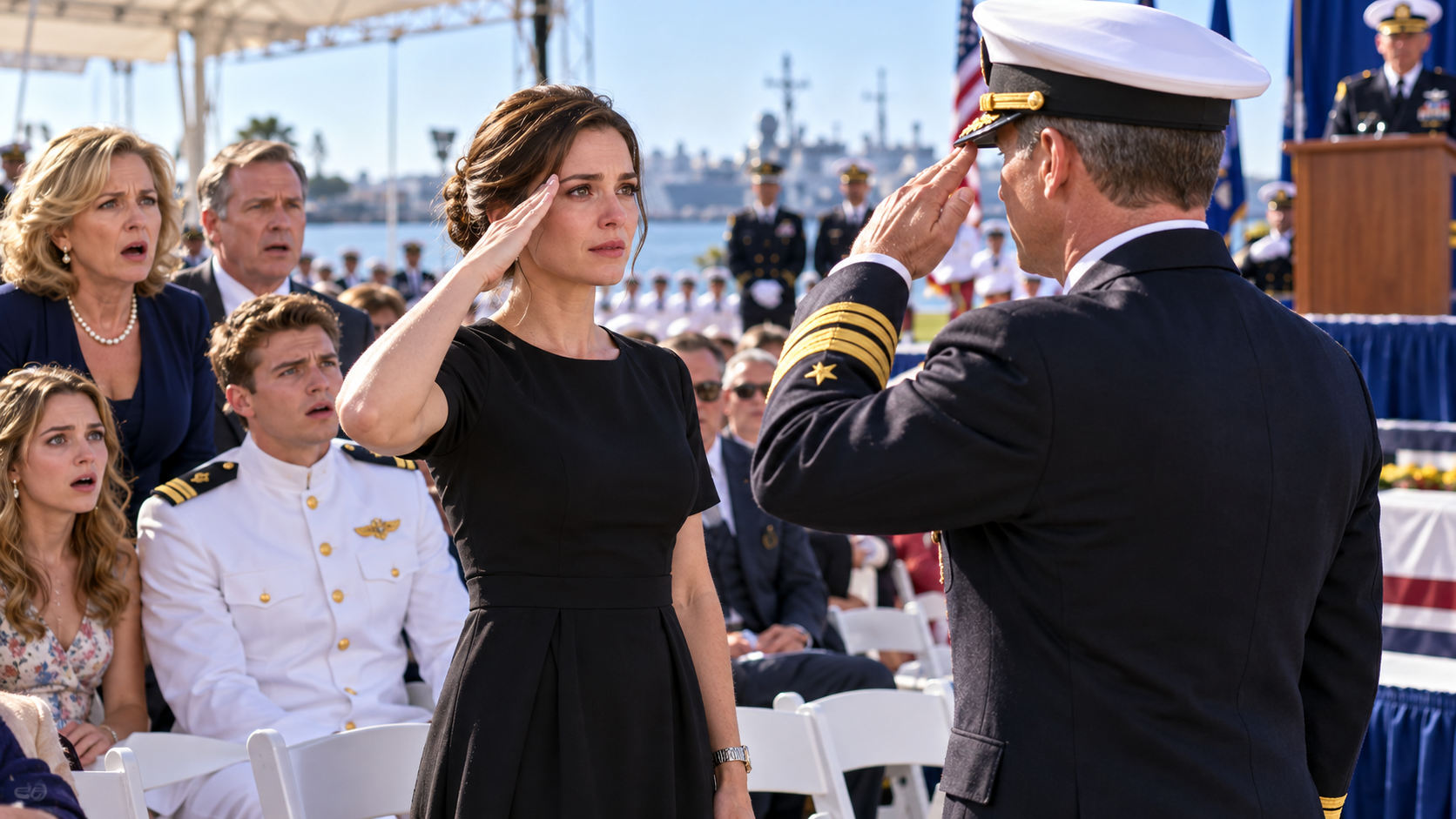
Then he raised his right hand in a sharp salute.
My family stared.
I stood.
Pain pulled beneath my ribs.
I ignored it and returned the salute.
Hayes lowered his hand.
There was something almost amused in his eyes.
“Captain Carter,” he said.
My mother made a tiny sound beside me.
Hayes looked at the empty seat near the stage.
Then back at me.
“Ma’am,” he said, loud enough for everyone beneath the canopy to hear, “we’ve been waiting for you.”
And for the first time in my life, my family had absolutely nothing to say.
PART 2: THE NAME THEY NEVER BOTHERED TO ASK ABOUT
I wished I could say I enjoyed their faces.
I didn’t.
Shock looks strangely similar on people, whether they love you or not.
Eyes widen.
Mouths part.
The body goes still while the mind searches frantically for an explanation that will preserve whatever it believed five seconds earlier.
My mother recovered first.
“Captain?”
The word came out as a whisper.
Commander Hayes glanced at her.
Then at me.
I gave him the look.
He knew the look.
We had worked together long enough.
Don’t.
His expression said something equally clear.
Too late.
“Your seat is up front, ma’am,” he said.
“I’m fine here.”
“I’m sure you are.”
That almost made me smile.
Hayes turned to the security officer standing near the aisle.
“Chief?”
“Yes, sir.”
“Captain Carter’s seat.”
The chief looked relieved.
“Front row, adjacent to the stage, sir.”
Hayes looked at me again.
“I believe we reserved it for a reason.”
I lowered my voice.
“Nathaniel.”
“Emily.”
That was when Ryan moved.
“Sir?”
Commander Hayes turned.
Ryan’s posture was perfect, but I knew my brother.
The tension in his jaw gave him away.
“Yes, Carter?”
Ryan looked at me.
Then at Hayes.
Then at the seat by the stage.
“I didn’t know my sister was…”
He stopped.
Hayes waited.
Ryan swallowed.
“Military, sir.”
I could feel every member of my family staring at me.
Hayes did not rescue him.
“No,” he said. “I imagine you didn’t.”
The words weren’t cruel.
That made them worse.
Ryan’s face reddened.
I stepped into the aisle before Hayes could say anything else.
“Commander, this is Ryan’s ceremony.”
“I’m aware.”
“He earned today.”
“Yes, ma’am.”
“Then finish it.”
For a second, we simply looked at each other.
Something shifted in his expression.
Approval, maybe.
Or understanding.
Then he nodded.
“As you wish.”
He gestured toward the front.
I picked up my purse.
Mom grabbed my wrist.
Not hard.
Just enough.
“Emily.”
I looked down at her hand.
She released me immediately.
“What is this?”
“Not now.”
“What does Captain mean?”
Aunt Patricia turned around so quickly her chair squeaked.
“You’re a captain?”
Madison stared at my visitor badge.
Dad said nothing.
His face had gone pale.
I looked at Ryan.
He was watching me as though I had become a stranger in less than a minute.
Maybe I had.
Or maybe he was seeing me clearly for the first time.
“I’ll talk to you after,” I said.
Then I followed Commander Hayes toward the front.
Every step felt louder than it should have.
I hated public attention.
That was not false modesty.
It was survival.
Attention meant questions.
Questions meant details.
Details meant names.
Places.
Operations.
People who had not come home.
I had spent years building walls around that part of my life.
My family mistook those walls for emptiness.
I never corrected them.
The reserved chair sat at the edge of the stage.
A small white card had been placed on it.
CAPT EMILY CARTER.
I removed the card before sitting.
Hayes noticed.
Of course he did.
He leaned slightly toward me.
“You could have told them.”
“So could you.”
“I tried.”
That was true.
Three weeks earlier, he had called me.
I almost let it go to voicemail.
“Emily.”
“Nathaniel.”
“Ryan Carter.”
I had gone silent.
There were thousands of Carters in the military.
I had known instantly which one he meant.
“He’s your brother.”
“Yes.”
“He’s completing.”
“I know.”
Another pause.
“Does he know about you?”
“No.”
Hayes had exhaled slowly.
“Why?”
Because the first time I told my mother I was going back to school, she asked how long I thought that phase would last.
Because when I completed officer training, Dad said, “Is that like basic training?”
Because when I tried to explain what I actually did, Mom interrupted me to tell Aunt Patricia that Ryan had been accepted into an elite football camp.
Because later, when the work became classified, silence became easier.
Because eventually, the people who wanted to know asked.
And the people who didn’t never noticed the difference.
“I don’t discuss work with family,” I had said.
“That’s one way of describing it.”
“What do you want, Nathaniel?”
“I want you at the ceremony.”
“I was planning to attend.”
“Not in the audience.”
“No.”
“Emily.”
“No.”
“You know what your presence would mean.”
“It would mean my brother spends the day answering questions about me.”
“He might survive.”
“I said no.”
There had been another long pause.
Then Hayes said, “I’m reserving the chair anyway.”
I should have known.
Now I sat in that chair while he returned to the podium.
Ryan stood with the other candidates.
His eyes found mine.
This time, there was no contempt in them.
Only confusion.
The ceremony continued.
Hayes spoke about the Trident.
Not as jewelry.
Not as a finish line.
As obligation.
He talked about the men who had earned it before them and the standard they were expected to carry after today.
He talked about humility.
That word landed hard.
I watched Ryan’s face.
He looked straight ahead.
When his turn came, a senior operator stepped forward to pin the gold insignia onto his uniform.
Applause broke across the tent.
My parents stood.
So did I.
Whatever had happened between us, pride rose in my chest.
Complicated.
Painful.
But real.
That was my little brother.
He had done something hard.
He had refused to quit.
And for a few seconds, I let that be enough.
Then Hayes returned to the microphone.
“There’s one more thing before we conclude.”
I closed my eyes.
No.
Around me, people settled back into their chairs.
Hayes looked directly at me.
I gave him a warning stare.
He ignored it.
Of course.
“Today is about the men receiving their Tridents,” he said. “And I intend to keep it that way.”
I relaxed slightly.
Then he continued.
“But none of these men arrived here alone.”
Families shifted proudly.
Parents smiled.
Hayes glanced toward Ryan.
“Some were shaped by parents. Some by instructors. Some by teammates. Some by people they may not even realize were walking ahead of them.”
Ryan looked at me.
My stomach tightened.
Hayes continued.
“I’m not going to discuss Captain Carter’s assignments. I’m not going to discuss places, units, or operational details. What I will say is that there are people standing under this canopy today who are alive because she did her job when doing her job carried a price.”
The entire space went silent.
I stopped breathing.
He had cleared that line.
I knew immediately.
He would never say it otherwise.
Hayes touched two fingers lightly against the edge of the podium.
“Six years ago, during an operation overseas, a team under my command lost its planned extraction and communications became unreliable. Captain Carter was part of the command element coordinating what came next.”
Images moved through my mind before I could stop them.
Dust.
Blood.
A map illuminated beneath red light.
A voice shouting grid coordinates.
A helicopter that couldn’t land.
A second route.
A convoy.
A medic pressing gauze into my side while I kept one hand on a radio.
Hayes’s voice pulled me back.
“She remained at her station after being ordered to receive treatment because she had information no one else had yet connected.”
I looked down at my hands.
The scar beneath my ribs began to ache as if memory itself had nerves.
“She found a route through a situation that did not appear to have one.”
Hayes paused.
“I was on that team.”
A ripple moved through the audience.
I hated it.
Every second.
My family had wanted to know why I missed holidays?
That was why.
They wanted to know why I disappeared?
Sometimes people needed disappearing places.
They wanted to know why I never talked about my scars?
Because some stories were not mine alone to tell.
Hayes looked at the newly pinned men.
“This profession contains enough ego without us feeding it. So understand what I am saying. Heroism is an overused word. Competence is not. Discipline is not. Loyalty is not. Sometimes service looks like a Trident. Sometimes it looks like a person no one notices sitting behind a radio making sure someone else gets home.”
My throat tightened.
Then Hayes smiled faintly.
“Captain Carter also threatened me before this ceremony if I embarrassed her.”
A few people laughed.
Even I did.
He looked at me.
“I’m willing to accept the consequences.”
More laughter.
The tension broke.
Then he returned his attention to the class.
“Remember the people whose names may never appear beside yours.”
He stepped back.
“Congratulations, gentlemen.”
The ceremony ended.
Applause exploded.
People stood.
Chairs scraped.
Families surged toward the newly pinned men.
I remained seated.
For three seconds.
Five.
Ten.
Then I picked up my purse and started toward the side exit.
I almost made it.
“Emily.”
My father’s voice.
I stopped.
Slowly, I turned around.
My entire family stood behind him.
Dad.
Mom.
Aunt Patricia.
Madison.
And Ryan.
Ryan had removed his cover.
His Trident gleamed against his chest.
He looked like the same brother who had told me not to embarrass him an hour ago.
And nothing like him at all.
Mom stared at me.
“You saved his life?”
I looked past her toward Hayes, who was being cornered by several families.
“That isn’t exactly what he said.”
“He said they’re alive because of you.”
“He said I did my job.”
Dad’s voice was quieter.
“You’re a Navy captain?”
“Yes.”
“For how long?”
“Three years.”
Dad flinched.
Three years.
My own father had not known what I did for a living for three years.
Then Mom asked the question I should have expected.
“Why didn’t you tell us?”
I looked at her.
For a moment, nobody moved.
Then I asked softly, “When?”
Her brow furrowed.
“What?”
“When should I have told you?”
“Emily—”
“When I called after officer training and you put me on speaker because you were frosting Ryan’s graduation cake?”
Her face changed.
“When I came home after my first deployment and Dad spent dinner asking Ryan about football?”
Dad looked away.
“When I showed you the scar on my shoulder because you asked why I couldn’t lift a suitcase, and you told me not to be dramatic?”
Mom’s lips parted.
“I didn’t know—”
“No. You didn’t.”
I felt no anger when I said it.
That was what frightened her.
Anger could be dismissed.
Calm was harder.
“You didn’t know because you never asked long enough to hear the answer.”
Silence.
Then Ryan spoke.
“What do you actually do?”
I turned toward him.
His voice was different now.
No sarcasm.
No accusation.
Just a question.
A real one.
I looked at the gold Trident on his chest.
“Some of it I can tell you.”
His eyes dropped.
“And some you can’t.”
“That’s how it works.”
He nodded slowly.
Then he said the one thing I wasn’t ready for.
“I thought you quit.”
My chest tightened.
“Quit what?”
“Everything.”
No one spoke.
Ryan looked almost ashamed.
“You dropped out. You disappeared. Every time someone asked about you, Mom said you were between things. Dad said you couldn’t stick with anything.”
I looked at my parents.
Neither defended themselves.
Ryan swallowed.
“I believed them.”
The pain that landed then was quieter than anger.
Ryan hadn’t invented the story.
He had inherited it.
But he had still chosen to believe it.
And that choice belonged to him.
“You could have asked me,” I said.
He nodded.
“I know.”
Then Mom stepped forward.
“We were protecting him.”
“From what?”
She hesitated.
“Distraction.”
I almost laughed.
“Me?”
“You always complicated things.”
“How?”
“You left school.”
“So I could enlist.”
Mom froze.
Ryan’s head snapped up.
Dad stared at me.
I had almost forgotten.
Of course.
They didn’t even know that.
“I didn’t drop out because I failed,” I said. “I withdrew.”
“To enlist?” Dad asked.
“Yes.”
Mom shook her head.
“No. You said you were leaving.”
“I did.”
“You never said—”
“I tried.”
Memory hit me.
Nineteen years old.
Standing in the kitchen.
Recruitment paperwork folded inside my backpack.
Mom on the phone with Aunt Patricia.
Ryan racing through the house because scouts were coming to his next game.
Dad yelling from the garage.
I had said, “I need to talk to you.”
Mom had covered the receiver and said, “Not now, Emily. Your brother has something important happening.”
Not now.
There had always been a not now.
Until eventually, I stopped asking for one.
“I tried,” I repeated.
Nobody answered.
A shadow fell across us.
Commander Hayes.
He looked at me.
“Reception.”
“I’m aware.”
“You’re coming.”
Dad cleared his throat.
“We were told it was private.”
Hayes looked at him.
“It is.”
Then he looked at me.
“Captain Carter is the guest I personally asked to attend.”
Madison stared at the ground.
Aunt Patricia suddenly seemed fascinated by her purse.
My mother lifted her chin.
“Well, of course we’ll all—”
“No,” Ryan said.
Every head turned.
Ryan looked at Mom.
Then at me.
His face tightened.
“Emily comes with me.”
Mom blinked.
“But we’re family.”
Ryan’s gaze didn’t move from mine.
“So is she.”
For the first time that day, I saw something in my brother’s face I recognized.
Not pride.
Not shame.
The boy who used to knock on my door during thunderstorms.
He wasn’t gone.
But he had a lot to answer for.
So did I.
And I had no intention of making it easy.
“Fine,” I said.
Ryan exhaled.
Then I added, “But we’re talking first.”
His expression fell.
“Yeah.”
I nodded toward a quiet stretch beyond the tent.
“Now.”
PART 3: WHAT SILENCE COST US
We walked toward the water.
Not all the way.
Just far enough that the voices behind us blurred together.
For a while, neither of us spoke.
Ryan held his white cover in one hand.
I could tell he wanted to say something.
I let him struggle.
He had earned the discomfort.
Finally he said, “Captain.”
I looked at him.
He gave a humorless laugh.
“I don’t even know what to call you right now.”
“Emily usually works.”
He looked toward the ocean.
“Why didn’t you tell me?”
I almost gave him the answer I had given Mom.
You never asked.
It was true.
But not complete.
“You want the simple answer?”
“Yes.”
“I was angry.”
That surprised him.
“At me?”
“At everyone.”
I folded my arms carefully, avoiding pressure against my ribs.
“When I left college, Mom told everyone I couldn’t handle it. Dad told people I was wasting my life. You were sixteen.”
Ryan stared down at his cover.
“I remember some of that.”
“Do you remember asking where I was going?”
“No.”
“I do.”
He looked up.
“You said, ‘Are you coming to my game Friday?’”
His face fell.
“I didn’t know.”
“You were sixteen. You weren’t supposed to know.”
That mattered.
I needed him to hear it.
“I don’t blame sixteen-year-old you.”
He swallowed.
“What about now?”
“Now you’re twenty-eight.”
The words landed.
“You told me not to embarrass you.”
“I know.”
“You listened while Madison said I wasn’t supportive.”
“I know.”
“You heard Dad tell me not to come to your reception because people might ask what I do.”
“I know.”
“And you smiled.”
Ryan closed his eyes.
“For half a second.”
“I saw it.”
“I know.”
Silence stretched between us.
Then he said, “I’m sorry.”
I looked at him.
There were different kinds of apologies.
I had learned that too.
There were apologies people offered because they wanted the discomfort to stop.
There were apologies offered because consequences had arrived.
And there were apologies that cost something.
Ryan’s voice was low.
“I’m not sorry because Hayes saluted you.”
That got my attention.
He stared out toward the water.
“I mean, I am humiliated that he did it right after I treated you like that. But that’s not why I’m sorry.”
“Then why?”
“Because if he never walked over, I would still think I was right.”
That hurt.
But I respected it.
Ryan turned toward me.
“If nobody had told me who you were, I would’ve gone to that reception and let everyone keep laughing at you.”
His eyes reddened.
“I would have let you drive six hours home thinking your own brother was ashamed you showed up.”
I said nothing.
He shook his head.
“That’s disgusting.”
“Ryan.”
“No. It is.”
He took a breath.
“I spent years thinking you didn’t care about us.”
I looked at him.
“Because I missed things?”
“You missed my college graduation.”
“I was deployed.”
His mouth closed.
“You missed Christmas twice.”
“Deployed once. Hospital the other time.”
His head snapped toward me.
“Hospital?”
I nodded.
“For what?”
I hesitated.
“A vehicle accident.”
That was technically true.
It omitted the part where the vehicle had stopped being fully recognizable as a vehicle.
Ryan seemed to understand from my expression not to push.
“You missed Mom’s fiftieth birthday.”
“I was in training.”
“Dad said you forgot.”
“I sent flowers.”
Ryan stared.
“What?”
“I sent flowers.”
His face changed.
“Mom said Aunt Patricia sent them.”
I went still.
“Excuse me?”
“The white roses.”
I remembered those roses.
I had ordered them from another state at two in the morning after fourteen straight hours of training.
The card had said:
Happy birthday, Mom. I’m sorry I can’t be there. I love you. —Emily.
“She said Patricia sent them,” Ryan repeated.
Something cold moved through me.
That was new.
Not a secret operation.
Not a classified mission.
A bouquet of flowers.
An ordinary act of love.
Erased.
Why?
I looked back toward the ceremony tent.
Mom stood in the distance talking animatedly to two women.
Probably explaining.
Mom always explained.
She could turn any fact into a version that protected her.
“Did she read the card?” I asked.
“I never saw one.”
Of course.
Ryan rubbed a hand over his face.
“What else don’t I know?”
“A lot.”
“Tell me.”
“No.”
He looked hurt.
I softened slightly.
“Not like this.”
“Why?”
“Because you don’t get ten years of my life in fifteen minutes just because you suddenly discovered you were wrong about me.”
He stared at me.
That landed harder than I expected.
Good.
It needed to.
“You want to know me?” I said. “Then know me slowly.”
He nodded.
“Okay.”
“And don’t make me perform my life so you can decide whether I deserved respect.”
His jaw tightened.
“Okay.”
“You should have respected me this morning even if I was unemployed.”
He closed his eyes.
“Yeah.”
“Even if I had failed college.”
“Yeah.”
“Even if I had spent ten years doing absolutely nothing you admired.”
“I know.”
“No, Ryan. That’s the point. You didn’t.”
I watched that sink in.
The commander’s salute had changed my status in my family’s eyes.
But status should never have been the price of basic decency.
That was the lesson I refused to let them miss.
I didn’t want my mother apologizing because I was suddenly impressive.
I wanted her to understand she had been cruel before she knew whether I was impressive.
Otherwise, nothing had changed.
Ryan looked at the Trident on his uniform.
“I feel like an idiot.”
“You should.”
That startled a laugh out of him.
A real one.
The sound hit something old inside me.
For one second we were kids again.
Then he grew serious.
“Did you know Hayes would do that?”
“No.”
“He said he reserved your chair.”
“He told me he would.”
“And you sat with us anyway.”
“Yes.”
“Why?”
“Because Mom told security I belonged with family.”
Ryan stared at me.
“That’s why?”
“I thought it was funny.”
He blinked.
“It was not funny.”
“I have a dark sense of humor.”
He shook his head.
Then his expression shifted.
“The black dress.”
“What about it?”
“Mom said you wore it to make some kind of statement.”
“I wore it because it was in my car.”
“You drove straight here?”
“Basically.”
“From where?”
I looked at him.
He corrected himself quickly.
“Right. You can’t tell me.”
“I can tell you I was tired.”
His eyes moved over my face.
Then down.
His attention stopped at my left arm.
A small red stain had begun to appear near the inside of my sleeve.
Damn.
“Emily.”
“It’s nothing.”
“You’re bleeding.”
“It’s a scratch.”
“That is what people say right before somebody takes them to a hospital.”
“I’ve already been to one.”
Ryan went pale.
“What happened?”
“Work.”
His eyes widened.
“You drove six hours after being injured?”
“I was cleared.”
“When?”
“This morning.”
His mouth opened.
Closed.
Then he looked toward the tent again.
“You’re insane.”
“Possibly.”
“For my ceremony?”
“Yes.”
Something changed in his face.
The shame remained.
But beneath it was grief.
He looked down.
“You almost didn’t come.”
“I always intended to come.”
“Even after what I texted you?”
I frowned.
“What text?”
Ryan froze.
“What do you mean?”
“I mean what text?”
He reached for his phone.
Opened the conversation.
Turned the screen toward me.
Three days earlier.
Ryan:
Mom says you probably can’t make it. Don’t worry about it. We all understand work is more important to you than family.
I stared.
“I never got that.”
His brow furrowed.
“It says delivered.”
I took out my phone.
Our message thread ended twelve days earlier.
Me:
Proud of you. I’ll be there.
Ryan:
K.
Nothing else.
Ryan stared at my screen.
“What the hell?”
Then I remembered.
Three days earlier I had been unreachable for nearly twenty hours.
My mother had called before I left.
I had told her my phone would be locked away.
She knew.
When I got it back, there were missed calls but no message from Ryan.
Someone had deleted it?
No.
Too dramatic.
And unnecessary.
There were simpler possibilities.
A sync issue.
A different device.
A blocked message.
But Ryan’s expression said he was already thinking something worse.
“Don’t,” I said.
“What?”
“Build a conspiracy because you feel guilty.”
“But—”
“Technology fails. People misunderstand each other. Not everything has a villain.”
He looked at me strangely.
“You really don’t want revenge, do you?”
I almost smiled.
“On our mother?”
“On all of us.”
“No.”
“Why not?”
I thought about it.
“Because revenge means I still need you to hurt for me to feel okay.”
He said nothing.
“I don’t.”
That was true.
Mostly.
A small, human part of me had enjoyed my mother’s face when Hayes called me Captain.
I wasn’t a saint.
But I didn’t need to destroy anyone.
I needed something simpler.
The truth.
Then a voice behind us said, “Captain.”
We turned.
A young lieutenant stood several feet away.
“Commander Hayes asked me to let you know the reception is starting.”
“Thank you.”
He nodded to Ryan.
“Congratulations.”
Ryan straightened.
“Thank you, sir.”
The lieutenant left.
Ryan looked at me.
“You’re really going?”
“You want me there?”
“Yes.”
I studied him.
“This morning you didn’t.”
“I was wrong.”
“Very.”
“I know.”
I adjusted the strap of my purse.
“Then we go.”
Ryan exhaled.
As we started walking, he said, “Emily?”
“What?”
“If Mom says something—”
“I can handle Mom.”
“I know.”
He looked embarrassed.
“That’s becoming increasingly clear.”
I laughed despite myself.
Then he stopped walking.
“There’s something else.”
I turned.
His face had become serious again.
“Dad told me you weren’t proud of me.”
My smile disappeared.
“What?”
“Last year.”
The air seemed to change.
“He said he invited you to my graduation from the qualification course and you said you had better things to do.”
I stared at him.
“I was never invited.”
Ryan’s face drained.
Neither of us moved.
There it was.
Not a grand conspiracy.
Something sadder.
Years of small edits.
Small assumptions.
Small resentments.
A family story built sentence by sentence until Ryan and I were standing inside completely different versions of our own relationship.
He thought I never came because I didn’t care.
I thought he stopped asking because he didn’t want me.
And somewhere between those two misunderstandings, my parents had filled every silence with whatever explanation was easiest.
Ryan whispered, “Oh my God.”
I looked toward the reception building.
Mom and Dad had already gone inside.
“We’re not doing this here,” I said.
“When?”
“After.”
“No.”
I looked at him.
Ryan’s jaw hardened.
“For once, I don’t want after.”
Something in his voice sounded like me.
That stopped me.
He pointed toward the reception.
“For once, we ask now.”
PART 4: THE STORY MY FAMILY TOLD ABOUT ME
The reception was held in a large room overlooking the water.
White tablecloths.
Coffee.
Small plates of food.
Officers, instructors, families, and new SEALs moving between groups.
The moment I entered with Ryan, conversations shifted.
Not stopped.
Shifted.
Military people are good at pretending not to stare.
Families are not.
Commander Hayes saw us.
He started toward me.
Then noticed Ryan’s face.
He changed direction without a word.
That was another reason I respected him.
He knew when not to interfere.
Mom stood near a table with Dad and Aunt Patricia.
She smiled when she saw us.
Too brightly.
“There you are.”
Ryan stopped in front of her.
“Did you tell me Emily didn’t come to my graduation because she had better things to do?”
Mom’s smile faded.
Dad went rigid.
Aunt Patricia took one step backward.
“Ryan,” Mom said quietly, “not here.”
“Yes or no?”
“Today is your day.”
“That isn’t an answer.”
Dad stepped in.
“Son, don’t let emotions ruin the ceremony.”
“The ceremony is over.”
“Then don’t ruin the reception.”
Ryan laughed once.
It wasn’t a happy sound.
“You told Emily not to come.”
Dad looked at me.
I held his gaze.
“I said she shouldn’t come unless you invited her.”
“You told me she didn’t want to be at my graduation.”
“That was different.”
“How?”
Dad’s jaw tightened.
“It was a stressful time.”
“For who?”
“Ryan,” Mom whispered.
“No.”
People nearby had begun to notice.
I hated public scenes.
Mom knew that.
She lowered her voice.
“Please.”
For a second, I almost gave in.
Old habit.
Protect the family from embarrassment.
Absorb the discomfort privately.
Leave quietly.
Then I remembered what I had told Ryan.
You should have respected me even if I had done nothing impressive.
This wasn’t about revenge.
It was about ending the story.
“Let’s go outside,” I said.
Ryan shook his head.
“No more sending Emily away so nobody has to hear.”
“Ryan.”
He looked at our parents.
“You let me hate my sister.”
Mom’s eyes filled.
“That is not fair.”
“You told me she didn’t care.”
“Because she never called!”
“I called,” I said.
Mom turned toward me.
I kept my voice calm.
“I called a lot.”
“When?”
“Birthdays. Holidays. Before Ryan shipped out. After Dad’s surgery.”
Dad looked at me.
“You didn’t call after my surgery.”
“I called the hospital twice.”
His expression changed.
“You were asleep the first time. Mom answered the second.”
Every eye turned toward her.
Mom’s face tightened.
“I had a lot happening.”
“I know.”
“Then why are you making me sound like some monster?”
“I’m not.”
“You are!”
“No. I’m telling the truth.”
“That’s the same thing in your mind, isn’t it?”
There it was.
The real wound.
My mother didn’t fear lies.
She feared losing control over which truths mattered.
I set my purse on the table.
“Mom, I don’t think you’re a monster.”
Her eyes flickered.
“I think you decided a long time ago that Ryan was the child who made sense to you.”
She said nothing.
“He was social. Successful in obvious ways. He brought home trophies. He told you what was happening in his life.”
I touched my own chest.
“I was harder.”
“That’s not—”
“I was.”
I could admit that.
“I hated being questioned. I kept things to myself. I left suddenly. Later, my job made secrecy normal.”
I looked at Dad.
“And both of you filled in the gaps.”
Dad’s expression hardened defensively.
“What were we supposed to think?”
“You could have asked.”
“We did.”
“No. You asked questions you had already answered.”
Dad frowned.
“What does that mean?”
“It means there’s a difference between ‘What are you doing with your life?’ and ‘Tell me about your life.’”
He looked away.
Ryan stood beside me.
Quiet.
Listening.
I continued.
“Every time I tried to tell you something that didn’t fit the version of me you understood, it became inconvenient.”
Mom’s eyes shone.
“You’re remembering this very differently.”
“Probably.”
That surprised her.
“Memory is imperfect,” I said. “Mine too.”
I picked up my purse.
“But I know what happened today.”
No one moved.
“Today, you told security I wasn’t important.”
Mom flinched.
“I didn’t mean—”
“You said it.”
“I meant you weren’t part of the ceremony.”
“I was.”
“You never told me!”
“That doesn’t change what you said.”
Her face crumpled.
I hated seeing it.
That was the worst part of loving people who hurt you.
Their pain still reached you.
Even when they caused it.
“I’m sorry,” Mom whispered.
I waited.
“For what?”
She looked confused.
It was a harsh question.
A necessary one.
“For… for not knowing.”
“That’s part of it.”
Her mouth trembled.
“For embarrassing you.”
I shook my head.
“It isn’t the embarrassment.”
“Then what do you want from me?”
Finally.
The right question.
Not what do you want me to admit.
Not what do you want me to apologize for.
What do you want?
“I want you to stop deciding who I am when I’m not in the room.”
She went still.
“If you don’t know something about my life, say you don’t know.”
I looked at Dad.
“Don’t tell people I failed because that’s easier than admitting you never asked what happened.”
Then at Mom.
“Don’t tell Ryan I don’t care because I miss an event.”
My voice tightened.
“Don’t take the things I do manage to send and give the credit to someone else.”
Mom’s face drained.
Ryan spoke.
“The flowers.”
She closed her eyes.
Aunt Patricia looked horrified.
“What flowers?”
Mom whispered, “Please.”
“No,” Ryan said. “Why did you say Patricia sent Emily’s flowers?”
Patricia’s mouth fell open.
“I never sent white roses.”
Mom looked trapped.
For the first time in my life, she had no graceful exit.
“They came without a card,” she said.
“They had a card,” I replied.
She stared at me.
“I called the florist afterward because I worried it might have gotten lost.”
Her shoulders sank.
Dad looked at her.
“Margaret?”
She pressed her lips together.
Then something surprising happened.
She stopped defending herself.
“I was angry.”
The words were almost inaudible.
I said nothing.
Mom looked at me.
“You had missed Christmas.”
“I know.”
“You missed Thanksgiving before that.”
“I know.”
“You called from places you wouldn’t name. You never told me anything. You would disappear and then send flowers like that was supposed to fix it.”
Her voice cracked.
“I was your mother, Emily.”
For the first time that day, I heard pain beneath the anger.
Not justification.
Pain.
“You kept leaving.”
My own anger softened around the edges.
“I had a job.”
“I didn’t know that.”
“You didn’t want to know.”
She shook her head.
“I wanted you home.”
“That isn’t the same thing.”
Mom looked down.
No one spoke.
Then she whispered, “I thought if Ryan stopped expecting you, he would stop being disappointed.”
Ryan stared at her.
“So you told me she didn’t care?”
“I thought I was protecting you.”
“From my sister?”
“From being hurt.”
“You made me hurt her.”
Mom covered her mouth.
That line broke something.
Not in me.
In her.
Tears spilled down her face.
Aunt Patricia touched her arm.
Mom pulled away.
“No.”
She wiped her cheeks.
“No, he’s right.”
I had never heard her say that before.
Maybe Ryan hadn’t either.
Dad remained silent.
I looked at him.
“What about you?”
His shoulders sagged.
“What do you want me to say?”
“The truth would be interesting.”
He gave me a tired look.
“You always did that.”
“What?”
“Talk like you don’t care.”
I felt my back straighten.
Dad continued.
“That little dry voice. Like nothing gets to you.”
He pointed toward the room.
“Even today. Everyone is shocked. Your mother is crying. Ryan is upset. And you stand there like you’re briefing somebody.”
My instinct was immediate.
Defend.
Attack.
Leave.
Instead, I asked, “Do you know why?”
Dad frowned.
“Because if I get angry, you call me dramatic.”
He stopped.
“If I cry, Mom says I’m making everything about me.”
Mom looked down.
“If I defend myself, you tell me to stop arguing.”
My throat tightened.
“So I learned to be quiet.”
No one breathed.
“And then you hated that too.”
Dad’s face changed.
I had never said it aloud before.
Maybe I hadn’t even understood it until that moment.
Silence had protected me.
But it had also helped create the distance.
Not because silence made their behavior my fault.
It didn’t.
But walls have two sides.
I had spent years waiting for my family to prove they cared enough to climb mine.
They had spent years assuming the wall meant I wanted them gone.
My father looked suddenly older.
“I thought you didn’t need us.”
That hurt more than almost anything else.
“I didn’t need you to rescue me.”
He stared at me.
“That’s not the same as not needing you.”
Dad rubbed a hand over his mouth.
Behind us, the reception continued.
Glasses clinked.
Someone laughed.
Life moved around the four of us as if ours had not cracked open.
Ryan finally said, “I have a question.”
I looked at him.
“Okay.”
He gestured to the Trident on his chest.
“Did you really come just for this?”
I stared.
“What kind of question is that?”
“I need to hear it.”
Something in his face made me answer seriously.
“Yes.”
“Even after everything?”
“Yes.”
“Why?”
I looked at my brother.
The golden son.
The arrogant idiot who had humiliated me.
The boy who had once believed monsters lived under his bed.
The man standing in front of me wearing something he had suffered to earn.
“Because I’m proud of you.”
Ryan’s eyes filled immediately.
He looked away.
I continued.
“I’m angry with you.”
He nodded.
“I’m disappointed in you.”
Another nod.
“You were cruel to me.”
“I know.”
“But none of that changes what you accomplished.”
I reached out.
For the first time that day, I touched the gold Trident on his uniform.
“You earned this.”
Ryan swallowed hard.
“Hayes said it’s about responsibility.”
“It is.”
His eyes met mine.
“I think I screwed that up before I even got started.”
“Then start again.”
He stared.
“That easy?”
“No.”
I stepped back.
“Nothing worth earning is.”
A voice came from behind us.
“Captain Carter.”
Commander Hayes stood several feet away.
He had clearly approached slowly enough to give us a chance to stop talking.
“Sir,” Ryan said immediately.
Hayes ignored him.
He was looking at me.
“Everything all right?”
I considered the question.
Then looked at my family.
Mom’s makeup was streaked.
Dad looked shaken.
Ryan looked like someone had pulled the floor out from under him.
Aunt Patricia had quietly disappeared.
Madison was nowhere in sight.
“No,” I said.
Hayes nodded once.
“Good.”
Dad blinked.
I almost laughed.
Hayes added, “Means something honest probably happened.”
Ryan stared at him.
Hayes turned toward my brother.
“Carter.”
“Sir.”
“You ready to enjoy the rest of your day?”
Ryan glanced at me.
“Yes, sir.”
Hayes looked at him for another second.
“Then act like it.”
“Yes, sir.”
As he turned away, I said, “Nathaniel.”
He stopped.
“Thank you.”
He looked genuinely surprised.
“For embarrassing you?”
“For stopping the ceremony.”
His expression softened.
“I wasn’t going to let you sit in the wrong seat.”
I nodded.
“I know.”
Then he left.
Ryan watched him go.
After several seconds, he said, “He likes you.”
“He tolerates me.”
“Pretty sure that’s military for likes you.”
A laugh escaped me.
Dad smiled weakly.
Mom almost did.
It wasn’t forgiveness.
Not yet.
But it was the first moment all morning that did not feel like war.
Then my phone vibrated.
I looked down.
A message.
I read it once.
Then again.
Ryan noticed my expression.
“What is it?”
I locked the screen.
“Work.”
“You have to leave.”
It wasn’t a question.
I looked at the room.
My family.
The ocean beyond the windows.
The ceremony I had nearly missed.
Years ago, I would have left without explaining.
Maybe that had been necessary then.
Maybe not anymore.
“Not yet,” I said.
Ryan looked surprised.
“I have twenty minutes.”
Mom wiped her eyes.
“For what?”
I looked at her.
“For cake.”
Her mouth trembled into a smile.
It was small.
Fragile.
Real.
So I stayed.
For twenty minutes.
PART 5: THE PLACE I CHOSE FOR MYSELF
The cake was terrible.
Ryan agreed.
“It tastes like drywall.”
“You’ve eaten drywall?”
“Training.”
“I’m not asking.”
“Good.”
We stood near the windows with paper plates.
Mom was talking quietly with Dad across the room.
They kept looking toward me.
For once, they didn’t come over.
I appreciated that.
Ryan took another bite of cake and immediately regretted it.
“So.”
“So.”
“How much of what Hayes said was true?”
“All of it.”
“Can you tell me what happened?”
“Not all of it.”
“The scars?”
“Some.”
“The shoulder?”
“Training.”
“The ribs?”
I looked at him.
He raised both hands.
“Right. Classified mystery woman.”
I gave him a look.
He smiled faintly.
Then his expression turned serious.
“I used to make fun of you for wearing that watch.”
I glanced at the narrow silver watch on my wrist.
“You said it looked like something an accountant would wear.”
“I was seventeen.”
“You were an idiot.”
“Still developing.”
“That process appears ongoing.”
He laughed.
Then touched the edge of his Trident.
“I remember when you gave me your old running shoes.”
I looked at him.
That memory had been buried deep.
He had been fifteen.
Dad refused to buy expensive cleats and training shoes after Ryan outgrew another pair within months.
I had just started receiving steady pay.
So I bought myself cheap shoes and sent Ryan the better pair.
“They were too big,” I said.
“I stuffed socks in the toes.”
“I know.”
His eyes narrowed.
“How?”
“I saw.”
“You came to that game?”
I went quiet.
Ryan stared.
“You were there?”
“For the second half.”
“You never said.”
“You were busy.”
He laughed in disbelief.
“Oh my God.”
“What?”
“How many things did you show up for without telling us?”
I thought about it.
“Enough.”
“Why?”
I looked out toward the water.
“Sometimes it was easier.”
“For who?”
That was a good question.
I took a breath.
“For me.”
Ryan nodded slowly.
At least now I could admit my part.
“I got used to expecting nothing,” I said.
He listened.
“That way, when nobody noticed, it didn’t hurt as much.”
His smile disappeared.
“But it also meant I never gave anyone a chance to notice.”
“You shouldn’t have had to beg.”
“No.”
I looked at him.
“But I could have spoken.”
Ryan considered that.
“So we were all terrible at this.”
“Some more than others.”
“Fair.”
He looked at me for a long time.
Then said, “I want to know you.”
I did not answer immediately.
He seemed nervous.
That surprised me.
My brother had just endured one of the hardest military pipelines in existence, and apparently asking his sister to have a relationship with him frightened him more.
Finally I said, “Okay.”
His shoulders loosened.
“Okay?”
“Start with coffee.”
“What?”
“When I’m back.”
“From wherever classified people disappear to?”
“Ryan.”
“Sorry.”
I smiled despite myself.
“When I’m back, we get coffee.”
He nodded.
“No family.”
“No family.”
“No Mom.”
“Especially no Mom.”
“Can I ask questions?”
“Yes.”
“Will you answer them?”
“Some.”
He grinned.
“I’ll take it.”
The twenty minutes ended too quickly.
They always did.
I found Commander Hayes near the exit.
“I have to go.”
He nodded.
“I figured.”
“Thanks for the chair.”
“You didn’t sit in it voluntarily.”
“I got there eventually.”
He looked toward Ryan.
“He’s good.”
“I know.”
“He’ll need to become better.”
“I know that too.”
Hayes studied me.
“You did the right thing.”
“Which part?”
“Coming.”
I glanced toward my family.
“I almost didn’t.”
“But you did.”
I looked back at him.
“You could have finished the ceremony without making a scene.”
“I considered it.”
“Liar.”
“Briefly.”
I shook my head.
He smiled.
Then his expression became serious.
“You’re allowed to be known, Emily.”
The words irritated me instantly.
Probably because they were true.
“I’m known.”
“By people who work with you.”
“That counts.”
“It does.”
He nodded toward my family.
“But it isn’t the same.”
I didn’t answer.
Hayes knew better than to push.
“Safe travels, Captain.”
“You too, Commander.”
I turned toward the door.
“Emily!”
Mom hurried toward me.
For a second I tensed.
Then forced myself to stay.
She stopped several feet away.
Not touching me.
A small change.
But I noticed.
“You’re leaving.”
“Yes.”
“For work?”
“Yes.”
Her eyes went to the faint stain on my sleeve.
Fear crossed her face.
I expected questions.
Where?
Why?
What happened?
How long?
Instead, she asked, “Can I call you?”
I looked at her.
“When?”
“When you can answer.”
Another small change.
Not demand.
Permission.
“Yes.”
Her eyes filled again.
“I don’t know how to fix this.”
“You can’t fix ten years today.”
She nodded.
“What can I do?”
I thought about it.
“Next time somebody asks what I do…”
She looked ashamed.
“Say you don’t know.”
“Yes.”
“And maybe say you’re hoping I’ll tell you.”
Her mouth trembled.
“I am.”
I believed her.
That did not erase anything.
But belief was a beginning.
Dad approached more slowly.
He put his hands in his pockets.
I waited.
He looked uncomfortable.
Good.
“I owe you an apology,” he said.
“Yes.”
Mom glanced at me.
Dad almost smiled.
“Still sharp.”
“I’ve had coffee.”
He looked down.
“I was proud of Ryan because I understood what he was doing.”
I said nothing.
“With you, I didn’t.”
He swallowed.
“And instead of admitting that, I acted like it meant there was nothing to be proud of.”
My chest tightened.
Dad met my eyes.
“That was wrong.”
Simple.
No excuse.
No explanation.
Just wrong.
I nodded.
“Thank you.”
He exhaled.
“Are you safe?”
I almost gave him the answer I always gave.
Fine.
Instead I said, “Usually.”
His face tightened.
Not the answer he wanted.
But the truth.
He nodded anyway.
“Okay.”
Ryan joined us.
He had put his cover back on.
For the first time all day, he looked happy.
Not triumphant.
Happy.
“There she is,” he said.
“The disappointing sister.”
Mom winced.
Ryan immediately looked horrified.
“I meant it as—”
I laughed.
He stopped.
Mom stared at me.
I shook my head.
“Too soon.”
“Way too soon,” Ryan said.
“Possibly ten years too soon.”
“Understood.”
I hugged him.
That surprised both of us.
His arms came around me automatically.
Then he felt me stiffen.
He released me immediately.
“Injury?”
“A little.”
His face darkened.
“Emily.”
“Don’t start.”
He lowered his voice.
“Thank you for coming.”
I looked at the Trident on his chest one last time.
“I wouldn’t have missed it.”
Ryan swallowed.
“I almost made you wish you had.”
“Yes.”
“I’m sorry.”
“I know.”
“Coffee?”
“Coffee.”
He nodded.
A promise.
Small enough to keep.
I said goodbye.
Then I walked toward the parking lot alone.
The afternoon sun was brighter now.
My dress stuck to my back.
My ribs hurt.
My eyes burned from exhaustion.
And somewhere behind me, my family was probably beginning the long process of reconstructing a story they had told about me for years.
I knew something they didn’t.
Truth does not arrive like lightning.
Most of the time, it arrives slowly.
One corrected sentence.
One admitted mistake.
One question asked differently.
One silence finally broken.
I reached my car and opened the door.
Then I heard footsteps behind me.
I turned.
Ryan was running across the pavement.
“Emily!”
“What?”
He stopped, breathing hard.
For one terrified second, I thought something was wrong.
Then he held out a folded piece of paper.
My reserved-seat card.
CAPT EMILY CARTER.
I stared at it.
“You left this.”
“I took it off the chair.”
“I know.”
“Why?”
I looked at the card.
“Didn’t feel like I needed it.”
Ryan smiled.
“Take it anyway.”
“Why?”
His expression changed.
Not ashamed now.
Not shocked.
Proud.
“For your seat.”
I looked at him.
He pointed back toward the ceremony hall.
“All morning everybody kept deciding where you belonged.”
My throat tightened.
Ryan held the card closer.
“You should keep the one that actually had your name on it.”
For several seconds, I couldn’t speak.
Then I took it.
“Thanks.”
He nodded.
“See you when you’re back.”
I got into my car.
Ryan stepped away.
I placed the card on the passenger seat.
For years, my family had called me lost because they did not know where I was going.
They called me unsuccessful because they did not understand what I had achieved.
They called me distant because they never noticed how many times I had tried to come home.
And that morning, my own mother had told security I was not important.
The strangest part was that Commander Hayes’s salute did not change who I was.
His speech did not make me worthy.
My rank did not make the insults wrong.
My scars did not prove I deserved respect.
I had deserved it before they knew any of those things.
That was what I finally understood as I started the engine.
The real victory was not watching my family discover that the disappointing daughter had become someone important.
It was realizing I had never needed to become important to deserve a place among them.
Ryan had earned his Trident.
I was proud of him.
My parents had made mistakes.
Maybe they would change.
Maybe they wouldn’t.
And I had spent years using silence as armor because armor was easier than telling people they had hurt me.
Maybe I could change too.
I pulled out of the parking lot.
At the checkpoint, the same young petty officer from that morning recognized my car.
He stepped forward.
Then smiled.
“Have a good afternoon, Captain.”
I returned the smile.
“You too.”
As the gate lifted, my phone connected to the car.
A new message appeared from Ryan.
Coffee when you’re back. No excuses.
A second message arrived.
Also, for the record, you did not embarrass me.
Then a third.
I embarrassed myself.
I laughed.
Actually laughed.
Then I dictated a reply.
Good. Saves me from having to explain it.
Three dots appeared immediately.
Still mean.
I smiled.
Still your sister.
This time, his answer took longer.
When it appeared, I had already turned toward the highway.
Yeah. You are.
I looked once at the folded card on the passenger seat.
Captain Emily Carter.
For years, I had thought the only way to survive my family was to ask nothing from them.
No understanding.
No curiosity.
No apology.
No place.
That morning taught me something different.
You can stop begging for a seat at someone else’s table without pretending you don’t care whether they save one for you.
You can forgive slowly.
You can love someone and still require better from them.
You can walk away without disappearing.
And sometimes the most important moment is not when a room full of people finally sees who you are.
Sometimes it is when you do.
I merged onto the highway.
Behind me, Naval Amphibious Base Coronado disappeared in the mirror.
Ahead of me waited another assignment.
Another flight.
Another place I could not talk about.
But for the first time in years, leaving did not feel like vanishing.
Because somewhere behind me, my brother knew I was coming back.
And this time, he would be waiting.
Leave a Reply