
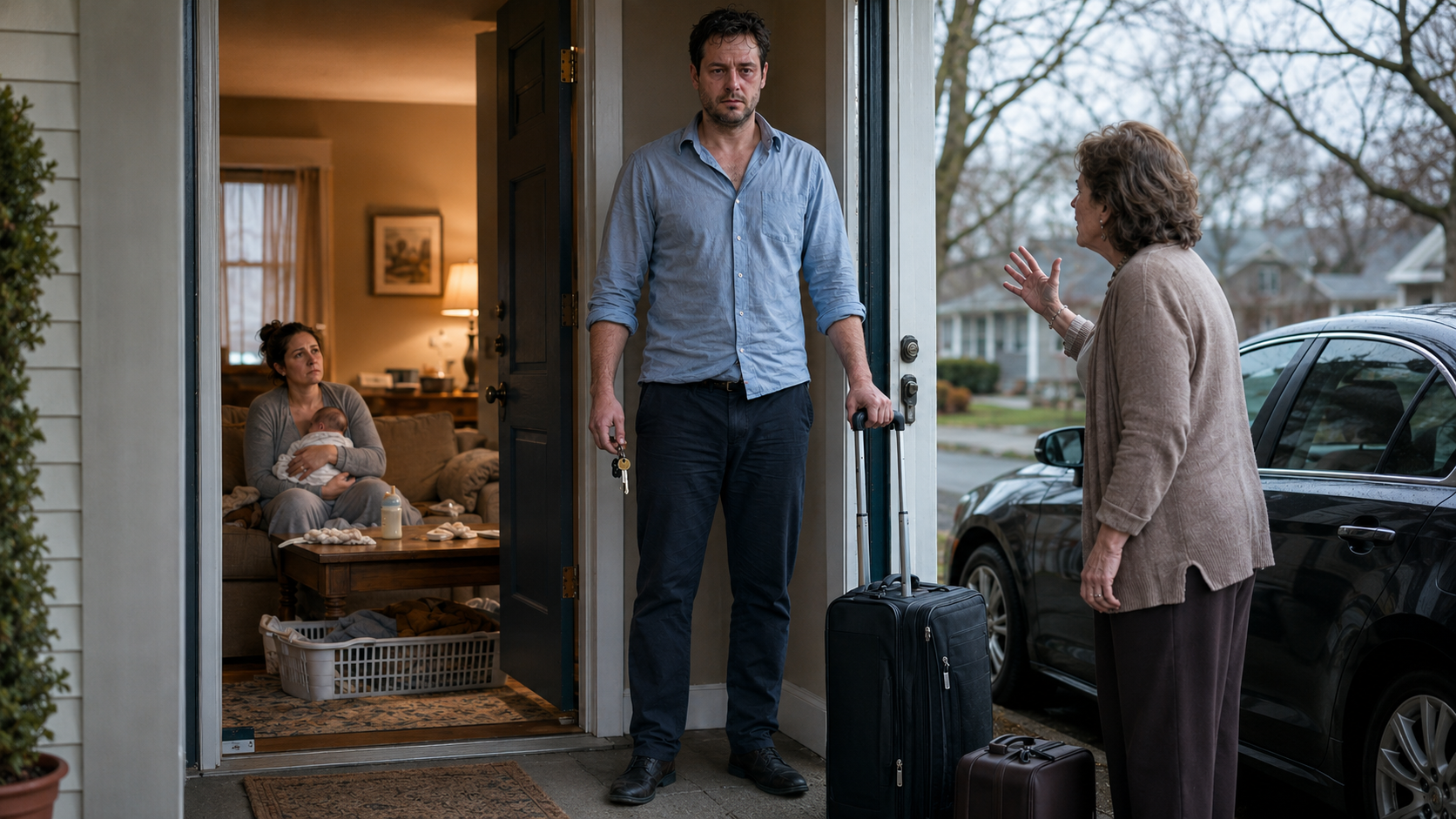
PART 1: SHE WAS EATING WHILE MY WIFE LAY UNCONSCIOUS
I heard my son screaming before I even put the key into the lock.
Not crying.
Screaming.
The sound came through the front door in sharp, desperate bursts—the kind of newborn cry that bypasses thought completely and reaches straight into your nervous system.
My hand froze over the lock.
I had come home almost three hours earlier than planned.
Until that moment, I had considered it a lucky break.
A meeting had been canceled. My supervisor had told me to finish the rest of the day from home. I had spent the drive imagining Maya’s reaction when I walked in unexpectedly. Maybe I could take the baby for a while and let her sleep. Maybe we could order dinner instead of worrying about cooking. Maybe, if our son cooperated, the three of us could sit together for ten quiet minutes and pretend we had figured out this terrifying new-parent thing.
Then I heard that scream.
I unlocked the door so quickly that the key scraped across the metal.
“ Maya?”
No answer.
I pushed inside.
Several smells hit me at once.
Warm baby formula.
Scorched rice.
Vegetables that had been boiling far too long.
Underneath it all was the faint sour smell of laundry that had sat wet for hours.
The kitchen lights were on, painfully bright against the late-afternoon shadows.
An overturned laundry basket lay in the middle of the living room, tiny baby clothes spilled across the floor. A grocery bag stood beside the back door, soaked through at the bottom and beginning to collapse. One carton of milk leaned against another, its condensation running into the paper.
Three feeding bottles sat beside Maya’s hospital discharge papers.
She had been discharged only two days earlier.
The bright yellow instruction sheet was still on top.
I remember reading the bold black print even though I already knew what it said.
Seek immediate medical assistance if the patient experiences dizziness, confusion, fever, severe weakness, or difficulty remaining conscious.
Then I saw my wife.
Maya was sprawled across the couch.
Her face was almost completely colorless.
One arm hung over the cushion. Her fingers dangled limply, stopping only inches above the carpet.
Our son, Noah, screamed from the bassinet beside her.
His tiny face had turned bright red. His fists opened and closed frantically. Every few seconds he paused just long enough to drag in another breath before releasing another terrified cry.
And my mother was sitting at our dining table.
Eating dinner.
For a few seconds, my brain refused to understand what my eyes were seeing.
Her plate had been carefully arranged.
Roasted chicken.
Rice.
Steamed vegetables.
A folded cloth napkin rested beside her hand.
This wasn’t takeout.
It wasn’t leftovers she had heated herself.
Someone had prepared the entire meal from scratch.
That morning, before I left for work, Maya had needed to sit down halfway through making herself toast.
She had laughed weakly about it because that was what Maya did when she was scared. She made jokes so the people around her wouldn’t worry.
“Apparently bread is an endurance sport now,” she had said.
I had crouched beside her chair.
“Then don’t make toast.”
“I need to eat.”
“I’ll make it.”
“You’ll be late.”
“I don’t care.”
My mother had been standing near the kitchen doorway when I said it.
I remembered the look she gave me.
Small.
Almost amused.
At the time, I ignored it.
Now she lifted another bite of chicken toward her mouth and glanced toward my unconscious wife with the irritated expression of someone watching a badly performed play.
“Drama queen,” she muttered.
Something inside me went completely silent.
Not calm.
Not peace.
Silence.
The kind that comes when a structure you have trusted your entire life finally collapses and, for one awful second, all you can hear is the empty space it leaves behind.
I didn’t yell.
I didn’t grab her plate.
I didn’t demand an explanation.
I crossed the room and lifted my son from the bassinet.
His onesie was damp.
His little body was hot from crying.
The second I pressed him against my chest, his fingers clenched around the fabric of my shirt.
That nearly broke me.
He was five days old.
Five days.
He couldn’t ask for food.
He couldn’t tell anyone he was wet or frightened or hungry.
All he could do was cry and trust that somebody would come.
Apparently, he had been crying long enough to learn that nobody would.
“It’s okay,” I whispered, although it obviously wasn’t. “Daddy’s here.”
My hands were shaking.
The phone records I later saved showed the time was exactly 5:47 p.m. when I knelt beside Maya.
I held Noah securely in one arm and touched my wife’s cheek with my other hand.
Her skin was terrifyingly cold.
For a moment, the room tilted beneath me.
“Maya.”
Nothing.
“Maya, sweetheart.”
Her eyelids fluttered.
I leaned closer.
“Please open your eyes.”
She took a shallow breath.
Her lips moved.
At first no sound came out.
Then, barely louder than air, she whispered my name.
“Evan…”
“I’m here.”
Behind me, my mother sighed.
Actually sighed.
As if I were inconveniencing her.
“Stop rewarding this kind of behavior,” she said.
I looked over my shoulder.
She picked up her water glass.
“Women give birth every day. I raised you without collapsing every time life became challenging.”
Thirty-four years.
For thirty-four years, I had called my mother strong.
Strong when she insulted people and called it honesty.
Strong when she controlled every room she entered.
Strong when she made decisions for other adults because, according to her, somebody needed to be sensible.
Strong when she could reduce me to tears as a child and then tell me that crying proved I was too sensitive.
Strong when she humiliated me in front of relatives and later insisted she was preparing me for a difficult world.
Strong when she punished silence as disrespect and disagreement as ingratitude.
She presented control as wisdom.
Humiliation became honesty.
Cruelty became discipline.
And because she could tear me apart at four in the afternoon and gently pull a blanket over me at ten that night, I had spent most of my life convincing myself that both things somehow counted as love.
I looked at her sitting there while my newborn son whimpered against my chest and my wife struggled to remain conscious.
For the first time, I understood something with absolute clarity.
A compassionate person does not continue eating while a helpless baby screams a few feet away.
A caring person does not watch a recently hospitalized woman collapse and complain about the state of the house.
Love does not require someone else to suffer so you can feel powerful.
“You made her cook this dinner?” I asked.
My voice surprised me.
It was quiet.
My mother calmly wiped the corner of her mouth with the napkin.
“She offered.”
Maya’s freezing fingers moved beneath mine.
Weakly, they tightened around my hand.
“No,” she whispered.
One word.
That was all.
It answered everything.
I looked around again.
The grocery bags beside the door.
The wet cutting board.
The vegetables.
The pans stacked in the sink.
The laundry.
The unfinished bottle sitting inside a cup of cooling water.
Maya had been trying to feed Noah.
She had been cooking dinner.
She had apparently gone shopping.
She had attempted the laundry.
All while still bleeding, barely sleeping, struggling to stand for more than a few minutes, and recovering from childbirth.
Whatever had happened here had not been one request.
It had been a campaign.
My mother’s mouth tightened.
“She needed to understand how to run a proper household,” she said. “You spoil her. The house is filthy, the baby cries constantly, and she behaves as though exhaustion excuses every failure.”
Failure.
I looked at Maya.
Then at Noah.
Then back at the woman who had taught me, for most of my life, that love had to be earned through obedience.
For one furious second, I imagined knocking the plate out of her hands.
I pictured chicken and rice scattering across the floor she apparently valued more than the human beings living on it.
I wanted her frightened.
I wanted her humiliated.
I wanted her to feel one second of what she had made Maya feel.
But I knew my mother.
If I screamed, she would remember only the screaming.
If I broke something, she would tell everyone about the broken object.
If I called her cruel, she would spend the next ten years telling people how cruelly her son had spoken to her.
She could build an entire alternate reality around one angry reaction.
So I did the one thing she had never taught me how to do.
I refused to participate.
I took out my phone.
Her expression changed slightly.
“What are you doing?”
“Calling an ambulance.”
“Oh, for heaven’s sake.”
I dialed emergency services.
That was the first time she stopped eating.
The dispatcher answered.
I gave our address.
“My wife gave birth five days ago,” I said. “She was discharged from the hospital two days ago. I found her unconscious. She’s barely responsive and extremely pale.”
Maya’s eyes opened for half a second.
Then closed again.
My throat tightened.
“Yes,” I told the dispatcher. “She’s breathing.”
My mother stood.
“You are making this ridiculous.”
I didn’t look at her.
The dispatcher asked questions.
I answered each one.
Then my mother said the sentence that ended whatever remained between us.
“She was perfectly capable of shopping when I told her we needed groceries.”
My head turned.
Not when she went shopping.
Not when she offered.
When I told her.
My mother realized what she had said a second too late.
Her eyes narrowed.
I stood slowly, Noah pressed against my shoulder.
“You sent her grocery shopping?”
“She needed fresh air.”
“She could barely walk from the bedroom to the kitchen this morning.”
“She’s recovering from childbirth, Evan. She isn’t dying.”
I stared at her.
Then I looked down at Maya.
“I’m removing my wife and my child from this house,” I said.
My mother gave a short, disbelieving laugh.
“This is your house.”
“I know.”
Her smile returned.
Smug.
Certain.
The smile of a woman who believed she understood exactly how this conversation would end because every serious disagreement between us had ended the same way since I was old enough to speak.
I would become angry.
She would become offended.
I would feel guilty.
Then I would apologize.
She had no idea that pattern had just died.
“What are you going to do?” she asked. “Throw your own mother into the street because your wife got tired?”
“No.”
I glanced toward the front window as sirens began approaching in the distance.
“I’m going to make sure Maya gets medical treatment. I’m going to take care of my son. And while I’m gone, you’re going to pack your things.”
Her smile disappeared.
“You don’t mean that.”
“I do.”
“I came here to help you.”
“You watched my wife lose consciousness while my newborn screamed beside her.”
“She was being dramatic.”
“No.”
The sirens grew louder.
I looked directly at my mother.
“You don’t get to decide that anymore.”
For the first time in my life, she had nothing ready to say.
Then somebody pounded on the front door.
And everything changed.
PART 2: THE THINGS MAYA HAD BEEN TOO AFRAID TO TELL ME
The paramedics moved quickly.
One checked Maya’s blood pressure while another asked me questions about the delivery, her medications, her bleeding, whether she had eaten, whether she had been drinking enough fluids.
I answered what I knew.
Every answer made me feel worse.
Had she eaten lunch?
I didn’t know.
How long had she been unconscious?
I didn’t know.
Had she complained of dizziness earlier?
I didn’t know.
Had she been exerting herself?
That one I knew.
I looked toward the kitchen.
“Yes.”
My mother stood behind the dining chair with her arms crossed.
The plate remained on the table.
Half eaten.
One of the paramedics glanced around the room.
His eyes paused on the grocery bags, then the pans, then Maya.
“How much activity has she been doing today?”
Before I could answer, Mom said, “Normal household things.”
I felt heat rise behind my eyes.
The paramedic looked at her.
Then at me.
“Shopping,” I said. “Cooking. Laundry. Taking care of the baby.”
“Today?”
“Yes.”
He didn’t say anything judgmental.
He didn’t have to.
His expression was enough.
They transferred Maya onto a stretcher.
As they lifted her, she opened her eyes.
“Baby?”
“I have him.”
Her gaze found Noah against my chest.
The fear in her face eased slightly.
Then she looked toward my mother.
Immediately, her fingers tightened around the blanket covering her.
It was small.
Almost invisible.
But I saw it.
Fear.
My wife was afraid of my mother.
Not annoyed by her.
Not frustrated.
Afraid.
And somehow I had brought that woman into our home and called it help.
“I’m coming with you,” I told Maya.
One of the paramedics explained what we needed to do about Noah and the ride. Everything after that became a blur of car-seat straps, paperwork, hospital corridors, fluorescent lights, and the unbearable sensation that I had failed both my wife and my son while congratulating myself for being responsible enough to return to work.
Before leaving the house, I turned to my mother.
She had followed me to the front hall.
“Evan.”
“I don’t have time.”
“You’re emotional.”
That almost made me laugh.
She said it as though emotion were a temporary illness that would wear off and return me to obedience.
“You’ll calm down at the hospital,” she continued. “Then we can discuss this like adults.”
“No.”
Her face hardened.
“You cannot speak to me like this.”
“I just did.”
“After everything I’ve done for you?”
There it was.
The oldest weapon in her collection.
Everything I’ve done for you.
Every meal.
Every school uniform.
Every birthday cake.
Every doctor’s appointment.
Every sacrifice carefully recorded and preserved as a debt I could never fully repay.
When I was twelve, she had screamed at me for nearly an hour because I forgot to bring home a permission slip. That night, after I cried myself sick, she brought warm milk to my room and stroked my hair.
“You know I only get upset because I love you,” she had said.
For years, that sentence lived inside me like a rule.
Cruelty was love if the cruel person claimed good intentions afterward.
Standing in my hallway with my son against my chest and paramedics carrying my unconscious wife toward an ambulance, I finally understood how dangerous that lesson had been.
“You have until I get back from the hospital,” I said.
“To do what?”
“Pack.”
Her face changed.
Not dramatically.
My mother rarely gave people the satisfaction of dramatic reactions.
But the certainty disappeared from her eyes.
“I’m your mother.”
“Yes.”
“You can’t throw me out like some stranger.”
“This isn’t about what you are to me.”
I looked toward the open door.
“This is about what you did to them.”
She stared at me.
Then she said, very quietly, “She has turned you against me.”
I almost answered.
Then I realized there was nothing to answer.
Because in my mother’s world, every boundary had to be somebody else’s manipulation.
If I disagreed with her, someone had influenced me.
If I resisted her, someone had poisoned me.
If I loved somebody she couldn’t control, they had stolen me.
She could imagine betrayal from everyone except herself.
I left without another word.
At the hospital, Noah finally stopped crying after I changed him and fed him.
I sat in a plastic chair beside Maya’s bed with my son sleeping against my chest.
A nurse had dimmed the lights.
Maya had fluids running through an IV.
Her blood pressure had been alarmingly low when we arrived. The doctor explained that childbirth had already left her body depleted, and the combination of blood loss, inadequate food and fluids, lack of sleep, and physical overexertion had pushed her far beyond what her body could handle.
She needed monitoring.
Rest.
Hydration.
Actual recovery.
Things she had been supposed to receive at home.
I listened while shame settled over me layer by layer.
Finally, after the doctor left, I looked at Maya.
Her eyes were closed.
“I’m sorry.”
She opened them.
“For what?”
The question made my chest hurt.
“For bringing her into our house.”
Maya looked away.
“For not seeing it.”
She swallowed.
“You were trying to help.”
“No. I was trying to make everything easier.”
“That’s helping.”
“Not if I make it easier for the wrong person.”
Her eyes filled.
I shifted Noah carefully and leaned closer.
“What happened today?”
She went very still.
“You don’t have to protect me from it.”
“I’m not.”
“Maya.”
Her lower lip trembled.
That frightened me more than if she had started crying immediately.
My wife was not someone who collapsed emotionally at the slightest pressure.
She was patient almost to a fault.
She apologized to furniture after bumping into it.
She once spent forty minutes trying to rescue a moth from our bathroom without hurting it.
If Maya had reached the point where she was afraid to speak, something had happened long before I opened that door.
“She said you were exhausted because you work,” Maya whispered. “She said you shouldn’t have to come home to chaos.”
I closed my eyes for one second.
“What else?”
“She said the laundry smelled.”
I looked at the bassinet beside the hospital bed.
Noah slept with his mouth slightly open.
“And?”
“She said a good mother knows how to keep a baby on a schedule.”
“He’s five days old.”
“I know.”
Her voice cracked.
“She said you were already doing too much. That if I kept expecting you to cook and clean, you’d eventually resent me.”
I stared at her.
“Did she say that I told her that?”
Maya hesitated.
That hesitation answered me.
“She implied it.”
My stomach turned.
“How?”
“She said she knew you better than I did.”
Of course she did.
My mother had always treated history like ownership.
She had known me longer, therefore she knew me best.
She had raised me, therefore no relationship could outrank hers.
She had sacrificed for me, therefore every future version of me owed her access.
“What happened this morning after I left?”
Maya took a slow breath.
“Noah started crying again. I’d only slept maybe forty minutes. Your mom came into the bedroom and said letting him cry like that was selfish.”
“She didn’t pick him up?”
“No.”
“Why?”
“She said he needed his mother.”
The words struck me with physical force.
Maya continued before I could interrupt.
“I fed him. Then she said the kitchen was disgusting. I told her I’d clean it later.”
Her fingers moved nervously over the hospital blanket.
“She said later was how women lost control of their homes.”
I could hear my mother saying it.
That precise tone.
Not shouting.
Worse.
Measured disappointment.
The voice that made resistance feel childish.
“So you cleaned.”
Maya nodded.
“Then the laundry?”
Another nod.
“And the groceries?”
“She said she wanted to make chicken for dinner, but we didn’t have enough vegetables.”
I stared at her.
“Wait.”
My voice came out sharper than I intended.
I forced it down.
“She said she wanted to make dinner?”
“At first.”
Maya looked embarrassed.
As if somehow she had caused this.
“She gave me a list. I said I didn’t think I could go to the store. She said walking was good after birth.”
“You told her you couldn’t?”
“I tried.”
“What did she say?”
Maya’s eyes filled completely this time.
“She said if I was strong enough to have a baby, I was strong enough to buy groceries.”
I turned my face away.
I needed a second.
Just one.
Because rage was moving through me so violently that my hands had begun trembling again.
Noah shifted against my chest.
I looked down at him.
My son.
Her grandson.
The baby she had supposedly come to help us care for.
“What happened when you came back?”
“I was dizzy.”
“And you told her?”
“Yes.”
“What did she do?”
“She told me to sit for five minutes.”
Five minutes.
Maya gave a broken little laugh.
“She timed it.”
I looked at her.
“What?”
“She actually looked at the clock.”
Something cold spread through me.
“Then she said dinner wasn’t going to make itself.”
I stood abruptly and walked three steps toward the window.
I couldn’t go farther because Noah was in my arms.
Maybe that saved me from doing something stupid.
My reflection stared back from the dark glass.
For years, I had thought becoming a husband meant learning how not to repeat my father’s mistakes.
Be present.
Listen.
Come home.
Help.
Say what you feel.
I had never considered that one of my greatest responsibilities would be protecting my family from the damage I had normalized in my own childhood.
“Maya.”
She looked at me.
“Why didn’t you call me?”
The second the question left my mouth, I regretted the way it sounded.
Her expression collapsed.
“I tried.”
My blood went cold.
“What?”
“I picked up my phone twice.”
She wiped at her cheek.
“She said not to bother you at work because you were under pressure. She said if I called you over basic household responsibilities, you’d think I couldn’t handle being a mother.”
“I would never think that.”
“I know.”
“Do you?”
She started crying then.
Quietly.
“I know now.”
That was worse.
I sat beside her again.
“I’m so sorry.”
“She made it sound like…”
Maya struggled for breath.
“Like what?”
“Like you’d been complaining about me.”
I stared at her.
“No.”
“I know.”
“No, Maya. Listen to me.”
I leaned toward her.
“I have never complained to my mother that you’re lazy. I have never told her you’re failing. I have never said I resent taking care of you or Noah.”
She nodded, crying harder.
“I know.”
“I am terrified that I’m not doing enough.”
That got her attention.
I laughed once, without humor.
“Every time I walk out of this hospital room to get coffee, I feel guilty. I’ve spent five days wondering how you survived labor and then somehow still worry about whether I’m tired.”
Her mouth shook.
“I thought I was supposed to be better at this.”
“Better at what? Nearly dying quietly?”
She looked down.
“I didn’t know I was that bad.”
“Neither did I.”
That truth hurt.
I should have known.
But regret could not undo the afternoon.
I reached for her hand.
“What did she do when you collapsed?”
“I don’t know.”
“You don’t remember?”
“I remember putting the chicken down.”
She frowned as though trying to reconstruct broken pieces of time.
“Noah was crying. I thought I needed to make his bottle. I stood up and everything went gray.”
Her fingers tightened around mine.
“I remember your mom saying, ‘Don’t start this.’”
My throat closed.
“Then?”
“Nothing.”
Nothing.
The next thing she remembered was my voice.
I sat there listening to the monitor beep beside her while one thought repeated inside my head.
My mother had watched her go down.
Then sat back at the table.
And ate the dinner Maya nearly collapsed preparing.
That was when my phone began vibrating.
Mom.
I stared at the screen until the call stopped.
A few seconds later, it rang again.
Mom.
Then again.
On the fourth call, Maya whispered, “You can answer.”
“No.”
“What if—”
“No.”
I turned the phone face down.
For the first time in thirty-four years, my mother was going to experience something she had never tolerated from me.
Silence on my terms.
But she wasn’t finished.
A message appeared.
You are making a serious mistake.
Then another.
When you are ready to behave rationally, call me.
A third followed.
I will not be blamed for Maya’s weakness.
I read that final sentence twice.
Then I saved it.
Not because I needed proof of what had happened.
I had already seen enough.
I saved it because I knew myself.
I knew the part of me my mother had trained carefully since childhood.
The part that would eventually whisper:
Maybe it wasn’t that bad.
Maybe you misunderstood.
Maybe she was only trying to help.
Maybe you overreacted.
So I kept the message for that future version of me.
The one who might be tempted to forget.
I turned off my phone.
Then Maya asked the question I had been avoiding.
“Is she still at the house?”
I looked at her.
“Not for long.”
PART 3: THE VERSION OF MY MOTHER I HAD INVENTED
Maya stayed overnight for observation.
Noah and I stayed with her as much as the hospital allowed.
I barely slept.
Every time I closed my eyes, I saw the dining room.
My mother cutting her chicken.
Maya’s hand hanging over the couch.
Noah screaming.
“Drama queen.”
The words became uglier every time they repeated.
Around three in the morning, while Maya slept, I sat beneath a weak hallway light with a paper cup of coffee and finally allowed myself to remember things I had spent years editing.
That was the strange part.
Nothing about my mother’s behavior had appeared from nowhere.
There had been no sudden transformation.
No shocking personality change.
The truth was that she had always been capable of making another person’s pain feel like an inconvenience.
I just hadn’t called it cruelty when the person in pain was me.
When I was eight, I fell from my bicycle and cut my knee badly enough that blood soaked through my sock.
I ran home crying.
My mother cleaned the wound.
She bandaged it.
Then she told me I had embarrassed her by “carrying on in the street.”
For years, when I remembered that day, I focused on the bandage.
Not the shame.
At thirteen, I came home devastated after being mocked during a school presentation.
She told me crying about it would only prove the other kids right.
Then she made my favorite dinner.
I remembered the dinner.
Not the sentence.
At seventeen, she read private messages between me and my first girlfriend because she believed I was “hiding something.”
When I objected, she accused me of becoming secretive and disrespectful.
Two days later, she bought me the jacket I had been saving for.
I remembered the jacket.
At twenty-six, when Maya and I had been dating for less than a year, Mom told me Maya was “pleasant but soft.”
I laughed it off.
At twenty-nine, when we got engaged, she said Maya relied on me too much.
At thirty-one, after the wedding, she began making little comments about how often I cooked.
“You’ve trained him well,” she would joke to Maya.
Or:
“My generation didn’t expect husbands to come home from work and start cleaning.”
Maya usually smiled politely.
I usually changed the subject.
I thought that was keeping the peace.
Now I understood what keeping the peace had actually meant.
Maya absorbed the discomfort so I wouldn’t have to confront the person causing it.
When we learned Maya was pregnant, my mother became intensely interested in everything.
What Maya ate.
How much weight she gained.
Whether she planned to breastfeed.
Which hospital we chose.
Whether I would take leave.
Every opinion arrived disguised as concern.
I pushed back occasionally.
But never hard enough.
Then, after Noah was born, Mom offered to stay with us “for a few days.”
Maya had looked uncertain.
I had interpreted that uncertainty as new-mother anxiety.
“She’ll help,” I told her.
Those words haunted me now.
She’ll help.
I hadn’t asked Maya what help looked like.
I had told her.
Because somewhere deep inside me, I still believed my mother’s intentions mattered more than other people’s reactions to them.
At 6:12 that morning, my phone came back on.
Twenty-three messages arrived.
I didn’t read all of them.
I didn’t need to.
The first few followed the pattern I knew perfectly.
Anger.
Then accusation.
Then sacrifice.
Then wounded motherhood.
I cannot believe you humiliated me in front of strangers.
The strangers were paramedics.
I gave up years of my life for you.
Maya has been waiting for an excuse to separate us.
You will regret choosing a woman who manipulates you over the mother who raised you.
Then, later:
I barely slept because of what you said to me.
I stared at that one.
My wife was in a hospital bed.
My mother wanted me to feel guilty because she had lost sleep.
For some reason, that was the message that finally made me laugh.
Not because anything was funny.
Because the absurdity was complete.
The door beside me opened.
Maya’s nurse stepped out.
“She’s awake.”
I went back in.
Maya looked better.
Still pale.
Still exhausted.
But present.
Her eyes immediately moved to Noah.
“He okay?”
“Perfectly.”
“You?”
“Less perfectly.”
She smiled weakly.
I sat beside her.
For a while, neither of us spoke.
Then I said, “I need to tell you something.”
Her smile disappeared.
“I should have protected you sooner.”
“Evan—”
“No. Please.”
I needed to say it without letting her rescue me from my own guilt.
“I knew my mother could be controlling. I knew she could be cruel with words. I knew she made you uncomfortable sometimes.”
Maya watched me.
“But I kept translating everything she did into a version I could tolerate.”
I looked down at my hands.
“If she insulted someone, I said she was blunt. If she crossed a boundary, I said she was trying to help. If she hurt me, I said she had a difficult life. If she hurt you, I told myself you two were just different.”
Maya’s eyes filled again.
“I made you live inside my excuses.”
“You didn’t know this would happen.”
“No.”
I looked at her.
“But I knew enough that it never should have gotten this far.”
She was quiet.
Then she asked, “What happens now?”
It was the most important question anybody had asked me in years.
And for once, I didn’t answer based on what would make my mother least angry.
“She leaves.”
Maya searched my face.
“Today?”
“Yes.”
“And after that?”
“She doesn’t come back unless we both decide she can.”
Her eyebrows lifted slightly.
“Both?”
“Both.”
I leaned forward.
“You never have to be alone with her again. She doesn’t get access to Noah just because she’s his grandmother. She doesn’t come into our home without being invited. She doesn’t criticize you, pressure you, or use me to make you doubt yourself.”
Maya wiped a tear from her cheek.
“And if she blames me?”
“She will.”
I didn’t lie.
“She’s already doing it.”
Maya looked down.
“What are you going to tell her?”
“The truth.”
“And if she doesn’t accept it?”
I thought of every argument I had ever had with my mother.
Every exhausting attempt to prove that my feelings were legitimate.
Every conversation where the goal moved the moment I reached it.
“That’s not required anymore.”
Maya looked at me.
I felt something shift inside myself as I said it.
My whole life, I had treated my mother’s agreement as the final stage of every decision.
I could choose something.
But until she accepted the choice, the conflict remained open.
Not anymore.
“She doesn’t have to understand the boundary,” I said. “She only has to obey it.”
Maya began crying again.
This time, I understood why.
Not because I had said something heroic.
Because I had finally said something I should have said much earlier.
The doctor discharged her late that morning with strict instructions.
Rest.
Fluids.
Food.
No unnecessary exertion.
Call immediately if the symptoms returned.
Before we left, Maya touched my wrist.
“I don’t want to go home if she’s there.”
“She won’t be.”
“How do you know?”
Because for most of my life, I had been afraid of my mother’s anger.
But fear changes shape when someone you love is lying unconscious because you were too afraid to create conflict.
“I’m going first.”
Maya’s fingers tightened.
“Don’t fight with her.”
“I won’t.”
“Promise.”
I thought of the plate.
“I promise.”
I kissed her forehead.
“I’m done fighting with her.”
And I meant it in a way Maya did not yet understand.
I wasn’t going home to convince my mother.
I wasn’t going home to make her apologize.
I wasn’t going home to win an argument.
I was going home to end one.
PART 4: THE LAST TIME SHE TRIED TO MAKE ME FEEL LIKE A BAD SON
When I pulled into the driveway, my mother’s car was still there.
For a few seconds, I sat behind the wheel.
Our house looked normal.
That bothered me.
The same front windows.
The same flowerpot Maya had bought in spring.
The same ridiculous welcome mat she had ordered online because it said, COME IN, WE’RE PROBABLY TIRED.
Nothing outside suggested that the meaning of the house had changed completely the day before.
I unlocked the door.
The living room had been cleaned.
Of course it had.
The laundry was gone.
The groceries had been put away.
The pans had been washed.
The dining table was spotless.
There was no plate.
No evidence of the meal.
Maya’s hospital papers had been stacked neatly on the counter.
My mother was sitting on the couch with her handbag beside her.
Two suitcases stood near the stairs.
For one dangerous second, the cleaned room made me doubt myself.
That was how powerful old conditioning could be.
I saw order and almost interpreted it as innocence.
Then I remembered Maya whispering:
No.
My mother stood.
“I assume you’re ready to talk now.”
“I came for your things.”
Her jaw tightened.
“I packed because I refuse to remain where I’m not wanted.”
“Okay.”
She blinked.
She had expected resistance.
Maybe reassurance.
Maybe the old dance.
You know I didn’t mean it.
Please stay.
Let’s calm down.
Instead, I picked up one suitcase.
Her face hardened.
“How is she?”
“Recovering.”
“From exhaustion?”
“From being pushed far beyond what her body could handle days after childbirth.”
“I did not push her.”
“You sent her shopping.”
“She agreed.”
“She told you she didn’t feel able to go.”
“She complains about everything.”
I put down the suitcase.
“Stop.”
My mother stared at me.
“No.”
The word came from somewhere deeper than anger.
“You don’t get to insult her while talking to me anymore.”
Her expression changed.
“You sound rehearsed.”
“I’m not.”
“Then this is Maya speaking through you.”
“No.”
I stepped closer.
“This is the problem. You think any version of me that you can’t control belongs to somebody else.”
Her mouth opened.
I continued.
“When I agreed with you, I was your son. When I disagreed, I was confused. When I chose something you disliked, someone had influenced me. When I defended Maya, she had manipulated me.”
“That is not what I said.”
“You said she turned me against you.”
“Because she has.”
“No.”
I held her gaze.
“You did that yourself.”
Silence.
My mother went pale.
Not with regret.
With offense.
“How dare you.”
There was a time those three words could have made me apologize before I even knew what I had supposedly done.
Not anymore.
“You watched her collapse.”
“I did not know she was unconscious.”
“She was unresponsive on the couch.”
“I thought she was sleeping.”
“Noah was screaming beside her.”
“Babies cry.”
“You ignored him.”
“He was fed.”
“His onesie was soaked.”
Her nostrils flared.
“You are exaggerating every detail because you want to justify what you are doing.”
“I don’t need to justify it.”
That stopped her.
I saw genuine confusion pass across her face.
My mother understood arguments.
She understood guilt.
She understood how to keep talking until the other person became exhausted enough to surrender.
What she did not understand was a decision she could not appeal.
“You forced a woman five days after childbirth to shop, clean, cook, and do laundry.”
“I did not force anyone.”
“She told you she was dizzy.”
“She is an adult.”
“And when she collapsed?”
My voice finally shook.
“What did you do?”
Mom looked away.
That tiny movement told me more than any confession could have.
“What did you do?” I repeated.
“She was lying down.”
“No.”
I felt my heartbeat in my throat.
“She remembers you telling her, ‘Don’t start this.’”
My mother’s eyes snapped back to mine.
For one second, I saw something.
Not guilt.
Calculation.
She was trying to decide which version of the story could still survive.
“I thought she was being dramatic.”
“So you knew something was wrong.”
“That is not what I said.”
“You thought she was pretending to collapse.”
“I thought she was making a scene because she didn’t want to finish what she started.”
I stared at her.
There it was.
Not a misunderstanding.
Not ignorance.
Not an accident.
She had seen Maya go down and decided that teaching her a lesson mattered more than finding out whether she was medically okay.
“You sat down and ate.”
My mother crossed her arms.
“The food was getting cold.”
I actually felt something inside me detach.
Maybe it was hope.
Some part of me had still been waiting for her to say she was sorry.
That she panicked.
That she misunderstood.
That she checked Maya’s breathing.
That she had almost called for help.
Anything.
Instead:
The food was getting cold.
I nodded slowly.
“Thank you.”
Her forehead creased.
“For what?”
“For making this easy.”
Her face sharpened.
“Evan.”
I picked up the suitcase again.
“You’re leaving.”
“So that’s it?”
“Yes.”
“Thirty-four years, and you throw me away because your wife got dizzy?”
“No.”
I carried the suitcase toward the door.
“I’m asking you to leave because you are dangerous to my family.”
She followed me.
“Dangerous?”
Her voice rose for the first time.
“I cooked for you when you were sick! I sat beside your bed all night when you had pneumonia! I worked two jobs when your father left! I gave you everything!”
I opened the front door.
Every one of those things might have been true.
That was what had trapped me for so long.
Cruel people are not cruel every second of every day.
Controlling people can make sacrifices.
They can provide.
They can care for you when you are sick.
They can love you in the only way they know how.
And still hurt you.
And still become unsafe.
I finally understood that gratitude did not require surrender.
“You did a lot for me,” I said.
She froze, perhaps hearing the old opening she recognized.
I continued.
“And I will always know that.”
Her shoulders lowered slightly.
“But none of it purchases the right to mistreat my wife.”
The softness vanished.
“You ungrateful—”
“No.”
I pointed toward the second suitcase.
“Get your bag.”
She stared at me.
“I am not finished.”
“I am.”
Her mouth opened.
Nothing came out.
I had never seen that before.
So many childhood arguments returned to me at once.
Me standing in the kitchen.
Me sitting in the passenger seat.
Me trapped at the dining table.
Always waiting for permission to leave the conversation.
Always believing walking away was disrespect.
Always forced to remain until she decided the discussion was complete.
That afternoon, at thirty-four years old, I finally learned that an argument requires two participants.
I picked up the second suitcase.
She followed me outside.
At her car, she turned.
“You will come crawling back when she turns Noah against you too.”
I put the suitcase beside the trunk.
“Do not contact Maya.”
Her eyes narrowed.
“Excuse me?”
“Do not call her. Do not text her. Do not come here without permission.”
“He is my grandson.”
“Yes.”
“You cannot keep him from me.”
“I can decide who is safe around my child.”
“I would never hurt that baby.”
“You listened to him scream and did nothing.”
“He was fine.”
“He was five days old.”
Her face flushed.
“I knew you would come home.”
That sentence stopped me cold.
I stared at her.
“What?”
She seemed to realize she had gone too far.
But it was too late.
“What do you mean you knew I would come home?”
“You come home every evening.”
My stomach turned.
“You were willing to let him cry until I got back?”
“He needed to learn that crying doesn’t make everyone jump.”
For several seconds, I could not speak.
Then I thought of Noah’s tiny fingers gripping my shirt.
Five days old.
She had interpreted an infant’s only method of communication as manipulation.
Exactly the way she had interpreted Maya’s collapse.
Exactly the way she had interpreted my childhood tears.
Need was weakness.
Pain was performance.
Vulnerability was a challenge to authority.
Suddenly, my entire childhood made sense in one terrible line.
I stepped backward.
“You will never be alone with my son.”
Her face changed.
This time there was no smugness.
No superiority.
No patient expression of a mother waiting for her foolish child to come to his senses.
Fear entered her eyes.
Not fear of me.
Fear of consequence.
“Evan.”
“I mean it.”
“You’re angry.”
“I’m certain.”
“You cannot decide something like that in anger.”
“I decided it in the hospital at three this morning.”
“You will regret this.”
“Maybe.”
That answer surprised her.
I had spent my whole life trying to guarantee that no decision could ever be used against me.
Now I understood that boundaries did not need to come with certainty about the future.
Only certainty about what I would tolerate today.
“Maybe I’ll regret things,” I said. “But I will never regret protecting them.”
She looked toward the house.
Then back at me.
“So she wins.”
I almost pitied her.
Almost.
Because even now she could only understand love as a competition.
Maya had to win.
Mom had to lose.
There was no world in which my wife could simply deserve safety.
“This isn’t about winning.”
“It always is.”
“For you, maybe.”
I opened her car door.
“Not for me anymore.”
She stood there for several seconds.
Then she got inside.
She slammed the door hard enough to shake the car.
I watched her reverse out of the driveway.
She stopped at the curb.
For one irrational moment, I expected her to get out.
To come back.
To find one final sentence sharp enough to reopen thirty-four years of conditioning.
Instead, she drove away.
I stood there until her car disappeared.
Then I went back inside.
The house was silent.
I walked to the dining room.
The table was clean.
But I could still see the plate.
I could still hear Noah screaming.
I could still see Maya’s hand hanging over the couch.
I put both hands on the back of a chair and lowered my head.
Then I cried.
Not because I wanted my mother back.
Because I finally understood how much of my life I had spent defending a version of her that had never completely existed.
PART 5: THE FAMILY I CHOSE TO PROTECT
I changed the locks before bringing Maya home.
It might have seemed excessive to someone who had never known my mother.
To me, it was necessary.
Not because I expected her to break in.
Because I needed the act itself.
A physical boundary.
A door that could no longer be opened by history alone.
When I picked Maya up from the hospital, she noticed the new keys immediately.
“You changed them?”
“Yes.”
She looked at me for a long time.
Then she started crying.
I panicked.
“Is that bad? I should’ve asked you first.”
She shook her head quickly.
“No.”
“Then what?”
“I didn’t realize how scared I was to go home.”
That sentence nearly destroyed me.
I put my arms around her carefully.
“I’m sorry.”
She pressed her face into my chest.
For a while, we stood beside the car with Noah sleeping in his seat.
“I need you to promise me something,” she whispered.
“Anything.”
“Don’t make me responsible for what happens between you and your mom.”
I understood immediately.
“You’re not.”
“She’ll say I did this.”
“I know.”
“And maybe other people will believe her.”
“Probably.”
Maya pulled back.
“What if your family blames me?”
I thought about that.
Then I answered honestly.
“They can.”
Her eyebrows drew together.
“I don’t mean I don’t care whether it hurts you.”
I squeezed her hand.
“I mean we are done making our decisions based on which version of the story keeps everyone else comfortable.”
She looked down at our hands.
“I don’t want you to lose your mother.”
“I don’t want to lose her either.”
That was true.
It would have been easier if I suddenly hated her.
I didn’t.
I hated what she had done.
I hated what she refused to see.
I hated what I had allowed myself to excuse.
But the part of me that remembered warm milk after nightmares still existed.
The boy who had once believed his mother could fix anything still lived somewhere inside me.
Setting a boundary did not kill that boy.
It simply stopped letting him make adult decisions.
“I love her,” I said.
Maya looked up.
“But love is not permission.”
We went home.
For the next week, our world became very small.
Feedings.
Diapers.
Medication schedules.
Water bottles.
Short naps.
Laundry when it absolutely needed doing.
Everything else waited.
The house was messy.
Sometimes there were bottles on the coffee table.
Sometimes clean clothes stayed in a basket for two days.
Once, we ate cereal for dinner because Noah refused to settle and neither of us had the energy to cook.
Every time I noticed the disorder, I heard my mother’s voice.
A proper household.
Failure.
Lazy.
Spoiled.
Then I would look at Maya sleeping safely on the couch with Noah against my chest.
And the voice became quieter.
On the fourth night, Maya woke around two in the morning and found me sitting in the nursery.
Noah had finally fallen asleep.
She leaned against the doorway.
“You okay?”
“Yeah.”
“You’re a terrible liar.”
I smiled.
“So are you.”
She came in and sat beside me.
For a few minutes we watched our son sleep.
Then I said, “Do you know what scares me most?”
“What?”
“That I’ll become like her.”
Maya turned toward me.
“You’re not.”
“You can’t know that.”
“Yes, I can.”
“How?”
“Because you’re asking.”
I looked at her.
“She never wondered whether she was hurting someone,” Maya said. “She only wondered whether they were obeying.”
The words settled between us.
I looked at Noah.
“What if I get controlling?”
“I’ll tell you.”
“What if I don’t listen?”
“I’ll tell you louder.”
I laughed.
She smiled.
Then her expression softened.
“And you’ll listen.”
I hoped she was right.
My mother continued contacting me.
At first, constantly.
Then every few days.
The messages changed tone but not meaning.
Some were angry.
Some were grieving.
Some sounded almost reasonable.
She said she wanted to clear up the misunderstanding.
There had been no misunderstanding.
She said motherhood was stressful and perhaps everyone had overreacted.
Maya had been unconscious.
She said families should forgive.
I believed that.
I simply no longer believed forgiveness meant immediate access.
She said Noah needed his grandmother.
Noah needed adults who responded when he cried.
Finally, almost three weeks after that afternoon, I answered one call.
Not because the guilt had won.
Because I had something to say.
“Hello?”
For a moment, my mother didn’t respond.
Then:
“Evan.”
Her voice sounded smaller than I remembered.
“I’m listening.”
“I miss you.”
I closed my eyes.
“I miss parts of this too.”
She inhaled sharply.
“I don’t understand what happened to you.”
“I do.”
Silence.
Then she said, “Are you really going to punish me forever?”
“This isn’t punishment.”
“You won’t let me see my grandson.”
“Right now, no.”
“Then what would you call that?”
“A consequence.”
Her breathing changed.
“Of one mistake?”
I looked through the living-room doorway.
Maya sat on the couch feeding Noah.
She looked stronger.
Color had returned to her face.
Her hair was tied in a loose knot, and there was a burp cloth over her shoulder.
The room around her was a mess.
It was the safest our home had felt in years.
“It wasn’t one mistake,” I said.
“What does that mean?”
“It means the problem wasn’t only what happened that afternoon.”
“So now we’re rewriting your childhood too?”
That almost made me smile.
She knew.
Maybe not consciously.
But she knew exactly where this was going.
“No,” I said. “I’m finally not rewriting it.”
She went silent.
I continued before fear could stop me.
“You loved me.”
Her breath caught.
“I know you did.”
“Then how can you—”
“But you also hurt me.”
She made a sound of disbelief.
“You had everything.”
“That isn’t what I said.”
“I worked constantly for you.”
“I know.”
“I sacrificed my entire life.”
“I know.”
“You never went hungry. You never went without clothes. I drove you everywhere. I paid for school activities I couldn’t afford.”
“I know.”
“Then what exactly was so terrible?”
There it was.
As if pain could only exist in the absence of food or shelter.
I sat down.
“You taught me that having needs made me weak.”
“That is ridiculous.”
“You taught me that crying was manipulation.”
“I taught you resilience.”
“You taught me that boundaries were disrespect.”
“I taught you to respect your mother.”
“You taught me that your feelings mattered more than everyone else’s.”
“You are twisting everything.”
Maybe I was.
That was the old fear.
Maybe I remembered wrong.
Maybe I was unfair.
Then I looked at Maya.
And I remembered my five-day-old son screaming beside an unconscious woman while my mother ate chicken.
Some truths do not need perfect childhood analysis.
Some truths stand on their own.
“This is exactly why nothing changes,” I said.
“What?”
“You’re more interested in proving you were right than understanding why I’m hurt.”
“Oh, Evan.”
Her voice softened.
Dangerously.
The voice from my childhood bedroom.
The voice that came after the damage.
“I’m your mother.”
“I know.”
“I love you.”
My eyes burned.
“I know.”
“Then come see me.”
“No.”
Silence.
I surprised both of us.
“Not yet.”
“What more do you want?”
“I want you to understand that what happened to Maya was unacceptable.”
“I have said I’m sorry she became unwell.”
“That is not the same thing.”
“What do you expect me to say?”
“The truth.”
She became quiet.
I waited.
Finally, she whispered, “I was trying to help.”
I looked down.
There it was again.
Intentions.
Always intentions.
Never consequences.
“Then we’re not ready.”
“Evan—”
“I have to go.”
“If you hang up—”
I almost smiled.
Another old command.
If you hang up.
The unfinished threat of guilt.
“I’m not twelve anymore, Mom.”
The words came out gently.
That was the strangest thing.
I wasn’t angry.
Not in that moment.
Just tired.
“I love you,” I said. “But you don’t get to hurt my family to prove you matter.”
Then I ended the call.
My hand shook afterward.
Maya had heard only my side.
She looked at me.
“You okay?”
I considered lying.
Then I sat beside her.
“No.”
She shifted carefully and rested her head against my shoulder.
I looked down at Noah.
His eyes were open.
Dark and unfocused.
One tiny hand escaped his blanket and wrapped around my finger.
That familiar pressure hit my chest again.
This time, I understood what it meant.
He needed me.
Not a perfect father.
Not a fearless one.
Not a man who always knew the right answer.
He needed a father willing to believe that his needs mattered.
A father who would come when he cried.
A father who did not confuse obedience with love.
A father who could say no to someone he loved when saying yes would hurt the people depending on him.
Months passed.
Maya recovered.
Slowly at first.
Then completely.
The first time she carried a full laundry basket across the hallway without getting exhausted, she stopped and looked at me.
“Look at me.”
I laughed.
“You want a medal?”
“Yes.”
So I made her one from a paper plate.
She kept it.
The first time Noah laughed, we both cried.
Our house stayed imperfect.
Some evenings the dishes piled up.
Some mornings nobody made the bed.
We ordered food more often than my mother would have approved of.
Noah ignored every schedule we tried to create for him.
He cried when he was hungry.
He cried when he was tired.
Sometimes he cried for reasons known only to babies.
And every time he cried, one of us went to him.
Not because we believed children should control a household.
Because babies do not manipulate.
They communicate.
Pain communicates.
Exhaustion communicates.
Fear communicates.
I had learned that far too late.
But not too late for him.
My relationship with my mother remained distant.
There was no dramatic reconciliation.
No miraculous apology.
No single conversation where she suddenly understood everything.
That would have belonged to another story.
In mine, change came through repetition.
Every time she insulted Maya, the conversation ended.
Every time she blamed Maya for my boundaries, I corrected her once and refused to argue.
Every time she demanded access to Noah as though family title alone entitled her to it, the answer remained no.
Eventually, her calls became less frequent.
I don’t know whether she changed.
I know I did.
Sometimes I still missed her.
Sometimes guilt arrived unexpectedly.
On birthdays.
On holidays.
When I cooked something she taught me to make.
When Noah reached a milestone I knew she would have wanted to see.
Love does not disappear just because you finally recognize the damage attached to it.
But guilt stopped controlling what I did next.
That was the difference.
One evening, almost a year after the day everything changed, I came home earlier than expected again.
For one second, as I put my key into the lock, my body remembered.
The screaming.
The scorched rice.
The bright kitchen.
Maya’s pale face.
My mother’s plate.
My hand stopped.
Then I opened the door.
Noah was sitting on the living-room rug, furiously banging two plastic blocks together.
Maya was stretched across the couch.
She looked at me and smiled.
“You’re early.”
Noah turned.
His entire face changed when he saw me.
He dropped one block and lifted both arms.
“Da!”
My heart nearly exploded.
I crossed the room and picked him up.
He grabbed my face with both hands.
Maya laughed.
“There goes your nose.”
I kissed his forehead.
Then I looked at the dining table.
There were unopened takeout containers sitting on it.
The laundry basket was overflowing.
A bottle waited in the sink.
Nothing was perfect.
Nobody was afraid.
I sat beside my wife.
She leaned into me.
Noah began trying to climb over both of us.
And I thought about the afternoon that had shattered my understanding of my mother.
For years, I believed the worst thing that happened that day was finding Maya unconscious.
It wasn’t.
The worst thing was realizing how close I had come to teaching my own family the lesson I had spent my entire childhood learning:
That keeping one powerful person happy was more important than protecting everyone else.
What I did after finding Maya did not erase the past.
It did not make me brave retroactively.
It did not undo what she endured.
I could only decide what happened next.
So I chose my wife.
I chose my son.
I chose the messy house.
The unanswered messages.
The uncomfortable holidays.
The guilt.
The boundaries.
The truth.
And when my mother looked at me that afternoon with complete certainty that I would eventually surrender, she was relying on the boy she had raised.
The boy who apologized to end arguments.
The boy who mistook fear for respect.
The boy who believed love meant enduring whatever the people closest to you decided to do.
She never expected to meet the man standing in front of her.
Neither did I.
But when I looked at my unconscious wife and heard my newborn son screaming while his grandmother calmly finished the dinner she had forced Maya to prepare, that boy finally disappeared.
And for the first time in my life, my mother was not the person I was most afraid to disappoint.
I was.
Để lại một bình luận