
PART 1: THE CHILD WHO DIDN’T BELONG
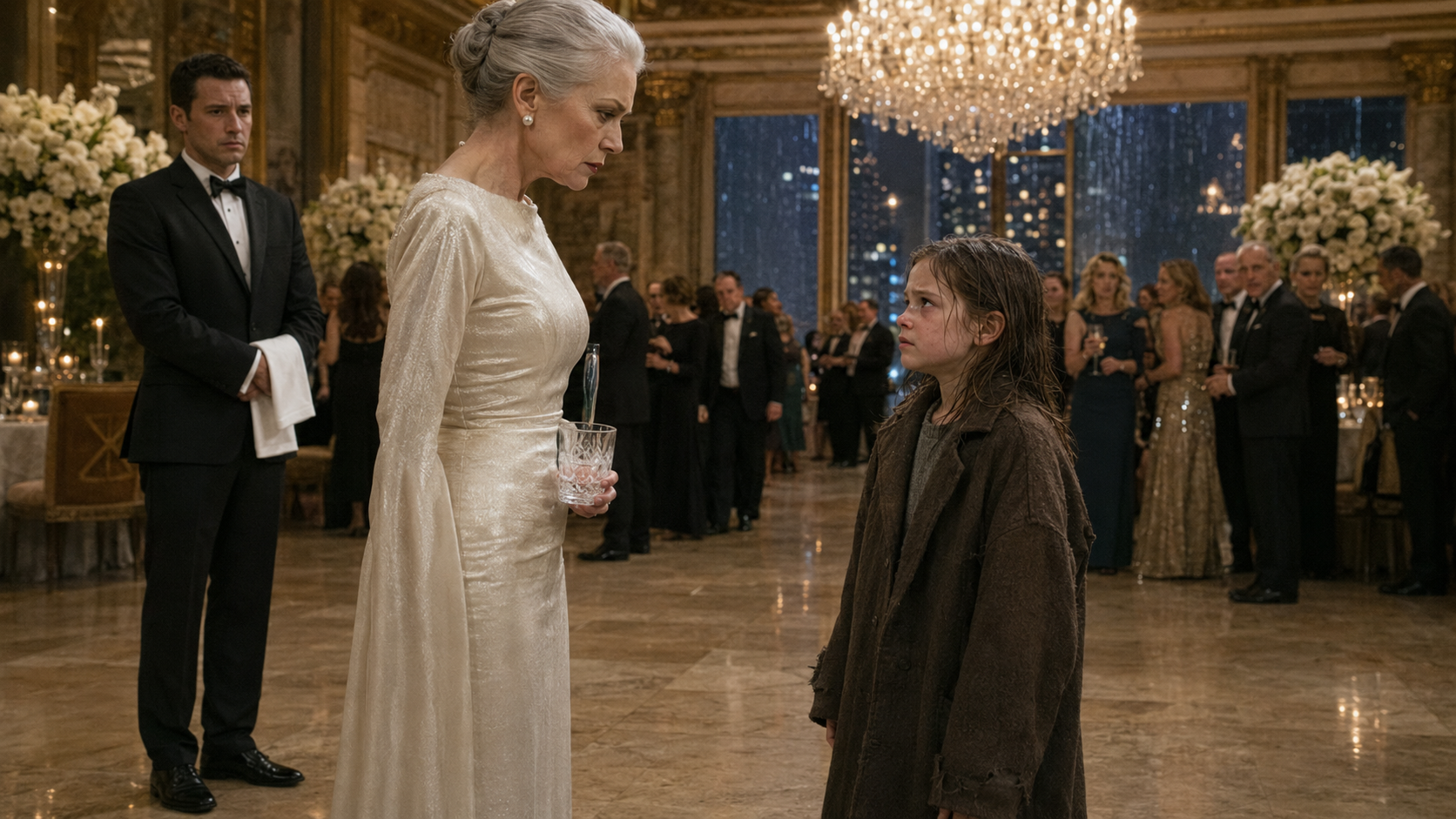
The water hit my face before I understood that Evelyn Whitmore had decided I was a thief.
One second, I was standing beneath a chandelier bigger than the apartment building where my mother and I rented a room.
The next, I was dripping onto polished marble while hundreds of Manhattan’s richest people stared at me.
I was nine years old.
My shoes were soaked from the rain. My knees were shaking beneath an oversized brown coat that had belonged to my mother before it belonged to me. One sleeve hung lower than the other because she had sewn it badly after I ripped it climbing a fence behind our building.
I knew how I looked.
I had seen the women near the ballroom entrance look me over.
Their eyes always started at my wet shoes.
Then they moved to the hem of my coat.
Then my tangled hair.
Then my face.
People with money could look at you for three seconds and decide they understood your entire life.
That night, they decided I didn’t belong.
They were right about that much.
I had never seen a room like the Waldorf ballroom.
Crystal chandeliers burned above me like upside-down cities. White flowers covered every table. Men wore black tuxedos and women glittered with diamonds so bright that, for a few stupid seconds, I forgot why I was there.
Waiters carried silver trays filled with tiny pieces of food I couldn’t name.
I hadn’t eaten since the morning.
My stomach twisted every time one of those trays passed.
But my mother’s last words kept me moving.
“Find Evelyn Whitmore.”
She had been gripping both my shoulders outside beneath the hotel awning.
Rain had run through her hair.
Her lips had looked almost blue from the cold.
“If they won’t let me inside, you find another way.”
“Mom—”
“Lucy.”
She had crouched so our faces were level.
My mother’s name was Sarah.
Sarah Hale, according to every school form I had ever filled out.
Sarah Whitmore, according to the secret she had finally told me thirty minutes earlier.
“You find Evelyn,” she said. “And if she doesn’t believe you…”
Her fingers had gone beneath my sweater.
She pulled out the chain I had worn since I was six.
“Show her this.”
I had touched the blue stone.
“Why?”
“Because she’ll know.”
“Know what?”
My mother looked away.
Two broad-shouldered security guards were moving along the curb, searching the faces beneath the awning.
Mom’s grip tightened.
“She’ll know who you are.”
That answer scared me more than if she had given me none.
I had wanted to ask a hundred questions.
Why did one of New York’s wealthiest women need to know who I was?
Why had my mother never told me that Whitmore was once her name?
Why had she stared at Evelyn’s photograph in the newspaper that morning as if she had seen a ghost?
Why were we standing outside a charity gala in the rain when we barely had enough money left for the subway?
But one of the guards had looked toward us.
Mom had pushed me gently toward the service entrance.
“Go.”
“What about you?”
“I’ll stay here.”
“Mom.”
“Lucy, listen to me.”
She took my face between her freezing hands.
“You find her before those men come back.”
So I had gone.
I slipped through a service door while two waiters rolled a cart of dishes inside. Nobody noticed me until I reached the ballroom.
Then everybody noticed me.
I tried not to look frightened.
That had been another lesson from my mother.
Never let strangers see how scared you are.
Sometimes fear makes good people help you.
Sometimes it tells bad people exactly where to hurt you.
I kept walking.
“Evelyn Whitmore,” I whispered.
I knew her face from the newspaper photograph.
Silver hair.
Sharp cheekbones.
A pearl-colored gown.
The article had called her a philanthropist, a patron of the arts, and one of Manhattan’s most influential widows.
I didn’t know what a philanthropist was.
I only knew my mother had stared at that photograph for nearly five minutes without blinking.
I was moving between tables when somebody finally stepped into my path.
A woman.
Tall.
Elegant.
Silver hair swept back from her face.
Pearl-colored gown.
Evelyn Whitmore.
For one wild second, relief washed through me.
I had found her.
Then she looked at me.
Her expression hardened.
“How did this filthy child get inside?”
The words seemed louder than they actually were.
Conversations stopped around us.
I swallowed.
“I’m looking for my mom.”
A waiter hurried over.
“I’m terribly sorry, Mrs. Whitmore. I’ll have security—”
“No.”
Evelyn raised one hand.
The waiter stopped.
She looked me over again.
There was something frightening about how controlled she was.
I later learned that Evelyn had spent forty years making powerful men nervous with that look.
That night, she used it on a nine-year-old girl.
“Where are your parents?” she asked.
“My mom is outside.”
“Then you should be outside with her.”
“I have to talk to you.”
A few guests turned more openly toward us.
My face grew hot.
“I beg your pardon?”
“My mom said—”
Evelyn’s gaze moved toward a nearby table.
A woman’s jeweled handbag sat on the edge.
Then Evelyn looked back at me.
Something changed in her face.
Suspicion.
“Children like you come into places like this for one reason.”
I didn’t understand at first.
“What reason?”
“Don’t pretend.”
My stomach dropped.
The waiter shifted awkwardly.
“Mrs. Whitmore, perhaps I should simply take her—”
“She’s been wandering between the tables.”
“I was looking for you.”
“Of course you were.”
I felt every eye in the room.
Someone whispered.
Someone else laughed softly.
I wanted my mother.
I wanted our ugly little rented room.
I wanted to be anywhere except beneath those chandeliers.
“I didn’t take anything,” I said.
Evelyn lifted the glass in her hand.
“Then perhaps this will teach you not to go where you don’t belong.”
She threw the water.
It struck me full in the face.
Cold.
Sharp.
Humiliating.
The ballroom erupted in shocked whispers.
I stumbled backward.
My wet shoe slid on the marble.
I fell hard.
Pain exploded through my hip and elbow.
My coat opened.
The chain around my neck caught against a button.
I heard it snap.
Something struck the floor.
Ping.
The sound was tiny.
But somehow, everyone heard it.
A gold necklace spun across the marble between Evelyn Whitmore’s shoes.
At its center was the stone my mother had told me never to remove.
Blue.
Deep blue.
Not sapphire blue.
Darker.
Almost red at the edges when light struck it.
A teardrop-shaped blue ruby surrounded by old diamonds.
Evelyn stopped breathing.
I saw the exact moment the anger left her face.
Her glass slipped slightly in her hand.
“What…”
She bent down so quickly I thought she might fall.
Her fingers closed around the necklace.
“Where did you get this?”
I pushed myself onto my knees.
“My mom gave it to me.”
“You stole it.”
My fear disappeared for one second beneath a burst of anger.
“I didn’t steal anything!”
“This necklace disappeared twenty years ago.”
“It’s mine!”
“Who gave it to you?”
“My mother!”
Evelyn grabbed my shoulder.
Not hard enough to hurt.
Hard enough that I couldn’t move away.
“Who is your mother?”
“Sarah.”
Her fingers went slack.
“What?”
“My mom’s name is Sarah.”
The color drained from Evelyn Whitmore’s face.
Behind her, a man muttered, “Jesus.”
Nobody else moved.
Evelyn stared at me as if my face were changing in front of her.
Then she looked down at the necklace.
Her hands began to shake.
I had never seen an old person’s hands shake like that.
There was a tiny clasp behind the blue stone.
I had known it was there but had never managed to open it.
Evelyn did.
The gemstone swung aside.
Inside was a photograph.
Old.
Faded.
A much younger Evelyn Whitmore sat in a chair holding a newborn baby wrapped in white.
My heart started hammering.
I had never seen the photograph before.
“Mom said it belonged to my grandmother,” I whispered.
Evelyn looked at my eyes.
Then my nose.
Then something beneath my left ear.
I knew what she was staring at.
A small reddish birthmark shaped almost like a crescent.
My mother had one in the same place.
Evelyn touched her own throat.
“Oh, God.”
The necklace slipped from her fingers.
She looked at me again.
This time, she didn’t see a dirty child.
She saw something that frightened her.
Something she had been looking for.
“You’re Sarah’s daughter.”
I didn’t answer.
I couldn’t.
Her knees struck the marble.
Evelyn Whitmore—the woman who had just humiliated me in front of hundreds of people—dropped to her knees.
Then she pulled me into her arms.
“My granddaughter.”
Her voice broke.
“My God. My granddaughter.”
I went stiff.
She smelled like roses and expensive perfume.
Her shoulders shook.
“I’ve been searching for you.”
I had never been held that tightly before.
Not by anyone except my mother.
Evelyn pressed her face against my wet hair.
“I’m sorry. I’m so sorry.”
The room had gone completely silent.
I didn’t hug her back.
I was too confused.
Too angry.
Too afraid.
Eventually she pulled away.
Her mascara had begun to run.
She looked almost embarrassed by her own tears.
Then she suddenly gripped my arms.
“Where is Sarah?”
That brought everything back.
The rain.
The guards.
My mother pushing me toward the door.
Her frightened face.
I pointed toward the ballroom entrance.
“Outside.”
Evelyn stared at me.
“Outside where?”
“By the hotel.”
“Why isn’t she here?”
“They wouldn’t let her in.”
Evelyn’s jaw tightened.
Then I remembered my mother’s last words.
My voice dropped.
“She told me to find you before the men came back.”
Evelyn went completely still.
“What men?”
I looked toward the doors.
And before I could answer, I saw two black-suited security guards enter the ballroom.
One of them looked directly at me.
Then he spoke into the radio at his shoulder.
“We found the child.”
My blood turned cold.
Because my mother wasn’t with them.
PART 2: MY MOTHER AT THE DOOR
I ran.
I didn’t care who shouted behind me.
I didn’t care that my elbow hurt from falling.
I didn’t care that my necklace was still lying on the marble.
“Mom!”
I sprinted toward the ballroom doors.
One of the guards stepped sideways.
“Hold on, sweetheart—”
“Where is she?”
“Lucy!”
Evelyn was behind me.
Her voice cut through the room like a knife.
The guard recognized her instantly.
Almost everybody in Manhattan seemed to recognize Evelyn Whitmore.
His posture changed.
“Mrs. Whitmore.”
“The woman who came with this child. Where is she?”
He hesitated.
“Ma’am, there was a woman attempting to gain access without an invitation. She became agitated when we told her—”
“Where is she?”
“I believe Officer Daniels escorted her toward the east entrance.”
“Escorted?”
The word came out dangerously soft.
The guard swallowed.
“Removed her from the restricted area.”
Evelyn turned toward me.
“Show me where she was.”
We went through the hotel so quickly that people had to jump aside.
I ran beside her.
Guests followed.
So did the waiter.
So did two members of the gala committee.
That was the strange thing about rich people.
When a poor woman was being removed from a doorway, nobody wanted to watch.
When Evelyn Whitmore ran after her, everybody suddenly wanted to know why.
We crossed the lobby.
The marble floor reflected chandeliers above us.
The front doors opened.
Cold rain blew against my face.
“Mom!”
No answer.
I ran toward the awning.
She wasn’t there.
The newspaper she had been carrying lay soggy near the curb.
Evelyn’s photograph stared up from it.
I picked it up.
“She was right here.”
Evelyn looked at the guards.
“Find her.”
“Mrs. Whitmore—”
“Now.”
The guard touched his radio.
I heard a voice crackle back.
“Female subject is near the service lane. We were waiting for NYPD because she refused to leave the property.”
Subject.
That was what they called my mother.
Not Sarah.
Not a frightened woman.
A subject.
I started running again.
Evelyn followed.
The service lane was narrow, wet and dark compared with the bright hotel entrance.
Delivery trucks lined one wall.
A security guard stood near the loading area.
My mother was beside him.
She had one hand braced against the brick wall.
Her coat was soaked through.
The guard wasn’t hurting her.
But he stood close enough that she couldn’t simply walk away.
“Mom!”
Sarah turned.
Relief hit her face.
Then she saw who was behind me.
Everything disappeared from her expression.
Twenty years passed between those two women in one second.
Evelyn stopped.
My mother stopped breathing.
Neither moved.
I looked from one to the other.
Same eyes.
That was the first thing I noticed.
Not exactly the same color.
The same way they narrowed when they were frightened and pretending not to be.
The guard glanced at Evelyn.
“Mrs. Whitmore?”
Evelyn didn’t even look at him.
“Leave us.”
“Ma’am, this woman—”
“Is my daughter.”
The guard stared at her.
My mother closed her eyes.
Evelyn’s voice cracked.
“Sarah.”
Mom opened them again.
“Hello, Mother.”
I had never heard my mother call anyone that.
I had never heard her voice sound like that either.
It was small.
Not weak.
Young.
Suddenly, she didn’t sound thirty-seven years old.
She sounded like the frightened girl she must have been the last time they saw each other.
Evelyn took one step.
Mom stepped backward.
That stopped her.
For a moment, all I could hear was rain dripping from the metal awning.
“You came back,” Evelyn whispered.
“I came because of Lucy.”
“You could have called.”
Mom laughed once.
There was no humor in it.
“Called?”
“I’ve had the same private number for twelve years.”
“I don’t know your private number.”
“You could have contacted the office. The foundation. The house.”
“And said what?”
“That you were alive!”
Evelyn’s voice broke.
My mother flinched.
Evelyn immediately regretted shouting.
I could see it.
She lowered her voice.
“Sarah, I searched for you.”
Mom looked away.
“I know.”
That surprised Evelyn.
“What?”
“I know.”
“You knew?”
“Eventually.”
“And you never—”
“I couldn’t.”
“Why?”
Mom looked at me.
Not because she wanted me to answer.
Because I was the reason she didn’t want to.
Evelyn followed her eyes.
Some of the anger left her face.
“What happened?”
“Not here.”
“Then come inside.”
“No.”
“Sarah—”
“I said no.”
The old hardness returned to Evelyn’s shoulders.
“You are standing in the rain with a child who looks half frozen.”
That did it.
My mother’s eyes flashed.
“We were standing in the rain because your people wouldn’t let us through the door.”
Evelyn took the hit.
She didn’t defend herself.
Mom continued.
“And when Lucy did get inside, you poured water on her.”
My stomach tightened.
Evelyn looked at me.
Shame crossed her face.
“She told you?”
“I can see her.”
Mom knelt.
She touched my wet hair.
Then she saw the red mark on my elbow.
“What happened?”
“I fell.”
Her head snapped toward Evelyn.
Evelyn looked like she wanted the pavement to open beneath her.
“I thought she was stealing.”
Mom stood.
“Of course you did.”
Three words.
Evelyn reacted as if Mom had slapped her.
“Sarah.”
“Nothing changes.”
“That isn’t fair.”
“Isn’t it?”
“You vanished twenty years ago.”
“And the first time you saw your granddaughter, you looked at her coat and decided she was a criminal.”
“I was wrong.”
“You were wrong about me too.”
There it was.
Something old.
Something sharp enough to survive twenty years.
I stared at them.
“What happened?”
Neither answered.
“Mom?”
Sarah rubbed her face.
“Not now.”
“You said she was my grandmother.”
“I know.”
“Why didn’t you tell me?”
“Lucy.”
“Why?”
My mother looked more frightened by that question than by the security guards.
Evelyn stared at her.
“You never told her about me?”
“I told her you existed.”
“You told me Grandma was gone,” I said.
Mom closed her eyes.
“I said we couldn’t go to her.”
“That’s not the same thing.”
“No.”
“Why couldn’t we?”
Sarah looked at Evelyn.
“Because some doors don’t open twice.”
Evelyn whispered, “You never tried.”
Mom’s expression changed.
“I came to this hotel tonight, didn’t I?”
“For money?”
I felt my mother stiffen.
Evelyn saw it too.
Her face changed instantly.
“I didn’t mean—”
“Yes, you did.”
“No.”
“That’s always what you think.”
“Sarah—”
“You see wet clothes and you think thief. You see me after twenty years and you think money.”
Evelyn looked shattered.
Mom turned to me.
“We’re leaving.”
“Sarah, don’t.”
“I did what I came to do.”
“What was that?”
Mom took my hand.
“Make sure Lucy knew where she came from.”
“And then?”
My mother didn’t answer.
Evelyn moved closer.
“Where are you staying?”
“We’ll manage.”
“Where?”
“That is none of your business.”
“You’re my daughter.”
“You don’t get to use that sentence whenever it becomes convenient.”
“I’m her grandmother.”
“And ten minutes ago you called her filthy.”
Evelyn’s lips parted.
Nothing came out.
Mom began walking.
I went with her.
I didn’t know what else to do.
For the first time since finding Evelyn, I wanted to leave too.
Then Evelyn said something that made my mother stop.
“The necklace was yours.”
Mom didn’t turn around.
Evelyn continued.
“I never told you.”
Rain whispered against the pavement.
“It was always yours.”
Mom slowly faced her.
“What are you talking about?”
“The blue ruby.”
My mother’s expression hardened.
“You called me a thief for taking it.”
“I know.”
“You told everyone I’d stolen from you.”
“I know.”
“You let me walk out believing—”
“I was angry.”
“Twenty years, Mother.”
“I was wrong.”
Mom laughed bitterly.
“That’s easy to say now.”
“No.”
Evelyn’s voice trembled.
“It is the hardest sentence I have ever learned.”
She reached inside the small evening bag hanging from her wrist.
The necklace was there.
She had picked it up from the ballroom.
She opened the locket.
Even from several feet away, I could see the tiny photograph.
Evelyn holding a baby.
My mother.
“This belonged to my mother,” Evelyn said. “Your grandmother.”
Sarah stared at it.
“She left it to you.”
My mother shook her head.
“No.”
“Yes.”
“You locked it in your safe.”
“Because you were seventeen. Because it was valuable. Because I thought protecting everything was the same thing as loving it.”
Evelyn’s voice cracked.
“I thought I could decide when you were ready.”
Mom’s face went pale.
“You never told me.”
“No.”
“So when I took it—”
“You took what already belonged to you.”
My mother stared at her.
Twenty years of anger shifted beneath her face.
Not disappearing.
Changing shape.
“And you knew?”
“Not that night.”
Evelyn swallowed.
“I found my mother’s will two days after you left.”
Mom looked almost sick.
“I went to your room.”
She said nothing.
“You were gone. The necklace was gone. Your clothes were gone.”
Evelyn drew a shaky breath.
“And I realized the last thing I had called my daughter before she walked out of my house was a thief.”
My mother finally looked at her.
For the first time, her anger wasn’t the only thing I saw.
There was grief beneath it.
Evelyn held the necklace toward her.
“I’ve spent twenty years wanting to take that word back.”
Mom stared at the blue ruby.
She did not reach for it.
Then a police car turned into the service lane.
Blue light flashed against the wet walls.
My mother froze.
The security guard muttered, “That’s the unit we called.”
Evelyn’s expression changed.
She looked from the police car to Sarah.
Then to me.
And for the second time that night, I watched Evelyn Whitmore make a decision that changed my life.
She stepped between my mother and the approaching officers.
“No one touches my family.”
PART 3: THE STORY MY MOTHER NEVER TOLD ME
The police didn’t arrest anyone.
There had been no real crime.
My mother had refused to leave because I was still inside the hotel.
Security had called the police because she kept returning to the entrance asking for me.
Once Evelyn explained that Sarah was her daughter and I was her granddaughter, everybody became painfully polite.
That made me angry in a way I couldn’t explain.
Nothing about my mother had changed.
Only the name attached to her.
Five minutes earlier, she had been a soaked woman somebody wanted removed.
Now she was Sarah Whitmore.
Doors opened.
Voices softened.
People apologized.
One guard even offered her an umbrella.
My mother stared at him until he lowered it.
Evelyn led us back into the hotel through a private entrance.
Mom didn’t want to go.
I could feel it in her hand.
But I was shaking from cold, and she knew it.
That was why she agreed.
Not for Evelyn.
For me.
We were taken to a small sitting room away from the ballroom.
There were couches the color of cream and a fireplace that looked too clean to have ever held real fire.
A hotel employee brought towels.
Then food.
I tried not to stare at it.
There were sandwiches.
Soup.
Fruit.
Bread still warm from an oven.
Mom noticed me looking.
“Eat.”
“I’m not hungry.”
“Lucy.”
My stomach growled loudly enough that all three of us heard it.
Evelyn looked down.
I hated that she had heard.
I hated that she knew.
Mom squeezed my shoulder.
“Eat.”
So I did.
At first I tried to be polite.
Then the warm soup hit my stomach and politeness disappeared.
I ate too fast.
My mother kept pretending not to notice.
Evelyn stopped pretending.
“When did she last eat?”
Mom’s jaw tightened.
“Don’t.”
“I’m asking because—”
“I know why you’re asking.”
“Sarah.”
“This morning.”
Evelyn closed her eyes.
“For God’s sake.”
“We were supposed to get paid today.”
“By whom?”
“My employer.”
“What happened?”
“The restaurant closed.”
“Without paying you?”
“They said checks would be mailed.”
“Where?”
Mom went silent.
Evelyn understood.
“You lost your apartment.”
“We lost the room.”
“When?”
“Yesterday.”
I stopped eating.
Mom had told me we were “changing places.”
That was all.
I knew money was bad.
I didn’t know we had nowhere to return to.
“Mom.”
She looked at me.
“We’re okay.”
“Where were we sleeping tonight?”
Her eyes filled.
She looked down.
That was answer enough.
Evelyn stood so suddenly that her chair scraped the floor.
“You’re coming home with me.”
“No.”
“Sarah.”
“No.”
“You and Lucy are not sleeping in a station.”
“We weren’t going to.”
“Then where?”
“I would have figured something out.”
“You shouldn’t have to!”
Mom stood too.
“And there it is.”
“What?”
“The part where you take over.”
“I am trying to help.”
“You always call it helping.”
“What would you prefer I call it? Your daughter hasn’t eaten since morning!”
“Do not use her to win an argument with me.”
“I’m not.”
“You are.”
They stared at each other.
I put down my spoon.
“Stop.”
They both looked at me.
I hated when adults did that.
Fought over you until you spoke, then acted surprised that you had a voice.
“I don’t want you to fight.”
Mom sat down immediately.
“I’m sorry.”
Evelyn did not sit.
She looked at my face.
Then she said quietly, “So am I.”
I stared at her.
“Did you really look for my mom?”
“Yes.”
Mom’s head lifted.
Evelyn sat opposite me.
“For years.”
“How?”
“Police at first. Then investigators.”
“Why didn’t they find her?”
Mom answered.
“Because I didn’t want to be found.”
I turned toward her.
“Why?”
She looked exhausted.
I had seen my mother exhausted before.
After double shifts.
After fever.
After carrying groceries six blocks because we couldn’t afford the bus.
This was different.
This was the exhaustion of carrying the same thing for twenty years.
“When I was seventeen,” she said, “your grandmother and I fought constantly.”
Evelyn flinched slightly at the word grandmother.
Mom continued.
“I hated that house. I hated the rules. I hated that everybody knew our name before they knew me.”
“What rules?”
“Everything had a rule.”
Evelyn almost smiled.
“That is not entirely untrue.”
Mom ignored her.
“How to sit. How to dress. Who I could bring home. What I could say at dinner. What I was expected to do with my life.”
“What did you want to do?”
“Leave.”
That answer made sense to me.
“When my father died, your grandmother got worse.”
Evelyn looked toward the window.
“He died suddenly,” Mom said. “And she became terrified of losing anything else.”
Evelyn whispered, “That’s true.”
“She couldn’t control death. So she controlled everything she could.”
I looked at Evelyn.
She didn’t argue.
“I was angry,” Mom continued. “And I knew exactly how to hurt her.”
“What did you do?”
“I told her I hated being her daughter.”
Something in Evelyn’s face broke.
Mom saw it.
Her voice softened for half a second.
Then hardened again.
“She told me I was spoiled. Reckless. Ungrateful.”
“You were very angry,” Evelyn said.
“So were you.”
“Yes.”
“I went upstairs. I opened the safe.”
“How did you know the combination?” I asked.
Mom looked embarrassed.
“I’d watched her.”
Despite everything, Evelyn gave a tiny laugh.
“Of course you had.”
“I took some cash.”
My stomach tightened.
“And the necklace.”
“The necklace was in the safe?”
“Yes.”
“Did you know it was yours?”
“No.”
Mom looked at Evelyn.
“I thought it had belonged to Grandma Rose.”
“It did.”
“I wanted something of hers.”
“Why?”
Mom swallowed.
“Because she was the only person in that family who ever made me feel like I didn’t have to perform.”
Evelyn lowered her eyes.
“I came downstairs with a bag.”
Her fingers tightened together.
“Your grandmother saw the safe open.”
“I saw the empty necklace case,” Evelyn corrected quietly.
Mom nodded.
“And she asked what I’d taken.”
“What did you say?”
“That I was leaving.”
I looked at Evelyn.
“What did you say?”
She didn’t answer immediately.
I knew before she did.
“Thief,” I whispered.
Evelyn nodded.
“Yes.”
The same word she had used on me.
I suddenly understood why my mother’s face had changed outside.
Evelyn had not simply insulted me.
She had repeated the last cruelty my mother remembered from that house.
“What happened next?” I asked.
Mom stared at her hands.
“I left.”
“That night?”
“That night.”
“Where did you go?”
“Boston first. Then Providence. Then other places.”
“Why didn’t you go back?”
“At first, because I was angry.”
She rubbed her thumb against her palm.
“Then because I was ashamed.”
“For taking the money?”
“For everything.”
She looked at me.
“The longer you stay away from someone, the harder the first sentence becomes.”
I understood that even at nine.
“If you don’t call for a week, you need an excuse. If you don’t call for a year, you need an explanation. If you don’t call for twenty…”
Mom looked toward Evelyn.
“You need a miracle.”
Evelyn’s eyes shone.
“I would have forgiven you the first morning.”
Mom laughed sadly.
“I didn’t know that.”
“I searched everywhere.”
“I know.”
“Then why didn’t you contact me when you found out?”
Mom’s shoulders tightened again.
“Because the first investigator found me when I was nineteen.”
Evelyn stared at her.
“What?”
Mom nodded.
“He approached me outside a diner in Hartford.”
“I never knew that.”
“He told me you were looking.”
“Then why—”
“I asked him why.”
Evelyn frowned.
“He said you wanted the necklace returned.”
The room became completely silent.
Evelyn stared at her.
“No.”
“That’s what he said.”
“No.”
“He said your family wanted to avoid a scandal and that if I returned the property, you would stop looking.”
Evelyn stood.
“I never told anyone that.”
Mom’s face shifted.
“What?”
“I never cared about the necklace.”
“But—”
“Sarah, I told every investigator the same thing. Find my daughter. Tell her to call me. Tell her I don’t care why she left.”
Mom shook her head.
“He was very clear.”
“I believe you.”
That stopped her.
Evelyn pressed her fingertips against her lips.
“I don’t know why he said it. Perhaps he thought he was protecting the family name. Perhaps somebody in the office told him to handle it discreetly. I don’t know.”
That explanation mattered because it was not a grand conspiracy.
No hidden mastermind stepped from the shadows.
No secret enemy had spent twenty years keeping them apart.
It was something worse in its own way.
Pride.
Bad judgment.
A man paid to solve a problem who had decided a rich family’s reputation mattered more than a frightened girl’s heart.
One careless message.
One wounded daughter ready to believe the worst.
One mother too proud to imagine that her instructions could be twisted.
Twenty years.
Mom stared at Evelyn.
“I thought you wanted the necklace.”
“I wanted you.”
Mom’s eyes filled.
She turned away.
I had never seen my mother cry in front of another person.
Not once.
She walked to the window.
Evelyn didn’t follow.
That was the first sign that something inside her had changed.
The Evelyn from the ballroom would have decided what Sarah needed and done it.
This Evelyn waited.
Finally Mom wiped her face.
“When Lucy was born,” she said, “I almost called.”
Evelyn stopped breathing.
“I held her in the hospital and thought, She should have a grandmother.”
I looked down at the table.
Mom continued.
“But then I remembered that investigator.”
Evelyn whispered, “Sarah…”
“And I imagined you looking at my life.”
She gestured vaguely toward her wet coat.
“My jobs. My apartment. Everything I’d become.”
“What did you think I would see?”
“A failure.”
Evelyn closed her eyes.
Mom laughed once.
“You don’t know what it’s like to walk into a room with people like you when you don’t look like them anymore.”
Evelyn looked at me.
I think she remembered exactly how she had looked at me.
“I do now.”
Mom’s expression tightened.
Evelyn continued.
“Because tonight I became the person you were afraid I would be.”
No one spoke.
She looked at me.
“I cannot undo what I did to you.”
I wrapped both hands around my soup bowl.
“But I can tell the truth about it.”
Her voice was steady now.
“I saw your clothes. I saw that you were alone. I saw people watching me. And instead of asking what you needed, I decided what you were.”
My cheeks burned.
“You called me filthy.”
“Yes.”
“And a thief.”
“Yes.”
“You threw water at me.”
“Yes.”
She didn’t say but.
She didn’t say because.
She didn’t tell me I had misunderstood.
She just said yes.
“I was cruel to you.”
My mother watched her.
Evelyn took a breath.
“And if you never forgive me for it, you will still be right about what happened.”
Something loosened inside me.
Not forgiveness.
Not yet.
But something.
Mom sat beside me.
“We should go.”
“Where?” I asked.
She hesitated.
That hesitation frightened me.
Evelyn spoke carefully.
“You can stay with me tonight.”
Mom’s jaw tightened.
Evelyn raised one hand.
“One night.”
She looked directly at Sarah.
“No conditions.”
Mom said nothing.
“I will not ask you to move in.”
Nothing.
“I will not ask you to change your name.”
Nothing.
“I will not offer you a job, an allowance, a trust, or anything else you didn’t ask for.”
Mom finally looked at her.
“You’re learning.”
“I am trying.”
I tugged Mom’s sleeve.
“I’m tired.”
That ended the argument.
My mother could fight Evelyn.
She could fight security guards.
She could fight the whole city if she had to.
But she couldn’t fight those two words from me.
She nodded.
“One night.”
Evelyn’s eyes filled again.
“One night.”
Then a knock came at the door.
The waiter from the ballroom stepped inside.
“Mrs. Whitmore?”
“Yes?”
He looked uncomfortable.
“The gala committee is asking whether you intend to return. They’re waiting for your speech.”
Evelyn glanced toward the ballroom doors.
Then at me.
My wet hair.
My borrowed towel.
My red elbow.
She stood.
“Yes.”
Mom frowned.
“You’re going back?”
Evelyn nodded.
“But first, there is something I need to do.”
“What?”
She opened the door.
“Tell the truth where I told the lie.”
PART 4: THE WOMAN WHO APOLOGIZED IN FRONT OF EVERYONE
I didn’t want to go back into the ballroom.
Neither did my mother.
Evelyn did not force us.
“Stay here,” she said. “You can watch from the side if you want. Or don’t watch at all.”
That surprised Mom.
“You aren’t going to bring Lucy out there?”
“No.”
“Why?”
“Because I have already used her once tonight to make myself feel powerful.”
Evelyn’s face tightened.
“I will not use her again to make myself look sorry.”
For the first time, my mother had no answer.
We followed anyway.
Not onto the stage.
Just to the open doors near the back.
The gala had resumed in that strange way rich events resume after something terrible happens.
Music played softly.
Waiters moved between tables.
People whispered.
But everyone kept glancing toward the entrance.
Then Evelyn walked onto the stage.
The room quieted immediately.
A microphone stood beside a podium decorated with white roses.
Someone began applauding.
Evelyn raised her hand.
The applause stopped.
She looked across the ballroom.
“I was supposed to speak tonight about compassion.”
A few people shifted in their chairs.
“I had prepared twelve minutes on charitable responsibility, civic duty and the obligation of those with abundance to see people whom society overlooks.”
Her mouth twisted bitterly.
“I will spare you the hypocrisy.”
No one moved.
My mother stared at her.
Evelyn continued.
“Less than an hour ago, a nine-year-old girl entered this ballroom.”
My stomach tightened.
“She was wet. Frightened. Hungry. And dressed in clothes that made it obvious she did not come from the world most of us inhabit.”
A woman near the front lowered her eyes.
“I looked at that child and decided, without evidence, that she was here to steal.”
Whispers moved through the room.
“I humiliated her.”
Evelyn’s voice remained steady.
“I threw water in her face.”
A man near the stage looked stunned.
Evelyn rested both hands on the podium.
“Then something fell from beneath her coat.”
She paused.
“A necklace I recognized.”
My mother stopped breathing beside me.
“Twenty years ago, my only daughter disappeared from my life carrying that necklace.”
The ballroom became so quiet I could hear silverware clink in the service corridor.
“The child I publicly called filthy tonight is my granddaughter.”
Gasps.
Heads turned toward the doors.
I stepped backward.
Mom immediately moved in front of me.
Evelyn noticed.
She did not point us out.
She did not call my name.
She kept her promise.
“Some of you may find that revelation moving,” she said. “Some of you may even imagine that recognizing my own blood transformed the child into someone worthy of kindness.”
Her face hardened.
“It did not.”
I stared at her.
“She was worthy of kindness before I knew her name.”
My mother’s fingers tightened around mine.
“She deserved dignity before I knew she was related to me.”
Several people looked down.
“And if we require a family connection, a famous surname, a jewel or some other proof of value before we treat a frightened child as human, then the money we raise in rooms like this means very little.”
The applause did not begin immediately.
That mattered.
For once, people seemed unsure whether they were supposed to clap.
Evelyn stepped away from the podium.
“I owe that child an apology that no check can purchase.”
Her eyes found the doorway.
Found me.
“But the apology belongs to her. Not to this audience.”
Then she left the stage.
No applause.
Not at first.
She was halfway across the ballroom when someone began.
Then another person.
Then dozens.
Evelyn ignored it.
She came straight toward us.
Mom looked at her strangely.
“That was dramatic.”
Evelyn gave a faint smile.
“You always accused me of that.”
“You are.”
“You were not wrong about everything.”
Mom almost smiled.
Almost.
We left through a private hallway.
Outside, a car waited.
I had never ridden in anything like it.
The seats felt softer than my bed.
Mom sat rigid beside me.
Evelyn sat opposite us.
No one spoke for several blocks.
Manhattan slid past the windows.
Rain made every traffic light smear across the glass.
Eventually I asked, “Where do you live?”
Evelyn looked at me.
“East Seventy-Ninth Street.”
“Is it an apartment?”
My mother made a sound that might have been a laugh.
Evelyn smiled.
“A house.”
“In Manhattan?”
“Yes.”
“Just you?”
Her smile disappeared.
“Mostly.”
That word stayed with me.
Mostly.
The car stopped in front of a limestone townhouse wider than our entire building.
A man opened the door.
Evelyn stopped him before he could say anything.
“Mr. Ruiz, this is my daughter Sarah.”
He froze.
Not dramatically.
Just enough.
Then something warm crossed his face.
“I remember you.”
My mother stared at him.
“Mateo?”
He smiled.
“I was much younger.”
“So was I.”
“And this must be…”
His eyes moved toward me.
Evelyn answered softly.
“Lucy.”
Mr. Ruiz smiled at me.
“Welcome, Lucy.”
Not Miss Whitmore.
Not young lady.
Just Lucy.
I liked him immediately.
Inside, the house felt like a museum where someone occasionally remembered to live.
Paintings.
Mirrors.
Flower arrangements.
A staircase curving upward beneath another chandelier.
I stared.
My mother didn’t.
She looked as if every piece of furniture had a memory attached.
Evelyn saw it.
“Would you like me to have a room prepared downstairs?”
Mom looked toward the staircase.
“No.”
Then she surprised both of us.
“I want to see my room.”
Evelyn went pale.
“Sarah…”
“Is it still there?”
“Yes.”
We went upstairs.
Evelyn stopped outside a white door.
Her hand hovered near the knob.
Mom opened it herself.
I don’t know what she expected.
I don’t think she expected the room to look untouched.
Not perfectly untouched.
The bedspread had been changed.
The wallpaper was newer.
But shelves still held books.
A faded stuffed horse sat in one corner.
Photographs remained on the dresser.
My mother at ten.
Twelve.
Fifteen.
Seventeen.
One picture showed her beside Evelyn.
They were laughing.
I had never seen my mother look like that.
Not young.
Safe.
Mom walked to the dresser.
Her fingers touched the photograph.
“You kept this.”
“All of it.”
“Why?”
Evelyn looked stunned by the question.
“Because I thought you were coming home.”
Mom’s shoulders shook once.
She turned away.
Evelyn remained by the door.
“I changed the sheets every month for the first year.”
Mom stared at her.
“Why?”
“I don’t know.”
Evelyn laughed through tears.
“I thought if you came back suddenly, I didn’t want you to think I had given your room away.”
The silence hurt.
Mom sat on the bed.
I climbed beside her.
Evelyn remained standing.
Then Mom noticed something beneath the window.
Boxes.
Dozens of them.
“What are those?”
Evelyn looked toward them.
“Letters.”
Mom frowned.
“From whom?”
“Me.”
My mother went still.
“To you.”
Evelyn walked toward the boxes.
“I didn’t know where to send them.”
She opened the nearest one.
Inside were envelopes.
Stacks of them.
Each had a date.
Some were twenty years old.
Some eighteen.
Some ten.
Some only months.
Mom picked one up.
The front said:
SARAH.
Nothing else.
No address.
Just her name.
“You wrote all these?”
“Sometimes every week.”
Mom opened the first envelope with trembling fingers.
I tried not to read.
I saw only the first line.
Sarah, I am sorry.
Mom folded it again immediately.
“Why didn’t you put them in the newspapers?”
“Because they were for you.”
“You placed notices.”
“Yes.”
“I saw some.”
“I never knew if you did.”
Mom sat surrounded by boxes full of words she had never heard.
Evelyn looked suddenly older than she had at the gala.
“I cannot give twenty years back to you,” she said.
Mom stared at the letters.
“No.”
“I cannot change the last thing I said before you left.”
“No.”
“And I cannot undo what I did to Lucy.”
Mom looked at me.
“No.”
Evelyn swallowed.
“But if you’ll let me…”
She stopped.
My mother waited.
Evelyn tried again.
“If you’ll let me, I’d like to stop losing days.”
Sarah looked toward the boxes.
Then toward the room.
Then toward me.
I think I understood before either of them that the decision wasn’t going to be simple.
Forgiveness didn’t arrive because a necklace fell onto a floor.
Money didn’t erase twenty years.
Blood didn’t repair trust.
My mother had built an entire life around surviving without Evelyn.
Evelyn had built an entire life around waiting for Sarah.
Those two lives could not become one in a single night.
But a door had opened.
And for the first time, neither woman was walking away from it.
My mother looked at Evelyn.
“One day.”
Evelyn’s eyes filled.
“What?”
“We start with one day.”
She nodded.
“One day.”
“No promises.”
“None.”
“No controlling Lucy.”
“I understand.”
“No controlling me.”
Evelyn hesitated.
Mom lifted an eyebrow.
“I’m learning,” Evelyn said.
Mom finally laughed.
It was small.
Broken.
But real.
Then I noticed the necklace was still in Evelyn’s hand.
“Who gets that?”
Both women looked at me.
Evelyn opened her palm.
The blue ruby gleamed beneath the bedroom light.
“It belongs to your mother.”
Mom shook her head.
“No.”
“Sarah.”
“It was Grandma Rose’s. Then mine.”
She took the necklace.
For a moment I thought she would put it around her own neck.
Instead she knelt in front of me.
She fastened it around mine.
“It goes to Lucy.”
Evelyn stared.
Mom touched the stone.
“On one condition.”
I looked at her.
“What?”
“Nobody ever uses it to decide what you’re worth.”
I frowned.
“I don’t understand.”
“You will.”
Evelyn knelt beside her.
“Your mother is right.”
I touched the ruby.
It felt cold.
Heavy.
Far too important for a girl whose socks were still wet inside her shoes.
Then Evelyn asked quietly, “Lucy?”
“Yeah?”
“May I hug you?”
She asked.
That mattered too.
I looked at Mom.
Mom said nothing.
The choice was mine.
I looked at Evelyn.
I remembered the water.
I remembered the marble.
I remembered her calling me filthy.
I remembered her kneeling.
I remembered the stage.
I wasn’t ready to forgive everything.
But I leaned forward.
Evelyn wrapped her arms around me carefully.
Not like she owned me.
Like she knew I might pull away.
I didn’t.
Over her shoulder, I saw my mother crying.
And for the first time in my life, I realized grown-ups could spend years waiting for someone else to make the first move because they were just as frightened as children.
PART 5: WHAT THE NECKLACE REALLY RETURNED
We stayed one night.
Then another.
Not because my mother had surrendered.
Because Evelyn never asked for a third.
That was how she began proving she had changed.
She stopped assuming.
She started asking.
Would we like breakfast?
Did I want to see the garden?
Was Sarah comfortable staying another night?
Could she make a phone call on our behalf?
Would Mom allow her to help us find a permanent apartment?
Every question seemed unnatural coming from Evelyn.
I could tell.
Sometimes she almost turned a request into an order halfway through.
Then she’d stop.
Rephrase it.
Try again.
Mom noticed too.
She pretended not to.
Three days after the gala, Evelyn helped us rent an apartment.
Not a penthouse.
Not a mansion.
Not a place with servants.
My mother refused all of those before Evelyn could even suggest them.
It was a clean two-bedroom apartment twenty minutes away.
Evelyn paid the deposit only after Mom agreed to repay it gradually.
“At no interest,” Evelyn said.
“Obviously.”
“I was going to say that.”
“You were thinking about interest.”
“I was not.”
I watched them argue in the kitchen and realized something strange.
They were becoming mother and daughter again.
Not the mother and daughter they had been.
That version was gone.
This one was older.
More careful.
More honest.
Mom found another restaurant job.
Evelyn offered connections.
Mom refused.
Evelyn accepted the refusal.
That mattered more than the offer.
Some days were good.
Some were terrible.
There were arguments about the past.
Mom read the letters slowly.
Never more than two or three at a time.
Sometimes she came home furious.
Sometimes she came home crying.
Sometimes she called Evelyn immediately.
Once I woke at midnight and heard my mother in the kitchen saying into the phone, “I didn’t know Dad blamed himself after I left.”
A pause.
Then:
“No, I’m not saying it was your fault.”
Another pause.
“Mother, if you interrupt me one more time, I’m hanging up.”
I smiled into my pillow.
Evelyn visited every Sunday.
At first she arrived with ridiculous gifts.
A coat that cost more than our rent.
A doll I was too old to want.
Shoes I was afraid to wear outside.
After the third Sunday, Mom stopped her at the door.
“Lucy needs a grandmother. Not a department store.”
The next Sunday, Evelyn arrived with a deck of cards.
We played gin rummy for three hours.
She cheated.
I caught her.
She denied it.
Mom laughed so hard she spilled tea.
That was the afternoon I began calling her Grandma.
Not because anyone asked me to.
The word just came out.
“Grandma, you’re hiding a card.”
Everything stopped.
Evelyn stared at me.
Her eyes filled.
I panicked.
“What?”
“Nothing.”
“Did I say something wrong?”
“No.”
She pressed one hand against her mouth.
“No, darling.”
Mom looked away, smiling.
Evelyn wiped her eyes.
Then she pointed at me.
“And I was not hiding a card.”
“You absolutely were.”
“Prove it.”
So I did.
The necklace stayed with me.
Mom had the broken chain repaired.
Evelyn offered to put the ruby in a bank vault.
We both said no at the same time.
After that, she stopped asking.
I didn’t wear it to school.
I didn’t wear it to the park.
Mostly it stayed in a small wooden box beside my bed.
Sometimes I opened the locket and looked at the photograph.
Young Evelyn.
Baby Sarah.
Before the fight.
Before twenty years of silence.
Before me.
For a long time, I thought the necklace had saved us.
I thought if it hadn’t fallen onto the marble, Evelyn would never have known who I was.
That was true.
But it wasn’t the whole truth.
The necklace had only forced three people to stop looking away.
A year after the gala, Evelyn asked if Mom and I would attend the event again.
My mother nearly choked on her coffee.
“Absolutely not.”
Evelyn sighed.
“Sarah.”
“No.”
“It would mean something to me.”
“No.”
“Would you at least hear why?”
“No.”
I raised my hand.
They looked at me.
“I want to hear.”
Mom groaned.
“Traitor.”
Evelyn tried not to smile.
“Thank you, Lucy.”
“Don’t enjoy this.”
“I’m not.”
“You are.”
Grandma looked at me.
“The foundation changed several things after last year.”
“What things?”
“The gala now funds emergency housing programs for families with children.”
Mom’s expression softened slightly.
Evelyn continued.
“We also changed hotel entry procedures. Anyone asking for help during the event is directed to an assistance coordinator rather than security.”
Mom crossed her arms.
“Good.”
“And every staff member working our events receives training on how to handle vulnerable guests.”
“Also good.”
“I would like Lucy to see that what happened to her resulted in something other than gossip.”
Mom looked at me.
I nodded.
So we went.
A year earlier, I had entered through a service door wearing soaked shoes.
This time I walked through the front entrance holding my mother’s hand.
I wore a dark blue dress.
Not because Evelyn bought it.
Because Mom and I found it on sale and both loved it.
The coat was mine too.
So were the shoes.
The necklace was under my dress.
I wanted it there.
Hidden.
Not because I was ashamed of it.
Because I had learned my mother’s lesson.
A jewel couldn’t tell anyone what I was worth.
Inside, people recognized us.
Some stared.
Some smiled too widely.
A few came over to apologize even though they had done nothing personally.
One woman said, “You poor darling.”
I hated that almost as much as being called filthy.
Grandma rescued me.
“Lucy is not a darling when she’s losing at gin rummy.”
“I do not lose.”
“You frequently lose.”
“You cheat.”
The woman looked confused.
Grandma took my hand.
“Excuse us.”
We escaped.
Later, Grandma went to the stage.
No dramatic confession this time.
No public tears.
She talked about the housing program.
She talked about dignity.
She did not tell my story.
She had asked permission.
I had said no.
She respected it.
That was how I knew her apology had become real.
Afterward, Mom and I stood near the place where I had fallen the year before.
The marble looked exactly the same.
That surprised me.
In my memory, it had become a place almost as large as the ballroom itself.
The spot where everything changed.
In reality, it was just floor.
Mom touched my shoulder.
“You okay?”
“Yeah.”
“Want to go?”
I looked toward Grandma.
She was arguing with a waiter because he wouldn’t let her carry her own coffee.
“Not yet.”
Mom smiled.
“No. Me neither.”
I reached beneath my dress and pulled out the necklace.
The blue ruby caught the chandelier light.
Mom looked at it.
“You know something funny?”
“What?”
“The first time Grandma saw this around my neck, she thought I stole it.”
Mom’s smile faded.
“I remember.”
“The first time she saw it around mine, she thought the same thing.”
“I know.”
I studied the stone.
“Maybe our family should stop keeping expensive jewelry.”
Mom laughed.
A real laugh.
“That may be the smartest thing any Whitmore has ever said.”
“Am I a Whitmore?”
The question came out before I planned it.
Mom considered it.
“You’re Lucy.”
“That’s not an answer.”
“It’s the most important answer.”
I looked toward Grandma.
“Am I a Hale?”
“You’re Lucy Hale.”
“And a Whitmore?”
She sighed.
“If you want to be.”
“What do you want?”
Mom looked at Evelyn.
For a moment I saw seventeen-year-old Sarah inside her.
The girl who had walked out carrying a bag, some cash and a necklace she didn’t know belonged to her.
Then she looked at me.
“I spent a long time thinking a name could trap you.”
She touched the stone.
“Now I think it’s just a name.”
“So?”
“So you’re my daughter.”
She smiled.
“You’re her granddaughter.”
“That’s it?”
“That’s enough.”
Grandma saw us and started walking over.
A server crossed between us carrying a tray of sparkling water.
I don’t know why that made all three of us notice each other at the same time.
Maybe we were thinking about that first glass.
Grandma reached us.
She looked at me.
Then the necklace.
Then the patch of marble beside my shoes.
Her face changed.
“I’m sorry,” she whispered.
She had said those words many times during the year.
That night they sounded different.
I took her hand.
“I know.”
Grandma looked at Mom.
Sarah looked at her mother.
No twenty-year silence stood between them anymore.
There were still wounds.
There were still things that couldn’t be repaired perfectly.
My mother had lost twenty years with Evelyn.
Evelyn had lost twenty years with her daughter.
I had lost nine years with my grandmother.
Nobody received those years back.
That wasn’t how forgiveness worked.
Forgiveness didn’t rewrite what happened.
It changed what happened next.
Grandma squeezed my hand.
“Would either of you like something to eat?”
Mom lifted an eyebrow.
“Are you asking?”
“Yes.”
“Not ordering?”
“I’m capable of growth, Sarah.”
“Debatable.”
Grandma looked offended.
I laughed.
Then the three of us walked toward the tables together.
The first time I entered that ballroom, every person who looked at me decided I didn’t belong there.
I had believed them.
I thought belonging meant wearing the right clothes.
Knowing the right names.
Walking through the right door.
Having a necklace valuable enough to make people stop insulting you.
I know better now.
A year earlier, Evelyn Whitmore had looked at my wet coat and called me a thief.
Then my necklace fell onto the marble, and one of the richest women in New York dropped to her knees.
People later said the necklace revealed who I was.
They were wrong.
The necklace revealed who she was.
A grieving mother.
A proud woman.
A woman capable of cruelty.
A woman capable of admitting it.
A grandmother who had almost repeated the worst mistake of her life before a blue stone forced her to look more closely.
And my mother?
She finally learned that going home didn’t mean surrendering.
Sometimes it meant returning strong enough to say exactly where the old home had hurt you.
As for me, I kept the necklace.
Not because it was rare.
Not because it was valuable.
Not because it belonged to the Whitmores.
I kept it because inside that tiny locket was proof that my family existed before its worst moment.
And whenever I opened it, I remembered something my mother had taken twenty years to learn and my grandmother had learned in one terrible night:
People are not what they wear.
They are not what they own.
They are not the mistakes made about them.
And sometimes the thing that falls to the floor isn’t what has been lost.
Sometimes it is what finally shows you the way home.
Để lại một bình luận